
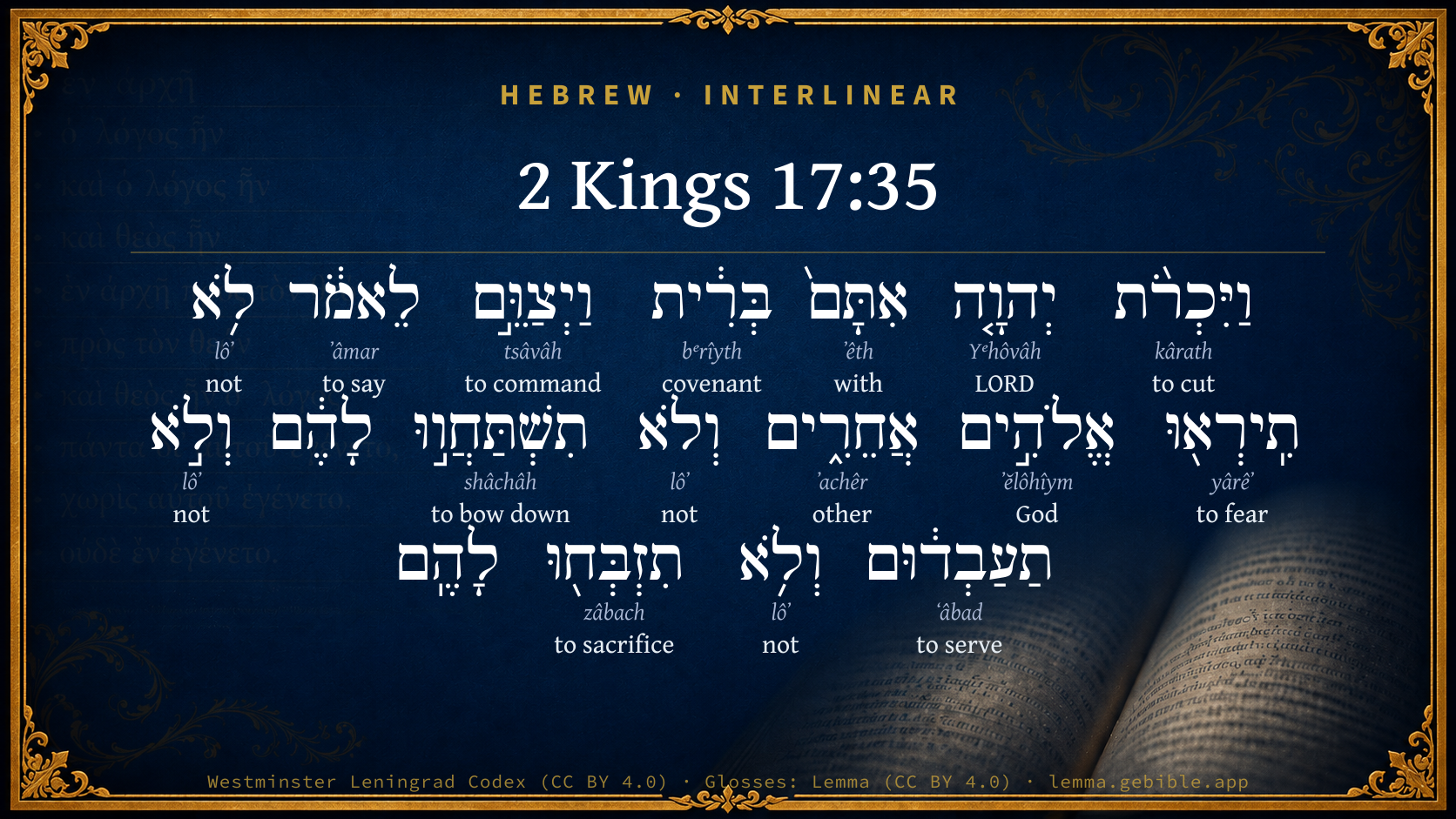
2 Kings 17:35

Hebrew (Westminster Leningrad Codex) 2 Kings 17:35 appears in the Hebrew Old Testament. The text above is from the Westminster Leningrad Codex. Each word links to its Strong’s number, a concise gloss, and parsing drawn from the Open Scriptures Hebrew Bible morphology. Click any word for its full Brown-Driver-Briggs (BDB) entry.
Download image
Cite this verse

2 Kings 17:35 (World English Bible). Public Domain. Lemma interlinear Bible study tool, https://lemma.gebible.app/v/2-kings/17/35.

Show BibTeX & RIS
BibTeX
RIS
English Translation
with whom Yahweh had made a covenant, and charged them, saying, You shall not fear other gods, nor bow yourselves to them, nor serve them, nor sacrifice to them:
World English Bible · Public Domain
Download a study sheet

One document with this verse’s original text, its word-by-word gloss line, the meaning frame, cross-references with their text, attributed commentary, and full source and license credits — printable, and it pastes into notes with its structure intact.

This verse Autodidact and up

Study sheet (.html) Plain text (.txt)

A passage Seminary Student

Up to 50 verses in one chapter. A passage sheet keeps up to 6 commentary sources and 12 cross-references per verse, in the order this page ranks them, and says so on the sheet whenever that leaves anything out. Ask for a single verse and you get the Autodidact verse sheet above.

Everything on this page stays free to read, with no account — the sheet is a download of what is already on screen, not access to it.

Want to remove ads? Support Godless Engineer
Compare translations 3

The same verse in 3 English versions, stacked beneath the original-language interlinear above. Click any original word for its lexicon entry.

Each is an independent rendering of the whole verse — the interlinear is not word-aligned to these translations.

Highlighted words mark where these versions differ — a whole-verse word diff, not a word-by-word alignment.

  • World English Bible Public Domain
    with whom Yahweh had made a covenant, and charged them, saying, You shall not fear other gods, nor bow yourselves to them, nor serve them, nor sacrifice to them:
  • King James Version Public Domain
    With whom the LORD had made a covenant, and charged them, saying, Ye shall not fear other gods, nor bow yourselves to them, nor serve them, nor sacrifice to them:
  • unfoldingWord Literal Text CC BY-SA 4.0
    For Yahweh had cut a covenant with them, and he had commanded them, saying, “You shall not fear other gods, and you shall not prostrate yourselves to them, and you shall not serve them, and you shall not sacrifice to them,

unfoldingWord Literal Text — © unfoldingWord, licensed CC BY-SA 4.0. Word-aligned USFM3 via Door43 (git.door43.org/unfoldingWord/en_ult).

Versions to compare (up to 4)

3 of 4 selected

Show all 18 translations

Every available English version of this verse, each an independent rendering of the whole verse.

  • World English Bible Public Domain
    with whom Yahweh had made a covenant, and charged them, saying, You shall not fear other gods, nor bow yourselves to them, nor serve them, nor sacrifice to them:
  • Berean Standard Bible Public Domain
    For the LORD had made a covenant with the Israelites and commanded them, “Do not worship other gods or bow down to them; do not serve them or sacrifice to them.
  • Majority Standard Bible Public Domain
    For the LORD had made a covenant with the Israelites and commanded them, “Do not worship other gods or bow down to them; do not serve them or sacrifice to them.
  • King James Version Public Domain
    With whom the LORD had made a covenant, and charged them, saying, Ye shall not fear other gods, nor bow yourselves to them, nor serve them, nor sacrifice to them:
  • American Standard Version (1901) Public Domain
    with whom Jehovah had made a covenant, and charged them, saying, Ye shall not fear other gods, nor bow yourselves to them, nor serve them, nor sacrifice to them:
  • Revised Version (1885) Public Domain
    with whom the LORD had made a covenant, and charged them, saying, Ye shall not fear other gods, nor bow yourselves to them, nor serve them, nor sacrifice to them:
  • Geneva Bible (1599) Public Domain
    And with whom the Lord had made a couenant, and charged them, saying, Feare none other gods, nor bowe your selues to them, nor serue them, nor sacrifice to them:
  • Douay-Rheims (1899) Public Domain
    With whom he made a covenant, and charged them, saying: You shall not fear strange gods, nor shall you adore them, nor worship them, nor sacrifice to them.
  • Young's Literal Translation Public Domain
    and Jehovah maketh with them a covenant, and chargeth them, saying, `Ye do not fear other gods, nor bow yourselves to them, nor serve them, nor sacrifice to them,
  • Literal Standard Version CC BY-SA 4.0
    and YHWH makes a covenant with them and charges them, saying, “You do not fear other gods, nor bow yourselves to them, nor serve them, nor sacrifice to them,
  • Unlocked Literal Bible CC BY-SA 4.0
    and with whom Yahweh had made a covenant and commanded them, “You will not fear other gods, nor bow yourselves to them, nor worship them, nor sacrifice to them.
  • unfoldingWord Literal Text CC BY-SA 4.0
    For Yahweh had cut a covenant with them, and he had commanded them, saying, “You shall not fear other gods, and you shall not prostrate yourselves to them, and you shall not serve them, and you shall not sacrifice to them,
  • Darby Bible Public Domain
    And Jehovah had made a covenant with them, and charged them saying, Ye shall not fear other gods, nor bow down yourselves to them, nor serve them, nor sacrifice to them;
  • World Messianic Bible Public Domain
    with whom the LORD had made a covenant and commanded them, saying, “You shall not fear other gods, nor bow yourselves to them, nor serve them, nor sacrifice to them;
  • Webster's Bible Public Domain
    With whom the LORD had made a covenant, and charged them, saying, Ye shall not fear other gods, nor bow yourselves to them, nor serve them, nor sacrifice to them:
  • Free Bible Version CC BY-SA 4.0
    For the Lord had made an agreement with the Israelites, ordering them, “Don't worship other gods or bow down to them; don't serve them or offer sacrifices to them.
  • Bible in Basic English Public Domain
    And the Lord made an agreement with them and gave them orders, saying, You are to have no other gods; you are not to give worship to them or be their servants or make them offerings:
  • JPS Tanakh (1917) Public Domain
    with whom the LORD had made a covenant, and charged them, saying: 'Ye shall not fear other gods, nor bow down to them, nor serve them, nor sacrifice to them;

Literal Standard Version (2020), Covenant Press — licensed CC BY-SA 4.0. Text via the HelloAO Bible API (eBible.org). Unlocked Literal Bible (unfoldingWord) — licensed CC BY-SA 4.0. Text via the HelloAO Bible API (eBible.org). unfoldingWord Literal Text — © unfoldingWord, licensed CC BY-SA 4.0. Word-aligned USFM3 via Door43 (git.door43.org/unfoldingWord/en_ult). Free Bible Version, Dr. Jonathan Gallagher — licensed CC BY-SA 4.0. Text via the HelloAO Bible API (eBible.org).

Word by word

More ways to search: Search by grammar → Find every occurrence → Compare this word →

Practice this passage: Drill this verse → Learn its vocabulary →

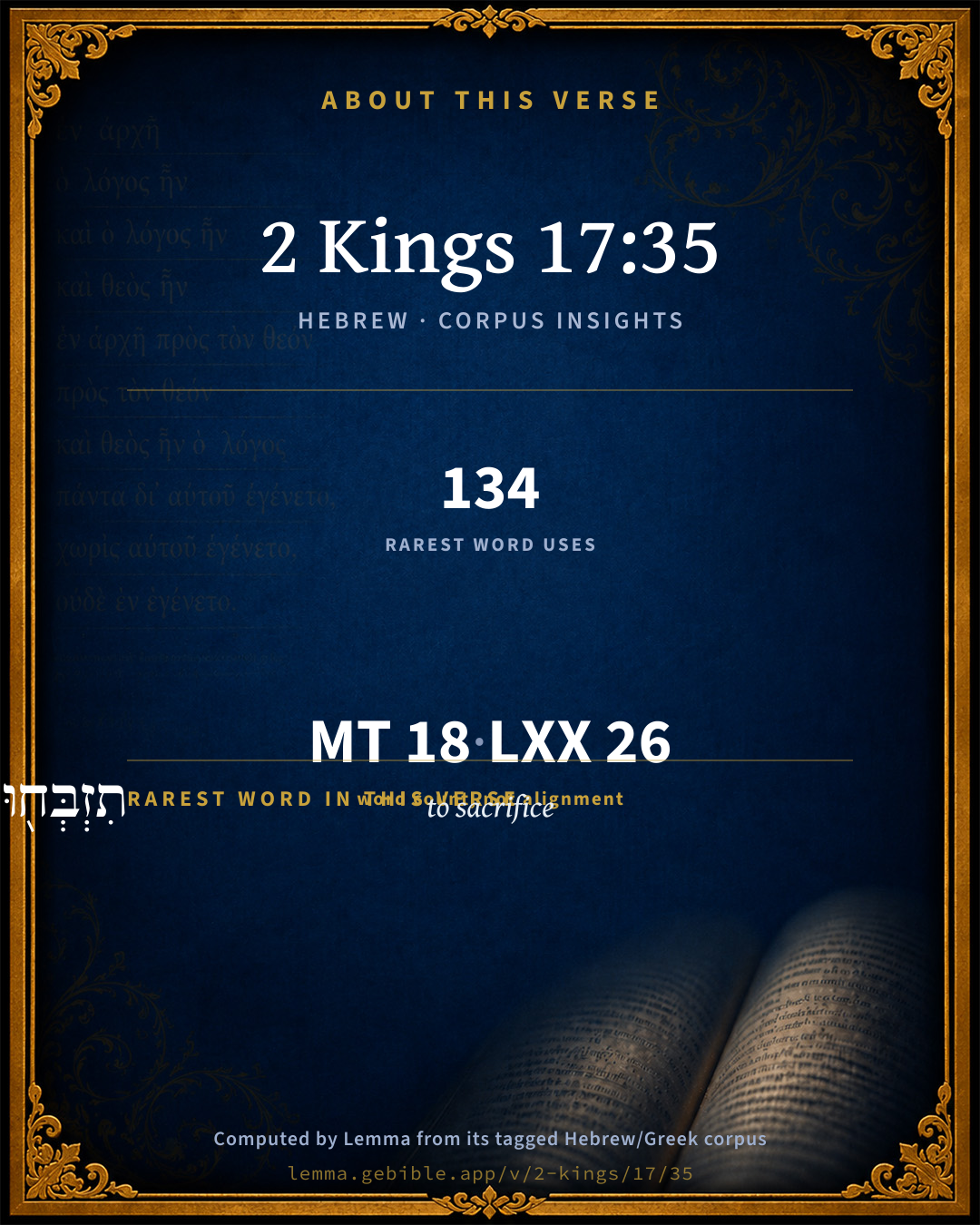
תִזְבְּח֖וּ
zâbach
H2076
“to sacrifice”
Verb, Qal, Imperfect, 2nd Person, Masculine, Plural
Part of Speech
Verb
Stem
Qal
Form
Imperfect
Person
2nd Person
Gender
Masculine
Number
Plural
Full BDB Definition

Origin: a primitive root

TWOT: 525

to slaughter, kill, sacrifice, slaughter for sacrifice - (Qal) - to slaughter for sacrifice - to slaughter for eating - to slaughter in divine judgment - (Piel) to sacrifice, offer sacrifice
  1. וַיִּכְרֹ֨ת kârath H3772 “and · to cut” Conjunction + Verb, Qal, Sequential Imperfect, 3rd Person, Masculine, Singular
  2. יְהוָ֤ה Yᵉhôvâh H3068 “LORD” Noun, Proper
  3. אִתָּם֙ ʼêth H854 “with · them” Preposition + Suffix, Personal, 3rd Person, Masculine, Plural
  4. בְּרִ֔ית bᵉrîyth H1285 “covenant” Noun, Common, Feminine, Singular, Absolute
  5. וַיְצַוֵּ֣ם tsâvâh H6680 “and · to command · them” Conjunction + Verb, Piel, Sequential Imperfect, 3rd Person, Masculine, Singular + Suffix, Personal, 3rd Person, Masculine, Plural
  6. לֵאמֹ֔ר ʼâmar H559 “to say” Preposition + Verb, Qal, Infinitive Construct
  7. לֹ֥א lôʼ H3808 “not” Particle, Negative
  8. תִֽירְא֖וּ yârêʼ H3372 “to fear” Verb, Qal, Imperfect, 2nd Person, Masculine, Plural
  9. אֱלֹהִ֣ים ʼĕlôhîym H430 “God(s)” Noun, Common, Masculine, Plural, Absolute
  10. אֲחֵרִ֑ים ʼachêr H312 “other” Adjective, Adjective, Masculine, Plural, Absolute
  11. וְלֹא lôʼ H3808 “and · not” Conjunction + Particle, Negative
  12. תִשְׁתַּחֲו֣וּ shâchâh H7812 “to bow down” Verb, Hishtaphel, Imperfect, 2nd Person, Masculine, Plural
  13. וְלֹ֣א lôʼ H3808 “and · not” Conjunction + Particle, Negative
  14. תַעַבְד֔וּם ʻâbad H5647 “to serve · them” Verb, Qal, Imperfect, 2nd Person, Masculine, Plural + Suffix, Personal, 3rd Person, Masculine, Plural
  15. וְלֹ֥א lôʼ H3808 “and · not” Conjunction + Particle, Negative

About this verse

These counts appear in no published source. They are computed here, from the morphology-tagged text and Lemma’s own curated glosses. What Lemma adds →

18
words
13
distinct lemmas
Historical
section

Grammatical profile

  • 7 verbs
  • 3 nouns
  • 1 adjective
  • 3 prepositions
  • 4 particles

Verb forms

  • וַיִּכְרֹ֨ת Qal · Sequential Imperfect
  • וַיְצַוֵּ֣ם Piel · Sequential Imperfect
  • לֵאמֹ֔ר Qal · Infinitive Construct
  • תִֽירְא֖וּ Qal · Imperfect
  • תִשְׁתַּחֲו֣וּ Hishtaphel · Imperfect
  • תַעַבְד֔וּם Qal · Imperfect
  • תִזְבְּח֖וּ Qal · Imperfect

Repetition

A word recurs within this verse — often emphatic in Hebrew:

Hebrew & Septuagint length

In English translation the verse runs 29 words from the Hebrew and 30 from the Septuagint (LXX English) — closely comparable.

A rough comparison of the two English renderings, which tokenize alike — not a word-level alignment.

Word counts can differ between the Hebrew and the Greek without any difference in meaning — e.g. the Hebrew direct-object marker אֵת has no separate Greek word, and Greek often adds the article ὁ.

In the original languages it is 18 Hebrew tokens and 26 Greek tokens — but the two are counted differently (Hebrew bundles its prefixes and suffixes into one token; the Greek is in lemma form), so that isn’t a like-for-like length.

Cross-references

14

Topical passages linked to 2 Kings 17:35 in the Treasury of Scripture Knowledge — connected by theme and wording, ordered by reader-vote popularity; previews shown in the World English Bible.

  • Judges 6:10 and I said to you, I am Yahweh your God; you shall not fear the gods of the Amorites, in whose land you dwell. But you have not listened to my voice.
  • Exodus 20:4–5 "You shall not make for yourselves an idol, nor any image of anything that is in the heavens above, or that is in the earth beneath, or that is in the water under the earth:
  • Exodus 34:12–17 Be careful, lest you make a covenant with the inhabitants of the land where you are going, lest it be for a snare in the midst of you:
  • Deuteronomy 4:23–27 Take heed to yourselves, lest you forget the covenant of Yahweh your God, which he made with you, and make you an engraved image in the form of anything which Yahweh your God has forbidden you.
  • Joshua 23:7 that you not come among these nations, these that remain among you; neither make mention of the name of their gods, nor cause to swear [by them], neither serve them, nor bow down yourselves to them;
  • Joshua 23:16 When you disobey the covenant of Yahweh your God, which he commanded you, and go and serve other gods, and bow down yourselves to them; then will the anger of Yahweh be kindled against you, and you shall perish quickly from off the good land which he has given to you.
  • Exodus 24:6–8 Moses took half of the blood and put it in basins, and half of the blood he sprinkled on the altar.
  • Deuteronomy 13:1–18 If there arise in the midst of you a prophet, or a dreamer of dreams, and he give you a sign or a wonder,
  • 2 Kings 17:15 They rejected his statutes, and his covenant that he made with their fathers, and his testimonies which he testified to them; and they followed vanity, and became vain, and [went] after the nations that were round about them, concerning whom Yahweh had charged those who they should not do like them.
  • Jeremiah 10:5 They are like a palm tree, of turned work, and don't speak: they must be carried, because they can't go. Don't be afraid of them; for they can't do evil, neither is it in them to do good."
  • Jeremiah 31:31–34 Behold, the days come, says Yahweh, that I will make a new covenant with the house of Israel, and with the house of Judah:
  • Hebrews 8:6–13 But now he has obtained a more excellent ministry, by so much as he is also the mediator of a better covenant, which has been enacted on better promises.
  • Exodus 19:5–6 Now therefore, if you will indeed obey my voice, and keep my covenant, then you shall be my own possession from among all peoples; for all the earth is mine;
  • Deuteronomy 29:10–15 You stand this day all of you before Yahweh your God; your heads, your tribes, your elders, and your officers, even all the men of Israel,

Cross-references courtesy of OpenBible.info (CC BY 4.0).

Hebrew and Greek witnesses Masoretic Hebrew ↔ Greek Septuagint

The same verse in the two great witnesses to the Old Testament, shown verse-for-verse.

These are two independent witnesses, not word-aligned to each other, and the Septuagint is shown in lemma (dictionary) form.

Hebrew 2 Kings 17:35 Masoretic · Westminster Leningrad Codex

וַיִּכְרֹ֨ת יְהוָ֤ה אִתָּם֙ בְּרִ֔ית וַיְצַוֵּ֣ם לֵאמֹ֔ר לֹ֥א תִֽירְא֖וּ אֱלֹהִ֣ים אֲחֵרִ֑ים וְלֹא תִשְׁתַּחֲו֣וּ לָהֶ֔ם וְלֹ֣א תַעַבְד֔וּם וְלֹ֥א תִזְבְּח֖וּ לָהֶֽם

with whom Yahweh had made a covenant, and charged them, saying, You shall not fear other gods, nor bow yourselves to them, nor serve them, nor sacrifice to them:

World English Bible · Public Domain

Greek LXX 2 Kings 17:35 Septuagint · lemma form

καί διατίθημι κύριος μετά αὐτός διαθήκη καί ἐντέλλομαι αὐτός λέγω οὐ φοβέω θεός ἕτερος καί οὐ προςκυνέω αὐτός καί οὐ λατρεύω αὐτός καί οὐ θυσιάζω αὐτός

And the Lord made a covenant with them, and charged them, saying, You⌃ shall not fear other gods, neither shall you⌃ worship them, nor serve them, nor sacrifice to them:

LXX2012 (modern English Septuagint) · Public Domain

Hebrew: Westminster Leningrad Codex (CC BY 4.0). Greek: Septuagint (public domain); English from LXX2012 (modern English Septuagint) (Public Domain). How the Septuagint differs from the Hebrew →

Targum (Aramaic paraphrase)

1

The Targum is the ancient Jewish Aramaic paraphrase of the Hebrew Scriptures — an interpretive translation, not the Hebrew text itself. Onkelos (literal) and Pseudo-Jonathan (expansive) render the Torah, and Jonathan the Prophets. Coverage is partial: where no permissively-licensed English translation exists for a verse, only the Aramaic is shown. This is verse-level text, not a word-by-word alignment to the Hebrew.

  1. Targum Jonathan Prophets (Joshua–Malachi)
    וּגְזַר יְיָ עִמְהוֹן קְיָם וּפַקְדִינוּן לְמֵימָר לָא תִדְחֲלוּן לְטַעֲוַת עַמְמַיָא וְלָא תִסְגְדוּן לְהוֹן וְלָא תִפְלְחִנוּן וְלָא תְדַבְּחוּן לְהוֹן:

    (no public-domain English translation for this verse)

    Targum Jonathan — Aramaic: “Mikraot Gedolot” (public domain). English: “Sefaria Community Translation” (CC0 1.0 (public-domain dedication)); “London "Chaldee Paraphrase," 1871” (public domain). Text via Sefaria.

Commentary

Notes on 2 Kings 17:35 from classic Christian and Jewish commentators (each source and its license shown beneath its notes). The classic Christian expositions comment on the surrounding passage and are grouped to its opening verse, so a note may address several verses; the Jewish commentaries on the Tanakh (Rashi and others) are per-verse, so they appear only where the commentator wrote on this verse.

Lemma curates 59 commentaries, every one of them public domain or Creative Commons licensed, each selected and text-cleaned for this edition rather than reprinted as found. About our sources →

Tyndale Open Study Notes

Tyndale Open Resources

17:35-39 According to Israel’s covenant with the Lord (Exod 20:5; Deut 6:4-15), Israel was to worship only the Lord. He alone could provide true redemption and rescue them from all . . . enemies.

Tyndale Open Study Notes — © Tyndale Open Resources, licensed CC BY-SA 4.0. Text via the HelloAO Bible API.

John Gill's Exposition

But the Lord, which brought you up out of the land of Egypt, with a great power, and a stretched out arm,.... Which is observed, to show the obligations they lay under, in point of gratitude, to serve the Lord:

him shall ye fear, and him shall ye worship, and to him shall ye do sacrifice: and him only, and not other gods; none but he being the object of religious fear and divine worship, and to whom sacrifices should be offered.

John Gill's Exposition of the Whole Bible (1746–1763) — public domain (CC PDM 1.0). Text via the HelloAO Bible API.

Matthew Poole's English Annotations

A covenant, containing many precious promises, upon the condition here following: see Gen 17:7; Exo 19:5; 24:7.

Matthew Poole's English Annotations on the Holy Bible (1683–1685) — public domain. Text from a community e-Sword/MySword module.

The Pulpit Commentary

With whom the Lord had made a covenant, and charged them, saying, Ye shall not fear other gods, nor bow yourselves to them, nor serve them, nor sacrifice to them. (see Exo_20:3; Deu_5:7 Deu_6:14 Deu_11:28. For the "covenant," see Exo_19:5-8 Exo_24:3-8)

The Pulpit Commentary (1880–1919), ed. H.D.M. Spence-Jones & Joseph S. Exell — public domain. Text from a community e-Sword module.

Rashi

Rabbi Shlomo Yitzchaki (Rashi)

And Adonoy enacted a covenant with them. When He gave them the Torah at Mount Sinai.

Rashi on the Tanakh — English translations: “The Judaica Press complete Tanach with Rashi, translated by A. J. Rosenberg” (CC BY 4.0); “Pentateuch with Rashi's commentary by M. Rosenbaum and A.M. Silbermann, 1929-1934” (public domain); “The Metsudah Tanach series, Lakewood, N.J” (CC BY 4.0); and “The Book of Joshua, Metsudah Publications, 1997” (CC BY 4.0). Text via Sefaria.

Lesson kit

Teaching starters — assembled from the data on this page, not authored interpretation. Every prompt links to the verse data it draws on. Edit before teaching.

2 Kings, in the Historical, opens this verse with 18 words (13 distinct Hebrew lemmas). Its most distinctive word is zâbach (“to sacrifice”). A historical commentator’s framing appears above. Read the whole chapter for the surrounding context.

Discussion questions

  1. How does “to sacrifice” (zâbach) shape what this verse is saying?
  2. Judges 6:10 shares this passage’s theme. How do the two illuminate each other?
  3. “not” occurs 4× in this one verse. What is the effect of the repetition?
  4. The translations on this page render this verse differently — a whole-verse word diff, not a word-by-word alignment. What might account for the different wordings?
  5. The verb «וַיִּכְרֹ֨ת» is Qal Sequential Imperfect. How does its form color the action?
  6. Reading how Tyndale Open Study Notes and John Gill's Exposition read this verse, where do the two commentators agree and where do they part?

Things to notice

Reading settings

Reading text

Shown beneath each verse's original-language words.

Old Testament
Old Testament edition

Read the OT as the Masoretic Hebrew (MT) or the Greek Septuagint (LXX).

English shown for the Greek Septuagint (in the Hebrew ↔ Greek comparison).

Comparing translations? Open the Compare panel on any verse page to stack up to four side by side.