
1 Kings 8:25

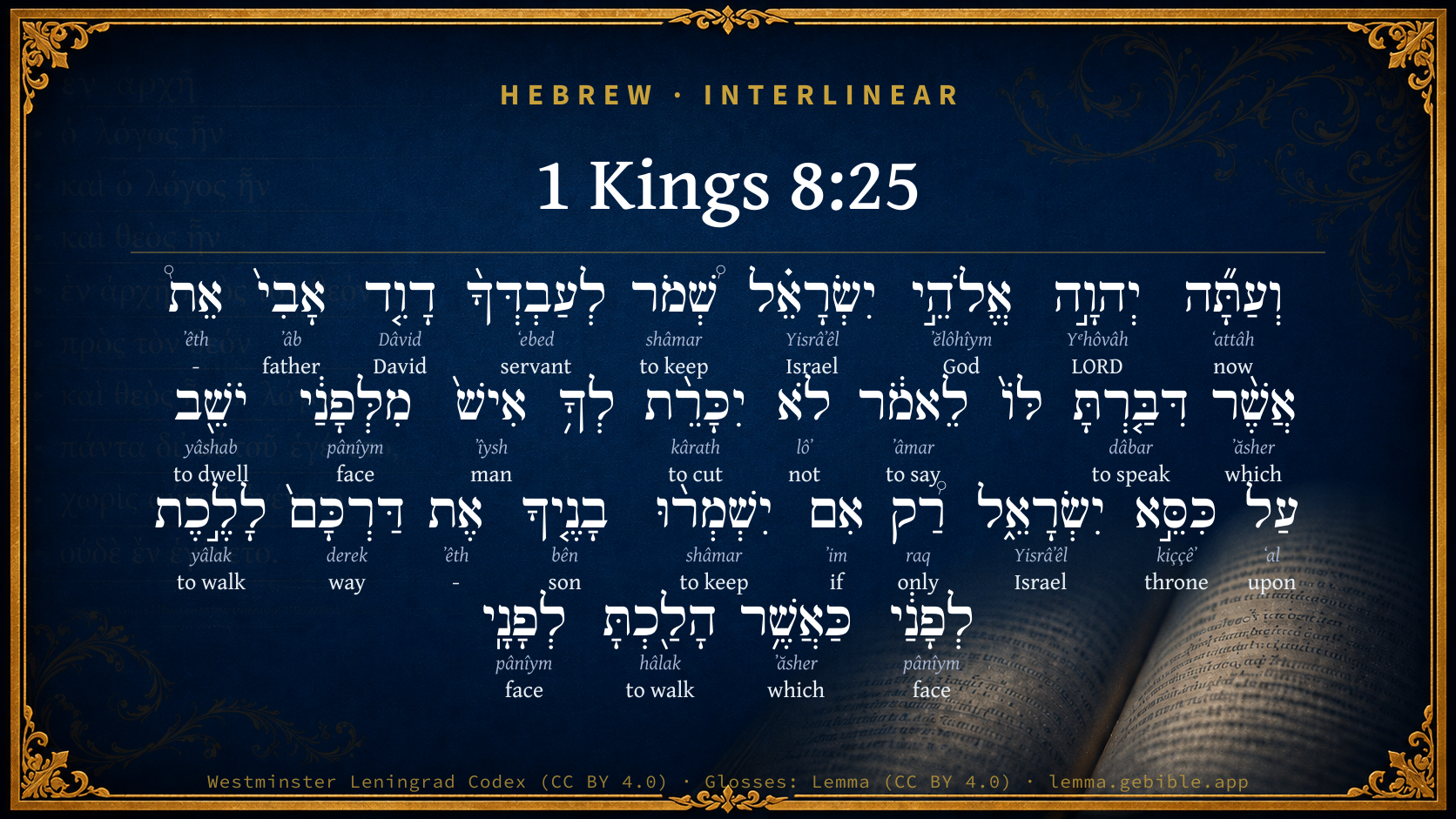
Hebrew (Westminster Leningrad Codex) 1 Kings 8:25 appears in the Hebrew Old Testament. The text above is from the Westminster Leningrad Codex. Each word links to its Strong’s number, a concise gloss, and parsing drawn from the Open Scriptures Hebrew Bible morphology. Click any word for its full Brown-Driver-Briggs (BDB) entry.
Download image
Cite this verse

1 Kings 8:25 (World English Bible). Public Domain. Lemma interlinear Bible study tool, https://lemma.gebible.app/v/1-kings/8/25.

Show BibTeX & RIS
BibTeX
RIS
English Translation
Now therefore, Yahweh, the God of Israel, keep with your servant David my father that which you have promised him, saying, There shall not fail you a man in my sight to sit on the throne of Israel, if only your children take heed to their way, to walk before me as you have walked before me.
World English Bible · Public Domain
Download a study sheet

One document with this verse’s original text, its word-by-word gloss line, the meaning frame, cross-references with their text, attributed commentary, and full source and license credits — printable, and it pastes into notes with its structure intact.

This verse Autodidact and up

Study sheet (.html) Plain text (.txt)

A passage Seminary Student

Up to 50 verses in one chapter. A passage sheet keeps up to 6 commentary sources and 12 cross-references per verse, in the order this page ranks them, and says so on the sheet whenever that leaves anything out. Ask for a single verse and you get the Autodidact verse sheet above.

Everything on this page stays free to read, with no account — the sheet is a download of what is already on screen, not access to it.

Want to remove ads? Support Godless Engineer
Compare translations 3

The same verse in 3 English versions, stacked beneath the original-language interlinear above. Click any original word for its lexicon entry.

Each is an independent rendering of the whole verse — the interlinear is not word-aligned to these translations.

Highlighted words mark where these versions differ — a whole-verse word diff, not a word-by-word alignment.

  • World English Bible Public Domain
    Now therefore, Yahweh, the God of Israel, keep with your servant David my father that which you have promised him, saying, There shall not fail you a man in my sight to sit on the throne of Israel, if only your children take heed to their way, to walk before me as you have walked before me.
  • King James Version Public Domain
    Therefore now, LORD God of Israel, keep with thy servant David my father that thou promisedst him, saying, There shall not fail thee a man in my sight to sit on the throne of Israel; so that thy children take heed to their way, that they walk before me as thou hast walked before me.
  • unfoldingWord Literal Text CC BY-SA 4.0
    And now, Yahweh, the God of Israel, keep for your servant David, my father, what you spoke to him, saying, ‘A man to you will not be cut off from to my face, sitting on the throne of Israel, if only your sons will keep their way, to walk to my face just as you have walked to my face.’

unfoldingWord Literal Text — © unfoldingWord, licensed CC BY-SA 4.0. Word-aligned USFM3 via Door43 (git.door43.org/unfoldingWord/en_ult).

Versions to compare (up to 4)

3 of 4 selected

Show all 18 translations

Every available English version of this verse, each an independent rendering of the whole verse.

  • World English Bible Public Domain
    Now therefore, Yahweh, the God of Israel, keep with your servant David my father that which you have promised him, saying, There shall not fail you a man in my sight to sit on the throne of Israel, if only your children take heed to their way, to walk before me as you have walked before me.
  • Berean Standard Bible Public Domain
    Therefore now, O LORD, God of Israel, keep for Your servant, my father David, what You promised when You said: ‘You will never fail to have a man to sit before Me on the throne of Israel, if only your descendants guard their way to walk before Me as you have done.’
  • Majority Standard Bible Public Domain
    Therefore now, O LORD, God of Israel, keep for Your servant, my father David, what You promised when You said: ‘You will never fail to have a man to sit before Me on the throne of Israel, if only your descendants guard their way to walk before Me as you have done.’
  • King James Version Public Domain
    Therefore now, LORD God of Israel, keep with thy servant David my father that thou promisedst him, saying, There shall not fail thee a man in my sight to sit on the throne of Israel; so that thy children take heed to their way, that they walk before me as thou hast walked before me.
  • American Standard Version (1901) Public Domain
    Now therefore, O Jehovah, the God of Israel, keep with thy servant David my father that which thou hast promised him, saying, There shall not fail thee a man in my sight to sit on the throne of Israel, if only thy children take heed to their way, to walk before me as thou hast walked before me.
  • Revised Version (1885) Public Domain
    Now therefore, O LORD, the God of Israel, keep with thy servant David my father that which thou hast promised him, saying, There shall not fail thee a man in my sight to sit on the throne of Israel; if only thy children take heed to their way to walk before me as thou hast walked before me.
  • Geneva Bible (1599) Public Domain
    Therefore now, Lord God of Israel, keepe with thy seruant Dauid my father that thou hast promised him, saying, Thou shalt not want a man in my sight to sit vpon ye throne of Israel: so that thy childre take heed to their way, that they walke before me; as thou hast walked in my sight
  • Douay-Rheims (1899) Public Domain
    Now therefore, O Lord God of Israel, keep with thy servant David my father what thou hast spoken to him, saying: There shall not be taken away of thee a man in my sight, to sit on the throne of Israel: yet so that thy children take heed to their way, that they walk before me as thou hast walked in my sight.
  • Young's Literal Translation Public Domain
    `And now, Jehovah, God of Israel, keep for Thy servant David my father that which Thou spakest to him, saying, There is not cut off to thee a man from before Me, sitting on the throne of Israel -- only, if thy sons watch their way, to walk before Me as thou hast walked before Me.
  • Literal Standard Version CC BY-SA 4.0
    And now, YHWH, God of Israel, keep for Your servant, my father David, that which You spoke to him, saying, A man of yours is never cut off from before My face, sitting on the throne of Israel—only, if your sons watch their way, to walk before Me as you have walked before Me.
  • Unlocked Literal Bible CC BY-SA 4.0
    Now then, Yahweh, God of Israel, carry out what you have promised to your servant David my father, when you said, 'You will not fail to have a man in my sight to sit on the throne of Israel, if only your descendants are careful to walk before me, as you have walked before me.'
  • unfoldingWord Literal Text CC BY-SA 4.0
    And now, Yahweh, the God of Israel, keep for your servant David, my father, what you spoke to him, saying, ‘A man to you will not be cut off from to my face, sitting on the throne of Israel, if only your sons will keep their way, to walk to my face just as you have walked to my face.’
  • Darby Bible Public Domain
    And now, Jehovah, God of Israel, keep with thy servant David my father that which thou hast promised him, saying, There shall not fail thee a man in my sight to sit on the throne of Israel, if only thy sons take heed to their way, to walk before me as thou hast walked before me.
  • World Messianic Bible Public Domain
    Now therefore, may LORD, the God of Israel, keep with your servant David my father that which you have promised him, saying, ‘There shall not fail from you a man in my sight to sit on the throne of Israel, if only your children take heed to their way, to walk before me as you have walked before me.’
  • Webster's Bible Public Domain
    Therefore now, LORD God of Israel, keep with thy servant David my father that which thou didst promise him, saying, There shall not fail thee a man in my sight to sit on the throne of Israel; provided thy children take heed to their way, that they walk before me as thou hast walked before me.
  • Free Bible Version CC BY-SA 4.0
    So now, Lord, God of Israel, please also keep the promise you made to your servant, my father David, when you said: ‘You will never fail to have a descendant sit in my presence on the throne of Israel, as long as they make sure to follow me as you have done.’
  • Bible in Basic English Public Domain
    So now, O Lord, the God of Israel, let your word to your servant David, my father, come true, when you said, You will never be without a man to take his place on the seat of the kingdom of Israel before me, if only your children give attention to their ways, walking before me as you have done.
  • JPS Tanakh (1917) Public Domain
    Now therefore, O LORD, the God of Israel, keep with Thy servant David my father that which Thou hast promised him saying: There shall not fail thee a man in My sight to sit on the throne of Israel, if only thy children take heed to their way, to walk before Me as thou hast walked before Me.

Literal Standard Version (2020), Covenant Press — licensed CC BY-SA 4.0. Text via the HelloAO Bible API (eBible.org). Unlocked Literal Bible (unfoldingWord) — licensed CC BY-SA 4.0. Text via the HelloAO Bible API (eBible.org). unfoldingWord Literal Text — © unfoldingWord, licensed CC BY-SA 4.0. Word-aligned USFM3 via Door43 (git.door43.org/unfoldingWord/en_ult). Free Bible Version, Dr. Jonathan Gallagher — licensed CC BY-SA 4.0. Text via the HelloAO Bible API (eBible.org).

Word by word

More ways to search: Search by grammar → Find every occurrence → Compare this word →

Practice this passage: Drill this verse → Learn its vocabulary →

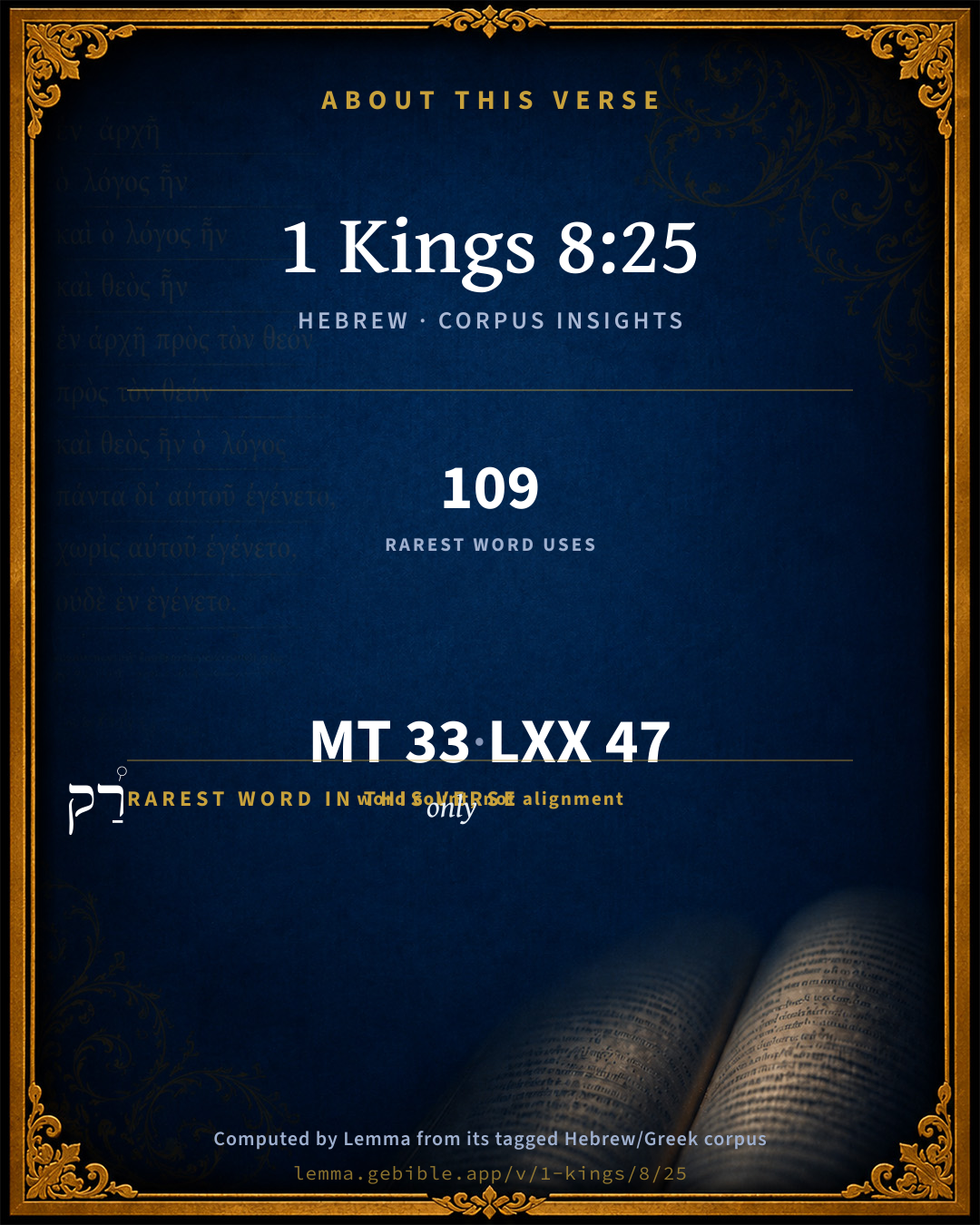
רַ֠ק
raq
H7535
“only”
Particle, Accusative
Part of Speech
Particle
Type
Accusative
Full BDB Definition

Origin: the same as H7534 as a noun

TWOT: 2218a

only, altogether, surely - only - only, nought but, altogether (in limitation) - save, except (after a negative) - only, altogether, surely (with an affirmative) - if only, provided only (prefixed for emphasis) - only, exclusively (for emphasis)
  1. וְעַתָּ֞ה ʻattâh H6258 “and · now” Conjunction + Adverb
  2. יְהוָ֣ה Yᵉhôvâh H3068 “LORD” Noun, Proper
  3. אֱלֹהֵ֣י ʼĕlôhîym H430 “God(s) of” Noun, Common, Masculine, Plural, Construct
  4. יִשְׂרָאֵ֗ל Yisrâʼêl H3478 “Israel” Noun, Proper
  5. שְׁ֠מֹר shâmar H8104 “keep” Verb, Qal, Imperative, 2nd Person, Masculine, Singular
  6. לְעַבְדְּךָ֨ ʻebed H5650 “to/for · servant · your” Preposition + Noun, Common, Masculine, Singular, Construct + Suffix, Personal, 2nd Person, Masculine, Singular
  7. דָוִ֤ד Dâvid H1732 “David” Noun, Proper
  8. אָבִי֙ ʼâb H1 “father · my” Noun, Common, Masculine, Singular, Construct + Suffix, Personal, 1st Person, Common, Singular
  9. אֵת֩ ʼêth H853 “-” Particle, Direct Object
  10. אֲשֶׁ֨ר ʼăsher H834 “which” Particle, Relative
  11. דִּבַּ֤רְתָּ dâbar H1696 “to speak” Verb, Piel, Perfect, 2nd Person, Masculine, Singular
  12. לֵאמֹ֔ר ʼâmar H559 “to say” Preposition + Verb, Qal, Infinitive Construct
  13. לֹא lôʼ H3808 “not” Particle, Negative
  14. יִכָּרֵ֨ת kârath H3772 “to cut” Verb, Niphal, Imperfect, 3rd Person, Masculine, Singular
  15. אִישׁ֙ ʼîysh H376 “man” Noun, Common, Masculine, Singular, Absolute
  16. מִלְּפָנַ֔י pânîym H6440 “from · to/for · face(s) · my” Preposition + Preposition + Noun, Common, Both, Plural, Construct + Suffix, Personal, 1st Person, Common, Singular
  17. יֹשֵׁ֖ב yâshab H3427 “dwelling” Verb, Qal, Participle Active, Masculine, Singular, Absolute
  18. עַל ʻal H5921 “upon” Preposition
  19. כִּסֵּ֣א kiççêʼ H3678 “throne of” Noun, Common, Masculine, Singular, Construct
  20. יִשְׂרָאֵ֑ל Yisrâʼêl H3478 “Israel” Noun, Proper
  21. אִם ʼim H518 “if” Conjunction
  22. יִשְׁמְר֨וּ shâmar H8104 “to keep” Verb, Qal, Imperfect, 3rd Person, Masculine, Plural
  23. בָנֶ֤יךָ bên H1121 “sons · your” Noun, Common, Masculine, Plural, Construct + Suffix, Personal, 2nd Person, Masculine, Singular
  24. אֶת ʼêth H853 “-” Particle, Direct Object
  25. דַּרְכָּם֙ derek H1870 “way · their” Noun, Common, Both, Singular, Construct + Suffix, Personal, 3rd Person, Masculine, Plural
  26. לָלֶ֣כֶת yâlak H3212 “to walk” Preposition + Verb, Qal, Infinitive Construct
  27. לְפָנַ֔י pânîym H6440 “to/for · face(s) · my” Preposition + Noun, Common, Both, Plural, Construct + Suffix, Personal, 1st Person, Common, Singular
  28. כַּאֲשֶׁ֥ר ʼăsher H834 “like/as · which” Preposition + Particle, Relative
  29. הָלַ֖כְתָּ hâlak H1980 “to walk” Verb, Qal, Perfect, 2nd Person, Masculine, Singular
  30. לְפָנָֽי pânîym H6440 “to/for · face(s) · my” Preposition + Noun, Common, Both, Plural, Construct + Suffix, Personal, 1st Person, Common, Singular

About this verse

These counts appear in no published source. They are computed here, from the morphology-tagged text and Lemma’s own curated glosses. What Lemma adds →

33
words
25
distinct lemmas
Historical
section

Grammatical profile

  • 8 verbs
  • 14 nouns
  • 3 prepositions
  • 1 conjunction
  • 1 adverb
  • 6 particles

Verb forms

  • שְׁ֠מֹר Qal · Imperative
  • דִּבַּ֤רְתָּ Piel · Perfect
  • לֵאמֹ֔ר Qal · Infinitive Construct
  • יִכָּרֵ֨ת Niphal · Imperfect
  • יֹשֵׁ֖ב Qal · Participle Active
  • יִשְׁמְר֨וּ Qal · Imperfect
  • לָלֶ֣כֶת Qal · Infinitive Construct
  • הָלַ֖כְתָּ Qal · Perfect

Repetition

Words recur within this verse — often emphatic in Hebrew:

  • מִלְּפָנַ֔י face H6440 ×3
  • יִשְׂרָאֵ֗ל Israel H3478 ×2
  • שְׁ֠מֹר to keep H8104 ×2
  • אֲשֶׁ֨ר which H834 ×2

Hebrew & Septuagint length

In English translation the verse runs 57 words from the Hebrew and 60 from the Septuagint (LXX English) — closely comparable.

A rough comparison of the two English renderings, which tokenize alike — not a word-level alignment.

Word counts can differ between the Hebrew and the Greek without any difference in meaning — e.g. the Hebrew direct-object marker אֵת has no separate Greek word, and Greek often adds the article ὁ.

In the original languages it is 33 Hebrew tokens and 47 Greek tokens — but the two are counted differently (Hebrew bundles its prefixes and suffixes into one token; the Greek is in lemma form), so that isn’t a like-for-like length.

Cross-references

8

Topical passages linked to 1 Kings 8:25 in the Treasury of Scripture Knowledge — connected by theme and wording, ordered by reader-vote popularity; previews shown in the World English Bible.

  • 1 Kings 2:4 That Yahweh may establish his word which he spoke concerning me, saying, If your children take heed to their way, to walk before me in truth with all their heart and with all their soul, there shall not fail you (said he) a man on the throne of Israel.
  • 1 Kings 9:4–6 As for you, if you will walk before me, as David your father walked, in integrity of heart, and in uprightness, to do according to all that I have commanded you, and will keep my statutes and my ordinances;
  • 2 Chronicles 6:16–17 Now therefore, Yahweh, the God of Israel, keep with your servant David my father that which you have promised him, saying, There shall not fail you a man in my sight to sit on the throne of Israel, if only your children take heed to their way, to walk in my law as you have walked before me.
  • Jeremiah 33:17–26 For thus says Yahweh: David shall never want a man to sit on the throne of the house of Israel;
  • 2 Samuel 7:27–29 For you, Yahweh of Hosts, the God of Israel, have revealed to your servant, saying, I will build you a house: therefore has your servant found in his heart to pray this prayer to you.
  • Luke 1:68–72 "Blessed be the Lord, the God of Israel, For he has visited and worked redemption for his people;
  • 1 Chronicles 17:23–27 Now, Yahweh, let the word that you have spoken concerning your servant, and concerning his house, be established forever, and do as you have spoken.
  • 1 Chronicles 28:9 You, Solomon my son, know the God of your father, and serve him with a perfect heart and with a willing mind; for Yahweh searches all hearts, and understands all the imaginations of the thoughts: if you seek him, he will be found of you; but if you forsake him, he will cast you off forever.

Cross-references courtesy of OpenBible.info (CC BY 4.0).

Hebrew and Greek witnesses Masoretic Hebrew ↔ Greek Septuagint

The same verse in the two great witnesses to the Old Testament, shown verse-for-verse.

These are two independent witnesses, not word-aligned to each other, and the Septuagint is shown in lemma (dictionary) form.

Hebrew 1 Kings 8:25 Masoretic · Westminster Leningrad Codex

וְעַתָּ֞ה יְהוָ֣ה אֱלֹהֵ֣י יִשְׂרָאֵ֗ל שְׁ֠מֹר לְעַבְדְּךָ֨ דָוִ֤ד אָבִי֙ אֵת֩ אֲשֶׁ֨ר דִּבַּ֤רְתָּ לּוֹ֙ לֵאמֹ֔ר לֹא יִכָּרֵ֨ת לְךָ֥ אִישׁ֙ מִלְּפָנַ֔י יֹשֵׁ֖ב עַל כִּסֵּ֣א יִשְׂרָאֵ֑ל רַ֠ק אִם יִשְׁמְר֨וּ בָנֶ֤יךָ אֶת דַּרְכָּם֙ לָלֶ֣כֶת לְפָנַ֔י כַּאֲשֶׁ֥ר הָלַ֖כְתָּ לְפָנָֽי

Now therefore, Yahweh, the God of Israel, keep with your servant David my father that which you have promised him, saying, There shall not fail you a man in my sight to sit on the throne of Israel, if only your children take heed to their way, to walk before me as you have walked before me.

World English Bible · Public Domain

Greek LXX 1 Kings 8:25 Septuagint · lemma form

καί νῦν κύριος ὁ θεός ἰσραήλ φυλάσσω ὁ δοῦλος σύ ὁ δαυίδ ὁ πατήρ ἐγώ ὅς λαλέω αὐτός λέγω οὐ ἐκαἴρω σύ ἀνήρ ἐκ πρόσωπον ἐγώ καταἧμαι ἐπί θρόνος ἰσραήλ πλήν ἐάν φυλάσσω ὁ τέκνον σύ ὁ ὁδός αὐτός ὁ πορεύομαι ἐνώπιον ἐγώ καθώς πορεύομαι ἐνώπιον ἐγώ

And now, O Lord God of Israel, keep for your servant David my father, the promises which you have spoken to him, saying, There shall not be taken from you a man sitting before me on the throne of Israel, provided only your children shall take heed to their ways, to walk before me as you have walked before me.

LXX2012 (modern English Septuagint) · Public Domain

On this verse, The Cambridge Bible for Schools and Colleges discusses the Septuagint’s reading. Read the note in Commentary ↓

Hebrew: Westminster Leningrad Codex (CC BY 4.0). Greek: Septuagint (public domain); English from LXX2012 (modern English Septuagint) (Public Domain). How the Septuagint differs from the Hebrew →

Targum (Aramaic paraphrase)

1

The Targum is the ancient Jewish Aramaic paraphrase of the Hebrew Scriptures — an interpretive translation, not the Hebrew text itself. Onkelos (literal) and Pseudo-Jonathan (expansive) render the Torah, and Jonathan the Prophets. Coverage is partial: where no permissively-licensed English translation exists for a verse, only the Aramaic is shown. This is verse-level text, not a word-by-word alignment to the Hebrew.

  1. Targum Jonathan Prophets (Joshua–Malachi)
    וּכְעַן יְיָ אֱלָהָא דְיִשְׂרָאֵל טַר לְעַבְדָךְ דָוִד אַבָּא יַת דְמַלֵילְתָּא לֵיהּ לְמֵימַר לָא יִפְסוֹק לָךְ גְבַר מִן קָדָמַי יָתֵיב עַל כּוּרְסֵי מַלְכוּתָא דְיִשְׂרָאֵל לְחוֹד אִם יִטְרוּן בְּנָךְ יַת אוֹרְחַתְהוֹן לְהַלָכָא קֳדָמַי כְּמָא דְהַלֵיכְתָּא קֳדָמַי:

    (no public-domain English translation for this verse)

    Targum Jonathan — Aramaic: “Mikraot Gedolot” (public domain). English: “Sefaria Community Translation” (CC0 1.0 (public-domain dedication)); “London "Chaldee Paraphrase," 1871” (public domain). Text via Sefaria.

Commentary

Notes on 1 Kings 8:25 from classic Christian and Jewish commentators (each source and its license shown beneath its notes). The classic Christian expositions comment on the surrounding passage and are grouped to its opening verse, so a note may address several verses; the Jewish commentaries on the Tanakh (Rashi and others) are per-verse, so they appear only where the commentator wrote on this verse.

Lemma curates 59 commentaries, every one of them public domain or Creative Commons licensed, each selected and text-cleaned for this edition rather than reprinted as found. About our sources →

Trapp's Complete Commentary

John Trapp

1Ki 8:25 Therefore now, LORD God of Israel, keep with thy servant David my father that thou promisedst him, saying, There shall not fail thee a man in my sight to sit on the throne of Israel; so that thy children take heed to their way, that they walk before me as thou hast walked before me.

Ver. 25. Keep with thy servant David.] Solomon knew well that such as would obtain the accomplishment of the promises, must put them in suit, as Jacob did, {Gen 32:9, &c.} and David, {Psa 119:49} and Elijah. {1Ki 18:41} Note here how Solomon pleadeth the performance of one promise, that he may prevail for another. Let us learn in this holy manner to encroach upon God.

John Trapp, A Commentary or Exposition upon All the Books of the Old and New Testament (1647–1656) — public domain. Text from a community e-Sword module.

Joseph Benson's Commentary

1Ki 8:25. Therefore now keep, &c. — Make good the other branch of thy promise. He considered God’s fulfilling the foregoing part of his promise, as an earnest that he would accomplish the other part also, made at the same time, concerning David’s posterity, 2Sa 7:12-13. So that thy children take heed to their way — Solomon here acknowledges that the accomplishment of the promise respecting the continuance of the kingdom in David’s family, depended on their continuance in the faith and worship of God: and that, if they became idolaters, they rendered themselves unworthy of this privilege, and forfeited all right to the inheritance of the kingdom, being no longer David’s genuine children. And therefore, according to Solomon’s own acknowledgment, after he and Rehoboam had departed from the worship of God, and began to follow idols, God might justly have taken away the kingdom from their posterity. And indeed when all Israel forsook the Lord, and worshipped the gods of the nations round about them, he did forsake their land, and would no longer dwell among them.

Joseph Benson's Commentary on the Old and New Testaments (1811–1818) — public domain. Text from a community e-Sword module.

Ellicott's Commentary for English Readers

(25) Therefore now.—The larger and grander part of the promise to David extends beyond Solomon’s quotation of it. For (see 2Sa_7:12-16; Psa_89:28-37) it expressly declares that, even if the seed of David fall away, they shall indeed be chastised, but they shall not be cast off. The prophet Jeremiah (Jer_31:36; Jer_33:20-26) as well as the Psalmist (Psa_89:36-37) enforce the declaration by comparing the certainty of its fulfilment with the fixity of “the ordinances of the sun and moon.” Like the ordinary dispensations of His Providence, it is in itself fixed and immutable, although the actual enjoyment of its blessing by each individual, or each age, is conditional on right reception of it.

A Bible Commentary for English Readers, edited by Charles John Ellicott (1878–1897) — public domain. Text from a community e-Sword module.

The Cambridge Bible for Schools and Colleges

gen. ed. J. J. S. Perowne

25. so that thy children take heed] In modern English ‘so that’ = ‘if only,’ ‘provided that,’ is not common, but was so when the A.V. was made. Cf. Shakespeare, All’s Well, ii. 4. 20, “So that you had her wrinkles, and I her money, I would she did as you say.” See also Richard II. iii. 4. 102. The R.V. has the modern ‘if only’ and the LXX. represents the sense by πλὴν ἐάν.

The Cambridge Bible for Schools and Colleges (gen. ed. J. J. S. Perowne; Cambridge University Press, 1878–1918) — public domain. Text from a community e-Sword module.

John Gill's Exposition

Therefore now, Lord God of Israel, keep with thy servant David my father that thou promisedst him,.... That as he had fulfilled one part of his promise respecting himself, his immediate successor, so that he would fulfil the other respecting his more remote offspring:

saying, there shall not fail thee a man in my sight, to sit on the throne of Israel; one of David's posterity to inherit his throne and kingdom, but with this proviso:

so that thy children takes heed to their way; in what way they walk, and how they walk in it:

that they walk before me as thou hast walked before me; meaning as David walked, see Psa 132:11.

John Gill's Exposition of the Whole Bible (1746–1763) — public domain (CC PDM 1.0). Text via the HelloAO Bible API.

Albert Barnes' Notes on the Bible

Solomon’s prayer is, perhaps, generally for the fulfillment of all the promises made to David in connection with the building of the temple. But there seems to be special allusion in this verse to the promise recorded in Psa 132:14.

Albert Barnes' Notes on the Bible (1834–1885) — public domain. Text from a community e-Sword/MySword module.

Haydock's Catholic Bible Commentary

Sight. Solomon was aware of the conditions on which he held his crown and the divine favour, so that his fall is the more inexcusable. (Haydock) --- His posterity lost a great part of the kingdom, though they had the right to rule over Juda, till the coming of Christ. (Worthington)

George Leo Haydock (1774–1849), Haydock's Catholic Family Bible and Commentary, 1859 edition — public domain. Excludes Psalms (Douay-Rheims chapter numbering differs from Protestant) and Deuterocanonical books (Catholic canon only).

Matthew Poole's English Annotations

Keep with thy servant David my father that thou promisedst him; make good the other branch of thy promise, and do not lose the glory of thy faithfulness, which now thou hast got.

Matthew Poole's English Annotations on the Holy Bible (1683–1685) — public domain. Text from a community e-Sword/MySword module.

The Pulpit Commentary

Therefore now Heb. And now. The promise has been but partially fulfilled. The house is built; he now prays that the succession may be continued in David"s line keep cf. ver. 24, "thou hast kept" with thy servant David my father that thou promisedst Heb. spakest to, as above him, saying The reference is of course to the great promise of 2Sa_7:12-16, There shall not fall thee a man in my sight to sit on the throne of Israel, (cf. 1Ki_2:4) so that marg., if only. As to the condition, see note on 1Ki_2:4, and cf. 1Ki_6:12, 13 thy children take heed to Heb. keep. Same word as above. The repetition is suggestive. God"s keeping His promise was contingent on their keeping His commandments their way, that they walk before me as thou hast walked before me.

The Pulpit Commentary (1880–1919), ed. H.D.M. Spence-Jones & Joseph S. Exell — public domain. Text from a community e-Sword module.

John Wesley's Explanatory Notes

Keep - Make good the other branch of thy promise.

John Wesley, Explanatory Notes Upon the Whole Bible (1754–1765) — public domain. Text via the GEBible commentary corpus.

unfoldingWord translationNotes

Door43 World Missions Community

to sit on the throne of Israel

The throne is a metonym for the activity of the one who sits on the throne. AT: "to rule over Israel" (See: Metonymy)

walk before me ... have walked before me

The way a person lives is spoken of as if that person were walking on a path. AT: "live as I want you to ... have lived as I want you to" (See: Metaphor)

translationWords

throne

descend

walk

pray

true

unfoldingWord translationNotes — © Distant Shores Media and the Door43 World Missions Community, licensed CC BY-SA 4.0. Source: git.door43.org/Door43/en_tn.

Lesson kit

Teaching starters — assembled from the data on this page, not authored interpretation. Every prompt links to the verse data it draws on. Edit before teaching.

1 Kings, in the Historical, opens this verse with 33 words (25 distinct Hebrew lemmas). Its most distinctive word is raq (“only”). A historical commentator’s framing appears above. Read the whole chapter for the surrounding context.

Discussion questions

  1. How does “only” (raq) shape what this verse is saying?
  2. 1 Kings 2:4 shares this passage’s theme. How do the two illuminate each other?
  3. “face” occurs 3× in this one verse. What is the effect of the repetition?
  4. These translations render this verse differently. What is at stake in choosing one wording over another?
  5. The verb «שְׁ֠מֹר» is Qal Imperative. How does its form color the action?
  6. Reading how Trapp's Complete Commentary and Joseph Benson's Commentary read this verse, where do the two commentators agree and where do they part?

Things to notice

Reading settings

Reading text

Shown beneath each verse's original-language words.

Old Testament
Old Testament edition

Read the OT as the Masoretic Hebrew (MT) or the Greek Septuagint (LXX).

English shown for the Greek Septuagint (in the Hebrew ↔ Greek comparison).

Comparing translations? Open the Compare panel on any verse page to stack up to four side by side.