
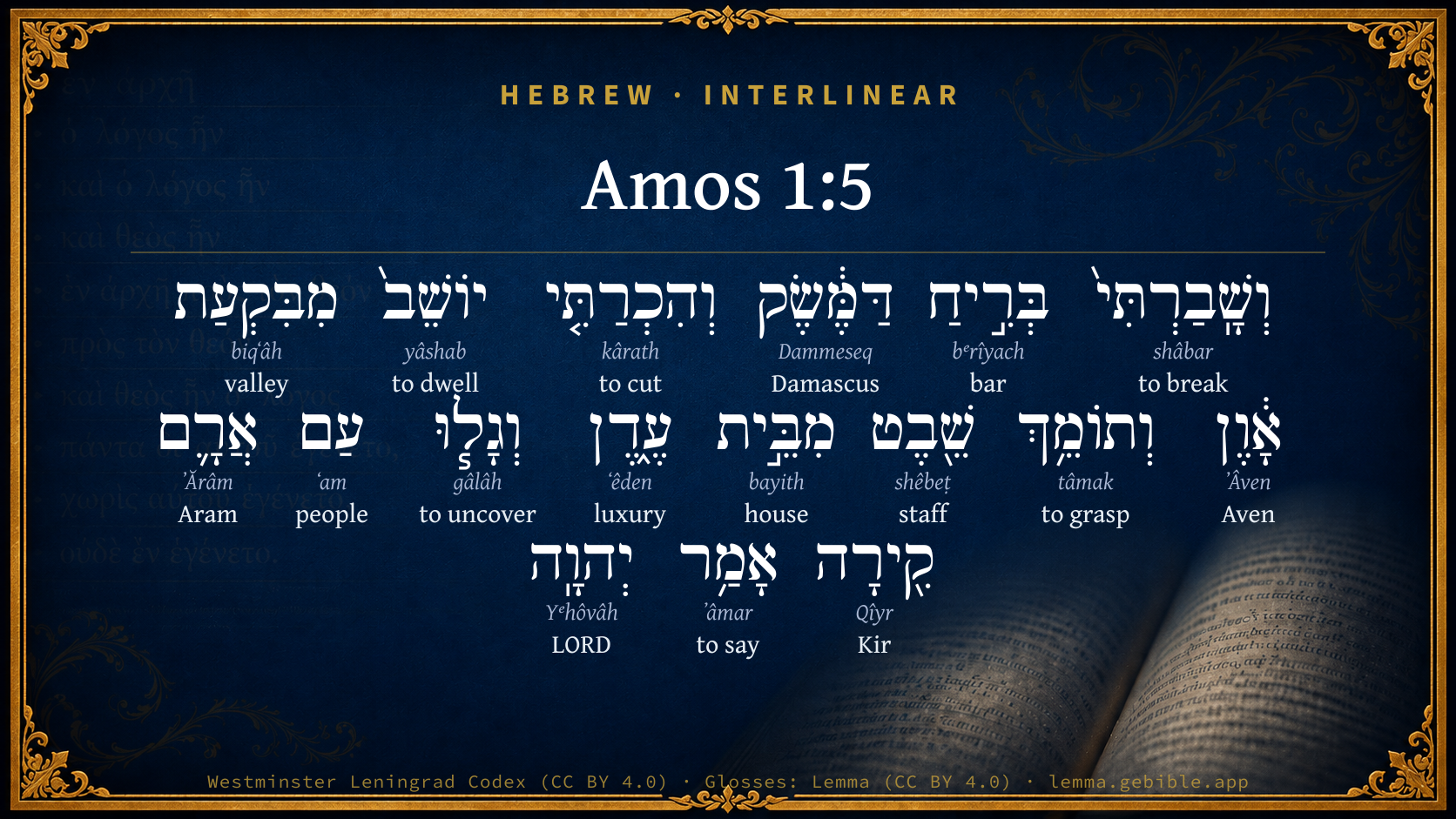
Amos 1:5

Hebrew (Westminster Leningrad Codex) Amos 1:5 appears in the Hebrew Old Testament. The text above is from the Westminster Leningrad Codex. Each word links to its Strong’s number, a concise gloss, and parsing drawn from the Open Scriptures Hebrew Bible morphology. Click any word for its full Brown-Driver-Briggs (BDB) entry.
Download image
Cite this verse

Amos 1:5 (World English Bible). Public Domain. Lemma interlinear Bible study tool, https://lemma.gebible.app/v/amos/1/5.

Show BibTeX & RIS
BibTeX
RIS
English Translation
I will break the bar of Damascus, And cut off the inhabitant from the valley of Aven, And him who holds the scepter from the house of Eden; And the people of Syria shall go into captivity to Kir," says Yahweh.
World English Bible · Public Domain
Download a study sheet

One document with this verse’s original text, its word-by-word gloss line, the meaning frame, cross-references with their text, attributed commentary, and full source and license credits — printable, and it pastes into notes with its structure intact.

This verse Autodidact and up

Study sheet (.html) Plain text (.txt)

A passage Seminary Student

Up to 50 verses in one chapter. A passage sheet keeps up to 6 commentary sources and 12 cross-references per verse, in the order this page ranks them, and says so on the sheet whenever that leaves anything out. Ask for a single verse and you get the Autodidact verse sheet above.

Everything on this page stays free to read, with no account — the sheet is a download of what is already on screen, not access to it.

Want to remove ads? Support Godless Engineer
Compare translations 3

The same verse in 3 English versions, stacked beneath the original-language interlinear above. Click any original word for its lexicon entry.

Each is an independent rendering of the whole verse — the interlinear is not word-aligned to these translations.

Highlighted words mark where these versions differ — a whole-verse word diff, not a word-by-word alignment.

  • World English Bible Public Domain
    I will break the bar of Damascus, And cut off the inhabitant from the valley of Aven, And him who holds the scepter from the house of Eden; And the people of Syria shall go into captivity to Kir," says Yahweh.
  • King James Version Public Domain
    I will break also the bar of Damascus, and cut off the inhabitant from the plain of Aven, and him that holdeth the sceptre from the house of Eden: and the people of Syria shall go into captivity unto Kir, saith the LORD.
  • unfoldingWord Literal Text CC BY-SA 4.0
    I will break the gate bars of Damascus and cut off the one who rules over the Valley of Aven, and also the one who holds the scepter in Beth Eden. The people of Aram will go in captivity to Kir,” says Yahweh.

unfoldingWord Literal Text — © unfoldingWord, licensed CC BY-SA 4.0. Word-aligned USFM3 via Door43 (git.door43.org/unfoldingWord/en_ult).

Versions to compare (up to 4)

3 of 4 selected

Show all 18 translations

Every available English version of this verse, each an independent rendering of the whole verse.

  • World English Bible Public Domain
    I will break the bar of Damascus, And cut off the inhabitant from the valley of Aven, And him who holds the scepter from the house of Eden; And the people of Syria shall go into captivity to Kir," says Yahweh.
  • Berean Standard Bible Public Domain
    I will break down the gates of Damascus; I will cut off the ruler of the Valley of Aven and the one who wields the scepter in Beth-eden. The people of Aram will be exiled to Kir,” says the LORD.
  • Majority Standard Bible Public Domain
    I will break down the gates of Damascus; I will cut off the ruler from the Valley of Aven and the one who wields the scepter in Beth-eden. The people of Aram will be exiled to Kir,” says the LORD.
  • King James Version Public Domain
    I will break also the bar of Damascus, and cut off the inhabitant from the plain of Aven, and him that holdeth the sceptre from the house of Eden: and the people of Syria shall go into captivity unto Kir, saith the LORD.
  • American Standard Version (1901) Public Domain
    And I will break the bar of Damascus, and cut off the inhabitant from the valley of Aven, and him that holdeth the sceptre from the house of Eden; and the people of Syria shall go into captivity unto Kir, saith Jehovah.
  • Revised Version (1885) Public Domain
    And I will break the bar of Damascus, and cut off the inhabitant from the valley of Aven, and him that holdeth the sceptre from the house of Eden: and the people of Syria shall go into captivity unto Kir, saith the LORD.
  • Geneva Bible (1599) Public Domain
    I will breake also the barres of Damascus, and cut off the inhabitant of Bikeath-auen: and him that holdeth the scepter out of Beth-eden, and the people of Aram shall goe into captiuitie vnto Kir, sayth the Lord.
  • Douay-Rheims (1899) Public Domain
    And I will break the bar of Damascus: and I will cut off the inhabitants from the plain of the idol, and him that holdeth the sceptre from the house of pleasure: and the people of Syria shall be carried away to Cyrene, saith the Lord.
  • Young's Literal Translation Public Domain
    And I have broken the bar of Damascus, And cut off the inhabitant from Bikat-Aven, And a holder of a sceptre from Beth-Eden, And removed have been the people of Aram to Kir, said Jehovah.
  • Literal Standard Version CC BY-SA 4.0
    And I have broken the bar of Damascus, || And cut off the inhabitant from Bikat-Aven, || And a holder of a scepter from Beth-Eden, || And the people of Aram have been removed to Kir,” said YHWH.
  • Unlocked Literal Bible CC BY-SA 4.0
    I will break the gate bars of Damascus and cut off the man who rules over the Valley of Aven, and also the man who holds the scepter in Beth Eden. The people of Aram will go in captivity to Kir,” says Yahweh.
  • unfoldingWord Literal Text CC BY-SA 4.0
    I will break the gate bars of Damascus and cut off the one who rules over the Valley of Aven, and also the one who holds the scepter in Beth Eden. The people of Aram will go in captivity to Kir,” says Yahweh.
  • Darby Bible Public Domain
    And I will break the bar of Damascus, and cut off the inhabitant from the valley of Aven, and him that holdeth the sceptre from Beth-Eden; and the people of Syria shall go into captivity unto Kir, saith Jehovah.
  • World Messianic Bible Public Domain
    I will break the bar of Damascus, and cut off the inhabitant from the valley of Aven, and him who holds the scepter from the house of Eden; and the people of Syria shall go into captivity to Kir,” says the LORD.
  • Webster's Bible Public Domain
    I will break also the bar of Damascus, and cut off the inhabitant from the plain of Aven, and him that holdeth the scepter from the house of Eden: and the people of Syria shall go into captivity to Kir, saith the LORD.
  • Free Bible Version CC BY-SA 4.0
    I will smash the gates of Damascus, I will cut down those who live in the Valley of Aven, and the ruler from Beth Eden. The people of Aram will be deported as prisoners to the land of Kir, says the Lord.
  • Bible in Basic English Public Domain
    And I will have the locks of the door of Damascus broken, and him who is seated in power cut off from the valley of Aven, and him in whose hand is the rod from the house of Eden; and the people of Aram will go away as prisoners into Kir, says the Lord.
  • JPS Tanakh (1917) Public Domain
    And I will break the bar of Damascus, and cut off the inhabitant from Bikath-Aven, and him that holdeth the sceptre from Beth-eden; and the people of Aram shall go into captivity unto Kir, saith the LORD.

Literal Standard Version (2020), Covenant Press — licensed CC BY-SA 4.0. Text via the HelloAO Bible API (eBible.org). Unlocked Literal Bible (unfoldingWord) — licensed CC BY-SA 4.0. Text via the HelloAO Bible API (eBible.org). unfoldingWord Literal Text — © unfoldingWord, licensed CC BY-SA 4.0. Word-aligned USFM3 via Door43 (git.door43.org/unfoldingWord/en_ult). Free Bible Version, Dr. Jonathan Gallagher — licensed CC BY-SA 4.0. Text via the HelloAO Bible API (eBible.org).

Word by word

More ways to search: Search by grammar → Find every occurrence → Compare this word →

Practice this passage: Drill this verse → Learn its vocabulary →

אָ֔וֶן
ʼÂven
H206
“Aven”
Noun, Proper
Part of Speech
Noun
Type
Proper
Full BDB Definition

Origin: the same as H205

TWOT: None

Aven = "vanity" - a name used contemptuously for the following places of idolatrous worship - a city in Egypt, possibly On ( Eze 30:17 ) - Bethel with its calf worship ( Hos 10:8 ) - A town or region in Syria ( Amo 1:5 )
  1. וְשָֽׁבַרְתִּי֙ shâbar H7665 “and · to break” Conjunction + Verb, Qal, Sequential Perfect, 1st Person, Common, Singular
  2. בְּרִ֣יחַ bᵉrîyach H1280 “bar of” Noun, Common, Masculine, Singular, Construct
  3. דַּמֶּ֔שֶׂק Dammeseq H1834 “Damascus” Noun, Proper
  4. וְהִכְרַתִּ֤י kârath H3772 “and · to cut” Conjunction + Verb, Hiphil, Sequential Perfect, 1st Person, Common, Singular
  5. יוֹשֵׁב֙ yâshab H3427 “dwelling” Verb, Qal, Participle Active, Masculine, Singular, Absolute
  6. מִבִּקְעַת biqʻâh H1237 “from · valley” Preposition + Noun, Proper
  7. וְתוֹמֵ֥ךְ tâmak H8551 “and · grasping” Conjunction + Verb, Qal, Participle Active, Masculine, Singular, Construct
  8. שֵׁ֖בֶט shêbeṭ H7626 “staff” Noun, Common, Masculine, Singular, Absolute
  9. מִבֵּ֣ית bayith H1004 “from · house” Preposition + Noun, Proper
  10. עֶ֑דֶן ʻêden H5730 “luxury” Noun, Proper
  11. וְגָל֧וּ gâlâh H1540 “and · to uncover” Conjunction + Verb, Qal, Sequential Perfect, 3rd Person, Common, Plural
  12. עַם ʻam H5971 “people of” Noun, Common, Masculine, Singular, Construct
  13. אֲרָ֛ם ʼĂrâm H758 “Aram” Noun, Proper
  14. קִ֖ירָה Qîyr H7024 “Kir · toward” Noun, Proper + Suffix, Demonstrative
  15. אָמַ֥ר ʼâmar H559 “to say” Verb, Qal, Perfect, 3rd Person, Masculine, Singular
  16. יְהוָֽה Yᵉhôvâh H3068 “LORD” Noun, Proper

About this verse

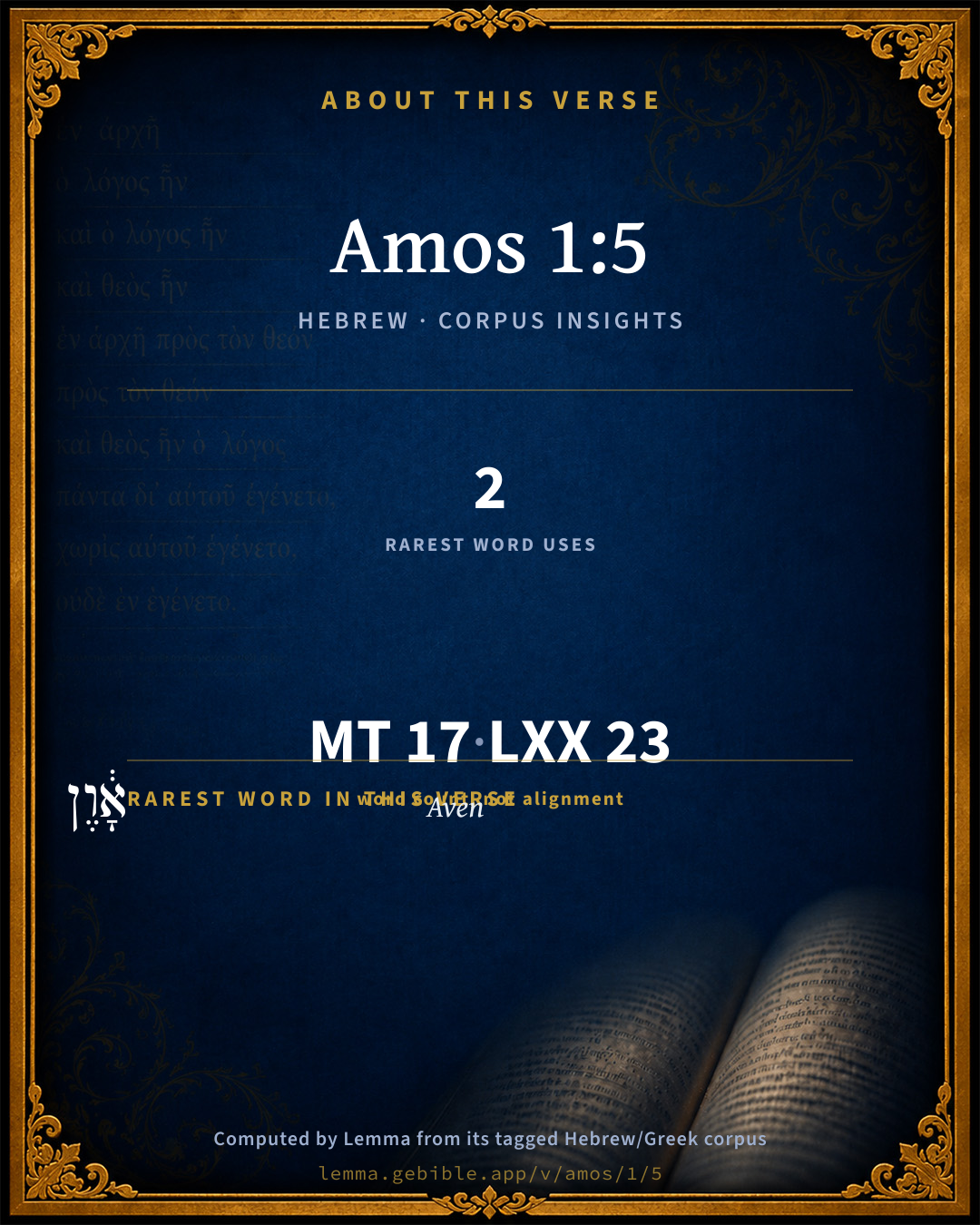
These counts appear in no published source. They are computed here, from the morphology-tagged text and Lemma’s own curated glosses. What Lemma adds →

17
words
17
distinct lemmas
Prophets
section

Notable vocabulary

The rarest word here is אָ֔וֶן Aven H206 — appearing just 2 times in the whole Hebrew Bible.

Shared distinctive vocabulary

אָ֔וֶן Aven H206 occurs in 2 verses of the Hebrew Bible. Also found in:

Grammatical profile

  • 6 verbs
  • 11 nouns

Verb forms

  • וְשָֽׁבַרְתִּי֙ Qal · Sequential Perfect
  • וְהִכְרַתִּ֤י Hiphil · Sequential Perfect
  • יוֹשֵׁב֙ Qal · Participle Active
  • וְתוֹמֵ֥ךְ Qal · Participle Active
  • וְגָל֧וּ Qal · Sequential Perfect
  • אָמַ֥ר Qal · Perfect

Hebrew & Septuagint length

In English translation the verse runs 41 words from the Hebrew and 47 from the Septuagint (LXX English) — closely comparable.

A rough comparison of the two English renderings, which tokenize alike — not a word-level alignment.

Word counts can differ between the Hebrew and the Greek without any difference in meaning — e.g. the Hebrew direct-object marker אֵת has no separate Greek word, and Greek often adds the article ὁ.

In the original languages it is 17 Hebrew tokens and 23 Greek tokens — but the two are counted differently (Hebrew bundles its prefixes and suffixes into one token; the Greek is in lemma form), so that isn’t a like-for-like length.

Cross-references

7

Topical passages linked to Amos 1:5 in the Treasury of Scripture Knowledge — connected by theme and wording, ordered by reader-vote popularity; previews shown in the World English Bible.

  • 2 Kings 16:9 The king of Assyria listened to him; and the king of Assyria went up against Damascus, and took it, and carried [the people of] it captive to Kir, and killed Rezin.
  • Amos 9:7 Are you not like the children of the Ethiopians to me, children of Israel?" says Yahweh. "Haven't I brought up Israel out of the land of Egypt, and the Philistines from Caphtor, and the Syrians from Kir?
  • Jeremiah 51:30 The mighty men of Babylon have forborne to fight, they remain in their strongholds; their might has failed; they are become as women: her dwelling-places are set on fire; her bars are broken.
  • Isaiah 43:14 Thus says Yahweh, your Redeemer, the Holy One of Israel: For your sake I have sent to Babylon, and I will bring down all of them as fugitives, even the Chaldeans, in the ships of their rejoicing.
  • Lamentations 2:9 Her gates are sunk into the ground; he has destroyed and broken her bars: Her king and her princes are among the nations where the law is not; Yes, her prophets find no vision from Yahweh.
  • Jeremiah 50:36 A sword is on the boasters, and they shall become fools; a sword is on her mighty men, and they shall be dismayed.
  • Nahum 3:13 Behold, your troops in your midst are women. The gates of your land are set wide open to your enemies. The fire has devoured your bars.

Cross-references courtesy of OpenBible.info (CC BY 4.0).

Hebrew and Greek witnesses Masoretic Hebrew ↔ Greek Septuagint

The same verse in the two great witnesses to the Old Testament, shown verse-for-verse.

These are two independent witnesses, not word-aligned to each other, and the Septuagint is shown in lemma (dictionary) form.

Hebrew Amos 1:5 Masoretic · Westminster Leningrad Codex

וְשָֽׁבַרְתִּי֙ בְּרִ֣יחַ דַּמֶּ֔שֶׂק וְהִכְרַתִּ֤י יוֹשֵׁב֙ מִבִּקְעַת אָ֔וֶן וְתוֹמֵ֥ךְ שֵׁ֖בֶט מִבֵּ֣ית עֶ֑דֶן וְגָל֧וּ עַם אֲרָ֛ם קִ֖ירָה אָמַ֥ר יְהוָֽה

I will break the bar of Damascus, And cut off the inhabitant from the valley of Aven, And him who holds the scepter from the house of Eden; And the people of Syria shall go into captivity to Kir," says Yahweh.

World English Bible · Public Domain

Greek LXX Amos 1:5 Septuagint · lemma form

καί συντρίβω μοχλός δαμασκός καί ἐκὀλεθρεύω καταοἰκέω ἐκ πεδίον ων καί κατακόπτω φυλή ἐκ ἀνήρ χαρραν καί αἰχμαλωτεύω λαός συρία ἐπίκλητος λέγω κύριος

And I will break to pieces the bars of Damascus, and will destroy the inhabitants out of the plain of On, and will cut in pieces a tribe out of the men of Charrhan: and the famous people of Syria shall be led captive, says the Lord.

LXX2012 (modern English Septuagint) · Public Domain

On this verse, The Cambridge Bible for Schools and Colleges discusses the Septuagint’s reading. Read the note in Commentary ↓

Hebrew: Westminster Leningrad Codex (CC BY 4.0). Greek: Septuagint (public domain); English from LXX2012 (modern English Septuagint) (Public Domain). How the Septuagint differs from the Hebrew →

Targum (Aramaic paraphrase)

1

The Targum is the ancient Jewish Aramaic paraphrase of the Hebrew Scriptures — an interpretive translation, not the Hebrew text itself. Onkelos (literal) and Pseudo-Jonathan (expansive) render the Torah, and Jonathan the Prophets. Coverage is partial: where no permissively-licensed English translation exists for a verse, only the Aramaic is shown. This is verse-level text, not a word-by-word alignment to the Hebrew.

  1. Targum Jonathan Prophets (Joshua–Malachi)
    וְאֶתְּבַר תְּקוֹף דַמֶשֶׂק וֶאֱשֵׁיצֵי יָתֵיב מִבִּקְעַת אָוֶן וְעָבֵיד שׁוּלְטַן מִבֵּית עֶדֶן וְיִגְלוּן עַמָא דַאֲרָם לְקִירְנֵי אֲמַר יְיָ:

    (no public-domain English translation for this verse)

    Targum Jonathan — Aramaic: “Mikraot Gedolot” (public domain). English: “Sefaria Community Translation” (CC0 1.0 (public-domain dedication)); “London "Chaldee Paraphrase," 1871” (public domain). Text via Sefaria.

Commentary

Notes on Amos 1:5 from classic Christian and Jewish commentators (each source and its license shown beneath its notes). The classic Christian expositions comment on the surrounding passage and are grouped to its opening verse, so a note may address several verses; the Jewish commentaries on the Tanakh (Rashi and others) are per-verse, so they appear only where the commentator wrote on this verse.

Lemma curates 59 commentaries, every one of them public domain or Creative Commons licensed, each selected and text-cleaned for this edition rather than reprinted as found. About our sources →

The Cambridge Bible for Schools and Colleges

gen. ed. J. J. S. Perowne

5. And I will break the bar of Damascus] Damascus will be powerless to resist the besieger. The allusion is to the ‘bars’ of bronze or iron by which the gates of every fortified city were secured (see Deu_3:5; 1Ki_4:13), and which, when a city is captured, are spoken of as ‘broken’ (Lam_2:9; Jer_51:30), or ‘hewn’ asunder (Isa_45:2).

and cut off the inhabitant] better, perhaps (note the parallel clause, him that holdeth the sceptre), as R.V. marg. him that sitteth (enthroned): yâshab (‘to sit’) has sometimes this force, even when standing alone; see Isa_10:13 R.V.; Psa_2:4; Psa_22:3 (R.V. marg.).

from the plain] Biḳ‘âh (from bâḳa‘, to cleave) is a broad ‘cleft,’ or level (Isa_40:4) plain, between mountains: it is applied, for instance, to the plain of Jericho, Deu_34:3, of Megiddo, Zec_12:11, 2Ch_35:22, of Lebanon, Jos_11:17, i.e. Coele-Syria, the flat and broad plain between the two ranges of Lebanon and Hermon, which is still called (in Arabic) el-Beḳâ‘a, and is probably the plain meant here.

of Aven] or of idolatry. The reference is uncertain. The common supposition is that Amos alludes to the worship of the Sun, carried on at a spot in the plain of Coele-Syria, called by the ancients Heliopolis, and now known as Baalbeḳ,—some sixty miles N.N.E of Dan,—where are still, in a partly ruined state, the massive walls and richly decorated pillars and architraves, of two magnificent temples. These temples, dedicated respectively to Jupiter and the Sun, are not of earlier date than the 2nd cent. a.d.,—the temple of Jupiter having been erected as a wonder of the world, by Antoninus Pius (a.d. 133–161); but the massive substructures are considered to date from a much earlier period, and to bear witness to the fact that a temple of the Sun had stood there from a distant past. According to Macrobius (Sat. 1:23) and Lucian (de Dea Syria § 5—both quoted by Robinson, Bibl. Researches, iii. 518) the worship of the Sun as carried on at Heliopolis in Syria was derived from Heliopolis in Egypt; and upon assumption of the correctness of this statement, it has been supposed that, with the worship of the Sun, the Egyptian name of Heliopolis, Aûnû (Heb. On, Gen_41:45; Gen_41:50; Gen_46:20) may have been brought from Egypt; and further that, as the Egyptian On (און) is punctuated in Eze_30:17—by way of contempt—אָוֶן Aven (i.e. idolatry), so here the Syrian On may have been called, whether by Amos himself, or by the later scribes, Aven. These suppositions are however, mere conjectures. The statements of Macrobius and Lucian may be nothing more than inferences from the fact of two celebrated temples being dedicated to a similar cult; and there is no independent evidence that On was a name of the Syrian Heliopolis. (The LXX. rendering here τὸ πεδίον Ὦν is not proof of it: for they represent On in Gen. and Ezek. by Ἡλιούπολις.) In view of the double fact that Coele-Syria was a biḳ‘âh, or broad vale, and that Baalbek, in this vale, was the old-established seat of an idolatrous worship of the Sun, it is not improbable that Amos may mean to allude to it; possibly, also,—though there is no proof that the place was called On,—the designation ‘Plain of Aven (idolatry)’ may have been suggested to him by the thought of the Egyptian On, just as the nickname Beth-Aven for Beth-el (Hos_4:1; Hos_4:5; Hos_5:8; cf. on ch. Amo_5:5) may have been suggested by the place Beth-Aven in the neighbourhood, a little to the east of Beth-el (Jos_7:2; Jos_18:12; 1Sa_13:5; 1Sa_14:23). But the identification cannot be regarded as certain: Wellhausen doubts even whether in the time of Amos Heliopolis was an Aramaic city.

him that holdeth the sceptre] the σκηπτοῦχος βασιλεὺς of Homer (Il. II. 26; Od. ii. 231): comp. the corresponding Aramaic expression (חטראחז) in the Hadad-inscription (8 cent. b.c.) of Zinjirli, lines 15, 20, 25 (see D. H. Müller, Die altsemitischen Inschriften von Sendschirli, 1893, p. 20 sq., or in the Contemp. Review, April, 1894, p. 572 f.).

from the house of Eden] or from Beth-eden. Another uncertain locality. Interpreted as a Hebrew word, ‘Eden—vocalized ‘eden, not ‘çden, as in the ‘garden of Eden’—would signify ‘pleasure.’ Of the identifications that have been proposed, relatively the most probable are, perhaps, either the modern Ehden, a village situated attractively in a fertile valley about 20 miles N.W. of Baalbek or Bît-Adini, a district mentioned in the Assyrian Inscriptions and lying some 200 miles N.N.E. of Damascus, on the Euphrates. The place intended may have been a summer-residence of the kings of Damascus, or the seat of some king who held his position in dependence upon the king of Damascus. See further the Additional Note, p. 228.

Syria] Heb. Aram, the name borne regularly in the O. T. by the people (and country) whom the classical writers, through a confusion with Assyrian, knew as Syrians and Syria. (See Nöldeke in Schenkel’s Bibel-Lex. s. v. ‘Aram, or in Hermes Amo_1:3, p. 433 ff., and Z.D.M.[115]. 1871, p. 115.) The people calling themselves Aram were very widely diffused over the regions N.E. of Palestine; their different divisions were distinguished by local designations as ‘Aram of Damascus’ 2Sa_8:5 f. (also, as the most important branch, called often, as here, ‘Aram’ simply), ‘Aram of Zobah,’ 2Sa_10:6; 2Sa_10:8; ‘Aram of Maachah,’ 1Ch_19:6; ‘Aram of Beth-Rĕḥôb,’ 2Sa_10:6; ‘Aram of the two Rivers’ (i.e. probably between the Euphrates and the Chaboras), Gen_24:10 : there were also many other tribes which were reckoned as belonging to ‘Aram,’ Gen_10:23; Gen_22:20-24. The language spoken by this people is called “Aramaic”; it exists in many dialects, corresponding to the different localities in which it was spoken, as the Palestinian Aramaic of Ezra and Daniel, the Palmyrene Aramaic, the dialects (not all the same) of the various Targums, the Aramaic of Edessa (commonly known as “Syriac,” par excellence), &c. From Amo_9:7 it appears that recollections of the migrations of some of these tribes were retained, and that Aram—i.e., it may be presumed, ‘Aram of Damascus’—came originally from Kir.

[115] .D.M.G … Zeitschrift der Deutschen Morgenländischen Gesellschaft.

shall go into captivity] Rather into exile. Though in a passage such as the present there is no appreciable difference between the two ideas, yet gâlâh, the word used here, expresses properly migration from a home, exile; and it is better, where possible, not to confuse it with hâlakh bash-shebî, to go into captivity, or nishbâh, to be taken captive.

unto Kir] In Amo_9:7 stated to have been their original home, which Amos accordingly here declares will be also their place of exile. 2Ki_16:9 shews how within less than a generation the prophecy was fulfilled. The result of the combined attack of Pekah king of Israel and Rezin king of Damascus upon Judah (2Ki_16:5 ff.; Isaiah 7) was that Ahaz applied for help to Tiglath-pileser, who, responding to the appeal, attacked Damascus, slew Rezin, and carried away the people into exile to Kir.

The brief notice of the book of Kings may be supplemented by the details given in the annals of Tiglath-pileser. From these we learn that in his 13th year (b.c. 733), the king laid siege to Damascus, and that in (probably) the following year (b.c. 732), after ravaging the surrounding country, he took the city, and carried large numbers of its inhabitants into exile. The place to which they were deported is not, however, mentioned in the existing (mutilated) text of the Inscriptions. The situation of Kir is very uncertain. A people of the same name is mentioned in Isa_22:6 beside Elam, as supplying a contingent in the Assyrian army. It is generally supposed to have been the district about the river Kur, which flows into the Caspian Sea on the N. of Armenia; but (Schrader in Riehm, H.W.B., s.v.) this region does not seem to have formed part of the Assyrian dominions in the time of either Tiglath-pileser, or Sennacherib; the k in the Assyrian Kurru (Kur) is also not the same as the ḳ (q) in ḳir. Others (as Furrer in Schenkel’s Bibel-lex.; Dillm. on Isa_22:6) think of the place called by the Greeks Cyrrhus (now Kuris) about 30 miles N.E. of Antioch, which gave to the surrounding region the name of Cyrrhestica. Some region more remote from Damascus itself appears however to be required by the allusions in Amos; Cyrrhus, moreover, there is reason to suppose (Schrader, l.c.), was only so called by the Greeks after a place of the same name in Macedonia.

Additional Note on Chap. Amo_1:5 (‘Eden)

The following are the principal identifications that have been proposed for ‘Eden (or Beth-‘eden). (1) ‘Edçn, as it is called in Syriac, or ’Ehden, as it is called in Arabic, a village some 20 miles N.W. of Baalbek, on the opposite (N. W.) slope of Lebanon, attractively situated on the side of a rich and highly-cultivated valley, near the cedars, described by Amira—the author of the first Syriac grammar published in Europe (1596, p. 59), whose native place it was—as “loci situ, aquarum copia, terrae fertilitate, aeris temperie, in toto Libano praestantissima; unde non immerito tali nomine est nuncupata” (quoted by Payne Smith, Thesaurus Syriacus, col. 2810). The accounts given by modern travellers fully bear out this description: Lord Lindsay, for instance (cited by Dr Pusey) speaks of the slopes of the valleys about it as “one mass of verdure,” with “the springs of Lebanon gushing down, fresh, cool, and melodious, in every direction.” The place is said to be at present a favourite summer resort for the wealthier inhabitants of Tripoli. (2) Bêt-jenn, at the foot (E.) of Anti-Libanus, about 12 miles N.E. of Banias, and 25 miles S.S.W. of Damascus, watered by the Nahr-jennâni, which, flowing down from Anti-Libanus, forms one of the two sources of the A‘waj (the Pharpar), the second great river near Damascus (Porter, Damascus, ed. 2, p. 117 sq.). (3) Jubb ‘Adin, a village situated in the hills, about 25 miles N.E. of Damascus, and 20 miles S.E. of Baalbek. (4) The place called by the Greeks Paradisus, identified by Robinson (B.R[213] III. 544, 556) with old-Jûsieh, far up the valley of Coele-Syria, near Riblah, some 30 miles N.E. of Baalbek—a spot described as being now, at any rate, remarkably “dreary and barren” (Porter, Handbook to Palestine, p. 577). (5) The ‘Eden of Eze_27:23, 2Ki_19:12 (= Isa_37:12), which Schrader (K.A.T[214][215] p. 327) is disposed to identify with the Bît-Adini, often mentioned in the Inscriptions of Asshurnazirpal and Shalmaneser II., a district lying on both sides of the Euphrates, in the middle part of its course, between Bâlis and Biredschik, some 200 miles N.N.E. of Damascus.

[213] .R. … Edw. Robinson, Biblical Researches in Palestine (ed. 2, 1856).

[214] .A.T. … Eb. Schrader, Die Keilinschriften und das A. T., ed. 2, 1883 (translated under the title The Cuneiform Inscriptions and the O. T. 1885, 1888). The references are to the pagination of the German, which is given on the margin of the English translation.

[215] … Eb. Schrader, Die Keilinschriften und das A. T., ed. 2, 1883 (translated under the title The Cuneiform Inscriptions and the O. T. 1885, 1888). The references are to the pagination of the German, which is given on the margin of the English translation.

None of these identifications can be regarded as certain: and the grounds upon which some of them have been suggested are very insufficient. The name Bêt-jenn, for instance, was formerly supposed to be Bêt el-janne, i.e. “house, or place, of the garden (Paradise),” which bore the appearance of being an Arabic translation of Beth-‘eden; but this supposition appears not to be correct[216]. The Greek—or ultimately Persian—word Paradisus, again, does not mean a ‘Paradise,’ in our sense of the term, but merely an enclosed park. Jubb ‘Adin would seem to be a place of too little note to have been signalized by the prophet in such a connexion. On the whole, either (1) or (5) appears to be, relatively, the most probable. Bît-Adini (5) might indeed be thought to be too distant from Damascus; but it has been observed that thirty-two kings are mentioned as being in alliance with Ben-hadad (I.), in 1Ki_20:1; 1Ki_20:16, and twelve ‘kings of the land of the Hittites,’ or of the coasts of the Mediterranean Sea, are mentioned as allies of the same king by Shalmaneser II. (K.A.T[217][218], pp. 202, 203); hence the allusion may not impossibly be to one or other of the subordinate kings who held rule under the suzerainty of the king of Damascus, and who, the prophet declares, will be involved with him in his fall. Perhaps there were various Aramaean settlements in Coele-Syria and Mesopotamia governed in this way; and the “plain of Aven” and “Eden”—whether this be the Syrian ‘Edçn, or Bît-adini—may have been mentioned as representing these. Others have supposed the allusion to be to a summer residence of the kings of Damascus themselves. It is impossible to speak more definitely for lack of the necessary data. We must be content to know that some place or other, connected politically with Damascus, and, no doubt, prominent at the time, is intended by the prophet.

[216] See Robinson, B.R. iii. 447; Porter, Damascus, l. c.; Socin in Bädeker’s Palästina und Syrien, ed. 2, p. 283; all of whom write Bêt-jenn.

[217] .A.T. … Eb. Schrader, Die Keilinschriften und das A. T., ed. 2, 1883 (translated under the title The Cuneiform Inscriptions and the O. T. 1885, 1888). The references are to the pagination of the German, which is given on the margin of the English translation.

[218] … Eb. Schrader, Die Keilinschriften und das A. T., ed. 2, 1883 (translated under the title The Cuneiform Inscriptions and the O. T. 1885, 1888). The references are to the pagination of the German, which is given on the margin of the English translation.

The Cambridge Bible for Schools and Colleges (gen. ed. J. J. S. Perowne; Cambridge University Press, 1878–1918) — public domain. Text from a community e-Sword module.

Trapp's Complete Commentary

John Trapp

Amo 1:5 I will break also the bar of Damascus, and cut off the inhabitant from the plain of Aven, and him that holdeth the sceptre from the house of Eden: and the people of Syria shall go into captivity unto Kir, saith the LORD.

Ver. 5. I will break also the bar of Damascus] i.e. their power and might, all strength defensive, or offensive, and so make way for the enemy into the city; give him a fair entrance without resistance. It is God that orders the battle, and renders men’s attempts vain or prosperous, Isa 54:17 Jer 50:9; whereever the sword comes it is "bathed in heaven," Isa 34:5.

And cut off the inhabitant from the plain of Aven] Campus idoli, the plain or valley of idols (so Mercer rendereth it), that is, of Syria given to idolatry; or Damascus, a very Poneropolis, and therefore ripe for ruin.

And him that holdeth the sceptre] & plain periphrasis of a king (called often by Homer, σκηπρουχος, sceptre bearer), or of him that was to succeed in the kingdom. The French call him Dauphin; the Spaniards, Infant, &c. Our Henry II crowned his eldest son Henry while he was yet alive, and put the sceptre into his hand; which made his ambition quite turn off his obedience.

From the house of Eden] Or of pleasure, the king’s palace, a very paradise. God denieth not great men their lawful pleasures for refreshment, amidst their weighty businesses, &c., but yet they must remember St James’s charge, Jas 5:5, against the grandees of his time: "Ye have lived in pleasure on the earth, and been wanton; ye have nourished your hearts as in a day of slaughter," or of good cheer. And that of Abraham to Dives, "Son, remember that thou in thy lifetime receivedst thy good things," &c., Luk 16:25, which text Gregory the Great could never read but his heart ached with fear, lest it should be his own case. It is well observed that (φιληδονοι) lovers of pleasure are set as last and worst of those wicked ones, 2Ti 3:4. Solomon is blamed for spending thirteen years in building his house, and planting those paradises about it, Ecc 2:5.

And the people of Syria shall go into captivity unto Kir] A place of Media, called by other authors Cyrrha, or (as others think) Cyrene, in Egypt or Africa. This was fulfilled fifty years after by Tiglathpileser.

Saith the Lord] Who spake the word and it was done, Psa 33:9; Psa 148:5. And what wonder, when his fiat only made the world, and he can as easily unmake it if he please.

John Trapp, A Commentary or Exposition upon All the Books of the Old and New Testament (1647–1656) — public domain. Text from a community e-Sword module.

Tyndale Open Study Notes

Tyndale Open Resources

1:5 Aven and Beth-eden were both connected with Aram and Damascus. Aven (meaning evil, wickedness) refers to the valley between the Lebanon and Anti-Lebanon mountains or the plain of Damascus. The city-state Beth-eden was north of Aram, elsewhere simply called Eden (2 Kgs 19:12; Ezek 27:23). • The Arameans originally came from Kir (Amos 9:7), probably in southern Babylonia; Kir was where Assyria deported them when Damascus fell (2 Kgs 16:9). Just as Egypt was a symbol of captivity for Israel (see Deut 28:68), Kir represented captivity for Aram.

Tyndale Open Study Notes — © Tyndale Open Resources, licensed CC BY-SA 4.0. Text via the HelloAO Bible API.

Geneva Bible (1599)

Geneva Bible translators

Tiglath-Pileser led the Assyrians captive, and brought them to Cyrene, which he calleth here Kir.

Geneva Bible (1599) marginal notes — public domain. Text via Bolls.life.

Jamieson, Fausset & Brown

Robert Jamieson, A. R. Fausset & David Brown

bar of Damascus--that is, the bar of its gates (compare Jer 51:30).

the inhabitant--singular for plural, "inhabitants." HENDERSON, because of the parallel, "him that holdeth the scepter," translates, "the ruler." But the parallelism is that of one clause complementing the other, "the inhabitant" or subject here answering to "him that holdeth the scepter" or ruler there, both ruler and subject alike being cut off.

Aven--the same as Oon or Un, a delightful valley, four hours' journey from Damascus, towards the desert. Proverbial in the East as a place of delight [JOSEPHUS ABASSUS]. It is here parallel to "Eden," which also means "pleasantness"; situated at Lebanon. As JOSEPHUS ABASSUS is a doubtful authority, perhaps the reference may be rather to the valley between Lebanon and Anti-Lebanon, called El-Bekaa, where are the ruins of the Baal-bek temple of the sun; so the Septuagint renders it On, the same name as the city in Egypt bears, dedicated to the sun-worship (Gen 41:45; Heliopolis, "the city of the sun," Eze 30:17, Margin). It is termed by Amos "the valley of Aven," or "vanity," from the worship of idols in it.

Kir--a region subject to Assyria (Isa 22:6) in Iberia, the same as that called now in Armenian Kur, lying by the river Cyrus which empties itself into the Caspian Sea. Tiglath-pileser fulfilled this prophecy when Ahaz applied for help to him against Rezin king of Syria, and the Assyrian king took Damascus, slew Rezin, and carried away its people captive to Kir.

Jamieson, Fausset & Brown — Commentary Critical and Explanatory on the Whole Bible (1871) — public domain (CC PDM 1.0). Text via the HelloAO Bible API.

Adam Clarke's Commentary

Verse 5. The bar of Damascus] The gates, whose long traverse bars, running from wall to wall, were their strength. I will throw it open; and the gates were forced, and the city taken, as above.

The plain of Aven - the house of Eden] These are names, says Bochart, of the valley of Damascus. The plain of Aven, or Birkath-Aven, Calmet says, is a city of Syria, at present called Baal-Bek, and by the Greeks Heliopolis; and is situated at the end of that long valley which extends from south to north, between Libanus and Anti-Libanus.

The people of Syria shall go into captivity unto Kir] KIR is supposed to be the country of Cyrene in Albania, on the river Cyrus, which empties itself into the Caspian Sea. The fulfilment of this prophecy may be seen in 2Kg 16:1-9.

Adam Clarke's Commentary on the Bible (1810–1826) — public domain. Text from a community e-Sword/MySword module.

John Calvin's Commentaries

He then adds, I will break in pieces the bar of Damascus The Prophet confirms what he had already said; for Damascus, being strongly fortified, might have seemed unassailable. By bar, the Prophet, mentioning a part for the whole, meant strongholds and everything which could keep out enemies. Nothing, then, shall prevent enemies from taking possession of the city of Damascus. How so? Because the Lord will break in pieces its bars.

It is then added, I will cut off, or destroy, the inhabitant from Bikoth Aven, or from the plain of Aven. It is uncertain whether this was the proper name of a place or not, though this is probable; and yet it means a plain, derived from a verb, which signifies to cut into two, or divide, because a plain or a valley divides or separates mountains; hence a valley or plain is called in Hebrew a division. Now, we know that there were most delightful plains in the kingdom of Syria, and even near Damascus. Aven also may have been the name of a place, though it means in Hebrew trouble or laborer. But whatever it may have been, the Prophet no doubt declares here, that all the plains nigh Damascus, and in the kingdom of Syria, would be deprived of their inhabitants. I will then destroy the inhabitant from the plain of Aven, and the holder of the scepter from the house of Eden, or from the house of pleasure. This also may have been the name of a place, and from its situation a region, which, by its pleasantness greatly delighted its inhabitants. But the Prophet, I have no doubt, alludes, in these two words, to trouble and pleasure Removed, he says, shall be the people of Syria into Kir. The purport of this is, that the kingdom of Syria would be wasted, so that the people would be taken into Assyria; for the Prophet declares that the Assyrians would be the conquerors, and remove the spoils into their own kingdom, and lead away the people as captives; for the word city, as a part for the whole, is put here for the whole land. It now follows —

John Calvin's Commentaries (1540-1563) — public domain. Text from the Calvin Translation Society English edition (1840s-50s) via the Christian Classics Ethereal Library (ccel.org). Calvin's coverage is partial (roughly two-thirds of the Bible); uncommented books and verses are honest gaps, never fabricated. The 19th-century editor's footnotes and remarks are omitted so the notes are faithfully Calvin's own voice.

Ellicott's Commentary for English Readers

(5) I will break . . .—The “bar” means the bolt of iron or brass with which the city was defended. But it is possible that it may be used of persons, i.e., princes or leaders (comp. Hos_4:18; Hos_11:6); and this seems confirmed by the parallelism. The plain or valley cleft between Libanus and Antilibanus is still called by the Arabs by a name closely resembling the rendering in the margin, “the valley.” It is probable that the word rendered “vanity,” (aven) is simply a Masoretic reading, and not what Amos intended. It is better to follow the LXX. and read the word On (as in Eze_30:17), the reference being to the Temple of Baalbec, then in ruins, the Syrian Heliopolis. (Comp. Hos_4:15.)[16] The site of Beth-eden (house of Eden) cannot be satisfactorily determined. Kir is the region of the river Cyrus, or, perhaps, the E. of the Upper Euphrates (see Amo_9:7). (2Ki_16:9, we see fulfilment of this doom.)

[16] On the other hand the Masoretic reading seems to have been suggested (if not confirmed) by Amo_5:5, where LXX. read aven.

A Bible Commentary for English Readers, edited by Charles John Ellicott (1878–1897) — public domain. Text from a community e-Sword module.

John Gill's Exposition

I will break also the bar of Damascus,.... Or bars, the singular for the plural, by which the gates of the city were barred; and, being broken, the gates would be easily opened, and way made for the enemy to pass into the city and spoil it; or it may signify the whole strength and all the fortifications of it. So the Targum,

"I will break the strength of Damascus:''

and cut off the inhabitant from the plain of Aven; or, "of an idol", as the Vulgate Latin version. It is thought to be some place where idols were worshipped by the Syrians; their gods were the gods of the valleys, which they denied the God of Israel to be, Kg1 20:23. Mr. Maundrell (g) says, that near Damascus there is a plain still called the valley of Bocat, and which he thinks is the same with this Bicataven, as it is in the Hebrew text; and which lies between Libanus and Antilibanus, near to the city, of Heliopolis and the Septuagint and Arabic versions here call this valley the plain of On, which Theodoret interprets of an idol called On. Father Calmet (h) takes it to be the same with Heliopolis, now called Balbec, or Baalbeck, the valley of Baal; where was a famous temple dedicated to the sun, the magnificent remains whereof are still at this day visible. Balbec is mentioned by the Arabians as the wonder of Syria; and one of their lexicographers says it is three days' journey from Damascus, where are wonderful foundations, and magnificent vestiges of antiquity, and palaces with marble columns, such as in the whole world are nowhere else to be seen; and such of our European travellers as have visited it are so charmed with what they beheld there, that they are at a loss how to express their admiration. On the southwest of the town, which stands in a "delightful plain" on the west foot of Antilibanus, is a Heathen temple, with the remains of some other edifices, and, among the rest, of a magnificent palace (i): Some late travellers (k) into these parts tell us, that

"upon a rising ground near the northeast extremity of this "plain", and immediately under Antilibanus, is pleasantly situated the city of Balbec, between Tripoli of Syria, and Damascus, and about sixteen hours distant from each.----This plain of Bocat (they say) might by a little care be made one of the richest and most fertile spots in Syria; for it is more fertile than the celebrated vale of Damascus, and better watered than the rich plains of Esdraelon and Rama. In its present neglected state it produces grain, some good grapes, but very little wood.--It extends in length from Balbec almost to the sea; its direction is from northeast by north, to southwest by south; and its breadth from Libanus to Antilibanus is guessed to be in few places more than twelve miles, or less than six.''

It seems to be the same with Bicatlebanon, or the valley of Lebanon, Jos 11:17; and with that which Strabo (l) calls the hollow plain; the breadth of which to the sea (he says) is twenty five miles, and the length from the sea to the midland is double that:

and him that holdeth the sceptre from the house of Eden; that is, the king from his pleasure house; or it may be understood of the name of some place in Syria, where the kings of it used sometimes to be, and had their palace there, called Betheden; and it seems there is still a place near Damascus, on Mount Libanus, called Eden, as the above traveller says; and Calmet (m) takes it to be the same that is here spoken of:

and the people of Syria shall go into captivity unto Kir, saith the Lord; which last clause is added for the certainty of it, and accordingly it was punctually fulfilled; for in the times of Rezin, which was about fifty years after this prophecy of Amos, though Kimchi says but twenty five, Tiglathpileser king of Assyria came up against Damascus, took it, and carried the people captive to Kir, Kg2 16:9. The Targum and Vulgate Latin version call it Cyrene, which some understand of Cyrene in Egypt; see Act 2:10; but this cannot be, since it was in the hands of the king of Assyria; but rather Kir in Media is meant; see Isa 22:6; which was under his dominion; and so Josephus says (n), that he carried captive the inhabitants of Damascus into Upper Media.

(g) Journey from Aleppo to Jerusalem, p. 119, 120. Ed. 7. (h) Dictionary, in the word "Heliopolis". (i) Universal History, vol. 2. p. 266. (k) Authors of "The Ruins of Balbec". (l) Geograph. l. 16. p. 519. (m) Dictionary, in the word "Eden". (n) Antiqu. l. 9. c. 12. sect. 3.

John Gill's Exposition of the Whole Bible (1746–1763) — public domain (CC PDM 1.0). Text via the HelloAO Bible API.

Albert Barnes' Notes on the Bible

I will also break the bar of Damascus - In the East, every city was fortified; the gates of the stronger cities were cased in iron, that they might not be set on fire by the enemy; they were fastened within with bars of brass 1Ki 4:13 or iron (Psa 107:16; Isa 45:2; compare Isa 48:14; Jer 51:3 O). They were flanked with towers, and built over, so that what was naturally the weakest point and the readiest access to an enemy became the strongest defense. In Hauran the huge doors and gates of a single stone 9 and 10 feet high , and 1 12 foot thick , are still extant, and “the place for the ponderous bars,” proportioned to such gates, “may yet be seen.” The walls were loosened with the battering-ram, or scaled by mounds: the strong gate was seldom attacked; but, when a breach was made, was thrown open from within. The “breaking of the bar” laid open the city to the enemy, to go in and come out at his will. The whole strength of the kingdom of Damascus lay in the capital. It was itself the seat of the empire and was the empire itself. God says then, that He Himself would shiver all their means of resistance, whatever could hinder the inroad of the enemy.

And cut off the inhabitant from the plain of Aven - Literally, “from the vale of vanity,” the “Bik’ah” being a broad vale between hills . Here it is doubtless the rich and beautiful valley, still called el-bukaa by the Arabs, La Boquea by William of Tyre , lying between Lebanon and Anti-libanus, the old Coele-Syria in its narrowest sense. It is, on high ground, the continuation of that long deep valley which, along the Jordan, the Dead sea, and the Arabah, reaches to the Red Sea. lts extreme length, from its southern close at Kal’at-esh-shakif to Hums (Emesa) has been counted at 7 days journey ; it narrows toward its southern extremity, expands at its northern, yet it cannot any how be said to lose its character of a valley until 10 miles north of Riblah .

Midway, on its ,” was Baalbek, or Heliopolis, where the Egyptian worship is said to have been brought of old times from their “city of the sun .” Baalbek, as the ruins still attest, was full of the worship of the sun. But the whole of that beautiful range, “a magnificent vista” , it has been said, “carpeted with verdure and beauty” , “a gem lying deep in its valley of mountains,” was a citadel of idolatry. The name Baal-Hermon connects Mount Hermon itself, the snow-capped height which so towers over its southeast extremity, with the worship of Baal or the sun, and that, from the time of the Judges Jdg 3:3. The name Baal-gad connects “the valley of Lebanon,” that is, most probably the south end of the great valley, with the same worship, anterior to Joshua Jos 11:17; Jos 12:7; Jos 13:5.

The name Baalbek is probably an abbreviation of the old name, Baal-bik’ah , “Baal of the valley,” in contrast with the neighboring Baalhermon. : “The whole of Hermon was girded with temples.” : “Some eight or ten of them cluster round it,” and, which is more remarkable, one is built” to catch the first beams of the sun rising over Hermon;” and temples on its opposite sides face toward it, as a sort of center .

In Jerome’s time, the pagan still reverenced a celebrated temple on its summit . On the crest of its central peak, 3,000 feet above the glen below, in winter inaccessible, beholding far asunder the rising and the setting sun on the eastern desert and in the western sea, are still seen the foundations of a circular wall or ring of large stones, a rude temple, within which another of Grecian art was subsequently built . “On three other peaks of the Anti-libanus range are ruins of great antiquity” . : “The Bukaa and its borders are full of the like buildings.”

“Lebanon, Anti-lebanon and the valleys between are thronged with ancient temples” . Some indeed were Grecian, but others Syro-Phoenician. The Grecian temples were probably the revival of Syro-Phoenician. The “massive substructions of Baalbek are conjectured to have been those of an earlier temple.” The new name “Heliopolis” only substituted the name of the object of worship (the sun) for its title Lord. The pagan emperors would not have lavished so much and such wondrous cost and gorgeous art on a temple in Coele-Syria, had not its pagan celebrity recommended it to their superstition or their policy. On the west side of Lebanon at Afca, (Apheca) was the temple of Venus at the source of the River Adonis , a center of the most hateful Syrian idolatry , “a school of misdoing for all profligates.”

At Heliopolis too, men “shamelessly gave their wives and daughters to shame.” The outburst of paganism there in the reign of Julian the Apostate shows how deeply rooted was its idolatry. Probably then, Amos pronounces the sentence of the people of that whole beautiful vale, as “valley of vanity” or “iniquity” , being wholly given to that worst idolatry which degraded Syria. Here, as the seat of idolatry, the chief judgments of God were to fall. Its inhabitants were to be cut off, that is, utterly destroyed; on the rest, captivity is the only sentence pronounced. The Assyrian monarchs not unfrequently put to death those who despised their religion , and so may herein have executed blindly the sentence of God.

From the house of Eden - A Proper, but significant, name, “Beth-Eden,” that is, “house of pleasure.” The name, like the Eden of Assyria 2Ki 19:12; Isa 37:12; Eze 27:23, is, in distinction from man’s first home, pronounced “EH-den,” not “EE-den” . Two places near, and one in, the Bik’ah have, from similarity of name, been thought to be this “house of delight.”

1. Most beautiful now for situation and climate, is what is probably mispronounced Ehden; a Maronite Village “of 4 or 500 families, on the side of a rich highly-cultivated valley” near Beshirrai on the road from Tripolis to the Cedars. Its climate is described as a ten months spring ; “the hills are terraced up to their summits;” and every place full of the richest, most beautiful, vegetation; “grain is poured out into the lap of man, and wine into his cup without measure.” “The slopes of the valleys, one mass of verdure, are yet more productive than the hills; the springs of Lebanon gushing down, fresh, cool and melodious in every direction .” The wealthier families of Tripoli still resort there for summer, “the climate being tempered by the proximity of the snow-mountains, the most luxuriant vegetation favored by the soft airs from the sea . “It is still counted” the Paradise of Lebanon.”

2. Beit-el-Janne, literally, “house of Paradise,” is an Arabic translation of Beth-Eden. It “lies under the root of Libanus, (Hermon) gushing forth clear water, whence,” says WilIiam of Tyre , “it is called ‘house of pleasure.’” It lies in a narrow valley, where it widens a little, about 34 of an hour from the plain of Damascus , and about 27 miles from that city on the way from Banias. : “Numerous rock-tombs, above and around, bear testimony to the antiquity of the site.” It gives its name to the Jennani (Paradise River), one of two streams which form the second great river near Damascus, the Awadj.

3. The third, the Paradisus of the Greeks, one of the three towns of Laodicene , agrees only accidentally with the Scripture name, since their Paradisus signifies not an earthly Paradise, but a “hunting-park.” For this the site is well suited; but in that country so abounding in water, and of soil so rich that the earth seems ready, on even slight pains of man, to don itself in luxuriant beauty, what probably is the site of the old Paradisus, is hopelessly barren Beth-Eden may have been the residence of one of the subordinate kings under the king of Damascus, who was to be involved in the ruin of his suzerain; or it may have been a summer-residence of the king of Damascus himself, where, in the midst of his trust in his false gods, and in a Paradise, as it were, of delight, God would cut him off altogether. Neither wealth nor any of a man’s idols protect against God. As Adam, for sin, was expelled from Paradise, so the rulers of Damascus from the place of their pleasure and their sin.

And the people of Syria shall go into captivity - Syria or Aram perhaps already included, under the rule of Damascus, all the little kingdoms on this side of the Euphrates, into which it had been formerly sub-divided. At least, it is spoken of as a whole, without any of the additions which occur in the earlier history, Aram-beth-rehob, Aramzobah, Aram-Maachah. Before its captivity Damascus is spoken of as “the head of Syria” Isa 7:8.

Into Kir - Kir has been identified:

(1) with the part of Iberia near the River Kur which unites with the Araxes, not far from the Caspian, to the north of Armenia;

(2) a city called by the Greeks Kourena or Kourna on the River Mardus in southern Media;

(3) a city, Karine , the modern Kerend .

The first is the most likely, as the most known; the Kur is part probably of the present name Kurgistan, our “Georgia.” Armenia at least which lay on the south of the River Kur, is frequently mentioned in the cuneiform inscriptions, as a country where the kings of Assyria warred and conquered . The two parricide sons of Sennacherib are as likely to have fled Isa 37:38 to a distant portion of their father’s empire, as beyond it. Their flight there may have been the ground of Esarhaddon’s war against it . It has at all times afforded a shelter to those expelled from others’ lands . The domestic, though late, traditions of the Armenians count as their first inhabitants some who had fled out of Mesopotamia to escape the yoke of Bel, king of Babylon . Whatever be the value of particular traditions, its mountain-valleys form a natural refuge to fugitives.

On occasion of some such oppression, as that from which Asshur fled before Nimrod , Aram may have been the first of those who took shelter in the mountains of Armenia and Georgia, and thence spread themselves, where we afterward find them, in the lowlands of Mesopotamia. The name Aram, however, is in no way connected with Armenia, which is itself no indigenous name of that country, but was probably formed by the Greeks, from a name which they heard . The name Aram, “lofty,” obviously describes some quality of the son of Shem, as of others who bore the name . Contrariwise, Canaan, (whether or no anticipating his future degraded character as partaking in the sin of Ham) may signify “crouching.” But neither has Aram any meaning of “highland,” nor Canaan of “lowland,” as has of late been imagined. .

From Kir the forefathers of the Syrians had, of their own will, been brought by the good all-disposing Providence of God; to Kir should the Syrians, against their will, be carried back. Aram of Damascus had been led to a land which, for its fertility and beauty, has been and is still praised as a sort of Paradise. Now, softened as they were by luxury, they were to be transported back to the austere though healthy climate, from where they had come. They had abused the might given to them by God, in the endeavor to uproot Israel; now they were themselves to be utterly uprooted. The captivity which Amos foretells is complete; a captivity by which (as the word means) the land should be bared of its inhabitants. Such a captivity he foretells of no other, except the ten tribes. He foretells it absolutely of these two nations alone , of the king and princes of Ammon Amo 1:15, not of Tyre, or the cities of Philistia, or Edom, or Ammon, or Moab. The punishment did not reach Syria in those days, but in those of Rezin who also oppressed Judah. The sin not being cut off; the punishment too was handed down.

Tiglath-pileser carried them away, about 50 years after this, and killed Rezin 2Ki 16:9. In regard to these two nations, Amos foretells the captivity absolutely. Yet at this time, there was no human likelihood, no ground, except of a divine knowledge, to predict it of these two nations especially. They went into captivity too long after this for human foresight to predict it; yet long enough before the captivity of Judah for the fulfillment to have impressed Judah if they would. The transportation of whole populations, which subsequently became part of the standing policy of the Persian and of the later Assyrian Empires, was not, as far as we know, any part of Eastern policy at the time of the prophet. Sesostris, the Egyptian conqueror, some centuries before Amos, is related to have brought together “many men,” “a crowd,” from the nations whom he had subdued, and to have employed them on his buildings and canals.

Even this account has received no support from the Egyptian monuments, and the deeds ascribed by the Greeks to Sesostris have been supposed to be a blending of those of two monarchs of the xix. Dynasty, Sethos I and Raamses II, interwoven with those of Ousartesen III (Dynasty xii.) and Tothmosis III (Dyn. xviii). But the carrying away of tiny number of prisoners from fields of battle is something altogether different from the political removal of a nation. It had in it nothing systematic or designed. It was but the employment of those whom war had thrown into their hands, as slaves. The Egyptian monarchs availed themselves of this resource, to spare the labor of their native subjects in their great works of utility or of vanity. But the prisoners so employed were but a slave population, analogous to those who, in other nations, labored in the mines or in agriculture.

They employed in the like way the Israelites, whom they had received peacefully. Their earlier works were carried on by native labor . After Tothmosis III, in whose reign is the first representation of prisoners employed in forced labor , they could, during their greatness, spare their subjects. They imported labor, not by slave trade, but through war. Nubia was incorporated with Egypt , and Nubian prisoners were, of course, employed, not in their own country but in the north of Egypt; Asiatic prisoners in Nubia . But they were prisoners made in a campaign, not a population; a foreign element in Egyptian soil, not an interchange of subject-populations. Doubtless, “the mixed multitude” Exo 12:38, which “went up with” Israel from Egypt, were in part these Asiatic captives, who had been subjected to the same hard bondage.

The object and extent of those forced transportations by the later Assyrians, Babylonians, and Persians were altogether different. Here the intention was to remove the people from their original seat, or at most to leave those only who, from their fewness or poverty, would be in no condition to rebel. The cuneiform inscriptions have brought before us, to a great extent, the records of the Assyrian conquests, as given by their kings. But whereas the later inscriptions of Sargon, Sennacherib, Esarhaddon, mention repeatedly the deportation of populations, the earlier annals of Asshurdanipal or Asshurakhbal relate the carrying off of soldiers only as prisoners, and women as captives . They mention also receiving slaves as tributes, the number of oxen and sheep, the goods and possessions and the gods of the people which they carry off .

Else the king relates, how he crucified or impaled or put to death men at arms or the people generally, but in no one of his expeditions does he mention any deportation. Often as modern writers assume, that the transportation of nations was part of the hereditary policy of the Monarchs of Asia, no instances before this period have been found. It appears to have been a later policy, first adopted by Tiglath-pileser toward Damascus and east and north Palestine, but foretold by the prophet long before it was adopted. It was the result probably of experience, that they could not keep these nations in dependence upon themselves while they left them in their old abodes. As far as our knowledge reaches, the prophet foretold the removal of these people, at a time when no instance of any such removal had occurred.

Albert Barnes' Notes on the Bible (1834–1885) — public domain. Text from a community e-Sword/MySword module.

Haydock's Catholic Bible Commentary

Plain. The city "Bikhath-Aven," or the latter word, probably denotes Baal, as the Syrians style Baal-Bek, the city which the Greeks call Heliopolis. The valley between the two mountains extending northward, is still called Bucca. --- Pleasure. Hebrew, "Beth Heden." We find Eden in a delightful part of Libanus. --- Cyrene, not in Africa, but on the river Cyrus, in Albania, 4 Kings xv. 29.

George Leo Haydock (1774–1849), Haydock's Catholic Family Bible and Commentary, 1859 edition — public domain. Excludes Psalms (Douay-Rheims chapter numbering differs from Protestant) and Deuterocanonical books (Catholic canon only).

Matthew Poole's English Annotations

I, the mighty God, as Amo 1:4,

will break, weaken and shake into pieces,

the bar; literally, the bar with which the city gates were shut, and both fastened and strengthened, Jdg 16:3; Neh 7:3; Psa 107:16. Metaphorically it contains all the munitions, fortresses, and strength of a place or people: so here. Damascus: see Amo 1:3. It is put here, as before, for the whole kingdom, of which it was the metropolis.

Cut off, by the judgments of war, pestilence, famine, or diseases, all commissioned to do this. The inhabitant, for inhabitants, the singular used for the plural; and may possibly denote the universal excision and destruction of the Syrians, who shall perish as one man: see the like use of the singular number, Exo 8:6; Jer 8:7.

The plain of Aven: it is possible this may refer to, some peculiar manner which the Syrians observed in their choosing the valley or champaign for the place of worship to their idols; Israel chose high places, the Syrians chose valleys it is likely, and therefore though beaten in the hills, where they thought the gods which Israel worshipped were strongest, yet are confident that in the valleys, where Syrians worshipped their gods, the Syrians would find their gods the stronger, 1Ki 20:23 for this reason the valley or plain hath its name the plain of liven, of iniquity and vanity, because in it they worshipped vain gods, and their religion was highest idolatry; or it may be that Bikath-aven was the name of some city of Syria well known then, but whose memory is perished with it a great while ago.

Him that holdeth the sceptre; a description of the king of Syria. whose royal dignity shall be no security to him.

The house of Eden; some royal seat, where the kings of Syria did think good to build them a house or palace, for pleasure and delights, and therefore gave it this name, Beth-eden, or the house of pleasure; all their pleasant seats, the king’s summer-houses, shall be laid waste.

The people of Syria; the main body of the subjects and people of Syria; this explains Damascus, Amo 1:3, and in this verse.

Kir; Cyrene of Egypt, say some, but without any probability in this place: there was also Kir of Moab, Isa 15:1; but this was not the Kir in the text: this was Kir of Media, Isa 22:6, now under the Assyrian yoke; and thither did Tiglath-pileser carry the conquered Syrians, 2Ki 16:9, and placed them captives in that barren, mountainous country about fifty years after it was foretold by Amos.

Saith the Lord: this gives us an assurance that all here threatened should at last be executed.

Matthew Poole's English Annotations on the Holy Bible (1683–1685) — public domain. Text from a community e-Sword/MySword module.

The Pulpit Commentary

The bar which secured the gate of the city (1Ki_4:13; Jer_51:30; Nah_3:13) Breaking the bar is equivalent to laying the place open to the enemy. From the plain of Avon; Vulgate, de campo idoli; Hebrew, bikath-Aven; Septuagint, ejk pediou Wn; better, from the valley of Aven, or vanity, perhaps so called analogously with Hosea"s naming Bethel, Bethaven, "House of God" and "House of vanity". (Hos_5:8) Robinson ("Bibl. Res.," 677) and Pusey refer the name to a valley between Lebanon and Antilibanus, a continuation of the Arabah, still called Bukaa, in the middle of which stood Baalbec, "the Temple of the sun of the valley," called Heliopolis by Greek and Roman writers (see "Classical Museum," 3:136). The LXX Renders "On" in Gen_41:45 by "Heliopolis;" and On and Baal being both titles of the sun, and indeed synonymous, the introduction of "On" into this passage may be accounted for. Him that holdeth the sceptre. The king and princes, as ver. 8. From the house of Eden; Hebrew, Beth-Eden, "House of delight;" Vulgate, de domo voluptatis; Septuagint, ejx ajndrwn CarjrJan, "out of the men of Charran." This last rendering arises from considering that the reference was to the Eden of Genesis 2., which the translators placed in the region of Haran. The place in the text Keil supposes to be the Paradisus of the Greeks, which Ptolemy (5:15, 20) locates southeast of Laodicea. Schrader suggests a place on the banks of the middle Euphrates between Balis and Biredschich called Bit-Adini in inscriptions of Asurnasirhabal and Salmanassur II But this seems to be a wrong locality (see "Die Keilinschriften," p. 327). The passage means that all the inhabitants of valley and city, king and peasant, shall be cut off. Shall go into captivity. The word implies that the land shall be "stripped" or "bared" of its inhabitants. Wholesale deportation had not hitherto been common in these regions. Kir has been identified with the country on the banks of the river Kar, which flows into the Araxes on the southwest of the Caspian Sea. It forms part of the territory known as Transcaucasia. From this region the Syrians originally emigrated, (Amo_9:7) and back to this land a large body were carried when Tiglath-Pileser, some fifty years later, killed Rezin and sacked Damascus, as related in 2Ki_16:9. Saith the Lord. This is the solemn confirmation of the prophet"s announcement, and recurs in vers. 8, 15 and Amo_2:3.

The Pulpit Commentary (1880–1919), ed. H.D.M. Spence-Jones & Joseph S. Exell — public domain. Text from a community e-Sword module.

John Wesley's Explanatory Notes

The bar - Literally the bar with which the city gates were shut, and fastened. Of Eden - Some royal seat, of the kings of Syria. Kir - Kir of Media, Isaiah xxii, 6, thither did Tiglath-Pilneser carry the conquered Syrians, 2 Kings xvi, 9, and placed them captives in that barren mountainous country, about fifteen years after it was foretold by Amos.

John Wesley, Explanatory Notes Upon the Whole Bible (1754–1765) — public domain. Text via the GEBible commentary corpus.

unfoldingWord translationNotes

Door43 World Missions Community

Connecting Statement:

Yahweh continues his message of judgment on Damascus.

cut off the man

Here to "cut off" means either to destroy or to drive away, as one would cut a piece of cloth or cut a branch from a tree. AT: "destroy the man" or "drive away the man" (See: Metaphor)

Valley of Aven

This is the name of a place that means "valley of wickedness." Possible meanings are 1) this is the name of an actual place in that region or 2) this is a metonym for Damascus or the surrounding region. AT: "the valley of wickedness" (See: How to Translate Names and Metonymy)

the man who holds the scepter in

This is a metonym for the ruler of that city or region. AT: "the ruler of" (See: Metonymy)

Beth Eden

This is the name of a place that means "house of pleasure." Possible meanings are 1) this is the name of an actual place in that region or 2) this is another metonym for Damascus or the surrounding region. AT: "the house of pleasure" (See: How to Translate Names and Metonymy)

Kir

This is the name of a region from which the people of Aram originally came. (See: How to Translate Names)

translationWords

gate

Damascus

cut off

scepter

Aram

captive

Yahweh

unfoldingWord translationNotes — © Distant Shores Media and the Door43 World Missions Community, licensed CC BY-SA 4.0. Source: git.door43.org/Door43/en_tn.

Rashi

Rabbi Shlomo Yitzchaki (Rashi)

from Bik’ath-Aven—That is a place in Aram.

and one who holds the scepter—[Jonathan renders:] and one who exercises sovereignty. Cf. (Gen. 49:10) “The scepter shall not turn away from Judah,” since the ruler castigates the people with sticks.

from Beth-Eden—A place name.

to Kir—A place name, where Sennacherib exiled them during the time of Ahaz, as it is stated: “And he went up to Damascus and seized it, and exiled Aram to Kir.” [see II Kings 16:9, where the wording differs.] All the retribution that the prophets of Israel prophesied concerning the nations - the prophets who preceded Sennacherib, e.g. Isaiah and Amos, prophesied concerning the sword of Sennacherib, and Jeremiah and Ezekiel prophesied concerning the sword of Nebuchadnezzar.

Rashi on the Tanakh — English translations: “The Judaica Press complete Tanach with Rashi, translated by A. J. Rosenberg” (CC BY 4.0); “Pentateuch with Rashi's commentary by M. Rosenbaum and A.M. Silbermann, 1929-1934” (public domain); “The Metsudah Tanach series, Lakewood, N.J” (CC BY 4.0); and “The Book of Joshua, Metsudah Publications, 1997” (CC BY 4.0). Text via Sefaria.

Lesson kit

Teaching starters — assembled from the data on this page, not authored interpretation. Every prompt links to the verse data it draws on. Edit before teaching.

Amos, in the Prophets, opens this verse with 17 words (17 distinct Hebrew lemmas). Its most distinctive word is ʼÂven (“Aven”). A historical commentator’s framing appears above. Read the whole chapter for the surrounding context.

Discussion questions

  1. What does “Aven” (ʼÂven) contribute to the verse as a whole?
  2. Ezekiel 30:17 shares the word «Aven» with this verse. How do the two illuminate each other?
  3. These translations render this verse differently. What is at stake in choosing one wording over another?
  4. The verb «וְשָֽׁבַרְתִּי֙» is Qal Sequential Perfect. How does its form color the action?
  5. Reading how The Cambridge Bible for Schools and Colleges and Trapp's Complete Commentary read this verse, where do the two commentators agree and where do they part?

Things to notice

Reading settings

Reading text

Shown beneath each verse's original-language words.

Old Testament
Old Testament edition

Read the OT as the Masoretic Hebrew (MT) or the Greek Septuagint (LXX).

English shown for the Greek Septuagint (in the Hebrew ↔ Greek comparison).

Comparing translations? Open the Compare panel on any verse page to stack up to four side by side.