
Proverbs 2:22

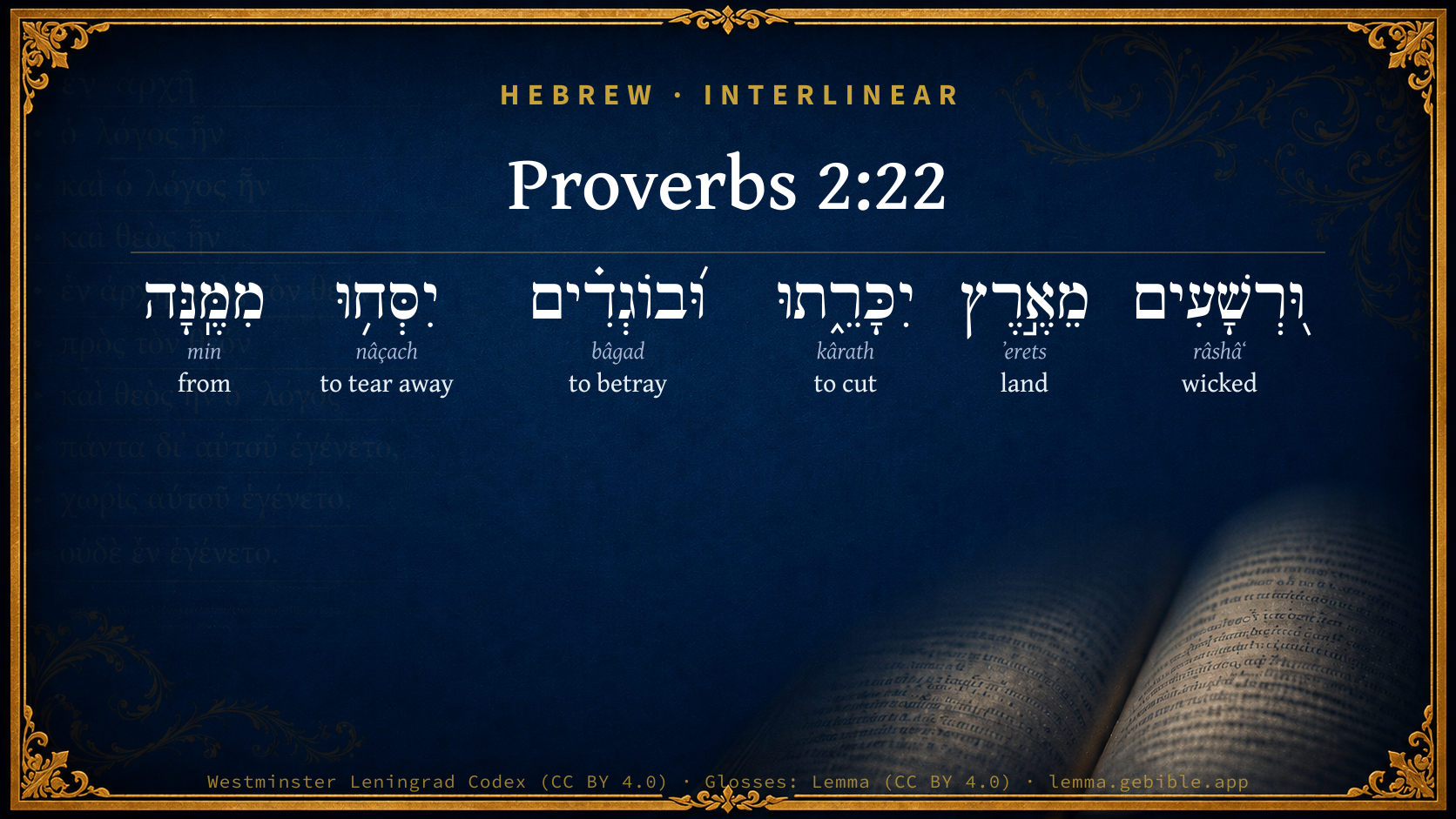
Hebrew (Westminster Leningrad Codex) Proverbs 2:22 appears in the Hebrew Old Testament. The text above is from the Westminster Leningrad Codex. Each word links to its Strong’s number, a concise gloss, and parsing drawn from the Open Scriptures Hebrew Bible morphology. Click any word for its full Brown-Driver-Briggs (BDB) entry.
Download image
Cite this verse

Proverbs 2:22 (World English Bible). Public Domain. Lemma interlinear Bible study tool, https://lemma.gebible.app/v/proverbs/2/22.

Show BibTeX & RIS
BibTeX
RIS
English Translation
But the wicked will be cut off from the land. The treacherous will be rooted out of it.
World English Bible · Public Domain
Download a study sheet

One document with this verse’s original text, its word-by-word gloss line, the meaning frame, cross-references with their text, attributed commentary, and full source and license credits — printable, and it pastes into notes with its structure intact.

This verse Autodidact and up

Study sheet (.html) Plain text (.txt)

A passage Seminary Student

Up to 50 verses in one chapter. A passage sheet keeps up to 6 commentary sources and 12 cross-references per verse, in the order this page ranks them, and says so on the sheet whenever that leaves anything out. Ask for a single verse and you get the Autodidact verse sheet above.

Everything on this page stays free to read, with no account — the sheet is a download of what is already on screen, not access to it.

Want to remove ads? Support Godless Engineer
Compare translations 3

The same verse in 3 English versions, stacked beneath the original-language interlinear above. Click any original word for its lexicon entry.

Each is an independent rendering of the whole verse — the interlinear is not word-aligned to these translations.

Highlighted words mark where these versions differ — a whole-verse word diff, not a word-by-word alignment.

  • World English Bible Public Domain
    But the wicked will be cut off from the land. The treacherous will be rooted out of it.
  • King James Version Public Domain
    But the wicked shall be cut off from the earth, and the transgressors shall be rooted out of it.
  • unfoldingWord Literal Text CC BY-SA 4.0
    but wicked ones will be cut off from the land, and treacherous ones will be torn away from it.

unfoldingWord Literal Text — © unfoldingWord, licensed CC BY-SA 4.0. Word-aligned USFM3 via Door43 (git.door43.org/unfoldingWord/en_ult).

Versions to compare (up to 4)

3 of 4 selected

Show all 18 translations

Every available English version of this verse, each an independent rendering of the whole verse.

  • World English Bible Public Domain
    But the wicked will be cut off from the land. The treacherous will be rooted out of it.
  • Berean Standard Bible Public Domain
    but the wicked will be cut off from the land, and the unfaithful will be uprooted.
  • Majority Standard Bible Public Domain
    but the wicked will be cut off from the land, and the unfaithful will be uprooted.
  • King James Version Public Domain
    But the wicked shall be cut off from the earth, and the transgressors shall be rooted out of it.
  • American Standard Version (1901) Public Domain
    But the wicked shall be cut off from the land, And the treacherous shall be rooted out of it.
  • Revised Version (1885) Public Domain
    But the wicked shall be cut off from the land, and they that deal treacherously shall be rooted out of it.
  • Geneva Bible (1599) Public Domain
    But the wicked shalbe cut off from ye earth, and the transgressours shalbe rooted out of it.
  • Douay-Rheims (1899) Public Domain
    But the wicked shall be destroyed from the earth: and they that do unjustly shall be taken away from it.
  • Young's Literal Translation Public Domain
    And the wicked from the earth are cut off, And treacherous dealers plucked out of it!
  • Literal Standard Version CC BY-SA 4.0
    And the wicked are cut off from the earth, || And treacherous dealers plucked out of it!
  • Unlocked Literal Bible CC BY-SA 4.0
    But the wicked will be cut off from the land, and the faithless will be cut off from it.
  • unfoldingWord Literal Text CC BY-SA 4.0
    but wicked ones will be cut off from the land, and treacherous ones will be torn away from it.
  • Darby Bible Public Domain
    but the wicked shall be cut off from the land, and the unfaithful shall be plucked up out of it.
  • World Messianic Bible Public Domain
    But the wicked will be cut off from the land. The treacherous will be rooted out of it.
  • Webster's Bible Public Domain
    But the wicked shall be cut off from the earth, and the transgressors shall be rooted out of it.
  • Free Bible Version CC BY-SA 4.0
    But the wicked will be thrown out of the land; those who are untrustworthy will be pulled out by the roots.
  • Bible in Basic English Public Domain
    But sinners will be cut off from the land, and those whose acts are false will be uprooted.
  • JPS Tanakh (1917) Public Domain
    But the wicked shall be cut off from the land, and the faithless shall be plucked up out of it.

Literal Standard Version (2020), Covenant Press — licensed CC BY-SA 4.0. Text via the HelloAO Bible API (eBible.org). Unlocked Literal Bible (unfoldingWord) — licensed CC BY-SA 4.0. Text via the HelloAO Bible API (eBible.org). unfoldingWord Literal Text — © unfoldingWord, licensed CC BY-SA 4.0. Word-aligned USFM3 via Door43 (git.door43.org/unfoldingWord/en_ult). Free Bible Version, Dr. Jonathan Gallagher — licensed CC BY-SA 4.0. Text via the HelloAO Bible API (eBible.org).

Word by word

More ways to search: Search by grammar → Find every occurrence → Compare this word →

Practice this passage: Drill this verse → Learn its vocabulary →

About this verse

These counts appear in no published source. They are computed here, from the morphology-tagged text and Lemma’s own curated glosses. What Lemma adds →

6
words
6
distinct lemmas
Wisdom
section

Notable vocabulary

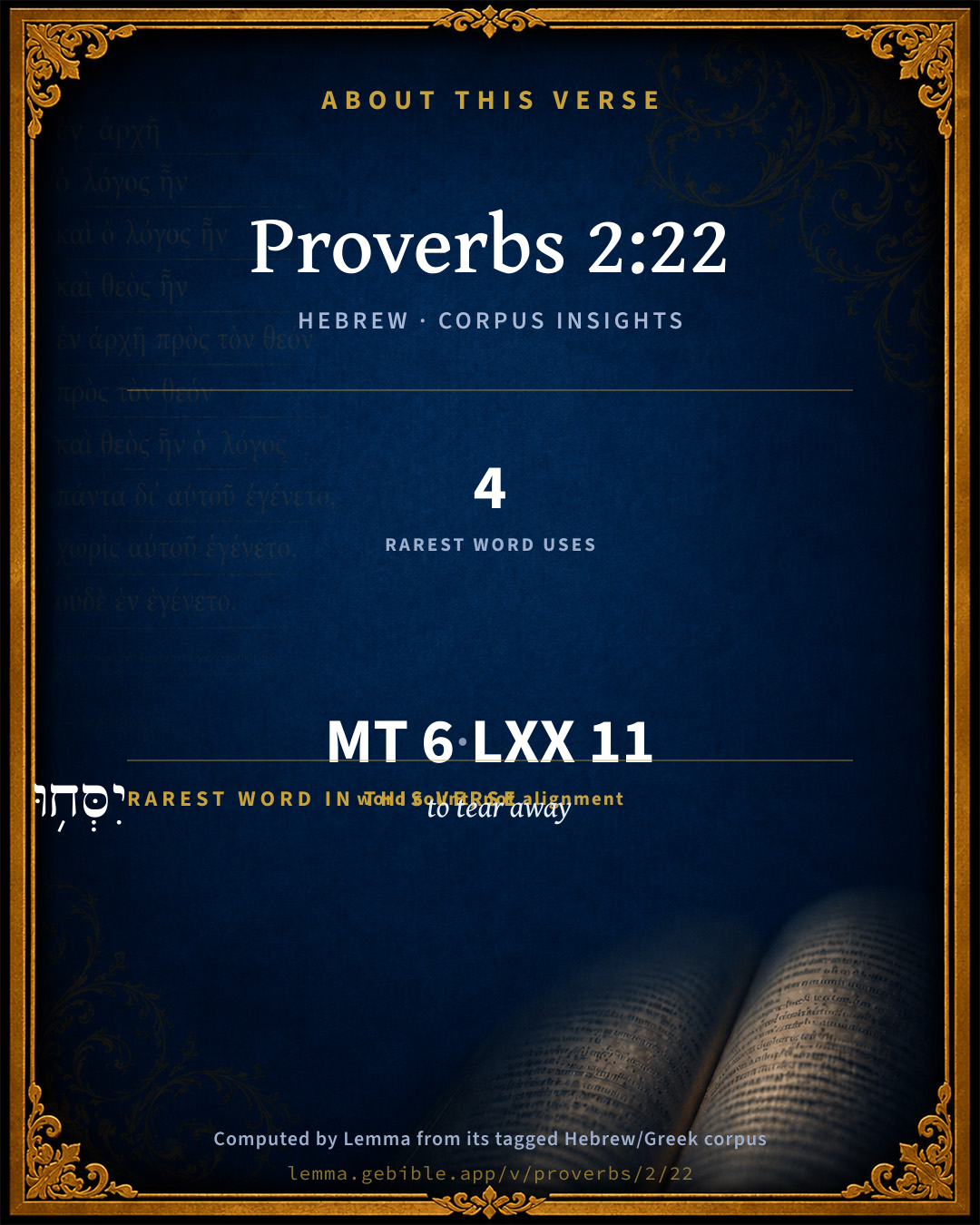
The rarest word here is יִסְּח֥וּ to tear away H5255 — appearing just 4 times in the whole Hebrew Bible.

Shared distinctive vocabulary

יִסְּח֥וּ to tear away H5255 occurs in 4 verses of the Hebrew Bible. Also found in:

Grammatical profile

  • 3 verbs
  • 1 noun
  • 1 adjective
  • 1 preposition

Verb forms

  • יִכָּרֵ֑תוּ Niphal · Imperfect
  • וּ֝בוֹגְדִ֗ים Qal · Participle Active
  • יִסְּח֥וּ Qal · Imperfect

Hebrew & Septuagint length

In English translation the verse runs 18 words from the Hebrew and 19 from the Septuagint (LXX English) — closely comparable.

A rough comparison of the two English renderings, which tokenize alike — not a word-level alignment.

Word counts can differ between the Hebrew and the Greek without any difference in meaning — e.g. the Hebrew direct-object marker אֵת has no separate Greek word, and Greek often adds the article ὁ.

In the original languages it is 6 Hebrew tokens and 11 Greek tokens — but the two are counted differently (Hebrew bundles its prefixes and suffixes into one token; the Greek is in lemma form), so that isn’t a like-for-like length.

Cross-references

14

Topical passages linked to Proverbs 2:22 in the Treasury of Scripture Knowledge — connected by theme and wording, ordered by reader-vote popularity; previews shown in the World English Bible.

  • Psalms 52:5 God will likewise destroy you forever. He will take you up, and pluck you out of your tent, And root you out of the land of the living. Selah.
  • Deuteronomy 7:22 Yahweh your God will cast out those nations before you by little and little: you may not consume them at once, lest the animals of the field increase on you.
  • Isaiah 3:10–11 Tell the righteous "Good!" For they shall eat the fruit of their deeds.
  • Psalms 37:28 For Yahweh loves justice, And doesn't forsake his saints. They are preserved forever, But the children of the wicked shall be cut off.
  • Deuteronomy 28:63–64 It shall happen that as Yahweh rejoiced over you to do you good, and to multiply you, so Yahweh will rejoice over you to cause you to perish, and to destroy you; and you shall be plucked from off the land where you go in to possess it.
  • Psalms 145:20 Yahweh preserves all those who love him, But all the wicked he will destroy.
  • Proverbs 10:30 The righteous will never be removed, But the wicked will not dwell in the land.
  • Job 18:16–18 His roots shall be dried up beneath, Above shall his branch be cut off.
  • Proverbs 5:22–23 The evil deeds of the wicked ensnare him. The cords of his sin hold him firmly.
  • Job 21:30 That the evil man is reserved to the day of calamity? That they are led forth to the day of wrath?
  • Psalms 37:37–38 Mark the perfect man, and see the upright, For there is a future for the man of peace.
  • Psalms 104:35 Let sinners be consumed out of the earth. Let the wicked be no more. Bless Yahweh, my soul. Praise Yah!
  • Psalms 37:20 But the wicked shall perish. The enemies of Yahweh shall be like the beauty of the fields. They will vanish-- Vanish like smoke.
  • Psalms 37:22 For such as are blessed by him shall inherit the land. Those who are cursed by him shall be cut off.

Cross-references courtesy of OpenBible.info (CC BY 4.0).

Hebrew and Greek witnesses Masoretic Hebrew ↔ Greek Septuagint

The same verse in the two great witnesses to the Old Testament, shown verse-for-verse.

These are two independent witnesses, not word-aligned to each other, and the Septuagint is shown in lemma (dictionary) form.

Hebrew Proverbs 2:22 Masoretic · Westminster Leningrad Codex

וּ֭רְשָׁעִים מֵאֶ֣רֶץ יִכָּרֵ֑תוּ וּ֝בוֹגְדִ֗ים יִסְּח֥וּ מִמֶּֽנָּה

But the wicked will be cut off from the land. The treacherous will be rooted out of it.

World English Bible · Public Domain

Greek LXX Proverbs 2:22 Septuagint · lemma form

ὁδός ἀσεβής ἐκ γῆ ὄλλυμι ὁ δέ παράνομος ἐκὠθέω ἀπό αὐτός

The paths of the ungodly shall perish out of the earth, and transgressors shall be driven away from it.

LXX2012 (modern English Septuagint) · Public Domain

On this verse, The Pulpit Commentary discusses the Septuagint’s reading. Read the note in Commentary ↓

Hebrew: Westminster Leningrad Codex (CC BY 4.0). Greek: Septuagint (public domain); English from LXX2012 (modern English Septuagint) (Public Domain). How the Septuagint differs from the Hebrew →

Commentary

Notes on Proverbs 2:22 from classic Christian and Jewish commentators (each source and its license shown beneath its notes). The classic Christian expositions comment on the surrounding passage and are grouped to its opening verse, so a note may address several verses; the Jewish commentaries on the Tanakh (Rashi and others) are per-verse, so they appear only where the commentator wrote on this verse.

Lemma curates 59 commentaries, every one of them public domain or Creative Commons licensed, each selected and text-cleaned for this edition rather than reprinted as found. About our sources →

Trapp's Complete Commentary

John Trapp

Pro 2:22 But the wicked shall be cut off from the earth, and the transgressors shall be rooted out of it.

Ver. 22. But the wicked shall be cut off.] Certainly, suddenly, utterly, cum maxime velint vivere, when they have feathered their nests, and set up their rest, and reckon upon long life, as the fool in the Gospel: "God will shoot at them with an arrow suddenly," and fetch them off when they least look for it. The wicked may die sinning. The saints shall not die till the best time - not till that time when, if they were but rightly informed, they would even desire to die.

Shall be rooted out.] Heb., Plucked up, as degenerate plants. Exorientur, sed exurentur. "God shall likewise destroy thee for ever: he shall take thee away, and pluck thee out of thy dwellingplace, and root thee out of the land of the living. Selah." {Psa 52:5}

John Trapp, A Commentary or Exposition upon All the Books of the Old and New Testament (1647–1656) — public domain. Text from a community e-Sword module.

The Biblical Illustrator

Joseph S. Exell

Pro_2:22

Transgressors shall be rooted out of it.

The present punishments of evil men

The metaphor rooted out is taken from a tree. If a wild tree and offensive grow in a garden, and the gardener cut off the top of it, if it send forth new sprouts, as bad as the former, he digs up the root itself. So doth God deal with wicked men. He takes them away, and if their posterity follow their courses, He proceeds to root out the whole name and family.

I. God will sometimes in this world put a difference between good men and bad. That men may see who God is, and learn what He is.

II. Wicked men are restless in evil. Because they have a body of sin in them, and abundance of opportunities around them; and are left by God to run on to perdition. So they are never weary of sinning.

III. Wicked mens lives are often cut short by their wicked courses. Drunkenness breeds dropsies; gluttony breeds fevers; wantonness breeds foul diseases. Trouble of conscience sometimes makes men end their days. Gods just judgments fall on them.

IV. Transgressors deal treacherously with God. Because they fail in the trust committed to them; act against their trust; betray Gods honour; and labour to undo Gods Church.

V. Sin roots out the posterity of wicked men. Because sin goes by propagation, and also by imitation.

VI. If men will not for their own sakes forsake sin, they should do it for their childrens sakes. Much evil may come on our posterity from our sins: as hereditary diseases, poverty, losses, crosses. (Francis Taylor.)

.

The Biblical Illustrator, edited by Joseph S. Exell (c. 1880s–1900s) — public domain. Text from a community e-Sword module.

Whedon's Commentary on the Bible

Daniel D. Whedon

22. But… the transgressors — בוגדים, (bogedhim,) those of concealed, illicit practices, such as above referred to, shall be swept off. The words land (Pro_2:21) and earth (Pro_2:22) are the same in the Hebrew. They mean the land of promise. The Israelites were bound by strong ties to their God-given inheritance: to dwell in the land was their highest desire and greatest blessing, (see Exo_20:12; Lev_25:18; Lev_26:5; 2Ki_4:13 :) to be torn from it was esteemed the greatest calamity. Their attachment to it may be learned from the psalms belonging to the times of the exile. The same idea has passed over to the New Testament.

Mat_5:5; compare Psa_39:9. For their patriotic feelings see Psalms 125, 126.

Daniel D. Whedon (gen. ed.), Commentary on the Old and New Testaments (1874–1909) — public domain. Text from a community e-Sword module.

Jamieson, Fausset & Brown

Robert Jamieson, A. R. Fausset & David Brown

transgressors--or impious rebels (compare Jer 9:2).

rooted out--utterly destroyed, as trees plucked up by the roots.

Next: Proverbs Chapter 3

Jamieson, Fausset & Brown — Commentary Critical and Explanatory on the Whole Bible (1871) — public domain (CC PDM 1.0). Text via the HelloAO Bible API.

Adam Clarke's Commentary

Verse 22. Transgressors] בוגדים bogedim. The garment men, the hypocrites; those who act borrowed characters, who go under a cloak; dissemblers. All such shall be rooted out of the land; they shall not be blessed with posterity. In general it is so: and were it not so, one evil offspring succeeding another, adding their own to their predecessors' vices, the earth would become so exceedingly corrupt that a second flood, or a fire, would be necessary to purge it.

Adam Clarke's Commentary on the Bible (1810–1826) — public domain. Text from a community e-Sword/MySword module.

The Cambridge Bible for Schools and Colleges

gen. ed. J. J. S. Perowne

22. transgressors] Rather, treacherous, or perfidious, with special reference perhaps to Pro_2:16-19.

The Cambridge Bible for Schools and Colleges (gen. ed. J. J. S. Perowne; Cambridge University Press, 1878–1918) — public domain. Text from a community e-Sword module.

John Gill's Exposition

But the wicked shall be cut off from the earth,.... Suddenly by death; or in a judicial way by the hand of the civil magistrate, before they have lived out half their days; and shall not enjoy the good things of the earth they have been seeking for, and laying up, and promising themselves a long and quiet possession of; but, on the contrary, like unfruitful trees, shall be cut down, and cast into the fire; and, however, shall not dwell in the second Adam's earth, in the new earth, but shall perish out of his land, Psa 10:16; see Psa 37:2;

and the transgressors shall be rooted out of it; such as have acted treacherously and perfidiously (c), and are opposed to upright men; as the wicked are to the righteous, pure, and spotless; these shall not only be cut off as trees to the stump, but be rooted up, and have neither root nor branch left them; they shall have no posterity to succeed them, and their memory shall utterly perish; see Mal 4:1; or "shall be scraped off", or "swept away" (d), as the dust and dross of the earth, and the offscouring of all things.

(c) "perfide agentis", Junius & Tremellius, Piscator; "perfidi", Cocceius, Michaelis, Schultens. (d) "eradentur", Montanus, Mercerus, Gejerus; "everrentur", Schultens.

Next: Proverbs Chapter 3

John Gill's Exposition of the Whole Bible (1746–1763) — public domain (CC PDM 1.0). Text via the HelloAO Bible API.

The Pulpit Commentary

But the wicked shall be cut off from the earth. The punishment of the wicked is contrasted with the blessings that are promised to the upright. Shall be cut off; Wtrepyi (yikkarethu), niph. future of trk ( karath), "to cut off, or destroy." LXX, olountai ; Vulgate, perdentur. The expression is used to convey the idea of extermination, as in Psa_37:9. (cf. Job_18:17 Psa_37:28 Psa_104:35) The verb is found also in Gen_17:14 Exo_12:15. The earth; properly, the land. The same word (xra, arets) is used as in ver. 21. The transgressors ( bog"dim); here employed synonymously with "the wicked" ( y"shaim), "the impious." The primary meaning of the verb from which it is derived (dgb, bagad) is "to cover," "to deal treacherously," and hence the word signifies those who act treacherously or perfidiously, the faithless. They are those who perfidiously depart from God, and break away from the covenant with Jehovah. LXX, paranomoi . (cf. Pro_11:3, 6 13:2, 25 22:12 Psa_25:3 Psa_59:5 Isa_33:1) Shall be rooted out (WjSy yiss"khu). This word is taken by Davidson as the future kal of hsn (nasah), "to pluck up," and hence is equivalent to "they shall pluck up," or, passively, "they stroll be plucked up." Delitzsch remarks that it is as at Pro_15:25 and Psa_52:7, active, "they shall pluck up," and this with the subject remaining indefinite is equivalent to the passive form, "they shall be plucked up." This indefinite "they" can be used of God, as also in Job_7:3 (Fleischer). The expression has been understood as referring to being driven into exile (Gesenius), and this view would be amply justified by the fate which overtook the apostate nation when both the kingdoms of Israel and Judah suffered this fate (cf. LXX exwyhsontai , "they shall be driven out"). It also derives colour from the language of the preceding verse, but the imagery appears to be derived from the cutting down and rooting up of trees. The destruction of the wicked and transgressors will be complete. They shall be exterminated (cf. Targum, eradicabuntur; Syriac evellentur; and Arabic, exterminabuntur).

The Pulpit Commentary (1880–1919), ed. H.D.M. Spence-Jones & Joseph S. Exell — public domain. Text from a community e-Sword module.

Lesson kit

Teaching starters — assembled from the data on this page, not authored interpretation. Every prompt links to the verse data it draws on. Edit before teaching.

Proverbs, in the Wisdom, opens this verse with 6 words (6 distinct Hebrew lemmas). Its most distinctive word is nâçach (“to tear away”). A historical commentator’s framing appears above. Read the whole chapter for the surrounding context.

Discussion questions

  1. How does “to tear away” (nâçach) shape what this verse is saying?
  2. How does Deuteronomy 28:63, which shares the word «to tear away», read alongside this verse?
  3. The translations on this page render this verse differently — a whole-verse word diff, not a word-by-word alignment. What might account for the different wordings?
  4. «יִכָּרֵ֑תוּ» is a Niphal Imperfect verb. How does that grammatical form shape the action described?
  5. Compare how Trapp's Complete Commentary and The Biblical Illustrator read this verse. Where do they agree or differ?

Things to notice

Reading settings

Reading text

Shown beneath each verse's original-language words.

Old Testament
Old Testament edition

Read the OT as the Masoretic Hebrew (MT) or the Greek Septuagint (LXX).

English shown for the Greek Septuagint (in the Hebrew ↔ Greek comparison).

Comparing translations? Open the Compare panel on any verse page to stack up to four side by side.