
1 Samuel 20:15

Hebrew (Westminster Leningrad Codex) 1 Samuel 20:15 appears in the Hebrew Old Testament. The text above is from the Westminster Leningrad Codex. Each word links to its Strong’s number, a concise gloss, and parsing drawn from the Open Scriptures Hebrew Bible morphology. Click any word for its full Brown-Driver-Briggs (BDB) entry.
Download image
Cite this verse

1 Samuel 20:15 (World English Bible). Public Domain. Lemma interlinear Bible study tool, https://lemma.gebible.app/v/1-samuel/20/15.

Show BibTeX & RIS
BibTeX
RIS
English Translation
but also you shall not cut off your kindness from my house forever; no, not when Yahweh has cut off the enemies of David everyone from the surface of the earth.
World English Bible · Public Domain
Download a study sheet

One document with this verse’s original text, its word-by-word gloss line, the meaning frame, cross-references with their text, attributed commentary, and full source and license credits — printable, and it pastes into notes with its structure intact.

This verse Autodidact and up

Study sheet (.html) Plain text (.txt)

A passage Seminary Student

Up to 50 verses in one chapter. A passage sheet keeps up to 6 commentary sources and 12 cross-references per verse, in the order this page ranks them, and says so on the sheet whenever that leaves anything out. Ask for a single verse and you get the Autodidact verse sheet above.

Everything on this page stays free to read, with no account — the sheet is a download of what is already on screen, not access to it.

Want to remove ads? Support Godless Engineer
Compare translations 3

The same verse in 3 English versions, stacked beneath the original-language interlinear above. Click any original word for its lexicon entry.

Each is an independent rendering of the whole verse — the interlinear is not word-aligned to these translations.

Highlighted words mark where these versions differ — a whole-verse word diff, not a word-by-word alignment.

  • World English Bible Public Domain
    but also you shall not cut off your kindness from my house forever; no, not when Yahweh has cut off the enemies of David everyone from the surface of the earth.
  • King James Version Public Domain
    But also thou shalt not cut off thy kindness from my house for ever: no, not when the LORD hath cut off the enemies of David every one from the face of the earth.
  • unfoldingWord Literal Text CC BY-SA 4.0
    but you shall not cut off your covenant faithfulness from with my house forever, not even when Yahweh cuts off the enemies of David, a man from upon the face of the ground.”

unfoldingWord Literal Text — © unfoldingWord, licensed CC BY-SA 4.0. Word-aligned USFM3 via Door43 (git.door43.org/unfoldingWord/en_ult).

Versions to compare (up to 4)

3 of 4 selected

Show all 18 translations

Every available English version of this verse, each an independent rendering of the whole verse.

  • World English Bible Public Domain
    but also you shall not cut off your kindness from my house forever; no, not when Yahweh has cut off the enemies of David everyone from the surface of the earth.
  • Berean Standard Bible Public Domain
    and do not ever cut off your loving devotion from my household—not even when the LORD cuts off every one of David’s enemies from the face of the earth.”
  • Majority Standard Bible Public Domain
    and do not ever cut off your loving devotion from my household—not even when the LORD cuts off every one of David’s enemies from the face of the earth.”
  • King James Version Public Domain
    But also thou shalt not cut off thy kindness from my house for ever: no, not when the LORD hath cut off the enemies of David every one from the face of the earth.
  • American Standard Version (1901) Public Domain
    but also thou shalt not cut off thy kindness from my house for ever; no, not when Jehovah hath cut off the enemies of David every one from the face of the earth.
  • Revised Version (1885) Public Domain
    but also thou shalt not cut off thy kindness from my house for ever: no, not when the LORD hath cut off the enemies of David every one from the face of the earth.
  • Geneva Bible (1599) Public Domain
    But I require that thou cut not off thy mercie from mine house for euer: no, not when the Lord hath destroyed the enemies of Dauid, euery one from the earth.
  • Douay-Rheims (1899) Public Domain
    Thou shalt not take away thy kindness from my house for ever, when the Lord shall have rooted out the enemies of David, every one of them from the earth, may he take away Jonathan from his house, and may the Lord require it at the hands of David's enemies.
  • Young's Literal Translation Public Domain
    but thou dost not cut off thy kindness from my house unto the age, nor in Jehovah's cutting off the enemies of David, each one from off the face of the ground.'
  • Literal Standard Version CC BY-SA 4.0
    but you do not cut off your kindness from my house for all time, nor in YHWH’s cutting off the enemies of David, each one from off the face of the ground.”
  • Unlocked Literal Bible CC BY-SA 4.0
    Do not cut off your covenant faithfulness from my house forever—not even when Yahweh cuts off every one of the enemies of David from the face of the earth.”
  • unfoldingWord Literal Text CC BY-SA 4.0
    but you shall not cut off your covenant faithfulness from with my house forever, not even when Yahweh cuts off the enemies of David, a man from upon the face of the ground.”
  • Darby Bible Public Domain
    but thou shalt not cut off thy kindness from my house for ever, no, not when Jehovah cuts off the enemies of David, every one from the face of the earth.
  • World Messianic Bible Public Domain
    but you shall also not cut off your kindness from my house forever, no, not when the LORD has cut off every one of the enemies of David from the surface of the earth.”
  • Webster's Bible Public Domain
    But also thou shalt not withdraw thy kindness from my house for ever: no, not when the LORD hath cut off the enemies of David every one from the face of the earth.
  • Free Bible Version CC BY-SA 4.0
    and please don't ever remove your trustworthy love for my family, even when the Lord has removed every one of your enemies from the earth.”
  • Bible in Basic English Public Domain
    And let not your mercy ever be cut off from my family, even when the Lord has sent destruction on all David's haters, cutting them off from the face of the earth.
  • JPS Tanakh (1917) Public Domain
    but also thou shalt not cut off thy kindness from my house for ever; no, not when the LORD hath cut off the enemies of David every one from the face of the earth.'

Literal Standard Version (2020), Covenant Press — licensed CC BY-SA 4.0. Text via the HelloAO Bible API (eBible.org). Unlocked Literal Bible (unfoldingWord) — licensed CC BY-SA 4.0. Text via the HelloAO Bible API (eBible.org). unfoldingWord Literal Text — © unfoldingWord, licensed CC BY-SA 4.0. Word-aligned USFM3 via Door43 (git.door43.org/unfoldingWord/en_ult). Free Bible Version, Dr. Jonathan Gallagher — licensed CC BY-SA 4.0. Text via the HelloAO Bible API (eBible.org).

Word by word

More ways to search: Search by grammar → Find every occurrence → Compare this word →

Practice this passage: Drill this verse → Learn its vocabulary →

הָאֲדָמָֽה
ʼădâmâh
H127
“the · ground”
Particle, Definite Article + Noun, Common, Feminine, Singular, Absolute
Part of Speech
Particle + Noun
Type
Common
Gender
Feminine
Number
Singular
State
Absolute
Full BDB Definition

Origin: from H119

TWOT: 25b

ground, land - ground (as general, tilled, yielding sustenance) - piece of ground, a specific plot of land - earth substance (for building or constructing) - ground as earth's visible surface - land, territory, country - whole inhabited earth - city in Naphtali
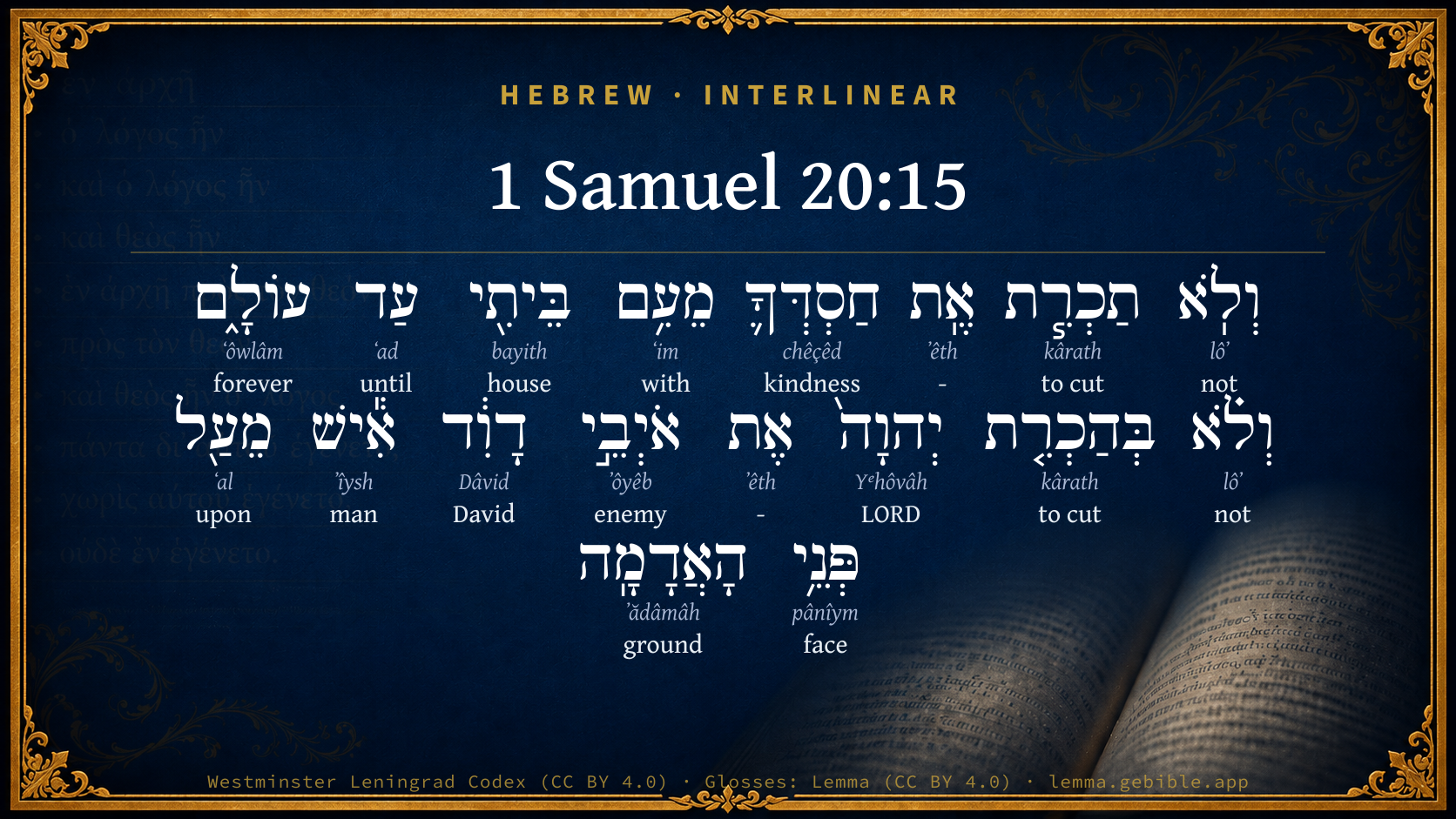
  1. וְלֹֽא lôʼ H3808 “and · not” Conjunction + Particle, Negative
  2. תַכְרִ֧ת kârath H3772 “to cut” Verb, Hiphil, Imperfect, 2nd Person, Masculine, Singular
  3. אֶֽת ʼêth H853 “-” Particle, Direct Object
  4. חַסְדְּךָ֛ chêçêd H2617 “kindness · your” Noun, Common, Masculine, Singular, Construct + Suffix, Personal, 2nd Person, Masculine, Singular
  5. מֵעִ֥ם ʻim H5973 “from · with” Preposition + Preposition
  6. בֵּיתִ֖י bayith H1004 “house · my” Noun, Common, Masculine, Singular, Construct + Suffix, Personal, 1st Person, Common, Singular
  7. עַד ʻad H5704 “until” Preposition
  8. עוֹלָ֑ם ʻôwlâm H5769 “forever” Noun, Common, Masculine, Singular, Absolute
  9. וְלֹ֗א lôʼ H3808 “and · not” Conjunction + Particle, Negative
  10. בְּהַכְרִ֤ת kârath H3772 “in/at · to cut” Preposition + Verb, Hiphil, Infinitive Construct
  11. יְהוָה֙ Yᵉhôvâh H3068 “LORD” Noun, Proper
  12. אֶת ʼêth H853 “-” Particle, Direct Object
  13. אֹיְבֵ֣י ʼôyêb H341 “enemy” Verb, Qal, Participle Active, Masculine, Plural, Construct
  14. דָוִ֔ד Dâvid H1732 “David” Noun, Proper
  15. אִ֕ישׁ ʼîysh H376 “man” Noun, Common, Masculine, Singular, Absolute
  16. מֵעַ֖ל ʻal H5921 “from · upon” Preposition + Preposition
  17. פְּנֵ֥י pânîym H6440 “face(s) of” Noun, Common, Both, Plural, Construct

About this verse

These counts appear in no published source. They are computed here, from the morphology-tagged text and Lemma’s own curated glosses. What Lemma adds →

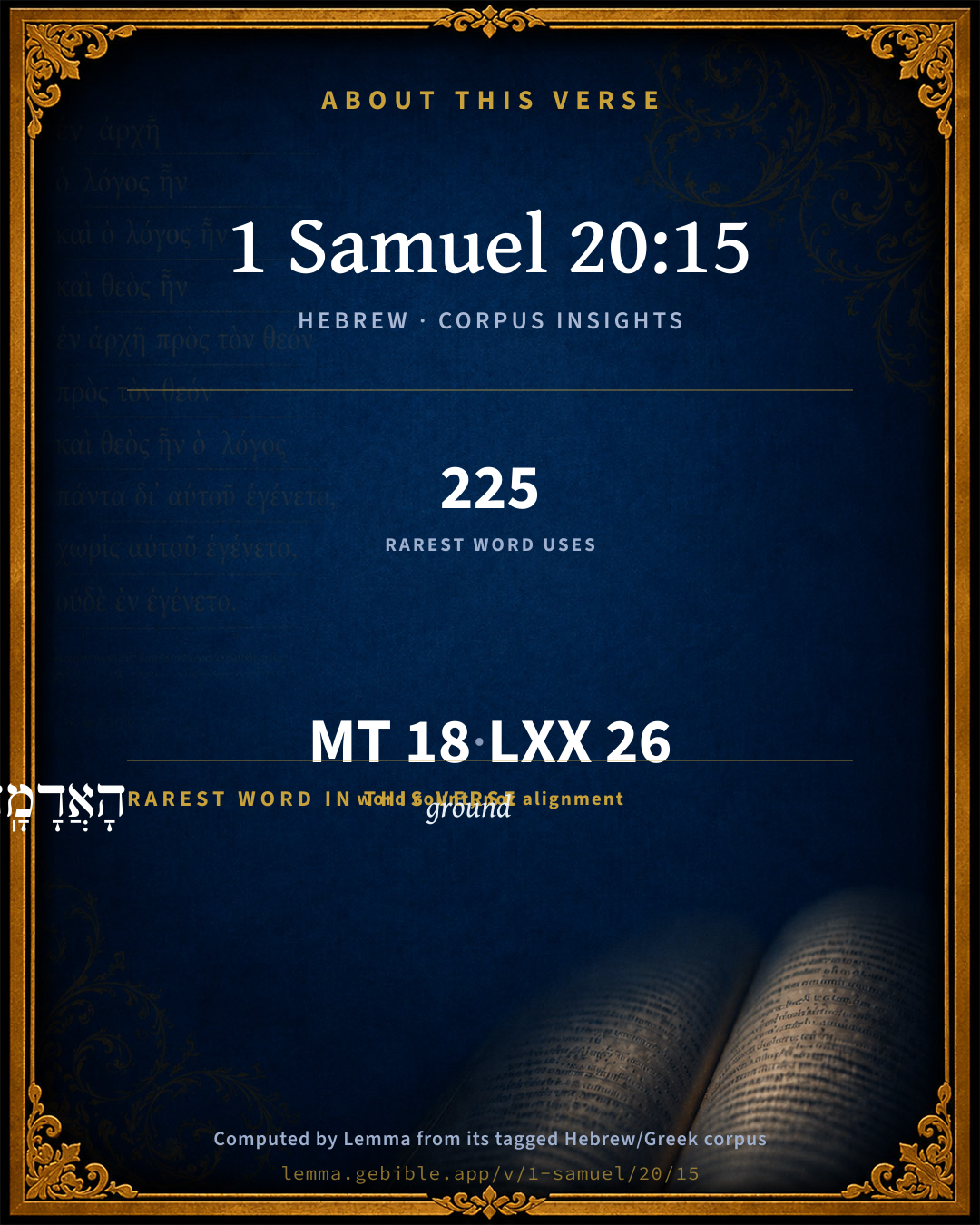
18
words
15
distinct lemmas
Historical
section

Grammatical profile

  • 3 verbs
  • 8 nouns
  • 3 prepositions
  • 4 particles

Verb forms

  • תַכְרִ֧ת Hiphil · Imperfect
  • בְּהַכְרִ֤ת Hiphil · Infinitive Construct
  • אֹיְבֵ֣י Qal · Participle Active

Repetition

Words recur within this verse — often emphatic in Hebrew:

  • תַכְרִ֧ת to cut H3772 ×2
  • וְלֹֽא not H3808 ×2

Hebrew & Septuagint length

In English translation the verse runs 31 words from the Hebrew and 32 from the Septuagint (LXX English) — closely comparable.

A rough comparison of the two English renderings, which tokenize alike — not a word-level alignment.

Word counts can differ between the Hebrew and the Greek without any difference in meaning — e.g. the Hebrew direct-object marker אֵת has no separate Greek word, and Greek often adds the article ὁ.

In the original languages it is 18 Hebrew tokens and 26 Greek tokens — but the two are counted differently (Hebrew bundles its prefixes and suffixes into one token; the Greek is in lemma form), so that isn’t a like-for-like length.

Cross-references

3

Topical passages linked to 1 Samuel 20:15 in the Treasury of Scripture Knowledge — connected by theme and wording, ordered by reader-vote popularity; previews shown in the World English Bible.

  • 2 Samuel 21:7 But the king spared Mephibosheth, the son of Jonathan the son of Saul, because of Yahweh's oath that was between them, between David and Jonathan the son of Saul.
  • 1 Samuel 24:21 Swear now therefore to me by Yahweh, that you will not cut off my seed after me, and that you will not destroy my name out of my father's house.
  • 2 Samuel 9:1–7 David said, Is there yet any who is left of the house of Saul, that I may show him kindness for Jonathan's sake?

Cross-references courtesy of OpenBible.info (CC BY 4.0).

Hebrew and Greek witnesses Masoretic Hebrew ↔ Greek Septuagint

The same verse in the two great witnesses to the Old Testament, shown verse-for-verse.

These are two independent witnesses, not word-aligned to each other, and the Septuagint is shown in lemma (dictionary) form.

Hebrew 1 Samuel 20:15 Masoretic · Westminster Leningrad Codex

וְלֹֽא תַכְרִ֧ת אֶֽת חַסְדְּךָ֛ מֵעִ֥ם בֵּיתִ֖י עַד עוֹלָ֑ם וְלֹ֗א בְּהַכְרִ֤ת יְהוָה֙ אֶת אֹיְבֵ֣י דָוִ֔ד אִ֕ישׁ מֵעַ֖ל פְּנֵ֥י הָאֲדָמָֽה

but also you shall not cut off your kindness from my house forever; no, not when Yahweh has cut off the enemies of David everyone from the surface of the earth.

World English Bible · Public Domain

Greek LXX 1 Samuel 20:15 Septuagint · lemma form

οὐ ἐκαἴρω ἔλεος σύ ἀπό ὁ οἶκος ἐγώ ἕως ὁ αἰών καί εἰ μή ἐν ὁ ἐκαἴρω κύριος ὁ ἐχθρός δαυίδ ἕκαστος ἀπό πρόσωπον ὁ γῆ

you shall not withdraw your mercy from my house for ever: and if you do not, when the Lord cuts off the enemies of David each from the face of the earth,

LXX2012 (modern English Septuagint) · Public Domain

Hebrew: Westminster Leningrad Codex (CC BY 4.0). Greek: Septuagint (public domain); English from LXX2012 (modern English Septuagint) (Public Domain). How the Septuagint differs from the Hebrew →

Targum (Aramaic paraphrase)

1

The Targum is the ancient Jewish Aramaic paraphrase of the Hebrew Scriptures — an interpretive translation, not the Hebrew text itself. Onkelos (literal) and Pseudo-Jonathan (expansive) render the Torah, and Jonathan the Prophets. Coverage is partial: where no permissively-licensed English translation exists for a verse, only the Aramaic is shown. This is verse-level text, not a word-by-word alignment to the Hebrew.

  1. Targum Jonathan Prophets (Joshua–Malachi)
    וְלָא תַפְסִיק יַת טִיבוּתָךְ מִן אֱנַשׁ בֵּיתִי עַד עַלְמָא וְלָא כַּד שֵׁיצֵי יְיָ יַת סַנְאֵי דָוִד גְבַר מֵעַל אַפֵּי אַרְעָא:

    (no public-domain English translation for this verse)

    Targum Jonathan — Aramaic: “Mikraot Gedolot” (public domain). English: “Sefaria Community Translation” (CC0 1.0 (public-domain dedication)); “London "Chaldee Paraphrase," 1871” (public domain). Text via Sefaria.

Commentary

Notes on 1 Samuel 20:15 from classic Christian and Jewish commentators (each source and its license shown beneath its notes). The classic Christian expositions comment on the surrounding passage and are grouped to its opening verse, so a note may address several verses; the Jewish commentaries on the Tanakh (Rashi and others) are per-verse, so they appear only where the commentator wrote on this verse.

Lemma curates 59 commentaries, every one of them public domain or Creative Commons licensed, each selected and text-cleaned for this edition rather than reprinted as found. About our sources →

Trapp's Complete Commentary

John Trapp

1Sa 20:15 But [also] thou shalt not cut off thy kindness from my house for ever: no, not when the LORD hath cut off the enemies of David every one from the face of the earth.

Ver. 15. No, not when the Lord hath cut off,] i.e., When thou art in thy greatest power, and hast none to oppose thee. Jonathan looked upon David as his greatest under, - as king of Israel; so did the penitent thief upon Christ. {Luk 23:42}

John Trapp, A Commentary or Exposition upon All the Books of the Old and New Testament (1647–1656) — public domain. Text from a community e-Sword module.

Joseph Benson's Commentary

1Sa 20:15. Thou shalt not cut off thy kindness from my house — The covenant they had made was not merely personal, but reached to their posterity, and was to be kept even when David should have the greatest power, and there were none to oppose his will. These verses seem strongly to indicate that Jonathan knew of David’s being anointed to the kingdom! How unspeakable a generosity is here shown by Jonathan to stipulate for his own life, and the lives of his posterity, with that man whose life, humanly speaking, was now in his power!

Joseph Benson's Commentary on the Old and New Testaments (1811–1818) — public domain. Text from a community e-Sword module.

Tyndale Open Study Notes

Tyndale Open Resources

20:15 treat my family: David later treated Jonathan’s son, Mephibosheth, as one of his own sons (2 Sam 9:1-13).

Tyndale Open Study Notes — © Tyndale Open Resources, licensed CC BY-SA 4.0. Text via the HelloAO Bible API.

John Gill's Exposition

But also thou shalt not cut off thy kindness from my house for ever,.... His family should partake of it as well as himself:

no, not when the Lord hath cut off the enemies of David, everyone from the face of the earth; Saul and his sons, and everyone that should oppose his settlement in the kingdom: Jonathan's meaning is, that the covenant between them should not be only between them personally, but include their posterity, as follows.

John Gill's Exposition of the Whole Bible (1746–1763) — public domain (CC PDM 1.0). Text via the HelloAO Bible API.

Haydock's Catholic Bible Commentary

May he. It is a curse upon himself, if he should not be faithful to his promise. --- It. That is, revenge it upon David’s enemies, and upon me, if I shall fail of my word given to him. (Challoner) --- The Hebrew and several Latin manuscripts stop at earth; and what follows, is not found in some Greek and Latin editions. (Calmet) --- Enemies. May God punish David’s enemies, and me among the rest. (Menochius)

George Leo Haydock (1774–1849), Haydock's Catholic Family Bible and Commentary, 1859 edition — public domain. Excludes Psalms (Douay-Rheims chapter numbering differs from Protestant) and Deuterocanonical books (Catholic canon only).

Matthew Poole's English Annotations

Thy kindness; he saith not, the kindness of the Lord, as before, because the covenant between them seem to have been only personal, and not comprehending their posterity. And therefore as Jonathan speaks confidently of his own preservation by virtue of that covenant; so he here lays this additional obligation upon David, that he would extend his kindness to all his progeny.

When the Lord hath cut off the enemies of David; which he will certainly do without exception of Saul my father, and those of his children who have joined, or shall join, with him in his hostilities and cruelties against David. And by this word

enemies he implies the reasonableness of his request, because Jonathan was none of that number, and therefore not to be treated as such.

Matthew Poole's English Annotations on the Holy Bible (1683–1685) — public domain. Text from a community e-Sword/MySword module.

Rashi

Rabbi Shlomo Yitzchaki (Rashi)

Not even when Adonoy cuts off. And also, you will not remove your kindness from them even when retribution befalls my father's house, for I know that God will cut off your enemies.

Rashi on the Tanakh — English translations: “The Judaica Press complete Tanach with Rashi, translated by A. J. Rosenberg” (CC BY 4.0); “Pentateuch with Rashi's commentary by M. Rosenbaum and A.M. Silbermann, 1929-1934” (public domain); “The Metsudah Tanach series, Lakewood, N.J” (CC BY 4.0); and “The Book of Joshua, Metsudah Publications, 1997” (CC BY 4.0). Text via Sefaria.

Lesson kit

Teaching starters — assembled from the data on this page, not authored interpretation. Every prompt links to the verse data it draws on. Edit before teaching.

1 Samuel, in the Historical, opens this verse with 18 words (15 distinct Hebrew lemmas). Its most distinctive word is ʼădâmâh (“ground”). A historical commentator’s framing appears above. Read the whole chapter for the surrounding context.

Discussion questions

  1. What does “ground” (ʼădâmâh) contribute to the verse as a whole?
  2. 2 Samuel 21:7 shares this passage’s theme. How do the two illuminate each other?
  3. “to cut” occurs 2× in this one verse. What is the effect of the repetition?
  4. The translations on this page render this verse differently — a whole-verse word diff, not a word-by-word alignment. What might account for the different wordings?
  5. The verb «תַכְרִ֧ת» is Hiphil Imperfect. How does its form color the action?
  6. Reading how Trapp's Complete Commentary and Joseph Benson's Commentary read this verse, where do the two commentators agree and where do they part?

Things to notice

Reading settings

Reading text

Shown beneath each verse's original-language words.

Old Testament
Old Testament edition

Read the OT as the Masoretic Hebrew (MT) or the Greek Septuagint (LXX).

English shown for the Greek Septuagint (in the Hebrew ↔ Greek comparison).

Comparing translations? Open the Compare panel on any verse page to stack up to four side by side.