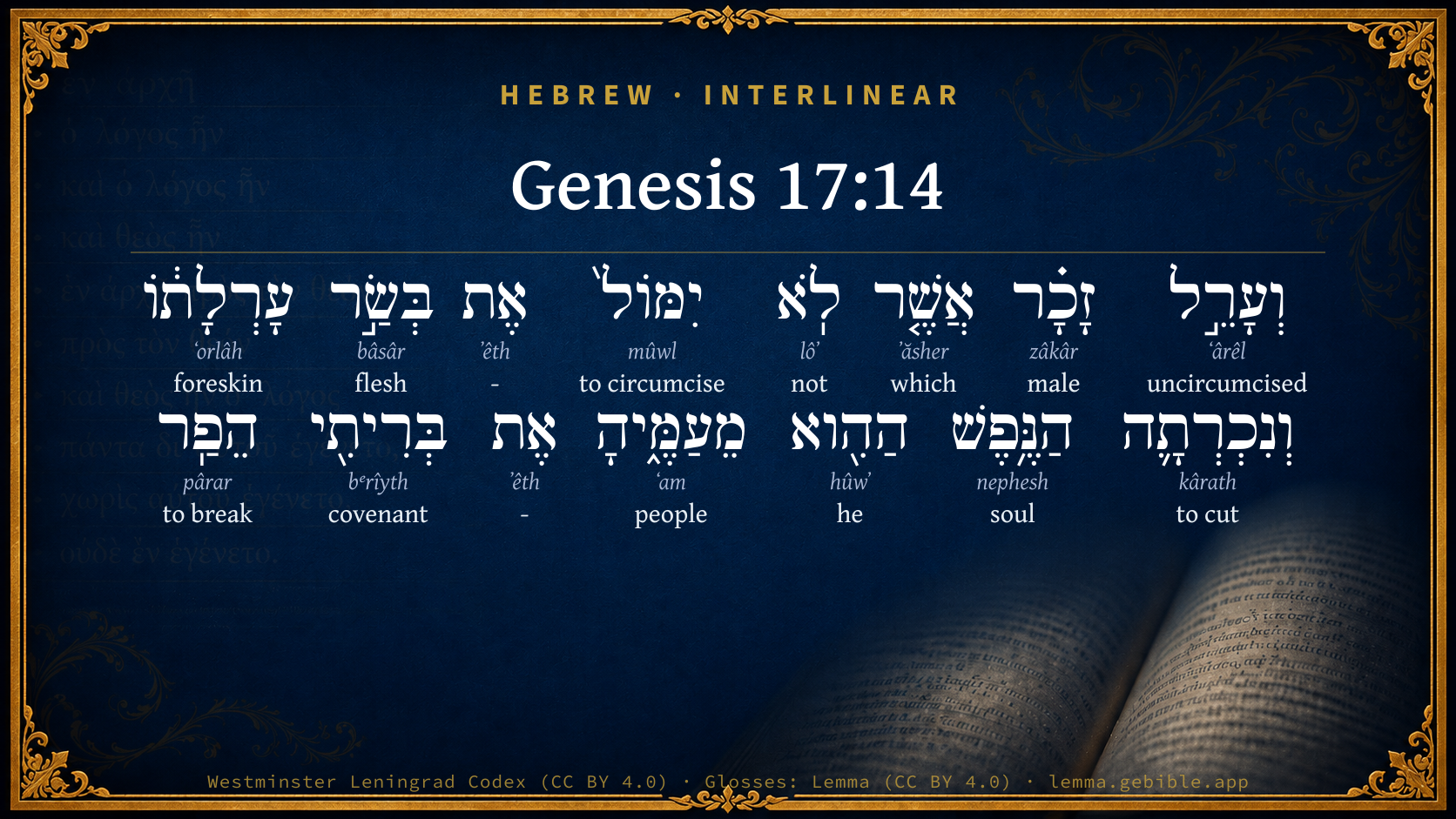
Genesis 17:14

Hebrew (Westminster Leningrad Codex) Genesis 17:14 appears in the Hebrew Old Testament. The text above is from the Westminster Leningrad Codex. Each word links to its Strong’s number, a concise gloss, and parsing drawn from the Open Scriptures Hebrew Bible morphology. Click any word for its full Brown-Driver-Briggs (BDB) entry.
Download image
Cite this verse

Genesis 17:14 (World English Bible). Public Domain. Lemma interlinear Bible study tool, https://lemma.gebible.app/v/genesis/17/14.

Show BibTeX & RIS
BibTeX
RIS
English Translation
The uncircumcised male who is not circumcised in the flesh of his foreskin, that soul shall be cut off from his people. He has broken my covenant."
World English Bible · Public Domain
Highlights
  • 2 first appearances in the Hebrew Bible
Full analysis ↓
Download a study sheet

One document with this verse’s original text, its word-by-word gloss line, the meaning frame, cross-references with their text, attributed commentary, and full source and license credits — printable, and it pastes into notes with its structure intact.

This verse Autodidact and up

Study sheet (.html) Plain text (.txt)

A passage Seminary Student

Up to 50 verses in one chapter. A passage sheet keeps up to 6 commentary sources and 12 cross-references per verse, in the order this page ranks them, and says so on the sheet whenever that leaves anything out. Ask for a single verse and you get the Autodidact verse sheet above.

Everything on this page stays free to read, with no account — the sheet is a download of what is already on screen, not access to it.

Want to remove ads? Support Godless Engineer
Compare translations 3

The same verse in 3 English versions, stacked beneath the original-language interlinear above. Click any original word for its lexicon entry.

Each is an independent rendering of the whole verse — the interlinear is not word-aligned to these translations.

Highlighted words mark where these versions differ — a whole-verse word diff, not a word-by-word alignment.

  • World English Bible Public Domain
    The uncircumcised male who is not circumcised in the flesh of his foreskin, that soul shall be cut off from his people. He has broken my covenant."
  • King James Version Public Domain
    And the uncircumcised man child whose flesh of his foreskin is not circumcised, that soul shall be cut off from his people; he hath broken my covenant.
  • unfoldingWord Literal Text CC BY-SA 4.0
    And an uncircumcised male who is not circumcised in the flesh of his foreskin, indeed that person must be cut off from his people; he has broken my covenant.”

unfoldingWord Literal Text — © unfoldingWord, licensed CC BY-SA 4.0. Word-aligned USFM3 via Door43 (git.door43.org/unfoldingWord/en_ult).

Versions to compare (up to 4)

3 of 4 selected

Show all 18 translations

Every available English version of this verse, each an independent rendering of the whole verse.

  • World English Bible Public Domain
    The uncircumcised male who is not circumcised in the flesh of his foreskin, that soul shall be cut off from his people. He has broken my covenant."
  • Berean Standard Bible Public Domain
    But if any male is not circumcised, he will be cut off from his people; he has broken My covenant.”
  • Majority Standard Bible Public Domain
    But if any male is not circumcised, he will be cut off from his people; he has broken My covenant.”
  • King James Version Public Domain
    And the uncircumcised man child whose flesh of his foreskin is not circumcised, that soul shall be cut off from his people; he hath broken my covenant.
  • American Standard Version (1901) Public Domain
    And the uncircumcised male who is not circumcised in the flesh of his foreskin, that soul shall be cut off from his people; he hath broken my covenant.
  • Revised Version (1885) Public Domain
    And the uncircumcised male who is not circumcised in the flesh of his foreskin, that soul shall be cut off from his people; he hath broken my covenant.
  • Geneva Bible (1599) Public Domain
    But the vncircumcised man childe, in whose flesh the foreskin is not circumcised, euen that person shall be cut off from his people, because he hath broken my couenant.
  • Douay-Rheims (1899) Public Domain
    The male, whose dash of his foreskin shall not be circumcised, that soul shall be destroyed out of his people: because he hath broken my covenant.
  • Young's Literal Translation Public Domain
    and an uncircumcised one, a male, the flesh of whose foreskin is not circumcised, even that person hath been cut off from his people; My covenant he hath broken.'
  • Literal Standard Version CC BY-SA 4.0
    and an uncircumcised one, a male, the flesh of whose foreskin is not circumcised, indeed, that person has been cut off from his people; My covenant he has broken.”
  • Unlocked Literal Bible CC BY-SA 4.0
    Any uncircumcised male who is not circumcised in the flesh of his foreskin will be cut off from his people. He has broken my covenant.”
  • unfoldingWord Literal Text CC BY-SA 4.0
    And an uncircumcised male who is not circumcised in the flesh of his foreskin, indeed that person must be cut off from his people; he has broken my covenant.”
  • Darby Bible Public Domain
    And the uncircumcised male who hath not been circumcised in the flesh of his foreskin, that soul shall be cut off from his peoples: he hath broken my covenant.
  • World Messianic Bible Public Domain
    The uncircumcised male who is not circumcised in the flesh of his foreskin, that soul shall be cut off from his people. He has broken my covenant.”
  • Webster's Bible Public Domain
    And the uncircumcised male-child, whose flesh of his foreskin is not circumcised, that soul shall be cut off from his people; he hath broken my covenant.
  • Free Bible Version CC BY-SA 4.0
    Any uncircumcised male who refuses circumcision will be excluded from his people because he has broken my agreement.”
  • Bible in Basic English Public Domain
    And any male who does not undergo circumcision will be cut off from his people: my agreement has been broken by him.
  • JPS Tanakh (1917) Public Domain
    And the uncircumcised male who is not circumcised in the flesh of his foreskin, that soul shall be cut off from his people; he hath broken My covenant.'

Literal Standard Version (2020), Covenant Press — licensed CC BY-SA 4.0. Text via the HelloAO Bible API (eBible.org). Unlocked Literal Bible (unfoldingWord) — licensed CC BY-SA 4.0. Text via the HelloAO Bible API (eBible.org). unfoldingWord Literal Text — © unfoldingWord, licensed CC BY-SA 4.0. Word-aligned USFM3 via Door43 (git.door43.org/unfoldingWord/en_ult). Free Bible Version, Dr. Jonathan Gallagher — licensed CC BY-SA 4.0. Text via the HelloAO Bible API (eBible.org).

Word by word

More ways to search: Search by grammar → Find every occurrence → Compare this word →

Practice this passage: Drill this verse → Learn its vocabulary →

עָרְלָת֔וֹ
ʻorlâh
H6190
“foreskin · his”
Noun, Common, Feminine, Singular, Construct + Suffix, Personal, 3rd Person, Masculine, Singular
Part of Speech
Noun
Type
Common
Gender
Feminine
Number
Singular
State
Construct
Full BDB Definition

Origin: from H6189

TWOT: 1695a

foreskin, uncircumcised
  1. וְעָרֵ֣ל ʻârêl H6189 “and · uncircumcised” Conjunction + Adjective, Adjective, Masculine, Singular, Absolute
  2. זָכָ֗ר zâkâr H2145 “male” Adjective, Adjective, Masculine, Singular, Absolute
  3. אֲשֶׁ֤ר ʼăsher H834 “which” Particle, Relative
  4. לֹֽא lôʼ H3808 “not” Particle, Negative
  5. יִמּוֹל֙ mûwl H4135 “to circumcise” Verb, Niphal, Imperfect, 3rd Person, Masculine, Singular
  6. אֶת ʼêth H853 “-” Particle, Direct Object
  7. בְּשַׂ֣ר bâsâr H1320 “flesh of” Noun, Common, Masculine, Singular, Construct
  8. וְנִכְרְתָ֛ה kârath H3772 “and · to cut” Conjunction + Verb, Niphal, Sequential Perfect, 3rd Person, Feminine, Singular
  9. הַנֶּ֥פֶשׁ nephesh H5315 “the · soul” Particle, Definite Article + Noun, Common, Both, Singular, Absolute
  10. הַהִ֖וא hûwʼ H1931 “the · he” Particle, Definite Article + Pronoun, Personal, 3rd Person, Feminine, Singular
  11. מֵעַמֶּ֑יהָ ʻam H5971 “from · peoples · her” Preposition + Noun, Common, Masculine, Plural, Construct + Suffix, Personal, 3rd Person, Feminine, Singular
  12. אֶת ʼêth H853 “-” Particle, Direct Object
  13. בְּרִיתִ֖י bᵉrîyth H1285 “covenant · my” Noun, Common, Feminine, Singular, Construct + Suffix, Personal, 1st Person, Common, Singular
  14. הֵפַֽר pârar H6565 “to break” Verb, Hiphil, Perfect, 3rd Person, Masculine, Singular

About this verse

These counts appear in no published source. They are computed here, from the morphology-tagged text and Lemma’s own curated glosses. What Lemma adds →

15
words
14
distinct lemmas
Pentateuch
section

Notable vocabulary

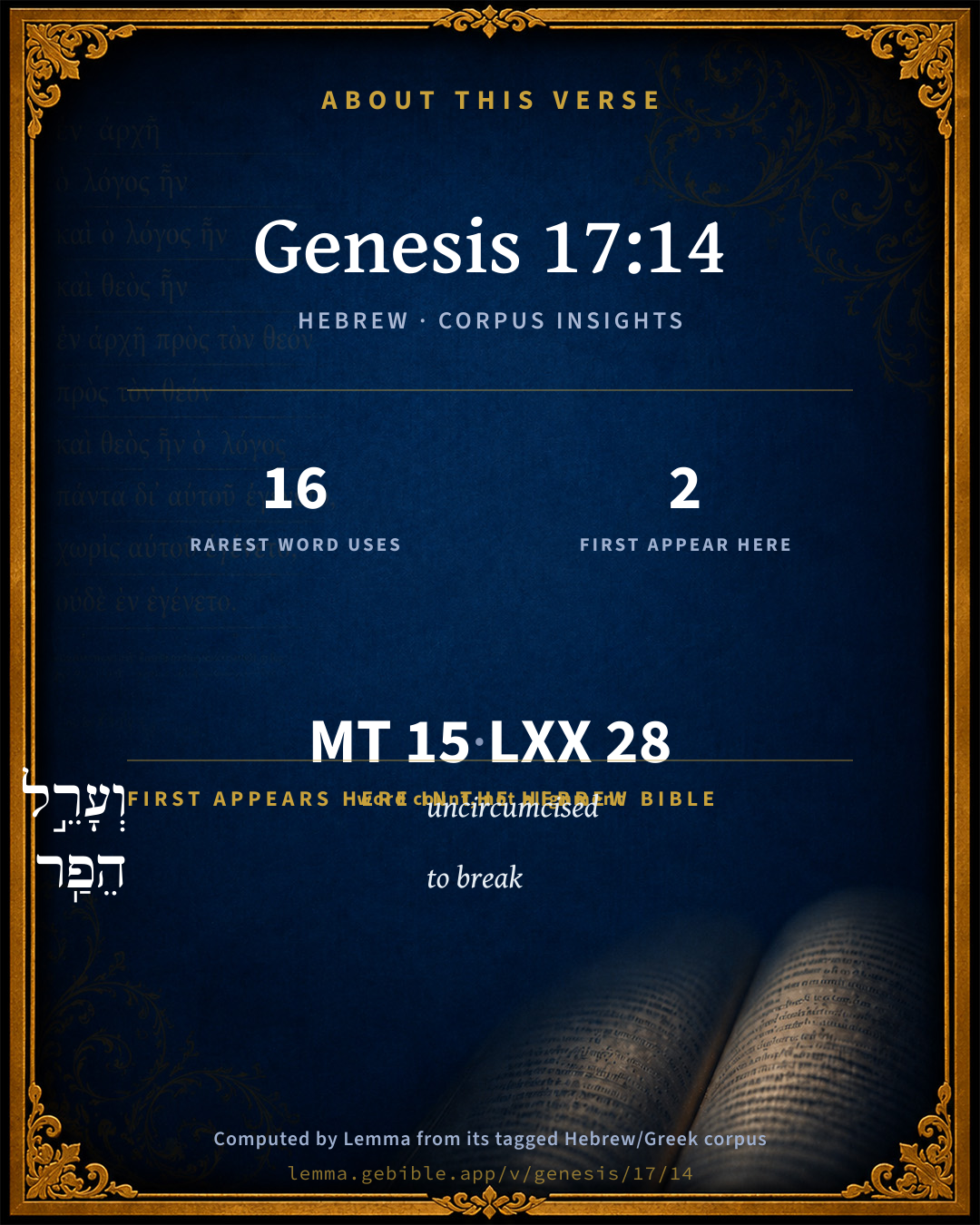
The rarest word here is עָרְלָת֔וֹ foreskin H6190 — appearing just 16 times in the whole Hebrew Bible.

First appearance in Scripture

These words make their first canonical appearance in the Hebrew Bible here:

  • וְעָרֵ֣ל uncircumcised H6189
  • הֵפַֽר to break H6565

Shared distinctive vocabulary

עָרְלָת֔וֹ foreskin H6190 occurs in 16 verses of the Hebrew Bible. Also found in:

Grammatical profile

  • 3 verbs
  • 5 nouns
  • 2 adjectives
  • 1 pronoun
  • 4 particles

Verb forms

  • יִמּוֹל֙ Niphal · Imperfect
  • וְנִכְרְתָ֛ה Niphal · Sequential Perfect
  • הֵפַֽר Hiphil · Perfect

Hebrew & Septuagint length

In English translation the verse runs 27 words from the Hebrew and 34 from the Septuagint (LXX English) — closely comparable.

A rough comparison of the two English renderings, which tokenize alike — not a word-level alignment.

Word counts can differ between the Hebrew and the Greek without any difference in meaning — e.g. the Hebrew direct-object marker אֵת has no separate Greek word, and Greek often adds the article ὁ.

In the original languages it is 15 Hebrew tokens and 28 Greek tokens — but the two are counted differently (Hebrew bundles its prefixes and suffixes into one token; the Greek is in lemma form), so that isn’t a like-for-like length.

Cross-references

19

Topical passages linked to Genesis 17:14 in the Treasury of Scripture Knowledge — connected by theme and wording, ordered by reader-vote popularity; previews shown in the World English Bible.

  • Exodus 4:24–26 It happened on the way at a lodging place, that Yahweh met him and wanted to kill him.
  • Exodus 12:19 Seven days shall there be no yeast found in your houses, for whoever eats that which is leavened, that soul shall be cut off from the congregation of Israel, whether he be a foreigner, or one who is born in the land.
  • Numbers 15:30–31 But the soul who does anything with a high hand, whether he is home-born or a foreigner, the same blasphemes Yahweh; and that soul shall be cut off from among his people.
  • Exodus 12:15 Seven days shall you eat unleavened bread; even the first day you shall put away yeast out of your houses, for whoever eats leavened bread from the first day until the seventh day, that soul shall be cut off from Israel.
  • Exodus 30:33 Whoever compounds any like it, or whoever puts any of it on a stranger, he shall be cut off from his people.'"
  • Exodus 30:38 Whoever shall make any like that, to smell of it, he shall be cut off from his people."
  • Leviticus 7:20–21 but the soul who eats of the flesh of the sacrifice of peace offerings, that belongs to Yahweh, having his uncleanness on him, that soul shall be cut off from his people.
  • Leviticus 7:25 For whoever eats the fat of the animal, of which men offer an offering made by fire to Yahweh, even the soul who eats it shall be cut off from his people.
  • Leviticus 7:27 Whoever it is who eats any blood, that soul shall be cut off from his people.'"
  • Leviticus 18:29 "'For whoever shall do any of these abominations, even the souls that do them shall be cut off from among their people.
  • Leviticus 19:8 but everyone who eats it shall bear his iniquity, because he has profaned the holy thing of Yahweh, and that soul shall be cut off from his people.
  • Psalms 55:20 He raises his hands against his friends. He has violated his covenant.
  • Isaiah 24:5 The earth also is polluted under the inhabitants of it; because they have transgressed the laws, violated the statutes, broken the everlasting covenant.
  • Isaiah 33:8 The highways lie waste, the wayfaring man ceases: [the enemy] has broken the covenant, he has despised the cities, he doesn't regard man.
  • Jeremiah 11:10 They are turned back to the iniquities of their forefathers, who refused to hear my words; and they are gone after other gods to serve them: the house of Israel and the house of Judah have broken my covenant which I made with their fathers.
  • Jeremiah 31:32 not according to the covenant that I made with their fathers in the day that I took them by the hand to bring them out of the land of Egypt; which my covenant they broke, although I was a husband to them, says Yahweh.
  • 1 Corinthians 11:27 Therefore whoever eats this bread or drinks the Lord's cup in a manner unworthy of the Lord will be guilty of the body and the blood of the Lord.
  • 1 Corinthians 11:29 For he who eats and drinks in an unworthy manner eats and drinks judgment to himself, if he doesn't discern the Lord's body.
  • Joshua 5:2–12 At that time Yahweh said to Joshua, Make you flint knives, and circumcise again the children of Israel the second time.

Cross-references courtesy of OpenBible.info (CC BY 4.0).

Hebrew and Greek witnesses Masoretic Hebrew ↔ Greek Septuagint

The same verse in the two great witnesses to the Old Testament, shown verse-for-verse.

These are two independent witnesses, not word-aligned to each other, and the Septuagint is shown in lemma (dictionary) form.

Hebrew Genesis 17:14 Masoretic · Westminster Leningrad Codex

וְעָרֵ֣ל זָכָ֗ר אֲשֶׁ֤ר לֹֽא יִמּוֹל֙ אֶת בְּשַׂ֣ר עָרְלָת֔וֹ וְנִכְרְתָ֛ה הַנֶּ֥פֶשׁ הַהִ֖וא מֵעַמֶּ֑יהָ אֶת בְּרִיתִ֖י הֵפַֽר

The uncircumcised male who is not circumcised in the flesh of his foreskin, that soul shall be cut off from his people. He has broken my covenant."

World English Bible · Public Domain

Greek LXX Genesis 17:14 Septuagint · lemma form

καί ἀπερίτμητος ἄρσην ὅς οὐ περιτέμνω ὁ σάρξ ὁ ἀκροβυστία αὐτός ὁ ἡμέρα ὁ ὄγδοος ἐκὀλεθρεύω ὁ ψυχή ἐκεῖνος ἐκ ὁ γένος αὐτός ὅτι ὁ διαθήκη ἐγώ διασκεδάζω

And the uncircumcised male, who shall not be circumcised in the flesh of his foreskin on the eighth day, that soul shall be utterly destroyed from its family, for he has broken my covenant.

LXX2012 (modern English Septuagint) · Public Domain

On this verse, Haydock's Catholic Bible Commentary discusses the Septuagint’s reading. Read the note in Commentary ↓

Hebrew: Westminster Leningrad Codex (CC BY 4.0). Greek: Septuagint (public domain); English from LXX2012 (modern English Septuagint) (Public Domain). How the Septuagint differs from the Hebrew →

Targum (Aramaic paraphrase)

2

The Targum is the ancient Jewish Aramaic paraphrase of the Hebrew Scriptures — an interpretive translation, not the Hebrew text itself. Onkelos (literal) and Pseudo-Jonathan (expansive) render the Torah, and Jonathan the Prophets. Coverage is partial: where no permissively-licensed English translation exists for a verse, only the Aramaic is shown. This is verse-level text, not a word-by-word alignment to the Hebrew.

  1. Targum Onkelos Torah (Genesis–Deuteronomy)
    וְעָרֵל דְכוּרָא דִי לָא יִגְזַר יָת בְּשַׂר עָרְלָתֵהּ וְיִשְׁתֵּיצֵי אֱנָשָׁא הַהוּא מֵעַמֵּיהּ יָת קְיָמִי אַשְׁנִי

    (no public-domain English translation for this verse)

    Targum Onkelos — Aramaic: “Onkelos Genesis” (public domain); “Onkelos Exodus” (public domain); “Onkelos Leviticus” (public domain); “Onkelos Numbers” (public domain); “Onkelos Deuteronomy” (public domain). English: “Sefaria Community Translation” (CC0 1.0 (public-domain dedication)); “J.W. Etheridge. The Targums of Onkelos and Jonathan Ben Uzziel on the Pentateuch. London: Longmans, Green, 1862” (public domain). Text via Sefaria.

  2. Targum Pseudo-Jonathan Torah (Genesis–Deuteronomy)
    וְעַרְלָאָה דְכוּרָאָה דְלָא יִגְזַר יַת בִּשְרָא דְעוּרְלָתֵיהּ וְאִין לֵית לֵיהּ מַאן דְיִגְזַר וְיִשְׁתְּצֵי בַּר נְשָׁא הַהוּא מֵעַמֵיהּ יַת קְיָימֵי אַשְׁנִי

    And the uncircumcised male who is not circumcised in the flesh of his foreskin, unless he have some one to circumcise him, that man shall be cut off from his people; he hath made My covenant to pass away.

    Targum Pseudo-Jonathan — Aramaic: “Targum Jonathan on Genesis” (public domain); “Targum Jonathan on Exodus” (public domain); “Targum Jonathan on Leviticus” (public domain); “Targum Jonathan on Numbers” (public domain); “Targum Jonathan on Deuteronomy” (public domain). English: “The Targum of Jonathan ben Uzziel, trans. J. W. Etheridge, London, 1862” (public domain). Text via Sefaria.

Commentary

Notes on Genesis 17:14 from classic Christian and Jewish commentators (each source and its license shown beneath its notes). The classic Christian expositions comment on the surrounding passage and are grouped to its opening verse, so a note may address several verses; the Jewish commentaries on the Tanakh (Rashi and others) are per-verse, so they appear only where the commentator wrote on this verse.

Lemma curates 59 commentaries, every one of them public domain or Creative Commons licensed, each selected and text-cleaned for this edition rather than reprinted as found. About our sources →

Ellicott's Commentary for English Readers

(14) Shall be cut off from his people.—Jewish commentators generally consider that this penalty consisted in the offender being left to the direct interposition of God, who would punish him with childlessness and premature death (Talmud: Tract Yebam, 55). Most Christian commentators suppose that the offender was to be put to death by the civil magistrate; but this view is untenable. For a distinction is constantly drawn between the penalty of death, and the being “cut off from among the people,” as, for instance, in Leviticus 20. So, too, the killing of a clean beast anywhere, except at the door of the tabernacle (Lev_17:4), and the eating of blood (Lev_17:9; Lev_17:14), are to be thus dealt with, while blasphemy and murder are to be punished with death (Lev_24:16-17). Now it became very common to kill clean beasts in all parts of the land, and the eating of blood, though regarded with horror (1Sa_14:32-34), apparently had no penalty attached to it. The Jewish commentators seem to err only in being too special, and in defining the method in which God would punish. The punishment really seems to have been that of excommunication or outlawry, to which other penalties might have been attached by custom: but the main point was that one uncircumcised (as subsequently one who violated the principles of the Mosaic law) forfeited his privileges as a member of the Jewish nation, could claim no protection from the elders for life and property, and could not take his place at the gate of the city.

A Bible Commentary for English Readers, edited by Charles John Ellicott (1878–1897) — public domain. Text from a community e-Sword module.

Trapp's Complete Commentary

John Trapp

Gen 17:14 And the uncircumcised man child whose flesh of his foreskin is not circumcised, that soul shall be cut off from his people; he hath broken my covenant.

Ver. 14. That soul shall be cut off.] From the commonwealth of Israel; so shall those be from benefit by Christ, that are uncircumcised in heart; as hateful to him as Goliath was to David. Pray, therefore, that God will thrust his holy hand into thy bosom, and pull off that abominable foreskin. He had much ado to forbear Moses, when he met him in the inn; and we know why. {Exo 4:24-25}

John Trapp, A Commentary or Exposition upon All the Books of the Old and New Testament (1647–1656) — public domain. Text from a community e-Sword module.

Tyndale Open Study Notes

Tyndale Open Resources

17:14 will be cut off: This punishment seems to have several applications. A person could be exiled from society or put to death by the community; most often it warned that a person might die prematurely as God cut him off from the land of the living (see Exod 31:14; Lev 7:20-27; 17:3-4; 20:17-18; 23:28-29; Num 15:30-31; see also Ps 31:22; Ezek 21:4; Rom 9:3; 11:22). Failure to be circumcised was a serious violation (see Exod 4:24-26; cp. Gal 5:2-4).

Tyndale Open Study Notes — © Tyndale Open Resources, licensed CC BY-SA 4.0. Text via the HelloAO Bible API.

Geneva Bible (1599)

Geneva Bible translators

Albeit women were not circumcised, yet were they partakers of God’s promise: for under the mankind all was consecrated, and here is declared, that whosoever contemneth the sign, despiseth also the promise.

Geneva Bible (1599) marginal notes — public domain. Text via Bolls.life.

Adam Clarke's Commentary

Verse 14. The uncircumcised - shall be cut off from his people] By being cut off some have imagined that a sudden temporal death was implied; but the simple meaning seems to be that such should have no right to nor share in the blessings of the covenant, which we have already seen were both of a temporal and spiritual kind; and if so, then eternal death was implied, for it was impossible for a person who had not received the spiritual purification to enter into eternal glory. The spirit of this law extends to all ages, dispensations, and people; he whose heart is not purified from sin cannot enter into the kingdom of God. Reader, on what is thy hope of heaven founded?

Adam Clarke's Commentary on the Bible (1810–1826) — public domain. Text from a community e-Sword/MySword module.

John Calvin's Commentaries

14. And the uncircumcised man-child In order that circumcision might be the more attended to, God denounces a severe punishment on any one who should neglect it. And as this shows God’s great care for the salvation of men; so, on the other hand, it rebukes their negligence. For since God thus benignantly offers a pledge of his love, and of eternal life, for what purpose does he add threatening but to rouse the sluggishness of those whose duty it is to run with diligence? Therefore, this denunciation of punishment virtually charges men with foul ingratitude, because they either reject or despise the grace of God. The passage however teaches, that such contempt shall not pass unpunished. And since God threatens punishment only to despisers, we infer that the uncircumcision of children would do them no harm, if they died before the eighth day. For the bare promise of God was effectual to their salvation. He did not so attest this salvation by external signs, as to restrict his own effectual working to those signs. Moses, indeed, sets aside all controversy on this subject, by adducing as a reason, that they would make void the covenant of God: for we know, that the covenant was not violated, when the power of keeping it was taken away. Let us then consider, that the salvation of the race of Abraham was included in that expression, ‘I will be a God to thy seed.’ And although circumcision was added as a confirmation, it nevertheless did not deprive the word of its force and efficacy. But because it is not in the power of man to sever what God has joined together; no one could despise or neglect the sign, without both rejecting the word itself; and depriving himself of the benefit therein offered. And therefore the Lord punished bare neglect with such severity. But if any infants were deprived by death of the tokens of salvation, he spared them, because they had done nothing derogatory to the covenant of God. The same reasoning is at this day in force respecting baptism. Whoever, having neglected baptism, feigns himself to be contented with the bare promise, tramples, as much as in him lies, upon the blood of Christ, or at least does not suffer it to flow for the washing of his own children. Therefore, just punishment follows the contempt of the sign, in the privation of grace; because, by an impious severance of the sign and the word, or rather by a laceration of them, the covenant of God is violated. To consign to destruction those infants, whom a sudden death has not allowed to be presented for baptism, before any neglect of parents could intervene, is a cruelty originating in superstition. But that the promise belongs to such children, is not in the least doubtful. For what can be more absurd than that the symbol, which is added for the sake of confirming the promise, should really enervate its force? Wherefore, the common opinion, by which baptism is supposed to be necessary to salvation, ought to be so moderated, that it should not bind the grace of Gods or the power of the Spirit, to external symbols, and bring against God a charge of falsehood.

He hath broken my covenant For the covenant of God is ratified, when by faith we embrace what he promises. Should any one object, that infants were guiltless of this fault, because they hitherto were destitute of reason: I answer, we ought not to press this divine declaration too closely, as if God held the infants as chargeable with a fault of their own: but we must observe the antithesis, that as God adopts the infant son in the person of his father, so when the father repudiates such a benefit, the infant is said to cut himself off from the Church. For the meaning of the expression is this, ‘He shall be blotted out from the people whom God had chosen to himself’. The explanation of some, that they who remained in uncircumcision would not be Jews, and would have no place in the census of that people, is too frigid. We must go farther, and say, that God, indeed, will not acknowledge those as among his people, who will not bear the mark and token of adoption.

John Calvin's Commentaries (1540-1563) — public domain. Text from the Calvin Translation Society English edition (1840s-50s) via the Christian Classics Ethereal Library (ccel.org). Calvin's coverage is partial (roughly two-thirds of the Bible); uncommented books and verses are honest gaps, never fabricated. The 19th-century editor's footnotes and remarks are omitted so the notes are faithfully Calvin's own voice.

The Cambridge Bible for Schools and Colleges

gen. ed. J. J. S. Perowne

14. shall be cut off] The penalty of being “cut off” is frequently mentioned in P. It does not appear certain, (1) whether the penalty is to be inflicted by God or by man; (2) whether, if it be the infliction of a judicial punishment by man, it denotes capital punishment, or expulsion from the ranks of the community. The formula has probably been transmitted from a very early period; and the lapse of time led to change in practice. Thus, in Exo_31:13-14, the penalty of death is inflicted by the people: see Num_15:32-36. But, in Lev_17:10; Lev_20:3, the sentence is pronounced by God, “I will cut him off.”

from his people] Lit. “from his peoples,” a phrase used by P, which seems to denote “father’s kin,” and evidently possessed a special technical meaning of clanship. See note on Gen_25:8.

The Cambridge Bible for Schools and Colleges (gen. ed. J. J. S. Perowne; Cambridge University Press, 1878–1918) — public domain. Text from a community e-Sword module.

John Gill's Exposition

And the uncircumcised man child, whose flesh of his foreskin is not circumcised,.... Whose circumcision was neglected by his father, or by his mother, or by the civil magistrate, or by himself; for each of these, according to the Jewish canons, were obliged to see this performed;"the commandment lies upon a father to circumcise his son, and upon a master to circumcise his servants born in his house, or bought with money (m):''and it is elsewhere said (n),"if a father does not circumcise his son, the sanhedrim are bound to circumcise him; and if they do not circumcise him, he is obliged when he is grown up to circumcise himself; and if he does not circumcise himself, he is guilty of cutting off,''as it here follows:

that soul shall be cut off from his people; which Jarchi interprets of his being childless, and dying before his time; and which, according to some in Aben Ezra, is, when a man dies before he is fifty two years of age; and some erroneous persons, as the same writer calls them, thought that if a child died, and was not circumcised, it had no part in the world to come. The simplest and plainest meaning of the phrase seems to be, that such should be cut off, and deprived of all civil and religious privileges with the Israelites in the land of Canaan, and be reckoned as Heathens. Concerning this matter, Maimonides (o) thus writes;"a father or a mother that transgress, and circumcise not, make void the affirmative commandment, but are not guilty of cutting off; for no cutting off depends but upon the uncircumcised person himself; and the sanhedrim are commanded to circumcise a son or a servant in its time, that they may not leave an uncircumcised person in Israel, nor among their servants; if the thing is hid from the sanhedrim, and they do not circumcise him, when he is grown up, he is bound to circumcise himself; and every day that passes over him, after he is grown up, and he does not circumcise himself, lo, he maketh the commandment to cease; but he is not guilty of cutting off until he dies, and he is a presumptuous uncircumcised person;''and so, according to him, this must respect his punishment after death in another world:

he hath broken my covenant; made it null and void, neglecting the token of it, circumcision.

(m) Maimon. ut supra, (Hilchot Milah) c. 1. sect. 1. (n) Schulchan Aruch, ib. c. 361. sect. 1. (o) Maimon. Hilchot. Milah, c. 1. sect. 1, 2.

John Gill's Exposition of the Whole Bible (1746–1763) — public domain (CC PDM 1.0). Text via the HelloAO Bible API.

Haydock's Catholic Bible Commentary

Circumcised. Septuagint adds, "on the eighth day," with the Samaritan and many Latin copies. (Calmet) --- Destroyed, &c. lose the privileges of the Hebrews, or be put to death, when he grows up and does not supply this defect. St. Augustine reading on the eighth day, concluded that as a child of that age, could not, with reason, be put to death for an offense, in which he could have no share, the destruction here threatened is that of the soul, for transgression, in Adam, the original covenant, and dying in that state unclean, must be excluded from heaven, as people are now who die unbaptized. This difficult passage may, however, be explained as if the threat regarded the negligent parents. "He who shall not circumcise...shall be destroyed." Syriac, or, as the Hebrew may be rendered, "the male that doth not," &c.; in which case, he becomes guilty of a transgression, when he is arrived at the years sufficient to understand his duty, and does not fulfil it. (Worthington)

George Leo Haydock (1774–1849), Haydock's Catholic Family Bible and Commentary, 1859 edition — public domain. Excludes Psalms (Douay-Rheims chapter numbering differs from Protestant) and Deuterocanonical books (Catholic canon only).

Matthew Poole's English Annotations

And the uncircumcised man-child; or rather, and as for the uncircumcised man-child. So the nominative is put absolutely, as is frequent in the Hebrew tongue.

Whose flesh of his foreskin is not circumcised, or, who shall not circumcise the flesh of his foreskin; for the Hebrew verb may be rendered actively, which seems best here; because the punishment seems more justly to belong to the parent, who was guilty of this neglect; than to the child, who was not capable of this precept, and therefore not guilty of the violation of it. And this may further appear from Exo 4:24,25, where God seeks to kill, not the child, but the father, Moses, for this sin. And the flesh of the child’s foreskin is rightly called the flesh of his, i.e. the parent’s, foreskin, because the child is a part and the possession of his parent. So that this threatening concerns only grown persons, and of them only such as shall wilfully and unnecessarily neglect this duty; for otherwise it was neglected by the Israelites for forty years together in the wilderness, Jos 5:7, without any token of God’s displeasure for it.

That soul shall be cut off from his people. This phrase denotes either,

1. An exclusion from fellowship with God’s people, and from all the promises, privileges, and blessings belonging to them, either in this life or that to come. Or rather,

2. An untimely and violent death, as may be gathered from Exo 31:14, to be inflicted by the magistrate, to whom God committed the execution of this as well as other laws; and in case of his neglect and default, or the secrecy of the fact, by the extraordinary hand of God, who sometimes ascribes this act to himself, as Lev 17:10; 20:6.

He hath broken my covenant, that sacred bond which tied him and me together; and by his neglect and contempt of the condition required on his part, he hath forfeited the blessing promised on my part.

Matthew Poole's English Annotations on the Holy Bible (1683–1685) — public domain. Text from a community e-Sword/MySword module.

Whedon's Commentary on the Bible

Daniel D. Whedon

14. Shall be cut off from his people — This may mean either excommunication, or, as these words seem to signify in Exo_31:14, the penalty of death. The neglect of such a sign and ordinance would be an open breach of the covenant, and demand a severe penalty.

He hath broken my covenant — To neglect this sign was looked upon as open and defiant disobedience. It was equivalent to a violation of the covenant itself.

Note now the five points of circumcision: 1) It was an outward ceremony of the flesh. 2) It was the token of the covenant. 3) It was to be performed on the eighth day. 4) It was to be applied to all the regular household. 5) It was imperative and inviolable under penalty of death.

Daniel D. Whedon (gen. ed.), Commentary on the Old and New Testaments (1874–1909) — public domain. Text from a community e-Sword module.

The Pulpit Commentary

And the uncircumcised man child whose flesh of his foreskin is not circumcised, that soul shall be cut off from his people. jExoloqreuqhsetai ejk tou genouv aujthv (LXX), i.e. shall be destroyed from amongst his nation, from among his people (Lev_17:4, Lev_17:10; Num_15:30) from Israel (Exo_12:15; Num_19:13) from the congregation of Israel, (Exo_12:19) by the infliction of death at the hands of the congregation, the civil magistrate, or of God (Abarbanel, Gesenius, Clericus, Michaelis, Rosenm Keil, Wordsworth, Alford); or shall be excommunicated from the Church, and no longer reckoned among the people of God (Augustine, Vatablus, Piscator, Willet, Calvin, Knobel, Murphy, Kalisch, Inglis). That excision from one s people was in certain cases followed by the death penalty (Exo_31:14; Lev_18:29; Num_15:30) does not prove that the capital infliction was an invariable accompaniment of such sentence (vide Exo_12:19; Lev_7:20, Lev_7:21; Num_19:13) Besides, to suppose that such was its meaning here necessitates the restriction of the punishment to adults, whereas with the alternative signification no such restriction requires to be imposed on the statute. The uncircumcised Hebrew, whether child or adult, forfeited his standing in the congregation, i.e. ceased to be a member of the Hebrew Church. He hath broken my covenant.

The Pulpit Commentary (1880–1919), ed. H.D.M. Spence-Jones & Joseph S. Exell — public domain. Text from a community e-Sword module.

Rashi

Rabbi Shlomo Yitzchaki (Rashi)

וערל זכר AND THE UNCIRCUMCISED MALE — This phrase teaches that circumcision must be at that place where the distinction between male and female is evident (Genesis Rabbah 46:13).

אשר לא ימול HE WHO DOES NOT CIRCUMCISE HIMSELF) as soon as he reaches the age when he is legally liable to punishment, ונכרתה THEN HE SHALL BE CUT OFF — his father, however, who did not have him circumcised is not punished on his account with כרת (excision, “being cut off from his people”), but is merely transgressing an עשה “a positive commandment” (for which the punishment is flagellation).

ונכרתה הנפש THAT SOUL SHALL BE CUT OFF — i. e. he shall depart hence childless and shall suffer an untimely death.

Rashi on the Tanakh — English translations: “The Judaica Press complete Tanach with Rashi, translated by A. J. Rosenberg” (CC BY 4.0); “Pentateuch with Rashi's commentary by M. Rosenbaum and A.M. Silbermann, 1929-1934” (public domain); “The Metsudah Tanach series, Lakewood, N.J” (CC BY 4.0); and “The Book of Joshua, Metsudah Publications, 1997” (CC BY 4.0). Text via Sefaria.

Ramban (Nachmanides)

Rabbi Moshe ben Nachman (Ramban / Nachmanides)

AND THE UNCIRCUMCISED MALE. Here Scripture teaches you that this circumcision must be at the location where the distinction between male and female is evident. Thus the words of Rashi. Our Rabbis have likewise mentioned other reasons. Rabbi Abraham ibn Ezra said: “his foreskin, which is known, for it is in the genital organ. But not so are the expressions: uncircumcised in the heart; uncircumcised lips; their ear is uncircumcised. All of these latter are in a construct state. is not used in the construct state (as in Leviticus 12:3) it refers to the genital organ.In my opinion the matter is clearly explained in Scripture. It does not say, “And ye shall circumcise your foreskin,” thus leaving the meaning in doubt, nor does it say, “the foreskin of your flesh,” just as it says the foreskin of your heart, and “the foreskin of your lips.” But instead it says, And ye shall circumcise the flesh of your foreskin, meaning that you are to cut off the flesh which is your foreskin, namely, your flesh which obstructs, and there is no flesh in the body which obstructs and covers a limb [as is the case with the genital organ], where one can cut the flesh and remain without the foreskin, other than the “flesh that covers the corona,” which the Sages mentioned..) The word “flesh” in the expression, uncircumcised in flesh, is a euphemism for the genital organ, just as in the verses great of flesh, 16:26. and an issue of his flesh.

Ramban (Nachmanides) on the Tanakh — English translation: “Commentary on the Torah by Ramban (Nachmanides). Translated and annotated by Charles B. Chavel. New York, Shilo Pub. House, 1971-1976” (CC BY 4.0). Text via Sefaria.

Radak

Rabbi David Kimhi (Radak)

וערל זכר, and an uncircumcised male' the verse speaks of a Jew. The commandment as well as the penalty for non-observance applies only to Jews. The members of Avraham's household whom G'd had commanded Avraham to circumcise, do not in turn have to circumcise their own children - even if they obtained their freedom and were no longer member of his household. The only reason a Jewish household must consist of males who have been circumcised is to preserve the uniform nature of such a household. In the event such a slave in a Jewish household does not want to submit to circumcision, his Jewish master must sell him. The owner is given 12 months to persuade such a slave to undergo circumcision. (Yevamot 48)

שלא ימול את בשר ערלתו ונכרתה הנפש ההיא, the penalty for non-performance of this commandment becomes applicable only once the male in question has reached the age of performing mitzvot, i.e. is over the age of 13. His father - usually the one who has been responsible for such neglect - is not subject to the penalty of karet, but is treated as having neglected to perform an ordinary positive commandment.

ימול; the root is נמל, conjugation kal, as in ונמלתם. The penalty is premature death of the guilty party.

הפר; My covenant which I established with Avraham. This covenant applied also to the person who failed to observe this commandment even if he lived a thousand years after Avraham.

Radak on the Tanakh — English translations: “Sefaria Community Translation” (CC0 1.0 (public-domain dedication)); “Eliyahu Munk, HaChut Hameshulash” (CC BY 4.0); “Rabbi Mike Feuer, Jerusalem Anthology” (CC BY 4.0); and “R. David Kimhi on the first book of Psalms, Translated by R.G. Finch, London, 1919” (public domain). Text via Sefaria.

Lesson kit

Teaching starters — assembled from the data on this page, not authored interpretation. Every prompt links to the verse data it draws on. Edit before teaching.

Genesis, in the Pentateuch, opens this verse with 15 words (14 distinct Hebrew lemmas). Its most distinctive word is ʻorlâh (“foreskin”). A historical commentator’s framing appears above. Read the whole chapter for the surrounding context.

Discussion questions

  1. What does “foreskin” (ʻorlâh) contribute to the verse as a whole?
  2. 2 words make their first appearance in Scripture here. What does this debut establish?
  3. How does Genesis 17:11, which shares the word «foreskin», read alongside this verse?
  4. These translations render this verse differently. What is at stake in choosing one wording over another?
  5. «יִמּוֹל֙» is a Niphal Imperfect verb. How does that grammatical form shape the action described?
  6. Compare how Ellicott's Commentary for English Readers and Trapp's Complete Commentary read this verse. Where do they agree or differ?

Things to notice

Reading settings

Reading text

Shown beneath each verse's original-language words.

Old Testament
Old Testament edition

Read the OT as the Masoretic Hebrew (MT) or the Greek Septuagint (LXX).

English shown for the Greek Septuagint (in the Hebrew ↔ Greek comparison).

Comparing translations? Open the Compare panel on any verse page to stack up to four side by side.