Job 14:7

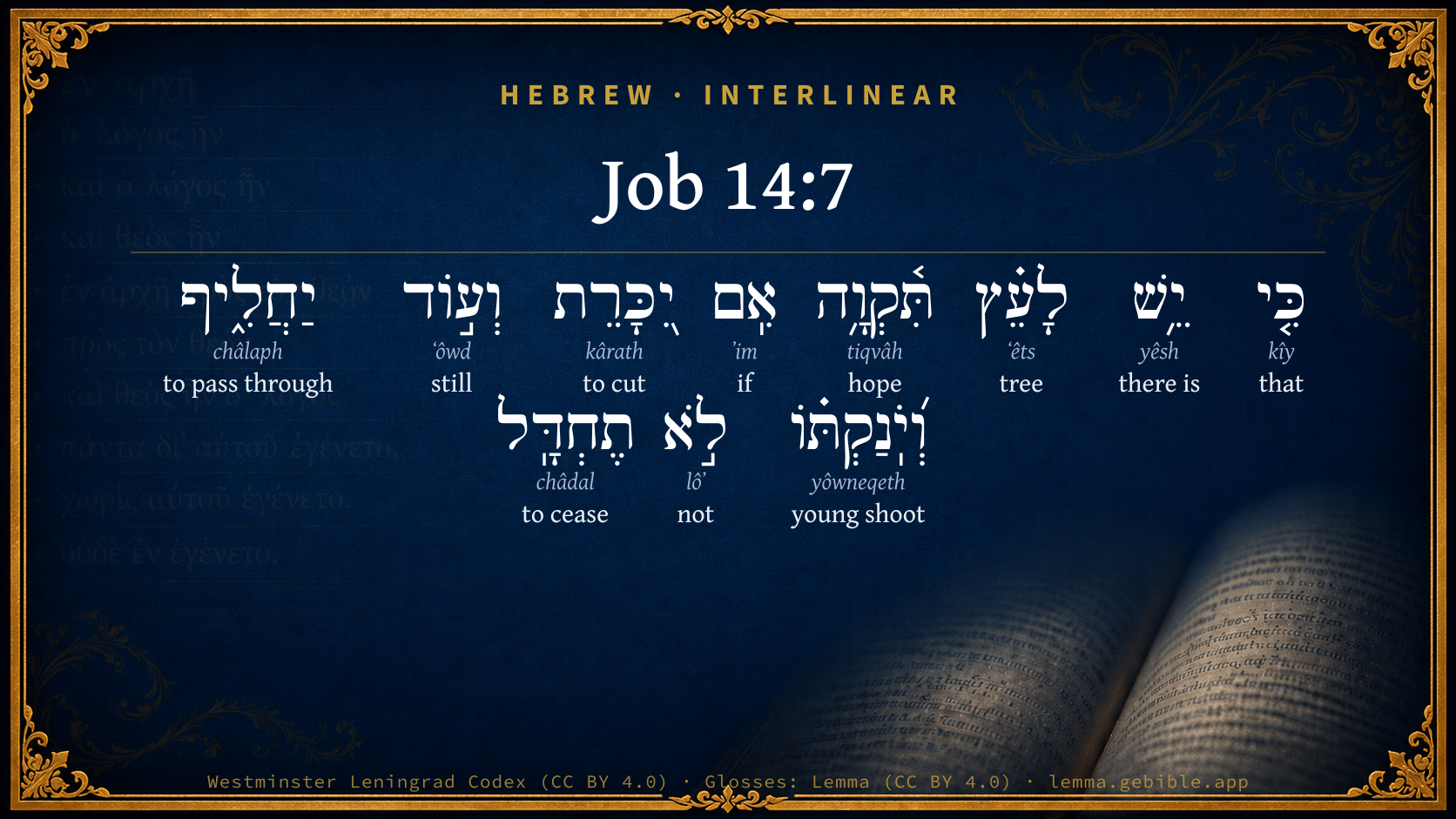
Hebrew (Westminster Leningrad Codex) Job 14:7 appears in the Hebrew Old Testament. The text above is from the Westminster Leningrad Codex. Each word links to its Strong’s number, a concise gloss, and parsing drawn from the Open Scriptures Hebrew Bible morphology. Click any word for its full Brown-Driver-Briggs (BDB) entry.
Download image
Cite this verse

Job 14:7 (World English Bible). Public Domain. Lemma interlinear Bible study tool, https://lemma.gebible.app/v/job/14/7.

Show BibTeX & RIS
BibTeX
RIS
English Translation
"For there is hope for a tree, If it is cut down, that it will sprout again, That the tender branch of it will not cease.
World English Bible · Public Domain
Download a study sheet

One document with this verse’s original text, its word-by-word gloss line, the meaning frame, cross-references with their text, attributed commentary, and full source and license credits — printable, and it pastes into notes with its structure intact.

This verse Autodidact and up

Study sheet (.html) Plain text (.txt)

A passage Seminary Student

Up to 50 verses in one chapter. A passage sheet keeps up to 6 commentary sources and 12 cross-references per verse, in the order this page ranks them, and says so on the sheet whenever that leaves anything out. Ask for a single verse and you get the Autodidact verse sheet above.

Everything on this page stays free to read, with no account — the sheet is a download of what is already on screen, not access to it.

Want to remove ads? Support Godless Engineer
Compare translations 3

The same verse in 3 English versions, stacked beneath the original-language interlinear above. Click any original word for its lexicon entry.

Each is an independent rendering of the whole verse — the interlinear is not word-aligned to these translations.

Highlighted words mark where these versions differ — a whole-verse word diff, not a word-by-word alignment.

  • World English Bible Public Domain
    "For there is hope for a tree, If it is cut down, that it will sprout again, That the tender branch of it will not cease.
  • King James Version Public Domain
    For there is hope of a tree, if it be cut down, that it will sprout again, and that the tender branch thereof will not cease.
  • unfoldingWord Literal Text CC BY-SA 4.0
    For there is hope for a tree if it is cut down, that it will sprout again and its stalk will not cease.

unfoldingWord Literal Text — © unfoldingWord, licensed CC BY-SA 4.0. Word-aligned USFM3 via Door43 (git.door43.org/unfoldingWord/en_ult).

Versions to compare (up to 4)

3 of 4 selected

Show all 18 translations

Every available English version of this verse, each an independent rendering of the whole verse.

  • World English Bible Public Domain
    "For there is hope for a tree, If it is cut down, that it will sprout again, That the tender branch of it will not cease.
  • Berean Standard Bible Public Domain
    For there is hope for a tree: If it is cut down, it will sprout again, and its tender shoots will not fail.
  • Majority Standard Bible Public Domain
    For there is hope for a tree: If it is cut down, it will sprout again, and its tender shoots will not fail.
  • King James Version Public Domain
    For there is hope of a tree, if it be cut down, that it will sprout again, and that the tender branch thereof will not cease.
  • American Standard Version (1901) Public Domain
    For there is hope of a tree, If it be cut down, that it will sprout again, And that the tender branch thereof will not cease.
  • Revised Version (1885) Public Domain
    For there is hope of a tree, if it be cut down, that it will sprout again, and that the tender branch thereof will not cease.
  • Geneva Bible (1599) Public Domain
    For there is hope of a tree, if it bee cut downe, that it will yet sproute, and the branches thereof will not cease.
  • Douay-Rheims (1899) Public Domain
    A tree hath hope: if it be cut, it groweth green again, and the boughs thereof sprout.
  • Young's Literal Translation Public Domain
    For there is of a tree hope, if it be cut down, That again it doth change, That its tender branch doth not cease.
  • Literal Standard Version CC BY-SA 4.0
    For there is hope for a tree, if it is cut down, || That it changes again, || That its tender branch does not cease.
  • Unlocked Literal Bible CC BY-SA 4.0
    There can be hope for a tree; if it is cut down, it might sprout again, so that its tender stalk does not disappear.
  • unfoldingWord Literal Text CC BY-SA 4.0
    For there is hope for a tree if it is cut down, that it will sprout again and its stalk will not cease.
  • Darby Bible Public Domain
    For there is hope for a tree: if it be cut down, it will sprout again, and its tender branch will not cease;
  • World Messianic Bible Public Domain
    “For there is hope for a tree if it is cut down, that it will sprout again, that the tender branch of it will not cease.
  • Webster's Bible Public Domain
    For there is hope of a tree, if it is cut down, that it will sprout again, and that its tender branch will not cease.
  • Free Bible Version CC BY-SA 4.0
    Even a tree that's cut down has the hope of sprouting again, of sending up shoots and continuing to live.
  • Bible in Basic English Public Domain
    For there is hope of a tree; if it is cut down, it will come to life again, and its branches will not come to an end.
  • JPS Tanakh (1917) Public Domain
    For there is hope of a tree, if it be cut down, that it will sprout again, and that the tender branch thereof will not cease.

Literal Standard Version (2020), Covenant Press — licensed CC BY-SA 4.0. Text via the HelloAO Bible API (eBible.org). Unlocked Literal Bible (unfoldingWord) — licensed CC BY-SA 4.0. Text via the HelloAO Bible API (eBible.org). unfoldingWord Literal Text — © unfoldingWord, licensed CC BY-SA 4.0. Word-aligned USFM3 via Door43 (git.door43.org/unfoldingWord/en_ult). Free Bible Version, Dr. Jonathan Gallagher — licensed CC BY-SA 4.0. Text via the HelloAO Bible API (eBible.org).

Word by word

More ways to search: Search by grammar → Find every occurrence → Compare this word →

Practice this passage: Drill this verse → Learn its vocabulary →

וְ֝יֹֽנַקְתּ֗וֹ
yôwneqeth
H3127
“and · young shoot · his”
Conjunction + Noun, Common, Feminine, Singular, Construct + Suffix, Personal, 3rd Person, Masculine, Singular
Part of Speech
Conjunction + Noun
Type
Common
Gender
Feminine
Number
Singular
State
Construct
Full BDB Definition

Origin: from H3126

TWOT: 874b

young plant, twig, young shoot
  1. כִּ֤י kîy H3588 “that” Conjunction
  2. יֵ֥שׁ yêsh H3426 “there is” Particle, Demonstrative
  3. לָעֵ֗ץ ʻêts H6086 “to/for the · tree” Preposition, Determined + Noun, Common, Masculine, Singular, Absolute
  4. תִּ֫קְוָ֥ה tiqvâh H8615 “hope” Noun, Common, Feminine, Singular, Absolute
  5. אִֽם ʼim H518 “if” Conjunction
  6. יִ֭כָּרֵת kârath H3772 “to cut” Verb, Niphal, Imperfect, 3rd Person, Masculine, Singular
  7. וְע֣וֹד ʻôwd H5750 “and · still” Conjunction + Adverb
  8. יַחֲלִ֑יף châlaph H2498 “to pass through” Verb, Hiphil, Imperfect, 3rd Person, Masculine, Singular
  9. לֹ֣א lôʼ H3808 “not” Particle, Negative
  10. תֶחְדָּֽל châdal H2308 “to cease” Verb, Qal, Imperfect, 3rd Person, Feminine, Singular

About this verse

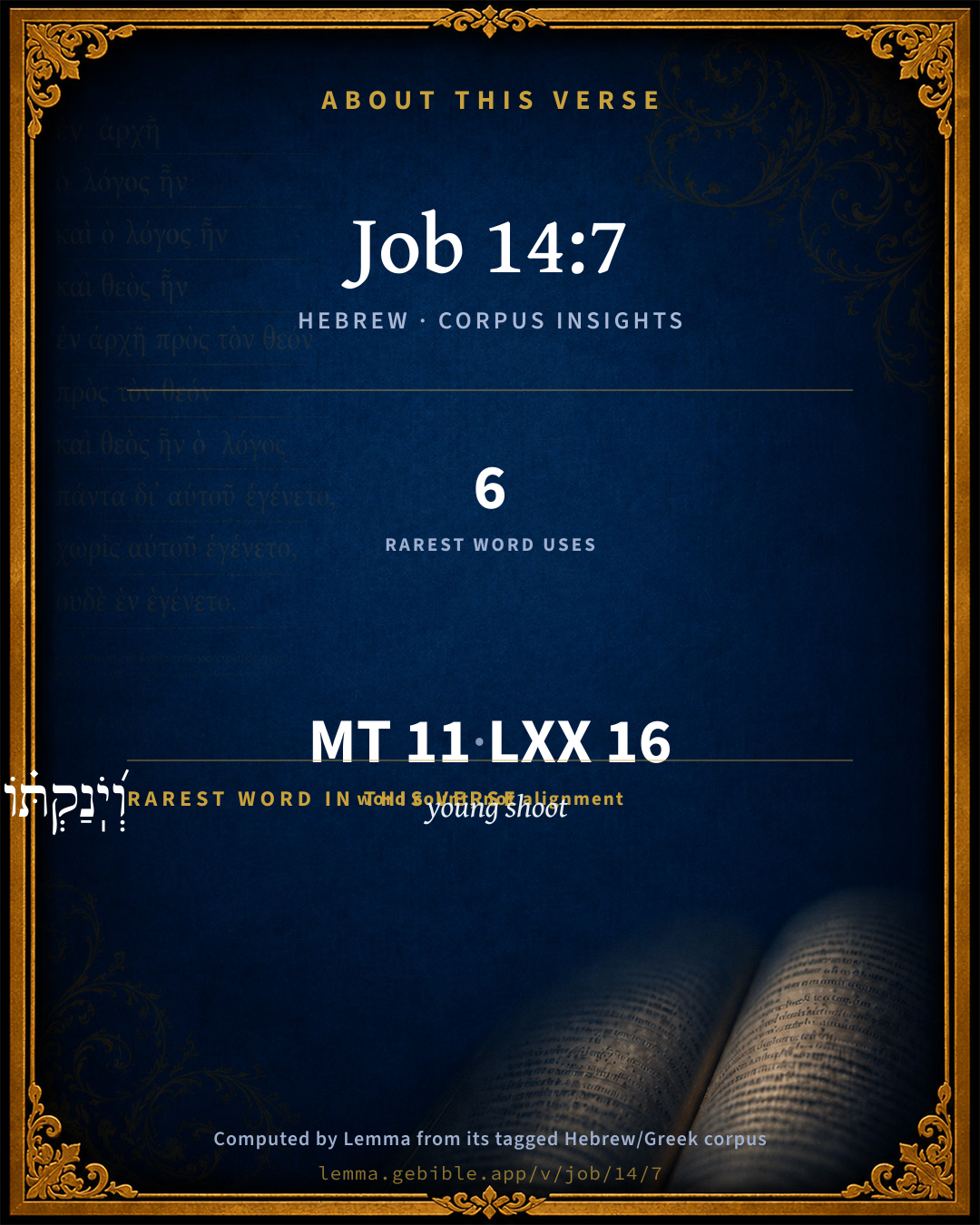
These counts appear in no published source. They are computed here, from the morphology-tagged text and Lemma’s own curated glosses. What Lemma adds →

11
words
11
distinct lemmas
Wisdom
section

Notable vocabulary

The rarest word here is וְ֝יֹֽנַקְתּ֗וֹ young shoot H3127 — appearing just 6 times in the whole Hebrew Bible.

Shared distinctive vocabulary

וְ֝יֹֽנַקְתּ֗וֹ young shoot H3127 occurs in 6 verses of the Hebrew Bible. Also found in:

Grammatical profile

  • 3 verbs
  • 3 nouns
  • 2 conjunctions
  • 1 adverb
  • 2 particles

Verb forms

  • יִ֭כָּרֵת Niphal · Imperfect
  • יַחֲלִ֑יף Hiphil · Imperfect
  • תֶחְדָּֽל Qal · Imperfect

Hebrew & Septuagint length

In English translation the verse runs 26 words from the Hebrew and 25 from the Septuagint (LXX English) — closely comparable.

A rough comparison of the two English renderings, which tokenize alike — not a word-level alignment.

Word counts can differ between the Hebrew and the Greek without any difference in meaning — e.g. the Hebrew direct-object marker אֵת has no separate Greek word, and Greek often adds the article ὁ.

In the original languages it is 11 Hebrew tokens and 16 Greek tokens — but the two are counted differently (Hebrew bundles its prefixes and suffixes into one token; the Greek is in lemma form), so that isn’t a like-for-like length.

Cross-references

6

Topical passages linked to Job 14:7 in the Treasury of Scripture Knowledge — connected by theme and wording, ordered by reader-vote popularity; previews shown in the World English Bible.

  • Isaiah 27:6 In days to come shall Jacob take root; Israel shall blossom and bud; and they shall fill the surface of the world with fruit.
  • Isaiah 11:1 There shall come forth a shoot out of the stock of Jesse, and a branch out of his roots shall bear fruit.
  • Job 14:14 If a man dies, shall he live again? All the days of my warfare would I wait, Until my release should come.
  • Daniel 4:23–25 Whereas the king saw a watcher and a holy one coming down from the sky, and saying, Hew down the tree, and destroy it; nevertheless leave the stump of the roots of it in the earth, even with a band of iron and brass, in the tender grass of the field, and let it be wet with the dew of the sky: and let his portion be with the animals of the field, until seven times pass over him;
  • Job 19:10 He has broken me down on every side, and I am gone. My hope he has plucked up like a tree.
  • Daniel 4:15 Nevertheless leave the stump of its roots in the earth, even with a band of iron and brass, in the tender grass of the field; and let it be wet with the dew of the sky: and let his portion be with the animals in the grass of the earth:

Cross-references courtesy of OpenBible.info (CC BY 4.0).

Hebrew and Greek witnesses Masoretic Hebrew ↔ Greek Septuagint

The same verse in the two great witnesses to the Old Testament, shown verse-for-verse.

These are two independent witnesses, not word-aligned to each other, and the Septuagint is shown in lemma (dictionary) form.

Hebrew Job 14:7 Masoretic · Westminster Leningrad Codex

כִּ֤י יֵ֥שׁ לָעֵ֗ץ תִּ֫קְוָ֥ה אִֽם יִ֭כָּרֵת וְע֣וֹד יַחֲלִ֑יף וְ֝יֹֽנַקְתּ֗וֹ לֹ֣א תֶחְדָּֽל

"For there is hope for a tree, If it is cut down, that it will sprout again, That the tender branch of it will not cease.

World English Bible · Public Domain

Greek LXX Job 14:7 Septuagint · lemma form

εἰμί γάρ δένδρον ἐλπίς ἐάν γάρ ἐκκόπτω ἔτι ἐπιἀνθέω καί ὁ ῥάδαμνος αὐτός οὐ μή ἐκλείπω

For there is hope for a tree, even if it should be cut down, that it shall blossom again, and its branch shall not fail.

LXX2012 (modern English Septuagint) · Public Domain

On this verse, Keil & Delitzsch discusses the Septuagint’s reading. Read the note in Commentary ↓

Hebrew: Westminster Leningrad Codex (CC BY 4.0). Greek: Septuagint (public domain); English from LXX2012 (modern English Septuagint) (Public Domain). How the Septuagint differs from the Hebrew →

Commentary

Notes on Job 14:7 from classic Christian and Jewish commentators (each source and its license shown beneath its notes). The classic Christian expositions comment on the surrounding passage and are grouped to its opening verse, so a note may address several verses; the Jewish commentaries on the Tanakh (Rashi and others) are per-verse, so they appear only where the commentator wrote on this verse.

Lemma curates 59 commentaries, every one of them public domain or Creative Commons licensed, each selected and text-cleaned for this edition rather than reprinted as found. About our sources →

Matthew Henry's Commentary

We have seen what Job has to say concerning life; let us now see what he has to say concerning death, which his thoughts were very much conversant with, now that he was sick and sore. It is not unseasonable, when we are in health, to think of dying; but it is an inexcusable incogitancy if, when we are already taken into the custody of death's messengers, we look upon it as a thing at a distance. Job had already shown that death will come, and that its hour is already fixed. Now here he shows,

I. That death is a removal for ever out of this world. This he had spoken of before (Job 7:9, Job 7:10), and now he mentions it again; for, though it be a truth that needs not be proved, yet it needs to be much considered, that it may be duly improved.

1. A man cut down by death will not revive again, as a tree cut down will. What hope there is of a tree he shows very elegantly, Job 14:7-9. If the body of the tree be cut down, and only the stem or stump left in the ground, though it seem dead and dry, yet it will shoot out young boughs again, as if it were but newly planted. The moisture of the earth and the rain of heaven are, as it were, scented and perceived by the stump of a tree, and they have an influence upon it to revive it; but the dead body of a man would not perceive them, nor be in the least affected by them. In Nebuchadnezzar's dream, when his being deprived of the use of his reason was signified by the cutting down of a tree, his return to it again was signified by the leaving of the stump in the earth with a band of iron and brass to be wet with the dew of heaven, Dan 4:15. But man has no such prospect of a return to life. The vegetable life is a cheap and easy thing: the scent of water will recover it. The animal life, in some insects and fowls, is so: the heat of the sun retrieves it. But the rational soul, when once retired, is too great, too noble, a thing to be recalled by any of the powers of nature; it is out of the reach of sun or rain, and cannot be restored but by the immediate operations of Omnipotence itself; for (Job 14:10) man dieth and wasteth, away, yea, man giveth up the ghost, and where is he? Two words are here used for man: - Geber, a mighty man, though mighty, dies; Adam, a man of the earth, because earthy, gives up the ghost. Note, Man is a dying creature. He is here described by what occurs, (1.) Before death: he wastes away; he is continually wasting, dying daily, spending upon the quick stock of life. Sickness and old age are wasting things to the flesh, the strength, the beauty. (2.) In death: he gives up the ghost; the soul leaves the body, and returns to God who gave it, the Father of spirits. (3.) After death: Where is he? He is not where he was; his place knows him no more; but is he nowhere? So some read it. Yes, he is somewhere; and it is a very awful consideration to think where those are that have given up the ghost, and where we shall be when we give it up. It has gone to the world of spirits, gone into eternity, gone to return no more to this world.

2. A man laid down in the grave will not rise up again, Job 14:11, Job 14:12. Every night we lie down to sleep, and in the morning we awake and rise again; but at death we must lie down in the grave, not to awake or rise again to such a world, such a state, as we are now in, never to awake or arise until the heavens, the faithful measures of time, shall be no more, and consequently time itself shall come to an end and be swallowed up in eternity; so that the life of man may fitly be compared to the waters of a land-flood, which spread far and make a great show, but they are shallow, and when they are cut off from the sea or river, the swelling and overflowing of which was the cause of them, they soon decay and dry up, and their place knows them no more. The waters of life are soon exhaled and disappear. The body, like some of those waters, sinks and soaks into the earth, and is buried there; the soul, like others of them, is drawn upwards, to mingle with the waters above the firmament. The learned Sir Richard Blackmore makes this also to be a dissimilitude. If the waters decay and be dried up in the summer, yet they will return again in the winter; but it is not so with the life of man. Take part of his paraphrase in his own words: -

A flowing river, or a standing lake,

May their dry banks and naked shores forsake;

Their waters may exhale and upward move,

Their channel leave to roll in clouds above;

But the returning water will restore

What in the summer they had lost before:

But if, O man! thy vital streams desert

Their purple channels and defraud the heart,

With fresh recruits they ne'er will be supplied,

Nor feel their leaping life's returning tide.

II. That yet there will be a return of man to life again in another world, at the end of time, when the heavens are no more. Then they shall awake and be raised out of their sleep. The resurrection of the dead was doubtless an article of Job's creed, as appears, Job 19:26, and to that, it should seem, he has an eye here, where, in the belief of that, we have three things: -

1. A humble petition for a hiding-place in the grave, Job 14:13. It was not only a passionate weariness of this life that he wished to die, but in a pious assurance of a better life, to which at length he should arise. O that thou wouldst hide me in the grave! The grave is not only a resting-place, but a hiding-place, to the people of God. God has the key of the grave, to let in now and to let out at the resurrection. He hides men in the grave, as we hide our treasure in a place of secresy and safety; and he who hides will find, and nothing shall be lost. "O that thou wouldst hide me, not only from the storms and troubles of this life, but for the bliss and glory of a better life! Let me lie in the grave, reserved for immortality, in secret from all the world, but not from thee, not from those eyes which saw my substance when first curiously wrought in the lowest parts of the earth," Psa 139:15, Psa 139:16. There let me lie, (1.) Until thy wrath be past. As long as the bodies of the saints lie in the grave, so long there are some remains of that wrath which they were by nature children of, so long they are under some of the effects of sin; but, when the body is raised, it is wholly past - death, the last enemy, will then be totally destroyed. (2.) Until the set time comes for my being remembered, as Noah was remembered in the ark (Gen 8:1), where God not only hid him from the destruction of the old world, but reserved him for the reparation of a new world. The bodies of the saints shall not be forgotten in the grave. There is a time appointed, a time set, for their being enquired after. We cannot be sure that we shall look through the darkness of our present troubles and see good days after them in this world; but, if we can but get well to the grave, we may with an eye of faith look through the darkness of that, as Job here, and see better days on the other side of it, in a better world.

2. A holy resolution patiently to attend the will of God both in his death and his resurrection (Job 14:14): If a man die, shall he live again? All the days of my appointed time will I wait until my change come. Job's friends proving miserable comforters, he set himself to be the more his own comforter. His case was now bad, but he pleases himself with the expectation of a change. I think it cannot be meant of his return to a prosperous condition in this world. His friends indeed flattered him with the hopes of that, but he himself all along despaired of it. Comforts founded upon uncertainties at best must needs be uncertain comforts; and therefore, no doubt, it is something more sure than that which he here bears up himself with the expectation of. The change he waits for must therefore be understood either, (1.) Of the change of the resurrection, when the vile body shall be changed (Phi 3:21), and a great and glorious change it will be; and then that question, If a man die, shall he live again? must be taken by way of admiration. "Strange! Shall these dry bones live! If so, all the time appointed for the continuance of the separation between soul and body my separate soul shall wait until that change comes, when it shall be united again to the body, and my flesh also shall rest in hope." Psa 16:9. Or, (2.) Of the change at death. "If a man die, shall he live again? No, not such a life as he now lives; and therefore I will patiently wait until that change comes which will put a period to my calamities, and not impatiently wish for the anticipation of it, as I have done." Observe here, [1.] That it is a serious thing to die; it is a work by itself. It is a change; there is a visible change in the body, its appearance altered, its actions brought to an end, but a greater change with the soul, which quits the body, and removes to the world of spirits, finishes its state of probation and enters upon that of retribution. This change will come, and it will be a final change, not like the transmutations of the elements, which return to their former state. No, we must die, not thus to live again. It is but once to die, and that had need be well done that is to be done but once. An error here is fatal, conclusive, and not again to be rectified. [2.] That therefore it is the duty of every one of us to wait for that change, and to continue waiting all the days of our appointed time. The time of life is an appointed time; that time is to be reckoned by days; and those days are to be spent in waiting for our change. That is, First, We must expect that it will come, and think much of it. Secondly, We must desire that it would come, as those that long to be with Christ. Thirdly, We must be willing to tarry until it does come, as those that believe God's time to be the best. Fourthly, We must give diligence to get ready against it comes, that it may be a blessed change to us.

3. A joyful expectation of bliss and satisfaction in this (Job 14:15): Then thou shalt call, and I will answer thee. Now, he was under such a cloud that he could not, he durst not, answer (Job 9:15, Job 9:35; Job 13:22); but he comforted himself with this, that there would come a time when God would call and he should answer. Then, that is, (1.) At the resurrection, "Thou shalt call me out of the grave, by the voice of the archangel, and I will answer and come at the call." The body is the work of God's hands, and he will have a desire to that, having prepared a glory for it. Or, (2.) At death: "Thou shalt call my body to the grave, and my soul to thyself, and I will answer, Ready, Lord, ready - Coming, coming; here I am." Gracious souls can cheerfully answer death's summons, and appear to his writ. Their spirits are not forcibly required from them (as Luk 12:20), but willingly resigned by them, and the earthly tabernacle not violently pulled down, but voluntarily laid down, with this assurance, "Thou wilt have a desire to the work of thy hands. Thou hast mercy in store for me, not only as made by thy providence, but new-made by thy grace;" otherwise he that made them will not save them. Note, Grace in the soul is the work of God's own hands, and therefore he will not forsake it in this world (Psa 138:8), but will have a desire to it, to perfect it in the other, and to crown it with endless glory.

Matthew Henry's Commentary on the Whole Bible (1708–1710) — public domain (CC PDM 1.0). Text via the HelloAO Bible API.

Trapp's Complete Commentary

John Trapp

Job 14:7 For there is hope of a tree, if it be cut down, that it will sprout again, and that the tender branch thereof will not cease.

Ver. 7. For there is hope of a tree, &c.] Here Job setteth on his request, Job 14:6, with a reason; God loveth a reasonable service, and liketh well that we reverently reason it out with him. And for the literal sense, all things, saith Gregory, are so plain, that there is no need to say anything to that, it being no more than this; either I shall have comfort in this world before I die, or never here; therefore grant me rest now. This argument Job illustrateth, 1. By a dissimilitude, here. 2. By a similitude, Job 14:11-12. The dissimilitude between a tree and a man is this: a tree may be hewed and felled, yet feel no pain. Again, succisa repullalat, imbribus irrigata, a tree cut down, if well watered, - will spring and sprout up again (Merlin). But now man, as he is very sensible of every stroke of God’s hand, neither can he suffer sickness or other affliction without smart, so when once cut down by death, he can by no means be recovered; he cannot revive without a miracle.

John Trapp, A Commentary or Exposition upon All the Books of the Old and New Testament (1647–1656) — public domain. Text from a community e-Sword module.

Joseph Benson's Commentary

Job 14:7-10. For there is hope of a tree, if it be cut down — If the body of a tree be cut down, and only the stem or stump be left in the ground, yet there is hope; that it will sprout again — Hebrew, יחליŠ, jachalip, will yet renew itself, will revive and flourish as the spring comes on. Though the root wax old — Begin to wither and decay; and the stock thereof die — Namely, in outward appearance; yet, through the scent of water — By means of water; scent or smell being here figuratively ascribed to a tree. The moisture of the earth, and the rain of heaven, have sufficient influence upon it to revive it, and cause it to bud; and bring forth boughs like a plant — As if it were a tree newly planted. But man dieth and wasteth away — Man, though a far nobler creature, is in a much worse condition, as to this world, for when once he loseth his present life he never recovers it. Two words are here used for man, גבר, geber, a mighty man: though mighty, he dies: אדם, adam, a man of earth: being made of earth, he returns to it. He dieth and wasteth away: before death he is dying daily, continually wasting away; in death he gives up the ghost: the spirit leaves the body and returns to God, the Father of spirits, who gave it. After death, where is he? — Not where he was; his place knows him no more: his body, all that is visible of him, is rotting away in the grave. But where is the thinking, intelligent principle, the self-conscious being, the proper man? Is this nowhere? Yes, it is somewhere; and it is a very awful consideration to think where they are that have given up the ghost, and where we shall be when we give it up. It is gone into the world of spirits; gone into eternity, gone to return no more to this world.

Joseph Benson's Commentary on the Old and New Testaments (1811–1818) — public domain. Text from a community e-Sword module.

Whedon's Commentary on the Bible

Daniel D. Whedon

7. For — Introduces another reason for the plea in Job_14:6.

Tender branch — Sprout. The description from Job_14:7-9 is specially applicable to the palm-tree, which is endowed with a wonderful vitality, whence it becomes a figure for youthful vigour. The Greeks gave the same name phoenix (palm-tree) to the wondrous bird which fable represented as rising again from its own ashes. “Even when centuries have at last destroyed the palm,” says Masius, whom Delitzsch quotes, “thousands of inextricable fibres of parasites cling about the stem.” In the country east of the Jordan, the walnut-tree ceases to bear much after one hundred years, and becomes hollow and decayed. It is then cut down to within two or three yards from the ground. If the trees are well watered, new shoots spring up in a year in uncommon luxuriance, and bear fruit the second year. (Wetzstein.) “The Romans,” says Rosenmuller, “made those trees to be the symbol of death which, being cut down, do not live again, and from whose roots no germs arise, such as the pine and cypress.” The revivification of nature, in contrast to the hopeless death of man, has often inspired the muse to elegiac strains, as with the poet Moschus bewailing the death of Bion; also the poets Catullus and Horace, and even the Yajur Veda. See Wordsworth, Good, or Barnes. Compare with Job’s melancholy strains the exquisite, but quite as hopeless, lines of Beattie’s Hermit: “‘Tis night,” etc., and closing with —

But when shall spring visit the mouldering urn?

O! when shall it dawn on the night of the grave?

Daniel D. Whedon (gen. ed.), Commentary on the Old and New Testaments (1874–1909) — public domain. Text from a community e-Sword module.

Jamieson, Fausset & Brown

Robert Jamieson, A. R. Fausset & David Brown

Man may the more claim a peaceful life, since, when separated from it by death, he never returns to it. This does not deny a future life, but a return to the present condition of life. Job plainly hopes for a future state (Job 14:13; Job 7:2). Still, it is but vague and trembling hope, not assurance; excepting the one bright glimpse in Job 19:25. The Gospel revelation was needed to change fears, hopes, and glimpses into clear and definite certainties.

Jamieson, Fausset & Brown — Commentary Critical and Explanatory on the Whole Bible (1871) — public domain (CC PDM 1.0). Text via the HelloAO Bible API.

Adam Clarke's Commentary

Verse 7. For there is hope of a tree] We must not, says Calmet, understand this of an old tree, the stem and roots of which are dried up and rotted: but there are some trees which grow from cuttings, and some which, though pulled out of the earth, and having had their roots dried and withered by long exposure to the sun and wind, will, on being replanted, take root and resume their verdure. There are also certain trees, the fibres of which are so solid, that if after several years they be steeped in water, they resume their vigour, the tubes dilate, and the blossoms or flowers which were attached to them expand; as I have often witnessed in what is called the rose of Jericho. There are few trees which will not send forth new shoots, when the stock is cut down level with the earth.

Adam Clarke's Commentary on the Bible (1810–1826) — public domain. Text from a community e-Sword/MySword module.

The Cambridge Bible for Schools and Colleges

gen. ed. J. J. S. Perowne

7. For there is hope of a tree, if] lit. for a tree hath hope; if it be cut down it will sprout again &c.

7–12. The irreparable extinction of man’s life in death. His destiny is sadder even than that of the tree. His sleep in death is eternal.

The Cambridge Bible for Schools and Colleges (gen. ed. J. J. S. Perowne; Cambridge University Press, 1878–1918) — public domain. Text from a community e-Sword module.

John Gill's Exposition

For there is hope of a tree, if it be cut down, that it will sprout again,.... That is, if it be cut down to the root, and only the stump of the root is left in the ground, as the tree in Nebuchadnezzar's dream, Dan 4:15, yet the owner of it may entertain a hope that it is not utterly destroyed, but will bud out again; or "change" (s) its state and condition, and become flourishing again: or "renew" (t) itself; and its strength, and put out new shoots and branches; either it will rise up into a new body, as the laurel, as Pliny (u) relates, or produce new sprouts as the willow, alder tree, and others; for this is not true of every tree, though it may be of many; for it is (w) reported of the cypress tree, when cut down, it never sprouts out any more, unless in one place, in Aenaria; but since this is the case of some, it is sufficient to Job's purpose:

and that the tender branch thereof will not cease; from shooting out; or "its suckers will not cease" (x); which may be observed frequently to grow out of the roots of trees, even of those that are cut down, such as above mentioned.

(s) "mutabit se", Drusius; "conditionem suam", Piscator. (t) "Renovat se", Schmidt. (u) Nat. Hist. apud Pinedam in loc. (w) Servius in Virgil. Aeneid. l. 3. p. 681. Plin. Nat. Hist. l. 16. c. 33. (x) "sugensque ejus surculus", Schultens.

John Gill's Exposition of the Whole Bible (1746–1763) — public domain (CC PDM 1.0). Text via the HelloAO Bible API.

Albert Barnes' Notes on the Bible

For there is hope of a tree - This passage to Job 14:12, is one of exquisite beauty. Its object is to state reasons why man should be permitted to enjoy this life. A tree, if cut down, might spring up again and flourish; but not man. He died to rise no more; he is cut down and lives not again. The passage is important as expressing the prevalent sentiment of the time in which Job lived about the future condition of man, and is one that deserves a close examination. The great question is, whether Job believed in the future state, or in the resurrection of the dead? On this question one or two things are clear at the outset.

(1) He did not believe that man would spring up from the grave in any sense similar to the mode in which the sprout or germ of a tree grows up when the tree is cut down.

(2) He did not believe in the doctrine of metempsychosis, or transmigration of souls; a doctrine that was so common among the ancients.

In this respect the patriarchal religion stood aloof from the systems of paganism, and there is not to be found, that I know of, any expression that would lead us to suppose that they had ever embraced it, or had even heard of it. The general sentiment here is, that if a tree is cut down, it may be expected to shoot up again, and another tree will be found in its place - as is the case with the chestnut, the willow, the oak. But Job says that there was nothing like this to happen to man. There was no root, no germ, no seminal principle from which he would be made to live again on the earth. He was to be finally cut off, from all his pleasures and his friends here, and to go away to return no more. Still, that Job believed in his continued existence beyond the grave - his existence in the dark and gloomy world of shades, is apparent from the whole book, and indeed from the very passage before us; see Job 14:13 - compare Job 10:21-22. The image here is one that is very beautiful, and one that is often employed by poets. Thus, Moschus, in his third Idyl, as translated by Gisborne:

The meanest herb we trample in the field,

Or in the garden nurture, when its leaf

At winter’s touch is blasted, and its place

Forgotten, soon its vernal bud renews,

And from short slumber wakes to life again.

Man wakes no more! Man, valiant, glorious, wise,

When death once chills him, sinks in sleep profound.

A long, unconscious, never-ending sleep.

See also Beattie’s Hermit:

‘Tis night, and the landscape is lovely no more;

I mourn, but ye woodlands, I mourn not for you;

For morn is approaching, your charms to restore,

Perfumed with fresh fragrance, and glittering with dew.

Nor yet for the ravage of winter I mourn;

Kind nature the embryo blossom will save;

But when shall spring visit the mouldering urn?

O when shall it dawn on the night of the grave?

The same image, also, has been beautifully employed by Dr. Dwight, though urged by him as an argument to prove the doctrine of the resurrection:

In those lone, silent realms of night,

Shall peace and hope no more arise?

No future morning light the tomb,

Nor day-star gild the darksome skies?

Shall spring the faded world revive?

Shall waning moons their light renew?

Again shall setting suns ascend,

And chase the darkness from our view?

The feeling of Job here is, that when man was removed from the earth, he was removed finally; that there was no hope of his revisiting it again, and that he could not be employed in the dark abode of departed spirits in the cheerful and happy manner in which he might be in this world of light. This idea is expressed, also, in a most tender manner by the Psalmist:

Wilt thou show wonders to the dead?

Shall the dead arise and praise thee?

Shall thy loving-kindness be declared in the grave?

Or thy faithfulness in destruction?

Shall thy wonders be known in the dark?

And thy righteousness in the land of forgetfulness?

–Psa 88:10-12.

And the same feelings were evinced by Hezekiah, the pious king of Israel:

For Sheol cannot praise thee;

Death cannot celebrate thee;

They that go down into the pit cannot hope for thy truth.

The living, the living, he shall praise thee, as I do this day;

The father to the children shall make known thy faithfulness.

Isa 38:18-19.

All these gloomy and desponding views arose from the imperfect conception which they had of the future world. It was to them a world of dense and gloomy shades - a world of night - of conscious existence indeed - but still far away from light, and from the comforts which people enjoyed on the earth. We are to remember that the revelations then made were very few and obscure; and we should deem it a matter of inestimable favor that we have a better hope, and have far more just and clear views of the employments of the future world. Yet probably our views of that world, with all the light which we have, are much further from the reality than the views of the patriarchs were from those which we are permitted to cherish. Such as they are, however, they are fitted to elevate and cheer the soul. We shall not, indeed, live again on the earth, but we shall enter a world of light and glory, compared with which all that is glorious here shall fade away. Not far distant is that blessed world; and in our trials we may look to it not with dread, as Job did to the land of shades, but with triumph and joy.

Will not cease - Will not fail, or be missing. It will spring up and live.

Albert Barnes' Notes on the Bible (1834–1885) — public domain. Text from a community e-Sword/MySword module.

Matthew Poole's English Annotations

But man, though a far nobler creature, is in a much worse condition, and when once he loseth this present and worldly life, he never recovers it; therefore show some pity to him, and give him some comfort whilst he lives.

Matthew Poole's English Annotations on the Holy Bible (1683–1685) — public domain. Text from a community e-Sword/MySword module.

The Pulpit Commentary

For there is hope of a tree, if it be cut down. God"s vegetable creation is better off, in respect of length of days, than man. Let a tree be cut down, it is not therefore of necessity destroyed. There is yet hope for it. The bare dry stump will sometimes put forth tender branches, which will grow and flourish, and renew the old life. Or, if the stump be quite dead, suckers may spring up from the root and grow into new trees as vigorous as the one that they replace. (comp. Isa_11:1) Herodotus considered that all trees had this recuperative power, except the pituv , a species of fir (Herod., 6:37), and the traveller Shaw says that when a palm tree dies there is always a sucker ready to take its place. Pliny also observes of the laurel, "Viva-cissima est radix, ita ut, si truncus ina-ruerit, recisa arbor mox laetius frutificet" ("Hist. Nat.," 1:15. That it will sprout again. That is, from the spool or stump. Some trees, as the Spanish chest. nut, if cut down flush with the ground, throw up shoots from the entire circle of the stomp, often as many as fifteen or twenty. And that the tender branch thereof will not cease. The vigour of such shoots is very great. In a few years they grow to the height of the parent tree. If they are then removed they are quickly replaced by a fresh growth.

Vers. 7-15. Job to God: 3. A glimpse into the life beyond.

I "IF A MAN DIE, SHALL HE LIVE AGAIN?" No!

1. The voice of nature is against it. "For there is hope of a tree, if it be cut down, that it will sprout again," etc. (vers. 7-9). But nothing like this occurs in the case of man, of whom rather the cheerless proverb holds that, as the tree falls, so shall it lie. (Ecc_11:3) Hewn down by the axe of death, or laid prostrate by age beneath the sod, there is in his decaying body no vital germ which can send forth tender sprouts. The earth contains no revivifying principle for him as for trees. The fine manly fellow, rejoicing in his vigorous health, begins to droop and to die; he gives up the ghost, or expires, and where is he? (ver. 10). There is no subsequent resuscitation for him. No! Man"s appropriate emblem is not the trees, but the streams and the lakes. When man dies, he disappears completely from the present scene, like the dried-up waters of a lake, or of a mountain torrent that have forsaken their accustomed bed.

2. The testimony of experience is against it. A phenomenon so stupendous as the return of a dead and buried man to life has never once been witnessed. With a terrible uniformity of sadness, each age has followed its predecessor to the tomb. And there are those who affirm that this dreary monotony has never been interrupted; that the sum of human experience is the same to-day as it was in Job"s time; that "man lieth down, and riseth not" (ver. 12); and that there is no reason to anticipate that it ever will be different, but much cause to conclude that for evermore it will continue the. (Ecc_1:9) But

a. uniformity of past experience cannot with absolute finality determine future events in a world governed by Omniscient Wisdom and Infinite Power;

b. in numerous instances already the principle of reckoning from past uniformity has been found to be unsafe, as e.g. the successive appearance of new species of living creatures on earth, according to either geological science or biblical revelation, the occurrence of the Deluge, the manifestation of Christ;

c. in particular the uniformity of experience referred to, viz. of the non-return of men from their graves, has, on the evidence of human testimony, been broken at least once by the resurrection of Christ; and

d. even had it not been broken once, such uniformity of past experience cannot be regarded as valid against the doctrine of a resurrection such as Scripture teaches, viz. a return of mankind to the earth, not successively at different times and in divers parts and parcels, but simultaneously in one united body.

2. The verdict of silence is against it. Not of true science, but of arrogantly talking, much asserting, materialism. What Job uses as beautiful similitudes (vers. 7, 11, 18, 19) modern sages employ as scientific truth. Man, according to their findings, is of a piece with the great material world by which he is surrounded, in which there is continually going on a resistless process of disintegration and dissolution, before which he sooner or later succumbs, like the trees and the rocks, the mountains and the streams. To expect, therefore, that a dead man shall return to his place on earth is as unscientific as to anticipate that the alluvial deposits of the plain shall replace themselves upon the mountain"s sides from which they have been taken, or that the shattered rock shall resume its station in the crevice out of which it has fallen, or that the water of a lake which has evaporated shall again cover its desiccated bed, or the fleecy cloud which has dissolved and been dispersed shall recombine itself upon the face of heaven.

II "IF A MAN DIE, SHALL HE LIVE AGAIN?" YES!

1. The phenomena of nature suggest it. "There is hope of a tree, if it be cut down, that it will sprout again." Why, then, should there not be hope of a man reviving from the bed of death? Why should not man have his springtime as well as the plants and flowers and roots? "Everything in nature is a sign of something higher and more living than itself, to follow in due course, and in turn announce a yet higher one; the mineral foretells the plant, the plant the animal, all things in their degree foretell mankind" (Leo Grindon, "Life: its Nature," etc., p. 301). Again, "The presignificance of animal forms and economy by plants extends to the whole of their organic functions, to many of their organs, even to their spontaneous movements, their habits and qualities" (ibid., p. 306). Many of the functions usually supposed to be characteristic of animals have a marvellous foreshadowing in vegetables, as e.g. the processes of eating and digesting food, the procreation and birth of offspring, the act of respiration and the repose of sleep. May it not, then, be maintained that the constantly recurring winter death, and spring revival of trees and plants and flowers, are prefigurements, not only of the sleeping and waking of animals generally, but also of the death and resurrection of man?

2. The instincts of humanity desire it. "Oh that thou wouldest hide me in Sheol!" etc. (ver. 13). Job had not, indeed, perfect certainty on the subject of his returning from Hades, but in the deepest yearnings of his soul, which here flashed up into momentary brightness, he longed for such a revival as is implied in the resurrection. And the argument derived from this is that the existence of such a hope in the human soul renders probable at least the doctrine of a resurrection. "Intuition is worth volumes of logic" (Grindon, p. 287). "Where in the plan of nature do we find instincts falsified? Where do we see an instance of a creature instinctively craving a certain kind of food in a place where no such food can be found? Are the swallows deceived by their instinct when they fly away from clouds and storms to seek a warmer country? Do they not find a milder climate beyond the water? When the may-flies and other aquatic insects leave their shells, expand their winos, and soar from the water into the air, do they not find an atmosphere fitted to sustain them in a new stage of life? Yes. The voice of nature does not utter false prophecies. It is the call, the invitation, of the Creator addressed to his creatures. And if this be true with regard to the impulses of the physical life, why should it not be true with regard to the superior instincts of the soul?" (Reimar, "Truths of Natural Religion," quoted by Grindon, p. 287).

3. The dignity of man demands it. "Thou shalt call, and I will answer thee: thou wilt have a desire to the work of thine hands" (ver. 15). It was utterly inconceivable that God could be happy so long as man, the noblest specimen of his handiwork, whom his own hands had fashioned with tender care and infinite skill, (Job_10:3, Job_10:9) upon whom, as it were, he had impressed the stamp of his own Divinity, (Gen_1:26) and whom he had set at the very apex of creation, (Psa_8:6) was lying mouldering in the dust; nay, by the very necessities of the case, God would yearn (grow pale with anxiety and wan with longing) after his absent creature and child, and, eventually breaking in upon the silence of the grave, would summon the unconscious sleeper to arise. "Do you suppose," Job virtually asks, "that if I yearn after God as I do, God does not likewise yearn after me; that if it would add to my felicity to see God in the flesh, and to talk with him as a man talketh with his friend, it would not likewise intensify his blessedness to have me in my complete manhood by his side?" And in this idea of the essential dignity of man as God"s handiwork and God"s child, we are warranted to find, if not a certain demonstration, at least a strong presumption that man will yet attain to an embodied life be: end the grave.

4. The witness of revelation proclaims it. Like other parts of the gospel scheme, the doctrine of a resurrection was only gradually unfolded. In antediluvian times it may have been suggested to thoughtful minds by the translation of Enoch. In the Abrahamic period the hope of a better country, even a heavenly, was strong in pious hearts; but it is not certain that this implied more than a belief in immortality, or in a continuous existence beyond the grave, though the case of Job clearly shows that even then men had begun to speculate about the probability of a return to the embodied state alter death, and the practice of embalming among the Egyptians has been held to prove that such a doctrine had even then become a popular belief. In the age of David the hope of a resurrection burned brighter and clearer. (Psa_16:11 Psa_17:15) Isaiah spoke of a rising of Jehovah"s dead body, and of the earth casting forth her dead; (Isa_26:19) Ezekiel, of an opening of the graves; (Eze_38:9, Eze_38:18) Daniel, of an awaking out of sleep. (Dan_12:2) But not until the times of the gospel was the doctrine fully declared. Christ affirmed it; (Joh_5:28, Joh_5:29) St. Peter proved it; (Act_2:25-32 Act_12:3-4) St. Paul preached it (Act_17:31) and wrote concerning it. (Rom_8:11, 12 1Co_15:12-20)

5. The resurrection of Christ secures it. "But now is Christ risen from the dead, and become the firstfruits of them that sleep". (1Co_15:20) The resurrection of Christ being as certain a fact of history as his death, the resurrection of his people at least is conclusively established, (Joh_14:19 Rom_8:11 1Th_4:14) and the question of Job finally answered.

LESSONS.

1. The importance of using life well, since no man returns to the present scene.

2. The strong consolation which the saint finds in the hope of a resurrection.

Vers. 7-10. Sad views of life.

If the tree be cut down, it springs again; but if man dieth, he wasteth away. Certainly, then, man"s hope is not in this life. The dismal views given in these few verses demand the full assurance of the resurrection. This is a feature of the Book of Job. It presents a negative view of human life. There is always a demand to be met. Only the fuller teachings of the New Testament meet it. Consider this aspect of human life with its demand for supplementary views in order to completeness and satisfaction. The complementary character of subsequent revelations.

I The present life of man presents characteristics of imperfectness which indicate that this cannot be the complete view of life.

II The moral, spiritual, and intellectual capabilities which are obviously but partially called into play demand other circumstances for their full development, and indicate the incompleteness of the view of life when confined to the present only.

III The aspirations of men towards conditions that cannot be attained in this life are a testimony to its incompleteness.

IV The ideals of life are so far superior to the realizations, that they become a constant prophecy of something better and higher than the present life.

V The hope of higher conditions than the present is strongest in the best and purest souls.

VI The painfulness of the present with the consciousness of capacity for great and pure enjoyment a further evidence of the incompleteness of life if the view be restricted to the present.

VII All is satisfied in" the subsequent revelations, and in the calm assurance they give of the resurrection of the dead and the life of the world to come. R.G.

Vers. 7-14. Is there a life beyond the grave?

We have here one of the dim Old Testament speculations on the life beyond, that stand out in startling contrast to the prevalent obscurity and apparent indifference of ancient Hebrew thought in regard to the great future. This serves as a good starting-point from which to approach the more full Christian light on the resurrection.

I THE CRAVING FOR IMMORTALITY IS INSTINCTIVE. The craving may be hidden by more pressing desires of the moment; it may even be crushed by despair. But it is not the less natural and instinctive. For when we come to ourselves and calmly reflect on life and its issues, we cannot be satisfied that death should end all. Then there wakes up in us a deep, insatiable hunger for life. The essential characteristic of this desire is its craving for more than the repose of a future that is rescued from the turmoil of this present time; its object is life. It is not enough for us that an end may come to our present troubles, That is all Job desired at first (see ch. 3), but now a deeper thought stirs in his breast, and he thinks of the possibility of living again. Surely it is a miserable degradation of this instinct of immortality that represents the future blessedness as chiefly consisting in indolent repose.

II NATURE DOES NOT SATISFY THE CRAVING FOR IMMORTALITY. Job turns to the analogies of nature. They are obscure and contradictory. The tree that has been cut down will sprout again from its roots. But is this life the fate of man? "Man giveth up the ghost, and where is he?" Has he any root remaining that can be quickened at the scent of water? Then if the tree sprouts again, there are other things in nature that cease altogether, e.g. the stream that is entirely dried up. May not man"s fate be like these temporal things that come to an end? We look for analogies in the awakening spring, in the emerging of the butterfly from the chrysalis, in the return of day after night. These analogies afford but faint suggestions, little more than fanciful illustrations, Nature does point to the existence of an unseen universe, but she gives us little, if any, hints as to our share in the life beyond the present and the seen.

III CHRIST SATISFIES THE CRAVING FOR IMMORTALITY. He has brought "life and incorruption to light through the gospel". (2Ti_1:10)

1. By his revelation of God. In Christ we see God as our Father. Such a God cannot mock us with a delusion, cannot plant an instinct in us for which there is no satisfaction. All other instincts have their objects provided. A good Father will not let this starve and pine into disappointment.

2. By his direct teaching. Christ said little about the future life, but that little was clear, unhesitating, emphatic. He made no mention of harps and palms, but he said, "I am the Resurrection, and the Life: he that believeth in me, though he were dead, yet shall he live". (Joh_11:25)

3. By his own resurrection. He is "the Firstfruits from the dead". (1Co_15:20) One man has risen. This is enough to show that death does not end all.

4. By his saving grace. He not only reveals the life beyond. He gives the life eternal. A mere shadowy existence in Hades would be no boon; an existence of torment in Gehenna would be a curse. We want a full and glorious life. That is not ours by nature; it is the gilt of God; (Rom_6:23) and it is received through Christ. W.F.A. (1Jn_5:11, 1Jn_5:12)

The Pulpit Commentary (1880–1919), ed. H.D.M. Spence-Jones & Joseph S. Exell — public domain. Text from a community e-Sword module.

Keil & Delitzsch

C. F. Keil & F. Delitzsch

7 For there is hope for a tree:

If it is hewn down, it sprouts again,

And its shoot ceaseth not.

8 If its root becometh old in the ground,

And its trunk dieth off in the dust:

9 At the scent of water it buddeth,

And bringeth forth branches like a young plant.

As the tree falleth so it lieth, says a cheerless proverb. Job, a true child of his age, has a still sadder conception of the destiny of man in death; and the conflict through which he is passing makes this sad conception still sadder than it otherwise is. The fate of the tree is far from being so hopeless as that of man; for (1) if a tree is hewn down, it (the stump left in the ground) puts forth new shoots (on החליף, vid., on Psa 90:6), and young branches (יונקת, the tender juicy sucker μόσχος) do not cease. This is a fact, which is used by Isaiah (Isa 6:1-13) as an emblem of a fundamental law in operation in the history of Israel: the terebinth and oak there symbolize Israel; the stump (מצבת) is the remnant that survives the judgment, and this remnant becomes the seed from which a new sanctified Israel springs up after the old is destroyed. Carey is certainly not wrong when he remarks that Job thinks specially of the palm (the date), which is propagated by such suckers; Shaw's expression corresponds exactly to לא תחדל: "when the old trunk dies, there is never wanting one or other of these offsprings to succeed it." Then (2) if the root of a tree becomes old (חזקין inchoative Hiphil: senescere, Ew. 122, c) in the earth, and its trunk (גּזע also of the stem of an undecayed tree, Isa 40:24) dies away in the dust, it can nevertheless regain its vitality which had succumbed to the weakness of old age: revived by the scent (ריח always of scent, which anything exhales, not, perhaps Sol 1:3 only excepted, odor = odoratus) of water, it puts forth buds for both leaves and flowers, and brings forth branches (קציר, prop. cuttings, twigs) again, כמו נטע, like a plant, or a young plant (the form of נטע in pause), therefore, as if fresh planted, lxx ὥσπερ νεόφυτον. One is here at once reminded of the palm which, on the one hand, is pre-eminently a φιλυδρον φυτόν,

(Note: When the English army landed in Egypt in 1801, Sir Sydney Smith gave the troops the sure sign, that wherever date-trees grew there must be water; and this is supported by the fact of people digging after it generally, within a certain range round the tree within which the roots of the tree could obtain moisture from the fluid. - Vid., R. Wilson's History of the Expedition to Egypt, p. 18.)

on the other hand possesses a wonderful vitality, whence it is become a figure for youthful vigour. The palm and the phoenix have one name, and not without reason. The tree reviving as from the dead at the scent of water, which Job describes, is like that wondrous bird rising again from its own ashes (vid., on Job 29:18). Even when centuries have at last destroyed the palm - says Masius, in his beautiful and thoughtful studies of nature - thousands of inextricable fibres of parasites cling about the stem, and delude the traveller with an appearance of life.

Keil & Delitzsch — Biblical Commentary on the Old Testament (1861–1891) — public domain (CC PDM 1.0). Text via the HelloAO Bible API. (Old Testament only.)

unfoldingWord translationNotes

Door43 World Missions Community

There can be hope for a tree

The abstract noun "hope" can be expressed with the verb "hope." The hope is explained in verses 7-9. AT: "We can hope that a tree will live again" (See: Abstract Nouns and Assumed Knowledge and Implicit Information)

it might sprout again

"it might start growing again"

so that its tender stalk does not disappear

Disappearing represents dying. AT: "so that its young shoot will not die" (See: Metaphor)

Though

"Even if"

stump

the part of the tree that remains sticking out of the ground after someone has cut down most of the tree

even if it only smells water

This describes the dead stump as if it could smell water to represent water being near it. AT: "even if only a little water is near it" (See: Personification)

it will bud

"it will start growing"

send out branches like a plant

The tree sending out branches represents branches growing on the tree. AT: "branches will start growing on it like a plant" (See: Personification)

translationWords

hope

die

unfoldingWord translationNotes — © Distant Shores Media and the Door43 World Missions Community, licensed CC BY-SA 4.0. Source: git.door43.org/Door43/en_tn.

Rashi

Rabbi Shlomo Yitzchaki (Rashi)

a tree has This [tree] has hope that it will renew itself

and its bough will not cease from being a branch.

Rashi on the Tanakh — English translations: “The Judaica Press complete Tanach with Rashi, translated by A. J. Rosenberg” (CC BY 4.0); “Pentateuch with Rashi's commentary by M. Rosenbaum and A.M. Silbermann, 1929-1934” (public domain); “The Metsudah Tanach series, Lakewood, N.J” (CC BY 4.0); and “The Book of Joshua, Metsudah Publications, 1997” (CC BY 4.0). Text via Sefaria.

Lesson kit

Teaching starters — assembled from the data on this page, not authored interpretation. Every prompt links to the verse data it draws on. Edit before teaching.

Job, in the Wisdom, opens this verse with 11 words (11 distinct Hebrew lemmas). Its most distinctive word is yôwneqeth (“young shoot”). A historical commentator’s framing appears above. Read the whole chapter for the surrounding context.

Discussion questions

  1. How does “young shoot” (yôwneqeth) shape what this verse is saying?
  2. How does Job 8:16, which shares the word «young shoot», read alongside this verse?
  3. The translations on this page render this verse differently — a whole-verse word diff, not a word-by-word alignment. What might account for the different wordings?
  4. «יִ֭כָּרֵת» is a Niphal Imperfect verb. How does that grammatical form shape the action described?
  5. Compare how Matthew Henry's Commentary and Trapp's Complete Commentary read this verse. Where do they agree or differ?

Things to notice

Reading settings

Reading text

Shown beneath each verse's original-language words.

Old Testament
Old Testament edition

Read the OT as the Masoretic Hebrew (MT) or the Greek Septuagint (LXX).

English shown for the Greek Septuagint (in the Hebrew ↔ Greek comparison).

Comparing translations? Open the Compare panel on any verse page to stack up to four side by side.