
Proverbs 10:31

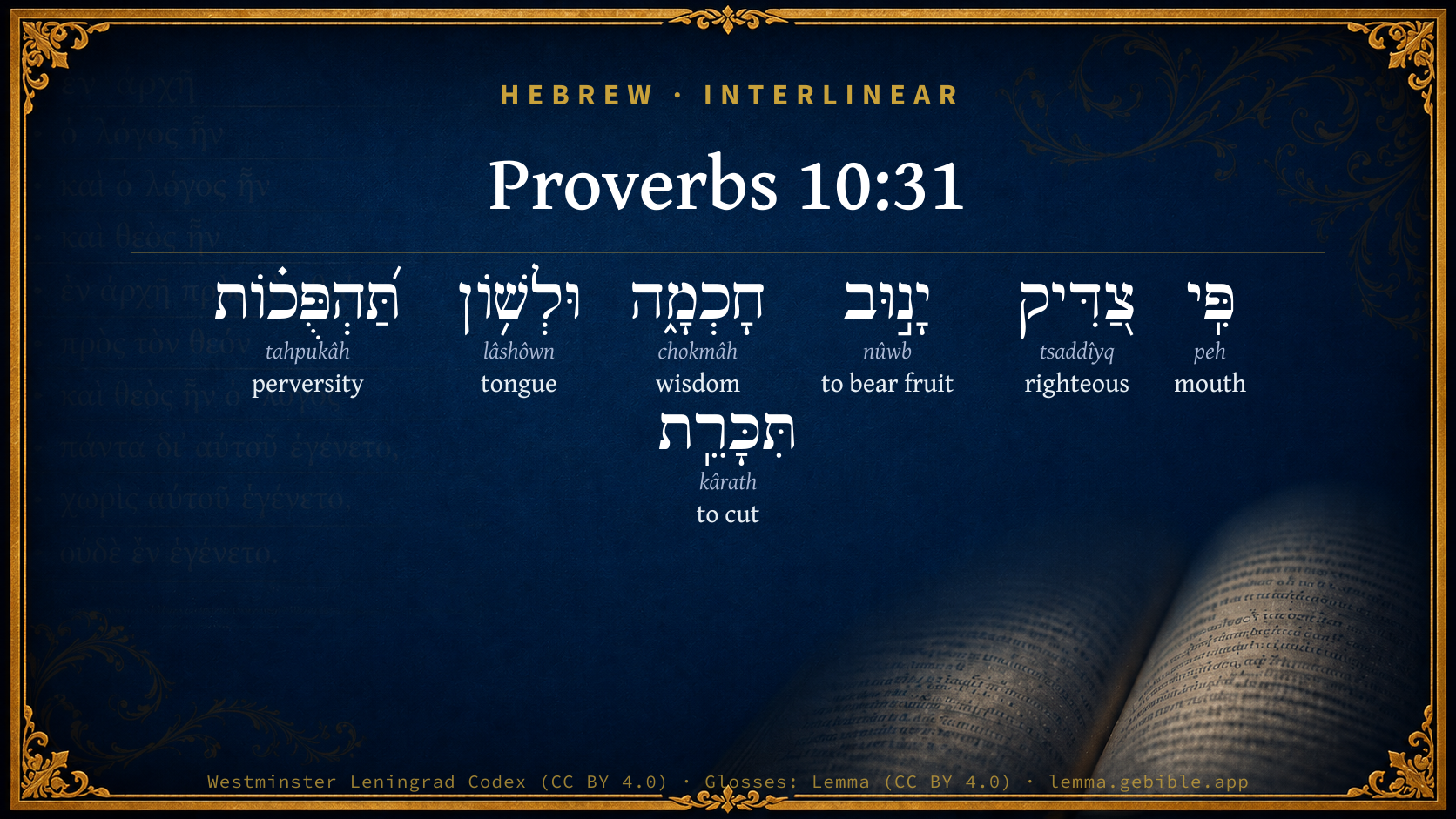
Hebrew (Westminster Leningrad Codex) Proverbs 10:31 appears in the Hebrew Old Testament. The text above is from the Westminster Leningrad Codex. Each word links to its Strong’s number, a concise gloss, and parsing drawn from the Open Scriptures Hebrew Bible morphology. Click any word for its full Brown-Driver-Briggs (BDB) entry.
Download image
Cite this verse

Proverbs 10:31 (World English Bible). Public Domain. Lemma interlinear Bible study tool, https://lemma.gebible.app/v/proverbs/10/31.

Show BibTeX & RIS
BibTeX
RIS
English Translation
The mouth of the righteous brings forth wisdom, But the perverse tongue will be cut off.
World English Bible · Public Domain
Download a study sheet

One document with this verse’s original text, its word-by-word gloss line, the meaning frame, cross-references with their text, attributed commentary, and full source and license credits — printable, and it pastes into notes with its structure intact.

This verse Autodidact and up

Study sheet (.html) Plain text (.txt)

A passage Seminary Student

Up to 50 verses in one chapter. A passage sheet keeps up to 6 commentary sources and 12 cross-references per verse, in the order this page ranks them, and says so on the sheet whenever that leaves anything out. Ask for a single verse and you get the Autodidact verse sheet above.

Everything on this page stays free to read, with no account — the sheet is a download of what is already on screen, not access to it.

Want to remove ads? Support Godless Engineer
Compare translations 3

The same verse in 3 English versions, stacked beneath the original-language interlinear above. Click any original word for its lexicon entry.

Each is an independent rendering of the whole verse — the interlinear is not word-aligned to these translations.

Highlighted words mark where these versions differ — a whole-verse word diff, not a word-by-word alignment.

  • World English Bible Public Domain
    The mouth of the righteous brings forth wisdom, But the perverse tongue will be cut off.
  • King James Version Public Domain
    The mouth of the just bringeth forth wisdom: but the froward tongue shall be cut out.
  • unfoldingWord Literal Text CC BY-SA 4.0
    The mouth of the righteous one bears the fruit of wisdom, but the tongue of the perverse ones will be cut off.

unfoldingWord Literal Text — © unfoldingWord, licensed CC BY-SA 4.0. Word-aligned USFM3 via Door43 (git.door43.org/unfoldingWord/en_ult).

Versions to compare (up to 4)

3 of 4 selected

Show all 18 translations

Every available English version of this verse, each an independent rendering of the whole verse.

  • World English Bible Public Domain
    The mouth of the righteous brings forth wisdom, But the perverse tongue will be cut off.
  • Berean Standard Bible Public Domain
    The mouth of the righteous brings forth wisdom, but a perverse tongue will be cut out.
  • Majority Standard Bible Public Domain
    The mouth of the righteous brings forth wisdom, but a perverse tongue will be cut out.
  • King James Version Public Domain
    The mouth of the just bringeth forth wisdom: but the froward tongue shall be cut out.
  • American Standard Version (1901) Public Domain
    The mouth of the righteous bringeth forth wisdom; But the perverse tongue shall be cut off.
  • Revised Version (1885) Public Domain
    The mouth of the righteous bringeth forth wisdom: but the froward tongue shall be cut off.
  • Geneva Bible (1599) Public Domain
    The mouth of the iust shall be fruitfull in wisdome: but the tongue of the froward shall be cut out.
  • Douay-Rheims (1899) Public Domain
    The mouth of the just shall bring forth wisdom: the tongue of the perverse shall perish.
  • Young's Literal Translation Public Domain
    The mouth of the righteous uttereth wisdom, And the tongue of frowardness is cut out.
  • Literal Standard Version CC BY-SA 4.0
    The mouth of the righteous utters wisdom, || And the tongue of contrariness is cut out.
  • Unlocked Literal Bible CC BY-SA 4.0
    Out of the mouth of the righteous person comes the fruit of wisdom, but the perverse tongue will be cut out.
  • unfoldingWord Literal Text CC BY-SA 4.0
    The mouth of the righteous one bears the fruit of wisdom, but the tongue of the perverse ones will be cut off.
  • Darby Bible Public Domain
    The mouth of a righteous [man] putteth forth wisdom; but the froward tongue shall be cut out.
  • World Messianic Bible Public Domain
    The mouth of the righteous produces wisdom, but the perverse tongue will be cut off.
  • Webster's Bible Public Domain
    The mouth of the just bringeth forth wisdom: but the froward tongue shall be cut out.
  • Free Bible Version CC BY-SA 4.0
    What good people say produces wisdom, but liars will have their tongues cut out.
  • Bible in Basic English Public Domain
    The mouth of the upright man is budding with wisdom, but the twisted tongue will be cut off.
  • JPS Tanakh (1917) Public Domain
    The mouth of the righteous buddeth with wisdom; but the froward tongue shall be cut off.

Literal Standard Version (2020), Covenant Press — licensed CC BY-SA 4.0. Text via the HelloAO Bible API (eBible.org). Unlocked Literal Bible (unfoldingWord) — licensed CC BY-SA 4.0. Text via the HelloAO Bible API (eBible.org). unfoldingWord Literal Text — © unfoldingWord, licensed CC BY-SA 4.0. Word-aligned USFM3 via Door43 (git.door43.org/unfoldingWord/en_ult). Free Bible Version, Dr. Jonathan Gallagher — licensed CC BY-SA 4.0. Text via the HelloAO Bible API (eBible.org).

Word by word

More ways to search: Search by grammar → Find every occurrence → Compare this word →

Practice this passage: Drill this verse → Learn its vocabulary →

About this verse

These counts appear in no published source. They are computed here, from the morphology-tagged text and Lemma’s own curated glosses. What Lemma adds →

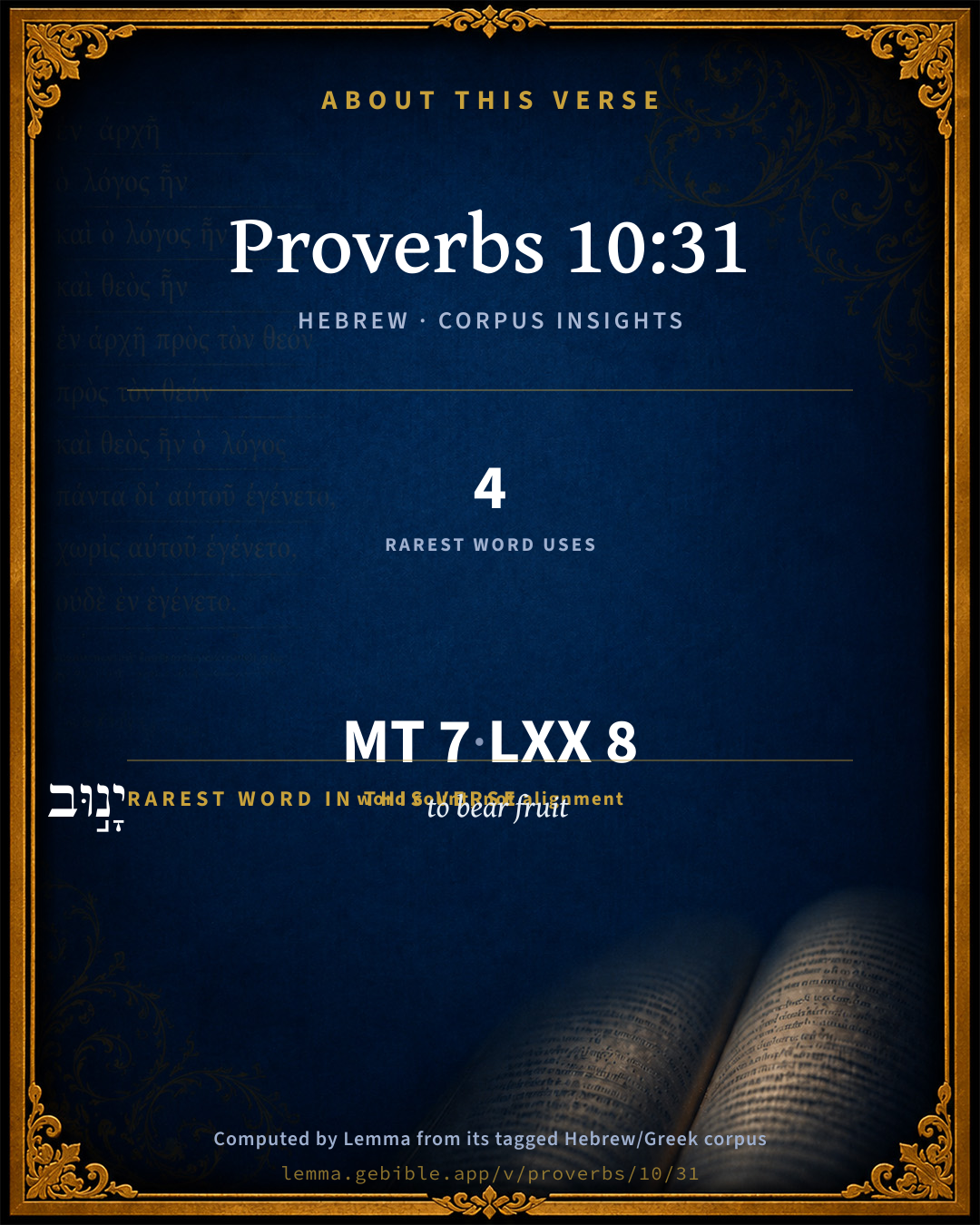
7
words
7
distinct lemmas
Wisdom
section

Notable vocabulary

The rarest word here is יָנ֣וּב to bear fruit H5107 — appearing just 4 times in the whole Hebrew Bible.

Shared distinctive vocabulary

יָנ֣וּב to bear fruit H5107 occurs in 4 verses of the Hebrew Bible. Also found in:

Grammatical profile

  • 2 verbs
  • 4 nouns
  • 1 adjective

Verb forms

  • יָנ֣וּב Qal · Imperfect
  • תִּכָּרֵֽת Niphal · Imperfect

Hebrew & Septuagint length

In English translation the verse runs 16 words from the Hebrew and 15 from the Septuagint (LXX English) — closely comparable.

A rough comparison of the two English renderings, which tokenize alike — not a word-level alignment.

Word counts can differ between the Hebrew and the Greek without any difference in meaning — e.g. the Hebrew direct-object marker אֵת has no separate Greek word, and Greek often adds the article ὁ.

In the original languages it is 7 Hebrew tokens and 8 Greek tokens — but the two are counted differently (Hebrew bundles its prefixes and suffixes into one token; the Greek is in lemma form), so that isn’t a like-for-like length.

Cross-references

7

Topical passages linked to Proverbs 10:31 in the Treasury of Scripture Knowledge — connected by theme and wording, ordered by reader-vote popularity; previews shown in the World English Bible.

  • Psalms 37:30 The mouth of the righteous talks of wisdom. His tongue speaks justice.
  • Proverbs 10:13 Wisdom is found on the lips of him who has discernment, But a rod is for the back of him who is void of understanding.
  • Proverbs 10:20–21 The tongue of the righteous is like choice silver. The heart of the wicked is of little worth.
  • Psalms 31:18 Let the lying lips be mute, Which speak against the righteous insolently, with pride and contempt.
  • Psalms 63:11 But the king shall rejoice in God. Everyone who swears by him will praise him, For the mouth of those who speak lies shall be silenced.
  • Psalms 120:3–4 What will be given to you, and what will be done more to you, You deceitful tongue?
  • Proverbs 10:11 The mouth of the righteous is a spring of life, But violence covers the mouth of the wicked.

Cross-references courtesy of OpenBible.info (CC BY 4.0).

Hebrew and Greek witnesses Masoretic Hebrew ↔ Greek Septuagint

The same verse in the two great witnesses to the Old Testament, shown verse-for-verse.

These are two independent witnesses, not word-aligned to each other, and the Septuagint is shown in lemma (dictionary) form.

Hebrew Proverbs 10:31 Masoretic · Westminster Leningrad Codex

פִּֽי צַ֭דִּיק יָנ֣וּב חָכְמָ֑ה וּלְשׁ֥וֹן תַּ֝הְפֻּכ֗וֹת תִּכָּרֵֽת

The mouth of the righteous brings forth wisdom, But the perverse tongue will be cut off.

World English Bible · Public Domain

Greek LXX Proverbs 10:31 Septuagint · lemma form

στόμα δίκαιος ἀποστάζω σοφία γλῶσσα δέ ἄδικος ἐκὄλλυμι

The mouth of the righteous drops wisdom: but the tongue of the unjust shall perish.

LXX2012 (modern English Septuagint) · Public Domain

On this verse, The Pulpit Commentary discusses the Septuagint’s reading. Read the note in Commentary ↓

Hebrew: Westminster Leningrad Codex (CC BY 4.0). Greek: Septuagint (public domain); English from LXX2012 (modern English Septuagint) (Public Domain). How the Septuagint differs from the Hebrew →

Commentary

Notes on Proverbs 10:31 from classic Christian and Jewish commentators (each source and its license shown beneath its notes). The classic Christian expositions comment on the surrounding passage and are grouped to its opening verse, so a note may address several verses; the Jewish commentaries on the Tanakh (Rashi and others) are per-verse, so they appear only where the commentator wrote on this verse.

Lemma curates 59 commentaries, every one of them public domain or Creative Commons licensed, each selected and text-cleaned for this edition rather than reprinted as found. About our sources →

Trapp's Complete Commentary

John Trapp

Pro 10:31 The mouth of the just bringeth forth wisdom: but the froward tongue shall be cut out.

Ver. 31. The mouth of the just, &c.] Heb., Buddeth forth, as a fruit tree, to which the tongue is fitly and finely here resembled. Hence speech is called the "fruit of the lips."

But the froward tongue shall be cut out.] As a fruitless tree is cut down to the fire. Nestorius the heretic his tongue was eaten off with worms. {a} Archbishop Arundel’s tongue rotted in his head. From Miriam’s example, {Num 12:1-3; Num 12:10} the Jewish doctors gather that leprosy is a punishment for an evil tongue, and in special for speaking against rulers. The Lady de Breuse had by her virulent and railing tongue more exasperated the fury of King John, whom she reviled as a tyrant and a murderer, than could be pacified by her strange present, of four hundred kine, and one bull, all milk white, except only the ears, which were red, sent unto the queen. {b}

{a} Nestorii lingua vermibus exesa.

{b} Speed’s Chron., fol. 572.

John Trapp, A Commentary or Exposition upon All the Books of the Old and New Testament (1647–1656) — public domain. Text from a community e-Sword module.

The Biblical Illustrator

Joseph S. Exell

Pro_10:31

The mouth of the just bringeth forth wisdom.

Piety a peculiar ornament to the aged

I. Who may properly be called old people? Old and young are relative terms, and admit of different significations. Children always think their parents are old. They are old who have grey hairs here and there upon them. The distinction in ages has always been considered as an important distinction by all mankind, who have marked it by some peculiar symptoms or visible effects which the different periods of life produce on the body or on the mind. God leaves it to every individual to judge for himself when the precepts to the young bind him, and when the precepts to the old bind him. Every one should judge justly.

II. What is to be understood by the piety of old people? It is called their righteousness. Righteousness is often used in Scripture to denote holiness in heart and life. Righteousness is true holiness, which is the moral excellence of all moral beings, and the essence of all vital piety in mankind. The piety of old people implies two things.

1. Their cordial belief in the great truths of the gospel. All true piety is founded on the knowledge, the belief, and the love of the great and peculiar truths of the gospel.

2. The practice of the duties, as well as the belief of the doctrines, of the gospel. It is generally true that aged Christians have lived a long time in the way of holiness and obedience to the Divine commands. The promises of the gospel are expressly made to those who overcome, to those who continue in well-doing, and to those who endure unto the end. Internal piety always produces external obedience to the precepts of the gospel. Though the oldest Christians never arrive at sinless perfection in this life, yet they generally grow in grace as they grow in years. Though the piety of the young and that of the old are essentially alike, yet the piety of the aged has a specific and superior excellence.

III. In what respects is the piety of the aged their peculiar ornament? Piety adorns the hoary head, and spreads a peculiar beauty over the aged.

1. Their piety appears with peculiar purity. Through the sanctified discipline of a life-experience. Aged piety is tried, purified, refined piety.

2. Their piety hides the infirmities and imperfections which are peculiar to their age. They often become more amiable in their age than they were in their full vigour and activity.

3. Their piety renders them useful, when they would otherwise be useless and burdensome to the world. They are still capable of serving God and their generation, by their examples, their instructions, their admonitions, and their prayers. The pious examples and instructions of aged parents are often tenfold more valuable to their families than all the wealth and respectability they can bestow upon them.

4. Their piety makes them happy in themselves and pleasant to others.

Improvement.

1. There are many more old people than are usually reckoned such.

2. They ought always to be treated with respect.

3. The want of piety is a peculiar blemish in the character of the aged.

4. Aged saints have great reason to be thankful for what God has done for them. (N. Emmons, D..D.)

The speech of the righteous and the wicked compared

Solomon attaches great importance to the power of the tongue to work good or ill.

I. The speech of the good man is valuable, that of the other is worthless. Solomon brings the heart and the tongue into comparison, rather than the tongue of each, to express the idea that speech is always the outcome and exponent of the heart.

II. The speech of the good man is nourishing, that of the other is killing. How one soul can nourish and invigorate another by the language of truth and love. The spiritual destroyer of humanity makes corrupt words his wings to bear him through the world.

III. The speech of the good man is wise, that of the other is foolish. The words of him whose intellect is under the teachings of God, and whose heart is in vital sympathy with Him, are wise words. The policies propounded by the wicked may seem wise at first, but time always exposes their folly, and brings its disciples to confusion and shame.

IV. The speech of the good man is acceptable, that of the other is perverse. The words of truth are always acceptable to God, as they are also to all thoughtful and candid men. There is a frowardness in the utterances of the wicked that is distasteful to all consciences, and repugnant to the heart of God and the good. What are the elements of good moral speech? Sincerity and purity. By sincerity is meant the strict correspondence of the language with the sentiments of the heart. By purity is meant the strict correspondence of those sentiments with the principles of everlasting right. (Homilist.)

.

The Biblical Illustrator, edited by Joseph S. Exell (c. 1880s–1900s) — public domain. Text from a community e-Sword module.

Joseph Benson's Commentary

Pro 10:31-32. The mouth of the just bringeth forth wisdom — It freely, abundantly, and constantly brings forth wise counsels, as the earth or a tree brings forth its proper fruit, as the word ינוב, here used, properly signifies; but the froward tongue shall be cut off — Because it brings forth, not wisdom, but folly and wickedness. The lips of the righteous know — Namely, practically, so as to consider and speak; what is acceptable — To God and good men, or what is truly worthy of acceptation; for this is opposed to what is froward or wicked in the next clause. Knowledge is here ascribed to the lips, as it is to the hands, Psa 78:72, because they are conducted by knowledge and wisdom.

Joseph Benson's Commentary on the Old and New Testaments (1811–1818) — public domain. Text from a community e-Sword module.

Matthew Henry's Commentary

Here, as before, men are judged of, and, accordingly, are justified or condemned, by their words, Mat 12:37. 1. It is both the proof and the praise of a man's wisdom and goodness that he speaks wisely and well. A good man, in his discourse, brings forth wisdom for the benefit of others. God gives him wisdom as a reward of his righteousness (Ecc 2:26), and he, in gratitude for that gift and justice to the giver, does good with it, and with his wise and pious discourses edifies many. He knows what is acceptable, what discourse will be pleasing to God (for that is it that he studies more than to oblige the company), and what will be agreeable both to the speaker and to the hearers, what will become him and benefit them, and that he will speak. 2. It is the sin, and will be the ruin, of a wicked man, that he speaks wickedly like himself. The mouth of the wicked speaks frowardness, that which is displeasing to God and provoking to those he converses with; and what is the issue of it? Why, the froward tongue shall be cut out, as surely as the flattering one, Psa 12:3.

Matthew Henry's Commentary on the Whole Bible (1708–1710) — public domain (CC PDM 1.0). Text via the HelloAO Bible API.

Jamieson, Fausset & Brown

Robert Jamieson, A. R. Fausset & David Brown

bringeth forth--literally, "germinates" as a plant.

froward--(Compare Pro 2:12, Pro 2:14).

cut off--as an unproductive plant.

Jamieson, Fausset & Brown — Commentary Critical and Explanatory on the Whole Bible (1871) — public domain (CC PDM 1.0). Text via the HelloAO Bible API.

Adam Clarke's Commentary

Verse 31. The froward tongue shall be cut out.] This probably alludes to the punishment of cutting out the tongue for blasphemy, treasonable speeches, profane swearing, or such like. The tunge of schrewis schal perishen. - Old MS. Bible. Were the tongue of every shrew or scold to be extracted, we should soon have much less noise in the world.

Adam Clarke's Commentary on the Bible (1810–1826) — public domain. Text from a community e-Sword/MySword module.

Ellicott's Commentary for English Readers

(31) Bringeth forth wisdom.—As the fields their “increase” (Deu_32:13); hence words are termed the “fruit of the lips” (Isa_57:19).

The froward tongue.—See above on Pro_2:12.

Shall be cut out.—Comp. Christ’s warning (Mat_12:36). Sins of the tongue will be severely judged, because, besides doing mischief to others, they are signs of an evil mind within (Mat_5:34).

A Bible Commentary for English Readers, edited by Charles John Ellicott (1878–1897) — public domain. Text from a community e-Sword module.

The Cambridge Bible for Schools and Colleges

gen. ed. J. J. S. Perowne

31. bringeth forth] as a tree its leaves or fruit: “buddeth with,” R.V. marg.

The Cambridge Bible for Schools and Colleges (gen. ed. J. J. S. Perowne; Cambridge University Press, 1878–1918) — public domain. Text from a community e-Sword module.

John Gill's Exposition

The mouth of the just bringeth forth wisdom,.... As the earth brings forth its increase, and a tree brings forth its fruit; hence speech is called the fruit of the lips; wisdom is good fruit; a good man is comparable to the fruitful earth, and to a good tree; whose mouth brings forth wise things in abundance, which are very pleasant and profitable; not worldly wisdom, much less devilish; not merely natural wisdom, but spiritual and evangelical; see Psa 37:30;

but the froward tongue shall be cut out; or "cut down" (z); as an unprofitable tree, which brings forth nothing but perverse things; things contrary to God and good men, to truth and right reason, to the light of nature, the law of God, and Gospel of Christ. Such "a tongue of perversities" (a), as it may be rendered, that brings forth blasphemies against God, his tabernacle and his saints, as the tongue of antichrist does, deserves to be cut out, as the tongue of a blasphemer.

(z) "succidetur", Pagninus, Montanus, Mercerus, Gejerus. (a) "lingua perversitatum", Montanus, Junius & Tremeilius, Gejerus, Michaelis.

John Gill's Exposition of the Whole Bible (1746–1763) — public domain (CC PDM 1.0). Text via the HelloAO Bible API.

Albert Barnes' Notes on the Bible

Bringeth forth ... - As a tree full of life and sap brings forth its fruit. So the “froward tongue” is like a tree that brings forth evil and not good fruit; it “shall be cut down.” The abuse of God’s gift of speech will lead ultimately to its forfeiture. There shall, at last, be the silence of shame and confusion.

Albert Barnes' Notes on the Bible (1834–1885) — public domain. Text from a community e-Sword/MySword module.

Matthew Poole's English Annotations

Bringeth forth, freely, and abundantly, and constantly, as the earth or a tree bring forth their proper fruit, as the word properly signifies.

Wisdom; wise counsels, by which he directeth and secureth himself and others.

Shall be cut out, because it bringeth forth not wisdom, but folly and wickedness.

Matthew Poole's English Annotations on the Holy Bible (1683–1685) — public domain. Text from a community e-Sword/MySword module.

Whedon's Commentary on the Bible

Daniel D. Whedon

31. Bringeth forth — Puts forth, blooms or bears; a figure taken from the habit of a fruitful tree.

Froward tongue — A tongue of perversities. “Tongue” is used by metonymy for the person, as (Psa_120:3) “Thou false tongue.”

Cut out — Or, cut off, like a branch; or, cut up, like a worthless tree. The idea is, that the righteous man, like a wholesome tree, yields fruits of wisdom, (Psa_92:14,) consequently shall be valued and preserved; but the perverter, who turns men from the right, shall be cut down. See Mat_3:10; Mat_7:19.

Daniel D. Whedon (gen. ed.), Commentary on the Old and New Testaments (1874–1909) — public domain. Text from a community e-Sword module.

The Pulpit Commentary

Bringeth forth; as a tree produces fruit, and the fields yield their increase. The metaphor is common. Thus Isaiah (Isa_57:19) speaks of "the fruit of the lips". (comp. Heb_13:15 and Psa_37:30, which latter passage occurs in the same connection as the present) The Septuagint renders, "distilleth wisdom." So Son_5:13, "His lips are like lilies, dropping sweet smelling myrrh." The froward tongue. (Pro_2:12, Pro_14:8:13, which speaks only what is perverse and evil) Shall be cut out; like a corrupt tree that cumbers the ground. (Mat_3:10 Luk_13:7) The abuse of God"s great gift of speech shall be severely punished. "For by thy words thou shalt be justified, and by thy words thou shalt be condemned". (Mat_12:36, Mat_12:37)

Righteousness and wisdom.

These two attributes appear to belong to different spheres the one to the moral and the other to the intellectual. Yet they are here associated as parent and child, and righteousness is seen to sprout into wisdom. Righteous men are represented as speaking wisely. Now, we know that good people have not a monopoly of intellect. Aristides the virtuous was not as clever as Themistocles. There are small-minded saints, and there are sinners of giant intellect. Where, then, is the connection between righteousness and wisdom?

I RIGHTEOUSNESS STRENGTHENS THE WHOLE SOUL. It will not convert a peasant into a philosopher, but it will brighten the faculties of the peasant. While sin deadens the soul, dissipates its faculties, and lowers its powers, the calm and temperate life of a good man helps him to attain to such vigour of thought as is within the reach of his powers.

II RIGHTEOUSNESS REMOVES THE HINDRANCE OF PREJUDICE. No doubt many good people have their prejudices. But that is in spite of their goodness, and the goodness is an antidote of more or less efficacy. The root of prejudice is self-will, and this is also the root of sin. Just in proportion as we learn the self-distrust of humility we shall be freed from the blindness of prejudice.

III RIGHTEOUSNESS INSTILS THE LOVE OF TRUTH. The good man wishes to know truth; he acknowledges the duty of seeking light; he will not let indolence keep him in ignorance. Now, an earnest pursuit of truth is not likely to be rewarded with failure. They who seek Wisdom earnestly will find her. (Pro_8:17) Thus the rousing of a motive to strive after wisdom helps us to reach it, and this is the fruit of righteousness.

IV RIGHTEOUSNESS OPENS THE EYES OF THE SOUL. It has a direct influence in purging the inward vision. There are truths which can only be revealed through channels of sympathy. The way of holiness lies hidden from the gaze of the corrupt. To be good is to see the best truth.

V RIGHTEOUSNESS LEADS TO THE PRACTICAL USE OF TRUTH. Wisdom is not a merely intellectual attainment. While intimately connected with the thoughts of the mind, it also has vital relations with the resolves of the will. The wise man is not only one who knows the right way; he practises his knowledge by walking therein.

VI RIGHTEOUSNESS IS TRUTHFUL. When a good man speaks he will not knowingly deceive. His earnest desire will be to utter just what he believes to be true. But such a desire will help him to put forth words of wisdom.

A practical result of this association of wisdom with righteousness is that we should look well to the character of our teachers. The merely popular preacher, or the merely clever thinker, will not be so useful a guide in the higher reaches of the spiritual life as the good man of less brilliant natural gifts and intellectual attainments. Thus true wisdom may be discovered where the world only expects foolishness. (1Co_1:20, 1Co_1:21)

The Pulpit Commentary (1880–1919), ed. H.D.M. Spence-Jones & Joseph S. Exell — public domain. Text from a community e-Sword module.

Keil & Delitzsch

C. F. Keil & F. Delitzsch

21 The lips of the righteous edify many;

But fools die through want of understanding.

Keil & Delitzsch — Biblical Commentary on the Old Testament (1861–1891) — public domain (CC PDM 1.0). Text via the HelloAO Bible API. (Old Testament only.)

Bridges on Proverbs

Charles Bridges

Another image (Compare Pro 10:11, Pro 10:20-21 ) of the fruitfulness of a gracious tongue! It bringeth forth wisdom (Psa 37:30 ), and that too in the practical exercise of knowing what is acceptable. This gift needs to be deeply pondered, and carefully cultivated (Pro 15:23 ; Pro 25:11 . Job 6:25 ), to give it a free scope, while we jealously confine it to its own sphere of influence. There is evidently much diversity of application. The same statement of truth does not suit all. And how — what — when — to whom — to speak — is a matter of great wisdom. (Ecc 8:5 .) Yet this consideration of acceptableness must involve no compromise of principle. Let it be a considerate accommodation of mode to the diversity of tastes; a forbearance with lesser prejudices and constitutional infirmities; avoiding — not all offenses (which faithfulness to our Divine Master forbids), but all needless offenses; all uncalled-for occasions of design and irritation. "The meekness of wisdom" (Jas 3:13 ) should be clearly manifested in Christian faithfulness. Thus Gideon melted the frowardness of the men of Ephraim. (Jdg 8:2-3 .) Abigail restrained David’s hands from blood. (1Sa 25:23-33 .) Daniel stood fearless before the mighty-monarch of Babylon. (Dan 4:27 .) Their lips knew what was acceptable, and their God honoured them.

But most of all — let the Minister of God study to clothe his most unpalatable message in an acceptable garb. Let him mold it in all the sweetness of persuasion (2Co 5:11, 2Co 5:20 ), compassion (Rom 9:1-3 . 2Co 2:4 ), and sympathy. (Tit 3:2-3 . 2Co 11:29 .) With what parental earnestness does the ’Preacher of Jerusalem,’ in his introductory chapters, allure us to Wisdom’s voice and instruction! Yet were his "acceptable words upright, even words of truth." (Ecc 12:10 .) And thus must "the priest’s lips keep knowledge," if he would have his people "seek the law at his mouth, as the messenger of the LORD of Hosts." (Mal 2:7 .) He must discriminate his statements, without diluting them. The "truth is to be proclaimed upon the housetop" to the multitude. But it is to be refrained from ungodly scorners. (Mat 10:27, with Mat 7:6 .) Always must he gain his people’s ears, that he may win their hearts.

The froward tongue, pouring forth its own frowardness, provokes its own ruin. It shall be cut out. (Pro 8:13 ; Pro 18:7 . Psa 12:3 ; Psa 52:1-5 ; Psa 120:3-4 . Num 16:1-33 .) O my God, what do I owe thee for the bridle of discipline, that restrains me from self-destruction!

Charles Bridges, An Exposition of the Book of Proverbs (1846) — public domain. Text from a community e-Sword module.

Kretzmann's Popular Commentary

Paul E. Kretzmann

v. 31. The mouth of the just bringeth forth wisdom, that being the fruit of his lips, the outgrowth of the faith of his heart; but the froward tongue, that given to malice and deceit, shall be cut out, like an unfruitful tree or a dangerous shrub.

Paul E. Kretzmann, Popular Commentary of the Bible (1921–1924) — public domain. Text from a community e-Sword module.

unfoldingWord translationNotes

Door43 World Missions Community

Out of the mouth of the righteous person

"Mouth" represents what a person says. AT: "From the righteous man's words" (See: Metonymy)

the perverse tongue will be cut out

"Tongue" represents what a person says. AT: "God will shut the mouths of people who say what is false" (See: Metonymy and Active or Passive)

lips of the righteous person know what is acceptable

"Lips" represent what a person says. AT: "righteous person knows how to speak acceptably" (See: Metonymy)

mouth of the wicked

"Mouth" represents what a person says. AT: "the words of the wicked" (See: Metonymy)

translationWords

fruit

wise

evil

unfoldingWord translationNotes — © Distant Shores Media and the Door43 World Missions Community, licensed CC BY-SA 4.0. Source: git.door43.org/Door43/en_tn.

Rashi

Rabbi Shlomo Yitzchaki (Rashi)

The mouth of the righteous man speaks wisdom Heb. ינוב, speaks, an expression of (Isa. 57: 9): “the speech (ניב) of the lips.”

Rashi on the Tanakh — English translations: “The Judaica Press complete Tanach with Rashi, translated by A. J. Rosenberg” (CC BY 4.0); “Pentateuch with Rashi's commentary by M. Rosenbaum and A.M. Silbermann, 1929-1934” (public domain); “The Metsudah Tanach series, Lakewood, N.J” (CC BY 4.0); and “The Book of Joshua, Metsudah Publications, 1997” (CC BY 4.0). Text via Sefaria.

Lesson kit

Teaching starters — assembled from the data on this page, not authored interpretation. Every prompt links to the verse data it draws on. Edit before teaching.

Proverbs, in the Wisdom, opens this verse with 7 words (7 distinct Hebrew lemmas). Its most distinctive word is nûwb (“to bear fruit”). A historical commentator’s framing appears above. Read the whole chapter for the surrounding context.

Discussion questions

  1. What does “to bear fruit” (nûwb) contribute to the verse as a whole?
  2. Psalms 62:10 shares the word «to bear fruit» with this verse. How do the two illuminate each other?
  3. These translations render this verse differently. What is at stake in choosing one wording over another?
  4. The verb «יָנ֣וּב» is Qal Imperfect. How does its form color the action?
  5. Reading how Trapp's Complete Commentary and The Biblical Illustrator read this verse, where do the two commentators agree and where do they part?

Things to notice

Reading settings

Reading text

Shown beneath each verse's original-language words.

Old Testament
Old Testament edition

Read the OT as the Masoretic Hebrew (MT) or the Greek Septuagint (LXX).

English shown for the Greek Septuagint (in the Hebrew ↔ Greek comparison).

Comparing translations? Open the Compare panel on any verse page to stack up to four side by side.