
Psalms 12:4

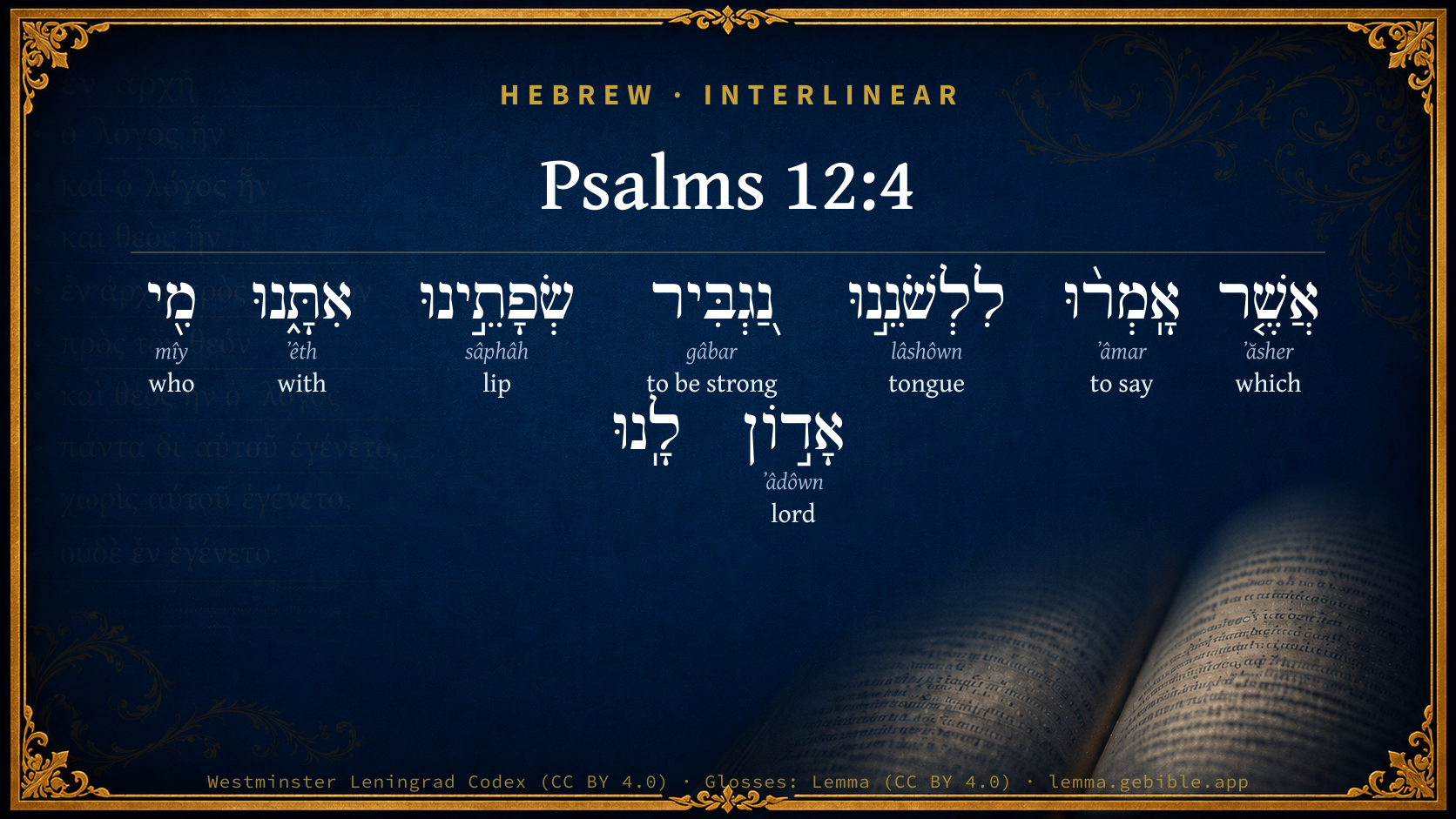
Hebrew (Westminster Leningrad Codex) Psalms 12:4 appears in the Hebrew Old Testament. The text above is from the Westminster Leningrad Codex. Each word links to its Strong’s number, a concise gloss, and parsing drawn from the Open Scriptures Hebrew Bible morphology. Click any word for its full Brown-Driver-Briggs (BDB) entry.
Download image
Cite this verse

Psalms 12:4 (World English Bible). Public Domain. Lemma interlinear Bible study tool, https://lemma.gebible.app/v/psalms/12/4.

Show BibTeX & RIS
BibTeX
RIS
English Translation
Who have said, "With our tongue we will prevail. Our lips are our own. Who is lord over us?"
World English Bible · Public Domain
Download a study sheet

One document with this verse’s original text, its word-by-word gloss line, the meaning frame, cross-references with their text, attributed commentary, and full source and license credits — printable, and it pastes into notes with its structure intact.

This verse Autodidact and up

Study sheet (.html) Plain text (.txt)

A passage Seminary Student

Up to 50 verses in one chapter. A passage sheet keeps up to 6 commentary sources and 12 cross-references per verse, in the order this page ranks them, and says so on the sheet whenever that leaves anything out. Ask for a single verse and you get the Autodidact verse sheet above.

Everything on this page stays free to read, with no account — the sheet is a download of what is already on screen, not access to it.

Want to remove ads? Support Godless Engineer
Compare translations 3

The same verse in 3 English versions, stacked beneath the original-language interlinear above. Click any original word for its lexicon entry.

Each is an independent rendering of the whole verse — the interlinear is not word-aligned to these translations.

Highlighted words mark where these versions differ — a whole-verse word diff, not a word-by-word alignment.

  • World English Bible Public Domain
    Who have said, "With our tongue we will prevail. Our lips are our own. Who is lord over us?"
  • King James Version Public Domain
    Who have said, With our tongue will we prevail; our lips are our own: who is lord over us?
  • unfoldingWord Literal Text CC BY-SA 4.0
    which say, “With our tongue we will make strong. Our lips with us, who master over us?”

unfoldingWord Literal Text — © unfoldingWord, licensed CC BY-SA 4.0. Word-aligned USFM3 via Door43 (git.door43.org/unfoldingWord/en_ult).

Versions to compare (up to 4)

3 of 4 selected

Show all 18 translations

Every available English version of this verse, each an independent rendering of the whole verse.

  • World English Bible Public Domain
    Who have said, "With our tongue we will prevail. Our lips are our own. Who is lord over us?"
  • Berean Standard Bible Public Domain
    They say, “With our tongues we will prevail. We own our lips—who can be our master?”
  • Majority Standard Bible Public Domain
    They say, “With our tongues we will prevail. We own our lips—who can be our master?”
  • King James Version Public Domain
    Who have said, With our tongue will we prevail; our lips are our own: who is lord over us?
  • American Standard Version (1901) Public Domain
    Who have said, With our tongue will we prevail; Our lips are our own: who is lord over us?
  • Revised Version (1885) Public Domain
    Who have said, with our tongue will we prevail; our lips are our own: who is lord over us?
  • Geneva Bible (1599) Public Domain
    Which haue saide, With our tongue will we preuaile: our lippes are our owne: who is Lord ouer vs?
  • Douay-Rheims (1899) Public Domain
    May the Lord destroy all deceitful lips, and the tongue that speaketh proud things.
  • Young's Literal Translation Public Domain
    Who said, `By our tongue we do mightily: Our lips `are' our own; who `is' lord over us?'
  • Literal Standard Version CC BY-SA 4.0
    Who said, “By our tongue we do mightily: Our lips [are] our own; who [is] lord over us?”
  • Unlocked Literal Bible CC BY-SA 4.0
    These are those who have said, “With our tongues will we prevail. When our lips speak, who can be master over us?”
  • unfoldingWord Literal Text CC BY-SA 4.0
    which say, “With our tongue we will make strong. Our lips with us, who master over us?”
  • Darby Bible Public Domain
    Who have said, With our tongue will we prevail, our lips are our own: who [is] lord over us?
  • World Messianic Bible Public Domain
    who have said, “With our tongue we will prevail. Our lips are our own. Who is lord over us?”
  • Webster's Bible Public Domain
    \\12:3\\The LORD shall cut off all flattering lips, and the tongue that speaketh proud things:
  • Free Bible Version CC BY-SA 4.0
    these people who say, “We will succeed through what we say; our mouths belong to us. We don't take orders from anyone!”
  • Bible in Basic English Public Domain
    They have said, With our tongues will we overcome; our lips are ours: who is lord over us?
  • JPS Tanakh (1917) Public Domain
    (12-5) Who have said: 'Our tongue will we make mighty; our lips are with us: who is lord over us?'

Literal Standard Version (2020), Covenant Press — licensed CC BY-SA 4.0. Text via the HelloAO Bible API (eBible.org). Unlocked Literal Bible (unfoldingWord) — licensed CC BY-SA 4.0. Text via the HelloAO Bible API (eBible.org). unfoldingWord Literal Text — © unfoldingWord, licensed CC BY-SA 4.0. Word-aligned USFM3 via Door43 (git.door43.org/unfoldingWord/en_ult). Free Bible Version, Dr. Jonathan Gallagher — licensed CC BY-SA 4.0. Text via the HelloAO Bible API (eBible.org).

Word by word

More ways to search: Search by grammar → Find every occurrence → Compare this word →

Practice this passage: Drill this verse → Learn its vocabulary →

נַ֭גְבִּיר
gâbar
H1396
“to be strong”
Verb, Hiphil, Imperfect, 1st Person, Common, Plural
Part of Speech
Verb
Stem
Hiphil
Form
Imperfect
Person
1st Person
Gender
Common
Number
Plural
Full BDB Definition

Origin: a primitive root

TWOT: 310

to prevail, have strength, be strong, be powerful, be mighty, be great - (Qal) - to be strong, mighty - to prevail - (Piel) to make strong, strengthen - (Hiphil) - to confirm, give strength - to confirm (a covenant) - (Hithpael) - to show oneself mighty - to act proudly (toward God)
  1. אֲשֶׁ֤ר ʼăsher H834 “which” Particle, Relative
  2. אָֽמְר֨וּ ʼâmar H559 “to say” Verb, Qal, Perfect, 3rd Person, Common, Plural
  3. לִלְשֹׁנֵ֣נוּ lâshôwn H3956 “to/for · tongue · our” Preposition + Noun, Common, Both, Singular, Construct + Suffix, Personal, 1st Person, Common, Plural
  4. שְׂפָתֵ֣ינוּ sâphâh H8193 “lips · our” Noun, Common, Feminine, Dual, Construct + Suffix, Personal, 1st Person, Common, Plural
  5. אִתָּ֑נוּ ʼêth H854 “with · us” Preposition + Suffix, Personal, 1st Person, Common, Plural
  6. מִ֖י mîy H4310 “who” Particle, Interrogative
  7. אָד֣וֹן ʼâdôwn H113 “lord” Noun, Common, Masculine, Singular, Absolute

About this verse

These counts appear in no published source. They are computed here, from the morphology-tagged text and Lemma’s own curated glosses. What Lemma adds →

9
words
8
distinct lemmas
Wisdom
section

Notable vocabulary

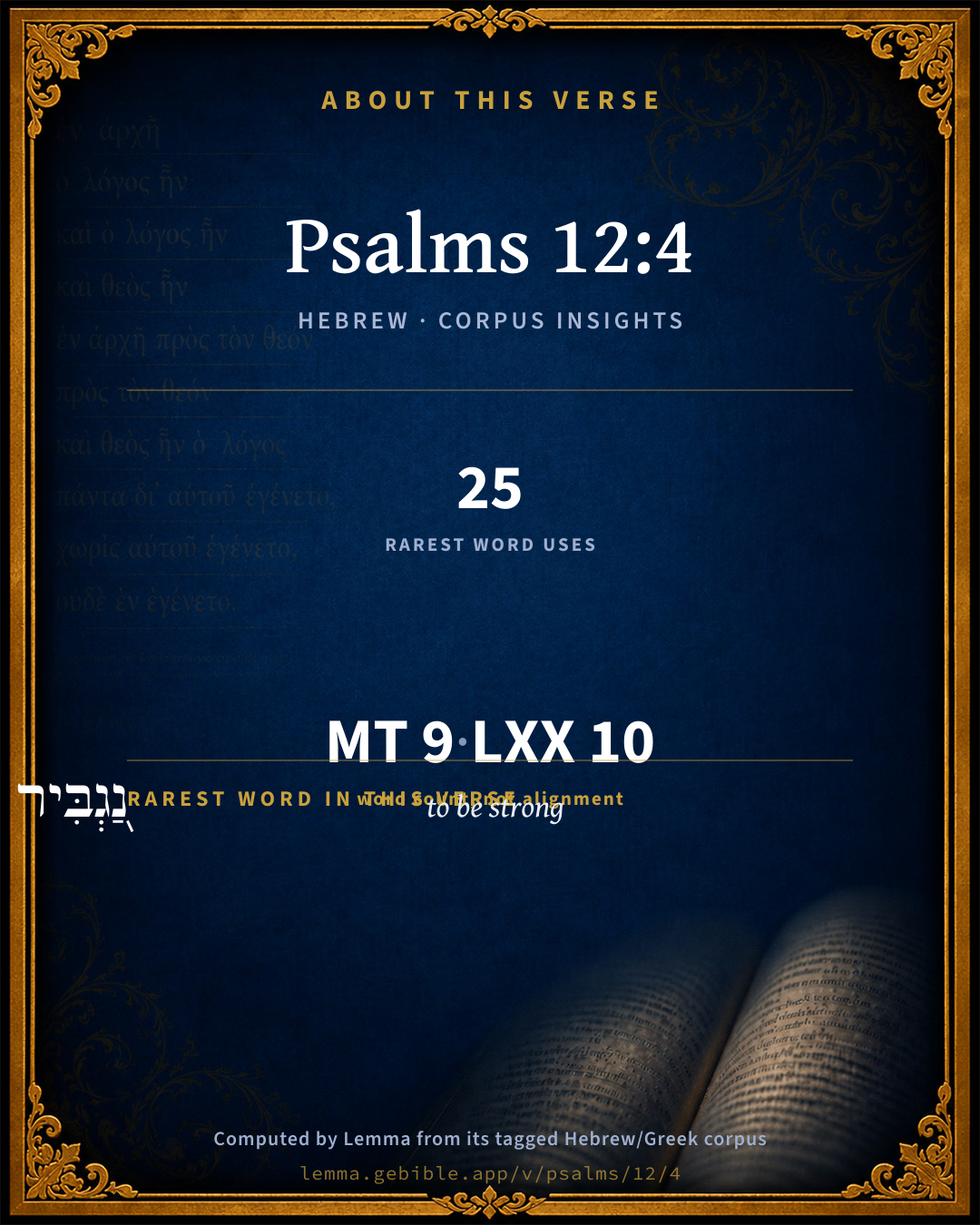
The rarest word here is נַ֭גְבִּיר to be strong H1396 — appearing just 25 times in the whole Hebrew Bible.

Shared distinctive vocabulary

נַ֭גְבִּיר to be strong H1396 occurs in 24 verses of the Hebrew Bible. Also found in:

Grammatical profile

  • 2 verbs
  • 3 nouns
  • 2 prepositions
  • 2 particles

Verb forms

  • אָֽמְר֨וּ Qal · Perfect
  • נַ֭גְבִּיר Hiphil · Imperfect

Hebrew & Septuagint length

In English translation the verse runs 19 words from the Hebrew and 18 from the Septuagint (LXX English) — closely comparable.

A rough comparison of the two English renderings, which tokenize alike — not a word-level alignment.

Word counts can differ between the Hebrew and the Greek without any difference in meaning — e.g. the Hebrew direct-object marker אֵת has no separate Greek word, and Greek often adds the article ὁ.

In the original languages it is 9 Hebrew tokens and 10 Greek tokens — but the two are counted differently (Hebrew bundles its prefixes and suffixes into one token; the Greek is in lemma form), so that isn’t a like-for-like length.

Cross-references

8

Topical passages linked to Psalms 12:4 in the Treasury of Scripture Knowledge — connected by theme and wording, ordered by reader-vote popularity; previews shown in the World English Bible.

  • James 3:5–6 So the tongue is also a little member, and boasts great things. See how a small fire can spread to a large forest!
  • Exodus 5:2 Pharaoh said, "Who is Yahweh, that I should listen to his voice to let Israel go? I don't know Yahweh, and moreover I will not let Israel go."
  • Job 21:14–15 They tell God, 'Depart from us, For we don't want to know about your ways.
  • 2 Thessalonians 2:4 he who opposes and exalts himself against all that is called God or that is worshiped; so that he sits as God in the temple of God, setting himself up as God.
  • Jeremiah 18:18 Then said they, Come, and let us devise devices against Jeremiah; for the law shall not perish from the priest, nor counsel from the wise, nor the word from the prophet. Come, and let us strike him with the tongue, and let us not give heed to any of his words.
  • Daniel 3:15 Now if you are ready whenever you hear the sound of the horn, flute, zither, lyre, harp, pipe, and all kinds of music to you fall down and worship the image which I have made, [well]: but if you don't worship, you shall be cast the same hour into the midst of a burning fiery furnace; and who is that god that shall deliver you out of my hands?
  • Genesis 3:5 for God knows that in the day you eat it, your eyes will be opened, and you will be like God, knowing good and evil."
  • Jeremiah 2:31 Generation, see the word of Yahweh. Have I been a wilderness to Israel? or a land of thick darkness? why say my people, We are broken loose; we will come no more to you?

Cross-references courtesy of OpenBible.info (CC BY 4.0).

Hebrew and Greek witnesses Masoretic Hebrew ↔ Greek Septuagint

The same verse in the two great witnesses to the Old Testament, shown verse-for-verse.

You’re reading Greek Psalm 11 (Hebrew Psalm 12). The Septuagint counts the superscription, so verse numbers can differ from the Hebrew — chapter-level alignment, not verse-by-verse. Numbering follows Rahlfs.

These are two independent witnesses, not word-aligned to each other, and the Septuagint is shown in lemma (dictionary) form.

Hebrew Psalms 12:4 Masoretic · Westminster Leningrad Codex

אֲשֶׁ֤ר אָֽמְר֨וּ לִלְשֹׁנֵ֣נוּ נַ֭גְבִּיר שְׂפָתֵ֣ינוּ אִתָּ֑נוּ מִ֖י אָד֣וֹן לָֽנוּ

Who have said, "With our tongue we will prevail. Our lips are our own. Who is lord over us?"

World English Bible · Public Domain

Greek LXX Greek Psalm 11:4 Septuagint · lemma form

ἐκὀλεθρεύω κύριος πᾶς ὁ χεῖλος ὁ δόλιος καί γλῶσσα μεγαλορρήμων

who have said, We will magnify our tongue; our lips are our own: who is Lord of us?

LXX2012 (modern English Septuagint) · Public Domain

Hebrew: Westminster Leningrad Codex (CC BY 4.0). Greek: Septuagint (public domain); English from LXX2012 (modern English Septuagint) (Public Domain). How the Septuagint differs from the Hebrew →

Commentary

Notes on Psalms 12:4 from classic Christian and Jewish commentators (each source and its license shown beneath its notes). The classic Christian expositions comment on the surrounding passage and are grouped to its opening verse, so a note may address several verses; the Jewish commentaries on the Tanakh (Rashi and others) are per-verse, so they appear only where the commentator wrote on this verse.

Lemma curates 59 commentaries, every one of them public domain or Creative Commons licensed, each selected and text-cleaned for this edition rather than reprinted as found. About our sources →

Trapp's Complete Commentary

John Trapp

Psa 12:4 Who have said, With our tongue will we prevail; our lips [are] our own: who [is] lord over us?

Ver. 4. Who have said, With our tongue will we prevail] Dictitant enim, this was a common word with them. And surely the tongue is a desperate weapon, made in the form of a flaming sword, and elsewhere by David compared to a tuck or rapier, Psa 64:3, to a razor also, doing deceit, Psa 52:2 The Chaldee paraphrast hath this text thus, Because we can swear and lie, therefore we shall prevail.

Our lips are our own] Heb. are with us, that is, we have the command of our tongues, and have words at will; we can speak persuasively, and, therefore, we doubt not to persuade Saul to anything against David. Socrates, in his apology, My lords, said he to the judges, I know not how you have been affected with mine adversaries’ eloquence while you heard them speak; for mine own part, I assure you that I, whom it toucheth most, was almost drawn to believe that all they said, though against myself, was true, when they scarcely uttered one word of truth. Gaius Curio, the Roman, was ingeniose nequam, wittily wicked (Paterculus); and the Duke of Buckingham, in his speech to the Londoners, for Richard III, gained this (though slender) commendation, that no man could deliver so much bad matter in so good words and quaint phrases.

Who is lord over us?] sc. To hinder us from speaking what and when we list with fineness and eloquence, though to the slaying of three at once, the tale bearer, the tale hearer, and the party traduced. R. Samuel Ben Jochai hath this note upon the text: A slanderous tongue is called Lashon Tabithai ( Lingua tertia), because it slayeth three; but here it slew four, viz. Doeg, Saul, Nob, the city of the priests, and Abner, who suffered it so to be, 1Sa 22:18-19.

John Trapp, A Commentary or Exposition upon All the Books of the Old and New Testament (1647–1656) — public domain. Text from a community e-Sword module.

Joseph Benson's Commentary

Psa 12:4. With our tongues will we prevail — By raising and spreading evil reports concerning him. We will have the better of all that oppose us; and our tongues are the instruments whereby we will get the victory. Our lips are our own — At our own disposal to speak what we please. Who is lord over us? — Who can, or has any right to control us; or to call us to an account?

Joseph Benson's Commentary on the Old and New Testaments (1811–1818) — public domain. Text from a community e-Sword module.

J. A. Alexander on Psalms

Joseph Addison Alexander

5. (Psa 12:4). Who have said, By our tongues will we do mightily; our lips (are) with us: who is lord to us, or over us? This is an amplified specification of the phrase speaking great things in the preceding verse. By our tongues, literally, as to, with respect to our tongues. The idea of agency or instrumentality is suggested by the context. Do mightily, exercise power, shew ourselves to be strong. Our lips are with us may either mean they are our own, at our disposal, or, they are on our side. The idea of the whole verse is, by our own lips and our tongues we can accomplish what we will.

Joseph Addison Alexander, The Psalms Translated and Explained (1850) — public domain. Text from a community e-Sword module.

Tyndale Open Study Notes

Tyndale Open Resources

12:4 The words they say reveal the character of the wicked. They deceive and overpower the godly and arrogantly question the Lord’s purposes.

Tyndale Open Study Notes — © Tyndale Open Resources, licensed CC BY-SA 4.0. Text via the HelloAO Bible API.

Geneva Bible (1599)

Geneva Bible translators

They think themselves able to persuade whatsoever they take in hand.

Geneva Bible (1599) marginal notes — public domain. Text via Bolls.life.

Adam Clarke's Commentary

Verse 4. Our lips are our own] Many think, because they have the faculty of speaking, that therefore they may speak what they please.

Old MS. - The qwilk sayd, our toung we sal wyrchip, our lippes er of us, qwas our Lorde? Tha Ypocrites worchepes thair toung; for thai hee tham self janglyng and settes in thaire pouste to do mykil thyng and grete: and thai rose tham that thair lippes that es thair facund and thair wyls er of tham self, nought of God, ne of haly menes lare; for thi that say qua es our Lord? that es, qwat es he to qwas rewle and conversacioun we sal be undir lout? and confourme us til? Als so to say, That es none.

Adam Clarke's Commentary on the Bible (1810–1826) — public domain. Text from a community e-Sword/MySword module.

John Calvin's Commentaries

This the Psalmist confirms more fully in the following verse: Who have said, we will be strengthened by our tongues Those must be possessed of great authority who think that, in the very falsehood to which they are addicted, they have enough of strength to accomplish their purposes, and to protect themselves. It is the utmost height of wickedness for persons to break out into such presumption, that they scruple not to overthrow all law and equity by their arrogant and boasting language; for, in doing this, it is just as if they openly declared war against God himself. Some read, we will strengthen our tongues. This reading is passable, in so far as the sense is concerned, but it scarcely agrees with the rules of grammar, because the letter ל, lamed, is added. Moreover, the sense which is more suitable is this: that the wicked persons spoken of being armed with their tongues, go beyond all bounds, and think they can accomplish by this means whatever they please; just as this set of men so deform every thing with their calumnies, that they would almost cover the sun himself with darkness.

John Calvin's Commentaries (1540-1563) — public domain. Text from the Calvin Translation Society English edition (1840s-50s) via the Christian Classics Ethereal Library (ccel.org). Calvin's coverage is partial (roughly two-thirds of the Bible); uncommented books and verses are honest gaps, never fabricated. The 19th-century editor's footnotes and remarks are omitted so the notes are faithfully Calvin's own voice.

Ellicott's Commentary for English Readers

(4) With our tongue.—This is the proud saying just mentioned, and is plainly a boast of the power possessed by those who have the ear of persons in authority, and can adroitly “make the worse appear the better cause”; or being themselves in high places, can, like Angelo in Measure for Measure, defy the accusations of their victims:—

“Who will believe thee, Isabel?

My place in the State

Will so your accusation overweigh

That you shall stifle in your own report,

And smell of calumny.”

But there is great difference of opinion as to the proper rendering, “with our tongues will we prevail.” Some render, “we are masters of our tongues”; others, “with our tongues we confederate”: i.e., “our tongues are our allies.” The last rendering agrees best with the next clause.

Our lips are our own.—Literally, are with us: i.e., on our side. (Comp. 2Ki_9:32.)

A Bible Commentary for English Readers, edited by Charles John Ellicott (1878–1897) — public domain. Text from a community e-Sword module.

The Cambridge Bible for Schools and Colleges

gen. ed. J. J. S. Perowne

4. Who] Namely, the owners of the flattering lips and boastful tongues. ‘Our tongue,’ they say, ‘we will make mighty: our lips are with us,’ under our own control, at command as faithful allies; who is lord over us? No one can call us to account for our use of them (Psa_10:4). Unscrupulous courtiers appear to be meant, who deliberately propose to obtain their own ends by reckless disregard of truth, e.g. by flattery, slander, false witness, and the like.

The Cambridge Bible for Schools and Colleges (gen. ed. J. J. S. Perowne; Cambridge University Press, 1878–1918) — public domain. Text from a community e-Sword module.

John Gill's Exposition

Who have said, with our tongue will we prevail,.... Either through the eloquence of them, or the outward force and power with which they are backed. The sense is, as we say, so shall it be; our words are laws, and shall be obeyed, there is no standing against them; our edicts and decrees shall everywhere be regarded: or "we will make one to prevail", or "have the dominion" (g); meaning antichrist, the man of sin; for all this is true of the tongues of the antichristian party, and of their laws, edicts, and decrees and which have obtained everywhere, and by which the wicked one has been established in his tyrannical power and authority;

our lips are our own, or "with us" (h): we will say what we please, and make what laws and decrees we think fit, and impose them upon men; and so change times and laws without control, Dan 7:25;

who is Lord over us? which is the very language and conduct of antichrist, who opposes and exalts himself above all that is called God, Th2 2:4; and is indeed the language of the hearts and lives of all wicked and ungodly men, sons of Belial, men without any yoke or restraint; who walk, and are resolved to walk, after the imagination of their own evil hearts; not knowing the Lord, and being unwilling to obey him, or to be restrained by him; see Exo 5:2.

(g) "prevalere ac dominare, faciemus, scil. aliquem regem, dominum", Cocceius. (h) "nobiscum", Musculus, Pagninus, Montanus, Vatablus, Cocceius, Gejerus, Michaelis; so Junius & Tremellius, Piscator, Ainsworth.

John Gill's Exposition of the Whole Bible (1746–1763) — public domain (CC PDM 1.0). Text via the HelloAO Bible API.

Albert Barnes' Notes on the Bible

Who have said - Who habitually say. This does not mean that they had formally and openly said this - for none would be likely to do so - but that they had practically and really said this by their conduct. They acted as if it were the real principle on which they framed their lives, that they might use their tongues as they pleased.

With our tongue - literally, “as to,” or “in respect to our tongue;” that is, by our tongue. It was by the tongue that they expected to accomplish their purposes. It was not by direct power, or by violence, but by the power of speech.

Will we prevail - literally, “We will do mightily;” that is, they would accomplish their purposes. They relied on the power of speech - on their ability in influencing others; in deceiving others; in persuading others to fall in with their plans.

Our lips are our own - That is, we may use them as we please; no one has a right to control us in the use of what properly belongs to ourselves. It cannot be meant that they intended to assert this openly as a right, for there are perhaps none who will not admit in words that they are responsible for what they “say,” as well as for what they “do.” But their conduct was such that this was the fair interpretation to be placed on what they said. They would speak this if they openly professed and avowed what was their real opinion.

Who is lord over us? - That is, who has a right to control us in the case? There are many who practically avow this as a principle of conduct, and who seem to feel that they are not responsible for their words, however much they may admit their responsibility for their actions. There is usually a greater degree of recklessness among men in regard to their speech than in regard to their conduct; and many a man who would shrink from doing another wrong by an act of dishonesty in business, may be utterly reckless as to doing him wrong by an unkind remark.

Albert Barnes' Notes on the Bible (1834–1885) — public domain. Text from a community e-Sword/MySword module.

Matthew Poole's English Annotations

With our tongue will we prevail, by raising and spreading slanders and evil reports concerning him, whereby both Saul will be highly and implacably enraged against David, and the hearts of the people alienated from him; which was indeed a very likely way to prevail against, him, and that by their tongues only.

Our lips are our own, i.e. at our own dispose to speak what we please.

Who is lord over us; who can control or restrain us? This was not the language of their mouths, for they were Israelites, that owned a God above them, and they were subjects of Saul; but the language of their actions. Scripture oft tells us not only what men do actually say, but what they would say if they durst, or what their actions mean, as Psa 94:7; Mal 1:12,13; 2:17. They take as great a liberty in their speech as if they believed there was no God or man superior to them; because neither the fear of God, nor the reverence of men, can keep them from speaking whatsoever they please, or what they suppose makes for their interest.

Matthew Poole's English Annotations on the Holy Bible (1683–1685) — public domain. Text from a community e-Sword/MySword module.

The Treasury of David

Charles H. Spurgeon

Ver. 4. Who have said, With our tongues will we prevail; who is Lord over us? So it was: twelve poor and unlearned men on the one side, all the eloquence of Greece and Rome arrayed on the other. From the time of Tertullus to that of Julian the apostate, every species of oratory, learning, wit, was lavished against the church of God; and the result, like the well known story of that dispute between the Christian peasant and the heathen philosopher, when the latter, having challenged the assembled fathers of a synod to silence him, was put to shame by the simple faith of the former "In the name of our Lord Jesus Christ, I command thee to be dumb." Who is lord over us? "Who is the Lord, that I should obey his voice to let Israel go?" Ex 5:2. "What is the Almighty, that we should serve him?" Job 21:15. "Who is that God that shall deliver you?" Da 3:15. Michael Ayguan, in J. M. Neale's Commentary.

Ver. 4. Our lips are our own. If we have to do with God, we must quit claim to ourselves and look on God as our owner; but this is fixed in the hearts of men, We will be our own; we will not consent to the claim which God makes to us: "Our lips are our own." Wicked men might as well say the same thing of their whole selves; our bodies, strength, time, parts, etc., are our own, and who is Lord over us? John Howe.

Ver. 4. From the faults of the wicked we must learn three contrary lessons; to wit: 1. That nothing which we have is our own. But, 2. Whatsoever is given to us of God is for service to be done to him. 3. That whatsoever we do or say, we have a Lord over us to whom we must be answerable when he calleth us to account. David Dickson.

Charles H. Spurgeon's The Treasury of David (1869–1885) — public domain. Psalms only. Text from a community e-Sword/MySword module.

Whedon's Commentary on the Bible

Daniel D. Whedon

4. With our tongue will we prevail—The tongue is often a more deadly weapon than the sword, and these boasters seem to have been aware of its envenomed power. These men would be weak in open war, but were terrible in flattery, evil counsel, and lies. Here-in lay their strength, of which they boasted, not knowing that a just God rules, and that the world is not abandoned to become the victim of tricks and contrivances.

Our lips are our own—Literally, our lips are with us; are our servants, subject to our will.

Who is lord over us—Here is the climax of their arrogance and impudence.

Daniel D. Whedon (gen. ed.), Commentary on the Old and New Testaments (1874–1909) — public domain. Text from a community e-Sword module.

The Pulpit Commentary

Who have said, With our tongue will we prevail; or, through our tongues are we powerful; i.e. whatever we desire we can accomplish through our tongues by persuasion, or by menaces, or by skill in argument. Success in pleading before courts of law is, perhaps, included. Our lips are our own; literally, are with us; i.e. are on our side, are our helpers ("Nobis auxilio et praesto sunt," Michaelis). Who is lord over us? Who, i.e. , can interfere with us and impede our action? They do not believe in any righteous Judge and Controller of the world, who can step in to frustrate their plans, upset their designs, and bring them to ruin. (see Psa_10:4, 11 14:1)

Unbridled speech.

"Our lips are our own," etc. If it be true, as we often say, that "actions speak louder than words," it is also true that speech is a kind of action, and that words often speak more than the speaker means to utter. Light, thoughtless words, void of serious meaning, sometimes flash a light into the inmost chamber of the heart; they could not have been spoken if kindness, good sense, justice, humility, dwelt and ruled there. Profuse professions are often interpreted by the rule of contrary. When Judas said, "Hail, Master!" he branded himself as a traitor, hypocrite, murderer. The text may not mean that these words are audibly uttered. The Bible speaks often of what men say in their heart. The temper and spirit which go with an unbridled tongue are expressed thus: "Our lips are our own.

I THIS IS A GREAT MISTAKE. Responsibility is not annihilated or lessened by our refusing to acknowledge it. We are responsible for our words as much as for the rest of our life. Our lips are not our own, because we ourselves are not our own. (1Co_6:19, 20Psa_100:3, Revised Version) God "giveth richly all things to enjoy;" but he can give nothing away; all is his still, and cannot cease to be his. (1Ch_29:14 Rom_12:1) Responsibility to use God"s gifts in a way pleasing to him and to his glory increases with the preciousness of the gift. Who can reckon the value of speech? That without which reason would be not only dumb, but blind, deaf, paralyzed the chief bond of human society, the instrument of truth, instruction, command, persuasion, comfort, converse. All life is "in the power of the tongue". (Pro_18:21) For good or for evil, even a short speech often long outlives the lips that uttered it. Not only "what is written remains." Books and writings decay and perish, while "winged words" fly from land to land, and live on through ages. A great trust is man"s gift of speech.

II A MORE COMMON MISTAKE THAN MAY BE THOUGHT. Thus boldly, coarsely spoken, it is indeed the language of atheism. But think of the enormous amount of idle, unprofitable, unkind, unjust, insincere talk poured forth every day; not to speak of what is wilfully false, impure, or malignant. What does all this mean but utter forgetfulness of responsibility to God for our use of this great gift? Passing sad, too, it is to think how it runs to waste; of all the words of counsel, comfort, kindness, prayer, praise, that might be spoken, but are not. The dulness of conscience on this point is astonishing. You may meet often with Christians who positively pride themselves on "speaking their mind," no matter at what cost to others. People who would think it unpardonably wicked to strike a hard blow with the fist, think nothing of giving a stab with the tongue, which perhaps years will not heal. (Jam_3:6)

III It is not enough that we see the sin of unbridled speech, the reckless impiety of supposing "our lips are our own." Let us take to heart OUR RESPONSIBILITY to our brother man, above all, to our Saviour, for our use of this noble faculty and priceless gift. "The fruit of our lips" (Heb_13:15) may be a "sacrifice" in other ways as well as praise. Remember our Lord"s warning. (Mat_12:36, Mat_12:37) Meditate on what we owe to the words of those who have taught, counselled, cheered, and helped us; to the words of inspired men; above all, to the words of the Lord Jesus. "A word spoken in season, how good is it!" A kind word, a faithful rebuke, an honest avowal of faith and conviction, a manly protest against impure or ill-natured speech, may be the turning-point for good of some young life. "Let your speech be alway with grace". (Col_4:6 Eph_4:29, Eph_4:30, where note the remarkable reference to the Holy Spirit; Psa_19:14)

The Pulpit Commentary (1880–1919), ed. H.D.M. Spence-Jones & Joseph S. Exell — public domain. Text from a community e-Sword module.

John Wesley's Explanatory Notes

Prevail - By raising and spreading evil reports concerning him. Our own - At our own disposal to speak what we please, who can control or restrain us?

John Wesley, Explanatory Notes Upon the Whole Bible (1754–1765) — public domain. Text via the GEBible commentary corpus.

Lesson kit

Teaching starters — assembled from the data on this page, not authored interpretation. Every prompt links to the verse data it draws on. Edit before teaching.

Psalms, in the Wisdom, opens this verse with 9 words (8 distinct Hebrew lemmas). Its most distinctive word is gâbar (“to be strong”). A historical commentator’s framing appears above. Read the whole chapter for the surrounding context.

Discussion questions

  1. How does “to be strong” (gâbar) shape what this verse is saying?
  2. How does Genesis 7:18, which shares the word «to be strong», read alongside this verse?
  3. The translations on this page render this verse differently — a whole-verse word diff, not a word-by-word alignment. What might account for the different wordings?
  4. «אָֽמְר֨וּ» is a Qal Perfect verb. How does that grammatical form shape the action described?
  5. Compare how Trapp's Complete Commentary and Joseph Benson's Commentary read this verse. Where do they agree or differ?

Things to notice

Reading settings

Reading text

Shown beneath each verse's original-language words.

Old Testament
Old Testament edition

Read the OT as the Masoretic Hebrew (MT) or the Greek Septuagint (LXX).

English shown for the Greek Septuagint (in the Hebrew ↔ Greek comparison).

Comparing translations? Open the Compare panel on any verse page to stack up to four side by side.