
1 Samuel 28:9

Hebrew (Westminster Leningrad Codex) 1 Samuel 28:9 appears in the Hebrew Old Testament. The text above is from the Westminster Leningrad Codex. Each word links to its Strong’s number, a concise gloss, and parsing drawn from the Open Scriptures Hebrew Bible morphology. Click any word for its full Brown-Driver-Briggs (BDB) entry.
Download image
Cite this verse

1 Samuel 28:9 (World English Bible). Public Domain. Lemma interlinear Bible study tool, https://lemma.gebible.app/v/1-samuel/28/9.

Show BibTeX & RIS
BibTeX
RIS
English Translation
The woman said to him, Behold, you know what Saul has done, how he has cut off those who have familiar spirits, and the wizards, out of the land: why then lay you a snare for my life, to cause me to die?
World English Bible · Public Domain
Download a study sheet

One document with this verse’s original text, its word-by-word gloss line, the meaning frame, cross-references with their text, attributed commentary, and full source and license credits — printable, and it pastes into notes with its structure intact.

This verse Autodidact and up

Study sheet (.html) Plain text (.txt)

A passage Seminary Student

Up to 50 verses in one chapter. A passage sheet keeps up to 6 commentary sources and 12 cross-references per verse, in the order this page ranks them, and says so on the sheet whenever that leaves anything out. Ask for a single verse and you get the Autodidact verse sheet above.

Everything on this page stays free to read, with no account — the sheet is a download of what is already on screen, not access to it.

Want to remove ads? Support Godless Engineer
Compare translations 3

The same verse in 3 English versions, stacked beneath the original-language interlinear above. Click any original word for its lexicon entry.

Each is an independent rendering of the whole verse — the interlinear is not word-aligned to these translations.

Highlighted words mark where these versions differ — a whole-verse word diff, not a word-by-word alignment.

  • World English Bible Public Domain
    The woman said to him, Behold, you know what Saul has done, how he has cut off those who have familiar spirits, and the wizards, out of the land: why then lay you a snare for my life, to cause me to die?
  • King James Version Public Domain
    And the woman said unto him, Behold, thou knowest what Saul hath done, how he hath cut off those that have familiar spirits, and the wizards, out of the land: wherefore then layest thou a snare for my life, to cause me to die?
  • unfoldingWord Literal Text CC BY-SA 4.0
    But the woman said to him, “Behold, you yourself know what Saul has done, that he has cut off the ritual pits and the familiar spirits from the land. So why are you setting a trap against my life, to cause me to die?”

unfoldingWord Literal Text — © unfoldingWord, licensed CC BY-SA 4.0. Word-aligned USFM3 via Door43 (git.door43.org/unfoldingWord/en_ult).

Versions to compare (up to 4)

3 of 4 selected

Show all 18 translations

Every available English version of this verse, each an independent rendering of the whole verse.

  • World English Bible Public Domain
    The woman said to him, Behold, you know what Saul has done, how he has cut off those who have familiar spirits, and the wizards, out of the land: why then lay you a snare for my life, to cause me to die?
  • Berean Standard Bible Public Domain
    But the woman replied, “Surely you know what Saul has done, how he has killed the mediums and spiritists in the land. Why have you set a trap to get me killed?”
  • Majority Standard Bible Public Domain
    But the woman replied, “Surely you know what Saul has done, how he has killed the mediums and spiritists in the land. Why have you set a trap to get me killed?”
  • King James Version Public Domain
    And the woman said unto him, Behold, thou knowest what Saul hath done, how he hath cut off those that have familiar spirits, and the wizards, out of the land: wherefore then layest thou a snare for my life, to cause me to die?
  • American Standard Version (1901) Public Domain
    And the woman said unto him, Behold, thou knowest what Saul hath done, how he hath cut off those that have familiar spirits, and the wizards, out of the land: wherefore then layest thou a snare for my life, to cause me to die?
  • Revised Version (1885) Public Domain
    And the woman said unto him, Behold, thou knowest what Saul hath done, how he hath cut off those that have familiar spirits, and the wizards, out of the land: wherefore then layest thou a snare for my life, to cause me to die?
  • Geneva Bible (1599) Public Domain
    And the woman saide vnto him, Beholde, thou knowest what Saul hath done, how he hath destroyed the sorcerers, and the southsayers out of the land: wherefore then seekest thou to take me in a snare to cause me to die?
  • Douay-Rheims (1899) Public Domain
    And the woman said to him: Behold thou knowest all that Saul hath done, and how he hath rooted out the magicians and soothsayers from the land: why then dost thou lay a snare for my life, to cause me to be put to death?
  • Young's Literal Translation Public Domain
    And the woman saith unto him, `Lo, thou hast known that which Saul hath done, that he hath cut off those having familiar spirits, and the wizards, out of the land; and why art thou laying a snare for my soul -- to put me to death?'
  • Literal Standard Version CC BY-SA 4.0
    And the woman says to him, “Behold, you have known that which Saul has done, that he has cut off those having familiar spirits, and the wizards, out of the land; and why are you laying a snare for my soul—to put me to death?”
  • Unlocked Literal Bible CC BY-SA 4.0
    The woman said to him, “See, you know what Saul has done, how he has banned from the land those who talk with the dead or with spirits. So why are you setting a trap for my life, to make me die?”
  • unfoldingWord Literal Text CC BY-SA 4.0
    But the woman said to him, “Behold, you yourself know what Saul has done, that he has cut off the ritual pits and the familiar spirits from the land. So why are you setting a trap against my life, to cause me to die?”
  • Darby Bible Public Domain
    And the woman said to him, Behold, thou knowest what Saul has done, how he has cut off the necromancers and the soothsayers out of the land; and why layest thou a snare for my life, to cause me to die?
  • World Messianic Bible Public Domain
    The woman said to him, “Behold, you know what Saul has done, how he has cut off those who have familiar spirits and the wizards out of the land. Why then do you lay a snare for my life, to cause me to die?”
  • Webster's Bible Public Domain
    And the woman said to him, Behold, thou knowest what Saul hath done, how he hath cut off those that have familiar spirits, and the wizards, out of the land: Why then layest thou a snare for my life, to cause me to die?
  • Free Bible Version CC BY-SA 4.0
    “Don't you know what Saul has done,” she replied. “He's got rid of the mediums and spiritists from the country. Are you trying to set a trap for me and get me killed?”
  • Bible in Basic English Public Domain
    And the woman said to him, But you have knowledge of what Saul has done, how he has put away out of the land those who have control of spirits and the users of secret arts: why would you, by a trick, put me in danger of death?
  • JPS Tanakh (1917) Public Domain
    And the woman said unto him: 'Behold, thou knowest what Saul hath done, how he hath cut off those that divine by a ghost or a familiar spirit out of the land; wherefore then layest thou a snare for my life, to cause me to die?'

Literal Standard Version (2020), Covenant Press — licensed CC BY-SA 4.0. Text via the HelloAO Bible API (eBible.org). Unlocked Literal Bible (unfoldingWord) — licensed CC BY-SA 4.0. Text via the HelloAO Bible API (eBible.org). unfoldingWord Literal Text — © unfoldingWord, licensed CC BY-SA 4.0. Word-aligned USFM3 via Door43 (git.door43.org/unfoldingWord/en_ult). Free Bible Version, Dr. Jonathan Gallagher — licensed CC BY-SA 4.0. Text via the HelloAO Bible API (eBible.org).

Word by word

More ways to search: Search by grammar → Find every occurrence → Compare this word →

Practice this passage: Drill this verse → Learn its vocabulary →

מִתְנַקֵּ֥שׁ
nâqash
H5367
“striking”
Verb, Hithpael, Participle Active, Masculine, Singular, Absolute
Part of Speech
Verb
Stem
Hithpael
Form
Participle Active
Gender
Masculine
Number
Singular
State
Absolute
Full BDB Definition

Origin: a primitive root

TWOT: 1419

to knock, strike, bring down - (Qal) to strike down - (Niphal) to be thrust after, be impelled - (Piel) to strike at, take aim at - (Hithpael) to be struck - (CLBL) to ensnare - (Qal) to ensnare - (Niphal) to be ensnared - (Piel) to lay snares - (Hithpael) to lay snares
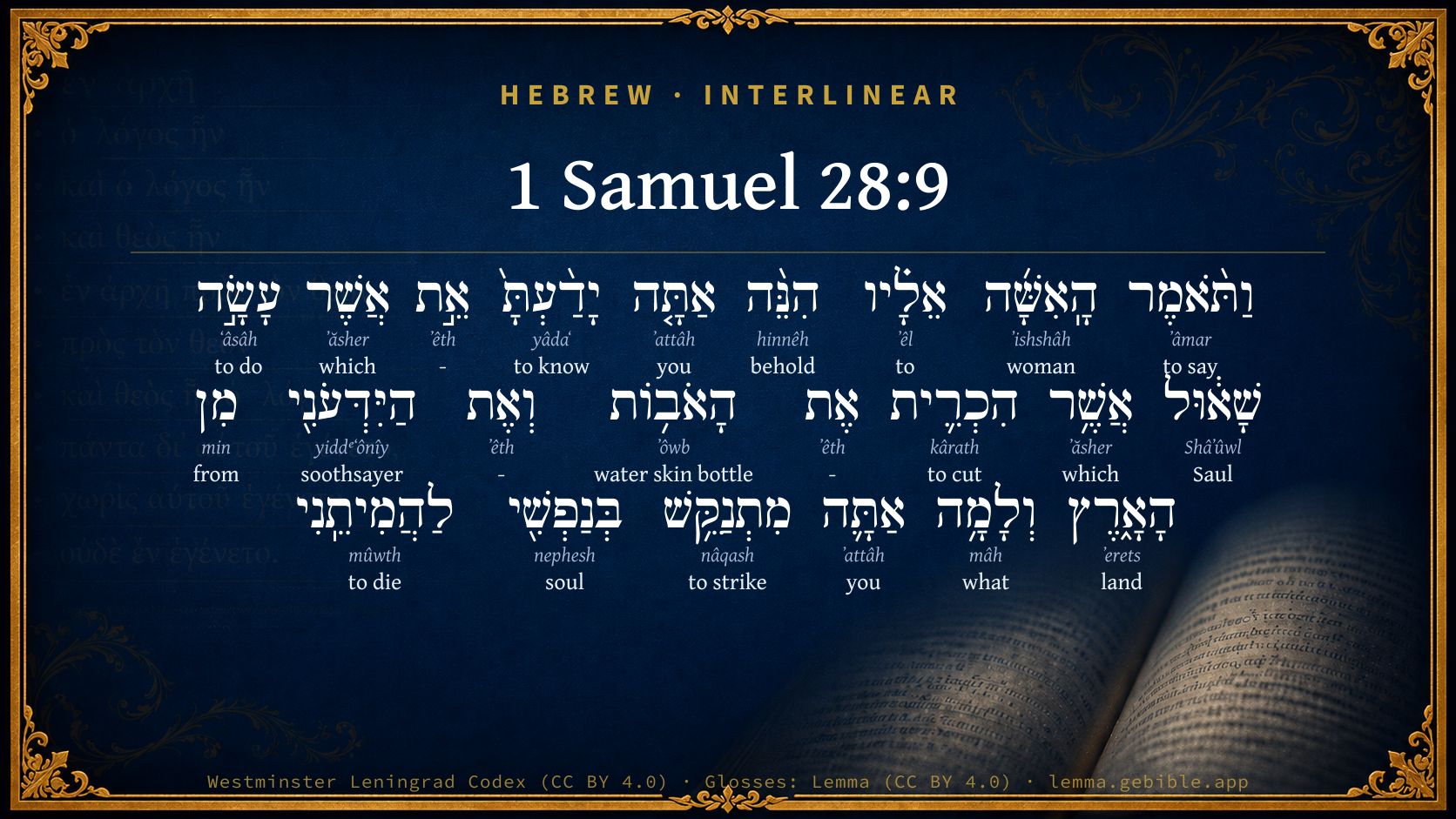
  1. וַתֹּ֨אמֶר ʼâmar H559 “and · to say” Conjunction + Verb, Qal, Sequential Imperfect, 3rd Person, Feminine, Singular
  2. הָֽאִשָּׁ֜ה ʼishshâh H802 “the · woman” Particle, Definite Article + Noun, Common, Feminine, Singular, Absolute
  3. אֵלָ֗יו ʼêl H413 “to · him” Preposition + Suffix, Personal, 3rd Person, Masculine, Singular
  4. הִנֵּ֨ה hinnêh H2009 “behold” Particle, Demonstrative
  5. אַתָּ֤ה ʼattâh H859 “you” Pronoun, Personal, 2nd Person, Masculine, Singular
  6. יָדַ֨עְתָּ֙ yâdaʻ H3045 “to know” Verb, Qal, Perfect, 2nd Person, Masculine, Singular
  7. אֵ֣ת ʼêth H853 “-” Particle, Direct Object
  8. אֲשֶׁר ʼăsher H834 “which” Particle, Relative
  9. עָשָׂ֣ה ʻâsâh H6213 “to do” Verb, Qal, Perfect, 3rd Person, Masculine, Singular
  10. שָׁא֔וּל Shâʼûwl H7586 “Saul” Noun, Proper
  11. אֲשֶׁ֥ר ʼăsher H834 “which” Particle, Relative
  12. הִכְרִ֛ית kârath H3772 “to cut” Verb, Hiphil, Perfect, 3rd Person, Masculine, Singular
  13. אֶת ʼêth H853 “-” Particle, Direct Object
  14. הָאֹב֥וֹת ʼôwb H178 “the · water skin bottles” Particle, Definite Article + Noun, Common, Masculine, Plural, Absolute
  15. וְאֶת ʼêth H853 “and · -” Conjunction + Particle, Direct Object
  16. הַיִּדְּעֹנִ֖י yiddᵉʻônîy H3049 “the · soothsayer” Particle, Definite Article + Noun, Common, Masculine, Singular, Absolute
  17. מִן min H4480 “from” Preposition
  18. הָאָ֑רֶץ ʼerets H776 “the · land” Particle, Definite Article + Noun, Common, Both, Singular, Absolute
  19. וְלָמָ֥ה mâh H4100 “and · to/for · what” Conjunction + Preposition + Particle, Interrogative
  20. אַתָּ֛ה ʼattâh H859 “you” Pronoun, Personal, 2nd Person, Masculine, Singular
  21. בְּנַפְשִׁ֖י nephesh H5315 “in/at · soul · my” Preposition + Noun, Common, Both, Singular, Construct + Suffix, Personal, 1st Person, Common, Singular
  22. לַהֲמִיתֵֽנִי mûwth H4191 “to die · me” Preposition + Verb, Hiphil, Infinitive Construct + Suffix, Personal, 1st Person, Common, Singular

About this verse

These counts appear in no published source. They are computed here, from the morphology-tagged text and Lemma’s own curated glosses. What Lemma adds →

23
words
19
distinct lemmas
Historical
section

Notable vocabulary

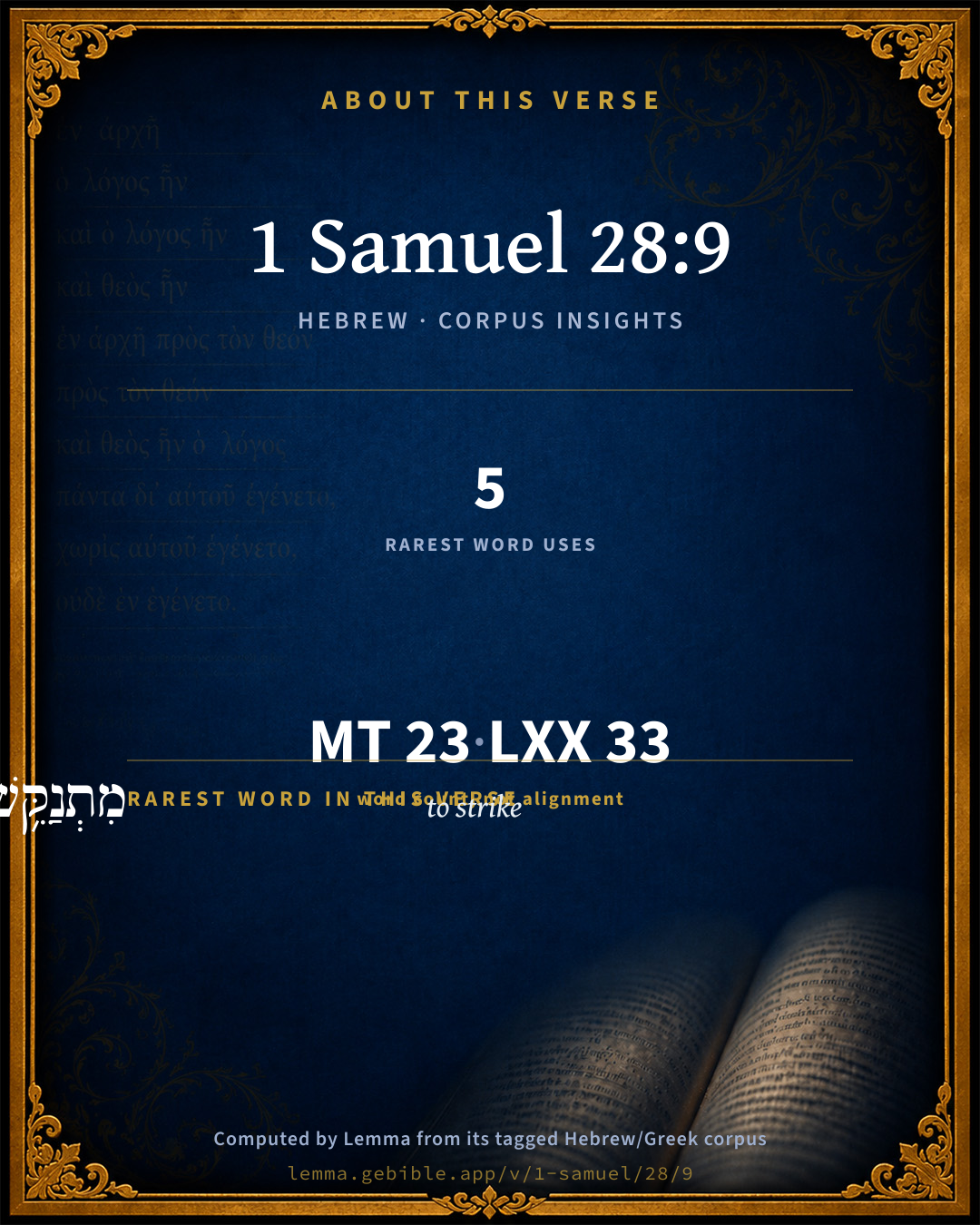
The rarest word here is מִתְנַקֵּ֥שׁ to strike H5367 — appearing just 5 times in the whole Hebrew Bible.

Shared distinctive vocabulary

מִתְנַקֵּ֥שׁ to strike H5367 occurs in 5 verses of the Hebrew Bible. Also found in:

Grammatical profile

  • 6 verbs
  • 6 nouns
  • 2 pronouns
  • 2 prepositions
  • 7 particles

Verb forms

  • וַתֹּ֨אמֶר Qal · Sequential Imperfect
  • יָדַ֨עְתָּ֙ Qal · Perfect
  • עָשָׂ֣ה Qal · Perfect
  • הִכְרִ֛ית Hiphil · Perfect
  • מִתְנַקֵּ֥שׁ Hithpael · Participle Active
  • לַהֲמִיתֵֽנִי Hiphil · Infinitive Construct

Repetition

Words recur within this verse — often emphatic in Hebrew:

  • אַתָּ֤ה you H859 ×2
  • אֲשֶׁר which H834 ×2

Hebrew & Septuagint length

In English translation the verse runs 43 words from the Hebrew and 45 from the Septuagint (LXX English) — closely comparable.

A rough comparison of the two English renderings, which tokenize alike — not a word-level alignment.

Word counts can differ between the Hebrew and the Greek without any difference in meaning — e.g. the Hebrew direct-object marker אֵת has no separate Greek word, and Greek often adds the article ὁ.

In the original languages it is 23 Hebrew tokens and 33 Greek tokens — but the two are counted differently (Hebrew bundles its prefixes and suffixes into one token; the Greek is in lemma form), so that isn’t a like-for-like length.

Cross-references

3

Topical passages linked to 1 Samuel 28:9 in the Treasury of Scripture Knowledge — connected by theme and wording, ordered by reader-vote popularity; previews shown in the World English Bible.

  • 1 Samuel 28:3 Now Samuel was dead, and all Israel had lamented him, and buried him in Ramah, even in his own city. Saul had put away those who had familiar spirits, and the wizards, out of the land.
  • 2 Samuel 18:13 Otherwise if I had dealt falsely against his life (and there is no matter hid from the king), then you yourself would have set yourself against [me].
  • 2 Kings 5:7 It happened, when the king of Israel had read the letter, that he tore his clothes, and said, Am I God, to kill and to make alive, that this man does send to me to recover a man of his leprosy? but consider, I pray you, and see how he seeks a quarrel against me.

Cross-references courtesy of OpenBible.info (CC BY 4.0).

Hebrew and Greek witnesses Masoretic Hebrew ↔ Greek Septuagint

The same verse in the two great witnesses to the Old Testament, shown verse-for-verse.

These are two independent witnesses, not word-aligned to each other, and the Septuagint is shown in lemma (dictionary) form.

Hebrew 1 Samuel 28:9 Masoretic · Westminster Leningrad Codex

וַתֹּ֨אמֶר הָֽאִשָּׁ֜ה אֵלָ֗יו הִנֵּ֨ה אַתָּ֤ה יָדַ֨עְתָּ֙ אֵ֣ת אֲשֶׁר עָשָׂ֣ה שָׁא֔וּל אֲשֶׁ֥ר הִכְרִ֛ית אֶת הָאֹב֥וֹת וְאֶת הַיִּדְּעֹנִ֖י מִן הָאָ֑רֶץ וְלָמָ֥ה אַתָּ֛ה מִתְנַקֵּ֥שׁ בְּנַפְשִׁ֖י לַהֲמִיתֵֽנִי

The woman said to him, Behold, you know what Saul has done, how he has cut off those who have familiar spirits, and the wizards, out of the land: why then lay you a snare for my life, to cause me to die?

World English Bible · Public Domain

Greek LXX 1 Samuel 28:9 Septuagint · lemma form

καί εἶπον ὁ γυνή πρός αὐτός ἰδού δή σύ οἶδα ὅσος ποιέω σαούλ ὡς ἐκὀλεθρεύω ὁ ἐγγαστρίμυθος καί ὁ γνώστης ἀπό ὁ γῆ καί ἵνα τίς σύ παγιδεύω ὁ ψυχή ἐγώ θανατόω αὐτός

And the woman said to him, Behold now, you know what Saul has done, how he has cut off those who had in them divining spirits, and the wizards from the land, and why do you spread a snare for my life to destroy it?

LXX2012 (modern English Septuagint) · Public Domain

Hebrew: Westminster Leningrad Codex (CC BY 4.0). Greek: Septuagint (public domain); English from LXX2012 (modern English Septuagint) (Public Domain). How the Septuagint differs from the Hebrew →

Targum (Aramaic paraphrase)

1

The Targum is the ancient Jewish Aramaic paraphrase of the Hebrew Scriptures — an interpretive translation, not the Hebrew text itself. Onkelos (literal) and Pseudo-Jonathan (expansive) render the Torah, and Jonathan the Prophets. Coverage is partial: where no permissively-licensed English translation exists for a verse, only the Aramaic is shown. This is verse-level text, not a word-by-word alignment to the Hebrew.

  1. Targum Jonathan Prophets (Joshua–Malachi)
    וַאֲמַרַת אִתְּתָא לֵיהּ הָא אַתְּ יָדַעְתָּא יַת דַעֲבַד שָׁאוּל דְשֵׁיצֵי יַת בִּידִין וְיַת זְכוּרוּ מִן אַרְעָא וּלְמָא אַתְּ מִתְגָרֵי בְּנַפְשִׁי לְמִקְטְלִי:

    (no public-domain English translation for this verse)

    Targum Jonathan — Aramaic: “Mikraot Gedolot” (public domain). English: “Sefaria Community Translation” (CC0 1.0 (public-domain dedication)); “London "Chaldee Paraphrase," 1871” (public domain). Text via Sefaria.

Commentary

Notes on 1 Samuel 28:9 from classic Christian and Jewish commentators (each source and its license shown beneath its notes). The classic Christian expositions comment on the surrounding passage and are grouped to its opening verse, so a note may address several verses; the Jewish commentaries on the Tanakh (Rashi and others) are per-verse, so they appear only where the commentator wrote on this verse.

Lemma curates 59 commentaries, every one of them public domain or Creative Commons licensed, each selected and text-cleaned for this edition rather than reprinted as found. About our sources →

Trapp's Complete Commentary

John Trapp

1Sa 28:9 And the woman said unto him, Behold, thou knowest what Saul hath done, how he hath cut off those that have familiar spirits, and the wizards, out of the land: wherefore then layest thou a snare for my life, to cause me to die?

Ver. 9. Behold, thou knowest what Saul hath done.] This speech could not choose but beat hard upon Saul’s evil conscience, making it sound heavily, as a Shaulm, but to little purpose.

How he hath cut off those, &c.] The Hebrews say he cut them off because they also foretold the ruin of his family, and the succession of David in the kingdom. {a}

Wherefore then layest thou a snare for my life?] A good and seasonable answer to Satan, soliciting us to evil. We should cut him up short in such a case, as Christ doth the Pharisees, Why tempt ye me, ye hypocrites? and as Solomon did his mother interceding for Adoniah, Ask for him the kingdom also.

{a} Lyra.

John Trapp, A Commentary or Exposition upon All the Books of the Old and New Testament (1647–1656) — public domain. Text from a community e-Sword module.

Tyndale Open Study Notes

Tyndale Open Resources

28:9 outlawed: Literally cut off, suggesting that Saul might have had most of the mediums executed.

Tyndale Open Study Notes — © Tyndale Open Resources, licensed CC BY-SA 4.0. Text via the HelloAO Bible API.

Ellicott's Commentary for English Readers

(9) What Saul hath done . . .—The law, re-enacted by Saul in earlier days, which made the practice of these dark arts a capital offence, was evidently still in force. Sorcerers and witches, like the woman of En-dor, had, no doubt, been often hunted down by means of informers. The woman possibly at first suspected that something of the kind was intended now. The old tradition, however, which represents the two companions of the king as Abner and Amasa, would preclude such a supposition. Still, in any event, the act of summoning the dead was a capital offence, and the woman would be on her guard, even in the presence of her near relatives, which the old tradition asserts Abner and Amasa to have been. She may, too, by enhancing the peril in which she stood, have thought a larger present would be extorted from the stranger who sought her aid.

A Bible Commentary for English Readers, edited by Charles John Ellicott (1878–1897) — public domain. Text from a community e-Sword module.

John Gill's Exposition

And the woman said unto him,.... Not knowing who he was:

behold, thou knowest what Saul hath done; for by his speech and habit she perceived he was an Israelite, and so must be acquainted with what had passed in the nation, especially of a public nature, and which made a great noise, as doubtless this, lid:

how he both cut off those that have familiar spirits, and the wizards,

out of the land; as many of them as he had knowledge of, or information about; and by this it appears that he did not merely expel them his dominions, but he put them to death, according to the law of God, Exo 22:18; so the putting them out of the land, Sa1 28:3, was putting them to death, and the woman's after reasoning confirms this: one should think for Saul to be told this to his face must fill him with shame and confusion, and his conscience must accuse him of sin and folly to make this attempt; and he must stand self-convicted and self-condemned; and it was enough to have deterred him from pursuing his scheme, had not his heart been strangely hardened:

wherefore then layest thou a snare for my life, to cause me to die? she suspected that Saul and his men were persons that came to entrap her; that when they had prevailed upon her to exercise her art, would turn informers against her, to the taking away of her life, it being death to practise it.

John Gill's Exposition of the Whole Bible (1746–1763) — public domain (CC PDM 1.0). Text via the HelloAO Bible API.

Matthew Poole's English Annotations

Woman said, Behold, thou knowest; for his speech and garb discovered him to be an Israelite, and therefore acquainted with these matters.

To cause me to die, by accusing me to Saul as guilty of a capital crime.

Matthew Poole's English Annotations on the Holy Bible (1683–1685) — public domain. Text from a community e-Sword/MySword module.

Whedon's Commentary on the Bible

Daniel D. Whedon

9. Wherefore then layest thou a snare for my life — We have seen (note introductory to 1Sa_28:3) that according to some interpreters the witch knew Saul as soon as he came into her presence, and her words to him are but a device to deceive him and secure herself. The possibility of this cannot be denied. She might have recognised his stately form though in disguise, or possibly some secret sympathizer with her craft might have advised her of the king’s approach. But it is more in harmony with the narrative to understand that she knew him not until she entered the clairvoyant state. Her words in this verse virtually charge Saul with a purpose of convicting her of sorcery that he might bring her to capital punishment.

Daniel D. Whedon (gen. ed.), Commentary on the Old and New Testaments (1874–1909) — public domain. Text from a community e-Sword module.

The Pulpit Commentary

Vers. 9, 10. Thou knowest what Saul hath done. Not only had Saul in the earlier part of his reign been earnest in his zeal for the Mosaic law, but even now it seems as if a witch was in danger of death; for he has to take an oath before she will acknowledge that she practises any illicit art,

The Pulpit Commentary (1880–1919), ed. H.D.M. Spence-Jones & Joseph S. Exell — public domain. Text from a community e-Sword module.

Rashi

Rabbi Shlomo Yitzchaki (Rashi)

To entrap. Seek a stumbling block [i.e., trap].

Rashi on the Tanakh — English translations: “The Judaica Press complete Tanach with Rashi, translated by A. J. Rosenberg” (CC BY 4.0); “Pentateuch with Rashi's commentary by M. Rosenbaum and A.M. Silbermann, 1929-1934” (public domain); “The Metsudah Tanach series, Lakewood, N.J” (CC BY 4.0); and “The Book of Joshua, Metsudah Publications, 1997” (CC BY 4.0). Text via Sefaria.

Lesson kit

Teaching starters — assembled from the data on this page, not authored interpretation. Every prompt links to the verse data it draws on. Edit before teaching.

1 Samuel, in the Historical, opens this verse with 23 words (19 distinct Hebrew lemmas). Its most distinctive word is nâqash (“to strike”). A historical commentator’s framing appears above. Read the whole chapter for the surrounding context.

Discussion questions

  1. How does “to strike” (nâqash) shape what this verse is saying?
  2. How does Deuteronomy 12:30, which shares the word «to strike», read alongside this verse?
  3. What does the repetition of “you” (2× in this one verse) do in this verse?
  4. These translations render this verse differently; the difference is in the English rendering, not the original. What questions does that raise?
  5. «וַתֹּ֨אמֶר» is a Qal Sequential Imperfect verb. How does that grammatical form shape the action described?
  6. Compare how Trapp's Complete Commentary and Tyndale Open Study Notes read this verse. Where do they agree or differ?

Things to notice

Reading settings

Reading text

Shown beneath each verse's original-language words.

Old Testament
Old Testament edition

Read the OT as the Masoretic Hebrew (MT) or the Greek Septuagint (LXX).

English shown for the Greek Septuagint (in the Hebrew ↔ Greek comparison).

Comparing translations? Open the Compare panel on any verse page to stack up to four side by side.