Ezekiel 14:19

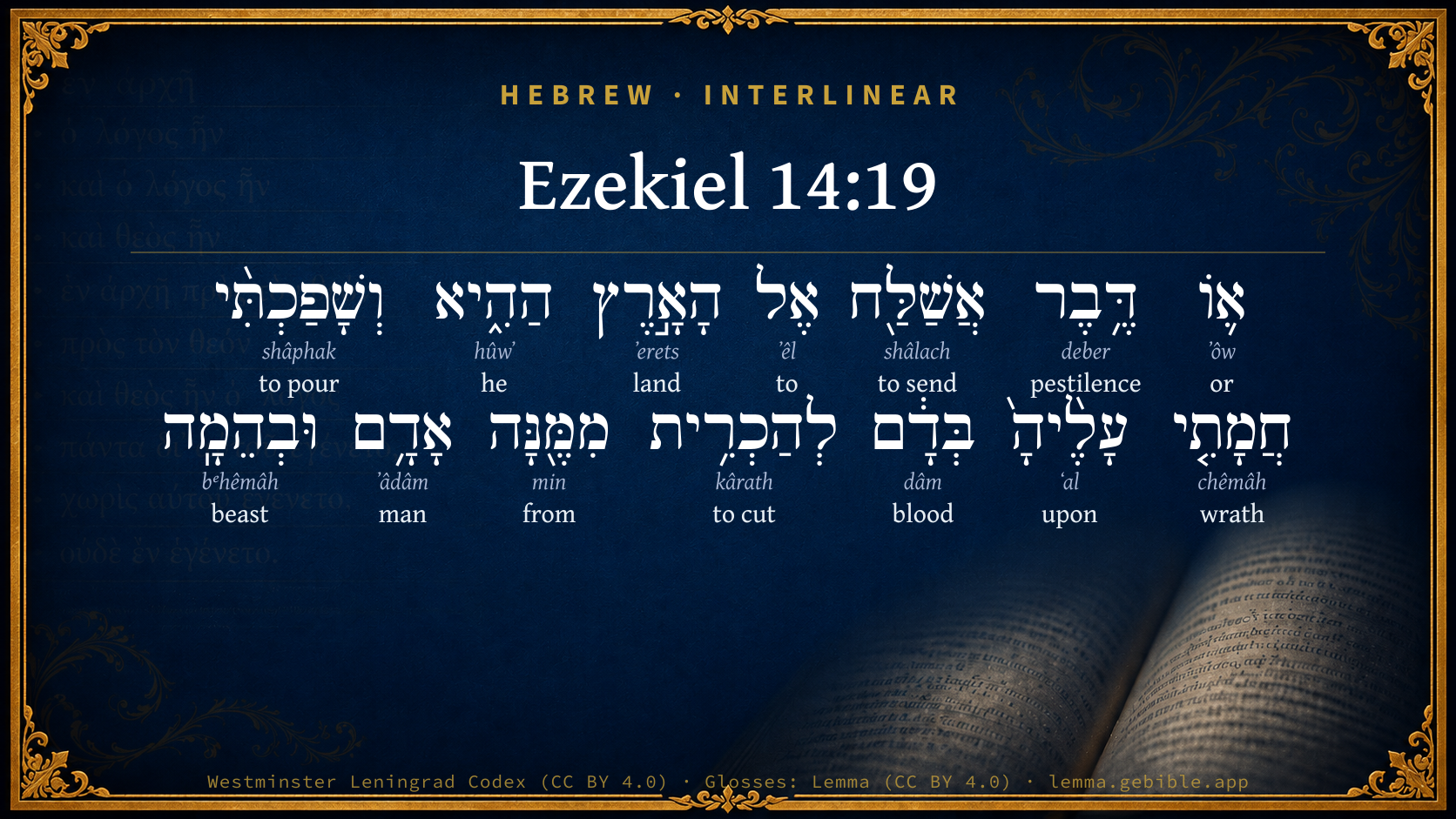
Hebrew (Westminster Leningrad Codex) Ezekiel 14:19 appears in the Hebrew Old Testament. The text above is from the Westminster Leningrad Codex. Each word links to its Strong’s number, a concise gloss, and parsing drawn from the Open Scriptures Hebrew Bible morphology. Click any word for its full Brown-Driver-Briggs (BDB) entry.
Download image
Cite this verse

Ezekiel 14:19 (World English Bible). Public Domain. Lemma interlinear Bible study tool, https://lemma.gebible.app/v/ezekiel/14/19.

Show BibTeX & RIS
BibTeX
RIS
English Translation
Or if I send a pestilence into that land, and pour out my wrath on it in blood, to cut off from it man and animal;
World English Bible · Public Domain
Download a study sheet

One document with this verse’s original text, its word-by-word gloss line, the meaning frame, cross-references with their text, attributed commentary, and full source and license credits — printable, and it pastes into notes with its structure intact.

This verse Autodidact and up

Study sheet (.html) Plain text (.txt)

A passage Seminary Student

Up to 50 verses in one chapter. A passage sheet keeps up to 6 commentary sources and 12 cross-references per verse, in the order this page ranks them, and says so on the sheet whenever that leaves anything out. Ask for a single verse and you get the Autodidact verse sheet above.

Everything on this page stays free to read, with no account — the sheet is a download of what is already on screen, not access to it.

Want to remove ads? Support Godless Engineer
Compare translations 3

The same verse in 3 English versions, stacked beneath the original-language interlinear above. Click any original word for its lexicon entry.

Each is an independent rendering of the whole verse — the interlinear is not word-aligned to these translations.

Highlighted words mark where these versions differ — a whole-verse word diff, not a word-by-word alignment.

  • World English Bible Public Domain
    Or if I send a pestilence into that land, and pour out my wrath on it in blood, to cut off from it man and animal;
  • King James Version Public Domain
    Or if I send a pestilence into that land, and pour out my fury upon it in blood, to cut off from it man and beast:
  • unfoldingWord Literal Text CC BY-SA 4.0
    Or if I send a plague against this land and pour out my fury against it through bloodshed, in order to cut off both man and beast,

unfoldingWord Literal Text — © unfoldingWord, licensed CC BY-SA 4.0. Word-aligned USFM3 via Door43 (git.door43.org/unfoldingWord/en_ult).

Versions to compare (up to 4)

3 of 4 selected

Show all 18 translations

Every available English version of this verse, each an independent rendering of the whole verse.

  • World English Bible Public Domain
    Or if I send a pestilence into that land, and pour out my wrath on it in blood, to cut off from it man and animal;
  • Berean Standard Bible Public Domain
    Or if I send a plague into that land and pour out My wrath upon it through bloodshed, cutting off from it both man and beast,
  • Majority Standard Bible Public Domain
    Or if I send a plague into that land and pour out My wrath upon it through bloodshed, cutting off from it both man and beast,
  • King James Version Public Domain
    Or if I send a pestilence into that land, and pour out my fury upon it in blood, to cut off from it man and beast:
  • American Standard Version (1901) Public Domain
    Or if I send a pestilence into that land, and pour out my wrath upon it in blood, to cut off from it man and beast;
  • Revised Version (1885) Public Domain
    Or if I send a pestilence into that land, and pour out my fury upon it in blood, to cut off from it man and beast:
  • Geneva Bible (1599) Public Domain
    Or if I send a pestilence into this land, and powre out my wrath vpon it in blood, to destroy out of it man and beast,
  • Douay-Rheims (1899) Public Domain
    Or if I also send the pestilence upon that land, and pour out my indignation upon it in blood, to cut off from it man and beast:
  • Young's Literal Translation Public Domain
    `Or -- pestilence I send unto that land, and I have poured out My fury against it in blood, to cut off from it man and beast --
  • Literal Standard Version CC BY-SA 4.0
    Or [if] I send pestilence to that land, and I have poured out My fury against it in blood, to cut off man and beast from it—
  • Unlocked Literal Bible CC BY-SA 4.0
    Or if I send a plague against this land and pour out my fury against it through bloodshed, in order to cut off both man and beast,
  • unfoldingWord Literal Text CC BY-SA 4.0
    Or if I send a plague against this land and pour out my fury against it through bloodshed, in order to cut off both man and beast,
  • Darby Bible Public Domain
    Or [if] I send a pestilence into that land, and pour out my fury upon it in blood, to cut off from it man and beast,
  • World Messianic Bible Public Domain
    “Or if I send a pestilence into that land, and pour out my wrath on it in blood, to cut off from it man and animal—
  • Webster's Bible Public Domain
    Or if I send a pestilence into that land, and pour out my fury upon it in blood, to cut off from it man and beast:
  • Free Bible Version CC BY-SA 4.0
    I could send a disease on that country and because of my anger I would kill many, both people and animals.
  • Bible in Basic English Public Domain
    Or if I send disease into that land, letting loose my wrath on it in blood, cutting off from it man and beast:
  • JPS Tanakh (1917) Public Domain
    Or if I send a pestilence into that land, and pour out My fury upon it in blood, to cut off from it man and beast;

Literal Standard Version (2020), Covenant Press — licensed CC BY-SA 4.0. Text via the HelloAO Bible API (eBible.org). Unlocked Literal Bible (unfoldingWord) — licensed CC BY-SA 4.0. Text via the HelloAO Bible API (eBible.org). unfoldingWord Literal Text — © unfoldingWord, licensed CC BY-SA 4.0. Word-aligned USFM3 via Door43 (git.door43.org/unfoldingWord/en_ult). Free Bible Version, Dr. Jonathan Gallagher — licensed CC BY-SA 4.0. Text via the HelloAO Bible API (eBible.org).

Word by word

More ways to search: Search by grammar → Find every occurrence → Compare this word →

Practice this passage: Drill this verse → Learn its vocabulary →

דֶּ֥בֶר
deber
H1698
“pestilence”
Noun, Common, Masculine, Singular, Absolute
Part of Speech
Noun
Type
Common
Gender
Masculine
Number
Singular
State
Absolute
Full BDB Definition

Origin: from H1696 (in the sense of destroying)

TWOT: 399b

pestilence, plague - murrain, cattle disease, cattle-plague
  1. א֛וֹ ʼôw H176 “or” Conjunction
  2. אֲשַׁלַּ֖ח shâlach H7971 “to send” Verb, Piel, Imperfect, 1st Person, Common, Singular
  3. אֶל ʼêl H413 “to” Preposition
  4. הָאָ֣רֶץ ʼerets H776 “the · land” Particle, Definite Article + Noun, Common, Both, Singular, Absolute
  5. הַהִ֑יא hûwʼ H1931 “the · he” Particle, Definite Article + Pronoun, Personal, 3rd Person, Feminine, Singular
  6. וְשָׁפַכְתִּ֨י shâphak H8210 “and · to pour” Conjunction + Verb, Qal, Sequential Perfect, 1st Person, Common, Singular
  7. חֲמָתִ֤י chêmâh H2534 “wrath · my” Noun, Common, Feminine, Singular, Construct + Suffix, Personal, 1st Person, Common, Singular
  8. עָלֶ֨יהָ֙ ʻal H5921 “upon · her” Preposition + Suffix, Personal, 3rd Person, Feminine, Singular
  9. בְּדָ֔ם dâm H1818 “in/at · blood” Preposition + Noun, Common, Masculine, Singular, Absolute
  10. לְהַכְרִ֥ית kârath H3772 “to cut” Preposition + Verb, Hiphil, Infinitive Construct
  11. מִמֶּ֖נָּה min H4480 “from · her” Preposition + Suffix, Personal, 3rd Person, Feminine, Singular
  12. אָדָ֥ם ʼâdâm H120 “man” Noun, Common, Masculine, Singular, Absolute
  13. וּבְהֵמָֽה bᵉhêmâh H929 “and · beast” Conjunction + Noun, Common, Feminine, Singular, Absolute

About this verse

These counts appear in no published source. They are computed here, from the morphology-tagged text and Lemma’s own curated glosses. What Lemma adds →

14
words
14
distinct lemmas
Prophets
section

Shared distinctive vocabulary

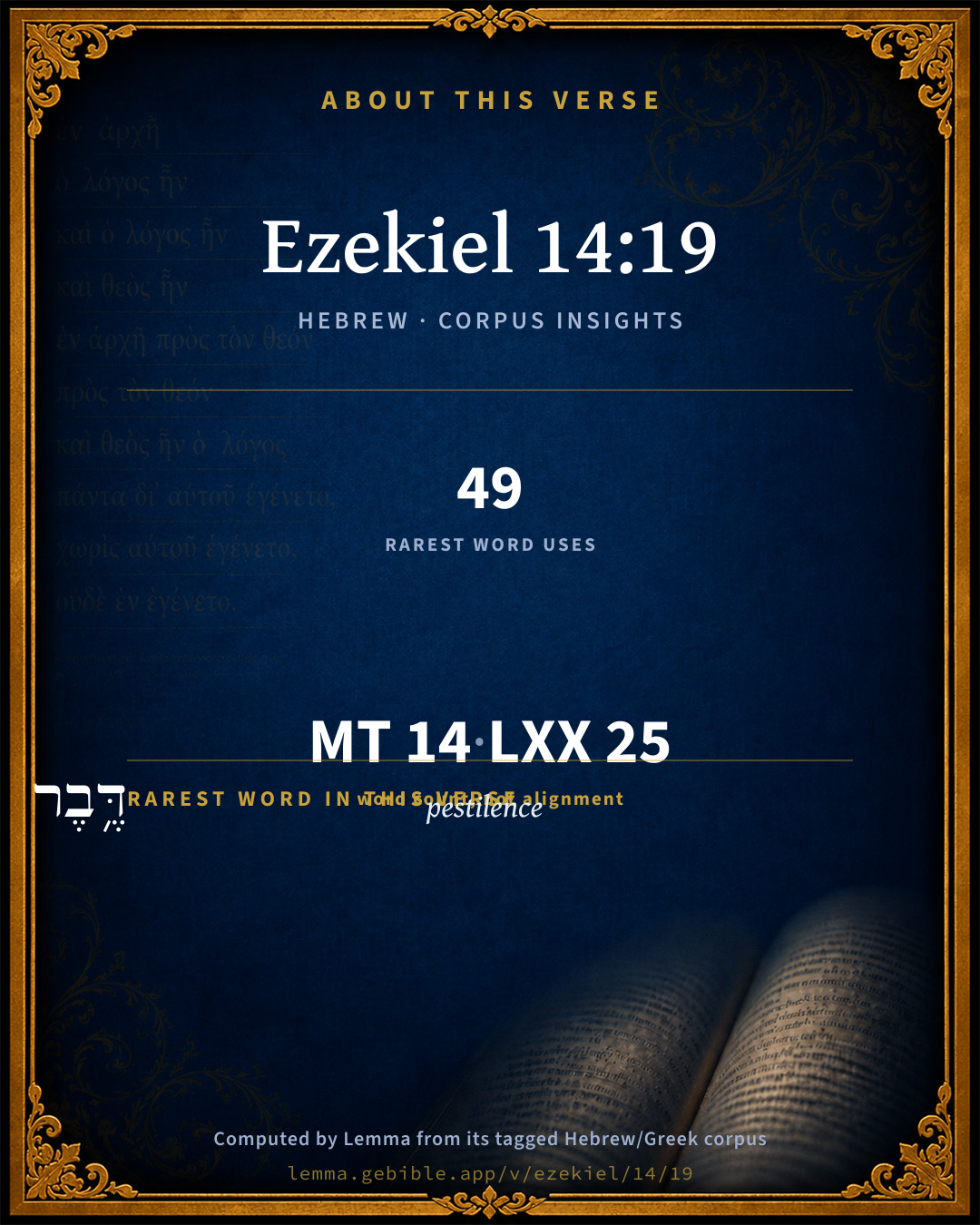
דֶּ֥בֶר pestilence H1698 occurs in 48 verses of the Hebrew Bible. Also found in:

Grammatical profile

  • 3 verbs
  • 6 nouns
  • 1 pronoun
  • 3 prepositions
  • 1 conjunction

Verb forms

  • אֲשַׁלַּ֖ח Piel · Imperfect
  • וְשָׁפַכְתִּ֨י Qal · Sequential Perfect
  • לְהַכְרִ֥ית Hiphil · Infinitive Construct

Hebrew & Septuagint length

In English translation the verse runs 26 words from the Hebrew and 26 from the Septuagint (LXX English) — the same length.

A rough comparison of the two English renderings, which tokenize alike — not a word-level alignment.

Word counts can differ between the Hebrew and the Greek without any difference in meaning — e.g. the Hebrew direct-object marker אֵת has no separate Greek word, and Greek often adds the article ὁ.

In the original languages it is 14 Hebrew tokens and 25 Greek tokens — but the two are counted differently (Hebrew bundles its prefixes and suffixes into one token; the Greek is in lemma form), so that isn’t a like-for-like length.

Cross-references

24

Topical passages linked to Ezekiel 14:19 in the Treasury of Scripture Knowledge — connected by theme and wording, ordered by reader-vote popularity; previews shown in the World English Bible.

  • Ezekiel 38:22 With pestilence and with blood will I enter into judgment with him; and I will rain on him, and on his hordes, and on the many peoples who are with him, an overflowing shower, and great hailstones, fire, and sulfur.
  • 2 Samuel 24:15 So Yahweh sent a pestilence on Israel from the morning even to the time appointed; and there died of the people from Dan even to Beersheba seventy thousand men.
  • Jeremiah 14:12 When they fast, I will not hear their cry; and when they offer burnt offering and meal-offering, I will not accept them; but I will consume them by the sword, and by the famine, and by the pestilence.
  • Ezekiel 5:12 A third part of you shall die with the pestilence, and with famine shall they be consumed in the midst of you; and a third part shall fall by the sword round about you; and a third part I will scatter to all the winds, and will draw out a sword after them.
  • Ezekiel 7:8 Now will I shortly pour out my wrath on you, and accomplish my anger against you, and will judge you according to your ways; and I will bring on you all your abominations.
  • Numbers 14:12 I will strike them with the pestilence, and disinherit them, and will make of you a nation greater and mightier than they.
  • Numbers 16:46–50 Moses said to Aaron, Take your censer, and put fire therein from off the altar, and lay incense thereon, and carry it quickly to the congregation, and make atonement for them: for there is wrath gone out from Yahweh; the plague is begun.
  • Deuteronomy 28:21–22 Yahweh will make the pestilence cleave to you, until he have consumed you from off the land, where you go in to possess it.
  • Deuteronomy 28:59–61 then Yahweh will make your plagues wonderful, and the plagues of your seed, even great plagues, and of long continuance, and sore sicknesses, and of long continuance.
  • 2 Samuel 24:13 So Gad came to David, and told him, and said to him, Shall seven years of famine come to you in your land? or will you flee three months before your foes while they pursue you? or shall there be three days' pestilence in your land? now advise you, and consider what answer I shall return to him who sent me.
  • 1 Kings 8:37 If there be in the land famine, if there be pestilence, if there be blasting [or] mildew, locust [or] caterpillar; if their enemy besiege them in the land of their cities; whatever plague, whatever sickness there be;
  • 2 Chronicles 6:28 If there be in the land famine, if there be pestilence, if there be blasting or mildew, locust or caterpillar; if their enemies besiege them in the land of their cities; whatever plague or whatever sickness there be;
  • 2 Chronicles 7:13 If I shut up the sky so that there is no rain, or if I command the locust to devour the land, or if I send pestilence among my people;
  • 2 Chronicles 20:9 If evil come on us, the sword, judgment, or pestilence, or famine, we will stand before this house, and before you, (for your name is in this house), and cry to you in our affliction, and you will hear and save.
  • Psalms 91:3 For he will deliver you from the snare of the fowler, And from the deadly pestilence.
  • Psalms 91:6 Nor of the pestilence that walks in darkness, Nor of the destruction that wastes at noonday.
  • Isaiah 37:36 The angel of Yahweh went forth, and struck in the camp of the Assyrians one hundred and eighty-five thousand; and when men arose early in the morning, behold, these were all dead bodies.
  • Jeremiah 21:6 I will strike the inhabitants of this city, both man and animal: they shall die of a great pestilence.
  • Jeremiah 21:9 He who remains in this city shall die by the sword, and by the famine, and by the pestilence; but he who goes out, and passes over to the Chaldeans who besiege you, he shall live, and his life shall be to him for a prey.
  • Jeremiah 24:10 I will send the sword, the famine, and the pestilence, among them, until they be consumed from off the land that I gave to them and to their fathers.
  • Ezekiel 36:18 Therefore I poured out my wrath on them for the blood which they had poured out on the land, and because they had defiled it with their idols;
  • Amos 4:10 I sent plagues among you like I did Egypt. I have slain your young men with the sword, And have carried away your horses; And I filled your nostrils with the stench of your camp Yet you haven't returned to me," says Yahweh.
  • Matthew 24:7 For nation will rise against nation, and kingdom against kingdom; and there will be famines, plagues, and earthquakes in various places.
  • Revelation 16:3–6 The second angel poured out his bowl into the sea, and it became blood as of a dead man. Every living thing in the sea died.

Cross-references courtesy of OpenBible.info (CC BY 4.0).

Hebrew and Greek witnesses Masoretic Hebrew ↔ Greek Septuagint

The same verse in the two great witnesses to the Old Testament, shown verse-for-verse.

These are two independent witnesses, not word-aligned to each other, and the Septuagint is shown in lemma (dictionary) form.

Hebrew Ezekiel 14:19 Masoretic · Westminster Leningrad Codex

א֛וֹ דֶּ֥בֶר אֲשַׁלַּ֖ח אֶל הָאָ֣רֶץ הַהִ֑יא וְשָׁפַכְתִּ֨י חֲמָתִ֤י עָלֶ֨יהָ֙ בְּדָ֔ם לְהַכְרִ֥ית מִמֶּ֖נָּה אָדָ֥ם וּבְהֵמָֽה

Or if I send a pestilence into that land, and pour out my wrath on it in blood, to cut off from it man and animal;

World English Bible · Public Domain

Greek LXX Ezekiel 14:19 Septuagint · lemma form

ἤ καί θάνατος ἐπι ἀποστέλλω ἐπί ὁ γῆ ἐκεῖνος καί ἐκχέω ὁ θυμός ἐγώ ἐπί αὐτός ἐν αἷμα ὁ ἐκὀλεθρεύω ἐκ αὐτός ἄνθρωπος καί κτῆνος

Or if again I send pestilence upon that land, and pour out my wrath upon it in blood, to destroy from off it man and beast:

LXX2012 (modern English Septuagint) · Public Domain

On this verse, Haydock's Catholic Bible Commentary discusses the Septuagint’s reading. Read the note in Commentary ↓

Hebrew: Westminster Leningrad Codex (CC BY 4.0). Greek: Septuagint (public domain); English from LXX2012 (modern English Septuagint) (Public Domain). How the Septuagint differs from the Hebrew →

Targum (Aramaic paraphrase)

1

The Targum is the ancient Jewish Aramaic paraphrase of the Hebrew Scriptures — an interpretive translation, not the Hebrew text itself. Onkelos (literal) and Pseudo-Jonathan (expansive) render the Torah, and Jonathan the Prophets. Coverage is partial: where no permissively-licensed English translation exists for a verse, only the Aramaic is shown. This is verse-level text, not a word-by-word alignment to the Hebrew.

  1. Targum Jonathan Prophets (Joshua–Malachi)
    אוֹ מוֹתָא אֲשַׁלַח עַל אַרְעָא הַהִיא וְאֶשְׁפּוֹךְ חֵימְתִי עֲלָה בִּקְטוֹל לְשֵׁיצָאָה מִנָהּ אֱנָשָׁא וּבְעִירָא:

    (no public-domain English translation for this verse)

    Targum Jonathan — Aramaic: “Mikraot Gedolot” (public domain). English: “Sefaria Community Translation” (CC0 1.0 (public-domain dedication)); “London "Chaldee Paraphrase," 1871” (public domain). Text via Sefaria.

Commentary

Notes on Ezekiel 14:19 from classic Christian and Jewish commentators (each source and its license shown beneath its notes). The classic Christian expositions comment on the surrounding passage and are grouped to its opening verse, so a note may address several verses; the Jewish commentaries on the Tanakh (Rashi and others) are per-verse, so they appear only where the commentator wrote on this verse.

Lemma curates 59 commentaries, every one of them public domain or Creative Commons licensed, each selected and text-cleaned for this edition rather than reprinted as found. About our sources →

Trapp's Complete Commentary

John Trapp

Eze 14:19 Or [if] I send a pestilence into that land, and pour out my fury upon it in blood, to cut off from it man and beast:

Ver. 19. Or if I send a pestilence.] Which Hippocartes calleth το Yειον, because God hath a special hand in it. Physicians can give no good reason for it.

In blood,] i.e., In great slaughter, laying heaps upon heaps.

John Trapp, A Commentary or Exposition upon All the Books of the Old and New Testament (1647–1656) — public domain. Text from a community e-Sword module.

The Biblical Illustrator

Joseph S. Exell

Eze_14:19-20

Or if I send a pestilence.

Public calamity a call to private humiliation

Depend upon it, we have need, and as the years roll away we shall have more and more need, to remind ourselves of the unseen Hand which sends us our blessings or withdraws them from us. New appliances of mechanical skill have a tendency to keep God out of our sight. The simple machinery which depended on the wind or the stream for motion did not suffer men so easily to forget their immediate dependence on God. His agency is half obscured when they become independent of the breath of heaven, and of the moisture which cometh down from above. And so there is a constant danger of our lapsing into practical atheism, if we allow ourselves, in the mere contemplation of a natural law apart from its Divine Author; or attend to its results, without adverting to the revealed cause of its operation. It is no disparagement to natural science to declare that, pursued in any but a godly spirit, it sometimes has a tendency to obscure the vision of God: to interpose hard names and technical phrases between Him and ourselves; and practically to keep Him out of our sight. Nay, the very progress of civilisation, the increase of wealth and refinement and luxury--all have the same tendency. The table daily spread without our care helps to keep God out of sight. And the special value of Scripture is seen in the unconditional and most unceremonious way in which it brushes aside this web of words; puts God, the Giver, prominently forward; and vindicates His absolute Sovereignty in creation. When Christ says, He maketh His sun to rise,--His language is altogether unscientific, to be sure; but He declares a truth which to the devout soul is of paramount importance; namely, that the heavenly bodies are all His creatures; and that, in reality, the phenomena which attend them are but the visible expression of His will. While thoughtful men are investigating the natural history of a calamity which, unless it be stayed, will inevitably press with terrible severity on the poor;--which, if it spreads, may bring contagion to all our doors,--occasion death within our homes and darken every domestic hearth;--a more excellent way is revealed to us in Holy Scripture; a method which is within the reach of us all. I allude, of course, to individual acts of repentance,--personal efforts after holiness,--the heartfelt use of private prayer. The special mention of three of Gods chiefest saints Noah, Daniel, and Job, reminds us that we must as individuals seek to turn away Gods anger from this Church and nation. What, above all, shall be said of our unconcern for the spiritual wants of the benighted heathen,--of our own countrymen in foreign parts, of our fellow citizens here at home? (Dean Burgon.)

The Biblical Illustrator, edited by Joseph S. Exell (c. 1880s–1900s) — public domain. Text from a community e-Sword module.

Jamieson, Fausset & Brown

Robert Jamieson, A. R. Fausset & David Brown

in blood--not literally. In Hebrew, "blood" expresses every premature kind of death.

Jamieson, Fausset & Brown — Commentary Critical and Explanatory on the Whole Bible (1871) — public domain (CC PDM 1.0). Text via the HelloAO Bible API.

John Calvin's Commentaries

He now affirms of the fourth kind of punishment, what he has hitherto pronounced of the rest. He says, then, If I shall have sent a pestilence, and have devoted a land to devastation, that Job, Daniel, and Noah, should be safe if they dwelt there: but that their righteousness should not profit even their sons and their daughters. Nay, he seems to speak with greater restriction, since he has substituted the singular number for the plural: for he had just said, they shall not free either sons or daughters. He now says, not even a son or a daughter, that is, they shall not prevail with me by their intercession so much as to save from death even a single son or daughter. We must also remember what I have said, that God does not always act in the way related here: for he has manifold and various methods of carrying out his judgments. Hence it would not be just to impose a law not to liberate any one, and according to his own will either to hear or reject their prayers. But here he only means, that when he has determined to destroy a land, there is no hope of pardon, since even the most holy will not persuade him to desist from his wrath and vengeance. But now the conclusion follows —

John Calvin's Commentaries (1540-1563) — public domain. Text from the Calvin Translation Society English edition (1840s-50s) via the Christian Classics Ethereal Library (ccel.org). Calvin's coverage is partial (roughly two-thirds of the Bible); uncommented books and verses are honest gaps, never fabricated. The 19th-century editor's footnotes and remarks are omitted so the notes are faithfully Calvin's own voice.

The Cambridge Bible for Schools and Colleges

gen. ed. J. J. S. Perowne

19. my fury upon it in blood] The term “blood” is almost a synonym for “death;” cf. Psa_30:9, “What profit is there in my blood, in my going down to the pit?” Ch. Eze_5:7. On the Babylonian idea of “four” plagues, cf. Del. Parad. p. 146.

Eze_14:21-23. Application to Jerusalem.

The Cambridge Bible for Schools and Colleges (gen. ed. J. J. S. Perowne; Cambridge University Press, 1878–1918) — public domain. Text from a community e-Sword module.

John Gill's Exposition

Though Noah, Daniel, and Job, were in it,.... Who are again mentioned by name, as in Eze 14:14; and are the three men referred to in Eze 14:16;

as I live, saith the Lord God, they shall deliver neither son nor daughter; not so much as an only son, or an only daughter, no, not even a single child: the plural number is used before, as in Eze 14:16; here the singular, to show how resolutely determined the Lord was upon the destruction of the land; that even the prayers of the best of men among them should not prevail with him to save a single person, no, not a single infant: they

shall but deliver their own souls by their righteousness; See Gill on Eze 14:14.

John Gill's Exposition of the Whole Bible (1746–1763) — public domain (CC PDM 1.0). Text via the HelloAO Bible API.

Haydock's Catholic Bible Commentary

Pestilence. Septuagint, "death," as ver. 12., (Calmet) denoting the plague, chap. v. 2. (Haydock)

George Leo Haydock (1774–1849), Haydock's Catholic Family Bible and Commentary, 1859 edition — public domain. Excludes Psalms (Douay-Rheims chapter numbering differs from Protestant) and Deuterocanonical books (Catholic canon only).

Matthew Poole's English Annotations

Diseases are sent whenever they come, especially wasting diseases, which empty nations and cities apace.

Pestilence; God’s arrow that flies from God’s bow.

Pour out; not drop or distil on a people in small measures, and by leisure, but in great measures, and hastily, as waters are poured out of a vessel all at once almost.

In blood: sometimes blood does denote war, but here, and in many other places, it denotes death and destruction of men, though not by the sword.

Man and beast; not that beasts die of the same pestilential disease which kills man, but either death of men by pestilence emptieth the nation, that there are not men to take care and provide for the beasts; or rather, because when pestilence wasteth men, murrains and plague of cattle, from the same infected air, and from the hand of God, waste the beasts also.

Matthew Poole's English Annotations on the Holy Bible (1683–1685) — public domain. Text from a community e-Sword/MySword module.

The Pulpit Commentary

Pestilence is joined with blood, as in Eze_5:17 Eze_38:22, as indicating its death-bearing character.

The Pulpit Commentary (1880–1919), ed. H.D.M. Spence-Jones & Joseph S. Exell — public domain. Text from a community e-Sword module.

John Wesley's Explanatory Notes

In blood - In death and destruction, not by the sword.

John Wesley, Explanatory Notes Upon the Whole Bible (1754–1765) — public domain. Text via the GEBible commentary corpus.

unfoldingWord translationNotes

Door43 World Missions Community

pour out my fury

Yahweh speaks of expressing his fury as if his fury were a liquid that he pours out from a container. AT: "I will express my fury" (See: Metaphor)

cut off both man and beast

Yahweh speaks of killing people and animals as if he were cutting them off, like a person would cut a branch from a tree. AT: "kill both man and beast" (See: Metaphor)

only their own lives would be rescued

This can be stated in active form. AT: "they would only rescue their own lives" (See: Active or Passive)

translationWords

plague

bloodshed

cut off

Noah

Daniel

Job

declare

Lord Yahweh

life

righteous

unfoldingWord translationNotes — © Distant Shores Media and the Door43 World Missions Community, licensed CC BY-SA 4.0. Source: git.door43.org/Door43/en_tn.

Lesson kit

Teaching starters — assembled from the data on this page, not authored interpretation. Every prompt links to the verse data it draws on. Edit before teaching.

Ezekiel, in the Prophets, opens this verse with 14 words (14 distinct Hebrew lemmas). Its most distinctive word is deber (“pestilence”). A historical commentator’s framing appears above. Read the whole chapter for the surrounding context.

Discussion questions

  1. How does “pestilence” (deber) shape what this verse is saying?
  2. Exodus 5:3 shares the word «pestilence» with this verse. How do the two illuminate each other?
  3. These translations render this verse differently. What is at stake in choosing one wording over another?
  4. The verb «אֲשַׁלַּ֖ח» is Piel Imperfect. How does its form color the action?
  5. Reading how Trapp's Complete Commentary and The Biblical Illustrator read this verse, where do the two commentators agree and where do they part?

Things to notice

Reading settings

Reading text

Shown beneath each verse's original-language words.

Old Testament
Old Testament edition

Read the OT as the Masoretic Hebrew (MT) or the Greek Septuagint (LXX).

English shown for the Greek Septuagint (in the Hebrew ↔ Greek comparison).

Comparing translations? Open the Compare panel on any verse page to stack up to four side by side.