
Jeremiah 33:17

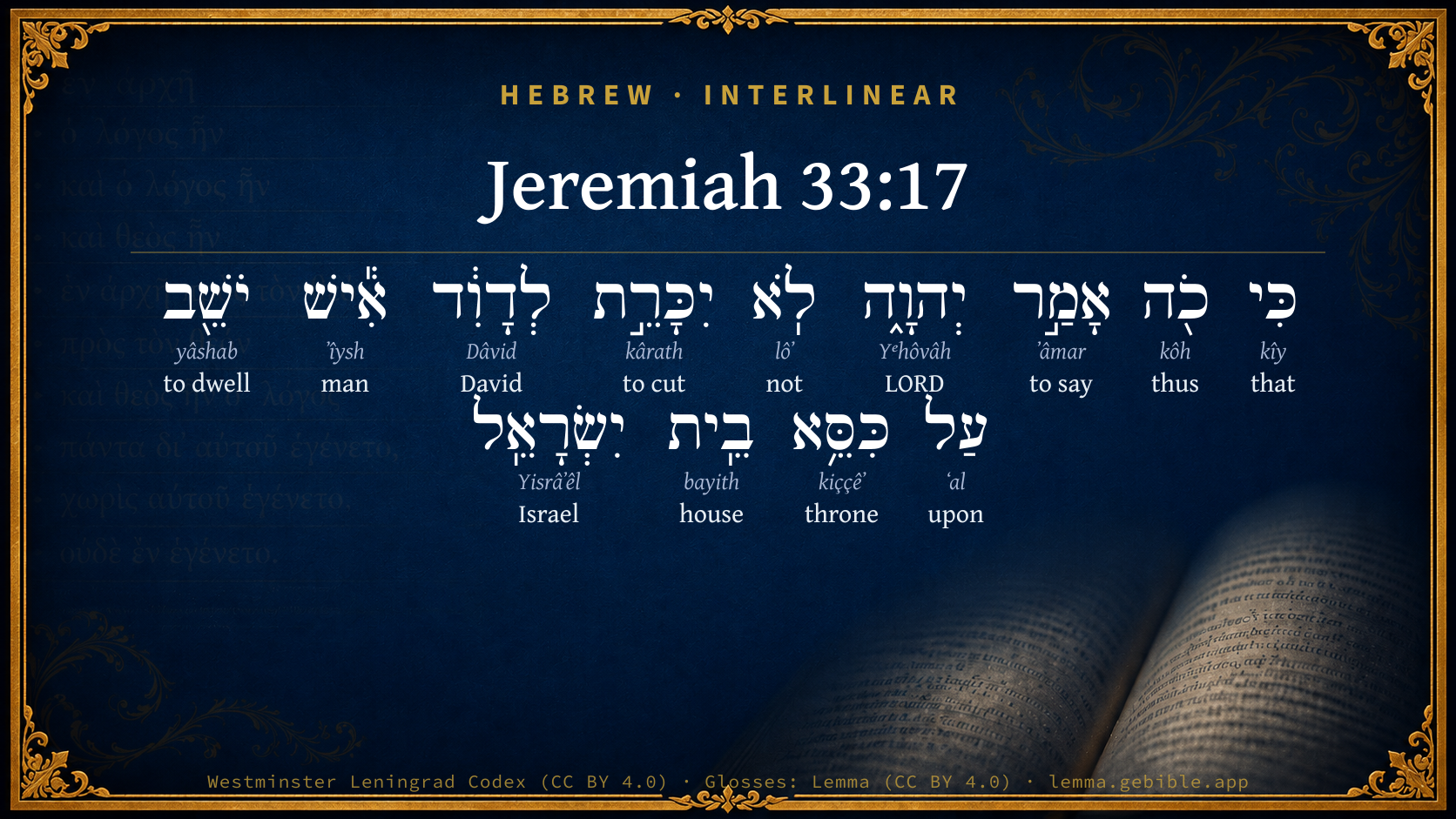
Hebrew (Westminster Leningrad Codex) Jeremiah 33:17 appears in the Hebrew Old Testament. The text above is from the Westminster Leningrad Codex. Each word links to its Strong’s number, a concise gloss, and parsing drawn from the Open Scriptures Hebrew Bible morphology. Click any word for its full Brown-Driver-Briggs (BDB) entry.
Download image
Cite this verse

Jeremiah 33:17 (World English Bible). Public Domain. Lemma interlinear Bible study tool, https://lemma.gebible.app/v/jeremiah/33/17.

Show BibTeX & RIS
BibTeX
RIS
English Translation
For thus says Yahweh: David shall never want a man to sit on the throne of the house of Israel;
World English Bible · Public Domain
Download a study sheet

One document with this verse’s original text, its word-by-word gloss line, the meaning frame, cross-references with their text, attributed commentary, and full source and license credits — printable, and it pastes into notes with its structure intact.

This verse Autodidact and up

Study sheet (.html) Plain text (.txt)

A passage Seminary Student

Up to 50 verses in one chapter. A passage sheet keeps up to 6 commentary sources and 12 cross-references per verse, in the order this page ranks them, and says so on the sheet whenever that leaves anything out. Ask for a single verse and you get the Autodidact verse sheet above.

Everything on this page stays free to read, with no account — the sheet is a download of what is already on screen, not access to it.

Want to remove ads? Support Godless Engineer
Compare translations 3

The same verse in 3 English versions, stacked beneath the original-language interlinear above. Click any original word for its lexicon entry.

Each is an independent rendering of the whole verse — the interlinear is not word-aligned to these translations.

Highlighted words mark where these versions differ — a whole-verse word diff, not a word-by-word alignment.

  • World English Bible Public Domain
    For thus says Yahweh: David shall never want a man to sit on the throne of the house of Israel;
  • King James Version Public Domain
    For thus saith the LORD; David shall never want a man to sit upon the throne of the house of Israel;
  • unfoldingWord Literal Text CC BY-SA 4.0
    For Yahweh says this: ‘A man from David’s line will never be lacking to sit on the throne of the house of Israel,

unfoldingWord Literal Text — © unfoldingWord, licensed CC BY-SA 4.0. Word-aligned USFM3 via Door43 (git.door43.org/unfoldingWord/en_ult).

Versions to compare (up to 4)

3 of 4 selected

Show all 18 translations

Every available English version of this verse, each an independent rendering of the whole verse.

  • World English Bible Public Domain
    For thus says Yahweh: David shall never want a man to sit on the throne of the house of Israel;
  • Berean Standard Bible Public Domain
    For this is what the LORD says: David will never lack a man to sit on the throne of the house of Israel,
  • Majority Standard Bible Public Domain
    For this is what the LORD says: David will never lack a man to sit on the throne of the house of Israel,
  • King James Version Public Domain
    For thus saith the LORD; David shall never want a man to sit upon the throne of the house of Israel;
  • American Standard Version (1901) Public Domain
    For thus saith Jehovah: David shall never want a man to sit upon the throne of the house of Israel;
  • Revised Version (1885) Public Domain
    For thus saith the LORD: David shall never want a man to sit upon the throne of the house of Israel;
  • Geneva Bible (1599) Public Domain
    For thus sayth the Lord, Dauid shall neuer want a man to sit vpon the throne of the house of Israel.
  • Douay-Rheims (1899) Public Domain
    For thus saith the Lord: There shall not be cut off from David a man to sit upon the throne of the house of Israel.
  • Young's Literal Translation Public Domain
    For thus said Jehovah: `Not cut off to David is one sitting on the throne of the house of Israel,
  • Literal Standard Version CC BY-SA 4.0
    For thus said YHWH: “A man sitting on the throne of the house of Israel [is] never cut off from David,
  • Unlocked Literal Bible CC BY-SA 4.0
    For Yahweh says this: 'A man from David's line will never be lacking to sit on the throne of the house of Israel,
  • unfoldingWord Literal Text CC BY-SA 4.0
    For Yahweh says this: ‘A man from David’s line will never be lacking to sit on the throne of the house of Israel,
  • Darby Bible Public Domain
    For thus saith Jehovah: There shall never fail to David a man to sit upon the throne of the house of Israel;
  • World Messianic Bible Public Domain
    For the LORD says: “David will never lack a man to sit on the throne of the house of Israel.
  • Webster's Bible Public Domain
    For thus saith the LORD; David shall never want a man to sit upon the throne of the house of Israel;
  • Free Bible Version CC BY-SA 4.0
    This is what the Lord says: David will always have a descendant who will be king of Israel,
  • Bible in Basic English Public Domain
    For the Lord has said, David will never be without a man to take his place on the seat of the kingdom of Israel;
  • JPS Tanakh (1917) Public Domain
    For thus saith the LORD: There shall not be cut off unto David a man to sit upon the throne of the house of Israel;

Literal Standard Version (2020), Covenant Press — licensed CC BY-SA 4.0. Text via the HelloAO Bible API (eBible.org). Unlocked Literal Bible (unfoldingWord) — licensed CC BY-SA 4.0. Text via the HelloAO Bible API (eBible.org). unfoldingWord Literal Text — © unfoldingWord, licensed CC BY-SA 4.0. Word-aligned USFM3 via Door43 (git.door43.org/unfoldingWord/en_ult). Free Bible Version, Dr. Jonathan Gallagher — licensed CC BY-SA 4.0. Text via the HelloAO Bible API (eBible.org).

Word by word

More ways to search: Search by grammar → Find every occurrence → Compare this word →

Practice this passage: Drill this verse → Learn its vocabulary →

כִּסֵּ֥א
kiççêʼ
H3678
“throne of”
Noun, Common, Masculine, Singular, Construct
Part of Speech
Noun
Type
Common
Gender
Masculine
Number
Singular
State
Construct
Full BDB Definition

Origin: from H3680

TWOT: 1007

seat (of honour), throne, seat, stool - seat (of honour), throne - royal dignity, authority, power (figuratively)
  1. כִּי kîy H3588 “that” Conjunction
  2. כֹ֖ה kôh H3541 “thus” Adverb
  3. אָמַ֣ר ʼâmar H559 “to say” Verb, Qal, Perfect, 3rd Person, Masculine, Singular
  4. יְהוָ֑ה Yᵉhôvâh H3068 “LORD” Noun, Proper
  5. לֹֽא lôʼ H3808 “not” Particle, Negative
  6. יִכָּרֵ֣ת kârath H3772 “to cut” Verb, Niphal, Imperfect, 3rd Person, Masculine, Singular
  7. לְדָוִ֔ד Dâvid H1732 “to/for · David” Preposition + Noun, Proper
  8. אִ֕ישׁ ʼîysh H376 “man” Noun, Common, Masculine, Singular, Absolute
  9. יֹשֵׁ֖ב yâshab H3427 “dwelling” Verb, Qal, Participle Active, Masculine, Singular, Absolute
  10. עַל ʻal H5921 “upon” Preposition
  11. בֵֽית bayith H1004 “house of” Noun, Common, Masculine, Singular, Construct
  12. יִשְׂרָאֵֽל Yisrâʼêl H3478 “Israel” Noun, Proper

About this verse

These counts appear in no published source. They are computed here, from the morphology-tagged text and Lemma’s own curated glosses. What Lemma adds →

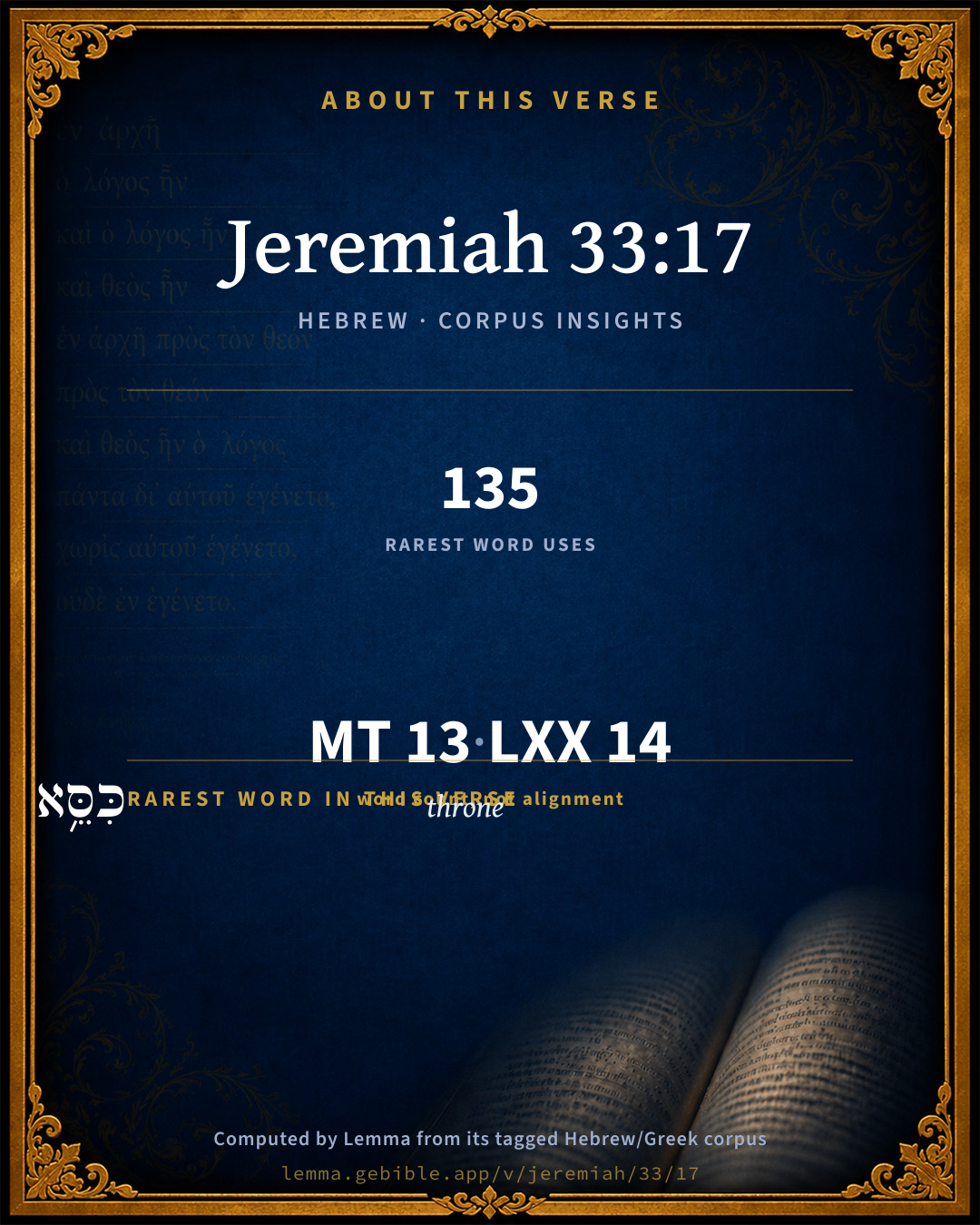
13
words
13
distinct lemmas
Prophets
section

Grammatical profile

  • 3 verbs
  • 6 nouns
  • 1 preposition
  • 1 conjunction
  • 1 adverb
  • 1 particle

Verb forms

  • אָמַ֣ר Qal · Perfect
  • יִכָּרֵ֣ת Niphal · Imperfect
  • יֹשֵׁ֖ב Qal · Participle Active

Hebrew & Septuagint length

In the original languages it is 13 Hebrew tokens and 14 Greek tokens — but the two are counted differently (Hebrew bundles its prefixes and suffixes into one token; the Greek is in lemma form), so that isn’t a like-for-like length.

Cross-references

10

Topical passages linked to Jeremiah 33:17 in the Treasury of Scripture Knowledge — connected by theme and wording, ordered by reader-vote popularity; previews shown in the World English Bible.

  • 1 Kings 2:4 That Yahweh may establish his word which he spoke concerning me, saying, If your children take heed to their way, to walk before me in truth with all their heart and with all their soul, there shall not fail you (said he) a man on the throne of Israel.
  • Psalms 89:29–37 I will also make his seed endure forever, And his throne as the days of heaven.
  • Luke 1:32–33 He will be great, and will be called the Son of the Most High. The Lord God will give him the throne of his father, David,
  • 1 Chronicles 17:11–14 It shall happen, when your days are fulfilled that you must go to be with your fathers, that I will set up your seed after you, who shall be of your sons; and I will establish his kingdom.
  • 1 Kings 8:25 Now therefore, Yahweh, the God of Israel, keep with your servant David my father that which you have promised him, saying, There shall not fail you a man in my sight to sit on the throne of Israel, if only your children take heed to their way, to walk before me as you have walked before me.
  • Isaiah 9:7 Of the increase of his government and of peace there shall be no end, on the throne of David, and on his kingdom, to establish it, and to uphold it with justice and with righteousness from henceforth even forever. The zeal of Yahweh of Hosts will perform this.
  • 2 Samuel 7:14–16 I will be his father, and he shall be my son: if he commit iniquity, I will chasten him with the rod of men, and with the stripes of the children of men;
  • 1 Chronicles 17:27 and now it has pleased you to bless the house of your servant, that it may continue forever before you: for you, Yahweh, have blessed, and it is blessed forever.
  • Jeremiah 35:19 therefore thus says Yahweh of Hosts, the God of Israel: Jonadab the son of Rechab shall not want a man to stand before me forever.
  • 2 Samuel 3:29 let it fall on the head of Joab, and on all his father's house; and let there not fail from the house of Joab one who has an issue, or who is a leper, or who leans on a staff, or who falls by the sword, or who lacks bread.

Cross-references courtesy of OpenBible.info (CC BY 4.0).

Hebrew and Greek witnesses Masoretic Hebrew ↔ Greek Septuagint

The same verse in the two great witnesses to the Old Testament, shown verse-for-verse.

These are two independent witnesses, not word-aligned to each other, and the Septuagint is shown in lemma (dictionary) form.

Hebrew Jeremiah 33:17 Masoretic · Westminster Leningrad Codex

כִּי כֹ֖ה אָמַ֣ר יְהוָ֑ה לֹֽא יִכָּרֵ֣ת לְדָוִ֔ד אִ֕ישׁ יֹשֵׁ֖ב עַל כִּסֵּ֥א בֵֽית יִשְׂרָאֵֽל

For thus says Yahweh: David shall never want a man to sit on the throne of the house of Israel;

World English Bible · Public Domain

Greek LXX Structure differs

In the Septuagint, Jeremiah is about an eighth shorter than the Hebrew and arranges its material differently — the Oracles Against the Nations (Hebrew chapters 46–51) appear in the middle of the Greek book, after 25:13. Because the chapter and verse boundaries do not line up, a verse-for-verse comparison with the Hebrew is not shown.

A verse-for-verse comparison isn’t shown here because the chapters and verses don’t line up. Switch to the LXX edition with the MT / LXX toggle above to read the Greek directly.

Hebrew: Westminster Leningrad Codex (CC BY 4.0). Greek: Septuagint (public domain); English from a public-domain English Septuagint. How the Septuagint differs from the Hebrew →

Targum (Aramaic paraphrase)

1

The Targum is the ancient Jewish Aramaic paraphrase of the Hebrew Scriptures — an interpretive translation, not the Hebrew text itself. Onkelos (literal) and Pseudo-Jonathan (expansive) render the Torah, and Jonathan the Prophets. Coverage is partial: where no permissively-licensed English translation exists for a verse, only the Aramaic is shown. This is verse-level text, not a word-by-word alignment to the Hebrew.

  1. Targum Jonathan Prophets (Joshua–Malachi)
    אֲרֵי כִדְנַן אֲמַר יְיָ לָא יִפְסוֹק לְדָוִד גְבַר יָתֵיב עַל כּוּרְסֵי מַלְכוּתָא דְבֵית יִשְׂרָאֵל:

    (no public-domain English translation for this verse)

    Targum Jonathan — Aramaic: “Mikraot Gedolot” (public domain). English: “Sefaria Community Translation” (CC0 1.0 (public-domain dedication)); “London "Chaldee Paraphrase," 1871” (public domain). Text via Sefaria.

Commentary

Notes on Jeremiah 33:17 from classic Christian and Jewish commentators (each source and its license shown beneath its notes). The classic Christian expositions comment on the surrounding passage and are grouped to its opening verse, so a note may address several verses; the Jewish commentaries on the Tanakh (Rashi and others) are per-verse, so they appear only where the commentator wrote on this verse.

Lemma curates 59 commentaries, every one of them public domain or Creative Commons licensed, each selected and text-cleaned for this edition rather than reprinted as found. About our sources →

Matthew Henry's Commentary

Three of God's covenants, that of royalty with David and his seed, that of the priesthood with Aaron and his seed, and that of Peculiarity with Abraham and his seed, seemed to be all broken and lost while the captivity lasted; but it is here promised that, notwithstanding that interruption and discontinuance for a time, they shall all three take place again, and the true intents and meaning of them all shall be abundantly answered in the New Testament blessings, typified by those conferred on the Jews after their return out of captivity.

I. The covenant of royalty shall be secured and the promises of it shall have their full accomplishment in the kingdom of Christ, the Son of David, Jer 33:17. The throne of Israel was overturned in the captivity; the crown had fallen from their head; there was not a man to sit on the throne of Israel; Jeconiah was written childless. After their return the house of David made a figure again; but it in the Messiah that this promise is performed that David shall never want a man to sit on the throne of Israel, and that David shall have always a son to reign upon his throne. For as long as the man Christ Jesus sits on the right hand of the throne of God, rules the world, and rules it for the good of the church, to which he is a quickening head, and glorified head over all things, as long as he is King upon the holy hill of Zion, David does not want a successor, nor is the covenant with him broken. When the first-begotten was brought into the world it was declared concerning him, The Lord God shall give him the throne of his father David and he shall reign over the house of Jacob for ever, Luk 1:32, Luk 1:33. For the confirmation of this it is promised, 1. That the covenant with David shall be as firm as the ordinances of heaven, to the stability of which that of God's promise is compared, Jer 31:35, Jer 31:36. There is a covenant of nature, by which the common course of providence is settled and on which it is founded, here called a covenant of the day and the night (Jer 33:20, Jer 33:25), because this is one of the articles of it, That there shall be day and night in their season, according to the distinction put between them in the creation, when God divided between the light and the darkness, and established their mutual succession, and a government to each, that the sun should rule by day and the moon and stars by night (Gen 1:4, Gen 1:5, Gen 1:16), which establishment was renewed after the flood (Gen 8:22), and has continued ever since, Psa 19:2. The morning and the evening have both of them their regular outgoings (Psa 65:8); the day-spring knows its place, knows its time, and keeps both, so do the shadows of the evening; and, while the world stands, this course shall not be altered, this covenant shall not be broken. The ordinances of heaven and earth (of this communication between heaven and earth, the dominion of these ordinances of heaven upon the earth), which God has appointed (Jer 33:25; compare Job 38:33), shall never be disappointed. Thus firm shall the covenant of redemption be with the Redeemer - God's servant, but David our King, Jer 33:21. This intimates that Christ shall have a church on earth to the world's end; he shall see a seed in which he shall prolong his days till time and day shall be no more. Christ's kingdom is an everlasting kingdom; and when the end cometh, and not till then, it shall be delivered up to God, even the Father. But it intimates that the condition of it in this world shall be intermixed and counterchanged, prosperity and adversity succeeding each other, as light and darkness, day and night. But this is plainly taught us, that, as sure as we may be that, though the sun will set tonight, it will rise again tomorrow morning, whether we live to see it or no, so sure we may be that, though the kingdom of the Redeemer in the world may for a time be clouded and eclipsed by corruptions and persecutions, yet it will shine forth again, and recover its lustre, in the time appointed. 2. That the seed of David shall be as numerous as the host of heaven, that is, the spiritual seed of the Messiah, that shall be born to him by the efficacy of his gospel and his Spirit working with it. From the womb of the morning he shall have the dew of their youth, to be his willing people, Psa 110:3. Christ's seed are not, as David's were, his successors, but his subjects; yet the day is coming when they also shall reign with him (Jer 33:22): As the host of heaven cannot be numbered, so will I multiply the seed of David, so that there shall be no danger of the kingdom's being extinct, or extirpated, for want of heirs. The children are numerous; and, if children, then heirs.

II. The covenant of priesthood shall be secured, and the promises of that also shall have their full accomplishment. This seemed likewise to be forgotten during the captivity, when there was no altar, no temple service, for the priests to attend upon; but this also shall revive. It did so; immediately upon their coming back to Jerusalem there were priests and Levites ready to offer burnt-offerings and to do sacrifice continually (Ezr 3:2, Ezr 3:3), as is here promised, Jer 33:18. But that priesthood soon grew corrupt; the covenant of Levi was profaned (as appears Mal 2:8), and in the destruction of Jerusalem by the Romans it came to a final period. We must therefore look elsewhere for the performance of this word, that the covenant with the Levites, the priests, God's ministers, shall be as firm, and last as long, as the covenant with the day and the night. And we find it abundantly performed, 1. In the priesthood of Christ, which supersedes that of Aaron, and is the substance of that shadow. While that great high priest of our profession is always appearing in the presence of God for us, presenting the virtue of his blood by which he made atonement in the incense of his intercession, it may truly be said that the Levites do not want a man before God to offer continually, Heb 7:3, Heb 7:17. He is a priest for ever. The covenant of the priesthood is called a covenant of peace (Num 25:12), of life and peace, Mal 2:5. Now we are sure that this covenant is not broken, nor in the least weakened, while Jesus Christ is himself our life and our peace. This covenant of priesthood is here again and again joined with that of royalty, for Christ is a priest upon his throne, as Melchizedek. 2. In a settled gospel ministry. While there are faithful ministers to preside in religious assemblies, and to offer up the spiritual sacrifices of prayer and praise, the priests, the Levites, do not want successors, and such as have obtained a more excellent ministry. The apostle makes those that preach the gospel to come in the room of those that served at the altar, Co1 9:13, Co1 9:14. 3. In all true believers, who are a holy priesthood, a royal priesthood (Pe1 2:5, Pe1 2:9), who are made to our God kings and priests (Rev 1:6); they offer up spiritual sacrifices, acceptable to God, and themselves, in the first place, living sacrifices. Of these Levites this promise must be understood (Jer 33:22), that they shall be as numerous as the sand of the sea, the same that is promised concerning Israel in general (Gen 22:17); for all God's spiritual Israel are spiritual priests, Rev 5:9, Rev 5:10; Rev 7:9, Rev 7:15.

III. The covenant of peculiarity likewise shall be secured and the promises of that covenant shall have their full accomplishment in the gospel Israel. Observe, 1. How this covenant was looked upon as broken during the captivity, Jer 33:24. God asks the prophet, "Hast though not heard, and dost thou not consider, what this people have spoken?" either the enemies of Israel, who triumphed in the extirpation of a people that had made such a noise in the world, or the unbelieving Israelites themselves, "this people among whom thou dwellest;" they have broken covenant with God, and then quarrel with him as if he had not dealt faithfully with them. The two families which the Lord hath chosen, Israel and Judah, whereas they were but one when he chose them, he hath even cast them off. "Thus have they despised my people, that is, despised the privilege of being my people as if it were a privilege of no value at all." The neighbouring nations despised them as now no more a nation, but the ruins of a nation, and looked upon all their honour as laid in the dust; but, 2. See how firm the covenant stands notwithstanding, as firm as that with day and night; sooner will God suffer day and night to cease then he will cast away the seed of Jacob. This cannot refer to the seed of Jacob according to the flesh, for they are cast away, but to the Christian church, in which all these promises were to be lodged, as appears by the apostle's discourse, Rom 11:1, etc. Christ is that seed of David that is to be perpetual dictator to the seed of Abraham, Isaac, and Jacob; and, as this people shall never want such a king, so this king shall never want such a people. Christianity shall continue in the dominion of Christ, and the subjection of Christians to him, till day and night come to an end. And, as a pledge of this, that promise is again repeated, I will cause their captivity to return; and, having brought them back, I will have mercy on them. To whom this promise refers appears Gal 6:16, where all that walk according to the gospel rule are made to be the Israel of God, on whom peace and mercy shall be.

Matthew Henry's Commentary on the Whole Bible (1708–1710) — public domain (CC PDM 1.0). Text via the HelloAO Bible API.

Trapp's Complete Commentary

John Trapp

Jer 33:17 For thus saith the LORD; David shall never want a man to sit upon the throne of the house of Israel;

Ver. 17. David shall never want a man.] The man Christ Jesus. {Luk 1:32-33}

John Trapp, A Commentary or Exposition upon All the Books of the Old and New Testament (1647–1656) — public domain. Text from a community e-Sword module.

Joseph Benson's Commentary

Jer 33:17-18. For thus saith the Lord, David shall never want a man, &c. — It is very evident that the prophecies in these verses were not fulfilled in the Jews after the Babylonish captivity; for, from that time to the coming of Christ, David was without a successor of his family sitting upon the throne of Judah or Israel. Nor have they been fulfilled in them since, for, from the destruction of Jerusalem by the Romans to the present time, they have neither had a king nor a regular priesthood belonging to their nation. There can therefore be no doubt that Jeremiah here foretels the kingdom of the Messiah, and the priesthood, or ministry rather, to be established by him, by which a pure and spiritual oblation should be offered in every place where a church should be formed for him, (see Mal 1:11,) and not at Jerusalem and in Judea only. “As the Jewish priesthood, in the family of Aaron, is extinct, and hath been exercised neither in Jerusalem nor in any other place for seventeen centuries, it follows,” says Calmet, “that these promises can respect only the eternal priesthood of Jesus Christ, exercised by himself, and by his ministers, in the Christian Church from the beginning, and which shall continue to the end of time.” Nor is it unusual for God in the Old Testament to express promises relating to, and to be fulfilled under, the gospel, by terms proper to the Old Testament. See Isa 19:19; Isa 56:7; Isa 66:23. And as the prophets often describe the Christian worship by representations taken from the temple service, so the apostles prove the rights and privileges belonging to the ministers of the gospel from the prerogatives given to the Jewish priesthood. See Rom 15:16; 1Co 9:13-14.

Joseph Benson's Commentary on the Old and New Testaments (1811–1818) — public domain. Text from a community e-Sword module.

Tyndale Open Study Notes

Tyndale Open Resources

33:17 Though Zedekiah was the last descendant of David to rule over the kingdom of Judah, the Messiah, a future descendant of David, would be Israel’s king forever.

Tyndale Open Study Notes — © Tyndale Open Resources, licensed CC BY-SA 4.0. Text via the HelloAO Bible API.

Jamieson, Fausset & Brown

Robert Jamieson, A. R. Fausset & David Brown

The promises of perpetuity of the throne of David fulfilled in Messiah, the son of David (Sa2 7:16; Kg1 2:4; Psa 89:4, Psa 89:29, Psa 89:36; compare Luk 1:32-33).

Jamieson, Fausset & Brown — Commentary Critical and Explanatory on the Whole Bible (1871) — public domain (CC PDM 1.0). Text via the HelloAO Bible API.

John Calvin's Commentaries

The Prophet had spoken of the restoration of the Church; he now confirms the same truth, for he promises that the kingdom and the priesthood would be perpetual. The safety of the people, as it is well known, was secured by these two things; for without a king they were like an imperfect or a maimed body, and without a priesthood there was nothing but ruin; for the priest was, as it were, the mediator between God and the people, and the king represented God. We now, then, perceive the object of the Prophet, why he speaks expressly here of the kingdom and the priesthood, for the people could not otherwise have any ground to stand on. He therefore declares that the condition of the people would be safe, because there would always be some of the posterity of David, who would succeed to govern them, and there would always be some of the posterity of Levi, to offer sacrifices.

But this passage ought to be carefully noticed, for we hence gather, that though all other things were given to us according to our wishes, we should yet be ever miserable, except we had Christ as our head, to perform the office of a king and of a priest. This, then, is the only true happiness of the Church, even to be in subjection to Christ, so that he may exercise towards us the two offices described here. Hence also we gather, that these are the two marks of a true Church, by which she is to be distinguished from all conventicles, who falsely profess the name of God, and boast themselves to be Churches. For where the kingdom and priesthood of Christ are found, there, no doubt, is the Church; but where Christ is not owned as a king and a priest, nothing is there but confusion, as under the Papacy; for though they pretend the name of Christ, yet, as they do not submit to his government and laws, nor are satisfied with his priesthood, but have devised for themselves numberless patrons and advocates, it is quite evident that, notwithstanding the great splendor of the Papacy, it is nothing but an abomination before God. Let us, then, learn to begin with the kingdom and the priesthood, when we speak of the state and government of the Church.

Now we know that in David was promised a spiritual kingdom, for what was David but a type of Christ? As God then gave in David a living image of his only-begotten Son, we ought ever to pass from the temporal kingdom to the eternal, from the visible to the spiritual, from the earthly to the celestial. The same thing ought to be said of the priesthood; for no mortal can reconcile God to men, and make an atonement for sins; and further, the blood of bulls and of goats could not pacify the wrath of God, nor incense, nor the sprinkling of water, nor any of the things which belonged to the ceremonial laws; they could not, give the hope of salvation, so as to quiet trembling consciences. It then follows, that that priesthood was shadowy, and that the Levites represented Christ until he came.

But the Prophet here speaks according to the circumstances of his own time, when he says, Cut off shall not be from David a man, who may sit on the throne of the house of Israel; and then, cut off shall not be from the priests, the Levites, a man who may kindle burnt-offerings burn an oblation, etc. Why does he not speak in general of the whole people? Why does he not promise that the twelve tribes would be saved? for this would be, a matter of greater moment. But as we have said, we ought to understand this principle, that every kind of blessing is included here, so that men are always in a miserable state unless they are ruled by Christ and have him as their priest.

But it may be asked here, how does this prophecy agree with facts? for from the time Jeremiah promised such a state of things, there has been no successor to David. It is true, indeed, that Zerubbabel was a leader among the people, but he was without a royal title or dignity. There was no throne, no crown, no scepter, from the time in which the people returned from their Babylonian exile; and yet God testified by the mouth of Jeremiah that there would be those from the posterity of David, who would govern the people in continual succession. He does not stay that they would be chiefs or leaders, but he adorns them with a royal title. Some one, he says, will ever remain to occupy the throne. I have said already that there has been no throne. But we must bear in mind what Ezekiel says, that an interruption as to the kingdom is not contrary to this prophecy, as to the perpetuity of the kingdom, or continued succession, (Ezekiel 21:27) for he prophesied that the crown would be cast down, until the legitimate successor of David came. It was therefore necessary that the diadem should fall and be cast on the ground, or be transverted, as the Prophet says, until Christ was manifested. As, then, this had been declared, now when our Prophet speaks of kings succeeding David, we must so understand what he says as that that should remain true which has been said of the cast down diadem. God, then, did cast down the diadem until the legitimate successor came. Ezekiel does not only say, “Cast ye it down transverted,” but he repeats the words three times, intimating thereby that the interruption would be long. There was, therefore, no cause of stumbling, when there was no kind of government, nor dignity, nor power; for it was necessary to look forward to the king, to whom the diadem, or the royal crown, was to be restored.

We now then see how it was that there have been always those of David’s posterity who occupied the throne; though this was hidden, yet it may be gathered from other prophetic testimonies. For Amos, when he speaks of Christ’s coming, makes this announcement,

“There shall come at that time one who will repair the ruins of the tabernacle of David.” (Amos 9:11)

It was therefore necessary that the kingdom should be, as it were, demolished when Christ appeared. We further know what Isaiah says,

“Come forth shall a shoot from the root of Jesse.” (Isaiah 11:1)

He does not there name David, but a private person, who was content with a humble, retired, and rustic life; for a husbandman and a shepherd, as it is well known, was Jesse the father of David. In short, whenever the Prophets declare that the kingdom of David would be perpetual, they do not promise that there would be a succession without interruption; but this ought to be referred to that perpetuity which was at length manifested in Christ alone. We have said elsewhere, how the time of return ought to be connected with the coming of Christ. For it is not necessary nor expedient to introduce an anagogical sense, as interpreters are wont to do, by representing the return of the people as symbolical of what was higher, even of the deliverance which was effected by Christ; for it ought to be considered as one and the same favor of God, that is, that he brought back his people from exile, that they might at length enjoy quiet and solid happiness when the kingdom of David should again be established.

John Calvin's Commentaries (1540-1563) — public domain. Text from the Calvin Translation Society English edition (1840s-50s) via the Christian Classics Ethereal Library (ccel.org). Calvin's coverage is partial (roughly two-thirds of the Bible); uncommented books and verses are honest gaps, never fabricated. The 19th-century editor's footnotes and remarks are omitted so the notes are faithfully Calvin's own voice.

Ellicott's Commentary for English Readers

(17) David shall never want a man . . .—The words are hardly more than a repetition of promises like those of 2Sa_7:16; 1Ki_2:4; Psa_89:29; Psa_89:36, but it is here repeated under very different circumstances. Then it had been given when the line of David was in all the freshness of its strength. Now it is uttered when that line seemed on the very point of dying out. The hope of the prophet is, however, inextinguishable. He is certain that the true King will always be of the house of David. It lay almost in the nature of the case that the words of the prophet should find a fulfilment other than that which was present to his thoughts; and that, while he pictured to himself an unbroken succession of sovereigns of David’s line, there was in fact a higher fulfilment in the continuous sovereignty of the Christ as the true Son of David. We have something like an echo of the words in the words of the Angel at the Annunciation (Luk_1:32-33), and it is an echo that interprets them.

A Bible Commentary for English Readers, edited by Charles John Ellicott (1878–1897) — public domain. Text from a community e-Sword module.

The Cambridge Bible for Schools and Colleges

gen. ed. J. J. S. Perowne

17. David … man] lit. as mg. There shall not be cut off from David.

The Cambridge Bible for Schools and Colleges (gen. ed. J. J. S. Perowne; Cambridge University Press, 1878–1918) — public domain. Text from a community e-Sword module.

John Gill's Exposition

For thus saith the Lord,.... Confirming the above promise concerning the Messiah; giving a reason why his coming may be expected; and why the salvation, justification, and final perseverance of his church and people, are certain things, and to be depended upon:

David shall never want a man to sit upon the throne of the house of Israel; or, "there shall not be cut off unto David a man" (a); and this is not to be understood of the temporal kingdom of David, which has been at an end long ago: Jeconiah, that was carried captive into Babylon, was written childless, and left no issue; and Zerubbabel, the only one of David's seed that made any figure after the captivity, was not a king; this is only true of the man Christ Jesus, of the seed of David, and is his son, to whom has been given the throne of his father David; and who reigns over the house of Jacob for ever; and of whose kingdom there is no end, Luk 1:32; and as long as he is King of saints, which will be for ever, David will not want a man to sit upon his throne. David's earthly kingdom was but a typical and shadowy one; a type of Christ's spiritual kingdom, which has succeeded it, and in which Christ is David's son and successor, and whose kingdom is an everlasting kingdom.

(a) "non exscindetur Davidi vir", Junius & Tremellius, Piscator, Schmidt.

John Gill's Exposition of the Whole Bible (1746–1763) — public domain (CC PDM 1.0). Text via the HelloAO Bible API.

Albert Barnes' Notes on the Bible

Read literally, these verses promise the permanent restoration of the Davidic throne and (of the Levitical priesthood. As a matter of fact Zedekiah was the last king of David’s line, and the Levitical priest-hood has long passed away. Both these changes Jeremiah himself foretold Jer 22:30; Jer 3:16. In what way then is this apparent contradiction (compare Isa 66:20-23; Ezek. 40–48) to be explained? The solution is probably as follows. It was necessary that the Bible should be intelligible to the people at the time when it was written, and in some degree to the writer. The Davidic kingship and the Levitical priest-hood were symbols, which represented to the Jew all that was most dear to his heart in the state of things under which he lived. Their restoration was the restoration of his national and spiritual life. Neither was so restored as to exist permanently. But that was given instead, of which both were types, the Church, whose Head is the true prophet, priest and King.

Albert Barnes' Notes on the Bible (1834–1885) — public domain. Text from a community e-Sword/MySword module.

Haydock's Catholic Bible Commentary

David. This was verified in Christ, who is of the house of David; and whose kingdom in his Church shall have no end. (Challoner) --- The tribe of Juda continued most eminent till his coming. But there was no king till Hyrcan, and he was of another tribe. The priests governed after Nehemias, till Herod was appointed by the Romans. This must therefore be explained of Christ’s eternal kingdom, Genesis xlix. (Calmet)

George Leo Haydock (1774–1849), Haydock's Catholic Family Bible and Commentary, 1859 edition — public domain. Excludes Psalms (Douay-Rheims chapter numbering differs from Protestant) and Deuterocanonical books (Catholic canon only).

Matthew Poole's English Annotations

This is apparently a promise relating to Christ, for David’s line had failed long since, had it not been continued in Christ, whose kingdom is and shall be an everlasting kingdom. So long as Israel remained a kingdom, those of the line of David ruled over it; when that failed, Christ came in the flesh, who ruleth, and shall rule, over the Israel of God for ever.

Matthew Poole's English Annotations on the Holy Bible (1683–1685) — public domain. Text from a community e-Sword/MySword module.

Whedon's Commentary on the Bible

Daniel D. Whedon

17, 18. David shall never want a man — And yet in such passages as Jer_22:30; Jer_30:21, the failure of the Davidic kingdom seems to be definitely predicted; and this prediction, as a matter of fact, was exactly fulfilled. No king, after Zedekiah, of the Davidic line ever sat upon the throne. The explanation of this apparent incongruity is this: the real reign of David was perpetuated in Christ. His kingdom was a permanent reality. The stream of its life might, for a time, disappear beneath the surface; yet in Christ it would break forth in exhaustless fulness. So, also, of the Levitical priesthood. Its offerings might be interrupted, but these types would be fulfilled in the permanent priesthood of Jesus Christ.

Daniel D. Whedon (gen. ed.), Commentary on the Old and New Testaments (1874–1909) — public domain. Text from a community e-Sword module.

The Pulpit Commentary

David shall never want a man, etc. This is, in fact, a republication of the promise given by Nathan in 2Sa_7:12-16. It agrees in form with the announcements in 1Ki_2:4 1Ki_8:25 1Ki_9:5.

Vers. 17, 18. Perpetuation of the kingly and priestly stock.

I THE SIGNIFICANCE OF THESE OFFICES. To single out these two offices from the others existing within the Jewish nation is to emphasize their importance. They are thereby recognized as the pillars of the theocratic constitution.

1. The king. The grandest unit of human society. Evidently no accidental office, but an ordained and significant one. The king, as representative of God, was the supreme authority of the state, As the chosen of God, or as legitimately descended from such a one, he ruled by Divine right. He was the centre of patriotic attachment, and the authoritative embodiment and enforcer of Divine righteousness at least that was the ideal. How few of the princes of the Davidic succession realized this the history of Judah can witness. But it was ever held before the people as a sacred promise that a "king should reign in righteousness.

2. The priest. The covenant of priesthood was a covenant of peace, (Num_25:12) of life and peace. (Mal_2:5) It was the mediatorial or reconciling element in the constitution that through which the nation in its individual citizens, and as a whole, was related acceptably with God, and made partaker of his righteousness. The consecration of the priesthood in a mediate sense sanctified the people; and in the continued existence of the priesthood a guarantee was afforded of the favour of God and the permanence of Israel"s mission as the righteous servant of God.

II HOW THE PROMISE WAS FULFILLED. What is actually predicted concerning the Davidic and Levitical succession is that it will never be quite cut off; it will never happen that there is wanting any one in whom the house may be perpetuated. In the Captivity such a gap took place: Jeconiah was written childless. But it was never to occur again. Now, how are we to understand this promise? In its literal sense it was only approximately fulfilled; spiritually and figuratively the fulfilment was complete:

1. In our Lord Jesus Christ. Of the house of David after the flesh, he is eternal King and Lord of the spiritual Israel. He is also "a Priest forever after the order of Melchisedec." As the great High Priest of mankind, he appears before God "making continual intercession". (Heb_8:3)

2. Christians, too, realize the ideal here presented. Through the atoning work of Christ they are made "kings and priests," a "royal priesthood". (1Pe_2:5-8) The identification of the Lord with his servant dignifies and ennobles the latter, making him a new centre of spiritual dominion and of intercessory and reconciling influence. "If we suffer endure we shall also reign with him" (2Ti_2:12) is a promise which looks forward to the completion of the Messianic kingdom. The Levitical priesthood, too, is lost and absorbed in the priestly character of Christ and his people. M.

Vers. 17, 18. Do the prophets prophesy falsely?

If the statements of these verses be taken literally, it would seem as if they did. The house of Israel never, since its exile, has had a throne at all, nor has any descendant of David been acknowledged as its prince. Yet these verses say, "David shall never want," etc. And, literally, it never can come to pass, for in the lapse and confusion of the ages their genealogical tables have been utterly lost, so that none can certainly say who is of the house of David or who of the house of Levi. The Asmonean princes who occupied the throne of Judah were of the tribe of Levi, and Herod was no Jew at all. Now, the promise of these verses is one that is perpetually repeated. (cf. 2Sa_7:16 1Ki_2:4 Psa_89:4, Psa_89:29, 36 Num_25:12, etc.) How, then, are they to be understood, since events have most surely, falsified them if understood in any literal way? And so the Prophet Hoses cheered the ten tribes of Israel those of whom we speak now as the lost ten tribes by promises of their restoration, and Jeremiah does the same. (cf. Hos_6:2 Jer_3:14, etc.) But in spite of all these prophecies, the "tea tribes never were restored, and never, as a whole, received any favour from God after they went into captivity" (Pusey). Now, what shall we say to these things? Shall we say

I THE PROPHETS WERE BUT MEN, AND HENCE THEY WERE CERTAIN TO BE WRONG WHEN THEY VENTURED INTO THE DOMAIN OF THE FUTURE? This is the rationalist"s reply. He attributes all these utterances to the wish to cheer their countrymen in their sorrow, and perhaps to maintain their own credit. Sanguine enthusiasm will account for all. Is, then, the estimate that our Lord and his apostles and the Church universal held concerning these "holy men of old, who spake as they were moved by the Holy Ghost," to be regarded as false? Are the prophets themselves to be convicted as liars, affirming, "Thus saith the Lord," when not the Lord, but only their own poor weak selves were speaking? And are all the manifest fulfilments of prophecy to go for nothing in establishing their authority? The rationalist"s reply will not do.

II THAT THE EXILES DID NOT FULFIL THE CONDITIONS OF THE PROMISED RESTORATION? (Cf. homily on A never-to-be-forgotten principle of interpretation, vol. 1. p. 451.) But does this principle apply here? No; for the promise of restoration carries along with it the promise of the "new covenant," which included "the new heart the heart of stone taken away and the heart of flesh given instead. The conditions necessary for the restoration were the subjects of promise as much as the restoration itself. God took the whole matter into his own hand.

III THAT THE PROPHETS, LIKE THE APOSTLES CONCERNING THE RETURN OF THE LORD, DID NOT KNOW CONCERNING THE RETURN OF THE CAPTIVITY? The apostles do undoubtedly speak of the Lord"s return as a thing close at hand, to be looked for in their own day. But such language is to be regarded rather as the language of desire than of knowledge. For the Lord had distinctly told them that it was not for them to know the times and the seasons. Therefore we can only regard their words as those of desire, hope permitted hope, indeed, but not of Divine assurance. May we do thus with the prophetic word on the return of the Captivity? No; because they so distinctly claim the Divine authority (cf. vers. 25 and 26 of this chapter and passim, for what they affirm). The apostles do not; 1Th_4:15, "By the word of the Lord" is an exception. The Lord"s revelation referred only to such as should be alive and remain at his coming, not to that generation then living.

IV THAT THE PROMISE IS BUT DELAYED? This is loudly maintained by many. They who believe that the Jews will be restored to their native land, expect it on the express ground that Canaan has never been actually and permanently theirs. A certain tract of country, three hundred miles in length by two hundred in breadth, must be given, or else they think the promise has been broken. "If there be nothing yet future for Israel, then the magnificence of the promise has been lost in the poverty of its accomplishment." This reply is not to be lightly dismissed. If the kingdom of God, for whose coming we daily pray, do mean that which all who heard our Lord so perpetually speak about it, understood it to mean and he never, in the main substance of their belief, even hinted that they were wrong if it mean the reign of God upon earth, as we believe it does, in which, under Christ, the Israel of God, the Church, shall be first in the kingdom of heaven, having been of those blessed ones who had part in "the first resurrection," then the literal fulfilment of the prophetic word may reasonably be looked for. This was "the hope of Israel," of which St. Paul spoke; "the restitution of all things," and "the times of refreshing," of which St. Peter spoke; and this belief has at least this vast advantage, that it enables those who hold it to read the Scriptures literally, and to understand by David, Jerusalem, Levi, Israel, etc., that which they seem to mean, and not whatsoever the too facile process of spiritualizing may say that they mean. Of course, if the kingdom is of this world, this age, as our Lord distinctly told Pilate it was not, then a literal fulfilment of these prophecies is out of the question; but regarded as the kingdom to be revealed in another age, after the resurrection and the Lord"s return, then all is as possible as it will be blessed.

V THAT IT IS FULFILLED ALREADY? This is what they affirm who regard our Lord as embodying in himself both the regal and priestly functions, and the Church as being the nation whom God has restored. The Jew"s national life and his religion were the two things most dear to him. These, it is said, have been preserved to him in the Church, and in him who is the Church"s Head. But surely these are the exigencies of exegesis, and but preteroea nihil.

VI THAT SUCH PREDICTIONS ARE INSTANCES OF GOD"S LAW OF ILLUSION? (cf. on this F. Robertson"s sermons on the "Illusions of Life," vol. 3. p. 83.) We have illusions in nature. The sun, etc., seem to move round us whilst we are at rest. The hedges, fields, etc., fly along whilst the train in which we are seems to be stationary. The mirage. We have them in moral and mental life. "hope springs eternal in the human breast, Which never is, but always to be, blest.

What pictures we draw in our youth of what life is going to be for us! Then see what life really turns out. We are all subjects of the law of illusion. Now, was it so in these Bible histories? Abraham was promised Canaan. But he never had a foot of it to call his own. (cf. Act_7:5) All the patriarchs "died in the faith, not having received the promises, but were persuaded of them". (cf. Heb 11) The early Church was persuaded that "the Lord was at hand;" "the coming of the Lord draweth nigh." And yet he never came, and has not come to this day. Now, may not these predictions be further instances of this law of illusion? Ten thousand times "No," exclaim as many people; "it is to make God a liar." Is it so? Of course, then, we would rather not be deceived; we would have all our illusions done away. Would we? As for "Hope," let her be put an end to, seeing what an incurable liar she is. But distinguish between being subject to delusion and illusion. He who is subject to the former hopes for some good thing and gets nothing. He who is subject to the latter, hopes for some good thing and, if the illusion be of God"s permission, gets something better. Our hopes lure us on. We acquire character, habits of patient industry, etc., better far than the mere material thing hoped for. The patriarchs hoped for an earthly Canaan; they won such faith in God that by it they all "obtained a good report." They never complained of God deceiving them; (read Heb 11) for they knew that, if not the thing they hoped for was given, God had provided that which was better. (Heb_11:8-10) Our own belief is that, in regard to this world, these promises were illusions, but in regard to the world to come, they shall in substance and reality be fulfilled there. Meanwhile let us all have faith in God, who, in ways better far than we think, will fulfil that which now it sometimes seems as if he never fulfilled at all. C.

Vers. 17, 18. King and priest in perpetuity.

The declarations of these verses come by a natural association after the declaration of his advent who is the righteous Scion of David. Kingship and priesthood in perpetuity that is the general assurance; but what a difference between the assurance looked at from the point of view given by Jeremiah"s time and the point of view given by ours! We look back on the achievements of history, and then see how much more a prediction means than anything that could have been supposed possible at the time it was spoken. Observe

I THE NEEDFUL PERPETUITY OF THE OFFICES. Kingship and priesthood cannot perish out of God"s true Israel There must always be a king; there must always be a priest. These offices, properly discharged and honoured, are as needful to the prosperity of Israel as fruitful lands and pastures well occupied with flocks. All government has to come at last to some personal authority. That the authority of some single person rests on the choice and acceptance of the many does not make that authority less needful, less real. And so with priesthood. The priestly office is needed, however it may change its forms and channels. Mediation between God and man is a necessity, which more and more unfolds its depths as man reflects more on the possibilities of his being. Even priestcraft, with its marked repugnances to intelligence and liberty, has at least this much good about it, that it is a testimony to man"s need of mediation.

II THE WAY IN WHICH THE PERPETUITY IS MANIFESTED. The king is one; the priest is one. Looking back, we are made to see this clearly. "Of his reign there shall be no end," says Gabriel to Mary. Whatever wisdom, power, and beneficence are in Jesus, are in perpetual exercise. Death, which ends the authority of purely human kings, only enlarged and deepened the authority of Jesus. He not only claims perpetuity for his demands, but we have ample reason now to say that the claim is admitted, And as to priesthood, what more need be said than]make a reference to the expositions of the priesthood of Jesus made in the epistle to the Hebrews? It is the priesthood forever according to the order of Melchisedec. What an abidingly helpful thought it should be that we look to a Mediator ever active in sympathy with human wants, ever understanding them, knowing them indeed far better than the subjects of them! All the externalities are gone sacrifices of beasts, furnishings of the holy place, symbolic garments of the priests, symbolic ordinances of service; but the reality remains and must remain in the priesthood of Jesus Christ. The deepest evils of human life, the evils that cause all others, are swept away by the priesthood of Jesus. And so also the greatest goods of human life, those that are seminal and full of energy towards the production of other goods, come through the same priesthood. Compared with the possibilities of the future, the predictions of these verses are, indeed, only at the beginning of their fulfilment. Y.

The Pulpit Commentary (1880–1919), ed. H.D.M. Spence-Jones & Joseph S. Exell — public domain. Text from a community e-Sword module.

John Wesley's Explanatory Notes

David - That is, apparently a promise relating to Christ, for David's line had failed long since, had it not been continued in Christ, whose kingdom is and shall be an everlasting kingdom.

John Wesley, Explanatory Notes Upon the Whole Bible (1754–1765) — public domain. Text via the GEBible commentary corpus.

unfoldingWord translationNotes

Door43 World Missions Community

A man from David's line will never be lacking

"There will always be a man from David's line"

A man from David's line

a male descendant of King David

to sit on the throne of the house of Israel

The throne is a metonym for the king. AT: "to be king over the house of Israel" (See: Metonymy)

the house of Israel

The word "house" is a metonym for the family that lives in the house. In this case it refers to the kingdom of Israel. See how you translated this in Jeremiah 3:18. AT: "Israel" or "the kingdom of Israel" (See: Metonymy)

nor will a man from the Levitical priests be lacking before me to raise burnt offerings

"and there will always be a man from the Levitical priests to raise burnt offerings"

raise burnt offerings

"offer burnt offerings"

translationWords

throne

house

Levi

priest

raise

burnt offering

grain offering

unfoldingWord translationNotes — © Distant Shores Media and the Door43 World Missions Community, licensed CC BY-SA 4.0. Source: git.door43.org/Door43/en_tn.

Rashi

Rabbi Shlomo Yitzchaki (Rashi)

There shall not be cut off permanently, but if it is discontinued, it will ultimately be reinstated.

Rashi on the Tanakh — English translations: “The Judaica Press complete Tanach with Rashi, translated by A. J. Rosenberg” (CC BY 4.0); “Pentateuch with Rashi's commentary by M. Rosenbaum and A.M. Silbermann, 1929-1934” (public domain); “The Metsudah Tanach series, Lakewood, N.J” (CC BY 4.0); and “The Book of Joshua, Metsudah Publications, 1997” (CC BY 4.0). Text via Sefaria.

Lesson kit

Teaching starters — assembled from the data on this page, not authored interpretation. Every prompt links to the verse data it draws on. Edit before teaching.

Jeremiah, in the Prophets, opens this verse with 13 words (13 distinct Hebrew lemmas). Its most distinctive word is kiççêʼ (“throne”). A historical commentator’s framing appears above. Read the whole chapter for the surrounding context.

Discussion questions

  1. How does “throne” (kiççêʼ) shape what this verse is saying?
  2. How does 1 Kings 2:4, which shares this passage’s theme, read alongside this verse?
  3. These translations render this verse differently. What is at stake in choosing one wording over another?
  4. «אָמַ֣ר» is a Qal Perfect verb. How does that grammatical form shape the action described?
  5. Compare how Matthew Henry's Commentary and Trapp's Complete Commentary read this verse. Where do they agree or differ?

Things to notice

Reading settings

Reading text

Shown beneath each verse's original-language words.

Old Testament
Old Testament edition

Read the OT as the Masoretic Hebrew (MT) or the Greek Septuagint (LXX).

English shown for the Greek Septuagint (in the Hebrew ↔ Greek comparison).

Comparing translations? Open the Compare panel on any verse page to stack up to four side by side.