
Deuteronomy 5:2

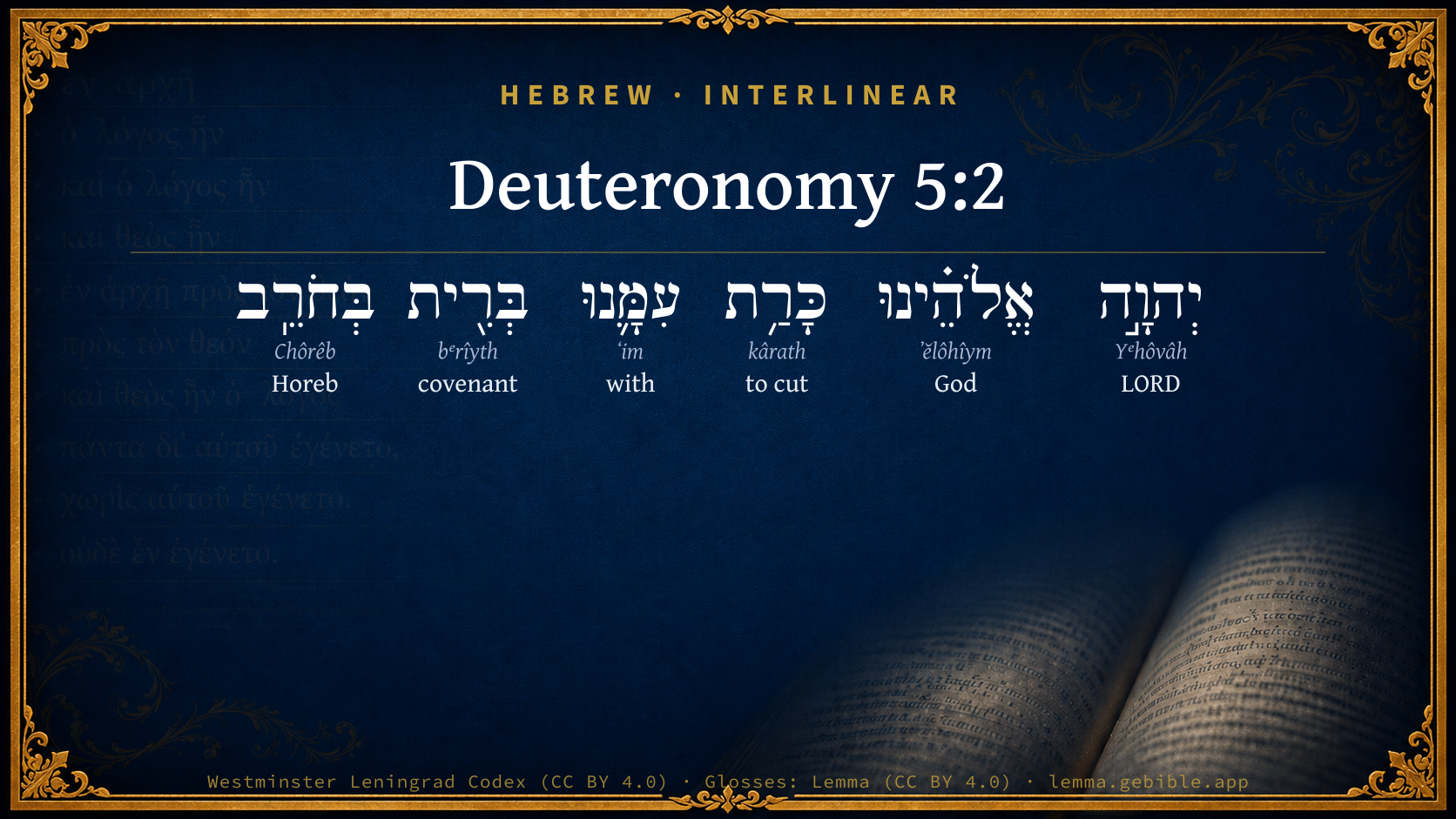
Hebrew (Westminster Leningrad Codex) Deuteronomy 5:2 appears in the Hebrew Old Testament. The text above is from the Westminster Leningrad Codex. Each word links to its Strong’s number, a concise gloss, and parsing drawn from the Open Scriptures Hebrew Bible morphology. Click any word for its full Brown-Driver-Briggs (BDB) entry.
Download image
Cite this verse

Deuteronomy 5:2 (World English Bible). Public Domain. Lemma interlinear Bible study tool, https://lemma.gebible.app/v/deuteronomy/5/2.

Show BibTeX & RIS
BibTeX
RIS
English Translation
Yahweh our God made a covenant with us in Horeb.
World English Bible · Public Domain
Download a study sheet

One document with this verse’s original text, its word-by-word gloss line, the meaning frame, cross-references with their text, attributed commentary, and full source and license credits — printable, and it pastes into notes with its structure intact.

This verse Autodidact and up

Study sheet (.html) Plain text (.txt)

A passage Seminary Student

Up to 50 verses in one chapter. A passage sheet keeps up to 6 commentary sources and 12 cross-references per verse, in the order this page ranks them, and says so on the sheet whenever that leaves anything out. Ask for a single verse and you get the Autodidact verse sheet above.

Everything on this page stays free to read, with no account — the sheet is a download of what is already on screen, not access to it.

Want to remove ads? Support Godless Engineer
Compare translations 3

The same verse in 3 English versions, stacked beneath the original-language interlinear above. Click any original word for its lexicon entry.

Each is an independent rendering of the whole verse — the interlinear is not word-aligned to these translations.

Highlighted words mark where these versions differ — a whole-verse word diff, not a word-by-word alignment.

  • World English Bible Public Domain
    Yahweh our God made a covenant with us in Horeb.
  • King James Version Public Domain
    The LORD our God made a covenant with us in Horeb.
  • unfoldingWord Literal Text CC BY-SA 4.0
    Yahweh our God cut a covenant with us at Horeb.

unfoldingWord Literal Text — © unfoldingWord, licensed CC BY-SA 4.0. Word-aligned USFM3 via Door43 (git.door43.org/unfoldingWord/en_ult).

Versions to compare (up to 4)

3 of 4 selected

Show all 18 translations

Every available English version of this verse, each an independent rendering of the whole verse.

  • World English Bible Public Domain
    Yahweh our God made a covenant with us in Horeb.
  • Berean Standard Bible Public Domain
    The LORD our God made a covenant with us at Horeb.
  • Majority Standard Bible Public Domain
    The LORD our God made a covenant with us at Horeb.
  • King James Version Public Domain
    The LORD our God made a covenant with us in Horeb.
  • American Standard Version (1901) Public Domain
    Jehovah our God made a covenant with us in Horeb.
  • Revised Version (1885) Public Domain
    The LORD our God made a covenant with us in Horeb.
  • Geneva Bible (1599) Public Domain
    The Lord our God made a couenant with vs in Horeb.
  • Douay-Rheims (1899) Public Domain
    The Lord our God made a covenant with us in Horeb.
  • Young's Literal Translation Public Domain
    Jehovah our God made with us a covenant in Horeb;
  • Literal Standard Version CC BY-SA 4.0
    Our God YHWH made a covenant with us in Horeb;
  • Unlocked Literal Bible CC BY-SA 4.0
    Yahweh our God made a covenant with us at Horeb.
  • unfoldingWord Literal Text CC BY-SA 4.0
    Yahweh our God cut a covenant with us at Horeb.
  • Darby Bible Public Domain
    Jehovah our God made a covenant with us in Horeb.
  • World Messianic Bible Public Domain
    The LORD our God made a covenant with us in Horeb.
  • Webster's Bible Public Domain
    The LORD our God made a covenant with us in Horeb.
  • Free Bible Version CC BY-SA 4.0
    Remember that the Lord our God made an agreement with us at Horeb.
  • Bible in Basic English Public Domain
    The Lord our God made an agreement with us in Horeb.
  • JPS Tanakh (1917) Public Domain
    The LORD our God made a covenant with us in Horeb.

Literal Standard Version (2020), Covenant Press — licensed CC BY-SA 4.0. Text via the HelloAO Bible API (eBible.org). Unlocked Literal Bible (unfoldingWord) — licensed CC BY-SA 4.0. Text via the HelloAO Bible API (eBible.org). unfoldingWord Literal Text — © unfoldingWord, licensed CC BY-SA 4.0. Word-aligned USFM3 via Door43 (git.door43.org/unfoldingWord/en_ult). Free Bible Version, Dr. Jonathan Gallagher — licensed CC BY-SA 4.0. Text via the HelloAO Bible API (eBible.org).

Word by word

More ways to search: Search by grammar → Find every occurrence → Compare this word →

Practice this passage: Drill this verse → Learn its vocabulary →

About this verse

These counts appear in no published source. They are computed here, from the morphology-tagged text and Lemma’s own curated glosses. What Lemma adds →

6
words
6
distinct lemmas
Pentateuch
section

Notable vocabulary

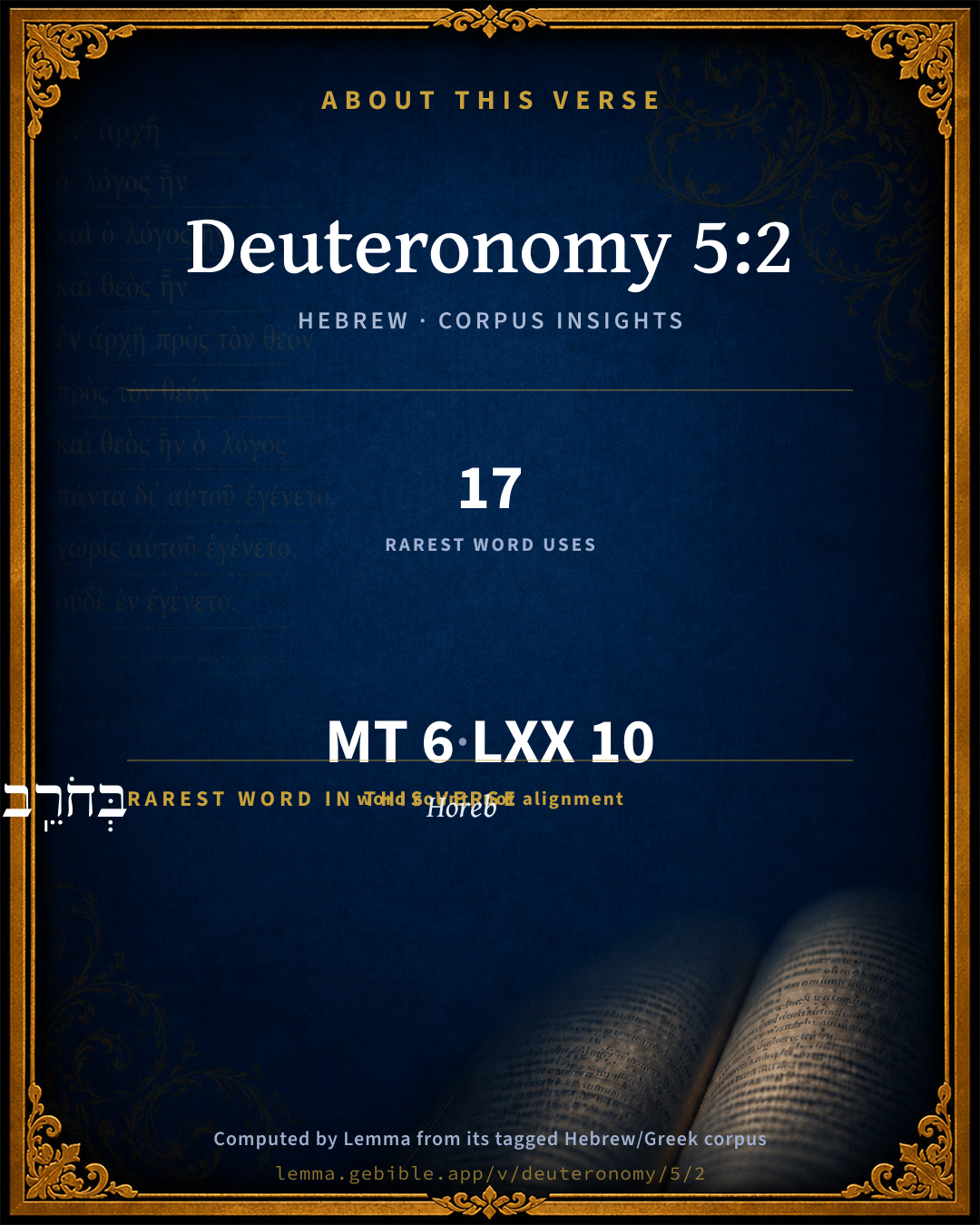
The rarest word here is בְּחֹרֵֽב Horeb H2722 — appearing just 17 times in the whole Hebrew Bible.

Shared distinctive vocabulary

בְּחֹרֵֽב Horeb H2722 occurs in 17 verses of the Hebrew Bible. Also found in:

Grammatical profile

  • 1 verb
  • 4 nouns
  • 1 preposition

Verb forms

  • כָּרַ֥ת Qal · Perfect

Hebrew & Septuagint length

In English translation the verse runs 10 words from the Hebrew and 11 from the Septuagint (LXX English) — closely comparable.

A rough comparison of the two English renderings, which tokenize alike — not a word-level alignment.

Word counts can differ between the Hebrew and the Greek without any difference in meaning — e.g. the Hebrew direct-object marker אֵת has no separate Greek word, and Greek often adds the article ὁ.

In the original languages it is 6 Hebrew tokens and 10 Greek tokens — but the two are counted differently (Hebrew bundles its prefixes and suffixes into one token; the Greek is in lemma form), so that isn’t a like-for-like length.

Cross-references

5

Topical passages linked to Deuteronomy 5:2 in the Treasury of Scripture Knowledge — connected by theme and wording, ordered by reader-vote popularity; previews shown in the World English Bible.

  • Deuteronomy 4:23 Take heed to yourselves, lest you forget the covenant of Yahweh your God, which he made with you, and make you an engraved image in the form of anything which Yahweh your God has forbidden you.
  • Exodus 19:5–8 Now therefore, if you will indeed obey my voice, and keep my covenant, then you shall be my own possession from among all peoples; for all the earth is mine;
  • Exodus 24:8 Moses took the blood, and sprinkled it on the people, and said, "Look, this is the blood of the covenant, which Yahweh has made with you concerning all these words."
  • Hebrews 8:6–13 But now he has obtained a more excellent ministry, by so much as he is also the mediator of a better covenant, which has been enacted on better promises.
  • Hebrews 9:19–23 For when every commandment had been spoken by Moses to all the people according to the law, he took the blood of the calves and the goats, with water and scarlet wool and hyssop, and sprinkled both the book itself and all the people,

Cross-references courtesy of OpenBible.info (CC BY 4.0).

Hebrew and Greek witnesses Masoretic Hebrew ↔ Greek Septuagint

The same verse in the two great witnesses to the Old Testament, shown verse-for-verse.

These are two independent witnesses, not word-aligned to each other, and the Septuagint is shown in lemma (dictionary) form.

Hebrew Deuteronomy 5:2 Masoretic · Westminster Leningrad Codex

יְהוָ֣ה אֱלֹהֵ֗ינוּ כָּרַ֥ת עִמָּ֛נוּ בְּרִ֖ית בְּחֹרֵֽב

Yahweh our God made a covenant with us in Horeb.

World English Bible · Public Domain

Greek LXX Deuteronomy 5:2 Septuagint · lemma form

κύριος ὁ θεός σύ διατίθημι πρός σύ διαθήκη ἐν χωρηβ

The Lord your God made a covenant with you in Choreb.

LXX2012 (modern English Septuagint) · Public Domain

Hebrew: Westminster Leningrad Codex (CC BY 4.0). Greek: Septuagint (public domain); English from LXX2012 (modern English Septuagint) (Public Domain). How the Septuagint differs from the Hebrew →

Targum (Aramaic paraphrase)

2

The Targum is the ancient Jewish Aramaic paraphrase of the Hebrew Scriptures — an interpretive translation, not the Hebrew text itself. Onkelos (literal) and Pseudo-Jonathan (expansive) render the Torah, and Jonathan the Prophets. Coverage is partial: where no permissively-licensed English translation exists for a verse, only the Aramaic is shown. This is verse-level text, not a word-by-word alignment to the Hebrew.

  1. Targum Onkelos Torah (Genesis–Deuteronomy)
    יְיָ אֱלָהָנָא גְזַר עִמָנָא קְיָם בְּחֹרֵב

    (no public-domain English translation for this verse)

    Targum Onkelos — Aramaic: “Onkelos Genesis” (public domain); “Onkelos Exodus” (public domain); “Onkelos Leviticus” (public domain); “Onkelos Numbers” (public domain); “Onkelos Deuteronomy” (public domain). English: “Sefaria Community Translation” (CC0 1.0 (public-domain dedication)); “J.W. Etheridge. The Targums of Onkelos and Jonathan Ben Uzziel on the Pentateuch. London: Longmans, Green, 1862” (public domain). Text via Sefaria.

  2. Targum Pseudo-Jonathan Torah (Genesis–Deuteronomy)
    יְיָ אֱלָהָנָא גְּזַר עִמָנָא קְיָים בְּחוֹרֵב

    The Lord our God confirmed a covenant with us in Horeb:

    Targum Pseudo-Jonathan — Aramaic: “Targum Jonathan on Genesis” (public domain); “Targum Jonathan on Exodus” (public domain); “Targum Jonathan on Leviticus” (public domain); “Targum Jonathan on Numbers” (public domain); “Targum Jonathan on Deuteronomy” (public domain). English: “The Targum of Jonathan ben Uzziel, trans. J. W. Etheridge, London, 1862” (public domain). Text via Sefaria.

Commentary

Notes on Deuteronomy 5:2 from classic Christian and Jewish commentators (each source and its license shown beneath its notes). The classic Christian expositions comment on the surrounding passage and are grouped to its opening verse, so a note may address several verses; the Jewish commentaries on the Tanakh (Rashi and others) are per-verse, so they appear only where the commentator wrote on this verse.

Lemma curates 59 commentaries, every one of them public domain or Creative Commons licensed, each selected and text-cleaned for this edition rather than reprinted as found. About our sources →

Trapp's Complete Commentary

John Trapp

Deu 5:2 The LORD our God made a covenant with us in Horeb.

Ver. 2. God made a covenant with us.] We also have the covenant, the seals, minister, &c. But, alas, are not these blessings amongst us, as the ark was among the Philistines, rather as prisoners than as privileges, rather in testimonium et ruinam quam salutem?

John Trapp, A Commentary or Exposition upon All the Books of the Old and New Testament (1647–1656) — public domain. Text from a community e-Sword module.

Ellicott's Commentary for English Readers

(2) The Lord our God made a covenant with us in Horeb.—It must never be forgotten that the Law is a covenant in its very form. (See Note on Deu_5:6.)

A Bible Commentary for English Readers, edited by Charles John Ellicott (1878–1897) — public domain. Text from a community e-Sword module.

The Cambridge Bible for Schools and Colleges

gen. ed. J. J. S. Perowne

2. covenant] See Deu_4:13.

The Cambridge Bible for Schools and Colleges (gen. ed. J. J. S. Perowne; Cambridge University Press, 1878–1918) — public domain. Text from a community e-Sword module.

John Gill's Exposition

The Lord our God made a covenant with us in Horeb. Which is Sinai, as Aben Ezra observes; it being the same mountain, only it had two tops, which bore these different names; for certain it is that the decalogue after repeated was given at Sinai, and had the nature and form of a covenant; see Exo 24:7.

.

Deuteronomy 5:3

deu 5:3

deu 5:3

deu 5:3The Lord made not this covenant with our fathers,.... That is, not with them only, as Jarchi, Aben Ezra, and Abendana remark; for certain it is that this covenant was made, or law was given, to the immediate fathers of this present generation of Israelites, whose carcasses had fallen in the wilderness; unless this is to be understood of their more remote ancestors, Abraham, Isaac, and Jacob, with whom the covenant of grace was made, or afresh made manifest, especially with the former; when the law, the covenant here spoken of, was not delivered until four hundred and thirty years after, Gal 3:16,

but with us, even us, who are all of us here alive this day; many of them were then present at the giving of the law, and though under twenty years of age, could remember it, and the circumstances of it; and besides, they were the same people to whom it was given, though not consisting wholly of the same individuals.

John Gill's Exposition of the Whole Bible (1746–1763) — public domain (CC PDM 1.0). Text via the HelloAO Bible API.

Whedon's Commentary on the Bible

Daniel D. Whedon

2. The Lord… made a covenant with us — It was to be impressed upon the Israelites that Jehovah their God had made a covenant with them. And here, just on the boundary line of the land promised to the seed of Abraham, they are to go back in thought to Sinai, with its awful splendour.

Daniel D. Whedon (gen. ed.), Commentary on the Old and New Testaments (1874–1909) — public domain. Text from a community e-Sword module.

The Pulpit Commentary

Vers. 2, 3. Not with our fathers, the patriarchs (cf. Deu_4:37) The covenant to which Moses refers is not that made with Abraham, but that made at Sinai, with Israel as a people; and though the individuals who were then present had all perished with the exception of Moses, Joshua, and Caleb, the nation survived, and as it was with the nation as an organic whole that the covenant had been made. it might be with propriety said that it was made with those whom Moses addressed at this time, inasmuch as they constituted the nation.

Vers. 2, 3. The covenant at Horeb.

Here spoken of as distinct from the older covenant made with the patriarchs. (Gen_15:17)

I ITS RELATIONS TO THE COVENANT MADE WITH THE FATHERS, It was not a new thing absolutely. It rested on that older covenant, and on the series of revelations which sprang out of it. It could not disannul that older covenant. (Gal_3:17) It could not run counter to it. (Gal_3:21) It must, though "superadded," be in subserviency to it. (Gal_3:15-26) But that covenant made with the fathers was:

1. Of promise. (Gal_3:18)

2. Couched in absolute terms. God pledged his perfections that the promise conveyed in it would be ultimately realized. (Rom_3:3)

3. In which an interest was obtained by faith (Gen_15:6; Rom_4:3-23)

4. While yet it bound the person received into covenant to a holy life. (Gen_17:1) The new covenant could "make void" the older one in none of these particulars.

II ITS DISTINCTION FROM THE COVENANT MADE WITH THE FATHERS.

1. It was a national covenant, having reference primarily to national existence and prosperity.

2. It was a covenant of Law. It was

1. connected with a promulgation of Law, and

2. required obedience to the prescribed Law as the condition of acceptance.

Does this look like a retrograde step in the Divine procedure, a contradiction of the covenant with Abraham? Seemingly it was so, but the backward step was really a forward one, bringing to light demands of the Divine holiness which it was absolutely essential man should become acquainted with. Two points have to be noticed:

(a) that obedience was not made the ground of admission to the covenant, or aught else than the condition of continuance in privileges freely conferred; and

(b) that the requirement of obedience did not stand alone, but was connected with provisions for the removal of the guilt contracted by transgression and shortcoming. This brings into view the peculiar feature in the covenant of Horeb the hidden grace of it. In form and letter it was a strictly legal covenant. Obedience to the Law in all its parts, and without failure, was the technical condition of the fulfillment of promise, and of continuance in covenant privilege. (cf. Mat_19:17; Gal_3:10) The fact that atonements were provided to remove the guilt which otherwise would have broken up the covenant, is proof that such was its constitution. The same fact shows that in the structure of the covenant it was recognized that sin and shortcoming would mark the history of Israel; that, on the strictly legal basis, standing in the state of acceptance was impossible. A theoretically perfect obedience no Jew ever rendered. His standing in no case was in virtue of a perfectly fulfilled Law, but was due to forgiving mercy, which daily pardoned his shortcomings, and gave him an acceptance which these shortcomings were as constantly forfeiting. It was faith, not works, which justified him; while yet, in harmony with the unalterable law of moral life, it was his duty to aim at the realization of the ideal of righteousness which the Law presented. Just as with Abraham, the faith which justified him, and did so before a single work had issued from it (Gen_15:6; Jam_2:23) was a faith which "wrought with works," and "by works was faith made perfect". (Jam_2:22) It follows from these peculiarities, and from thestatements of Scripture, that it was:

3. A preparatory and temporary covenant. Its leading design was to develop the consciousness of sin, to awaken a feeling of the need of redemption, to evince the powerlessness of mere Law as a source of moral strength, to drive men back from legal efforts to faith, and so, finally, to prepare the way for Christ (Rom_3:20; Gal_3:23, Gal_3:24, etc.) In this we discern the reason of the severe and threatening form in which it was couched, and of the terrors which attended its promulgation. It was a covenant which could not of itself save or do aught but kill. J.O. (2Co_3:6-12)

The Pulpit Commentary (1880–1919), ed. H.D.M. Spence-Jones & Joseph S. Exell — public domain. Text from a community e-Sword module.

Lesson kit

Teaching starters — assembled from the data on this page, not authored interpretation. Every prompt links to the verse data it draws on. Edit before teaching.

Deuteronomy, in the Pentateuch, opens this verse with 6 words (6 distinct Hebrew lemmas). Its most distinctive word is Chôrêb (“Horeb”). A historical commentator’s framing appears above. Read the whole chapter for the surrounding context.

Discussion questions

  1. How does “Horeb” (Chôrêb) shape what this verse is saying?
  2. Exodus 3:1 shares the word «Horeb» with this verse. How do the two illuminate each other?
  3. These translations render this verse differently; the difference is in the English rendering, not the original. What questions does that raise?
  4. The verb «כָּרַ֥ת» is Qal Perfect. How does its form color the action?
  5. Reading how Trapp's Complete Commentary and Ellicott's Commentary for English Readers read this verse, where do the two commentators agree and where do they part?

Things to notice

Reading settings

Reading text

Shown beneath each verse's original-language words.

Old Testament
Old Testament edition

Read the OT as the Masoretic Hebrew (MT) or the Greek Septuagint (LXX).

English shown for the Greek Septuagint (in the Hebrew ↔ Greek comparison).

Comparing translations? Open the Compare panel on any verse page to stack up to four side by side.