
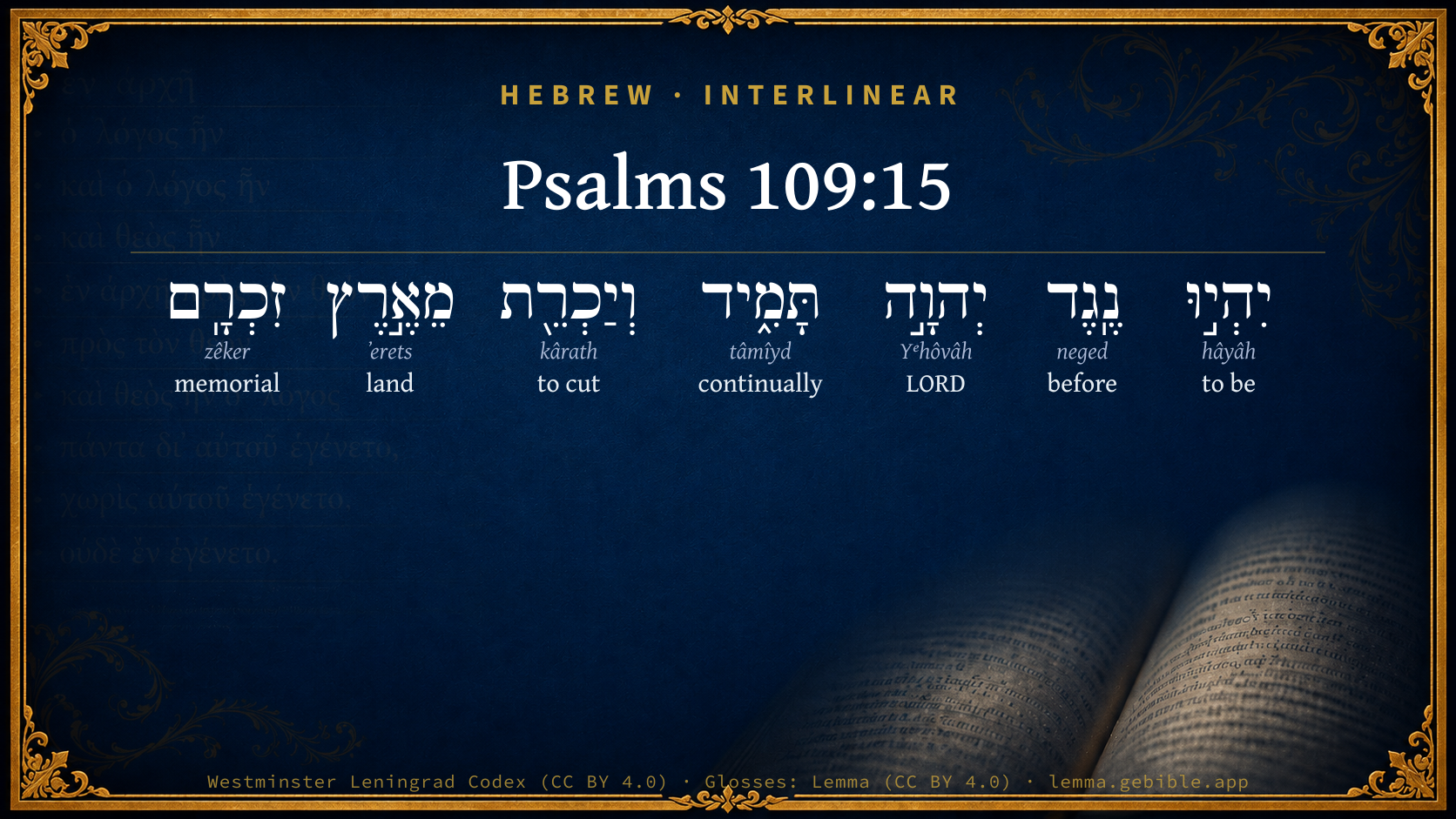
Psalms 109:15

Hebrew (Westminster Leningrad Codex) Psalms 109:15 appears in the Hebrew Old Testament. The text above is from the Westminster Leningrad Codex. Each word links to its Strong’s number, a concise gloss, and parsing drawn from the Open Scriptures Hebrew Bible morphology. Click any word for its full Brown-Driver-Briggs (BDB) entry.
Download image
Cite this verse

Psalms 109:15 (World English Bible). Public Domain. Lemma interlinear Bible study tool, https://lemma.gebible.app/v/psalms/109/15.

Show BibTeX & RIS
BibTeX
RIS
English Translation
Let them be before Yahweh continually, That he may cut off the memory of them from the earth;
World English Bible · Public Domain
Download a study sheet

One document with this verse’s original text, its word-by-word gloss line, the meaning frame, cross-references with their text, attributed commentary, and full source and license credits — printable, and it pastes into notes with its structure intact.

This verse Autodidact and up

Study sheet (.html) Plain text (.txt)

A passage Seminary Student

Up to 50 verses in one chapter. A passage sheet keeps up to 6 commentary sources and 12 cross-references per verse, in the order this page ranks them, and says so on the sheet whenever that leaves anything out. Ask for a single verse and you get the Autodidact verse sheet above.

Everything on this page stays free to read, with no account — the sheet is a download of what is already on screen, not access to it.

Want to remove ads? Support Godless Engineer
Compare translations 3

The same verse in 3 English versions, stacked beneath the original-language interlinear above. Click any original word for its lexicon entry.

Each is an independent rendering of the whole verse — the interlinear is not word-aligned to these translations.

Highlighted words mark where these versions differ — a whole-verse word diff, not a word-by-word alignment.

  • World English Bible Public Domain
    Let them be before Yahweh continually, That he may cut off the memory of them from the earth;
  • King James Version Public Domain
    Let them be before the LORD continually, that he may cut off the memory of them from the earth.
  • unfoldingWord Literal Text CC BY-SA 4.0
    May they be before Yahweh continually and may he cut off their remembrance from the earth,

unfoldingWord Literal Text — © unfoldingWord, licensed CC BY-SA 4.0. Word-aligned USFM3 via Door43 (git.door43.org/unfoldingWord/en_ult).

Versions to compare (up to 4)

3 of 4 selected

Show all 18 translations

Every available English version of this verse, each an independent rendering of the whole verse.

  • World English Bible Public Domain
    Let them be before Yahweh continually, That he may cut off the memory of them from the earth;
  • Berean Standard Bible Public Domain
    May their sins always remain before the LORD, that He may cut off their memory from the earth.
  • Majority Standard Bible Public Domain
    May their sins always remain before the LORD, that He may cut off their memory from the earth.
  • King James Version Public Domain
    Let them be before the LORD continually, that he may cut off the memory of them from the earth.
  • American Standard Version (1901) Public Domain
    Let them be before Jehovah continually, That he may cut off the memory of them from the earth;
  • Revised Version (1885) Public Domain
    Let them be before the LORD continually, that he may cut off the memory of them from the earth.
  • Geneva Bible (1599) Public Domain
    But let them alway be before the Lord, that he may cut off their memorial from ye earth.
  • Douay-Rheims (1899) Public Domain
    May they be before the lord continually, and let the memory of them perish from the earth:
  • Young's Literal Translation Public Domain
    They are before Jehovah continually, And He cutteth off from earth their memorial.
  • Literal Standard Version CC BY-SA 4.0
    They are continually before YHWH, || And He cuts off their memorial from earth.
  • Unlocked Literal Bible CC BY-SA 4.0
    May their guilt always be before Yahweh; may Yahweh cut off their memory from the earth.
  • unfoldingWord Literal Text CC BY-SA 4.0
    May they be before Yahweh continually and may he cut off their remembrance from the earth,
  • Darby Bible Public Domain
    Let them be before Jehovah continually, that he may cut off the memory of them from the earth:
  • World Messianic Bible Public Domain
    Let them be before the LORD continually, that he may cut off their memory from the earth;
  • Webster's Bible Public Domain
    Let them be before the LORD continually, that he may cut off the memory of them from the earth.
  • Free Bible Version CC BY-SA 4.0
    May their sins be constantly before the Lord; may his name be totally forgotten by people.
  • Bible in Basic English Public Domain
    Let them be ever before the eyes of the Lord, so that the memory of them may be cut off from the earth.
  • JPS Tanakh (1917) Public Domain
    Let them be before the LORD continually, that He may cut off the memory of them from the earth.

Literal Standard Version (2020), Covenant Press — licensed CC BY-SA 4.0. Text via the HelloAO Bible API (eBible.org). Unlocked Literal Bible (unfoldingWord) — licensed CC BY-SA 4.0. Text via the HelloAO Bible API (eBible.org). unfoldingWord Literal Text — © unfoldingWord, licensed CC BY-SA 4.0. Word-aligned USFM3 via Door43 (git.door43.org/unfoldingWord/en_ult). Free Bible Version, Dr. Jonathan Gallagher — licensed CC BY-SA 4.0. Text via the HelloAO Bible API (eBible.org).

Word by word

More ways to search: Search by grammar → Find every occurrence → Compare this word →

Practice this passage: Drill this verse → Learn its vocabulary →

About this verse

These counts appear in no published source. They are computed here, from the morphology-tagged text and Lemma’s own curated glosses. What Lemma adds →

7
words
7
distinct lemmas
Wisdom
section

Notable vocabulary

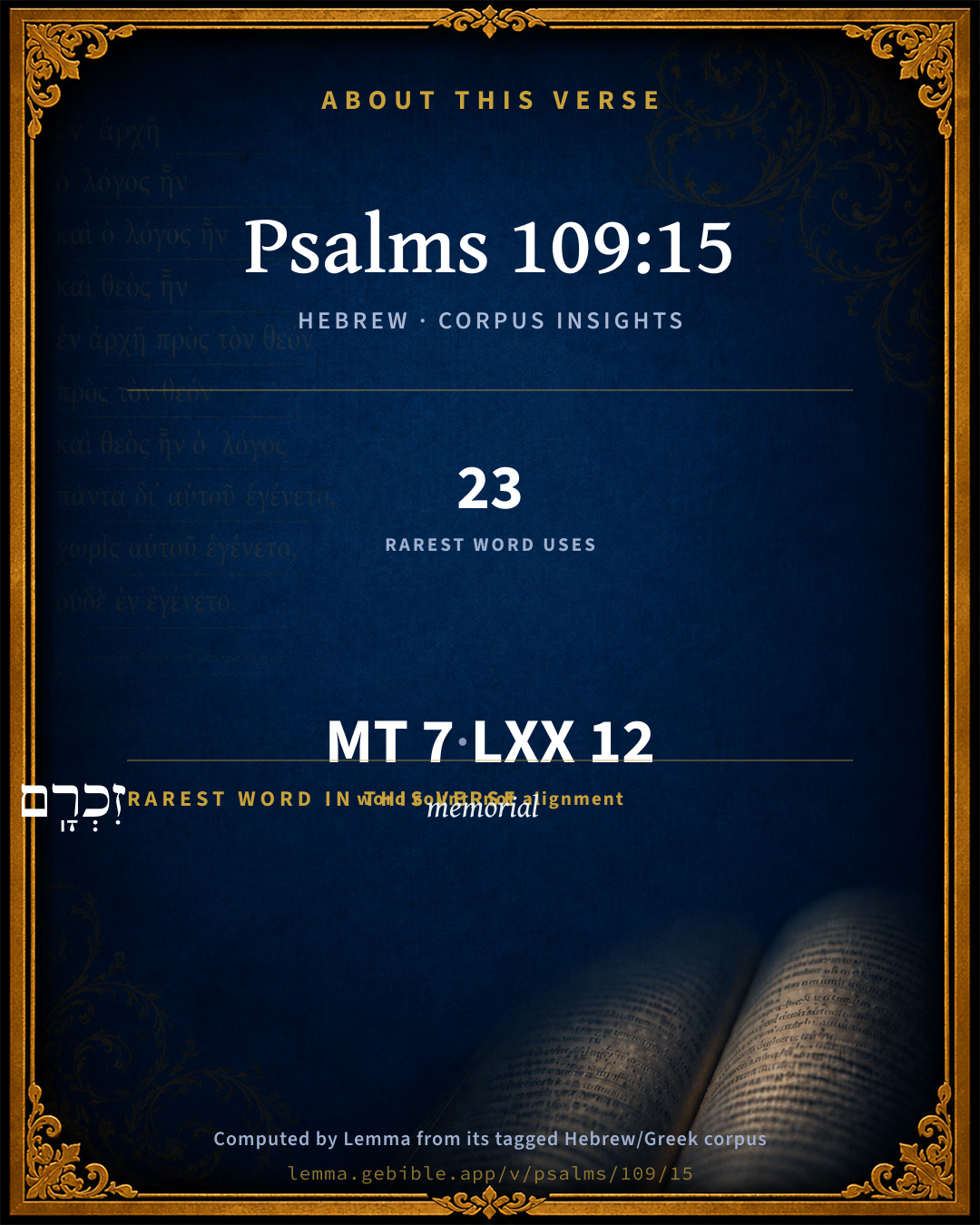
The rarest word here is זִכְרָֽם memorial H2143 — appearing just 23 times in the whole Hebrew Bible.

Shared distinctive vocabulary

זִכְרָֽם memorial H2143 occurs in 23 verses of the Hebrew Bible. Also found in:

Grammatical profile

  • 2 verbs
  • 4 nouns
  • 1 preposition

Verb forms

  • יִהְי֣וּ Qal · Imperfect
  • וְיַכְרֵ֖ת Hiphil · Imperfect

Hebrew & Septuagint length

In English translation the verse runs 18 words from the Hebrew and 17 from the Septuagint (LXX English) — closely comparable.

A rough comparison of the two English renderings, which tokenize alike — not a word-level alignment.

Word counts can differ between the Hebrew and the Greek without any difference in meaning — e.g. the Hebrew direct-object marker אֵת has no separate Greek word, and Greek often adds the article ὁ.

In the original languages it is 7 Hebrew tokens and 12 Greek tokens — but the two are counted differently (Hebrew bundles its prefixes and suffixes into one token; the Greek is in lemma form), so that isn’t a like-for-like length.

Cross-references

10

Topical passages linked to Psalms 109:15 in the Treasury of Scripture Knowledge — connected by theme and wording, ordered by reader-vote popularity; previews shown in the World English Bible.

  • Psalms 34:16 Yahweh's face is against those who do evil, To cut off the memory of them from the earth.
  • Job 18:17 His memory shall perish from the earth. He shall have no name in the street.
  • Psalms 90:8 You have set our iniquities before you, Our secret sins in the light of your presence.
  • Psalms 51:9 Hide your face from my sins, And blot out all of my iniquities.
  • Deuteronomy 32:34 Isn't this laid up in store with me, Sealed up among my treasures?
  • Psalms 109:13 Let his posterity be cut off. In the generation following let their name be blotted out.
  • Isaiah 65:15 You shall leave your name for a curse to my chosen; and the Lord Yahweh will kill you; and he will call his servants by another name:
  • Jeremiah 2:22 For though you wash yourself with lye, and use much soap, yet your iniquity is marked before me, says the Lord Yahweh.
  • Amos 8:7 Yahweh has sworn by the pride of Jacob, "Surely I will never forget any of their works.
  • Hosea 7:2 They don't consider in their hearts that I remember all their wickedness. Now their own deeds have engulfed them. They are before my face.

Cross-references courtesy of OpenBible.info (CC BY 4.0).

Hebrew and Greek witnesses Masoretic Hebrew ↔ Greek Septuagint

The same verse in the two great witnesses to the Old Testament, shown verse-for-verse.

You’re reading Greek Psalm 108 (Hebrew Psalm 109). The Septuagint counts the superscription, so verse numbers can differ from the Hebrew — chapter-level alignment, not verse-by-verse. Numbering follows Rahlfs.

These are two independent witnesses, not word-aligned to each other, and the Septuagint is shown in lemma (dictionary) form.

Hebrew Psalms 109:15 Masoretic · Westminster Leningrad Codex

יִהְי֣וּ נֶֽגֶד יְהוָ֣ה תָּמִ֑יד וְיַכְרֵ֖ת מֵאֶ֣רֶץ זִכְרָֽם

Let them be before Yahweh continually, That he may cut off the memory of them from the earth;

World English Bible · Public Domain

Greek LXX Greek Psalm 108:15 Septuagint · lemma form

γίγνομαι ἔναντι κύριος διά πᾶς καί ἐκὀλεθρεύω ἐκ γῆ ὁ μνημόσυνον αὐτός

Let them be before the Lord continually; and let their memorial be blotted out from the earth.

LXX2012 (modern English Septuagint) · Public Domain

Hebrew: Westminster Leningrad Codex (CC BY 4.0). Greek: Septuagint (public domain); English from LXX2012 (modern English Septuagint) (Public Domain). How the Septuagint differs from the Hebrew →

Commentary

Notes on Psalms 109:15 from classic Christian and Jewish commentators (each source and its license shown beneath its notes). The classic Christian expositions comment on the surrounding passage and are grouped to its opening verse, so a note may address several verses; the Jewish commentaries on the Tanakh (Rashi and others) are per-verse, so they appear only where the commentator wrote on this verse.

Lemma curates 59 commentaries, every one of them public domain or Creative Commons licensed, each selected and text-cleaned for this edition rather than reprinted as found. About our sources →

Trapp's Complete Commentary

John Trapp

Psa 109:15 Let them be before the LORD continually, that he may cut off the memory of them from the earth.

Ver. 15. Let them be before the Lord] Stand ever upon record in his presence, to provoke him to wrath. A heavy curse indeed.

John Trapp, A Commentary or Exposition upon All the Books of the Old and New Testament (1647–1656) — public domain. Text from a community e-Sword module.

J. A. Alexander on Psalms

Joseph Addison Alexander

15. (Psa 109:15) Let them be before Jehovah always, and let him cut off from the earth their memory. The subject of the first clause is the guilt and sin mentioned in the verse preceding. Before Jehovah, in his sight, an object of attention to him. See above, Psa 90:8. With the last clause compare Psa 9:6; Psa 34:16.

Joseph Addison Alexander, The Psalms Translated and Explained (1850) — public domain. Text from a community e-Sword module.

The Cambridge Bible for Schools and Colleges

gen. ed. J. J. S. Perowne

15. Let them be] The iniquity and sin. Cp. Psa_90:8; Lam_1:22.

the memory of them] Of his ancestors and all their posterity. Cp. Psa_34:16.

The Cambridge Bible for Schools and Colleges (gen. ed. J. J. S. Perowne; Cambridge University Press, 1878–1918) — public domain. Text from a community e-Sword module.

John Gill's Exposition

Because that he remembered not to show mercy,.... As Judas did not; neither to the poor, whom he cared not for, Joh 12:6 nor to Christ, whom he betrayed with a kiss to his enemies: nor had these words of Christ any effect upon him, to move his pity and compassion, "Friend, wherefore art thou come?" Mat 26:49 nor did the Jews show mercy to him: they were a merciless and hardhearted people; though mercy was one of the weightier matters of the law, this they omitted, Mat 23:23, their want of compassion may be observed in the priest and Levite passing by the man wounded by thieves, Luk 10:30. Nor did they show any mercy to Christ, when they smote and buffeted him; nor did it move their pity when Pilate brought him forth with a crown of thorns on his head, and in a miserable condition, saying, "Behold the man"; but they cried out, "Crucify him, crucify him"; and gave him gall for his meat, and vinegar to drink; and mocked him when in all his miseries and agonies.

But persecuted the poor and needy man; Christ, who became poor for our sakes, and stood in need of the ministration of others to him, Co2 8:9 and was poor in spirit, a man of sorrows, and acquainted with griefs; him Judas and the Jews persecuted to death, as follows:

that he might even slay the broken in heart; Christ, whose heart was broken with the reproach and cruel usage of men, Psa 69:20, whose life the Jews sought to take away, and by means of Judas did.

John Gill's Exposition of the Whole Bible (1746–1763) — public domain (CC PDM 1.0). Text via the HelloAO Bible API.

Albert Barnes' Notes on the Bible

Let them be before the Lord continually - Let their sins never pass from the mind of God. Let him never so forget them as not to inflict punishment for them.

That he may cut off the memory of them from the earth - That they may be wholly forgotten among people. Let their very name perish; and let the offender in this case be in the condition of those who have no ancestors to whom they can refer with pride and pleasure. The idea here is drawn from the honor which is felt in being able to refer to ancestors worthy of being remembered for their virtues.

Albert Barnes' Notes on the Bible (1834–1885) — public domain. Text from a community e-Sword/MySword module.

Matthew Poole's English Annotations

Let them, the sins of his parents last mentioned, be before Lord; in God’s sight and memory, to provoke God them: let them not be covered or pardoned.

Matthew Poole's English Annotations on the Holy Bible (1683–1685) — public domain. Text from a community e-Sword/MySword module.

The Treasury of David

Charles H. Spurgeon

Ver. 15. Again, he wishes that his father's sins may follow up the transgressor and assist to fill the measure of his own iniquities, so that for the whole accumulated load the family may be smitten with utter extinction. A king might justly wish for such an end to fall upon an incorrigible brood of rebels; and of persecutors, continuing in the same mind, the saints might well pray for their extinction; but the passage is dark; and we must leave it so. It must be right or it would not be here, but how we cannot see. Why should we expect to understand all things? Perhaps it is more for our benefit to exercise humility, and reverently worship God over a hard text, than it would be to comprehend all mysteries.

Ver. 15. Let them be before the Lord continually. The fearful punishment of sinners is, to be always under the eye of an angry God: then the soul of the sinner is dismayed at its own deformity. Le Blanc.

Ver. 15. Let them be before the Lord continually. Lafayette, the friend and ally of Washington, was in his youth confined in a French dungeon. In the door of his ceil there was cut a small hole, just big enough for a man's eye; at that hole a sentinel was placed, whose duty it was to watch, moment by moment, till he was relieved by a change of guard. All Lafayette saw was the winking eye, but the eye was always there; look when he would, it met his gaze. In his dreams, he was conscious it was staring at him. "Oh", he says, "it was horrible; there was no escape; when he lay down and when he rose up, when he ate and when he read, that eye searched him." "New Cyclopaedia of Illustrative Anecdote", 1875.

Ver. 15-19, 29. Strict justice, and nothing more, breathes in every petition. Cannot you say, Amen! to all these petitions? Are you not glad when the wicked man falls into the ditch he has made for another's destruction, and when his mischief returns upon his own head? But you say, "These petitions are unquestionably just, but why did not the psalmist ask, not for justice, but for mercy?" The answer is, that in his public capacity, he was bound to think first about justice.

No government could stand upon the basis of forgiveness, justice must always go before mercy. Suppose that in the course of the next session Parliament should decree that henceforth, instead of justice being shown to thieves, by sending them to prison, they should be treated charitably, and compelled to restore one half of what they stole, what would honest men say about the government? The thieves would doubtless be very complimentary, but what would honest men say? Why, they would say the government had altogether failed of its function, and it would not live to be a week older. And just so, the psalmists were bound first of all to seek for the vindication and establishment of justice and truth. Like the magistrates of today, they considered first the well being of the community. This they had in view in all the calamities they sought to bring upon wrong doers. R.A. Bertram.

Psalms 109:16*

Charles H. Spurgeon's The Treasury of David (1869–1885) — public domain. Psalms only. Text from a community e-Sword/MySword module.

Whedon's Commentary on the Bible

Daniel D. Whedon

15. Cut off the memory of them—That is, the honourable memorial of them, as the word commonly signifies. Their crimes are their only memorial, as in the case of Judas Iscariot; and this is equal to “cutting off, blotting out,” or forgetting the memory of them. See Exo_17:14; Deu_25:19; Psa_34:16

Daniel D. Whedon (gen. ed.), Commentary on the Old and New Testaments (1874–1909) — public domain. Text from a community e-Sword module.

The Pulpit Commentary

Let them be before the Lord continually; i.e. let these sins be present to the mind of God constantly, that he may visit for them constantly, even to the bitter end; and so may cut off the memory of them (i.e. of the original sinners) from the earth (comp. ver. 13).

The Pulpit Commentary (1880–1919), ed. H.D.M. Spence-Jones & Joseph S. Exell — public domain. Text from a community e-Sword module.

Rashi

Rabbi Shlomo Yitzchaki (Rashi)

May they be [May] these iniquities [be] before the Lord constantly.

and may He cut off their remembrance from the earth [the remembrance] of Esau and his chieftains.

Rashi on the Tanakh — English translations: “The Judaica Press complete Tanach with Rashi, translated by A. J. Rosenberg” (CC BY 4.0); “Pentateuch with Rashi's commentary by M. Rosenbaum and A.M. Silbermann, 1929-1934” (public domain); “The Metsudah Tanach series, Lakewood, N.J” (CC BY 4.0); and “The Book of Joshua, Metsudah Publications, 1997” (CC BY 4.0). Text via Sefaria.

Lesson kit

Teaching starters — assembled from the data on this page, not authored interpretation. Every prompt links to the verse data it draws on. Edit before teaching.

Psalms, in the Wisdom, opens this verse with 7 words (7 distinct Hebrew lemmas). Its most distinctive word is zêker (“memorial”). A historical commentator’s framing appears above. Read the whole chapter for the surrounding context.

Discussion questions

  1. How does “memorial” (zêker) shape what this verse is saying?
  2. Exodus 3:15 shares the word «memorial» with this verse. How do the two illuminate each other?
  3. The translations on this page render this verse differently — a whole-verse word diff, not a word-by-word alignment. What might account for the different wordings?
  4. The verb «יִהְי֣וּ» is Qal Imperfect. How does its form color the action?
  5. Reading how Trapp's Complete Commentary and J. A. Alexander on Psalms read this verse, where do the two commentators agree and where do they part?

Things to notice

Reading settings

Reading text

Shown beneath each verse's original-language words.

Old Testament
Old Testament edition

Read the OT as the Masoretic Hebrew (MT) or the Greek Septuagint (LXX).

English shown for the Greek Septuagint (in the Hebrew ↔ Greek comparison).

Comparing translations? Open the Compare panel on any verse page to stack up to four side by side.