
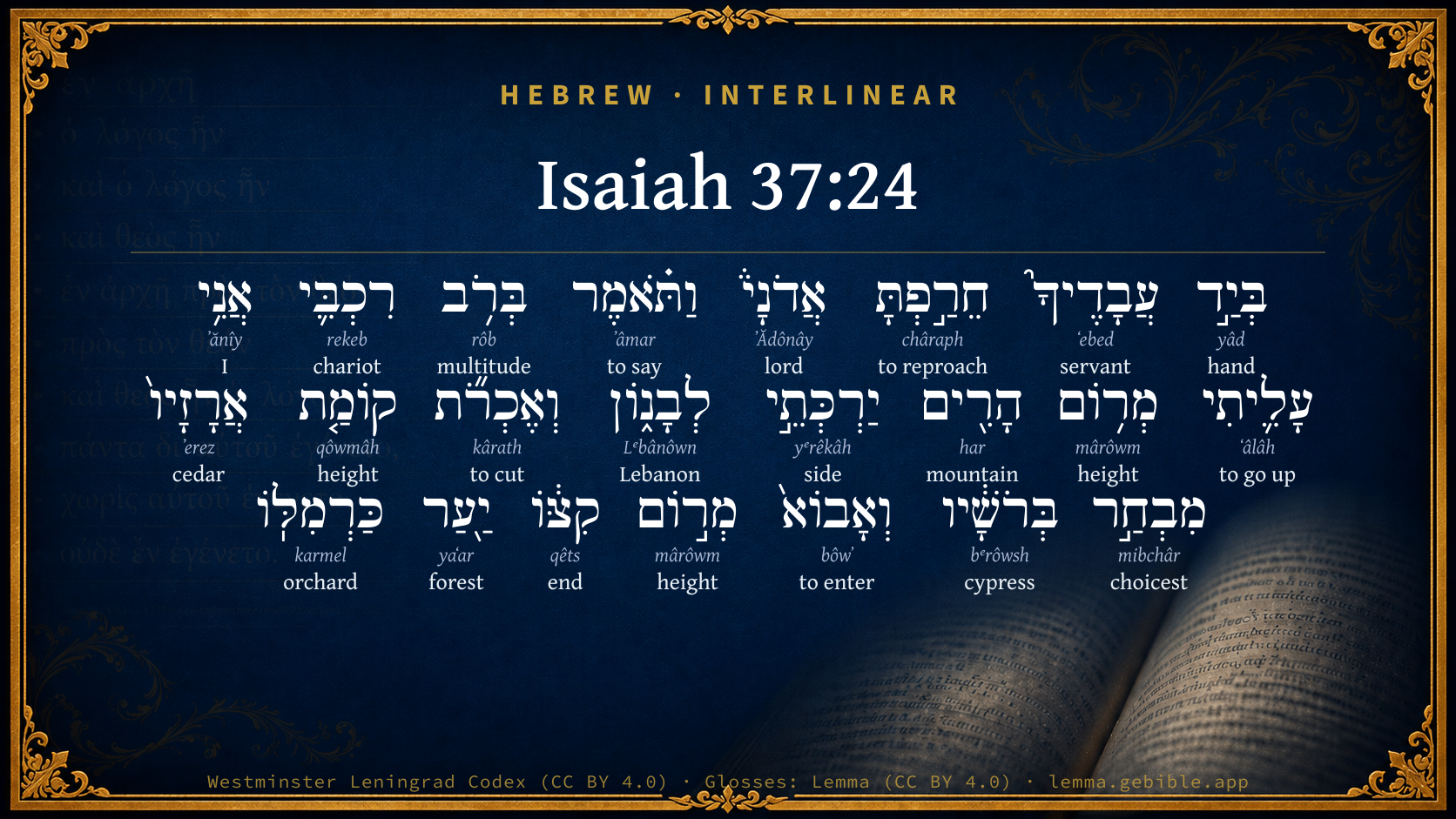
Isaiah 37:24

Hebrew (Westminster Leningrad Codex) Isaiah 37:24 appears in the Hebrew Old Testament. The text above is from the Westminster Leningrad Codex. Each word links to its Strong’s number, a concise gloss, and parsing drawn from the Open Scriptures Hebrew Bible morphology. Click any word for its full Brown-Driver-Briggs (BDB) entry.
Download image
Cite this verse

Isaiah 37:24 (World English Bible). Public Domain. Lemma interlinear Bible study tool, https://lemma.gebible.app/v/isaiah/37/24.

Show BibTeX & RIS
BibTeX
RIS
English Translation
By your servants have you defied the Lord, and have said, With the multitude of my chariots am I come up to the height of the mountains, to the innermost parts of Lebanon; and I will cut down the tall cedars of it, and the choice fir trees of it; and I will enter into its farthest height, the forest of its fruitful field;
World English Bible · Public Domain
Download a study sheet

One document with this verse’s original text, its word-by-word gloss line, the meaning frame, cross-references with their text, attributed commentary, and full source and license credits — printable, and it pastes into notes with its structure intact.

This verse Autodidact and up

Study sheet (.html) Plain text (.txt)

A passage Seminary Student

Up to 50 verses in one chapter. A passage sheet keeps up to 6 commentary sources and 12 cross-references per verse, in the order this page ranks them, and says so on the sheet whenever that leaves anything out. Ask for a single verse and you get the Autodidact verse sheet above.

Everything on this page stays free to read, with no account — the sheet is a download of what is already on screen, not access to it.

Want to remove ads? Support Godless Engineer
Compare translations 3

The same verse in 3 English versions, stacked beneath the original-language interlinear above. Click any original word for its lexicon entry.

Each is an independent rendering of the whole verse — the interlinear is not word-aligned to these translations.

Highlighted words mark where these versions differ — a whole-verse word diff, not a word-by-word alignment.

  • World English Bible Public Domain
    By your servants have you defied the Lord, and have said, With the multitude of my chariots am I come up to the height of the mountains, to the innermost parts of Lebanon; and I will cut down the tall cedars of it, and the choice fir trees of it; and I will enter into its farthest height, the forest of its fruitful field;
  • King James Version Public Domain
    By thy servants hast thou reproached the Lord, and hast said, By the multitude of my chariots am I come up to the height of the mountains, to the sides of Lebanon; and I will cut down the tall cedars thereof, and the choice fir trees thereof: and I will enter into the height of his border, and the forest of his Carmel.
  • unfoldingWord Literal Text CC BY-SA 4.0
    By the hand of your servants you mocked the Lord and said, “With the multitude of my chariotry, I, I went up the height of the mountains, the recesses of Lebanon. And I cut down the heights of its cedars, the choicest of its cypress trees, that I might enter the lodging place of its end, the forest of its garden.

unfoldingWord Literal Text — © unfoldingWord, licensed CC BY-SA 4.0. Word-aligned USFM3 via Door43 (git.door43.org/unfoldingWord/en_ult).

Versions to compare (up to 4)

3 of 4 selected

Show all 18 translations

Every available English version of this verse, each an independent rendering of the whole verse.

  • World English Bible Public Domain
    By your servants have you defied the Lord, and have said, With the multitude of my chariots am I come up to the height of the mountains, to the innermost parts of Lebanon; and I will cut down the tall cedars of it, and the choice fir trees of it; and I will enter into its farthest height, the forest of its fruitful field;
  • Berean Standard Bible Public Domain
    Through your servants you have taunted the Lord, and you have said: “With my many chariots I have ascended to the heights of the mountains, to the remote peaks of Lebanon. I have cut down its tallest cedars, the finest of its cypresses. I have reached its farthest heights, the densest of its forests.
  • Majority Standard Bible Public Domain
    Through your servants you have taunted the Lord, and you have said: “With my many chariots I have ascended to the heights of the mountains, to the remote peaks of Lebanon. I have cut down its tallest cedars, the finest of its cypresses. I have reached its farthest heights, the densest of its forests.
  • King James Version Public Domain
    By thy servants hast thou reproached the Lord, and hast said, By the multitude of my chariots am I come up to the height of the mountains, to the sides of Lebanon; and I will cut down the tall cedars thereof, and the choice fir trees thereof: and I will enter into the height of his border, and the forest of his Carmel.
  • American Standard Version (1901) Public Domain
    By thy servants hast thou defied the Lord, and hast said, With the multitude of my chariots am I come up to the height of the mountains, to the innermost parts of Lebanon; and I will cut down the tall cedars thereof, and the choice fir-trees thereof; and I will enter into its farthest height, the forest of its fruitful field;
  • Revised Version (1885) Public Domain
    By thy servants hast thou reproached the Lord, and hast said, With the multitude of my chariots am I come up to the height of the mountains, to the innermost parts of Lebanon; and I will cut down the tall cedars thereof, and the choice fir trees thereof: and I will enter into his farthest height, the forest of his fruitful field.
  • Geneva Bible (1599) Public Domain
    By thy seruants hast thou railed on the Lord, and sayd, By the multitude of my charets I am come vp to the top of the mountaines to the sides of Lebanon, and will cut downe the hie cedars thereof, and the faire firre trees thereof, and I will goe vp to the heightes of his top and to the forest of his fruitfull places.
  • Douay-Rheims (1899) Public Domain
    By the hand of thy servants thou hast reproached the Lord: and hast said: With the multitude of my chariots I have gone up to the height of the mountains, to the top of Libanus: and I will out down its tall cedars, and its choice fir trees, end will enter to the top of its height, to the forest of its Carmel.
  • Young's Literal Translation Public Domain
    By the hand of thy servants Thou hast reviled the Lord, and sayest: In the multitude of my chariots I have come up to a high place of hills, The sides of Lebanon, And I cut down the height of its cedars, The choice of its firs, And I enter the high place of its extremity, The forest of its Carmel.
  • Literal Standard Version CC BY-SA 4.0
    By the hand of your servants || You have reviled the Lord, and say: In the multitude of my chariots || I have come up to a high place of hills, || The sides of Lebanon, || And I cut down the height of its cedars, || The choice of its firs, || And I enter the high place of its extremity, || The forest of its Carmel.
  • Unlocked Literal Bible CC BY-SA 4.0
    By your servants you have defied the Lord and have said, 'With the multitude of my chariots I have gone up to the heights of the mountains, to the highest elevations of Lebanon. I will cut down its tall cedars and choice cypress trees there, and I will enter into its farthest high places, its most fruitful forest.
  • unfoldingWord Literal Text CC BY-SA 4.0
    By the hand of your servants you mocked the Lord and said, “With the multitude of my chariotry, I, I went up the height of the mountains, the recesses of Lebanon. And I cut down the heights of its cedars, the choicest of its cypress trees, that I might enter the lodging place of its end, the forest of its garden.
  • Darby Bible Public Domain
    By thy servants thou hast reproached the Lord, and hast said, With the multitude of my chariots am I come up to the height of the mountains, to the recesses of Lebanon; and I will cut down its tall cedars, the choice of its cypresses; and I will enter into its furthest height, [into] the forest of its fruitful field.
  • World Messianic Bible Public Domain
    By your servants, you have defied the Lord, and have said, “With the multitude of my chariots I have come up to the height of the mountains, to the innermost parts of Lebanon. I will cut down its tall cedars and its choice cypress trees. I will enter into its farthest height, the forest of its fruitful field.
  • Webster's Bible Public Domain
    By thy servants hast thou reproached the Lord, and hast said, By the multitude of my chariots have I come up to the hight of the mountains, to the sides of Lebanon; and I will cut down its tall cedars, and its choice fir-trees: and I will enter into the hight of its border, and the forest of its Carmel.
  • Free Bible Version CC BY-SA 4.0
    By your servants you have mocked the Lord. You said: ‘With my many chariots I have ascended to the high mountains, to the farthest peaks of Lebanon. I have chopped down its tallest cedars, the best of its cypress trees. I have reached its most distant heights, its deepest forests.
  • Bible in Basic English Public Domain
    You have sent your servants with evil words against the Lord, and have said, With all my war-carriages I have come up to the top of the mountains, to the inmost parts of Lebanon; and its tall cedars will be cut down, and the best trees of its woods: I will come up into his highest places, into his thick woods.
  • JPS Tanakh (1917) Public Domain
    By thy servants hast thou taunted the Lord, and hast said: With the multitude of my chariots am I come up to the height of the mountains, to the innermost parts of Lebanon; and I have cut down the tall cedars thereof, and the choice cypress-trees thereof; and I have entered into his farthest height, the forest of his fruitful field.

Literal Standard Version (2020), Covenant Press — licensed CC BY-SA 4.0. Text via the HelloAO Bible API (eBible.org). Unlocked Literal Bible (unfoldingWord) — licensed CC BY-SA 4.0. Text via the HelloAO Bible API (eBible.org). unfoldingWord Literal Text — © unfoldingWord, licensed CC BY-SA 4.0. Word-aligned USFM3 via Door43 (git.door43.org/unfoldingWord/en_ult). Free Bible Version, Dr. Jonathan Gallagher — licensed CC BY-SA 4.0. Text via the HelloAO Bible API (eBible.org).

Word by word

More ways to search: Search by grammar → Find every occurrence → Compare this word →

Practice this passage: Drill this verse → Learn its vocabulary →

מִבְחַ֣ר
mibchâr
H4005
“choicest of”
Noun, Common, Masculine, Singular, Construct
Part of Speech
Noun
Type
Common
Gender
Masculine
Number
Singular
State
Construct
Full BDB Definition

Origin: from H977

TWOT: 231d

choicest, best
  1. בְּיַ֣ד yâd H3027 “in/at · hand of” Preposition + Noun, Common, Both, Singular, Construct
  2. עֲבָדֶיךָ֮ ʻebed H5650 “servants · your” Noun, Common, Masculine, Plural, Construct + Suffix, Personal, 2nd Person, Masculine, Singular
  3. חֵרַ֣פְתָּ châraph H2778 “to reproach” Verb, Piel, Perfect, 2nd Person, Masculine, Singular
  4. אֲדֹנָי֒ ʼĂdônây H136 “Lord · my” Noun, Common, Masculine, Plural, Construct + Suffix, Personal, 1st Person, Common, Singular
  5. וַתֹּ֗אמֶר ʼâmar H559 “and · to say” Conjunction + Verb, Qal, Sequential Imperfect, 2nd Person, Masculine, Singular
  6. בְּרֹ֥ב rôb H7230 “in/at · multitude of” Preposition + Noun, Common, Both, Singular, Construct
  7. רִכְבִּ֛י rekeb H7393 “chariot · my” Noun, Common, Masculine, Singular, Construct + Suffix, Personal, 1st Person, Common, Singular
  8. אֲנִ֥י ʼănîy H589 “I” Pronoun, Personal, 1st Person, Common, Singular
  9. עָלִ֛יתִי ʻâlâh H5927 “to go up” Verb, Qal, Perfect, 1st Person, Common, Singular
  10. מְר֥וֹם mârôwm H4791 “height of” Noun, Common, Masculine, Singular, Construct
  11. הָרִ֖ים har H2022 “mountains” Noun, Common, Masculine, Plural, Absolute
  12. יַרְכְּתֵ֣י yᵉrêkâh H3411 “sides of” Noun, Common, Feminine, Dual, Construct
  13. לְבָנ֑וֹן Lᵉbânôwn H3844 “Lebanon” Noun, Proper
  14. וְאֶכְרֹ֞ת kârath H3772 “and · to cut” Conjunction + Verb, Qal, Imperfect, 1st Person, Common, Singular
  15. קוֹמַ֤ת qôwmâh H6967 “height of” Noun, Common, Feminine, Singular, Construct
  16. אֲרָזָיו֙ ʼerez H730 “cedars · his” Noun, Common, Masculine, Plural, Construct + Suffix, Personal, 3rd Person, Masculine, Singular
  17. בְּרֹשָׁ֔יו bᵉrôwsh H1265 “cypresses · his” Noun, Common, Masculine, Plural, Construct + Suffix, Personal, 3rd Person, Masculine, Singular
  18. וְאָבוֹא֙ bôwʼ H935 “and · to enter” Conjunction + Verb, Qal, Imperfect, 1st Person, Common, Singular
  19. מְר֣וֹם mârôwm H4791 “height of” Noun, Common, Masculine, Singular, Construct
  20. קִצּ֔וֹ qêts H7093 “end · his” Noun, Common, Masculine, Singular, Construct + Suffix, Personal, 3rd Person, Masculine, Singular
  21. יַ֖עַר yaʻar H3293 “forest of” Noun, Common, Masculine, Singular, Construct
  22. כַּרְמִלּֽוֹ karmel H3759 “orchard · his” Noun, Common, Masculine, Singular, Construct + Suffix, Personal, 3rd Person, Masculine, Singular

About this verse

These counts appear in no published source. They are computed here, from the morphology-tagged text and Lemma’s own curated glosses. What Lemma adds →

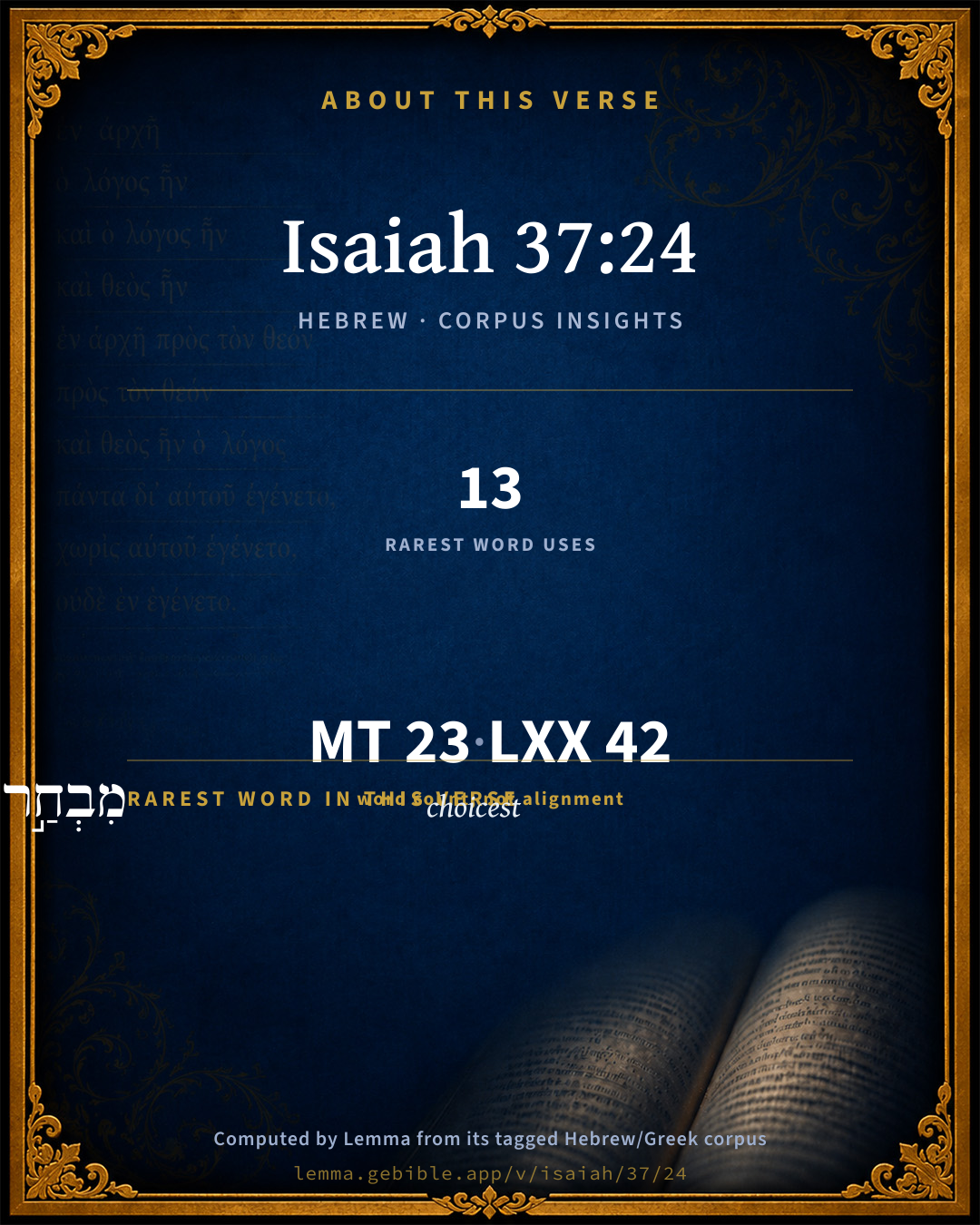
23
words
22
distinct lemmas
Prophets
section

Notable vocabulary

The rarest word here is מִבְחַ֣ר choicest H4005 — appearing just 13 times in the whole Hebrew Bible.

Shared distinctive vocabulary

מִבְחַ֣ר choicest H4005 occurs in 13 verses of the Hebrew Bible. Also found in:

Grammatical profile

  • 5 verbs
  • 17 nouns
  • 1 pronoun

Verb forms

  • חֵרַ֣פְתָּ Piel · Perfect
  • וַתֹּ֗אמֶר Qal · Sequential Imperfect
  • עָלִ֛יתִי Qal · Perfect
  • וְאֶכְרֹ֞ת Qal · Imperfect
  • וְאָבוֹא֙ Qal · Imperfect

Repetition

A word recurs within this verse — often emphatic in Hebrew:

  • מְר֥וֹם height H4791 ×2

Hebrew & Septuagint length

In English translation the verse runs 64 words from the Hebrew and 56 from the Septuagint (LXX English) — closely comparable.

A rough comparison of the two English renderings, which tokenize alike — not a word-level alignment.

Word counts can differ between the Hebrew and the Greek without any difference in meaning — e.g. the Hebrew direct-object marker אֵת has no separate Greek word, and Greek often adds the article ὁ.

In the original languages it is 23 Hebrew tokens and 42 Greek tokens — but the two are counted differently (Hebrew bundles its prefixes and suffixes into one token; the Greek is in lemma form), so that isn’t a like-for-like length.

Cross-references

15

Topical passages linked to Isaiah 37:24 in the Treasury of Scripture Knowledge — connected by theme and wording, ordered by reader-vote popularity; previews shown in the World English Bible.

  • Isaiah 14:8 Yes, the fir trees rejoice at you, [and] the cedars of Lebanon, [saying], Since you are laid low, no lumberjack is come up against us.
  • Isaiah 10:18 He will consume the glory of his forest, and of his fruitful field, both soul and body: and it shall be as when a standard-bearer faints.
  • Exodus 15:9 The enemy said, 'I will pursue, I will overtake, I will divide the spoil. My desire shall be satisfied on them. I will draw my sword, my hand shall destroy them.'
  • 2 Kings 19:22–23 Whom have you defied and blasphemed? and against whom have you exalted your voice and lifted up your eyes on high? [even] against the Holy One of Israel.
  • Psalms 20:7 Some trust in chariots, and some in horses, But we trust the name of Yahweh our God.
  • Isaiah 10:13–14 For he has said, By the strength of my hand I have done it, and by my wisdom; for I have understanding: and I have removed the bounds of the peoples, and have robbed their treasures, and like a valiant man I have brought down those who sit [on thrones]:
  • Isaiah 29:17 Is it not yet a very little while, and Lebanon shall be turned into a fruitful field, and the fruitful field shall be esteemed as a forest?
  • Isaiah 36:9 How then can you turn away the face of one captain of the least of my master's servants, and put your trust on Egypt for chariots and for horsemen?
  • Isaiah 36:15–20 neither let Hezekiah make you trust in Yahweh, saying, Yahweh will surely deliver us; this city shall not be given into the hand of the king of Assyria.
  • Isaiah 37:4 It may be Yahweh your God will hear the words of Rabshakeh, whom the king of Assyria his master has sent to defy the living God, and will rebuke the words which Yahweh your God has heard. Therefore lift up your prayer for the remnant that is left.
  • Ezekiel 31:3–18 Behold, the Assyrian was a cedar in Lebanon with beautiful branches, and with a forest-like shade, and of high stature; and its top was among the thick boughs.
  • Daniel 4:8–14 But at the last Daniel came in before me, whose name was Belteshazzar, according to the name of my god, and in whom is the spirit of the holy gods: and I told the dream before him, [saying],
  • Daniel 4:20–22 The tree that you saw, which grew, and was strong, whose height reached to the sky, and the sight of it to all the earth;
  • Daniel 4:30 The king spoke and said, Is not this great Babylon, which I have built for the royal dwelling-place, by the might of my power and for the glory of my majesty?
  • Zechariah 11:1–2 Open your doors, Lebanon, That the fire may devour your cedars.

Cross-references courtesy of OpenBible.info (CC BY 4.0).

Hebrew and Greek witnesses Masoretic Hebrew ↔ Greek Septuagint

The same verse in the two great witnesses to the Old Testament, shown verse-for-verse.

These are two independent witnesses, not word-aligned to each other, and the Septuagint is shown in lemma (dictionary) form.

Hebrew Isaiah 37:24 Masoretic · Westminster Leningrad Codex

בְּיַ֣ד עֲבָדֶיךָ֮ חֵרַ֣פְתָּ אֲדֹנָי֒ וַתֹּ֗אמֶר בְּרֹ֥ב רִכְבִּ֛י אֲנִ֥י עָלִ֛יתִי מְר֥וֹם הָרִ֖ים יַרְכְּתֵ֣י לְבָנ֑וֹן וְאֶכְרֹ֞ת קוֹמַ֤ת אֲרָזָיו֙ מִבְחַ֣ר בְּרֹשָׁ֔יו וְאָבוֹא֙ מְר֣וֹם קִצּ֔וֹ יַ֖עַר כַּרְמִלּֽוֹ

By your servants have you defied the Lord, and have said, With the multitude of my chariots am I come up to the height of the mountains, to the innermost parts of Lebanon; and I will cut down the tall cedars of it, and the choice fir trees of it; and I will enter into its farthest height, the forest of its fruitful field;

World English Bible · Public Domain

Greek LXX Isaiah 37:24 Septuagint · lemma form

ὅτι διά ἄγγελος ὀνειδίζω κύριος σύ γάρ εἶπον ὁ πλῆθος ὁ ἅρμα ἐγώ ἀναβαίνω εἰς ὕψος ὄρος καί εἰς ὁ ἔσχατος ὁ λίβανος καί κόπτω ὁ ὕψος ὁ κέδρος αὐτός καί ὁ κάλλος ὁ κυπάρισσος καί εἰςἔρχομαι εἰς ὕψος μέρος ὁ δρυμός

For you have reproached the Lord by messengers; for you have said, With the multitude of chariots have I ascended to the height of mountains, and to the sides of Libanus; and I have cropped the height of his cedars and the beauty of his cypresses; and I entered into the height of the forest region:

LXX2012 (modern English Septuagint) · Public Domain

On this verse, Adam Clarke's Commentary discusses the Septuagint’s reading. Read the note in Commentary ↓

Hebrew: Westminster Leningrad Codex (CC BY 4.0). Greek: Septuagint (public domain); English from LXX2012 (modern English Septuagint) (Public Domain). How the Septuagint differs from the Hebrew →

Targum (Aramaic paraphrase)

1

The Targum is the ancient Jewish Aramaic paraphrase of the Hebrew Scriptures — an interpretive translation, not the Hebrew text itself. Onkelos (literal) and Pseudo-Jonathan (expansive) render the Torah, and Jonathan the Prophets. Coverage is partial: where no permissively-licensed English translation exists for a verse, only the Aramaic is shown. This is verse-level text, not a word-by-word alignment to the Hebrew.

  1. Targum Jonathan Prophets (Joshua–Malachi)
    בְּיַד עַבְדָךְ חִסַדְתָּ עַמָא דַייָ וַאֲמַרְתָּ בִּסְגִיאוּת רְתִיכֵי אֲנָא סַלְקֵית לִתְקוֹף כְּרַכֵּיהוֹן וְאַף אֵיחוּד בֵּית מַקְדַשֵׁהוֹן וְאֶקְטוֹל שְׁפַר גִבָּרֵיהוֹן מִבְחַר שִׁלְטוֹנֵיהוֹן וְאֶכְבּוֹשׁ קִרְיַת תּוּקְפֵיהוֹן וֶאֱשֵׁיצֵי סַגִי מַשִׁרְיָתֵהוֹן:

    By thy servants hast thou reproached the people of the Lord, and hast said, By the multitude of my chariots am I come up against their fortified cities; and moreover, I will seize the house of their sanctuary, and I will slay the most beautiful? of their mighty ones, and the choicest of their rulers, and I will subdue the city of their strength, and I will destroy the multitude of their army.

    Targum Jonathan — Aramaic: “Mikraot Gedolot” (public domain). English: “Sefaria Community Translation” (CC0 1.0 (public-domain dedication)); “London "Chaldee Paraphrase," 1871” (public domain). Text via Sefaria.

Commentary

Notes on Isaiah 37:24 from classic Christian and Jewish commentators (each source and its license shown beneath its notes). The classic Christian expositions comment on the surrounding passage and are grouped to its opening verse, so a note may address several verses; the Jewish commentaries on the Tanakh (Rashi and others) are per-verse, so they appear only where the commentator wrote on this verse.

Lemma curates 59 commentaries, every one of them public domain or Creative Commons licensed, each selected and text-cleaned for this edition rather than reprinted as found. About our sources →

Tyndale Open Study Notes

Tyndale Open Resources

37:24 Isaiah seems to be familiar with the typical royal Assyrian boasts, including that they possessed the highest mountains. These words sound very much like those found in the annals of the Assyrian kings inscribed on the walls of their temples.

Tyndale Open Study Notes — © Tyndale Open Resources, licensed CC BY-SA 4.0. Text via the HelloAO Bible API.

Jamieson, Fausset & Brown

Robert Jamieson, A. R. Fausset & David Brown

said--virtually. Hast thou within thyself?

height--imagery from the Assyrian felling of trees in Lebanon (Isa 14:8; Isa 33:9); figuratively for, "I have carried my victorious army through the regions most difficult of access, to the most remote lands."

sides--rather, "recesses" [G. V. SMITH].

fir trees--not cypresses, as some translate; pine foliage and cedars are still found on the northwest side of Lebanon [STANLEY].

height of . . . border--In Kg2 19:23, "the lodgings of his borders." Perhaps on the ascent to the top there was a place of repose or caravansary, which bounded the usual attempts of persons to ascend [BARNES]. Here, simply, "its extreme height."

forest of . . . Carmel--rather, "its thickest forest." "Carmel" expresses thick luxuriance (see on Isa 10:18; Isa 29:17).

Jamieson, Fausset & Brown — Commentary Critical and Explanatory on the Whole Bible (1871) — public domain (CC PDM 1.0). Text via the HelloAO Bible API.

Adam Clarke's Commentary

Verse 24. By thy servants - "By thy messengers"] The text has עבדיך abdeycha, thy servants; but the true reading seems to be מלאכיך malacheycha, thy messengers, as in the other copy, 2Kg 19:23; and as the Septuagint and Syriac found it in their copies in this place.

Reproached the Lord] אדני Adonai: but one of my MSS. has יהוה אדני Yehovah Adonai, Jehovah the Lord. This reading is not found, I think, in any other MS., but several have יהוה Yehovah for אדני Adonai.

I will enter into the height of his border - "I will penetrate into his extreme retreats"] The text has מרום marom, the height which seems to have been taken by mistake from the line but one above. Two MSS. have here מלון malon, the lodge or retreat; which is the word in the other copy, 2Kg 19:23, and I think is the true reading.

The forest of his Carmel.] The forest and his fruitful field; that is, I will possess myself of the whole country.

Adam Clarke's Commentary on the Bible (1810–1826) — public domain. Text from a community e-Sword/MySword module.

Ellicott's Commentary for English Readers

(24) By the multitude of my chariots.—The words refer apparently to the taunt of Isa_36:8. The inscriptions of the Assyrian king are full of like boasts. Shalmaneser, “Trackless paths and difficult mountains . . . I penetrated” (Records of the Past, iii. 85): and Assumacirpal, “Rugged mountains, difficult paths, which for the passage of chariots were not suited, I passed” (Ibid. p. 43).

To the sides of Lebanon.—The passage of Lebanon was not necessarily implied in Sennacherib’s invasion of Palestine. Possibly the words had become a kind of proverb for surmounting obstacles. Lebanon and Carmel are joined together, as in Isa_33:9.

A Bible Commentary for English Readers, edited by Charles John Ellicott (1878–1897) — public domain. Text from a community e-Sword module.

The Cambridge Bible for Schools and Colleges

gen. ed. J. J. S. Perowne

24. For servants 2 Kings has “messengers,” as in Isa_37:9; Isa_37:14.

am I come up] Better, I go up. The “I” is emphatic.

the sides of Lebanon means its recesses (R.V. “innermost parts”).

the height of his border] Render, its furthest height; or (changing the text in accordance with 2Ki_19:33) its last retreat (lit. “lodging-place”).

the forest of his Carmel] R.V. the forest of his fruitful field (see ch. Isa_10:18, Isa_29:17, Isa_32:15 f.)—perhaps the cedar groves on the highest ridges.

24, 25. The king of Assyria is represented as boasting of the ease with which he triumphs over all natural obstacles in the pursuance of his plans; such language is blasphemy against Jehovah, the Lord of Nature; although the king himself may be hardly conscious of the sin he is committing. The tenses in the speech might all be made perfects by a change of vowels, or they may all be rendered by presents; the king’s meaning being simply that he constantly performs such impossibilities as these. The Assyrian parallels cited by Cheyne are very striking (see his Commentary, p. 219 and the references there).

The Cambridge Bible for Schools and Colleges (gen. ed. J. J. S. Perowne; Cambridge University Press, 1878–1918) — public domain. Text from a community e-Sword module.

John Gill's Exposition

Hast thou not heard long ago?.... By report, by reading the history of ancient times, or by means of the prophets; these are the words of the Lord to Sennacherib. The Targum adds,

"what I did to Pharaoh king of Egypt;''

it follows:

how I have done it; and of ancient times that I have formed it? meaning either the decree in his own breast from all eternity, and which he had published by his prophets, of raising up him, this wicked prince, to be the scourge of nations; or by the "it" are meant the people of the Jews, God's Israel, whom he had made, formed into a body politic, and into a church state, and had done great things for, in bringing them out of Egypt, leading them through the Red sea, providing for them, and protecting them in the wilderness, subduing nations under them, and settling them in the land of Canaan;

now have I brought it to pass, that thou shouldest be to lay waste defenced cities into ruinous heaps (t); which some render interrogatively,

now should I bring, it to be laid waste, and fenced cities to be ruinous heaps? that is, the people of the Jews, the city of Jerusalem, and other fenced cities? no, I will not: or the meaning is, that that decree, which he had framed and formed in his own mind from all eternity, he was now bringing to pass; which was, that this king of Babylon should be a waster and destroyer of fortified cities, which he should reduce to heaps of ruin; wherefore he had no reason to vaunt as he had done, for he was only an instrument of executing the purposes and designs of God, though it was not in his heart, nor did he so mean.

(t) "in acervos et flores", "into heaps and flowers", that is, into heaps of dust, which being moved, and raised by the wind, fly away like flowers and blossoms of trees; so Gussetius, "in acervos volantes, aut ad volandum excitatos, scil. dum redacti in pulveres, magna ex parte, volant, excitati a ventis", Comment. Ebr. p. 502.

John Gill's Exposition of the Whole Bible (1746–1763) — public domain (CC PDM 1.0). Text via the HelloAO Bible API.

Albert Barnes' Notes on the Bible

By thy servants - Hebrew, ‘By the hand of thy servants.’ That is, by Rabshakeh Isa. 36, and by those whom he had now sent to Hezekiah with letters Isa 37:9, Isa 37:14.

And hast said - Isaiah does not here quote the precise words which Rabshakeh or the other messengers had used, but quotes the substance of what had been uttered, and expresses the real feelings and intentions of Sennacherib.

By the multitude of my chariots - The word ‘chariots’ here denotes war-chariois (see the notes at Isa 2:7; Isa 66:20).

To the height of the mountains - Lebanon is here particularly referred to. Chariots were commonly used, as cavalry was, in plains. But it is probable that Lebanon was accessible by chariots drawn by horses.

To the sides of Lebanon - On the situation of Lebanon see the notes at Isa 10:34; Isa 29:17. Sennacherib is represented as having carried desolation to Lebanon, and as having cut down its stately trees (see the note at Isa 33:9).

I will cut down the tall cedars thereof - Margin, ‘The tallness of the cedars thereof.’ The boast of Sennacherib was that he would strip it of its beauty and ornament; that is, that he would lay the land waste.

And the choice fir-trees thereof - (see the note at Isa 14:8). The Septuagint renders it, Υπαρίσσου Uparissou - ‘The beauty of the cypress.’ The word here denotes the cypress, a tree resembling the white cedar. It grew on Lebanon, and, together with the cedar, constituted its glory. Its wood, like that of the cedar, was employed for the floors and ceilings of the temple 1Ki 5:10; 1Ki 6:15, 1Ki 6:34. It was used for the decks and sheathing of ships Eze 27:5, for spears Neh 2:4; and for musical instruments 2Sa 6:5.

The height of his border - The extreme retreats; the furthest part of Lebanon. In 2Ki 19:23, it is, ‘I will enter the lodgings of his borders;’ perhaps referring to the fact that on the ascent to the top of the mountain there was a place for the repose of travelers; a species of inn or caravansera which bounded the usual attempts of persons to ascend the mountain. Such a lodging-place on the sides or tops of mountains which are frequently ascended, is not uncommon.

And the forest his Carmel - On the meaning of the word Carmel, see the note at Isa 29:17. Here it means, as in that passage, a rich, fertile, and beautiful country. It is known that Lebanon was covered on the top, and far down the sides, with perpetual snow. But there was a region lying on its sides, between the snow and the base of the mountain, that was distinguished for fertility, and that was highly cultivated. This region produced grapes in abundance; and this cultivated part of the mountain, thick set with vines and trees, might be called a beautiful grove. This was doubtless the portion of Lebanon which is here intended. At a distance, this tract on the sides of Lebanon appeared doubtless as a thicket of shrubs and trees. The phrase ‘garden-forest,’ will probably express the sense of the passage. ‘After leaving Baalbec, and approaching Lebanon, towering walnut trees, either singly or in groups, and a rich carpet of verdure, the offspring of numerous streams, give to this charming district the air of an English park, majestically bordered with snow-tipped mountains. At Deir-el-Akmaar, the ascent begins winding among dwarf oaks, hawthorns, and a great variety of shrubs and flowers. A deep bed of snow had now to be crossed, and the horses sunk or slipped at every moment. To ride was impracticable, and to walk dangerous, for the melting snow penetrated our boots, and our feet were nearly frozen. An hour and a half brought us to the cedars.’ (Hogg.)

Albert Barnes' Notes on the Bible (1834–1885) — public domain. Text from a community e-Sword/MySword module.

Haydock's Catholic Bible Commentary

Carmel. See 4 Kings xix. (Challoner)

George Leo Haydock (1774–1849), Haydock's Catholic Family Bible and Commentary, 1859 edition — public domain. Excludes Psalms (Douay-Rheims chapter numbering differs from Protestant) and Deuterocanonical books (Catholic canon only).

Whedon's Commentary on the Bible

Daniel D. Whedon

24. By thy servants hast thou — Thus Sennacherib is properly held responsible for the insult his servants had given at his command. The reasons seem good which consider Lebanon, here, with its accompanying figures, as referring to Jerusalem. The kingdoms above mentioned, with the kingdom of Israel, have all fallen by Assyrian power; now the kingdom of Judah and its capital shall go the same way. So Sennacherib thought and said.

Daniel D. Whedon (gen. ed.), Commentary on the Old and New Testaments (1874–1909) — public domain. Text from a community e-Sword module.

The Pulpit Commentary

By thy servants hast thou reproached the Lord. (see Isa_36:15-20) And hast said. Sennacherib had not actually uttered these words with his mouth; but the prophet clothes in his own highly poetic language the thoughts which the Assyrian king had cherished in his heart. He had regarded "the multitude of his chariots" as irresistible; he had considered that the mountains which guarded Palestine would be no obstacle to his advance; he had contemplated ravaging and despoiling of its timber the entire country; he had meant to penetrate into every region that was lovely and fertile. The emphatic "I" of the original ani twice repeated, marks the proud egotism of the monarch. By the multitude of my chariots am I come up to the height of the mountains; rather, with the multitude; or, according to another reading, with chariots upon chariots. The Assyrian kings contrived to cross with their chariots mountain chains of great difficulty, and frequently boast of the achievement. Tiglath-Pileser I says, "I assembled my chariots and warriors. I betook myself to carts of iron in order to overcome the rough mountains and their difficult marches. I made the wilderness thus practicable for the passage of my chariots and warriors" ("Records of the Past," vol. 5. pp. 9, 10). Asshur-izir-pal, "The rugged hill country, unfitted for the passage of chariots and armies, with instruments of iron I cut through, and with metal rollers I beat down the chariots and troops I brought over" (ibid., vol. 3. p. 58). Shalmaneser II, "Trackless paths, difficult mountains, which like the point of an iron sword stood pointed to the sky, on wheels of iron and bronze I penetrated. My chariots and armies I transported over them" (ibid., p. 85). In the less rough parts, while the warders dismounted, tire horses drew the chariots, which were assisted over obstacles by attendants ("Ancient Monarchies," vol. 2. p. 74); but, in regions of greater difficulty, they were conveyed across the mountain ranges in waggons of rude and strong construction ("Records of the Past," vol. 5. p. 13) The chariot-force was regarded as so important that the Assyrians never made any distant expedition without it. To the sides of Lebanon. It was not necessary to cross either Libanus or Anti-Libanus in order to invade Judaea, since the natural route was along the Coele-Syrian valley and across the spurs of Hermon to the Jordan; but an Assyrian army was intent on plunder and devastation, no less than upon conquest, and would ascend mountain regions that did not lie on its direct line of march for either or both of these objects. It was customary for the soldiers to cut clown the tall cedars and choice fir trees of Lebanon on their Syrian campaigns, in order to transport the timber to Nineveh and other great cities, where it was used for building (see the comment on Isa_14:8, and compare Layard, "Nineveh and Babylon," pp. 356, 357, and "Records of the Past," vol. 3. pp. 40, 47, 83, 90; vol. 5. p. 119; vol. 9. p. 16, etc.). It was also customary to destroy the trees in an enemy"s country, simply in order to inflict injury upon the foe ("Ancient Monarchies." vol. 2. p. 84). I will enter into the height of his border; rather, I will enter into its uttermost height; i.e. I will penetrate through the entire mountain region of Palestine, called roughly "Lebanon," to the furthest height of any importance that on which Jerusalem stood and thus occupy the whole land. The parallel passage of 2 Kings has "lodging" for "height," in apparent allusion to the palace of Hezekiah. And the forest of his Carmel; or, the forest of its pleasure-garden; i.e. the rich plantation tracts, covered with vines, olives, and fig trees, which formed the special glory of Judaea. (Isa_36:16, Isa_36:17)

The Pulpit Commentary (1880–1919), ed. H.D.M. Spence-Jones & Joseph S. Exell — public domain. Text from a community e-Sword module.

Keil & Delitzsch

C. F. Keil & F. Delitzsch

Second turn, "By thy servants (K. thy messengers) hast thou reviled the Lord, in that thou sayest, With the multitude (K. chethib ברכב) of my chariots have I climbed the height of the mountains, the inner side of Lebanon; and I shall fell the lofty growth of its cedars, the choice (mibhchar, K. mibhchōr) of its cypresses: and I shall penetrate (K. and will penetrate) to the height (K. the halting-place) of its uttermost border, the grove of its orchard." The other text appears, for the most part, the preferable one here. Whether mal'ăkhekhâ (thy messengers, according to Isa 9:14) or ‛ăbhâdekhâ (thy servants, viz., Rabshakeh, Tartan, and Rabsaris) is to be preferred, may be left undecided; also whether רכבי ברכב is an error or a superlative expression, "with chariots of my chariots," i.e., my countless chariots; also, thirdly, whether Isaiah wrote mibhchōr. He uses mistōr in Isa 4:6 for a special reason; but such obscure forms befit in other instances the book of Kings, with its colouring of northern Palestine; and we also meet with mibhchōr in Kg2 3:19, in the strongly Aramaic first series of histories of Elisha. On the other hand, קצּה מלון is certainly the original reading, in contrast with קצו מרום. It is important, as bearing upon the interpretation of the passage, that both texts have ואכרת, not ואכרת, and that the other text confirms this pointing, inasmuch as it has ואבואה instead of ואובא. The Lebanon here, if not purely emblematical (as in Jer 22:6 = the royal city Jerusalem; Eze 17:3 = Judah-Jerusalem), has at any rate a synecdochical meaning (cf., Isa 14:8), signifying the land of Lebanon, i.e., the land of Israel, into which he had forced a way, and all the fortresses and great men of which he would destroy. He would not rest till Jerusalem, the most renowned height of the land of Lebanon, was lying at his feet. Thenius is quite right in regarding the "resting-place of the utmost border" and "the pleasure-garden wood" as containing allusions to the holy city and its royal citadel (compare the allegory in chapter 5).

Keil & Delitzsch — Biblical Commentary on the Old Testament (1861–1891) — public domain (CC PDM 1.0). Text via the HelloAO Bible API. (Old Testament only.)

J. A. Alexander on Isaiah

Joseph Addison Alexander

“By the hand of thy servants hast thou reproached the Lord and said, With the multitude of my chariots (or cavalry) I have ascended the height of mountains, the sides of Lebanon, and I will cut down the loftiness of its cedars and the choice of its firs (or cypresses), and I will reach its extreme height (literally, the height of its extremity), its garden-forest (literally, the garden of its forest).” This may be regarded either as the substance of another message actually sent by Sennacherib, or as a translation of his feelings and his conduct into words. ‘By the hand’ may then mean simply through (as in Isa 20:1), or refer particularly to the letters mentioned in v. 14. The fruitful field, vineyard, garden, orchard, or the like, is here combined with forest, either for the purpose of describing the cedar groves of Lebanon as similar to parks and orchards, or of designating the spot where the cultivated slope of the mountain is gradually changed into a forest. It was long supposed that the only cedar grove of Lebanon was the one usually visited near the highest summit of the range; but in 1805, Seetzen discovered two others of greater extent, and the American missionaries have since found many trees in different parts of the mountain. (See Robinson’s Palestine, III 440.) If we take into consideration the whole context, and the strongly hyperbolical expressions of the other messages and speeches of Sennacherib, it will be found most natural to understand this verse as a poetical assertion of the speaker’s power to overcome all obstacles.

Joseph Addison Alexander, The Prophecies of Isaiah (1846–1847; New York: Scribner, 1870–1878) — public domain. Text from a community e-Sword module.

unfoldingWord translationNotes

Door43 World Missions Community

General Information:

This continues Yahweh's message to the king of Assyria.

By your servants

This refers to to the servants that he had sent to Hezekiah with a message. This can be stated clearly. AT: "In the messages you sent with your servants" (See: Assumed Knowledge and Implicit Information)

I have gone ... I will cut ... I will enter ... I have dug ... I dried ... my feet

Here Sennacherib speaks of himself conquering many things. He is actually conquering them with the armies and chariots that he commands. AT: "We have gone ... We will cut ... we will enter ... We have dug ... we dried ... our feet" (See: Synecdoche)

its tall cedars

"Lebanon's tall cedars"

its most fruitful forest

Here the word "fruitful" refers to the forest being dense and full of healthy trees. The understood information may be supplied. AT: "and into its most fruitful forest" (See: Ellipsis)

I dried up all the rivers of Egypt under the soles of my feet

Here Sennachrib is exaggerating his conquest and travels across the rivers of Egypt by claiming to have dried up the rivers when he marched his army through them. AT: "I have marched through all the rivers of Egypt as if they were dry under my feet" (See: Hyperbole and Generalization)

translationWords

servant

lord

chariot

Lebanon

cedar

fir

Egypt

unfoldingWord translationNotes — © Distant Shores Media and the Door43 World Missions Community, licensed CC BY-SA 4.0. Source: git.door43.org/Door43/en_tn.

Rashi

Rabbi Shlomo Yitzchaki (Rashi)

to the heights of mountains the Temple mount.

to the end of the Lebanon the Temple.

and I will cut down its tallest cedars I will not go to my land until I destroy it.

its remotest height (lit., the height of) its end.

its farmland forest The best of its praise and the intensity of its strength.

Rashi on the Tanakh — English translations: “The Judaica Press complete Tanach with Rashi, translated by A. J. Rosenberg” (CC BY 4.0); “Pentateuch with Rashi's commentary by M. Rosenbaum and A.M. Silbermann, 1929-1934” (public domain); “The Metsudah Tanach series, Lakewood, N.J” (CC BY 4.0); and “The Book of Joshua, Metsudah Publications, 1997” (CC BY 4.0). Text via Sefaria.

Lesson kit

Teaching starters — assembled from the data on this page, not authored interpretation. Every prompt links to the verse data it draws on. Edit before teaching.

Isaiah, in the Prophets, opens this verse with 23 words (22 distinct Hebrew lemmas). Its most distinctive word is mibchâr (“choicest”). A historical commentator’s framing appears above. Read the whole chapter for the surrounding context.

Discussion questions

  1. How does “choicest” (mibchâr) shape what this verse is saying?
  2. How does Genesis 23:6, which shares the word «choicest», read alongside this verse?
  3. What does the repetition of “height” (2× in this one verse) do in this verse?
  4. These translations render this verse differently. What is at stake in choosing one wording over another?
  5. «חֵרַ֣פְתָּ» is a Piel Perfect verb. How does that grammatical form shape the action described?
  6. Compare how Tyndale Open Study Notes and Jamieson, Fausset & Brown read this verse. Where do they agree or differ?

Things to notice

Reading settings

Reading text

Shown beneath each verse's original-language words.

Old Testament
Old Testament edition

Read the OT as the Masoretic Hebrew (MT) or the Greek Septuagint (LXX).

English shown for the Greek Septuagint (in the Hebrew ↔ Greek comparison).

Comparing translations? Open the Compare panel on any verse page to stack up to four side by side.