
Numbers 9:13

Hebrew (Westminster Leningrad Codex) Numbers 9:13 appears in the Hebrew Old Testament. The text above is from the Westminster Leningrad Codex. Each word links to its Strong’s number, a concise gloss, and parsing drawn from the Open Scriptures Hebrew Bible morphology. Click any word for its full Brown-Driver-Briggs (BDB) entry.
Download image
Cite this verse

Numbers 9:13 (World English Bible). Public Domain. Lemma interlinear Bible study tool, https://lemma.gebible.app/v/numbers/9/13.

Show BibTeX & RIS
BibTeX
RIS
English Translation
But the man who is clean, and is not on a journey, and fails to keep the Passover, that soul shall be cut off from his people. Because he didn't offer the offering of Yahweh in its appointed season, that man shall bear his sin.
World English Bible · Public Domain
Download a study sheet

One document with this verse’s original text, its word-by-word gloss line, the meaning frame, cross-references with their text, attributed commentary, and full source and license credits — printable, and it pastes into notes with its structure intact.

This verse Autodidact and up

Study sheet (.html) Plain text (.txt)

A passage Seminary Student

Up to 50 verses in one chapter. A passage sheet keeps up to 6 commentary sources and 12 cross-references per verse, in the order this page ranks them, and says so on the sheet whenever that leaves anything out. Ask for a single verse and you get the Autodidact verse sheet above.

Everything on this page stays free to read, with no account — the sheet is a download of what is already on screen, not access to it.

Want to remove ads? Support Godless Engineer
Compare translations 3

The same verse in 3 English versions, stacked beneath the original-language interlinear above. Click any original word for its lexicon entry.

Each is an independent rendering of the whole verse — the interlinear is not word-aligned to these translations.

Highlighted words mark where these versions differ — a whole-verse word diff, not a word-by-word alignment.

  • World English Bible Public Domain
    But the man who is clean, and is not on a journey, and fails to keep the Passover, that soul shall be cut off from his people. Because he didn't offer the offering of Yahweh in its appointed season, that man shall bear his sin.
  • King James Version Public Domain
    But the man that is clean, and is not in a journey, and forbeareth to keep the passover, even the same soul shall be cut off from among his people: because he brought not the offering of the LORD in his appointed season, that man shall bear his sin.
  • unfoldingWord Literal Text CC BY-SA 4.0
    And the man who is clean and is not on a way and ceases to do the Passover, then that person shall be cut off from his people, for he did not present the offering of Yahweh in its appointed time. That man shall lift up his sin.

unfoldingWord Literal Text — © unfoldingWord, licensed CC BY-SA 4.0. Word-aligned USFM3 via Door43 (git.door43.org/unfoldingWord/en_ult).

Versions to compare (up to 4)

3 of 4 selected

Show all 18 translations

Every available English version of this verse, each an independent rendering of the whole verse.

  • World English Bible Public Domain
    But the man who is clean, and is not on a journey, and fails to keep the Passover, that soul shall be cut off from his people. Because he didn't offer the offering of Yahweh in its appointed season, that man shall bear his sin.
  • Berean Standard Bible Public Domain
    But if a man who is ceremonially clean and is not on a journey still fails to observe the Passover, he must be cut off from his people, because he did not present the LORD’s offering at its appointed time. That man will bear the consequences of his sin.
  • Majority Standard Bible Public Domain
    But if a man who is ceremonially clean and is not on a journey still fails to observe the Passover, he must be cut off from his people, because he did not present the LORD’s offering at its appointed time. That man will bear the consequences of his sin.
  • King James Version Public Domain
    But the man that is clean, and is not in a journey, and forbeareth to keep the passover, even the same soul shall be cut off from among his people: because he brought not the offering of the LORD in his appointed season, that man shall bear his sin.
  • American Standard Version (1901) Public Domain
    But the man that is clean, and is not on a journey, and forbeareth to keep the passover, that soul shall be cut off from his people; because he offered not the oblation of Jehovah in its appointed season, that man shall bear his sin.
  • Revised Version (1885) Public Domain
    But the man that is clean, and is not in a journey, and forbeareth to keep the passover, that soul shall be cut off from his people: because he offered not the oblation of the LORD in its appointed season, that man shall bear his sin.
  • Geneva Bible (1599) Public Domain
    But the man that is cleane and is not in a iourney, and is negligent to keepe the Passeouer, the same person shalbe cut off from his people: because he brought not the offring of the Lord in his due season, that man shall beare his sinne.
  • Douay-Rheims (1899) Public Domain
    But if any man is clean, and was not on a journey, and did not make the phase, that soul shall be cut off from among his people, because he offered not sacrifice to the Lord in due season: he shall bear his sin.
  • Young's Literal Translation Public Domain
    `And the man who is clean, and hath not been on a journey, and hath ceased to prepare the passover, even that person hath been cut off from his people; because the offering of Jehovah he hath not brought near, in its appointed season, that man doth bear his sin.
  • Literal Standard Version CC BY-SA 4.0
    And the man who is clean, and has not been on a journey, and has ceased to prepare the Passover, indeed, that person has been cut off from his people; because he has not brought the offering of YHWH near in its appointed time, that man bears his sin.
  • Unlocked Literal Bible CC BY-SA 4.0
    But any person who is clean and is not on a journey, but who fails to keep the Passover, that person must be cut off from his people because he did not offer the sacrifice that Yahweh requires at the fixed time of year. That man must carry his sin.
  • unfoldingWord Literal Text CC BY-SA 4.0
    And the man who is clean and is not on a way and ceases to do the Passover, then that person shall be cut off from his people, for he did not present the offering of Yahweh in its appointed time. That man shall lift up his sin.
  • Darby Bible Public Domain
    But a man that is clean, and is not on a journey, and forbeareth to hold the passover, that soul shall be cut off from among his peoples; because he presented not the offering of Jehovah at its set time: that man shall bear his sin.
  • World Messianic Bible Public Domain
    But the man who is clean, and is not on a journey, and fails to keep the Passover, that soul shall be cut off from his people. Because he didn’t offer the offering of the LORD in its appointed season, that man shall bear his sin.
  • Webster's Bible Public Domain
    But the man that is clean, and is not in a journey, and forbeareth to keep the passover, even the same soul shall be cut off from among his people: because he brought not the offering of the LORD in its appointed season, that man shall bear his sin.
  • Free Bible Version CC BY-SA 4.0
    However, anyone ceremonially clean and not away traveling who neglects to observe the Passover must be expelled from their people, because they didn't present the Lord's offering at the appropriate time. They will bear the responsibility for the consequences of their sin.
  • Bible in Basic English Public Domain
    But the man who, not being unclean or on a journey, does not keep the Passover, will be cut off from his people: because he did not make the offering of the Lord at the regular time, his sin will be on him.
  • JPS Tanakh (1917) Public Domain
    But the man that is clean, and is not on a journey, and forbeareth to keep the passover, that soul shall be cut off from his people; because he brought not the offering of the LORD in its appointed season, that man shall bear his sin.

Literal Standard Version (2020), Covenant Press — licensed CC BY-SA 4.0. Text via the HelloAO Bible API (eBible.org). Unlocked Literal Bible (unfoldingWord) — licensed CC BY-SA 4.0. Text via the HelloAO Bible API (eBible.org). unfoldingWord Literal Text — © unfoldingWord, licensed CC BY-SA 4.0. Word-aligned USFM3 via Door43 (git.door43.org/unfoldingWord/en_ult). Free Bible Version, Dr. Jonathan Gallagher — licensed CC BY-SA 4.0. Text via the HelloAO Bible API (eBible.org).

Word by word

More ways to search: Search by grammar → Find every occurrence → Compare this word →

Practice this passage: Drill this verse → Learn its vocabulary →

חֶטְא֥וֹ
chêṭᵉʼ
H2399
“sin · his”
Noun, Common, Masculine, Singular, Construct + Suffix, Personal, 3rd Person, Masculine, Singular
Part of Speech
Noun
Type
Common
Gender
Masculine
Number
Singular
State
Construct
Full BDB Definition

Origin: from H2398

TWOT: 638a

sin - sin - guilt for sin - punishment for sin
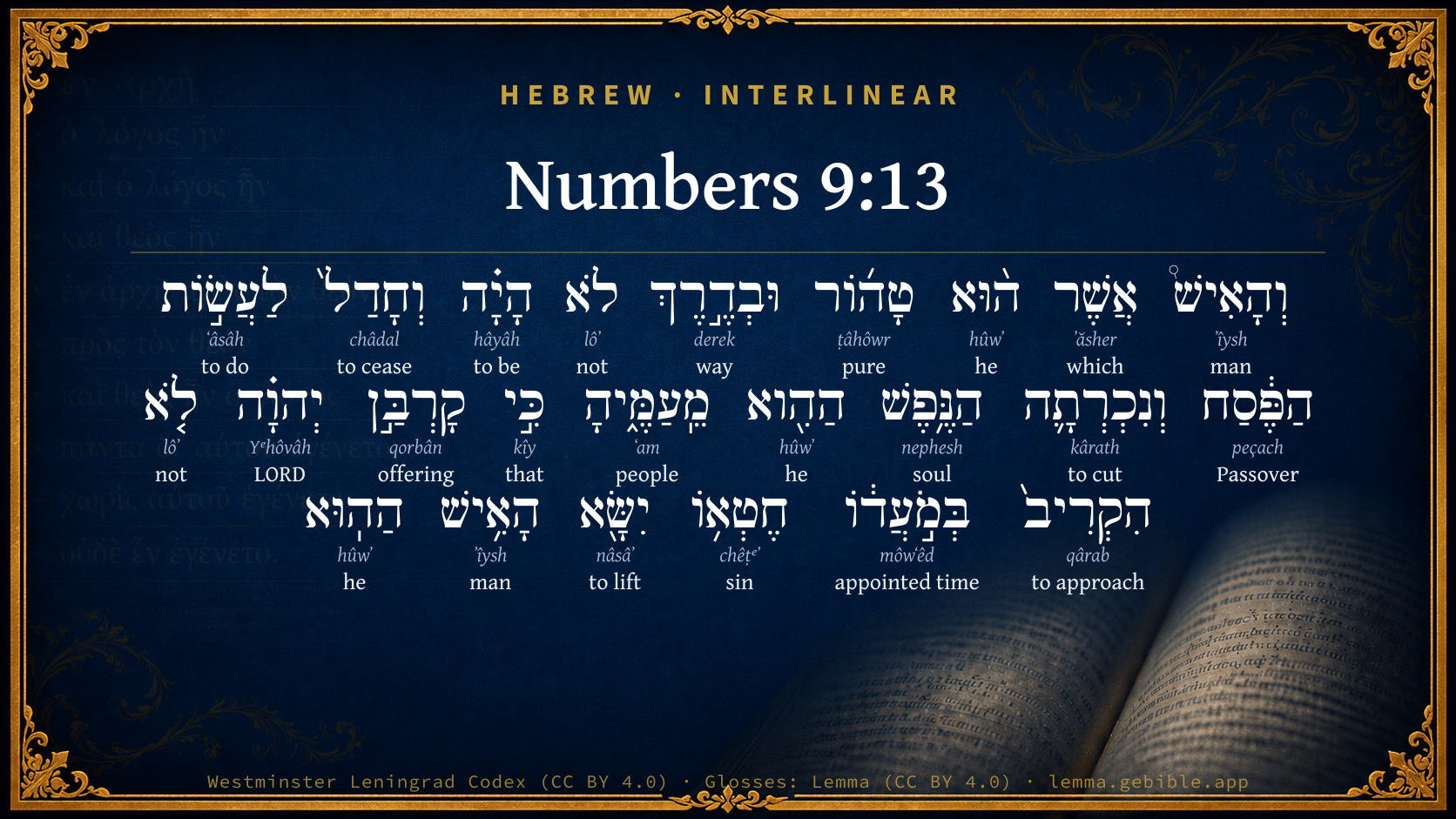
  1. וְהָאִישׁ֩ ʼîysh H376 “and · the · man” Conjunction + Particle, Definite Article + Noun, Common, Masculine, Singular, Absolute
  2. אֲשֶׁר ʼăsher H834 “which” Particle, Relative
  3. ה֨וּא hûwʼ H1931 “he” Pronoun, Personal, 3rd Person, Masculine, Singular
  4. טָה֜וֹר ṭâhôwr H2889 “pure” Adjective, Adjective, Masculine, Singular, Absolute
  5. וּבְדֶ֣רֶךְ derek H1870 “and · in/at · way” Conjunction + Preposition + Noun, Common, Both, Singular, Absolute
  6. לֹא lôʼ H3808 “not” Particle, Negative
  7. הָיָ֗ה hâyâh H1961 “to be” Verb, Qal, Perfect, 3rd Person, Masculine, Singular
  8. וְחָדַל֙ châdal H2308 “and · to cease” Conjunction + Verb, Qal, Sequential Perfect, 3rd Person, Masculine, Singular
  9. לַעֲשׂ֣וֹת ʻâsâh H6213 “to do” Preposition + Verb, Qal, Infinitive Construct
  10. הַפֶּ֔סַח peçach H6453 “the · Passover” Particle, Definite Article + Noun, Common, Masculine, Singular, Absolute
  11. וְנִכְרְתָ֛ה kârath H3772 “and · to cut” Conjunction + Verb, Niphal, Sequential Perfect, 3rd Person, Feminine, Singular
  12. הַנֶּ֥פֶשׁ nephesh H5315 “the · soul” Particle, Definite Article + Noun, Common, Both, Singular, Absolute
  13. הַהִ֖וא hûwʼ H1931 “the · he” Particle, Definite Article + Pronoun, Personal, 3rd Person, Feminine, Singular
  14. מֵֽעַמֶּ֑יהָ ʻam H5971 “from · peoples · her” Preposition + Noun, Common, Masculine, Plural, Construct + Suffix, Personal, 3rd Person, Feminine, Singular
  15. כִּ֣י kîy H3588 “that” Conjunction
  16. קָרְבַּ֣ן qorbân H7133 “offering of” Noun, Common, Masculine, Singular, Construct
  17. יְהוָ֗ה Yᵉhôvâh H3068 “LORD” Noun, Proper
  18. לֹ֤א lôʼ H3808 “not” Particle, Negative
  19. הִקְרִיב֙ qârab H7126 “to approach” Verb, Hiphil, Perfect, 3rd Person, Masculine, Singular
  20. בְּמֹ֣עֲד֔וֹ môwʻêd H4150 “in/at · appointed time · his” Preposition + Noun, Common, Masculine, Singular, Construct + Suffix, Personal, 3rd Person, Masculine, Singular
  21. יִשָּׂ֖א nâsâʼ H5375 “to lift” Verb, Qal, Imperfect, 3rd Person, Masculine, Singular
  22. הָאִ֥ישׁ ʼîysh H376 “the · man” Particle, Definite Article + Noun, Common, Masculine, Singular, Absolute
  23. הַהֽוּא hûwʼ H1931 “the · he” Particle, Definite Article + Pronoun, Personal, 3rd Person, Masculine, Singular

About this verse

These counts appear in no published source. They are computed here, from the morphology-tagged text and Lemma’s own curated glosses. What Lemma adds →

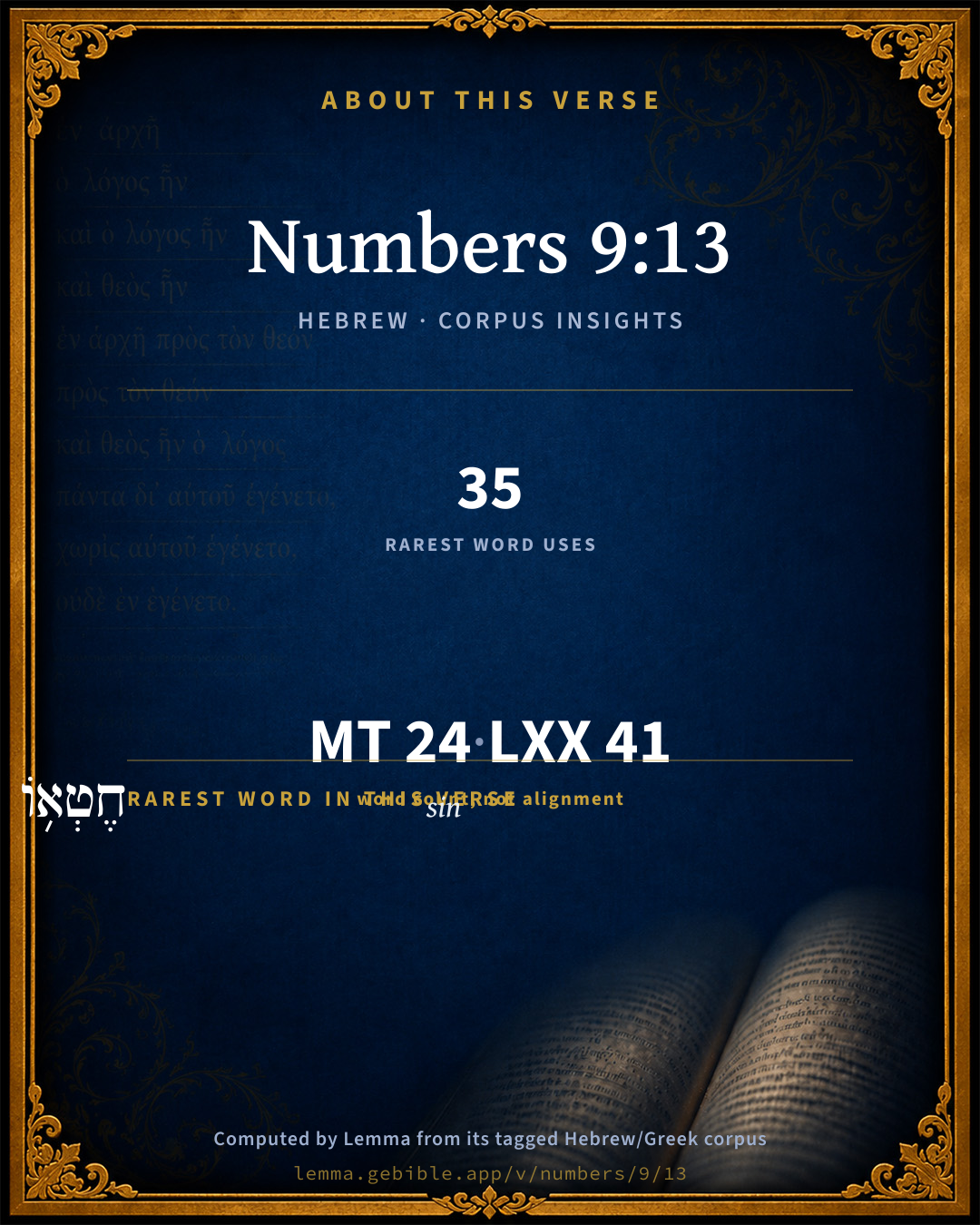
24
words
20
distinct lemmas
Pentateuch
section

Shared distinctive vocabulary

חֶטְא֥וֹ sin H2399 occurs in 34 verses of the Hebrew Bible. Also found in:

Grammatical profile

  • 6 verbs
  • 10 nouns
  • 1 adjective
  • 3 pronouns
  • 1 conjunction
  • 3 particles

Verb forms

  • הָיָ֗ה Qal · Perfect
  • וְחָדַל֙ Qal · Sequential Perfect
  • לַעֲשׂ֣וֹת Qal · Infinitive Construct
  • וְנִכְרְתָ֛ה Niphal · Sequential Perfect
  • הִקְרִיב֙ Hiphil · Perfect
  • יִשָּׂ֖א Qal · Imperfect

Repetition

Words recur within this verse — often emphatic in Hebrew:

  • וְהָאִישׁ֩ man H376 ×2
  • ה֨וּא he H1931 ×3
  • לֹא not H3808 ×2

Hebrew & Septuagint length

In English translation the verse runs 45 words from the Hebrew and 49 from the Septuagint (LXX English) — closely comparable.

A rough comparison of the two English renderings, which tokenize alike — not a word-level alignment.

Word counts can differ between the Hebrew and the Greek without any difference in meaning — e.g. the Hebrew direct-object marker אֵת has no separate Greek word, and Greek often adds the article ὁ.

In the original languages it is 24 Hebrew tokens and 41 Greek tokens — but the two are counted differently (Hebrew bundles its prefixes and suffixes into one token; the Greek is in lemma form), so that isn’t a like-for-like length.

Cross-references

18

Topical passages linked to Numbers 9:13 in the Treasury of Scripture Knowledge — connected by theme and wording, ordered by reader-vote popularity; previews shown in the World English Bible.

  • Genesis 17:14 The uncircumcised male who is not circumcised in the flesh of his foreskin, that soul shall be cut off from his people. He has broken my covenant."
  • Exodus 12:15 Seven days shall you eat unleavened bread; even the first day you shall put away yeast out of your houses, for whoever eats leavened bread from the first day until the seventh day, that soul shall be cut off from Israel.
  • Numbers 9:7 Those men said to him, "We are unclean because of the dead body of a man. Why are we kept back, that we may not offer the offering of Yahweh in its appointed season among the children of Israel?"
  • Numbers 15:30–31 But the soul who does anything with a high hand, whether he is home-born or a foreigner, the same blasphemes Yahweh; and that soul shall be cut off from among his people.
  • Leviticus 17:4 and hasn't brought it to the door of the Tent of Meeting, to offer it as an offering to Yahweh before the tabernacle of Yahweh: blood shall be imputed to that man. He has shed blood; and that man shall be cut off from among his people.
  • Leviticus 17:10 "'Any man of the house of Israel, or of the strangers who live as foreigners among them, who eats any kind of blood, I will set my face against that soul who eats blood, and will cut him off from among his people.
  • Leviticus 17:14–16 For as to the life of all flesh, its blood is with its life: therefore I said to the children of Israel, "You shall not eat the blood of any kind of flesh; for the life of all flesh is its blood. Whoever eats it shall be cut off."
  • Leviticus 20:20 If a man lies with his uncle's wife, he has uncovered his uncle's nakedness: they shall bear their sin; they shall die childless.
  • Numbers 5:31 The man shall be free from iniquity, and that woman shall bear her iniquity."
  • Numbers 9:2–3 "Moreover let the children of Israel keep the Passover in its appointed season.
  • Numbers 19:13 Whoever touches a dead person, the body of a man who has died, and doesn't purifies himself, defiles the tent of Yahweh; and that soul shall be cut off from Israel: because the water for impurity was not sprinkled on him, he shall be unclean; his uncleanness is yet on him.
  • Ezekiel 23:49 They shall recompense your lewdness on you, and you shall bear the sins of your idols; and you shall know that I am the Lord Yahweh.
  • Hebrews 2:3 how will we escape if we neglect so great a salvation-- which at the first having been spoken through the Lord, was confirmed to us by those who heard;
  • Hebrews 6:6 and then fell away, it is impossible to renew them again to repentance; seeing they crucify the Son of God for themselves again, and put him to open shame.
  • Hebrews 9:28 so Christ also, having been once offered to bear the sins of many, will appear a second time, without sin, to those who are eagerly waiting for him for salvation.
  • Hebrews 10:26–29 For if we sin willfully after we have received the knowledge of the truth, there remains no more a sacrifice for sins,
  • Hebrews 12:25 See that you don't refuse him who speaks. For if they didn't escape when they refused him who warned on the Earth, how much more will we not escape who turn away from him who warns from heaven,
  • Leviticus 22:9 "'They shall therefore keep my charge, lest they bear sin for it, and die therein, if they profane it. I am Yahweh who sanctifies them.

Cross-references courtesy of OpenBible.info (CC BY 4.0).

Hebrew and Greek witnesses Masoretic Hebrew ↔ Greek Septuagint

The same verse in the two great witnesses to the Old Testament, shown verse-for-verse.

These are two independent witnesses, not word-aligned to each other, and the Septuagint is shown in lemma (dictionary) form.

Hebrew Numbers 9:13 Masoretic · Westminster Leningrad Codex

וְהָאִישׁ֩ אֲשֶׁר ה֨וּא טָה֜וֹר וּבְדֶ֣רֶךְ לֹא הָיָ֗ה וְחָדַל֙ לַעֲשׂ֣וֹת הַפֶּ֔סַח וְנִכְרְתָ֛ה הַנֶּ֥פֶשׁ הַהִ֖וא מֵֽעַמֶּ֑יהָ כִּ֣י קָרְבַּ֣ן יְהוָ֗ה לֹ֤א הִקְרִיב֙ בְּמֹ֣עֲד֔וֹ חֶטְא֥וֹ יִשָּׂ֖א הָאִ֥ישׁ הַהֽוּא

But the man who is clean, and is not on a journey, and fails to keep the Passover, that soul shall be cut off from his people. Because he didn't offer the offering of Yahweh in its appointed season, that man shall bear his sin.

World English Bible · Public Domain

Greek LXX Numbers 9:13 Septuagint · lemma form

καί ἄνθρωπος ὅς ἐάν καθαρός εἰμί καί ἐν ὁδός μακρός οὐ εἰμί καί ὑστερέω ποιέω ὁ πασχα ἐκὀλεθρεύω ὁ ψυχή ἐκεῖνος ἐκ ὁ λαός αὐτός ὅτι ὁ δῶρον κύριος οὐ προςφέρω κατά ὁ καιρός αὐτός ἁμαρτία αὐτός λαμβάνω ὁ ἄνθρωπος ἐκεῖνος

And whatever man shall be clean, and is not far off on a journey, and shall fail to keep the passover, that soul shall be cut off from his people, because he has not offered the gift to the Lord in its season: that man shall bear his iniquity.

LXX2012 (modern English Septuagint) · Public Domain

Hebrew: Westminster Leningrad Codex (CC BY 4.0). Greek: Septuagint (public domain); English from LXX2012 (modern English Septuagint) (Public Domain). How the Septuagint differs from the Hebrew →

Targum (Aramaic paraphrase)

2

The Targum is the ancient Jewish Aramaic paraphrase of the Hebrew Scriptures — an interpretive translation, not the Hebrew text itself. Onkelos (literal) and Pseudo-Jonathan (expansive) render the Torah, and Jonathan the Prophets. Coverage is partial: where no permissively-licensed English translation exists for a verse, only the Aramaic is shown. This is verse-level text, not a word-by-word alignment to the Hebrew.

  1. Targum Onkelos Torah (Genesis–Deuteronomy)
    וְגַבְרָא דְהוּא דְכֵי וּבְאֹרַח לָא הֲוָה וְיִתְמְנַע לְמֶעְבַּד פִּסְחָא וְיִשְׁתֵּצֵי אֲנָשָׁא הַהִיא מֵעַמֵהּ אֲרֵי קֻרְבָּנָא דַיְיָ לָא קָרִיב בְּזִמְנֵהּ חוֹבֵהּ יְקַבֵּל גַבְרָא הַהוּא

    (no public-domain English translation for this verse)

    Targum Onkelos — Aramaic: “Onkelos Genesis” (public domain); “Onkelos Exodus” (public domain); “Onkelos Leviticus” (public domain); “Onkelos Numbers” (public domain); “Onkelos Deuteronomy” (public domain). English: “Sefaria Community Translation” (CC0 1.0 (public-domain dedication)); “J.W. Etheridge. The Targums of Onkelos and Jonathan Ben Uzziel on the Pentateuch. London: Longmans, Green, 1862” (public domain). Text via Sefaria.

  2. Targum Pseudo-Jonathan Torah (Genesis–Deuteronomy)
    וְגַבְרָא דְהוּא דְכֵי וּבְאוֹרַח עַלְמָא לָא אִסְתָּאֵב וּמִבָּרָא לְסִיקוּף מַשְׁכְּנֵיהּ לָא הֲוָה וּפְסַק מִלְמֶעֱבַד קוּרְבַּן פִּסְחָא דְנִיסָן וְיִשְׁתֵּיצֵי בַּר נְשָׁא הַהוּא מֵעַמֵיהּ אֲרוּם קוּרְבָּנָא דַיְיָ לָא קְרֵיב בְּזִמְנֵיהּ חוֹבֵיהּ יְקַבֵּיל גַבְרָא הַהוּא

    But the man who, being clean and undefiled by the way of the world, and not at a distance from the threshold of his home, neglecteth to perform the oblation of the Pascha of Nisan, that man shall be cut off from his people, because he hath not offered the Lord's oblation in its season; that man shall bear his sin.

    Targum Pseudo-Jonathan — Aramaic: “Targum Jonathan on Genesis” (public domain); “Targum Jonathan on Exodus” (public domain); “Targum Jonathan on Leviticus” (public domain); “Targum Jonathan on Numbers” (public domain); “Targum Jonathan on Deuteronomy” (public domain). English: “The Targum of Jonathan ben Uzziel, trans. J. W. Etheridge, London, 1862” (public domain). Text via Sefaria.

Commentary

Notes on Numbers 9:13 from classic Christian and Jewish commentators (each source and its license shown beneath its notes). The classic Christian expositions comment on the surrounding passage and are grouped to its opening verse, so a note may address several verses; the Jewish commentaries on the Tanakh (Rashi and others) are per-verse, so they appear only where the commentator wrote on this verse.

Lemma curates 59 commentaries, every one of them public domain or Creative Commons licensed, each selected and text-cleaned for this edition rather than reprinted as found. About our sources →

Tyndale Open Study Notes

Tyndale Open Resources

9:13 If they ignored the required Passover, they must be cut off from the community. It is not clear whether this refers to the death penalty or banishment (see study note on Lev 7:20-21).

Tyndale Open Study Notes — © Tyndale Open Resources, licensed CC BY-SA 4.0. Text via the HelloAO Bible API.

Geneva Bible (1599)

Geneva Bible translators

When the Passover is celebrated.

Or, punishment of his sin.

Geneva Bible (1599) marginal notes — public domain. Text via Bolls.life.

Ellicott's Commentary for English Readers

(13) Shall bear his sin—i.e., shall be put to death. (Comp. Lev_24:15; Num_18:22.)

A Bible Commentary for English Readers, edited by Charles John Ellicott (1878–1897) — public domain. Text from a community e-Sword module.

The Cambridge Bible for Schools and Colleges

gen. ed. J. J. S. Perowne

13. shall be cut off] He shall suffer death by divine agency, not by punishment inflicted at the hands of the community.

shall bear his sin] Shall suffer the consequences of his sin; cf. Num_18:22; Num_18:32 (P ), Lev_19:17; Lev_20:20; Lev_22:9; Lev_24:15 (H), Eze_23:49.

The Cambridge Bible for Schools and Colleges (gen. ed. J. J. S. Perowne; Cambridge University Press, 1878–1918) — public domain. Text from a community e-Sword module.

John Gill's Exposition

And if a stranger shall sojourn among you, and will keep the passover unto the Lord,.... Then he must become a proselyte of righteousness, and be circumcised, or otherwise be might not eat of the passover, Exo 12:48; Ben Gersom interprets this of the second passover, and of a proselyte that was not obliged to the first, he not being then a proselyte, but became one between the first and the second; and so Aben Ezra understands it of a second passover, though he observes, that some say the first is meant:

according to the ordinance of the passover, and according to the manner thereof, so shall he do; according to the several rites and ceremonies, whether of the first or second passover, that an Israelite was obliged to observe, the same a proselyte was to observe, and what they were has been already taken notice of:

ye shall have one ordinance, both for the stranger and for him that was born in the land: for a proselyte, and a native of Israel; see Exo 12:49.

John Gill's Exposition of the Whole Bible (1746–1763) — public domain (CC PDM 1.0). Text via the HelloAO Bible API.

Matthew Poole's English Annotations

The man that forbeareth to keep the passover, through contempt or neglect, without these or any other just impediments, as before.

Matthew Poole's English Annotations on the Holy Bible (1683–1685) — public domain. Text from a community e-Sword/MySword module.

Whedon's Commentary on the Bible

Daniel D. Whedon

13. Forbeareth to keep the passover — For sins of omission resulting from obstinate unbelief the wicked will be sentenced to everlasting punishment. See Mat_25:45-46; Joh_3:18; Joh_16:9.

Shall be cut off — It is not easy to determine the precise meaning of these words. The original terms are too strong for the idea of excommunication, and they legitimately imply capital punishment. This was done by the sentence of the judge when the crime is known, otherwise it is implied, say the Jewish writers, that he should fall by the hand of Jehovah cutting him off prematurely. See Lev_17:10, note. But several of the rabbinical writers, as Maimonides, interpret these words as signifying not only temporal but eternal death. The threatening is a severe one, and is designed to inspire the deepest reverence for the divine ordinances.

Shall bear his sin — The punishment of sin. Lev_10:17; Lev_22:9, notes. Dr. Hodge asserts that “when נשׂא, nasah, is construed with sin, it plainly means, ‘to bear sin’ in the sense of being personally responsible for it.” According to this, Jesus Christ was punished for our sins, a statement which we cannot receive. We prefer a broader signification of the phrase. (1.) One bears his own sin by suffering its punishment. (2.) He may bear another’s sin by suffering in consequence of it. (3.) He may bear another’s sin aimed against himself by withholding his displeasure and treating the offender graciously. See Lev_10:17, note. (4.) Or he may endure sufferings which are not penal, but a conditional substitute for the penal sufferings of guilty persons. Such were the sufferings of Christ in taking away the sin of the world. For an exhaustive discussion see Bibliotheca Sacra, 18:284, 30:422; 32:475; and Dr. Miley’s Atonement in Christ.

Daniel D. Whedon (gen. ed.), Commentary on the Old and New Testaments (1874–1909) — public domain. Text from a community e-Sword module.

The Pulpit Commentary

But the man that is clean, and is not in a journey. This threat was added no doubt in order to prevent men from taking advantage of the permission to keep a supplemental passover in order to suit their own convenience or interest. Only two reasons could absolve a man from the absolute necessity of keeping the passover at the due season, and these reasons must be bona fide, and not pretended. Because he brought not the offering of the Lord. In the original institution the paschal lamb did not appear distinctly in the character of an offering made to God, although undoubtedly it was such. It was rather the eating of the lamb that was insisted upon, as placing the partaker in communion with the God and Church of Israel, and so in a state of salvation. But after the law of sacrifices had been elaborated, then the paschal lamb, though prior to them all, naturally took its place amongst them as the greatest of them all, and as uniting in itself the special beauties of all.

The Pulpit Commentary (1880–1919), ed. H.D.M. Spence-Jones & Joseph S. Exell — public domain. Text from a community e-Sword module.

unfoldingWord translationNotes

Door43 World Missions Community

any person who is clean

A person who God considers spiritually acceptable is spoken of as if the person were physically clean. (See: Metaphor)

keep the Passover

Here the word "keep" means to observe. AT: "observe the Passover" or "celebrate the Passover" (See: Idiom)

that person must be cut off

Here the phrase "cut off" means to be disowned and sent away. AT: "that person must be sent away" or "you must send that person away" (See: Metaphor and Active or Passive)

fixed

set or predetermined

That man must carry his sin

Here the concept of the man having to bear the consequences of his sin is spoken of as if his sin were a heavy object object that he had to carry. AT: "That man must bear the punishment for his sin" (See: Metaphor)

lives among you

Here "you" is plural and refers to the people of Israel. (See: Forms of You)

he must keep it and do all he commands

"that stranger must keep it and do all that Yahweh commands"

keeping the rules of the Passover, and obeying the laws for it

These two phrases mean basically the same thing and are used together to emphasize that the stranger must obey all of the rules about the Passover. (See: Parallelism)

in the land

"in the land of Israel"

translationWords

clean

cut off

sacrifice

sin

honor

command

obey

law, laws

alien

unfoldingWord translationNotes — © Distant Shores Media and the Door43 World Missions Community, licensed CC BY-SA 4.0. Source: git.door43.org/Door43/en_tn.

Lesson kit

Teaching starters — assembled from the data on this page, not authored interpretation. Every prompt links to the verse data it draws on. Edit before teaching.

Numbers, in the Pentateuch, opens this verse with 24 words (20 distinct Hebrew lemmas). Its most distinctive word is chêṭᵉʼ (“sin”). A historical commentator’s framing appears above. Read the whole chapter for the surrounding context.

Discussion questions

  1. The word chêṭᵉʼ carries the sense “sin.” How does it shape the verse?
  2. How does Genesis 41:9, which shares the word «sin», read alongside this verse?
  3. What does the repetition of “man” (2× in this one verse) do in this verse?
  4. These translations render this verse differently; the difference is in the English rendering, not the original. What questions does that raise?
  5. «הָיָ֗ה» is a Qal Perfect verb. How does that grammatical form shape the action described?
  6. Compare how Tyndale Open Study Notes and Geneva Bible (1599) read this verse. Where do they agree or differ?

Things to notice

Reading settings

Reading text

Shown beneath each verse's original-language words.

Old Testament
Old Testament edition

Read the OT as the Masoretic Hebrew (MT) or the Greek Septuagint (LXX).

English shown for the Greek Septuagint (in the Hebrew ↔ Greek comparison).

Comparing translations? Open the Compare panel on any verse page to stack up to four side by side.