
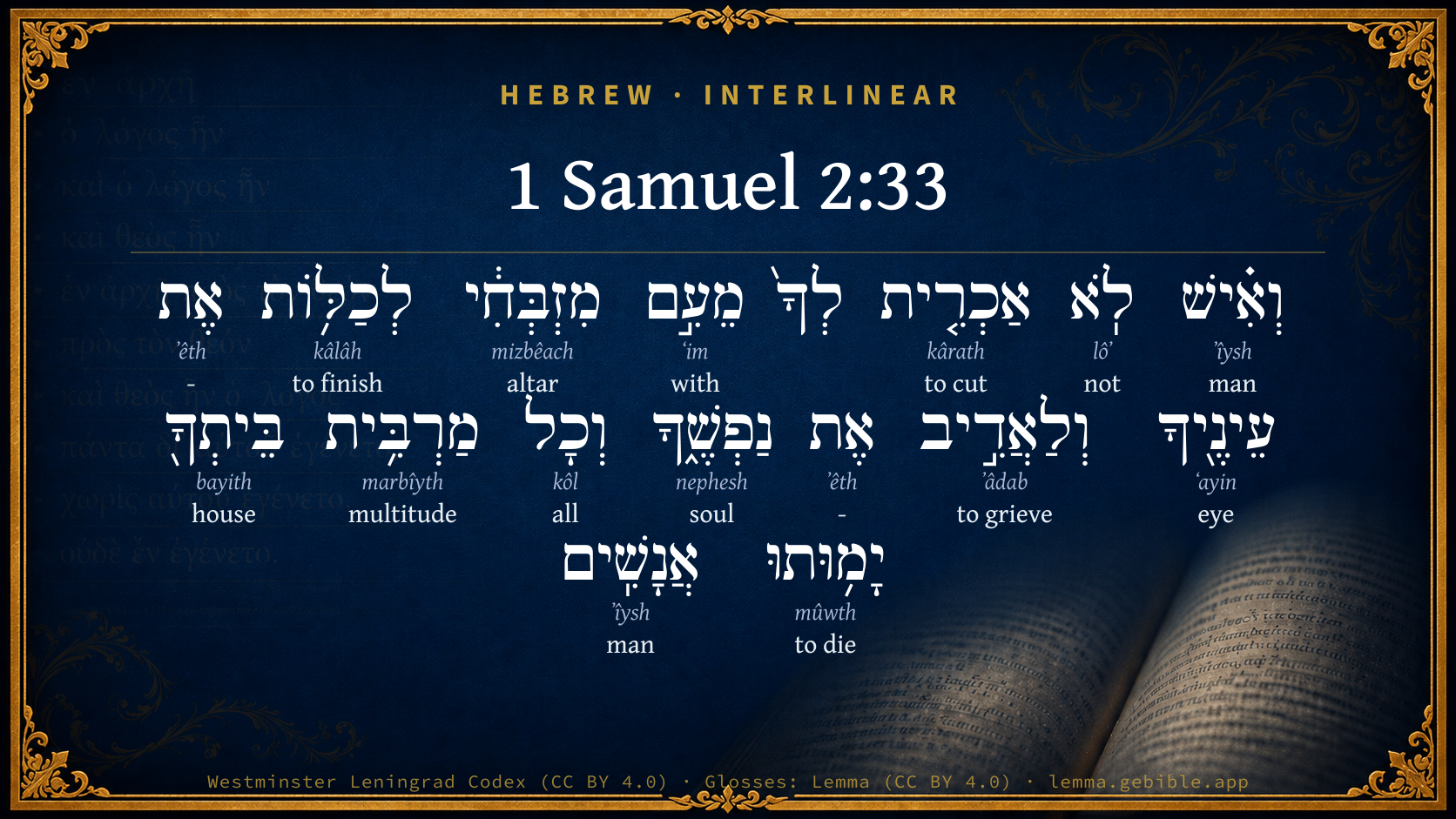
1 Samuel 2:33

Hebrew (Westminster Leningrad Codex) 1 Samuel 2:33 appears in the Hebrew Old Testament. The text above is from the Westminster Leningrad Codex. Each word links to its Strong’s number, a concise gloss, and parsing drawn from the Open Scriptures Hebrew Bible morphology. Click any word for its full Brown-Driver-Briggs (BDB) entry.
Download image
Cite this verse

1 Samuel 2:33 (World English Bible). Public Domain. Lemma interlinear Bible study tool, https://lemma.gebible.app/v/1-samuel/2/33.

Show BibTeX & RIS
BibTeX
RIS
English Translation
The man of yours, [whom] I shall not cut off from my altar, [shall be] to consume your eyes, and to grieve your heart; and all the increase of your house shall die in the flower of their age.
World English Bible · Public Domain
Highlights
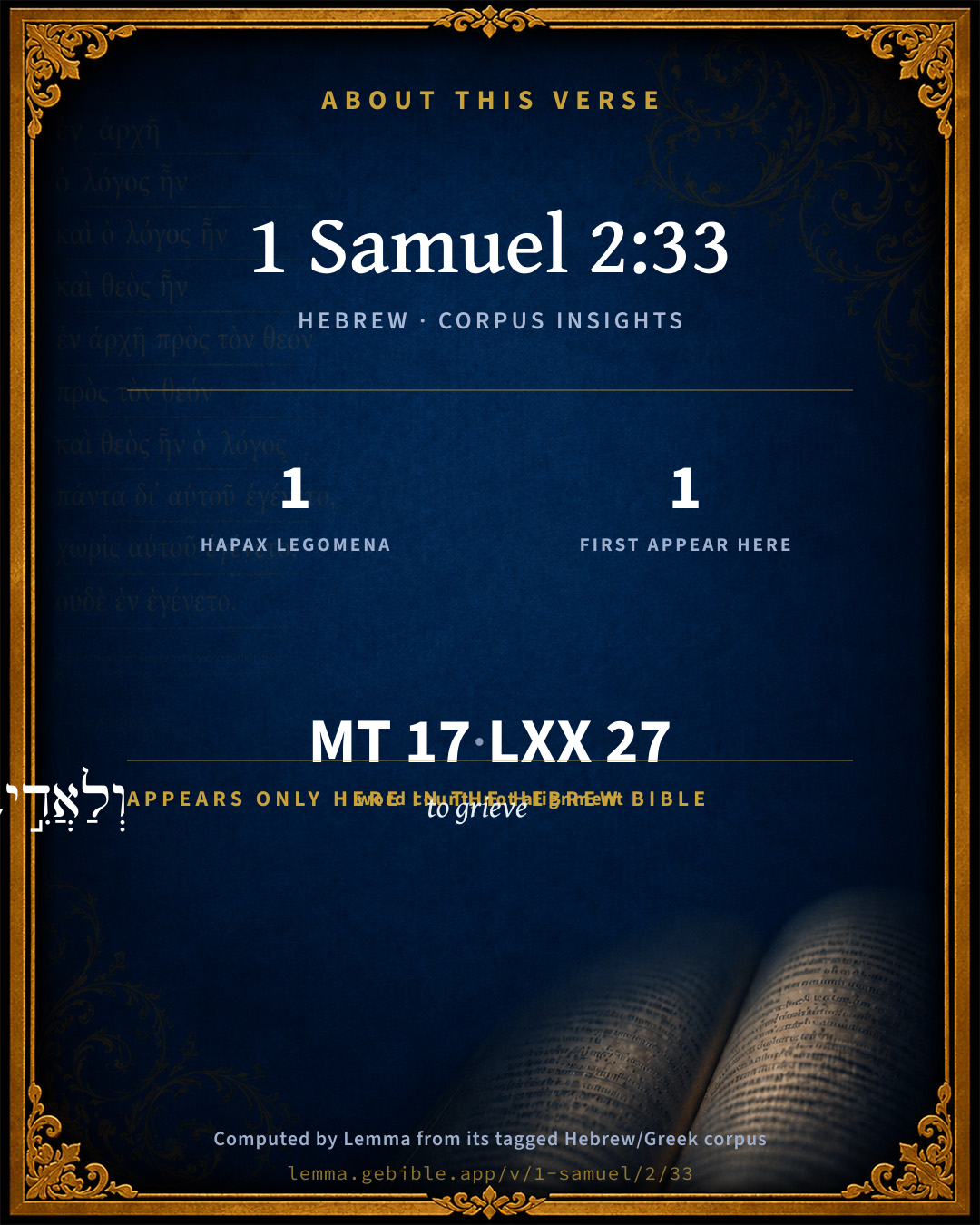
  • 1 hapax legomenon — only here in the Hebrew Bible
  • 1 first appearance in the Hebrew Bible
Full analysis ↓
Download a study sheet

One document with this verse’s original text, its word-by-word gloss line, the meaning frame, cross-references with their text, attributed commentary, and full source and license credits — printable, and it pastes into notes with its structure intact.

This verse Autodidact and up

Study sheet (.html) Plain text (.txt)

A passage Seminary Student

Up to 50 verses in one chapter. A passage sheet keeps up to 6 commentary sources and 12 cross-references per verse, in the order this page ranks them, and says so on the sheet whenever that leaves anything out. Ask for a single verse and you get the Autodidact verse sheet above.

Everything on this page stays free to read, with no account — the sheet is a download of what is already on screen, not access to it.

Want to remove ads? Support Godless Engineer
Compare translations 3

The same verse in 3 English versions, stacked beneath the original-language interlinear above. Click any original word for its lexicon entry.

Each is an independent rendering of the whole verse — the interlinear is not word-aligned to these translations.

Highlighted words mark where these versions differ — a whole-verse word diff, not a word-by-word alignment.

  • World English Bible Public Domain
    The man of yours, [whom] I shall not cut off from my altar, [shall be] to consume your eyes, and to grieve your heart; and all the increase of your house shall die in the flower of their age.
  • King James Version Public Domain
    And the man of thine, whom I shall not cut off from mine altar, shall be to consume thine eyes, and to grieve thine heart: and all the increase of thine house shall die in the flower of their age.
  • unfoldingWord Literal Text CC BY-SA 4.0
    But I will not cut off a man to you from near my altar, to make your eyes fail and to make your soul grieve. And all of the increase of your house will die men.

unfoldingWord Literal Text — © unfoldingWord, licensed CC BY-SA 4.0. Word-aligned USFM3 via Door43 (git.door43.org/unfoldingWord/en_ult).

Versions to compare (up to 4)

3 of 4 selected

Show all 18 translations

Every available English version of this verse, each an independent rendering of the whole verse.

  • World English Bible Public Domain
    The man of yours, [whom] I shall not cut off from my altar, [shall be] to consume your eyes, and to grieve your heart; and all the increase of your house shall die in the flower of their age.
  • Berean Standard Bible Public Domain
    And every one of you that I do not cut off from My altar, your eyes will fail and your heart will grieve. All your descendants will die by the sword of men.
  • Majority Standard Bible Public Domain
    And every one of you that I do not cut off from My altar, I will cause your eyes to fail and your heart to grieve. All your descendants will die by the sword of men.
  • King James Version Public Domain
    And the man of thine, whom I shall not cut off from mine altar, shall be to consume thine eyes, and to grieve thine heart: and all the increase of thine house shall die in the flower of their age.
  • American Standard Version (1901) Public Domain
    And the man of thine, `whom' I shall not cut off from mine altar, `shall be' to consume thine eyes, and to grieve thy heart; and all the increase of thy house shall die in the flower of their age.
  • Revised Version (1885) Public Domain
    And the man of thine, whom I shall not cut off from mine altar, shall be to consume thine eyes, and to grieve thine heart: and all the increase of thine house shall die in the flower of their age.
  • Geneva Bible (1599) Public Domain
    Neuerthelesse, I will not destroy euery one of thine from mine altar, to make thine eyes to faile, and to make thine heart sorowfull: and all ye multitude of thine house shall die when they be men.
  • Douay-Rheims (1899) Public Domain
    However I will not altogether take away a man of thee from my altar: but that thy eyes may faint and thy soul be spent: and a great part of thy house shall die when they come to man's estate.
  • Young's Literal Translation Public Domain
    `And the man I cut not off of thine from Mine altar, `is' to consume thine eyes, and to grieve thy soul; and all the increase of thy house do die men;
  • Literal Standard Version CC BY-SA 4.0
    And the man of yours I do not cut off from My altar—[My purpose is] to consume your eyes, and to grieve your soul; and all the increase of men [in] your house die;
  • Unlocked Literal Bible CC BY-SA 4.0
    Any one of you that I do not cut off from my altar, I will cause your eyes to fail, and I will cause grief for your life. All the men born in your family will die.
  • unfoldingWord Literal Text CC BY-SA 4.0
    But I will not cut off a man to you from near my altar, to make your eyes fail and to make your soul grieve. And all of the increase of your house will die men.
  • Darby Bible Public Domain
    And the man of thine [whom] I shall not cut off from mine altar, shall be to cause thine eyes to fail and to grieve thy soul; and all the increase of thy house shall die in their vigour.
  • World Messianic Bible Public Domain
    The man of yours whom I don’t cut off from my altar will consume your eyes and grieve your heart. All the increase of your house will die in the flower of their age.
  • Webster's Bible Public Domain
    And the man of thine, whom I shall not cut off from my altar, shall be to consume thy eyes, and to grieve thy heart: and all the increase of thy house shall die in the flower of their age.
  • Free Bible Version CC BY-SA 4.0
    Anyone of your family not cut off from serving at my altar will make your eyes weep and cause you grief. All your descendants will die when full of life.
  • Bible in Basic English Public Domain
    But one man of your family will not be cut off by my hand, and his eyes will be made dark, and grief will be in his heart: and all the offspring of your family will come to their end by the sword of men.
  • JPS Tanakh (1917) Public Domain
    Yet will I not cut off every man of thine from Mine altar, to make thine eyes to fail, and thy heart to languish; and all the increase of thy house shall die young men.

Literal Standard Version (2020), Covenant Press — licensed CC BY-SA 4.0. Text via the HelloAO Bible API (eBible.org). Unlocked Literal Bible (unfoldingWord) — licensed CC BY-SA 4.0. Text via the HelloAO Bible API (eBible.org). unfoldingWord Literal Text — © unfoldingWord, licensed CC BY-SA 4.0. Word-aligned USFM3 via Door43 (git.door43.org/unfoldingWord/en_ult). Free Bible Version, Dr. Jonathan Gallagher — licensed CC BY-SA 4.0. Text via the HelloAO Bible API (eBible.org).

Word by word

More ways to search: Search by grammar → Find every occurrence → Compare this word →

Practice this passage: Drill this verse → Learn its vocabulary →

וְלַאֲדִ֣יב
ʼâdab
H109
“and · to grieve”
Conjunction + Preposition + Verb, Hiphil, Infinitive Construct
Part of Speech
Conjunction + Preposition + Verb
Stem
Hiphil
Form
Infinitive Construct
Full BDB Definition

Origin: a primitive root

TWOT: 24

to grieve, cause grief - (Hiphil) to cause to grieve, to grieve, to cause grief
  1. וְאִ֗ישׁ ʼîysh H376 “and · man” Conjunction + Noun, Common, Masculine, Singular, Absolute
  2. לֹֽא lôʼ H3808 “not” Particle, Negative
  3. אַכְרִ֤ית kârath H3772 “to cut” Verb, Hiphil, Imperfect, 1st Person, Common, Singular
  4. מֵעִ֣ם ʻim H5973 “from · with” Preposition + Preposition
  5. מִזְבְּחִ֔י mizbêach H4196 “altar · my” Noun, Common, Masculine, Singular, Construct + Suffix, Personal, 1st Person, Common, Singular
  6. לְכַלּ֥וֹת kâlâh H3615 “to finish” Preposition + Verb, Piel, Infinitive Construct
  7. אֶת ʼêth H853 “-” Particle, Direct Object
  8. עֵינֶ֖יךָ ʻayin H5869 “eyes · your” Noun, Common, Both, Dual, Construct + Suffix, Personal, 2nd Person, Masculine, Singular
  9. אֶת ʼêth H853 “-” Particle, Direct Object
  10. נַפְשֶׁ֑ךָ nephesh H5315 “soul · your” Noun, Common, Both, Singular, Construct + Suffix, Personal, 2nd Person, Masculine, Singular
  11. וְכָל kôl H3605 “and · all of” Conjunction + Noun, Common, Masculine, Singular, Construct
  12. מַרְבִּ֥ית marbîyth H4768 “multitude of” Noun, Common, Feminine, Singular, Construct
  13. בֵּיתְךָ֖ bayith H1004 “house · your” Noun, Common, Masculine, Singular, Construct + Suffix, Personal, 2nd Person, Masculine, Singular
  14. יָמ֥וּתוּ mûwth H4191 “to die” Verb, Qal, Imperfect, 3rd Person, Masculine, Plural
  15. אֲנָשִֽׁים ʼîysh H376 “men” Noun, Common, Masculine, Plural, Absolute

About this verse

These counts appear in no published source. They are computed here, from the morphology-tagged text and Lemma’s own curated glosses. What Lemma adds →

17
words
14
distinct lemmas
Historical
section

Notable vocabulary

1 hapax legomenon — a word that appears only here in the entire Hebrew Bible:

  • וְלַאֲדִ֣יב to grieve H109

First appearance in Scripture

This word makes its first canonical appearance in the Hebrew Bible here:

  • וְלַאֲדִ֣יב to grieve H109

Shared distinctive vocabulary

מַרְבִּ֥ית multitude H4768 occurs in 5 verses of the Hebrew Bible. Also found in:

Grammatical profile

  • 4 verbs
  • 8 nouns
  • 2 prepositions
  • 3 particles

Verb forms

  • אַכְרִ֤ית Hiphil · Imperfect
  • לְכַלּ֥וֹת Piel · Infinitive Construct
  • וְלַאֲדִ֣יב Hiphil · Infinitive Construct
  • יָמ֥וּתוּ Qal · Imperfect

Repetition

A word recurs within this verse — often emphatic in Hebrew:

  • וְאִ֗ישׁ man H376 ×2

Hebrew & Septuagint length

In English translation the verse runs 39 words from the Hebrew and 41 from the Septuagint (LXX English) — closely comparable.

A rough comparison of the two English renderings, which tokenize alike — not a word-level alignment.

Word counts can differ between the Hebrew and the Greek without any difference in meaning — e.g. the Hebrew direct-object marker אֵת has no separate Greek word, and Greek often adds the article ὁ.

In the original languages it is 17 Hebrew tokens and 27 Greek tokens — but the two are counted differently (Hebrew bundles its prefixes and suffixes into one token; the Greek is in lemma form), so that isn’t a like-for-like length.

Cross-references

5

Topical passages linked to 1 Samuel 2:33 in the Treasury of Scripture Knowledge — connected by theme and wording, ordered by reader-vote popularity; previews shown in the World English Bible.

  • 1 Kings 2:26–27 To Abiathar the priest said the king, Get you to Anathoth, to your own fields; for you are worthy of death: but I will not at this time put you to death, because you bear the ark of the Lord Yahweh before David my father, and because you were afflicted in all in which my father was afflicted.
  • 1 Samuel 22:21–23 Abiathar told David that Saul had slain Yahweh's priests.
  • 1 Kings 1:7 He conferred with Joab the son of Zeruiah, and with Abiathar the priest: and they following Adonijah helped him.
  • 1 Kings 1:19 and he has slain oxen and fatlings and sheep in abundance, and has called all the sons of the king, and Abiathar the priest, and Joab the captain of the host; but he hasn't called Solomon your servant.
  • Matthew 2:16–18 Then Herod, when he saw that he was mocked by the wise men, was exceedingly angry, and sent out, and killed all the male children who were in Bethlehem and in all the surrounding countryside, from two years old and under, according to the exact time which he had learned from the wise men.

Cross-references courtesy of OpenBible.info (CC BY 4.0).

Hebrew and Greek witnesses Masoretic Hebrew ↔ Greek Septuagint

The same verse in the two great witnesses to the Old Testament, shown verse-for-verse.

These are two independent witnesses, not word-aligned to each other, and the Septuagint is shown in lemma (dictionary) form.

Hebrew 1 Samuel 2:33 Masoretic · Westminster Leningrad Codex

וְאִ֗ישׁ לֹֽא אַכְרִ֤ית לְךָ֙ מֵעִ֣ם מִזְבְּחִ֔י לְכַלּ֥וֹת אֶת עֵינֶ֖יךָ וְלַאֲדִ֣יב אֶת נַפְשֶׁ֑ךָ וְכָל מַרְבִּ֥ית בֵּיתְךָ֖ יָמ֥וּתוּ אֲנָשִֽׁים

The man of yours, [whom] I shall not cut off from my altar, [shall be] to consume your eyes, and to grieve your heart; and all the increase of your house shall die in the flower of their age.

World English Bible · Public Domain

Greek LXX 1 Samuel 2:33 Septuagint · lemma form

καί ἀνήρ οὐ ἐκὀλεθρεύω σύ ἀπό ὁ θυσιαστήριον ἐγώ ἐκλείπω ὁ ὀφθαλμός αὐτός καί καταῥέω ὁ ψυχή αὐτός καί πᾶς περισσεύω οἶκος σύ πίπτω ἐν ῥομφαία ἀνήρ

And if I do not destroy a man of your from my altar, it shall be that his eyes may fail and his soul may perish; and every one that remains in your house shall fall by the sword of men.

LXX2012 (modern English Septuagint) · Public Domain

On this verse, Haydock's Catholic Bible Commentary discusses the Septuagint’s reading. Read the note in Commentary ↓

Hebrew: Westminster Leningrad Codex (CC BY 4.0). Greek: Septuagint (public domain); English from LXX2012 (modern English Septuagint) (Public Domain). How the Septuagint differs from the Hebrew →

Targum (Aramaic paraphrase)

1

The Targum is the ancient Jewish Aramaic paraphrase of the Hebrew Scriptures — an interpretive translation, not the Hebrew text itself. Onkelos (literal) and Pseudo-Jonathan (expansive) render the Torah, and Jonathan the Prophets. Coverage is partial: where no permissively-licensed English translation exists for a verse, only the Aramaic is shown. This is verse-level text, not a word-by-word alignment to the Hebrew.

  1. Targum Jonathan Prophets (Joshua–Malachi)
    וָאֱנַשׁ לָא אַפְסִיק לָךְ מִן מַדְבְּחִי לְחַשָׁכָא יַת עֵינָךְ וּלְאַפָּחָא יַת נַפְשָׁךְ וְכָל סַגְיוֹת בֵּיתָךְ יְמוּתוּן עוּלֵימִין:

    (no public-domain English translation for this verse)

    Targum Jonathan — Aramaic: “Mikraot Gedolot” (public domain). English: “Sefaria Community Translation” (CC0 1.0 (public-domain dedication)); “London "Chaldee Paraphrase," 1871” (public domain). Text via Sefaria.

Commentary

Notes on 1 Samuel 2:33 from classic Christian and Jewish commentators (each source and its license shown beneath its notes). The classic Christian expositions comment on the surrounding passage and are grouped to its opening verse, so a note may address several verses; the Jewish commentaries on the Tanakh (Rashi and others) are per-verse, so they appear only where the commentator wrote on this verse.

Lemma curates 59 commentaries, every one of them public domain or Creative Commons licensed, each selected and text-cleaned for this edition rather than reprinted as found. About our sources →

Ellicott's Commentary for English Readers

(33) To consume thine eyes and to grieve thine heart.—The Speaker’s Commentary well refers to 1Sa_2:36 for an explanation of these difficult words. “Those who are not cut off in the flower of their youth shall be worse off than those who are, for they shall have to beg their bread.”

And all the increase of thine house shall die.—In the Babylonian Talmud the Rabbis have related that there was once a family in Jerusalem the members of which died off regularly at eighteen years of age. Rabbi Jochanan ben Zacchai shrewdly guessed that they were descendants of Eli, regarding whom it is said (1Sa_2:33), “And all the increase of thine house shall die in the flower of their age; “and he accordingly advised them to devote themselves to the study of the Law, as the certain and only means of neutralising the curse. They acted upon the advice of the Rabbi; their lives were in consequence prolonged; and they thenceforth went by the name of their spiritual father.—Rosh Hashanah, fol. 18, Colossians 1.

A Bible Commentary for English Readers, edited by Charles John Ellicott (1878–1897) — public domain. Text from a community e-Sword module.

Trapp's Complete Commentary

John Trapp

1Sa 2:33 And the man of thine, [whom] I shall not cut off from mine altar, [shall be] to consume thine eyes, and to grieve thine heart: and all the increase of thine house shall die in the flower of their age.

Ver. 33. Shall be to consume thine eyes.] Should be so; couldst thou live so long, thou wouldst even weep thyself blind, and thy heart would fall asunder like drops of water.

John Trapp, A Commentary or Exposition upon All the Books of the Old and New Testament (1647–1656) — public domain. Text from a community e-Sword module.

The Biblical Illustrator

Joseph S. Exell

1Sa_2:33

In the flower of their age.

Premature death consequent upon, parental neglect

Now it is too evident to require proof, that the sin, of which Eli was guilty, naturally tends to produce the consequence which is here threatened as a punishment. When youth are permitted to make themselves vile, without restraint, they almost inevitably fall into courses which tend to undermine their constitutions, and shorten their days. It is, indeed, a well known fact that, in populous towns, comparatively few live to become aged, and that a much larger proportion of mankind, especially of the male sex who are most exposed to the influence of temptation, die in the flower or meridian of their days, than in the country where parental discipline is less generally neglected, and youth are under greater restraints. If parents wished that their sons should drag out a short life of debility and disease, and die before they reach half the common age of man, they could not adopt measures better calculated to produce this effect, than to cast loose the reins of parental authority, and suffer them to follow their own inclinations, and associate with vicious companions without restraint. We may, therefore, consider the premature death of ungoverned children, as the natural consequence, as well as the usual punishment, of parental neglect. (E. Payson, D. D.)

The Biblical Illustrator, edited by Joseph S. Exell (c. 1880s–1900s) — public domain. Text from a community e-Sword module.

Joseph Benson's Commentary

1Sa 2:33. The man of thine — That is, of thy posterity. Shall be to grieve thy heart — Shall be so forlorn and miserable, that if thou wast alive to see it, it would grieve thee at the heart, and thou wouldst consume thine eyes with weeping for their calamities. The increase of thy house — That is, thy children. Flower of their age — About the thirtieth year of their age, when they were to be admitted to the full administration of their office.

Joseph Benson's Commentary on the Old and New Testaments (1811–1818) — public domain. Text from a community e-Sword module.

Geneva Bible (1599)

Geneva Bible translators

Or, when they come to man’s age.

Geneva Bible (1599) marginal notes — public domain. Text via Bolls.life.

Adam Clarke's Commentary

Verse 33. And the man of thine] Of this passage Calmet observes: "The posterity of Eli possessed the high priesthood to the time of Solomon; and even when that dynasty was transferred to another family, God preserved that of Eli, not to render it more happy, but to punish it by seeing the prosperity of its enemies, to the end that it might see itself destitute and despised. This shows the depth of the judgments of God and the grandeur of his justice, which extends even to distant generations, and manifests itself to sinners both in life and death; both in their own disgrace, and in the prosperity of their enemies."

Adam Clarke's Commentary on the Bible (1810–1826) — public domain. Text from a community e-Sword/MySword module.

The Cambridge Bible for Schools and Colleges

gen. ed. J. J. S. Perowne

33. And the man, &c.] or, Yet every man of thine will I not cut off from mine altar, to consume thine eyes and to vex thy soul; i.e. some will still survive to mourn over the ruin of their family. “Thine eyes,” “thy soul,” because Eli is identified with his posterity. But the Sept. has “his eyes,” “his soul.”

increase] = offspring, Lat. incrementum.

in the flower of their age] Heb. men: i.e. when they come to manhood.

The Cambridge Bible for Schools and Colleges (gen. ed. J. J. S. Perowne; Cambridge University Press, 1878–1918) — public domain. Text from a community e-Sword module.

John Gill's Exposition

This shall be a sign unto thee,.... A confirming one, that all which had been now said would be fulfilled:

that shall come upon thy two sons, Hophni and Phinehas; which Eli would live to see fulfilled on them; and when it was, he might be assured the rest would be most certainly accomplished, and it was this:

in one day they shall die both of them; as they did in battle with the Philistines, Sa1 4:11.

John Gill's Exposition of the Whole Bible (1746–1763) — public domain (CC PDM 1.0). Text via the HelloAO Bible API.

Albert Barnes' Notes on the Bible

The meaning is explained by 1Sa 2:36. Those who are not cut off in the flower of their youth shall be worse off than those who are, for they shall have to beg their bread. (Compare Jer 22:10.)

Thine eyes ... thine heart - For a similar personification of the tribe or family see Jdg 1:2-4.

Albert Barnes' Notes on the Bible (1834–1885) — public domain. Text from a community e-Sword/MySword module.

Haydock's Catholic Bible Commentary

Spent. Hence we may learn to adore the depth of God’s judgments, who knows how to punish both in life and death. --- Part. Septuagint, "the most exalted of thy house shall fall by the sword of men."

George Leo Haydock (1774–1849), Haydock's Catholic Family Bible and Commentary, 1859 edition — public domain. Excludes Psalms (Douay-Rheims chapter numbering differs from Protestant) and Deuterocanonical books (Catholic canon only).

Matthew Poole's English Annotations

The man of thine, i.e. those of thy posterity.

From mine altar, i.e. from attendance upon mine altar; whom I shall not destroy, but suffer to live, and wait at the altar.

Shall be to consume thine eyes, and to grieve thine heart; shall be so forlorn and miserable, that if thou wast alive to see it, it would grieve thee at the very heart, and thou wouldst consume thine eyes with weeping for their calamities. So the phrase is like that of Rachel weeping for her children, Jer 31:15, which were slain long after her death.

The increase of thine house, i.e. thy children.

In the flower of their age; about the thirtieth year of their age, when they were to be admitted to the plenary administration of their office, Num 4:3, then they shall die.

Matthew Poole's English Annotations on the Holy Bible (1683–1685) — public domain. Text from a community e-Sword/MySword module.

Whedon's Commentary on the Bible

Daniel D. Whedon

33. And the man of thine — The meaning is, I will not cut off all thy posterity from the altar service, but there will be always remaining some, who shall witness in sorrow and grief the fulfilment of this judgment against the house of their father. Ahitub, the grandson of Eli, seems to have succeeded him in the priesthood, (1Sa_14:3;) after him Ahimelech, (1Sa_22:11,) and next Abiathar, whom Solomon thrust out of the priesthood in fulfilment of this prophecy. 1Ki_2:27. Eli’s eyes and heart were thus consumed in the posterity that succeeded him. none of whom lived to old age, but all died in the bloom of manhood. See still other woes foretold in 1Sa_2:36.

Daniel D. Whedon (gen. ed.), Commentary on the Old and New Testaments (1874–1909) — public domain. Text from a community e-Sword module.

The Pulpit Commentary

The man of thine, etc. The meaning of the Hebrews is here again changed by the insertion of words not in the original. Translated literally the sense is good, but merciful, and this the A.V has so rendered as to make it the most bitter of all denunciations. The Hebrews is, "Yet I will not cut off every one of thine from my altar, to consume thine eyes and to grieve thy soul;" that is, thy punishment shall not be so utter as to leave thee with no consolation; for thy descendants, though diminished in numbers, and deprived of the highest rank, shall still minister as priests at mine altar. "But the majority of try house lit, the multitude of thy house shall die as men." This is very well rendered in the A.V "in the flowerof theft age," only we must not explain this of dying of disease. They were to die in their vigour, not, like children and old men, in theft beds, but by violent deaths, such as actually befell them at Shiloh and at Nob.

The Pulpit Commentary (1880–1919), ed. H.D.M. Spence-Jones & Joseph S. Exell — public domain. Text from a community e-Sword module.

John Wesley's Explanatory Notes

Of thine - That is, of thy posterity. Shalt grieve - Shall be so forlorn and miserable, that if thou wast alive to see it, it would grieve thee at the heart, and thou wouldst consume thine eyes with weeping for their calamities. Increase - That is, thy children. Flower - About the thirtieth year of their age, when they were to be admitted to the full administration of their office.

John Wesley, Explanatory Notes Upon the Whole Bible (1754–1765) — public domain. Text via the GEBible commentary corpus.

Rashi

Rabbi Shlomo Yitzchaki (Rashi)

And sadden.וְלַאֲדִיב is the same as וְלַדְאִיב [disillusioned].

Will die as [young] men. Young. There is no comparison between the mourning for a young man and the mourning for a child.

Rashi on the Tanakh — English translations: “The Judaica Press complete Tanach with Rashi, translated by A. J. Rosenberg” (CC BY 4.0); “Pentateuch with Rashi's commentary by M. Rosenbaum and A.M. Silbermann, 1929-1934” (public domain); “The Metsudah Tanach series, Lakewood, N.J” (CC BY 4.0); and “The Book of Joshua, Metsudah Publications, 1997” (CC BY 4.0). Text via Sefaria.

Lesson kit

Teaching starters — assembled from the data on this page, not authored interpretation. Every prompt links to the verse data it draws on. Edit before teaching.

1 Samuel, in the Historical, opens this verse with 17 words (14 distinct Hebrew lemmas). Its most distinctive word is ʼâdab (“to grieve”). A historical commentator’s framing appears above. Read the whole chapter for the surrounding context.

Discussion questions

  1. The word ʼâdab carries the sense “to grieve.” How does it shape the verse?
  2. This verse holds 1 word here found nowhere else in the Hebrew Bible. What might the rare word draw attention to?
  3. The word “to grieve” first appears here in Scripture. What is being introduced at this debut?
  4. Leviticus 25:37 shares the word «multitude» with this verse. How do the two illuminate each other?
  5. “man” occurs 2× in this one verse. What is the effect of the repetition?
  6. These translations render this verse differently; the difference is in the English rendering, not the original. What questions does that raise?
  7. The verb «אַכְרִ֤ית» is Hiphil Imperfect. How does its form color the action?
  8. Reading how Ellicott's Commentary for English Readers and Trapp's Complete Commentary read this verse, where do the two commentators agree and where do they part?

Things to notice

  • 1 word in this verse appears nowhere else in the Hebrew Bible.
  • 1 word makes its first canonical appearance in Scripture here.
  • This verse counts 17 Hebrew ↔ 27 Greek words.
  • These translations choose different wording for 15 words in this verse.
  • “man” occurs 2× in this single verse.

Reading settings

Reading text

Shown beneath each verse's original-language words.

Old Testament
Old Testament edition

Read the OT as the Masoretic Hebrew (MT) or the Greek Septuagint (LXX).

English shown for the Greek Septuagint (in the Hebrew ↔ Greek comparison).

Comparing translations? Open the Compare panel on any verse page to stack up to four side by side.