
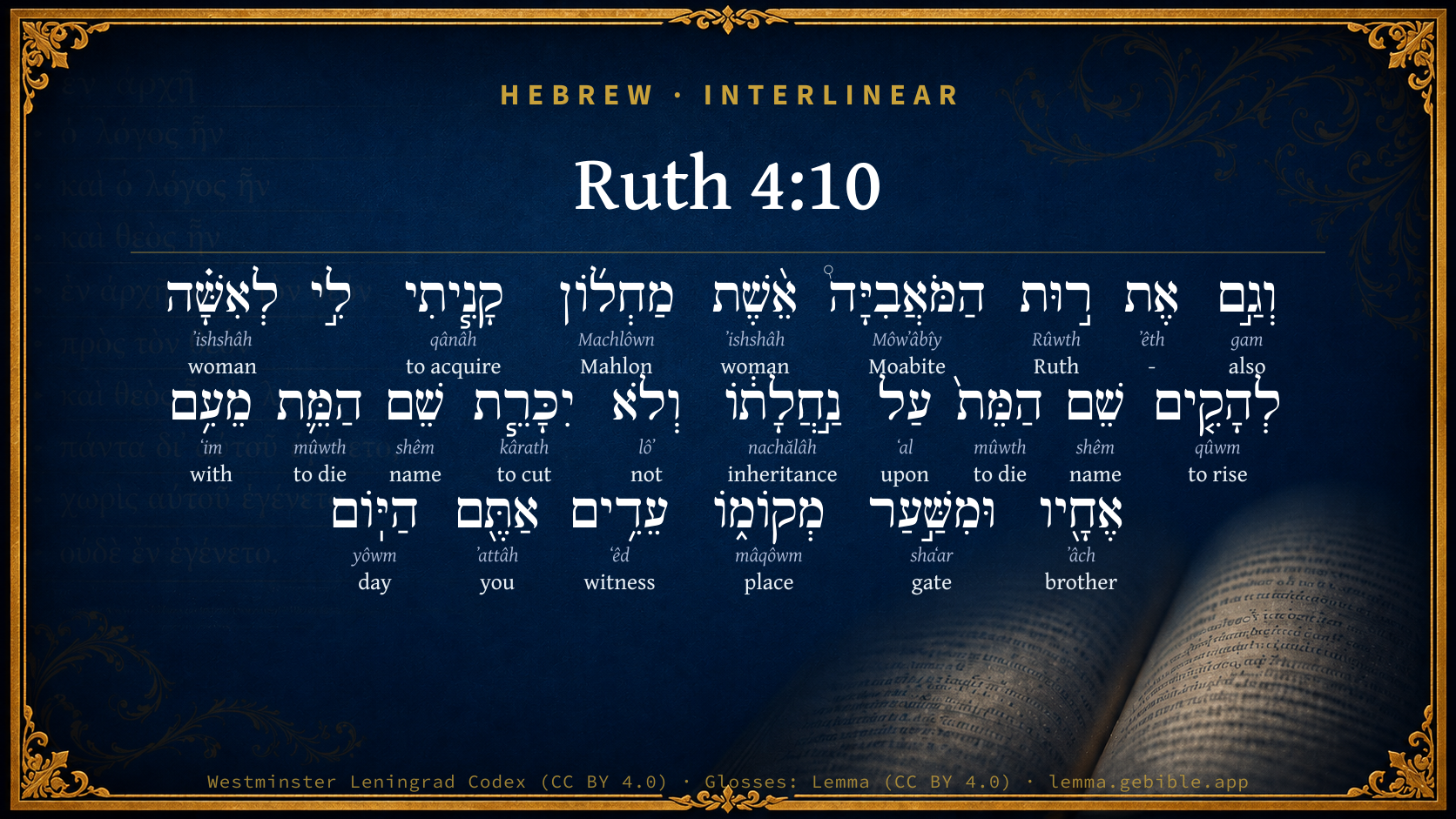
Ruth 4:10

Hebrew (Westminster Leningrad Codex) Ruth 4:10 appears in the Hebrew Old Testament. The text above is from the Westminster Leningrad Codex. Each word links to its Strong’s number, a concise gloss, and parsing drawn from the Open Scriptures Hebrew Bible morphology. Click any word for its full Brown-Driver-Briggs (BDB) entry.
Download image
Cite this verse

Ruth 4:10 (World English Bible). Public Domain. Lemma interlinear Bible study tool, https://lemma.gebible.app/v/ruth/4/10.

Show BibTeX & RIS
BibTeX
RIS
English Translation
Moreover Ruth the Moabitess, the wife of Mahlon, have I purchased to be my wife, to raise up the name of the dead on his inheritance, that the name of the dead not be cut off from among his brothers, and from the gate of his place: you are witnesses this day.
World English Bible · Public Domain
Download a study sheet

One document with this verse’s original text, its word-by-word gloss line, the meaning frame, cross-references with their text, attributed commentary, and full source and license credits — printable, and it pastes into notes with its structure intact.

This verse Autodidact and up

Study sheet (.html) Plain text (.txt)

A passage Seminary Student

Up to 50 verses in one chapter. A passage sheet keeps up to 6 commentary sources and 12 cross-references per verse, in the order this page ranks them, and says so on the sheet whenever that leaves anything out. Ask for a single verse and you get the Autodidact verse sheet above.

Everything on this page stays free to read, with no account — the sheet is a download of what is already on screen, not access to it.

Want to remove ads? Support Godless Engineer
Compare translations 3

The same verse in 3 English versions, stacked beneath the original-language interlinear above. Click any original word for its lexicon entry.

Each is an independent rendering of the whole verse — the interlinear is not word-aligned to these translations.

Highlighted words mark where these versions differ — a whole-verse word diff, not a word-by-word alignment.

  • World English Bible Public Domain
    Moreover Ruth the Moabitess, the wife of Mahlon, have I purchased to be my wife, to raise up the name of the dead on his inheritance, that the name of the dead not be cut off from among his brothers, and from the gate of his place: you are witnesses this day.
  • King James Version Public Domain
    Moreover Ruth the Moabitess, the wife of Mahlon, have I purchased to be my wife, to raise up the name of the dead upon his inheritance, that the name of the dead be not cut off from among his brethren, and from the gate of his place: ye are witnesses this day.
  • unfoldingWord Literal Text CC BY-SA 4.0
    And also Ruth, the Moabite woman, the widow of Mahlon, I am acquiring as my wife, in order to raise up the name of the dead over his inheritance, so that the name of the dead will not be cut off from among his brothers and from the gate of his place. Today you are witnesses!”

unfoldingWord Literal Text — © unfoldingWord, licensed CC BY-SA 4.0. Word-aligned USFM3 via Door43 (git.door43.org/unfoldingWord/en_ult).

Versions to compare (up to 4)

3 of 4 selected

Show all 18 translations

Every available English version of this verse, each an independent rendering of the whole verse.

  • World English Bible Public Domain
    Moreover Ruth the Moabitess, the wife of Mahlon, have I purchased to be my wife, to raise up the name of the dead on his inheritance, that the name of the dead not be cut off from among his brothers, and from the gate of his place: you are witnesses this day.
  • Berean Standard Bible Public Domain
    Moreover, I have acquired Ruth the Moabitess, Mahlon’s widow, as my wife, to raise up the name of the deceased through his inheritance, so that his name will not disappear from among his brothers or from the gate of his home. You are witnesses today.”
  • Majority Standard Bible Public Domain
    Moreover, I have acquired Ruth the Moabitess, Mahlon’s widow, as my wife, to raise up the name of the deceased through his inheritance, so that his name will not disappear from among his brothers or from the gate of his home. You are witnesses today.”
  • King James Version Public Domain
    Moreover Ruth the Moabitess, the wife of Mahlon, have I purchased to be my wife, to raise up the name of the dead upon his inheritance, that the name of the dead be not cut off from among his brethren, and from the gate of his place: ye are witnesses this day.
  • American Standard Version (1901) Public Domain
    Moreover Ruth the Moabitess, the wife of Mahlon, have I purchased to be my wife, to raise up the name of the dead upon his inheritance, that the name of the dead be not cut off from among his brethren, and from the gate of his place: ye are witnesses this day.
  • Revised Version (1885) Public Domain
    Moreover Ruth the Moabitess, the wife of Mahlon, have I purchased to be my wife, to raise up the name of the dead upon his inheritance, that the name of the dead be not cut off from among his brethren, and from the gate of his place: ye are witnesses this day.
  • Geneva Bible (1599) Public Domain
    And moreouer, Ruth the Moabitesse the wife of Mahlon, haue I bought to be my wife, to stirre vp the name of the dead vpon his inheritance, and that the name of the dead be not put out from among his brethren, and from the gate of his place: ye are witnesses this day.
  • Douay-Rheims (1899) Public Domain
    And have taken to wife Ruth the Moabitess, the wife of Mahalon, to raise up the name of the deceased in his inheritance lest his name be cut off, from among his family and his brethren and his people. You, I say, are witnesses of this thing.
  • Young's Literal Translation Public Domain
    and also Ruth the Moabitess, wife of Mahlon, I have bought to myself for a wife, to raise up the name of the dead over his inheritance; and the name of the dead is not cut off from among his brethren, and from the gate of his place; witnesses ye `are' to-day.'
  • Literal Standard Version CC BY-SA 4.0
    and also Ruth the Moabitess, wife of Mahlon, I have bought to myself for a wife, to raise up the name of the dead over his inheritance; and the name of the dead is not cut off from among his brothers, and from the gate of his place; witnesses you [are] today.”
  • Unlocked Literal Bible CC BY-SA 4.0
    Also Ruth the Moabite woman, the wife of Mahlon, I have acquired to be my wife, in order that I might raise up the name of the dead man on his inheritance, so that his name will not be cut off from among his brothers and from the gate of his place. Today you are witnesses!”
  • unfoldingWord Literal Text CC BY-SA 4.0
    And also Ruth, the Moabite woman, the widow of Mahlon, I am acquiring as my wife, in order to raise up the name of the dead over his inheritance, so that the name of the dead will not be cut off from among his brothers and from the gate of his place. Today you are witnesses!”
  • Darby Bible Public Domain
    moreover Ruth the Moabitess, the wife of Mahlon, have I purchased to be my wife, to raise up the name of the dead upon his inheritance, that the name of the dead be not cut off from among his brethren and from the gate of his place: ye are witnesses this day.
  • World Messianic Bible Public Domain
    Moreover, Ruth the Moabitess, the wife of Mahlon, I have purchased to be my wife, to raise up the name of the dead on his inheritance, that the name of the dead may not be cut off from among his brothers and from the gate of his place. You are witnesses today.”
  • Webster's Bible Public Domain
    Moreover, Ruth the Moabitess, the wife of Mahlon, have I purchased to be my wife, to raise up the name of the dead upon his inheritance, that the name of the dead be not cut off from among his brethren, and from the gate of his place: ye are witnesses this day.
  • Free Bible Version CC BY-SA 4.0
    I have also acquired Ruth the Moabite, Mahlon's widow, as my wife. By having children who may inherit his property his name will be kept alive in his family and in his home town. You are witnesses of this today.”
  • Bible in Basic English Public Domain
    And, further, I have taken Ruth, the Moabitess, who was the wife of Mahlon, to be my wife, to keep the name of the dead man living in his heritage, so that his name may not be cut off from among his countrymen, and from the memory of his town: you are witnesses this day.
  • JPS Tanakh (1917) Public Domain
    Moreover Ruth the Moabitess, the wife of Mahlon, have I acquired to be my wife, to raise up the name of the dead upon his inheritance, that the name of the dead be not cut off from among his brethren, and from the gate of his place; ye are witnesses this day.'

Literal Standard Version (2020), Covenant Press — licensed CC BY-SA 4.0. Text via the HelloAO Bible API (eBible.org). Unlocked Literal Bible (unfoldingWord) — licensed CC BY-SA 4.0. Text via the HelloAO Bible API (eBible.org). unfoldingWord Literal Text — © unfoldingWord, licensed CC BY-SA 4.0. Word-aligned USFM3 via Door43 (git.door43.org/unfoldingWord/en_ult). Free Bible Version, Dr. Jonathan Gallagher — licensed CC BY-SA 4.0. Text via the HelloAO Bible API (eBible.org).

Word by word

More ways to search: Search by grammar → Find every occurrence → Compare this word →

Practice this passage: Drill this verse → Learn its vocabulary →

מַחְל֜וֹן
Machlôwn
H4248
“Mahlon”
Noun, Proper
Part of Speech
Noun
Type
Proper
Full BDB Definition

Origin: from H2470

TWOT: None

Mahlon = "sick" - son of Elimelech by Naomi and first husband of Ruth
  1. וְגַ֣ם gam H1571 “and · also” Conjunction + Particle, Accusative
  2. אֶת ʼêth H853 “-” Particle, Direct Object
  3. ר֣וּת Rûwth H7327 “Ruth” Noun, Proper
  4. הַמֹּאֲבִיָּה֩ Môwʼâbîy H4125 “the · Moabite” Particle, Definite Article + Noun, Gentilic, Feminine, Singular, Absolute
  5. אֵ֨שֶׁת ʼishshâh H802 “woman of” Noun, Common, Feminine, Singular, Construct
  6. קָנִ֧יתִי qânâh H7069 “to acquire” Verb, Qal, Perfect, 1st Person, Common, Singular
  7. לְאִשָּׁ֗ה ʼishshâh H802 “to/for · woman” Preposition + Noun, Common, Feminine, Singular, Absolute
  8. לְהָקִ֤ים qûwm H6965 “to rise” Preposition + Verb, Hiphil, Infinitive Construct
  9. שֵׁם shêm H8034 “name of” Noun, Common, Masculine, Singular, Construct
  10. הַמֵּת֙ mûwth H4191 “the · dying” Particle, Definite Article + Verb, Qal, Participle Active, Masculine, Singular, Absolute
  11. עַל ʻal H5921 “upon” Preposition
  12. נַ֣חֲלָת֔וֹ nachălâh H5159 “inheritance · his” Noun, Common, Feminine, Singular, Construct + Suffix, Personal, 3rd Person, Masculine, Singular
  13. וְלֹא lôʼ H3808 “and · not” Conjunction + Particle, Negative
  14. יִכָּרֵ֧ת kârath H3772 “to cut” Verb, Niphal, Imperfect, 3rd Person, Masculine, Singular
  15. שֵׁם shêm H8034 “name of” Noun, Common, Masculine, Singular, Construct
  16. הַמֵּ֛ת mûwth H4191 “the · dying” Particle, Definite Article + Verb, Qal, Participle Active, Masculine, Singular, Absolute
  17. מֵעִ֥ם ʻim H5973 “from · with” Preposition + Preposition
  18. אֶחָ֖יו ʼâch H251 “brothers · his” Noun, Common, Masculine, Plural, Construct + Suffix, Personal, 3rd Person, Masculine, Singular
  19. וּמִשַּׁ֣עַר shaʻar H8179 “and · from · gate of” Conjunction + Preposition + Noun, Common, Masculine, Singular, Construct
  20. מְקוֹמ֑וֹ mâqôwm H4725 “place · his” Noun, Common, Masculine, Singular, Construct + Suffix, Personal, 3rd Person, Masculine, Singular
  21. עֵדִ֥ים ʻêd H5707 “witnesses” Noun, Common, Masculine, Plural, Absolute
  22. אַתֶּ֖ם ʼattâh H859 “you” Pronoun, Personal, 2nd Person, Masculine, Plural
  23. הַיּֽוֹם yôwm H3117 “the · day” Particle, Definite Article + Noun, Common, Masculine, Singular, Absolute

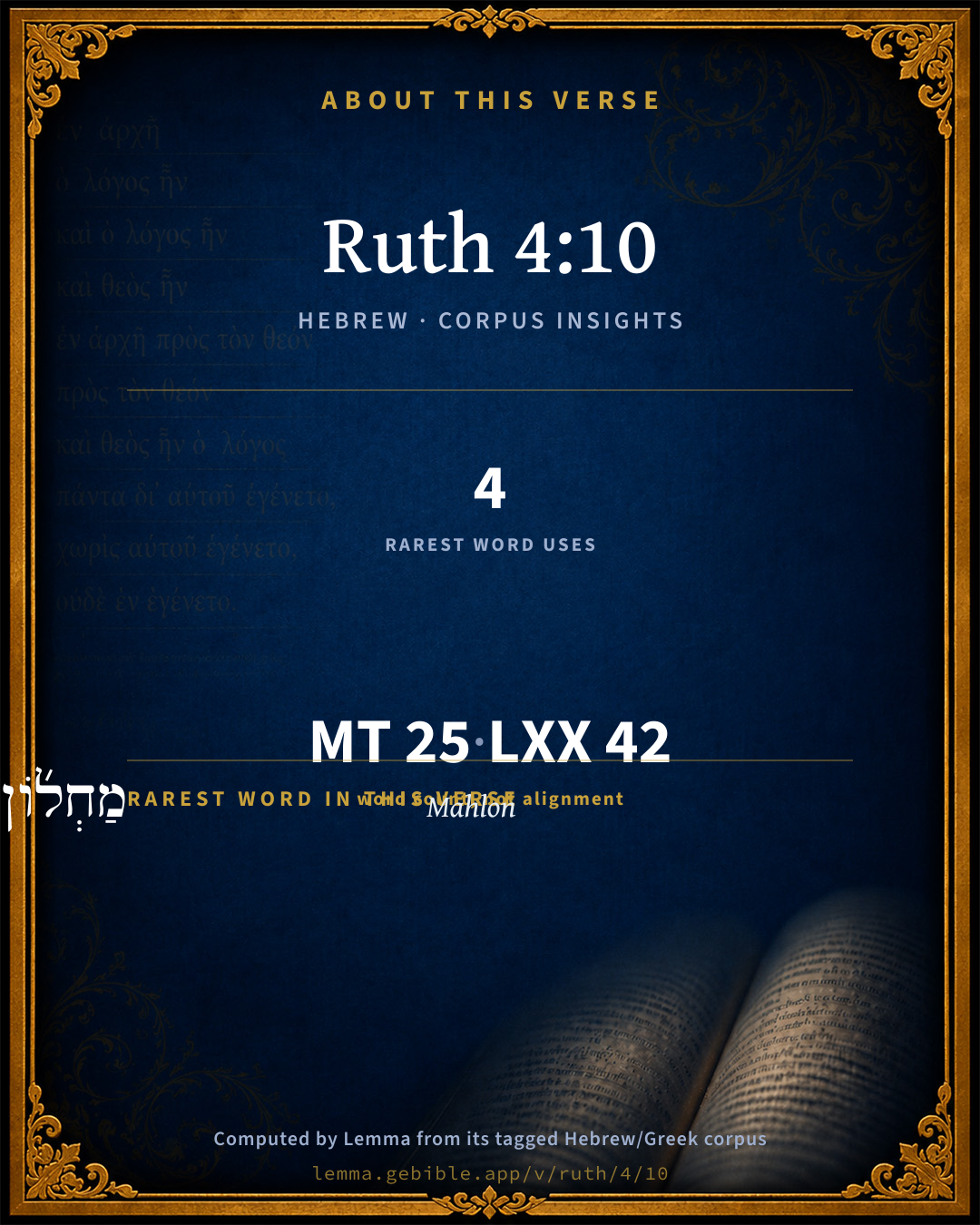
About this verse

These counts appear in no published source. They are computed here, from the morphology-tagged text and Lemma’s own curated glosses. What Lemma adds →

25
words
21
distinct lemmas
Historical
section

Notable vocabulary

The rarest word here is מַחְל֜וֹן Mahlon H4248 — appearing just 4 times in the whole Hebrew Bible.

Shared distinctive vocabulary

מַחְל֜וֹן Mahlon H4248 occurs in 4 verses of the Hebrew Bible. Also found in:

Grammatical profile

  • 5 verbs
  • 13 nouns
  • 1 pronoun
  • 3 prepositions
  • 3 particles

Verb forms

  • קָנִ֧יתִי Qal · Perfect
  • לְהָקִ֤ים Hiphil · Infinitive Construct
  • הַמֵּת֙ Qal · Participle Active
  • יִכָּרֵ֧ת Niphal · Imperfect
  • הַמֵּ֛ת Qal · Participle Active

Repetition

Words recur within this verse — often emphatic in Hebrew:

  • אֵ֨שֶׁת woman H802 ×2
  • שֵׁם name H8034 ×2
  • הַמֵּת֙ to die H4191 ×2

Hebrew & Septuagint length

In English translation the verse runs 52 words from the Hebrew and 53 from the Septuagint (LXX English) — closely comparable.

A rough comparison of the two English renderings, which tokenize alike — not a word-level alignment.

Word counts can differ between the Hebrew and the Greek without any difference in meaning — e.g. the Hebrew direct-object marker אֵת has no separate Greek word, and Greek often adds the article ὁ.

In the original languages it is 25 Hebrew tokens and 42 Greek tokens — but the two are counted differently (Hebrew bundles its prefixes and suffixes into one token; the Greek is in lemma form), so that isn’t a like-for-like length.

Cross-references

17

Topical passages linked to Ruth 4:10 in the Treasury of Scripture Knowledge — connected by theme and wording, ordered by reader-vote popularity; previews shown in the World English Bible.

  • Deuteronomy 25:6 It shall be, that the firstborn whom she bears shall succeed in the name of his brother who is dead, that his name not be blotted out of Israel.
  • Ephesians 5:25 Husbands, love your wives, even as Christ also loved the assembly, and gave himself up for it;
  • Genesis 29:18–19 Jacob loved Rachel. He said, "I will serve you seven years for Rachel, your younger daughter."
  • Genesis 29:27 Fulfill the week of this one, and we will give you the other also for the service which you will serve with me yet seven other years."
  • Joshua 7:9 For the Canaanites and all the inhabitants of the land will hear of it, and will compass us round, and cut off our name from the earth: and what will you do for your great name?
  • Psalms 34:16 Yahweh's face is against those who do evil, To cut off the memory of them from the earth.
  • Psalms 109:15 Let them be before Yahweh continually, That he may cut off the memory of them from the earth;
  • Proverbs 18:22 Whoever finds a wife finds a good thing, And obtains favor of Yahweh.
  • Proverbs 19:14 House and riches are an inheritance from fathers, But a prudent wife is from Yahweh.
  • Proverbs 31:10–11 Who can find a worthy woman? For her price is far above rubies.
  • Isaiah 8:2–3 and I will take to me faithful witnesses to record, Uriah the priest, and Zechariah the son of Jeberechiah.
  • Isaiah 48:19 your seed also had been as the sand, and the offspring of your loins like the grains of it: his name would not be cut off nor destroyed from before me.
  • Hosea 3:2 So I bought her for myself for fifteen pieces of silver and a homer and a half of barley.
  • Hosea 12:12 Jacob fled into the country of Aram, And Israel served to get a wife, And for a wife he tended flocks and herds.
  • Zechariah 13:2 It will come to pass in that day, says Yahweh of Hosts, that I will cut off the names of the idols out of the land, and they will no more be remembered; and also I will cause the prophets and the spirit of impurity to pass out of the land.
  • Malachi 2:14 Yet you say, 'Why?' Because Yahweh has been witness between you and the wife of your youth, against whom you have dealt treacherously, though she is your companion, and the wife of your covenant.
  • Hebrews 13:4 Let marriage be held in honor among all, and let the bed be undefiled: but God will judge the sexually immoral and adulterers.

Cross-references courtesy of OpenBible.info (CC BY 4.0).

Hebrew and Greek witnesses Masoretic Hebrew ↔ Greek Septuagint

The same verse in the two great witnesses to the Old Testament, shown verse-for-verse.

These are two independent witnesses, not word-aligned to each other, and the Septuagint is shown in lemma (dictionary) form.

Hebrew Ruth 4:10 Masoretic · Westminster Leningrad Codex

וְגַ֣ם אֶת ר֣וּת הַמֹּאֲבִיָּה֩ אֵ֨שֶׁת מַחְל֜וֹן קָנִ֧יתִי לִ֣י לְאִשָּׁ֗ה לְהָקִ֤ים שֵׁם הַמֵּת֙ עַל נַ֣חֲלָת֔וֹ וְלֹא יִכָּרֵ֧ת שֵׁם הַמֵּ֛ת מֵעִ֥ם אֶחָ֖יו וּמִשַּׁ֣עַר מְקוֹמ֑וֹ עֵדִ֥ים אַתֶּ֖ם הַיּֽוֹם

Moreover Ruth the Moabitess, the wife of Mahlon, have I purchased to be my wife, to raise up the name of the dead on his inheritance, that the name of the dead not be cut off from among his brothers, and from the gate of his place: you are witnesses this day.

World English Bible · Public Domain

Greek LXX Ruth 4:10 Septuagint · lemma form

καί γέ ρουθ ὁ μωαβῖτις ὁ γυνή μααλων κτάομαι ἐμαυτοῦ εἰς γυνή ὁ ἀναἵστημι ὁ ὄνομα ὁ θνήσκω ἐπί ὁ κληρονομία αὐτός καί οὐ ἐκὀλεθρεύω ὁ ὄνομα ὁ θνήσκω ἐκ ὁ ἀδελφός αὐτός καί ἐκ ὁ φυλή λαός αὐτός μάρτυς σύ σήμερον

Moreover I have bought for myself for a wife Ruth the Moabitess, the wife of Maalon, to raise up the name of the dead upon his inheritance; so the name of the dead shall not be destroyed from among his brethren, and from the tribe of his people: you⌃ are this day witnesses.

LXX2012 (modern English Septuagint) · Public Domain

Hebrew: Westminster Leningrad Codex (CC BY 4.0). Greek: Septuagint (public domain); English from LXX2012 (modern English Septuagint) (Public Domain). How the Septuagint differs from the Hebrew →

Commentary

Notes on Ruth 4:10 from classic Christian and Jewish commentators (each source and its license shown beneath its notes). The classic Christian expositions comment on the surrounding passage and are grouped to its opening verse, so a note may address several verses; the Jewish commentaries on the Tanakh (Rashi and others) are per-verse, so they appear only where the commentator wrote on this verse.

Lemma curates 59 commentaries, every one of them public domain or Creative Commons licensed, each selected and text-cleaned for this edition rather than reprinted as found. About our sources →

Trapp's Complete Commentary

John Trapp

Rth 4:10 Moreover Ruth the Moabitess, the wife of Mahlon, have I purchased to be my wife, to raise up the name of the dead upon his inheritance, that the name of the dead be not cut off from among his brethren, and from the gate of his place: ye [are] witnesses this day.

Ver. 10. Moreover Ruth the Moabitess.] But a proselyte: not such as were Solomon’s mistresses of Moab, who caused him to sin, {Neh 13:26} but such as was Jether, by nature an Ishmaelite, {1Ch 2:17} but by his faith and religion an Israelite. {2Sa 17:25}

Have I purchased to be my wife.] Neither could he pay too dear for such a purchase, since procul prae unionibus precium eius, "her price is far above rubies." {Pro 31:10} A good wife was one of the first real and royal gifts bestowed on Adam.

And from the gate of his place.] Hence some note that Elimelech had been a man of authority among them, an elder and judge in the gate.

John Trapp, A Commentary or Exposition upon All the Books of the Old and New Testament (1647–1656) — public domain. Text from a community e-Sword module.

The Biblical Illustrator

Joseph S. Exell

Rth_4:10-11

Ruth the Moabitess . . . have I purchased to be my wife.

The marriage of Boaz and Ruth

Two features which stand prominent in this description make it valuable for all time.

1. There is the publicity by which the interesting transaction was distinguished. All the people that were in the gate, and the elders, said, We are witnesses. The laws and customs of every country not in the lowest stage of barbarism or in the foulest depths of licentiousness have provided that the conjugal relation shall be formed in the presence of qualified witnesses, and in the observance of certain well-understood ceremonies and forms. This is appointed for reasons of obvious propriety, especially to enforce fidelity, and to secure permanence to the connection, and, by a line sufficiently distinct and broad, to separate virtuous marriage from all illicit and impure connections. Clandestine marriages are always disreputable in themselves. Then--

2. Let us not leave unnoticed the religious spirit in which the union was formed. The devout benedictions of the elders and the other witnesses were showered upon Boaz and his bride with all the lavish profusion of a most hearty goodwill, and prayers ascended for them to Him who in all ages has looked approvingly on virtuous wedlock. It is one of the marks of the divinity of our religion that it touches our humanity on all sides. Surely the formation of the marriage-bond pre-eminently ought to be sanctified by the Word of God and prayer. (A. Thomson, D. D.)

A happy marriage

Ruths marriage was a happy one--

1. Because they could reckon on Gods blessing, and doubtless both earnestly prayed for it.

2. Again, we may be sure it was a happy marriage, for there was a oneness of feeling between Boaz and Ruth. They both loved God. They were both journeying on one and the same road. They were partners for eternity. It matters little, whether earthly comforts be many or few; if the hearts within it are bound together by that bond which is stronger even than the tie of affection--the bond of grace--then, be assured, there will be happiness. (Bp. Oxenden.)

What a true wife ought to be

Marriage, to a certain degree, a young man is to look upon from a utilitarian standpoint. A good wife is so much capital. She makes him to be, by a kind of grace, a great deal more than he is by nature. She contributes the qualities needed in order to convert his vigour into a safe as well as productive efficiency. She introduces, for instance, into his intellectual nature that ingredient of sentiment; which intellect requires in order to be able to do its best work. Heart and brain need to conspire in order to the attainment of the true, and without caring to assert that man is naturally heartless, any more than I should wish to assume that woman is by nature brainless, yet heart in its way is just as precious as brain in its way, and woman, so long as she is untainted by the passion of wanting to be a man, will be that member of the connubial corporation that will in particular contribute to the capital stock its affectional element. Some women may resent this, but I would like to caution young men against cherishing matrimonial designs upon any woman who is likely to resent it. If what you want is a wife, and not merely a housekeeper, you must keep your eye well open for a warm bundle of femininity that will be to you in a personal way what the fire on the hearth is to you in a physical way--a fund of tropical comfort that will keep the stiffness out of your thinking, the frost out of your feeling, and the general machinery of your life in a condition of pleasurable activity. (C. H. Parkhurst, D. D.)

The Biblical Illustrator, edited by Joseph S. Exell (c. 1880s–1900s) — public domain. Text from a community e-Sword module.

Joseph Benson's Commentary

Rth 4:10. Ruth the Moabitess have I purchased to be my wife — He had her by the right of the same purchase, and did not succeed into the right of a brother, as mentioned Deuteronomy 25.; for he was not a brother to Elimelech, but only a remote kinsman of the same family, who could not enjoy the land while she lived, unless he would take her with it; to whom it belonged while she lived, and was to go to her issue when she died. From the gate of his place — That is, from among the inhabitants dwelling within the gate of his city, which was Beth-lehem-judah.

Joseph Benson's Commentary on the Old and New Testaments (1811–1818) — public domain. Text from a community e-Sword module.

Tyndale Open Study Notes

Tyndale Open Resources

4:10 And with the land (literally And besides): Boaz intended to raise an heir for Mahlon, the first son, who would carry on the family name of her dead husband and inherit his land.

Tyndale Open Study Notes — © Tyndale Open Resources, licensed CC BY-SA 4.0. Text via the HelloAO Bible API.

Geneva Bible (1599)

Geneva Bible translators

Or, of the city where he remained.

Geneva Bible (1599) marginal notes — public domain. Text via Bolls.life.

Jamieson, Fausset & Brown

Robert Jamieson, A. R. Fausset & David Brown

Ruth the Moabitess . . . have I purchased to be my wife--This connection Boaz not only might form, since Ruth had embraced the true religion, but he was under a legal necessity of forming it.

Jamieson, Fausset & Brown — Commentary Critical and Explanatory on the Whole Bible (1871) — public domain (CC PDM 1.0). Text via the HelloAO Bible API.

The Cambridge Bible for Schools and Colleges

gen. ed. J. J. S. Perowne

10. Moreover Ruth … have I purchased] do I buy, the same word and tense as in Rth_4:9. This was an additional and voluntary feature of the transaction, due to the goodwill of Boaz, and as such receives the applause and congratulations of the people.

to raise up the name of the dead] One object of the marriage was to secure the preservation of the name of the dead (see on Rth_4:5); by a legal fiction the child of the marriage would be regarded as the son of Mahlon, Rth_4:17 (‘a son born to Naomi’).

The Cambridge Bible for Schools and Colleges (gen. ed. J. J. S. Perowne; Cambridge University Press, 1878–1918) — public domain. Text from a community e-Sword module.

John Gill's Exposition

Moreover, Ruth the Moabitess, the wife of Mahlon, have I purchased to be my wife,.... Which was the condition on which the purchase of the land was, that whoever bought that should take her for his wife; nor did Boaz do evil in marrying her, though a Moabitess. Moab was not one of the nations with whom marriage was forbidden; and though it was a Heathenish and idolatrous nation, and so on that account it was not fit and proper to marry with such, yet Ruth was become a proselytess; nor was this contrary to the law in Deu 23:3, since, according to the sense the Jews give of it, it respects men, and not women, and such men who otherwise were capable of bearing offices in the congregation;"an Ammonite, and a Moabite (they say (n)) are forbidden, and their prohibition is a perpetual one, but their women are free immediately:"

to raise up the name of the dead upon his inheritance; the name of Mahlon, Ruth's former husband, to whom the inheritance would have come had he lived; the raising up of his name is not upon a son of hers by Boaz, for her firstborn was called Obed, and not Mahlon, and is always spoken of as the son of Boaz, and not of Mahlon, but upon his inheritance, having bought his wife along with it, which the register of the purchase would show, and so cause his name to be remembered; and, as Jarchi says, when Ruth went in and out upon the estate or inheritance, they would say, this was the wife of Mahlon, and so through her his name would be made mention of:

that the name of the dead be not cut off from among his brethren, and from the gate of this place; might not be quite forgotten both in the city and in the court, and be remembered no more:

ye are witnesses this day; this is repeated, that they might answer to it, as they do in the next verse.

(n) Misn. Yebamot, c. 8. sect. 3.

John Gill's Exposition of the Whole Bible (1746–1763) — public domain (CC PDM 1.0). Text via the HelloAO Bible API.

Haydock's Catholic Bible Commentary

Moabitess. The sons of Elimelech were excused in taking such women to wife, on account of necessity, and to avoid the danger of incontinence, which is a greater evil. Booz was under another sort of necessity, and was bound to comply with the law; (Calmet) so that he was guilty of no sin, as Beza would pretend. (Tirinus) --- Some also remark, that the exclusion of the people of Moab from the Church of God, regarded not the females, (St. Augustine, q. 35, In Deut.; Serarius; Tirinus; &c.) particularly if they embraced the true religion. According to the Rabbins, Obed should have been accounted a Moabite, as they say children follow the condition of their mothers: but we need not here adopt their decisions. --- People. Hebrew, "and from the gate of his place." In the assemblies, the legal son of Mahalon would represent him, though he was also considered as the son of Booz, at least if the latter had no other, as was probably the case.

George Leo Haydock (1774–1849), Haydock's Catholic Family Bible and Commentary, 1859 edition — public domain. Excludes Psalms (Douay-Rheims chapter numbering differs from Protestant) and Deuterocanonical books (Catholic canon only).

Matthew Poole's English Annotations

From the gate of his place, i.e. from among the inhabitants dwelling within the gate of this city, which was Bethlehem-judah.

Matthew Poole's English Annotations on the Holy Bible (1683–1685) — public domain. Text from a community e-Sword/MySword module.

Whedon's Commentary on the Bible

Daniel D. Whedon

10. That the name of the dead be not cut off — The name of the child borne unto Boaz by Ruth was not called Mahlon, the name of the deceased husband, but Obed. Rth_4:17. To the question why this was so, Patrick answers that what Boaz did was in obedience to the law in Deu_25:6, for he was not the brother of Mahlon, but only a remote kinsman, and therefore not bound by the strict letter of the law in giving a name to the child. But the passage in Deu_25:6, need not be pressed to mean that, even if the redeemer be a brother, the child born of the levirate marriage must literally bear the name of the deceased brother; but rather, that all the facts of the case should be made known and preserved, as has been done in this history before us. Thus the name and memory of the dead Elimelech and of Mahlon were not cut off from among their brethren, nor from the gate of their native city, although the child of Ruth was not called after either of them.

Daniel D. Whedon (gen. ed.), Commentary on the Old and New Testaments (1874–1909) — public domain. Text from a community e-Sword module.

The Pulpit Commentary

And likewise Ruth the Moabitess, wife of Machlon, have I acquired to myself to wife, to establish the name of the deceased upon his inheritance, so that the name of the deceased may not be cut off from among his Brethren, and from the gate of his place: ye are witnesses this day. This, to Boaz, would be by far the most delightful part of the day"s proceedings. His heart would swell with manly pride and devout gratitude when he realized, amid all the cumbrous technicalities of old Hebrew law, that Ruth was his. And he would rejoice all the more, as, in virtue of her connection with Machlon and Elimelech, both of their names would still be encircled with honor, and might, by the blessing of Yahveh, be linked on distinguishingly and lovingly to future generations. Note the expression, that the name of the deceased may not be cut off from among his brethren, and from the gate of his place." The people who assembled at the gate might on some future day be able to say, This boy is the heir of Machlon and Elimelech, who once migrated to Moab.

The name of the dead.

Elimelech was dead, Mahlon was dead. But to Naomi and to Ruth, who survived, and even to Boaz, the kinsmen of the deceased, the dead were sacred. Not only was their memory treasured in the hearts of the survivors; the fact that they had lived exercised an influence, and a very marked influence, over the conduct of those still living. This was human, admirable, and right.

I THE NAME OF THE DEAD SHOULD BE SACRED IN EVERY FAMILY. We were theirs, and they are still ours ours whilst we live. To forget them would be brutish and inhuman. Their memory should be cherished. Their wishes, within reasonable limits, should be fulfilled. Their example, if good, should be reverently studied and diligently copied.

II THE NAME OF THE DEAD IS A NATIONAL POSSESSION AND POWER. "One generation passeth away, and another generation cometh." But each generation inherits from its predecessor. Patriotism is fostered by the traditions of the great men who have gone, and whose memory is the national pride and glory. To us in England what inspiration does "the name of the dead" afford? The heroes, statesmen, patriots, saints, discoverers, etc. have left behind them imperishable names. "Let us now," says the apocryphal writer, "let us now praise famous men and our fathers which begat us.

III THE NAME OF THE DEAD IS THE INSPIRATION OF THE WORLD"S LABORS AND HOPES. All great names, save One, are names of the dead, or of those who soon will be such. One was dead, but lives again, and for evermore. His undying life gives true life and power to the great names of those whom he causes to live again; for he teaches us that nothing he has sanctified can ever die.

Query: What shall our name be when we are with the dead? T.

The Pulpit Commentary (1880–1919), ed. H.D.M. Spence-Jones & Joseph S. Exell — public domain. Text from a community e-Sword module.

John Wesley's Explanatory Notes

From the gate - That is, from among the inhabitants dwelling within the gate of this city, which was Bethlehem-judah.

John Wesley, Explanatory Notes Upon the Whole Bible (1754–1765) — public domain. Text via the GEBible commentary corpus.

Rashi

Rabbi Shlomo Yitzchaki (Rashi)

to preserve the name of the deceased on his heritage Since his wife comes and goes on the estate and brings in and takes out, people say, “This is Mahlon’s wife,” and his name is remembered upon it.

Rashi on the Tanakh — English translations: “The Judaica Press complete Tanach with Rashi, translated by A. J. Rosenberg” (CC BY 4.0); “Pentateuch with Rashi's commentary by M. Rosenbaum and A.M. Silbermann, 1929-1934” (public domain); “The Metsudah Tanach series, Lakewood, N.J” (CC BY 4.0); and “The Book of Joshua, Metsudah Publications, 1997” (CC BY 4.0). Text via Sefaria.

Lesson kit

Teaching starters — assembled from the data on this page, not authored interpretation. Every prompt links to the verse data it draws on. Edit before teaching.

Ruth, in the Historical, opens this verse with 25 words (21 distinct Hebrew lemmas). Its most distinctive word is Machlôwn (“Mahlon”). A historical commentator’s framing appears above. Read the whole chapter for the surrounding context.

Discussion questions

  1. How does “Mahlon” (Machlôwn) shape what this verse is saying?
  2. Ruth 1:2 shares the word «Mahlon» with this verse. How do the two illuminate each other?
  3. “woman” occurs 2× in this one verse. What is the effect of the repetition?
  4. These translations render this verse differently; the difference is in the English rendering, not the original. What questions does that raise?
  5. The verb «קָנִ֧יתִי» is Qal Perfect. How does its form color the action?
  6. Reading how Trapp's Complete Commentary and The Biblical Illustrator read this verse, where do the two commentators agree and where do they part?

Things to notice

Reading settings

Reading text

Shown beneath each verse's original-language words.

Old Testament
Old Testament edition

Read the OT as the Masoretic Hebrew (MT) or the Greek Septuagint (LXX).

English shown for the Greek Septuagint (in the Hebrew ↔ Greek comparison).

Comparing translations? Open the Compare panel on any verse page to stack up to four side by side.