
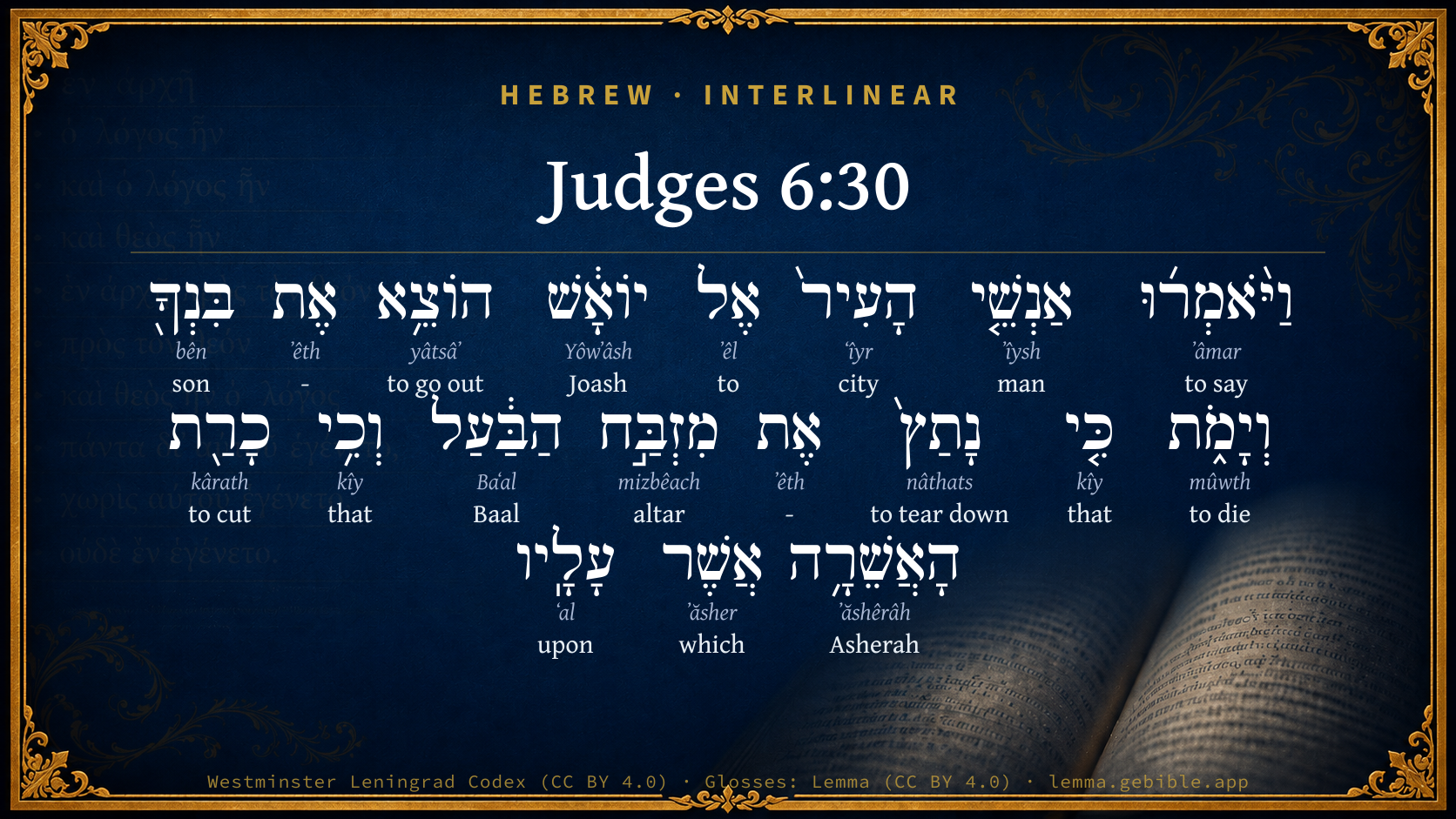
Judges 6:30

Hebrew (Westminster Leningrad Codex) Judges 6:30 appears in the Hebrew Old Testament. The text above is from the Westminster Leningrad Codex. Each word links to its Strong’s number, a concise gloss, and parsing drawn from the Open Scriptures Hebrew Bible morphology. Click any word for its full Brown-Driver-Briggs (BDB) entry.
Download image
Cite this verse

Judges 6:30 (World English Bible). Public Domain. Lemma interlinear Bible study tool, https://lemma.gebible.app/v/judges/6/30.

Show BibTeX & RIS
BibTeX
RIS
English Translation
Then the men of the city said to Joash, Bring out your son, that he may die, because he has broken down the altar of Baal, and because he has cut down the Asherah that was by it.
World English Bible · Public Domain
Download a study sheet

One document with this verse’s original text, its word-by-word gloss line, the meaning frame, cross-references with their text, attributed commentary, and full source and license credits — printable, and it pastes into notes with its structure intact.

This verse Autodidact and up

Study sheet (.html) Plain text (.txt)

A passage Seminary Student

Up to 50 verses in one chapter. A passage sheet keeps up to 6 commentary sources and 12 cross-references per verse, in the order this page ranks them, and says so on the sheet whenever that leaves anything out. Ask for a single verse and you get the Autodidact verse sheet above.

Everything on this page stays free to read, with no account — the sheet is a download of what is already on screen, not access to it.

Want to remove ads? Support Godless Engineer
Compare translations 3

The same verse in 3 English versions, stacked beneath the original-language interlinear above. Click any original word for its lexicon entry.

Each is an independent rendering of the whole verse — the interlinear is not word-aligned to these translations.

Highlighted words mark where these versions differ — a whole-verse word diff, not a word-by-word alignment.

  • World English Bible Public Domain
    Then the men of the city said to Joash, Bring out your son, that he may die, because he has broken down the altar of Baal, and because he has cut down the Asherah that was by it.
  • King James Version Public Domain
    Then the men of the city said unto Joash, Bring out thy son, that he may die: because he hath cast down the altar of Baal, and because he hath cut down the grove that was by it.
  • unfoldingWord Literal Text CC BY-SA 4.0
    Then the men of the city said to Joash, “Bring out your son, that he may die, because he tore down the altar of Baal and because he cut down the Asherah that beside it.”

unfoldingWord Literal Text — © unfoldingWord, licensed CC BY-SA 4.0. Word-aligned USFM3 via Door43 (git.door43.org/unfoldingWord/en_ult).

Versions to compare (up to 4)

3 of 4 selected

Show all 18 translations

Every available English version of this verse, each an independent rendering of the whole verse.

  • World English Bible Public Domain
    Then the men of the city said to Joash, Bring out your son, that he may die, because he has broken down the altar of Baal, and because he has cut down the Asherah that was by it.
  • Berean Standard Bible Public Domain
    Then the men of the city said to Joash, “Bring out your son. He must die, because he has torn down Baal’s altar and cut down the Asherah pole beside it.”
  • Majority Standard Bible Public Domain
    Then the men of the city said to Joash, “Bring out your son. He must die, because he has torn down Baal’s altar and cut down the Asherah pole beside it.”
  • King James Version Public Domain
    Then the men of the city said unto Joash, Bring out thy son, that he may die: because he hath cast down the altar of Baal, and because he hath cut down the grove that was by it.
  • American Standard Version (1901) Public Domain
    Then the men of the city said unto Joash, Bring out thy son, that he may die, because he hath broken down the altar of Baal, and because he hath cut down the Asherah that was by it.
  • Revised Version (1885) Public Domain
    Then the men of the city said unto Joash, Bring out thy son, that he may die: because he hath broken down the altar of Baal, and because he hath cut down the Asherah that was by it.
  • Geneva Bible (1599) Public Domain
    Then the men of the citie said vnto Ioash, Bring out thy sonne, that hee may dye: for he hath destroyed the altar of Baal, and hath also cut downe the groue that was by it.
  • Douay-Rheims (1899) Public Domain
    And they said one to another: Who hath done this? And when they inquired for the author of the fact, it was said: Gedeon the son of Joas did all this.
  • Young's Literal Translation Public Domain
    And the men of the city say unto Joash, `Bring out thy son, and he dieth, because he hath broken down the altar of Baal, and because he hath cut down the shrine which `is' by it.'
  • Literal Standard Version CC BY-SA 4.0
    And the men of the city say to Joash, “Bring out your son, and he dies, because he has broken down the altar of Ba‘al, and because he has cut down the Asherah which [is] by it.”
  • Unlocked Literal Bible CC BY-SA 4.0
    Then the men of the town said to Joash, “Bring out your son so that he may be put to death, because he pulled apart the altar of Baal, and because he cut down the Asherah beside it.”
  • unfoldingWord Literal Text CC BY-SA 4.0
    Then the men of the city said to Joash, “Bring out your son, that he may die, because he tore down the altar of Baal and because he cut down the Asherah that beside it.”
  • Darby Bible Public Domain
    Then the men of the town said to Jo'ash, "Bring out your son, that he may die, for he has pulled down the altar of Ba'al and cut down the Ashe'rah beside it."
  • World Messianic Bible Public Domain
    Then the men of the city said to Joash, “Bring out your son, that he may die, because he has broken down the altar of Baal, and because he has cut down the Asherah that was by it.”
  • Webster's Bible Public Domain
    Then the men of the city said to Joash, Bring out thy son, that he may die: because he hath cast down the altar of Baal, and because he hath cut down the grove that was by it.
  • Free Bible Version CC BY-SA 4.0
    “Hand over your son,” the people of the town ordered Joash. “He must die, because he has torn down the altar of Baal and cut down the Asherah pole beside it.”
  • Bible in Basic English Public Domain
    Then the men of the town said to Joash, Make your son come out to be put to death, for pulling down the altar of Baal and cutting down the holy tree which was by it.
  • JPS Tanakh (1917) Public Domain
    Then the men of the city said unto Joash: 'Bring out thy son, that he may die; because he hath broken down the altar of Baal, and because he hath cut down the Asherah that was by it.'

Literal Standard Version (2020), Covenant Press — licensed CC BY-SA 4.0. Text via the HelloAO Bible API (eBible.org). Unlocked Literal Bible (unfoldingWord) — licensed CC BY-SA 4.0. Text via the HelloAO Bible API (eBible.org). unfoldingWord Literal Text — © unfoldingWord, licensed CC BY-SA 4.0. Word-aligned USFM3 via Door43 (git.door43.org/unfoldingWord/en_ult). Free Bible Version, Dr. Jonathan Gallagher — licensed CC BY-SA 4.0. Text via the HelloAO Bible API (eBible.org).

Word by word

More ways to search: Search by grammar → Find every occurrence → Compare this word →

Practice this passage: Drill this verse → Learn its vocabulary →

הָאֲשֵׁרָ֥ה
ʼăshêrâh
H842
“the · Asherah”
Particle, Definite Article + Noun, Proper
Part of Speech
Particle + Noun
Type
Proper
Full BDB Definition

Origin: from H833

TWOT: 183h

Ashera(h) = "groves (for idol worship)" - a Babylonian (Astarte)-Canaanite goddess (of fortune and happiness), the supposed consort of Baal, her images - the goddess, goddesses - her images - sacred trees or poles set up near an altar
  1. וַיֹּ֨אמְר֜וּ ʼâmar H559 “and · to say” Conjunction + Verb, Qal, Sequential Imperfect, 3rd Person, Masculine, Plural
  2. אַנְשֵׁ֤י ʼîysh H376 “men of” Noun, Common, Masculine, Plural, Construct
  3. הָעִיר֙ ʻîyr H5892 “the · city” Particle, Definite Article + Noun, Common, Feminine, Singular, Absolute
  4. אֶל ʼêl H413 “to” Preposition
  5. יוֹאָ֔שׁ Yôwʼâsh H3101 “Joash” Noun, Proper
  6. הוֹצֵ֥א yâtsâʼ H3318 “go out” Verb, Hiphil, Imperative, 2nd Person, Masculine, Singular
  7. אֶת ʼêth H853 “-” Particle, Direct Object
  8. בִּנְךָ֖ bên H1121 “son · your” Noun, Common, Masculine, Singular, Construct + Suffix, Personal, 2nd Person, Masculine, Singular
  9. וְיָמֹ֑ת mûwth H4191 “and · to die” Conjunction + Verb, Qal, Jussive, 3rd Person, Masculine, Singular
  10. כִּ֤י kîy H3588 “that” Conjunction
  11. נָתַץ֙ nâthats H5422 “to tear down” Verb, Qal, Perfect, 3rd Person, Masculine, Singular
  12. אֶת ʼêth H853 “-” Particle, Direct Object
  13. מִזְבַּ֣ח mizbêach H4196 “altar of” Noun, Common, Masculine, Singular, Construct
  14. הַבַּ֔עַל Baʻal H1168 “the · Baal” Particle, Definite Article + Noun, Proper
  15. וְכִ֥י kîy H3588 “and · that” Conjunction + Conjunction
  16. כָרַ֖ת kârath H3772 “to cut” Verb, Qal, Perfect, 3rd Person, Masculine, Singular
  17. אֲשֶׁר ʼăsher H834 “which” Particle, Relative
  18. עָלָֽיו ʻal H5921 “upon · him” Preposition + Suffix, Personal, 3rd Person, Masculine, Singular

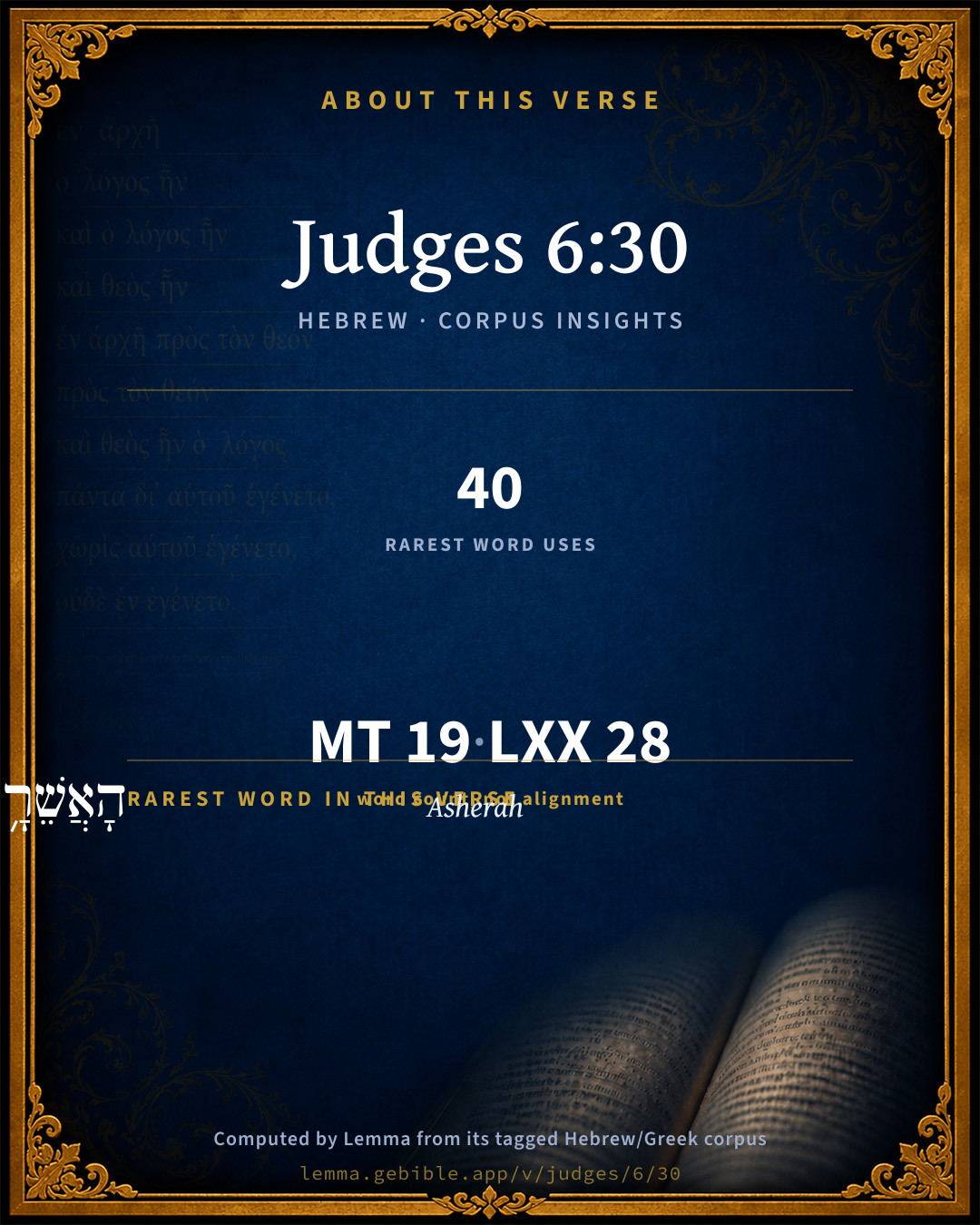
About this verse

These counts appear in no published source. They are computed here, from the morphology-tagged text and Lemma’s own curated glosses. What Lemma adds →

19
words
17
distinct lemmas
Historical
section

Shared distinctive vocabulary

הָאֲשֵׁרָ֥ה Asherah H842 occurs in 40 verses of the Hebrew Bible. Also found in:

Grammatical profile

  • 5 verbs
  • 7 nouns
  • 2 prepositions
  • 2 conjunctions
  • 3 particles

Verb forms

  • וַיֹּ֨אמְר֜וּ Qal · Sequential Imperfect
  • הוֹצֵ֥א Hiphil · Imperative
  • וְיָמֹ֑ת Qal · Jussive
  • נָתַץ֙ Qal · Perfect
  • כָרַ֖ת Qal · Perfect

Repetition

A word recurs within this verse — often emphatic in Hebrew:

  • כִּ֤י that H3588 ×2

Hebrew & Septuagint length

In English translation the verse runs 38 words from the Hebrew and 36 from the Septuagint (LXX English) — closely comparable.

A rough comparison of the two English renderings, which tokenize alike — not a word-level alignment.

Word counts can differ between the Hebrew and the Greek without any difference in meaning — e.g. the Hebrew direct-object marker אֵת has no separate Greek word, and Greek often adds the article ὁ.

In the original languages it is 19 Hebrew tokens and 28 Greek tokens — but the two are counted differently (Hebrew bundles its prefixes and suffixes into one token; the Greek is in lemma form), so that isn’t a like-for-like length.

Cross-references

5

Topical passages linked to Judges 6:30 in the Treasury of Scripture Knowledge — connected by theme and wording, ordered by reader-vote popularity; previews shown in the World English Bible.

  • Acts 26:9 "I myself most assuredly thought that I ought to do many things contrary to the name of Jesus of Nazareth.
  • John 16:2 They will put you out of the synagogues. Yes, the time comes that whoever kills you will think that he offers service to God.
  • Philippians 3:6 concerning zeal, persecuting the assembly; concerning the righteousness which is in the law, found blameless.
  • Jeremiah 26:11 Then spoke the priests and the prophets to the princes and to all the people, saying, This man is worthy of death; for he has prophesied against this city, as you have heard with your ears.
  • Jeremiah 50:38 A drought is on her waters, and they shall be dried up; for it is a land of engraved images, and they are mad over idols.

Cross-references courtesy of OpenBible.info (CC BY 4.0).

Hebrew and Greek witnesses Masoretic Hebrew ↔ Greek Septuagint

The same verse in the two great witnesses to the Old Testament, shown verse-for-verse.

These are two independent witnesses, not word-aligned to each other, and the Septuagint is shown in lemma (dictionary) form.

Hebrew Judges 6:30 Masoretic · Westminster Leningrad Codex

וַיֹּ֨אמְר֜וּ אַנְשֵׁ֤י הָעִיר֙ אֶל יוֹאָ֔שׁ הוֹצֵ֥א אֶת בִּנְךָ֖ וְיָמֹ֑ת כִּ֤י נָתַץ֙ אֶת מִזְבַּ֣ח הַבַּ֔עַל וְכִ֥י כָרַ֖ת הָאֲשֵׁרָ֥ה אֲשֶׁר עָלָֽיו

Then the men of the city said to Joash, Bring out your son, that he may die, because he has broken down the altar of Baal, and because he has cut down the Asherah that was by it.

World English Bible · Public Domain

Greek LXX Judges 6:30 Septuagint · lemma form

καί εἶπον ὁ ἀνήρ ὁ πόλις πρός ιωας ἐκφέρω ὁ υἱός σύ καί ἀποθνήσκω ὅτι κατααἱρέω ὁ θυσιαστήριον ὁ βααλ καί ὅτι ὀλεθρεύω ὁ ἄλσος ὁ ἐπί αὐτός

And the men of the city said to Joas, Bring out your son, and let him die, because he has destroyed the altar of Baal, and because he has destroyed the grove that is by it.

LXX2012 (modern English Septuagint) · Public Domain

Hebrew: Westminster Leningrad Codex (CC BY 4.0). Greek: Septuagint (public domain); English from LXX2012 (modern English Septuagint) (Public Domain). How the Septuagint differs from the Hebrew →

Targum (Aramaic paraphrase)

1

The Targum is the ancient Jewish Aramaic paraphrase of the Hebrew Scriptures — an interpretive translation, not the Hebrew text itself. Onkelos (literal) and Pseudo-Jonathan (expansive) render the Torah, and Jonathan the Prophets. Coverage is partial: where no permissively-licensed English translation exists for a verse, only the Aramaic is shown. This is verse-level text, not a word-by-word alignment to the Hebrew.

  1. Targum Jonathan Prophets (Joshua–Malachi)
    וַאֲמַרוּ אֱנָשֵׁי קַרְתָּא לְיוֹאָשׁ אַפֵיק יַת בְּרָךְ וְיִתְקְטַל אֲרֵי תְרַע יַת אֵיגוֹרָא דְבַעֲלָא וַאֲרֵי קָץ אֲשֶׁרְתָּא דִי עֲלוֹהִי:

    (no public-domain English translation for this verse)

    Targum Jonathan — Aramaic: “Mikraot Gedolot” (public domain). English: “Sefaria Community Translation” (CC0 1.0 (public-domain dedication)); “London "Chaldee Paraphrase," 1871” (public domain). Text via Sefaria.

Commentary

Notes on Judges 6:30 from classic Christian and Jewish commentators (each source and its license shown beneath its notes). The classic Christian expositions comment on the surrounding passage and are grouped to its opening verse, so a note may address several verses; the Jewish commentaries on the Tanakh (Rashi and others) are per-verse, so they appear only where the commentator wrote on this verse.

Lemma curates 59 commentaries, every one of them public domain or Creative Commons licensed, each selected and text-cleaned for this edition rather than reprinted as found. About our sources →

Trapp's Complete Commentary

John Trapp

Jdg 6:30 Then the men of the city said unto Joash, Bring out thy son, that he may die: because he hath cast down the altar of Baal, and because he hath cut down the grove that [was] by it.

Ver. 30. Bring out thy son, that he may die.] Idolatry is bloody, as the experience of all ages testifieth. How Nebuchadnezzar dealt by those who would not worship his golden gods, and how the king of Persia handled Abdas, the bishop who had overturned his idol temple, A.D. 413, I need not relate. The memorable story of William Gardiner, an English martyr in Portugal, who had both his hands cut off, and was afterwards burnt to ashes, for overturning the chalice at Mass, and treading under foot the breaden god, may be read in Mr Foxe’s "Martyrology," fol. 1242; and so may the story of William Flower, who, for like cause here in England, had first his hand held up against the stake where he was burned, and stricken off. {a} John Clark, of Melda, for testifying against the Pope’s pardons, and calling him Antichrist, was whipped and branded with a hot iron. But the next year, A.D. 1524, for breaking down the images without the town, which the superstitious Papists were the next day to have worshipped, he had first his right hand chopped off, and after that his nose pulled off with pinchers, and then his two arms and his two breasts torn from his body with the same instrument. Amidst his greatest torments he cried out, "Their idols are silver and gold, the work of men’s hands." When they had tired themselves torturing of him, they burnt his body with fire. {b}

{a} Act. and Mon., 1427.

{b} Scultet., Annal.

John Trapp, A Commentary or Exposition upon All the Books of the Old and New Testament (1647–1656) — public domain. Text from a community e-Sword module.

Adam Clarke's Commentary

Verse 30. The men of the city said] They all felt an interest in the continuance of rites in which they had often many sensual gratifications. Baal and Ashtaroth would have more worshippers than the true God, because their rites were more adapted to the fallen nature of man.

Adam Clarke's Commentary on the Bible (1810–1826) — public domain. Text from a community e-Sword/MySword module.

Ellicott's Commentary for English Readers

(30) The men of the city said unto Joash.—It is difficult to conceive that these could have been Israelites (see on Jdg_6:27).

Bring out thy son, that he may die.—For the phrase, see Gen_38:24; 1Ki_21:10; Luk_19:27.

A Bible Commentary for English Readers, edited by Charles John Ellicott (1878–1897) — public domain. Text from a community e-Sword module.

The Cambridge Bible for Schools and Colleges

gen. ed. J. J. S. Perowne

30. Bring out thy son] If the father gave up his son there would be no blood-feud.

The Cambridge Bible for Schools and Colleges (gen. ed. J. J. S. Perowne; Cambridge University Press, 1878–1918) — public domain. Text from a community e-Sword module.

John Gill's Exposition

And Joash said unto all that stood against him,.... Against his son; that were his accusers and adversaries, and required him to be given up to them, that they might put him to death:

will ye plead for Baal? what, Israelites, and plead for Baal! or what need is there for this, cannot he plead for himself?

will ye save him? what, take upon you to save your god! cannot he save himself? he ought to save both himself and you, if he is a god, and not you save him:

he that will plead for him, let him be put to death, while it is yet morning; immediately, before noon, for it was now morning when they came to him; this he said to terrify them, and to express the hatred he now had of idolatry, and the just sense of its being punishable with death by the law of God. This he may be supposed to say, to save his son from their present wrath and fury, hoping by that time to find out some ways and means for his safety:

if he be a god, let him plead for himself, because one hath cast down his altar; if he is a god, he knows who has done it, and is able to avenge himself on him, and put him to death himself that has done it, and therefore leave it with him to plead his own cause, and avenge his own injuries; this he said, deriding the deity; for though Joash had been a worshipper of Baal, yet he might be now convinced by his son of the sinfulness of it, and of the necessity of a reformation, in order to a deliverance from the Midianites, for which he had a commission, and had perhaps informed his father of it; or however he was not so attached to Baal, but that he preferred the life of his son to the worship of him.

John Gill's Exposition of the Whole Bible (1746–1763) — public domain (CC PDM 1.0). Text via the HelloAO Bible API.

Haydock's Catholic Bible Commentary

Bring. Parents took cognizance of the evil actions done in their family. The citizens require Joas to punish his son, or to deliver him up to them. On the same principle, the Israelites insisted that the tribes of Benjamin should not neglect to punish the citizens of Gabaa; and the Philistines demand Samson, chap. xv. 12., and xx. 13. Cato advised that Cæsar should be given up to the Germans, whom he had unjustly invaded; and the Gauls would not be satisfied, unless the Fabii should be abandoned unto them. (Grotius, Jur. ii. 21, 4.[24?]) (Haydock)

George Leo Haydock (1774–1849), Haydock's Catholic Family Bible and Commentary, 1859 edition — public domain. Excludes Psalms (Douay-Rheims chapter numbering differs from Protestant) and Deuterocanonical books (Catholic canon only).

Whedon's Commentary on the Bible

Daniel D. Whedon

30. That he may die — Such sacrilege, in their judgment, deserved immediate death.

Daniel D. Whedon (gen. ed.), Commentary on the Old and New Testaments (1874–1909) — public domain. Text from a community e-Sword module.

John Wesley's Explanatory Notes

They said - Probably some of the persons employed in it.

John Wesley, Explanatory Notes Upon the Whole Bible (1754–1765) — public domain. Text via the GEBible commentary corpus.

unfoldingWord translationNotes

Door43 World Missions Community

he may be put to death

This can be stated in active form. AT: "we may kill him as punishment" (See: Active or Passive)

translationWords

Joash

son

die

altar

Baal

Asherah

unfoldingWord translationNotes — © Distant Shores Media and the Door43 World Missions Community, licensed CC BY-SA 4.0. Source: git.door43.org/Door43/en_tn.

Lesson kit

Teaching starters — assembled from the data on this page, not authored interpretation. Every prompt links to the verse data it draws on. Edit before teaching.

Judges, in the Historical, opens this verse with 19 words (17 distinct Hebrew lemmas). Its most distinctive word is ʼăshêrâh (“Asherah”). A historical commentator’s framing appears above. Read the whole chapter for the surrounding context.

Discussion questions

  1. The word ʼăshêrâh carries the sense “Asherah.” How does it shape the verse?
  2. How does Exodus 34:13, which shares the word «Asherah», read alongside this verse?
  3. What does the repetition of “that” (2× in this one verse) do in this verse?
  4. These translations render this verse differently; the difference is in the English rendering, not the original. What questions does that raise?
  5. «וַיֹּ֨אמְר֜וּ» is a Qal Sequential Imperfect verb. How does that grammatical form shape the action described?
  6. Compare how Trapp's Complete Commentary and Adam Clarke's Commentary read this verse. Where do they agree or differ?

Things to notice

Reading settings

Reading text

Shown beneath each verse's original-language words.

Old Testament
Old Testament edition

Read the OT as the Masoretic Hebrew (MT) or the Greek Septuagint (LXX).

English shown for the Greek Septuagint (in the Hebrew ↔ Greek comparison).

Comparing translations? Open the Compare panel on any verse page to stack up to four side by side.