
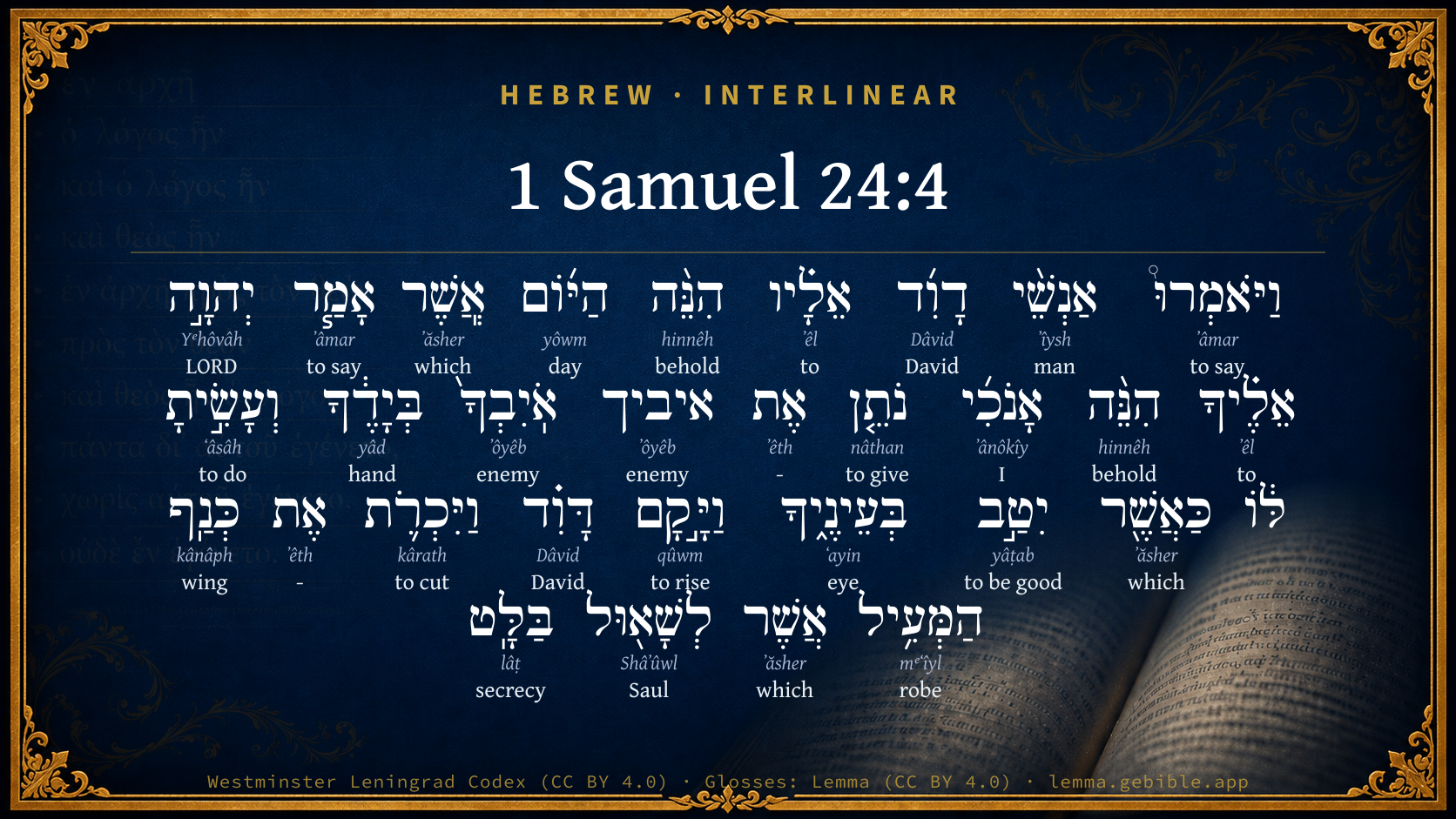
1 Samuel 24:4

Hebrew (Westminster Leningrad Codex) 1 Samuel 24:4 appears in the Hebrew Old Testament. The text above is from the Westminster Leningrad Codex. Each word links to its Strong’s number, a concise gloss, and parsing drawn from the Open Scriptures Hebrew Bible morphology. Click any word for its full Brown-Driver-Briggs (BDB) entry.
Download image
Cite this verse

1 Samuel 24:4 (World English Bible). Public Domain. Lemma interlinear Bible study tool, https://lemma.gebible.app/v/1-samuel/24/4.

Show BibTeX & RIS
BibTeX
RIS
English Translation
The men of David said to him, Behold, the day of which Yahweh said to you, Behold, I will deliver your enemy into your hand, and you shall do to him as it shall seem good to you. Then David arose, and cut off the skirt of Saul's robe secretly.
World English Bible · Public Domain
Download a study sheet

One document with this verse’s original text, its word-by-word gloss line, the meaning frame, cross-references with their text, attributed commentary, and full source and license credits — printable, and it pastes into notes with its structure intact.

This verse Autodidact and up

Study sheet (.html) Plain text (.txt)

A passage Seminary Student

Up to 50 verses in one chapter. A passage sheet keeps up to 6 commentary sources and 12 cross-references per verse, in the order this page ranks them, and says so on the sheet whenever that leaves anything out. Ask for a single verse and you get the Autodidact verse sheet above.

Everything on this page stays free to read, with no account — the sheet is a download of what is already on screen, not access to it.

Want to remove ads? Support Godless Engineer
Compare translations 3

The same verse in 3 English versions, stacked beneath the original-language interlinear above. Click any original word for its lexicon entry.

Each is an independent rendering of the whole verse — the interlinear is not word-aligned to these translations.

Highlighted words mark where these versions differ — a whole-verse word diff, not a word-by-word alignment.

  • World English Bible Public Domain
    The men of David said to him, Behold, the day of which Yahweh said to you, Behold, I will deliver your enemy into your hand, and you shall do to him as it shall seem good to you. Then David arose, and cut off the skirt of Saul's robe secretly.
  • King James Version Public Domain
    And the men of David said unto him, Behold the day of which the LORD said unto thee, Behold, I will deliver thine enemy into thine hand, that thou mayest do to him as it shall seem good unto thee. Then David arose, and cut off the skirt of Saul's robe privily.
  • unfoldingWord Literal Text CC BY-SA 4.0
    And the men of David said to him, “Behold, today what Yahweh said to you, ‘Behold, I am giving your enemy into your hand, and you will do to him just as is good in your eyes.’” And David arose and cut off the edge of the robe that to Saul, in secrecy.

unfoldingWord Literal Text — © unfoldingWord, licensed CC BY-SA 4.0. Word-aligned USFM3 via Door43 (git.door43.org/unfoldingWord/en_ult).

Versions to compare (up to 4)

3 of 4 selected

Show all 18 translations

Every available English version of this verse, each an independent rendering of the whole verse.

  • World English Bible Public Domain
    The men of David said to him, Behold, the day of which Yahweh said to you, Behold, I will deliver your enemy into your hand, and you shall do to him as it shall seem good to you. Then David arose, and cut off the skirt of Saul's robe secretly.
  • Berean Standard Bible Public Domain
    So David’s men said to him, “This is the day about which the LORD said to you, ‘Behold, I will deliver your enemy into your hand, that you may do with him as you wish.’” Then David crept up secretly and cut off a corner of Saul’s robe.
  • Majority Standard Bible Public Domain
    So David’s men said to him, “This is the day about which the LORD said to you, ‘Behold, I will deliver your enemy into your hand, that you may do with him as you wish.’” Then David crept up and stealthily cut off a corner of Saul’s robe.
  • King James Version Public Domain
    And the men of David said unto him, Behold the day of which the LORD said unto thee, Behold, I will deliver thine enemy into thine hand, that thou mayest do to him as it shall seem good unto thee. Then David arose, and cut off the skirt of Saul's robe privily.
  • American Standard Version (1901) Public Domain
    And the men of David said unto him, Behold, the day of which Jehovah said unto thee, Behold, I will deliver thine enemy into thy hand, and thou shalt do to him as it shall seem good unto thee. Then David arose, and cut off the skirt of Saul's robe privily.
  • Revised Version (1885) Public Domain
    And the men of David said unto him, Behold, the day of which the LORD said unto thee, Behold, I will deliver thine enemy into thine hand, and thou shalt do to him as it shall seem good unto thee. Then David arose, and cut off the skirt of Saul’s robe privily.
  • Geneva Bible (1599) Public Domain
    And hee came to the sheepecoates by the way where there was a caue, and Saul went in to do his easement: and Dauid and his men sate in the inward parts of the caue.
  • Douay-Rheims (1899) Public Domain
    And he came to the sheepcotes, which were in his way. And there was a cave, into which Saul went, to ease nature: now David and his men lay hid in the inner part of the cave.
  • Young's Literal Translation Public Domain
    And the men of David say unto him, `Lo, the day of which Jehovah said unto thee, Lo, I am giving thine enemy into thy hand, and thou hast done to him as it is good in thine eyes;' and David riseth and cutteth off the skirt of the upper robe which `is' on Saul -- gently.
  • Literal Standard Version CC BY-SA 4.0
    And the men of David say to him, “Behold, the day of which YHWH said to you, Behold, I am giving your enemy into your hand, and you have done to him as it is good in your eyes”; and David rises and cuts off the skirt of the upper robe which [is] on Saul with stealth.
  • Unlocked Literal Bible CC BY-SA 4.0
    David's men said to him, “This is the day of which Yahweh spoke when he said to you, 'I will give your enemy into your hand, for you to do with him as you wish.'” Then David arose and quietly crept forward and cut off the corner of Saul's robe.
  • unfoldingWord Literal Text CC BY-SA 4.0
    And the men of David said to him, “Behold, today what Yahweh said to you, ‘Behold, I am giving your enemy into your hand, and you will do to him just as is good in your eyes.’” And David arose and cut off the edge of the robe that to Saul, in secrecy.
  • Darby Bible Public Domain
    And David's men said to him, Behold the day of which Jehovah said to thee, Behold, I will give thine enemy into thy hand, that thou mayest do to him as it shall seem good to thee. And David arose, and cut off the skirt of Saul's robe secretly.
  • World Messianic Bible Public Domain
    David’s men said to him, “Behold, the day of which the LORD said to you, ‘Behold, I will deliver your enemy into your hand, and you shall do to him as it shall seem good to you.’” Then David arose and cut off the skirt of Saul’s robe secretly.
  • Webster's Bible Public Domain
    \\24:3\\And he came to the sheep-cotes by the way, where was a cave; and Saul went in to cover his feet: and David and his men remained in the sides of the cave.
  • Free Bible Version CC BY-SA 4.0
    David's men said to him, “Today's the day the Lord promised you when he told you, ‘Listen, I'm going to hand over your enemy to you, so you can do to him whatever you want.’” Then David crept up quietly and cut a piece from the edge of Saul's robe.
  • Bible in Basic English Public Domain
    And on the way he came to a place where sheep were kept, where there was a hollow in the rock; and Saul went in for a private purpose. Now David and his men were in the deepest part of the hollow.
  • JPS Tanakh (1917) Public Domain
    (24-5) And the men of David said unto him: 'Behold the day in which the LORD hath said unto thee: Behold, I will deliver thine enemy into thy hand, and thou shalt do to him as it shall seem good unto thee.' Then David arose, and cut off the skirt of Saul's robe privily.

Literal Standard Version (2020), Covenant Press — licensed CC BY-SA 4.0. Text via the HelloAO Bible API (eBible.org). Unlocked Literal Bible (unfoldingWord) — licensed CC BY-SA 4.0. Text via the HelloAO Bible API (eBible.org). unfoldingWord Literal Text — © unfoldingWord, licensed CC BY-SA 4.0. Word-aligned USFM3 via Door43 (git.door43.org/unfoldingWord/en_ult). Free Bible Version, Dr. Jonathan Gallagher — licensed CC BY-SA 4.0. Text via the HelloAO Bible API (eBible.org).

Word by word

More ways to search: Search by grammar → Find every occurrence → Compare this word →

Practice this passage: Drill this verse → Learn its vocabulary →

בַּלָּֽט
lâṭ
H3909
“in/at the · secrecy”
Preposition, Determined + Noun, Common, Masculine, Singular, Absolute
Part of Speech
Preposition + Noun
Type
Common
Gender
Masculine
Number
Singular
State
Absolute
Full BDB Definition

Origin: a form of H3814 or else participle from H3874

TWOT: 1092a

secrecy, mystery, enchantment - secrecy, secretly - mystery, enchantment
  1. וַיֹּאמְרוּ֩ ʼâmar H559 “and · to say” Conjunction + Verb, Qal, Sequential Imperfect, 3rd Person, Masculine, Plural
  2. אַנְשֵׁ֨י ʼîysh H376 “men of” Noun, Common, Masculine, Plural, Construct
  3. דָוִ֜ד Dâvid H1732 “David” Noun, Proper
  4. אֵלָ֗יו ʼêl H413 “to · him” Preposition + Suffix, Personal, 3rd Person, Masculine, Singular
  5. הִנֵּ֨ה hinnêh H2009 “behold” Particle, Demonstrative
  6. הַיּ֜וֹם yôwm H3117 “the · day” Particle, Definite Article + Noun, Common, Masculine, Singular, Absolute
  7. אֲֽשֶׁר ʼăsher H834 “which” Particle, Relative
  8. אָמַ֧ר ʼâmar H559 “to say” Verb, Qal, Perfect, 3rd Person, Masculine, Singular
  9. יְהוָ֣ה Yᵉhôvâh H3068 “LORD” Noun, Proper
  10. אֵלֶ֗יךָ ʼêl H413 “to · you” Preposition + Suffix, Personal, 2nd Person, Masculine, Singular
  11. הִנֵּ֨ה hinnêh H2009 “behold” Particle, Demonstrative
  12. אָנֹכִ֜י ʼânôkîy H595 “I” Pronoun, Personal, 1st Person, Common, Singular
  13. נֹתֵ֤ן nâthan H5414 “giving” Verb, Qal, Participle Active, Masculine, Singular, Absolute
  14. אֶת ʼêth H853 “-” Particle, Direct Object
  15. איביך ʼôyêb H341 “enemy · you” Verb, Qal, Participle Active, Masculine, Plural, Construct + Suffix, Personal, 2nd Person, Masculine, Singular
  16. אֹֽיִבְךָ֙ ʼôyêb H341 “enemy · you” Verb, Qal, Participle Active, Masculine, Singular, Construct + Suffix, Personal, 2nd Person, Masculine, Singular
  17. בְּיָדֶ֔ךָ yâd H3027 “in/at · hand · your” Preposition + Noun, Common, Both, Singular, Construct + Suffix, Personal, 2nd Person, Masculine, Singular
  18. וְעָשִׂ֣יתָ ʻâsâh H6213 “and · to do” Conjunction + Verb, Qal, Sequential Perfect, 2nd Person, Masculine, Singular
  19. כַּאֲשֶׁ֖ר ʼăsher H834 “like/as · which” Preposition + Particle, Relative
  20. יִטַ֣ב yâṭab H3190 “to be good” Verb, Qal, Imperfect, 3rd Person, Masculine, Singular
  21. בְּעֵינֶ֑יךָ ʻayin H5869 “in/at · eyes · your” Preposition + Noun, Common, Both, Dual, Construct + Suffix, Personal, 2nd Person, Masculine, Singular
  22. וַיָּ֣קָם qûwm H6965 “and · to rise” Conjunction + Verb, Qal, Sequential Imperfect, 3rd Person, Masculine, Singular
  23. דָּוִ֗ד Dâvid H1732 “David” Noun, Proper
  24. וַיִּכְרֹ֛ת kârath H3772 “and · to cut” Conjunction + Verb, Qal, Sequential Imperfect, 3rd Person, Masculine, Singular
  25. אֶת ʼêth H853 “-” Particle, Direct Object
  26. כְּנַֽף kânâph H3671 “wing of” Noun, Common, Feminine, Singular, Construct
  27. הַמְּעִ֥יל mᵉʻîyl H4598 “the · robe” Particle, Definite Article + Noun, Common, Masculine, Singular, Absolute
  28. אֲשֶׁר ʼăsher H834 “which” Particle, Relative
  29. לְשָׁא֖וּל Shâʼûwl H7586 “to/for · Saul” Preposition + Noun, Proper

About this verse

These counts appear in no published source. They are computed here, from the morphology-tagged text and Lemma’s own curated glosses. What Lemma adds →

31
words
22
distinct lemmas
Historical
section

Notable vocabulary

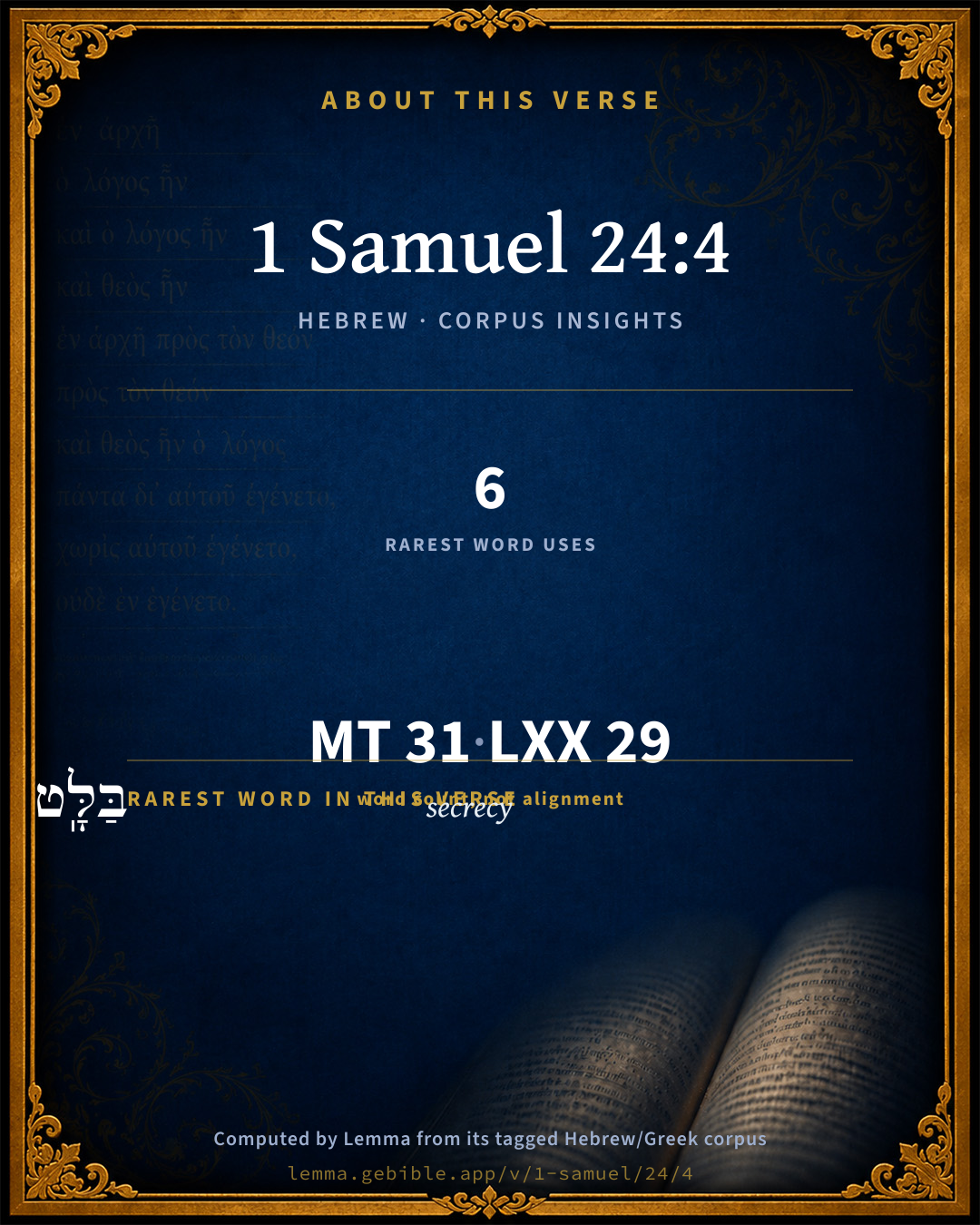
The rarest word here is בַּלָּֽט secrecy H3909 — appearing just 6 times in the whole Hebrew Bible.

Shared distinctive vocabulary

בַּלָּֽט secrecy H3909 occurs in 6 verses of the Hebrew Bible. Also found in:

Grammatical profile

  • 9 verbs
  • 11 nouns
  • 1 pronoun
  • 3 prepositions
  • 7 particles

Verb forms

  • וַיֹּאמְרוּ֩ Qal · Sequential Imperfect
  • אָמַ֧ר Qal · Perfect
  • נֹתֵ֤ן Qal · Participle Active
  • איביך Qal · Participle Active
  • אֹֽיִבְךָ֙ Qal · Participle Active
  • וְעָשִׂ֣יתָ Qal · Sequential Perfect
  • יִטַ֣ב Qal · Imperfect
  • וַיָּ֣קָם Qal · Sequential Imperfect
  • וַיִּכְרֹ֛ת Qal · Sequential Imperfect

Repetition

Words recur within this verse — often emphatic in Hebrew:

  • וַיֹּאמְרוּ֩ to say H559 ×2
  • דָוִ֜ד David H1732 ×2
  • הִנֵּ֨ה behold H2009 ×2
  • איביך enemy H341 ×2
  • אֲֽשֶׁר which H834 ×3
  • אֵלָ֗יו to H413 ×2

Hebrew & Septuagint length

In English translation the verse runs 50 words from the Hebrew and 40 from the Septuagint (LXX English) — closely comparable.

A rough comparison of the two English renderings, which tokenize alike — not a word-level alignment.

Word counts can differ between the Hebrew and the Greek without any difference in meaning — e.g. the Hebrew direct-object marker אֵת has no separate Greek word, and Greek often adds the article ὁ.

In the original languages it is 31 Hebrew tokens and 29 Greek tokens — but the two are counted differently (Hebrew bundles its prefixes and suffixes into one token; the Greek is in lemma form), so that isn’t a like-for-like length.

Cross-references

9

Topical passages linked to 1 Samuel 24:4 in the Treasury of Scripture Knowledge — connected by theme and wording, ordered by reader-vote popularity; previews shown in the World English Bible.

  • 1 Samuel 26:8–11 Then said Abishai to David, God has delivered up your enemy into your hand this day: now therefore please let me strike him with the spear to the earth at one stroke, and I will not strike him the second time.
  • 1 Samuel 24:10 Behold, this day your eyes have seen how that Yahweh had delivered you today into my hand in the cave: and some bade me kill you; but [my eye] spared you; and I said, I will not put forth my hand against my lord; for he is Yahweh's anointed.
  • 1 Samuel 26:23 Yahweh will render to every man his righteousness and his faithfulness; because Yahweh delivered you into my hand today, and I wouldn't put forth my hand against Yahweh's anointed.
  • 1 Samuel 25:28–30 Please forgive the trespass of your handmaid: for Yahweh will certainly make my lord a sure house, because my lord fights the battles of Yahweh; and evil shall not be found in you all your days.
  • 1 Samuel 23:7 It was told Saul that David was come to Keilah. Saul said, God has delivered him into my hand; for he is shut in, by entering into a town that has gates and bars.
  • 1 Samuel 23:17 He said to him, Don't be afraid; for the hand of Saul my father shall not find you; and you shall be king over Israel, and I shall be next to you; and that also Saul my father knows.
  • 1 Samuel 24:18 You have declared this day how that you have dealt well with me, because when Yahweh had delivered me up into your hand, you didn't kill me.
  • 2 Samuel 4:8 They brought the head of Ish-bosheth to David to Hebron, and said to the king, Behold, the head of Ish-bosheth, the son of Saul, your enemy, who sought your life; and Yahweh has avenged my lord the king this day of Saul, and of his seed.
  • Job 31:31 If the men of my tent have not said, 'Who can find one who has not been filled with his meat?'

Cross-references courtesy of OpenBible.info (CC BY 4.0).

Hebrew and Greek witnesses Masoretic Hebrew ↔ Greek Septuagint

The same verse in the two great witnesses to the Old Testament, shown verse-for-verse.

These are two independent witnesses, not word-aligned to each other, and the Septuagint is shown in lemma (dictionary) form.

Hebrew 1 Samuel 24:4 Masoretic · Westminster Leningrad Codex

וַיֹּאמְרוּ֩ אַנְשֵׁ֨י דָוִ֜ד אֵלָ֗יו הִנֵּ֨ה הַיּ֜וֹם אֲֽשֶׁר אָמַ֧ר יְהוָ֣ה אֵלֶ֗יךָ הִנֵּ֨ה אָנֹכִ֜י נֹתֵ֤ן אֶת איביך אֹֽיִבְךָ֙ בְּיָדֶ֔ךָ וְעָשִׂ֣יתָ לּ֔וֹ כַּאֲשֶׁ֖ר יִטַ֣ב בְּעֵינֶ֑יךָ וַיָּ֣קָם דָּוִ֗ד וַיִּכְרֹ֛ת אֶת כְּנַֽף הַמְּעִ֥יל אֲשֶׁר לְשָׁא֖וּל בַּלָּֽט

The men of David said to him, Behold, the day of which Yahweh said to you, Behold, I will deliver your enemy into your hand, and you shall do to him as it shall seem good to you. Then David arose, and cut off the skirt of Saul's robe secretly.

World English Bible · Public Domain

Greek LXX 1 Samuel 24:4 Septuagint · lemma form

καί ἔρχομαι εἰς ὁ ἀγέλη ὁ ποίμνιον ὁ ἐπί ὁ ὁδός καί εἰμί ἐκεῖ σπήλαιον καί σαούλ εἰςἔρχομαι παρασκευάζω καί δαυίδ καί ὁ ἀνήρ αὐτός ἐσώτερον ὁ σπήλαιον καταἧμαι

And he came to the flocks of sheep that were by the way, and there was a cave there; and Saul went in to make preparation, and David and his men were sitting in the inner part of the cave.

LXX2012 (modern English Septuagint) · Public Domain

Hebrew: Westminster Leningrad Codex (CC BY 4.0). Greek: Septuagint (public domain); English from LXX2012 (modern English Septuagint) (Public Domain). How the Septuagint differs from the Hebrew →

Targum (Aramaic paraphrase)

1

The Targum is the ancient Jewish Aramaic paraphrase of the Hebrew Scriptures — an interpretive translation, not the Hebrew text itself. Onkelos (literal) and Pseudo-Jonathan (expansive) render the Torah, and Jonathan the Prophets. Coverage is partial: where no permissively-licensed English translation exists for a verse, only the Aramaic is shown. This is verse-level text, not a word-by-word alignment to the Hebrew.

  1. Targum Jonathan Prophets (Joshua–Malachi)
    וַאֲתָא לְחַטְרֵי עָאנָא דְעַל אוֹרְחָא וְתַמָן מְעַרְתָּא וְעַל שָׁאוּל לְמֶעְבַּד צוֹרְכֵיהּ וְדָוִד וְגַבְרוֹהִי בִסְיָפֵי מְעַרְתָּא יָתְבִין:

    (no public-domain English translation for this verse)

    Targum Jonathan — Aramaic: “Mikraot Gedolot” (public domain). English: “Sefaria Community Translation” (CC0 1.0 (public-domain dedication)); “London "Chaldee Paraphrase," 1871” (public domain). Text via Sefaria.

Commentary

Notes on 1 Samuel 24:4 from classic Christian and Jewish commentators (each source and its license shown beneath its notes). The classic Christian expositions comment on the surrounding passage and are grouped to its opening verse, so a note may address several verses; the Jewish commentaries on the Tanakh (Rashi and others) are per-verse, so they appear only where the commentator wrote on this verse.

Lemma curates 59 commentaries, every one of them public domain or Creative Commons licensed, each selected and text-cleaned for this edition rather than reprinted as found. About our sources →

Trapp's Complete Commentary

John Trapp

1Sa 24:4 And the men of David said unto him, Behold the day of which the LORD said unto thee, Behold, I will deliver thine enemy into thine hand, that thou mayest do to him as it shall seem good unto thee. Then David arose, and cut off the skirt of Saul’s robe privily.

Ver. 4. Behold the day of which the Lord said unto thee.] But when and where did the Lord say this to David? Either not at all, but they spoke it of their own heads, to move him to make an end of Saul, the cause of all their sorrows and sufferings; or else they collected it from God’s general promise to deliver all David’s enemies into his hands; their fingers even itched to be doing at Saul, and therefore they urge the matter so hard upon David to despatch him out of the way: the present opportunity here thrust into his hands they looked upon as an oracle and warrant good enough, and therefore not to be slighted or let slip. Thus we see how ready we are to hasten the Lord’s promise, if the occasion serve never so little, saith the Geneva note here.

And cut off the skirt of Saul’s robe privily.] Sine impetu aut strepitu alam pallii abscidit. Abulensis thinketh that God at this time made David extraordinarily nimble, and Saul extraordinarily deaf; but the noise of Saul’s soldiers without the cave, and Saul’s upper garment lying at some distance from him as then, might easily give David this opportunity of cutting a lap of it undiscerned.

John Trapp, A Commentary or Exposition upon All the Books of the Old and New Testament (1647–1656) — public domain. Text from a community e-Sword module.

Joseph Benson's Commentary

1Sa 24:4. The men of David said unto him, &c. — The cave being very large, and David and his men at the further end of it, they might see Saul by the light of the entrance, without his seeing them, and might whisper together what follows without being heard. The Lord said unto thee, Behold, I will deliver, &c. — We do not read anywhere that God said these very words, or made a promise to deliver Saul into David’s hands. But they put this construction on what Samuel had said about taking the kingdom from Saul and giving it to David, and on those promises which God had made to him of delivering him from all his enemies, and carrying him through all difficulties to the throne. These promises, they conceived, laid him under an obligation of taking all opportunities which God put into his hands for their accomplishment. Add to this, that, having a desire to return to their own habitations, and also to have preferment under David, they wished him to seize this occasion which now presented itself of destroying his enemy, and advancing himself. Then David arose and cut off the skirt of Saul’s robe privily — Which he might easily do, as he was asleep.

Joseph Benson's Commentary on the Old and New Testaments (1811–1818) — public domain. Text from a community e-Sword module.

MacLaren's Expositions of Holy Scripture

Alexander MacLaren

1 Samuel

LOVE FOR HATE, THE TRUE QUID PRO QUO

1Sa 24:4 - 1Sa 24:17.

A sudden Philistine invasion had saved David, when hard pressed by Saul, and had given him the opportunity of flight to the wild country on the west of the Dead Sea, near the place where En-Gedi {‘the Fountain of the Wild Goat’} sparkles into light on the hill above the weird lake. In these savage gorges Saul’s three thousand men would be of little use against the light-footed outlaw and his troop. The whole district is seamed with ravines, and these are honeycombed with great caverns, where dangerous outcasts still lurk and defy capture. Travellers go into raptures over the beauty of some of these ‘fairy grottoes’ draped with maiden-hair fern, cool and moist, and blessedly dark after the fierce light outside. In some one of these the beautiful story which makes our lesson occurred.

I. We have the scene in the cave. The interior would be black as night to one looking inward with eyes fresh from the blinding glare of such sunlight upon limestone, but it would hold a glimmering twilight for one looking outward, with eyes accustomed to the gloom. David and his men, keeping close to the walls and hiding behind angles, might well be unobserved by Saul at the mouth, and probably never looking in at all. How vividly the whispered eagerness of the outcasts round David is reproduced! They think it would be ‘tempting Providence’ to let such a chance slip. They put a religious varnish on their advice. It would be almost impious not to kill Saul, for here was the hand of God evidently fulfilling a prophecy! There may have been some unrecorded prediction of the sort which they seem to quote; but more probably they are only referring to David’s designation to the crown, which they had come to know. It never struck them as possible that it could ‘seem good’ to a wise man not to cut his enemy’s throat when he could do it without danger to himself. So they would watch David stealing down quietly to the place where the unconscious king was crouching, and getting close behind him, knife in hand. How disgusted they must have been when the blade, that flashed for a moment in the light at the cave’s mouth, was not buried in Saul’s great back, but only hacked off the end of his robe spread out behind him! No personal animosity was in David. However he had been driven to consort with outlaws, and to live a kind of freebooter’s life, his natural sweetness was unspoiled, and was reinforced by solemn veneration for the sanctity of the Lord’s anointing, which he reverenced all the more because himself had received it. He clambered back to his disappointed men, and, as soon as he was up in the dark again, his chivalry and his religion made him ashamed of his coarse practical jest. The humour of the thing had tempted him to do it; but it was a rude insult, which lowered him more than it did Saul, and, like a true man, he blushes there in the gloom at what he has done. Then he has to defend himself to his men for not coming up to their expectations, and he does it by insisting on the sacredness which still surrounded Saul as ‘the Lord’s anointed.’ David knew that the unhappy king had been rejected and forsaken by ‘the Spirit of the Lord,’ and that he himself was the true bearer of the regal unction; but he will not take the law into his own hands, and still regards Saul as his ‘lord.’ He sets the example, much needed by us all, of leaving God to carry out His purposes at His own time, and patiently waiting till that time comes. He had hard work to keep his men from rushing down on the king; but, having commanded himself, is able to restrain them. How many virtues may be in exercise in one action! Here we have generosity, clemency, sensitiveness of conscience, reverence, self-abnegation, patience, loyalty, firmness, sway over lower natures for high ends,-a whole constellation shining star-like in the dark cavern.

II. We have, next, David’s pathetic remonstrance. Saul was alone, and David could easily escape among the cliffs, if the king summoned his men; but he risks capture, in the gush of ancient friendship. His words are full of nobleness, and his silence is no less so. He has no reproaches, no anger nor hate. He will not even suppose that Saul has followed his own impulses in his persecution, but assumes that he has been led astray by calumnies. He points to the fragment of Saul’s robe in his hand as the disproof of the lie that he had designs against him, and passionately asserts his innocence now and in all the past. He compares himself to some timid wild thing, like one of the goats among the cliffs, and Saul to a hunter. He solemnly calls God to judge between them, and appeals from the slanders and misjudgings of men to the perfect tribunal of God, to whom he commits his cause. He abjures all intention of striking at Saul in his own defence. He quotes, in true Eastern manner, a scrap of proverbial wisdom, which contains the homely truth that character determines action; for it needs a wicked man to do a wicked thing, and he implies that he is not wicked, and that Saul knows that well enough,-by what has just happened, if by nothing else. Then he puts his own insignificance and the disproportion between him and his ragged band and the imposing force of Saul in vivid light by his half-humorous and wholly humble description of himself as a ‘dead dog,’ and a ‘flea’; as harmless as the one, as hard to catch as the other, as little important as either. Finally, he reiterates his devout reference of the whole cause to God, and his fixed resolution to take no steps to right himself, but to leave all to Him.

So ought we to deal with slanders and enmity. The eternal law for us in all opposition and hostility is enshrined in David’s noble words and deeds. To repay evil with benefits, to abstain from retaliation when it is in our power, to keep our tongues from bitter and wounding words, to appeal to the adversary’s better self, even at the cost of our own ‘dignity,’-all that is not easy nor usual among professing Christians. But it ought to be. David’s Lord, ‘when He suffered, threatened not; but committed Himself to Him that judgeth righteously.’ We are poor followers of Him, if David surpasses us in patience and magnanimity. It has taken nineteen hundred years to teach us that passive endurance is more heroic than fighting for our own hand, and that repaying scorn and hate with their like is less noble than meeting them with endless forgiveness.

Psa 7:1 - Psa 7:17 is all but universally regarded as David’s, and as belonging to this period. In it we find a clause, ‘I have delivered him that without cause was mine enemy,’ which may fairly he supposed to refer to the scene in the cave, and we read the same vehement protestations of innocence, the same figure of himself as a hunted wild animal, the same appeal to God’s judgment, as in his remonstrance with Saul. The psalm is the poetic echo of our lesson.

III. We have the momentary melting of Saul’s heart. He breaks into passionate weeping. With that sudden flashing out into vehement emotion, so characteristic of him throughout, and, in these latter days of his life, so significant of enfeebled self-control, he recognises David’s generous forbearance in its contrast to his own hate, which, for the moment, he feels to be causeless. There is a piteous remembrance of the days when David soothed him by song, in his mention of the sweet ‘voice,’ and some rekindling of ancient love in his calling him ‘My son.’ Then follow the sad words which confess the hopelessness of his struggle against the divine purpose, and his appeal for mercy to his house. The picture may well move solemn thoughts and pity for that scathed and solitary soul, seeing for a moment, as by a lightning flash, the madness of his course, and yet held so fast in the grip of his dark passions that he cannot shake off their tyranny.

Two great lessons are taught by that tragic figure of the weeping and yet unchanged king. One is of the power of forbearing gentleness to exorcise hate. The true way to ‘overcome evil’ is to melt it by fiery coals of gentleness. That is God’s way. An iceberg may be crushed to powder, but every fragment is still ice. Only sunshine that melts it will turn it into sweet water. Love is conqueror, and the only conqueror, and its conquest is to transform hate into love. The other lesson is the worthlessness of mere feeling, which by its very nature passes away, and, like unstored rain, leaves the rock in its obstinate hardness more exposed. Saul only increased his guilt by reason of the fleeting glimpse of his folly which he did not follow up; and our gleams of insight into some sin and madness of ours but add to our responsibility. Emotion which does not lead to action hardens the heart, and adds to our guilt and condemnation.

Alexander MacLaren, Expositions of Holy Scripture (1904–1910) — public domain. Text from a community e-Sword module.

Tyndale Open Study Notes

Tyndale Open Resources

24:4 David’s men believed, as Saul did, that if the circumstances seem right, the Lord is telling you through those circumstances what to do (cp. 23:7). • Perhaps David was able to cut off a piece of the hem of Saul’s robe without being apprehended because Saul had taken off the robe and laid it aside, or perhaps he fell asleep in the cave.

Tyndale Open Study Notes — © Tyndale Open Resources, licensed CC BY-SA 4.0. Text via the HelloAO Bible API.

Geneva Bible (1599)

Geneva Bible translators

Hebrew, to cover his feet.

Hebrew, in the sides.

Geneva Bible (1599) marginal notes — public domain. Text via Bolls.life.

Jamieson, Fausset & Brown

Robert Jamieson, A. R. Fausset & David Brown

the men of David said . . . Behold the day of which the Lord said unto thee, Behold, I will deliver thine enemy into thine hand--God had never made any promise of delivering Saul into David's hand; but, from the general and repeated promises of the kingdom to him, they concluded that the king's death was to be effected by taking advantage of some such opportunity as the present. David steadily opposed the urgent instigations of his followers to put an end to his and their troubles by the death of their persecutor (a revengeful heart would have followed their advice, but David rather wished to overcome evil with good, and heap coals of fire upon his head); he, however, cut off a fragment from the skirt of the royal robe. It is easy to imagine how this dialogue could be carried on and David's approach to the king's person could have been effected without arousing suspicion. The bustle and noise of Saul's military men and their beasts, the number of cells or divisions in these immense caverns (and some of them far interior) being enveloped in darkness, while every movement could be seen at the cave's mouth--the probability that the garment David cut from might have been a loose or upper cloak lying on the ground, and that Saul might have been asleep--these facts and presumptions will be sufficient to account for the incidents detailed.

Jamieson, Fausset & Brown — Commentary Critical and Explanatory on the Whole Bible (1871) — public domain (CC PDM 1.0). Text via the HelloAO Bible API.

Adam Clarke's Commentary

Verse 4. And the men of David said] We know not to what promise of God the men of David refer; they perhaps meant no more than to say, "Behold, the Lord hath delivered thine enemy into thy land, now do to him as he wishes to do to thee."

Then David arose] Though I have a high opinion of the character of David, yet the circumstances of the case seem to indicate that he arose to take away the life of Saul, and that it was in reference to this that his heart smote him. It appears that he rose up immediately at the desire of his men to slay his inveterate enemy, and one whom he knew the Lord had rejected; but when about to do it he was prevented by the remonstrance of God in his conscience, and instead of cutting off his head, as he might have done, an act which the laws and usages of war would have justified, he contented himself with cutting off the skirt of his robe; and he did this only to show Saul how much he had been in his power.

Adam Clarke's Commentary on the Bible (1810–1826) — public domain. Text from a community e-Sword/MySword module.

Ellicott's Commentary for English Readers

(4) Behold the day of which the Lord said unto thee.—This was the version by David’s men of such predictions as 1Sa_15:28; 1Sa_16:1; 1Sa_16:12. Jonathan’s words (1Sa_20:15; 1Sa_23:17) show clearly that these predictions were known; and the version of them here given was a very natural one in the mouth of David’s men (Speaker’s Commentary). It is, however, quite possible that a prophet such as Gad had predicted publicly, in the hearing of David’s band of followers, that the days would come when their now outlawed captain, the son of Jesse, the “Anointed of Jehovah”—all his enemies being overthrown—would reign in peace and glory over all the land.

Then David arose.—For a moment the “king to be” listened to the seductive voice of the tempter; and we may imagine him, with the sword of Goliath naked in his hand, advancing towards his unconscious adversary, sleeping in the cave’s mouth, resolved with one good blow to end the long, cruel war, and then, his great rival being gone, to seat himself at once on the empty throne which he knew the Eternal meant him one day to occupy—but only for a moment; for through the soul of David rapidly passed the thought that the helpless sleeping one was, after all, the “Anointed of Jehovah.” How could he, himself “an anointed king,” touch another of the same order to do him harm? So with a matchless generosity, unequalled, indeed, in those rough days, he spared the man who so ruthlessly and so often had sought his life, and even at that moment, with all the power of the land, was trying to do him to death; and David the outlaw bent over the sleeping king who hated him with so deep a hate, and deftly cut off the skirt, perhaps some of the golden fringe which edged the royal m’il, and as he bent over him, and saw once more the face of Saul—from whose brow so often his minstrelsy had chased the dark clouds of madness—we can fancy the son of Jesse once more loving the great hero of his boyhood: loving him as he did in the old days when he played in the king’s dark hours.

There is no doubt but that one of the most beautiful characteristics of David’s many-sided nature, was this enduring loyalty to Saul and to Saul’s house. No jealousy, or even bitter injuries done in after years could affect the old love, the old feeling of loyal reverence, the more than filial affection; it was even proof against time. Years after Saul was in his grave. David gave the most conspicuous proof of his faithful memory of his old, devoted friendship for Saul and his house, when he pardoned Mephibosheth, the grandson of Saul, for his more than suspected treason, in the matter of the revolt of Absalom, and restored to him a large portion of his forfeited lands (2Sa_19:24-29).

A Bible Commentary for English Readers, edited by Charles John Ellicott (1878–1897) — public domain. Text from a community e-Sword module.

The Cambridge Bible for Schools and Colleges

gen. ed. J. J. S. Perowne

4. of which the Lord said] David may have received from Samuel and Gad assurances of his ultimate deliverance from Saul’s persecutions, which his followers interpret in their own way. Cp. 1Sa_23:17, 1Sa_25:28-30.

the skirt] See on 1Sa_25:27. He wished to have some proof to convince Saul that his life had been in his power.

The Cambridge Bible for Schools and Colleges (gen. ed. J. J. S. Perowne; Cambridge University Press, 1878–1918) — public domain. Text from a community e-Sword module.

John Gill's Exposition

And the men of David said unto him,.... Some of his principal men, who were about him, and near him, such as Joab and Abishai:

behold the day of which the Lord said unto thee: now the time was come that he spoke of to him by Samuel, or Gad, or to himself directly:

behold, I will deliver thine enemy into thine hand; and such was Saul, as appeared by his seeking to take away his life; and now he was in the hand of David to take away his life, if he pleased:

that thou mayest do to him as it shall seem good unto thee; an opportunity of this kind now offered:

then David arose; from that part of the cave in which he was, the further part of it:

and cut off the skirt of Saul's robe privily; unawares to him, and unobserved by him, which might be easily done, if Saul was asleep, and it is probable he was; and by the same way it may be accounted for that he did not hear the discourse that passed between David and his men.

John Gill's Exposition of the Whole Bible (1746–1763) — public domain (CC PDM 1.0). Text via the HelloAO Bible API.

Albert Barnes' Notes on the Bible

The day of which the Lord said ... - This was the version by David’s men of such divine predictions as 1Sa 15:28; 1Sa 16:1, 1Sa 16:12. Jonathan’s words 1Sa 20:15; 1Sa 23:17 show clearly that these predictions were known.

Albert Barnes' Notes on the Bible (1834–1885) — public domain. Text from a community e-Sword/MySword module.

Haydock's Catholic Bible Commentary

Cotes. These were probably no other than the caverns, in which shepherds there secure themselves and their flocks, in the night, and from storms. (Tirinus) --- Some of them, in Syria, are so capacious as to contain 4,000 men, (Strabo xvi.) so that David might well remain unperceived by Saul, who did not enter so far. Polyphemus and Cacus dwelt in caverns, with their flocks. (Virgil, Æneid viii.) --- Nature. Hebrew, "to cover his feet," which has the same import. Syriac and Arabic, "to rest, or sleep."

George Leo Haydock (1774–1849), Haydock's Catholic Family Bible and Commentary, 1859 edition — public domain. Excludes Psalms (Douay-Rheims chapter numbering differs from Protestant) and Deuterocanonical books (Catholic canon only).

Matthew Poole's English Annotations

Quest. How came it to pass that Saul did not hear his debates of David and his men?

Answ. First, The greater noise of Saul’s men and horses, just by the cave’s mouth, might easily drown the lesser. Secondly, There were in these large and capacious caves several cells or parts, whereof some were more inward and remote from the cave’s mouth, in which they might freely converse and discourse, and yet neither be heard nor seen by Saul, though they could easily see him, and observe all his postures and actions, because he was in the mouth of the cave. Thirdly, Saul might be asleep, as hath been discoursed.

Behold the day of which the Lord said unto thee; not that either said these words, or made any such particular promise. as some apprehend; but they put this construction upon those confessed and known promises which God had made to him, of delivering him from all his enemies, and carrying him through all hinderances and difficulties to the throne and kingdom; which promise they conceived put him under an obligation of watching and taking all opportunities which God by his providence should put into his hand for their accomplishment, whereof this was an eminent instance.

David arose, and cut off the skirt of Saul’s robe privily.

Quest. How could David do thus, and Saul not perceive it?

Answ. First, This might be some loose and upper garment, which Saul might then lay at some distance from him, as we oft do on the same occasion. Secondly, In those vast caves there were divers particular cells and rooms, which were distinct one from another, yet so as there were secret passages from one to another, as may be gathered from the relations of historians and travellers. At the mouth of one of these, Saul might lay his upper garment; which David perceiving, and very well knowing all the cells and passages of that cave, might go some secret way to it, and cut off a little part of it. Thirdly, The noise which David’s motion might be supposed to make was but small, and that he well knew would be perfectly drowned with the far greater noise of Saul’s army, which lay at the mouth of the cave. Fourthly, The heroical actions of great men in Scripture are not to be measured by common rules. And as divers of the prophets and saints of old were in some of their actions, so David might be in this, moved to it by a secret and Divine impulse, which also gave him confidence of God’s assistance therein, and of the success of his enterprise. Fifthly, This difficulty doth perfectly vanish, if Saul was now asleep. And as no man can prove that he was not, so that he was may seem probable from what is said on 1Sa 24:3.

Matthew Poole's English Annotations on the Holy Bible (1683–1685) — public domain. Text from a community e-Sword/MySword module.

Whedon's Commentary on the Bible

Daniel D. Whedon

4. Behold the day of which the Lord said unto thee — We have no mention elsewhere of any such oracle as this, though David may have received it through Gad or Abiathar. But probably we should understand it as a free construction by David’s friends of all such prophecies and events as had designated this son of Jesse for the throne of Israel. 1Sa_15:28; 1Sa_16:1; 1Sa_16:12; 1Sa_20:15; 1Sa_23:17.

The skirt of Saul’s robe — A corner or flap of his outer garment. This garment Saul had probably laid off when he entered the cave, and so David was able the more easily to cut a piece from it unobserved by the king.

Daniel D. Whedon (gen. ed.), Commentary on the Old and New Testaments (1874–1909) — public domain. Text from a community e-Sword module.

The Pulpit Commentary

Vers. 4, 5. Behold the day of which Jehovah said unto thee, etc. David"s men regard this deliverance of Saul into their band as providential, and the fulfilment of the promises made in David"s favour, with which, no doubt, they were well acquainted. But with a noble self-control he refuses to take the matter into his own hand, and leaves unto God in trusting faith the execution of his purposes. To prove, nevertheless, to Saul his innocence, to soften his bitterness, and refute the suspicion that he was lying in wait to murder him, he cuts off the corner Hebrew, wing of his meil. (see 1Sa_2:19) Even for this his heart smote him. So tender was his conscience that he condemned himself for even deviating so slightly from the respect due to the anointed king.

The Pulpit Commentary (1880–1919), ed. H.D.M. Spence-Jones & Joseph S. Exell — public domain. Text from a community e-Sword module.

John Wesley's Explanatory Notes

Behold, &c. - Not that God had said these words, or made any such promise; but they put this construction upon those promises which God had made to him, of delivering him from all his enemies, and carrying him through all difficulties to the throne. This promise they conceived put him under an obligation of taking all opportunities which God put into his hand for their accomplishment.

John Wesley, Explanatory Notes Upon the Whole Bible (1754–1765) — public domain. Text via the GEBible commentary corpus.

Rashi

Rabbi Shlomo Yitzchaki (Rashi)

To relieve himself. To defecate.

Rashi on the Tanakh — English translations: “The Judaica Press complete Tanach with Rashi, translated by A. J. Rosenberg” (CC BY 4.0); “Pentateuch with Rashi's commentary by M. Rosenbaum and A.M. Silbermann, 1929-1934” (public domain); “The Metsudah Tanach series, Lakewood, N.J” (CC BY 4.0); and “The Book of Joshua, Metsudah Publications, 1997” (CC BY 4.0). Text via Sefaria.

Lesson kit

Teaching starters — assembled from the data on this page, not authored interpretation. Every prompt links to the verse data it draws on. Edit before teaching.

1 Samuel, in the Historical, opens this verse with 31 words (22 distinct Hebrew lemmas). Its most distinctive word is lâṭ (“secrecy”). A historical commentator’s framing appears above. Read the whole chapter for the surrounding context.

Discussion questions

  1. The word lâṭ carries the sense “secrecy.” How does it shape the verse?
  2. Exodus 7:22 shares the word «secrecy» with this verse. How do the two illuminate each other?
  3. “to say” occurs 2× in this one verse. What is the effect of the repetition?
  4. These translations render this verse differently. What is at stake in choosing one wording over another?
  5. The verb «וַיֹּאמְרוּ֩» is Qal Sequential Imperfect. How does its form color the action?
  6. Reading how Trapp's Complete Commentary and Joseph Benson's Commentary read this verse, where do the two commentators agree and where do they part?

Things to notice

Reading settings

Reading text

Shown beneath each verse's original-language words.

Old Testament
Old Testament edition

Read the OT as the Masoretic Hebrew (MT) or the Greek Septuagint (LXX).

English shown for the Greek Septuagint (in the Hebrew ↔ Greek comparison).

Comparing translations? Open the Compare panel on any verse page to stack up to four side by side.