
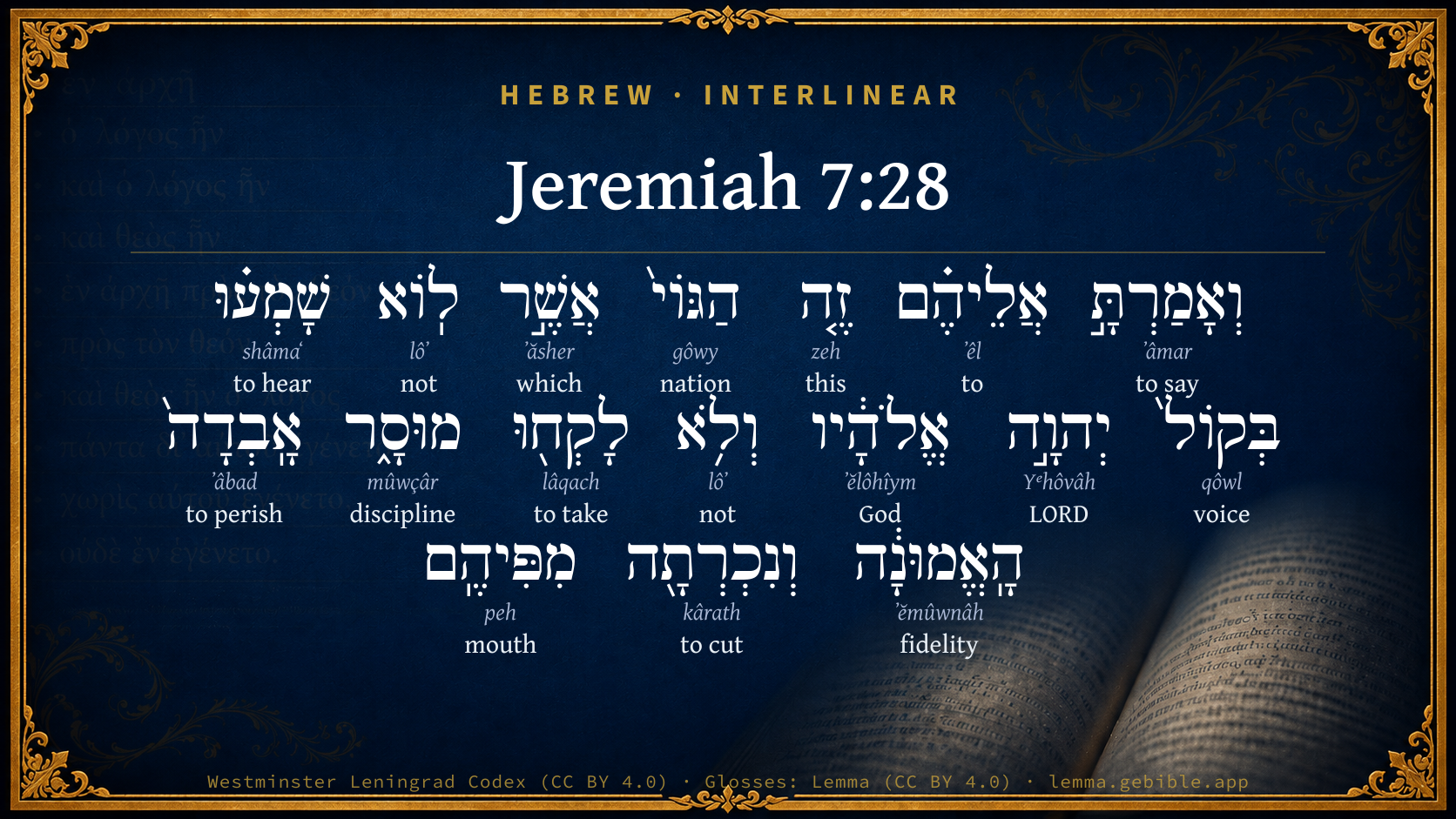
Jeremiah 7:28

Hebrew (Westminster Leningrad Codex) Jeremiah 7:28 appears in the Hebrew Old Testament. The text above is from the Westminster Leningrad Codex. Each word links to its Strong’s number, a concise gloss, and parsing drawn from the Open Scriptures Hebrew Bible morphology. Click any word for its full Brown-Driver-Briggs (BDB) entry.
Download image
Cite this verse

Jeremiah 7:28 (World English Bible). Public Domain. Lemma interlinear Bible study tool, https://lemma.gebible.app/v/jeremiah/7/28.

Show BibTeX & RIS
BibTeX
RIS
English Translation
You shall tell them, This is the nation that has not listened to the voice of Yahweh their God, nor received instruction: truth is perished, and is cut off from their mouth.
World English Bible · Public Domain
Download a study sheet

One document with this verse’s original text, its word-by-word gloss line, the meaning frame, cross-references with their text, attributed commentary, and full source and license credits — printable, and it pastes into notes with its structure intact.

This verse Autodidact and up

Study sheet (.html) Plain text (.txt)

A passage Seminary Student

Up to 50 verses in one chapter. A passage sheet keeps up to 6 commentary sources and 12 cross-references per verse, in the order this page ranks them, and says so on the sheet whenever that leaves anything out. Ask for a single verse and you get the Autodidact verse sheet above.

Everything on this page stays free to read, with no account — the sheet is a download of what is already on screen, not access to it.

Want to remove ads? Support Godless Engineer
Compare translations 3

The same verse in 3 English versions, stacked beneath the original-language interlinear above. Click any original word for its lexicon entry.

Each is an independent rendering of the whole verse — the interlinear is not word-aligned to these translations.

Highlighted words mark where these versions differ — a whole-verse word diff, not a word-by-word alignment.

  • World English Bible Public Domain
    You shall tell them, This is the nation that has not listened to the voice of Yahweh their God, nor received instruction: truth is perished, and is cut off from their mouth.
  • King James Version Public Domain
    But thou shalt say unto them, This is a nation that obeyeth not the voice of the LORD their God, nor receiveth correction: truth is perished, and is cut off from their mouth.
  • unfoldingWord Literal Text CC BY-SA 4.0
    And you shall say to them: This the nation that does not listen to the voice of Yahweh its God and does not receive discipline. Truth has perished and has been cut off from their mouth.

unfoldingWord Literal Text — © unfoldingWord, licensed CC BY-SA 4.0. Word-aligned USFM3 via Door43 (git.door43.org/unfoldingWord/en_ult).

Versions to compare (up to 4)

3 of 4 selected

Show all 18 translations

Every available English version of this verse, each an independent rendering of the whole verse.

  • World English Bible Public Domain
    You shall tell them, This is the nation that has not listened to the voice of Yahweh their God, nor received instruction: truth is perished, and is cut off from their mouth.
  • Berean Standard Bible Public Domain
    Therefore you must say to them, ‘This is the nation that would not listen to the voice of the LORD their God and would not receive correction. Truth has perished; it has disappeared from their lips.
  • Majority Standard Bible Public Domain
    Therefore you must say to them, ‘This is the nation that would not listen to the voice of the LORD their God and would not receive correction. Truth has perished; it has disappeared from their lips.
  • King James Version Public Domain
    But thou shalt say unto them, This is a nation that obeyeth not the voice of the LORD their God, nor receiveth correction: truth is perished, and is cut off from their mouth.
  • American Standard Version (1901) Public Domain
    And thou shalt say unto them, This is the nation that hath not hearkened to the voice of Jehovah their God, nor received instruction: truth is perished, and is cut off from their mouth.
  • Revised Version (1885) Public Domain
    And thou shalt say unto them, This is the nation that hath not hearkened to the voice of the LORD their God, nor received instruction: truth is perished, and is cut off from their mouth.
  • Geneva Bible (1599) Public Domain
    But thou shalt say vnto them, This is a nation that heareth not the voice of the Lord their God, nor receiueth discipline: trueth is perished, and is cleane gone out of their mouth.
  • Douay-Rheims (1899) Public Domain
    And thou shalt say to them: This is a nation which hath not hearkened to the voice of the Lord their God, nor received instruction: Faith is lost, and is carried away out of their mouth.
  • Young's Literal Translation Public Domain
    And thou hast said unto them: This `is' the nation that hath not hearkened, To the voice of Jehovah its God, Nor have they accepted instruction, Perished hath stedfastness, Yea, it hath been cut off from their mouth.
  • Literal Standard Version CC BY-SA 4.0
    And you have said to them: This [is] the nation that has not listened, || To the voice of its God YHWH, || Nor have they accepted instruction, || Steadfastness has perished, || Indeed, it has been cut off from their mouth.
  • Unlocked Literal Bible CC BY-SA 4.0
    Say to them: This is a nation that does not listen to the voice of Yahweh its God and does not receive discipline. Truth is destroyed and cut off from their mouths.
  • unfoldingWord Literal Text CC BY-SA 4.0
    And you shall say to them: This the nation that does not listen to the voice of Yahweh its God and does not receive discipline. Truth has perished and has been cut off from their mouth.
  • Darby Bible Public Domain
    And thou shalt say unto them, This is the nation which hath not hearkened unto the voice of Jehovah their God, nor received correction; fidelity is perished, and is cut off from their mouth.
  • World Messianic Bible Public Domain
    You shall tell them, ‘This is the nation that has not listened to the LORD their God’s voice, nor received instruction. Truth has perished, and is cut off from their mouth.’
  • Webster's Bible Public Domain
    But thou shalt say to them, This is a nation that obeyeth not the voice of the LORD their God, nor receiveth correction: truth hath perished, and is cut off from their mouth.
  • Free Bible Version CC BY-SA 4.0
    So you have to tell them, “This is the nation that refused to listen to what the Lord their God said, and would not accept the Lord's discipline. Truth has died out; people don't even talk about it.
  • Bible in Basic English Public Domain
    And you are to say to them, This is the nation which has not given ear to the voice of their God, or taken his teaching to heart: good faith is dead and is cut off from their mouths.
  • JPS Tanakh (1917) Public Domain
    Therefore thou shalt say unto them: This is the nation that hath not hearkened to the voice of the LORD their God, nor received correction; faithfulness is perished, and is cut off from their mouth.

Literal Standard Version (2020), Covenant Press — licensed CC BY-SA 4.0. Text via the HelloAO Bible API (eBible.org). Unlocked Literal Bible (unfoldingWord) — licensed CC BY-SA 4.0. Text via the HelloAO Bible API (eBible.org). unfoldingWord Literal Text — © unfoldingWord, licensed CC BY-SA 4.0. Word-aligned USFM3 via Door43 (git.door43.org/unfoldingWord/en_ult). Free Bible Version, Dr. Jonathan Gallagher — licensed CC BY-SA 4.0. Text via the HelloAO Bible API (eBible.org).

Word by word

More ways to search: Search by grammar → Find every occurrence → Compare this word →

Practice this passage: Drill this verse → Learn its vocabulary →

הָֽאֱמוּנָ֔ה
ʼĕmûwnâh
H530
“the · fidelity”
Particle, Definite Article + Noun, Common, Feminine, Singular, Absolute
Part of Speech
Particle + Noun
Type
Common
Gender
Feminine
Number
Singular
State
Absolute
Full BDB Definition

Origin: from H529

TWOT: 116e

firmness, fidelity, steadfastness, steadiness
  1. וְאָמַרְתָּ֣ ʼâmar H559 “and · to say” Conjunction + Verb, Qal, Sequential Perfect, 2nd Person, Masculine, Singular
  2. אֲלֵיהֶ֗ם ʼêl H413 “to · them” Preposition + Suffix, Personal, 3rd Person, Masculine, Plural
  3. זֶ֤ה zeh H2088 “this” Pronoun, Demonstrative, Masculine, Singular
  4. הַגּוֹי֙ gôwy H1471 “the · nation” Particle, Definite Article + Noun, Common, Masculine, Singular, Absolute
  5. אֲשֶׁ֣ר ʼăsher H834 “which” Particle, Relative
  6. לֽוֹא lôʼ H3808 “not” Particle, Negative
  7. שָׁמְע֗וּ shâmaʻ H8085 “to hear” Verb, Qal, Perfect, 3rd Person, Common, Plural
  8. בְּקוֹל֙ qôwl H6963 “in/at · voice of” Preposition + Noun, Common, Masculine, Singular, Construct
  9. יְהוָ֣ה Yᵉhôvâh H3068 “LORD” Noun, Proper
  10. אֱלֹהָ֔יו ʼĕlôhîym H430 “God(s) · his” Noun, Common, Masculine, Plural, Construct + Suffix, Personal, 3rd Person, Masculine, Singular
  11. וְלֹ֥א lôʼ H3808 “and · not” Conjunction + Particle, Negative
  12. לָקְח֖וּ lâqach H3947 “to take” Verb, Qal, Perfect, 3rd Person, Common, Plural
  13. מוּסָ֑ר mûwçâr H4148 “discipline” Noun, Common, Masculine, Singular, Absolute
  14. אָֽבְדָה֙ ʼâbad H6 “to perish” Verb, Qal, Perfect, 3rd Person, Feminine, Singular
  15. וְנִכְרְתָ֖ה kârath H3772 “and · to cut” Conjunction + Verb, Niphal, Perfect, 3rd Person, Feminine, Singular
  16. מִפִּיהֶֽם peh H6310 “from · mouth · their” Preposition + Noun, Common, Masculine, Singular, Construct + Suffix, Personal, 3rd Person, Masculine, Plural

About this verse

These counts appear in no published source. They are computed here, from the morphology-tagged text and Lemma’s own curated glosses. What Lemma adds →

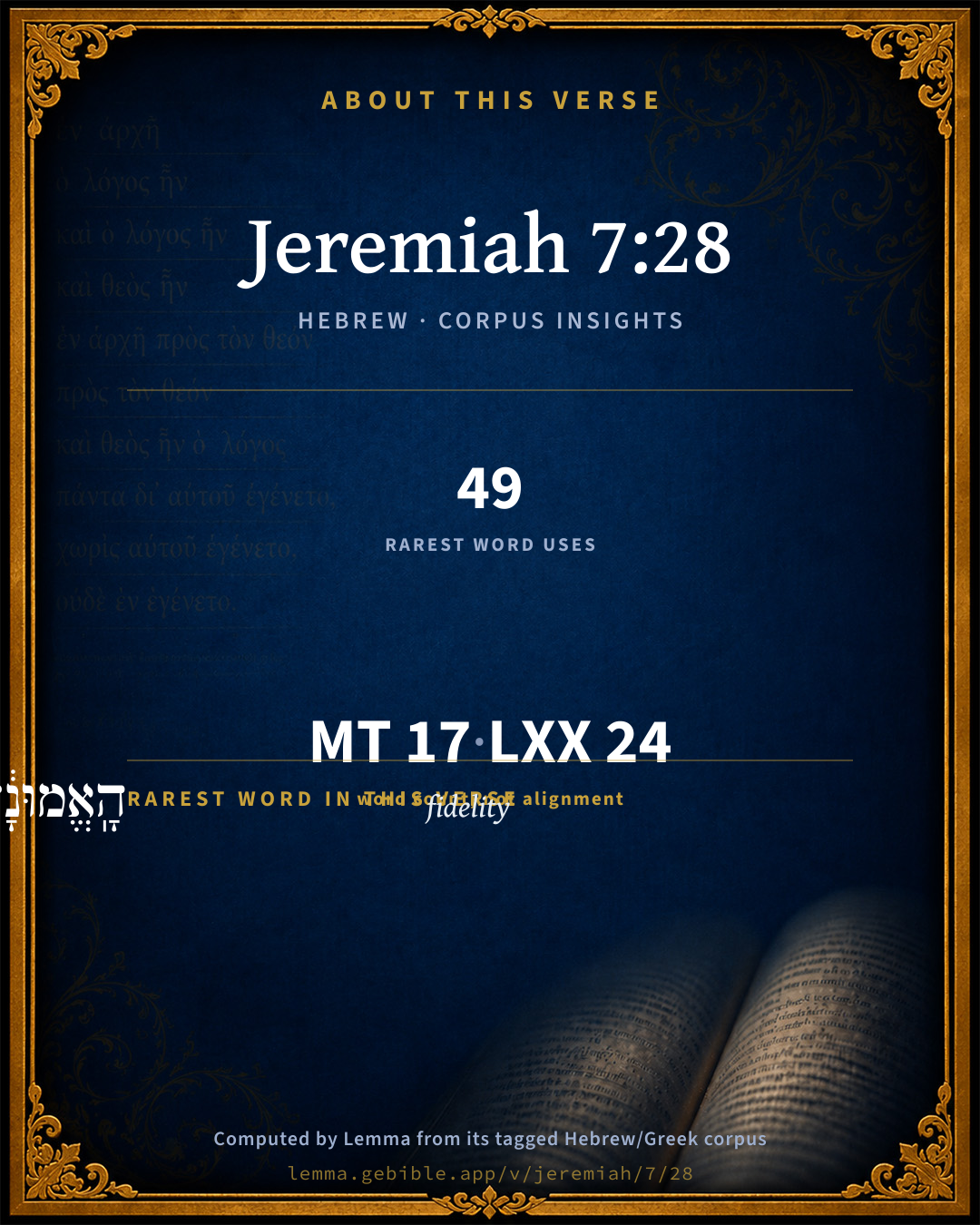
17
words
16
distinct lemmas
Prophets
section

Shared distinctive vocabulary

הָֽאֱמוּנָ֔ה fidelity H530 occurs in 49 verses of the Hebrew Bible. Also found in:

Grammatical profile

  • 5 verbs
  • 7 nouns
  • 1 pronoun
  • 1 preposition
  • 3 particles

Verb forms

  • וְאָמַרְתָּ֣ Qal · Sequential Perfect
  • שָׁמְע֗וּ Qal · Perfect
  • לָקְח֖וּ Qal · Perfect
  • אָֽבְדָה֙ Qal · Perfect
  • וְנִכְרְתָ֖ה Niphal · Perfect

Repetition

A word recurs within this verse — often emphatic in Hebrew:

  • לֽוֹא not H3808 ×2

Hebrew & Septuagint length

In the original languages it is 17 Hebrew tokens and 24 Greek tokens — but the two are counted differently (Hebrew bundles its prefixes and suffixes into one token; the Greek is in lemma form), so that isn’t a like-for-like length.

Cross-references

15

Topical passages linked to Jeremiah 7:28 in the Treasury of Scripture Knowledge — connected by theme and wording, ordered by reader-vote popularity; previews shown in the World English Bible.

  • Isaiah 59:14–15 Justice is turned away backward, and righteousness stands afar off; for truth is fallen in the street, and uprightness can't enter.
  • Proverbs 1:7 The fear of Yahweh is the beginning of knowledge; But the foolish despise wisdom and instruction.
  • Isaiah 1:4–5 Ah sinful nation, A people loaded with iniquity, A seed of evil-doers, Children who deal corruptly! They have forsaken Yahweh. They have despised the Holy One of Israel. They are estranged and backward.
  • Jeremiah 32:33 They have turned to me the back, and not the face: and though I taught them, rising up early and teaching them, yet they have not listened to receive instruction.
  • Zephaniah 3:2 She didn't obey the voice. She didn't receive correction. She didn't trust in Yahweh. She didn't draw near to her God.
  • Psalms 50:17 Seeing you hate instruction, And throw my words behind you?
  • Jeremiah 2:30 In vain have I struck your children; they received no correction: your own sword has devoured your prophets, like a destroying lion.
  • Jeremiah 5:1 Run you back and forth through the streets of Jerusalem, and see now, and know, and seek in the broad places of it, if you can find a man, if there are any who does justly, who seeks truth; and I will pardon her.
  • Jeremiah 5:3 O Yahweh, don't your eyes look on truth? you have stricken them, but they were not grieved; you have consumed them, but they have refused to receive correction: they have made their faces harder than a rock; they have refused to return.
  • Jeremiah 6:8 Be instructed, Jerusalem, lest my soul be alienated from you; lest I make you a desolation, a land not inhabited.
  • Jeremiah 6:29–30 The bellows blow fiercely; the lead is consumed of the fire: in vain do they go on refining; for the wicked are not plucked away.
  • Jeremiah 9:3–8 They bend their tongue, [as it were] their bow, for falsehood; and they are grown strong in the land, but not for truth: for they proceed from evil to evil, and they don't know me, says Yahweh.
  • Hosea 4:1 Hear the word of Yahweh, you children of Israel; For Yahweh has a charge against the inhabitants of the land: "Indeed there is no truth, Nor goodness, Nor knowledge of God in the land.
  • Micah 7:2–5 The godly man has perished out of the earth, And there is no one upright among men. They all lie in wait for blood; Every man hunts his brother with a net.
  • Zephaniah 3:7 I said, "Just fear me. Receive correction, so that her dwelling won't be cut off, according to all that I have appointed concerning her." But they rose early and corrupted all their doings.

Cross-references courtesy of OpenBible.info (CC BY 4.0).

Hebrew and Greek witnesses Masoretic Hebrew ↔ Greek Septuagint

The same verse in the two great witnesses to the Old Testament, shown verse-for-verse.

These are two independent witnesses, not word-aligned to each other, and the Septuagint is shown in lemma (dictionary) form.

Hebrew Jeremiah 7:28 Masoretic · Westminster Leningrad Codex

וְאָמַרְתָּ֣ אֲלֵיהֶ֗ם זֶ֤ה הַגּוֹי֙ אֲשֶׁ֣ר לֽוֹא שָׁמְע֗וּ בְּקוֹל֙ יְהוָ֣ה אֱלֹהָ֔יו וְלֹ֥א לָקְח֖וּ מוּסָ֑ר אָֽבְדָה֙ הָֽאֱמוּנָ֔ה וְנִכְרְתָ֖ה מִפִּיהֶֽם

You shall tell them, This is the nation that has not listened to the voice of Yahweh their God, nor received instruction: truth is perished, and is cut off from their mouth.

World English Bible · Public Domain

Greek LXX Structure differs

In the Septuagint, Jeremiah is about an eighth shorter than the Hebrew and arranges its material differently — the Oracles Against the Nations (Hebrew chapters 46–51) appear in the middle of the Greek book, after 25:13. Because the chapter and verse boundaries do not line up, a verse-for-verse comparison with the Hebrew is not shown.

A verse-for-verse comparison isn’t shown here because the chapters and verses don’t line up. Switch to the LXX edition with the MT / LXX toggle above to read the Greek directly.

Hebrew: Westminster Leningrad Codex (CC BY 4.0). Greek: Septuagint (public domain); English from a public-domain English Septuagint. How the Septuagint differs from the Hebrew →

Targum (Aramaic paraphrase)

1

The Targum is the ancient Jewish Aramaic paraphrase of the Hebrew Scriptures — an interpretive translation, not the Hebrew text itself. Onkelos (literal) and Pseudo-Jonathan (expansive) render the Torah, and Jonathan the Prophets. Coverage is partial: where no permissively-licensed English translation exists for a verse, only the Aramaic is shown. This is verse-level text, not a word-by-word alignment to the Hebrew.

  1. Targum Jonathan Prophets (Joshua–Malachi)
    וְתֵימַר לְהוֹן דֵין עַמָא דִי לָא שְׁמָעוּ לְמֵימְרָא דַייָ אֱלָהָהוֹן וְלָא קַבִּילוּ אוּלְפַן פִּסְקַת הֵימָנוּתָא וְאִתְמַנָעַת מִפּוּמְהוֹן:

    (no public-domain English translation for this verse)

    Targum Jonathan — Aramaic: “Mikraot Gedolot” (public domain). English: “Sefaria Community Translation” (CC0 1.0 (public-domain dedication)); “London "Chaldee Paraphrase," 1871” (public domain). Text via Sefaria.

Commentary

Notes on Jeremiah 7:28 from classic Christian and Jewish commentators (each source and its license shown beneath its notes). The classic Christian expositions comment on the surrounding passage and are grouped to its opening verse, so a note may address several verses; the Jewish commentaries on the Tanakh (Rashi and others) are per-verse, so they appear only where the commentator wrote on this verse.

Lemma curates 59 commentaries, every one of them public domain or Creative Commons licensed, each selected and text-cleaned for this edition rather than reprinted as found. About our sources →

Trapp's Complete Commentary

John Trapp

Jer 7:28 But thou shalt say unto them, This [is] a nation that obeyeth not the voice of the LORD their God, nor receiveth correction: truth is perished, and is cut off from their mouth.

Ver. 28. This is a nation.] A heathenish nation, such as they use to reproach with this name, Goi, and Mamzer Gojim, that is, bastardly heathens.

Nor receiveth correction.] Or, Instruction.

John Trapp, A Commentary or Exposition upon All the Books of the Old and New Testament (1647–1656) — public domain. Text from a community e-Sword module.

Jamieson, Fausset & Brown

Robert Jamieson, A. R. Fausset & David Brown

unto them--that is, in reference to them.

a nation--The word usually applied to the Gentile nations is here applied to the Jews, as being east off and classed by God among the Gentiles.

nor receiveth correction-- (Jer 5:3).

truth . . . perished-- (Jer 9:3).

Jamieson, Fausset & Brown — Commentary Critical and Explanatory on the Whole Bible (1871) — public domain (CC PDM 1.0). Text via the HelloAO Bible API.

Adam Clarke's Commentary

Verse 28. Nor receiveth correction] They have profited neither by mercies nor by judgments: blessings and corrections have been equally lost upon them.

Adam Clarke's Commentary on the Bible (1810–1826) — public domain. Text from a community e-Sword/MySword module.

John Calvin's Commentaries

God shews now that he must act in a new way. The first duty of teachers is to set forth the will of God, to shew what is right, and then to exhort, if plain teaching proves not sufficient. But God intimates here that he was under the necessity to change his manner, because they were wholly irreclaimable. Thou shalt then say this as the last thing; as though he had said, “I indeed wished to try, whether they were capable of being improved, and have employed thee for this purpose: after having long borne with them, knowing by a long trial that thy labor is useless, thou shalt say to them, “I bid you adieu at last.” For what is the meaning of these words, This is a nation which heard not the voice of its God, except that the Prophet, after long trials, knew that he was neither to teach nor exhort them? It is not to be doubted but that God referred to the Jews themselves; for it was his object to expose their impious perverseness. He yet comforted his servant; for he hence knew, that though he could do no good to his hearers, yet his labor was acceptable to God and not without its fruit: for the truth of God is not only fruitful in the salvation of men, but also in their perdition. (2 Corinthians 2:15, 16.) God then shews, that there would be no loss to his servant, even though the Jews repented not; for he would be their judge, and denounce by the highest authority their destruction.

We now perceive the design of the Holy Spirit, in saying, Thou shalt at length say, This is a nation which has not hearkened to the voice of its God: for the Prophet is not bidden here to address the Jews, but to pronounce on them a sentence, that the whole world might know how base and detestable had been their contumacy, and how abominable their impiety; for the whole nation had refused to hear The word nation seems here to be taken in a bad sense: it is indeed in many places to be taken for “people;” but in other places Scripture sets גוים, guim, in opposition to God’s chosen people. And perhaps this word has been used, that the Jews might know that they in vain gloried in their own dignity. He shews that they did not excel other nations, for they were themselves of the same class, a nation. This is a nation, he says, which has not hearkened to the voice of Jehovah their God In saying this he doubtless amplified their crime; for as God had made himself plainly known to the Jews, they could not pretend ignorance nor plead any doubt respecting what the prophets taught. As then they had designedly rejected their own God, they hence became more obviously guilty and abominable.

He afterwards adds, They have not received correction, he points out the very source of rebellion, — they were unwilling to undertake the yoke. Here then he excludes all those plausible pretences by which the Jews might cloak their impiety, as hypocrites are ever wont to do. Hence he declares that they had been unteachable, for they had refused correction. The word מוסר, musar, often means chastisement; but generally signifies every kind of training. As the subject here is teaching, the Prophet means that they were willfully blind, for they would not be taught; Now this is the extremity of wicked perverseness, that is, when men become so degenerated, that they willfully assimilate themselves to brute beasts by rejecting the yoke of God.

He then subjoins, that truth, or faith, had perished The word אמונה, amune, may be taken in two senses. Some refer it to what belongs to God, as meaning religion, or faith: or piety. But the Prophet seems to take it in a larger sense, as signifying what is sincere; for they acted perfidiously towards men as well as towards God. The word then is to be taken simply as meaning integrity, as though he had said, that nothing true or sincere remained in them, but that they were so corrupt that they mocked God and deceived men, and that nothing but dissimulation prevailed among them. This meaning is confirmed by what follows, that it is cut off from their mouth We hence learn that their perfidy is condemned because they acted falsely; and as their heart was full of duplicity, so also was their tongue. He intimates, in short, that there was no hope as to their repentance; for had they promised a hundred times to God to be teachable and obedient, and shewed before the world any appearance of integrity, their promises would have passed off into mere fallacies and deceptions. He then adds —

John Calvin's Commentaries (1540-1563) — public domain. Text from the Calvin Translation Society English edition (1840s-50s) via the Christian Classics Ethereal Library (ccel.org). Calvin's coverage is partial (roughly two-thirds of the Bible); uncommented books and verses are honest gaps, never fabricated. The 19th-century editor's footnotes and remarks are omitted so the notes are faithfully Calvin's own voice.

Ellicott's Commentary for English Readers

(28) But thou shalt say.—Better, And thou shalt say, with an implied “therefore.”

This is a nation.—Better, This is the nation, as pre-eminent in its sin.

Truth.—Better, as in Jer_7:2, faithfulness.

A Bible Commentary for English Readers, edited by Charles John Ellicott (1878–1897) — public domain. Text from a community e-Sword module.

The Cambridge Bible for Schools and Colleges

gen. ed. J. J. S. Perowne

28. the nation] conspicuous for their disobedience. Cp. Psa_12:4.

truth] mg. faithfulness. See on ch. Jer_5:3.

29–8:3. See introd. note on the section.

The verbs and pronoun are fem. in the original, shewing that E.VV. are right in giving them a collective sense, and inserting “O Jerusalem.” See on Jer_4:30. Polling the hair was a sign of mourning. Cp. Job_1:20; Mic_1:16; also Deu_14:1.

The Cambridge Bible for Schools and Colleges (gen. ed. J. J. S. Perowne; Cambridge University Press, 1878–1918) — public domain. Text from a community e-Sword module.

John Gill's Exposition

But thou shalt say unto them,.... Having found by experience, after long speaking and calling to them, that they are a disobedient and incorrigible people:

this is a nation that obeyeth not the voice of the Lord their God; who, though the Lord is their God, and has chosen and avouched them to be his special people, whom he has distinguished by special favours; yet what he says by his prophets they pay no regard unto, and are no better than the Gentiles, which know not God:

nor receiveth correction; or "instruction" (y); so as to be reclaimed, and made the better; neither by the word, nor by the rod; neither had any effect upon them:

truth is perished, and is cut off from their mouth; neither faith nor faithfulness is in them; nothing but lying, hypocrisy, and insincerity.

(y) "neque acceperunt disciplinam", Schmidt.

John Gill's Exposition of the Whole Bible (1746–1763) — public domain (CC PDM 1.0). Text via the HelloAO Bible API.

Albert Barnes' Notes on the Bible

A nation - The “nation.” Israel holds so unique a position among all nations that for it to disobey God is marvelous.

Truth ... - Fidelity to God. Though they have the name of Yahweh often upon their lips and swear by Him Jer 5:2, yet it is only profession without practice.

Albert Barnes' Notes on the Bible (1834–1885) — public domain. Text from a community e-Sword/MySword module.

Matthew Poole's English Annotations

This is a nation that obeyeth not the voice of the Lord their God; spoke in a way of contempt: q.d. A nation more than heathenish; though they profess themselves a peculiar people to me, yet to be numbered among the Gentiles.

Nor receiveth correction, i.e. answer not the ends of correction, viz. to be instructed, Jer 5:3, and submit their necks to the yoke, which laid the foundation of all their rebellion.

Truth is perished, and is off from their mouth; there is no trusting or believing them in any thing they say or do; no veracity or fidelity, but perfidious both to God and men, being all filed with hypocrisy, lies, and deceits.

Matthew Poole's English Annotations on the Holy Bible (1683–1685) — public domain. Text from a community e-Sword/MySword module.

Whedon's Commentary on the Bible

Daniel D. Whedon

28. Truth is perished — Better, faithfulness is perished. That is, truth in character, not objective truth.

Daniel D. Whedon (gen. ed.), Commentary on the Old and New Testaments (1874–1909) — public domain. Text from a community e-Sword module.

The Pulpit Commentary

But thou shalt say; rather, thou shalt therefore say. A nation; rather, the nation. "What one nation in the earth is like thy people, even like Israel, whom God went to redeem for a people to him-serf?". (2Sa_7:23) And yet "this is the nation that have not hearkened," etc. Truth; rather, good faith. (as Jer_5:1) Is cut off from their mouth; i.e. their oaths to Jehovah are false oaths. (Jer_5:2)

The inveterate disobedience of Israel.

All along, from Ver. 21, this is the theme, viz. the disobedience of Israel. Now, to give fall force to a charge of disobedience there must be the means of furnishing ample proofs that directions have first been given plain, earnest, and authoritative. And this is just what we find here. God refers his people back over the long years in which, by divers agencies, he had laid before them his righteous and beneficent will. What he commended was for his glory; for his glory because for his people"s good; for his people"s good because for his glory. The present state and prospects of the people are very humiliating, but assuredly no part of their humiliation can be laid to the charge of their God. The cloudy and the fiery pillar was but a symbol of most distinct guidance for the whole heart. The people were not suffered to wander for lack of expostulation and warning. When a lad turns out badly, criticizing speech is often directed against the parents, as if somehow they must be at fault. They may be at fault indeed, but there is no must in the matter. Hasty criticism at such a time, from the very injustice of it, adds a cruel intensity to the pain and disappointment already existing. But hasty criticism cannot be silenced by merely deprecating it, and parents at such moments would do well to remember that they stand in relations to their disobedient children not unlike those in which, as is represented here, Jehovah stood towards Israel of old. The most loving and watchful and patient of parents never did for his children near so much as Jehovah did for Israel. There was the instruction of their wonderful career, in which God had moved so sublimely among them. There were the ten commandments, formulated so distinctly, and set in such a grand historical frame. There were all the rites and ceremonies filled with instructing power to those who would seek to understand them. And there was also, accumulating generation after generation, the great mass of prophetic truth. Man is what he is, not for want of light, but for want of disposition to use and obey the light when it appears. There is an indisposition to attend to truth and to fidelity in all duty, until at last the very feeling of what faithfulness and righteousness are vanishes from the breast. But still the excuse is attempted, and persisted in with shameless impudence, that the word which professes to come from God must have in it something defective, something that effectually prevents it from being received. But it is only from the unrenewed mind that talk of this kind comes. Those who have had their eyes opened to the truth of God soon begin to discern that in that truth there is no lack of guidance, or inspiration, or comfort, or any good thing which can uplift and satisfy the heart. And we may be sure that God, who has given this immense and fruitful body of truth, has brought it nearer to the individual conscience than the individual in his perversity will always acknowledge. Men are indulged too much in the complaint that nobody has spoken to them about their souls. A miserable egotism often lies at the bottom of such complaining. If they know by any means whatever and it matters not how slight the hint may be that there is something written for the obedience of all mankind and for their consequent advantage, then these complainers are bound to attend to it. Men are not so foolish in the quest of worldly gains. Then they will go upon the slightest hint, and follow it up discreetly and warily. Why, then, should they be so foolish in the matter of spiritual gain? Because "truth is perished, and is cut off from their mouth. Y.

The Pulpit Commentary (1880–1919), ed. H.D.M. Spence-Jones & Joseph S. Exell — public domain. Text from a community e-Sword module.

John Wesley's Explanatory Notes

Cut off - There is no believing them in any thing they say.

John Wesley, Explanatory Notes Upon the Whole Bible (1754–1765) — public domain. Text via the GEBible commentary corpus.

Keil & Delitzsch

C. F. Keil & F. Delitzsch

Hence the prophet will be bound to say to them: This is the people that hath not hearkened to the voice of God. On this Chr. B. Mich. makes this remark: Etsi adhortationibus tuis non obedient, tamen, ut sciant quales sint et quae paenae ipsos maneant, dicas eis. Perished or gone is faithfulness, and cut off out of their mouth. They have violated the fidelity they owed to God, by not hearkening to His voice, by breaking all His commandments (cf. Jer 7:23 and Jer 7:9). "Out of their mouth" is used instead of "out of the heart," because they continually make profession with their mouth of their devotion to God, e.g., swear by Jahveh, but always lyingly, Jer 7:2.

Keil & Delitzsch — Biblical Commentary on the Old Testament (1861–1891) — public domain (CC PDM 1.0). Text via the HelloAO Bible API. (Old Testament only.)

Lesson kit

Teaching starters — assembled from the data on this page, not authored interpretation. Every prompt links to the verse data it draws on. Edit before teaching.

Jeremiah, in the Prophets, opens this verse with 17 words (16 distinct Hebrew lemmas). Its most distinctive word is ʼĕmûwnâh (“fidelity”). A historical commentator’s framing appears above. Read the whole chapter for the surrounding context.

Discussion questions

  1. What does “fidelity” (ʼĕmûwnâh) contribute to the verse as a whole?
  2. Exodus 17:12 shares the word «fidelity» with this verse. How do the two illuminate each other?
  3. “not” occurs 2× in this one verse. What is the effect of the repetition?
  4. These translations render this verse differently. What is at stake in choosing one wording over another?
  5. The verb «וְאָמַרְתָּ֣» is Qal Sequential Perfect. How does its form color the action?
  6. Reading how Trapp's Complete Commentary and Jamieson, Fausset & Brown read this verse, where do the two commentators agree and where do they part?

Things to notice

Reading settings

Reading text

Shown beneath each verse's original-language words.

Old Testament
Old Testament edition

Read the OT as the Masoretic Hebrew (MT) or the Greek Septuagint (LXX).

English shown for the Greek Septuagint (in the Hebrew ↔ Greek comparison).

Comparing translations? Open the Compare panel on any verse page to stack up to four side by side.