
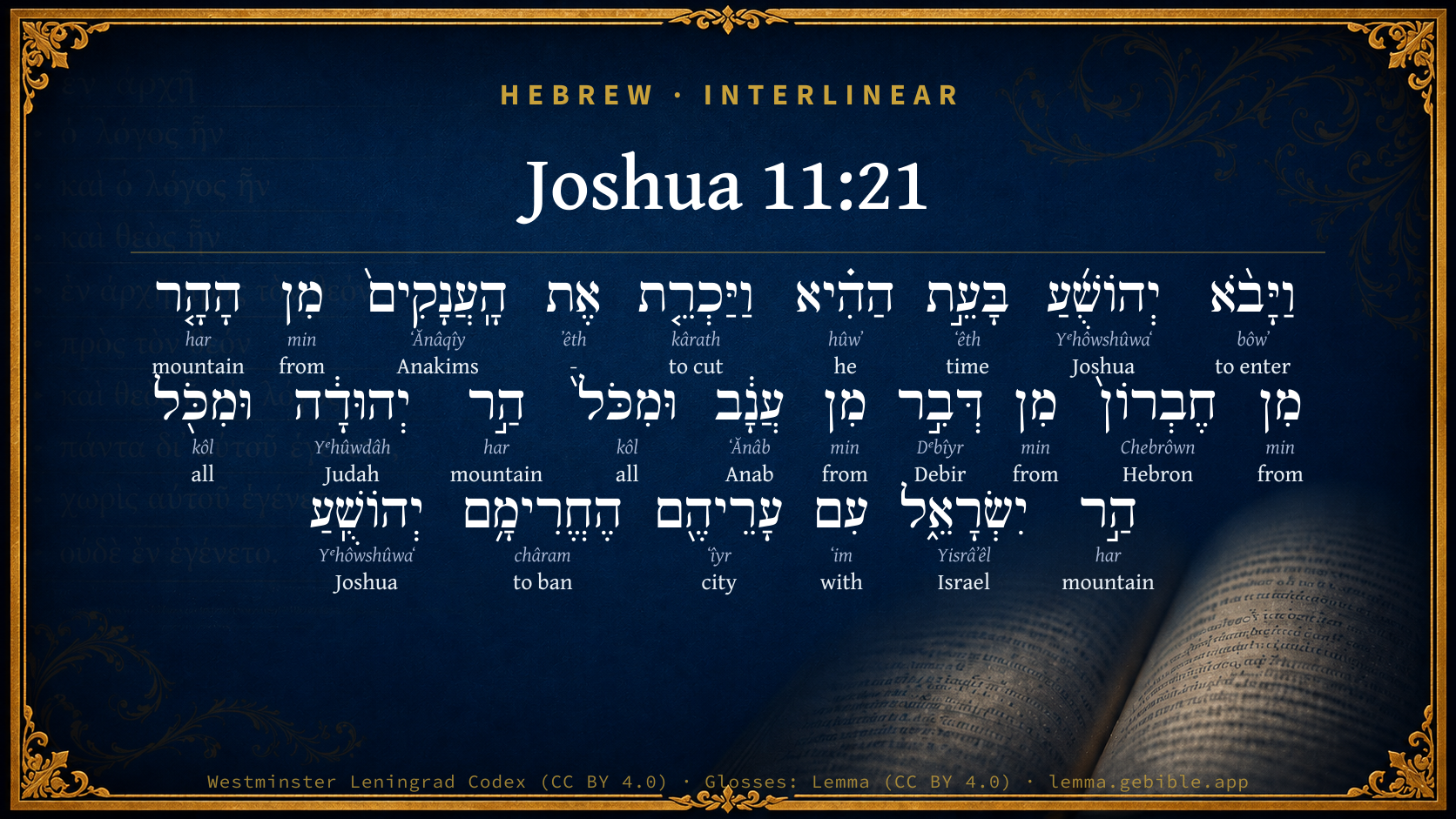
Joshua 11:21

Hebrew (Westminster Leningrad Codex) Joshua 11:21 appears in the Hebrew Old Testament. The text above is from the Westminster Leningrad Codex. Each word links to its Strong’s number, a concise gloss, and parsing drawn from the Open Scriptures Hebrew Bible morphology. Click any word for its full Brown-Driver-Briggs (BDB) entry.
Download image
Cite this verse

Joshua 11:21 (World English Bible). Public Domain. Lemma interlinear Bible study tool, https://lemma.gebible.app/v/joshua/11/21.

Show BibTeX & RIS
BibTeX
RIS
English Translation
Joshua came at that time, and cut off the Anakim from the hill-country, from Hebron, from Debir, from Anab, and from all the hill-country of Judah, and from all the hill-country of Israel: Joshua utterly destroyed them with their cities.
World English Bible · Public Domain
Highlights
  • 1 first appearance in the Hebrew Bible
Full analysis ↓
Download a study sheet

One document with this verse’s original text, its word-by-word gloss line, the meaning frame, cross-references with their text, attributed commentary, and full source and license credits — printable, and it pastes into notes with its structure intact.

This verse Autodidact and up

Study sheet (.html) Plain text (.txt)

A passage Seminary Student

Up to 50 verses in one chapter. A passage sheet keeps up to 6 commentary sources and 12 cross-references per verse, in the order this page ranks them, and says so on the sheet whenever that leaves anything out. Ask for a single verse and you get the Autodidact verse sheet above.

Everything on this page stays free to read, with no account — the sheet is a download of what is already on screen, not access to it.

Want to remove ads? Support Godless Engineer
Compare translations 3

The same verse in 3 English versions, stacked beneath the original-language interlinear above. Click any original word for its lexicon entry.

Each is an independent rendering of the whole verse — the interlinear is not word-aligned to these translations.

Highlighted words mark where these versions differ — a whole-verse word diff, not a word-by-word alignment.

  • World English Bible Public Domain
    Joshua came at that time, and cut off the Anakim from the hill-country, from Hebron, from Debir, from Anab, and from all the hill-country of Judah, and from all the hill-country of Israel: Joshua utterly destroyed them with their cities.
  • King James Version Public Domain
    And at that time came Joshua, and cut off the Anakims from the mountains, from Hebron, from Debir, from Anab, and from all the mountains of Judah, and from all the mountains of Israel: Joshua destroyed them utterly with their cities.
  • unfoldingWord Literal Text CC BY-SA 4.0
    And Joshua came at that time and cut off the Anakites from the hill country, from Hebron, from Debir, from Anab, and from all of the hill country of Judah, and from all of the hill country of Israel. Joshua devoted them with their cities.

unfoldingWord Literal Text — © unfoldingWord, licensed CC BY-SA 4.0. Word-aligned USFM3 via Door43 (git.door43.org/unfoldingWord/en_ult).

Versions to compare (up to 4)

3 of 4 selected

Show all 18 translations

Every available English version of this verse, each an independent rendering of the whole verse.

  • World English Bible Public Domain
    Joshua came at that time, and cut off the Anakim from the hill-country, from Hebron, from Debir, from Anab, and from all the hill-country of Judah, and from all the hill-country of Israel: Joshua utterly destroyed them with their cities.
  • Berean Standard Bible Public Domain
    At that time Joshua proceeded to eliminate the Anakim from the hill country of Hebron, Debir, and Anab, and from all the hill country of Judah and of Israel. Joshua devoted them to destruction, along with their cities.
  • Majority Standard Bible Public Domain
    At that time Joshua proceeded to eliminate the Anakim from the hill country of Hebron, Debir, and Anab, and from all the hill country of Judah and of Israel. Joshua devoted them to destruction, along with their cities.
  • King James Version Public Domain
    And at that time came Joshua, and cut off the Anakims from the mountains, from Hebron, from Debir, from Anab, and from all the mountains of Judah, and from all the mountains of Israel: Joshua destroyed them utterly with their cities.
  • American Standard Version (1901) Public Domain
    And Joshua came at that time, and cut off the Anakim from the hill-country, from Hebron, from Debir, from Anab, and from all the hill-country of Judah, and from all the hill-country of Israel: Joshua utterly destroyed them with their cities.
  • Revised Version (1885) Public Domain
    And Joshua came at that time, and cut off the Anakim from the hill country, from Hebron, from Debir, from Anab, and from all the hill country of Judah, and from all the hill country of Israel: Joshua utterly destroyed them with their cities.
  • Geneva Bible (1599) Public Domain
    And that same season came Ioshua, and destroyed the Anakims out of the mountaines: as out of Hebron, out of Debir, out of Anab, and out of all the mountaines of Iudah, and out of all the mountaines of Israel: Ioshua destroyed them vtterly with their cities.
  • Douay-Rheims (1899) Public Domain
    At that time Josue came and cut off the Enacims from the mountains, from Hebron, and Dabir, and Anab, and from all the mountain of Juda and Israel, and destroyed their cities.
  • Young's Literal Translation Public Domain
    And Joshua cometh at that time, and cutteth off the Anakim from the hill-country, from Hebron, from Debir, from Anab, even from all the hill-country of Judah, and from all the hill-country of Israel; with their cities hath Joshua devoted them.
  • Literal Standard Version CC BY-SA 4.0
    And Joshua comes at that time, and cuts off the Anakim from the hill-country, from Hebron, from Debir, from Anab, and from all the hill-country of Judah, and from all the hill-country of Israel; Joshua has devoted them with their cities.
  • Unlocked Literal Bible CC BY-SA 4.0
    Then Joshua came at that time and he destroyed the Anakim. He did this in the hill country, at Hebron, Debir, Anab, and in all the hill country of Judah, and in all the hill country of Israel. Joshua completely destroyed them and their cities.
  • unfoldingWord Literal Text CC BY-SA 4.0
    And Joshua came at that time and cut off the Anakites from the hill country, from Hebron, from Debir, from Anab, and from all of the hill country of Judah, and from all of the hill country of Israel. Joshua devoted them with their cities.
  • Darby Bible Public Domain
    And Joshua came at that time and cut off the Anakim from the mountains, from Hebron, from Debir, from Anab, and from all the mountain of Judah, and from all the mountain of Israel: Joshua destroyed them utterly, with their cities.
  • World Messianic Bible Public Domain
    Joshua came at that time, and cut off the Anakim from the hill country, from Hebron, from Debir, from Anab, and from all the hill country of Judah, and from all the hill country of Israel. Joshua utterly destroyed them with their cities.
  • Webster's Bible Public Domain
    And at that time came Joshua and cut off the Anakims from the mountains, from Hebron, from Debir, from Anab, and from all the mountains of Judah, and from all the mountains of Israel: Joshua destroyed them utterly with their cities.
  • Free Bible Version CC BY-SA 4.0
    During this time Joshua also annihilated the descendants of Anak living in the hill country of Hebron, Debir, and Anab, and all the hill country of Judah and Israel. Joshua set apart and completely destroyed their towns,
  • Bible in Basic English Public Domain
    And Joshua came at that time and put an end to the Anakim in the hill-country, in Hebron, in Debir, in Anab, and in all the hill-country of Judah and Israel: Joshua gave them and their towns to the curse.
  • JPS Tanakh (1917) Public Domain
    And Joshua came at that time, and cut off the Anakim from the hill-country, from Hebron, from Debir, from Anab, and from all the hill-country of Judah, and from all the hill-country of Israel; Joshua utterly destroyed them with their cities.

Literal Standard Version (2020), Covenant Press — licensed CC BY-SA 4.0. Text via the HelloAO Bible API (eBible.org). Unlocked Literal Bible (unfoldingWord) — licensed CC BY-SA 4.0. Text via the HelloAO Bible API (eBible.org). unfoldingWord Literal Text — © unfoldingWord, licensed CC BY-SA 4.0. Word-aligned USFM3 via Door43 (git.door43.org/unfoldingWord/en_ult). Free Bible Version, Dr. Jonathan Gallagher — licensed CC BY-SA 4.0. Text via the HelloAO Bible API (eBible.org).

Word by word

More ways to search: Search by grammar → Find every occurrence → Compare this word →

Practice this passage: Drill this verse → Learn its vocabulary →

עֲנָ֔ב
ʻĂnâb
H6024
“Anab”
Noun, Proper
Part of Speech
Noun
Type
Proper
Full BDB Definition

Origin: from the same as H6025

TWOT: None

Anab = "fruit" - a city in the mountains of southern Judah, 18 miles southwest of Hebron
  1. וַיָּבֹ֨א bôwʼ H935 “and · to enter” Conjunction + Verb, Qal, Sequential Imperfect, 3rd Person, Masculine, Singular
  2. יְהוֹשֻׁ֜עַ Yᵉhôwshûwaʻ H3091 “Joshua” Noun, Proper
  3. בָּעֵ֣ת ʻêth H6256 “in/at the · time” Preposition, Determined + Noun, Common, Both, Singular, Absolute
  4. הַהִ֗יא hûwʼ H1931 “the · he” Particle, Definite Article + Pronoun, Personal, 3rd Person, Feminine, Singular
  5. וַיַּכְרֵ֤ת kârath H3772 “and · to cut” Conjunction + Verb, Hiphil, Sequential Imperfect, 3rd Person, Masculine, Singular
  6. אֶת ʼêth H853 “-” Particle, Direct Object
  7. הָֽעֲנָקִים֙ ʻĂnâqîy H6062 “the · Anakims” Particle, Definite Article + Noun, Gentilic, Masculine, Plural, Absolute
  8. מִן min H4480 “from” Preposition
  9. הָהָ֤ר har H2022 “the · mountain” Particle, Definite Article + Noun, Common, Masculine, Singular, Absolute
  10. מִן min H4480 “from” Preposition
  11. חֶבְרוֹן֙ Chebrôwn H2275 “Hebron” Noun, Proper
  12. מִן min H4480 “from” Preposition
  13. דְּבִ֣ר Dᵉbîyr H1688 “Debir” Noun, Proper
  14. מִן min H4480 “from” Preposition
  15. וּמִכֹּל֙ kôl H3605 “and · from · all of” Conjunction + Preposition + Noun, Common, Masculine, Singular, Construct
  16. הַ֣ר har H2022 “mountain of” Noun, Common, Masculine, Singular, Construct
  17. יְהוּדָ֔ה Yᵉhûwdâh H3063 “Judah” Noun, Proper
  18. וּמִכֹּ֖ל kôl H3605 “and · from · all of” Conjunction + Preposition + Noun, Common, Masculine, Singular, Construct
  19. הַ֣ר har H2022 “mountain of” Noun, Common, Masculine, Singular, Construct
  20. יִשְׂרָאֵ֑ל Yisrâʼêl H3478 “Israel” Noun, Proper
  21. עִם ʻim H5973 “with” Preposition
  22. עָרֵיהֶ֖ם ʻîyr H5892 “cities · their” Noun, Common, Feminine, Plural, Construct + Suffix, Personal, 3rd Person, Masculine, Plural
  23. הֶחֱרִימָ֥ם châram H2763 “to ban · them” Verb, Hiphil, Perfect, 3rd Person, Masculine, Singular + Suffix, Personal, 3rd Person, Masculine, Plural
  24. יְהוֹשֻֽׁעַ Yᵉhôwshûwaʻ H3091 “Joshua” Noun, Proper

About this verse

These counts appear in no published source. They are computed here, from the morphology-tagged text and Lemma’s own curated glosses. What Lemma adds →

25
words
18
distinct lemmas
Historical
section

Notable vocabulary

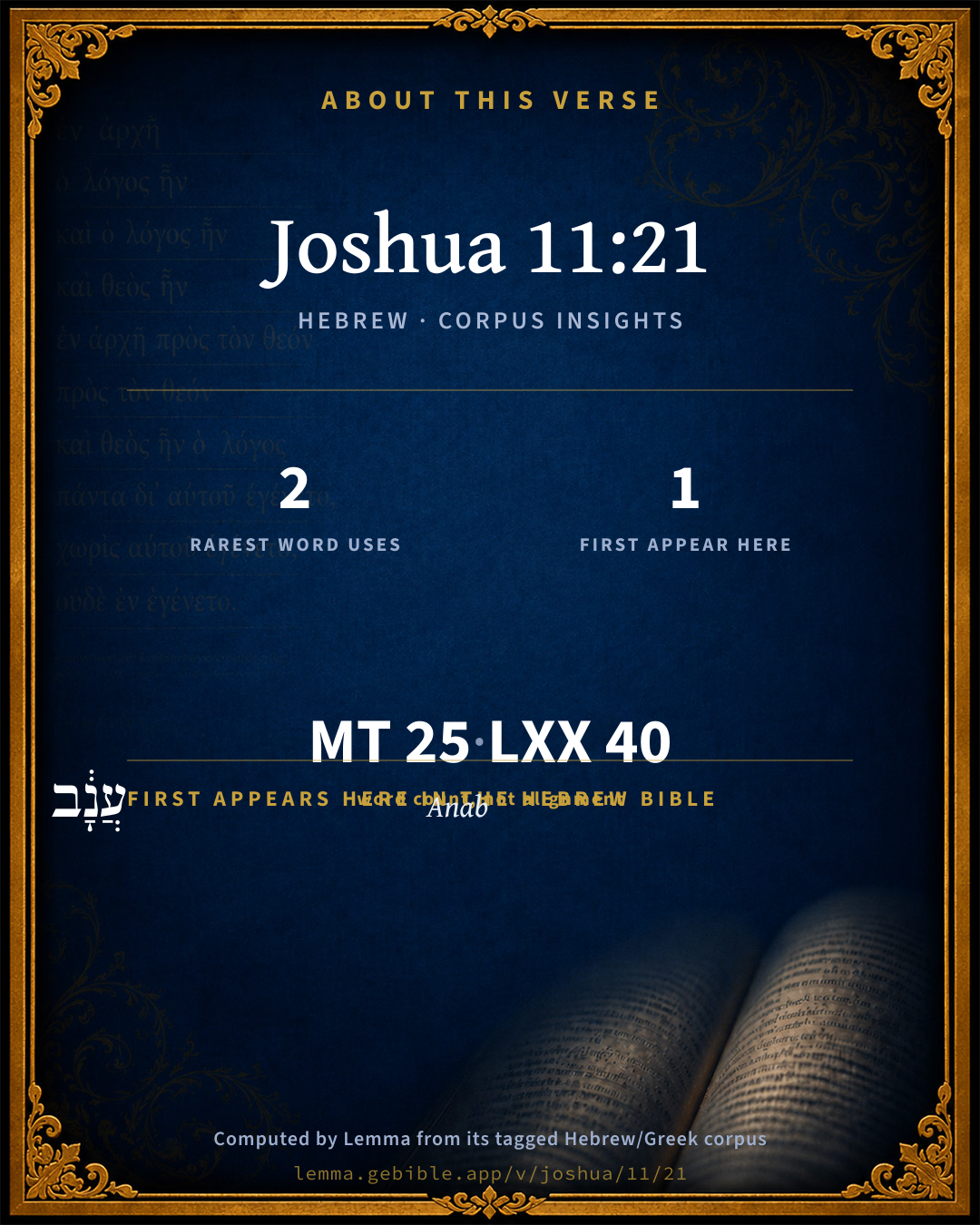
The rarest word here is עֲנָ֔ב Anab H6024 — appearing just 2 times in the whole Hebrew Bible.

First appearance in Scripture

This word makes its first canonical appearance in the Hebrew Bible here:

  • עֲנָ֔ב Anab H6024

Shared distinctive vocabulary

עֲנָ֔ב Anab H6024 occurs in 2 verses of the Hebrew Bible. Also found in:

Grammatical profile

  • 3 verbs
  • 15 nouns
  • 1 pronoun
  • 5 prepositions
  • 1 particle

Verb forms

  • וַיָּבֹ֨א Qal · Sequential Imperfect
  • וַיַּכְרֵ֤ת Hiphil · Sequential Imperfect
  • הֶחֱרִימָ֥ם Hiphil · Perfect

Repetition

Words recur within this verse — often emphatic in Hebrew:

  • הָהָ֤ר mountain H2022 ×3
  • יְהוֹשֻׁ֜עַ Joshua H3091 ×2
  • וּמִכֹּל֙ all H3605 ×2
  • מִן from H4480 ×4

Hebrew & Septuagint length

In English translation the verse runs 40 words from the Hebrew and 46 from the Septuagint (LXX English) — closely comparable.

A rough comparison of the two English renderings, which tokenize alike — not a word-level alignment.

Word counts can differ between the Hebrew and the Greek without any difference in meaning — e.g. the Hebrew direct-object marker אֵת has no separate Greek word, and Greek often adds the article ὁ.

In the original languages it is 25 Hebrew tokens and 40 Greek tokens — but the two are counted differently (Hebrew bundles its prefixes and suffixes into one token; the Greek is in lemma form), so that isn’t a like-for-like length.

Cross-references

18

Topical passages linked to Joshua 11:21 in the Treasury of Scripture Knowledge — connected by theme and wording, ordered by reader-vote popularity; previews shown in the World English Bible.

  • Deuteronomy 9:2 a people great and tall, the sons of the Anakim, whom you know, and of whom you have heard say, Who can stand before the sons of Anak?
  • Numbers 13:22–23 They went up by the South, and came to Hebron; and Ahiman, Sheshai, and Talmai, the children of Anak, were there. (Now Hebron was built seven years before Zoan in Egypt.)
  • Deuteronomy 1:28 Where are we going up? our brothers have made our heart to melt, saying, The people are greater and taller than we; the cities are great and fortified up to the sky; and moreover we have seen the sons of the Anakim there.
  • Joshua 15:13–14 To Caleb the son of Jephunneh he gave a portion among the children of Judah, according to the commandment of Yahweh to Joshua, even Kiriath Arba, [which Arba was] the father of Anak (the same is Hebron).
  • Numbers 13:33 There we saw the Nephilim, the sons of Anak, who come of the Nephilim: and we were in our own sight as grasshoppers, and so we were in their sight.
  • Deuteronomy 2:21 a people great, and many, and tall, as the Anakim; but Yahweh destroyed them before them; and they succeeded them, and lived in their place;
  • Joshua 10:42 All these kings and their land did Joshua take at one time, because Yahweh, the God of Israel, fought for Israel.
  • Joshua 14:12–14 Now therefore give me this hill-country, of which Yahweh spoke in that day; for you heard in that day how the Anakim were there, and cities great and fortified: it may be that Yahweh will be with me, and I shall drive them out, as Yahweh spoke.
  • Joshua 24:11–12 You went over the Jordan, and came to Jericho: and the men of Jericho fought against you, the Amorite, and the Perizzite, and the Canaanite, and the Hittite, and the Girgashite, the Hivite, and the Jebusite; and I delivered them into your hand.
  • Judges 1:10–11 Judah went against the Canaanites who lived in Hebron (now the name of Hebron before was Kiriath Arba); and they struck Sheshai, and Ahiman, and Talmai.
  • Judges 1:20 They gave Hebron to Caleb, as Moses had spoken: and he drove out there the three sons of Anak.
  • Psalms 110:5–6 The Lord is at your right hand. He will crush kings in the day of his wrath.
  • Psalms 149:6–9 May the high praises of God be in their mouths, And a two-edged sword in their hand;
  • Jeremiah 3:23 Truly in vain is [the help that is looked for] from the hills, the tumult on the mountains: truly in Yahweh our God is the salvation of Israel.
  • Jeremiah 9:23 Thus says Yahweh, Don't let the wise man glory in his wisdom, neither let the mighty man glory in his might, don't let the rich man glory in his riches;
  • Amos 2:9 Yet I destroyed the Amorite before them, Whose height was like the height of the cedars, And he was strong as the oaks; Yet I destroyed his fruit from above, and his roots from beneath.
  • Revelation 6:2 And behold, a white horse, and he who sat on it had a bow. A crown was given to him, and he came forth conquering, and to conquer.
  • Revelation 19:11–21 I saw the heaven opened, and behold, a white horse, and he who sat on it is called Faithful and True. In righteousness he judges and makes war.

Cross-references courtesy of OpenBible.info (CC BY 4.0).

Hebrew and Greek witnesses Masoretic Hebrew ↔ Greek Septuagint

The same verse in the two great witnesses to the Old Testament, shown verse-for-verse.

These are two independent witnesses, not word-aligned to each other, and the Septuagint is shown in lemma (dictionary) form.

Hebrew Joshua 11:21 Masoretic · Westminster Leningrad Codex

וַיָּבֹ֨א יְהוֹשֻׁ֜עַ בָּעֵ֣ת הַהִ֗יא וַיַּכְרֵ֤ת אֶת הָֽעֲנָקִים֙ מִן הָהָ֤ר מִן חֶבְרוֹן֙ מִן דְּבִ֣ר מִן עֲנָ֔ב וּמִכֹּל֙ הַ֣ר יְהוּדָ֔ה וּמִכֹּ֖ל הַ֣ר יִשְׂרָאֵ֑ל עִם עָרֵיהֶ֖ם הֶחֱרִימָ֥ם יְהוֹשֻֽׁעַ

Joshua came at that time, and cut off the Anakim from the hill-country, from Hebron, from Debir, from Anab, and from all the hill-country of Judah, and from all the hill-country of Israel: Joshua utterly destroyed them with their cities.

World English Bible · Public Domain

Greek LXX Joshua 11:21 Septuagint · lemma form

καί ἔρχομαι ἰησοῦς ἐν ὁ καιρός ἐκεῖνος καί ἐκὀλεθρεύω ὁ ενακιμ ἐκ ὁ ὀρεινή ἐκ χεβρων καί ἐκ δαβιρ καί ἐκ αναβωθ καί ἐκ πᾶς γένος ἰσραήλ καί ἐκ πᾶς ὄρος ιουδα σύν ὁ πόλις αὐτός καί ἐκὀλεθρεύω αὐτός ἰησοῦς

And Joshua came at that time, and utterly destroyed the Enakim out of the hill country, from Chebron and from Dabir, and from Anaboth, and from all the race of Israel, and from all the mountain of Juda with their cities; and Joshua utterly destroyed them.

LXX2012 (modern English Septuagint) · Public Domain

Hebrew: Westminster Leningrad Codex (CC BY 4.0). Greek: Septuagint (public domain); English from LXX2012 (modern English Septuagint) (Public Domain). How the Septuagint differs from the Hebrew →

Targum (Aramaic paraphrase)

1

The Targum is the ancient Jewish Aramaic paraphrase of the Hebrew Scriptures — an interpretive translation, not the Hebrew text itself. Onkelos (literal) and Pseudo-Jonathan (expansive) render the Torah, and Jonathan the Prophets. Coverage is partial: where no permissively-licensed English translation exists for a verse, only the Aramaic is shown. This is verse-level text, not a word-by-word alignment to the Hebrew.

  1. Targum Jonathan Prophets (Joshua–Malachi)
    וַאֲתָא יְהוֹשֻׁעַ בְּעִדָנָא הַהִיא וְשֵׁיצֵי יַת גִבָּרַיָא מִן טוּרָא מִן חֶבְרוֹן מִן דְבִיר מִן עֲנָב וּמִכֹּל טוּרָא דִיהוּדָה וּמִכֹּל טוּרָא דְיִשְׂרָאֵל עִם קִרְוֵיהוֹן גַמְרוּנוּן יְהוֹשֻׁעַ:

    (no public-domain English translation for this verse)

    Targum Jonathan — Aramaic: “Mikraot Gedolot” (public domain). English: “Sefaria Community Translation” (CC0 1.0 (public-domain dedication)); “London "Chaldee Paraphrase," 1871” (public domain). Text via Sefaria.

Commentary

Notes on Joshua 11:21 from classic Christian and Jewish commentators (each source and its license shown beneath its notes). The classic Christian expositions comment on the surrounding passage and are grouped to its opening verse, so a note may address several verses; the Jewish commentaries on the Tanakh (Rashi and others) are per-verse, so they appear only where the commentator wrote on this verse.

Lemma curates 59 commentaries, every one of them public domain or Creative Commons licensed, each selected and text-cleaned for this edition rather than reprinted as found. About our sources →

Trapp's Complete Commentary

John Trapp

Jos 11:21 And at that time came Joshua, and cut off the Anakims from the mountains, from Hebron, from Debir, from Anab, and from all the mountains of Judah, and from all the mountains of Israel: Joshua destroyed them utterly with their cities.

Ver. 21. And cut off all the Anakims.] Whom the spies had once represented, and reported insuperable. {Num 14:43-45} The lion is not so fierce as he is painted: to faith nothing is impossible.

John Trapp, A Commentary or Exposition upon All the Books of the Old and New Testament (1647–1656) — public domain. Text from a community e-Sword module.

Joseph Benson's Commentary

Jos 11:21. At that time — That is, in the war before mentioned, and probably toward the conclusion of it; after he had left none to oppose him in other places, but only in those mountainous parts which were of difficult access. Joshua cut off the Anakims — “A wild, barbarous, and gigantic people, who were of a different original from that of the Canaanites, and inhabited certain mountains of the country. It would have been dangerous to let them remain, nor were they worthy of such an indulgence. Joshua, therefore, marched against them, and crowned his victories by their utter defeat.” — Dodd. From the mountains — Hebrew, The mountain; but the singular number seems to be put for the plural. From Hebron, &c. — That is, from the territories belonging to these cities. For, as we have often seen in this history, cities are mentioned for the country subject to them. From all the mountains of Judah — All the mountainous country that fell afterward by lot to the tribe of Judah. And from all the mountains of Israel — The mountainous country that was allotted to the rest of the tribes of Israel, to which mountains these people, it is likely, fled for safety. Joshua destroyed them utterly with their cities — But how could Joshua be said to have utterly destroyed either the Anakims or their cities, when Caleb and Othniel destroyed some of them after Joshua’s death? Jos 14:12;

Jdg 1:10-12. This might be either, 1st, Because these places, though in part destroyed, yet, being neglected by the Israelites, were repossessed by the giants, and by them kept until Caleb destroyed them: or rather, 2d, Because this work, though done by the particular valour of Caleb, is ascribed to Joshua as the general of the army, according to the manner of all historians; and therefore it is here attributed to Joshua; though afterward, that Caleb might not lose his deserved honour, the history is more particularly described, and Caleb owned as the great instrument of it.

Joseph Benson's Commentary on the Old and New Testaments (1811–1818) — public domain. Text from a community e-Sword module.

Keil & Delitzsch

C. F. Keil & F. Delitzsch

In Jos 11:21, Jos 11:22, the destruction of the Anakites upon the mountains of Judah and Israel is introduced in a supplementary form, which completes the history of the subjugation and extermination of the Canaanites in the south of the land (Josh 10). This supplement is not to be regarded either as a fragment interpolated by a different hand, or as a passage borrowed from another source. On the contrary, the author himself thought it necessary, having special regard to Num 13:28, Num 13:31., to mention expressly that Joshua also rooted out from their settlements the sons of Anak, whom the spies in the time of Moses had described as terrible giants, and drove them into the Philistine cities of Gaza, Bath, and Ashdod. "At that time" points back to the "long time," mentioned in Jos 11:18, during which Joshua was making war upon the Canaanites. The words "cut off," etc., are explained correctly by Clericus: "Those who fell into his hands he slew, the rest he put to flight, though, as we learn from Jos 15:14, they afterwards returned." (On the Anakim, see at Num 13:22.) They had their principal settlement upon the mountains in Hebron (el Khulil, see Jos 10:3), Debir (see at Jos 10:38), and Anab. The last place (Anab), upon the mountains of Judah (Jos 15:50), has been preserved along with the old name in the village of Anb, four or five hours to the south of Hebron, on the eastern side of the great Wady el Khulil, which runs from Hebron down to Beersheba (Rob. Pal. ii. p. 193). "And from all (the rest of) the mountains of Judah, and all the mountains of Israel:" the latter are called the mountains of Ephraim in Jos 17:15. The two together form the real basis of the land of Canaan, and are separated from one another by the large Wady Beit Hanina (see Rob. Pal. ii. p. 333). They received their respective names from the fact that the southern portion of the mountain land of Canaan fell to the tribe of Judah as its inheritance, and the northern part to the tribe of Ephraim and other tribes of Israel.

(Note: The distinction here made may be explained without difficulty even from the circumstances of Joshua's own time. Judah and the double tribe of Joseph (Ephraim and Manasseh) received their inheritance by lot before any of the others. But whilst the tribe of Judah proceeded into the territory allotted to them in the south, all the other tribes still remained in Gilgal; and even at a later period, when Ephraim and Manasseh were in their possessions, all Israel, with the exception of Judah, were still encamped at Shiloh. Moreover, the two parts of the nation were now separated by the territory which was afterwards assigned to the tribe of Benjamin, but had no owner at this time; and in addition to this, the altar, tabernacle, and ark of the covenant were in the midst of Joseph and the other tribes that were still assembled at Shiloh. Under such circumstances, then, would not the idea of a distinction between Judah, on the one hand, and the rest of Israel, in which the double tribe of Joseph and then the single tribe of Ephraim acquired such peculiar prominence, on the other, shape itself more and more in the mind, and what already existed in the germ begin to attain maturity even here? And what could be more natural than that the mountains in which the "children of Judah" had their settlements should be called the mountains of Judah; and the mountains where all the rest of Israel was encamped, where the "children of Israel" were gathered together, be called the mountains of Israel, and, as that particular district really belonged to the tribe of Ephraim, the mountains of Ephraim also? (Jos 19:50; Jos 20:7; also Jos 24:30.))

Gaza, Gath, and Ashdod were towns of the Philistines; of these Gaza and Ashdod were allotted to the tribe of Judah (Jos 15:47), but were never taken possession of by the Israelites, although the Philistines were sometimes subject to the Israelites (see at Jos 13:3). - With Jos 11:23, "thus Joshua took the whole land" etc., the history of the conquest of Canaan by Joshua is brought to a close; and Jos 11:23, "and Joshua gave it for an inheritance unto Israel," forms a kind of introduction to the second part of the book. The list of the conquered kings in Josh 12 is simply an appendix to the first part.

The taking of the whole land does not imply that all the towns and villages to the very last had been conquered, or that all the Canaanites were rooted out from every corner of the land, but simply that the conquest was of such a character that the power of the Canaanites was broken, their dominion overthrown, and their whole land so thoroughly given into the hands of the Israelites, that those who still remained here and there were crushed into powerless fugitives, who could neither offer any further opposition to the Israelites, nor dispute the possession of the land with them, if they would only strive to fulfil the commandments of their God and persevere in the gradual extermination of the scattered remnants. Moreover, Israel had received the strongest pledge, in the powerful help which it had received from the Lord in the conquests thus far obtained, that the faithful covenant God would continue His help in the conflicts which still remained, and secure for it a complete victory and the full possession of the promised land. Looking, therefore, at the existing state of things from this point of view, Joshua had taken possession of the whole land, and could now proceed to finish the work entrusted to him by the Lord, by dividing the land among the tribes of Israel. Joshua had really done all that the Lord had said to Moses. For the Lord had not only promised to Moses the complete extermination of the Canaanites, but had also told him that He would not drive out the Canaanites at once, or "in one year," but only little by little, until Israel multiplied and took the land (Exo 23:28-30; cf. Deu 7:22). Looking at this promised, therefore, the author of the book could say with perfect justice, that "Joshua took the whole land according to all that (precisely in the manner in which) the Lord had said to Moses." But this did not preclude the fact, that a great deal still remained to be done before all the Canaanites could be utterly exterminated from every part of the land. Consequently, the enumeration of towns and districts that were not yet conquered, and of Canaanites who still remained, which we find in Jos 13:1-6; Jos 17:14., Jos 18:3; Jos 23:5, Jos 23:12, forms no discrepancy with the statements in the verses before us, so as to warrant us in adopting any critical hypotheses or conclusions as to the composition of the book by different authors. The Israelites could easily have taken such portions of the land as were still unconquered, and could have exterminated all the Canaanites who remained, without any severe or wearisome conflicts; if they had but persevered in fidelity to their God and in the fulfilment of His commandments. If, therefore, the complete conquest of the whole land was not secured in the next few years, but, on the contrary, the Canaanites repeatedly gained the upper hand over the Israelites; we must seek for the explanation, not in the fact that Joshua had not completely taken and conquered the land, but simply in the fact that the Lord had withdrawn His help from His people because of their apostasy from Him, and had given them up to the power of their enemies to chastise them for their sins. - The distribution of the land for an inheritance to the Israelites took place "according to their divisions by their tribes." מחלקות denote the division of the twelve tribes of Israel into families, fathers' houses, and households; and is so used not only here, but in Jos 12:7 and Jos 18:10. Compare with this Ch1 23:6; Ch1 24:1, etc., where it is applied to the different orders of priests and Levites. "And the land rested from war:" i.e., the war was ended, so that the peaceable task of distributing the land by lot could now be proceeded with (vid., Jos 14:15; Jdg 3:11, Jdg 3:30; Jdg 5:31).

Keil & Delitzsch — Biblical Commentary on the Old Testament (1861–1891) — public domain (CC PDM 1.0). Text via the HelloAO Bible API. (Old Testament only.)

Tyndale Open Study Notes

Tyndale Open Resources

11:21-22 the descendants of Anak: See Num 13:28, 33.

Tyndale Open Study Notes — © Tyndale Open Resources, licensed CC BY-SA 4.0. Text via the HelloAO Bible API.

Adam Clarke's Commentary

Verse 21. Cut off the Anakims - from Hebron, from Debir] This is evidently a recapitulation of the military operations detailed Jos 10:36-41.

Destroyed - their cities] That is, those of the Anakims; for from Jos 11:13 we learn that Joshua preserved certain other cities.

Adam Clarke's Commentary on the Bible (1810–1826) — public domain. Text from a community e-Sword/MySword module.

John Calvin's Commentaries

21. And at that time came Joshua, etc Of the sons of Anak we have spoken elsewhere. They were a race of giants, with the account of whose mighty stature the spies so terrified the people, that they refused to proceed into the land of Canaan. Therefore, seeing they were objects of so much dread, it was of importance that they should be put out of the way, and the people made more alert by their good hopes of success. It would have been exceedingly injurious to keep objects which filled them with alarm and anxiety always present before their minds, inasmuch as fear obscured the glory ascribed to God for former victories, and overthrew their faith, while they reflected that the most difficult of all their contests still awaited them. Therefore, not without cause is it mentioned among the other instances of divine aid, that by purging the land of such monsters, it was rendered a fit habitation for the people. The less credible it seemed that they could be warred against with success, the more illustriously was the divine power displayed.

John Calvin's Commentaries (1540-1563) — public domain. Text from the Calvin Translation Society English edition (1840s-50s) via the Christian Classics Ethereal Library (ccel.org). Calvin's coverage is partial (roughly two-thirds of the Bible); uncommented books and verses are honest gaps, never fabricated. The 19th-century editor's footnotes and remarks are omitted so the notes are faithfully Calvin's own voice.

Ellicott's Commentary for English Readers

(21) Anab is identified with Anâb, west of Debir. The death of Ahiman, Sheshai, and Talmai, the three sons of Anak, the chiefs of the Anakim, is recorded in Jdg_1:10.

A Bible Commentary for English Readers, edited by Charles John Ellicott (1878–1897) — public domain. Text from a community e-Sword module.

The Cambridge Bible for Schools and Colleges

gen. ed. J. J. S. Perowne

21–23. Extermination of the Anakims

21. at that time] That is, in the course of the “long time,” the seven years spoken of in Jos_11:18. We have now a supplementary notice of the destruction of the Anakims, and a general conclusion substantially as given in Jos_11:16.

the Anakims] In Num_13:22 we are told of the spies that they “ascended by the south and came unto Hebron; where Ahiman, Sheshai, and Talmai, the children of Anak, were,” and when this was reported to the Israelites, and they heard of “the giants, the sons of Anak, which come of the giants, in whose sight the spies seemed as grasshoppers” (Num_13:33), “all the congregation lifted up their voice, and cried, and murmured against Moses and against Aaron” (Num_14:1-2). The sacred writer therefore now goes back to record pointedly this terrible race, who had inspired such faithless murmuring and complaint (comp. Deu_9:2). It has been concluded by some that these giants were a tribe of Cushite wanderers from Babel, and of the same race as the Philistines, the Phœnicians, and the Egyptian shepherd-kings, representing one or more families of Amorite descent, distinguished for their lofty stature and physical powers. Thus Og, king of Bashan, is described as of the “remnant of the giants” (Deu_3:11). In Abraham’s time (Gen_14:5-6) they inhabited the territories afterwards known as Edom and Moab, and the region east of Jordan, under the names of (a) Rephaims, (b) Zuzims or Zamzummims, (c) Emims, and (d) Horites. Here they were attacked by Chedorlaomer, the Elamite king, who also smote the Amorites of Engedi in the Jordan valley. Subsequently the Horites were conquered by the Edomites, the Emims and the Zuzims by the Moabites and Ammonites, while the remnant, to which Og king of Bashan belonged, was destroyed by the Israelites under Moses. Now, as under Moses on the east, so under Joshua on the west of Jordan, the Anakims were driven forth before the arms of Israel.

from Hebron] Which from the progenitor of this race received its original name of Kirjath-Arba. See above on Jos_10:3.

from Debir] See Jos_10:38.

from Anab] A town in the mountains of Judah (Jos_15:50). It has retained its ancient name, and lies among the hills about 10 miles S. S. W. of Hebron, close to Shoco and Eshtemoa. See Robinson’s Bib. Researches, I. 494 and II. 195, who from Main (the Maon of Scripture) preserved a place of this name, distinguished by a small tower.

the mountains of Judah] A distinction is here made between “the mountains of Judah,” and “the mountains of Israel.” This, strange as it may seem, affords one of the undesigned evidences of the early composition of the Book of Joshua. “When Judah entered on his possession, all the other tribes were still in Gilgal (Jos_14:6; Jos_15:1). Afterwards, when Ephraim and Manasseh entered on theirs, all Israel, except Judah, were camped in Shiloh (Jos_16:1; Jos_18:1), these two possessions being separated by the still unallotted territory which later was given to Benjamin (Jos_18:11). What more natural than that the mountain given to ‘the children of Judah’ should have been called ‘the mountain of Judah,’ and that where all the rest of Israel camped ‘the mountain of Israel,’ and also ‘the mountain of Ephraim’ (Jos_19:50; Jos_20:7), because it was afterwards given to that tribe?” Dr Edersheim’s Israel in Canaan, p. 86.

The Cambridge Bible for Schools and Colleges (gen. ed. J. J. S. Perowne; Cambridge University Press, 1878–1918) — public domain. Text from a community e-Sword module.

John Gill's Exposition

And at that time came Joshua,.... After he had made a conquest of the land, or at the time he made it, as before related:

and cut off the Anakims from the mountains; whither, upon the conquest of the land, they had betaken themselves, and lived in dens and caves: these were giants, so called from Anak the father of them; though these are not to be restrained to his posterity, but include all other giants in the land; and the Targum renders the word by "mighty men"; and as some of them dwelt in mountains, others in cities, as follows:

from Hebron; where the children of Anak dwelt when the spies were sent into the land between forty and fifty years before this; and though the inhabitants of Hebron had been before destroyed by Joshua, these Anakims, who very likely then made their escape, returned and took possession of it after Joshua's departure, and while he was engaged in making other conquests; as we find that after this others of the same race again possessed it, and were in the possession of it after the death of Joshua, when they were slain by the tribe of Judah, Jdg 1:10; from Debir: where others of them also had got after the conquest of it; unless we suppose, as I see no great reason to object to it, that these were cut off both at Hebron and Debir, at the time of the taking of them, of which see Jos 10:36,

from Anab; a city which fell to the lot of the tribe of Judah, Jos 15:50. Jerom (g) says, in his time it was a village, near Diospolis or Lydda, about four miles from it to the east, and called Bethoannaba; but he says, that most affirm it to be eight miles from it, and called Bethannaba: Masius conjectures, that it is the same with the city of Nob; for, he says, that travellers in those parts affirm, that the city Nob is called Bethanoba and Bethanopolis:

and from all the mountains of Judah; the hill country of Judea, and the mountains round about Jerusalem:

and from all the mountains of Israel; as those about Samaria, and elsewhere:

Joshua destroyed them utterly with their cities; which they had formerly inhabited, or had got into the possession of.

(g) De loc. Heb. fol. 88. C.

John Gill's Exposition of the Whole Bible (1746–1763) — public domain (CC PDM 1.0). Text via the HelloAO Bible API.

Albert Barnes' Notes on the Bible

At that time - i. e. in course of the “long time” mentioned in Jos 11:18.

The Anakims - See Num 13:22. As it was the report of the spies respecting the Anakims which, above all, struck terror into the Israelites in the wilderness, and caused their faithless complaining and revolt, so the sacred writer goes back here in his story to record pointedly the overthrow of this gigantic and formidable race. They had their chief settlements in the mountains around Hebron Jos 10:3 or Debir. See Jos 15:15.

Anab was a city in the mountain district of Judah, lying some distance south of Hebron. It still bears its ancient name.

Albert Barnes' Notes on the Bible (1834–1885) — public domain. Text from a community e-Sword/MySword module.

Haydock's Catholic Bible Commentary

Time. Among his other conquests, after the victory of Gabaon, Josue defeated the Enacim at Hebron, &c. Many of them fled into the country of the Philistines, and afterwards seized an opportunity of re-establishing themselves, so that Caleb had to drive them out afresh, chap. xv. 14. --- Cities, or inhabitants. We have seen that he did not demolish all the cities, which were built on a commanding situation, ver. 13. --- Enacim. Goliah[Goliath] is supposed to have been of this family, being six cubits and a span high, 1 Kings xvii. 4. (Calmet) --- The Phœnicians probably took their name from Enak, bene anak, "sons of Enak;" whence Phœnix might easily be formed. (Bochart) --- Carthage was founded by them, and styled Chadre-Anak, "the dwelling of Anak," (Plautus) as they chose to pass for descendants of that giant, though they were not in reality. Anak means "a chain;" and some have asserted that he wore one, as the kings of the Madianites did when they were vanquished by Gedeon, and the Torquati at Rome, as a mark of honour. But this is uncertain. (Calmet)

George Leo Haydock (1774–1849), Haydock's Catholic Family Bible and Commentary, 1859 edition — public domain. Excludes Psalms (Douay-Rheims chapter numbering differs from Protestant) and Deuterocanonical books (Catholic canon only).

Matthew Poole's English Annotations

At that time, i.e. in that war; for it cannot be meant of any particular and short time, because the work here related was done in divers times and years.

The Anakims; a race of giants, of which see Num 13:33.

From the mountain, or, mountains, the singular number for the plural: these barbarous and monstrous persons either chose to live in the dens or caves, which were frequent in the mountains of those parts; or else they were driven thither by the arms and success of the Israelites.

From Debir; either,

1. From the territories belonging to these cities, as we have oft seen in this history, cities mentioned for the country subject to them; for the cities were taken before by Joshua, Jos 10:36-38. Or,

2. From the cities themselves; and so either the cities were retaken by the giants, which it is not probable that God would permit in Joshua’s time; or he speaks here of that time when he took those places mentioned here and Jos 10, which history he here in part repeats and enlargeth with this memorable circumstance, that, together with the rest, he destroyed also the giants which were in those places.

Anab; a place in the tribe of Judah, Jos 15:50.

From all the mountains of Judah, and from all the mountains of Israel: it doth not follow from hence, which some conclude, that this book was written by some other person long after Joshua’s death, even after the division of the Israelites into two kingdoms, of Israel and Judah; but only that this was one of those clauses which were added or altered and suited to the style of the present times by Ezra, or some other prophet, though that be not necessary; for since it was evident to Joshua, from Gen 49:9, &c., that the tribe of Judah was to be the chief of all the tribes, and some dawnings of its eminency appeared in that time, in their having the first lot in the land of Canaan, Jos 15:1, and the largest inheritance, Jos 19:9, it is no wonder that it is mentioned apart, and distinguished from the rest of the tribes of Israel, though that also be one of them; even as the daughter of Pharaoh is distinguished from the strange women, 1Ki 11:1, and Saul from all David’s enemies, Psa 18:1, and Peter from the disciples, Mar 6:7, though they were each of the same nature and quality with the rest. Joshua destroyed them utterly with their cities.

Quest. How could Joshua utterly destroy these, when Caleb and Othniel destroyed some of them after Joshua’s death, Jos 14:12; Jdg 1:10-13.

Answ. This might be, either,

1. Because these places being in part destroyed and neglected by the Israelites, might be repossessed by the giants, either in Joshua’s time, or after his death, and by them kept till Caleb dispossessed and destroyed them. Or rather,

2. Because this work, though done by the particular valour and industry of Caleb, is ascribed to Joshua as the general of the army, according to the manner of all historians; and therefore it is here attributed to Joshua, though afterwards, that Caleb might not lose his deserved honour, the history is more particularly described, and Caleb owned as the great instrument in the achievement of it, Jos 14; Jdg 1.

Matthew Poole's English Annotations on the Holy Bible (1683–1685) — public domain. Text from a community e-Sword/MySword module.

Whedon's Commentary on the Bible

Daniel D. Whedon

21. At that time — During the war, the long time mentioned in Jos_11:18. The Anakim were a race of giants in Southern Palestine. Some escaped to the Philistines and became the progenitors of Goliath. See references in margin, especially Num_13:22; Num_13:33. On Hebron and Debir see notes on Jos_10:3; Jos_10:38. Anab is probably identical with the place of this name which Dr. Robinson discovered about ten miles south of Hebron. But this could hardly be said to be in the mountains of Judah, where Jos_15:48; Jos_15:50, also locates it.

[Mountains of Judah and… Israel — The words Judah and Israel in this passage do not, as some critics have assumed, betray the hand of a writer who lived after the nation was divided into two rival kingdoms bearing these names. The use of these expressions may easily have grown out of facts existing in Joshua’s time. The tribe of Judah first received its allotment, comprising nearly all Palestine south of Jerusalem, and some time elapsed before the rest of Israel — especially seven of the tribes (Jos_18:2) — received their allotments. It was therefore perfectly natural at that early time to apply the names here used respectively to the southern and northern parts of the great mountain range of Palestine. The central part of this range, where the sons of Joseph early received their portion, (chaps. 16, 17,) was sometimes called Mount Ephraim. Jos_17:15.]

Daniel D. Whedon (gen. ed.), Commentary on the Old and New Testaments (1874–1909) — public domain. Text from a community e-Sword module.

The Pulpit Commentary

And at that time (see ver. 18). What is meant is, during the continuance of the war in which the country above described was conquered. The destruction of the Anakim was the conclusion of the work, and was rendered necessary by their having reoccupied the places Joshua had taken. (see notes on Jos_10:36-39) The Anakims. Literally, the long-necked men. Called the "children of Anak". (Num_13:28, 33Jo 15:13, 14) Gesenius would derive the German nacken and the English neck from this root. The word is used of the chains on the necks of camels. (Jud_1:8:26. So also Son_4:9, of a necklace) They were men of gigantic stature, (Num_13:32) and were no doubt a hill tribe of the Amorites. It is worthy of remark that to the two fearless men whose faith did not fail them at the sight of the walled cities, and of the giant forms of their inhabitants, was entrusted the task of overcoming these antagonists, and thus of proving the truth of their own words. Thus it ever is in the counsels of God. "To him that hath shall be given, and from him that hath not, even that which he hath shall be taken away." To Joshua, who had confidence in God, the whole land of Canaan was given into subjection. From the Israelites, who had not that confidence, the inheritance of their fathers was taken away. (cf. also Mat_25:21, Mat_25:28) Many writers suppose that these Anakim (like the Rephaim of Jos_12:4) were the aboriginal inhabitants, and of Turanian descent (see note on next verse). Anab. A town about ten miles southwest of Hebron. (cf. also Jos_15:50) It was apparently one of the daughter cities of Debir, and there is still a place of that name in the immediate vicinity of Dhaharijeh. Mountains of Judah. For this and the "mountains of Israel" see note on ver. 16.

HOMILIES BY R. GLOVER Vers. 21, 22. The destruction of the giants.

These giants had been the terror of Israel. In the evil report of the unfaithful spies they are mentioned last in the ascending scale of difficulties which seemed to make the conquest of the land an impossibility. The dread of their prowess had provoked the mutiny in the wilderness which led to the forty years of homeless journeying. But here we have the account of their destruction; the brevity of the account itself suggesting what everything subsequently stated confirms, that the most dreaded was not the most arduous part of their task, but somehow a part which was done like all the rest, without hitch or strain. There is much here that is very suggestive.

I THERE ARE GIANTS THAT WE HAVE TO RIGHT. The spies had made a true report. Their report erred not in the measurement of the difficulty, but in the estimate of the nation"s power with God"s help to overcome it. It was true enough that scattered over the land were these tribes or families of great stature Anakim, Emim, Zamzummims, Rephaim, as they are variously called. The Israelites being probably a people of less than ordinary stature found themselves thus face to face with a most stalwart and lordly race, with a people whose strength is still evinced in those marvellous remains of "the giant cities of Bashan," which impress all who behold them. And the land cannot be theirs until these giant tribes in their mountain fastnesses are destroyed. It is with them as it is with all men all have to fight some giants in their fight of life. Our outlook should be made hopeful by faith, not by illusion. There are giants before us whom we shall have to fight if we are faithful. Difficulties, temptations, huge griefs, loneliness of spirit, impulses of wrong, cares and anxieties, still make a great tribe of the children of Anak. We shall find them scattered all over the land in Bashan and in Hebron, and throughout all the hill country. Wherever the conquest would be hard enough without them, there are they found to make it harder still. It is well to abjure self deception. The way of righteousness is hard, and many a battle will try all our nerve and all our endurance. Life itself is stern and fun of conflict. Be not surprised if the strain on you be terrific, if the number and force of the enemy alike distress you; there has nothing new happened to you. All have had giants to fight with in their course through life. Israel could not possess the land until the giants were conquered, and your apprehensions of the future are so far accurate that you will have to encounter them without doubt. Secondly observe

II WE CANNOT HELP BEING. AFRAID OF THEM, BUT WE MUST KEEP THE FEAR WITHIN PROPER LIMITS. It is useless to forbid fear, and perhaps unwise. Useless, because so long as our nervous system is what it is, and the possibilities of life are so solemn and various, it is inevitable that solicitude should be awakened. It would be unwise, for the fear, kept within proper limits, is one of the most valuable of all our instinctive emotions. The eye, by a sort of fear instinctively operative in it, brings down its lid over it whenever anything approaches it. And by the physical apprehensiveness of the organ itself its delicate arrangements are protected. And what is done for that organ by its nerves of peculiar sensibility is done for our lives in all their complexity by an instinctive apprehensiveness which "scents the danger from afar." While there are giants it is desirable that there should be some fear of them. For fear, within bounds, makes men brace up their energies take all precautions against surprise, sends them to God for guidance and for help, sets them to repair their weak point, whatever it may be. It is only in excess that fear is mischievous that is, when it occupies the entire thought, paralyses all the energies of the life, and itself directly aids the overthrow it was meant to avert. It may perhaps be expressed accurately thus: Fear is a good servant but a bad master. So long as it does not rule us, but only suggests precautions and helps to make our protection complete, so long it is a blessing. Whenever it becomes master, and commands instead of merely advising us, then our manhood is destroyed, and the ills we fear overtake us all the faster for our alarm. Israel did not do wrong in fearing the Anakim, but only in letting their fear exceed its proper limits, and fill their souls to the exclusion of all faith in God and hope of His help. Do not needlessly blame yourself for the agitation and apprehension produced by the possibilities of the future, only limit these things by faith and prayer and watchfulness, so that, thus kept in its place, your fear may serve you well. Thirdly observe

III ISRAEL HAS NOT TO FIGHT THE GIANTS TILL IT IS STRONG ENOUGH TO CONQUER THEM. Somehow we hardly know how the fight with the Anakim comes last. Perhaps because they occupied the fortresses formed by Nature the mountain fastnesses; and naturally the first attention was given to the more regular and more numerous combatants inhabiting the cities. Whatever the reason, they were five years in the land before Caleb led the first attack on them. (see Jos_14:10) And only when they were flushed with victory, every man a conqueror when the prestige of their miraculous forces conquered men"s hearts before a sword was drawn only then are they exposed to the strain of what seemed such an unequal conflict. And meeting them when they were thus grown in courage and prowess, their defeat requires no more effort than many of the lesser struggles which taxed their less developed powers. There seems something here characteristic of a universal experience. God"s Israel are never unequal for a conflict, when the time has come for it. There is always such growth of force, or such heavenly aid, that when the fight comes it is found that fitness for it has come before it. You perhaps look forward with extreme solicitude to the giants that will dispute your passage. Remember, there is some distance between you and them, and much may happen before you reach them. You are gathering strength every step you take on the right road. And every lesser victory is giving you force and nerve to win a greater one. And should the giants not die before you get to them, you will find that, like Israel, you have grown fit to fight them before you are called to fight them. You will be strong enough for victory over them before you are required to enter into conflict with them. Lastly observe

IV THEY FOUND OUT THAT THE WORST PART OF THE GIANTS WAS THE TERROR THEY COULD INSPIRE. The great power of the giants was over the imaginations of their foes. And they had no real force at all equal to the terror they excited. Israel saw in imagination the size of the men, heard with alarm of the length of their spears and the weight of their armour. They did not remember that in any match between a great soul and a big body, the big body has but little chance. And so they were overpowered by the mere imagination of their enemy"s force. But when they actually face them, they find that valour avails more than muscle, energy than height, faith than armour, soul than body. By beating them they found that the chief power of the giant was his power of affecting the imagination of his opponent. So is it still. "The worst ills are those that never happen," as the French proverb says. They threaten us, alarm us, agitate us, and after all turn off in some other direction, and do not come to us. And so is it with our giants. Their worst part is something which exists only in our imagination. They kill us by frightening us, and they frighten us by the powers they borrow from our imagination. Let us be of good courage and not afraid. And if giants many and strong threaten us let us keep fear in the bounds of faith, let us remember on warfare is ordained for us except where victory is possible, and let us put a check on the too easily affected imagination which needlessly dreads a foe, whose outward bigness is no accurate measure of the dimensions of his real force. G.

The Pulpit Commentary (1880–1919), ed. H.D.M. Spence-Jones & Joseph S. Exell — public domain. Text from a community e-Sword module.

John Wesley's Explanatory Notes

At that time - In that war, but in divers years. The mountain - Or, mountains, the singular number for the plural; these barbarous and monstrous persons either chose to live in the dens or caves, which were frequent in the mountains of those parts, or else they were driven thither by the arms and success of the Israelites. From Debir - From the territories belonging to these cities, as we have often seen in this history, cities mentioned for the country subject to them. The mountains of Israel - It doth not follow from hence, that this book was written by some other person long after Joshua's death, even after the division of the Israelites into two kingdoms. of Israel and Judah; but only that this was one of those clauses which were added by Ezra or some other prophet; though that be not necessary: for since it was evident to Joshua, from Gen. xlix, 10, &c. that the tribe of Judah was to be the chief of all these tribes, and some dawnings of its eminency appeared in that time, in their having the first lot in the land of Canaan, chap. xv, 1, and the largest inheritance, chap. xix, 9, it is no wonder that it is mentioned apart, and distinguished from the rest of the tribes of Israel, though that also be one of them. But how could Joshua utterly destroy these, when Caleb and Othniel destroyed some of them after Joshua's death? chap. xiv, 12Judg. i, 10-12. This might be, either

1. Because these places being in part destroyed and neglected by the Israelites, were repossessed by the giants, and by them kept 'till Caleb destroyed them. Or rather

2. Because this work, though done by the particular valour of Caleb, is ascribed to Joshua as the general of the army, according to the manner of all historians; and therefore it is here attributed to Joshua, though afterwards, that Caleb might not lose his deserved honour, the history is more particularly described, and Caleb owned as the great instrument of it, chap. xiv, 6-15 and Judg. i, 12-20.

John Wesley, Explanatory Notes Upon the Whole Bible (1754–1765) — public domain. Text via the GEBible commentary corpus.

unfoldingWord translationNotes

Door43 World Missions Community

Anakim

These are the descendants of Anak. (See: How to Translate Names)

Debir ... Anab

These are the names of places. (See: How to Translate Names)

translationWords

Joshua

Hebron

Judah

Israel

Gaza

Gath

Ashdod

unfoldingWord translationNotes — © Distant Shores Media and the Door43 World Missions Community, licensed CC BY-SA 4.0. Source: git.door43.org/Door43/en_tn.

Lesson kit

Teaching starters — assembled from the data on this page, not authored interpretation. Every prompt links to the verse data it draws on. Edit before teaching.

Joshua, in the Historical, opens this verse with 25 words (18 distinct Hebrew lemmas). Its most distinctive word is ʻĂnâb (“Anab”). A historical commentator’s framing appears above. Read the whole chapter for the surrounding context.

Discussion questions

  1. How does “Anab” (ʻĂnâb) shape what this verse is saying?
  2. This is the first place “Anab” appears in Scripture (first appears here). What does its debut here establish?
  3. How does Joshua 15:50, which shares the word «Anab», read alongside this verse?
  4. What does the repetition of “mountain” (3× in this one verse) do in this verse?
  5. The translations on this page render this verse differently — a whole-verse word diff, not a word-by-word alignment. What might account for the different wordings?
  6. «וַיָּבֹ֨א» is a Qal Sequential Imperfect verb. How does that grammatical form shape the action described?
  7. Compare how Trapp's Complete Commentary and Joseph Benson's Commentary read this verse. Where do they agree or differ?

Things to notice

Reading settings

Reading text

Shown beneath each verse's original-language words.

Old Testament
Old Testament edition

Read the OT as the Masoretic Hebrew (MT) or the Greek Septuagint (LXX).

English shown for the Greek Septuagint (in the Hebrew ↔ Greek comparison).

Comparing translations? Open the Compare panel on any verse page to stack up to four side by side.