1 Kings 8:21

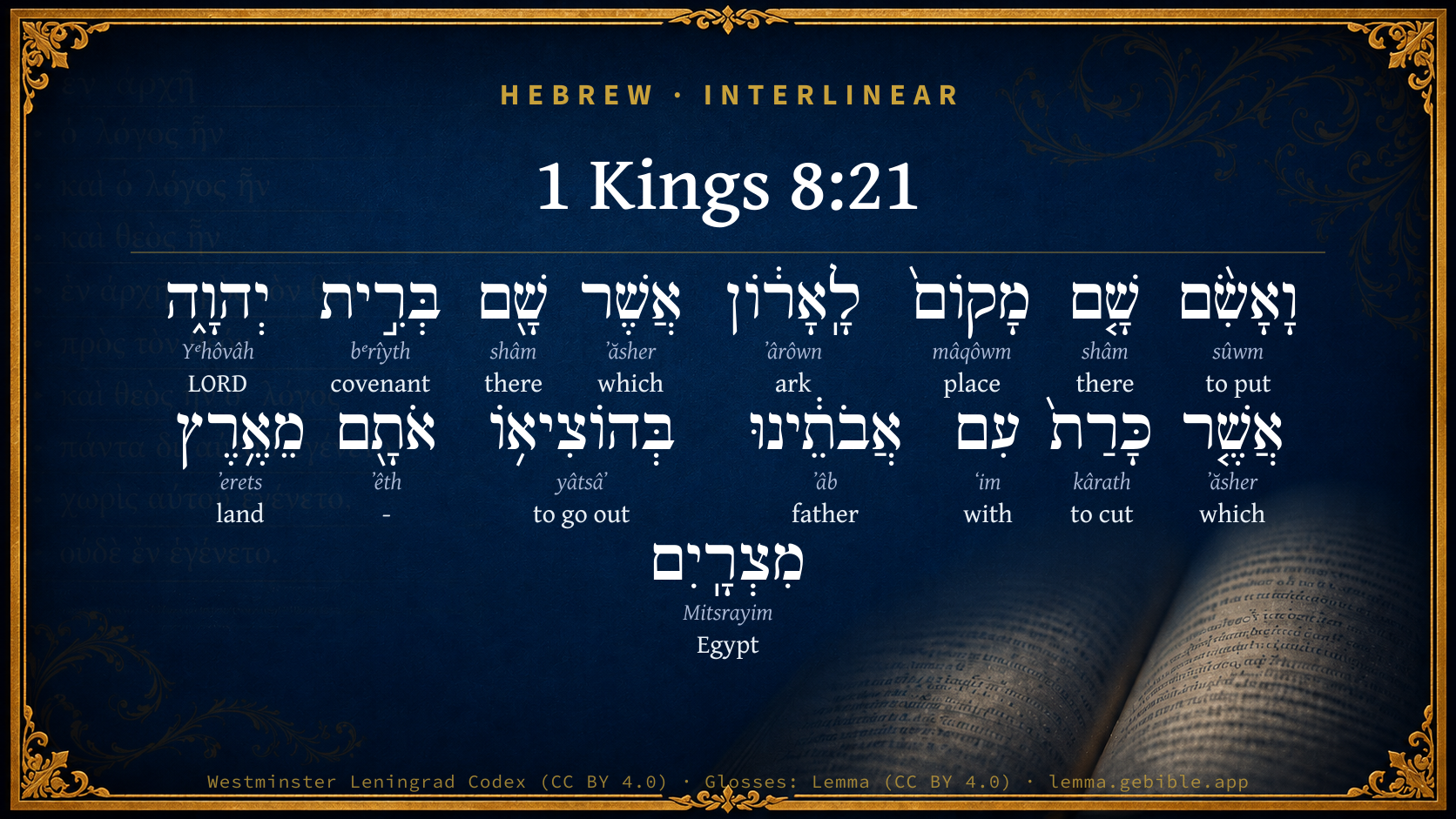
Hebrew (Westminster Leningrad Codex) 1 Kings 8:21 appears in the Hebrew Old Testament. The text above is from the Westminster Leningrad Codex. Each word links to its Strong’s number, a concise gloss, and parsing drawn from the Open Scriptures Hebrew Bible morphology. Click any word for its full Brown-Driver-Briggs (BDB) entry.
Download image
Cite this verse

1 Kings 8:21 (World English Bible). Public Domain. Lemma interlinear Bible study tool, https://lemma.gebible.app/v/1-kings/8/21.

Show BibTeX & RIS
BibTeX
RIS
English Translation
There have I set a place for the ark, in which is the covenant of Yahweh, which he made with our fathers, when he brought them out of the land of Egypt.
World English Bible · Public Domain
Download a study sheet

One document with this verse’s original text, its word-by-word gloss line, the meaning frame, cross-references with their text, attributed commentary, and full source and license credits — printable, and it pastes into notes with its structure intact.

This verse Autodidact and up

Study sheet (.html) Plain text (.txt)

A passage Seminary Student

Up to 50 verses in one chapter. A passage sheet keeps up to 6 commentary sources and 12 cross-references per verse, in the order this page ranks them, and says so on the sheet whenever that leaves anything out. Ask for a single verse and you get the Autodidact verse sheet above.

Everything on this page stays free to read, with no account — the sheet is a download of what is already on screen, not access to it.

Want to remove ads? Support Godless Engineer
Compare translations 3

The same verse in 3 English versions, stacked beneath the original-language interlinear above. Click any original word for its lexicon entry.

Each is an independent rendering of the whole verse — the interlinear is not word-aligned to these translations.

Highlighted words mark where these versions differ — a whole-verse word diff, not a word-by-word alignment.

  • World English Bible Public Domain
    There have I set a place for the ark, in which is the covenant of Yahweh, which he made with our fathers, when he brought them out of the land of Egypt.
  • King James Version Public Domain
    And I have set there a place for the ark, wherein is the covenant of the LORD, which he made with our fathers, when he brought them out of the land of Egypt.
  • unfoldingWord Literal Text CC BY-SA 4.0
    And I have made a place there for the Box where the Covenant of Yahweh there, which he cut with our fathers when he brought them out from the land of Egypt.”

unfoldingWord Literal Text — © unfoldingWord, licensed CC BY-SA 4.0. Word-aligned USFM3 via Door43 (git.door43.org/unfoldingWord/en_ult).

Versions to compare (up to 4)

3 of 4 selected

Show all 18 translations

Every available English version of this verse, each an independent rendering of the whole verse.

  • World English Bible Public Domain
    There have I set a place for the ark, in which is the covenant of Yahweh, which he made with our fathers, when he brought them out of the land of Egypt.
  • Berean Standard Bible Public Domain
    And there I have provided a place for the ark, which contains the covenant of the LORD that He made with our fathers when He brought them out of the land of Egypt.”
  • Majority Standard Bible Public Domain
    And there I have provided a place for the ark, which contains the covenant of the LORD that He made with our fathers when He brought them out of the land of Egypt.”
  • King James Version Public Domain
    And I have set there a place for the ark, wherein is the covenant of the LORD, which he made with our fathers, when he brought them out of the land of Egypt.
  • American Standard Version (1901) Public Domain
    And there have I set a place for the ark, wherein is the covenant of Jehovah, which he made with our fathers, when he brought them out of the land of Egypt.
  • Revised Version (1885) Public Domain
    And there have I set a place for the ark, wherein is the covenant of the LORD, which he made with our fathers, when he brought them out of the land of Egypt.
  • Geneva Bible (1599) Public Domain
    And I haue prepared therein a place for the Arke, wherein is the couenant of the Lord which he made with our fathers, whe he brought them out of the lande of Egypt.
  • Douay-Rheims (1899) Public Domain
    And I have set there a place for the ark, wherein is the covenant of the Lord, which he made with our fathers, when they came out of the land of Egypt.
  • Young's Literal Translation Public Domain
    and set there a place for the ark, where `is' the covenant of Jehovah which He made with our fathers in His bringing them out from the land of Egypt.'
  • Literal Standard Version CC BY-SA 4.0
    and I set a place for the Ark there, where the covenant of YHWH [is], which He made with our fathers in His bringing them out from the land of Egypt.”
  • Unlocked Literal Bible CC BY-SA 4.0
    I have made a place for the ark there, in which is Yahweh's covenant, which he made with our fathers when he brought them out of the land of Egypt.”
  • unfoldingWord Literal Text CC BY-SA 4.0
    And I have made a place there for the Box where the Covenant of Yahweh there, which he cut with our fathers when he brought them out from the land of Egypt.”
  • Darby Bible Public Domain
    And I have set there a place for the ark, wherein is the covenant of Jehovah, which he made with our fathers when he brought them out of the land of Egypt.
  • World Messianic Bible Public Domain
    There I have set a place for the ark, in which is the LORD’s covenant, which he made with our fathers when he brought them out of the land of Egypt.”
  • Webster's Bible Public Domain
    And I have set there a place for the ark, in which is the covenant of the LORD, which he made with our fathers, when he brought them from the land of Egypt.
  • Free Bible Version CC BY-SA 4.0
    I have provided a place there for the Ark, which contains the agreement of the Lord that he made with our forefathers when he led them out of the land of Egypt.”
  • Bible in Basic English Public Domain
    In it I have made a place for the ark, in which is the agreement which the Lord made with our fathers, when he took them out of the land of Egypt.
  • JPS Tanakh (1917) Public Domain
    And there have I set a place for the ark, wherein is the covenant of the LORD, which He made with our fathers, when He brought them out of the land of Egypt.'

Literal Standard Version (2020), Covenant Press — licensed CC BY-SA 4.0. Text via the HelloAO Bible API (eBible.org). Unlocked Literal Bible (unfoldingWord) — licensed CC BY-SA 4.0. Text via the HelloAO Bible API (eBible.org). unfoldingWord Literal Text — © unfoldingWord, licensed CC BY-SA 4.0. Word-aligned USFM3 via Door43 (git.door43.org/unfoldingWord/en_ult). Free Bible Version, Dr. Jonathan Gallagher — licensed CC BY-SA 4.0. Text via the HelloAO Bible API (eBible.org).

Word by word

More ways to search: Search by grammar → Find every occurrence → Compare this word →

Practice this passage: Drill this verse → Learn its vocabulary →

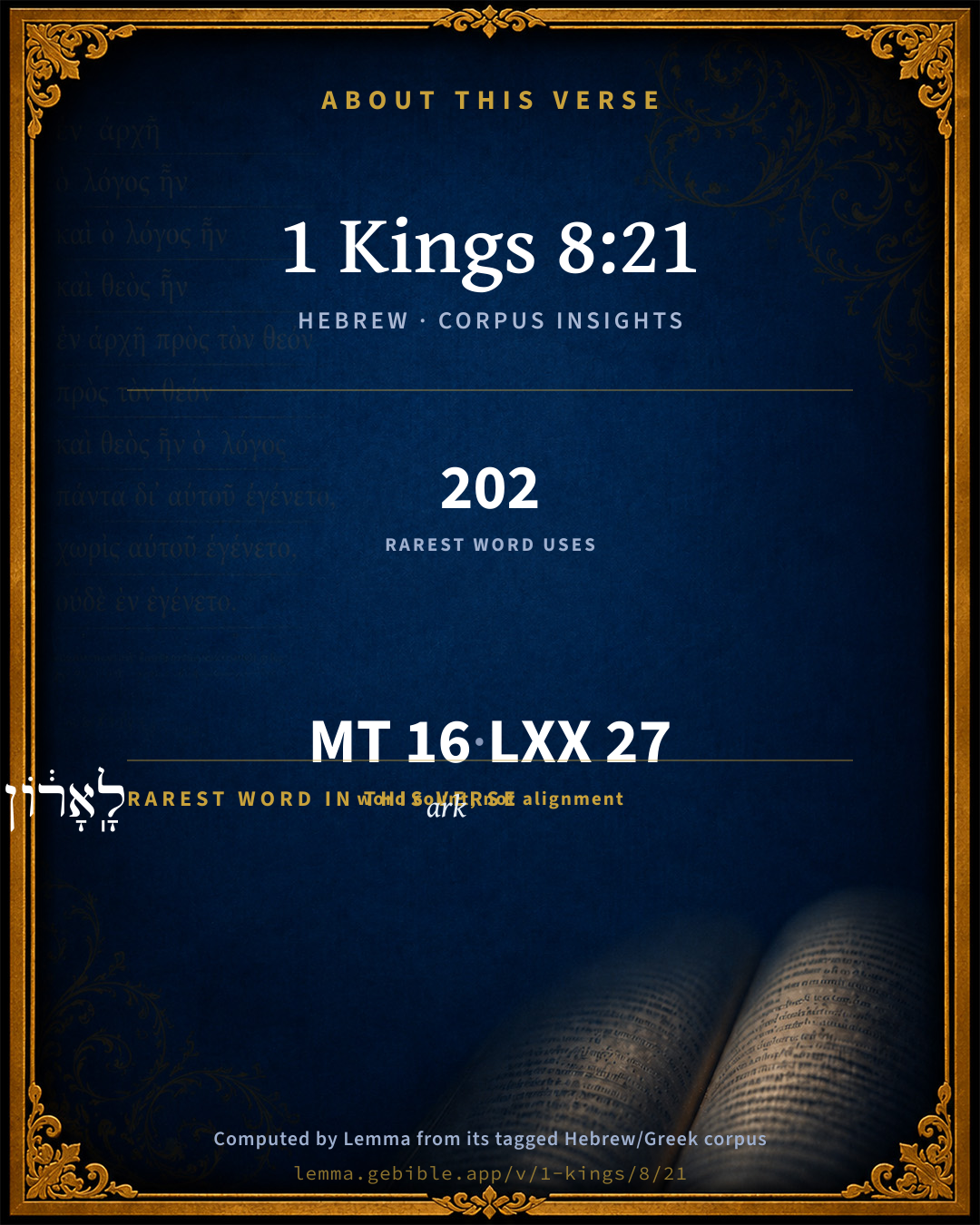
לָֽאָר֔וֹן
ʼârôwn
H727
“to/for the · ark”
Preposition, Determined + Noun, Common, Both, Singular, Absolute
Part of Speech
Preposition + Noun
Type
Common
Gender
Both
Number
Singular
State
Absolute
Full BDB Definition

Origin: from H717 (in the sense of gathering)

TWOT: 166a

chest, ark - money chest - Ark of the Covenant - (TWOT)coffin
  1. וָאָשִׂ֨ם sûwm H7760 “and · to put” Conjunction + Verb, Qal, Sequential Imperfect, 1st Person, Common, Singular
  2. שָׁ֤ם shâm H8033 “there” Adverb
  3. מָקוֹם֙ mâqôwm H4725 “place” Noun, Common, Masculine, Singular, Absolute
  4. אֲשֶׁר ʼăsher H834 “which” Particle, Relative
  5. שָׁ֖ם shâm H8033 “there” Adverb
  6. בְּרִ֣ית bᵉrîyth H1285 “covenant of” Noun, Common, Feminine, Singular, Construct
  7. יְהוָ֑ה Yᵉhôvâh H3068 “LORD” Noun, Proper
  8. אֲשֶׁ֤ר ʼăsher H834 “which” Particle, Relative
  9. כָּרַת֙ kârath H3772 “to cut” Verb, Qal, Perfect, 3rd Person, Masculine, Singular
  10. עִם ʻim H5973 “with” Preposition
  11. אֲבֹתֵ֔ינוּ ʼâb H1 “fathers · our” Noun, Common, Masculine, Plural, Construct + Suffix, Personal, 1st Person, Common, Plural
  12. בְּהוֹצִיא֥וֹ yâtsâʼ H3318 “in/at · to go out · him” Preposition + Verb, Hiphil, Infinitive Construct + Suffix, Personal, 3rd Person, Masculine, Singular
  13. אֹתָ֖ם ʼêth H853 “- · them” Particle, Direct Object + Suffix, Personal, 3rd Person, Masculine, Plural
  14. מֵאֶ֥רֶץ ʼerets H776 “from · land of” Preposition + Noun, Common, Both, Singular, Construct
  15. מִצְרָֽיִם Mitsrayim H4714 “Egypt” Noun, Proper

About this verse

These counts appear in no published source. They are computed here, from the morphology-tagged text and Lemma’s own curated glosses. What Lemma adds →

16
words
14
distinct lemmas
Historical
section

Grammatical profile

  • 3 verbs
  • 7 nouns
  • 1 preposition
  • 2 adverbs
  • 3 particles

Verb forms

  • וָאָשִׂ֨ם Qal · Sequential Imperfect
  • כָּרַת֙ Qal · Perfect
  • בְּהוֹצִיא֥וֹ Hiphil · Infinitive Construct

Repetition

Words recur within this verse — often emphatic in Hebrew:

  • שָׁ֤ם there H8033 ×2
  • אֲשֶׁר which H834 ×2

Hebrew & Septuagint length

In English translation the verse runs 32 words from the Hebrew and 35 from the Septuagint (LXX English) — closely comparable.

A rough comparison of the two English renderings, which tokenize alike — not a word-level alignment.

Word counts can differ between the Hebrew and the Greek without any difference in meaning — e.g. the Hebrew direct-object marker אֵת has no separate Greek word, and Greek often adds the article ὁ.

In the original languages it is 16 Hebrew tokens and 27 Greek tokens — but the two are counted differently (Hebrew bundles its prefixes and suffixes into one token; the Greek is in lemma form), so that isn’t a like-for-like length.

Cross-references

6

Topical passages linked to 1 Kings 8:21 in the Treasury of Scripture Knowledge — connected by theme and wording, ordered by reader-vote popularity; previews shown in the World English Bible.

  • Deuteronomy 31:26 Take this book of the law, and put it by the side of the ark of the covenant of Yahweh your God, that it may be there for a witness against you.
  • 1 Kings 8:9 There was nothing in the ark save the two tables of stone which Moses put there at Horeb, when Yahweh made a covenant with the children of Israel, when they came out of the land of Egypt.
  • 1 Kings 8:5–6 King Solomon and all the congregation of Israel, who were assembled to him, were with him before the ark, sacrificing sheep and oxen, that could not be counted nor numbered for multitude.
  • Exodus 34:28 He was there with Yahweh forty days and forty nights; he neither ate bread, nor drank water. He wrote on the tablets the words of the covenant, the ten commandments.
  • Deuteronomy 9:9 When I was gone up onto the mountain to receive the tables of stone, even the tables of the covenant which Yahweh made with you, then I stayed on the mountain forty days and forty nights; I did neither eat bread nor drink water.
  • Deuteronomy 9:11 It came to pass at the end of forty days and forty nights, that Yahweh gave me the two tables of stone, even the tables of the covenant.

Cross-references courtesy of OpenBible.info (CC BY 4.0).

Hebrew and Greek witnesses Masoretic Hebrew ↔ Greek Septuagint

The same verse in the two great witnesses to the Old Testament, shown verse-for-verse.

These are two independent witnesses, not word-aligned to each other, and the Septuagint is shown in lemma (dictionary) form.

Hebrew 1 Kings 8:21 Masoretic · Westminster Leningrad Codex

וָאָשִׂ֨ם שָׁ֤ם מָקוֹם֙ לָֽאָר֔וֹן אֲשֶׁר שָׁ֖ם בְּרִ֣ית יְהוָ֑ה אֲשֶׁ֤ר כָּרַת֙ עִם אֲבֹתֵ֔ינוּ בְּהוֹצִיא֥וֹ אֹתָ֖ם מֵאֶ֥רֶץ מִצְרָֽיִם

There have I set a place for the ark, in which is the covenant of Yahweh, which he made with our fathers, when he brought them out of the land of Egypt.

World English Bible · Public Domain

Greek LXX 1 Kings 8:21 Septuagint · lemma form

καί τίθημι ἐκεῖ τόπος ὁ κιβωτός ἐν ὅς εἰμί ἐκεῖ διαθήκη κύριος ὅς διατίθημι κύριος μετά ὁ πατήρ ἐγώ ἐν ὁ ἐκἄγω αὐτός αὐτός ἐκ γῆ αἴγυπτος

And I have set there a place for the ark, in which is the covenant of the Lord, which the Lord made with our fathers, when he brought them out of the land of Egypt.

LXX2012 (modern English Septuagint) · Public Domain

Hebrew: Westminster Leningrad Codex (CC BY 4.0). Greek: Septuagint (public domain); English from LXX2012 (modern English Septuagint) (Public Domain). How the Septuagint differs from the Hebrew →

Targum (Aramaic paraphrase)

1

The Targum is the ancient Jewish Aramaic paraphrase of the Hebrew Scriptures — an interpretive translation, not the Hebrew text itself. Onkelos (literal) and Pseudo-Jonathan (expansive) render the Torah, and Jonathan the Prophets. Coverage is partial: where no permissively-licensed English translation exists for a verse, only the Aramaic is shown. This is verse-level text, not a word-by-word alignment to the Hebrew.

  1. Targum Jonathan Prophets (Joshua–Malachi)
    וְשַׁוֵיתִי תַמָן אֲתַר מְתַקֵן לַאֲרוֹנָא דִי בֵיהּ מַחֲתִין תְּרֵין לוּחֵי אַבְנַיָא דִי עֲלֵיהוֹן קְיָמָא דַייָ דִי גְזַר עִם אַבְהָתָנָא בְּאַפָּקוּתֵיהּ יַתְהוֹן מֵאַרְעָא דְמִצְרָיִם:

    (no public-domain English translation for this verse)

    Targum Jonathan — Aramaic: “Mikraot Gedolot” (public domain). English: “Sefaria Community Translation” (CC0 1.0 (public-domain dedication)); “London "Chaldee Paraphrase," 1871” (public domain). Text via Sefaria.

Commentary

Notes on 1 Kings 8:21 from classic Christian and Jewish commentators (each source and its license shown beneath its notes). The classic Christian expositions comment on the surrounding passage and are grouped to its opening verse, so a note may address several verses; the Jewish commentaries on the Tanakh (Rashi and others) are per-verse, so they appear only where the commentator wrote on this verse.

Lemma curates 59 commentaries, every one of them public domain or Creative Commons licensed, each selected and text-cleaned for this edition rather than reprinted as found. About our sources →

Trapp's Complete Commentary

John Trapp

1Ki 8:21 And I have set there a place for the ark, wherein [is] the covenant of the LORD, which he made with our fathers, when he brought them out of the land of Egypt.

Ver. 21. A place for the ark.] Even the best and innermost part of the temple, because it was the chiefest evidence of God’s presence, and is called God’s face, {Psa 105:4} yea, even God himself. {Psa 132:5}

John Trapp, A Commentary or Exposition upon All the Books of the Old and New Testament (1647–1656) — public domain. Text from a community e-Sword module.

Joseph Benson's Commentary

1Ki 8:21. I have set there a place for the ark — The token of God’s presence with us; wherein is the covenant of the Lord — That is, the tables of the covenant, in which are written the conditions of God’s covenant with our fathers. When he brought them out of the land of Egypt — And declared to them that by the tenure of this covenant they were to hold the land of Canaan.

Joseph Benson's Commentary on the Old and New Testaments (1811–1818) — public domain. Text from a community e-Sword module.

Geneva Bible (1599)

Geneva Bible translators

The two Tables wherein the articles of the covenant were written.

Geneva Bible (1599) marginal notes — public domain. Text via Bolls.life.

Adam Clarke's Commentary

Verse 21. Wherein is the covenant of the Lord] As it is said, 1Kg 8:9, that there was nothing in the ark but the two tables of stone, consequently these are called the Covenant, i.e., a sign of the covenant; as our Lord calls the cup the new covenant in his blood, that is, the sign of the new covenant: for This is my body implies, This is the sign or emblem of my body.

Adam Clarke's Commentary on the Bible (1810–1826) — public domain. Text from a community e-Sword/MySword module.

Ellicott's Commentary for English Readers

(21) Wherein is the covenant of the Lord—the Tables, that is, containing the “words of the covenant” (Exo_34:28). This remarkable application of the word “covenant” illustrates strikingly the characteristics of the Divine covenants with man. Such covenants are not (like most human covenants) undertakings of reciprocal engagements between parties regarded as independent. For such a conception of the relation between God and man is monstrous. God’s covenants proceed simply from His will, expressed in His call to an individual or a nation. They begin in free grace and blessing from Him; they require simply that men should believe and accept His call, and act in obedience to that belief. Thus the Decalogue opens with the words, “I am the Lord thy God, who brought thee out of the land of Egypt, out of the house of bondage,” describing the gift of salvation from the mercy of God, which constituted Israel afresh as His peculiar people. (See Exo_3:7-15.) On the ground of this salvation, rather than of His Omnipotence as Creator and Sustainer of the world, He calls for their obedience to the commandments, which are thus “the words of the covenant.” Similarly St. Paul, when (Rom_12:1) he calls Christians to absolute self-devotion, appeals to them by “the mercies of God,” on which he had so fully dwelt—the larger and more spiritual covenant in Christ.

A Bible Commentary for English Readers, edited by Charles John Ellicott (1878–1897) — public domain. Text from a community e-Sword module.

The Cambridge Bible for Schools and Colleges

gen. ed. J. J. S. Perowne

21. the ark, wherein is the covenant of the Lord] It has just been said (1Ki_8:9) that only the two tables of stone were in the ark. They must then be meant by ‘the covenant of the Lord,’ and this is borne out by such passages as Deu_4:23; Deu_29:25, where the covenant alluded to forms a part of the ten commandments. But ‘the book of the covenant’ (Exo_24:7) appears to have included all the laws contained in Exodus 20-23.

The Cambridge Bible for Schools and Colleges (gen. ed. J. J. S. Perowne; Cambridge University Press, 1878–1918) — public domain. Text from a community e-Sword module.

John Gill's Exposition

And I have set there a place for the ark,.... The most holy place:

wherein is the covenant of the Lord; the two tables of stone, on which were the covenant of the Lord, as the Targum:

which he made with our fathers, when he brought them out of the land of Egypt; as in Kg1 8:9.

John Gill's Exposition of the Whole Bible (1746–1763) — public domain (CC PDM 1.0). Text via the HelloAO Bible API.

Matthew Poole's English Annotations

The covenant of the Lord, i.e. the tables of the covenant, by a metonymy, wherein the conditions of God’s covenant with Israel are written.

Matthew Poole's English Annotations on the Holy Bible (1683–1685) — public domain. Text from a community e-Sword/MySword module.

The Pulpit Commentary

And I have set there a place for the ark, wherein is the covenant of the Lord. Hence its name, "the ark of the covenant" (Exo_34:28; cf. Deu_9:11) which he made with our forefathers when he brought them out of the land of Egypt (vers. 9, 16) .

The Pulpit Commentary (1880–1919), ed. H.D.M. Spence-Jones & Joseph S. Exell — public domain. Text from a community e-Sword module.

John Wesley's Explanatory Notes

The covenant - The tables of the covenant, wherein the conditions of God's covenant with Israel are written.

John Wesley, Explanatory Notes Upon the Whole Bible (1754–1765) — public domain. Text via the GEBible commentary corpus.

Lesson kit

Teaching starters — assembled from the data on this page, not authored interpretation. Every prompt links to the verse data it draws on. Edit before teaching.

1 Kings, in the Historical, opens this verse with 16 words (14 distinct Hebrew lemmas). Its most distinctive word is ʼârôwn (“ark”). A historical commentator’s framing appears above. Read the whole chapter for the surrounding context.

Discussion questions

  1. What does “ark” (ʼârôwn) contribute to the verse as a whole?
  2. Deuteronomy 31:26 shares this passage’s theme. How do the two illuminate each other?
  3. “there” occurs 2× in this one verse. What is the effect of the repetition?
  4. These translations render this verse differently. What is at stake in choosing one wording over another?
  5. The verb «וָאָשִׂ֨ם» is Qal Sequential Imperfect. How does its form color the action?
  6. Reading how Trapp's Complete Commentary and Joseph Benson's Commentary read this verse, where do the two commentators agree and where do they part?

Things to notice

Reading settings

Reading text

Shown beneath each verse's original-language words.

Old Testament
Old Testament edition

Read the OT as the Masoretic Hebrew (MT) or the Greek Septuagint (LXX).

English shown for the Greek Septuagint (in the Hebrew ↔ Greek comparison).

Comparing translations? Open the Compare panel on any verse page to stack up to four side by side.