Proverbs 24:14

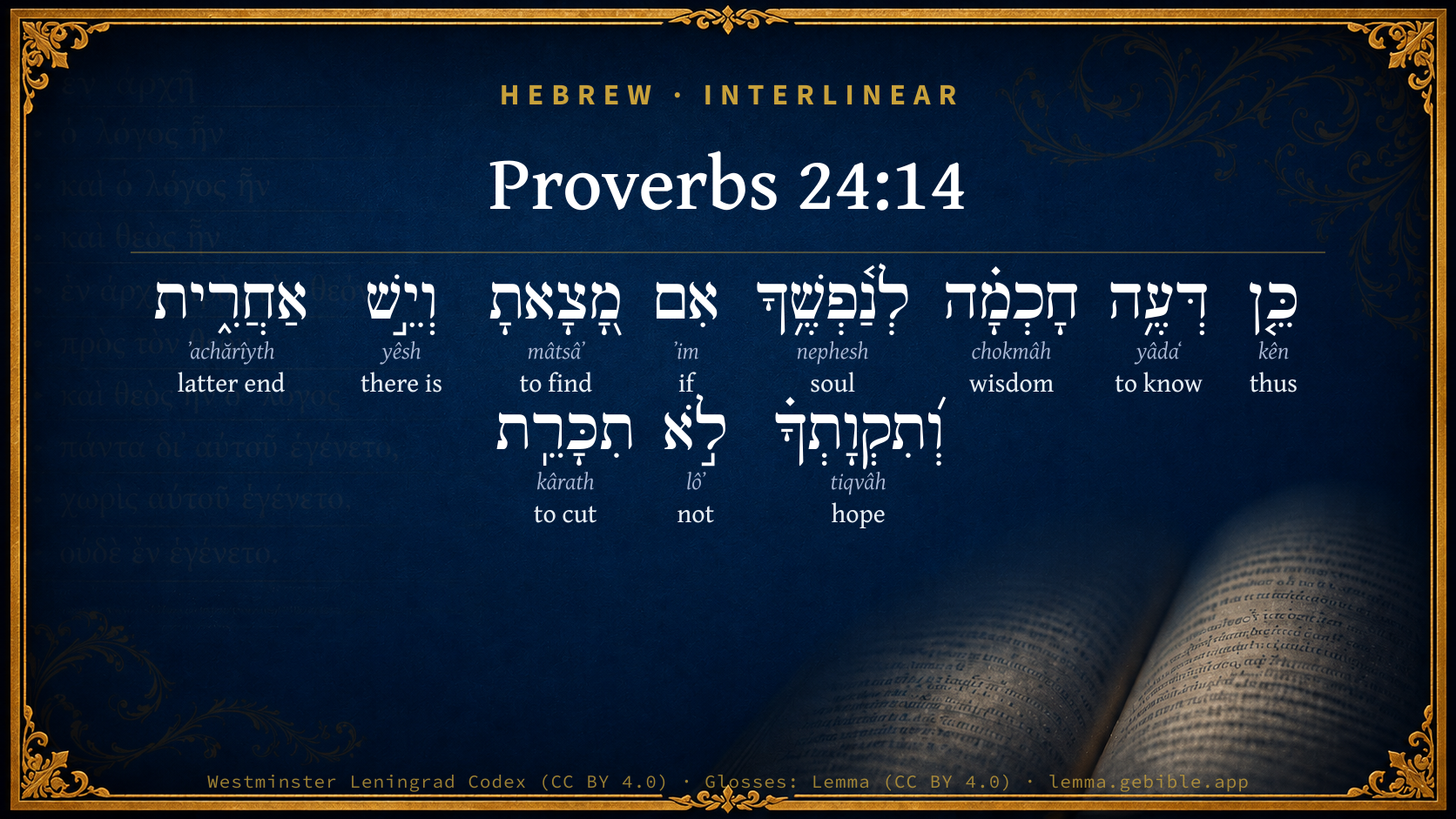
Hebrew (Westminster Leningrad Codex) Proverbs 24:14 appears in the Hebrew Old Testament. The text above is from the Westminster Leningrad Codex. Each word links to its Strong’s number, a concise gloss, and parsing drawn from the Open Scriptures Hebrew Bible morphology. Click any word for its full Brown-Driver-Briggs (BDB) entry.
Download image
Cite this verse

Proverbs 24:14 (World English Bible). Public Domain. Lemma interlinear Bible study tool, https://lemma.gebible.app/v/proverbs/24/14.

Show BibTeX & RIS
BibTeX
RIS
English Translation
So you shall know wisdom to be to your soul; If you have found it, then there will be a reward, Your hope will not be cut off.
World English Bible · Public Domain
Download a study sheet

One document with this verse’s original text, its word-by-word gloss line, the meaning frame, cross-references with their text, attributed commentary, and full source and license credits — printable, and it pastes into notes with its structure intact.

This verse Autodidact and up

Study sheet (.html) Plain text (.txt)

A passage Seminary Student

Up to 50 verses in one chapter. A passage sheet keeps up to 6 commentary sources and 12 cross-references per verse, in the order this page ranks them, and says so on the sheet whenever that leaves anything out. Ask for a single verse and you get the Autodidact verse sheet above.

Everything on this page stays free to read, with no account — the sheet is a download of what is already on screen, not access to it.

Want to remove ads? Support Godless Engineer
Compare translations 3

The same verse in 3 English versions, stacked beneath the original-language interlinear above. Click any original word for its lexicon entry.

Each is an independent rendering of the whole verse — the interlinear is not word-aligned to these translations.

Highlighted words mark where these versions differ — a whole-verse word diff, not a word-by-word alignment.

  • World English Bible Public Domain
    So you shall know wisdom to be to your soul; If you have found it, then there will be a reward, Your hope will not be cut off.
  • King James Version Public Domain
    So shall the knowledge of wisdom be unto thy soul: when thou hast found it, then there shall be a reward, and thy expectation shall not be cut off.
  • unfoldingWord Literal Text CC BY-SA 4.0
    Know wisdom thus for your soul; if you find, then there will be a future and your hope will not be cut off.

unfoldingWord Literal Text — © unfoldingWord, licensed CC BY-SA 4.0. Word-aligned USFM3 via Door43 (git.door43.org/unfoldingWord/en_ult).

Versions to compare (up to 4)

3 of 4 selected

Show all 18 translations

Every available English version of this verse, each an independent rendering of the whole verse.

  • World English Bible Public Domain
    So you shall know wisdom to be to your soul; If you have found it, then there will be a reward, Your hope will not be cut off.
  • Berean Standard Bible Public Domain
    Know therefore that wisdom is sweet to your soul. If you find it, there is a future for you, and your hope will never be cut off.
  • Majority Standard Bible Public Domain
    Know therefore that wisdom is sweet to your soul. If you find it, there is a future for you, and your hope will never be cut off.
  • King James Version Public Domain
    So shall the knowledge of wisdom be unto thy soul: when thou hast found it, then there shall be a reward, and thy expectation shall not be cut off.
  • American Standard Version (1901) Public Domain
    So shalt thou know wisdom to be unto thy soul; If thou hast found it, then shall there be a reward, And thy hope shall not be cut off.
  • Revised Version (1885) Public Domain
    So shalt thou know wisdom to be unto thy soul: if thou hast found it, then shall there be a reward, and thy hope shall not be cut off.
  • Geneva Bible (1599) Public Domain
    So shall the knowledge of wisdome be vnto thy soule, if thou finde it, and there shall be an ende, and thine hope shall not be cut off.
  • Douay-Rheims (1899) Public Domain
    So also is the doctrine of wisdom to thy soul: which when thou hast found, thou shalt have hope in the end, and thy hope shall not perish.
  • Young's Literal Translation Public Domain
    So `is' the knowledge of wisdom to thy soul, If thou hast found that there is a posterity And thy hope is not cut off.
  • Literal Standard Version CC BY-SA 4.0
    So [is] the knowledge of wisdom to your soul, || If you have found that there is a posterity || And your hope is not cut off.
  • Unlocked Literal Bible CC BY-SA 4.0
    Such is wisdom for your soul— if you find it, there will be a future and your hope will not be cut off.
  • unfoldingWord Literal Text CC BY-SA 4.0
    Know wisdom thus for your soul; if you find, then there will be a future and your hope will not be cut off.
  • Darby Bible Public Domain
    so consider wisdom for thy soul; if thou hast found it, there shall be a result, and thine expectation shall not be cut off.
  • World Messianic Bible Public Domain
    so you shall know wisdom to be to your soul. If you have found it, then there will be a reward: Your hope will not be cut off.
  • Webster's Bible Public Domain
    So shall the knowledge of wisdom be to thy soul: when thou hast found it, then there shall be a reward, and thy expectation shall not be cut off.
  • Free Bible Version CC BY-SA 4.0
    In the same way, you should know that wisdom is good for you; if you find it, there will be a future for you, and your hope will not be crushed.
  • Bible in Basic English Public Domain
    So let your desire be for wisdom: if you have it, there will be a future, and your hope will not be cut off.
  • JPS Tanakh (1917) Public Domain
    So know thou wisdom to be unto thy soul; if thou hast found it, then shall there be a future, and thy hope shall not be cut off.

Literal Standard Version (2020), Covenant Press — licensed CC BY-SA 4.0. Text via the HelloAO Bible API (eBible.org). Unlocked Literal Bible (unfoldingWord) — licensed CC BY-SA 4.0. Text via the HelloAO Bible API (eBible.org). unfoldingWord Literal Text — © unfoldingWord, licensed CC BY-SA 4.0. Word-aligned USFM3 via Door43 (git.door43.org/unfoldingWord/en_ult). Free Bible Version, Dr. Jonathan Gallagher — licensed CC BY-SA 4.0. Text via the HelloAO Bible API (eBible.org).

Word by word

More ways to search: Search by grammar → Find every occurrence → Compare this word →

Practice this passage: Drill this verse → Learn its vocabulary →

וְ֝תִקְוָתְךָ֗
tiqvâh
H8615
“and · hope · your”
Conjunction + Noun, Common, Feminine, Singular, Construct + Suffix, Personal, 2nd Person, Masculine, Singular
Part of Speech
Conjunction + Noun
Type
Common
Gender
Feminine
Number
Singular
State
Construct
Full BDB Definition

Origin: from H6960

TWOT: 1994d , 1994e

cord - hope, expectation - hope - ground of hope - things hoped for, outcome
  1. כֵּ֤ן kên H3651 “thus” Particle, Demonstrative
  2. דְּעֶ֥ה yâdaʻ H3045 “know” Verb, Qal, Imperative, 2nd Person, Masculine, Singular + Suffix, h
  3. חָכְמָ֗ה chokmâh H2451 “wisdom” Noun, Common, Feminine, Singular, Absolute
  4. לְנַ֫פְשֶׁ֥ךָ nephesh H5315 “to/for · soul · your” Preposition + Noun, Common, Both, Singular, Construct + Suffix, Personal, 2nd Person, Masculine, Singular
  5. אִם ʼim H518 “if” Conjunction
  6. מָ֭צָאתָ mâtsâʼ H4672 “to find” Verb, Qal, Perfect, 2nd Person, Masculine, Singular
  7. וְיֵ֣שׁ yêsh H3426 “and · there is” Conjunction + Particle, Demonstrative
  8. אַחֲרִ֑ית ʼachărîyth H319 “latter end” Noun, Common, Feminine, Singular, Absolute
  9. לֹ֣א lôʼ H3808 “not” Particle, Negative
  10. תִכָּרֵֽת kârath H3772 “to cut” Verb, Niphal, Imperfect, 3rd Person, Feminine, Singular

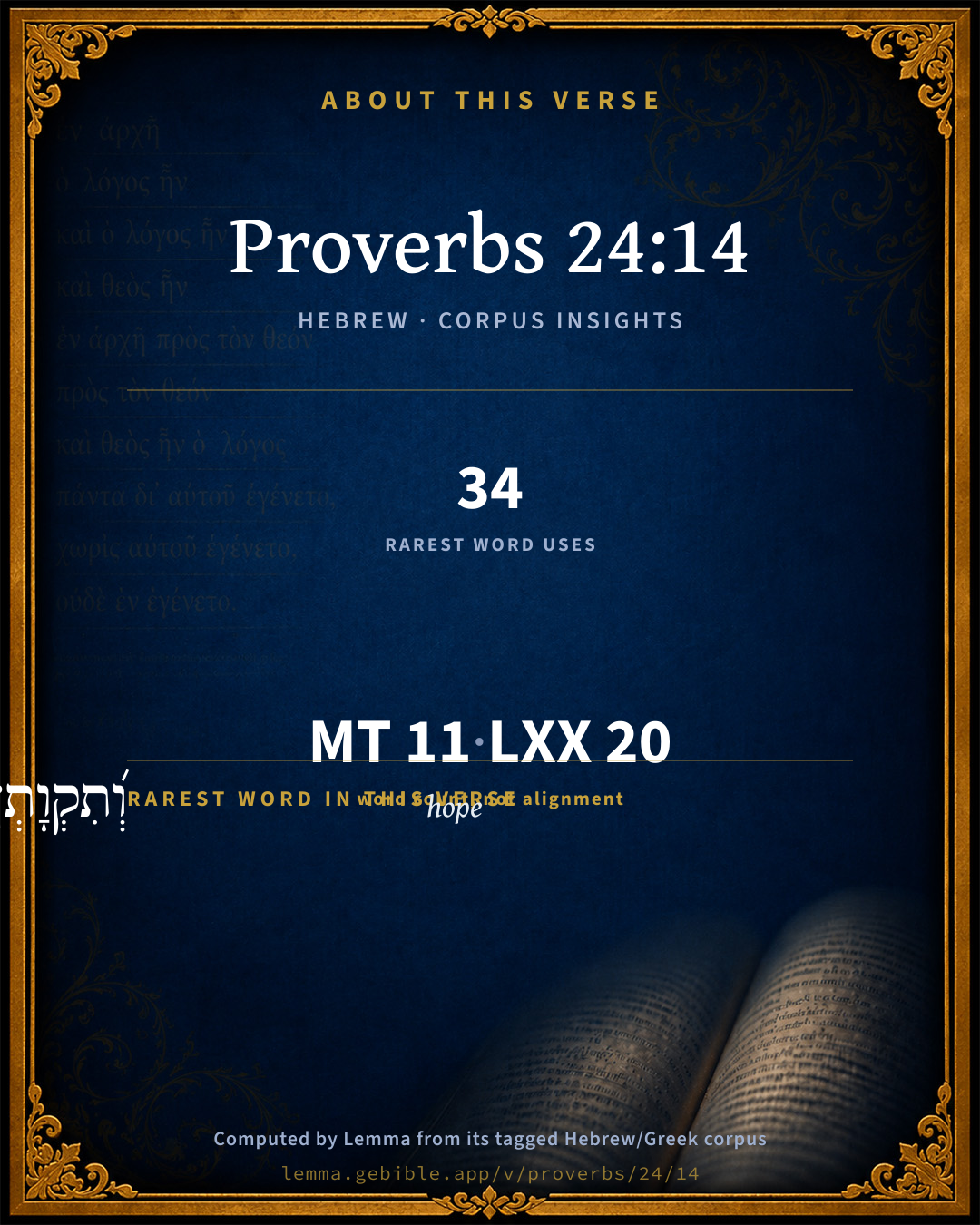
About this verse

These counts appear in no published source. They are computed here, from the morphology-tagged text and Lemma’s own curated glosses. What Lemma adds →

11
words
11
distinct lemmas
Wisdom
section

Shared distinctive vocabulary

וְ֝תִקְוָתְךָ֗ hope H8615 occurs in 33 verses of the Hebrew Bible. Also found in:

Grammatical profile

  • 3 verbs
  • 4 nouns
  • 1 conjunction
  • 3 particles

Verb forms

  • דְּעֶ֥ה Qal · Imperative
  • מָ֭צָאתָ Qal · Perfect
  • תִכָּרֵֽת Niphal · Imperfect

Hebrew & Septuagint length

In English translation the verse runs 28 words from the Hebrew and 24 from the Septuagint (LXX English) — closely comparable.

A rough comparison of the two English renderings, which tokenize alike — not a word-level alignment.

Word counts can differ between the Hebrew and the Greek without any difference in meaning — e.g. the Hebrew direct-object marker אֵת has no separate Greek word, and Greek often adds the article ὁ.

In the original languages it is 11 Hebrew tokens and 20 Greek tokens — but the two are counted differently (Hebrew bundles its prefixes and suffixes into one token; the Greek is in lemma form), so that isn’t a like-for-like length.

Cross-references

11

Topical passages linked to Proverbs 24:14 in the Treasury of Scripture Knowledge — connected by theme and wording, ordered by reader-vote popularity; previews shown in the World English Bible.

  • James 1:25 But he who looks into the perfect law, the law of freedom, and continues, not being a hearer who forgets but a doer of the work, this man will be blessed in what he does.
  • Proverbs 2:10 For wisdom will enter into your heart. Knowledge will be pleasant to your soul.
  • Jeremiah 15:16 Your words were found, and I ate them; and your words were to me a joy and the rejoicing of my heart: for I am called by your name, Yahweh, God of hosts.
  • Psalms 119:103 How sweet are your promises to my taste, More than honey to my mouth!
  • Proverbs 23:18 Indeed surely there is a future hope, And your hope will not be cut off.
  • Proverbs 2:1–5 My son, if you will receive my words, And store up my commandments within you;
  • Proverbs 3:13–18 Happy is the man who finds wisdom, The man who gets understanding.
  • Proverbs 22:18 For it is a pleasant thing if you keep them within you, If all of them are ready on your lips.
  • Psalms 19:10–11 More to be desired are they than gold, yes, than much fine gold; Sweeter also than honey and the extract of the honeycomb.
  • Psalms 119:111 I have taken your testimonies as a heritage forever, For they are the joy of my heart.
  • Matthew 19:21 Jesus said to him, "If you want to be perfect, go, sell what you have, and give to the poor, and you will have treasure in heaven; and come, follow me."

Cross-references courtesy of OpenBible.info (CC BY 4.0).

Hebrew and Greek witnesses Masoretic Hebrew ↔ Greek Septuagint

The same verse in the two great witnesses to the Old Testament, shown verse-for-verse.

These are two independent witnesses, not word-aligned to each other, and the Septuagint is shown in lemma (dictionary) form.

Hebrew Proverbs 24:14 Masoretic · Westminster Leningrad Codex

כֵּ֤ן דְּעֶ֥ה חָכְמָ֗ה לְנַ֫פְשֶׁ֥ךָ אִם מָ֭צָאתָ וְיֵ֣שׁ אַחֲרִ֑ית וְ֝תִקְוָתְךָ֗ לֹ֣א תִכָּרֵֽת

So you shall know wisdom to be to your soul; If you have found it, then there will be a reward, Your hope will not be cut off.

World English Bible · Public Domain

Greek LXX Proverbs 24:14 Septuagint · lemma form

οὕτως αἰσθάνομαι σοφία ὁ σός ψυχή ἐάν γάρ εὑρίσκω εἰμί καλός ὁ τελευτή σύ καί ἐλπίς σύ οὐ ἐν καταλείπω

Thus shall you perceive wisdom in your soul: for if you find it, your end shall be good, and hope shall not fail you.

LXX2012 (modern English Septuagint) · Public Domain

On this verse, Adam Clarke's Commentary discusses the Septuagint’s reading. Read the note in Commentary ↓

Hebrew: Westminster Leningrad Codex (CC BY 4.0). Greek: Septuagint (public domain); English from LXX2012 (modern English Septuagint) (Public Domain). How the Septuagint differs from the Hebrew →

Commentary

Notes on Proverbs 24:14 from classic Christian and Jewish commentators (each source and its license shown beneath its notes). The classic Christian expositions comment on the surrounding passage and are grouped to its opening verse, so a note may address several verses; the Jewish commentaries on the Tanakh (Rashi and others) are per-verse, so they appear only where the commentator wrote on this verse.

Lemma curates 59 commentaries, every one of them public domain or Creative Commons licensed, each selected and text-cleaned for this edition rather than reprinted as found. About our sources →

Geneva Bible (1599)

Geneva Bible translators

Or, reward.

Geneva Bible (1599) marginal notes — public domain. Text via Bolls.life.

Jamieson, Fausset & Brown

Robert Jamieson, A. R. Fausset & David Brown

reward--literally, "after part," the proper result (compare Pro 23:18; Psa 37:37-38).

Jamieson, Fausset & Brown — Commentary Critical and Explanatory on the Whole Bible (1871) — public domain (CC PDM 1.0). Text via the HelloAO Bible API.

Adam Clarke's Commentary

Verse 14. So shall the knowledge of wisdom be unto thy soul] True religion, experimental godliness, shall be to thy soul as the honey-comb is to thy mouth.

Then there shall be a reward, and thy expectation shall not be cut off.] This is precisely the same with that in the preceding chapter, Pr 23:18, where see the note. See Clarke on Pr 23:18. The word אחרית acharith, we translate in the former place an end, and here we translate it a reward; but there is no place I believe in the sacred writings in which it has any such acceptation; nor can such a meaning be deduced from the root אחר achar, which always refers to behind, after, extremity, latter part, time, c., but never carries the idea of recompense, compensation, or such like nor has one of the versions understood it so. There is another state or life, and thy expectation of happiness in a future world shall not be cut off. In this sense the versions all understood it. I will take them as they lie before me.

"Which (wisdom) when thou shalt have found, thou shalt have hope in thy last days; and thy hope shall not perish." - Vulgate.

"And if thou find it, thou shalt have a good death; and hope shall not forsake thee." - Septuagint.

"Which, if thou have found, thy latter days shall be better than the former; and thy hope shall not be consumed." - Chaldee.

"There shall be an end, and thy hope shall not be cut off." - Syriac.

"For, if thou shalt find her, (wisdom,) thy death shall be glorious, and thy hope will not fail thee." - Arabic.

Whiche whan thou fyndist schalt han in the last thingis, hope: and thin hope schal not perischen. - Old MS. Bible.

"And there is GOOD HOPE; yee that hope shal not be in vayne." - Coverdale.

This rendering is indefinite, which is not the usual custom of the translator.

Adam Clarke's Commentary on the Bible (1810–1826) — public domain. Text from a community e-Sword/MySword module.

Ellicott's Commentary for English Readers

(14) So shall the knowledge of wisdom be unto thy soul.—Rather, Know (or understand) that wisdom is such (equally sweet and good) for thy soul.

A reward.—Literally, a future. (Comp. Pro_23:18.)

A Bible Commentary for English Readers, edited by Charles John Ellicott (1878–1897) — public domain. Text from a community e-Sword module.

The Cambridge Bible for Schools and Colleges

gen. ed. J. J. S. Perowne

14. so shall the knowledge of wisdom be] Rather, so know wisdom to be. With like avidity as you eat honey (Pro_24:13), know, get to know, pursue the knowledge of, wisdom. Comp. Psa_19:10 (Hebrews 11).

reward] See Pro_23:18 note.

The Cambridge Bible for Schools and Colleges (gen. ed. J. J. S. Perowne; Cambridge University Press, 1878–1918) — public domain. Text from a community e-Sword module.

John Gill's Exposition

Lay not wait, O wicked man, against the dwelling of the righteous,.... The church of God, which is the righteous man's dwelling place, and where he desires and delights to dwell; or his own dwelling house; it may be rendered, "at the dwelling of the righteous" (p); lay not wait at his door to observe who goes in and out, and what is done there; and to watch for his halting, and take notice of his infirmities, slips, and falls, and improve them to his disadvantage; and so the Vulgate Latin version, "and lay not wait and seek ungodliness in the house of the righteous"; or lay not wait there for him, as Saul set men to watch the house of David to kill him, Sa1 19:11; or to take an opportunity and get into it and plunder it, as follows;

spoil not his resting place: by pulling it down, or stripping it of its furniture; by robbing him of the substance in it, and thus disturbing his rest, and destroying the place of it; or the place where he lies down as a sheep in its fold, or as the shepherd in his cottage, of which the words in the text are used; and so denote that as the righteous man is like a sheep, harmless and innocent, those that lay in wait for him and spoil him are no other than wolves.

(p) "habitaculo", Pagninus, Montanus, Mercerus; "habitationi", Michaelis; "mansioni", Cocceius, Schultens.

John Gill's Exposition of the Whole Bible (1746–1763) — public domain (CC PDM 1.0). Text via the HelloAO Bible API.

Albert Barnes' Notes on the Bible

The knowledge of wisdom - Better, Know that thus (like the honey) is wisdom to thy soul.

Albert Barnes' Notes on the Bible (1834–1885) — public domain. Text from a community e-Sword/MySword module.

Haydock's Catholic Bible Commentary

Thou shalt. Hebrew, "yea, it is the last." (Montanus) --- "Then there shall be a reward." (Protestants) --- Thou shalt enjoy old age, or have posterity. (Calmet)

George Leo Haydock (1774–1849), Haydock's Catholic Family Bible and Commentary, 1859 edition — public domain. Excludes Psalms (Douay-Rheims chapter numbering differs from Protestant) and Deuterocanonical books (Catholic canon only).

Matthew Poole's English Annotations

When thou hast found it; whereby he implies that there is indeed some difficulty and trouble in the pursuit of wisdom, but that it is abundantly compensated with the sweetness and advantage of it when a man arrives at it.

Then there shall be a reward, Heb. and or also there is a reward. It is not only as good as honey, sweet for the present, but it is infinitely better, bringing a sure and everlasting reward with it.

Matthew Poole's English Annotations on the Holy Bible (1683–1685) — public domain. Text from a community e-Sword/MySword module.

The Pulpit Commentary

So shall the knowledge of wisdom be unto thy soul; better, know, apprehend wisdom to be such for thy soul to be as pleasant and nourishing and profitable to thy soul, as honey is to thy taste and thy body. The moralist would have his disciple feel the same relish for wisdom that he has for sweet food, recognize it not simply as useful, but as delightful and enjoyable. When thou hast found it. To find wisdom is to get possession of it and use it. (comp. Pro_3:13, and note there) Then there shall be a reward. The apodosis begins here. We have had the same assurance in Pro_23:18 (where see note). The word is literally future. One who has obtained wisdom has a glorious hope before him; habebis in novissimis spem, Vulgate; but his hope is better than that it goes with him, not in his last hour only, but all his life long. Septuagint, "Then shalt thou perceive wisdom in thy soul; for if thou find it, fair shall be thine end, and hope shall not fail thee."

The Pulpit Commentary (1880–1919), ed. H.D.M. Spence-Jones & Joseph S. Exell — public domain. Text from a community e-Sword module.

John Wesley's Explanatory Notes

A reward - It is not only sweet for the present, but brings a sure and everlasting reward.

John Wesley, Explanatory Notes Upon the Whole Bible (1754–1765) — public domain. Text via the GEBible commentary corpus.

Kretzmann's Popular Commentary

Paul E. Kretzmann

v. 14. So shall the knowledge of wisdom be unto thy soul, altogether agreeable and full of rich nourishment and therefore well worth acquiring; when thou hast found it, then there shall be a reward, and thy expectation shall not be cut off, the future will show that the acquiring of wisdom was well worthwhile.

Paul E. Kretzmann, Popular Commentary of the Bible (1921–1924) — public domain. Text from a community e-Sword module.

Rashi

Rabbi Shlomo Yitzchaki (Rashi)

if you have found it, then you will have a future.

Rashi on the Tanakh — English translations: “The Judaica Press complete Tanach with Rashi, translated by A. J. Rosenberg” (CC BY 4.0); “Pentateuch with Rashi's commentary by M. Rosenbaum and A.M. Silbermann, 1929-1934” (public domain); “The Metsudah Tanach series, Lakewood, N.J” (CC BY 4.0); and “The Book of Joshua, Metsudah Publications, 1997” (CC BY 4.0). Text via Sefaria.

Lesson kit

Teaching starters — assembled from the data on this page, not authored interpretation. Every prompt links to the verse data it draws on. Edit before teaching.

Proverbs, in the Wisdom, opens this verse with 11 words (11 distinct Hebrew lemmas). Its most distinctive word is tiqvâh (“hope”). A historical commentator’s framing appears above. Read the whole chapter for the surrounding context.

Discussion questions

  1. What does “hope” (tiqvâh) contribute to the verse as a whole?
  2. Joshua 2:18 shares the word «hope» with this verse. How do the two illuminate each other?
  3. The translations on this page render this verse differently — a whole-verse word diff, not a word-by-word alignment. What might account for the different wordings?
  4. The verb «דְּעֶ֥ה» is Qal Imperative. How does its form color the action?
  5. Reading how Geneva Bible (1599) and Jamieson, Fausset & Brown read this verse, where do the two commentators agree and where do they part?

Things to notice

Reading settings

Reading text

Shown beneath each verse's original-language words.

Old Testament
Old Testament edition

Read the OT as the Masoretic Hebrew (MT) or the Greek Septuagint (LXX).

English shown for the Greek Septuagint (in the Hebrew ↔ Greek comparison).

Comparing translations? Open the Compare panel on any verse page to stack up to four side by side.