
Leviticus 7:20

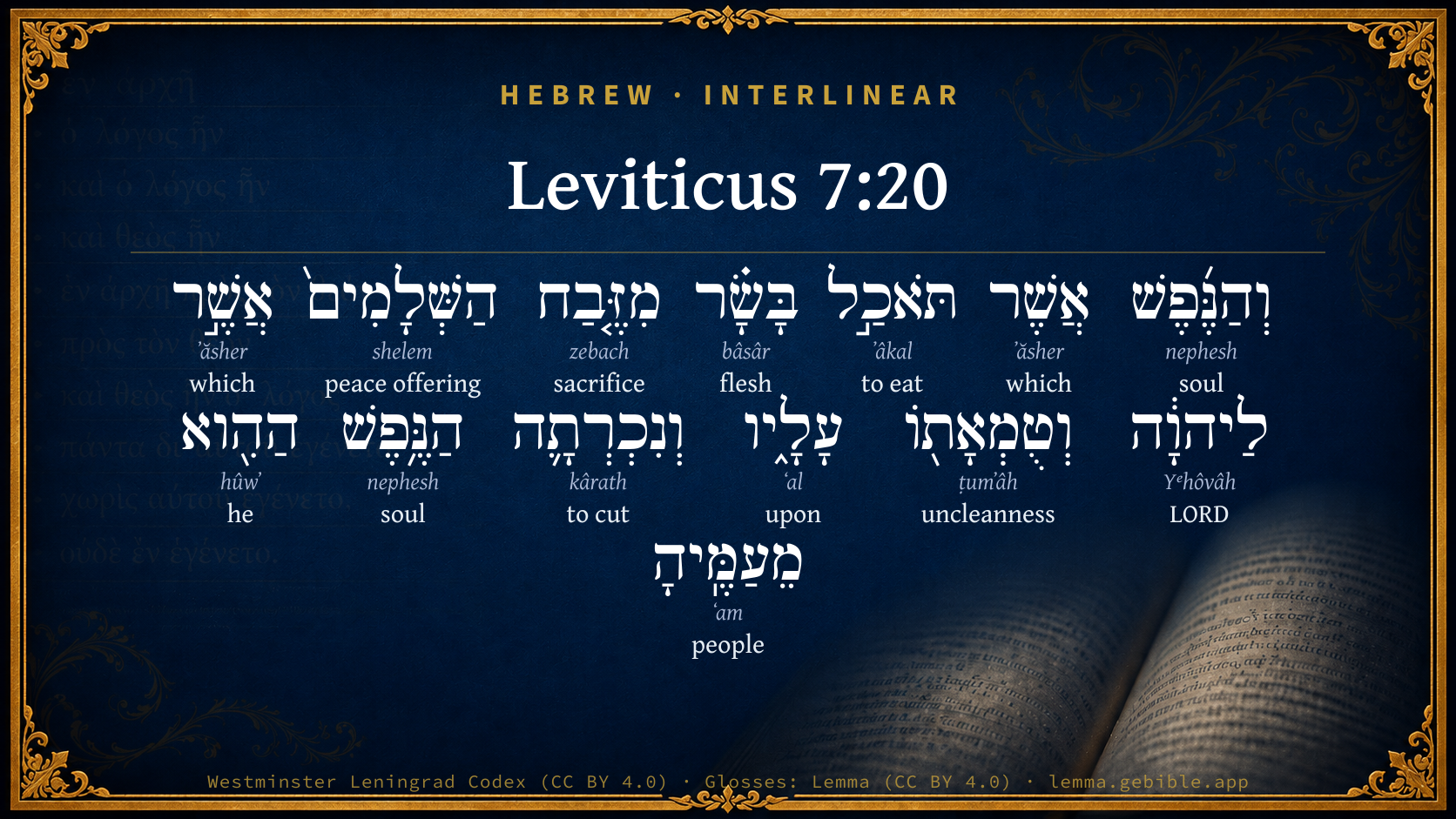
Hebrew (Westminster Leningrad Codex) Leviticus 7:20 appears in the Hebrew Old Testament. The text above is from the Westminster Leningrad Codex. Each word links to its Strong’s number, a concise gloss, and parsing drawn from the Open Scriptures Hebrew Bible morphology. Click any word for its full Brown-Driver-Briggs (BDB) entry.
Download image
Cite this verse

Leviticus 7:20 (World English Bible). Public Domain. Lemma interlinear Bible study tool, https://lemma.gebible.app/v/leviticus/7/20.

Show BibTeX & RIS
BibTeX
RIS
English Translation
but the soul who eats of the flesh of the sacrifice of peace offerings, that belongs to Yahweh, having his uncleanness on him, that soul shall be cut off from his people.
World English Bible · Public Domain
Download a study sheet

One document with this verse’s original text, its word-by-word gloss line, the meaning frame, cross-references with their text, attributed commentary, and full source and license credits — printable, and it pastes into notes with its structure intact.

This verse Autodidact and up

Study sheet (.html) Plain text (.txt)

A passage Seminary Student

Up to 50 verses in one chapter. A passage sheet keeps up to 6 commentary sources and 12 cross-references per verse, in the order this page ranks them, and says so on the sheet whenever that leaves anything out. Ask for a single verse and you get the Autodidact verse sheet above.

Everything on this page stays free to read, with no account — the sheet is a download of what is already on screen, not access to it.

Want to remove ads? Support Godless Engineer
Compare translations 3

The same verse in 3 English versions, stacked beneath the original-language interlinear above. Click any original word for its lexicon entry.

Each is an independent rendering of the whole verse — the interlinear is not word-aligned to these translations.

Highlighted words mark where these versions differ — a whole-verse word diff, not a word-by-word alignment.

  • World English Bible Public Domain
    but the soul who eats of the flesh of the sacrifice of peace offerings, that belongs to Yahweh, having his uncleanness on him, that soul shall be cut off from his people.
  • King James Version Public Domain
    But the soul that eateth of the flesh of the sacrifice of peace offerings, that pertain unto the LORD, having his uncleanness upon him, even that soul shall be cut off from his people.
  • unfoldingWord Literal Text CC BY-SA 4.0
    And the person who eats meat from the sacrifice of the peace offerings that for Yahweh, and his uncleanness on him, then that person shall be cut off from his people.

unfoldingWord Literal Text — © unfoldingWord, licensed CC BY-SA 4.0. Word-aligned USFM3 via Door43 (git.door43.org/unfoldingWord/en_ult).

Versions to compare (up to 4)

3 of 4 selected

Show all 18 translations

Every available English version of this verse, each an independent rendering of the whole verse.

  • World English Bible Public Domain
    but the soul who eats of the flesh of the sacrifice of peace offerings, that belongs to Yahweh, having his uncleanness on him, that soul shall be cut off from his people.
  • Berean Standard Bible Public Domain
    But if anyone who is unclean eats meat from the peace offering that belongs to the LORD, that person must be cut off from his people.
  • Majority Standard Bible Public Domain
    But if anyone who is unclean eats meat from the peace offering that belongs to the LORD, that person must be cut off from his people.
  • King James Version Public Domain
    But the soul that eateth of the flesh of the sacrifice of peace offerings, that pertain unto the LORD, having his uncleanness upon him, even that soul shall be cut off from his people.
  • American Standard Version (1901) Public Domain
    but the soul that eateth of the flesh of the sacrifice of peace-offerings, that pertain unto Jehovah, having his uncleanness upon him, that soul shall be cut off from his people.
  • Revised Version (1885) Public Domain
    but the soul that eateth of the flesh of the sacrifice of peace offerings, that pertain unto the LORD, having his uncleanness upon him, that soul shall be cut off from his people.
  • Geneva Bible (1599) Public Domain
    But if any eate of the flesh of the peace offerings that pertaineth to the Lord, hauing his vncleannesse vpon him, euen the same person shalbe cut off from his people.
  • Douay-Rheims (1899) Public Domain
    If any one that is defiled shall eat of the flesh of the sacrifice of peace offerings, which is offered to the Lord, he shall be cut off from his people.
  • Young's Literal Translation Public Domain
    and the person who eateth of the flesh of the sacrifice of the peace-offerings which `are' Jehovah's, and his uncleanness upon him, even that person hath been cut off from his people.
  • Literal Standard Version CC BY-SA 4.0
    and the person who eats of the flesh of the sacrifice of the peace-offerings which [are] YHWH’s, and his uncleanness [is] on him, indeed, that person has been cut off from his people.
  • Unlocked Literal Bible CC BY-SA 4.0
    However, an unclean person who eats any meat from the sacrifice of a peace offering that belongs to Yahweh—that person must be cut off from his people.
  • unfoldingWord Literal Text CC BY-SA 4.0
    And the person who eats meat from the sacrifice of the peace offerings that for Yahweh, and his uncleanness on him, then that person shall be cut off from his people.
  • Darby Bible Public Domain
    But the soul that eateth the flesh of the sacrifice of peace-offering which is for Jehovah, having his uncleanness upon him, that soul shall be cut off from his peoples.
  • World Messianic Bible Public Domain
    but the soul who eats of the meat of the sacrifice of peace offerings that belongs to the LORD, having his uncleanness on him, that soul shall be cut off from his people.
  • Webster's Bible Public Domain
    But the soul that eateth of the flesh of the sacrifice of peace-offerings that pertain to the LORD, having his uncleanness upon him, even that soul shall be cut off from his people.
  • Free Bible Version CC BY-SA 4.0
    If anyone who is unclean eats meat from the peace offering given to the Lord, they must be expelled from their people.
  • Bible in Basic English Public Domain
    But he who is unclean when he takes as food the flesh of the peace-offerings, which are the Lord's, will be cut off from his people.
  • JPS Tanakh (1917) Public Domain
    But the soul that eateth of the flesh of the sacrifice of peace-offerings, that pertain unto the LORD, having his uncleanness upon him, that soul shall be cut off from his people.

Literal Standard Version (2020), Covenant Press — licensed CC BY-SA 4.0. Text via the HelloAO Bible API (eBible.org). Unlocked Literal Bible (unfoldingWord) — licensed CC BY-SA 4.0. Text via the HelloAO Bible API (eBible.org). unfoldingWord Literal Text — © unfoldingWord, licensed CC BY-SA 4.0. Word-aligned USFM3 via Door43 (git.door43.org/unfoldingWord/en_ult). Free Bible Version, Dr. Jonathan Gallagher — licensed CC BY-SA 4.0. Text via the HelloAO Bible API (eBible.org).

Word by word

More ways to search: Search by grammar → Find every occurrence → Compare this word →

Practice this passage: Drill this verse → Learn its vocabulary →

וְטֻמְאָת֖וֹ
ṭumʼâh
H2932
“and · uncleanness · his”
Conjunction + Noun, Common, Feminine, Singular, Construct + Suffix, Personal, 3rd Person, Masculine, Singular
Part of Speech
Conjunction + Noun
Type
Common
Gender
Feminine
Number
Singular
State
Construct
Full BDB Definition

Origin: from H2930

TWOT: 809b

uncleanness - sexual - of filthy mass - ethical and religious - ritual - local (of nations)
  1. וְהַנֶּ֜פֶשׁ nephesh H5315 “and · the · soul” Conjunction + Particle, Definite Article + Noun, Common, Both, Singular, Absolute
  2. אֲשֶׁר ʼăsher H834 “which” Particle, Relative
  3. תֹּאכַ֣ל ʼâkal H398 “to eat” Verb, Qal, Imperfect, 3rd Person, Feminine, Singular
  4. בָּשָׂ֗ר bâsâr H1320 “flesh” Noun, Common, Masculine, Singular, Absolute
  5. מִזֶּ֤בַח zebach H2077 “from · sacrifice of” Preposition + Noun, Common, Masculine, Singular, Construct
  6. הַשְּׁלָמִים֙ shelem H8002 “the · peace offerings” Particle, Definite Article + Noun, Common, Masculine, Plural, Absolute
  7. אֲשֶׁ֣ר ʼăsher H834 “which” Particle, Relative
  8. לַיהוָ֔ה Yᵉhôvâh H3068 “to/for · LORD” Preposition + Noun, Proper
  9. עָלָ֑יו ʻal H5921 “upon · him” Preposition + Suffix, Personal, 3rd Person, Masculine, Singular
  10. וְנִכְרְתָ֛ה kârath H3772 “and · to cut” Conjunction + Verb, Niphal, Sequential Perfect, 3rd Person, Feminine, Singular
  11. הַנֶּ֥פֶשׁ nephesh H5315 “the · soul” Particle, Definite Article + Noun, Common, Both, Singular, Absolute
  12. הַהִ֖וא hûwʼ H1931 “the · he” Particle, Definite Article + Pronoun, Personal, 3rd Person, Feminine, Singular
  13. מֵעַמֶּֽיהָ ʻam H5971 “from · peoples · her” Preposition + Noun, Common, Masculine, Plural, Construct + Suffix, Personal, 3rd Person, Feminine, Singular

About this verse

These counts appear in no published source. They are computed here, from the morphology-tagged text and Lemma’s own curated glosses. What Lemma adds →

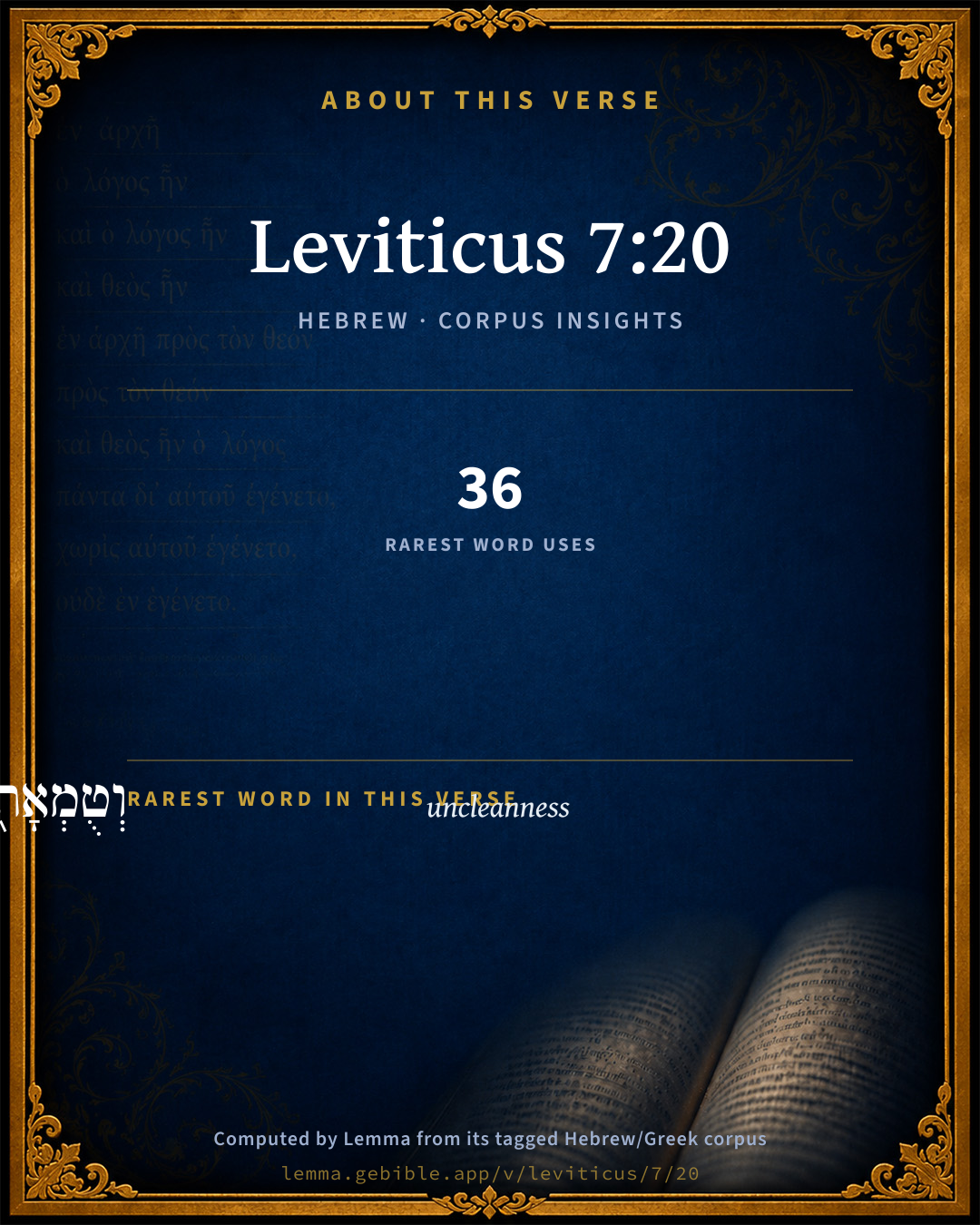
14
words
12
distinct lemmas
Pentateuch
section

Shared distinctive vocabulary

וְטֻמְאָת֖וֹ uncleanness H2932 occurs in 31 verses of the Hebrew Bible. Also found in:

Grammatical profile

  • 2 verbs
  • 8 nouns
  • 1 pronoun
  • 1 preposition
  • 2 particles

Verb forms

  • תֹּאכַ֣ל Qal · Imperfect
  • וְנִכְרְתָ֛ה Niphal · Sequential Perfect

Repetition

Words recur within this verse — often emphatic in Hebrew:

  • וְהַנֶּ֜פֶשׁ soul H5315 ×2
  • אֲשֶׁר which H834 ×2

Hebrew & Septuagint length

In English translation the verse runs 32 words from the Hebrew and 38 from the Septuagint (LXX English) — closely comparable.

A rough comparison of the two English renderings, which tokenize alike — not a word-level alignment.

Word counts can differ between the Hebrew and the Greek without any difference in meaning — e.g. the Hebrew direct-object marker אֵת has no separate Greek word, and Greek often adds the article ὁ.

Cross-references

4

Topical passages linked to Leviticus 7:20 in the Treasury of Scripture Knowledge — connected by theme and wording, ordered by reader-vote popularity; previews shown in the World English Bible.

  • Leviticus 15:2–33 "Speak to the children of Israel, and tell them, 'When any man has a discharge from his body, because of his discharge he is unclean.
  • Genesis 17:14 The uncircumcised male who is not circumcised in the flesh of his foreskin, that soul shall be cut off from his people. He has broken my covenant."
  • Leviticus 22:3–7 Tell them, 'If anyone of all your seed throughout your generations approaches the holy things, which the children of Israel make holy to Yahweh, having his uncleanness on him, that soul shall be cut off from before me. I am Yahweh.
  • 1 Corinthians 11:28 But let a man examine himself, and so let him eat of the bread, and drink of the cup.

Cross-references courtesy of OpenBible.info (CC BY 4.0).

Hebrew and Greek witnesses Masoretic Hebrew ↔ Greek Septuagint

The same verse in the two great witnesses to the Old Testament, shown verse-for-verse.

These are two independent witnesses, not word-aligned to each other, and the Septuagint is shown in lemma (dictionary) form.

Hebrew Leviticus 7:20 Masoretic · Westminster Leningrad Codex

וְהַנֶּ֜פֶשׁ אֲשֶׁר תֹּאכַ֣ל בָּשָׂ֗ר מִזֶּ֤בַח הַשְּׁלָמִים֙ אֲשֶׁ֣ר לַיהוָ֔ה וְטֻמְאָת֖וֹ עָלָ֑יו וְנִכְרְתָ֛ה הַנֶּ֥פֶשׁ הַהִ֖וא מֵעַמֶּֽיהָ

but the soul who eats of the flesh of the sacrifice of peace offerings, that belongs to Yahweh, having his uncleanness on him, that soul shall be cut off from his people.

World English Bible · Public Domain

Greek LXX Leviticus 7:20 Septuagint · lemma form

ὁ δέ ψυχή ὅστις ἐάν ἐσθίω ἀπό ὁ κρέας ὁ θυσία ὁ σωτήριον ὅς εἰμί κύριος καί ὁ ἀκαθαρσία αὐτός ἐπί αὐτός ἀποὀλλύω ὁ ψυχή ἐκεῖνος ἐκ ὁ λαός αὐτός

His hands shall bring the burnt offerings to the Lord; the fat which is on the breast and the lobe of the liver, he shall bring them, so as to set them for a gift before the Lord.

LXX2012 (modern English Septuagint) · Public Domain

Hebrew: Westminster Leningrad Codex (CC BY 4.0). Greek: Septuagint (public domain); English from LXX2012 (modern English Septuagint) (Public Domain). How the Septuagint differs from the Hebrew →

Targum (Aramaic paraphrase)

2

The Targum is the ancient Jewish Aramaic paraphrase of the Hebrew Scriptures — an interpretive translation, not the Hebrew text itself. Onkelos (literal) and Pseudo-Jonathan (expansive) render the Torah, and Jonathan the Prophets. Coverage is partial: where no permissively-licensed English translation exists for a verse, only the Aramaic is shown. This is verse-level text, not a word-by-word alignment to the Hebrew.

  1. Targum Onkelos Torah (Genesis–Deuteronomy)
    וֶאֱנַשׁ דִי תֵכוּל בִּסְרָא מִנִכְסַת קוּדְשַׁיָא דִי קֳדָם יְיָ וְסוֹבְתֵהּ עֲלוֹהִי וְיִשְׁתֵּיצֵי אֱנָשָׁא הַהוּא מֵעַמֵּיהּ

    (no public-domain English translation for this verse)

    Targum Onkelos — Aramaic: “Onkelos Genesis” (public domain); “Onkelos Exodus” (public domain); “Onkelos Leviticus” (public domain); “Onkelos Numbers” (public domain); “Onkelos Deuteronomy” (public domain). English: “Sefaria Community Translation” (CC0 1.0 (public-domain dedication)); “J.W. Etheridge. The Targums of Onkelos and Jonathan Ben Uzziel on the Pentateuch. London: Longmans, Green, 1862” (public domain). Text via Sefaria.

  2. Targum Pseudo-Jonathan Torah (Genesis–Deuteronomy)
    וּבַר נַשׁ דְיֵיכוֹל בִּסְרָא מִנִכְסַת קוּדְשַׁיָא דְמִתְקַרְבִין קֳדָם יְיָ וּסְאוֹבְתֵיהּ עֲלוֹי וְיִשְׁתְּצֵי בַּר נְשָׁא הַהוּא מֵעַמֵיהּ

    But the man who eateth of the flesh of the hallowed sacrifice that is offered before the Lord with his uncleanness upon him, that man shall be destroyed from among his people.

    Targum Pseudo-Jonathan — Aramaic: “Targum Jonathan on Genesis” (public domain); “Targum Jonathan on Exodus” (public domain); “Targum Jonathan on Leviticus” (public domain); “Targum Jonathan on Numbers” (public domain); “Targum Jonathan on Deuteronomy” (public domain). English: “The Targum of Jonathan ben Uzziel, trans. J. W. Etheridge, London, 1862” (public domain). Text via Sefaria.

Commentary

Notes on Leviticus 7:20 from classic Christian and Jewish commentators (each source and its license shown beneath its notes). The classic Christian expositions comment on the surrounding passage and are grouped to its opening verse, so a note may address several verses; the Jewish commentaries on the Tanakh (Rashi and others) are per-verse, so they appear only where the commentator wrote on this verse.

Lemma curates 59 commentaries, every one of them public domain or Creative Commons licensed, each selected and text-cleaned for this edition rather than reprinted as found. About our sources →

John Gill's Exposition

Moreover, the soul that shall touch any unclean thing,.... Person or thing, the dead body of a man, or the bone of a dead body, or a grave in which it was laid:

as the uncleanness of man; the issue that runs from a profluvious person:

or any unclean beast; that was so by the law ceremonial; see Lev 11:4,

or any abominable unclean thing; which the Targum of Jonathan interprets of every unclean reptile: see Lev 11:20.

and eat of the flesh of the sacrifice of peace offerings, which pertain unto the Lord, even that soul shall be cut off from his people; See Gill on Lev 7:20.

John Gill's Exposition of the Whole Bible (1746–1763) — public domain (CC PDM 1.0). Text via the HelloAO Bible API.

Trapp's Complete Commentary

John Trapp

Lev 7:20 But the soul that eateth [of] the flesh of the sacrifice of peace offerings, that [pertain] unto the LORD, having his uncleanness upon him, even that soul shall be cut off from his people.

Ver. 20. Having his uncleanness upon him.] To the unclean all things are unclean, &c. {Tit 1:15} {See Trapp on "Tit 1:15"}

John Trapp, A Commentary or Exposition upon All the Books of the Old and New Testament (1647–1656) — public domain. Text from a community e-Sword module.

Tyndale Open Study Notes

Tyndale Open Resources

7:20-21 cut off: Three interpretations are possible for this expression, all of them very grave: (1) The person was subject to God’s judgment and faced an early death by natural causes (17:10-14). (2) The person was to be executed by the community (cp. Exod 31:14). (3) The person lost communal membership in Israel, either by banishment (such as by excommunication) or by shunning the person and treating him or her as unclean (Lev 18:24-30; cp. 23:29-30, where “cut off” seems distinct from “destroy”).

Tyndale Open Study Notes — © Tyndale Open Resources, licensed CC BY-SA 4.0. Text via the HelloAO Bible API.

Jamieson, Fausset & Brown

Robert Jamieson, A. R. Fausset & David Brown

cut off from his people--that is, excluded from the privileges of an Israelite--lie under a sentence of excommunication.

Jamieson, Fausset & Brown — Commentary Critical and Explanatory on the Whole Bible (1871) — public domain (CC PDM 1.0). Text via the HelloAO Bible API.

Adam Clarke's Commentary

Verse 20. Having his uncleanness upon him] Having touched any unclean thing by which he became legally defiled, and had not washed his clothes, and bathed his flesh.

Adam Clarke's Commentary on the Bible (1810–1826) — public domain. Text from a community e-Sword/MySword module.

Ellicott's Commentary for English Readers

(20, 21) But the soul that eateth, &c—Any one who partakes of the Lord’s holy peace offering in a state of legal defilement, arising either from contact with unclean men or objects (see Lev_11:8-44; Lev_15:1-33), incurs the penalty of excision.

A Bible Commentary for English Readers, edited by Charles John Ellicott (1878–1897) — public domain. Text from a community e-Sword module.

Haydock's Catholic Bible Commentary

People excommunicated, or even slain, either by God, or by the judge. (Calmet)

George Leo Haydock (1774–1849), Haydock's Catholic Family Bible and Commentary, 1859 edition — public domain. Excludes Psalms (Douay-Rheims chapter numbering differs from Protestant) and Deuterocanonical books (Catholic canon only).

Matthew Poole's English Annotations

The soul that eateth knowingly; for if it were done ignorantly, a sacrifice was accepted for it, Lev 5:2.

Having his uncleanness upon him, i.e. not being cleansed from his uncleanness according to the appointment, Lev 11:24, &c. This verse speaks of uncleanness from an internal cause, as by an issue, &c., for what was from an external cause is spoken of in the next verse.

Matthew Poole's English Annotations on the Holy Bible (1683–1685) — public domain. Text from a community e-Sword/MySword module.

Whedon's Commentary on the Bible

Daniel D. Whedon

20. The soul… having his uncleanness — This verse implies that there is an order in the religious exercises of the Hebrews. The ceremonially impure could bring but one acceptable oblation, the sin offering, for the removal of his defilement. Eucharistic offerings from hands impure are not a sweet savour unto Jehovah, but a stench in his nostrils. The first duty of an impenitent sinner is not to lay earthly holocausts upon God’s altar, but to “cease to do evil.”

That soul shall be cut off from his people — This must be understood as the punishment of an audacious and defiant trampling down of Jehovah’s authority, a high-handed sin, and not a mere inadvertence. The cutting off denotes not mere excommunication, but, “the punishment of death in general, without defining the manner.” — Gesenius. Probation is made up of small things. These are tests of character more practicable than requirements of greater seeming importance. Divine authority infuses a moral element into mere ritualism.

Hence positive precepts, as the Christian sacraments, are often a higher test of faith than commandments, which find their reason in man’s moral nature. See Butler’s Analogy, part ii, chap. 1.

Daniel D. Whedon (gen. ed.), Commentary on the Old and New Testaments (1874–1909) — public domain. Text from a community e-Sword module.

The Pulpit Commentary

Vers. 20, 21. Divine and human severity.

There is something almost startling in the closing words, "That soul shall be cut off from his people." It suggests thoughts of

I APPARENT DIVINE SEVERITY.

1. That God sometimes seems to be severe in his dealings with men. These particular injunctions must have had to the Jews an aspect of rigour. An Israelite excommunicated for one of these offenses probably felt that he had been hardly dealt with. God"s dealings have an occasional aspect of severity. (see Rom_11:22) So with us. In his providence comparatively slight faults, errors, transgressions, are sometimes followed by most serious evils disgrace, sorrow, loss, death.

2. That the light of after-days often explains his dealing with us. We can see now that the paramount and supreme importance of maintaining the purity of Israel, its separateness from all the abominations of surrounding heathendom, made the most stringent regulations on that subject necessary and wise, and therefore kind. So with us. Looking back on the way by which we have been led, we frequently see that that very thing which at the time was not only distressing but perplexing, was the most signal act of the Divine wisdom and goodness, the providential ordering for which, above every other thing, we now give thanks.

3. That present faith should rise to the realization that, somewhere in the future, apparent severity will bear the aspect of wise and holy love. "What we know not now we shall know hereafter." "Then shall we know," etc. (1Co_13:12)

II OCCASIONAL HUMAN SEVERITY.

1. That we are sometimes obliged to seem severe towards those for whom we are responsible.

a. The statesman is obliged to introduce a severe measure;

b. a father to take a strong and energetic course;

c. a Church to excommunicate a member.

2. That apparent severity is sometimes the only rightful course which wise and holy love can take. It is the action which is (1) due to itself; (Jam_3:17) (2) due to the object of its affection. C. (1Ti_1:20)

The Pulpit Commentary (1880–1919), ed. H.D.M. Spence-Jones & Joseph S. Exell — public domain. Text from a community e-Sword module.

John Wesley's Explanatory Notes

That eateth - Knowingly; for if it were done ignorantly, a sacrifice was accepted for it. Not being cleansed from his uncleanness according to the appointment, chap. xi, 24, &c. This verse speaks of uncleanness from an internal cause, as by an issue, &c. for what was from an external cause is spoken of in the next verse.

John Wesley, Explanatory Notes Upon the Whole Bible (1754–1765) — public domain. Text via the GEBible commentary corpus.

Rashi

Rabbi Shlomo Yitzchaki (Rashi)

וטמאתו עליו [BUT THE SOUL THAT EATETH OF THE FLESH OF THE SACRIFICES …] HAVING ITS (or HIS) UNCLEANNESS UPON IT (or HIM) — Scripture is speaking here of the uncleanness of the person (i.e., the words mean: And the soul (person) that eateth of the flesh of the שלמים whilst his uncleanness is upon him; it does not mean: the person who eateth the flesh whilst its uncleanness is upon it) (Sifra, Tzav, Chapter 14 3; Zevachim 43b; cf. Rashi on Leviticus 22:3). But a clean person who eats unclean sacrificial flesh is not punished with excision, as is the case here, but only for transgressing the prohibition in v. 19:“And the flesh, that toucheth any unclean thing [shall not be eaten]”, for which the punishment is lashes. The prohibition referring to the case of “an unclean person who eats holy things” for which our text states the punishment is not expressly mentioned in the Torah but the Sages derived it by means of a verbal analogy (ג"ש) (Makkot 14b). — Three times is the punishment of excision stated in the Torah with reference to people eating holy sacrifices in a state of bodily uncleanness, (here, in v. 21 and in Leviticus 22:3), and our Rabbis explained them in Treatise Shevuot 7a as follows: one is intended as a general statement, the other as referring to a particular case and the third is intended to teach about the קרבן עולה ויורד (the sacrifice of higher or lesser value according to monetary circumstances of him who offers it; Leviticus 5:2, 3), that it is prescribed only as an atonement for communicating uncleanness to the Temple or sacred food by entering the former or eating the latter in a state of uncleanness (cf. Rashi on Leviticus 22:3 and Note thereon).

Rashi on the Tanakh — English translations: “The Judaica Press complete Tanach with Rashi, translated by A. J. Rosenberg” (CC BY 4.0); “Pentateuch with Rashi's commentary by M. Rosenbaum and A.M. Silbermann, 1929-1934” (public domain); “The Metsudah Tanach series, Lakewood, N.J” (CC BY 4.0); and “The Book of Joshua, Metsudah Publications, 1997” (CC BY 4.0). Text via Sefaria.

Lesson kit

Teaching starters — assembled from the data on this page, not authored interpretation. Every prompt links to the verse data it draws on. Edit before teaching.

Leviticus, in the Pentateuch, opens this verse with 14 words (12 distinct Hebrew lemmas). Its most distinctive word is ṭumʼâh (“uncleanness”). A historical commentator’s framing appears above. Read the whole chapter for the surrounding context.

Discussion questions

  1. What does “uncleanness” (ṭumʼâh) contribute to the verse as a whole?
  2. How does Leviticus 5:3, which shares the word «uncleanness», read alongside this verse?
  3. What does the repetition of “soul” (2× in this one verse) do in this verse?
  4. These translations render this verse differently; the difference is in the English rendering, not the original. What questions does that raise?
  5. «תֹּאכַ֣ל» is a Qal Imperfect verb. How does that grammatical form shape the action described?
  6. Compare how John Gill's Exposition and Trapp's Complete Commentary read this verse. Where do they agree or differ?

Things to notice

Reading settings

Reading text

Shown beneath each verse's original-language words.

Old Testament
Old Testament edition

Read the OT as the Masoretic Hebrew (MT) or the Greek Septuagint (LXX).

English shown for the Greek Septuagint (in the Hebrew ↔ Greek comparison).

Comparing translations? Open the Compare panel on any verse page to stack up to four side by side.