1 Chronicles 19:4

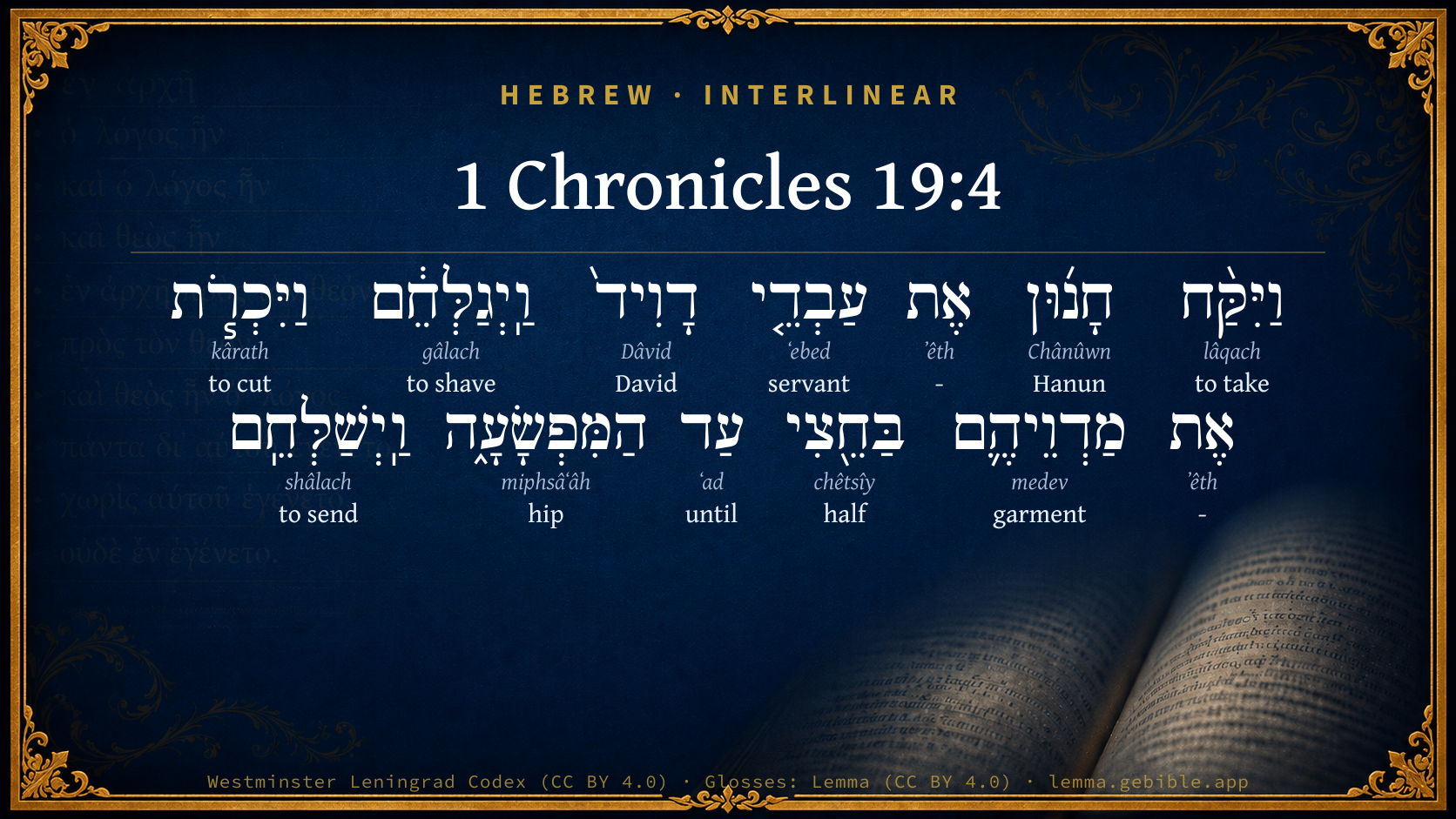
Hebrew (Westminster Leningrad Codex) 1 Chronicles 19:4 appears in the Hebrew Old Testament. The text above is from the Westminster Leningrad Codex. Each word links to its Strong’s number, a concise gloss, and parsing drawn from the Open Scriptures Hebrew Bible morphology. Click any word for its full Brown-Driver-Briggs (BDB) entry.
Download image
Cite this verse

1 Chronicles 19:4 (World English Bible). Public Domain. Lemma interlinear Bible study tool, https://lemma.gebible.app/v/1-chronicles/19/4.

Show BibTeX & RIS
BibTeX
RIS
English Translation
So Hanun took David's servants, and shaved them, and cut off their garments in the middle, even to their buttocks, and sent them away.
World English Bible · Public Domain
Highlights
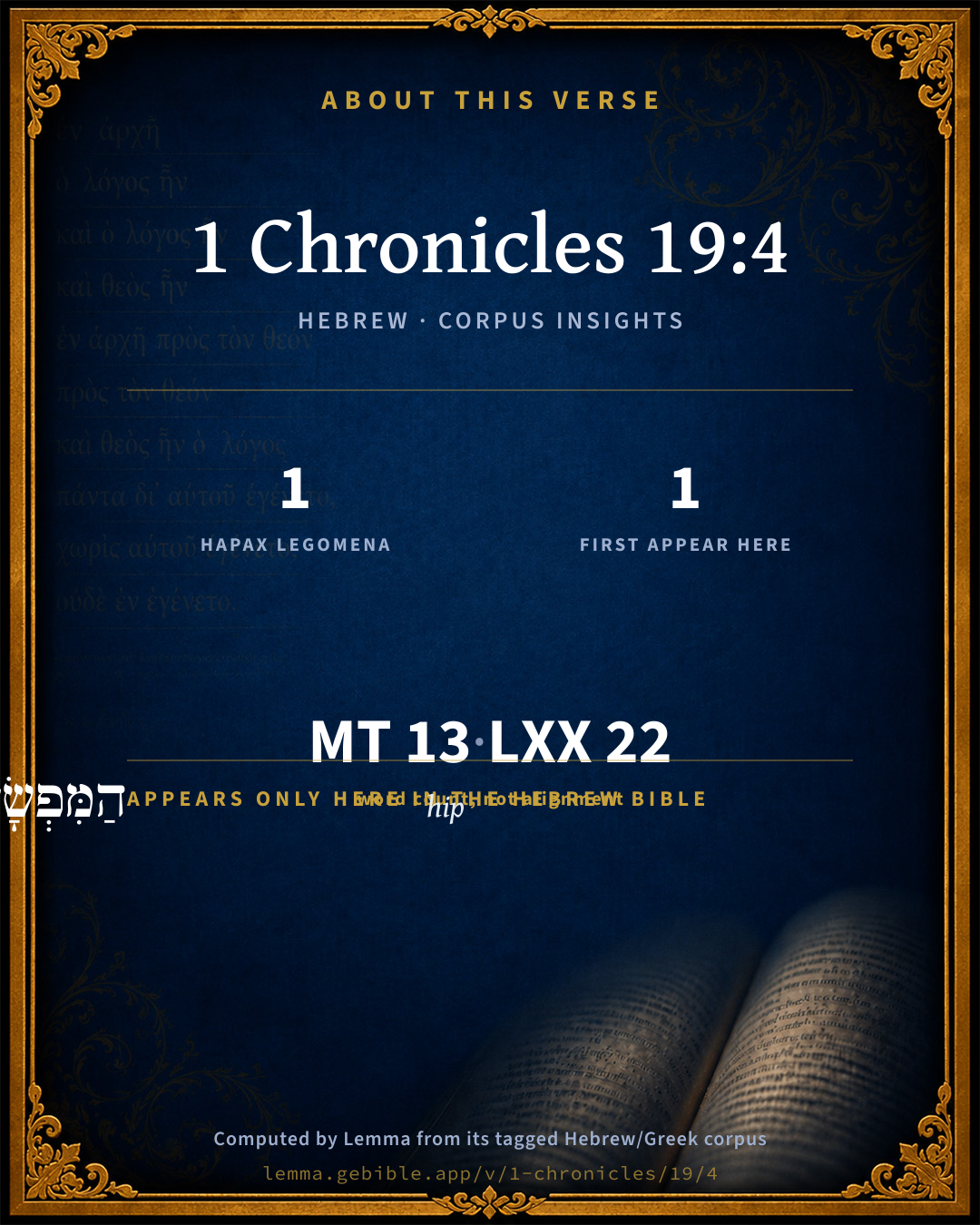
  • 1 hapax legomenon — only here in the Hebrew Bible
  • 1 first appearance in the Hebrew Bible
Full analysis ↓
Download a study sheet

One document with this verse’s original text, its word-by-word gloss line, the meaning frame, cross-references with their text, attributed commentary, and full source and license credits — printable, and it pastes into notes with its structure intact.

This verse Autodidact and up

Study sheet (.html) Plain text (.txt)

A passage Seminary Student

Up to 50 verses in one chapter. A passage sheet keeps up to 6 commentary sources and 12 cross-references per verse, in the order this page ranks them, and says so on the sheet whenever that leaves anything out. Ask for a single verse and you get the Autodidact verse sheet above.

Everything on this page stays free to read, with no account — the sheet is a download of what is already on screen, not access to it.

Want to remove ads? Support Godless Engineer
Compare translations 3

The same verse in 3 English versions, stacked beneath the original-language interlinear above. Click any original word for its lexicon entry.

Each is an independent rendering of the whole verse — the interlinear is not word-aligned to these translations.

Highlighted words mark where these versions differ — a whole-verse word diff, not a word-by-word alignment.

  • World English Bible Public Domain
    So Hanun took David's servants, and shaved them, and cut off their garments in the middle, even to their buttocks, and sent them away.
  • King James Version Public Domain
    Wherefore Hanun took David's servants, and shaved them, and cut off their garments in the midst hard by their buttocks, and sent them away.
  • unfoldingWord Literal Text CC BY-SA 4.0
    So Hanun took the servants of David, and he shaved them, and he cut their garments in the middle, to the buttocks, and he sent them away,

unfoldingWord Literal Text — © unfoldingWord, licensed CC BY-SA 4.0. Word-aligned USFM3 via Door43 (git.door43.org/unfoldingWord/en_ult).

Versions to compare (up to 4)

3 of 4 selected

Show all 18 translations

Every available English version of this verse, each an independent rendering of the whole verse.

  • World English Bible Public Domain
    So Hanun took David's servants, and shaved them, and cut off their garments in the middle, even to their buttocks, and sent them away.
  • Berean Standard Bible Public Domain
    So Hanun took David’s servants, shaved their beards, cut off their garments at the hips, and sent them away.
  • Majority Standard Bible Public Domain
    So Hanun took David’s servants, shaved their beards, cut off their garments at the hips, and sent them away.
  • King James Version Public Domain
    Wherefore Hanun took David's servants, and shaved them, and cut off their garments in the midst hard by their buttocks, and sent them away.
  • American Standard Version (1901) Public Domain
    So Hanun took David's servants, and shaved them, and cut off their garments in the middle, even to their buttocks, and sent them away.
  • Revised Version (1885) Public Domain
    So Hanun took David’s servants, and shaved them, and cut off their garments in the middle, even to their buttocks, and sent them away.
  • Geneva Bible (1599) Public Domain
    Wherefore Hanun tooke Dauids seruants, and shaued them, and cut off their garments by the halfe vnto the buttocks, and sent them away.
  • Douay-Rheims (1899) Public Domain
    Wherefore Hanon shaved the heads and beards of the servants of David, and cut away their garments from the buttocks to the feet, and sent them away.
  • Young's Literal Translation Public Domain
    And Hanun taketh the servants of David, and shaveth them, and cutteth their long robes in the midst, unto the buttocks, and sendeth them away.
  • Literal Standard Version CC BY-SA 4.0
    And Hanun takes the servants of David and shaves them, and cuts their long robes in the midst, to the buttocks, and sends them away.
  • Unlocked Literal Bible CC BY-SA 4.0
    So Hanun seized David's servants, shaved them, cut off their garments to the waist, up to their buttocks, and sent them away.
  • unfoldingWord Literal Text CC BY-SA 4.0
    So Hanun took the servants of David, and he shaved them, and he cut their garments in the middle, to the buttocks, and he sent them away,
  • Darby Bible Public Domain
    And Hanun took David's servants, and had them shaved, and their raiment cut off in the midst, as far as the hip, and sent them away.
  • World Messianic Bible Public Domain
    So Hanun took David’s servants, shaved them, and cut off their garments in the middle at their buttocks, and sent them away.
  • Webster's Bible Public Domain
    Wherefore Hanun took David's servants, and shaved them, and cut off their garments in the midst hard by their buttocks, and sent them away.
  • Free Bible Version CC BY-SA 4.0
    So Hanun detained David's ambassadors and had them shaved, and their robes cut off at the buttocks. Then he sent them back.
  • Bible in Basic English Public Domain
    So Hanun took David's servants, and cutting off their hair and the skirts of their robes up to the middle, sent them away.
  • JPS Tanakh (1917) Public Domain
    So Hanun took David's servants, and shaved them, and cut off their garments in the middle, even to their hips, and sent them away.

Literal Standard Version (2020), Covenant Press — licensed CC BY-SA 4.0. Text via the HelloAO Bible API (eBible.org). Unlocked Literal Bible (unfoldingWord) — licensed CC BY-SA 4.0. Text via the HelloAO Bible API (eBible.org). unfoldingWord Literal Text — © unfoldingWord, licensed CC BY-SA 4.0. Word-aligned USFM3 via Door43 (git.door43.org/unfoldingWord/en_ult). Free Bible Version, Dr. Jonathan Gallagher — licensed CC BY-SA 4.0. Text via the HelloAO Bible API (eBible.org).

Word by word

More ways to search: Search by grammar → Find every occurrence → Compare this word →

Practice this passage: Drill this verse → Learn its vocabulary →

הַמִּפְשָׂעָ֑ה
miphsâʻâh
H4667
“the · hip”
Particle, Definite Article + Noun, Common, Feminine, Singular, Absolute
Part of Speech
Particle + Noun
Type
Common
Gender
Feminine
Number
Singular
State
Absolute
Full BDB Definition

Origin: from H6585

TWOT: 1841b

hip, buttock, stepping region of body
  1. וַיִּקַּ֨ח lâqach H3947 “and · to take” Conjunction + Verb, Qal, Sequential Imperfect, 3rd Person, Masculine, Singular
  2. חָנ֜וּן Chânûwn H2586 “Hanun” Noun, Proper
  3. אֶת ʼêth H853 “-” Particle, Direct Object
  4. עַבְדֵ֤י ʻebed H5650 “servants of” Noun, Common, Masculine, Plural, Construct
  5. דָוִיד֙ Dâvid H1732 “David” Noun, Proper
  6. וַֽיְגַלְּחֵ֔ם gâlach H1548 “and · to shave · them” Conjunction + Verb, Piel, Sequential Imperfect, 3rd Person, Masculine, Singular + Suffix, Personal, 3rd Person, Masculine, Plural
  7. וַיִּכְרֹ֧ת kârath H3772 “and · to cut” Conjunction + Verb, Qal, Sequential Imperfect, 3rd Person, Masculine, Singular
  8. אֶת ʼêth H853 “-” Particle, Direct Object
  9. מַדְוֵיהֶ֛ם medev H4063 “garments · their” Noun, Common, Masculine, Plural, Construct + Suffix, Personal, 3rd Person, Masculine, Plural
  10. בַּחֵ֖צִי chêtsîy H2677 “in/at the · half” Preposition, Determined + Noun, Common, Masculine, Singular, Absolute
  11. עַד ʻad H5704 “until” Preposition
  12. וַֽיְשַׁלְּחֵֽם shâlach H7971 “and · to send · them” Conjunction + Verb, Piel, Sequential Imperfect, 3rd Person, Masculine, Singular + Suffix, Personal, 3rd Person, Masculine, Plural

About this verse

These counts appear in no published source. They are computed here, from the morphology-tagged text and Lemma’s own curated glosses. What Lemma adds →

13
words
12
distinct lemmas
Historical
section

Notable vocabulary

1 hapax legomenon — a word that appears only here in the entire Hebrew Bible:

  • הַמִּפְשָׂעָ֑ה hip H4667

First appearance in Scripture

This word makes its first canonical appearance in the Hebrew Bible here:

  • הַמִּפְשָׂעָ֑ה hip H4667

Shared distinctive vocabulary

מַדְוֵיהֶ֛ם garment H4063 occurs in 2 verses of the Hebrew Bible. Also found in:

Grammatical profile

  • 4 verbs
  • 6 nouns
  • 1 preposition
  • 2 particles

Verb forms

  • וַיִּקַּ֨ח Qal · Sequential Imperfect
  • וַֽיְגַלְּחֵ֔ם Piel · Sequential Imperfect
  • וַיִּכְרֹ֧ת Qal · Sequential Imperfect
  • וַֽיְשַׁלְּחֵֽם Piel · Sequential Imperfect

Hebrew & Septuagint length

In English translation the verse runs 24 words from the Hebrew and 27 from the Septuagint (LXX English) — closely comparable.

A rough comparison of the two English renderings, which tokenize alike — not a word-level alignment.

Word counts can differ between the Hebrew and the Greek without any difference in meaning — e.g. the Hebrew direct-object marker אֵת has no separate Greek word, and Greek often adds the article ὁ.

In the original languages it is 13 Hebrew tokens and 22 Greek tokens — but the two are counted differently (Hebrew bundles its prefixes and suffixes into one token; the Greek is in lemma form), so that isn’t a like-for-like length.

Cross-references

12

Topical passages linked to 1 Chronicles 19:4 in the Treasury of Scripture Knowledge — connected by theme and wording, ordered by reader-vote popularity; previews shown in the World English Bible.

  • 2 Samuel 10:4–5 So Hanun took David's servants, and shaved off the one half of their beards, and cut off their garments in the middle, even to their buttocks, and sent them away.
  • Leviticus 19:27 You shall not cut the hair on the sides of your heads, neither shall you clip off the edge of your beard.
  • 2 Chronicles 36:16 but they mocked the messengers of God, and despised his words, and scoffed at his prophets, until the wrath of Yahweh arose against his people, until there was no remedy.
  • Psalms 35:12 They reward me evil for good, To the bereaving of my soul.
  • Psalms 109:4–5 In return for my love, they are my adversaries; But I am in prayer.
  • Isaiah 15:2 They are gone up to Bayith, and to Dibon, to the high places, to weep: Moab wails over Nebo, and over Medeba; on all their heads is baldness, every beard is cut off.
  • Isaiah 20:4 so shall the king of Assyria lead away the captives of Egypt, and the exiles of Ethiopia, young and old, naked and barefoot, and with buttocks uncovered, to the shame of Egypt.
  • Isaiah 47:2–3 Take the millstones, and grind meal; remove your veil, strip off the train, uncover the leg, pass through the rivers.
  • Jeremiah 41:5 that there came men from Shechem, from Shiloh, and from Samaria, even eighty men, having their beards shaved and their clothes torn, and having cut themselves, with meal-offerings and frankincense in their hand, to bring them to the house of Yahweh.
  • Jeremiah 48:37 For every head is bald, and every beard clipped: on all the hands are cuttings, and on the loins sackcloth.
  • Mark 12:4 Again, he sent another servant to them; and they threw stones at him, wounded him in the head, and sent him away shamefully treated.
  • Luke 20:10–11 At the proper season, he sent a servant to the farmers to collect his share of the fruit of the vineyard. But the farmers beat him, and sent him away empty.

Cross-references courtesy of OpenBible.info (CC BY 4.0).

Hebrew and Greek witnesses Masoretic Hebrew ↔ Greek Septuagint

The same verse in the two great witnesses to the Old Testament, shown verse-for-verse.

These are two independent witnesses, not word-aligned to each other, and the Septuagint is shown in lemma (dictionary) form.

Hebrew 1 Chronicles 19:4 Masoretic · Westminster Leningrad Codex

וַיִּקַּ֨ח חָנ֜וּן אֶת עַבְדֵ֤י דָוִיד֙ וַֽיְגַלְּחֵ֔ם וַיִּכְרֹ֧ת אֶת מַדְוֵיהֶ֛ם בַּחֵ֖צִי עַד הַמִּפְשָׂעָ֑ה וַֽיְשַׁלְּחֵֽם

So Hanun took David's servants, and shaved them, and cut off their garments in the middle, even to their buttocks, and sent them away.

World English Bible · Public Domain

Greek LXX 1 Chronicles 19:4 Septuagint · lemma form

καί λαμβάνω αναν ὁ παῖς δαυίδ καί ξυράω αὐτός καί ἀποαἱρέω ὁ μανδύας αὐτός ὁ ἥμισυς ἕως ὁ ἀναβολή καί ἀποστέλλω αὐτός

And Anan took the servants of David, and shaved them, and cut off the half of their garments as far as their tunic, and sent them away.

LXX2012 (modern English Septuagint) · Public Domain

Hebrew: Westminster Leningrad Codex (CC BY 4.0). Greek: Septuagint (public domain); English from LXX2012 (modern English Septuagint) (Public Domain). How the Septuagint differs from the Hebrew →

Commentary

Notes on 1 Chronicles 19:4 from classic Christian and Jewish commentators (each source and its license shown beneath its notes). The classic Christian expositions comment on the surrounding passage and are grouped to its opening verse, so a note may address several verses; the Jewish commentaries on the Tanakh (Rashi and others) are per-verse, so they appear only where the commentator wrote on this verse.

Lemma curates 59 commentaries, every one of them public domain or Creative Commons licensed, each selected and text-cleaned for this edition rather than reprinted as found. About our sources →

Trapp's Complete Commentary

John Trapp

1Ch 19:4 Wherefore Hanun took David’s servants, and shaved them, and cut off their garments in the midst hard by their buttocks, and sent them away.

Ver. 4. And shaved them.] Sic legatos Davidis deturpans illudit, {a} Popish priests say they do therefore shave their beards, lest while they drink Christ’s blood out of the chalice, any drop thereof should hang upon their beards. Oh, shameful superstition!

Hard by their buttocks.] This is check to the fashion mongers of our time, saith Piscator; who wear their clothes so close, and cloaks so short, that they cover not their buttocks.

{a} Piscator.

John Trapp, A Commentary or Exposition upon All the Books of the Old and New Testament (1647–1656) — public domain. Text from a community e-Sword module.

Geneva Bible (1599)

Geneva Bible translators

To put them to shame and villainy, whereas the ambassadors ought to have been honored: and because the Jews used to wear side garments and beards, they thus disfigured them, to make them odious to others.

They shaved off the half of their beards, 2 Sam. 10:4.

Geneva Bible (1599) marginal notes — public domain. Text via Bolls.life.

Jamieson, Fausset & Brown

Robert Jamieson, A. R. Fausset & David Brown

shaved them--not completely, but only the half of their face. This disrespect to the beard, and indecent exposure of their persons by their clothes being cut off from the girdle downwards, was the grossest indignity to which Jews, in common with all Orientals, could be subjected. No wonder that the men were ashamed to appear in public--that the king recommended them to remain in seclusion on the border till the mark of their disgrace had disappeared--and then they might, with propriety, return to the court.

Jamieson, Fausset & Brown — Commentary Critical and Explanatory on the Whole Bible (1871) — public domain (CC PDM 1.0). Text via the HelloAO Bible API.

Adam Clarke's Commentary

Verse 4. And cut off their garments in the midst] Usque ad eorum, pudenda. So the Targum, Jarchi, and others; leaving exposed what nature and decency require to be concealed. See on 2Sa 10:4.

Adam Clarke's Commentary on the Bible (1810–1826) — public domain. Text from a community e-Sword/MySword module.

Ellicott's Commentary for English Readers

(4) Shaved them—i.e., the half of their beards (Samuel).

Hard by their buttocks.—Literally, unto the extremities. The chronicler has substituted a more decorous term for the one which appears in Samuel.

Cut off their garments.—To look like captives (Isa_20:4).

A Bible Commentary for English Readers, edited by Charles John Ellicott (1878–1897) — public domain. Text from a community e-Sword module.

The Cambridge Bible for Schools and Colleges

gen. ed. J. J. S. Perowne

4. shaved them] 2Sa_10:4, shaved off the one half of iheir beards. Of course a great insult; cp. Isa_50:6.

cut off their garments] Jewish ambassadors are represented on the Black Obelisk (a monument of Shalmaneser II, king of Assyria, now preserved in the British Museum) as wearing robes reaching to the feet; Hanun reduced ambassadors to the level of captives; cp. Isa_20:4.

The Cambridge Bible for Schools and Colleges (gen. ed. J. J. S. Perowne; Cambridge University Press, 1878–1918) — public domain. Text from a community e-Sword module.

Haydock's Catholic Bible Commentary

From. Hebrew, "in the midst, above the thighs:" exposing them to derision. (Haydock)

George Leo Haydock (1774–1849), Haydock's Catholic Family Bible and Commentary, 1859 edition — public domain. Excludes Psalms (Douay-Rheims chapter numbering differs from Protestant) and Deuterocanonical books (Catholic canon only).

The Pulpit Commentary

The classical scholar will not fail to be reminded, so far as the shaving here spoken of is concerned, of the account contained in Herodotus, 2:121. The parallel place makes the resemblance close, in that it tells us that "one-half of their beards" was shaved. To shave them was an affront to their customs, dignity, and religion: to shave them half added mockery; and to cut off half their garments completed the tale of ignominious and contemptuous insult. (Isa_20:4) The beard was held almost in reverence by Easterns.

The Pulpit Commentary (1880–1919), ed. H.D.M. Spence-Jones & Joseph S. Exell — public domain. Text from a community e-Sword module.

unfoldingWord translationNotes

Door43 World Missions Community

So Hanun seized

Hanun did not do this personally, but ordered his men to do it. AT: "So Hanun's men seized" (See: Metonymy)

their garments

"their clothes"

he sent to meet with them

"David sent some messengers to encourage them"

deeply ashamed

In this idiom, shame is described as deep to show that it has greatly affected them. AT: "very ashamed" (See: Idiom)

The king

This refers to David.

then return

"then return to Jerusalem"

translationWords

seize

shame

Jericho

unfoldingWord translationNotes — © Distant Shores Media and the Door43 World Missions Community, licensed CC BY-SA 4.0. Source: git.door43.org/Door43/en_tn.

Rashi

Rabbi Shlomo Yitzchaki (Rashi)

their garments - Heb. מַדְוֵיהֶם, like (Lev. 6:3): “The priest shall put on his linen garment (מִדּוֹ).”

in half up to their groin - Heb. הַמִפְשָׂעָה, up to their private parts, both front and back, and in Samuel (II 10:4): “שְׁתוֹתֵיהֶם, their private parts,” like (Isa. 20:4): “... with their private parts (שֵׁת) bared, the shame of Egypt.”

Rashi on the Tanakh — English translations: “The Judaica Press complete Tanach with Rashi, translated by A. J. Rosenberg” (CC BY 4.0); “Pentateuch with Rashi's commentary by M. Rosenbaum and A.M. Silbermann, 1929-1934” (public domain); “The Metsudah Tanach series, Lakewood, N.J” (CC BY 4.0); and “The Book of Joshua, Metsudah Publications, 1997” (CC BY 4.0). Text via Sefaria.

Lesson kit

Teaching starters — assembled from the data on this page, not authored interpretation. Every prompt links to the verse data it draws on. Edit before teaching.

1 Chronicles, in the Historical, opens this verse with 13 words (12 distinct Hebrew lemmas). Its most distinctive word is miphsâʻâh (“hip”). A historical commentator’s framing appears above. Read the whole chapter for the surrounding context.

Discussion questions

  1. The word miphsâʻâh carries the sense “hip.” How does it shape the verse?
  2. 1 word here appears nowhere else in the Hebrew Bible. Why might the author reach for such rare wording?
  3. This is the first place “hip” appears in Scripture (first appears here). What does its debut here establish?
  4. How does 2 Samuel 10:4, which shares the word «garment», read alongside this verse?
  5. These translations render this verse differently; the difference is in the English rendering, not the original. What questions does that raise?
  6. «וַיִּקַּ֨ח» is a Qal Sequential Imperfect verb. How does that grammatical form shape the action described?
  7. Compare how Trapp's Complete Commentary and Geneva Bible (1599) read this verse. Where do they agree or differ?

Things to notice

Reading settings

Reading text

Shown beneath each verse's original-language words.

Old Testament
Old Testament edition

Read the OT as the Masoretic Hebrew (MT) or the Greek Septuagint (LXX).

English shown for the Greek Septuagint (in the Hebrew ↔ Greek comparison).

Comparing translations? Open the Compare panel on any verse page to stack up to four side by side.