
Isaiah 44:14

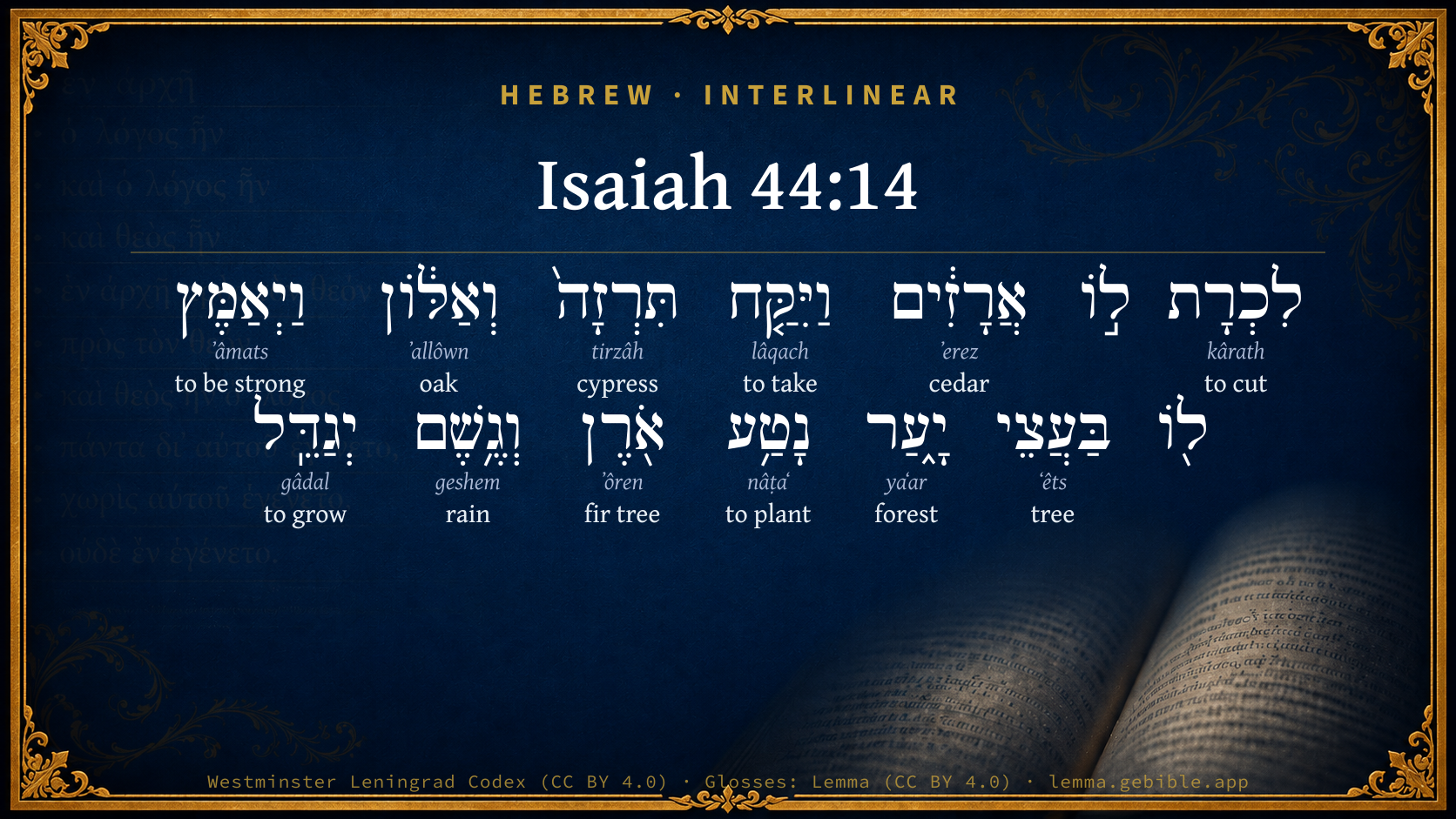
Hebrew (Westminster Leningrad Codex) Isaiah 44:14 appears in the Hebrew Old Testament. The text above is from the Westminster Leningrad Codex. Each word links to its Strong’s number, a concise gloss, and parsing drawn from the Open Scriptures Hebrew Bible morphology. Click any word for its full Brown-Driver-Briggs (BDB) entry.
Download image
Cite this verse

Isaiah 44:14 (World English Bible). Public Domain. Lemma interlinear Bible study tool, https://lemma.gebible.app/v/isaiah/44/14.

Show BibTeX & RIS
BibTeX
RIS
English Translation
He cuts down cedars for himself, and takes the cypress and the oak, and strengthens for himself one among the trees of the forest: he plants a fir tree, and the rain nourishes it.
World English Bible · Public Domain
Highlights Full analysis ↓
Download a study sheet

One document with this verse’s original text, its word-by-word gloss line, the meaning frame, cross-references with their text, attributed commentary, and full source and license credits — printable, and it pastes into notes with its structure intact.

This verse Autodidact and up

Study sheet (.html) Plain text (.txt)

A passage Seminary Student

Up to 50 verses in one chapter. A passage sheet keeps up to 6 commentary sources and 12 cross-references per verse, in the order this page ranks them, and says so on the sheet whenever that leaves anything out. Ask for a single verse and you get the Autodidact verse sheet above.

Everything on this page stays free to read, with no account — the sheet is a download of what is already on screen, not access to it.

Want to remove ads? Support Godless Engineer
Compare translations 3

The same verse in 3 English versions, stacked beneath the original-language interlinear above. Click any original word for its lexicon entry.

Each is an independent rendering of the whole verse — the interlinear is not word-aligned to these translations.

Highlighted words mark where these versions differ — a whole-verse word diff, not a word-by-word alignment.

  • World English Bible Public Domain
    He cuts down cedars for himself, and takes the cypress and the oak, and strengthens for himself one among the trees of the forest: he plants a fir tree, and the rain nourishes it.
  • King James Version Public Domain
    He heweth him down cedars, and taketh the cypress and the oak, which he strengtheneth for himself among the trees of the forest: he planteth an ash, and the rain doth nourish it.
  • unfoldingWord Literal Text CC BY-SA 4.0
    He cuts down cedars for it, or he takes a cypress or an oak and secures for himself among the trees of the forest; he planted a pine tree and the rain made grow.

unfoldingWord Literal Text — © unfoldingWord, licensed CC BY-SA 4.0. Word-aligned USFM3 via Door43 (git.door43.org/unfoldingWord/en_ult).

Versions to compare (up to 4)

3 of 4 selected

Show all 18 translations

Every available English version of this verse, each an independent rendering of the whole verse.

  • World English Bible Public Domain
    He cuts down cedars for himself, and takes the cypress and the oak, and strengthens for himself one among the trees of the forest: he plants a fir tree, and the rain nourishes it.
  • Berean Standard Bible Public Domain
    He cuts down cedars or retrieves a cypress or oak. He lets it grow strong among the trees of the forest. He plants a laurel, and the rain makes it grow.
  • Majority Standard Bible Public Domain
    He cuts down cedars or retrieves a cypress or oak. He lets it grow strong among the trees of the forest. He plants a laurel, and the rain makes it grow.
  • King James Version Public Domain
    He heweth him down cedars, and taketh the cypress and the oak, which he strengtheneth for himself among the trees of the forest: he planteth an ash, and the rain doth nourish it.
  • American Standard Version (1901) Public Domain
    He heweth him down cedars, and taketh the holm-tree and the oak, and strengtheneth for himself one among the trees of the forest: he planteth a fir-tree, and the rain doth nourish it.
  • Revised Version (1885) Public Domain
    He heweth him down cedars, and taketh the holm tree and the oak, and strengtheneth for himself one among the trees of the forest: he planteth a fir tree, and the rain doth nourish it.
  • Geneva Bible (1599) Public Domain
    He will hewe him downe cedars, and take the pine tree and the oke, and taketh courage among the trees of the forest: he planteth a firre tree, and the raine doeth nourish it.
  • Douay-Rheims (1899) Public Domain
    He hath cut down cedars, taken the holm, and the oak that stood among the trees of the forest: he hath planted the pine tree, which the rain hath nourished.
  • Young's Literal Translation Public Domain
    Cutting down to himself cedars, He taketh also a cypress, and an oak, And he strengtheneth `it' for himself Among the trees of a forest, He hath planted an ash, and the shower doth nourish `it'.
  • Literal Standard Version CC BY-SA 4.0
    Cutting down cedars for himself, || He also takes a cypress, and an oak, || And he strengthens [it] for himself || Among the trees of a forest, || He has planted an ash, and the shower nourishes [it].
  • Unlocked Literal Bible CC BY-SA 4.0
    He cuts down cedars, or chooses a cypress tree or an oak tree. He picks for himself trees in the forest. He plants a fir tree and the rain makes it grow.
  • unfoldingWord Literal Text CC BY-SA 4.0
    He cuts down cedars for it, or he takes a cypress or an oak and secures for himself among the trees of the forest; he planted a pine tree and the rain made grow.
  • Darby Bible Public Domain
    When he heweth him down cedars, he taketh also a holm-oak and a terebinth -- he chooseth for himself among the trees of the forest: he planteth a pine, and the rain maketh [it] grow.
  • World Messianic Bible Public Domain
    He cuts down cedars for himself, and takes the cypress and the oak, and strengthens for himself one among the trees of the forest. He plants a cypress tree, and the rain nourishes it.
  • Webster's Bible Public Domain
    He heweth down cedars for himself, and taketh the cypress and the oak, which he strengtheneth for himself among the trees of the forest: he planteth an ash, and the rain doth nourish it.
  • Free Bible Version CC BY-SA 4.0
    He chops down cedars, or takes a cypress or an oak. He lets them grow strong in the forest. He plants a fir tree, and the rain makes it grow.
  • Bible in Basic English Public Domain
    He has cedars cut down for himself, he takes an oak and lets it get strong among the trees of the wood; he has an ash-tree planted, and the rain gives it growth.
  • JPS Tanakh (1917) Public Domain
    He heweth him down cedars, and taketh the ilex and the oak, and strengtheneth for himself one among the trees of the forest; he planteth a bay-tree, and the rain doth nourish it.

Literal Standard Version (2020), Covenant Press — licensed CC BY-SA 4.0. Text via the HelloAO Bible API (eBible.org). Unlocked Literal Bible (unfoldingWord) — licensed CC BY-SA 4.0. Text via the HelloAO Bible API (eBible.org). unfoldingWord Literal Text — © unfoldingWord, licensed CC BY-SA 4.0. Word-aligned USFM3 via Door43 (git.door43.org/unfoldingWord/en_ult). Free Bible Version, Dr. Jonathan Gallagher — licensed CC BY-SA 4.0. Text via the HelloAO Bible API (eBible.org).

Word by word

More ways to search: Search by grammar → Find every occurrence → Compare this word →

Practice this passage: Drill this verse → Learn its vocabulary →

תִּרְזָה֙
tirzâh
H8645
“cypress”
Noun, Common, Feminine, Singular, Absolute
Part of Speech
Noun
Type
Common
Gender
Feminine
Number
Singular
State
Absolute
Full BDB Definition

Origin: probably from H7329

TWOT: 2543 . 1

a type of tree - perhaps the cypress, holm-tree - meaning very dubious
  1. לִכְרָת kârath H3772 “to cut” Preposition + Verb, Qal, Infinitive Construct
  2. אֲרָזִ֔ים ʼerez H730 “cedars” Noun, Common, Masculine, Plural, Absolute
  3. וַיִּקַּ֤ח lâqach H3947 “and · to take” Conjunction + Verb, Qal, Sequential Imperfect, 3rd Person, Masculine, Singular
  4. וְאַלּ֔וֹן ʼallôwn H437 “and · oak” Conjunction + Noun, Common, Masculine, Singular, Absolute
  5. וַיְאַמֶּץ ʼâmats H553 “and · to be strong” Conjunction + Verb, Piel, Sequential Imperfect, 3rd Person, Masculine, Singular
  6. בַּעֲצֵי ʻêts H6086 “in/at · trees of” Preposition + Noun, Common, Masculine, Plural, Construct
  7. יָ֑עַר yaʻar H3293 “forest” Noun, Common, Masculine, Singular, Absolute
  8. נָטַ֥ע nâṭaʻ H5193 “to plant” Verb, Qal, Perfect, 3rd Person, Masculine, Singular
  9. אֹ֖רֶן ʼôren H766 “fir tree” Noun, Common, Masculine, Singular, Absolute
  10. וְגֶ֥שֶׁם geshem H1653 “and · rain” Conjunction + Noun, Common, Masculine, Singular, Absolute
  11. יְגַדֵּֽל gâdal H1431 “to grow” Verb, Piel, Imperfect, 3rd Person, Masculine, Singular

About this verse

These counts appear in no published source. They are computed here, from the morphology-tagged text and Lemma’s own curated glosses. What Lemma adds →

14
words
12
distinct lemmas
Prophets
section

Notable vocabulary

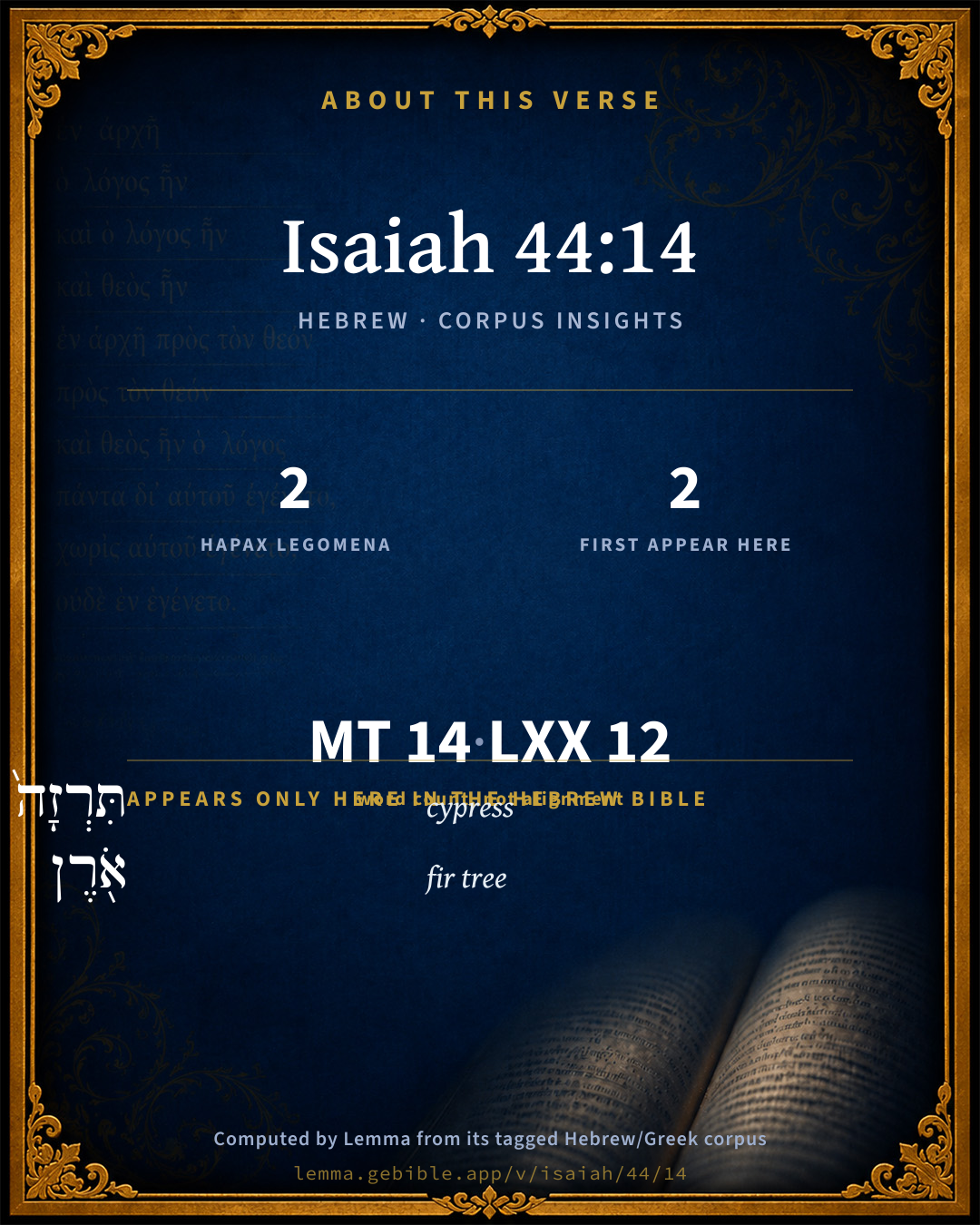
2 hapax legomena — words that appear only here in the entire Hebrew Bible:

  • תִּרְזָה֙ cypress H8645
  • אֹ֖רֶן fir tree H766

First appearance in Scripture

These words make their first canonical appearance in the Hebrew Bible here:

  • תִּרְזָה֙ cypress H8645
  • אֹ֖רֶן fir tree H766

Shared distinctive vocabulary

וְאַלּ֔וֹן oak H437 occurs in 8 verses of the Hebrew Bible. Also found in:

Grammatical profile

  • 5 verbs
  • 7 nouns
  • 2 prepositions

Verb forms

  • לִכְרָת Qal · Infinitive Construct
  • וַיִּקַּ֤ח Qal · Sequential Imperfect
  • וַיְאַמֶּץ Piel · Sequential Imperfect
  • נָטַ֥ע Qal · Perfect
  • יְגַדֵּֽל Piel · Imperfect

Hebrew & Septuagint length

In English translation the verse runs 34 words from the Hebrew and 21 from the Septuagint (LXX English) — the Septuagint runs noticeably shorter here. See the side-by-side →

A rough comparison of the two English renderings, which tokenize alike — not a word-level alignment.

Word counts can differ between the Hebrew and the Greek without any difference in meaning — e.g. the Hebrew direct-object marker אֵת has no separate Greek word, and Greek often adds the article ὁ.

In the original languages it is 14 Hebrew tokens and 12 Greek tokens — but the two are counted differently (Hebrew bundles its prefixes and suffixes into one token; the Greek is in lemma form), so that isn’t a like-for-like length.

Cross-references

4

Topical passages linked to Isaiah 44:14 in the Treasury of Scripture Knowledge — connected by theme and wording, ordered by reader-vote popularity; previews shown in the World English Bible.

  • Isaiah 40:20 He who is too impoverished for [such] an offering chooses a tree that will not rot; he seeks to him a skillful workman to set up an engraved image, that shall not be moved.
  • Jeremiah 10:3–8 For the customs of the peoples are vanity; for one cuts a tree out of the forest, the work of the hands of the workman with the axe.
  • Hosea 4:12 My people consult with their wooded idol, And answer to a stick of wood. Indeed the spirit of prostitution has led them astray, And they have been unfaithful to their God.
  • Habakkuk 2:19 Woe to him who says to the wood, 'Awake!' or to the mute stone, 'Arise!' Shall this teach? Behold, it is overlaid with gold and silver, and there is no breath at all in the midst of it.

Cross-references courtesy of OpenBible.info (CC BY 4.0).

Hebrew and Greek witnesses Masoretic Hebrew ↔ Greek Septuagint

The same verse in the two great witnesses to the Old Testament, shown verse-for-verse.

Here the Septuagint runs noticeably shorter than the Hebrew — LXX2012 (modern English Septuagint) 21 words vs World English Bible 34. A rough length comparison of the two English translations, not a word-level alignment — read both below.

These are two independent witnesses, not word-aligned to each other, and the Septuagint is shown in lemma (dictionary) form.

Hebrew Isaiah 44:14 Masoretic · Westminster Leningrad Codex

לִכְרָת ל֣וֹ אֲרָזִ֔ים וַיִּקַּ֤ח תִּרְזָה֙ וְאַלּ֔וֹן וַיְאַמֶּץ ל֖וֹ בַּעֲצֵי יָ֑עַר נָטַ֥ע אֹ֖רֶן וְגֶ֥שֶׁם יְגַדֵּֽל

He cuts down cedars for himself, and takes the cypress and the oak, and strengthens for himself one among the trees of the forest: he plants a fir tree, and the rain nourishes it.

World English Bible · Public Domain

Greek LXX Isaiah 44:14 Septuagint · lemma form

ὅς κόπτω ξύλον ἐκ ὁ δρυμός ὅς φυτεύω κύριος καί ὑετός μηκύνω

He cuts wood out of the forest, which the Lord planted, even a pine tree, and the rain made it grow,

LXX2012 (modern English Septuagint) · Public Domain

On this verse, Adam Clarke's Commentary discusses the Septuagint’s reading. Read the note in Commentary ↓

Hebrew: Westminster Leningrad Codex (CC BY 4.0). Greek: Septuagint (public domain); English from LXX2012 (modern English Septuagint) (Public Domain). How the Septuagint differs from the Hebrew →

Targum (Aramaic paraphrase)

1

The Targum is the ancient Jewish Aramaic paraphrase of the Hebrew Scriptures — an interpretive translation, not the Hebrew text itself. Onkelos (literal) and Pseudo-Jonathan (expansive) render the Torah, and Jonathan the Prophets. Coverage is partial: where no permissively-licensed English translation exists for a verse, only the Aramaic is shown. This is verse-level text, not a word-by-word alignment to the Hebrew.

  1. Targum Jonathan Prophets (Joshua–Malachi)
    לְמִקַץ לֵיהּ אַרְזִין וּנְסִיב תְּרֵז וּבְלוּט וּמַתְקֵיף לֵיהּ בַּאֲעֵי חוּרְשָׁא נְצַב אוּרְנָא וּמִטְרָא יְרַבֵּי:

    He heweth for himself cedars and taketh the scarlet oak, and the chestnut, and seasons them. He plants the ash amongst the trees of the forest, and the rain nourisheth it.

    Targum Jonathan — Aramaic: “Mikraot Gedolot” (public domain). English: “Sefaria Community Translation” (CC0 1.0 (public-domain dedication)); “London "Chaldee Paraphrase," 1871” (public domain). Text via Sefaria.

Commentary

Notes on Isaiah 44:14 from classic Christian and Jewish commentators (each source and its license shown beneath its notes). The classic Christian expositions comment on the surrounding passage and are grouped to its opening verse, so a note may address several verses; the Jewish commentaries on the Tanakh (Rashi and others) are per-verse, so they appear only where the commentator wrote on this verse.

Lemma curates 59 commentaries, every one of them public domain or Creative Commons licensed, each selected and text-cleaned for this edition rather than reprinted as found. About our sources →

Trapp's Complete Commentary

John Trapp

Isa 44:14 He heweth him down cedars, and taketh the cypress and the oak, which he strengtheneth for himself among the trees of the forest: he planteth an ash, and the rain doth nourish [it].

Ver. 14. He heweth him down cedars.] Choice wood, yet but wood. Qualis igitur inde Deus consurgat?

And the rain doth nourish it.] Not the idol; for it can do nothing toward the production of that matter whereof it is made. Some have observed that the four sorts of trees here mentioned are all of them fruitless, and growing in woods.

John Trapp, A Commentary or Exposition upon All the Books of the Old and New Testament (1647–1656) — public domain. Text from a community e-Sword module.

The Biblical Illustrator

Joseph S. Exell

Isa_44:14

He planteth an ash

The planter and the rain

The civilised and cultivated tree is the joint product of human care and the earths fertility.

Let us study the picture and see how true it is to what the world contains.

1. We may ask ourselves how it is that any institution or established form of human living comes to be prevalent and dominant. A strong idea, of freedom, of justice, of mercy, enters into some strong mans soul. It makes itself completely his. Then it will not be satisfied with him; it grows restless within him, and demands the world. Then he takes it out some day and plants it. With some vigorous, incisive word or deed he thrusts his live and fiery idea down deep into the fruitful soil of human life. Then human life takes up his idea and nourishes it. Wonderfully all the forces gather around it and give it their vitality. History bears witness that it has all been living by the power of that idea unknown, unguessed; philosophy says that in it lies the key of her hard problems; economy discovers that by it life may be made more thrifty and complete; poetry shows its nobleness; affection wreaths it with love; all the essential hopes and fears and needs of human nature come flocking to it; until at last you can no more conceive of human life without that idea than you can think with complacency of the landscape without the great tree which is as thoroughly a part of it as is the very ground itself. A free Church, a just court, a popular government--this is the way in which every institution comes to be. Here is the relation of the worlds few great creative men to the great mass and body of its life. Helpless Europe without Martin Luther. Helpless also Martin Luther without Europe. Here is the mutual need of great souls and the great world.

2. We have another illustration, even more striking, close at our hand, in the way in which character grows up in our personal nature. Where do our characters come from? It is easy sometimes to represent them as the result of strong influence which other men have had over us. It is easy at other times to think of them as if they made themselves, shaping themselves by mere internal fermentation into the result we see. But neither account tells the story by itself. When we question ourselves, not about character in general, but about special points and qualities of character, then we are sure that it was by some outer influence made our own, some seed of motive or example set into our lives and then taken possession of by those lives and filled with their vitality, developed into their owe type and kind of vice or virtue--it was thus that this, which is now so intimate that we call it not merely ours but ourselves, came into being. This is the reason of the perpetual identity along with the perpetual variety of goodness and badness. We are all good and bad alike; and yet every man is good and bad in a way all his own--in a way in which no other man has ever been bad or good since the world began,--just as all ash-trees are alike because they have all been planted from the same nurseries; and yet every ash-tree is different from every other because it has grown in its own soil and fed on its own rain: the society and the individuality of moral life.

3. The truth has its clearest illustration, it may be, in the way in which God has sent into the world the Gospel of His Son. Most sharp and clear and definite stands out in history the life and death of Jesus Christ. It was the entrance of a new, Divine force into the world. But what has been the story of that force once introduced? It has been subjected to the influences which have created the ordinary currents of human life. The characters and thoughts of men have told upon it. The Gospel has shared in the fortunes of the Christian world. It has followed in the track of conquering armies; it has been beaten back and hindered by the tempests of revolution and misrule; it has been tossed upon the waves of philosophical speculation; it has been made the plaything or the tool of politics; it has taken possession of countries and centuries only by taking possession of men through the natural affections of their human hearts; it has worked through institutions which it only helped to create. While it has helped to make the world, it has also at every moment been made by the world into something different from its own pure self. If you try to take either half of the truth by itself you get into the midst of puzzle and mistake. Think of the Gospel simply as an intrusion of Divine force kept apart from any mixture with the influences of the world, and it is impossible to understand the forms in which it has been allowed to present itself. Its weaknesses and its strength are alike unintelligible. Think of it as a mere development of human life, and you cannot conceive how it came to exist at all. But consider it in its completeness. Remember that it is a Divine force working through human conditions; let it be all one long incarnation, God manifest in the flesh--and then you see at once why it is so weak and why it is so strong; why it has not occupied the world with one lightning flash of power, and why it must at last, however slowly, accomplish its complete salvation.

4. Every Christian is a little Christendom; and the method of the entrance of the Gospel into the great world is repeated in the way in which the Gospel enters into every soul, which then it occupies and changes. Again, there is the special act of the implanting of the new life, and then there is the intrusting of the new-implanted life to the nature and its circumstances. The man was born again! Since then, long years have come and gone. What have they seen? The rain has nourished it--that long-sown seed! Nothing has happened since which has not touched that seed and helped or hindered its maturity. Still remember, it is His rain. The influences into whose influence the seed was given still were Gods. He took the child, and gave the friend, and sent you on the journey, and shaped the nature which bestowed on the Christian life its distinctive character.

5. May we not say that the principle itself includes the whole truth of the supernatural, and its relation to the natural? (Phillips Brooks, D. D)

The Biblical Illustrator, edited by Joseph S. Exell (c. 1880s–1900s) — public domain. Text from a community e-Sword module.

Jamieson, Fausset & Brown

Robert Jamieson, A. R. Fausset & David Brown

Description of the material out of which the idol is formed.

cypress--rather, from Hebrew root, "to be hard," the holm oak," an evergreen abundant in Palestine [GESENIUS].

strengtheneth--literally, "and he getteth strength to himself in the trees of the forest;" that is, he layeth in a great store of timber [LOWTH]. Or, "chooseth," as "madest strong for thyself," that is, hast chosen (Psa 80:15, Psa 80:17) [GESENIUS]. But English Version gives a good sense: "strengtheneth"; that is, rears to maturity; a meaning suitable also to the context of Psa 80:15, Psa 80:17, where Israel is compared to a vine planted by Jehovah [MAURER].

rain doth nourish it--Though the man planted the tree, yet he could not make it grow. In preparing to make an idol, he has to depend on the true God for rain from heaven (Jer 14:22).

Jamieson, Fausset & Brown — Commentary Critical and Explanatory on the Whole Bible (1871) — public domain (CC PDM 1.0). Text via the HelloAO Bible API.

Adam Clarke's Commentary

Verse 14. He heweth him down - "He heweth down"] For לכרת lichroth, the Septuagint and Vulgate read כרת carath or יכרת yichroth.

Adam Clarke's Commentary on the Bible (1810–1826) — public domain. Text from a community e-Sword/MySword module.

Ellicott's Commentary for English Readers

(14) He heweth him down cedars.—The manufacture is traced further back, possibly by way of protest against the belief current in all nations that some archaic image had fallen from heaven (Act_19:35). The “cypress” is probably the Quercus ilex, and the “ash” a fig tree; but the identification of trees in the language of a remote time and language is always somewhat uncertain.

Which he strengtheneth for himself.—Better, fixeth his choice among. The eye travels, it will be noted, backward from the workshop.

A Bible Commentary for English Readers, edited by Charles John Ellicott (1878–1897) — public domain. Text from a community e-Sword module.

The Cambridge Bible for Schools and Colleges

gen. ed. J. J. S. Perowne

14–17. The writer now goes back to the material of which this second kind of idol is made.

He heweth him down] The Heb. text, which reads “to hew down,” probably contains a mistake in the first letter.

strengtheneth for himself] must mean “allows to grow strong” in its native forest. Nay, in some cases the future deity has been actually planted by his worshipper, and nourished by the rain from heaven! The words tirzâh (“cypress”) and ’ôren (“ash”) occur only here in the O.T. The former, according to the Vulg. and the Greek Versions of Aquila and Theodotion, is the “holm-oak” (ilex); the latter may be translated “pine” (Vulg.); the corresponding word in Assyrian denotes the cedar.

The Cambridge Bible for Schools and Colleges (gen. ed. J. J. S. Perowne; Cambridge University Press, 1878–1918) — public domain. Text from a community e-Sword module.

John Gill's Exposition

He heweth him down cedars, and taketh the cypress and the oak,.... To make gods of, trees both pleasant and durable, but all unfruitful:

which he strengtheneth for himself among the trees of the forest; taking a great deal of pains in seeking out such trees as were most fit for his use, and a great deal of care in the growth of them, that they might answer his end, as well as exerting his strength in cutting of them down:

he planteth an ash, and the rain doth nourish it; a tree that soon grows up, and which he plants for the purpose to make a god of; and this being watered and nourished with rain, which God vouchsafes, though designed for an idolatrous use, grows, and is fit for what it was intended; and being so, he cuts it down, and, makes an image of it; which shows his folly and madness, that a tree of his own planting, which he has seen the growth of, and yet be so sottish as to imagine that a god may be may be made of it. The word for "rain" signifies a body in the Syriac (g) language, as Kimchi observes, and for which he produces Dan 4:33, and so Aben Ezra says it signifies in the Arabic language (h); and the sense is, "the body" of the tree "grew up", and being grown up, was cut down, and used as follows.

(g) "corpus", Luke iii. 22. 2Cor. x. 10. Castel. Lex. Polyglott. col. 627. So in the Chaldee language. (h) So, according to Schindler, signifies a body, Lex. Pentaglott. col. 347, 348.

John Gill's Exposition of the Whole Bible (1746–1763) — public domain (CC PDM 1.0). Text via the HelloAO Bible API.

Albert Barnes' Notes on the Bible

He heweth him down cedars - In the previous verses, the prophet had described the formation of an axe with which the work was to be done Isa 44:12, and the laying out, and carving of the idol Isa 44:13. In this verse he proceeds to describe the material of which the idol was made, and the different purposes Isa 44:15-17 to which that material was applied. The object is to show the amazing stupidity of those who should worship a god made of the same material from which they made a fire to warm themselves, or to cook their food. For a description of cedars, see the notes at Isa 9:10.

And taketh - Takes to himself; that is, makes use of.

The cypress - (תרזה tı̂rzâh). This word occurs nowhere else in the Bible. It is probably derived from a root (תרז târaz) signifying to be hard, or firm. Hence, it probably means some species of wood that derived its name from its hardness or firmness. Jerome translates it, Ilex (a species of oak) - ‘the holm-oak.’ It was an evergreen. This species of evergreen, Gesenius says, was abundant in Palestine.

And the oak - The oak was commonly used for this purpose on account of its hardness and durability.

Which he strengtheneth for himself - Margin, ‘Taketh courage.’ The word אמץ 'ı̂mmēts means properly “to strenthen,” to make strong, to repair, to replace, to harden. Rosenmuller and Gesenius suppose that it means here to choose, that is, to set fast, or appoint; and they appeal to Psa 80:15, Psa 80:17, ‘thou madest strong for thyself.’ Kimchi supposes that it means, that he gave himself with the utmost diligence and care to select the best kinds of wood for the purpose. Vitringa, that he was intent on his work, and did not leave the place, but refreshed himself with food in the woods without returning home, in order that be might accomplish his design. Others interpret it to mean that he girded himself with strength, and made use of his most intense efforts in felling the trees of the forest. Lowth renders it, ‘Layeth in good store of the trees of the forest.’ It may mean that he gave himself with great diligence to the work; or may it not mean that he planted such trees, and took great pains in watering and cultivating them for this purpose?

He planteth an ash - (ארן 'oren). The Septuagint renders it, Πίτυν Pitun - ‘Pine.’ Jerome also renders it, Pinum. Gesenius supposes the name was given from the fact that the tree had a tall and slender top, which, when it vibrated, gave forth a tremulous, creaking sound (from רנן rânan). This derivation is, however, somewhat fanciful. Most interpreters regard it as the ash - a well-known tree. In idolatrous countries, where it is common to have idols in almost every family, the business of idol-making is a very important manufacture. Of course, large quantities of wood would be needed; and it would be an object to procure that which was most pure, or as we say, ‘clear stuff,’ and which would work easily, and to advantage. It became important, therefore, to cultivate that wood, as we do for shipbuilding, or for cabinet-work, and doubtless groves were planted for this purpose.

And the rain doth nourish it - These circumstances are mentioned to show the folly of worshipping a god that was formed in this manner. Perhaps also the prophet means to intimate that though the man planted the tree, yet that be could not make it grow. He was dependent on the rains of heaven; and even in making an idol-god he was indebted to the providential care of the true God. Men, even in their schemes of wickedness, are dependent on God. Even in forming and executing plans to oppose and resist him, they can do nothing without his aid. He preserves them, feeds them, clothes them; and the instruments which they use against him are those which he has nurtured. On the rain of heaven; on the sunbeam and the dew; on the teeming earth, and on the elements which he has made, and which he controls, they are dependent; and they can do nothing in their wicked plans without abusing the bounties of his Providence, and the expressions of his tender mercy.

Albert Barnes' Notes on the Bible (1834–1885) — public domain. Text from a community e-Sword/MySword module.

Matthew Poole's English Annotations

The cypress and the oak, which afford the best and most durable timber.

Which he strengtheneth for himself among the tress of the forest: the sense of the words thus rendered is, that he planteth, and with care and diligence improveth, those trees among and above all the trees of the forest, that he or his posterity may thence have materials for their images, and those things which belong to them. And this sense seems to be favoured by the following clause, wherein it is said, he planteth an ash, for this very reason. Or the sense may be this, which he suffers to grow to greater strength and largeness than other trees of the forest, that they may be better and fitter for his use. Heb. and he strengtheneth himself, &c.; and he useth all his strength among the trees of the forest, in planting such as are proper for this end, in walking hither and thither to survey which is the best of them; in hewing them down, and in other things relating to them.

Matthew Poole's English Annotations on the Holy Bible (1683–1685) — public domain. Text from a community e-Sword/MySword module.

Whedon's Commentary on the Bible

Daniel D. Whedon

14-17. Heweth… cedars… cypress… oak — Back of manufacture, the prophet now goes for the origin of idols. He seeks the trees from which they are made — trees which require rains long before they can be made into idols. He seeks the cedar, oak, holm oak. (Why seek trees of Palestine if this prophet is of Babylon at the time of Cyrus, and is not Isaiah one hundred and fifty years before?) The fig tree is used, too, but half of it — its chips — is taken for fuel to cook and warm by. Why such a material for the making of a god? Delitzsch quotes as follows, in loco: “Diagoras of Melos, a pupil of Democritus, once threw a wooden figure of Hercules into the fire, and said jocularly, “Hercules, come now, perform thy thirteenth labour, and help me cook my turnips.” With as keen a point does Isaiah virtually ask: “Is there a god in your cedar, holm, or fig tree logs or billets?”

Daniel D. Whedon (gen. ed.), Commentary on the Old and New Testaments (1874–1909) — public domain. Text from a community e-Sword module.

The Pulpit Commentary

Cedars... cypress... oak. The second of the trees mentioned is more probably the ilex than the cypress, which does not grow either in Palestine or in Babylonia. Idols would be made of cedar on account of its fragrance, of flex and oak on account of their hardness and durability. Cedar was used as a material for carved figures in Egypt (Birch, "Contents of British Museum," p. 21). Which he strengtheneth for himself among the trees of the forest. The meaning is obscure. Dr. Kay translates, "and he encourages himself in the trees of the forest," which conveys no very distinct idea; Delitzsch, "and he chooses for himself among the trees," etc., which is sufficiently clear, but scarcely obtainable from the Hebrew text; Knobel, "he makes himself secure among the trees" (by putting a mark on those which he intends to have), which imparts an idea certainly not contained in the original. He planteth an ash. It is uncertain, and it does not greatly matter, what tree is intended. The point is that, before trees can grow up, they have to be planted, and that, for them to grow when planted, God"s gift of rain is necessary (see the comment on ver. 13).

The Pulpit Commentary (1880–1919), ed. H.D.M. Spence-Jones & Joseph S. Exell — public domain. Text from a community e-Sword module.

John Wesley's Explanatory Notes

Oak - Which afford the best and most durable timber. Strengtheneth - He plants, and with care and diligence improves those trees, that he or his posterity may thence have materials for their images, and those things which belong to them.

John Wesley, Explanatory Notes Upon the Whole Bible (1754–1765) — public domain. Text via the GEBible commentary corpus.

Keil & Delitzsch

C. F. Keil & F. Delitzsch

The prophet now traces the origin of the idols still further back. Their existence or non-existence ultimately depends upon whether it rains or not. "One prepares to cut down cedars, and takes holm and oak-tree, and chooses for himself among the trees of the forest. He has planted a fig, and the rain draws it up. And it serves the man for firing: he takes thereof, and warms himself; he also heats, and bakes bread; he also works it into a god, and prostrates himself; makes an idol of it, and falls down before it. The half of it he has burned in the fire: over the half of it he eats flesh, roasts a roast, and is satisfied; he also warms himself, and says, Hurrah, I am getting warm, I feel the heat. And the rest of it he makes into a god, into his idol, and says, Save me, for thou art my god." The subject of the sentence is not the carpenter of the previous verse, but "any one." ארזים apparently stands first, as indicating the species; and in the Talmud and Midrash the trees named are really described as ארזים מיני. But tirzâh (from târaz, to be hard or firm) does not appear to be a coniferous tree; and the connection with 'allōn, the oak, is favourable to the rendering ἀγριοβάλανος (lxx, A. Th.), ilex (Vulg.). On 'immēts, to choose, see Isa 41:10. ארן (with Nun minusculum), plur. ארונים (b. Ros-ha Sana 23a) or ארנים (Para iii. 8), is explained by the Talmud as ערי, sing. ערא, i.e., according to Aruch and Rashi, laurier, the berries of which are called baies. We have rendered it "fig," according to the lxx and Jerome, since it will not do to follow the seductive guidance of the similarity in sound to ornus (which is hardly equivalent to ὀρεινός).

(Note: The ἀρία of Theophrastus is probably quercus ilex, which is still called ἀρία; the laurus nobilis is now called βαΐηά, from the branches which serve instead of palm-branches.)

The description is genealogical, and therefore moves retrogressively, from the felling to the planting. והיה in Isa 44:15 refers to the felled and planted tree, and primarily to the ash. מהם (of such as these) is neuter, as in Isa 30:6; at the same time, the prophet had the עצים (the wood, both as produce and material) in his mind. The repeated אף lays emphasis upon the fact, that such different things are done with the very same wood. It is sued for warming, and fore the preparation of food, as well as for making a god. On the verbs of adoration, hishtachăvâh (root shach, to sink, to settle down) and sâgad, which is only applied to idolatrous worship, and from which mes'gid, a mosque, is derived, see Holemann's Bibelstudien, i. 3. למו may no doubt be take as a plural (= להם, as in Isa 30:5), "such things (taila) does he worship," as Stier supposes; but it is probably pathetic, and equivalent to לו, as in Isa 53:8 (compare Psa 11:7; Ewald, 247, a). According to the double application of the wood mentioned in Isa 44:15, a distinction is drawn in Isa 44:16, Isa 44:17 between the one half of the wood and the other. The repeated chetsyō (the half of it) in Isa 44:16 refers to the first half, which furnishes not only fuel for burning, but shavings and coals for roasting and baking as well. And as a fire made for cooking warms quite as much as one made expressly for the purpose, the prophet dwells upon this benefit which the wood of the idol does confer. On the tone upon the last syllable of chammōthı̄, see at Job 19:17; and on the use of the word ראה as a comprehensive term, embracing every kind of sensation and perception, see my Psychologie, p. 234. Diagoras of Melos, a pupil of Democritus, once threw a wooden standing figure of Hercules into the fire, and said jocularly, "Come now, Hercules, perform thy thirteenth labour, and help me to cook the turnips."

Keil & Delitzsch — Biblical Commentary on the Old Testament (1861–1891) — public domain (CC PDM 1.0). Text via the HelloAO Bible API. (Old Testament only.)

J. A. Alexander on Isaiah

Joseph Addison Alexander

“To hew him down cedars; and (now) he has taken cypress and an oak, and has strengthened (i.e., raised it) for himself among the trees of the forest; he has planted a pine, and the rain shall increase it, (i.e., make it grow).” To show more clearly the absurdity of ascribing deity to material images, he here goes back, not only to their human origin and their base material, but to the very generation of the trees by which the wood is furnished. The particulars are stated in an inverse order He begins with the felling of the trees, but interrupts himself in order to go still further back to their very cultivation. The essential idea is that man, instead of being the creature, is in some sort the creator of the wood he worships, since it does or may owe its existence to his agency. One of the Hebrew words strictly denotes a species of oak, but the common version cypress may be retained, as it yields an appropriate sense, and as botanical precision is in this case of no exegetical importance, since the meaning of the verse would be the same whatever species had been mentioned. The strict sense of making strong corresponds exactly to that of making great expressed by the last words, both meaning here to cause to grow. Thus understood, the word helps to bring out with more strength and clearness the main idea of the verse, viz. that the idolater not only chooses suitable trees, but plants and raises them for the purpose. It is not necessary to suppose that this is a description of a usual or frequent custom. It is rather an ideal exhibition of the idol-manufacture carried out to its extreme. The last clause is added to complete the picture of the natural origin and growth of that which the idolater adores as superhuman and divine. At the same time it implies the patient perseverance of the devotee, who first does his part and then waits for natural causes to do theirs, and all for the production of an idol!

Joseph Addison Alexander, The Prophecies of Isaiah (1846–1847; New York: Scribner, 1870–1878) — public domain. Text from a community e-Sword module.

unfoldingWord translationNotes

Door43 World Missions Community

He cuts down

"The carpenter cuts down" or "the woodcarver cuts down"

cypress tree

a tall evergreen tree (See: Translate Unknowns)

translationWords

cedar

cypress

oak

fir

unfoldingWord translationNotes — © Distant Shores Media and the Door43 World Missions Community, licensed CC BY-SA 4.0. Source: git.door43.org/Door43/en_tn.

Rashi

Rabbi Shlomo Yitzchaki (Rashi)

ilex and an oak kinds of non-fruit-producing trees.

and he reinforced it with forest trees He makes for it types of reinforcements, either for strength or for beauty, with types of trees, one different from the other in their appearance.

he planted a sapling When he finds a branch or a sapling that is fit for that, he plants it for that and the rain makes it grow.

a sapling Heb. אֹרֶן, a young sapling, ploncon in O.F.

Rashi on the Tanakh — English translations: “The Judaica Press complete Tanach with Rashi, translated by A. J. Rosenberg” (CC BY 4.0); “Pentateuch with Rashi's commentary by M. Rosenbaum and A.M. Silbermann, 1929-1934” (public domain); “The Metsudah Tanach series, Lakewood, N.J” (CC BY 4.0); and “The Book of Joshua, Metsudah Publications, 1997” (CC BY 4.0). Text via Sefaria.

Ibn Ezra

Rabbi Abraham ibn Ezra

He heweth him down cedars, etc. Some cut the idols out of cedar wood, others of. תרזה cypress. It is the name of a tree.

ויאמץ לו And he planted it.

אורן It is either the name of a tree, or it means root.

וגשם And the stem. Lit., the substance comp. גשמא in Chaldee, and in Arabic body. According to others: rain; the meaning of וגשם יגדל is then, and the rain will cause it to grow.

Ibn Ezra on the Tanakh — English translations: “Sefaria Community Translation” (CC0 1.0 (public-domain dedication)); “Yalkut, Sifsei Chachomim Chumash, Metsudah Publications, 2009” (CC BY 4.0); and “Commentary of Ibn Ezra on Isaiah - trans. by M. Friedlander, 1873” (public domain). Text via Sefaria.

Lesson kit

Teaching starters — assembled from the data on this page, not authored interpretation. Every prompt links to the verse data it draws on. Edit before teaching.

Isaiah, in the Prophets, opens this verse with 14 words (12 distinct Hebrew lemmas). Its most distinctive word is tirzâh (“cypress”). The Greek Septuagint runs shorter here. A historical commentator’s framing appears above. Read the whole chapter for the surrounding context.

Discussion questions

  1. What does “cypress” (tirzâh) contribute to the verse as a whole?
  2. This verse holds 2 words here found nowhere else in the Hebrew Bible. What might the rare words draw attention to?
  3. 2 words here appear for the first time in Scripture. What is being introduced at this debut?
  4. Genesis 35:8 shares the word «oak» with this verse. How do the two illuminate each other?
  5. Compared with the Hebrew, the Septuagint runs shorter here. What questions does that raise?
  6. These translations render this verse differently. What is at stake in choosing one wording over another?
  7. The verb «לִכְרָת» is Qal Infinitive Construct. How does its form color the action?
  8. Reading how Trapp's Complete Commentary and The Biblical Illustrator read this verse, where do the two commentators agree and where do they part?

Things to notice

Reading settings

Reading text

Shown beneath each verse's original-language words.

Old Testament
Old Testament edition

Read the OT as the Masoretic Hebrew (MT) or the Greek Septuagint (LXX).

English shown for the Greek Septuagint (in the Hebrew ↔ Greek comparison).

Comparing translations? Open the Compare panel on any verse page to stack up to four side by side.