
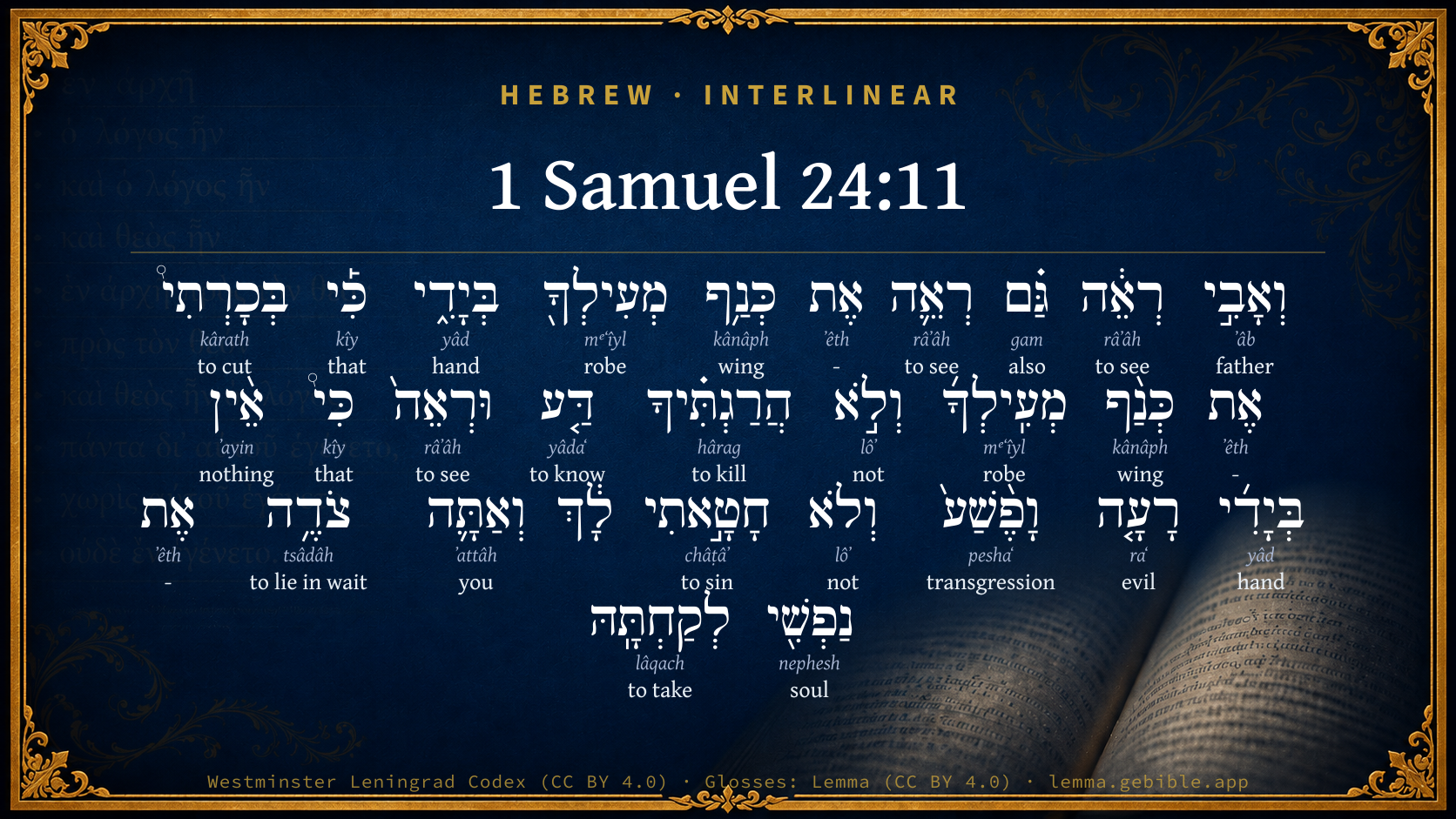
1 Samuel 24:11

Hebrew (Westminster Leningrad Codex) 1 Samuel 24:11 appears in the Hebrew Old Testament. The text above is from the Westminster Leningrad Codex. Each word links to its Strong’s number, a concise gloss, and parsing drawn from the Open Scriptures Hebrew Bible morphology. Click any word for its full Brown-Driver-Briggs (BDB) entry.
Download image
Cite this verse

1 Samuel 24:11 (World English Bible). Public Domain. Lemma interlinear Bible study tool, https://lemma.gebible.app/v/1-samuel/24/11.

Show BibTeX & RIS
BibTeX
RIS
English Translation
Moreover, my father, behold, yes, see the skirt of your robe in my hand; for in that I cut off the skirt of your robe, and didn't kill you, know you and see that there is neither evil nor disobedience in my hand, and I have not sinned against you, though you hunt after my life to take it.
World English Bible · Public Domain
Download a study sheet

One document with this verse’s original text, its word-by-word gloss line, the meaning frame, cross-references with their text, attributed commentary, and full source and license credits — printable, and it pastes into notes with its structure intact.

This verse Autodidact and up

Study sheet (.html) Plain text (.txt)

A passage Seminary Student

Up to 50 verses in one chapter. A passage sheet keeps up to 6 commentary sources and 12 cross-references per verse, in the order this page ranks them, and says so on the sheet whenever that leaves anything out. Ask for a single verse and you get the Autodidact verse sheet above.

Everything on this page stays free to read, with no account — the sheet is a download of what is already on screen, not access to it.

Want to remove ads? Support Godless Engineer
Compare translations 3

The same verse in 3 English versions, stacked beneath the original-language interlinear above. Click any original word for its lexicon entry.

Each is an independent rendering of the whole verse — the interlinear is not word-aligned to these translations.

Highlighted words mark where these versions differ — a whole-verse word diff, not a word-by-word alignment.

  • World English Bible Public Domain
    Moreover, my father, behold, yes, see the skirt of your robe in my hand; for in that I cut off the skirt of your robe, and didn't kill you, know you and see that there is neither evil nor disobedience in my hand, and I have not sinned against you, though you hunt after my life to take it.
  • King James Version Public Domain
    Moreover, my father, see, yea, see the skirt of thy robe in my hand: for in that I cut off the skirt of thy robe, and killed thee not, know thou and see that there is neither evil nor transgression in mine hand, and I have not sinned against thee; yet thou huntest my soul to take it.
  • unfoldingWord Literal Text CC BY-SA 4.0
    And see, my father, even see the edge of your robe in my hand! For when I cut off the edge of your robe, I did not kill you. Know and see that no evil or transgression in my hand, and I have not sinned against you, but you are hunting my life, to take it.

unfoldingWord Literal Text — © unfoldingWord, licensed CC BY-SA 4.0. Word-aligned USFM3 via Door43 (git.door43.org/unfoldingWord/en_ult).

Versions to compare (up to 4)

3 of 4 selected

Show all 18 translations

Every available English version of this verse, each an independent rendering of the whole verse.

  • World English Bible Public Domain
    Moreover, my father, behold, yes, see the skirt of your robe in my hand; for in that I cut off the skirt of your robe, and didn't kill you, know you and see that there is neither evil nor disobedience in my hand, and I have not sinned against you, though you hunt after my life to take it.
  • Berean Standard Bible Public Domain
    See, my father, look at the corner of your robe in my hand. For I cut it off, but I did not kill you. See and know that there is no evil or rebellion in my hands. I have not sinned against you, even though you are hunting me down to take my life.
  • Majority Standard Bible Public Domain
    See, my father, look at the corner of your robe in my hand. For I cut it off, but I did not kill you. Know and see that there is no evil or rebellion in my hands. I have not sinned against you, even though you are hunting me down to take my life.
  • King James Version Public Domain
    Moreover, my father, see, yea, see the skirt of thy robe in my hand: for in that I cut off the skirt of thy robe, and killed thee not, know thou and see that there is neither evil nor transgression in mine hand, and I have not sinned against thee; yet thou huntest my soul to take it.
  • American Standard Version (1901) Public Domain
    Moreover, my father, see, yea, see the skirt of thy robe in my hand; for in that I cut off the skirt of thy robe, and killed thee not, know thou and see that there is neither evil nor transgression in my hand, and I have not sinned against thee, though thou huntest after my life to take it.
  • Revised Version (1885) Public Domain
    Moreover, my father, see, yea, see the skirt of thy robe in my hand: for in that I cut off the skirt of thy robe, and killed thee not, know thou and see that there is neither evil nor transgression in mine hand, and I have not sinned against thee, though thou huntest after my soul to take it.
  • Geneva Bible (1599) Public Domain
    Behold, this day thine eyes haue seene, that the Lord had deliuered thee this day into mine hand in the caue, and some bade me kill thee, but I had compassion on thee, and said, I will not lay mine hande on my master: for he is the Lordes Anoynted.
  • Douay-Rheims (1899) Public Domain
    Behold this day thy eyes have seen, that the Lord hath delivered thee into my hand, in the cave, and I had a thought to kill thee, but my eye hath spared thee. For I said: I will not put out my hand against my lord, because he is the Lord's anointed.
  • Young's Literal Translation Public Domain
    `And, my father, see, yea see the skirt of thine upper robe in my hand; for by cutting off the skirt of thy upper robe, and I have not slain thee, know and see that there is not in my hand evil and transgression, and I have not sinned against thee, and thou art hunting my soul to take it!
  • Literal Standard Version CC BY-SA 4.0
    And my father, see, indeed see the skirt of your upper robe in my hand; for by cutting off the skirt of your upper robe, and I have not slain you, know and see that there is not evil and transgression in my hand, and I have not sinned against you, and you are hunting my soul to take it!
  • Unlocked Literal Bible CC BY-SA 4.0
    See, my father, see the corner of your robe in my hand. For the fact that I cut off the corner of your robe and did not kill you, you may know and see that there is no evil or treason in my hand, and I have not sinned against you, even though you hunt my life to take it.
  • unfoldingWord Literal Text CC BY-SA 4.0
    And see, my father, even see the edge of your robe in my hand! For when I cut off the edge of your robe, I did not kill you. Know and see that no evil or transgression in my hand, and I have not sinned against you, but you are hunting my life, to take it.
  • Darby Bible Public Domain
    And see, my father, yes, see the skirt of thy robe in my hand. For in that I cut off the skirt of thy robe, and killed thee not, know and see that there is neither evil nor transgression in my hand, and I have not sinned against thee; yet thou liest in wait for my life to take it.
  • World Messianic Bible Public Domain
    Moreover, my father, behold, yes, see the skirt of your robe in my hand; for in that I cut off the skirt of your robe and didn’t kill you, know and see that there is neither evil nor disobedience in my hand. I have not sinned against you, though you hunt for my life to take it.
  • Webster's Bible Public Domain
    \\24:10\\Behold, this day thy eyes have seen how the LORD hath delivered thee to-day into my hand in the cave; and some bade me kill thee: but my eye spared thee; and I said, I will not put forth my hand against my lord; for he is the LORD'S anointed.
  • Free Bible Version CC BY-SA 4.0
    Take a look, my father! You see this piece of your robe I'm holding. Yes, I did cut it off, but I didn't kill you. Now you can see for yourself and you can be sure that I have done nothing evil or rebellious. I have not sinned against you, but you are hunting me down, trying to kill me.
  • Bible in Basic English Public Domain
    Look! you have seen today how the Lord gave you up into my hands even now in the hollow of the rocks: and some would have had me put you to death, but I had pity on you: for I said, Never will my hand be lifted up against my lord, who has been marked with the holy oil.
  • JPS Tanakh (1917) Public Domain
    (24-12) Moreover, my father, see, yea, see the skirt of thy robe in my hand; for in that I cut off the skirt of thy robe, and killed thee not, know thou and see that there is neither evil nor transgression in my hand, and I have not sinned against thee, though thou layest wait for my soul to take it.

Literal Standard Version (2020), Covenant Press — licensed CC BY-SA 4.0. Text via the HelloAO Bible API (eBible.org). Unlocked Literal Bible (unfoldingWord) — licensed CC BY-SA 4.0. Text via the HelloAO Bible API (eBible.org). unfoldingWord Literal Text — © unfoldingWord, licensed CC BY-SA 4.0. Word-aligned USFM3 via Door43 (git.door43.org/unfoldingWord/en_ult). Free Bible Version, Dr. Jonathan Gallagher — licensed CC BY-SA 4.0. Text via the HelloAO Bible API (eBible.org).

Word by word

More ways to search: Search by grammar → Find every occurrence → Compare this word →

Practice this passage: Drill this verse → Learn its vocabulary →

צֹדֶ֥ה
tsâdâh
H6658
“lying in wait”
Verb, Qal, Participle Active, Masculine, Singular, Absolute
Part of Speech
Verb
Stem
Qal
Form
Participle Active
Gender
Masculine
Number
Singular
State
Absolute
Full BDB Definition

Origin: a primitive root

TWOT: 1877 , 1878

(Qal) to lie in wait - to lay waste - (Niphal) to be laid waste
  1. וְאָבִ֣י ʼâb H1 “and · father · my” Conjunction + Noun, Common, Masculine, Singular, Construct + Suffix, Personal, 1st Person, Common, Singular
  2. רְאֵ֔ה râʼâh H7200 “see” Verb, Qal, Imperative, 2nd Person, Masculine, Singular
  3. גַּ֗ם gam H1571 “also” Particle, Accusative
  4. רְאֵ֛ה râʼâh H7200 “see” Verb, Qal, Imperative, 2nd Person, Masculine, Singular
  5. אֶת ʼêth H853 “-” Particle, Direct Object
  6. כְּנַ֥ף kânâph H3671 “wing of” Noun, Common, Feminine, Singular, Construct
  7. מְעִילְךָ֖ mᵉʻîyl H4598 “robe · your” Noun, Common, Masculine, Singular, Construct + Suffix, Personal, 2nd Person, Masculine, Singular
  8. בְּיָדִ֑י yâd H3027 “in/at · hand · my” Preposition + Noun, Common, Both, Singular, Construct + Suffix, Personal, 1st Person, Common, Singular
  9. כִּ֡י kîy H3588 “that” Conjunction
  10. בְּכָרְתִי֩ kârath H3772 “in/at · to cut · me” Preposition + Verb, Qal, Infinitive Construct + Suffix, Personal, 1st Person, Common, Singular
  11. אֶת ʼêth H853 “-” Particle, Direct Object
  12. כְּנַ֨ף kânâph H3671 “wing of” Noun, Common, Feminine, Singular, Construct
  13. מְעִֽילְךָ֜ mᵉʻîyl H4598 “robe · your” Noun, Common, Masculine, Singular, Construct + Suffix, Personal, 2nd Person, Masculine, Singular
  14. וְלֹ֣א lôʼ H3808 “and · not” Conjunction + Particle, Negative
  15. הֲרַגְתִּ֗יךָ hârag H2026 “to kill · you” Verb, Qal, Perfect, 1st Person, Common, Singular + Suffix, Personal, 2nd Person, Masculine, Singular
  16. דַּ֤ע yâdaʻ H3045 “know” Verb, Qal, Imperative, 2nd Person, Masculine, Singular
  17. וּרְאֵה֙ râʼâh H7200 “and · see” Conjunction + Verb, Qal, Imperative, 2nd Person, Masculine, Singular
  18. כִּי֩ kîy H3588 “that” Conjunction
  19. אֵ֨ין ʼayin H369 “nothing” Particle, Negative
  20. בְּיָדִ֜י yâd H3027 “in/at · hand · my” Preposition + Noun, Common, Both, Singular, Construct + Suffix, Personal, 1st Person, Common, Singular
  21. רָעָ֤ה raʻ H7451 “evil” Noun, Common, Feminine, Singular, Absolute
  22. וָפֶ֨שַׁע֙ peshaʻ H6588 “and · transgression” Conjunction + Noun, Common, Masculine, Singular, Absolute
  23. וְלֹא lôʼ H3808 “and · not” Conjunction + Particle, Negative
  24. חָטָ֣אתִי châṭâʼ H2398 “to sin” Verb, Qal, Perfect, 1st Person, Common, Singular
  25. וְאַתָּ֛ה ʼattâh H859 “and · you” Conjunction + Pronoun, Personal, 2nd Person, Masculine, Singular
  26. אֶת ʼêth H853 “-” Particle, Direct Object
  27. נַפְשִׁ֖י nephesh H5315 “soul · my” Noun, Common, Both, Singular, Construct + Suffix, Personal, 1st Person, Common, Singular
  28. לְקַחְתָּֽהּ lâqach H3947 “to take · her” Preposition + Verb, Qal, Infinitive Construct + Suffix, Personal, 3rd Person, Feminine, Singular

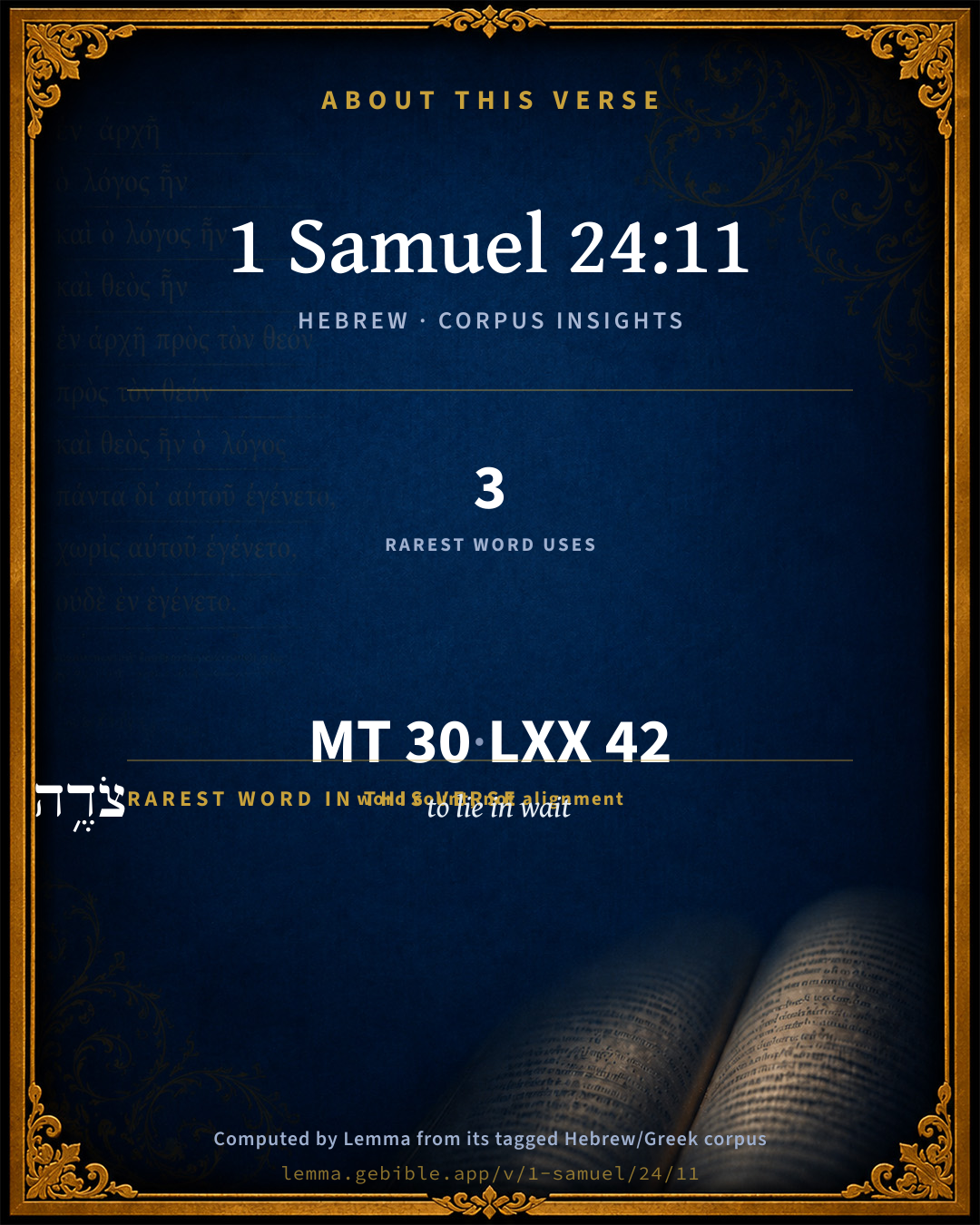
About this verse

These counts appear in no published source. They are computed here, from the morphology-tagged text and Lemma’s own curated glosses. What Lemma adds →

30
words
20
distinct lemmas
Historical
section

Notable vocabulary

The rarest word here is צֹדֶ֥ה to lie in wait H6658 — appearing just 3 times in the whole Hebrew Bible.

Shared distinctive vocabulary

צֹדֶ֥ה to lie in wait H6658 occurs in 3 verses of the Hebrew Bible. Also found in:

Grammatical profile

  • 9 verbs
  • 10 nouns
  • 1 pronoun
  • 1 preposition
  • 2 conjunctions
  • 7 particles

Verb forms

  • רְאֵ֔ה Qal · Imperative
  • רְאֵ֛ה Qal · Imperative
  • בְּכָרְתִי֩ Qal · Infinitive Construct
  • הֲרַגְתִּ֗יךָ Qal · Perfect
  • דַּ֤ע Qal · Imperative
  • וּרְאֵה֙ Qal · Imperative
  • חָטָ֣אתִי Qal · Perfect
  • צֹדֶ֥ה Qal · Participle Active
  • לְקַחְתָּֽהּ Qal · Infinitive Construct

Repetition

Words recur within this verse — often emphatic in Hebrew:

  • רְאֵ֔ה to see H7200 ×3
  • כְּנַ֥ף wing H3671 ×2
  • מְעִילְךָ֖ robe H4598 ×2
  • בְּיָדִ֑י hand H3027 ×2
  • כִּ֡י that H3588 ×2
  • וְלֹ֣א not H3808 ×2

Hebrew & Septuagint length

In English translation the verse runs 59 words from the Hebrew and 49 from the Septuagint (LXX English) — closely comparable.

A rough comparison of the two English renderings, which tokenize alike — not a word-level alignment.

Word counts can differ between the Hebrew and the Greek without any difference in meaning — e.g. the Hebrew direct-object marker אֵת has no separate Greek word, and Greek often adds the article ὁ.

In the original languages it is 30 Hebrew tokens and 42 Greek tokens — but the two are counted differently (Hebrew bundles its prefixes and suffixes into one token; the Greek is in lemma form), so that isn’t a like-for-like length.

Cross-references

15

Topical passages linked to 1 Samuel 24:11 in the Treasury of Scripture Knowledge — connected by theme and wording, ordered by reader-vote popularity; previews shown in the World English Bible.

  • 1 Samuel 26:20 Now therefore, don't let my blood fall to the earth away from the presence of Yahweh: for the king of Israel is come out to seek a flea, as when one does hunt a partridge in the mountains.
  • 1 Samuel 23:14 David abode in the wilderness in the strongholds, and remained in the hill-country in the wilderness of Ziph. Saul sought him every day, but God didn't deliver him into his hand.
  • 1 Samuel 23:23 See therefore, and take knowledge of all the lurking-places where he hides himself, and come you again to me of a certainty, and I will go with you: and it shall happen, if he be in the land, that I will search him out among all the thousands of Judah.
  • 1 Samuel 26:18 He said, Why does my lord pursue after his servant? for what have I done? or what evil is in my hand?
  • 2 Kings 5:13 His servants came near, and spoke to him, and said, My father, if the prophet had bid you do some great thing, wouldn't you have done it? how much rather then, when he says to you, Wash, and be clean?
  • John 15:25 But this happened so that the word may be fulfilled which was written in their law, 'They hated me without a cause.'
  • 1 Samuel 18:27 and David arose and went, he and his men, and killed of the Philistines two hundred men; and David brought their foreskins, and they gave them in full number to the king, that he might be the king's son-in-law. Saul gave him Michal his daughter as wife.
  • Job 10:16 If my head is held high, you hunt me like a lion. Again you show yourself powerful to me.
  • Psalms 7:3–4 Yahweh, my God, if I have done this, If there is iniquity in my hands,
  • Psalms 35:7 For without cause they have hidden their net in a pit for me. Without cause they have dug a pit for my soul.
  • Psalms 140:11 An evil speaker won't be established in the earth. Evil will hunt the violent man to overthrow him.
  • Proverbs 15:1 A gentle answer turns away wrath, But a harsh word stirs up anger.
  • Lamentations 4:18 They hunt our steps, so that we can't go in our streets: Our end is near, our days are fulfilled; for our end is come.
  • Ezekiel 13:18 and say, Thus says the Lord Yahweh: Woe to the women who sew pillows on all elbows, and make kerchiefs for the head of [persons of] every stature to hunt souls! Will you hunt the souls of my people, and save souls alive for yourselves?
  • Micah 7:2 The godly man has perished out of the earth, And there is no one upright among men. They all lie in wait for blood; Every man hunts his brother with a net.

Cross-references courtesy of OpenBible.info (CC BY 4.0).

Hebrew and Greek witnesses Masoretic Hebrew ↔ Greek Septuagint

The same verse in the two great witnesses to the Old Testament, shown verse-for-verse.

These are two independent witnesses, not word-aligned to each other, and the Septuagint is shown in lemma (dictionary) form.

Hebrew 1 Samuel 24:11 Masoretic · Westminster Leningrad Codex

וְאָבִ֣י רְאֵ֔ה גַּ֗ם רְאֵ֛ה אֶת כְּנַ֥ף מְעִילְךָ֖ בְּיָדִ֑י כִּ֡י בְּכָרְתִי֩ אֶת כְּנַ֨ף מְעִֽילְךָ֜ וְלֹ֣א הֲרַגְתִּ֗יךָ דַּ֤ע וּרְאֵה֙ כִּי֩ אֵ֨ין בְּיָדִ֜י רָעָ֤ה וָפֶ֨שַׁע֙ וְלֹא חָטָ֣אתִי לָ֔ךְ וְאַתָּ֛ה צֹדֶ֥ה אֶת נַפְשִׁ֖י לְקַחְתָּֽהּ

Moreover, my father, behold, yes, see the skirt of your robe in my hand; for in that I cut off the skirt of your robe, and didn't kill you, know you and see that there is neither evil nor disobedience in my hand, and I have not sinned against you, though you hunt after my life to take it.

World English Bible · Public Domain

Greek LXX 1 Samuel 24:11 Septuagint · lemma form

ἰδού ἐν ὁ ἡμέρα οὗτος ὁράω ὁ ὀφθαλμός σύ ὡς παραδίδωμι σύ κύριος σήμερον εἰς χείρ ἐγώ ἐν ὁ σπήλαιον καί οὐ ἀβουλέω ἀποκτείνω σύ καί φείδομαι σύ καί εἶπον οὐ ἐπιφέρω χείρ ἐγώ ἐπί κύριος ἐγώ ὅτι χριστός κύριος οὗτος εἰμί

Behold, your eyes have seen this day how that the Lord has delivered you this day into my hands in the cave; and I would not kill you, but spared you, and said, I will not lift up my hand against my lord, for he is the Lord's anointed.

LXX2012 (modern English Septuagint) · Public Domain

On this verse, Haydock's Catholic Bible Commentary discusses the Septuagint’s reading. Read the note in Commentary ↓

Hebrew: Westminster Leningrad Codex (CC BY 4.0). Greek: Septuagint (public domain); English from LXX2012 (modern English Septuagint) (Public Domain). How the Septuagint differs from the Hebrew →

Targum (Aramaic paraphrase)

1

The Targum is the ancient Jewish Aramaic paraphrase of the Hebrew Scriptures — an interpretive translation, not the Hebrew text itself. Onkelos (literal) and Pseudo-Jonathan (expansive) render the Torah, and Jonathan the Prophets. Coverage is partial: where no permissively-licensed English translation exists for a verse, only the Aramaic is shown. This is verse-level text, not a word-by-word alignment to the Hebrew.

  1. Targum Jonathan Prophets (Joshua–Malachi)
    הָא יוֹמָא דֵין חֲזָאָה עֵינָךְ יַת דְמַסְרָךְ יְיָ יוֹמָא דֵין בִּידִי בִּמְעַרְתָּא וַאֲמַרוּ אוֹחֲרָנִין לְמִקְטְלָךְ וְחָסִית עֲלָךְ וַאֲמַרִית לָא אוֹשִׁיט יְדִי בְּרִבּוֹנִי אֲרֵי מְשִׁיחָא דַייָ הוּא:

    (no public-domain English translation for this verse)

    Targum Jonathan — Aramaic: “Mikraot Gedolot” (public domain). English: “Sefaria Community Translation” (CC0 1.0 (public-domain dedication)); “London "Chaldee Paraphrase," 1871” (public domain). Text via Sefaria.

Commentary

Notes on 1 Samuel 24:11 from classic Christian and Jewish commentators (each source and its license shown beneath its notes). The classic Christian expositions comment on the surrounding passage and are grouped to its opening verse, so a note may address several verses; the Jewish commentaries on the Tanakh (Rashi and others) are per-verse, so they appear only where the commentator wrote on this verse.

Lemma curates 59 commentaries, every one of them public domain or Creative Commons licensed, each selected and text-cleaned for this edition rather than reprinted as found. About our sources →

Trapp's Complete Commentary

John Trapp

1Sa 24:11 Moreover, my father, see, yea, see the skirt of thy robe in my hand: for in that I cut off the skirt of thy robe, and killed thee not, know thou and see that [there is] neither evil nor transgression in mine hand, and I have not sinned against thee; yet thou huntest my soul to take it.

Ver. 11. And killed thee not.] Chrysostom saith that David, by his sparing of Saul, gave a deep wound to the devil, that old manslayer, qui non nisi caedes sitit, et suscitat. The Rabbins say that David went toward Saul with a purpose to have killed him, but that, as he went, he better bethought himself. See to the contrary of this, 1Sa 26:10, which the Vulgate hath here inserted.

That there is neither evil nor trangression in mine hand.] For that had been to have taken vengeance into his own hand, and to have raised trouble in the commonwealth. David was of his temper, - or rather of a far better, - who had escaped three tyrants, Caligula, Claudius, and Nero, - who had slain many good men, - and being asked how, answered, Iniurias accipiendo, et insuper gratias agendo, by bearing wrongs, and returning thanks for them.

John Trapp, A Commentary or Exposition upon All the Books of the Old and New Testament (1647–1656) — public domain. Text from a community e-Sword module.

The Biblical Illustrator

Joseph S. Exell

1Sa_24:11

I cut off the skirt of thy robe, and killed thee not.

David sparing Sauls life

We are taught:--

I. Thankfulness for preservation in sleep.

II. Attention to conscience in little things. When Saul slept in the cave at Engedi David spared his life, but not the skirt of his robe. That was cut off, to be visible token to the king of his exposure to Davids power. It was a little thing to do, and from one urged to a great and deadly. But his heart smote him. He had a conscience in little things. He must be stringent in obedience to it. Would that he always had been! Little things! So we speak. But these make the staple of life. This is the great need--for Christian men to reverence conscience in so-called little things, in all things. Home life remitter, purer, friendship firmer, business more honest and unselfish--these are evidences of Christianity which the enemy cannot gainsay or resist.

III. The cruelty of slander.

IV. The patience of faith. David believed God. The crown was Divinely assured him. He could wait Gods time for it.

V. The truth of repentance. Saul shed tears enough, and made vows enough. But it availed nothing. Quick to repent he was quick to fall into the old sin. Soon, in spite of solemn protestations, we find him again pursuing David. The truth of repentance is not to be read in tears. (G. T. Coster.)

The Biblical Illustrator, edited by Joseph S. Exell (c. 1880s–1900s) — public domain. Text from a community e-Sword module.

Tyndale Open Study Notes

Tyndale Open Resources

24:11 my father: Saul was, in fact, David’s father-in-law (18:27). David was demonstrating his respect for the king and recalling a day when their relationship had been much friendlier.

Tyndale Open Study Notes — © Tyndale Open Resources, licensed CC BY-SA 4.0. Text via the HelloAO Bible API.

Ellicott's Commentary for English Readers

(11) My father.—Not in the sense of “my father-in-law.” The Princess Michal before this time probably had been given to Phalti. The time when this wicked act was carried out by Saul is left quite indefinite in the notice of 1Sa_25:44; but the relations of David and Saul were evidently far more bitter before than after the En-gedi incident, hence the probability of Michal’s being given to Phalti before this meeting is great. The expression “my father” is simply the reverence (pietas) of the young to the old—of the loyal subject to the sovereign. It is so used in the beautiful lines of Browning already quoted.

See the skirt of thy robe.—Doubtless at this juncture holding up the piece of the royal m’il he had so carefully cut off when the king was sleeping in fancied security. “See this, how near thou wast to death had I been pleased to take thy life when I cut this off.”

A Bible Commentary for English Readers, edited by Charles John Ellicott (1878–1897) — public domain. Text from a community e-Sword module.

The Cambridge Bible for Schools and Colleges

gen. ed. J. J. S. Perowne

11. my father] The address of respect and affection. Cp. 2Ki_5:13; 2Ki_6:21.

evil] The same word as that rendered “thy hurt” in 1Sa_24:9.

my soul] i.e. my life.

The Cambridge Bible for Schools and Colleges (gen. ed. J. J. S. Perowne; Cambridge University Press, 1878–1918) — public domain. Text from a community e-Sword module.

John Gill's Exposition

Moreover, my father,.... So he was in a natural sense, as having married his daughter; and in a civil sense, as he was a king, and was, or ought to have been, the father of his country, and to treat his subjects as his children, and David among the rest:

see, yea see, the skirt of thy robe in my hand; look on it again and again; view it with the eyes of thy body intently, that thou mayest be satisfied of it, and behold with the eyes of thy mind and understanding, and consider that I could as easily have had thine head in my hand as the skirt of thy robe; and here see an instance and proof of the integrity and sincerity of my heart, and cordial affections to thee, and an evidence against all the charges and accusations of my enemies, and that I have no ill design upon thy person and life, and am far from seeking thy hurt, as they say:

for in that I cut off the skirt of thy robe, and killed thee not; not only did that to show that he was in his power, but did not cut off his head, as he could:

know thou, and see, that there is neither evil nor transgression in mine hand; this might be a full conviction to him that he had no ill, neither in his heart nor hand, to do unto him:

and I have not sinned against thee; done nothing to offend him, never acted against his will, nor disobeyed any of his commands, or had been guilty of one overt act of treason or rebellion, but all the reverse:

yet thou huntest my soul to take it; pursued him from place to place, hunted him in the wildernesses of Ziph and Maon, and upon the rocks of Engedi, as a partridge on the mountains, Sa1 26:20; and lay in wait for him to kill him, as the Targum: he may be thought to have penned the "seventh" psalm at this time, or on this occasion; at least there are some passages in it, which seem to refer to his present circumstances, Psa 7:1.

John Gill's Exposition of the Whole Bible (1746–1763) — public domain (CC PDM 1.0). Text via the HelloAO Bible API.

Albert Barnes' Notes on the Bible

My father - The respectful address of a junior and an inferior (see 2Ki 5:13, and compare 1Sa 24:16; 1Sa 25:8).

Albert Barnes' Notes on the Bible (1834–1885) — public domain. Text from a community e-Sword/MySword module.

Haydock's Catholic Bible Commentary

A thought to kill thee. That is, a suggestion, to which I did not consent. (Challoner) --- Hebrew, "and he spoke to kill thee, and he has pardoned thee; and he said, I will not," &c. (Calmet) --- Protestants, "and some bade me kill thee, but mine eye spared thee, and I said." Septuagint, "and I would not kill thee, and I spared thee, and said," &c. (Haydock)

George Leo Haydock (1774–1849), Haydock's Catholic Family Bible and Commentary, 1859 edition — public domain. Excludes Psalms (Douay-Rheims chapter numbering differs from Protestant) and Deuterocanonical books (Catholic canon only).

Matthew Poole's English Annotations

My father; so he calls him; partly, because he was his father-in-law; partly, in testimony of his respect and subjection to him as to a father; and partly, that by so amiable a compellation he might both insinuate himself into his favour, and mind him of that duty which as a father he owed to David.

There is neither evil nor transgression in mine hand; I neither design mischief against thee with my heart, nor will I execute it with my hand, which my false accusers told thee I would do, if thou didst at any time fall into my hand.

Matthew Poole's English Annotations on the Holy Bible (1683–1685) — public domain. Text from a community e-Sword/MySword module.

Whedon's Commentary on the Bible

Daniel D. Whedon

11. My father, see — A reverential form of addressing an esteemed superior, (2Ki_2:12; 2Ki_5:13,) but in this place it may mean more. Saul was David’s father in law, and by this address the son of Jesse shows the king a childlike respect and reverence. It was a word of love that touched the heart of Saul, and brought the response My son. 1Sa_24:16.

Daniel D. Whedon (gen. ed.), Commentary on the Old and New Testaments (1874–1909) — public domain. Text from a community e-Sword module.

The Pulpit Commentary

Vers. 11-13. My father. David thus salutes Saul not because he was actually his father-in-law, but as a title indicative of the respect due from an inferior to his superior. (2Ki_5:13) So David calls himself Nabal"s. (1Sa_25:8) In the rest of the verse he contrasts his refusal to slay Saul, when it might have seemed as if it were Providence that had put him into his power, with Saul"s determined pursuit of him. Thou huntest my soul to take it. Thou perpetually usest every artifice and stratagem against me for the confessed purpose of killing me, and pursuest me as eagerly as the hunter pursues his game. Hence David commits his cause to Jehovah, in the sure confidence that he will avenge him, and with the firm determination never himself to raise his hand against one who, though his enemy, was also the king. In proof of the impossibility of his ever seeking the king"s hurt, he quotes an ancient proverb, "From the wicked goeth out wickedness." Had David harboured evil intentions he would have executed them when so fair an opportunity offered, but as he has no such purposes "his hand will never be" upon Saul.

The Pulpit Commentary (1880–1919), ed. H.D.M. Spence-Jones & Joseph S. Exell — public domain. Text from a community e-Sword module.

Keil & Delitzsch

C. F. Keil & F. Delitzsch

To confirm what he said, he then showed him the lappet of his coat which he had cut off, and said, "My father, see." In these words there is an expression of the childlike reverence and affection which David cherished towards the anointed of the Lord. "For that I cut off the lappet and did not kill thee, learn and see (from this) that (there is) not evil in my hand (i.e., that I do not go about for the purpose of injury and crime), and that I have not sinned against thee, as thou nevertheless layest wait for my soul to destroy it."

Keil & Delitzsch — Biblical Commentary on the Old Testament (1861–1891) — public domain (CC PDM 1.0). Text via the HelloAO Bible API. (Old Testament only.)

Rashi

Rabbi Shlomo Yitzchaki (Rashi)

Someone said to kill you, but I had mercy on you. There are two words missing here, "and one who spoke [הָאוֹמֵר] said that I should kill you, but my soul [נַפְשִׁי] had pity on you, similar to "and King Dovid longed to go forth to Avshalom," [meaning,] and Dovid's soul [נֶפֶשׁ] longed.

Rashi on the Tanakh — English translations: “The Judaica Press complete Tanach with Rashi, translated by A. J. Rosenberg” (CC BY 4.0); “Pentateuch with Rashi's commentary by M. Rosenbaum and A.M. Silbermann, 1929-1934” (public domain); “The Metsudah Tanach series, Lakewood, N.J” (CC BY 4.0); and “The Book of Joshua, Metsudah Publications, 1997” (CC BY 4.0). Text via Sefaria.

Lesson kit

Teaching starters — assembled from the data on this page, not authored interpretation. Every prompt links to the verse data it draws on. Edit before teaching.

1 Samuel, in the Historical, opens this verse with 30 words (20 distinct Hebrew lemmas). Its most distinctive word is tsâdâh (“to lie in wait”). A historical commentator’s framing appears above. Read the whole chapter for the surrounding context.

Discussion questions

  1. How does “to lie in wait” (tsâdâh) shape what this verse is saying?
  2. Exodus 21:13 shares the word «to lie in wait» with this verse. How do the two illuminate each other?
  3. “to see” occurs 3× in this one verse. What is the effect of the repetition?
  4. The translations on this page render this verse differently — a whole-verse word diff, not a word-by-word alignment. What might account for the different wordings?
  5. The verb «רְאֵ֔ה» is Qal Imperative. How does its form color the action?
  6. Reading how Trapp's Complete Commentary and The Biblical Illustrator read this verse, where do the two commentators agree and where do they part?

Things to notice

Reading settings

Reading text

Shown beneath each verse's original-language words.

Old Testament
Old Testament edition

Read the OT as the Masoretic Hebrew (MT) or the Greek Septuagint (LXX).

English shown for the Greek Septuagint (in the Hebrew ↔ Greek comparison).

Comparing translations? Open the Compare panel on any verse page to stack up to four side by side.