
Joshua 9:6

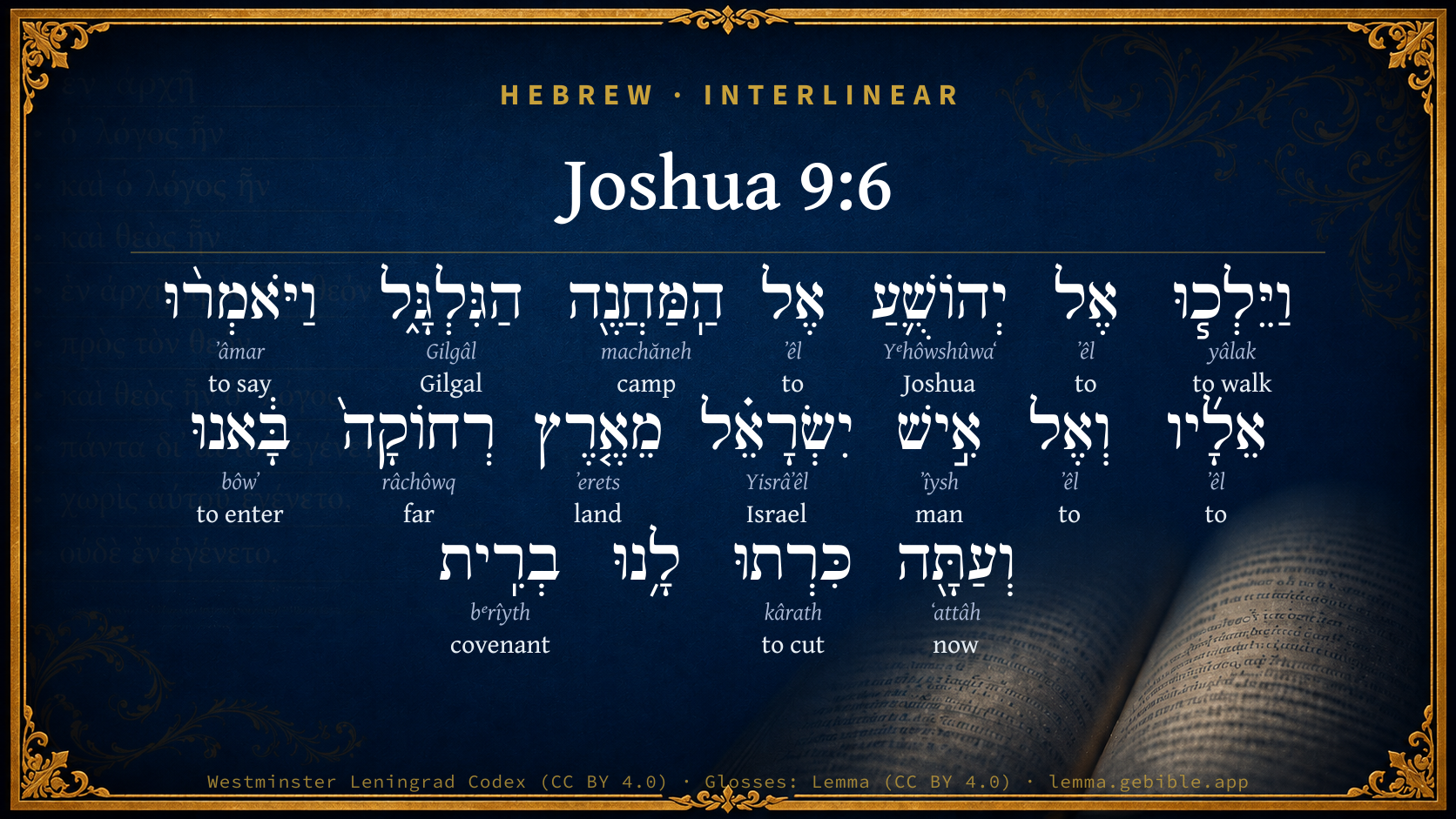
Hebrew (Westminster Leningrad Codex) Joshua 9:6 appears in the Hebrew Old Testament. The text above is from the Westminster Leningrad Codex. Each word links to its Strong’s number, a concise gloss, and parsing drawn from the Open Scriptures Hebrew Bible morphology. Click any word for its full Brown-Driver-Briggs (BDB) entry.
Download image
Cite this verse

Joshua 9:6 (World English Bible). Public Domain. Lemma interlinear Bible study tool, https://lemma.gebible.app/v/joshua/9/6.

Show BibTeX & RIS
BibTeX
RIS
English Translation
They went to Joshua to the camp at Gilgal, and said to him, and to the men of Israel, We are come from a far country: now therefore make you a covenant with us.
World English Bible · Public Domain
Download a study sheet

One document with this verse’s original text, its word-by-word gloss line, the meaning frame, cross-references with their text, attributed commentary, and full source and license credits — printable, and it pastes into notes with its structure intact.

This verse Autodidact and up

Study sheet (.html) Plain text (.txt)

A passage Seminary Student

Up to 50 verses in one chapter. A passage sheet keeps up to 6 commentary sources and 12 cross-references per verse, in the order this page ranks them, and says so on the sheet whenever that leaves anything out. Ask for a single verse and you get the Autodidact verse sheet above.

Everything on this page stays free to read, with no account — the sheet is a download of what is already on screen, not access to it.

Want to remove ads? Support Godless Engineer
Compare translations 3

The same verse in 3 English versions, stacked beneath the original-language interlinear above. Click any original word for its lexicon entry.

Each is an independent rendering of the whole verse — the interlinear is not word-aligned to these translations.

Highlighted words mark where these versions differ — a whole-verse word diff, not a word-by-word alignment.

  • World English Bible Public Domain
    They went to Joshua to the camp at Gilgal, and said to him, and to the men of Israel, We are come from a far country: now therefore make you a covenant with us.
  • King James Version Public Domain
    And they went to Joshua unto the camp at Gilgal, and said unto him, and to the men of Israel, We be come from a far country: now therefore make ye a league with us.
  • unfoldingWord Literal Text CC BY-SA 4.0
    And they went to Joshua in the camp at Gilgal and they said to him and to a man of Israel, “We have come from a distant land, and now, cut a covenant with us.”

unfoldingWord Literal Text — © unfoldingWord, licensed CC BY-SA 4.0. Word-aligned USFM3 via Door43 (git.door43.org/unfoldingWord/en_ult).

Versions to compare (up to 4)

3 of 4 selected

Show all 18 translations

Every available English version of this verse, each an independent rendering of the whole verse.

  • World English Bible Public Domain
    They went to Joshua to the camp at Gilgal, and said to him, and to the men of Israel, We are come from a far country: now therefore make you a covenant with us.
  • Berean Standard Bible Public Domain
    They went to Joshua in the camp at Gilgal and said to him and the men of Israel, “We have come from a distant land; please make a treaty with us.”
  • Majority Standard Bible Public Domain
    They went to Joshua in the camp at Gilgal and said to him and the men of Israel, “We have come from a distant land; please make a treaty with us.”
  • King James Version Public Domain
    And they went to Joshua unto the camp at Gilgal, and said unto him, and to the men of Israel, We be come from a far country: now therefore make ye a league with us.
  • American Standard Version (1901) Public Domain
    And they went to Joshua unto the camp at Gilgal, and said unto him, and to the men of Israel, We are come from a far country: now therefore make ye a covenant with us.
  • Revised Version (1885) Public Domain
    And they went to Joshua unto the camp at Gilgal, and said unto him, and to the men of Israel, We are come from a far country: now therefore make ye a covenant with us.
  • Geneva Bible (1599) Public Domain
    So they came vnto Ioshua into the hoste to Gilgal, and said vnto him, and vnto the men of Israel, Wee be come from a farre countrey: nowe therefore make a league with vs.
  • Douay-Rheims (1899) Public Domain
    And they went to Josue, who then abode in the camp at Galgal, and said to him, and to all Israel with him: We are come from a far country, desiring to make peace with you. And the children of Israel answered them, and said:
  • Young's Literal Translation Public Domain
    And they go unto Joshua, unto the camp at Gilgal, and say unto him, and unto the men of Israel, `From a land far off we have come, and now, make with us a covenant;'
  • Literal Standard Version CC BY-SA 4.0
    And they go to Joshua, to the camp at Gilgal, and say to him, and to the men of Israel, “We have come from a far-off land, and now, make a covenant with us”;
  • Unlocked Literal Bible CC BY-SA 4.0
    Then they went to Joshua in the camp at Gilgal and said to him and to the men of Israel, “We have traveled from a very far country, so now make a covenant with us.”
  • unfoldingWord Literal Text CC BY-SA 4.0
    And they went to Joshua in the camp at Gilgal and they said to him and to a man of Israel, “We have come from a distant land, and now, cut a covenant with us.”
  • Darby Bible Public Domain
    And they went to Joshua unto the camp at Gilgal, and said to him, and to the men of Israel, From a far country are we come; and now make a covenant with us.
  • World Messianic Bible Public Domain
    They went to Joshua at the camp at Gilgal, and said to him and to the men of Israel, “We have come from a far country. Now therefore make a covenant with us.”
  • Webster's Bible Public Domain
    And they went to Joshua to the camp at Gilgal, and said to him, and to the men of Israel, We have come from a far country: now therefore make ye a league with us.
  • Free Bible Version CC BY-SA 4.0
    They went to Joshua at the camp in Gilgal and told him and the men of Israel, “We have come from a land far away, so please make a treaty with us.”
  • Bible in Basic English Public Domain
    And they came to Joshua to the tent-circle at Gilgal, and said to him and to the men of Israel, We have come from a far country: so now make an agreement with us.
  • JPS Tanakh (1917) Public Domain
    And they went to Joshua unto the camp at Gilgal, and said unto him, and to the men of Israel: 'We are come from a far country; now therefore make ye a covenant with us.'

Literal Standard Version (2020), Covenant Press — licensed CC BY-SA 4.0. Text via the HelloAO Bible API (eBible.org). Unlocked Literal Bible (unfoldingWord) — licensed CC BY-SA 4.0. Text via the HelloAO Bible API (eBible.org). unfoldingWord Literal Text — © unfoldingWord, licensed CC BY-SA 4.0. Word-aligned USFM3 via Door43 (git.door43.org/unfoldingWord/en_ult). Free Bible Version, Dr. Jonathan Gallagher — licensed CC BY-SA 4.0. Text via the HelloAO Bible API (eBible.org).

Word by word

More ways to search: Search by grammar → Find every occurrence → Compare this word →

Practice this passage: Drill this verse → Learn its vocabulary →

הַגִּלְגָּ֑ל
Gilgâl
H1537
“the · Gilgal”
Particle, Definite Article + Noun, Proper
Part of Speech
Particle + Noun
Type
Proper
Full BDB Definition

Origin: the same as H1536

TWOT: None

Gilgal = "a wheel, rolling" - the first site of an Israelite camp west of the Jordan, east of Jericho, here Samuel was judge, and Saul was made king; later used for illicit worship - dwelling place of prophets in northern Israel about four miles - a region conquered by Joshua, site unsure
  1. וַיֵּלְכ֧וּ yâlak H3212 “and · to walk” Conjunction + Verb, Qal, Sequential Imperfect, 3rd Person, Masculine, Plural
  2. אֶל ʼêl H413 “to” Preposition
  3. יְהוֹשֻׁ֛עַ Yᵉhôwshûwaʻ H3091 “Joshua” Noun, Proper
  4. אֶל ʼêl H413 “to” Preposition
  5. הַֽמַּחֲנֶ֖ה machăneh H4264 “the · camp” Particle, Definite Article + Noun, Common, Both, Singular, Absolute
  6. וַיֹּאמְר֨וּ ʼâmar H559 “and · to say” Conjunction + Verb, Qal, Sequential Imperfect, 3rd Person, Masculine, Plural
  7. אֵלָ֜יו ʼêl H413 “to · him” Preposition + Suffix, Personal, 3rd Person, Masculine, Singular
  8. וְאֶל ʼêl H413 “and · to” Conjunction + Preposition
  9. אִ֣ישׁ ʼîysh H376 “man of” Noun, Common, Masculine, Singular, Construct
  10. יִשְׂרָאֵ֗ל Yisrâʼêl H3478 “Israel” Noun, Proper
  11. מֵאֶ֤רֶץ ʼerets H776 “from · land” Preposition + Noun, Common, Both, Singular, Absolute
  12. רְחוֹקָה֙ râchôwq H7350 “far” Adjective, Adjective, Feminine, Singular, Absolute
  13. בָּ֔אנוּ bôwʼ H935 “to enter” Verb, Qal, Perfect, 1st Person, Common, Plural
  14. וְעַתָּ֖ה ʻattâh H6258 “and · now” Conjunction + Adverb
  15. כִּרְתוּ kârath H3772 “cut” Verb, Qal, Imperative, 2nd Person, Masculine, Plural
  16. בְרִֽית bᵉrîyth H1285 “covenant” Noun, Common, Feminine, Singular, Absolute

About this verse

These counts appear in no published source. They are computed here, from the morphology-tagged text and Lemma’s own curated glosses. What Lemma adds →

18
words
14
distinct lemmas
Historical
section

Shared distinctive vocabulary

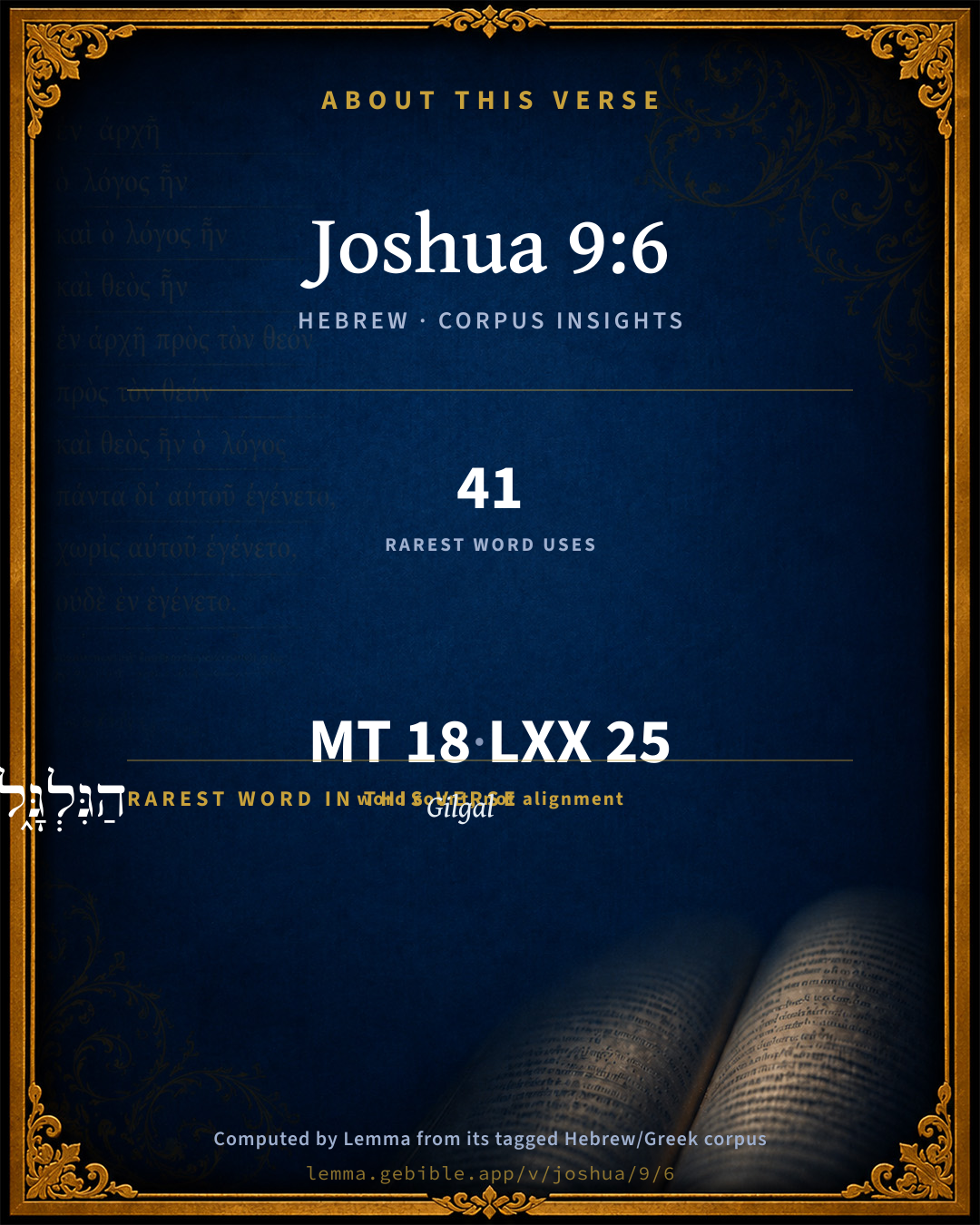
הַגִּלְגָּ֑ל Gilgal H1537 occurs in 39 verses of the Hebrew Bible. Also found in:

Grammatical profile

  • 4 verbs
  • 7 nouns
  • 1 adjective
  • 5 prepositions
  • 1 adverb

Verb forms

  • וַיֵּלְכ֧וּ Qal · Sequential Imperfect
  • וַיֹּאמְר֨וּ Qal · Sequential Imperfect
  • בָּ֔אנוּ Qal · Perfect
  • כִּרְתוּ Qal · Imperative

Repetition

A word recurs within this verse — often emphatic in Hebrew:

  • אֶל to H413 ×4

Hebrew & Septuagint length

In English translation the verse runs 34 words from the Hebrew and 32 from the Septuagint (LXX English) — closely comparable.

A rough comparison of the two English renderings, which tokenize alike — not a word-level alignment.

Word counts can differ between the Hebrew and the Greek without any difference in meaning — e.g. the Hebrew direct-object marker אֵת has no separate Greek word, and Greek often adds the article ὁ.

In the original languages it is 18 Hebrew tokens and 25 Greek tokens — but the two are counted differently (Hebrew bundles its prefixes and suffixes into one token; the Greek is in lemma form), so that isn’t a like-for-like length.

Cross-references

6

Topical passages linked to Joshua 9:6 in the Treasury of Scripture Knowledge — connected by theme and wording, ordered by reader-vote popularity; previews shown in the World English Bible.

  • Joshua 5:10 The children of Israel encamped in Gilgal; and they kept the Passover on the fourteenth day of the month at even in the plains of Jericho.
  • 2 Kings 20:14 Then came Isaiah the prophet to king Hezekiah, and said to him, What said these men? and from whence came they to you? Hezekiah said, They are come from a far country, even from Babylon.
  • Deuteronomy 20:11–15 It shall be, if it make you answer of peace, and open to you, then it shall be, that all the people who are found therein shall become tributary to you, and shall serve you.
  • Joshua 9:9 They said to him, From a very far country your servants are come because of the name of Yahweh your God: for we have heard the fame of him, and all that he did in Egypt,
  • Joshua 10:43 Joshua returned, and all Israel with him, to the camp to Gilgal.
  • 1 Kings 8:41 Moreover concerning the foreigner, who is not of your people Israel, when he shall come out of a far country for your name's sake

Cross-references courtesy of OpenBible.info (CC BY 4.0).

Hebrew and Greek witnesses Masoretic Hebrew ↔ Greek Septuagint

The same verse in the two great witnesses to the Old Testament, shown verse-for-verse.

These are two independent witnesses, not word-aligned to each other, and the Septuagint is shown in lemma (dictionary) form.

Hebrew Joshua 9:6 Masoretic · Westminster Leningrad Codex

וַיֵּלְכ֧וּ אֶל יְהוֹשֻׁ֛עַ אֶל הַֽמַּחֲנֶ֖ה הַגִּלְגָּ֑ל וַיֹּאמְר֨וּ אֵלָ֜יו וְאֶל אִ֣ישׁ יִשְׂרָאֵ֗ל מֵאֶ֤רֶץ רְחוֹקָה֙ בָּ֔אנוּ וְעַתָּ֖ה כִּרְתוּ לָ֥נוּ בְרִֽית

They went to Joshua to the camp at Gilgal, and said to him, and to the men of Israel, We are come from a far country: now therefore make you a covenant with us.

World English Bible · Public Domain

Greek LXX Joshua 9:6 Septuagint · lemma form

καί ἔρχομαι πρός ἰησοῦς εἰς ὁ παρεμβολή ἰσραήλ εἰς γάλγαλα καί εἶπον πρός ἰησοῦς καί ἰσραήλ ἐκ γῆ μακρόθεν ἥκω καί νῦν διατίθημι ἐγώ διαθήκη

And they came to Joshua into the camp of Israel to Galgala, and said to Joshua and Israel, We are come from a far land: now then make a covenant with us.

LXX2012 (modern English Septuagint) · Public Domain

Hebrew: Westminster Leningrad Codex (CC BY 4.0). Greek: Septuagint (public domain); English from LXX2012 (modern English Septuagint) (Public Domain). How the Septuagint differs from the Hebrew →

Targum (Aramaic paraphrase)

1

The Targum is the ancient Jewish Aramaic paraphrase of the Hebrew Scriptures — an interpretive translation, not the Hebrew text itself. Onkelos (literal) and Pseudo-Jonathan (expansive) render the Torah, and Jonathan the Prophets. Coverage is partial: where no permissively-licensed English translation exists for a verse, only the Aramaic is shown. This is verse-level text, not a word-by-word alignment to the Hebrew.

  1. Targum Jonathan Prophets (Joshua–Malachi)
    וַאֲזַלוּ לְוַת יְהוֹשֻׁעַ לְמַשְׁרִיתָא לְגִלְגְלָא וַאֲמַרוּ לֵיהּ וּלְאֱנַשׁ יִשְׂרָאֵל מֵאַרְעָא רְחִיקָא אָתֵינָא וּכְעַן גְזָרוּ לָנָא קְיָם:

    (no public-domain English translation for this verse)

    Targum Jonathan — Aramaic: “Mikraot Gedolot” (public domain). English: “Sefaria Community Translation” (CC0 1.0 (public-domain dedication)); “London "Chaldee Paraphrase," 1871” (public domain). Text via Sefaria.

Commentary

Notes on Joshua 9:6 from classic Christian and Jewish commentators (each source and its license shown beneath its notes). The classic Christian expositions comment on the surrounding passage and are grouped to its opening verse, so a note may address several verses; the Jewish commentaries on the Tanakh (Rashi and others) are per-verse, so they appear only where the commentator wrote on this verse.

Lemma curates 59 commentaries, every one of them public domain or Creative Commons licensed, each selected and text-cleaned for this edition rather than reprinted as found. About our sources →

The Cambridge Bible for Schools and Colleges

gen. ed. J. J. S. Perowne

6. unto the camp at Gilgal] Where was this Gilgal? (i) According to some it was the Gilgal, of which we have already heard (Jos_5:10), in the Jordan valley, whither Joshua had returned after his successful expedition against Ai, in order thence to undertake fresh enterprises, and where the women, children, and property were left under a sufficient guard, while he was absent with the host (ii) Others think it is impossible to suppose that Joshua marched back from Shechem to the banks of Jordan (Jos_9:6, Jos_10:6-7; Jos_10:9), and, again, that he did so a second time, after the battles in the north to make the final apportionment of the land among the people, and that the spot is that alluded to in Deu_11:30, as being situated “beside the oaks of Moreh,” i.e. near the site of Abraham’s first altar (Gen_12:6-7). If this is so, it would correspond with the modern Jilgiliah, a few miles from Bethel.

a far country] Far beyond the boundaries of Palestine.

The Cambridge Bible for Schools and Colleges (gen. ed. J. J. S. Perowne; Cambridge University Press, 1878–1918) — public domain. Text from a community e-Sword module.

Trapp's Complete Commentary

John Trapp

Jos 9:6 And they went to Joshua unto the camp at Gilgal, and said unto him, and to the men of Israel, We be come from a far country: now therefore make ye a league with us.

Ver. 6. We be come from a far country.] And therefore you may safely make a league with us. {Deu 20:11} Here was fair tale, but not a word of truth, Nusquam tuta fides.

“ Sit licit in partes circumspectissimus omnes,

Nemo tamen vulpes nemo cavere potest. ”

John Trapp, A Commentary or Exposition upon All the Books of the Old and New Testament (1647–1656) — public domain. Text from a community e-Sword module.

Joseph Benson's Commentary

Jos 9:6. Unto the camp to Gilgal — Joshua’s headquarters. And said to the men of Israel — To those that used to meet in council with Joshua, to whom it belonged to make leagues, namely, the princes of the congregation. Now therefore make a league with us — Because we are not of this people, whom, as we are informed, you are obliged utterly to destroy.

Joseph Benson's Commentary on the Old and New Testaments (1811–1818) — public domain. Text from a community e-Sword module.

Jamieson, Fausset & Brown

Robert Jamieson, A. R. Fausset & David Brown

they went to Joshua unto the camp at Gilgal--Arrived at the Israelitish headquarters, the strangers obtained an interview with Joshua and the elders, to whom they opened their business.

Jamieson, Fausset & Brown — Commentary Critical and Explanatory on the Whole Bible (1871) — public domain (CC PDM 1.0). Text via the HelloAO Bible API.

Adam Clarke's Commentary

Verse 6. Make ye a league with us.] כרתו לנו ברית kirethu lanu berith, cut, or divide, the covenant sacrifice with us. From this it appears that heathenism at this time had its sacrifices, and covenants were ratified by sacrificing to and invoking the objects of their adoration.

Adam Clarke's Commentary on the Bible (1810–1826) — public domain. Text from a community e-Sword/MySword module.

John Calvin's Commentaries

6. And they went to Joshua, etc. I have said that in strict law, a covenant of this description was null and void. For when they obtain their prayer, what is stipulated but just that they should be kept safe, provided they come from a distant and remote region of the globe? And the oftener they reiterate the same falsehood, the more do they annul a compact elicited by fraud, since its true meaning only amounts to this, that the Israelites will offer no molestation to a foreign people, living at a remote distance. This is shown to be more especially the meaning, from the fact, that the Israelites expressly exclude all the inhabitants of the land of Canaan. They could not, therefore, gain anything by the fraud. Nor are they more assisted by making a fallacious pretext of the name of God, and thus throwing a kind of mist over the mind of Joshua. They pretend that they had come in the name of God; as if they were professing to give glory to God, even the God of Israel; inasmuch as there is a tacit rejection of the superstitions to which they had been accustomed. For if it is true, that they had come, moved by the faith of the miracles which had been performed in Egypt, they concede supreme power to the God of Israel, though to them a God unknown.

John Calvin's Commentaries (1540-1563) — public domain. Text from the Calvin Translation Society English edition (1840s-50s) via the Christian Classics Ethereal Library (ccel.org). Calvin's coverage is partial (roughly two-thirds of the Bible); uncommented books and verses are honest gaps, never fabricated. The 19th-century editor's footnotes and remarks are omitted so the notes are faithfully Calvin's own voice.

John Gill's Exposition

And they went to Joshua, unto the camp at Gilgal,.... From whence it appears, that after Jericho and Ai were destroyed, the army of Israel returned to their encampment at Gilgal, Jos 5:10; and here they were when the Gibeonites applied to them:

and said unto him, and to the men of Israel; not to the whole body of the people, but either to the seventy elders, the great council, who were with Joshua, or the princes of the congregation, after mentioned, who are said to swear to them; and so some render the words, "to the chief men of Israel" (l); the word "Ish" here used sometimes denotes an eminent person or persons, see Isa 2:9,

we be come from a far country; this lie they told, that they might not be thought to be inhabitants of Canaan, and be destroyed as those of Jericho and Ai were; and as the rest of the inhabitants would be, of which they had intelligence, as the design of the Israelites, and what their orders were; according to Jerom (m), Gibeon was but four miles from Bethel, unless he means Gibeah; however, it could not be at a much greater distance; and as Gilgal was a mile and a quarter from Jericho, where the Gibeonites now were, and Ai but three miles from Jericho, and Bethel a mile from thence, and Gibeon four miles from Bethel, they were come but little more than nine miles. Bunting (n) makes it twelve miles from Gilgal to Gibeon:

now therefore make yea league with us; offensive and defensive, to help and assist each other against a common enemy.

(l) "primoribus viris Israelis", Junius & Tremellius; so Piscator. (m) De loc. Heb. fol. 92. A. (n) Travels, p. 96.

John Gill's Exposition of the Whole Bible (1746–1763) — public domain (CC PDM 1.0). Text via the HelloAO Bible API.

Albert Barnes' Notes on the Bible

Camp at Gilgal - While Joshua was engaged in more distant enterprises, the women, children, and property of the Israelites were left with a sufficient guard at this place, where they had been established immediately after crossing the Jordan Jos 5:9.

Albert Barnes' Notes on the Bible (1834–1885) — public domain. Text from a community e-Sword/MySword module.

Matthew Poole's English Annotations

Gilgal; the place of their head-quarters. To the men of Israel, to wit, those who used to meet in council with Joshua, to whom it belonged to make leagues, as it here follows, even the princes of the congregation; not the common people, as appears both from Jos 9:15,18,19,21, and from common usage of all ambassadors, who generally deliver their message to and treat with princes, not people. And the Hebrew word iseh, here used, sometimes notes men of eminency and dignity.

Now therefore, because we are not of this people, whom, as we are informed, you are obliged utterly to destroy; that which appeared sufficiently, by the Israelites’ practice in destroying the Amorites beyond Jordan, and the people of Jericho and At, without any allowance for sex or age; and by common rumour, and the report of the Israelites and other persons who dwelt among them, or had converse with them, as Rahab and all her kindred; and by the nature of the thing, because they were to possess that whole land, and were not to mix themselves with the people of it.

Matthew Poole's English Annotations on the Holy Bible (1683–1685) — public domain. Text from a community e-Sword/MySword module.

Whedon's Commentary on the Bible

Daniel D. Whedon

[6.

The camp at Gilgal — In the absence of any hint that this was altogether a different place from the Gilgal near Jericho, where Joshua first pitched his camp, it seems rather arbitrary and unnecessary, with Keil and Van de Velde, to maintain that this Gilgal must be identified with the modern Jiljilia, in the mountains of Ephraim. If, after the capture of Ai, or after the memorial service at Mount Ebal, Joshua had pitched his camp in a new spot, and especially at another place bearing the name Gilgal, it is inexplicably strange that no mention is anywhere made of a fact so noticeable and important. Further, the expressions in Jos_10:7; Jos_10:9 — Joshua ascended and went up from Gilgal — most naturally indicate the ascent from the Jordan valley to the interior of Palestine, (see note on Jos_8:10,) and show that the writer still had in mind the Gilgal near Jericho; for to understand the expressions in a military sense is hardly admissible. Keil’s only weighty argument is, that it would have been folly in Joshua, after having penetrated into the heart of the country, to go back again to the eastern border, and leave the Canaanites at liberty to move at pleasure through the conquered territory. But this whole argument rests on the assumption that Joshua would, of course, endeavour to keep the conquered Canaanites in subjection by the presence of his camp and army in the centre of the land, or else by establishing garrisons in the conquered districts — a thing which we have no evidence was ever done during the wars of the conquest. Keil’s argument is therefore altogether insufficient, and rests solely on a critic’s assumption of what Joshua ought to have done.]

From a far country — They had heard that all the Canaanites had been doomed to extermination. See Jos_9:24. To avoid such a fate they represented that they dwelt beyond the limits of Canaan. By this means they hoped to negotiate a treaty of peace, and even an alliance with the invincible invader. That such a treaty with nations beyond the limits of Canaan was lawful, see Deu_20:10-11.

Daniel D. Whedon (gen. ed.), Commentary on the Old and New Testaments (1874–1909) — public domain. Text from a community e-Sword module.

The Pulpit Commentary

To the camp at Gilgal. Many commentators, among whom we may number Vandevelde and the recent Palestine Exploration Expedition, suppose that the Gilgal mentioned here is another Gilgal, and certainly the supposition derives great force from the fact that there is a place the modern name of which is Jiljilia, situated near the oaks of Moreh, whose situation would be far more central, and would fall in better with the rest of the history, (see notes on Jos_8:30) than the original Gilgal. That such a second Gilgal is known to Jewish history would appear from Deu_11:30, where its situation is clearly pointed out as that of the modern Jiljilia, near the oaks of Moreh, and near the Arabah (champaign, Authorised Version), which runs in that direction. Jiljulieh, in the plain of Sharon, is supposed by Vandevelde and the Palestine explorers (see "Quarterly Statement," Jan., 1879) to be a third Gilgal, and Jerome, in his "Onomasticon," has identified it. (see note on Jos_12:23) The Gilgal in 1Sa_13:4-12 seems to require a central position like that of Jiljilia, rather than a place near the fords of Jordan. As Ewald reminds us, the earlier Gilgal lay out of the road from Jericho to Bethel. (see also 2Ki_2:1-6) The only argument against such a second Gilgal is the improbability of a removal of the camp without any mention of such removal by the historian (see Hengstenberg, "Geschichte des Reiches Gottes," p. 207), and the improbability of there having been a second Gilgal as the place of encampment of the Israelites. It is possible, however, that the second great place of encampment received the memorable name of the first, from the keen sense that the Israelitish encampment was the abode of a people from which the "reproach of Egypt" was forever rolled away. Another explanation is suggested by a comparison of Jos_15:7 with Jos_18:17 (see note on the former passage). The second Gilgal, if it really existed, was well suited for its purpose. "It was in the centre of the country, situated upon a steep hill, with a good table land at the top, and commanded a most extensive prospect of the large plain in the west, and also towards the north and east" (Keil) precisely the place which an able general would be likely to select. Though "in a high position" (Vandevelde), it was "lower than Gibeon," and was "an hour west of Sinjil on the Jerusalem Shechem road." Its situation enabled Joshua to strike a decisive blow without delay. (Jos_10:7, Jos_10:9) It is clear that this suggestion entirely obviates the difficulty of the concluding verses of ch. 8. And as the name implies a circular form as well as motion, and early camps were usually circular, it may have been the ordinary name for an encampment among the Hebrews.

The Pulpit Commentary (1880–1919), ed. H.D.M. Spence-Jones & Joseph S. Exell — public domain. Text from a community e-Sword module.

John Wesley's Explanatory Notes

The camp at Gilgal - The place of their head-quarters. Men of Israel - To those who used to meet in council with Joshua, to whom it belonged to make leagues, even the princes of the congregation. Now therefore - Because we are not of this people, whom, as we are informed, you are obliged utterly to destroy.

John Wesley, Explanatory Notes Upon the Whole Bible (1754–1765) — public domain. Text via the GEBible commentary corpus.

Keil & Delitzsch

C. F. Keil & F. Delitzsch

Having made these preparations, they went to the Israelitish camp at Gilgal (Jiljilia), introduced themselves to the men of Israel (אישׁ, in a collective sense, the plural being but little used, and only occurring in Pro 8:4; Isa 53:3, and Psa 141:4) as having come from a distant land, and asked them to make a league with them. But the Israelites hesitated, and said to the Hivites, i.e., the Gibeonites who were Hivites, that they might perhaps be living in the midst of them (the Israelites), i.e., in the land of Canaan, which the Israelites already looked upon as their own; and if so, how could they make a league with them? This hesitation on their part was founded upon the express command of God, that they were not to make any league with the tribes of Canaan (Exo 23:32; Exo 34:12; Num 33:55; Deu 7:2, etc.). In reply to this the Gibeonites simply said, "We are thy servants" (Jos 9:8), i.e., we are at thy service, which, according to the obsequious language common in the East, was nothing more than a phrase intended to secure the favour of Joshua, and by no means implied a readiness on their part to submit to the Israelites and pay them tribute, as Rosenmller, Knobel, and others suppose; for, as Grotius correctly observes, what they wished for was "a friendly alliance, by which both their territory and also full liberty would be secured to themselves." The Keri ויּאמר (Jos 9:7) is nothing more than a critical conjecture, occasioned not so much by the singular אישׁ, which is frequently construed in the historical writings as a collective noun with a plural verb, as by the singular suffix attached to בּקרבּי, which is to be explained on the ground that only one of the Israelites (viz., Joshua) was speaking as the mouthpiece of all the rest. The plural ויּאמרוּ is used, because Joshua spoke in the name of the people.

Keil & Delitzsch — Biblical Commentary on the Old Testament (1861–1891) — public domain (CC PDM 1.0). Text via the HelloAO Bible API. (Old Testament only.)

unfoldingWord translationNotes

Door43 World Missions Community

men of Israel

This refers to the entire nation of Israel. (See: Synecdoche)

the Hivites

This is another name for the Gibeonites. (See: How to Translate Names)

Perhaps you live near us. How can we make a covenant with you?

Joshua is emphasizing that the people of Israel have to follow the command of Yahweh above all else. AT: "If you do live near us, we cannot make a covenant with you." (See: Rhetorical Question)

translationWords

Joshua

Gilgal

Israel

covenant

Hivite

servant

unfoldingWord translationNotes — © Distant Shores Media and the Door43 World Missions Community, licensed CC BY-SA 4.0. Source: git.door43.org/Door43/en_tn.

Lesson kit

Teaching starters — assembled from the data on this page, not authored interpretation. Every prompt links to the verse data it draws on. Edit before teaching.

Joshua, in the Historical, opens this verse with 18 words (14 distinct Hebrew lemmas). Its most distinctive word is Gilgâl (“Gilgal”). A historical commentator’s framing appears above. Read the whole chapter for the surrounding context.

Discussion questions

  1. How does “Gilgal” (Gilgâl) shape what this verse is saying?
  2. How does Deuteronomy 11:30, which shares the word «Gilgal», read alongside this verse?
  3. What does the repetition of “to” (4× in this one verse) do in this verse?
  4. These translations render this verse differently. What is at stake in choosing one wording over another?
  5. «וַיֵּלְכ֧וּ» is a Qal Sequential Imperfect verb. How does that grammatical form shape the action described?
  6. Compare how The Cambridge Bible for Schools and Colleges and Trapp's Complete Commentary read this verse. Where do they agree or differ?

Things to notice

Reading settings

Reading text

Shown beneath each verse's original-language words.

Old Testament
Old Testament edition

Read the OT as the Masoretic Hebrew (MT) or the Greek Septuagint (LXX).

English shown for the Greek Septuagint (in the Hebrew ↔ Greek comparison).

Comparing translations? Open the Compare panel on any verse page to stack up to four side by side.