
Isaiah 56:5

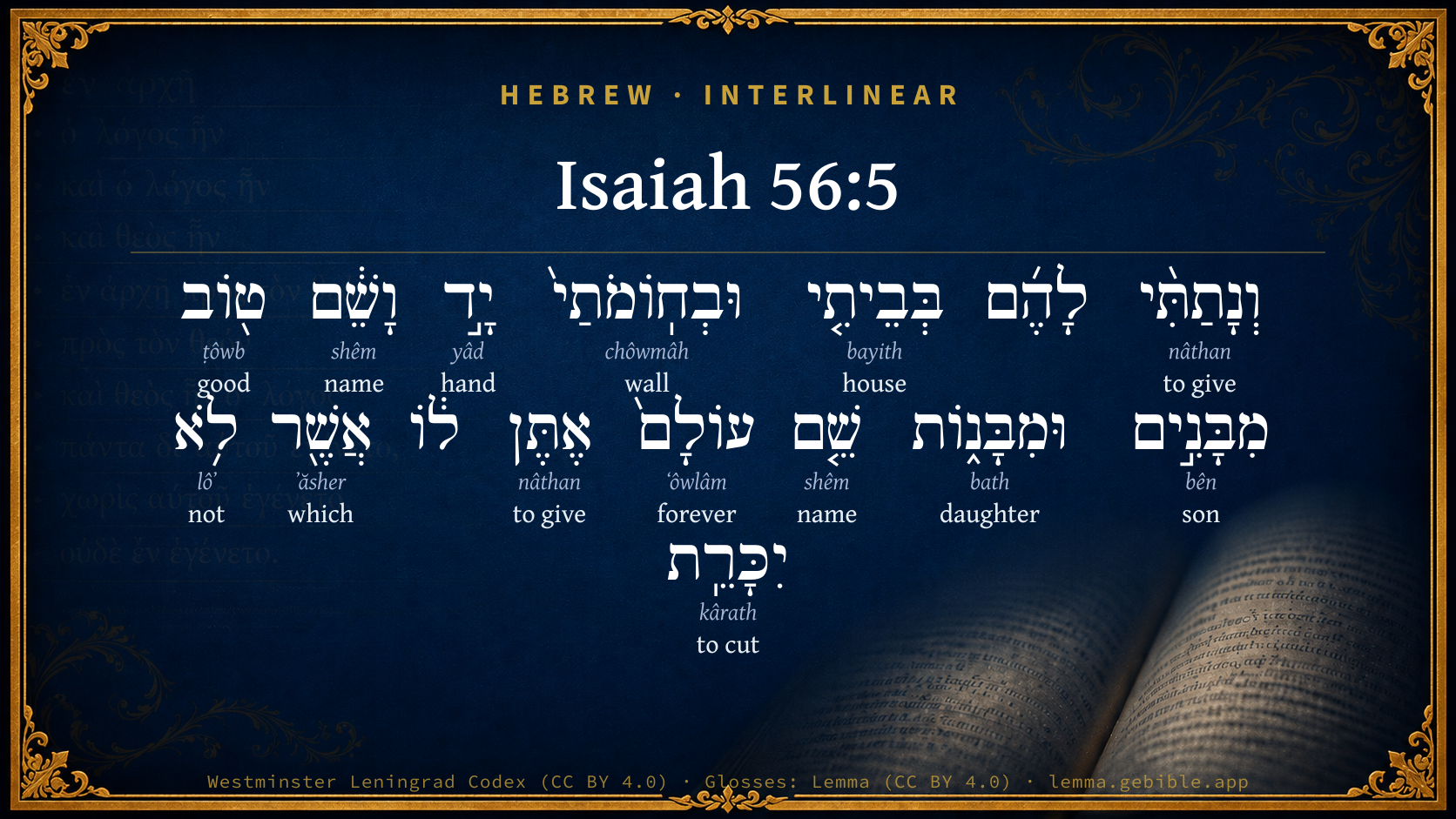
Hebrew (Westminster Leningrad Codex) Isaiah 56:5 appears in the Hebrew Old Testament. The text above is from the Westminster Leningrad Codex. Each word links to its Strong’s number, a concise gloss, and parsing drawn from the Open Scriptures Hebrew Bible morphology. Click any word for its full Brown-Driver-Briggs (BDB) entry.
Download image
Cite this verse

Isaiah 56:5 (World English Bible). Public Domain. Lemma interlinear Bible study tool, https://lemma.gebible.app/v/isaiah/56/5.

Show BibTeX & RIS
BibTeX
RIS
English Translation
To them will I give in my house and within my walls a memorial and a name better than of sons and of daughters; I will give them an everlasting name, that shall not be cut off.
World English Bible · Public Domain
Download a study sheet

One document with this verse’s original text, its word-by-word gloss line, the meaning frame, cross-references with their text, attributed commentary, and full source and license credits — printable, and it pastes into notes with its structure intact.

This verse Autodidact and up

Study sheet (.html) Plain text (.txt)

A passage Seminary Student

Up to 50 verses in one chapter. A passage sheet keeps up to 6 commentary sources and 12 cross-references per verse, in the order this page ranks them, and says so on the sheet whenever that leaves anything out. Ask for a single verse and you get the Autodidact verse sheet above.

Everything on this page stays free to read, with no account — the sheet is a download of what is already on screen, not access to it.

Want to remove ads? Support Godless Engineer
Compare translations 3

The same verse in 3 English versions, stacked beneath the original-language interlinear above. Click any original word for its lexicon entry.

Each is an independent rendering of the whole verse — the interlinear is not word-aligned to these translations.

Highlighted words mark where these versions differ — a whole-verse word diff, not a word-by-word alignment.

  • World English Bible Public Domain
    To them will I give in my house and within my walls a memorial and a name better than of sons and of daughters; I will give them an everlasting name, that shall not be cut off.
  • King James Version Public Domain
    Even unto them will I give in mine house and within my walls a place and a name better than of sons and of daughters: I will give them an everlasting name, that shall not be cut off.
  • unfoldingWord Literal Text CC BY-SA 4.0
    I will give to them in my house and within my walls a hand and a name better than sons and daughters; I will give to him a name of eternity that will not be cut off.

unfoldingWord Literal Text — © unfoldingWord, licensed CC BY-SA 4.0. Word-aligned USFM3 via Door43 (git.door43.org/unfoldingWord/en_ult).

Versions to compare (up to 4)

3 of 4 selected

Show all 18 translations

Every available English version of this verse, each an independent rendering of the whole verse.

  • World English Bible Public Domain
    To them will I give in my house and within my walls a memorial and a name better than of sons and of daughters; I will give them an everlasting name, that shall not be cut off.
  • Berean Standard Bible Public Domain
    I will give them, in My house and within My walls, a memorial and a name better than that of sons and daughters. I will give them an everlasting name that will not be cut off.
  • Majority Standard Bible Public Domain
    I will give them, in My house and within My walls, a memorial and a name better than that of sons and daughters. I will give them an everlasting name that will not be cut off.
  • King James Version Public Domain
    Even unto them will I give in mine house and within my walls a place and a name better than of sons and of daughters: I will give them an everlasting name, that shall not be cut off.
  • American Standard Version (1901) Public Domain
    Unto them will I give in my house and within my walls a memorial and a name better than of sons and of daughters; I will give them an everlasting name, that shall not be cut off.
  • Revised Version (1885) Public Domain
    Unto them will I give in mine house and within my walls a memorial and a name better than of sons and of daughters; I will give them an everlasting name, that shall not be cut off.
  • Geneva Bible (1599) Public Domain
    Euen vnto them wil I giue in mine House and within my walles, a place and a name better then of the sonnes and of the daughters: I will giue them an euerlasting name, that shall not be put out.
  • Douay-Rheims (1899) Public Domain
    I will give to them in my house, and within my walls, a place, and a name better than sons and daughters: I will give them an everlasting name which shall never perish.
  • Young's Literal Translation Public Domain
    I have given to them in My house, And within My walls a station and a name, Better than sons and than daughters, A name age-during I give to him That is not cut off.
  • Literal Standard Version CC BY-SA 4.0
    I have given to them in My house, || And within My walls a station and a name, || Better than sons and than daughters, || I give a continuous name to him || That is not cut off.
  • Unlocked Literal Bible CC BY-SA 4.0
    to them I will set up in my house and within my walls a monument that is better than having sons and of daughters. I will give them an everlasting monument that will never be cut off.
  • unfoldingWord Literal Text CC BY-SA 4.0
    I will give to them in my house and within my walls a hand and a name better than sons and daughters; I will give to him a name of eternity that will not be cut off.
  • Darby Bible Public Domain
    even unto them will I give in my house and within my walls a place and a name better than of sons and daughters; I will give them an everlasting name, that shall not be cut off.
  • World Messianic Bible Public Domain
    I will give them in my house and within my walls a memorial and a name better than of sons and of daughters. I will give them an everlasting name that will not be cut off.
  • Webster's Bible Public Domain
    Even to them will I give in my house and within my walls a place and a name better than of sons and of daughters: I will give them an everlasting name, that shall not be cut off.
  • Free Bible Version CC BY-SA 4.0
    I will give them, in my house and within my walls, a place to remember them and a reputation better than that of sons and daughters. I will give them an everlasting reputation that will never fade.
  • Bible in Basic English Public Domain
    I will give to them in my house, and inside my walls, a place and a name better than that of sons and daughters; I will give them an eternal name which will not be cut off.
  • JPS Tanakh (1917) Public Domain
    Even unto them will I give in My house and within My walls a monument and a memorial better than sons and daughters; I will give them an everlasting memorial, that shall not be cut off.

Literal Standard Version (2020), Covenant Press — licensed CC BY-SA 4.0. Text via the HelloAO Bible API (eBible.org). Unlocked Literal Bible (unfoldingWord) — licensed CC BY-SA 4.0. Text via the HelloAO Bible API (eBible.org). unfoldingWord Literal Text — © unfoldingWord, licensed CC BY-SA 4.0. Word-aligned USFM3 via Door43 (git.door43.org/unfoldingWord/en_ult). Free Bible Version, Dr. Jonathan Gallagher — licensed CC BY-SA 4.0. Text via the HelloAO Bible API (eBible.org).

Word by word

More ways to search: Search by grammar → Find every occurrence → Compare this word →

Practice this passage: Drill this verse → Learn its vocabulary →

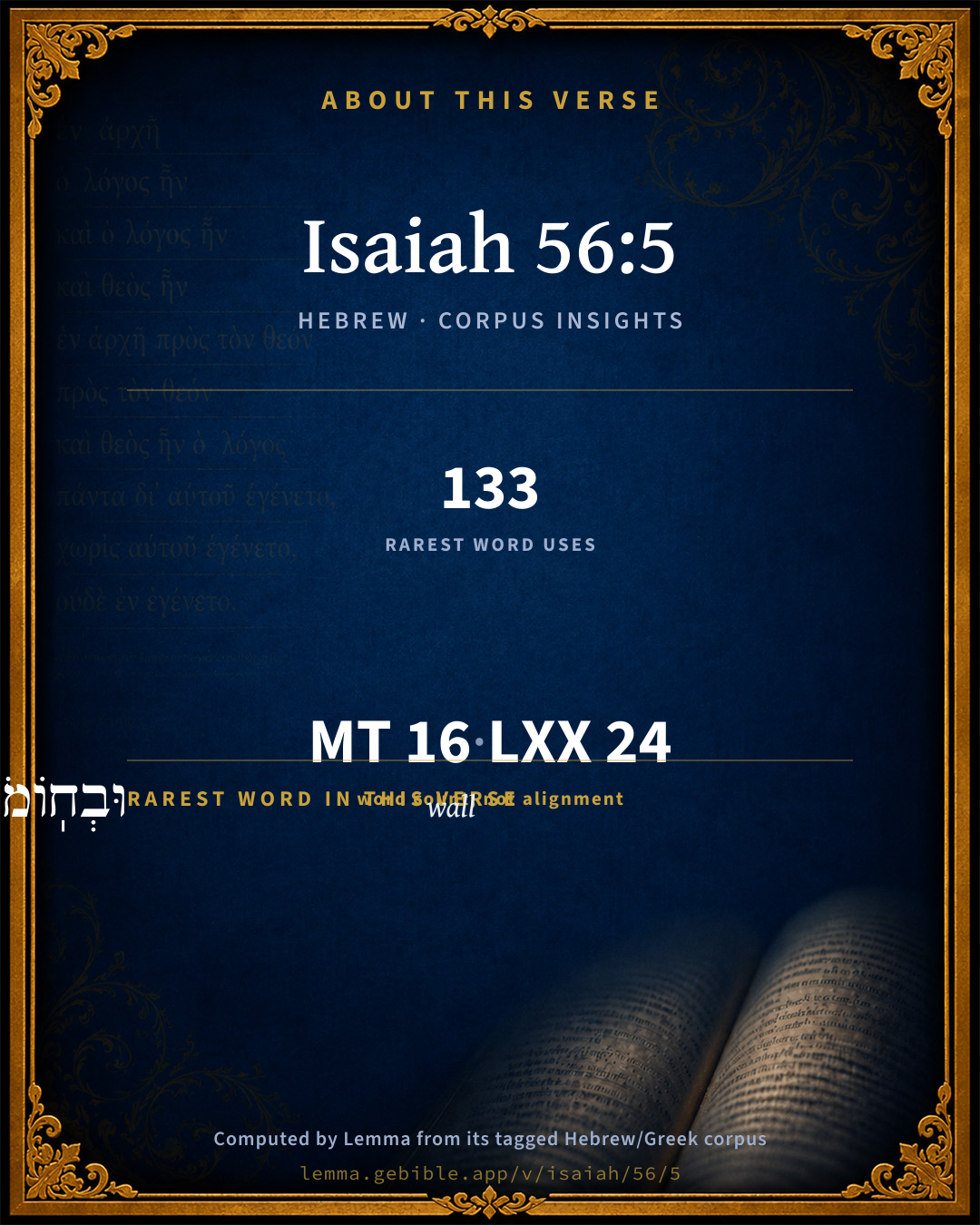
וּבְחֽוֹמֹתַי֙
chôwmâh
H2346
“and · in/at · walls · my”
Conjunction + Preposition + Noun, Common, Feminine, Plural, Construct + Suffix, Personal, 1st Person, Common, Singular
Part of Speech
Conjunction + Preposition + Noun
Type
Common
Gender
Feminine
Number
Plural
State
Construct
Full BDB Definition

Origin: act. participle of an unused root apparently meaning to join

TWOT: 674c

wall
  1. וְנָתַתִּ֨י nâthan H5414 “and · to give” Conjunction + Verb, Qal, Sequential Perfect, 1st Person, Common, Singular
  2. בְּבֵיתִ֤י bayith H1004 “in/at · house · my” Preposition + Noun, Common, Masculine, Singular, Construct + Suffix, Personal, 1st Person, Common, Singular
  3. יָ֣ד yâd H3027 “hand” Noun, Common, Both, Singular, Absolute
  4. וָשֵׁ֔ם shêm H8034 “and · name” Conjunction + Noun, Common, Masculine, Singular, Absolute
  5. ט֖וֹב ṭôwb H2896 “good” Adjective, Adjective, Masculine, Singular, Absolute
  6. מִבָּנִ֣ים bên H1121 “from · sons” Preposition + Noun, Common, Masculine, Plural, Absolute
  7. וּמִבָּנ֑וֹת bath H1323 “and · from · daughters” Conjunction + Preposition + Noun, Common, Feminine, Plural, Absolute
  8. שֵׁ֤ם shêm H8034 “name of” Noun, Common, Masculine, Singular, Construct
  9. עוֹלָם֙ ʻôwlâm H5769 “forever” Noun, Common, Masculine, Singular, Absolute
  10. אֶתֶּן nâthan H5414 “to give” Verb, Qal, Imperfect, 1st Person, Common, Singular
  11. אֲשֶׁ֖ר ʼăsher H834 “which” Particle, Relative
  12. לֹ֥א lôʼ H3808 “not” Particle, Negative
  13. יִכָּרֵֽת kârath H3772 “to cut” Verb, Niphal, Imperfect, 3rd Person, Masculine, Singular

About this verse

These counts appear in no published source. They are computed here, from the morphology-tagged text and Lemma’s own curated glosses. What Lemma adds →

16
words
12
distinct lemmas
Prophets
section

Grammatical profile

  • 3 verbs
  • 8 nouns
  • 1 adjective
  • 2 prepositions
  • 2 particles

Verb forms

  • וְנָתַתִּ֨י Qal · Sequential Perfect
  • אֶתֶּן Qal · Imperfect
  • יִכָּרֵֽת Niphal · Imperfect

Repetition

Words recur within this verse — often emphatic in Hebrew:

  • וְנָתַתִּ֨י to give H5414 ×2
  • וָשֵׁ֔ם name H8034 ×2

Hebrew & Septuagint length

In English translation the verse runs 37 words from the Hebrew and 32 from the Septuagint (LXX English) — closely comparable.

A rough comparison of the two English renderings, which tokenize alike — not a word-level alignment.

Word counts can differ between the Hebrew and the Greek without any difference in meaning — e.g. the Hebrew direct-object marker אֵת has no separate Greek word, and Greek often adds the article ὁ.

In the original languages it is 16 Hebrew tokens and 24 Greek tokens — but the two are counted differently (Hebrew bundles its prefixes and suffixes into one token; the Greek is in lemma form), so that isn’t a like-for-like length.

Cross-references

14

Topical passages linked to Isaiah 56:5 in the Treasury of Scripture Knowledge — connected by theme and wording, ordered by reader-vote popularity; previews shown in the World English Bible.

  • Revelation 3:12 He who overcomes, I will make him a pillar in the temple of my God, and he will go out from there no more. I will write on him the name of my God, and the name of the city of my God, the new Jerusalem, which comes down out of heaven from my God, and my own new name.
  • Revelation 3:5 He who overcomes will be arrayed in white garments, and I will in no way blot his name out of the book of life, and I will confess his name before my Father, and before his angels.
  • 1 John 3:1 Behold, how great a love the Father has bestowed on us, that we should be called children of God! For this cause the world doesn't know us, because it didn't know him.
  • Isaiah 55:13 Instead of the thorn shall come up the fir tree; and instead of the brier shall come up the myrtle tree: and it shall be to Yahweh for a name, for an everlasting sign that shall not be cut off.
  • John 1:12 But as many as received him, to them he gave the right to become God's children, to those who believe in his name:
  • 1 Timothy 3:15 but if I wait long, that you may know how men ought to behave themselves in the house of God, which is the assembly of the living God, the pillar and ground of the truth.
  • Isaiah 26:1 In that day shall this song be sung in the land of Judah: we have a strong city; salvation will he appoint for walls and bulwarks.
  • Isaiah 48:19 your seed also had been as the sand, and the offspring of your loins like the grains of it: his name would not be cut off nor destroyed from before me.
  • Isaiah 60:18 Violence shall no more be heard in your land, desolation nor destruction within your borders; but you shall call your walls Salvation, and your gates Praise.
  • Isaiah 62:12 They shall call them The holy people, The redeemed of Yahweh: and you shall be called Sought out, A city not forsaken.
  • Matthew 16:18 I also tell you that you are Peter, and on this rock I will build my assembly, and the gates of Hades will not prevail against it.
  • Ephesians 2:22 in whom you also are built together for a habitation of God in the Spirit.
  • Hebrews 3:6 but Christ is faithful as a Son over his house; whose house we are, if we hold fast our confidence and the glorying of our hope firm to the end.
  • 1 Samuel 1:8 Elkanah her husband said to her, Hannah, why weep you? and why don't you eat? and why is your heart grieved? am I not better to you than ten sons?

Cross-references courtesy of OpenBible.info (CC BY 4.0).

Hebrew and Greek witnesses Masoretic Hebrew ↔ Greek Septuagint

The same verse in the two great witnesses to the Old Testament, shown verse-for-verse.

These are two independent witnesses, not word-aligned to each other, and the Septuagint is shown in lemma (dictionary) form.

Hebrew Isaiah 56:5 Masoretic · Westminster Leningrad Codex

וְנָתַתִּ֨י לָהֶ֜ם בְּבֵיתִ֤י וּבְחֽוֹמֹתַי֙ יָ֣ד וָשֵׁ֔ם ט֖וֹב מִבָּנִ֣ים וּמִבָּנ֑וֹת שֵׁ֤ם עוֹלָם֙ אֶתֶּן ל֔וֹ אֲשֶׁ֖ר לֹ֥א יִכָּרֵֽת

To them will I give in my house and within my walls a memorial and a name better than of sons and of daughters; I will give them an everlasting name, that shall not be cut off.

World English Bible · Public Domain

Greek LXX Isaiah 56:5 Septuagint · lemma form

δίδωμι αὐτός ἐν ὁ οἶκος ἐγώ καί ἐν ὁ τεῖχος ἐγώ τόπος ὀνομαστός κρείσσων υἱός καί θυγάτηρ ὄνομα αἰώνιος δίδωμι αὐτός καί οὐ ἐκλείπω

I will give to them in my house and within my walls an honorable place, better than sons and daughters: I will give them an everlasting name, and it shall not fail.

LXX2012 (modern English Septuagint) · Public Domain

On this verse, Adam Clarke's Commentary discusses the Septuagint’s reading. Read the note in Commentary ↓

Hebrew: Westminster Leningrad Codex (CC BY 4.0). Greek: Septuagint (public domain); English from LXX2012 (modern English Septuagint) (Public Domain). How the Septuagint differs from the Hebrew →

Targum (Aramaic paraphrase)

1

The Targum is the ancient Jewish Aramaic paraphrase of the Hebrew Scriptures — an interpretive translation, not the Hebrew text itself. Onkelos (literal) and Pseudo-Jonathan (expansive) render the Torah, and Jonathan the Prophets. Coverage is partial: where no permissively-licensed English translation exists for a verse, only the Aramaic is shown. This is verse-level text, not a word-by-word alignment to the Hebrew.

  1. Targum Jonathan Prophets (Joshua–Malachi)
    וְאֶתֵּן לְהוֹן בְּבֵית מַקְדְשִׁי וּבַאֲרַע בֵּית שְׁכִנְתִּי אֲתַר וְשׁוּם דְטַב מִבְּנִין וּמִבְּנָן שׁוּם עֲלַם אֶתֵּן לְהוֹן דְלָא יִפְסוֹק:

    Even unto them will I give in the house of my sanctuary, and in the land of the house of my Shekinah a place, and a name that is better than that of sons and of daughters: I will give them an everlasting name that shall not be cut off.

    Targum Jonathan — Aramaic: “Mikraot Gedolot” (public domain). English: “Sefaria Community Translation” (CC0 1.0 (public-domain dedication)); “London "Chaldee Paraphrase," 1871” (public domain). Text via Sefaria.

Commentary

Notes on Isaiah 56:5 from classic Christian and Jewish commentators (each source and its license shown beneath its notes). The classic Christian expositions comment on the surrounding passage and are grouped to its opening verse, so a note may address several verses; the Jewish commentaries on the Tanakh (Rashi and others) are per-verse, so they appear only where the commentator wrote on this verse.

Lemma curates 59 commentaries, every one of them public domain or Creative Commons licensed, each selected and text-cleaned for this edition rather than reprinted as found. About our sources →

Trapp's Complete Commentary

John Trapp

Isa 56:5 Even unto them will I give in mine house and within my walls a place and a name better than of sons and of daughters: I will give them an everlasting name, that shall not be cut off.

Ver. 5. Even unto them will I give in mine house.] In the Church of the New Testament. {Eph 2:19-21}

A place.] Heb., A hand. A door keeper’s place in God’s house is worth having; {Psa 84:10} this was that one thing that he so dearly begged. {Psa 27:4}

And a name.] That new name, {Rev 2:17} that power or prerogative-royal - that heavenly honour, Nonnus there calleth it - viz., "to be the sons of God," {Joh 1:12} and so to be "called," {1Jn 3:1} to have both the comfort and the credit of it: this is nomen in mundo praestantissimum; none to this, {2Co 6:18} for "if sons, then heirs." {Rom 8:16-17}

John Trapp, A Commentary or Exposition upon All the Books of the Old and New Testament (1647–1656) — public domain. Text from a community e-Sword module.

The Biblical Illustrator

Joseph S. Exell

Isa_56:5

Even unto them will I give

God gives, but not indiscriminately

Again and again the Lord says will I give, and I will give.

He is always giving; He lives to give. God so loved the world that He gave; His hands are outstretched in continual dispensation of blessing. Observe here the usual condition upon which great honour are promised. This is not an indiscriminate rain of benediction, clouds emptying themselves without regard to character; it is not a confusion of man with man; but there is a principle of discrimination, election, selection, or choice,, running,, through the whole action. (J. Parker, D. D.)

A place and a name

A place

The noun offers several meanings suitable in this passage. It signifies a monument or memorial, as a lofty indicator or pointer Eze_21:24), as a finger-post pointing to the person for whom it has been erected (2Sa_18:18; 1Sa_15:12); in this sense, however, the word would declare more than the promise permits one to expect. The Semitic term also signifies a place (Num_2:17; Deu_23:12; Jer_6:3), and a share or portion (2Sa_19:43). (F. Delitzsch, D. D.)

Gods promise to pious eunuchs

There seems no reason to doubt that the promise is to be understood literally. An illustration of what is meant is found in 2Sa_18:18, where we read that Absalom, in the prospect of dying childless, erected the pillar to his own memory which was known as Absaloms hand (also 1Sa_15:12, R.V. marg.). The case of those here spoken of is precisely similar. They have no son to keep their name in remembrance, but their memory shall be perpetuated by a monument erected within the temple walls;, and such a memorial, testifying to the esteem of the whole community, is better (and more enduring) than sons and daughters. (Prof. J. Skinner, D. D.)

Better than sons and daughters

Better than sons and daughters may either mean better than the comfort immediately derived from children (as in Rth_4:15), or, better than the perpetuation of the name by hereditary succession. Most interpreters prefer the latter sense, but both may be included. A beautiful coincidence and partial fulfilment of the promise is pointed out by J. D. Michaelis, in the case of the Ethiopian eunuch, whose conversion is recorded in Act_8:7, and whose memory is far more honoured in the Church than it could have been by a long line of illustrious descendants. (B. A. Alexander.)

I will give them an everlasting name

Names

Our greatest poet asks, Whats in a name? but whoever reads his Bible carefully will see that the Jews attached very great importance to names. Thus we often find in the Bible that the name of a person is used when the person himself is meant, as for example, The name of the God of Jacob defend thee;--we will call upon the name of the Lord;--let their name be blotted out that they may be no more a nation. Jewish parents never gave their children a name for the sake of its sound, but because it expressed some peculiarity in the child, or some circumstance connected with its birth, or some wish for its future career. God Himself set this example when He named the first man Adam--red earth--to commemorate the fact that dust he was, and unto dust he should return.

The noblest name

1. Every Christian parent who now takes a child to the font of baptism should try and choose a name with some good meaning in it, and should endeavour to bring up the child to live a life worthy of its name, even as the parents of Timothy gave him a name which means one who fears God, and early taught him in the Holy Scriptures that he might learn what God would have him to do.

2. No matter what name our parents may have given us, all who are baptized have the very best of names. It is the name of Christ, the name of Christian.

(1) It is the oldest name, older than all the Howards or Sydneys of England, older than Saxon or Norman, or Jew, or Greek, or Roman. The name of Christ, which we bear, is from everlasting.

(2) It is the noblest name; most great families derive their name from some famous act of their founder, some great victory, or some wide estate; our name is better than all, for we are named after the greatest Conqueror, one who triumphed at the price of His own blood, one who conquered Death and Satan, and opened the kingdom of heaven to all believers. We are a royal family, for we bear the name of the King of kings, a better name than that of Caesar, or Pharaoh, or Tudor, or Stuart: all old families have a crest and a coat of arms, but our arms are the best, and they are the Cross.

(3) It is an everlasting name; some of the grandest old names in England have died out, many of the proudest family names are only to be seen on a tomb, but the name of our family will never be extinct, it becomes better known every year, and will be spread far and wide till the earth shall be filled with the knowledge of God, as the waters cover the sea. What, then, is required of us who bear such a name? The son of a good father would not willingly disgrace the name which has been made famous, so we must remember whose name we bear. (J. W. Buxton.)

The Biblical Illustrator, edited by Joseph S. Exell (c. 1880s–1900s) — public domain. Text from a community e-Sword module.

Tyndale Open Study Notes

Tyndale Open Resources

56:5 within the walls of my house: Those previously excluded would have a place in God’s presence. • a memorial and a name: Everlasting existence in God’s presence is better than the blessing of physical descendants.

Tyndale Open Study Notes — © Tyndale Open Resources, licensed CC BY-SA 4.0. Text via the HelloAO Bible API.

Geneva Bible (1599)

Geneva Bible translators

They shall be called after my people, and be of the same religion: yea, under Christ the dignity of the faithful shall be greater than the Jews were at that time.

Meaning, in his Church.

Geneva Bible (1599) marginal notes — public domain. Text via Bolls.life.

Jamieson, Fausset & Brown

Robert Jamieson, A. R. Fausset & David Brown

in mine house--the temple, the emblem of the Church (Ti1 3:15). They shall no longer be confined as proselytes were, to the outer court, but shall be admitted "into the holiest" (Heb 10:19-20).

a place--literally, "a hand."

than of sons--Though the eunuch is barren of children (Isa 56:3), I will give him a more lasting name than that of being father of sons and daughters (regarded as a high honor among the Hebrews) (Joh 1:12; Joh 10:3; Jo1 3:1; Rev 2:17; Rev 3:12).

Jamieson, Fausset & Brown — Commentary Critical and Explanatory on the Whole Bible (1871) — public domain (CC PDM 1.0). Text via the HelloAO Bible API.

Adam Clarke's Commentary

Verse 5. I will give them an everlasting name] For לו lo, him, in the singular, it is evident that we ought to read למו lamo, them, in the plural: so read the Septuagint, Syriac, Chaldee, and Vulgate.

Adam Clarke's Commentary on the Bible (1810–1826) — public domain. Text from a community e-Sword/MySword module.

Ellicott's Commentary for English Readers

(5) Even unto them will I give . . .—The words may refer simply to the spiritual blessedness of the faithful (Rev_2:17; Rev_3:5), but the customs of Eastern temples and of the later synagogues suggest that they may refer primarily to the memorial tablets which were put up in such places in commemoration of distinguished benefactors. For “place” read memorial. We note, of course, the special adaptation of the words “better than of sons and daughters” to the case which the prophet has in view; but it has to be remembered also that the whole promise substitutes the principle of catholicity for the rubrics of exclusiveness which we find in Deu_23:1.

A Bible Commentary for English Readers, edited by Charles John Ellicott (1878–1897) — public domain. Text from a community e-Sword module.

The Cambridge Bible for Schools and Colleges

gen. ed. J. J. S. Perowne

5. a place] a monument; lit., “a hand.” There seems no reason to doubt that the promise is to be understood literally. An illustration of what is meant is found in 2Sa_18:18, where we read that Absalom, in the prospect of dying childless, erected the pillar to his own memory which was known as “Absalom’s hand” (cf. also 1Sa_15:12, R.V. marg.). The case of those here spoken of is precisely similar. They have “no son to keep their name in remembrance,” but their memory shall be perpetuated by a monument erected within the Templewalls; and such a memorial, testifying to the esteem of the whole community, is better (and more enduring) than sons and daughters.

The Cambridge Bible for Schools and Colleges (gen. ed. J. J. S. Perowne; Cambridge University Press, 1878–1918) — public domain. Text from a community e-Sword module.

John Gill's Exposition

Even to them will I give in mine house and within my walls,.... The Targum is,

"in the house of my sanctuary, and in the land of the house of my Shechinah;''

meaning the temple at Jerusalem, in the land of Judea; but a Gospel church state is here meant, which is the house of God; the materials of which are true believers; the foundation Christ; the pillars and beams of it are the ministers of the word; the windows the ordinances, the door into it faith in Christ, and a profession of it; the provisions of it the word and ordinances; the stewards of it the preachers of the Gospel; where are saints of various sorts, fathers, young men, and children; where Christ is as a son over his own house, and acts as Prophet, Priest, and King, there. This is the Lord's house, it is of his building, where he dwells, which he keeps, repairs, beautifies, and adorns; here he promises to give the persons before described

a place and a name better than of sons and of daughters; a "place" of entrance and admission into his house, for continuance to dwell in; a place of honour, profit, and pleasure; a place of comfort, rest, ease, and quietness; a place of fulness at the table of the Lord; a fixed, abiding, settled place; or "a hand" (o), which may signify a part, portion, lot, or inheritance, Sa2 19:43 or a statue or pillar, Sa2 18:18, and a "name", not of office, for all in it are not officers; nor a mere name in a church book, which to have only is of no avail; nor the mere name of a professor, which men may have, and be dead; but a good name, as a church member: and such an one is he who keeps his place in the church; seeks to maintain peace and brotherly love in it; lays himself out for the welfare of it; is ready to contribute according to his ability for the support of it; and whose life and conversation is becoming the Gospel of Christ; moreover, by this name may be meant the name of the people of God, he being their covenant God; or of the priests of God, as all the saints are under the Gospel dispensation; or of Christians, as they are now called; or rather of the sons of God, which is the new name that is given them, and is a more excellent name

than of sons and daughters; that is, than to have sons and daughters, the want of which the eunuch complained of; or than to be the sons and daughters of the greatest potentate on earth:

I will give them an everlasting name, that shall never be cut off; such is their good name in the church, and is spoken well of in later ages, is had in everlasting remembrance, and will be confessed by Christ at the last day; and such is their name as the children of God, for, once sons, no more servants, the name and relation will always continue; and both this name and place are the gift of God; it is he that brings them to his house, and gives them a place there, and enables them to behave well in it, so as to have a good name; and it is he that gives them the name, privilege, power, and relation of children, which shall never be cut off by any act of their own, or his, or by men, or devils; such a name had the eunuch, converted and baptized by Philip, Act 8:27.

(o) "manum", Montanus, Cocceius. Ben Melech interprets it by "place"; and observes, that not at coporeal place is intended, but a place, of honour, excellency, dignity, and praise.

John Gill's Exposition of the Whole Bible (1746–1763) — public domain (CC PDM 1.0). Text via the HelloAO Bible API.

Albert Barnes' Notes on the Bible

Will I give in mine house - That is, they shalt be admitted to all the privileges of entering my house of prayer, and of being regarded as my true worshippers, and this shall be to them a more invaluable privilege than would be any earthly advantages. The word ‘house’ here refers undoubtedly to the temple, regarded as emblematic of the place of public worship in all ages.

And within my walls - The walls of the city where God dwelt, referring primarily to the walls of Jerusalem. They should be permitted to dwell with God, and be admitted to all the privileges of others. All, of all classes and conditions, under the reign of the Messiah, should be regarded as on a level, and entitled to equal advantages. There should be no religious disabilities arising from caste, age, country, color, or rank of life. Those who had any physical defect should not on that account be excluded from his favor, or be regarded as not entitled to his offers of mercy. The lame, therefore, the halt, the blind; the man of color, the african, the red man of the woods; the Hindu and the Islander; all are to be regarded as alike invited to participate in the favor of God, and none are to be excluded from the ‘house’ erected to his praise, and from within the ‘walls’ of the holy city where he dwells.

A place - Hebrew, יד yâd - ‘A hand.’ The word is, however, used to denote ‘a place’ Deu 23:13; Num 2:17; Jos 8:10. It is sometimes used in the sense of ‘monument,’ or ‘trophy’ 1Sa 15:12; 2Sa 18:18, as if a monument were a handpointing out or showing anything. The word here denotes, however, a place, and means that the excluded foreigner and the eunuch should be admitted to a place in the temple of God; that is, should be admitted to the favor of God, and be permitted to dwell with him.

And a name - As it was regarded among the Hebrews as one of the highest honors to have a numerous posterity, the idea here is, that they should be admitted to the highest possible honor - the honor of being regarded as the children of God, and treated as his friends.

And I will give them an everlasting name - Their memory shall not perish. They shall be admitted to eternal and unchangeable honors - the everlasting honor of being treated as the friends of God.

Albert Barnes' Notes on the Bible (1834–1885) — public domain. Text from a community e-Sword/MySword module.

Matthew Poole's English Annotations

In mine house; in my temple, to serve me there as priests, which eunuchs were not allowed to do, Lev 21:17, &c.; Deu 23:1.

Within my walls; in the courts of my temple, which were encompassed with walls. This seems to be added with respect to the people, who were admitted into the court, but not into the house itself.

A place and a name better than of sons and of daughters; a far greater blessing and honour than that of having posterity, which was but a temporal mercy, and that common to the worst of men; even my favour, and my Spirit, and eternal felicity.

Matthew Poole's English Annotations on the Holy Bible (1683–1685) — public domain. Text from a community e-Sword/MySword module.

The Pulpit Commentary

In mine house; i.e. "in my Church". (comp. 1Ti_3:15) Within my walls. Within the walls of my "holy city". (see above, Isa_54:11, 12 50:1-4 42:12) A place and a name; or, a memorial and a name; i.e. honourable mention, like that promised to the woman who anointed Christ for his burial. (Mat_26:13) Such mention is found in Mat_19:12 Act_8:27-39.

The Pulpit Commentary (1880–1919), ed. H.D.M. Spence-Jones & Joseph S. Exell — public domain. Text from a community e-Sword module.

John Wesley's Explanatory Notes

In mine house - In my temple. Better - A far greater blessing and honour than that of having posterity, even my favour, and my spirit, and eternal felicity.

John Wesley, Explanatory Notes Upon the Whole Bible (1754–1765) — public domain. Text via the GEBible commentary corpus.

J. A. Alexander on Isaiah

Joseph Addison Alexander

By “my walls” we are not to understand those of Jerusalem, nor, with the modern writers, those of the temple, but in a more ideal sense, the walls of God’s house or dwelling, which had just been mentioned. The promise is not merely one of free access to the material sanctuary, but of a home in the household or family of God, an image of perpetual occurrence in the Psalms of David. “Better than sons and daughters” may either mean better than the comfort immediately derived from children (as in Rth 4:15), or better than the perpetuation of the name by hereditary succession. Most interpreters prefer the latter sense, but both may be included. A beautiful coincidence and partial fulfillment of the promise has been pointed out in the case of the Ethiopian eunuch whose conversion is recorded in the eighth of Acts, and whose memory is far more honored in the church than it could have been by a long line of illustrious descendants.

Joseph Addison Alexander, The Prophecies of Isaiah (1846–1847; New York: Scribner, 1870–1878) — public domain. Text from a community e-Sword module.

Ibn Ezra

Rabbi Abraham ibn Ezra

יד A place. Comp. Deut. 23:13

Ibn Ezra on the Tanakh — English translations: “Sefaria Community Translation” (CC0 1.0 (public-domain dedication)); “Yalkut, Sifsei Chachomim Chumash, Metsudah Publications, 2009” (CC BY 4.0); and “Commentary of Ibn Ezra on Isaiah - trans. by M. Friedlander, 1873” (public domain). Text via Sefaria.

Lesson kit

Teaching starters — assembled from the data on this page, not authored interpretation. Every prompt links to the verse data it draws on. Edit before teaching.

Isaiah, in the Prophets, opens this verse with 16 words (12 distinct Hebrew lemmas). Its most distinctive word is chôwmâh (“wall”). A historical commentator’s framing appears above. Read the whole chapter for the surrounding context.

Discussion questions

  1. The word chôwmâh carries the sense “wall.” How does it shape the verse?
  2. How does Revelation 3:12, which shares this passage’s theme, read alongside this verse?
  3. What does the repetition of “to give” (2× in this one verse) do in this verse?
  4. These translations render this verse differently; the difference is in the English rendering, not the original. What questions does that raise?
  5. «וְנָתַתִּ֨י» is a Qal Sequential Perfect verb. How does that grammatical form shape the action described?
  6. Compare how Trapp's Complete Commentary and The Biblical Illustrator read this verse. Where do they agree or differ?

Things to notice

Reading settings

Reading text

Shown beneath each verse's original-language words.

Old Testament
Old Testament edition

Read the OT as the Masoretic Hebrew (MT) or the Greek Septuagint (LXX).

English shown for the Greek Septuagint (in the Hebrew ↔ Greek comparison).

Comparing translations? Open the Compare panel on any verse page to stack up to four side by side.