
Exodus 12:19

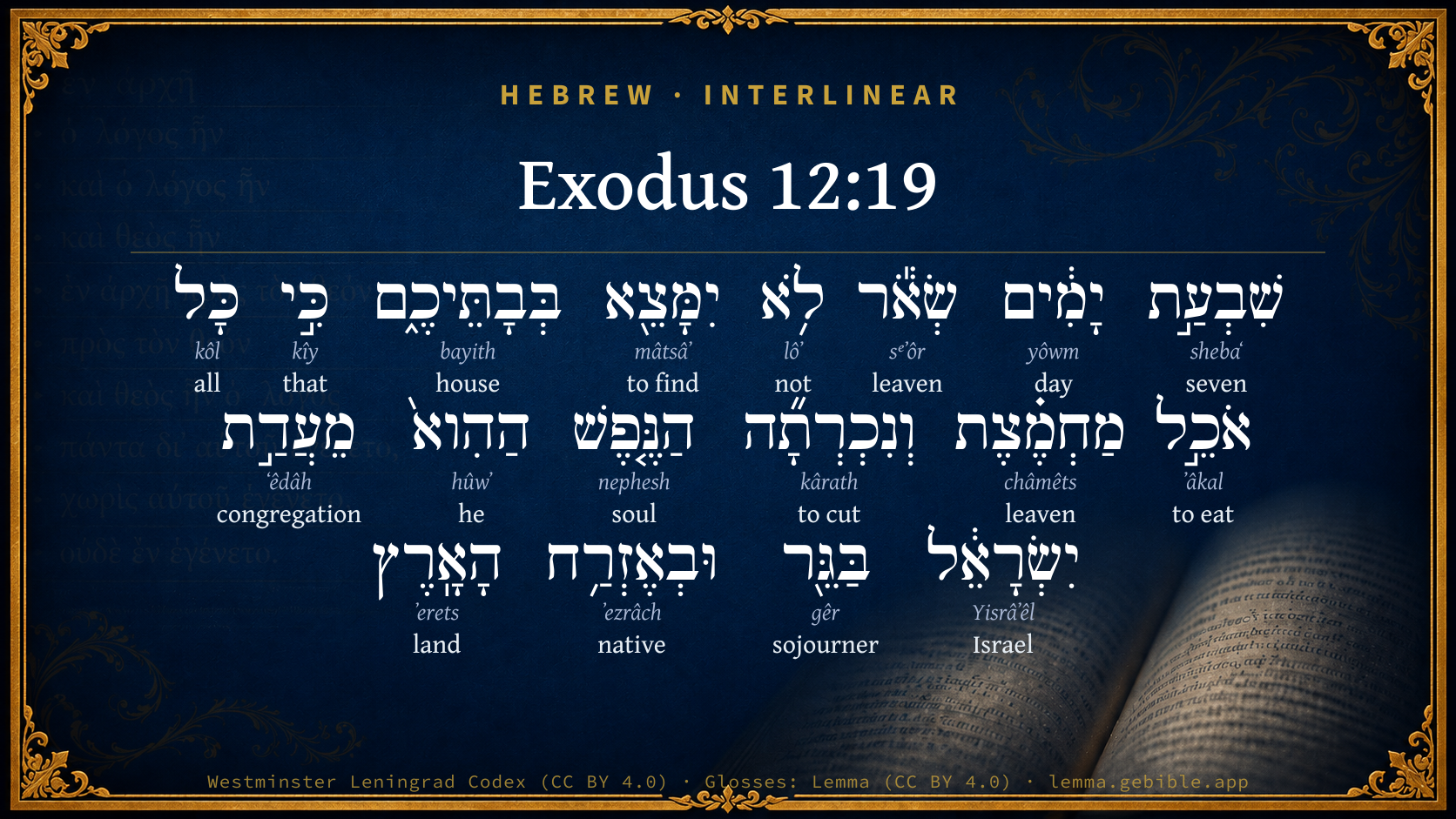
Hebrew (Westminster Leningrad Codex) Exodus 12:19 appears in the Hebrew Old Testament. The text above is from the Westminster Leningrad Codex. Each word links to its Strong’s number, a concise gloss, and parsing drawn from the Open Scriptures Hebrew Bible morphology. Click any word for its full Brown-Driver-Briggs (BDB) entry.
Download image
Cite this verse

Exodus 12:19 (World English Bible). Public Domain. Lemma interlinear Bible study tool, https://lemma.gebible.app/v/exodus/12/19.

Show BibTeX & RIS
BibTeX
RIS
English Translation
Seven days shall there be no yeast found in your houses, for whoever eats that which is leavened, that soul shall be cut off from the congregation of Israel, whether he be a foreigner, or one who is born in the land.
World English Bible · Public Domain
Highlights
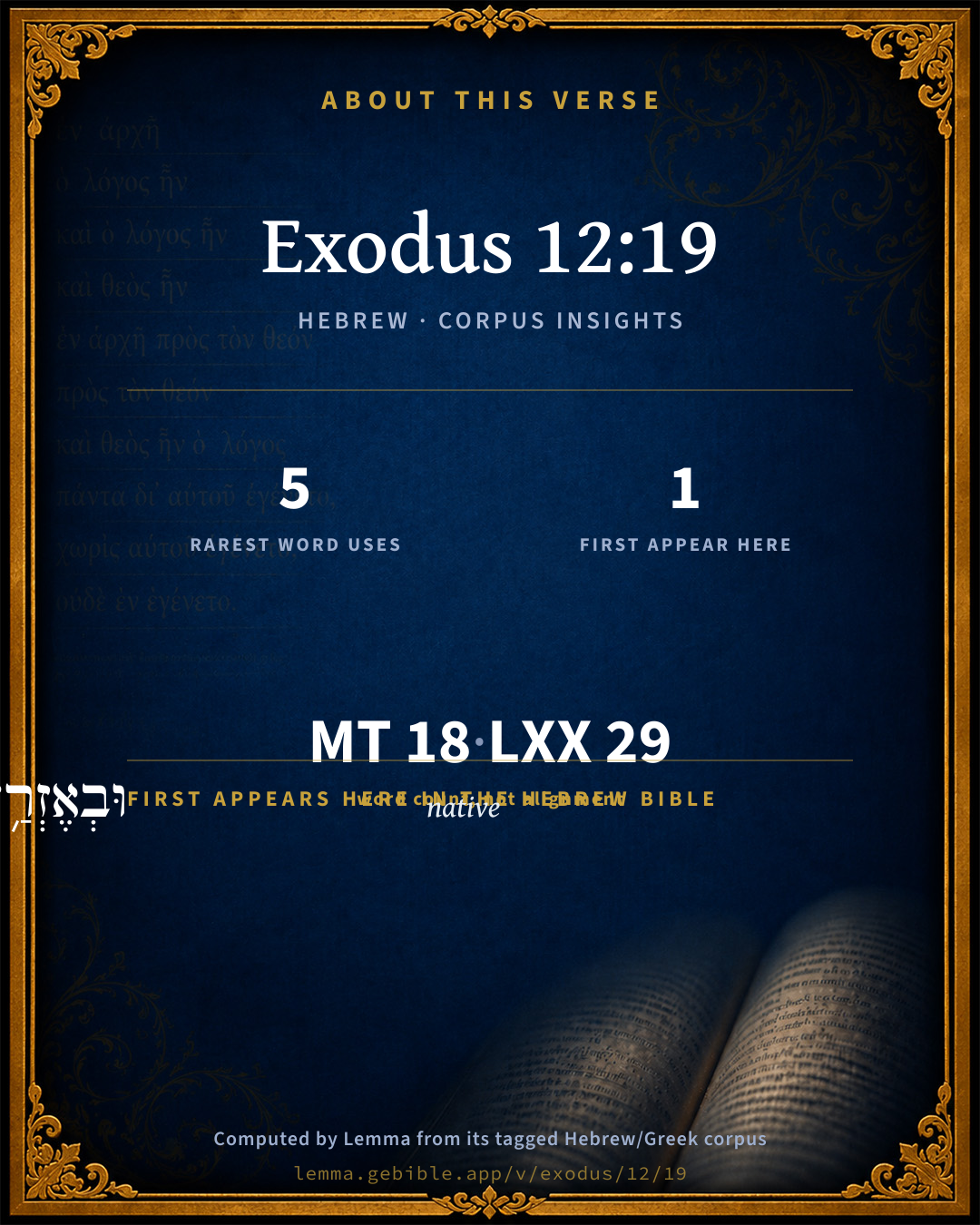
  • 1 first appearance in the Hebrew Bible
Full analysis ↓
Download a study sheet

One document with this verse’s original text, its word-by-word gloss line, the meaning frame, cross-references with their text, attributed commentary, and full source and license credits — printable, and it pastes into notes with its structure intact.

This verse Autodidact and up

Study sheet (.html) Plain text (.txt)

A passage Seminary Student

Up to 50 verses in one chapter. A passage sheet keeps up to 6 commentary sources and 12 cross-references per verse, in the order this page ranks them, and says so on the sheet whenever that leaves anything out. Ask for a single verse and you get the Autodidact verse sheet above.

Everything on this page stays free to read, with no account — the sheet is a download of what is already on screen, not access to it.

Want to remove ads? Support Godless Engineer
Compare translations 3

The same verse in 3 English versions, stacked beneath the original-language interlinear above. Click any original word for its lexicon entry.

Each is an independent rendering of the whole verse — the interlinear is not word-aligned to these translations.

Highlighted words mark where these versions differ — a whole-verse word diff, not a word-by-word alignment.

  • World English Bible Public Domain
    Seven days shall there be no yeast found in your houses, for whoever eats that which is leavened, that soul shall be cut off from the congregation of Israel, whether he be a foreigner, or one who is born in the land.
  • King James Version Public Domain
    Seven days shall there be no leaven found in your houses: for whosoever eateth that which is leavened, even that soul shall be cut off from the congregation of Israel, whether he be a stranger, or born in the land.
  • unfoldingWord Literal Text CC BY-SA 4.0
    For seven days no yeast shall be found in your houses. Because anyone who eats yeasted bread, that person shall be cut off from the congregation of Israel—among the sojourner or among the native of the land.

unfoldingWord Literal Text — © unfoldingWord, licensed CC BY-SA 4.0. Word-aligned USFM3 via Door43 (git.door43.org/unfoldingWord/en_ult).

Versions to compare (up to 4)

3 of 4 selected

Show all 18 translations

Every available English version of this verse, each an independent rendering of the whole verse.

  • World English Bible Public Domain
    Seven days shall there be no yeast found in your houses, for whoever eats that which is leavened, that soul shall be cut off from the congregation of Israel, whether he be a foreigner, or one who is born in the land.
  • Berean Standard Bible Public Domain
    For seven days there must be no leaven found in your houses. If anyone eats something leavened, that person, whether a foreigner or native of the land, must be cut off from the congregation of Israel.
  • Majority Standard Bible Public Domain
    For seven days there must be no leaven found in your houses. If anyone eats something leavened, that person, whether a foreigner or native of the land, must be cut off from the congregation of Israel.
  • King James Version Public Domain
    Seven days shall there be no leaven found in your houses: for whosoever eateth that which is leavened, even that soul shall be cut off from the congregation of Israel, whether he be a stranger, or born in the land.
  • American Standard Version (1901) Public Domain
    Seven days shall there be no leaven found in your houses: for whosoever eateth that which is leavened, that soul shall be cut off from the congregation of Israel, whether he be a sojourner, or one that is born in the land.
  • Revised Version (1885) Public Domain
    Seven days shall there be no leaven found in your houses: for whosoever eateth that which is leavened, that soul shall be cut off from the congregation of Israel, whether he be a sojourner, or one that is born in the land.
  • Geneva Bible (1599) Public Domain
    Seuen daies shall no leauen be founde in your houses: for whosoeuer eateth leauened bread, that person shalbe cut off from the Congregation of Israel: whether he bee a stranger, or borne in the land.
  • Douay-Rheims (1899) Public Domain
    Seven days there shall not be found any leaven in your houses: he that shall eat leavened bread, his soul shall perish out of the assembly of Israel, whether he be a stranger or born in the land.
  • Young's Literal Translation Public Domain
    seven days leaven is not found in your houses, for any `one' eating anything fermented -- that person hath been cut off from the company of Israel, among the sojourners or among the natives of the land;
  • Literal Standard Version CC BY-SA 4.0
    seven days leaven is not found in your houses, for anyone eating anything fermented—that person has been cut off from the congregation of Israel, among the sojourners or among the natives of the land;
  • Unlocked Literal Bible CC BY-SA 4.0
    During these seven days, no yeast must be found in your houses. Whoever eats bread made with yeast must be cut off from the community of Israel, whether that person is a foreigner or someone born in your land.
  • unfoldingWord Literal Text CC BY-SA 4.0
    For seven days no yeast shall be found in your houses. Because anyone who eats yeasted bread, that person shall be cut off from the congregation of Israel—among the sojourner or among the native of the land.
  • Darby Bible Public Domain
    Seven days shall there be no leaven found in your houses; for whoever eateth what is leavened -- that soul shall be cut off from the assembly of Israel, whether he be a sojourner, or born in the land.
  • World Messianic Bible Public Domain
    There shall be no yeast found in your houses for seven days, for whoever eats that which is leavened, that soul shall be cut off from the congregation of Israel, whether he is a foreigner, or one who is born in the land.
  • Webster's Bible Public Domain
    Seven days shall there be no leaven found in your houses: for whoever eateth that which is leavened, even that soul shall be cut off from the congregation of Israel, whether he shall be a stranger, or born in the land.
  • Free Bible Version CC BY-SA 4.0
    For seven days there must be no yeast in your houses. If anyone eats something with yeast in it, then they must be excluded from the Israelite community, whether they are a foreigner or a native of the land.
  • Bible in Basic English Public Domain
    For seven days no leaven is to be seen in your houses: for whoever takes bread which is leavened will be cut off from the people of Israel, if he is from another country or if he is an Israelite by birth.
  • JPS Tanakh (1917) Public Domain
    Seven days shall there be no leaven found in your houses; for whosoever eateth that which is leavened, that soul shall be cut off from the congregation of Israel, whether he be a sojourner, or one that is born in the land.

Literal Standard Version (2020), Covenant Press — licensed CC BY-SA 4.0. Text via the HelloAO Bible API (eBible.org). Unlocked Literal Bible (unfoldingWord) — licensed CC BY-SA 4.0. Text via the HelloAO Bible API (eBible.org). unfoldingWord Literal Text — © unfoldingWord, licensed CC BY-SA 4.0. Word-aligned USFM3 via Door43 (git.door43.org/unfoldingWord/en_ult). Free Bible Version, Dr. Jonathan Gallagher — licensed CC BY-SA 4.0. Text via the HelloAO Bible API (eBible.org).

Word by word

More ways to search: Search by grammar → Find every occurrence → Compare this word →

Practice this passage: Drill this verse → Learn its vocabulary →

שְׂאֹ֕ר
sᵉʼôr
H7603
“leaven”
Noun, Common, Masculine, Singular, Absolute
Part of Speech
Noun
Type
Common
Gender
Masculine
Number
Singular
State
Absolute
Full BDB Definition

Origin: from H7604

TWOT: 2229a

leaven
  1. שִׁבְעַ֣ת shebaʻ H7651 “seven” Adjective, Cardinal number, Masculine, Singular, Construct
  2. יָמִ֔ים yôwm H3117 “days” Noun, Common, Masculine, Plural, Absolute
  3. לֹ֥א lôʼ H3808 “not” Particle, Negative
  4. יִמָּצֵ֖א mâtsâʼ H4672 “to find” Verb, Niphal, Imperfect, 3rd Person, Masculine, Singular
  5. בְּבָתֵּיכֶ֑ם bayith H1004 “in/at · houses · your” Preposition + Noun, Common, Masculine, Plural, Construct + Suffix, Personal, 2nd Person, Masculine, Plural
  6. כִּ֣י kîy H3588 “that” Conjunction
  7. כָּל kôl H3605 “all of” Noun, Common, Masculine, Singular, Construct
  8. אֹכֵ֣ל ʼâkal H398 “eating” Verb, Qal, Participle Active, Masculine, Singular, Absolute
  9. מַחְמֶ֗צֶת châmêts H2557 “leaven” Verb, Hiphil, Participle Active, Feminine, Singular, Absolute
  10. וְנִכְרְתָ֞ה kârath H3772 “and · to cut” Conjunction + Verb, Niphal, Sequential Perfect, 3rd Person, Feminine, Singular
  11. הַנֶּ֤פֶשׁ nephesh H5315 “the · soul” Particle, Definite Article + Noun, Common, Both, Singular, Absolute
  12. הַהִוא֙ hûwʼ H1931 “the · he” Particle, Definite Article + Pronoun, Personal, 3rd Person, Feminine, Singular
  13. מֵעֲדַ֣ת ʻêdâh H5712 “from · congregation of” Preposition + Noun, Common, Feminine, Singular, Construct
  14. יִשְׂרָאֵ֔ל Yisrâʼêl H3478 “Israel” Noun, Proper
  15. בַּגֵּ֖ר gêr H1616 “in/at the · sojourner” Preposition, Determined + Noun, Common, Masculine, Singular, Absolute
  16. וּבְאֶזְרַ֥ח ʼezrâch H249 “and · in/at · native of” Conjunction + Preposition + Noun, Common, Masculine, Singular, Construct
  17. הָאָֽרֶץ ʼerets H776 “the · land” Particle, Definite Article + Noun, Common, Both, Singular, Absolute

About this verse

These counts appear in no published source. They are computed here, from the morphology-tagged text and Lemma’s own curated glosses. What Lemma adds →

18
words
18
distinct lemmas
Pentateuch
section

Notable vocabulary

The rarest word here is שְׂאֹ֕ר leaven H7603 — appearing just 5 times in the whole Hebrew Bible.

First appearance in Scripture

This word makes its first canonical appearance in the Hebrew Bible here:

  • וּבְאֶזְרַ֥ח native H249

Shared distinctive vocabulary

שְׂאֹ֕ר leaven H7603 occurs in 5 verses of the Hebrew Bible. Also found in:

Grammatical profile

  • 4 verbs
  • 10 nouns
  • 1 adjective
  • 1 pronoun
  • 1 conjunction
  • 1 particle

Verb forms

  • יִמָּצֵ֖א Niphal · Imperfect
  • אֹכֵ֣ל Qal · Participle Active
  • מַחְמֶ֗צֶת Hiphil · Participle Active
  • וְנִכְרְתָ֞ה Niphal · Sequential Perfect

Hebrew & Septuagint length

In English translation the verse runs 42 words from the Hebrew and 37 from the Septuagint (LXX English) — closely comparable.

A rough comparison of the two English renderings, which tokenize alike — not a word-level alignment.

Word counts can differ between the Hebrew and the Greek without any difference in meaning — e.g. the Hebrew direct-object marker אֵת has no separate Greek word, and Greek often adds the article ὁ.

In the original languages it is 18 Hebrew tokens and 29 Greek tokens — but the two are counted differently (Hebrew bundles its prefixes and suffixes into one token; the Greek is in lemma form), so that isn’t a like-for-like length.

Cross-references

8

Topical passages linked to Exodus 12:19 in the Treasury of Scripture Knowledge — connected by theme and wording, ordered by reader-vote popularity; previews shown in the World English Bible.

  • Exodus 12:15 Seven days shall you eat unleavened bread; even the first day you shall put away yeast out of your houses, for whoever eats leavened bread from the first day until the seventh day, that soul shall be cut off from Israel.
  • Exodus 23:15 You shall observe the feast of unleavened bread. Seven days you shall eat unleavened bread, as I commanded you, at the time appointed in the month Abib (for in it you came out from Egypt), and no one shall appear before me empty.
  • Deuteronomy 16:3 You shall eat no leavened bread with it; seven days shall you eat unleavened bread therewith, even the bread of affliction; for you came forth out of the land of Egypt in haste: that you may remember the day when you came forth out of the land of Egypt all the days of your life.
  • Exodus 12:48 When a stranger shall live as a foreigner with you, and will keep the Passover to Yahweh, let all his males be circumcised, and then let him come near and keep it; and he shall be as one who is born in the land: but no uncircumcised person shall eat of it.
  • Exodus 34:18 "You shall keep the feast of unleavened bread. Seven days you shall eat unleavened bread, as I commanded you, at the time appointed in the month Abib; for in the month Abib you came out from Egypt.
  • Numbers 9:13 But the man who is clean, and is not on a journey, and fails to keep the Passover, that soul shall be cut off from his people. Because he didn't offer the offering of Yahweh in its appointed season, that man shall bear his sin.
  • Exodus 12:43 Yahweh said to Moses and Aaron, "This is the ordinance of the Passover. There shall no foreigner eat of it,
  • 1 Corinthians 5:7–8 Purge out the old yeast, that you may be a new lump, even as you are unleavened. For indeed Christ, our Passover, has been sacrificed in our place.

Cross-references courtesy of OpenBible.info (CC BY 4.0).

Hebrew and Greek witnesses Masoretic Hebrew ↔ Greek Septuagint

The same verse in the two great witnesses to the Old Testament, shown verse-for-verse.

These are two independent witnesses, not word-aligned to each other, and the Septuagint is shown in lemma (dictionary) form.

Hebrew Exodus 12:19 Masoretic · Westminster Leningrad Codex

שִׁבְעַ֣ת יָמִ֔ים שְׂאֹ֕ר לֹ֥א יִמָּצֵ֖א בְּבָתֵּיכֶ֑ם כִּ֣י כָּל אֹכֵ֣ל מַחְמֶ֗צֶת וְנִכְרְתָ֞ה הַנֶּ֤פֶשׁ הַהִוא֙ מֵעֲדַ֣ת יִשְׂרָאֵ֔ל בַּגֵּ֖ר וּבְאֶזְרַ֥ח הָאָֽרֶץ

Seven days shall there be no yeast found in your houses, for whoever eats that which is leavened, that soul shall be cut off from the congregation of Israel, whether he be a foreigner, or one who is born in the land.

World English Bible · Public Domain

Greek LXX Exodus 12:19 Septuagint · lemma form

ἑπτά ἡμέρα ζύμη οὐ εὑρίσκω ἐν ὁ οἰκία σύ πᾶς ὅς ἄν ἐσθίω ζυμωτός ἐκὀλεθρεύω ὁ ψυχή ἐκεῖνος ἐκ συναγωγή ἰσραήλ ἐν τε ὁ γειώρας καί αὐτόχθων ὁ γῆ

Seven days leaven shall not be found in your houses; whoever shall eat anything leavened, that soul shall be cut off from the congregation of Israel, both among the occupiers of the land and the original inhabitants.

LXX2012 (modern English Septuagint) · Public Domain

Hebrew: Westminster Leningrad Codex (CC BY 4.0). Greek: Septuagint (public domain); English from LXX2012 (modern English Septuagint) (Public Domain). How the Septuagint differs from the Hebrew →

Targum (Aramaic paraphrase)

2

The Targum is the ancient Jewish Aramaic paraphrase of the Hebrew Scriptures — an interpretive translation, not the Hebrew text itself. Onkelos (literal) and Pseudo-Jonathan (expansive) render the Torah, and Jonathan the Prophets. Coverage is partial: where no permissively-licensed English translation exists for a verse, only the Aramaic is shown. This is verse-level text, not a word-by-word alignment to the Hebrew.

  1. Targum Onkelos Torah (Genesis–Deuteronomy)
    שִׁבְעַת יוֹמִין חֲמִיר לָא יִשְׁתְּכַח בְּבָתֵּיכוֹן אֲרֵי כָּל דְיֵכוּל מַחְמְעָא וְיִשְׁתֵּצֵי אֱנָשָׁא הַהוּא מִכְּנִשְׁתָּא דְיִשְׂרָאֵל בְּגִיוֹרָא וּבְיַצִיבָא דְאַרְעָא:

    (no public-domain English translation for this verse)

    Targum Onkelos — Aramaic: “Onkelos Genesis” (public domain); “Onkelos Exodus” (public domain); “Onkelos Leviticus” (public domain); “Onkelos Numbers” (public domain); “Onkelos Deuteronomy” (public domain). English: “Sefaria Community Translation” (CC0 1.0 (public-domain dedication)); “J.W. Etheridge. The Targums of Onkelos and Jonathan Ben Uzziel on the Pentateuch. London: Longmans, Green, 1862” (public domain). Text via Sefaria.

  2. Targum Pseudo-Jonathan Torah (Genesis–Deuteronomy)
    שׁוּבְעָא יוֹמִין חָמִיר לָא יִשְׁתְּכַח בְּבָתֵּיכוֹן אֲרוּם כָּל מַאן דְּיֵיכוּל מַחְמְעָא וְיִשְׁתֵּיצֵי בַּר נְשָׁא הַהוּא מִכְּנִשְׁתָּא דְיִשְרָאֵל בְּדִיוֹרֵי וּבְיַצִּיבֵי דְאַרְעָא

    For seven days leaven shall not be found in your houses; for whosoever eateth of leaven, that man shall perish from the congregation of Israel, whether he be a stranger or home-bred in the land.

    Targum Pseudo-Jonathan — Aramaic: “Targum Jonathan on Genesis” (public domain); “Targum Jonathan on Exodus” (public domain); “Targum Jonathan on Leviticus” (public domain); “Targum Jonathan on Numbers” (public domain); “Targum Jonathan on Deuteronomy” (public domain). English: “The Targum of Jonathan ben Uzziel, trans. J. W. Etheridge, London, 1862” (public domain). Text via Sefaria.

Commentary

Notes on Exodus 12:19 from classic Christian and Jewish commentators (each source and its license shown beneath its notes). The classic Christian expositions comment on the surrounding passage and are grouped to its opening verse, so a note may address several verses; the Jewish commentaries on the Tanakh (Rashi and others) are per-verse, so they appear only where the commentator wrote on this verse.

Lemma curates 59 commentaries, every one of them public domain or Creative Commons licensed, each selected and text-cleaned for this edition rather than reprinted as found. About our sources →

Trapp's Complete Commentary

John Trapp

Exo 12:19 Seven days shall there be no leaven found in your houses: for whosoever eateth that which is leavened, even that soul shall be cut off from the congregation of Israel, whether he be a stranger, or born in the land.

Ver. 19. No leaven found.] {See Trapp on "Exo 12:15"}

Shall be cut off.] For a small fault, as it may seem to some: but the less the matter the greater is the contempt in denying to do it. Keep therefore God’s commandment as the sight of thine eye. Look to those minutula legis, that ye may live.

John Trapp, A Commentary or Exposition upon All the Books of the Old and New Testament (1647–1656) — public domain. Text from a community e-Sword module.

Jamieson, Fausset & Brown

Robert Jamieson, A. R. Fausset & David Brown

stranger--No foreigner could partake of the passover, unless circumcised; the "stranger" specified as admissible to the privilege must, therefore, be considered a Gentile proselyte.

Jamieson, Fausset & Brown — Commentary Critical and Explanatory on the Whole Bible (1871) — public domain (CC PDM 1.0). Text via the HelloAO Bible API.

Adam Clarke's Commentary

Verse 19. No leaven found in your houses] To meet the letter of this precept in the fullest manner possible, the Jews, on the eve of this festival, institute the most rigorous search through every part of their houses, not only removing all leavened bread, but sweeping every part clean, that no crumb of bread shall be left that had any leaven in it. And so strict were they in the observance of the letter of this law, that if even a mouse was seen to run across the floor with a crumb of bread in its mouth, they considered the whole house as polluted, and began their purification afresh. We have already seen that leaven was an emblem of sin, because it proceeded from corruption; and the putting away of this implied the turning to God with simplicity and uprightness of heart. See on Ex 12:8, and See Clarke on Ex 12:27.

Adam Clarke's Commentary on the Bible (1810–1826) — public domain. Text from a community e-Sword/MySword module.

Ellicott's Commentary for English Readers

(19) A stranger—i.e., a foreigner in blood, who has been adopted into the nation, received circumcision, and become a full proselyte. It is not improbable that many of the “six hundred thousand” reckoned to “Israel” (Exo_12:37) were of this class—persons who had joined themselves to the nation during the sojourn in Egypt, or even earlier. (See Note on Gen_17:13.) When the “exclusiveness” of the Hebrews is made a charge against them, justice requires us to remember that from the first it was open to those who were not of Hebrew blood to share in the Hebrew privileges by accepting the covenant of circumcision, and joining themselves to the nation. It was in this way that the Kenites. and even the Gibeonites, became reckoned to Israel.

Born in the land.—Hob., natives of the land: i.e., of Canaan. Canaan was regarded as belonging to Abraham and his descendants from the time of the first promise (Gen_12:7). Thenceforth it was their true home: they were its expatriated inhabitants.

A Bible Commentary for English Readers, edited by Charles John Ellicott (1878–1897) — public domain. Text from a community e-Sword module.

The Cambridge Bible for Schools and Colleges

gen. ed. J. J. S. Perowne

19. Repeated, with slight alterations of phraseology, from v. 15, and with the new regulation that what has been laid down is to apply equally to the ‘sojourner,’ or resident foreigner (see on v. 48), and to the native Israelite.

The Cambridge Bible for Schools and Colleges (gen. ed. J. J. S. Perowne; Cambridge University Press, 1878–1918) — public domain. Text from a community e-Sword module.

John Gill's Exposition

Seven days there shall be no leaven found in your houses,..... Wherefore, on the fourteenth day the most diligent search was made, and whatever was found was burnt, or cast into the sea, or dispersed with the wind; about which the traditionary writers of the Jews, give many rules and canons; see Gill on Exo 12:15,

for whoso eateth that which is leavened, even that soul shall be cut off from the congregation of Israel; which is repeated to deter them from the breach of this ordinance; See Gill on Exo 12:15, and it is added for further explanation, of whom it concerns:

whether he be a stranger, or born in the land; by a "stranger" is meant, not a mere Heathen, who was not bound by this law, but a proselyte; and not a proselyte of the gate, one that was only a sojourner among them, and observed the commandments of the sons of Noah; but a proselyte of righteousness, who professed the Jewish religion, and proposed to conform to it in all respects, and therefore was obliged to observe this as other precepts: and by one "born in the land", is intended a native of the land of Canaan, whither they were now going in order to possess it, or a real Israelite, such as were born of Israelitish parents, and proper inhabitants of Canaan, which they would be put into the possession of.

John Gill's Exposition of the Whole Bible (1746–1763) — public domain (CC PDM 1.0). Text via the HelloAO Bible API.

Albert Barnes' Notes on the Bible

Born in the land - A stranger or foreigner might be born in the land, but the word here used means “a native of the land,” belonging to the country by virtue of descent, that descent being reckoned from Abraham, to whom Canaan was promised as a perpetual inheritance.

Albert Barnes' Notes on the Bible (1834–1885) — public domain. Text from a community e-Sword/MySword module.

Haydock's Catholic Bible Commentary

Stranger. Hebrew ger, signifies also a proselyte. (Menochius) See ver. 43. --- Only those men who had been circumcised were allowed to eat the Phase. Women, belonging to the Hebrews, might partake of it. The unclean were excluded. (Calmet)

George Leo Haydock (1774–1849), Haydock's Catholic Family Bible and Commentary, 1859 edition — public domain. Excludes Psalms (Douay-Rheims chapter numbering differs from Protestant) and Deuterocanonical books (Catholic canon only).

Matthew Poole's English Annotations

A stranger, to wit, a proselyte; for strangers unconverted to the Jewish religion were not obliged nor admitted to the celebration of the passover or feast of unleavened bread. Though I see no inconvenience, if all strangers, though heathens, were forbidden to have or use any unleavened bread at that time, lest the Jews who conversed with them might be tempted to desire or partake of it with them.

In the land, to wit, of Canaan, which I have promised to you, and to which I am now leading you, which was so well known to all of them, that it was needless to express it in this place.

Matthew Poole's English Annotations on the Holy Bible (1683–1685) — public domain. Text from a community e-Sword/MySword module.

The Pulpit Commentary

This is not a mere "vain repetition" of verse 15. It adds an important extension of the punitive clause soul shall be cut off from Israel from Israelites proper to proselytes. We are thus reminded, at the very time when Israel is about to become a nation and to enter upon its inheritance of exclusive privileges, that no exclusion of the Gentries by reason of race or descent was ever contemplated by God, either at the giving of the law, or at any other time. In Abraham all the families of them were to be blessed. (Gen_12:3) It was always open to any Gentiles to join themselves to Israel by becoming "proselytes of justice," adopting circumcision and the general observance of the law, and joining the Israelite community. The whole law is full of references to persons of this (Exo_20:10 Exo_23:12; Lev_16:29 Lev_17:10 Lev_18:26 Lev_20:2; Num_35:15; Deu_5:14 Deu_16:11-14 Deu_24:17, 19 27:19 29:11, etc.) It must have been largely recruited in the times immediately following the exodus from the "mixed multitude" which accompanied the Israelites out of Egypt, (Exo_12:38) and from the Kenites who joined them in the wilderness (Num_10:29-31; Jud_1:16) Born in the landi.e. , an Israelite by birth land" is, no doubt, Canaan, which is regarded as the true "Land of Israel" from the time when it was assigned by God to the posterity of Abraham. (Gen_15:18)

The Pulpit Commentary (1880–1919), ed. H.D.M. Spence-Jones & Joseph S. Exell — public domain. Text from a community e-Sword module.

John Wesley's Explanatory Notes

A stranger - A proselyte. Heathens were not concerned in the passover.

John Wesley, Explanatory Notes Upon the Whole Bible (1754–1765) — public domain. Text via the GEBible commentary corpus.

unfoldingWord translationNotes

Door43 World Missions Community

no yeast must be found in your houses

This can be stated in active form. AT: "there must not be any yeast in your houses" (See: Active or Passive)

must be cut off from the community of Israel

The metaphor "cut off" has at least three possible meanings. They can be expressed in active form: 1) "the people of Israel must send him away" or 2) "I will no longer consider him to be one of the people of Israel" or 3) "the people of Israel must kill him." See how you translated "must be cut off from Israel" in Exodus 12:15. (See: Metaphorand Active or Passive)

bread made without yeast

This can be stated in active form. See how you translated this in Exodus 12:08. AT: "bread which you have made without yeast" (See: Active or Passive)

translationWords

yeast

alien

life

unfoldingWord translationNotes — © Distant Shores Media and the Door43 World Missions Community, licensed CC BY-SA 4.0. Source: git.door43.org/Door43/en_tn.

Rashi

Rabbi Shlomo Yitzchaki (Rashi)

לא ימצא בבתיכם NO LEAVEN SHALL BE FOUND IN YOUR HOUSES — Whence may we derive that this applies also to the external properties which belong to you? From what Scripture states, (Exodus 13:7) “[Neither shall leaven be seen with thee] in all thy boundaries”. If this be so, why then need Scripture specify here “in your houses” (since this term is comprised in the more general term “in all thy boundaries”)? It is for the purpose of defining the latter term through the former. How is it the case of thy house? Everything contained in it is under thy control! So, too, the term “[leaven in all] your boundaries” means only such leaven as is in your boundaries and under your control, thereby excluding such leaven belonging to a non-Israelite as is deposited with an Israelite but for which he has accepted no responsibility (Mekhilta).

כי כל אכל מחמצת FOR WHOSOEVER EATETH THAT WHICH LEAVENETH — The purpose of this statement is to mention the punishment of excision for eating שאור (a synonym for מחמצת, which is something that causes the leavening process to set in, such as yeast etc., whilst חמץ denotes food which has become leavened). But has not Scripture already mentioned this punishment for eating leavened food (v. 15)? But the mention of this punishment is repeated here in connection with leaven מחמצת, in order that you should not argue as follows: For eating leavened food — a thing which is fitted to be eaten — it mentions this punishment, but if one eats leaven itself — which is something not fitted to be eaten — one should not be punished for it. If, however, it had mentioned the punishment for eating leaven but had not mentioned the punishment for eating leavened food, I might have said: For eating leaven — a thing which has the property of making other things leavened — it mentions the punishment, but if one eats leavened food — which is something that does not possess the property of making other things leavened — one should not be punished for it; therefore they are both mentioned (Mekhilta; cf. Beitzah 7b).

בגר ובאזרח הארץ WHETHER HE BE A STRANGER OR A NATIVE OF THE LAND — Because the miracle of the Exodus was performed for Israel it is necessary expressly to include the stranger who has become an Israelite in this command (Mekhilta).

Rashi on the Tanakh — English translations: “The Judaica Press complete Tanach with Rashi, translated by A. J. Rosenberg” (CC BY 4.0); “Pentateuch with Rashi's commentary by M. Rosenbaum and A.M. Silbermann, 1929-1934” (public domain); “The Metsudah Tanach series, Lakewood, N.J” (CC BY 4.0); and “The Book of Joshua, Metsudah Publications, 1997” (CC BY 4.0). Text via Sefaria.

Ramban (Nachmanides)

Rabbi Moshe ben Nachman (Ramban / Nachmanides)

NO LEAVEN SHALL BE FOUND IN YOUR HOMES. “Whence do we know that this applies also to the borders? Scripture therefore says, Neither shall there be leaven seen with thee, in all thy borders. Why then need Scripture say here, in all your homes, [since these are already included in the comprehensive term of borders]? It is to teach us that just as what is in your home is under your control, so also what is in thy borders must be under your control. Thus there is excluded [from this prohibition] leavened bread actually owned by a non-Israelite but deposited with an Israelite for which the latter has accepted no responsibility.” This is the language of Rashi.I do not find it correct. The purport of the term “under your control” is not to exclude leavened bread owned by a non-Israelite [which is deposited with an Israelite], since that is indeed under the Israelite’s control. Homes and borders are both alike in this respect since both of them are under his control and the leavened bread belongs to others. Moreover, the case of leavened bread owned by a non-Israelite [and deposited with an Israelite for which the Israelite] has accepted no responsibility, is not covered by this analogy, since the term “home” indicates permission no more than does the term “border.” Instead, the term “home” implies prohibition, as is obvious from the language of this verse before us, it shall not be found in your homes [under any circumstance]. We derive the permission from the expression, Neither shall there be seen leaven with thee, [i.e., that which actually belongs to you, as the Rabbis commented upon it]: “You may not see [leaven or leavened bread] which is yours, but you may see that of others and that which belongs to the Temple-treasury. I know only that this principle applies to the borders, [since the expression with thee is stated in connection with the borders, as it says, Neither shall there be leaven seen ‘with thee’ in all ‘thy borders’]. Whence do I know this applies also to the homes? Scripture therefore uses the identical word s’or (leaven) in the case of both home and border,”, “an equal expression.” Where a verbal congruity appears between two laws in the text of the Torah, it indicates that a law mentioned in one case applies equally to the other. In the case before us, the word s’or (leaven) appears here in Verse 19 where “home” is mentioned, and is also mentioned further, 13:7, where the border is mentioned. Now in the case of the border, the Torah clearly stated that the prohibition applies only where it actually belongs to the owner. On the strength of the gzeirah shavah, the same law applies to the case of the home. The gzeirah shavah is one of the thirteen rules by which the Torah is interpreted. One cannot establish, though, an analogy from congruent expressions of one’s own accord; the application of the similarity of expression must be authorized by tradition. as is explained at the beginning of Tractate Pesachim. But this Midrash [mentioned by Rashi], which explains, “just as what is in your home is under your control, so also what is in thy borders must be under your control,” is only intended to exclude [from this prohibition] an Israelite’s leavened bread which is deposited with a non-Israelite. And thus it is taught in the Mechilta: “In your homes. Why is this said? Because it is stated, in all thy borders, which I might understand literally, [i.e., that we are not to leave our leavened bread in all our borders even if it is deposited with a non-Israelite]. Scripture therefore says, in your homes; just as what is in your home is under your control, so also what is in thy border must be under your control. Thus there is excluded [from this prohibition] an Israelite’s leavened bread which he deposited with a non-Israelite. Even though the Israelite may destroy it, he could not do so because he does not have complete control over it. [Also] excluded [from this prohibition] is the leavened bread of a non-Israelite which is deposited with an Israelite, and [an Israelite’s] leavened bread buried under debris, for although it is under the control of the Israelite [or in his territory], he has not the right to destroy it, [or in the case of debris, he does not have the physical ability of actually destroying it], etc.”The explanation of this Mechilta is as follows: One might have thought that the intent of the verse, Neither shall there be leaven seen with thee in all thy borders, is to prohibit the leaving of our leavened bread in all our borders, even in the house of a non-Israelite. Therefore the Torah wrote in your homes to exclude [from this prohibition] the house of a non-Israelite. Thus we learn from this Beraitha that by law of the Torah we are admonished only against keeping our leavened bread under our control, whether it be in our homes or in our borders. But if we have deposited it with a non-Israelite in his home, we do not transgress [the two prohibitions], Neither shall there be leaven seen with thee, and There shall no leaven be found in your homes. And it must necessarily be so. If you do not say thus, then it should follow that for his own leavened bread, an Israelite will transgress the commandments even if he deposited it with a non-Israelite who is beyond the sea, while for a non-Israelite’s leavened bread, even though it be in the Israelite’s home, the Israelite does not violate the prohibitions. If that is the case, why does Scripture say [in one place], in your homes, and in another, in thy borders, when there is no difference between our homes and our borders and the homes and borders of the non-Israelites! Instead, we must conclude that by law of the Torah, we are admonished [against keeping and seeing leaven or leavened bread] only when it is in our control. But by enactment of the Sofrim, [the Rabbis of the pre-tannaitic period beginning with Ezra], we are obligated to destroy our leavened bread under all circumstances.Accordingly, the Rabbis have said in the Gemara: “If the Israelite singled out a room [to the non-Israelite and said to him, ‘This corner is for you to keep your leavened bread’], the Israelite does not violate [the prohibitions against keeping or seeing leavened bread in his possession].” This teaches us that for a non-Israelite’s leavened bread for which the Israelite has accepted responsibility, even though it be deemed as belonging to the Israelite, it is forbidden only when it is under the control of the Israelite, but if it be under the control of the non-Israelite, it is permissible. [In this case where the Israelite singled out a room for him to keep his leavened bread, “it is as if the Israelite assumed responsibility for the non-Israelite’s leavened bread which is in the non-Israelite’s home”], and even by law of the Rabbis, nothing was decreed against it. The Rabbi [Rashi], however, is not of this opinion in his commentary on the Gemara Pesachim. It is this principle which is the purport of the Beraitha we have cited: “Thus there is excluded [from this prohibition] leavened bread owned by a non-Israelite which is deposited with an Israelite.” [It is excluded] on account of the analogy between the homes and the borders:, as explained above. just as in the case of the borders it is permissible because it says with thee, meaning, “you may not see [leaven or leavened bread] which is yours, but you may see that of others and that which belongs to the Temple-treasury,” so too in the case of the home it is also permissible. Excluded also is the case of an Israelite’s leavened bread buried under great debris where it is impossible for him to clear away the ruin, and it is lost to him and everyone. It is permissible since it is no longer called “his.”

Ramban (Nachmanides) on the Tanakh — English translation: “Commentary on the Torah by Ramban (Nachmanides). Translated and annotated by Charles B. Chavel. New York, Shilo Pub. House, 1971-1976” (CC BY 4.0). Text via Sefaria.

Lesson kit

Teaching starters — assembled from the data on this page, not authored interpretation. Every prompt links to the verse data it draws on. Edit before teaching.

Exodus, in the Pentateuch, opens this verse with 18 words (18 distinct Hebrew lemmas). Its most distinctive word is sᵉʼôr (“leaven”). A historical commentator’s framing appears above. Read the whole chapter for the surrounding context.

Discussion questions

  1. How does “leaven” (sᵉʼôr) shape what this verse is saying?
  2. This is the first place “native” appears in Scripture (first appears here). What does its debut here establish?
  3. How does Exodus 12:15, which shares the word «leaven», read alongside this verse?
  4. These translations render this verse differently. What is at stake in choosing one wording over another?
  5. «יִמָּצֵ֖א» is a Niphal Imperfect verb. How does that grammatical form shape the action described?
  6. Compare how Trapp's Complete Commentary and Jamieson, Fausset & Brown read this verse. Where do they agree or differ?

Things to notice

Reading settings

Reading text

Shown beneath each verse's original-language words.

Old Testament
Old Testament edition

Read the OT as the Masoretic Hebrew (MT) or the Greek Septuagint (LXX).

English shown for the Greek Septuagint (in the Hebrew ↔ Greek comparison).

Comparing translations? Open the Compare panel on any verse page to stack up to four side by side.