
2 Kings 11:17

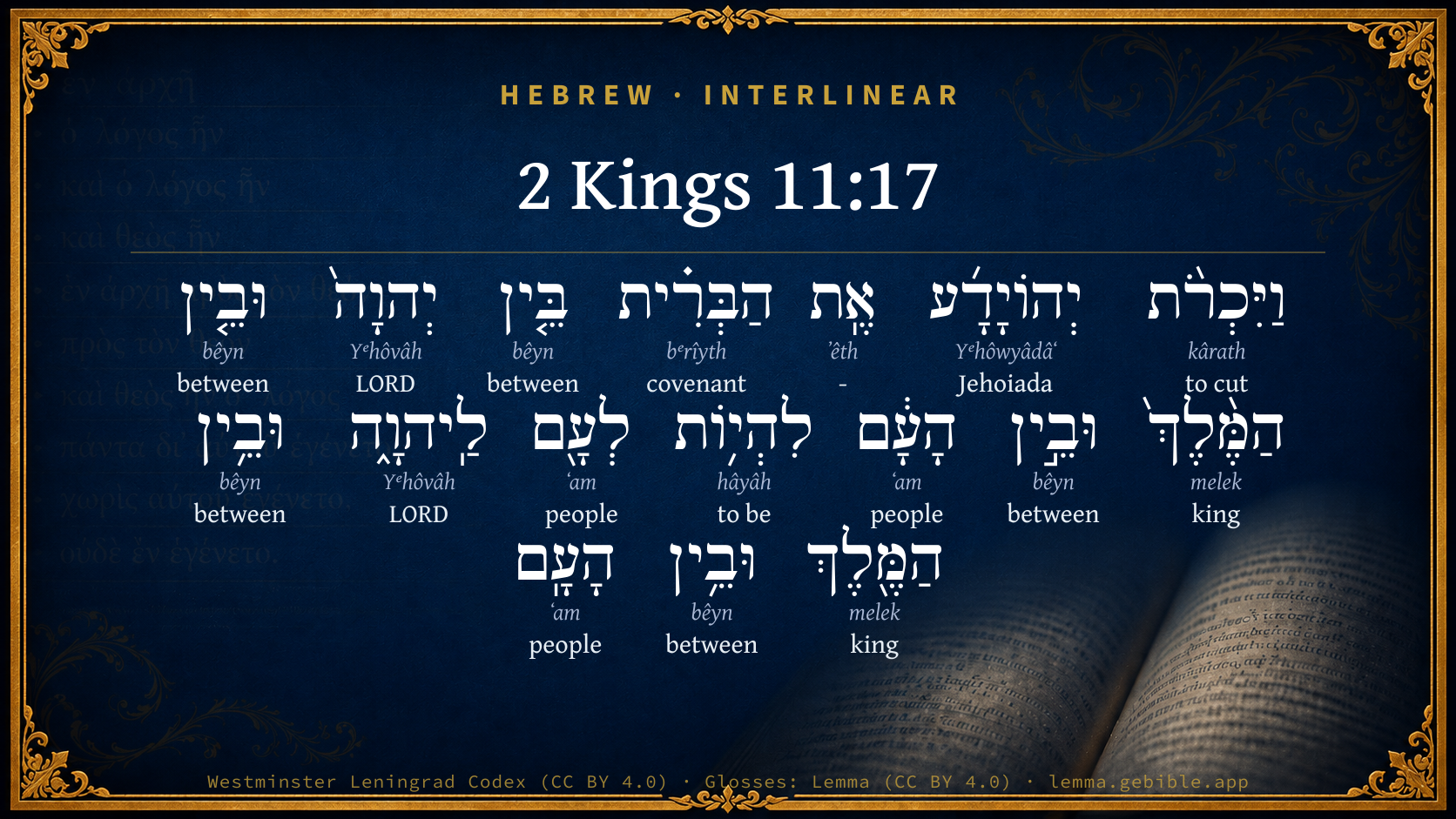
Hebrew (Westminster Leningrad Codex) 2 Kings 11:17 appears in the Hebrew Old Testament. The text above is from the Westminster Leningrad Codex. Each word links to its Strong’s number, a concise gloss, and parsing drawn from the Open Scriptures Hebrew Bible morphology. Click any word for its full Brown-Driver-Briggs (BDB) entry.
Download image
Cite this verse

2 Kings 11:17 (World English Bible). Public Domain. Lemma interlinear Bible study tool, https://lemma.gebible.app/v/2-kings/11/17.

Show BibTeX & RIS
BibTeX
RIS
English Translation
Jehoiada made a covenant between Yahweh and the king and the people, that they should be Yahweh's people; between the king also and the people.
World English Bible · Public Domain
Download a study sheet

One document with this verse’s original text, its word-by-word gloss line, the meaning frame, cross-references with their text, attributed commentary, and full source and license credits — printable, and it pastes into notes with its structure intact.

This verse Autodidact and up

Study sheet (.html) Plain text (.txt)

A passage Seminary Student

Up to 50 verses in one chapter. A passage sheet keeps up to 6 commentary sources and 12 cross-references per verse, in the order this page ranks them, and says so on the sheet whenever that leaves anything out. Ask for a single verse and you get the Autodidact verse sheet above.

Everything on this page stays free to read, with no account — the sheet is a download of what is already on screen, not access to it.

Want to remove ads? Support Godless Engineer
Compare translations 3

The same verse in 3 English versions, stacked beneath the original-language interlinear above. Click any original word for its lexicon entry.

Each is an independent rendering of the whole verse — the interlinear is not word-aligned to these translations.

Highlighted words mark where these versions differ — a whole-verse word diff, not a word-by-word alignment.

  • World English Bible Public Domain
    Jehoiada made a covenant between Yahweh and the king and the people, that they should be Yahweh's people; between the king also and the people.
  • King James Version Public Domain
    And Jehoiada made a covenant between the LORD and the king and the people, that they should be the LORD's people; between the king also and the people.
  • unfoldingWord Literal Text CC BY-SA 4.0
    And Jehoiada cut a covenant between Yahweh and between the king and between the people, to become a people for Yahweh, and between the king and between the people.

unfoldingWord Literal Text — © unfoldingWord, licensed CC BY-SA 4.0. Word-aligned USFM3 via Door43 (git.door43.org/unfoldingWord/en_ult).

Versions to compare (up to 4)

3 of 4 selected

Show all 18 translations

Every available English version of this verse, each an independent rendering of the whole verse.

  • World English Bible Public Domain
    Jehoiada made a covenant between Yahweh and the king and the people, that they should be Yahweh's people; between the king also and the people.
  • Berean Standard Bible Public Domain
    Then Jehoiada made a covenant between the LORD and the king and the people that they would be the LORD’s people. He also made a covenant between the king and the people.
  • Majority Standard Bible Public Domain
    Then Jehoiada made a covenant between the LORD and the king and the people that they would be the LORD’s people. He also made a covenant between the king and the people.
  • King James Version Public Domain
    And Jehoiada made a covenant between the LORD and the king and the people, that they should be the LORD's people; between the king also and the people.
  • American Standard Version (1901) Public Domain
    And Jehoiada made a covenant between Jehovah and the king and the people, that they should be Jehovah's people; between the king also and the people.
  • Revised Version (1885) Public Domain
    And Jehoiada made a covenant between the LORD and the king and the people, that they should be the LORD’S people; between the king also and the people.
  • Geneva Bible (1599) Public Domain
    And Iehoiada made a couenant betweene the Lord, and the King and the people, that they should be the Lordes people: likewise betweene the King and the people.
  • Douay-Rheims (1899) Public Domain
    And Joiada made a covenant between the Lord, and the king, and the people, that they should be the people of the Lord, and between the king and the people.
  • Young's Literal Translation Public Domain
    And Jehoiada maketh the covenant between Jehovah and the king and the people, to be for a people to Jehovah, and between the king and the people.
  • Literal Standard Version CC BY-SA 4.0
    And Jehoiada makes the covenant between YHWH and the king and the people, to be for a people to YHWH, and between the king and the people.
  • Unlocked Literal Bible CC BY-SA 4.0
    Then Jehoiada made a covenant between Yahweh and the king and people, that they should be Yahweh's people, and also between the king and the people.
  • unfoldingWord Literal Text CC BY-SA 4.0
    And Jehoiada cut a covenant between Yahweh and between the king and between the people, to become a people for Yahweh, and between the king and between the people.
  • Darby Bible Public Domain
    And Jehoiada made a covenant between Jehovah and the king and the people, that they should be the people of Jehovah; and between the king and the people.
  • World Messianic Bible Public Domain
    Jehoiada made a covenant between the LORD and the king and the people, that they should be the LORD’s people; also between the king and the people.
  • Webster's Bible Public Domain
    And Jehoiada made a covenant between the LORD and the king and the people, that they should be the LORD'S people; between the king also and the people.
  • Free Bible Version CC BY-SA 4.0
    Then Jehoiada made a solemn agreement between the Lord, the king, and the people that they would be the Lord's people. He also made an agreement between the king and the people.
  • Bible in Basic English Public Domain
    And Jehoiada made an agreement between the Lord and the king and the people, that they would be the Lord's people; and in the same way between the king and the people.
  • JPS Tanakh (1917) Public Domain
    And Jehoiada made a covenant between the LORD and the king and the people, that they should be the LORD'S people; between the king also and the people.

Literal Standard Version (2020), Covenant Press — licensed CC BY-SA 4.0. Text via the HelloAO Bible API (eBible.org). Unlocked Literal Bible (unfoldingWord) — licensed CC BY-SA 4.0. Text via the HelloAO Bible API (eBible.org). unfoldingWord Literal Text — © unfoldingWord, licensed CC BY-SA 4.0. Word-aligned USFM3 via Door43 (git.door43.org/unfoldingWord/en_ult). Free Bible Version, Dr. Jonathan Gallagher — licensed CC BY-SA 4.0. Text via the HelloAO Bible API (eBible.org).

Word by word

More ways to search: Search by grammar → Find every occurrence → Compare this word →

Practice this passage: Drill this verse → Learn its vocabulary →

יְהוֹיָדָ֜ע
Yᵉhôwyâdâʻ
H3077
“Jehoiada”
Noun, Proper
Part of Speech
Noun
Type
Proper
Full BDB Definition

Origin: from H3068 and H3045

TWOT: None

Jehoiada = "Jehovah knows" - father of Benaiah, David's mighty warrior - leader of the priests who joined David at Hebron - high priest at the time of Athaliah's usurpation of the throne of Judah; hid Joash, the king's son, for six years and eventually replaced him on the throne of Judah - second priest, or sagan, to Seraiah the high priest
  1. וַיִּכְרֹ֨ת kârath H3772 “and · to cut” Conjunction + Verb, Qal, Sequential Imperfect, 3rd Person, Masculine, Singular
  2. אֶֽת ʼêth H853 “-” Particle, Direct Object
  3. הַבְּרִ֗ית bᵉrîyth H1285 “the · covenant” Particle, Definite Article + Noun, Common, Feminine, Singular, Absolute
  4. בֵּ֤ין bêyn H996 “between” Preposition
  5. יְהוָה֙ Yᵉhôvâh H3068 “LORD” Noun, Proper
  6. וּבֵ֤ין bêyn H996 “and · between” Conjunction + Preposition
  7. הַמֶּ֨לֶךְ֙ melek H4428 “the · king” Particle, Definite Article + Noun, Common, Masculine, Singular, Absolute
  8. וּבֵ֣ין bêyn H996 “and · between” Conjunction + Preposition
  9. הָעָ֔ם ʻam H5971 “the · people” Particle, Definite Article + Noun, Common, Masculine, Singular, Absolute
  10. לִהְי֥וֹת hâyâh H1961 “to be” Preposition + Verb, Qal, Infinitive Construct
  11. לְעָ֖ם ʻam H5971 “to/for · people” Preposition + Noun, Common, Masculine, Singular, Absolute
  12. לַֽיהוָ֑ה Yᵉhôvâh H3068 “to/for · LORD” Preposition + Noun, Proper
  13. וּבֵ֥ין bêyn H996 “and · between” Conjunction + Preposition
  14. הַמֶּ֖לֶךְ melek H4428 “the · king” Particle, Definite Article + Noun, Common, Masculine, Singular, Absolute
  15. וּבֵ֥ין bêyn H996 “and · between” Conjunction + Preposition
  16. הָעָֽם ʻam H5971 “the · people” Particle, Definite Article + Noun, Common, Masculine, Singular, Absolute

About this verse

These counts appear in no published source. They are computed here, from the morphology-tagged text and Lemma’s own curated glosses. What Lemma adds →

17
words
9
distinct lemmas
Historical
section

Shared distinctive vocabulary

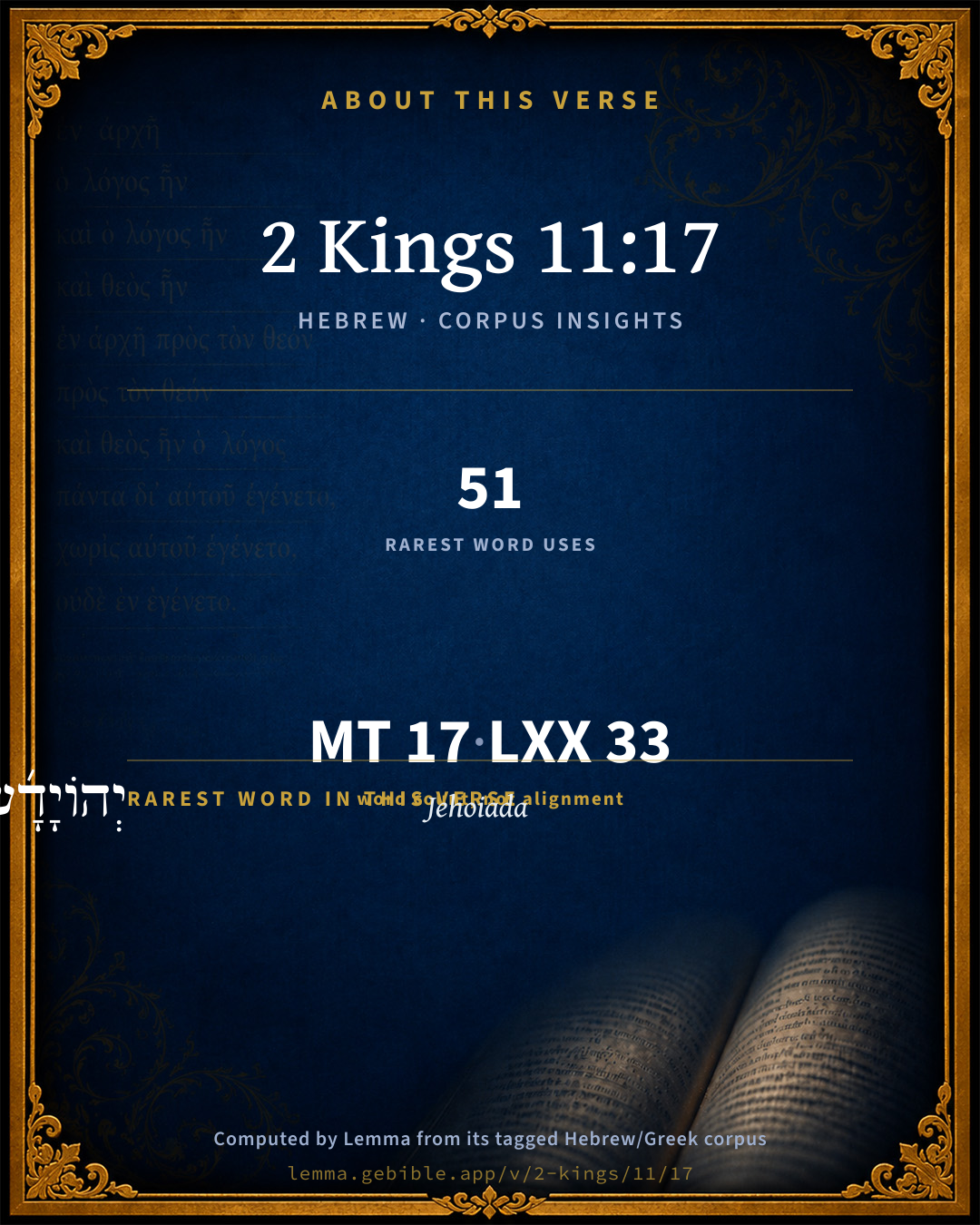
יְהוֹיָדָ֜ע Jehoiada H3077 occurs in 48 verses of the Hebrew Bible. Also found in:

Grammatical profile

  • 2 verbs
  • 9 nouns
  • 5 prepositions
  • 1 particle

Verb forms

  • וַיִּכְרֹ֨ת Qal · Sequential Imperfect
  • לִהְי֥וֹת Qal · Infinitive Construct

Repetition

Words recur within this verse — often emphatic in Hebrew:

  • בֵּ֤ין between H996 ×5
  • הָעָ֔ם people H5971 ×3
  • יְהוָה֙ LORD H3068 ×2
  • הַמֶּ֨לֶךְ֙ king H4428 ×2

Hebrew & Septuagint length

In English translation the verse runs 25 words from the Hebrew and 28 from the Septuagint (LXX English) — closely comparable.

A rough comparison of the two English renderings, which tokenize alike — not a word-level alignment.

Word counts can differ between the Hebrew and the Greek without any difference in meaning — e.g. the Hebrew direct-object marker אֵת has no separate Greek word, and Greek often adds the article ὁ.

In the original languages it is 17 Hebrew tokens and 33 Greek tokens — but the two are counted differently (Hebrew bundles its prefixes and suffixes into one token; the Greek is in lemma form), so that isn’t a like-for-like length.

Cross-references

17

Topical passages linked to 2 Kings 11:17 in the Treasury of Scripture Knowledge — connected by theme and wording, ordered by reader-vote popularity; previews shown in the World English Bible.

  • 2 Samuel 5:3 So all the elders of Israel came to the king to Hebron; and king David made a covenant with them in Hebron before Yahweh: and they anointed David king over Israel.
  • 2 Chronicles 15:12–14 They entered into the covenant to seek Yahweh, the God of their fathers, with all their heart and with all their soul;
  • Joshua 24:25 So Joshua made a covenant with the people that day, and set them a statute and an ordinance in Shechem.
  • 2 Chronicles 34:31 The king stood in his place, and made a covenant before Yahweh, to walk after Yahweh, and to keep his commandments, and his testimonies, and his statutes, with all his heart, and with all his soul, to perform the words of the covenant that were written in this book.
  • 1 Samuel 10:25 Then Samuel told the people the manner of the kingdom, and wrote it in a book, and laid it up before Yahweh. Samuel sent all the people away, every man to his house.
  • 2 Chronicles 29:10 Now it is in my heart to make a covenant with Yahweh, the God of Israel, that his fierce anger may turn away from us.
  • Ezra 10:3 Now therefore let us make a covenant with our God to put away all the wives, and such as are born of them, according to the counsel of my lord, and of those who tremble at the commandment of our God; and let it be done according to the law.
  • Deuteronomy 5:2–3 Yahweh our God made a covenant with us in Horeb.
  • Deuteronomy 29:1–15 These are the words of the covenant which Yahweh commanded Moses to make with the children of Israel in the land of Moab, besides the covenant which he made with them in Horeb.
  • 2 Kings 11:4 In the seventh year Jehoiada sent and fetched the captains over hundreds of the Carites and of the guard, and brought them to him into the house of Yahweh; and he made a covenant with them, and took an oath of them in the house of Yahweh, and shown them the king's son.
  • 1 Chronicles 11:3 So all the elders of Israel came to the king to Hebron; and David made a covenant with them in Hebron before Yahweh; and they anointed David king over Israel, according to the word of Yahweh by Samuel.
  • 2 Chronicles 23:16 Jehoiada made a covenant between himself, and all the people, and the king, that they should be Yahweh's people.
  • Nehemiah 5:12–13 Then said they, We will restore them, and will require nothing of them; so will we do, even as you say. Then I called the priests, and took an oath of them, that they would do according to this promise.
  • Nehemiah 9:38 Yet for all this we make a sure covenant, and write it; and our princes, our Levites, [and] our priests, seal to it.
  • Nehemiah 10:28–29 The rest of the people, the priests, the Levites, the porters, the singers, the Nethinim, and all those who had separated themselves from the peoples of the lands to the law of God, their wives, their sons, and their daughters, everyone who had knowledge, and understanding;
  • Romans 13:1–6 Let every soul be in subjection to the higher authorities, for there is no authority except from God, and those who exist are ordained by God.
  • 2 Corinthians 8:5 This was not as we had hoped, but first they gave their own selves to the Lord, and to us through the will of God.

Cross-references courtesy of OpenBible.info (CC BY 4.0).

Hebrew and Greek witnesses Masoretic Hebrew ↔ Greek Septuagint

The same verse in the two great witnesses to the Old Testament, shown verse-for-verse.

These are two independent witnesses, not word-aligned to each other, and the Septuagint is shown in lemma (dictionary) form.

Hebrew 2 Kings 11:17 Masoretic · Westminster Leningrad Codex

וַיִּכְרֹ֨ת יְהוֹיָדָ֜ע אֶֽת הַבְּרִ֗ית בֵּ֤ין יְהוָה֙ וּבֵ֤ין הַמֶּ֨לֶךְ֙ וּבֵ֣ין הָעָ֔ם לִהְי֥וֹת לְעָ֖ם לַֽיהוָ֑ה וּבֵ֥ין הַמֶּ֖לֶךְ וּבֵ֥ין הָעָֽם

Jehoiada made a covenant between Yahweh and the king and the people, that they should be Yahweh's people; between the king also and the people.

World English Bible · Public Domain

Greek LXX 2 Kings 11:17 Septuagint · lemma form

καί διατίθημι ιωδαε διαθήκη ἀνά μέσος κύριος καί ἀνά μέσος ὁ βασιλεύς καί ἀνά μέσος ὁ λαός ὁ εἰμί εἰς λαός ὁ κύριος καί ἀνά μέσος ὁ βασιλεύς καί ἀνά μέσος ὁ λαός

And Jodae made a covenant between the Lord and the king and the people, that they should be the Lord's people; also between the king and the people.

LXX2012 (modern English Septuagint) · Public Domain

Hebrew: Westminster Leningrad Codex (CC BY 4.0). Greek: Septuagint (public domain); English from LXX2012 (modern English Septuagint) (Public Domain). How the Septuagint differs from the Hebrew →

Targum (Aramaic paraphrase)

1

The Targum is the ancient Jewish Aramaic paraphrase of the Hebrew Scriptures — an interpretive translation, not the Hebrew text itself. Onkelos (literal) and Pseudo-Jonathan (expansive) render the Torah, and Jonathan the Prophets. Coverage is partial: where no permissively-licensed English translation exists for a verse, only the Aramaic is shown. This is verse-level text, not a word-by-word alignment to the Hebrew.

  1. Targum Jonathan Prophets (Joshua–Malachi)
    וּגְזַר יְהוֹיָדָע יַת קְיָמָא בֵּין מֵימְרָא דַייָ וּבֵין מַלְכָּא וּבֵין עַמָא לְמֶהֱוֵי לְעָם מְשַׁמֵשׁ קֳדָם יְיָ בֵּין מַלְכָּא וּבֵין עַמָא:

    (no public-domain English translation for this verse)

    Targum Jonathan — Aramaic: “Mikraot Gedolot” (public domain). English: “Sefaria Community Translation” (CC0 1.0 (public-domain dedication)); “London "Chaldee Paraphrase," 1871” (public domain). Text via Sefaria.

Commentary

Notes on 2 Kings 11:17 from classic Christian and Jewish commentators (each source and its license shown beneath its notes). The classic Christian expositions comment on the surrounding passage and are grouped to its opening verse, so a note may address several verses; the Jewish commentaries on the Tanakh (Rashi and others) are per-verse, so they appear only where the commentator wrote on this verse.

Lemma curates 59 commentaries, every one of them public domain or Creative Commons licensed, each selected and text-cleaned for this edition rather than reprinted as found. About our sources →

Matthew Henry's Commentary

Jehoiada had now got over the harlot part of his work, when, by the death of Athaliah, the young prince had his way to the throne cleared of all opposition. He had now to improve his advantages for the perfecting of the revolution and the settling of the government. Two things we have an account of here: -

I. The good foundations he laid, by an original contract, Kg2 11:17. Now that prince and people were together in God's house, as it should seem before they stirred, Jehoiada took care that they should jointly covenant with God, and mutually covenant with each other, that they might rightly understand their duty both to God and to one another, and be firmly bound to it. 1. He endeavoured to settle and secure the interests of religion among them, by a covenant between them and God. King and people would then cleave most firmly to each other when both had joined themselves to the Lord. God had already, on his part, promised to be their God (Jehoiada could show them that in the book of the testimony); now the king and people on their part must covenant and agree that they will be the Lord's people: in this covenant, the king stands upon the same level with his subjects and is as much bound as any of them to serve the Lord. By this engagement they renounced Baal, whom many of them had worshipped, and resigned themselves to God's government. It is well with a people when all the changes that pass over them help to revive, strengthen, and advance the interests of religion among them. And those are likely to prosper who set out in the world under fresh and sensible obligations to God and their duty. By our bonds to God the bonds of every relation are strengthened. They first gave themselves to the Lord, and then to us, Co2 8:5. 2. He then settled both the coronation-oath and the oath of allegiance, the pacta conventa - covenant, between the king and the people, by which the king was obliged to govern according to law and to protect his subjects, and they were obliged, while he did so, to obey him and to bear faith and true allegiance to him. Covenants are of use both to remind us of and to bind us to those duties which are already binding on us. It is good, in all relations, for the parties to understand one another fully, particularly in that between prince and subject, that the one may understand the limits of his power and prerogative, the other those of his liberty and property; and never may the ancient landmarks which our fathers have set before them be removed.

II. The good beginnings he raised on those foundations. 1. Pursuant to their covenant with God they immediately abolished idolatry, which the preceding kings, in compliance with the house of Ahab, had introduced (Kg2 11:18): All the people of the land, the mob, got together, to show their zeal against idolatry; and every one, now that they were so well headed, would lend a hand to pull down Baal's temple, his altars, and his images. All his worshippers, it should seem, deserted him; only his priest Mattan stuck to his altar. Though all men forsook Baal, he would not, and there he was slain, the best sacrifice that ever was offered upon that altar. Having destroyed Baal's temple, they appointed officers over the house of God, to see that the service of God was regularly performed by the proper persons, in due time, and according to the institutional manner. 2. Pursuant to their covenant with one another they expressed a mutual readiness to and satisfaction in each other. (1.) The king was brought in state to the royal palace, and sat there on the throne of judgment, the thrones of the house of David (Kg2 11:19), ready to receive petitions and appeals, which he would refer it to Jehoiada to give answers to and to give judgment upon. (2.) The people rejoiced, and Jerusalem was in quiet (Kg2 11:20), and Josephus says they kept a feast of joy many days, making good Solomon's observation (Pro 11:10), When it goes well with the righteous the city rejoices, and when the wicked perish there is shouting.

Matthew Henry's Commentary on the Whole Bible (1708–1710) — public domain (CC PDM 1.0). Text via the HelloAO Bible API.

Jamieson, Fausset & Brown

Robert Jamieson, A. R. Fausset & David Brown

JEHOIADA RESTORES GOD'S WORSHIP. (Kg2 11:17-20)

a covenant between the Lord and the king and the people--The covenant with the Lord was a renewal of the national covenant with Israel (Exo. 19:1-24:18; "to be unto him a people of inheritance," Deu 4:6; Deu 27:9). The covenant between the king and the people was the consequence of this, and by it the king bound himself to rule according to the divine law, while the people engaged to submit, to give him allegiance as the Lord's anointed. The immediate fruit of this renewal of the covenant was the destruction of the temple and the slaughter of the priests of Baal (see Kg2 10:27); the restoration of the pure worship of God in all its ancient integrity; and the establishment of the young king on the hereditary throne of Judah [Kg2 11:19].

Next: 2 Kings Chapter 12

Jamieson, Fausset & Brown — Commentary Critical and Explanatory on the Whole Bible (1871) — public domain (CC PDM 1.0). Text via the HelloAO Bible API.

Trapp's Complete Commentary

John Trapp

2Ki 11:17 And Jehoiada made a covenant between the LORD and the king and the people, that they should be the LORD’S people; between the king also and the people.

Ver. 17. And Jehoiada made a covenant.] Both sacred and civil: and they set forthwith upon the work of reformation, which prospered in their hands: for they pulled down Baal’s temples, and slew Mattan the priest before his altars. {2Ki 11:18}

John Trapp, A Commentary or Exposition upon All the Books of the Old and New Testament (1647–1656) — public domain. Text from a community e-Sword module.

Joseph Benson's Commentary

2Ki 11:17. Jehoiada made a covenant between the Lord, &c. — A sacred covenant, whereby he solemnly engaged both the king and people, that they should be the Lord’s people — That they should renounce and root out all idolatry, and set up and maintain God’s true worship. Between the king also and the people — This was a civil covenant, whereby the king engaged himself to rule them justly, and in the fear of God; and the people obliged themselves to defend and obey him. Compare 2Sa 5:3.

Joseph Benson's Commentary on the Old and New Testaments (1811–1818) — public domain. Text from a community e-Sword module.

The Preacher's Complete Homiletical Commentary

Joseph S. Exell (gen. ed.)

CRITICAL AND EXPLANATORY NOTES.—

2Ki_11:20. And all the people rejoiced—Because, with Athaliah’s death, the accursed house of Ahab ceased, and in Jehoash’s person the royal house of David was again established on the throne of Judah.—W. H. J.

HOMILETICS OF 2Ki_11:17-21

THE RESTORATION OF THE PUBLIC WORSHIP OF JEHOVAH

I. Was signalized by formal and impressive covenant.

1. This covenant recognized the supreme claims of Jehovah. “And Jehoiada made a covenant between the Lord and the king and the people” (2Ki_11:17). This was a renewal of the national covenant with Israel (Exodus 19-24; Deu_4:6; Deu_27:9) to be unto the Lord “a people of inheritance,” by which they solemnly engaged themselves to renounce and root out all idolatry, and set up and maintain God’s true worship. When the national conscience has been demoralized by idolatrous practices, it is important to present the supreme claims of God to our homage by the most impressive methods.

2. This covenant guarded the rights of both ruler and ruled. “Between the king also and the people.” This was a civil covenant whereby the king engaged himself to rule them justly and in the fear of God, and the people obliged themselves to defend and obey him (comp.

2. Sam. 2Ki_5:2). Government is impossible where the rights and privileges of both ruler and ruled are not duly respected and observed.

II. Ensured the downfall of idolatry (2Ki_11:18). This was the logical and necessary consequence of the restoration of the true worship. Athaliah had transplanted idolatry into Judah. She was the first to erect a temple to Baal in the holy city, and plundered the temple of Jehovah to enrich the shrine of her favourite deity. The people looked on aghast at this wanton sacrilege to their sacred fane and daring insult to the God of their fathers; but they were powerless to prevent it; they were held in check by the threats and tyranny of the usurper. Many a pious soul wept in secret because of the prevalent iniquity, and many an anxious prayer was offered for a day of deliverance. And now that day had come. The people, animated by a spirit of righteous indignation, rose against the Baal worshippers, and demolished their idol temple. Jehovah can admit no rival. The idols he shall utterly abolish (Isa_2:18).

No more at Delos or at Delphi now,

Or e’en at mighty Ammon’s Libyan shrine,

The white-robed priests before the altar bow,

To slay the victim and to pour the wine,

While gifts of kingdoms round each pillar twine.

Scarce can the classic pilgrim, sweeping free

From fallen architrave the desert vine,

Trace the dim names of their divinity;

Gods of the ruin’d temples, where, oh where are ye!—Bethune.

III. Was the guarantee of stability to the throne (2Ki_11:19). “It seems to me a great truth,” says Carlyle, “that human things cannot stand on selfishness, mechanical utilities, economics, and law courts; that if there be not a religious element in the relations of men, such relations are miserable, and doomed to ruin.”

King-becoming graces

Are justice, verity, temperance, stableness,

Bounty, perseverance, mercy, lowliness

Devotion, patience, courage, fortitude.

Where can such virtues be found, and where be better cultivated, than in the humble and reverent worship of Almighty God? No nation can be permanent or prosperous where king and people ignore the obvious claims of Divine worship.

Safety and equal government are things

Which subjects make as happy as their kings.—Waller.

IV. Was the occasion of national joy and tranquility. “And all the people of the land rejoiced, and the city was in quiet” (2Ki_11:20). The good rejoiced that the character of Jehovah was at length vindicated: their sighs, their tears, their prayers for Zion had not been in vain. The aged rejoiced that before their eyes closed in death they beheld their country free from the oppressor, and their loved worship once more restored. The young rejoiced in the brightening prospect of noblest service for God and king and country. “And the city was in quiet.” As in many other countries, the condition of the metropolis ruled the provinces. If Jerusalem was in anguish, the nation was in sorrow; if Jerusalem was happy, the nation shared the joy. If the vast populations of our great cities were penetrated with a love and enthusiasm for the worship of Jehovah, how readily would the rest of the country be won over to share in a like experience! It is not without significance that the first preachers of the Gospel directed their earliest endeavours to gain a footing in the great populous centres of their day. Flood the cities with light and joy, and the nations will soon be won. Then will come the time of which Alford sung—

What throbbings of deep oy

Pulsate through all I see; from the full bud

Whose unctuous sheath is glittering in the moon,

Up through the system of created things,

Even to the flaming ranks of Seraphim!

LESSONS:—

1. The nation is a prey to anarchy when God is not publicly acknowledged.

2. The pure worship of God tends to develop all that is best in national character.

3. To worship God aright, we must get rid of every idolatrous rival.

GERM NOTES ON THE VERSES

2Ki_11:17-18. Covenanting with God. I. All the more necessary when conscious of unfaithfulness. II. Should be solemn and impressive. III. Shown to be sincere by the destruction of that which led the soul astray. IV. Has a tendency to foster and strengthen right relations between God and king and people.

2Ki_11:17. The covenant which Jehoiada renewed. I. The covenant of the king and the people with God. The basis and fountain of all national prosperity. An irreligious state is a folly and an impossibility. It is nothing. II. The covenant between king and people. It is built upon the former. There is prosperity in a country only when the prince rules before and with God, and the people are obedient through obedience to God. Without this fundamental condition all constitutions, laws, and institutions, however good they may appear, are useless. No relation of subjects and ruler is sound if it has not the covenant of God as its basis on either side.—Lange.

2Ki_11:18. It is a grand national event when a people destroys its idols. He who stands by God and his word tolerates neither gross nor refined idolatry. Where there is decided faith in the living God, the altars of the false gods fall of themselves.

2Ki_11:20. National joy. I. May well be expressed when the throne is settled on a stable foundation. II. When religion triumphs over idolatry, oppression, and wrong. III. When peace and prosperty are guaranteed.

O beauteous peace,

Sweet union of a state! What else but thou

Gives safety, strength, and glory to a people.

Governments which are founded in blood always end disastrously.

2Ki_11:21. The sceptre of Judah is changed from a woman to a child; but a child trained up and tutored by Jehoiada. This minority so guided was not inferior to the mature age of many predecessors. Happy is that land the nonage of whose prince falls into holy and just hands.—Bp. Hall.

The Preacher's Complete Homiletical Commentary (gen. ed. Joseph S. Exell; Funk & Wagnalls, c. 1892) — public domain (pre-1929). A full-Bible homiletical/sermon-outline anthology covering 65 of 66 books (2 John is absent from the source module). Text from a community e-Sword module.

Tyndale Open Study Notes

Tyndale Open Resources

11:17 The renewal of the covenant was especially important after years of pagan rule. Covenant faithfulness accompanied by periodic renewal was mandated in the law (Deut 31:9-13), and Israel observed it at junctures in its history (see 2 Kgs 23:1-3; Josh 24).

Tyndale Open Study Notes — © Tyndale Open Resources, licensed CC BY-SA 4.0. Text via the HelloAO Bible API.

Geneva Bible (1599)

Geneva Bible translators

That he should govern and they obey in the fear of God.

That both the King and the people should maintain the true worship of God and destroy all idolatry.

Geneva Bible (1599) marginal notes — public domain. Text via Bolls.life.

Adam Clarke's Commentary

Verse 17. Jehoiada made a covenant] A general covenant was first made between the Lord, the Supreme King, the king his viceroy, and the people, that they should all be the Lord's people; each being equally bound to live according to the Divine law.

Then, secondly, a particular covenant was made between the king and the people, by which the king was bound to rule according to the laws and constitution of the kingdom, and to watch and live for the safety of the public. And the people were bound on their part, to love, honour, succour, and obey the king. Where these mutual and just agreements are made and maintained, there can be nothing else than prosperity in the Church and the state.

Adam Clarke's Commentary on the Bible (1810–1826) — public domain. Text from a community e-Sword/MySword module.

Ellicott's Commentary for English Readers

(17) A covenant.—Rather, the covenant. The high priest solemnly renewed the original compact between Jehovah and the king and people—a compact which had been violated by the Baal-worship of recent reigns.

That they should be the Lord’s people.—Comp. Deu_4:20; Exo_19:5-6.

Between the king also and the people.—For the protection of their mutual rights and prerogatives. (Comp. 1Sa_10:25.) The king was bound to govern according to the law of Jehovah—“the testimony” which had been put upon him (2Ki_11:12). (Comp. Note on 2Ch_23:16.) The people were to be loyal to the house of David.

A Bible Commentary for English Readers, edited by Charles John Ellicott (1878–1897) — public domain. Text from a community e-Sword module.

The Cambridge Bible for Schools and Colleges

gen. ed. J. J. S. Perowne

17–21. Jehoiada restores the worship of God. The house of Baal is destroyed. Joash is brought to the palace and enthroned (2Ch_23:16 to 2Ch_24:1)

17. And Jehoiada made a covenant between the Lord] In 2 Chron. ‘Jehoiada’ stands in the place of Jehovah, and it is said he made a covenant between himself and all the people and the king. Of course in the whole transaction he would appear as the representative of Jehovah, and receive in the name of the Lord the promise of both king and people, by which they dedicated themselves to the Lord.

between the king also and the people] i.e. that they should be loyal subjects and he a just ruler over them.

The Cambridge Bible for Schools and Colleges (gen. ed. J. J. S. Perowne; Cambridge University Press, 1878–1918) — public domain. Text from a community e-Sword module.

John Gill's Exposition

And all the people of the land,.... That were at Jerusalem, and the parts adjacent, that came from the country, hearing what was done: went into the house of Baal; a temple of his Athaliah had built, either in Jerusalem, or near it; perhaps on the mount of Olives, called the mount of corruption, Kg2 23:13 from the idolatry there committed:

and brake it down, his altars and his images brake they in pieces thoroughly; made an entire destruction of them all, temple, altars, the images of Baal and other deities:

and slew Mattan the priest of Baal before the altar; either as he was sacrificing, or that he might be a sacrifice, or where he had fled for refuge:

and the priest appointed officers over the house of the Lord; priests to offer sacrifices, Levites to sing the praises of God, porters at the door of the temple, and watches in it, and restored the courses of the priests, and everything to its proper order, which had been neglected, or had ceased, during the usurpation of Athaliah; see Ch2 23:18.

John Gill's Exposition of the Whole Bible (1746–1763) — public domain (CC PDM 1.0). Text via the HelloAO Bible API.

Albert Barnes' Notes on the Bible

A covenant - Rather, “the covenant,” which either was already an established part of a coronation (marginal reference “k”), or at least became such afterward.

Albert Barnes' Notes on the Bible (1834–1885) — public domain. Text from a community e-Sword/MySword module.

Haydock's Catholic Bible Commentary

People. Joiada, as mediator (Calmet) between God, the king, and the people, engaged the two latter to be faithful to their common Lord, and to each other. They promised mutually to observe the laws, and, on that condition, the high priest gave them an assurance that God would protect them. (Haydock) --- The covenant entered into by their fathers (Exodus xix. 5.) was renewed. (Calmet)

George Leo Haydock (1774–1849), Haydock's Catholic Family Bible and Commentary, 1859 edition — public domain. Excludes Psalms (Douay-Rheims chapter numbering differs from Protestant) and Deuterocanonical books (Catholic canon only).

Matthew Poole's English Annotations

Between the Lord and the king and the people; a sacred covenant, whereby he solemnly engaged both the king and people, as it here follows,

that they should be the Lord’s people, i.e. that they should renounce and root out all idolatry, and set up and maintain God’s true worship. Compare 2Ki 23:10.

Between the king also and the people: this was a civil covenant, whereby the king engaged himself to rule them justly, and in the fear of God; and the people obliged themselves to defend and obey him. Compare 2Sa 5:3.

Matthew Poole's English Annotations on the Holy Bible (1683–1685) — public domain. Text from a community e-Sword/MySword module.

Whedon's Commentary on the Bible

Daniel D. Whedon

17. Jehoiada made a covenant — Having succeeded thus far in reforming the kingdom, he would next renew the covenant with Jehovah. He made, in fact, two covenants: first, between the Lord and the king and the people, which involved their returning as a nation from Baal worship to the obedience and worship of the Lord; secondly, between the king also and the people, which involved that they would sacredly regard the duties and respect each party owed the other. The king must rule righteously, the people cheerfully obey.

Daniel D. Whedon (gen. ed.), Commentary on the Old and New Testaments (1874–1909) — public domain. Text from a community e-Sword module.

The Pulpit Commentary

Vers. 17-21. Further doings of Jehoiada. The king being at present a mere puppet in his hands, Jehoiada had to determine the next steps which were necessary to be taken. These, in his judgment, were three.

1. A solemn covenant must be made between the king and the people; and another between the king, the people, and God the latter pledging the king and people to maintain the worship of Jehovah, and never again to apostatize; the former pledging the king to govern according to law, and the people to remain faithful to him.

2. The temple of Baal, erected in Jerusalem at the instance of Athaliah, must be destroyed.

3. The king must be removed from the temple and installed in the palace of his ancestors. A brief account of these proceedings concludes the present chapter.

And Jehoiada made a covenant between the Lord and the king and the people. In the original it is "made the covenant;" and the meaning is that the high priest renewed the old covenant understood to exist between king and people on the one hand and God on the other, that they would be faithful to God and God to them that they would maintain his worship, and that he would continue his protection. (see Exo_19:5-8 Exo_24:3-8 Exo_34:10-28) The apostasy of Jehoram, Ahaziah, and Athaliah was regarded as having put an end to the old covenant, and therefore it was solemnly remade or renewed. That they should be the Lord"s people. (comp. Exo_19:5; Deu_4:20 Deu_9:29 Deu_32:9, etc.) between the king also and the people. The terms of this covenant are nowhere distinctly stated, but we can only suppose them to have expressed in words the intention of that novel act, the imposition of "the testimony" upon the head of the king at the time of his coronation (see the comment upon ver. 12).

Vers. 17-21. The covenant and its results.

Jehoiada was faithful to God. All that he had hitherto done was but the work of a pioneer, preparing the way for the restoration of God"s worship and God"s Law in the land. We have here

I THE COVENANT MADE. Very early in the history of God"s people we find them entering into covenants with him. When Jacob had that comforting vision at Bethel, he entered into a covenant. "If God will be with me, and will keep me in this way that I go so that I come again to my father"s house in peace; then shall the Lord be my God; and this stone, which I have set for a pillar, shall be God"s house: and of all that thou shalt give me I will surely give the tenth unto thee." The pillar he set up was the witness of the covenant. When God gave the Ten Commandments to the children of Israel, they entered into a covenant that they would keep them and do them. That covenant they publicly renewed and ratified many times in their subsequent history. They renewed it shortly before the death of Moses. They renewed it shortly before the death of Joshua, and on that occasion Joshua set up a great stone to be a witness of what they had done. On the occasion before us they renew it under the influence of Jehoiada. "And Jehoiada made a covenant between the Lord and the king and the people, that they should be the Lord"s people; between the king also and the people." They renewed it also in the reign of Josiah, and under Ezra and Nehemiah after the return from the Captivity. In all these cases we find three important features, common to them all. In each case the duty of making the covenant was enjoined upon the people by eminent men of God prophets, priests, and kings. In each case it was a public covenant,entered into by all the people. And in each case, when the covenant was renewed, it was accompanied by moral and spiritual revival and reformation. Have we not in the New Testament the same duty pointed out and practiced, though not indeed under the same name? It was a public covenant with the Lord when on the Day of Pentecost the three thousand souls were baptized. When Paul praises the Churches of Macedonia for that "they first gave their own selves to the Lord;" when he calls his readers to present themselves a living sacrifice unto God; to remember that they are not their own, but are bought with a price; to come out from among the godless and be separate; all these are just different ways of reminding them that as Christians they have entered into a covenant with God. Passing over the dark ages which came upon the Christian Church, we find that when the Bible truths began to shed their light once more in the surrounding darkness, the early Reformers found it necessary to baud themselves together in a solemn covenant with God and with one another. By this means they kept before them their great purpose. By this means they stimulated and strengthened and encouraged one another. By this means they lifted up a testimony against surrounding error. Such a covenant was publicly agreed to by the Protestant princes and states of Germany, and also by the Huguenots of France. But the best-known and most memorable covenants are those of Scotland. John Knox laid the foundation of the Reformation in Scotland, but the covenants built it up and strengthened it. The first of these was called the National Covenant, first drawn up in the year 1580. It was signed by the king, nobles, and persons of all ranks the king being James VI of Scotland, afterwards James I of England. By this memorable document the whole people of Scotland pledged themselves to renounce and resist all the errors of popery, and to maintain the truth as it is in Jesus. It was this covenant which was afterwards renewed in the Greyfriar"s Churchyard at Edinburgh, when, among the immense multitude who signed it, many opened their veins and wrote their names with their own blood. The other was the Solemn League and Covenant, entered into between the two parliaments of England and Scotland, also for resistance to popery, and the maintenance of pure religion throughout the land. These things suggest to us that, in times of prevailing wickedness or of prevailing error, it is the duty of God"s people to make public avowal of their faith in Christ and allegiance to him. It is a duty pointed out both in the Old Testament and in the New, and confirmed by the experience of God"s Church both in Scripture times and in more recent days. If ever there was a time when it was the duty of Christ"s people publicly and unitedly to confess him, that time is the present. Wickedness abounds. The love of many waxes cold. Many of Christ"s professing people seem utterly indifferent to the claims of their Master and his cause. False doctrines are taught; and under the show of religion there is a growing conformity to the world. A faithful, strong, united testimony for Christ is urgently needed. How, then, are we to carry out this duty of making a public covenant with God? There is one way which is available to us all, and that is the Lord"s Supper. It is an act of commemoration, communion, and consecration. In partaking of the Lord"s Supper we enter into a covenant with God. It is a public covenant. The eyes of the world are upon us. They see us make a profession to be Christ"s. Do they see that our practice corresponds with our profession? Each communion ought to be a personal covenant with God on the part of each individual believer. It ought to be a public covenant with God on the part of families. It ought to be a public covenant with God on the part of congregations.

II THE COVENANT KEPT. Jehoiada and the people had entered into a covenant or engagement that they would be the Lord"s. And they kept their promise. The first way in which they showed it was by breaking in pieces the idols and their altars, which were so abundant in the land. So, if we take Christ"s vows upon us at his table, let us show that we mean what we profess. Let us show that we are on the Lord"s side. "Better not to vow, than to vow and not pay." Let us begin with our own hearts. Are there no idols there that need to be thrown down, no besetting sins that need to be put away, no evil passions that need to be crucified? "If ye do return unto the Lord with all your hearts, then put away the strange gods and Ashtaroth from among you, and prepare your hearts unto the Lord, and serve him only". (1Sa_7:3)

III THE BLESSINGS OF THE COVENANT. "And all the people of the land rejoiced, and the city was in quiet." God kept them in perfect peace, because their minds were stayed on him. They kept their part of the covenant. God kept his. We find in Scripture that God promises special blessings to those who enter into a covenant with him. Before he gave the Law on Mount Sinai, he said to the children of Israel, "Now therefore, if ye will obey my voice indeed, and keep my covenant, then ye shall be a peculiar treasure unto me above all people: for all the earth is mine." Then again God says, "Come ye out from among them, and be ye separate, and touch not the unclean thing; and I will receive you, and will be a Father unto you, and ye shall be my sons and daughters, saith the Lord God Almighty." We also find that more than once these promises were fulfilled. In the days of Asa, when the people of Judah made a covenant with God, we read that "it was a time of great rejoicing, for they had sought the Lord with all their heart, and he was found of them; and the Lord gave them rest round about." So in the days of Josiah, When they made the covenant and put away the strange gods, we read, "Surely there was not holden such a Passover from the days of the judges that judged Israel, nor in all the days of the kings of Israel, nor of the kings of Judah." It was the same in more recent times. The covenanters, whose motto was "For Christ"s crown and covenant," and who shed their blood in defense of Christ"s authority, were a great means of preserving pure and undefiled religion in Scotland. Let us all, then, faithfully witness for him by our lives. "Come, and let us join ourselves to the Lord in a perpetual covenant that shall not be forgotten". C.H.I. (Jer_1:5)

The Pulpit Commentary (1880–1919), ed. H.D.M. Spence-Jones & Joseph S. Exell — public domain. Text from a community e-Sword module.

John Wesley's Explanatory Notes

A covenant - A sacred covenant whereby he solemnly engaged both the king, and people, that they should be the Lord's people; that they should renounce, and root out all idolatry, and set up and maintain God's true worship. Between the king - This was a civil covenant, whereby the king engaged himself to rule them justly, and in the fear of God; and the people obliged themselves to defend and obey him.

John Wesley, Explanatory Notes Upon the Whole Bible (1754–1765) — public domain. Text via the GEBible commentary corpus.

unfoldingWord translationNotes

Door43 World Missions Community

also between the king and the people

"also made a covenant between the king and the people"

all the people of the land

This is a generalization to show that a large group of people tore down the temple of Baal. AT: a large number of the people of the land" (See: Hyperbole and Generalization)

the house of Baal

"the temple of Baal"

Mattan

This is the name of a male priest. (See: How to Translate Names)

translationWords

covenant

Yahweh

Joash

people of God

Baal

altar

false god

appoint

temple

unfoldingWord translationNotes — © Distant Shores Media and the Door43 World Missions Community, licensed CC BY-SA 4.0. Source: git.door43.org/Door43/en_tn.

Rashi

Rabbi Shlomo Yitzchaki (Rashi)

Between Adonoy and between the king and the people. That the king and the people will follow Adonoy, and afterwards [he enacted a covenant] between the king and the people that they should be subservient to the king.

Rashi on the Tanakh — English translations: “The Judaica Press complete Tanach with Rashi, translated by A. J. Rosenberg” (CC BY 4.0); “Pentateuch with Rashi's commentary by M. Rosenbaum and A.M. Silbermann, 1929-1934” (public domain); “The Metsudah Tanach series, Lakewood, N.J” (CC BY 4.0); and “The Book of Joshua, Metsudah Publications, 1997” (CC BY 4.0). Text via Sefaria.

Lesson kit

Teaching starters — assembled from the data on this page, not authored interpretation. Every prompt links to the verse data it draws on. Edit before teaching.

2 Kings, in the Historical, opens this verse with 17 words (9 distinct Hebrew lemmas). Its most distinctive word is Yᵉhôwyâdâʻ (“Jehoiada”). A historical commentator’s framing appears above. Read the whole chapter for the surrounding context.

Discussion questions

  1. How does “Jehoiada” (Yᵉhôwyâdâʻ) shape what this verse is saying?
  2. 2 Samuel 8:18 shares the word «Jehoiada» with this verse. How do the two illuminate each other?
  3. “between” occurs 5× in this one verse. What is the effect of the repetition?
  4. These translations render this verse differently. What is at stake in choosing one wording over another?
  5. The verb «וַיִּכְרֹ֨ת» is Qal Sequential Imperfect. How does its form color the action?
  6. Reading how Matthew Henry's Commentary and Jamieson, Fausset & Brown read this verse, where do the two commentators agree and where do they part?

Things to notice

Reading settings

Reading text

Shown beneath each verse's original-language words.

Old Testament
Old Testament edition

Read the OT as the Masoretic Hebrew (MT) or the Greek Septuagint (LXX).

English shown for the Greek Septuagint (in the Hebrew ↔ Greek comparison).

Comparing translations? Open the Compare panel on any verse page to stack up to four side by side.