
Numbers 15:30

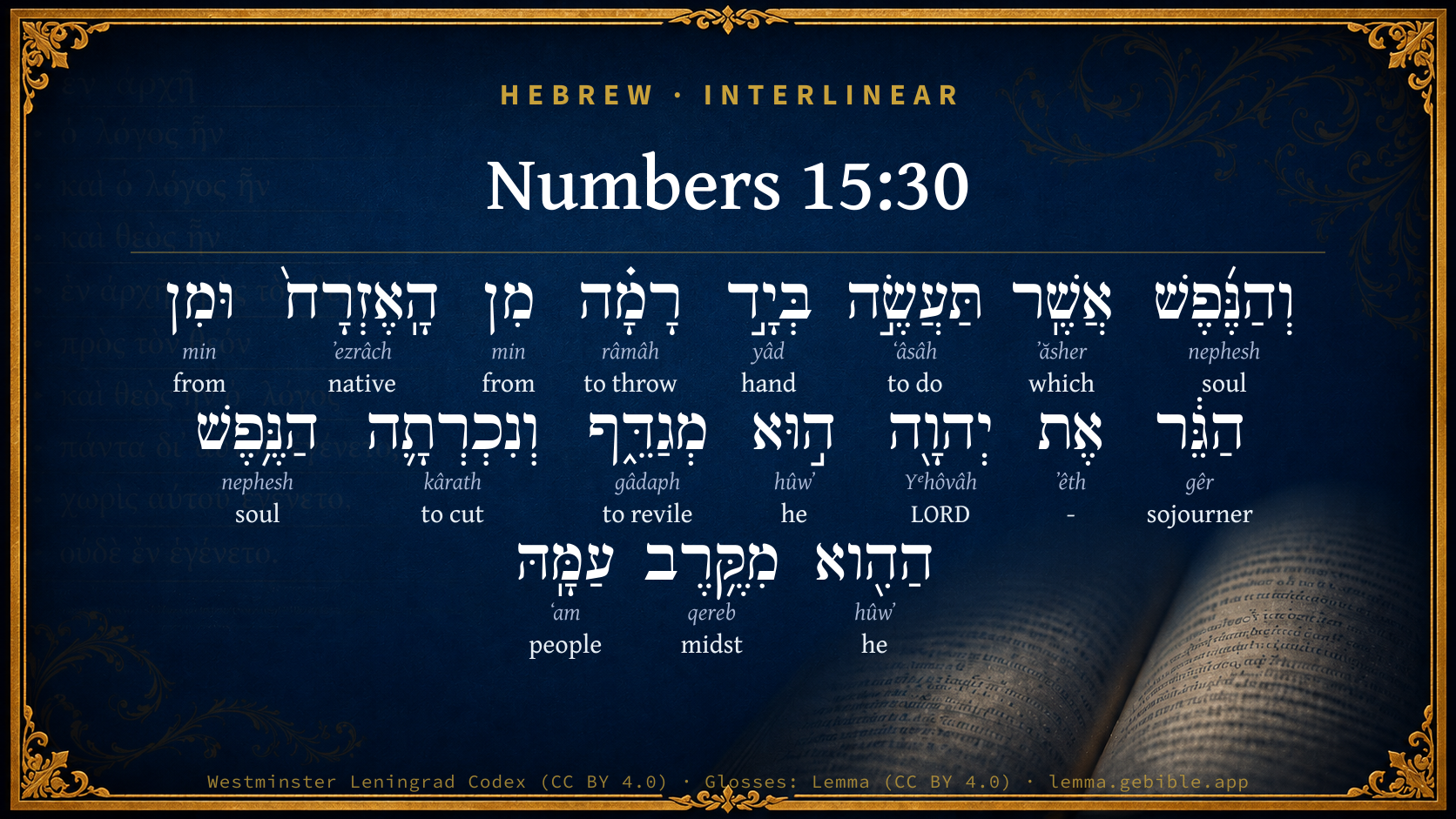
Hebrew (Westminster Leningrad Codex) Numbers 15:30 appears in the Hebrew Old Testament. The text above is from the Westminster Leningrad Codex. Each word links to its Strong’s number, a concise gloss, and parsing drawn from the Open Scriptures Hebrew Bible morphology. Click any word for its full Brown-Driver-Briggs (BDB) entry.
Download image
Cite this verse

Numbers 15:30 (World English Bible). Public Domain. Lemma interlinear Bible study tool, https://lemma.gebible.app/v/numbers/15/30.

Show BibTeX & RIS
BibTeX
RIS
English Translation
But the soul who does anything with a high hand, whether he is home-born or a foreigner, the same blasphemes Yahweh; and that soul shall be cut off from among his people.
World English Bible · Public Domain
Highlights
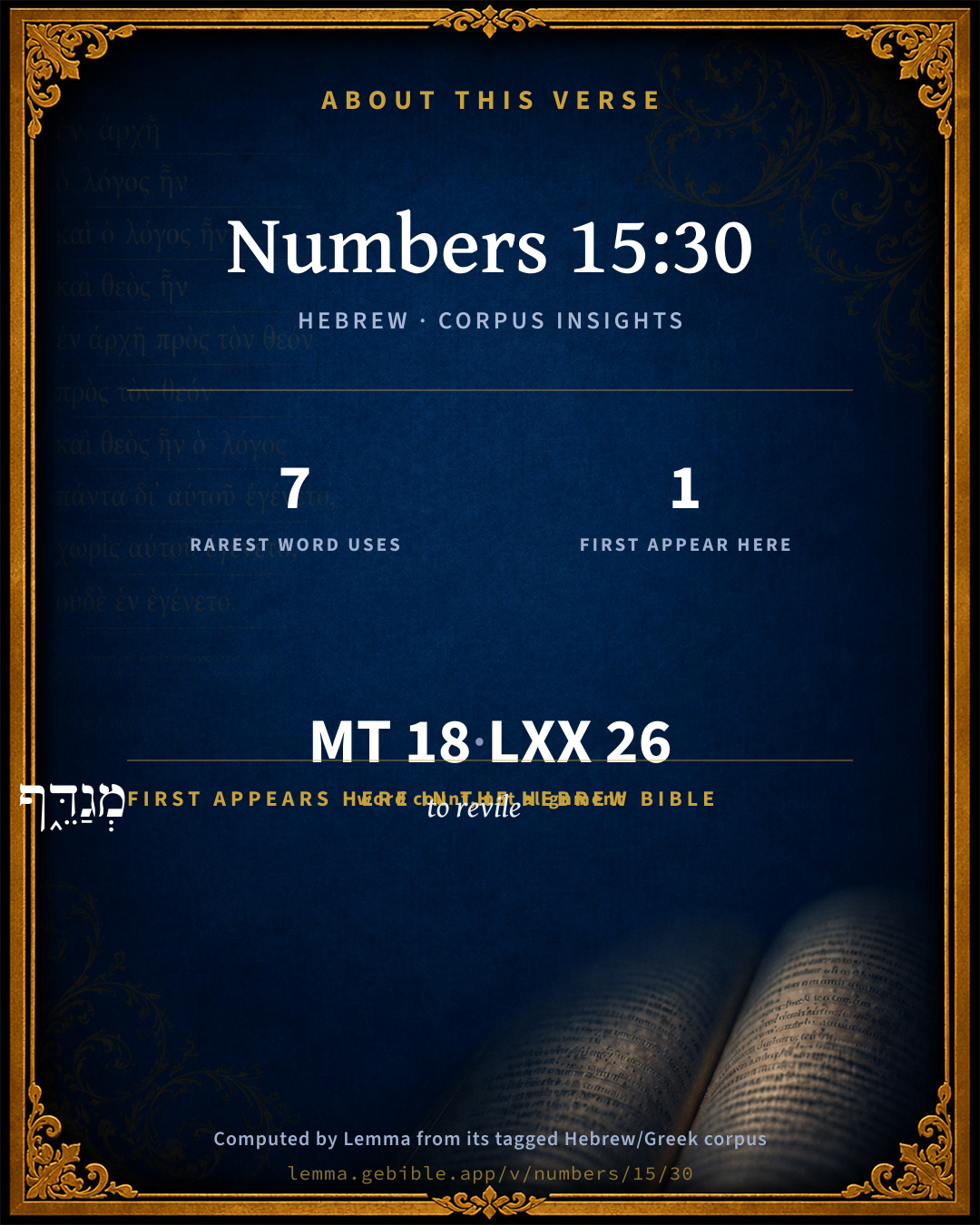
  • 1 first appearance in the Hebrew Bible
Full analysis ↓
Download a study sheet

One document with this verse’s original text, its word-by-word gloss line, the meaning frame, cross-references with their text, attributed commentary, and full source and license credits — printable, and it pastes into notes with its structure intact.

This verse Autodidact and up

Study sheet (.html) Plain text (.txt)

A passage Seminary Student

Up to 50 verses in one chapter. A passage sheet keeps up to 6 commentary sources and 12 cross-references per verse, in the order this page ranks them, and says so on the sheet whenever that leaves anything out. Ask for a single verse and you get the Autodidact verse sheet above.

Everything on this page stays free to read, with no account — the sheet is a download of what is already on screen, not access to it.

Want to remove ads? Support Godless Engineer
Compare translations 3

The same verse in 3 English versions, stacked beneath the original-language interlinear above. Click any original word for its lexicon entry.

Each is an independent rendering of the whole verse — the interlinear is not word-aligned to these translations.

Highlighted words mark where these versions differ — a whole-verse word diff, not a word-by-word alignment.

  • World English Bible Public Domain
    But the soul who does anything with a high hand, whether he is home-born or a foreigner, the same blasphemes Yahweh; and that soul shall be cut off from among his people.
  • King James Version Public Domain
    But the soul that doeth ought presumptuously, whether he be born in the land, or a stranger, the same reproacheth the LORD; and that soul shall be cut off from among his people.
  • unfoldingWord Literal Text CC BY-SA 4.0
    But the person who does with a hand being high, from the native and from the sojourner, he is blaspheming Yahweh, and that person shall be cut off from the midst of his people,

unfoldingWord Literal Text — © unfoldingWord, licensed CC BY-SA 4.0. Word-aligned USFM3 via Door43 (git.door43.org/unfoldingWord/en_ult).

Versions to compare (up to 4)

3 of 4 selected

Show all 18 translations

Every available English version of this verse, each an independent rendering of the whole verse.

  • World English Bible Public Domain
    But the soul who does anything with a high hand, whether he is home-born or a foreigner, the same blasphemes Yahweh; and that soul shall be cut off from among his people.
  • Berean Standard Bible Public Domain
    But the person who sins defiantly, whether a native or foreigner, blasphemes the LORD. That person shall be cut off from among his people.
  • Majority Standard Bible Public Domain
    But the person who sins defiantly, whether a native or foreigner, blasphemes the LORD. That person shall be cut off from among his people.
  • King James Version Public Domain
    But the soul that doeth ought presumptuously, whether he be born in the land, or a stranger, the same reproacheth the LORD; and that soul shall be cut off from among his people.
  • American Standard Version (1901) Public Domain
    But the soul that doeth aught with a high hand, whether he be home-born or a sojourner, the same blasphemeth Jehovah; and that soul shall be cut off from among his people.
  • Revised Version (1885) Public Domain
    But the soul that doeth aught with an high hand, whether he be homeborn or a stranger, the same blasphemeth the LORD; and that soul shall be cut off from among his people.
  • Geneva Bible (1599) Public Domain
    But the person that doeth ought presumptuously, whether he be borne in the land, or a stranger, the same blasphemeth the Lord: therefore that person shalbe cut off from among his people,
  • Douay-Rheims (1899) Public Domain
    But the soul that committeth any thing through pride, whether he be born in the land or a stranger (because he hath been rebellious against the Lord) shall be cut off from among his people:
  • Young's Literal Translation Public Domain
    `And the person who doth `aught' with a high hand -- of the native or of the sojourner -- Jehovah he is reviling, and that person hath been cut off from the midst of his people;
  • Literal Standard Version CC BY-SA 4.0
    And the person who does [evil] with a high hand—of the native or of the sojourner—he is reviling YHWH, and that person has been cut off from the midst of his people;
  • Unlocked Literal Bible CC BY-SA 4.0
    But the person who does anything in defiance, whether he is native born or a foreigner, blasphemes me. That person must be cut off from among his people.
  • unfoldingWord Literal Text CC BY-SA 4.0
    But the person who does with a hand being high, from the native and from the sojourner, he is blaspheming Yahweh, and that person shall be cut off from the midst of his people,
  • Darby Bible Public Domain
    But the soul that doeth ought with a high hand, whether born in the land, or a stranger, he reproacheth Jehovah; and that soul shall be cut off from among his people.
  • World Messianic Bible Public Domain
    “‘But the soul who does anything with a high hand, whether he is native-born or a foreigner, blasphemes the LORD. That soul shall be cut off from among his people.
  • Webster's Bible Public Domain
    But the soul that doeth aught presumptuously, whether he be born in the land, or a stranger, the same reproacheth the LORD; and that soul shall be cut off from among his people.
  • Free Bible Version CC BY-SA 4.0
    But the person who sins in defiance, whether an Israelite or foreigner, is blaspheming the Lord. They shall be expelled from their people.
  • Bible in Basic English Public Domain
    But the person who does wrong in the pride of his heart, if he is one of you or of another nation by birth, is acting without respect for the Lord, and will be cut off from his people.
  • JPS Tanakh (1917) Public Domain
    But the soul that doeth aught with a high hand, whether he be home-born or a stranger, the same blasphemeth the LORD; and that soul shall be cut off from among his people.

Literal Standard Version (2020), Covenant Press — licensed CC BY-SA 4.0. Text via the HelloAO Bible API (eBible.org). Unlocked Literal Bible (unfoldingWord) — licensed CC BY-SA 4.0. Text via the HelloAO Bible API (eBible.org). unfoldingWord Literal Text — © unfoldingWord, licensed CC BY-SA 4.0. Word-aligned USFM3 via Door43 (git.door43.org/unfoldingWord/en_ult). Free Bible Version, Dr. Jonathan Gallagher — licensed CC BY-SA 4.0. Text via the HelloAO Bible API (eBible.org).

Word by word

More ways to search: Search by grammar → Find every occurrence → Compare this word →

Practice this passage: Drill this verse → Learn its vocabulary →

מְגַדֵּ֑ף
gâdaph
H1442
“reviling”
Verb, Piel, Participle Active, Masculine, Singular, Absolute
Part of Speech
Verb
Stem
Piel
Form
Participle Active
Gender
Masculine
Number
Singular
State
Absolute
Full BDB Definition

Origin: a primitive root

TWOT: 317

to revile men, blaspheme God - (Piel) - to revile (between men) - to blaspheme (God)
  1. וְהַנֶּ֜פֶשׁ nephesh H5315 “and · the · soul” Conjunction + Particle, Definite Article + Noun, Common, Both, Singular, Absolute
  2. אֲשֶֽׁר ʼăsher H834 “which” Particle, Relative
  3. תַּעֲשֶׂ֣ה ʻâsâh H6213 “to do” Verb, Qal, Imperfect, 3rd Person, Feminine, Singular
  4. בְּיָ֣ד yâd H3027 “in/at · hand” Preposition + Noun, Common, Both, Singular, Absolute
  5. רָמָ֗ה râmâh H7411 “throwing” Verb, Qal, Participle Active, Feminine, Singular, Absolute
  6. מִן min H4480 “from” Preposition
  7. הָֽאֶזְרָח֙ ʼezrâch H249 “the · native” Particle, Definite Article + Noun, Common, Masculine, Singular, Absolute
  8. וּמִן min H4480 “and · from” Conjunction + Preposition
  9. הַגֵּ֔ר gêr H1616 “the · sojourner” Particle, Definite Article + Noun, Common, Masculine, Singular, Absolute
  10. אֶת ʼêth H853 “-” Particle, Direct Object
  11. יְהוָ֖ה Yᵉhôvâh H3068 “LORD” Noun, Proper
  12. ה֣וּא hûwʼ H1931 “he” Pronoun, Personal, 3rd Person, Masculine, Singular
  13. וְנִכְרְתָ֛ה kârath H3772 “and · to cut” Conjunction + Verb, Niphal, Sequential Perfect, 3rd Person, Feminine, Singular
  14. הַנֶּ֥פֶשׁ nephesh H5315 “the · soul” Particle, Definite Article + Noun, Common, Both, Singular, Absolute
  15. הַהִ֖וא hûwʼ H1931 “the · he” Particle, Definite Article + Pronoun, Personal, 3rd Person, Feminine, Singular
  16. מִקֶּ֥רֶב qereb H7130 “from · midst of” Preposition + Noun, Common, Masculine, Singular, Construct
  17. עַמָּֽהּ ʻam H5971 “people · her” Noun, Common, Masculine, Singular, Construct + Suffix, Personal, 3rd Person, Feminine, Singular

About this verse

These counts appear in no published source. They are computed here, from the morphology-tagged text and Lemma’s own curated glosses. What Lemma adds →

18
words
15
distinct lemmas
Pentateuch
section

Notable vocabulary

The rarest word here is מְגַדֵּ֑ף to revile H1442 — appearing just 7 times in the whole Hebrew Bible.

First appearance in Scripture

This word makes its first canonical appearance in the Hebrew Bible here:

  • מְגַדֵּ֑ף to revile H1442

Shared distinctive vocabulary

מְגַדֵּ֑ף to revile H1442 occurs in 7 verses of the Hebrew Bible. Also found in:

Grammatical profile

  • 4 verbs
  • 8 nouns
  • 2 pronouns
  • 2 prepositions
  • 2 particles

Verb forms

  • תַּעֲשֶׂ֣ה Qal · Imperfect
  • רָמָ֗ה Qal · Participle Active
  • מְגַדֵּ֑ף Piel · Participle Active
  • וְנִכְרְתָ֛ה Niphal · Sequential Perfect

Repetition

Words recur within this verse — often emphatic in Hebrew:

  • וְהַנֶּ֜פֶשׁ soul H5315 ×2
  • מִן from H4480 ×2
  • ה֣וּא he H1931 ×2

Hebrew & Septuagint length

In English translation the verse runs 32 words from the Hebrew and 32 from the Septuagint (LXX English) — the same length.

A rough comparison of the two English renderings, which tokenize alike — not a word-level alignment.

Word counts can differ between the Hebrew and the Greek without any difference in meaning — e.g. the Hebrew direct-object marker אֵת has no separate Greek word, and Greek often adds the article ὁ.

In the original languages it is 18 Hebrew tokens and 26 Greek tokens — but the two are counted differently (Hebrew bundles its prefixes and suffixes into one token; the Greek is in lemma form), so that isn’t a like-for-like length.

Cross-references

22

Topical passages linked to Numbers 15:30 in the Treasury of Scripture Knowledge — connected by theme and wording, ordered by reader-vote popularity; previews shown in the World English Bible.

  • Hebrews 10:26 For if we sin willfully after we have received the knowledge of the truth, there remains no more a sacrifice for sins,
  • Psalms 19:13 Keep back your servant also from presumptuous sins. Let them not have dominion over me. Then I will be upright, I will be blameless and innocent of great transgression.
  • Deuteronomy 1:43 So I spoke to you, and you didn't listen; but you rebelled against the commandment of Yahweh, and were presumptuous, and went up into the hill-country.
  • Deuteronomy 29:19–20 and it happen, when he hears the words of this curse, that he bless himself in his heart, saying, I shall have peace, though I walk in the stubbornness of my heart, to destroy the moist with the dry.
  • Deuteronomy 17:12–13 The man who does presumptuously, in not listening to the priest who stands to minister there before Yahweh your God, or to the judge, even that man shall die: and you shall put away the evil from Israel.
  • Hebrews 10:29 How much worse punishment, do you think, will he be judged worthy of, who has trodden under foot the Son of God, and has counted the blood of the covenant with which he was sanctified an unholy thing, and has insulted the Spirit of grace?
  • Numbers 14:40–44 They rose up early in the morning, and got them up to the top of the mountain, saying, Behold, we are here, and will go up to the place which Yahweh has promised: for we have sinned.
  • Matthew 12:32 Whoever speaks a word against the Son of Man, it will be forgiven him; but whoever speaks against the Holy Spirit, it will not be forgiven him, neither in this age, nor in that which is to come.
  • Exodus 21:14 If a man schemes and comes presumptuously on his neighbor to kill him, you shall take him from my altar, that he may die.
  • Numbers 9:13 But the man who is clean, and is not on a journey, and fails to keep the Passover, that soul shall be cut off from his people. Because he didn't offer the offering of Yahweh in its appointed season, that man shall bear his sin.
  • Psalms 74:18 Remember this, that the enemy has mocked you, Yahweh. Foolish people have blasphemed your name.
  • Psalms 74:22 Arise, God! Plead your own cause. Remember how the foolish man mocks you all day.
  • Psalms 79:12 Pay back to our neighbors seven times into their bosom Their reproach with which they have reproached you, Lord.
  • Psalms 89:51 With which your enemies have mocked, Yahweh, With which they have mocked the footsteps of your anointed one.
  • Isaiah 37:23–24 Whom have you defied and blasphemed? and against whom have you exalted your voice and lifted up your eyes on high? [even] against the Holy One of Israel.
  • 2 Peter 2:10 but chiefly those who walk after the flesh in the lust of defilement, and despise authority. Daring, self-willed, they are not afraid to speak evil of dignitaries;
  • Genesis 17:14 The uncircumcised male who is not circumcised in the flesh of his foreskin, that soul shall be cut off from his people. He has broken my covenant."
  • Leviticus 20:3 I also will set my face against that person, and will cut him off from among his people because he has given of his seed to Molech, to defile my sanctuary, and to profane my holy name.
  • Leviticus 20:6 "'The person that turns to those who are mediums, and to the wizards, to play the prostitute after them, I will even set my face against that person, and will cut him off from among his people.
  • Leviticus 20:10 "'The man who commits adultery with another man's wife, even he who commits adultery with his neighbor's wife, the adulterer and the adulteress shall surely be put to death.
  • Psalms 69:9 For the zeal of your house consumes me. The reproaches of those who reproach you have fallen on me.
  • Proverbs 14:31 He who oppresses the poor shows contempt for his Maker, But he who is kind to the needy honors him.

Cross-references courtesy of OpenBible.info (CC BY 4.0).

Hebrew and Greek witnesses Masoretic Hebrew ↔ Greek Septuagint

The same verse in the two great witnesses to the Old Testament, shown verse-for-verse.

These are two independent witnesses, not word-aligned to each other, and the Septuagint is shown in lemma (dictionary) form.

Hebrew Numbers 15:30 Masoretic · Westminster Leningrad Codex

וְהַנֶּ֜פֶשׁ אֲשֶֽׁר תַּעֲשֶׂ֣ה בְּיָ֣ד רָמָ֗ה מִן הָֽאֶזְרָח֙ וּמִן הַגֵּ֔ר אֶת יְהוָ֖ה ה֣וּא מְגַדֵּ֑ף וְנִכְרְתָ֛ה הַנֶּ֥פֶשׁ הַהִ֖וא מִקֶּ֥רֶב עַמָּֽהּ

But the soul who does anything with a high hand, whether he is home-born or a foreigner, the same blasphemes Yahweh; and that soul shall be cut off from among his people.

World English Bible · Public Domain

Greek LXX Numbers 15:30 Septuagint · lemma form

καί ψυχή ὅστις ποιέω ἐν χείρ ὑπερηφανία ἀπό ὁ αὐτόχθων ἤ ἀπό ὁ προσήλυτος ὁ θεός οὗτος παραὀξύνω ἐκὀλεθρεύω ὁ ψυχή ἐκεῖνος ἐκ ὁ λαός αὐτός

And whatever soul either of the natives or of the strangers shall do any thing with a presumptuous hand, he will provoke God; that soul shall be cut off from his people,

LXX2012 (modern English Septuagint) · Public Domain

On this verse, Haydock's Catholic Bible Commentary discusses the Septuagint’s reading. Read the note in Commentary ↓

Hebrew: Westminster Leningrad Codex (CC BY 4.0). Greek: Septuagint (public domain); English from LXX2012 (modern English Septuagint) (Public Domain). How the Septuagint differs from the Hebrew →

Targum (Aramaic paraphrase)

2

The Targum is the ancient Jewish Aramaic paraphrase of the Hebrew Scriptures — an interpretive translation, not the Hebrew text itself. Onkelos (literal) and Pseudo-Jonathan (expansive) render the Torah, and Jonathan the Prophets. Coverage is partial: where no permissively-licensed English translation exists for a verse, only the Aramaic is shown. This is verse-level text, not a word-by-word alignment to the Hebrew.

  1. Targum Onkelos Torah (Genesis–Deuteronomy)
    וֶאֱנַשׁ דְיַעְבֵּד בְּרֵישׁ גְלֵי מִן יַצִיבַיָא וּמִן גִיוֹרַיָא קֳדָם יְיָ הוּא מַרְגֵז וְיִשְׁתֵּצֵי אֲנָשָׁא הַהִיא מִגוֹ עַמֵהּ

    (no public-domain English translation for this verse)

    Targum Onkelos — Aramaic: “Onkelos Genesis” (public domain); “Onkelos Exodus” (public domain); “Onkelos Leviticus” (public domain); “Onkelos Numbers” (public domain); “Onkelos Deuteronomy” (public domain). English: “Sefaria Community Translation” (CC0 1.0 (public-domain dedication)); “J.W. Etheridge. The Targums of Onkelos and Jonathan Ben Uzziel on the Pentateuch. London: Longmans, Green, 1862” (public domain). Text via Sefaria.

  2. Targum Pseudo-Jonathan Torah (Genesis–Deuteronomy)
    וּבַר נַשׁ דְיֶעֱבַד בִּזְדָנָא מִן יַצִיבַיָא אוֹ מִן גִיוֹרַיָא וְלָא תָאִיב מִן סוּרְחָנוּתֵיהּ קֳדָם יְיָ הֲוָה מַרְגִיז וְיִשְׁתֵּיצֵי בַּר נְשָׁא הַהוּא מִגוֹ עַמֵיהּ

    but a man who transgresseth. with presumption, whether of the native-born or strangers, and who turneth. not away from his sin before the Lord, - he causeth anger, and that man shall perish from among his people;

    Targum Pseudo-Jonathan — Aramaic: “Targum Jonathan on Genesis” (public domain); “Targum Jonathan on Exodus” (public domain); “Targum Jonathan on Leviticus” (public domain); “Targum Jonathan on Numbers” (public domain); “Targum Jonathan on Deuteronomy” (public domain). English: “The Targum of Jonathan ben Uzziel, trans. J. W. Etheridge, London, 1862” (public domain). Text via Sefaria.

Commentary

Notes on Numbers 15:30 from classic Christian and Jewish commentators (each source and its license shown beneath its notes). The classic Christian expositions comment on the surrounding passage and are grouped to its opening verse, so a note may address several verses; the Jewish commentaries on the Tanakh (Rashi and others) are per-verse, so they appear only where the commentator wrote on this verse.

Lemma curates 59 commentaries, every one of them public domain or Creative Commons licensed, each selected and text-cleaned for this edition rather than reprinted as found. About our sources →

Matthew Henry's Commentary

Here is, I. The general doom passed upon presumptuous sinners. 1. Those are to be reckoned presumptuous sinners that sin with a high hand, as the original phrase is (Num 15:30), that is, that avowedly confront God's authority, and set up their own lust in competition with it, that sin for sinning-sake, in contradiction to the precept of the law, and in defiance of the penalty, that fight against God, and dare him to do his worst; see Job 15:25. It is not only to sin against knowledge, but to sin designedly against God's will and glory. 2. Sins thus committed are exceedingly sinful. He that thus breaks the commandment, (1.) Reproaches the Lord (Num 15:30); he says the worst he can of him, and most unjustly. The language of presumptuous sin is, "Eternal truth is not fit to be believed, the Lord of all not fit to be obeyed, and almighty power not fit to be either feared or trusted." It imputes folly to Infinite Wisdom, and iniquity to the righteous Judge of heaven and earth; such is the malignity of wilful sin. (2.) He despises the word of the Lord, Num 15:31. There are those who, in many instances, come short of fulfilling the word, and yet have a great value for it, and count the law honourable; but presumptuous sinners despise it, thinking themselves too great, too good, and too wise, to be ruled by it. What is the Almighty that we should serve him? Whatever the sin itself is, it is contumacy that incurs the anathema. It is rebellion added to the sin that is as witch-craft, and stubbornness as idolatry. 3. The sentence passed on such is dreadful. There remains no sacrifice for those sins; the law provided none: That soul shall be cut off from among his people (Num 15:30), utterly cut off (Num 15:31); and that God may be for ever justified, and the sinner for ever confounded, his iniquity shall be upon him, and there needs no more to sink him to the lowest hell. Thus the Jewish doctors understand it, that the iniquity shall cleave to the soul, after it is cut off, and that man shall give an account of his sin at the great day of judgment. Perhaps the kind of offence might be such as did not expose the offender to the censure of the civil magistrate, but, if it was done presumptuously, God himself would take the punishment of it into his own hands, and into them it is a fearful thing to fall. In the New Testament we find the like sentence of exclusion from all benefit by the great sacrifice passed upon the blasphemy against the Holy Ghost, and a total apostasy from Christianity.

II. A particular instance of presumption in the sin of sabbath-breaking. 1. The offence was the gathering of sticks on the sabbath day (Num 15:32), which, it is probable, were designed to make a fire of, whereas they were commanded to bake and seeth what they had occasion for the day before, Exo 16:23. This seemed but a small offence, but it was a violation of the law of the sabbath, and so was a tacit contempt of the Creator, to whose honour the sabbath was dedicated, and an incursion upon the whole law, which the sabbath was intended as a hedge about. And it appears by the context to have been done presumptuously, and in affront both of the law and to the Law-maker. 2. The offender was secured, Num 15:33, Num 15:34. Those that found him gathering sticks, in their zeal for the honour of the sabbath, brought him to Moses and Aaron, and all the congregation, which intimates that being the sabbath day the congregation was at that time gathered to Moses and Aaron, to receive instruction from them, and to join with them in religious worship. It seems, even common Israelites, though there was much amiss among them, yet would not contentedly see the sabbath profaned, which was a good sign that they had not quite forsaken God, nor were utterly forsaken of him. 3. God was consulted, because it was not declared what should be done to him. The law had already made the profanation of the sabbath a capital crime (Exo 31:14, Exo 35:2); but they were in doubt, either concerning the offence (whether this that he had done should be deemed a profanation or no) or concerning the punishment, which death he should die. God was the Judge, and before him they brought this cause. 4. Sentence was passed; the prisoner was adjudged a sabbath-breaker, according to the intent of that law, and as such he must be put to death; and to show how great the crime was, and how displeasing to God, and that others might hear and fear and not do in like manner presumptuously, that death is appointed him which was looked upon as most terrible: He must be stoned with stones, Num 15:35. Note, God is jealous for the honour of his sabbaths, and will not hold those guiltless, whatever men do, that profane them. 5. Execution was done pursuant to the sentence, Num 15:36. He was stoned to death by the congregation. As many as could were employed in the execution, that those, at least, might be afraid of breaking the sabbath, who had thrown a stone at this sabbath-breaker. This intimates that the open profanation of the sabbath is a sin which ought to be punished and restrained by the civil magistrate, who, as far as overt acts go, is keeper of both tables. See Neh 13:17. One would think there could be no great harm in gathering a few sticks, on what day soever it was, but God intended the exemplary punishment of him that did so for a standing warning to us all, to make conscience of keeping holy the sabbath.

Matthew Henry's Commentary on the Whole Bible (1708–1710) — public domain (CC PDM 1.0). Text via the HelloAO Bible API.

Trapp's Complete Commentary

John Trapp

Num 15:30 But the soul that doeth [ought] presumptuously, [whether he be] born in the land, or a stranger, the same reproacheth the LORD; and that soul shall be cut off from among his people.

Ver. 30. But the soul that doeth aught presumptuously.] When the heart at any time deliberates, saith a learned divine, {a} and yet that word is not sufficient to express it; but when the heart works according to its own proper inclination, and then wilfully disobeys the Lord in any commandment, certainly then it casts God away. And this is that "great transgression." {Psa 19:11}

The same reproacheth the Lord.] As if he wanted either wisdom to observe, or power to punish, such as take themselves to be out of the reach of his rod. See Eze 20:27.

{a} Dr Preston, Of God’s All-suff.

John Trapp, A Commentary or Exposition upon All the Books of the Old and New Testament (1647–1656) — public domain. Text from a community e-Sword module.

The Biblical Illustrator

Joseph S. Exell

Num_15:30-31

The soul that doeth aught presumptuously.

The definition and danger of presumptuous sins

I. The definition. We take, first, the case of an individual who sins against the positive remonstrances of his conscience; and we say that he sins presumptuously. We have all, at one time or another, withstood the clearest and most decisive suggestions of conscience. We have all proved the power of inclination, when it has come up in a pleasing shape, to bear down a consciousness of what is right, whether by an invention of some ingenious subterfuge, or by some weapons of unblushing hardihood. We could give no better definition of conscience than that it is evidently the vicegerent of Deity. And what then is presumption? Where shall it be found, if we describe not as presumptuous the conduct of the man who walks one way whilst the voice of the internal monitor summons him to walk another? Let us advance to other instances. The guilt of a sin is in a great degree to be estimated by the strength of the temptation which solicits its performance. But if you take the generality of men, you will find they scarcely need any temptation at all to induce them to sin. They may be said to give the devil no trouble, but to strike their colours without firing a shot: a breath of air will make them swerve from allegiance. There must be presumption, and that too of an enormity not easily measured, in conduct which is marked on one side with such contempt of God that men will obey His despisers even without strong inducement; and on the other, such neglect of the soul, that they surrender it without requiring anything in exchange. Now let us glance at the third sort of presumptuous sins. If I wantonly expose myself to temptation, then, though I may afterwards struggle hard before I yield, I shall sin presumptuously. It were better to see Christians--especially young ones--so distrustful of themselves that they might pass for timid, than so overweening of their own strength as to thrust themselves into danger. Take a still more general case--where a man goes on sinning, calculating either that it will be time enough by and by to repent, or that God will prove at last too merciful to execute His threatenings--most assuredly that man sins presumptuously. If he reckon on uncovenanted mercies, what is this but presumption?

II. But wherein, you will now ask, lies the peculiar guilt and danger of presumptuous sins? Why should David pray so earnestly to be kept from them? Why should our text be so emphatic in its condemnation? We will just take in succession several cases of presumptuous sins, and endeavour to answer the question in each. If, in the first place, it be sinning presumptuously to sin against conscience and conviction, there must be special guilt when a man does a thing in spite of the warnings of the delegate of God; he strips himself of every excuse of ignorance or inadvertence; and hence a special guilt. But conscience also will grow less sensitive, in proportion as it be less heeded. If, again, it be sinning presumptuously to sin on slight temptation, surely there must be peculiar guilt, inasmuch as there must be a readiness, nay, even an eagerness, to fail in spiritual matters. He is indeed guilty who is flung in wrestling with a giant, forasmuch as God is ready to give strength in proportion to the opponent; but what shall we say of him who is flung in wrestling with a dwarf? Then is there not peculiar danger and peculiar guilt in sinning on slight temptation, inasmuch as a man grows confirmed in habits of sin? For the moment sin becomes habitual, the breaking loose from it becomes miraculous. If you take our third class of presumptuous sins--sins, the result of temptation that we have ourselves sought, or at least not avoided, who sees not the guilt, who perceives not the danger? Christ would not throw Himself from the pinnacle of the temple, because it was unlawful to tempt the Lord. Yet we do that from which the Mediator indignantly recoiled, when we enter into scenes, or mingle with companies which we know likely to minister incentives to passions, or oppose hindrances to piety. Such is the guilt: and the danger is that of growing familiar with vice after having been vanquished by it. Mixed with the world, let the world once seduce you, and the world will appear to you not half so formidable as before, and not half so pernicious. Thus sinning presumptuously, through presumptuously exposing yourselves, you will be more and more inclined to continue the exposure, and the presumption, as it were, will propagate itself; and your danger will be that of growing apathy: issuing, at last, in total apostacy. Again, there is one other class. If I continue sinning in the vain hope that there will be time hereafter for repentance, or because I calculate that God will be too merciful to punish, I incur a special guilt, inasmuch as I trifle with the Almighty, or mock the Almighty; and I run a special risk as I deal with possibilities as though they were certainties, or stake on a minute chance the results of a long hereafter. So that, surveying successively the several descriptions of presumptuous sins, we bring out in each case the same result; and we are forced to pronounce that he who sins presumptuously--whether the presumption consist in withstanding conscience, or in yielding to slight temptation, or in seeking peril, or in reckoning on future repentance or future mercy--he who sins presumptuously, deserves, and may expect to have it said of him, The soul that reproacheth the Lord, shall be out off from among His people. (H. Melvill, B. D.)

Presumption

I. What presumption includes. It signifies--

1. Boldness in evil. Sinning without fear. Hardihood, recklessness.

2. Arrogance in evil. Setting ourselves up against God. Pride of heart and spirit and tongue (Psa_73:6; Psa_9:2; Act_2:18).

3. Irreverence towards God. All profanity. As in the case of Pharaoh, Who is the Lord? &c.

4. Confidence of escape from the threatenings of God. Not dreading nor caring for consequences, &c.

II. The chief causes of presumption.

1. Spiritual ignorance. Ignorance of self and God. It is the offspring of darkness.

2. Recklessness and inconsideration.

3. Confirmed unbelief, giving no credit to the Word.

4. Hardness of heart. This is both a cause and a result.

III. The terrible results of presumptuousness.

1. God, defied, will vindicate His authority. He cannot let it pass. His majesty and law concerned, &c.

2. Threatening despised, He will terribly execute. Not one jot fail. There may be delay, longsuffering, but the execution of vengeance is certain.

3. Mercy despised will involve in fearful retribution. Hear God (Pro_1:24; Psa_2:4, &c.). The instances of this, how numerous. The old world, Pharaoh, Sodom, &c., nations of Canaan, Jerusalem (see Luk_19:41-44).

Application--

1. How needful is consideration.

2. Repentance, how imperative.

3. To seek mercy. The gospel publishes it in Christ, and offers it to every sinner. (J. Burns, D. D.)

Sins dangerous and deadly

I. that there are degrees in sin. People sometimes say, as an excuse for their sin, that as they have gone wrong they might as wall suffer for much as for little. No! it is false. With every sin the man gets worse; sinfulness increases. Sins of ignorance through trifling may grow to be those of presumption.

II. That while all sins are dangerous, some are deadly. The text shows that all sin is dangerous by the fact that an atonement had to be made for sins of ignorance; none could be forgiven without. While ignorance may excuse, nothing can justify any sin.

1. That God is merciful. He sent His Son to die that He might put away sin, and restore us unto Himself.

2. That there is a limit to His mercy. What cost Him so much He will let no one despise. (D. Lloyd.)

Progress of presumption

Presumption never stops in its first attempt. If Caesar comes once to pass the Rubicon, he will be sure to march farther on, even till he enters the very bowels of Rome, and break open the Capitol itself. He that wades so far as to wet and foul himself, cares not how much he trashes farther. (R. South, D. D.)

Presumption punished

A young man who had inherited an estate from an uncle was exhorted to seek Christ, and said that he would do so as soon as he had paid off the debts which encumbered the estate. Young man, said the pastor, beware: you may never see that day: whilst you are gaining the world you may lose your soul. The young heir said, Ill run the risk. He went into the woods and was engaged in felling a tree, when a falling limb caused his instant death within a few hours of his bold presumption.

The Biblical Illustrator, edited by Joseph S. Exell (c. 1880s–1900s) — public domain. Text from a community e-Sword module.

Joseph Benson's Commentary

Num 15:30. The soul that doeth aught presumptuously — Hebrew, With a high hand, or, with violence. It is meant to express the action or conduct of a man who knowingly and wilfully broke the law, and when admonished, despised the admonition, and set the law at naught. Maimonides and other rabbis think this law is to be restrained to sins of idolatry, which certainly are most properly a reproaching of Jehovah, and a despising of his word, and therefore were commanded, in the law of Moses, to be punished with greater severity than other crimes, as being high treason against their state, subversive of the essential form of their government, and an implicit rejecting of Jehovah for their God and King, and yielding their allegiance to the idols of the nations. The same reproacheth the Lord — He sets God at defiance, and exposeth him to contempt, as if he were unable to punish transgressors. But every wilful sin is, in the nature of things, a reproach or dishonour to the Lord, Rom 2:23. It is saying, in effect, that his commandments are not wise, just, and good, and that we know better what is fit for ourselves than he can judge for us. But acts of idolatry, or whatever tended to favour it, whether in a Jew or proselyte, were especially reproachful to God, for the reasons just mentioned. That soul shall be cut off — Here this phrase signifies put to death, though in many other places it seems to denote only exclusion from the privileges of the Jewish community. Persons sinning thus presumptuously could have no benefit by the expiatory sacrifices of the law, for they blasphemed the Lawgiver, and disowned the authority of the law. Thus, (Heb 10:29,) He that despised Moses’s law died without mercy, under two or three witnesses.

Joseph Benson's Commentary on the Old and New Testaments (1811–1818) — public domain. Text from a community e-Sword module.

Whedon's Commentary on the Bible

Daniel D. Whedon

PRESUMPTUOUS SIN IS IRREMISSIBLE, Num_15:30-36.

The tender regard of Mosaism for the inadvertent sinner ought to have a safeguard against abuse. There must be a clearly defined limit beyond which the plea of ignorance cannot be made, or all law becomes a nullity.

30. Presumptuously — Literally, with upraised hand, that is, knowingly, defiantly, wilfully and maliciously. Deliberate and audacious violation of the law of Jehovah cannot be forgiven as a sin of inadvertence, because he is the theocratic head of the nation, and such sin is of the nature of treason and rebellion. This reason is expressed in the following words — the same reproacheth the Lord. No government can long abide the contempt of its subjects. Those manifestly guilty of such contempt could not, through the sacrificial atonement, be restored to communion with Israel without putting the theocratic-civil interest in imminent peril. Hence their exclusion from the theocratic expiation was essential to the permanency of the Hebrew commonwealth, which, without this, would be exposed to the workings of malice, licentiousness, and to inevitable failure.

Daniel D. Whedon (gen. ed.), Commentary on the Old and New Testaments (1874–1909) — public domain. Text from a community e-Sword module.

Tyndale Open Study Notes

Tyndale Open Resources

15:30-31 While atonement could be made for unwitting or inadvertent sins (15:22-29), anyone who brazenly (literally with a high hand; cp. Exod 14:8) violated the Lord’s will was guilty of blasphemy and suffered the consequences (cp. Lev 24:10-16; see also Deut 17:2-6; Heb 10:26-31). • cut off from the community: See study notes on Exod 31:14-15; Lev 7:20-21.

Tyndale Open Study Notes — © Tyndale Open Resources, licensed CC BY-SA 4.0. Text via the HelloAO Bible API.

Geneva Bible (1599)

Geneva Bible translators

Hebrew, with an high hand, that is, in contempt of God.

Geneva Bible (1599) marginal notes — public domain. Text via Bolls.life.

Jamieson, Fausset & Brown

Robert Jamieson, A. R. Fausset & David Brown

the soul that doeth aught presumptuously--Hebrew, "with an high" or "uplifted hand"--that is, knowingly, wilfully, obstinately. In this sense the phraseology occurs (Exo 14:8; Lev 26:21; Psa 19:13).

the same reproacheth the Lord--sets Him at open defiance and dishonors His majesty.

Jamieson, Fausset & Brown — Commentary Critical and Explanatory on the Whole Bible (1871) — public domain (CC PDM 1.0). Text via the HelloAO Bible API.

Adam Clarke's Commentary

Verse 30. But the soul that doeth aught presumptuously] Bold daring acts of transgression against the fullest evidence, and in despite of the Divine authority, admitted of no atonement; the person was to be cut off - to be excluded from God's people, and from all their privileges and blessings.

Probably the presumption mentioned here implied an utter contempt of the word and authority of God, springing from an idolatrous or atheistical mind. ln such a case all repentance was precluded, because of the denial of the word and being of God. It is probably a case similar to that mentioned Heb 6:4-8; Heb 10:26-31; on which passages see the notes.

Adam Clarke's Commentary on the Bible (1810–1826) — public domain. Text from a community e-Sword/MySword module.

Ellicott's Commentary for English Readers

(30) That doeth ought presumptuously.—Literally, with a high hand.

Reproacheth the Lord.—Rather, blasphemeth, as in 2Ki_19:6; 2Ki_19:22.

A Bible Commentary for English Readers, edited by Charles John Ellicott (1878–1897) — public domain. Text from a community e-Sword module.

The Cambridge Bible for Schools and Colleges

gen. ed. J. J. S. Perowne

30. with an high hand] with deliberate defiance. In Num_33:3, Exo_14:8 it is used of the bold defiance with which the Israelites marched out of Egypt.

the same blasphemeth the Lord] Jehovah doth he revile. The emphatic position of ‘Jehovah’ lays stress on the enormity of the crime. The ‘reviling’ was not necessarily in speech; actions speak louder than words.

The Cambridge Bible for Schools and Colleges (gen. ed. J. J. S. Perowne; Cambridge University Press, 1878–1918) — public domain. Text from a community e-Sword module.

John Gill's Exposition

Because he hath despised the word of the Lord, and hath broken his commandment,.... That is, has broken it through contempt of it, despising it as a command of God, paying no regard to it as a law of his; otherwise such who sin ignorantly break the commandment of God:

that soul shall be utterly cut off; or "in cutting off shall be cut off" (u); most certainly cut off and entirely ruined and destroyed in this world and in that to come, as the Targum of Jonathan; and Maimonides (w) understands it of such a cutting off, that the soul itself perishes and is no more; but such annihilation the Scripture nowhere gives us any reason to believe:

his iniquity shall be upon him; the punishment of it, no atonement being made for it by sacrifice; it shall be upon him and him only, or be "in him" (x), not repented of and not forgiven.

(u) "excidendo excidetur", Pagninus, Montanus, Drusius. (w) In Misn. Sanhedrin, c. 11. sect. 1. (x) "in ea", Montanus, Junins & Tremellius, Drusius; "in ipso", Piscator.

John Gill's Exposition of the Whole Bible (1746–1763) — public domain (CC PDM 1.0). Text via the HelloAO Bible API.

Haydock's Catholic Bible Commentary

Pride. Hebrew and Septuagint, "with hand, or with head (Chaldean) uplifted," without shame or control. The Rabbins say, he must deny that God is the author of the law, and sin deliberately, after being admonished, &c., before he will incur this penalty. But why all these restrictions? --- Rebellious. Hebrew, "he hath blasphemed, or irritated the Lord." Such crimes imply a contempt of the law. --- Cut off by God, if the judges neglect to do it. The Hebrews maintain, that each individual has a right to kill such scandalous offenders, as Phinees did Zambri, chap. xxv. 7. (1 Machabees ii. 23.) It is not clear whether all strangers, living in the country, were subjected to this law. (Selden, Jur. ii. 11.) Though such crimes were not pardoned by the law, true repentance will free us from them. (St. Augustine, q. 25.) (Worthington)

George Leo Haydock (1774–1849), Haydock's Catholic Family Bible and Commentary, 1859 edition — public domain. Excludes Psalms (Douay-Rheims chapter numbering differs from Protestant) and Deuterocanonical books (Catholic canon only).

Matthew Poole's English Annotations

Ought; understand such things as ought not to be done and things relating to the worship of God;

presumptously, Heb. with a high or lifted hand i. e. knowingly willfully, boldly, resolvedly, deliberately, designedly. So this phrase is elsewhere used. See Exo 14:8; Lev 26:21; Num 33:3; Job 15:26; Psa 19:13.

Reproacheth the Lord, i.e. he sets God at defiance, and exposeth him to contempt, as if he were unworthy of any regard, and unable to punish transgressors.

Matthew Poole's English Annotations on the Holy Bible (1683–1685) — public domain. Text from a community e-Sword/MySword module.

The Pulpit Commentary

The soul that doeth... presumptuously. Literally, "with a high hand," i.e., defiantly. A similar phrase is used of God himself. (Exo_13:9) The same reproacheth the Lord, pDegm, revileth. Septuagint, paroxunei In Eze_20:27 it is translated "blasphemeth." Perhaps "affronteth" would be better. He that deliberately broke the commandment of the Lord avowed him. self his open enemy, and, as it were, challenged him to single combat. Cut off. See Gen_17:14.

Vers. 30, 31. Presumptuous sins.

I THE GUILT OF PRESUMPTUOUS SINS. The transgressor sinneth "with a high hand" (Hebrews). It is not easy exactly to define sins of presumption or deliberate disobedience, for which there was no expiation by sacrifice. Some crimes involved capital punishment, (Lev_20:1, 2 Le 10 Exo_21:14 Deu_17:12) or were followed by fatal judgments by God. (Lev_17:10 Lev_20:4-6) The impossibility of drawing up a complete schedule of willful, presumptuous sins suggests a caution. For their heinous guilt is described by the term "reproacheth the Lord," i.e., blasphemes God in word or act. A presumptuous sinner reproaches God in four ways. He acts as though

(1) his commands were harsh;

(2) his authority was of no account;

(3) his favour was to be little prized;

(4) his threats were to be still less feared. (Deu_29:19, Deu_29:20)

Such guilt is aggravated under the law of the gospel, inasmuch as God"s commands, authority, favour, and threats are invested with greater weight and sanctity through the revelation of his will and his love in Jesus Christ. (Heb_2:1-3)

II THE DANGER OF PRESUMPTUOUS SINS.

1. Under the law there was no sacrifice to expiate for such sins, but fatal punishment at the hand of man or of God himself.

2. Under the gospel a sacrifice even for willful sin is provided. But as "the condemnation" is for unbelief, the neglect of the Saviour and his sacrifice is the most terrible, though a most common presumptuous sin, for which "there remaineth no more sacrifice". (Heb_10:26-29) There is a sin "unto death," which "shall not be forgiven," &c. ; (Mat_12:32 1Jn_5:16)

3. The difficulty of exactly deciding, either under the law or the gospel, what sins are beyond the power of expiation, and expose us to be "cut off," adds to their danger. All sins are like poisons, fatal if remedies are not applied. But if some are certainly fatal, and we know not which, what need for faith in the Physician, and prayer that we may be kept from all sins so as to be guarded from presumptuous sins among them. P. (Psa_19:12-14)

The Pulpit Commentary (1880–1919), ed. H.D.M. Spence-Jones & Joseph S. Exell — public domain. Text from a community e-Sword module.

John Wesley's Explanatory Notes

Reproacheth the Lord - He sets God at defiance, and exposeth him to contempt, as if he were unable to punish transgressors.

John Wesley, Explanatory Notes Upon the Whole Bible (1754–1765) — public domain. Text via the GEBible commentary corpus.

unfoldingWord translationNotes

Door43 World Missions Community

That person must be cut off from among his people

The metaphor "cut off" has at least three possible meanings. They can be expressed in active form: 1) "his people must send him away" or 2) "I will no longer consider him to be one of the people of Israel" or 3) "his people must kill him." (See: Metaphor and Active or Passive)

has broken my commandment

Not obeying a commandment is spoken of as breaking it. AT: "has disobeyed my commandment" or "has not obeyed what I commanded" (See: Metonymy)

His sin will be on him

Here "sin" represents either 1) punishment for that sin or 2) guilt of that sin. Sin being on him is a metaphor for either 1) being punished or 2) being guilty. AT: 1) "I will punish him because of his sin" or 2) "I will consider him guilty" (See: Metonymy and Metaphor)

translationWords

blasphemy

cut off

people group

word

command

sin

unfoldingWord translationNotes — © Distant Shores Media and the Door43 World Missions Community, licensed CC BY-SA 4.0. Source: git.door43.org/Door43/en_tn.

Rashi

Rabbi Shlomo Yitzchaki (Rashi)

ביד רמה [BUT A PERSON THAT DOETH OUGHT] WITH A HIGH HAND — i.e. with premeditation.

מגדף is synonymous with מחרף HE REVILETH, as in (Ezekiel 5:15) “it shall be a reproach (חרפה) and a reviling (גדופה) (Isaiah 37:6) “the servants of the king of Assyria have reviled (גדפו)”. Further, our Rabbis derived from here the law that he who blasphemes the name of the Lord is liable to excision (Keritot 7b).

Rashi on the Tanakh — English translations: “The Judaica Press complete Tanach with Rashi, translated by A. J. Rosenberg” (CC BY 4.0); “Pentateuch with Rashi's commentary by M. Rosenbaum and A.M. Silbermann, 1929-1934” (public domain); “The Metsudah Tanach series, Lakewood, N.J” (CC BY 4.0); and “The Book of Joshua, Metsudah Publications, 1997” (CC BY 4.0). Text via Sefaria.

Lesson kit

Teaching starters — assembled from the data on this page, not authored interpretation. Every prompt links to the verse data it draws on. Edit before teaching.

Numbers, in the Pentateuch, opens this verse with 18 words (15 distinct Hebrew lemmas). Its most distinctive word is gâdaph (“to revile”). A historical commentator’s framing appears above. Read the whole chapter for the surrounding context.

Discussion questions

  1. The word gâdaph carries the sense “to revile.” How does it shape the verse?
  2. This is the first place “to revile” appears in Scripture (first appears here). What does its debut here establish?
  3. How does 2 Kings 19:6, which shares the word «to revile», read alongside this verse?
  4. What does the repetition of “soul” (2× in this one verse) do in this verse?
  5. These translations render this verse differently. What is at stake in choosing one wording over another?
  6. «תַּעֲשֶׂ֣ה» is a Qal Imperfect verb. How does that grammatical form shape the action described?
  7. Compare how Matthew Henry's Commentary and Trapp's Complete Commentary read this verse. Where do they agree or differ?

Things to notice

Reading settings

Reading text

Shown beneath each verse's original-language words.

Old Testament
Old Testament edition

Read the OT as the Masoretic Hebrew (MT) or the Greek Septuagint (LXX).

English shown for the Greek Septuagint (in the Hebrew ↔ Greek comparison).

Comparing translations? Open the Compare panel on any verse page to stack up to four side by side.