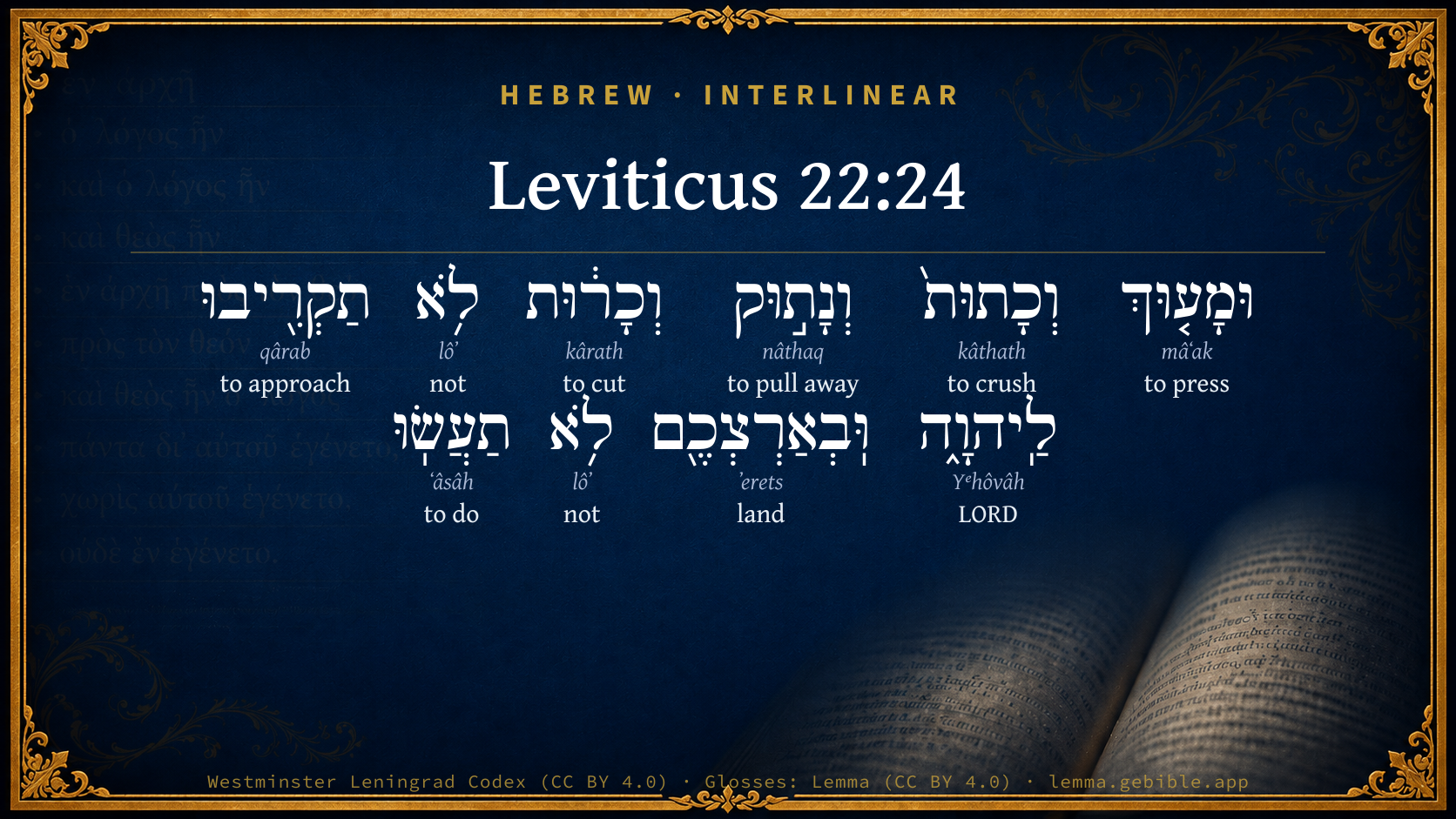
Leviticus 22:24

Hebrew (Westminster Leningrad Codex) Leviticus 22:24 appears in the Hebrew Old Testament. The text above is from the Westminster Leningrad Codex. Each word links to its Strong’s number, a concise gloss, and parsing drawn from the Open Scriptures Hebrew Bible morphology. Click any word for its full Brown-Driver-Briggs (BDB) entry.
Download image
Cite this verse

Leviticus 22:24 (World English Bible). Public Domain. Lemma interlinear Bible study tool, https://lemma.gebible.app/v/leviticus/22/24.

Show BibTeX & RIS
BibTeX
RIS
English Translation
That which has its testicles bruised, crushed, broken, or cut, you shall not offer to Yahweh; neither shall you do thus in your land.
World English Bible · Public Domain
Highlights
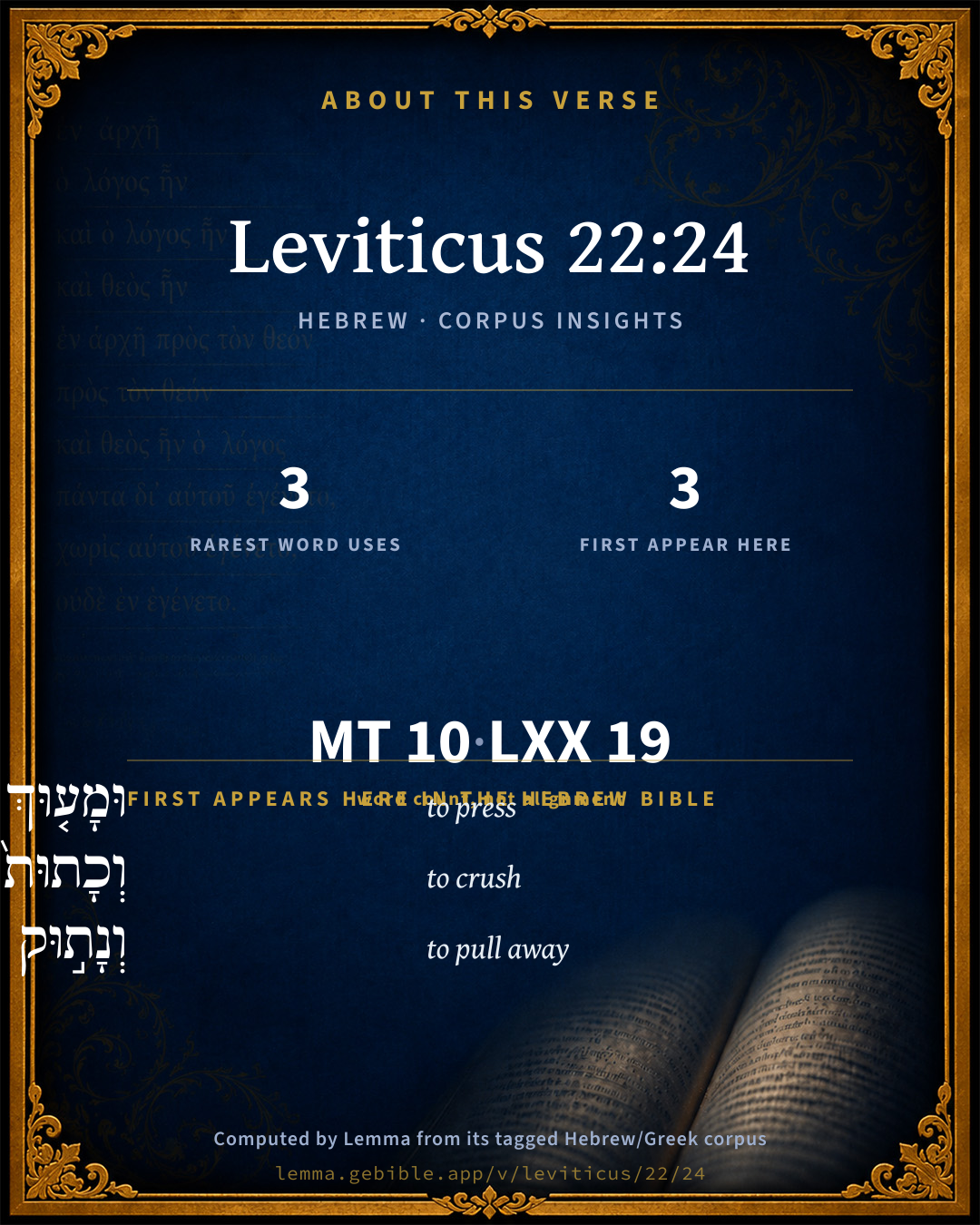
  • 3 first appearances in the Hebrew Bible
Full analysis ↓
Download a study sheet

One document with this verse’s original text, its word-by-word gloss line, the meaning frame, cross-references with their text, attributed commentary, and full source and license credits — printable, and it pastes into notes with its structure intact.

This verse Autodidact and up

Study sheet (.html) Plain text (.txt)

A passage Seminary Student

Up to 50 verses in one chapter. A passage sheet keeps up to 6 commentary sources and 12 cross-references per verse, in the order this page ranks them, and says so on the sheet whenever that leaves anything out. Ask for a single verse and you get the Autodidact verse sheet above.

Everything on this page stays free to read, with no account — the sheet is a download of what is already on screen, not access to it.

Want to remove ads? Support Godless Engineer
Compare translations 3

The same verse in 3 English versions, stacked beneath the original-language interlinear above. Click any original word for its lexicon entry.

Each is an independent rendering of the whole verse — the interlinear is not word-aligned to these translations.

Highlighted words mark where these versions differ — a whole-verse word diff, not a word-by-word alignment.

  • World English Bible Public Domain
    That which has its testicles bruised, crushed, broken, or cut, you shall not offer to Yahweh; neither shall you do thus in your land.
  • King James Version Public Domain
    Ye shall not offer unto the LORD that which is bruised, or crushed, or broken, or cut; neither shall ye make any offering thereof in your land.
  • unfoldingWord Literal Text CC BY-SA 4.0
    But bruised or crushed or torn or cut you shall not present to Yahweh, and in your land, you shall not do.

unfoldingWord Literal Text — © unfoldingWord, licensed CC BY-SA 4.0. Word-aligned USFM3 via Door43 (git.door43.org/unfoldingWord/en_ult).

Versions to compare (up to 4)

3 of 4 selected

Show all 18 translations

Every available English version of this verse, each an independent rendering of the whole verse.

  • World English Bible Public Domain
    That which has its testicles bruised, crushed, broken, or cut, you shall not offer to Yahweh; neither shall you do thus in your land.
  • Berean Standard Bible Public Domain
    You are not to present to the LORD an animal whose testicles are bruised, crushed, torn, or cut; you are not to sacrifice them in your land.
  • Majority Standard Bible Public Domain
    You are not to present to the LORD an animal whose testicles are bruised, crushed, torn, or cut; you are not to sacrifice them in your land.
  • King James Version Public Domain
    Ye shall not offer unto the LORD that which is bruised, or crushed, or broken, or cut; neither shall ye make any offering thereof in your land.
  • American Standard Version (1901) Public Domain
    That which hath its stones bruised, or crushed, or broken, or cut, ye shall not offer unto Jehovah; neither shall ye do `thus' in your land.
  • Revised Version (1885) Public Domain
    That which hath its stones bruised, or crushed, or broken, or cut, ye shall not offer unto the LORD; neither shall ye do thus in your land.
  • Geneva Bible (1599) Public Domain
    Ye shall not offer vnto ye Lord that which is bruised or crusshed, or broken, or cut away, neither shall ye make an offring thereof in your land,
  • Douay-Rheims (1899) Public Domain
    You shall not offer to the Lord any beast that hath the testicles bruised, or crushed, or cut and taken away: neither shall you do any such thing in your land.
  • Young's Literal Translation Public Domain
    As to a bruised, or beaten, or enlarged, or cut thing -- ye do not bring `it' near to Jehovah; even in your land ye do not do it.
  • Literal Standard Version CC BY-SA 4.0
    As for bruised, or beaten, or torn, or cut—you do not bring [it] near to YHWH; and in your land you do not do it.
  • Unlocked Literal Bible CC BY-SA 4.0
    Do not offer any animal to Yahweh that has bruised, crushed, torn, or cut testicles. Do not do this within your land.
  • unfoldingWord Literal Text CC BY-SA 4.0
    But bruised or crushed or torn or cut you shall not present to Yahweh, and in your land, you shall not do.
  • Darby Bible Public Domain
    That which is bruised, or crushed, or broken, or cut shall ye not present to Jehovah; neither in your land shall ye do [the like].
  • World Messianic Bible Public Domain
    You must not offer to the LORD that which has its testicles bruised, crushed, broken, or cut. You must not do this in your land.
  • Webster's Bible Public Domain
    Ye shall not offer to the LORD that which is bruised, or crushed, or broken, or cut; neither shall ye make any offering thereof in your land.
  • Free Bible Version CC BY-SA 4.0
    Don't present to the Lord an animal with testicles that are accidentally or deliberately damaged. You are not allowed to sacrifice any of these damaged animals in your land.
  • Bible in Basic English Public Domain
    An animal which has its sex parts damaged or crushed or broken or cut, may not be offered to the Lord; such a thing may not be done anywhere in your land.
  • JPS Tanakh (1917) Public Domain
    That which hath its stones bruised, or crushed, or torn, or cut, ye shall not offer unto the LORD; neither shall ye do thus in your land.

Literal Standard Version (2020), Covenant Press — licensed CC BY-SA 4.0. Text via the HelloAO Bible API (eBible.org). Unlocked Literal Bible (unfoldingWord) — licensed CC BY-SA 4.0. Text via the HelloAO Bible API (eBible.org). unfoldingWord Literal Text — © unfoldingWord, licensed CC BY-SA 4.0. Word-aligned USFM3 via Door43 (git.door43.org/unfoldingWord/en_ult). Free Bible Version, Dr. Jonathan Gallagher — licensed CC BY-SA 4.0. Text via the HelloAO Bible API (eBible.org).

Word by word

More ways to search: Search by grammar → Find every occurrence → Compare this word →

Practice this passage: Drill this verse → Learn its vocabulary →

וּמָע֤וּךְ
mâʻak
H4600
“and · pressed”
Conjunction + Verb, Qal, Participle Passive, Masculine, Singular, Absolute
Part of Speech
Conjunction + Verb
Stem
Qal
Form
Participle Passive
Gender
Masculine
Number
Singular
State
Absolute
Full BDB Definition

Origin: a primitive root

TWOT: 1229

to press, squeeze - (Qal) to be crushed - (Pual) to be handled, be pressed
  1. וְכָתוּת֙ kâthath H3807 “and · crushed” Conjunction + Verb, Qal, Participle Passive, Masculine, Singular, Absolute
  2. וְנָת֣וּק nâthaq H5423 “and · pulled away” Conjunction + Verb, Qal, Participle Passive, Masculine, Singular, Absolute
  3. וְכָר֔וּת kârath H3772 “and · cut” Conjunction + Verb, Qal, Participle Passive, Masculine, Singular, Absolute
  4. לֹ֥א lôʼ H3808 “not” Particle, Negative
  5. תַקְרִ֖יבוּ qârab H7126 “to approach” Verb, Hiphil, Imperfect, 2nd Person, Masculine, Plural
  6. לַֽיהוָ֑ה Yᵉhôvâh H3068 “to/for · LORD” Preposition + Noun, Proper
  7. וּֽבְאַרְצְכֶ֖ם ʼerets H776 “and · in/at · land · your” Conjunction + Preposition + Noun, Common, Both, Singular, Construct + Suffix, Personal, 2nd Person, Masculine, Plural
  8. לֹ֥א lôʼ H3808 “not” Particle, Negative
  9. תַעֲשֽׂוּ ʻâsâh H6213 “to do” Verb, Qal, Imperfect, 2nd Person, Masculine, Plural

About this verse

These counts appear in no published source. They are computed here, from the morphology-tagged text and Lemma’s own curated glosses. What Lemma adds →

10
words
9
distinct lemmas
Pentateuch
section

Notable vocabulary

The rarest word here is וּמָע֤וּךְ to press H4600 — appearing just 3 times in the whole Hebrew Bible.

First appearance in Scripture

These words make their first canonical appearance in the Hebrew Bible here:

  • וּמָע֤וּךְ to press H4600
  • וְכָתוּת֙ to crush H3807
  • וְנָת֣וּק to pull away H5423

Shared distinctive vocabulary

וּמָע֤וּךְ to press H4600 occurs in 3 verses of the Hebrew Bible. Also found in:

Grammatical profile

  • 6 verbs
  • 2 nouns
  • 2 particles

Verb forms

  • וּמָע֤וּךְ Qal · Participle Passive
  • וְכָתוּת֙ Qal · Participle Passive
  • וְנָת֣וּק Qal · Participle Passive
  • וְכָר֔וּת Qal · Participle Passive
  • תַקְרִ֖יבוּ Hiphil · Imperfect
  • תַעֲשֽׂוּ Qal · Imperfect

Repetition

A word recurs within this verse — often emphatic in Hebrew:

Hebrew & Septuagint length

In English translation the verse runs 24 words from the Hebrew and 28 from the Septuagint (LXX English) — closely comparable.

A rough comparison of the two English renderings, which tokenize alike — not a word-level alignment.

Word counts can differ between the Hebrew and the Greek without any difference in meaning — e.g. the Hebrew direct-object marker אֵת has no separate Greek word, and Greek often adds the article ὁ.

In the original languages it is 10 Hebrew tokens and 19 Greek tokens — but the two are counted differently (Hebrew bundles its prefixes and suffixes into one token; the Greek is in lemma form), so that isn’t a like-for-like length.

Cross-references

3

Topical passages linked to Leviticus 22:24 in the Treasury of Scripture Knowledge — connected by theme and wording, ordered by reader-vote popularity; previews shown in the World English Bible.

  • Leviticus 22:20 But whatever has a blemish, that you shall not offer: for it shall not be acceptable for you.
  • Deuteronomy 23:1 He who is wounded in the stones, or has his privy member cut off, shall not enter into the assembly of Yahweh.
  • Leviticus 21:20 or hunchbacked, or a dwarf, or one who has a defect in his eye, or an itching disease, or scabs, or who has damaged testicles;

Cross-references courtesy of OpenBible.info (CC BY 4.0).

Hebrew and Greek witnesses Masoretic Hebrew ↔ Greek Septuagint

The same verse in the two great witnesses to the Old Testament, shown verse-for-verse.

These are two independent witnesses, not word-aligned to each other, and the Septuagint is shown in lemma (dictionary) form.

Hebrew Leviticus 22:24 Masoretic · Westminster Leningrad Codex

וּמָע֤וּךְ וְכָתוּת֙ וְנָת֣וּק וְכָר֔וּת לֹ֥א תַקְרִ֖יבוּ לַֽיהוָ֑ה וּֽבְאַרְצְכֶ֖ם לֹ֥א תַעֲשֽׂוּ

That which has its testicles bruised, crushed, broken, or cut, you shall not offer to Yahweh; neither shall you do thus in your land.

World English Bible · Public Domain

Greek LXX Leviticus 22:24 Septuagint · lemma form

θλαδίας καί ἐκθλίβω καί ἐκτομίας καί ἀποσπάω οὐ προςἄγω αὐτός ὁ κύριος καί ἐπί ὁ γῆ σύ οὐ ποιέω

That which has broken testicles, or is crushed or gelt or mutilated, —you shall not offer them to the Lord, neither shall you⌃ sacrifice them upon your land.

LXX2012 (modern English Septuagint) · Public Domain

On this verse, Haydock's Catholic Bible Commentary discusses the Septuagint’s reading. Read the note in Commentary ↓

Hebrew: Westminster Leningrad Codex (CC BY 4.0). Greek: Septuagint (public domain); English from LXX2012 (modern English Septuagint) (Public Domain). How the Septuagint differs from the Hebrew →

Targum (Aramaic paraphrase)

2

The Targum is the ancient Jewish Aramaic paraphrase of the Hebrew Scriptures — an interpretive translation, not the Hebrew text itself. Onkelos (literal) and Pseudo-Jonathan (expansive) render the Torah, and Jonathan the Prophets. Coverage is partial: where no permissively-licensed English translation exists for a verse, only the Aramaic is shown. This is verse-level text, not a word-by-word alignment to the Hebrew.

  1. Targum Onkelos Torah (Genesis–Deuteronomy)
    וְדִי מְרִיס וְדִי רְסִיס וְדִי שְׁלִיף וְדִי גְזִיר לָא תְקָרְבוּן קֳדָם יְיָ וּבְאַרְעֲכוֹן לָא תַעְבְּדוּן

    (no public-domain English translation for this verse)

    Targum Onkelos — Aramaic: “Onkelos Genesis” (public domain); “Onkelos Exodus” (public domain); “Onkelos Leviticus” (public domain); “Onkelos Numbers” (public domain); “Onkelos Deuteronomy” (public domain). English: “Sefaria Community Translation” (CC0 1.0 (public-domain dedication)); “J.W. Etheridge. The Targums of Onkelos and Jonathan Ben Uzziel on the Pentateuch. London: Longmans, Green, 1862” (public domain). Text via Sefaria.

  2. Targum Pseudo-Jonathan Torah (Genesis–Deuteronomy)
    וּדְמָעִיךְ וּדְכָתִישִׁין פַּחֲדוֹי וְדִשְׁחִית וְדִמְרְסִיס גִדוֹי לָא תְקַרְבוּן לִשְׁמָא דַיְיָ וּבְאַרְעֲכוֹן לָא תְסַרְסוּן

    That which is crushed, or ruptured, or diseased, or enervated, you shall not offer to the Name of the Lord; and in your land you shall not emasculate.

    Targum Pseudo-Jonathan — Aramaic: “Targum Jonathan on Genesis” (public domain); “Targum Jonathan on Exodus” (public domain); “Targum Jonathan on Leviticus” (public domain); “Targum Jonathan on Numbers” (public domain); “Targum Jonathan on Deuteronomy” (public domain). English: “The Targum of Jonathan ben Uzziel, trans. J. W. Etheridge, London, 1862” (public domain). Text via Sefaria.

Commentary

Notes on Leviticus 22:24 from classic Christian and Jewish commentators (each source and its license shown beneath its notes). The classic Christian expositions comment on the surrounding passage and are grouped to its opening verse, so a note may address several verses; the Jewish commentaries on the Tanakh (Rashi and others) are per-verse, so they appear only where the commentator wrote on this verse.

Lemma curates 59 commentaries, every one of them public domain or Creative Commons licensed, each selected and text-cleaned for this edition rather than reprinted as found. About our sources →

Trapp's Complete Commentary

John Trapp

Lev 22:24 Ye shall not offer unto the LORD that which is bruised, or crushed, or broken, or cut; neither shall ye make [any offering thereof] in your land.

Ver. 24. Neither shall you make any offering.] No, not a freewill offering. Religion loves to lie clean. God will take up with a poor, but it must be a pure sacrifice.

John Trapp, A Commentary or Exposition upon All the Books of the Old and New Testament (1647–1656) — public domain. Text from a community e-Sword module.

Adam Clarke's Commentary

Verse 24. Bruised, or crushed, or broken, or cut] That is, no bullock or lamb that is injured in any of the above ways, shall be offered unto the Lord.

Adam Clarke's Commentary on the Bible (1810–1826) — public domain. Text from a community e-Sword/MySword module.

Ellicott's Commentary for English Readers

(24) That which is bruised, or crushed, or broken, or cut.—These four terms express the four ways which the ancients used to emasculate animals.

Neither shall ye make any offering thereof in your land.—Better, and this shall ye not do in your land; that is, not only are animals thus mutilated prohibited as offerings for the altar, but this practice of gelding is altogether forbidden to the Israelites with regard to any animal whatsoever throughout the country. This law is binding upon the orthodox Jews to this day, and the question has recently been discussed by some of their spiritual guides, since it seriously affects those of their community who are engaged in farming land.

A Bible Commentary for English Readers, edited by Charles John Ellicott (1878–1897) — public domain. Text from a community e-Sword module.

The Cambridge Bible for Schools and Colleges

gen. ed. J. J. S. Perowne

24. A reference to emasculation. Animals thus treated were forbidden to be offered.

The Cambridge Bible for Schools and Colleges (gen. ed. J. J. S. Perowne; Cambridge University Press, 1878–1918) — public domain. Text from a community e-Sword module.

John Gill's Exposition

Neither from a stranger's hand shall ye offer the bread of your God of any of these,.... That is, from a Gentile, a proselyte of the gate, who had renounced idolatry, and was willing to offer sacrifice to the true God; but what had such defects and blemishes in them as before described the priest might not take of his hands, and offer on the altar of God; and this is the rather observed, because on the one hand the Gentile might think such sacrifices would be acceptable, since he might have been used to offer such to idols; and on the other hand, the priest might think such would do well enough for Gentiles, though not for Israelites:

because their corruption is in them; or they are corrupt through being bruised, crushed, broken, or cut:

and blemishes be in them; which seems to be added to explain the former, and may have respect to all the blemishes before named, and whatsoever is included in them; for though there are but here mentioned, the Jews reckon no less than fifty (c):

they shall not be accepted for you; to make atonement for you; Jarchi says, or "from you", the priests; they shall not be accepted of the Lord from their hands, and so be of no avail to the offerers, nor to those for whom they are offered.

(c) Maimon. Hilchot Biath Hamikdash, c. 7. sect. 1, &c.

John Gill's Exposition of the Whole Bible (1746–1763) — public domain (CC PDM 1.0). Text via the HelloAO Bible API.

Albert Barnes' Notes on the Bible

The literal meaning of the passage in italics is, and this shall ye not do in your land. It appears to have been understood by the Jews as a prohibition of the mutilation of animals.

Albert Barnes' Notes on the Bible (1834–1885) — public domain. Text from a community e-Sword/MySword module.

Haydock's Catholic Bible Commentary

Bruised. Hebrew does not specify what part, no more than the Syriac or Arabic versions; but the Septuagint, Chaldean, Rabbins, and most commentators agree with us. --- Do any, &c. (faciatis.) You shall not sacrifice (Syriac) any thing that is rendered unfit to propagate its kind: neither shall you reduce either man or beast to that condition. (Josephus, contra Apion ii.; Rabbins)

George Leo Haydock (1774–1849), Haydock's Catholic Family Bible and Commentary, 1859 edition — public domain. Excludes Psalms (Douay-Rheims chapter numbering differs from Protestant) and Deuterocanonical books (Catholic canon only).

Whedon's Commentary on the Bible

Daniel D. Whedon

24. Bruised, crushed, broken, or cut — Here are four ways of castrating animals. Such victims are plainly prohibited for sacrifice, since they are not perfect. Neither shall ye make (such) in your land — This is evidently the meaning of this passage, instead of that given in the Authorized Version. The R.V. has “neither shall ye do thus in your land.” Josephus (Ant. Lev_4:8, § 40) says, “It is not lawful to geld either men or any other animals.” He regards such as of “a monstrous nature.”

Daniel D. Whedon (gen. ed.), Commentary on the Old and New Testaments (1874–1909) — public domain. Text from a community e-Sword module.

Keil & Delitzsch

C. F. Keil & F. Delitzsch

Castrated animals were not to be sacrificed, nor in fact to be kept in the land at all. מעוּך compressus, θλιβίας, an animal with the stones crushed; כּתוּת contusus, θλασίας, with them beaten to pieces; נתוּק avulsus, σπάδων, with them twisted off; כּרוּי excisus, τομίας or ἐκτομίας, with them cut off. In all these different ways was the operation performed among the ancients (cf. Aristot. hist. an. ix. 37, 3; Colum. vi. 26, vii. 11; Pallad. vi. 7). "And in your land ye shall not make," sc., וגו מעוּך, i.e., castrated animals, that is to say, "not castrate animals." This explanation, which is the one given by Josephus (Ant. iv. 8, 40) and all the Rabbins, is required by the expression "in your land," which does not at all suit the interpretation adopted by Clericus and Knobel, who understand by עשׂה the preparation of sacrifices, for sacrifices were never prepared outside the land. The castration of animals is a mutilation of God's creation, and the prohibition of it was based upon the same principle as that of mixing heterogeneous things in Lev 19:19.

Keil & Delitzsch — Biblical Commentary on the Old Testament (1861–1891) — public domain (CC PDM 1.0). Text via the HelloAO Bible API. (Old Testament only.)

unfoldingWord translationNotes

Door43 World Missions Community

must not present the bread of your God

Here "bread" represents food in general. God did not actually eat the sacrifices. Priests would offer the sacrifice on God's altar, and they would eat some of the meat. AT: "must not present an animal as a food offering to your God" (See: Synecdoche)

from the hand of a foreigner

The word "hand" represents the whole person. It is implied that Israelites could not use animals as a sacrifice to God if they bought it from a foreigner, because foreigners castrated their animals making them unacceptable to God. AT: "that a foreigner has given you, because they castrate their animals" (See: Synecdoche and Assumed Knowledge and Implicit Information)

they will not be accepted for you

This can be stated in active form. AT: "Yahweh will not accept them from you" (See: Active or Passive)

translationWords

Yahweh

hand

God

unfoldingWord translationNotes — © Distant Shores Media and the Door43 World Missions Community, licensed CC BY-SA 4.0. Source: git.door43.org/Door43/en_tn.

Rashi

Rabbi Shlomo Yitzchaki (Rashi)

ומעוך וכתות ונתוק וכרות are forbidden as sacrifices whether the mutilation be in the testicles or the membrum.

מעוך means, one whose testicles have been pressed by hand.

כתות CRUSHED — it implies more severely crushed than מעוך.

נתוק — they have been torn off by the hand, so that the threads on which they hang have snapped but they are still in the scrotum, the scrotum itself not having been torn off.

וכרות — they have been cut away by an instrument but are still in the scrotum (cf. Sifra, Emor, Chapter 7 9; Bekhorot 39b).

[ומעוך — Its translation in the Targum is, ודי מריס; this is its exact translation in Aramaic, because this Aramaic root has the meaning of pounding.

וכתות, however, is translated by the Targum ודי רסיס “and that which is smashed”, (a stronger term than מרס), similar to, Amos 6:11) “The great house shall be smitten into רסיסים‎” i. e. into small fragments; similar is the Talmudical expression (Shabbat 80b) a reed crushed to pieces (מרוסס‎‎‎‎)].

ובארצכם לא תעשו NEITHER SHALL YE DO IN YOUR LAND this thing — to castrate any cattle or beast even if it be unclean. That is why Scripture adds “in your land” — to include every animal that is in your land under this law (cf. Chagigah 14b and Tosafot there). For it is impossible to say that they are here commanded to abstain from mutilating animals in the Land of Israel only, (and that the word must be translated: “In your land you must not do this”, implying, but you may do it elsewhere) for surely the command regarding mutilation is a personal duty and any personal duty has to be practiced both in the Land and outside the Land (Kiddushin 36b; cf. Sifra, Emor, Chapter 7 11).

Rashi on the Tanakh — English translations: “The Judaica Press complete Tanach with Rashi, translated by A. J. Rosenberg” (CC BY 4.0); “Pentateuch with Rashi's commentary by M. Rosenbaum and A.M. Silbermann, 1929-1934” (public domain); “The Metsudah Tanach series, Lakewood, N.J” (CC BY 4.0); and “The Book of Joshua, Metsudah Publications, 1997” (CC BY 4.0). Text via Sefaria.

Lesson kit

Teaching starters — assembled from the data on this page, not authored interpretation. Every prompt links to the verse data it draws on. Edit before teaching.

Leviticus, in the Pentateuch, opens this verse with 10 words (9 distinct Hebrew lemmas). Its most distinctive word is mâʻak (“to press”). A historical commentator’s framing appears above. Read the whole chapter for the surrounding context.

Discussion questions

  1. How does “to press” (mâʻak) shape what this verse is saying?
  2. 3 words here appear for the first time in Scripture. What is being introduced at this debut?
  3. 1 Samuel 26:7 shares the word «to press» with this verse. How do the two illuminate each other?
  4. “not” occurs 2× in this one verse. What is the effect of the repetition?
  5. These translations render this verse differently; the difference is in the English rendering, not the original. What questions does that raise?
  6. The verb «וּמָע֤וּךְ» is Qal Participle Passive. How does its form color the action?
  7. Reading how Trapp's Complete Commentary and Adam Clarke's Commentary read this verse, where do the two commentators agree and where do they part?

Things to notice

Reading settings

Reading text

Shown beneath each verse's original-language words.

Old Testament
Old Testament edition

Read the OT as the Masoretic Hebrew (MT) or the Greek Septuagint (LXX).

English shown for the Greek Septuagint (in the Hebrew ↔ Greek comparison).

Comparing translations? Open the Compare panel on any verse page to stack up to four side by side.