Genesis 21:32

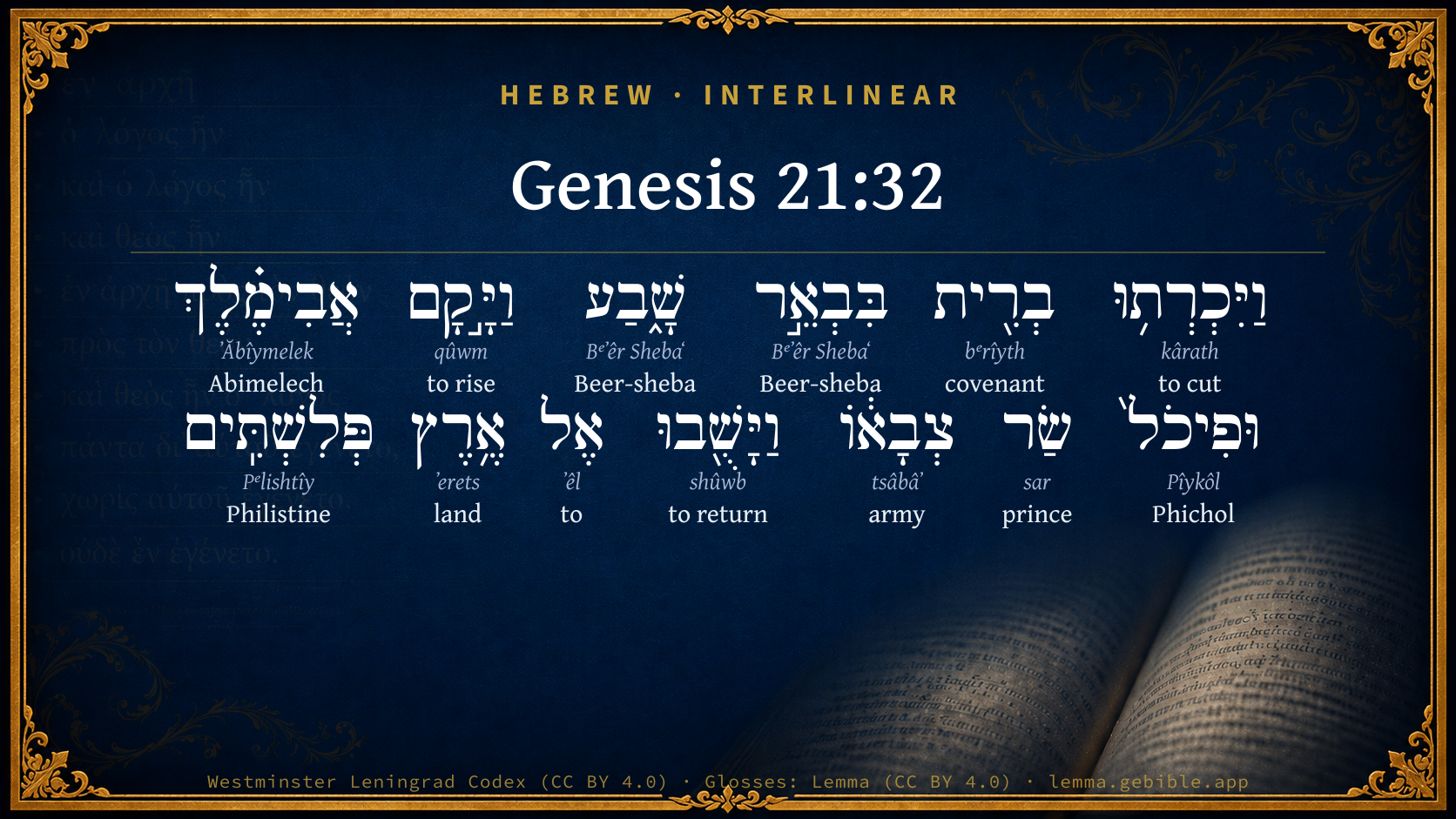
Hebrew (Westminster Leningrad Codex) Genesis 21:32 appears in the Hebrew Old Testament. The text above is from the Westminster Leningrad Codex. Each word links to its Strong’s number, a concise gloss, and parsing drawn from the Open Scriptures Hebrew Bible morphology. Click any word for its full Brown-Driver-Briggs (BDB) entry.
Download image
Cite this verse

Genesis 21:32 (World English Bible). Public Domain. Lemma interlinear Bible study tool, https://lemma.gebible.app/v/genesis/21/32.

Show BibTeX & RIS
BibTeX
RIS
English Translation
So they made a covenant at Beersheba. Abimelech rose up with Phicol, the captain of his host, and they returned into the land of the Philistines.
World English Bible · Public Domain
Download a study sheet

One document with this verse’s original text, its word-by-word gloss line, the meaning frame, cross-references with their text, attributed commentary, and full source and license credits — printable, and it pastes into notes with its structure intact.

This verse Autodidact and up

Study sheet (.html) Plain text (.txt)

A passage Seminary Student

Up to 50 verses in one chapter. A passage sheet keeps up to 6 commentary sources and 12 cross-references per verse, in the order this page ranks them, and says so on the sheet whenever that leaves anything out. Ask for a single verse and you get the Autodidact verse sheet above.

Everything on this page stays free to read, with no account — the sheet is a download of what is already on screen, not access to it.

Want to remove ads? Support Godless Engineer
Compare translations 3

The same verse in 3 English versions, stacked beneath the original-language interlinear above. Click any original word for its lexicon entry.

Each is an independent rendering of the whole verse — the interlinear is not word-aligned to these translations.

Highlighted words mark where these versions differ — a whole-verse word diff, not a word-by-word alignment.

  • World English Bible Public Domain
    So they made a covenant at Beersheba. Abimelech rose up with Phicol, the captain of his host, and they returned into the land of the Philistines.
  • King James Version Public Domain
    Thus they made a covenant at Beersheba: then Abimelech rose up, and Phichol the chief captain of his host, and they returned into the land of the Philistines.
  • unfoldingWord Literal Text CC BY-SA 4.0
    So they cut the covenant at Beersheba. Then Abimelech and Phicol, the commander of his army, got up and returned to the land of the Philistines.

unfoldingWord Literal Text — © unfoldingWord, licensed CC BY-SA 4.0. Word-aligned USFM3 via Door43 (git.door43.org/unfoldingWord/en_ult).

Versions to compare (up to 4)

3 of 4 selected

Show all 18 translations

Every available English version of this verse, each an independent rendering of the whole verse.

  • World English Bible Public Domain
    So they made a covenant at Beersheba. Abimelech rose up with Phicol, the captain of his host, and they returned into the land of the Philistines.
  • Berean Standard Bible Public Domain
    After they had made the covenant at Beersheba, Abimelech and Phicol the commander of his army got up and returned to the land of the Philistines.
  • Majority Standard Bible Public Domain
    After they had made the covenant at Beersheba, Abimelech and Phicol the commander of his army got up and returned to the land of the Philistines.
  • King James Version Public Domain
    Thus they made a covenant at Beersheba: then Abimelech rose up, and Phichol the chief captain of his host, and they returned into the land of the Philistines.
  • American Standard Version (1901) Public Domain
    So they made a covenant at Beer-sheba. And Abimelech rose up, and Phicol the captain of his host, and they returned into the land of the Philistines.
  • Revised Version (1885) Public Domain
    So they made a covenant at Beer-sheba: and Abimelech rose up, and Phicol the captain of his host, and they returned into the land of the Philistines.
  • Geneva Bible (1599) Public Domain
    Thus made they a couenant at Beer-sheba: afterward Abimelech and Phichol his chiefe captaine rose vp, and turned againe vnto the land of the Philistims.
  • Douay-Rheims (1899) Public Domain
    And they made a league for the well of oath.
  • Young's Literal Translation Public Domain
    And they make a covenant in Beer-Sheba, and Abimelech riseth -- Phichol also, head of his host -- and they turn back unto the land of the Philistines;
  • Literal Standard Version CC BY-SA 4.0
    And they make a covenant in Beer-Sheba, and Abimelech rises—Phichol also, head of his host—and they return to the land of the Philistines;
  • Unlocked Literal Bible CC BY-SA 4.0
    They made a covenant at Beersheba, and then Abimelech and Phicol, the captain of his army, returned to the land of the Philistines.
  • unfoldingWord Literal Text CC BY-SA 4.0
    So they cut the covenant at Beersheba. Then Abimelech and Phicol, the commander of his army, got up and returned to the land of the Philistines.
  • Darby Bible Public Domain
    And they made a covenant at Beer-sheba. And Abimelech rose up, and Phichol the captain of his host, and returned into the land of the Philistines.
  • World Messianic Bible Public Domain
    So they made a covenant at Beersheba. Abimelech rose up with Phicol, the captain of his army, and they returned into the land of the Philistines.
  • Webster's Bible Public Domain
    Thus they made a covenant at Beer-sheba: Then Abimelech arose, and Phichol the chief captain of his host, and they returned into the land of the Philistines.
  • Free Bible Version CC BY-SA 4.0
    After making the agreement at Beersheba, Abimelech and Phicol the commander of his army left and went home to the country of the Philistines.
  • Bible in Basic English Public Domain
    So they made an agreement at Beer-sheba, and Abimelech and Phicol, the captain of his army, went back to the land of the Philistines.
  • JPS Tanakh (1917) Public Domain
    So they made a covenant at Beer-sheba; and Abimelech rose up, and Phicol the captain of his host, and they returned into the land of the Philistines.

Literal Standard Version (2020), Covenant Press — licensed CC BY-SA 4.0. Text via the HelloAO Bible API (eBible.org). Unlocked Literal Bible (unfoldingWord) — licensed CC BY-SA 4.0. Text via the HelloAO Bible API (eBible.org). unfoldingWord Literal Text — © unfoldingWord, licensed CC BY-SA 4.0. Word-aligned USFM3 via Door43 (git.door43.org/unfoldingWord/en_ult). Free Bible Version, Dr. Jonathan Gallagher — licensed CC BY-SA 4.0. Text via the HelloAO Bible API (eBible.org).

Word by word

More ways to search: Search by grammar → Find every occurrence → Compare this word →

Practice this passage: Drill this verse → Learn its vocabulary →

וּפִיכֹל֙
Pîykôl
H6369
“and · Phichol”
Conjunction + Noun, Proper
Part of Speech
Conjunction + Noun
Type
Proper
Full BDB Definition

Origin: apparently from H6310 and H3605

TWOT: None

Phichol = "strong" - chief captain of the army of king Abimelech of the Philistines of Gerar in the days of Abraham and Isaac
  1. וַיִּכְרְת֥וּ kârath H3772 “and · to cut” Conjunction + Verb, Qal, Sequential Imperfect, 3rd Person, Masculine, Plural
  2. בְרִ֖ית bᵉrîyth H1285 “covenant” Noun, Common, Feminine, Singular, Absolute
  3. בִּבְאֵ֣ר Bᵉʼêr Shebaʻ H884 “in/at · Beer-sheba” Preposition + Noun, Proper
  4. שָׁ֑בַע Bᵉʼêr Shebaʻ H884 “Beer-sheba” Noun, Proper
  5. וַיָּ֣קָם qûwm H6965 “and · to rise” Conjunction + Verb, Qal, Sequential Imperfect, 3rd Person, Masculine, Singular
  6. אֲבִימֶ֗לֶךְ ʼĂbîymelek H40 “Abimelech” Noun, Proper
  7. שַׂר sar H8269 “prince of” Noun, Common, Masculine, Singular, Construct
  8. צְבָא֔וֹ tsâbâʼ H6635 “army · his” Noun, Common, Both, Singular, Construct + Suffix, Personal, 3rd Person, Masculine, Singular
  9. וַיָּשֻׁ֖בוּ shûwb H7725 “and · to return” Conjunction + Verb, Qal, Sequential Imperfect, 3rd Person, Masculine, Plural
  10. אֶל ʼêl H413 “to” Preposition
  11. אֶ֥רֶץ ʼerets H776 “land of” Noun, Common, Both, Singular, Construct
  12. פְּלִשְׁתִּֽים Pᵉlishtîy H6430 “Philistines” Noun, Gentilic, Masculine, Plural, Absolute

About this verse

These counts appear in no published source. They are computed here, from the morphology-tagged text and Lemma’s own curated glosses. What Lemma adds →

13
words
12
distinct lemmas
Pentateuch
section

Notable vocabulary

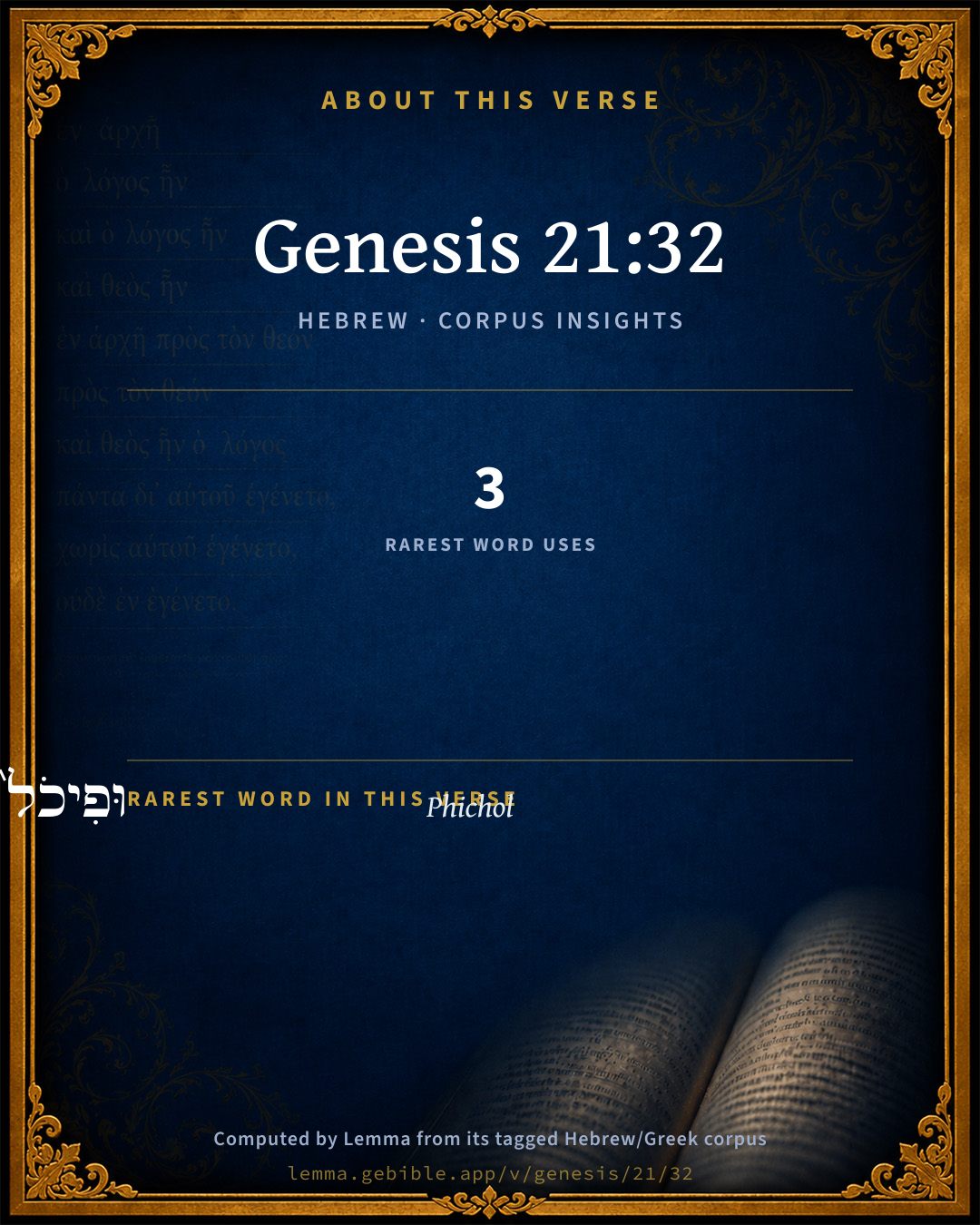
The rarest word here is וּפִיכֹל֙ Phichol H6369 — appearing just 3 times in the whole Hebrew Bible.

Shared distinctive vocabulary

וּפִיכֹל֙ Phichol H6369 occurs in 3 verses of the Hebrew Bible. Also found in:

Grammatical profile

  • 3 verbs
  • 9 nouns
  • 1 preposition

Verb forms

  • וַיִּכְרְת֥וּ Qal · Sequential Imperfect
  • וַיָּ֣קָם Qal · Sequential Imperfect
  • וַיָּשֻׁ֖בוּ Qal · Sequential Imperfect

Repetition

A word recurs within this verse — often emphatic in Hebrew:

  • בִּבְאֵ֣ר Beer-sheba H884 ×2

Hebrew & Septuagint length

In English translation the verse runs 26 words from the Hebrew and 35 from the Septuagint (LXX English) — closely comparable.

A rough comparison of the two English renderings, which tokenize alike — not a word-level alignment.

Word counts can differ between the Hebrew and the Greek without any difference in meaning — e.g. the Hebrew direct-object marker אֵת has no separate Greek word, and Greek often adds the article ὁ.

Cross-references

9

Topical passages linked to Genesis 21:32 in the Treasury of Scripture Knowledge — connected by theme and wording, ordered by reader-vote popularity; previews shown in the World English Bible.

  • Genesis 10:14 Pathrusim, Casluhim (which the Philistines descended from), and Caphtorim.
  • Genesis 14:13 One who had escaped came and told Abram, the Hebrew. Now he lived by the oaks of Mamre, the Amorite, brother of Eshcol, and brother of Aner; and these were allies of Abram.
  • Genesis 21:27 Abraham took sheep and oxen, and gave them to Abimelech. Those two made a covenant.
  • Genesis 26:8 It happened, when he had been there a long time, that Abimelech king of the Philistines looked out at a window, and saw, and, behold, Isaac was caressing Rebekah, his wife.
  • Genesis 26:14 He had possessions of flocks, possessions of herds, and a great household. The Philistines envied him.
  • Genesis 31:53 The God of Abraham, and the God of Nahor, the God of their father, judge between us." Then Jacob swore by the fear of his father, Isaac.
  • Exodus 13:17 It happened, when Pharaoh had let the people go, that God didn't lead them by the way of the land of the Philistines, although that was near; for God said, "Lest perhaps the people change their minds when they see war, and they return to Egypt;"
  • Judges 13:1 The children of Israel again did that which was evil in the sight of Yahweh; and Yahweh delivered them into the hand of the Philistines forty years.
  • 1 Samuel 18:3 Then Jonathan and David made a covenant, because he loved him as his own soul.

Cross-references courtesy of OpenBible.info (CC BY 4.0).

Hebrew and Greek witnesses Masoretic Hebrew ↔ Greek Septuagint

The same verse in the two great witnesses to the Old Testament, shown verse-for-verse.

These are two independent witnesses, not word-aligned to each other, and the Septuagint is shown in lemma (dictionary) form.

Hebrew Genesis 21:32 Masoretic · Westminster Leningrad Codex

וַיִּכְרְת֥וּ בְרִ֖ית בִּבְאֵ֣ר שָׁ֑בַע וַיָּ֣קָם אֲבִימֶ֗לֶךְ וּפִיכֹל֙ שַׂר צְבָא֔וֹ וַיָּשֻׁ֖בוּ אֶל אֶ֥רֶץ פְּלִשְׁתִּֽים

So they made a covenant at Beersheba. Abimelech rose up with Phicol, the captain of his host, and they returned into the land of the Philistines.

World English Bible · Public Domain

Greek LXX Genesis 21:32 Septuagint · lemma form

καί διατίθημι διαθήκη ἐν ὁ φρέαρ ὁ ὅρκος ἀναἵστημι δέ αβιμελεχ καί οχοζαθ ὁ νυμφαγωγός αὐτός καί φικολ ὁ ἀρχιστράτηγος ὁ δύναμις αὐτός καί ἐπιστρέφω εἰς ὁ γῆ ὁ φυλιστιιμ

And they made a covenant at the well of the oath. And there rose up Abimelech, Ochozath his friend, and Phichol the commander-in-chief of his army, and they returned to the land of the Phylistines.

LXX2012 (modern English Septuagint) · Public Domain

Hebrew: Westminster Leningrad Codex (CC BY 4.0). Greek: Septuagint (public domain); English from LXX2012 (modern English Septuagint) (Public Domain). How the Septuagint differs from the Hebrew →

Targum (Aramaic paraphrase)

2

The Targum is the ancient Jewish Aramaic paraphrase of the Hebrew Scriptures — an interpretive translation, not the Hebrew text itself. Onkelos (literal) and Pseudo-Jonathan (expansive) render the Torah, and Jonathan the Prophets. Coverage is partial: where no permissively-licensed English translation exists for a verse, only the Aramaic is shown. This is verse-level text, not a word-by-word alignment to the Hebrew.

  1. Targum Onkelos Torah (Genesis–Deuteronomy)
    וּגְזָרוּ קְיָם בִּבְאֵר שָׁבַע וְקָם אֲבִימֶלֶךְ וּפִיכֹל רַב חֵילֵהּ וְתָבוּ לְאַרַע פְּלִשְׁתָּאֵי

    (no public-domain English translation for this verse)

    Targum Onkelos — Aramaic: “Onkelos Genesis” (public domain); “Onkelos Exodus” (public domain); “Onkelos Leviticus” (public domain); “Onkelos Numbers” (public domain); “Onkelos Deuteronomy” (public domain). English: “Sefaria Community Translation” (CC0 1.0 (public-domain dedication)); “J.W. Etheridge. The Targums of Onkelos and Jonathan Ben Uzziel on the Pentateuch. London: Longmans, Green, 1862” (public domain). Text via Sefaria.

  2. Targum Pseudo-Jonathan Torah (Genesis–Deuteronomy)
    וּגְזָרוּ קְיָים בְּבֵרָא דְשֶׁבַע חוּרְפַן וְקָם אֲבִימֶלֶךְ וּפִיכוֹל רַב חֵילֵיהּ וְתָבוּ לְאַרַע פְּלִישְׁתָּאֵי

    And they struck a covenant at the Well of the Seven Lambs. And Abimelek and Phikol the Chief of his host arose and returned to the land of the Philistaee.

    Targum Pseudo-Jonathan — Aramaic: “Targum Jonathan on Genesis” (public domain); “Targum Jonathan on Exodus” (public domain); “Targum Jonathan on Leviticus” (public domain); “Targum Jonathan on Numbers” (public domain); “Targum Jonathan on Deuteronomy” (public domain). English: “The Targum of Jonathan ben Uzziel, trans. J. W. Etheridge, London, 1862” (public domain). Text via Sefaria.

Commentary

Notes on Genesis 21:32 from classic Christian and Jewish commentators (each source and its license shown beneath its notes). The classic Christian expositions comment on the surrounding passage and are grouped to its opening verse, so a note may address several verses; the Jewish commentaries on the Tanakh (Rashi and others) are per-verse, so they appear only where the commentator wrote on this verse.

Lemma curates 59 commentaries, every one of them public domain or Creative Commons licensed, each selected and text-cleaned for this edition rather than reprinted as found. About our sources →

Trapp's Complete Commentary

John Trapp

Gen 21:32 Thus they made a covenant at Beersheba: then Abimelech rose up, and Phichol the chief captain of his host, and they returned into the land of the Philistines.

Ver. 32. A covenant.] Foedus , παρα το πεποιθεναι {a}

{a} Sic fidus , παρα το πειθειν

John Trapp, A Commentary or Exposition upon All the Books of the Old and New Testament (1647–1656) — public domain. Text from a community e-Sword module.

Tyndale Open Study Notes

Tyndale Open Resources

21:32 The Philistines in Genesis are different from the Philistines of Judges through Kings. The earlier Philistines had Semitic names (e.g., Abimelech) and Canaanite culture. The later Philistines were apparently of Greek origin, with Greek customs and culture. They seem to have arrived in Canaan by sea from the Aegean area around 1200 BC, during the time of the judges. Probably the name of the later Philistines was used here simply to describe the region’s earlier inhabitants.

Tyndale Open Study Notes — © Tyndale Open Resources, licensed CC BY-SA 4.0. Text via the HelloAO Bible API.

Geneva Bible (1599)

Geneva Bible translators

Thus we see that the godly, as touching outward things may make peace with the wicked that know not the true God.

Geneva Bible (1599) marginal notes — public domain. Text via Bolls.life.

The Cambridge Bible for Schools and Colleges

gen. ed. J. J. S. Perowne

32. returned into the land of the Philistines] The reference to the Philistines is an anachronism. It is doubtful whether the Philistines occupied S. E. Palestine before the reign of Raamses III (1202–1172 b.c.). See Gen_26:1.

The Cambridge Bible for Schools and Colleges (gen. ed. J. J. S. Perowne; Cambridge University Press, 1878–1918) — public domain. Text from a community e-Sword module.

Matthew Poole's English Annotations

1891 i.e. Into their part of that land, to wit, Gerar, which was not far from this place. It is a usual synecdoche, whereby the whole land is put for a part of it; otherwise they were at this time in that land.

Matthew Poole's English Annotations on the Holy Bible (1683–1685) — public domain. Text from a community e-Sword/MySword module.

Whedon's Commentary on the Bible

Daniel D. Whedon

32. Returned into the land of the Philistines — That is, into its more central part. The limits of the territory claimed by them was probably in that age ill-defined and variable, and their chief cities much farther to the south than the later pentapolis of the Mediterranean plain. Beer-sheba appears, from Gen_21:34, to have been on the border of the Philistine territory, in which the patriarchs long sojourned.

Daniel D. Whedon (gen. ed.), Commentary on the Old and New Testaments (1874–1909) — public domain. Text from a community e-Sword module.

Ramban (Nachmanides)

Rabbi Moshe ben Nachman (Ramban / Nachmanides)

AND THEY RETURNED TO THE LAND OF THE PHILISTINES. The sense of the verse is that they returned to their city which was in the land of the Philistines for they lived in the land of the Philistines. However, they abode in Gerar, which was the royal capital, while Abraham dwelled in Beer-sheba, which is in the land of the Philistines, in the valley of Gerar.

Ramban (Nachmanides) on the Tanakh — English translation: “Commentary on the Torah by Ramban (Nachmanides). Translated and annotated by Charles B. Chavel. New York, Shilo Pub. House, 1971-1976” (CC BY 4.0). Text via Sefaria.

Radak

Rabbi David Kimhi (Radak)

ויכרתו...ויקם אבימלך, Avraham remained at Beer Sheva with his flocks for a day or two longer before returning to the land of the Philistines to his house in Gerar.

Radak on the Tanakh — English translations: “Sefaria Community Translation” (CC0 1.0 (public-domain dedication)); “Eliyahu Munk, HaChut Hameshulash” (CC BY 4.0); “Rabbi Mike Feuer, Jerusalem Anthology” (CC BY 4.0); and “R. David Kimhi on the first book of Psalms, Translated by R.G. Finch, London, 1919” (public domain). Text via Sefaria.

Lesson kit

Teaching starters — assembled from the data on this page, not authored interpretation. Every prompt links to the verse data it draws on. Edit before teaching.

Genesis, in the Pentateuch, opens this verse with 13 words (12 distinct Hebrew lemmas). Its most distinctive word is Pîykôl (“Phichol”). A historical commentator’s framing appears above. Read the whole chapter for the surrounding context.

Discussion questions

  1. How does “Phichol” (Pîykôl) shape what this verse is saying?
  2. Genesis 21:22 shares the word «Phichol» with this verse. How do the two illuminate each other?
  3. “Beer-sheba” occurs 2× in this one verse. What is the effect of the repetition?
  4. These translations render this verse differently. What is at stake in choosing one wording over another?
  5. The verb «וַיִּכְרְת֥וּ» is Qal Sequential Imperfect. How does its form color the action?
  6. Reading how Trapp's Complete Commentary and Tyndale Open Study Notes read this verse, where do the two commentators agree and where do they part?

Things to notice

Reading settings

Reading text

Shown beneath each verse's original-language words.

Old Testament
Old Testament edition

Read the OT as the Masoretic Hebrew (MT) or the Greek Septuagint (LXX).

English shown for the Greek Septuagint (in the Hebrew ↔ Greek comparison).

Comparing translations? Open the Compare panel on any verse page to stack up to four side by side.