
2 Chronicles 2:10

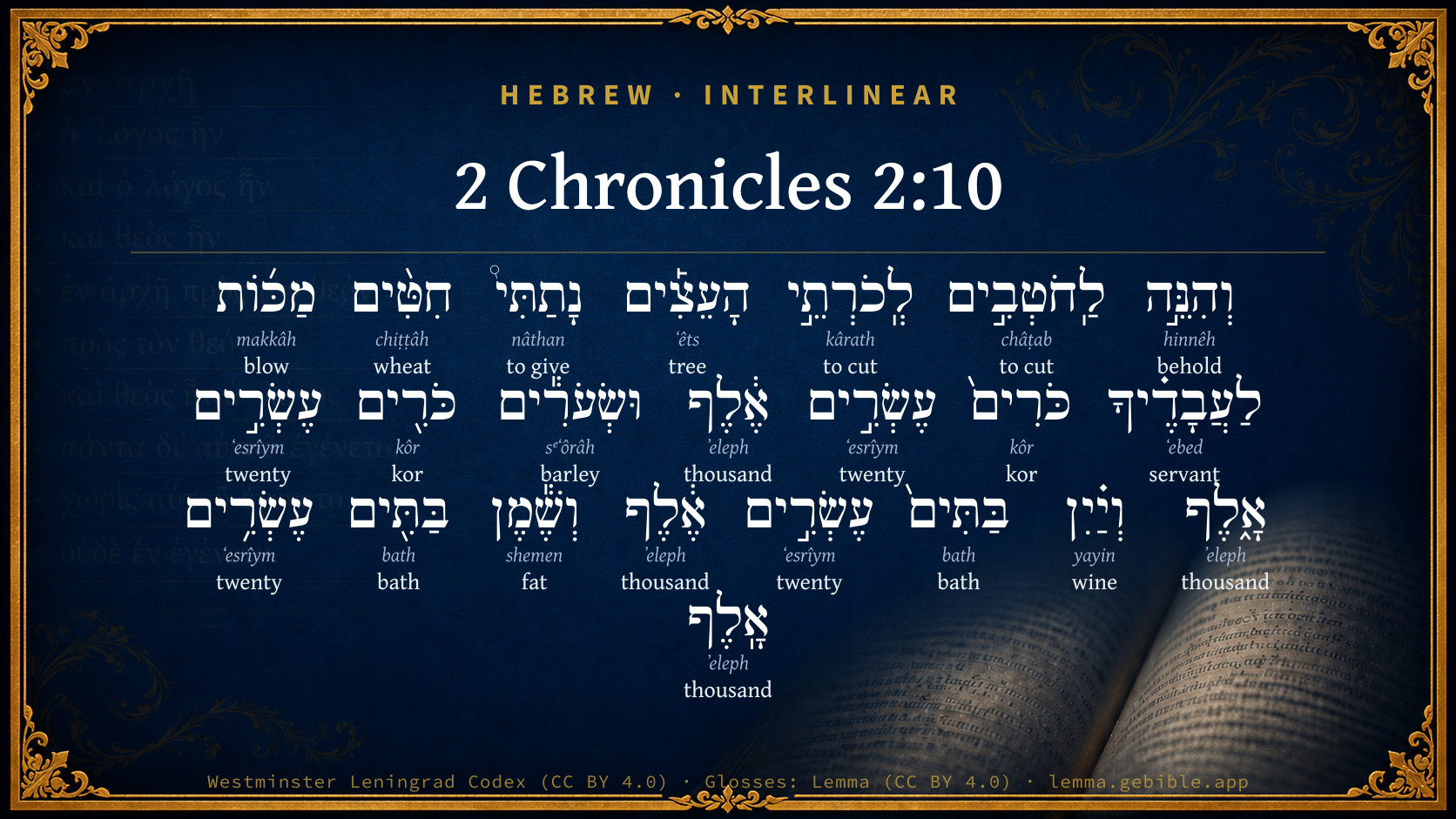
Hebrew (Westminster Leningrad Codex) 2 Chronicles 2:10 appears in the Hebrew Old Testament. The text above is from the Westminster Leningrad Codex. Each word links to its Strong’s number, a concise gloss, and parsing drawn from the Open Scriptures Hebrew Bible morphology. Click any word for its full Brown-Driver-Briggs (BDB) entry.
Download image
Cite this verse

2 Chronicles 2:10 (World English Bible). Public Domain. Lemma interlinear Bible study tool, https://lemma.gebible.app/v/2-chronicles/2/10.

Show BibTeX & RIS
BibTeX
RIS
English Translation
Behold, I will give to your servants, the cutters who cut timber, twenty thousand measures of beaten wheat, and twenty thousand measures of barley, and twenty thousand baths of wine, and twenty thousand baths of oil.
World English Bible · Public Domain
Download a study sheet

One document with this verse’s original text, its word-by-word gloss line, the meaning frame, cross-references with their text, attributed commentary, and full source and license credits — printable, and it pastes into notes with its structure intact.

This verse Autodidact and up

Study sheet (.html) Plain text (.txt)

A passage Seminary Student

Up to 50 verses in one chapter. A passage sheet keeps up to 6 commentary sources and 12 cross-references per verse, in the order this page ranks them, and says so on the sheet whenever that leaves anything out. Ask for a single verse and you get the Autodidact verse sheet above.

Everything on this page stays free to read, with no account — the sheet is a download of what is already on screen, not access to it.

Want to remove ads? Support Godless Engineer
Compare translations 3

The same verse in 3 English versions, stacked beneath the original-language interlinear above. Click any original word for its lexicon entry.

Each is an independent rendering of the whole verse — the interlinear is not word-aligned to these translations.

Highlighted words mark where these versions differ — a whole-verse word diff, not a word-by-word alignment.

  • World English Bible Public Domain
    Behold, I will give to your servants, the cutters who cut timber, twenty thousand measures of beaten wheat, and twenty thousand measures of barley, and twenty thousand baths of wine, and twenty thousand baths of oil.
  • King James Version Public Domain
    And, behold, I will give to thy servants, the hewers that cut timber, twenty thousand measures of beaten wheat, and twenty thousand measures of barley, and twenty thousand baths of wine, and twenty thousand baths of oil.
  • unfoldingWord Literal Text CC BY-SA 4.0
    And behold, to the wood cutters, to the ones who cut the trees, I will give crushed wheat to your servants 20,000 cors, and barley 20,000 cors, and wine 20,000 baths, and oil 20,000 baths.”

unfoldingWord Literal Text — © unfoldingWord, licensed CC BY-SA 4.0. Word-aligned USFM3 via Door43 (git.door43.org/unfoldingWord/en_ult).

Versions to compare (up to 4)

3 of 4 selected

Show all 18 translations

Every available English version of this verse, each an independent rendering of the whole verse.

  • World English Bible Public Domain
    Behold, I will give to your servants, the cutters who cut timber, twenty thousand measures of beaten wheat, and twenty thousand measures of barley, and twenty thousand baths of wine, and twenty thousand baths of oil.
  • Berean Standard Bible Public Domain
    I will pay your servants, the woodcutters, 20,000 cors of ground wheat, 20,000 cors of barley, 20,000 baths of wine, and 20,000 baths of olive oil.”
  • Majority Standard Bible Public Domain
    I will pay your servants, the woodcutters, 20,000 cors of ground wheat, 20,000 cors of barley, 20,000 baths of wine, and 20,000 baths of olive oil.”
  • King James Version Public Domain
    And, behold, I will give to thy servants, the hewers that cut timber, twenty thousand measures of beaten wheat, and twenty thousand measures of barley, and twenty thousand baths of wine, and twenty thousand baths of oil.
  • American Standard Version (1901) Public Domain
    And, behold, I will give to thy servants, the hewers that cut timber, twenty thousand measures of beaten wheat, and twenty thousand measures of barley, and twenty thousand baths of wine, and twenty thousand baths of oil.
  • Revised Version (1885) Public Domain
    And, behold, I will give to thy servants, the hewers that cut timber, twenty thousand measures of beaten wheat, and twenty thousand measures of barley, and twenty thousand baths of wine, and twenty thousand baths of oil.
  • Geneva Bible (1599) Public Domain
    And behold, I will giue to thy seruants the cutters and the hewers of timber twentie thousand measures of beaten wheate, and twentie thousand measures of barley, and twentie thousand baths of wine, and twentie thousand baths of oyle.
  • Douay-Rheims (1899) Public Domain
    And I will give thy servants the workmen that are to cut down the trees, for their food twenty thousand cores of wheat, and as many cores of barley, and twenty thousand measures of wine, and twenty thousand measures of oil.
  • Young's Literal Translation Public Domain
    `And lo, to hewers, to those cutting the trees, I have given beaten wheat to thy servants, cors twenty thousand, and barley, cors twenty thousand, and wine, baths twenty thousand, and oil, baths twenty thousand.'
  • Literal Standard Version CC BY-SA 4.0
    And behold, I have given to your servants, to hewers, to those cutting the trees, twenty thousand cors of beaten wheat, and twenty thousand cors of barley, and twenty thousand baths of wine, and twenty thousand baths of oil.”
  • Unlocked Literal Bible CC BY-SA 4.0
    See, I will give to your servants, the men who will cut the timber, twenty thousand cors of ground wheat, twenty thousand cors of barley, twenty thousand baths of wine, and twenty thousand baths of oil.”
  • unfoldingWord Literal Text CC BY-SA 4.0
    And behold, to the wood cutters, to the ones who cut the trees, I will give crushed wheat to your servants 20,000 cors, and barley 20,000 cors, and wine 20,000 baths, and oil 20,000 baths.”
  • Darby Bible Public Domain
    And behold, I will give to thy servants the hewers that fell timber, twenty thousand measures of beaten wheat, and twenty thousand measures of barley, and twenty thousand baths of wine, and twenty thousand baths of oil.
  • World Messianic Bible Public Domain
    Behold, I will give to your servants, the cutters who cut timber, twenty thousand cors of beaten wheat, twenty thousand baths of barley, twenty thousand baths of wine, and twenty thousand baths of oil.”
  • Webster's Bible Public Domain
    And behold, I will give to thy servants, the hewers that cut timber, twenty thousand measures of beaten wheat, and twenty thousand measures of barley, and twenty thousand baths of wine, and twenty thousand baths of oil.
  • Free Bible Version CC BY-SA 4.0
    I will pay your workers, the wood-cutters, 20,000 cors of crushed wheat, 20,000 cors of barley, 20,000 baths of wine, and 20,000 baths of olive oil.”
  • Bible in Basic English Public Domain
    And I will give as food to your servants, the wood-cutters, twenty thousand measures of grain, and twenty thousand measures of barley and twenty thousand measures of wine and twenty thousand measures of oil.
  • JPS Tanakh (1917) Public Domain
    (2-9) And, behold, I will give to thy servants, the hewers that cut timber, twenty thousand measures of beaten wheat, and twenty thousand measures of barley, and twenty thousand baths of wine, and twenty thousand baths of oil.'

Literal Standard Version (2020), Covenant Press — licensed CC BY-SA 4.0. Text via the HelloAO Bible API (eBible.org). Unlocked Literal Bible (unfoldingWord) — licensed CC BY-SA 4.0. Text via the HelloAO Bible API (eBible.org). unfoldingWord Literal Text — © unfoldingWord, licensed CC BY-SA 4.0. Word-aligned USFM3 via Door43 (git.door43.org/unfoldingWord/en_ult). Free Bible Version, Dr. Jonathan Gallagher — licensed CC BY-SA 4.0. Text via the HelloAO Bible API (eBible.org).

Word by word

More ways to search: Search by grammar → Find every occurrence → Compare this word →

Practice this passage: Drill this verse → Learn its vocabulary →

לַֽחֹטְבִ֣ים
châṭab
H2404
“to/for the · cutting”
Preposition, Determined + Verb, Qal, Participle Active, Masculine, Plural, Absolute
Part of Speech
Preposition + Verb
Stem
Qal
Form
Participle Active
Gender
Masculine
Number
Plural
State
Absolute
Full BDB Definition

Origin: a primitive root

TWOT: 639

to cut, gather - (Qal) to cut, gather (wood) - (Pual) to cut, carve
  1. וְהִנֵּ֣ה hinnêh H2009 “and · behold” Conjunction + Particle, Demonstrative
  2. לְֽכֹרְתֵ֣י kârath H3772 “to/for · cutting” Preposition + Verb, Qal, Participle Active, Masculine, Plural, Construct
  3. הָעֵצִ֡ים ʻêts H6086 “the · trees” Particle, Definite Article + Noun, Common, Masculine, Plural, Absolute
  4. נָתַתִּי֩ nâthan H5414 “to give” Verb, Qal, Perfect, 1st Person, Common, Singular
  5. חִטִּ֨ים chiṭṭâh H2406 “wheat” Noun, Common, Feminine, Plural, Absolute
  6. מַכּ֜וֹת makkâh H4347 “blows” Noun, Common, Feminine, Plural, Absolute
  7. לַעֲבָדֶ֗יךָ ʻebed H5650 “to/for · servants · your” Preposition + Noun, Common, Masculine, Plural, Construct + Suffix, Personal, 2nd Person, Masculine, Singular
  8. כֹּרִים֙ kôr H3734 “kors” Noun, Common, Masculine, Plural, Absolute
  9. עֶשְׂרִ֣ים ʻesrîym H6242 “twenty” Adjective, Cardinal number, Both, Plural, Absolute
  10. אֶ֔לֶף ʼeleph H505 “thousand” Adjective, Cardinal number, Both, Singular, Absolute
  11. וּשְׂעֹרִ֕ים sᵉʻôrâh H8184 “and · barley” Conjunction + Noun, Common, Feminine, Plural, Absolute
  12. כֹּרִ֖ים kôr H3734 “kors” Noun, Common, Masculine, Plural, Absolute
  13. עֶשְׂרִ֣ים ʻesrîym H6242 “twenty” Adjective, Cardinal number, Both, Plural, Absolute
  14. אָ֑לֶף ʼeleph H505 “thousand” Adjective, Cardinal number, Both, Singular, Absolute
  15. וְיַ֗יִן yayin H3196 “and · wine” Conjunction + Noun, Common, Masculine, Singular, Absolute
  16. בַּתִּים֙ bath H1324 “baths” Noun, Common, Both, Plural, Absolute
  17. עֶשְׂרִ֣ים ʻesrîym H6242 “twenty” Adjective, Cardinal number, Both, Plural, Absolute
  18. אֶ֔לֶף ʼeleph H505 “thousand” Adjective, Cardinal number, Both, Singular, Absolute
  19. וְשֶׁ֕מֶן shemen H8081 “and · fat” Conjunction + Noun, Common, Masculine, Singular, Absolute
  20. בַּתִּ֖ים bath H1324 “baths” Noun, Common, Both, Plural, Absolute
  21. עֶשְׂרִ֥ים ʻesrîym H6242 “twenty” Adjective, Cardinal number, Both, Plural, Absolute
  22. אָֽלֶף ʼeleph H505 “thousand” Adjective, Cardinal number, Both, Singular, Absolute

About this verse

These counts appear in no published source. They are computed here, from the morphology-tagged text and Lemma’s own curated glosses. What Lemma adds →

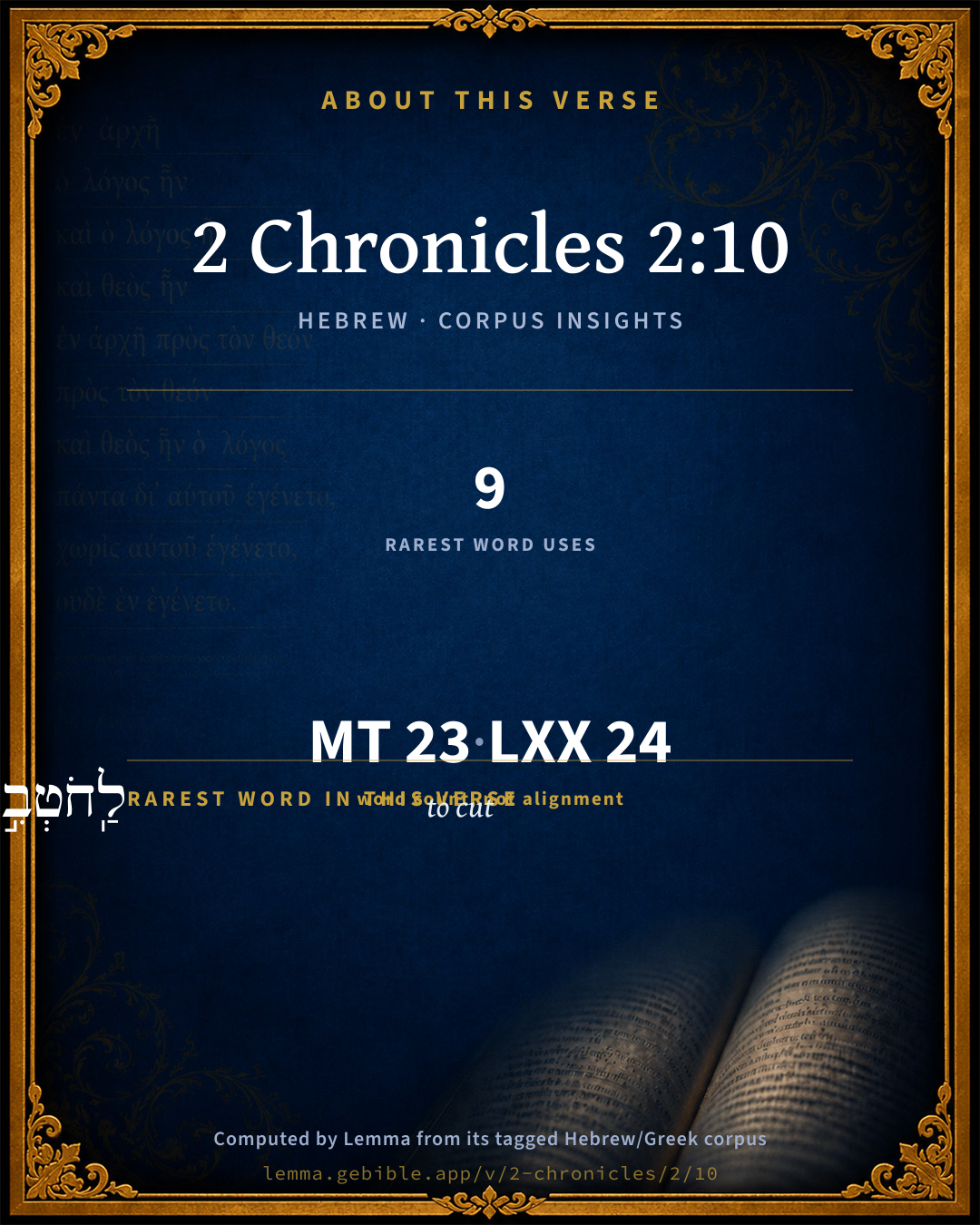
23
words
15
distinct lemmas
Historical
section

Notable vocabulary

The rarest word here is לַֽחֹטְבִ֣ים to cut H2404 — appearing just 9 times in the whole Hebrew Bible.

Shared distinctive vocabulary

לַֽחֹטְבִ֣ים to cut H2404 occurs in 9 verses of the Hebrew Bible. Also found in:

Grammatical profile

  • 3 verbs
  • 11 nouns
  • 8 adjectives
  • 1 particle

Verb forms

  • לַֽחֹטְבִ֣ים Qal · Participle Active
  • לְֽכֹרְתֵ֣י Qal · Participle Active
  • נָתַתִּי֩ Qal · Perfect

Repetition

Words recur within this verse — often emphatic in Hebrew:

  • עֶשְׂרִ֣ים twenty H6242 ×4
  • אֶ֔לֶף thousand H505 ×4
  • כֹּרִים֙ kor H3734 ×2
  • בַּתִּים֙ bath H1324 ×2

Hebrew & Septuagint length

In English translation the verse runs 36 words from the Hebrew and 42 from the Septuagint (LXX English) — closely comparable.

A rough comparison of the two English renderings, which tokenize alike — not a word-level alignment.

Word counts can differ between the Hebrew and the Greek without any difference in meaning — e.g. the Hebrew direct-object marker אֵת has no separate Greek word, and Greek often adds the article ὁ.

In the original languages it is 23 Hebrew tokens and 24 Greek tokens — but the two are counted differently (Hebrew bundles its prefixes and suffixes into one token; the Greek is in lemma form), so that isn’t a like-for-like length.

Cross-references

6

Topical passages linked to 2 Chronicles 2:10 in the Treasury of Scripture Knowledge — connected by theme and wording, ordered by reader-vote popularity; previews shown in the World English Bible.

  • 1 Kings 5:11 Solomon gave Hiram twenty thousand measures of wheat for food to his household, and twenty measures of pure oil: thus gave Solomon to Hiram year by year.
  • 1 Kings 7:26 It was a handbreadth thick: and the brim of it was worked like the brim of a cup, like the flower of a lily: it held two thousand baths.
  • 1 Kings 7:38 He made ten basins of brass: one basin contained forty baths; and every basin was four cubits; and on very one of the ten bases one basin.
  • Ezra 7:22 to one hundred talents of silver, and to one hundred measures of wheat, and to one hundred baths of wine, and to one hundred baths of oil, and salt without prescribing how much.
  • Luke 10:7 Remain in that same house, eating and drinking the things they give, for the laborer is worthy of his wages. Don't go from house to house.
  • Romans 13:7–8 Give therefore to everyone what you owe: taxes to whom taxes are due; customs to whom customs; respect to whom respect; honor to whom honor.

Cross-references courtesy of OpenBible.info (CC BY 4.0).

Hebrew and Greek witnesses Masoretic Hebrew ↔ Greek Septuagint

The same verse in the two great witnesses to the Old Testament, shown verse-for-verse.

These are two independent witnesses, not word-aligned to each other, and the Septuagint is shown in lemma (dictionary) form.

Hebrew 2 Chronicles 2:10 Masoretic · Westminster Leningrad Codex

וְהִנֵּ֣ה לַֽחֹטְבִ֣ים לְֽכֹרְתֵ֣י הָעֵצִ֡ים נָתַתִּי֩ חִטִּ֨ים מַכּ֜וֹת לַעֲבָדֶ֗יךָ כֹּרִים֙ עֶשְׂרִ֣ים אֶ֔לֶף וּשְׂעֹרִ֕ים כֹּרִ֖ים עֶשְׂרִ֣ים אָ֑לֶף וְיַ֗יִן בַּתִּים֙ עֶשְׂרִ֣ים אֶ֔לֶף וְשֶׁ֕מֶן בַּתִּ֖ים עֶשְׂרִ֥ים אָֽלֶף

Behold, I will give to your servants, the cutters who cut timber, twenty thousand measures of beaten wheat, and twenty thousand measures of barley, and twenty thousand baths of wine, and twenty thousand baths of oil.

World English Bible · Public Domain

Greek LXX 2 Chronicles 2:10 Septuagint · lemma form

καί εἶπον χιραμ βασιλεύς τύρος ἐν γραφή καί ἀποστέλλω πρός σαλωμών ἐν ὁ ἀγαπάω κύριος ὁ λαός αὐτός δίδωμι σύ ἐπί αὐτός εἰς βασιλεύς

And, behold, I have given freely to your servants that work and cut the wood, corn for food, even twenty thousand measures of wheat, and twenty thousand measures of barley, and twenty thousand measures of wine, and twenty thousand measures of oil.

LXX2012 (modern English Septuagint) · Public Domain

On this verse, Ellicott's Commentary for English Readers discusses the Septuagint’s reading. Read the note in Commentary ↓

Hebrew: Westminster Leningrad Codex (CC BY 4.0). Greek: Septuagint (public domain); English from LXX2012 (modern English Septuagint) (Public Domain). How the Septuagint differs from the Hebrew →

Commentary

Notes on 2 Chronicles 2:10 from classic Christian and Jewish commentators (each source and its license shown beneath its notes). The classic Christian expositions comment on the surrounding passage and are grouped to its opening verse, so a note may address several verses; the Jewish commentaries on the Tanakh (Rashi and others) are per-verse, so they appear only where the commentator wrote on this verse.

Lemma curates 59 commentaries, every one of them public domain or Creative Commons licensed, each selected and text-cleaned for this edition rather than reprinted as found. About our sources →

Trapp's Complete Commentary

John Trapp

2Ch 2:10 And, behold, I will give to thy servants, the hewers that cut timber, twenty thousand measures of beaten wheat, and twenty thousand measures of barley, and twenty thousand baths of wine, and twenty thousand baths of oil.

Ver. 10. And, behold, I will give to thy servants.] And shall not Christ’s servants and ministers have due maintenance? That which is given to them is given to Christ; as that which is here promised to Hiram’s servants, is promised to Hiram’s self, {1Ki 5:6; 1Ki 5:11} who, if he did not like it, is promised more. {1Ki 5:6} The difference of the food and measures given by Solomon here, over and above that in 1Ki 5:11, may stand in this, that the former was for king Hiram’s court and household: and this here, for his workmen in Lebanon.

John Trapp, A Commentary or Exposition upon All the Books of the Old and New Testament (1647–1656) — public domain. Text from a community e-Sword module.

Joseph Benson's Commentary

2Ch 2:10. Behold, I will give thy servants twenty thousand measures of beaten wheat, &c. — Solomon would not feed his workmen with bread and water, but with plenty of provisions, and of the best kind. They that employ labourers ought to take care that they be not only well paid, but well provided for, with sufficient of that which is wholesome and proper for them. Let rich masters do for their poor servants and workmen as they would be done by it the tables were turned.

Joseph Benson's Commentary on the Old and New Testaments (1811–1818) — public domain. Text from a community e-Sword module.

Geneva Bible (1599)

Geneva Bible translators

Of Bath read 1 Kings 7:26, it is called also Ephah, but Ephah is to measure dry things, as Bath is a measure for liquors.

Hebrew, Corins.

Geneva Bible (1599) marginal notes — public domain. Text via Bolls.life.

Jamieson, Fausset & Brown

Robert Jamieson, A. R. Fausset & David Brown

behold, I will give to thy servants . . . beaten wheat--Wheat, stripped of the husk, boiled, and saturated with butter, forms a frequent meal with the laboring people in the East (compare Kg1 5:11). There is no discrepancy between that passage and this. The yearly supplies of wine and oil, mentioned in the former, were intended for Huram's court in return for the cedars sent him; while the articles of meat and drink specified here were for the workmen on Lebanon.

Jamieson, Fausset & Brown — Commentary Critical and Explanatory on the Whole Bible (1871) — public domain (CC PDM 1.0). Text via the HelloAO Bible API.

Ellicott's Commentary for English Readers

(10) And, behold, I will give . . . barley.—Rather, And, behold, for the hewers, that is, for the woodcutters, I will give wheat as food for thy servants, viz., twenty thousand kors, and barley twenty thousand kors, &c. “For the hewers” may mean “as for the hewers,” or perhaps “on account of the hewers” (Gen_4:23). The latter sense would bring the verse into substantial harmony with 1Ki_5:11, where we read: “And Solomon gave Hiram twenty thousand kors of wheat as food for his household, and twenty kors” (LXX., 20,000 baths) “of pure oü: so used Solomon to give to Hiram year by year,” i.e., during his building operations.

Beaten wheat.—The Hebrew (hittîm makkôth) is literally wheat—strokes. But it is obvious that makkôth is a misreading for makkôleth, food, the word used in 1Ki_5:11; and so the LXX. renders. The expression “thy servants” here seems to correspond with the phrase” his household “there; and the drift of the whole passage is that, in return for the services of the Tyrian artificers, Solomon engages to supply Hiram’s royal household with provisions of corn and wine and oil.

Others assume, without much likelihood, that the two passages relate to two distinct agreements, by one of which Solomon undertook to supply Hiram’s court, and by the other his Tyrian workmen, with provisions.

Hewers (hôtĕbîm).—An old word, not recurring in the chronicle, and therefore explained by the writer.

Measures (kôrîm).—The kor was a dry measure = one quarter. (Syriac, reb‘e, “quarters.”) The bath, a liquid measure, of six or seven gallons’ capacity. Both words occur in the Greek of Luk_16:6-7.

A Bible Commentary for English Readers, edited by Charles John Ellicott (1878–1897) — public domain. Text from a community e-Sword module.

The Cambridge Bible for Schools and Colleges

gen. ed. J. J. S. Perowne

10. measures] Hebrew, cors. A cor was the same as a homer = 393.9 litres.

beaten wheat] 1Ki_5:11, wheat for food. The text is doubtful, and the phrase beaten wheat occurs nowhere else and is uncertain in meaning.

of barley] The barley and wine are not mentioned in 1Ki_5:11; there wheat and oil only are mentioned.

twenty thousand baths of oil] in 1Ki_5:11 (Heb.) twenty cors of pure oil. As ten baths went to a cor, the amount stated in Chron. is a hundred times as much as the amount given in 1 Kings (7878 litres).

The Cambridge Bible for Schools and Colleges (gen. ed. J. J. S. Perowne; Cambridge University Press, 1878–1918) — public domain. Text from a community e-Sword module.

John Gill's Exposition

Then Huram the king of Tyre answered in writing, which he sent to Solomon,.... In which letter he told him he had considered the contents of his, and would grant him all that he desired, see Kg1 5:8.

because the Lord hath loved his people; he hath made thee king over them; which are much the same words the queen of Sheba said to Solomon; see Gill on Kg1 10:9.

John Gill's Exposition of the Whole Bible (1746–1763) — public domain (CC PDM 1.0). Text via the HelloAO Bible API.

Albert Barnes' Notes on the Bible

Beaten wheat - The Hebrew text is probably corrupt here. The true original may be restored from marginal reference, where the wheat is said to have been given “for food.”

The barley and the wine are omitted in Kings. The author of Chronicles probably filled out the statement which the writer of Kings has given in brief; the barley, wine, and ordinary oil, would be applied to the sustenance of the foreign laborers.

Albert Barnes' Notes on the Bible (1834–1885) — public domain. Text from a community e-Sword/MySword module.

Haydock's Catholic Bible Commentary

Wheat. Hebrew adds, "beaten." --- Barley and wine are not specified [in] 3 Kings v. 11. (Calmet) --- Measures, like the Roman amphora, contained 960 ozs. (Cornelius a Lapide) --- Hebrew has, "batim," in both places; but [in] 3 Kings we find, "twenty cores of oil." The satum, "measure," was only one-third of the bath or epha. (Calmet)

George Leo Haydock (1774–1849), Haydock's Catholic Family Bible and Commentary, 1859 edition — public domain. Excludes Psalms (Douay-Rheims chapter numbering differs from Protestant) and Deuterocanonical books (Catholic canon only).

The Pulpit Commentary

Beaten wheat. In 1Ki_5:11 the language is "wheat for food" (Tl,kom) while the Septuagint gives kai maceir. In our present passage the Septuagint gives eijv brwmata, suggesting at once that our Hebrew twOKmi is an error for Tl,kom. The former Hebrew word is that constantly employed for "plagues," "strokes," etc., and it is nowhere but in this place rendered "beaten." I will give to thy servants. This passage is hard to reconcile with what is said in 1Ki_5:11; but meantime it is not certain that it needs to be reconciled with it. It is possible that the two passages are distinct. The contents of the present verse, at all events, need not be credited with any ambiguity, unless, indeed, we would wish it more definite, whether the expression, "I will give to thy servants," may not be quite as correctly understood, for thy servants," i.e. to thee as the hire of them. If this be so, it would enable us to give at once all the wheat, and two hundred out of the 20, 000 baths of oil, for the consumption, not of the literal workmen, but of the royal household. Then this granted, the verse, though not identical with 1Ki_5:11, is brought into harmony with it. Reverting to the statement in 1Ki 5, what we learn is that Solomon, in his application to Hiram, offers payment for the hire of his servants such as he shall appoint (ver. 6). Hiram"s reply is that he shall be satisfied to receive as payment "food for his household" (ver. 9), the amount of it and the annual payment of it being specified in ver. 11. This is the whole case, the discrepancies in which are plain, but they do not amount to contradictions. The appearance that is worn on the face of things is that the writer in Chronicles gives what came to be the final arrangement as to remuneration, though confessedly it is placed as much as the account in Kings in the draft of Solomon"s original application to Hiram. Measures. These were cots, and the cot was the same as the homer. From a calculation of some doubtfulness, however, made under the suggestions of 1Ki_4:22, it has been said that the consumption of the royal household of Solomon was above 32, 000 measures. The cor, or homer, was the largest of the five dry measures of capacity, being equal to 180 cabs, 100 omers, 30 seahe, 10 ephahs (see Dr. Smith"s "Bible Dictionary," 3.1741), though what was the exact value of any one of these in modern measures has only been uncertainly and very approximately arrived at. Baths. The bath was the largest of the three liquid measures of capacity, being equal to 6 bins and 72 logs (see same "Dictionary," 3:1740).

The Pulpit Commentary (1880–1919), ed. H.D.M. Spence-Jones & Joseph S. Exell — public domain. Text from a community e-Sword module.

Lesson kit

Teaching starters — assembled from the data on this page, not authored interpretation. Every prompt links to the verse data it draws on. Edit before teaching.

2 Chronicles, in the Historical, opens this verse with 23 words (15 distinct Hebrew lemmas). Its most distinctive word is châṭab (“to cut”). A historical commentator’s framing appears above. Read the whole chapter for the surrounding context.

Discussion questions

  1. The word châṭab carries the sense “to cut.” How does it shape the verse?
  2. How does Deuteronomy 19:5, which shares the word «to cut», read alongside this verse?
  3. What does the repetition of “twenty” (4× in this one verse) do in this verse?
  4. These translations render this verse differently; the difference is in the English rendering, not the original. What questions does that raise?
  5. «לַֽחֹטְבִ֣ים» is a Qal Participle Active verb. How does that grammatical form shape the action described?
  6. Compare how Trapp's Complete Commentary and Joseph Benson's Commentary read this verse. Where do they agree or differ?

Things to notice

Reading settings

Reading text

Shown beneath each verse's original-language words.

Old Testament
Old Testament edition

Read the OT as the Masoretic Hebrew (MT) or the Greek Septuagint (LXX).

English shown for the Greek Septuagint (in the Hebrew ↔ Greek comparison).

Comparing translations? Open the Compare panel on any verse page to stack up to four side by side.