
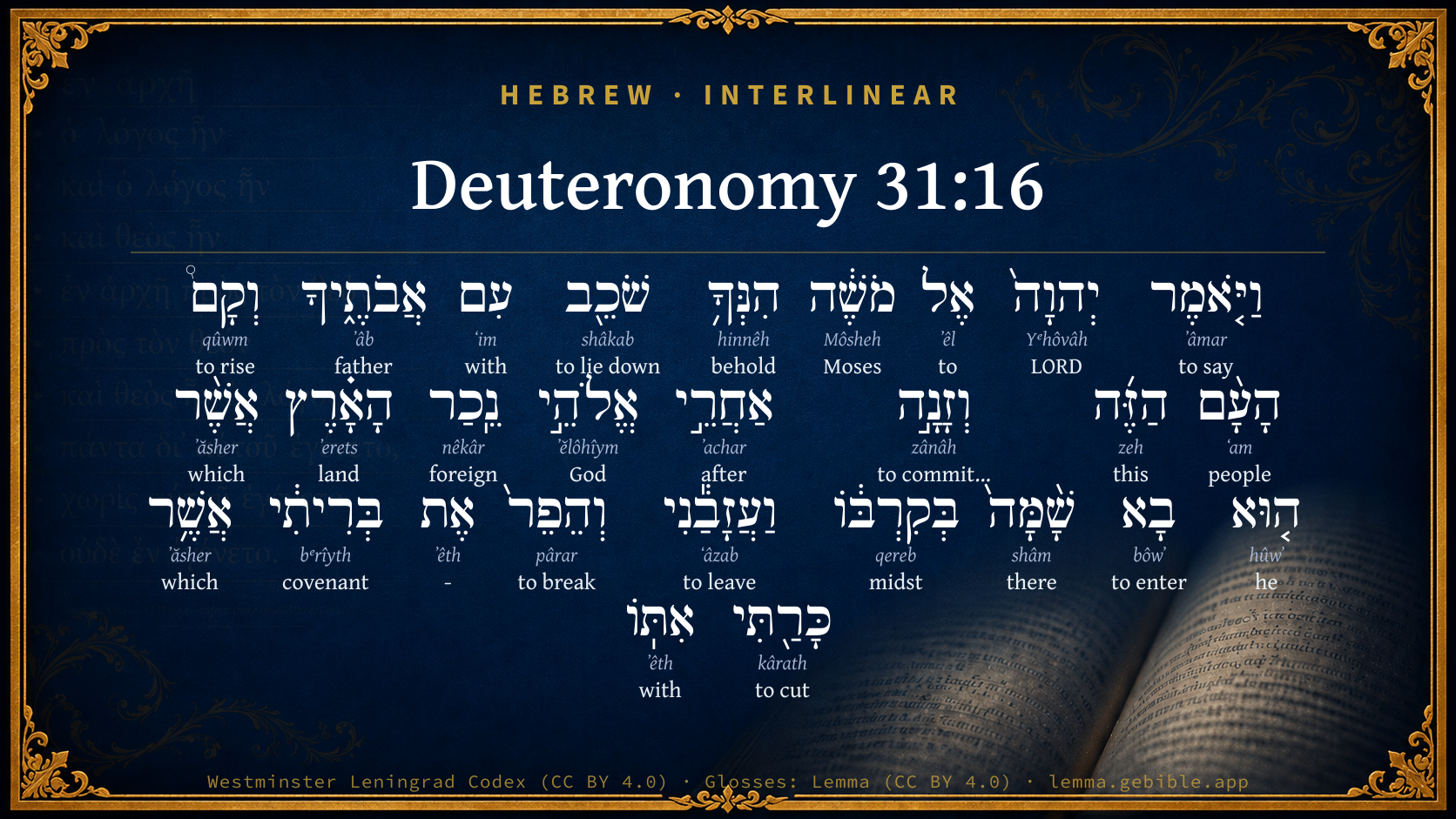
Deuteronomy 31:16

Hebrew (Westminster Leningrad Codex) Deuteronomy 31:16 appears in the Hebrew Old Testament. The text above is from the Westminster Leningrad Codex. Each word links to its Strong’s number, a concise gloss, and parsing drawn from the Open Scriptures Hebrew Bible morphology. Click any word for its full Brown-Driver-Briggs (BDB) entry.
Download image
Cite this verse

Deuteronomy 31:16 (World English Bible). Public Domain. Lemma interlinear Bible study tool, https://lemma.gebible.app/v/deuteronomy/31/16.

Show BibTeX & RIS
BibTeX
RIS
English Translation
Yahweh said to Moses, Behold, you shall sleep with your fathers; and this people will rise up, and play the prostitute after the strange gods of the land, where they go to be among them, and will forsake me, and break my covenant which I have made with them.
World English Bible · Public Domain
Download a study sheet

One document with this verse’s original text, its word-by-word gloss line, the meaning frame, cross-references with their text, attributed commentary, and full source and license credits — printable, and it pastes into notes with its structure intact.

This verse Autodidact and up

Study sheet (.html) Plain text (.txt)

A passage Seminary Student

Up to 50 verses in one chapter. A passage sheet keeps up to 6 commentary sources and 12 cross-references per verse, in the order this page ranks them, and says so on the sheet whenever that leaves anything out. Ask for a single verse and you get the Autodidact verse sheet above.

Everything on this page stays free to read, with no account — the sheet is a download of what is already on screen, not access to it.

Want to remove ads? Support Godless Engineer
Compare translations 3

The same verse in 3 English versions, stacked beneath the original-language interlinear above. Click any original word for its lexicon entry.

Each is an independent rendering of the whole verse — the interlinear is not word-aligned to these translations.

Highlighted words mark where these versions differ — a whole-verse word diff, not a word-by-word alignment.

  • World English Bible Public Domain
    Yahweh said to Moses, Behold, you shall sleep with your fathers; and this people will rise up, and play the prostitute after the strange gods of the land, where they go to be among them, and will forsake me, and break my covenant which I have made with them.
  • King James Version Public Domain
    And the LORD said unto Moses, Behold, thou shalt sleep with thy fathers; and this people will rise up, and go a whoring after the gods of the strangers of the land, whither they go to be among them, and will forsake me, and break my covenant which I have made with them.
  • unfoldingWord Literal Text CC BY-SA 4.0
    And Yahweh said to Moses, “Behold, you will sleep with your fathers, and this people will rise up and whore after the strange gods of the land in the midst of which he is going to there. And he will forsake me and break my covenant that I have cut with him.

unfoldingWord Literal Text — © unfoldingWord, licensed CC BY-SA 4.0. Word-aligned USFM3 via Door43 (git.door43.org/unfoldingWord/en_ult).

Versions to compare (up to 4)

3 of 4 selected

Show all 18 translations

Every available English version of this verse, each an independent rendering of the whole verse.

  • World English Bible Public Domain
    Yahweh said to Moses, Behold, you shall sleep with your fathers; and this people will rise up, and play the prostitute after the strange gods of the land, where they go to be among them, and will forsake me, and break my covenant which I have made with them.
  • Berean Standard Bible Public Domain
    And the LORD said to Moses, “You will soon rest with your fathers, and these people will rise up and prostitute themselves with the foreign gods of the land they are entering. They will forsake Me and break the covenant I have made with them.
  • Majority Standard Bible Public Domain
    And the LORD said to Moses, “You will soon rest with your fathers, and these people will rise up and prostitute themselves with the foreign gods of the land they are entering. They will forsake Me and break the covenant I have made with them.
  • King James Version Public Domain
    And the LORD said unto Moses, Behold, thou shalt sleep with thy fathers; and this people will rise up, and go a whoring after the gods of the strangers of the land, whither they go to be among them, and will forsake me, and break my covenant which I have made with them.
  • American Standard Version (1901) Public Domain
    And Jehovah said unto Moses, Behold, thou shalt sleep with thy fathers; and this people will rise up, and play the harlot after the strange gods of the land, whither they go to be among them, and will forsake me, and break my covenant which I have made with them.
  • Revised Version (1885) Public Domain
    And the LORD said unto Moses, Behold, thou shalt sleep with thy fathers; and this people will rise up, and go a whoring after the strange gods of the land, whither they go to be among them, and will forsake me, and break my covenant which I have made with them.
  • Geneva Bible (1599) Public Domain
    And the Lord said vnto Moses, Behold, thou shalt sleepe with thy fathers, and this people will rise vp, and goe a whoring after the gods of a strange land (whither they goe to dwell therein) and will forsake me, and breake my couenant which I haue made with them.
  • Douay-Rheims (1899) Public Domain
    And the Lord said to Moses: Behold thou shalt sleep with thy fathers, and this people rising up will go a fornicating after strange gods in the land, to which it goeth in to dwell: there will they forsake me, and will make void the covenant, which I have made with them,
  • Young's Literal Translation Public Domain
    And Jehovah saith unto Moses, `Lo, thou art lying down with thy fathers, and this people hath risen, and gone a-whoring after the gods of the stranger of the land into the midst of which it hath entered, and forsaken Me, and broken My covenant which I made with it;
  • Literal Standard Version CC BY-SA 4.0
    And YHWH says to Moses, “Behold, you are lying down with your fathers, and this people has risen and gone whoring after the gods of the stranger of the land, into the midst of which it has entered, and it has forsaken Me and broken My covenant which I made with it;
  • Unlocked Literal Bible CC BY-SA 4.0
    Yahweh said to Moses, “Look, you will sleep with your fathers; this people will rise up and act like a prostitute going after the strange gods that are among them in the land where they are going. They will forsake me and break my covenant that I have made with them.
  • unfoldingWord Literal Text CC BY-SA 4.0
    And Yahweh said to Moses, “Behold, you will sleep with your fathers, and this people will rise up and whore after the strange gods of the land in the midst of which he is going to there. And he will forsake me and break my covenant that I have cut with him.
  • Darby Bible Public Domain
    And Jehovah said to Moses, Behold, thou shalt sleep with thy fathers; and this people will rise up, and go a whoring after the strange gods of the land into which they enter, and will forsake me, and break my covenant which I have made with them.
  • World Messianic Bible Public Domain
    The LORD said to Moses, “Behold, you shall sleep with your fathers. This people will rise up and play the prostitute after the strange gods of the land where they go to be among them, and will forsake me and break my covenant which I have made with them.
  • Webster's Bible Public Domain
    And the LORD said to Moses, Behold, thou shalt sleep with thy fathers, and this people will rise up, and commit idolatry with the gods of the strangers of the land, whither they go to be among them, and will forsake me, and break my covenant which I have made with them.
  • Free Bible Version CC BY-SA 4.0
    The Lord told Moses, “You will join your ancestors in death, and these people are going to prostitute themselves by worshiping the foreign gods of the country they are entering. They will abandon me and break the agreement I've made with them.
  • Bible in Basic English Public Domain
    And the Lord said to Moses, Now you are going to rest with your fathers; and this people will be false to me, uniting themselves to the strange gods of the land where they are going; they will be turned away from me and will not keep the agreement I have made with them.
  • JPS Tanakh (1917) Public Domain
    And the LORD said unto Moses: 'Behold, thou art about to sleep with thy fathers; and this people will rise up, and go astray after the foreign gods of the land, whither they go to be among them, and will forsake Me, and break My covenant which I have made with them.

Literal Standard Version (2020), Covenant Press — licensed CC BY-SA 4.0. Text via the HelloAO Bible API (eBible.org). Unlocked Literal Bible (unfoldingWord) — licensed CC BY-SA 4.0. Text via the HelloAO Bible API (eBible.org). unfoldingWord Literal Text — © unfoldingWord, licensed CC BY-SA 4.0. Word-aligned USFM3 via Door43 (git.door43.org/unfoldingWord/en_ult). Free Bible Version, Dr. Jonathan Gallagher — licensed CC BY-SA 4.0. Text via the HelloAO Bible API (eBible.org).

Word by word

More ways to search: Search by grammar → Find every occurrence → Compare this word →

Practice this passage: Drill this verse → Learn its vocabulary →

נֵֽכַר
nêkâr
H5236
“foreign of”
Noun, Common, Masculine, Singular, Construct
Part of Speech
Noun
Type
Common
Gender
Masculine
Number
Singular
State
Construct
Full BDB Definition

Origin: from H5234

TWOT: 1368b

foreign, alien, foreignness, that which is foreign - foreignness, foreign gods - alien, foreigner - foreign (vanities)
  1. וַיֹּ֤אמֶר ʼâmar H559 “and · to say” Conjunction + Verb, Qal, Sequential Imperfect, 3rd Person, Masculine, Singular
  2. יְהוָה֙ Yᵉhôvâh H3068 “LORD” Noun, Proper
  3. אֶל ʼêl H413 “to” Preposition
  4. מֹשֶׁ֔ה Môsheh H4872 “Moses” Noun, Proper
  5. הִנְּךָ֥ hinnêh H2009 “behold · you” Particle, Demonstrative + Suffix, Personal, 2nd Person, Masculine, Singular
  6. שֹׁכֵ֖ב shâkab H7901 “lying down” Verb, Qal, Participle Active, Masculine, Singular, Absolute
  7. עִם ʻim H5973 “with” Preposition
  8. אֲבֹתֶ֑יךָ ʼâb H1 “fathers · your” Noun, Common, Masculine, Plural, Construct + Suffix, Personal, 2nd Person, Masculine, Singular
  9. וְקָם֩ qûwm H6965 “and · to rise” Conjunction + Verb, Qal, Sequential Perfect, 3rd Person, Masculine, Singular
  10. הָעָ֨ם ʻam H5971 “the · people” Particle, Definite Article + Noun, Common, Masculine, Singular, Absolute
  11. הַזֶּ֜ה zeh H2088 “the · this” Particle, Definite Article + Pronoun, Demonstrative, Masculine, Singular
  12. וְזָנָ֣ה zânâh H2181 “and · to commit fornication” Conjunction + Verb, Qal, Sequential Perfect, 3rd Person, Masculine, Singular
  13. אַחֲרֵ֣י ʼachar H310 “after” Preposition
  14. אֱלֹהֵ֣י ʼĕlôhîym H430 “God(s) of” Noun, Common, Masculine, Plural, Construct
  15. הָאָ֗רֶץ ʼerets H776 “the · land” Particle, Definite Article + Noun, Common, Both, Singular, Absolute
  16. אֲשֶׁ֨ר ʼăsher H834 “which” Particle, Relative
  17. ה֤וּא hûwʼ H1931 “he” Pronoun, Personal, 3rd Person, Masculine, Singular
  18. בָא bôwʼ H935 “entering” Verb, Qal, Participle Active, Masculine, Singular, Absolute
  19. שָׁ֨מָּה֙ shâm H8033 “there · toward” Adverb + Suffix, Demonstrative
  20. בְּקִרְבּ֔וֹ qereb H7130 “in/at · midst · his” Preposition + Noun, Common, Masculine, Singular, Construct + Suffix, Personal, 3rd Person, Masculine, Singular
  21. וַעֲזָבַ֕נִי ʻâzab H5800 “and · to leave · me” Conjunction + Verb, Qal, Sequential Perfect, 3rd Person, Masculine, Singular + Suffix, Personal, 1st Person, Common, Singular
  22. וְהֵפֵר֙ pârar H6565 “and · to break” Conjunction + Verb, Hiphil, Sequential Perfect, 3rd Person, Masculine, Singular
  23. אֶת ʼêth H853 “-” Particle, Direct Object
  24. בְּרִיתִ֔י bᵉrîyth H1285 “covenant · my” Noun, Common, Feminine, Singular, Construct + Suffix, Personal, 1st Person, Common, Singular
  25. אֲשֶׁ֥ר ʼăsher H834 “which” Particle, Relative
  26. כָּרַ֖תִּי kârath H3772 “to cut” Verb, Qal, Perfect, 1st Person, Common, Singular
  27. אִתּֽוֹ ʼêth H854 “with · him” Preposition + Suffix, Personal, 3rd Person, Masculine, Singular

About this verse

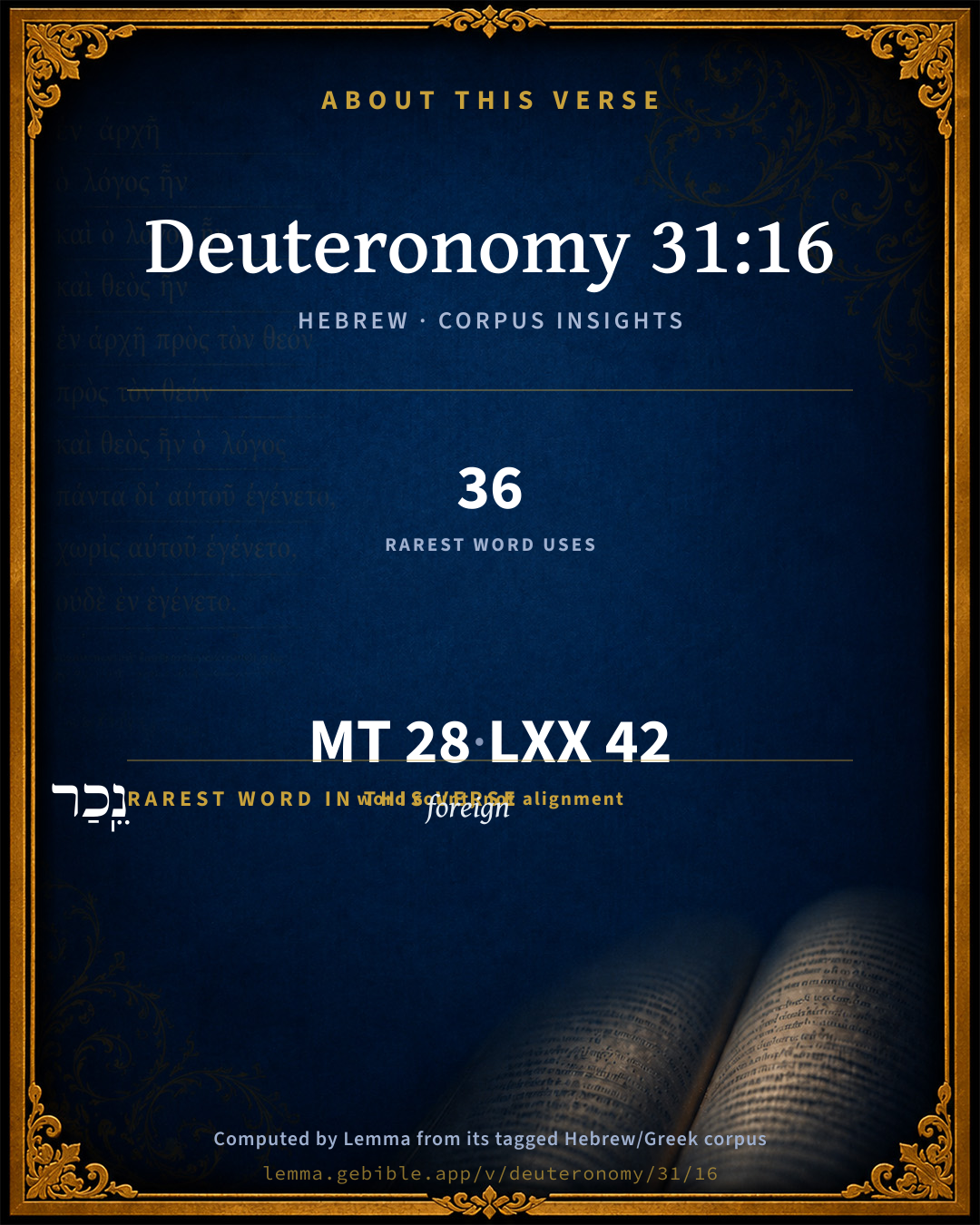
These counts appear in no published source. They are computed here, from the morphology-tagged text and Lemma’s own curated glosses. What Lemma adds →

28
words
27
distinct lemmas
Pentateuch
section

Shared distinctive vocabulary

נֵֽכַר foreign H5236 occurs in 35 verses of the Hebrew Bible. Also found in:

Grammatical profile

  • 8 verbs
  • 9 nouns
  • 2 pronouns
  • 4 prepositions
  • 1 adverb
  • 4 particles

Verb forms

  • וַיֹּ֤אמֶר Qal · Sequential Imperfect
  • שֹׁכֵ֖ב Qal · Participle Active
  • וְקָם֩ Qal · Sequential Perfect
  • וְזָנָ֣ה Qal · Sequential Perfect
  • בָא Qal · Participle Active
  • וַעֲזָבַ֕נִי Qal · Sequential Perfect
  • וְהֵפֵר֙ Hiphil · Sequential Perfect
  • כָּרַ֖תִּי Qal · Perfect

Repetition

A word recurs within this verse — often emphatic in Hebrew:

  • אֲשֶׁ֨ר which H834 ×2

Hebrew & Septuagint length

In English translation the verse runs 49 words from the Hebrew and 48 from the Septuagint (LXX English) — closely comparable.

A rough comparison of the two English renderings, which tokenize alike — not a word-level alignment.

Word counts can differ between the Hebrew and the Greek without any difference in meaning — e.g. the Hebrew direct-object marker אֵת has no separate Greek word, and Greek often adds the article ὁ.

In the original languages it is 28 Hebrew tokens and 42 Greek tokens — but the two are counted differently (Hebrew bundles its prefixes and suffixes into one token; the Greek is in lemma form), so that isn’t a like-for-like length.

Cross-references

25

Topical passages linked to Deuteronomy 31:16 in the Treasury of Scripture Knowledge — connected by theme and wording, ordered by reader-vote popularity; previews shown in the World English Bible.

  • Judges 10:6 The children of Israel again did that which was evil in the sight of Yahweh, and served the Baals, and the Ashtaroth, and the gods of Syria, and the gods of Sidon, and the gods of Moab, and the gods of the children of Ammon, and the gods of the Philistines; and they forsook Yahweh, and didn't serve him.
  • Judges 2:12 and they forsook Yahweh, the God of their fathers, who brought them out of the land of Egypt, and followed other gods, of the gods of the peoples who were round about them, and bowed themselves down to them: and they provoked Yahweh to anger.
  • Judges 10:13 Yet you have forsaken me, and served other gods: therefore I will save you no more.
  • Exodus 34:15 Don't make a covenant with the inhabitants of the land, lest they play the prostitute after their gods, and sacrifice to their gods, and one call you and you eat of his sacrifice;
  • Ezekiel 16:15 But you did trust in your beauty, and played the prostitute because of your renown, and poured out your prostitution on everyone who passed by; his it was.
  • Revelation 19:2 for true and righteous are his judgments. For he has judged the great prostitute, who corrupted the earth with her sexual immorality, and he has avenged the blood of his servants at her hand."
  • Deuteronomy 32:15 But Jeshurun grew fat, and kicked: You have grown fat, you are grown thick, you are become sleek; Then he forsook God who made him, Lightly esteemed the Rock of his salvation.
  • Jeremiah 2:11–13 Has a nation changed [its] gods, which yet are no gods? but my people have changed their glory for that which does not profit.
  • Hosea 2:2–5 Contend with your mother! Contend, for she is not my wife, Neither am I her husband; And let her put away her prostitution from her face, And her adulteries from between her breasts;
  • 2 Samuel 7:12 When your days are fulfilled, and you shall sleep with your fathers, I will set up your seed after you, who shall proceed out of your bowels, and I will establish his kingdom.
  • Isaiah 57:2–8 He enters into peace; they rest in their beds, each one who walks in his uprightness.
  • Ezekiel 16:25–36 You have built your lofty place at the head of every way, and have made your beauty an abomination, and have opened your feet to everyone who passed by, and multiplied your prostitution.
  • Ezekiel 23:5–21 Oholah played the prostitute when she was mine; and she doted on her lovers, on the Assyrians [her] neighbors,
  • Acts 13:36 For David, after he had in his own generation served the counsel of God, fell asleep, and was laid with his fathers, and saw decay.
  • Genesis 25:8 Abraham gave up the spirit, and died in a good old age, an old man, and full of years, and was gathered to his people.
  • Exodus 32:6 They rose up early on the next day, and offered burnt offerings, and brought peace-offerings; and the people sat down to eat and to drink, and rose up to play.
  • Leviticus 20:3–6 I also will set my face against that person, and will cut him off from among his people because he has given of his seed to Molech, to defile my sanctuary, and to profane my holy name.
  • Leviticus 26:15 and if you shall reject my statutes, and if your soul abhors my ordinances, so that you will not do all my commandments, but break my covenant;
  • Judges 2:17–20 Yet they didn't listen to their judges; for they played the prostitute after other gods, and bowed themselves down to them: they turned aside quickly out of the way in which their fathers walked, obeying the commandments of Yahweh; [but] they didn't do so.
  • Job 20:11 His bones are full of his youth, But youth shall lie down with him in the dust.
  • Psalms 73:27 For, behold, those who are far from you shall perish. You have destroyed all those who are unfaithful to you.
  • Psalms 106:39 Thus were they defiled with their works, And prostituted themselves in their deeds.
  • Jeremiah 3:1–3 They say, If a man put away his wife, and she go from him, and become another man's, will he return to her again? Won't that land be greatly polluted? But you have played the prostitute with many lovers; yet return again to me, says Yahweh.
  • Jeremiah 31:32 not according to the covenant that I made with their fathers in the day that I took them by the hand to bring them out of the land of Egypt; which my covenant they broke, although I was a husband to them, says Yahweh.
  • Revelation 17:2–5 with whom the kings of the earth committed sexual immorality, and those who dwell in the earth were made drunken with the wine of her sexual immorality."

Cross-references courtesy of OpenBible.info (CC BY 4.0).

Hebrew and Greek witnesses Masoretic Hebrew ↔ Greek Septuagint

The same verse in the two great witnesses to the Old Testament, shown verse-for-verse.

These are two independent witnesses, not word-aligned to each other, and the Septuagint is shown in lemma (dictionary) form.

Hebrew Deuteronomy 31:16 Masoretic · Westminster Leningrad Codex

וַיֹּ֤אמֶר יְהוָה֙ אֶל מֹשֶׁ֔ה הִנְּךָ֥ שֹׁכֵ֖ב עִם אֲבֹתֶ֑יךָ וְקָם֩ הָעָ֨ם הַזֶּ֜ה וְזָנָ֣ה אַחֲרֵ֣י אֱלֹהֵ֣י נֵֽכַר הָאָ֗רֶץ אֲשֶׁ֨ר ה֤וּא בָא שָׁ֨מָּה֙ בְּקִרְבּ֔וֹ וַעֲזָבַ֕נִי וְהֵפֵר֙ אֶת בְּרִיתִ֔י אֲשֶׁ֥ר כָּרַ֖תִּי אִתּֽוֹ

Yahweh said to Moses, Behold, you shall sleep with your fathers; and this people will rise up, and play the prostitute after the strange gods of the land, where they go to be among them, and will forsake me, and break my covenant which I have made with them.

World English Bible · Public Domain

Greek LXX Deuteronomy 31:16 Septuagint · lemma form

καί εἶπον κύριος πρός μωυσῆς ἰδού σύ κοιμάω μετά ὁ πατήρ σύ καί ἀναἵστημι ὁ λαός οὗτος ἐκπορνεύω ὀπίσω θεός ἀλλότριος ὁ γῆ εἰς ὅς οὗτος εἰςπορεύομαι ἐκεῖ εἰς αὐτός καί κατα ἐνλείπω ἐγώ καί διασκεδάζω ὁ διαθήκη ἐγώ ὅς διατίθημι αὐτός

And the Lord said to Moses, Behold, you shall sleep with your fathers, and this people will arise and go a whoring after the strange gods of the land, into which they are entering: and they will forsake me, and break my covenant, which I made with them.

LXX2012 (modern English Septuagint) · Public Domain

Hebrew: Westminster Leningrad Codex (CC BY 4.0). Greek: Septuagint (public domain); English from LXX2012 (modern English Septuagint) (Public Domain). How the Septuagint differs from the Hebrew →

Targum (Aramaic paraphrase)

2

The Targum is the ancient Jewish Aramaic paraphrase of the Hebrew Scriptures — an interpretive translation, not the Hebrew text itself. Onkelos (literal) and Pseudo-Jonathan (expansive) render the Torah, and Jonathan the Prophets. Coverage is partial: where no permissively-licensed English translation exists for a verse, only the Aramaic is shown. This is verse-level text, not a word-by-word alignment to the Hebrew.

  1. Targum Onkelos Torah (Genesis–Deuteronomy)
    וַאֲמַר יְיָ לְמֹשֶׁה הָא אַתְּ שָׁכֵב עִם אֲבָהָתָךְ וִיקוּם עַמָא הָדֵין וְיִטְּעֵי בָּתַר טַעֲוַת עַמְמֵי אַרְעָא דִי הוּא עַל תַּמָן בֵּינֵיהוֹן וְיִשְׁבְּקוּן דַחַלְתִּי וְיַשְׁנוּן יָת קְיָמִי דִי גְזָרִית עִמְהוֹן

    (no public-domain English translation for this verse)

    Targum Onkelos — Aramaic: “Onkelos Genesis” (public domain); “Onkelos Exodus” (public domain); “Onkelos Leviticus” (public domain); “Onkelos Numbers” (public domain); “Onkelos Deuteronomy” (public domain). English: “Sefaria Community Translation” (CC0 1.0 (public-domain dedication)); “J.W. Etheridge. The Targums of Onkelos and Jonathan Ben Uzziel on the Pentateuch. London: Longmans, Green, 1862” (public domain). Text via Sefaria.

  2. Targum Pseudo-Jonathan Torah (Genesis–Deuteronomy)
    וַאֲמַר יְיָ לְמשֶׁה הָא אַנְתְּ שְׁכִיב בְּעַפְרָא עִם אַבְהָתָךְ וְנִשְׁמָתָךְ תֶּהֱוֵי גְנִיזָא בִּגְנִיז חַיֵי עַלְמָא עִם אַבְהָתָךְ וִיקוּמוּן רַשִׁיעֵי עַמָא הָדֵין וְיִטְעוּן בָּתַר טַעֲוַות עַמְמַיָא דְהִינוּן עַלְלִין תַּמָן בֵּינֵיהוֹן וְיִשְׁבְּקוּן דַחַלְתִּי וְיִשְׁנוּן יַת קְיָימַי דִי גְזָרִית עִמְהוֹן

    And the Lord said to Mosheh, Behold, thou wilt lie down in the dust with thy fathers, and thy soul shall be treasured in the treasury of eternal life with thy fathers: but this wicked people will rise up and go astray after the idols of the nations among whom they come, and will forsake My worship, and change My covenant which I have made with them.

    Targum Pseudo-Jonathan — Aramaic: “Targum Jonathan on Genesis” (public domain); “Targum Jonathan on Exodus” (public domain); “Targum Jonathan on Leviticus” (public domain); “Targum Jonathan on Numbers” (public domain); “Targum Jonathan on Deuteronomy” (public domain). English: “The Targum of Jonathan ben Uzziel, trans. J. W. Etheridge, London, 1862” (public domain). Text via Sefaria.

Commentary

Notes on Deuteronomy 31:16 from classic Christian and Jewish commentators (each source and its license shown beneath its notes). The classic Christian expositions comment on the surrounding passage and are grouped to its opening verse, so a note may address several verses; the Jewish commentaries on the Tanakh (Rashi and others) are per-verse, so they appear only where the commentator wrote on this verse.

Lemma curates 59 commentaries, every one of them public domain or Creative Commons licensed, each selected and text-cleaned for this edition rather than reprinted as found. About our sources →

Joseph Benson's Commentary

Deu 31:16. Thou shalt sleep with thy fathers — Sleep is a common word for death, and, to those who believe a resurrection, has a peculiar propriety, to remind them that death shall not have dominion over them for ever, but that they shall awake as certainly as they fall asleep. This people will go after the gods of the strangers — That is, the Canaanites, who will be turned out of their possessions, and become as strangers in the land. This aggravates their folly to worship such gods as could neither preserve their friends nor annoy their enemies. What a convincing proof is this that these sacred writings are indeed divine! For what human knowledge could or would have pronounced this at a time when the whole people were undoubtedly actuated with the greatest willingness, and the strongest resolution to keep the commandments of God? Or what mere human legislator would, at the same time that he gave his laws, have left it upon record that his people would certainly forsake and break them?

Joseph Benson's Commentary on the Old and New Testaments (1811–1818) — public domain. Text from a community e-Sword module.

Jamieson, Fausset & Brown

Robert Jamieson, A. R. Fausset & David Brown

the Lord said unto Moses, . . . this people will rise up--In this remarkable interview, Moses was distinctly apprised of the infidelity of Israel, their corruptions of the true religion through intercourse with the idolatrous inhabitants of Canaan (Amo 5:26), and their chastisements in consequence of those national defections.

Jamieson, Fausset & Brown — Commentary Critical and Explanatory on the Whole Bible (1871) — public domain (CC PDM 1.0). Text via the HelloAO Bible API.

Adam Clarke's Commentary

Verse 16. Behold, thou shalt sleep with thy fathers] שכב shocheb, thou shalt lie down; it signifies to rest, take rest in sleep, and, metaphorically, to die. Much stress cannot be safely laid on this expression to prove the immortality of the soul, or that the people in the time of Moses had a distinct notion of its separate existence. It was, however, understood in this sense by Jonathan ben Uzziel, who in his Targum paraphrases the word thus: "Thou shalt lie down in the dust with thy fathers; and thy soul (נשמתך nishmethach) shall be laid up in the treasury of the life to come with thy fathers."

Adam Clarke's Commentary on the Bible (1810–1826) — public domain. Text from a community e-Sword/MySword module.

Ellicott's Commentary for English Readers

(16) And break my covenant.—With this, contrast Jdg_2:1 : “I said, I will never break my covenant with you.” The phrases are identical in Hebrew. Comp. 2Ti_2:13 : “If we believe not, yet He abideth faithful: He cannot deny Himself.”

(16, 19) Behold, thou shalt sleep with thy fathers . . . now therefore write ye this song.—This prophecy that the children of Israel would forsake Jehovah and break His covenant is not a little remarkable, when we consider His dealings with them as a nation. It is one of the many proofs in Holy Scripture that our Creator is not like the man in our Lord’s parable, who “intending to build a tower, sitteth not down first and counteth the cost, whether he hath sufficient to finish it.” When He chose Israel to be His people, He knew the risk of doing so, and He provided for it beforehand. Not less when He said, “Let us make man in our image, after our likeness,” did He provide the means of forming in us the Divine character by all that Christ has done. The fall is recorded in the third chapter of Genesis. Redemption and restoration are exhibited in type and symbol in the second chapter. God brought Israel into Canaan in full foreknowledge of what the people would become when there.

A Bible Commentary for English Readers, edited by Charles John Ellicott (1878–1897) — public domain. Text from a community e-Sword module.

The Cambridge Bible for Schools and Colleges

gen. ed. J. J. S. Perowne

16. Commences another saying of the Lord to Moses not connected with Joshua or with 14 f. except by reference to the approaching death of Moses.

And the Lord said … Behold] See on 14.

thou art about to sleep with thy fathers] In J, Gen_47:30, and frequently in Kings.

go a whoring after the strange gods of the land] Jehovah was Israel’s husband, and her worship of other gods is therefore figured as whoredom (as by Hosea), but the figure is the more forcible that such worship often involved physical unchastity as well. Strange, or foreign, gods, not elsewhere in Deut. (though in the Song, Deu_32:12), is found in E, Gen_35:2; Gen_35:4, Jos_24:20; Jos_24:23, and in some later books. Of the land whither it goeth in is probably a gloss (Klost., Dillm., Dri., etc.), for it renders the construction of the v. very awkward, which R.V. seeks to relieve by inserting the words ‘to be.’ Forsake me, Deu_28:20, and in E, Jos_24:16; Jos_24:20. Break my covenant is found in the Hex. only here, Deu_31:20 and H, Lev_26:15; Lev_26:44 and P, Gen_17:14, but is not uncommon elsewhere.

The Cambridge Bible for Schools and Colleges (gen. ed. J. J. S. Perowne; Cambridge University Press, 1878–1918) — public domain. Text from a community e-Sword module.

John Gill's Exposition

Then my anger shall be kindled against them in that day,.... As the anger of a man is against his wife who has treacherously departed from him: and jealousy, which is the rage of such a man, is very cruel; and much more the wrath and anger of a jealous God, who is a consuming fire:

and I will forsake them; withdraw his favours from them, and his protection of them:

and I will hide my face from them; take no notice of them in a providential way for good, nor hear their cries, to deliver them from evil:

and they shall be devoured; by their enemies, or by the sore judgments of God, by famine, sword, pestilence, and evil beasts, they and their substance:

and many evils and troubles shall befall them; both in their own land, and in other countries, where they would be, and have been carried captive:

so that they will say in that day, are not these evils come upon us,

because our God is not amongst us? of which they would be sensible by their being exposed to their enemies for want of his protection, and by the evils upon them through his displeasure, and by their being deprived of the good things that came from him; but no intimation is given of their being sensible of their sins as the cause of all this.

John Gill's Exposition of the Whole Bible (1746–1763) — public domain (CC PDM 1.0). Text via the HelloAO Bible API.

Matthew Poole's English Annotations

The death of men, both good and bad, is oft called a

sleep, because they shall certainly awake out of it by resurrection. See Psa 76:5; Dan 12:2; 1Th 4:13, &c.; 2Pe 3:4. This people will go a whoring: God certainly foresees all things to come, yea, even those which depend upon the wills of men, or contingencies of the things, as this unquestionably did.

Of the strangers of the land, i.e. of the Canaanites, who now are possessors, but shortly will be turned out of their possessions, and become as strangers in their own land. This aggravates their folly, to worship such gods as could neither preserve their friends, nor annoy their enemies.

Matthew Poole's English Annotations on the Holy Bible (1683–1685) — public domain. Text from a community e-Sword/MySword module.

The Pulpit Commentary

Behold, thou shalt sleep with thy fathers. (cf. Psa_13:3 Psa_76:5; Dan_12:2; Mat_27:52; 1Th_4:14) "The death of men, both good and bad, is often called a sleep, because they shall certainly awake out of it by resurrection" (Peele). Go a whoring (cf. Exo_34:15; Jud_1:2:17) after the gods of the strangers of the land; literally, after gods of strangeness of the land; i.e. after gods foreign to the land, as opposed to Jehovah, the alone proper God of the land he had given to them.

Vers. 16-21. Faithful words silent accusers of those who heed them not.

In the several paragraphs of this chapter we find that Moses was borne along by the Holy Ghost to take a glance into the future. He had been instructed by God to give a charge to Joshua, and to surrender into his hands the leadership of the host. He had given to the priests their commission to guard the Law for the people. And now there remained but for him to give his final words to the people themselves. The Omniscient One foresaw that, after the death of their leader, they would become corrupt, forsaking the Lord, and ensuring for themselves and their children a heritage of woe. And hence it was mercifully provided that, even in the worst of times, their lawgiver"s words should be for them a perpetual standard of appeal; so that, however the people might have fallen from the heights of virtue, they should still have the same trusty words to guide their path, and to direct and restore their life. While at the same time, these words would be a constant and silent witness against them for departing from the ways of the Lord. It is not at all unlikely that our Lord had this passage in mind when he said to the Jews, "Do not think that I will accuse you to the Father: there is one that accuseth you, even Moses, in whom ye trust." That very Book, which if rightly used is "a lamp" to the feet and "a light" to the path, becomes, if neglected, a perpetual and silent accuser. Very earnestly and solemnly may the Christian preacher press this home "to every man"s conscience in the sight of God." That selfsame purpose which was answered by securing permanent records of the Mosaic legislation, is also answered by permanent records of the Christian redemption. The apostles and prophets of the New Testament, like the legislator of the old, spake and wrote as they were borne along by the Holy Ghost. It is, therefore, over the larger sphere that we propose now to illustrate and enforce the truth that neglected teaching becomes a silent accuser.

I WHEN OUR GOD LODGED IN THE WORLD THE JEWISH AND CHRISTIAN FAITHS, HE LOOKED ONWARD AND FORESAW THE FEATURES OF THE COMING GENERATIONS. (Cf. vers 16-18; see Act_20:29, Act_20:30; 1Ti_4:1-3; 2Pe_3:3; Mat_24:24) Whatever developments of ungodliness or of unbelief, of immorality or of heresy, may develop themselves, are all known to him who seeth the end from the beginning.

II WITH FUTURE EVIL FULL IN VIEW, GOD HAS HAD HIS OWN WORD PUT DOWN IN WRITING. The words of Moses, of the prophets, of the Lord Jesus Christ, and of his apostles are faithfully recorded. They have suffered no material change through all the accidents of transition. (Php_3:1) Paul felt what a safeguard it would be for after ages to have his words written down, and sent to the Churches, that they might be by them guarded, distributed, and taught (see ver. 19).

III THE WORD OF GOD, SO RECORDED, IS A PERPETUAL STANDARD OF APPEAL FOR EVERY AGE. Whatever corruptions may enter into or fasten on the Churches; however oral tradition may change the original form of Divine communication, the written Word changeth not. How very soon Churches as Churches may drift far away from the true in faith and the holy in life, the Epistles to the Churches in Galatia, Corinth, Ephesus, Pergamos, Thyatira, Laodicea, tell. We see by them how very soon our faith might be seriously obscured or impaired if dependent merely on the oral transmission of any Church.

IV BY THE PURE WORD OF GOD, ABERRATIONS MAY FROM TIME TO TIME BE CORRECTED. It is by the Church that the Word of God is kept and transmitted. It is by the Word so kept and transmitted that the Church is to be tested. Hence, whatever respect it may he appropriate to pay to the decision of a Church or of Churches, those decisions are valid only as they harmonize with what the Lord hath spoken in his revealed Word. Whatever will not abide the test of an appeal to the Book of God, with it Christian Churches and people should have nothing to do. Of how much importance our Lord regarded this final test is seen by his frequent appeal to what is written. Whether he was in conflict with the evil one, or was himself exposing or denouncing evil, his ultimate reference was to what God had said.

V CONSEQUENTLY, BY HAVING IN OUR HANDS A PERPETUAL STANDARD OF REFERENCE, WE HAVE A CONSTANT AND UNVARYING GUIDE TO WHAT IS RIGHT BOTH IN FAITH AND PRACTICE. The accounts which we get of the after history of the Hebrew nation show us plainly enough how far adrift the people might soon have gone, if their faith had not been once for all enshrined and guarded in a book. And so it is in the New Testament. For though we get therein hints of the Church"s life for but little more than two generations after they were formed, yet the severe lashings and rebukes which the Churches in Corinth, Galatia, and Colosse required, as well as the seven Churches, show with equal distinctness that our most holy faith might soon have been all but unrecoverable from the mass of corruption, if it, too, had not been recorded in the writings of the apostles and evangelists. But thus recorded it was, and through all the ages it has been guarded for us as a perpetual standard of appeal.

VI IF, HOWEVER, WE ARE GUIDED BY THE VARYING OPINIONS AND SINFUL PRACTICES OF MEN, AND SO NEGLECT TO TAKE HEED TO OUR STANDARDS, THEY WILL BE PERPETUAL WITNESSES AGAINST US. (Ver. 21,) So our Lord tells the Jews in reference to the departures from the faith and the corruptions in life which marked his time. (cf. Joh 5) And thus it must ever be. The very fact of having a standard of appeal serves two purposes. Which of the two it will serve so far as we are concerned depends on the use we make thereof. If we abide by it and conform thereto, it will verify our belief and justify our life. But if we depart from it, it can only act as a witness against us to condemn us. Every privilege is this two-edged. If used aright, it helps us; if disused or abused, it will be for a perpetual reproof. So it is with parental advice, with a teacher"s counsels, with a pastor"s pleadings, with a Savior"s invitations: accepted and heeded, they will be a perpetual joy; but if made light of, they will plunge daggers into the soul.

VII THIS SILENT ACCUSATION GOING ON NOW FORESHADOWS A MORE SERIOUS CRIMINATION AT THE JUDGMENT DAY. (cf. Mat_11:22, 24 12:41, 42) The whirl of life, and the surroundings of flesh and sense, conceal from many the spiritual world. But it exists. And when we are summoned hence we shall see it and know it. We shall feel ourselves with God alone. And this this will be the beginning of that awful process of judgment which, on the last day, is to be consummated and sealed. And what sore condemnation must await those to whom God has spoken in his Word for years on years, but in vain! (see Eze 33)

Vers. 16-22, 28-30. God"s foresight of Israel"s declension.

We learn

I THAT THE FUTURE IS PERFECTLY UNVEILED TO GOD. God claims this power as one of his prerogatives. (Isa_41:22 Isa_42:9 Isa_43:25, 26 45:20, 21) And no one can question but that these predictions have been strikingly fulfilled. The people did corrupt themselves and turn aside, and evil did befall them in the latter days (ver. 29).

II THAT THE PLAINEST WARNINGS ARE FREQUENTLY DISREGARDED. Israel was under no government of fate. Had the people repented, they would have been forgiven. The predictions are cast in absolute form, only because God saw that warning would not be taken. He would only too gladly have revoked his threatenings, had Israel, roused to alarm, turned from its evil (cf. the case of Nineveh). This, however, it did not do, but, with these woe-laden prophecies spread before it, rushed madly on, as if eager to fulfill them. How like sinners still. The plainest declarations, the most explicit warnings, the direst threatenings, are as little recked of as if no Word of God were in existence. Strange that God"s Word should be so disregarded, and yet profession so often made of believing in it! (cf. Jer 36)

III THAT GOD"S WORD HAS ITS USES EVEN THOUGH MEN PROVE DISOBEDIENT. It is to be spoken to them and taught them, "whether they will hear, or whether they will forbear". (Eze_2:7) It tells them the truth. It shows them their duty. It warns them of the consequences of disobedience. It upholds a witness for God in their apostasy (ver. 19). It renders them inexcusable. A solemn responsibility thus attaches to us in the possession of God"s Word.

IV THAT A TIME WILL COME WHEN THE SINNER WILL BE FORCED TO CONFESS THAT GOD"S WORDS AGAINST HIM HAVE ALL BECOME TRUE. (Ver. 17.) Only that time may come too late (ver. 18). "Missing God is not true repentance" (Keil). J.O.

Vers. 16-22, 29. The last precaution against idolatry.

We cannot trace into all its ramifications the subtle influence of a good man"s life. If it does not accomplish all that he has desired, it often achieves more than he imagines. It operates in directions he had not designed. The presence of a good man will often repress an evil which he cannot eradicate. All the faith and piety of Moses had hardly restrained the people from idolatry; his removal will be the loosening of the flood-gates which had held in check the wayward passion. We have in this paragraph

I GOD"S FORECAST OF ISRAEL"S FUTURE SIN. "This people will rise up, and go a-whoring after the gods of the strangers" (ver. 16). Moses himself had surmised this result. With hidden sorrow, he had observed the base tendencies of the people towards idolatry. As he forecast the time when warfare should cease, and the tribes should find themselves among the relics of idols, he trembled for the result. And now this surmise on his part was confirmed by a revelation from God. It is now a foreseen reality: "They will forsake me, and break my covenant." Worldly success and self-indulgence would lead to impiety. Yet this foreknowledge of Israel"s certain sin did not deter God from promising to Joshua military success, nor did it deter God from using all practical measures to dissuade from sin. We conclude that God sees it best to employ all remedial measures, even when it is known that in the chief end they will fail.

II WE HAVE GOD"S ANNOUNCEMENT OF CONSEQUENT CALAMITY. "My anger shall be kindled against them and I will forsake them." The series of evils that would spring from idolatry is vividly set before them; and no other motive can be conjectured for this than a generous desire to deter from sin. Love is more conspicuous in portraying the certain miseries of misconduct, than in promising the rewards of obedience. The former duty is done with personal painfulness; the latter is a delight. And not only will the severity of the punishment be keenly felt, but the people will also apprehend the reason of the calamity. They will trace it up to God"s displeasure; yet will they not repent. Men are woefully blind to the iron force of sinful habit. Today it is a silken thread; tomorrow it is an iron chain.

III GOD"S LAST EXPEDIENT TO PREVENT SIN. Moses, the servant of God, was about to die; but his death was to be a sleep, and he should die with a song in his mouth. At first sight, it seems a strange expedient as a deterrent from sin. But the intention was, that by the sweet and flowing sounds of rhythm, the main facts of God"s covenant might be kept vividly alive in the people"s memory. In the absence of printing, and cheap circulations of written documents, poetic forms will live when prose is quite forgotten. God condescends to employ every possible method by which a sense of religious duty might be preserved and perpetuated. The song would live by the action of known law, when the full sense would be ignored. Thus the song of Moses, "familiar in their mouths as a household word," would be an abiding witness against them. Said God, "It shall not be forgotten." By such gracious methods the Most High would win men unto obedience and life. The mightiest power is in gentleness. If this fails, all fails. D.

The Pulpit Commentary (1880–1919), ed. H.D.M. Spence-Jones & Joseph S. Exell — public domain. Text from a community e-Sword module.

John Wesley's Explanatory Notes

The strangers of the land - That is, of the Canaanites, who will be turned out of their possessions, and become as strangers in their own land. This aggravates their folly to worship such gods as could neither preserve their friends, nor annoy their enemies.

John Wesley, Explanatory Notes Upon the Whole Bible (1754–1765) — public domain. Text via the GEBible commentary corpus.

unfoldingWord translationNotes

Door43 World Missions Community

Look, you

"Pay attention to what I am going to tell you. You"

you will sleep with your fathers

This is a polite way to say "you will die." AT: "you will die and join your ancestors who have died before you" (See: Euphemism)

will rise up and act like a prostitute

Being a prostitute is a metaphor for worshiping gods other than Yahweh. AT: "will start to be unfaithful to me" (See: Metaphor)

translationWords

Moses

asleep

ancestor

prostitute

false god

forsake

covenant

unfoldingWord translationNotes — © Distant Shores Media and the Door43 World Missions Community, licensed CC BY-SA 4.0. Source: git.door43.org/Door43/en_tn.

Rashi

Rabbi Shlomo Yitzchaki (Rashi)

נכר הארץ [THIS PEOPLE WILL … GO ASTRAY AFTER THE GODS OF] נכר הארץ — i.e., [after the gods of] the peoples of the land (Onkelos).

Rashi on the Tanakh — English translations: “The Judaica Press complete Tanach with Rashi, translated by A. J. Rosenberg” (CC BY 4.0); “Pentateuch with Rashi's commentary by M. Rosenbaum and A.M. Silbermann, 1929-1934” (public domain); “The Metsudah Tanach series, Lakewood, N.J” (CC BY 4.0); and “The Book of Joshua, Metsudah Publications, 1997” (CC BY 4.0). Text via Sefaria.

Ramban (Nachmanides)

Rabbi Moshe ben Nachman (Ramban / Nachmanides)

THE GODS OF ‘NEICHAR’ OF THE LAND — “the gods of the [foreign] peoples of the Land.” This is Rashi’s language. But it is not correct. (foreign) applies to the peoples — “the gods of the foreign peoples.” Ramban contends that the term “foreign” applies to the gods, as will be explained. Rather, it means “the gods that are foreign to this Land,” for the Glorious Name is called the G-d of the Land, similar to what is stated, because they know not the manner of the G-d of the Land. Similarly, And they spoke of the G-d of Jerusalem, as concerning the gods of the peoples of the earth and it is further written, They shall not dwell in the Eternal’s Land. Rabbi Abraham ibn Ezra mentioned this [here], and I have already explained it.

WHITHER HE GOETH TO BE ‘B’KIRBO’ (AMONG THEM). This means “whither he [the foreign god] goes to be among His people and His servants.” Or b’kirbo may mean “in the midst of the Land,” as in the expressions: and the land was not able to bear them; (land) is feminine, Scripture sometimes uses it as the subject of a masculine verb, as in this verse, where the verb nasa (able to bear) is used in connection with ha’aretz instead of the feminine verb nasah. Here, too, b’kirbo [literally: “in the midst of him”] is used with reference to “the Land” instead of the feminine b’kirboh. the land burnt up, (burnt up) instead of the feminine ne’tmah. in accordance with the words of Rabbi Abraham ibn Ezra.

Ramban (Nachmanides) on the Tanakh — English translation: “Commentary on the Torah by Ramban (Nachmanides). Translated and annotated by Charles B. Chavel. New York, Shilo Pub. House, 1971-1976” (CC BY 4.0). Text via Sefaria.

Lesson kit

Teaching starters — assembled from the data on this page, not authored interpretation. Every prompt links to the verse data it draws on. Edit before teaching.

Deuteronomy, in the Pentateuch, opens this verse with 28 words (27 distinct Hebrew lemmas). Its most distinctive word is nêkâr (“foreign”). A historical commentator’s framing appears above. Read the whole chapter for the surrounding context.

Discussion questions

  1. What does “foreign” (nêkâr) contribute to the verse as a whole?
  2. Genesis 17:12 shares the word «foreign» with this verse. How do the two illuminate each other?
  3. “which” occurs 2× in this one verse. What is the effect of the repetition?
  4. The translations on this page render this verse differently — a whole-verse word diff, not a word-by-word alignment. What might account for the different wordings?
  5. The verb «וַיֹּ֤אמֶר» is Qal Sequential Imperfect. How does its form color the action?
  6. Reading how Joseph Benson's Commentary and Jamieson, Fausset & Brown read this verse, where do the two commentators agree and where do they part?

Things to notice

Reading settings

Reading text

Shown beneath each verse's original-language words.

Old Testament
Old Testament edition

Read the OT as the Masoretic Hebrew (MT) or the Greek Septuagint (LXX).

English shown for the Greek Septuagint (in the Hebrew ↔ Greek comparison).

Comparing translations? Open the Compare panel on any verse page to stack up to four side by side.