
Leviticus 7:21

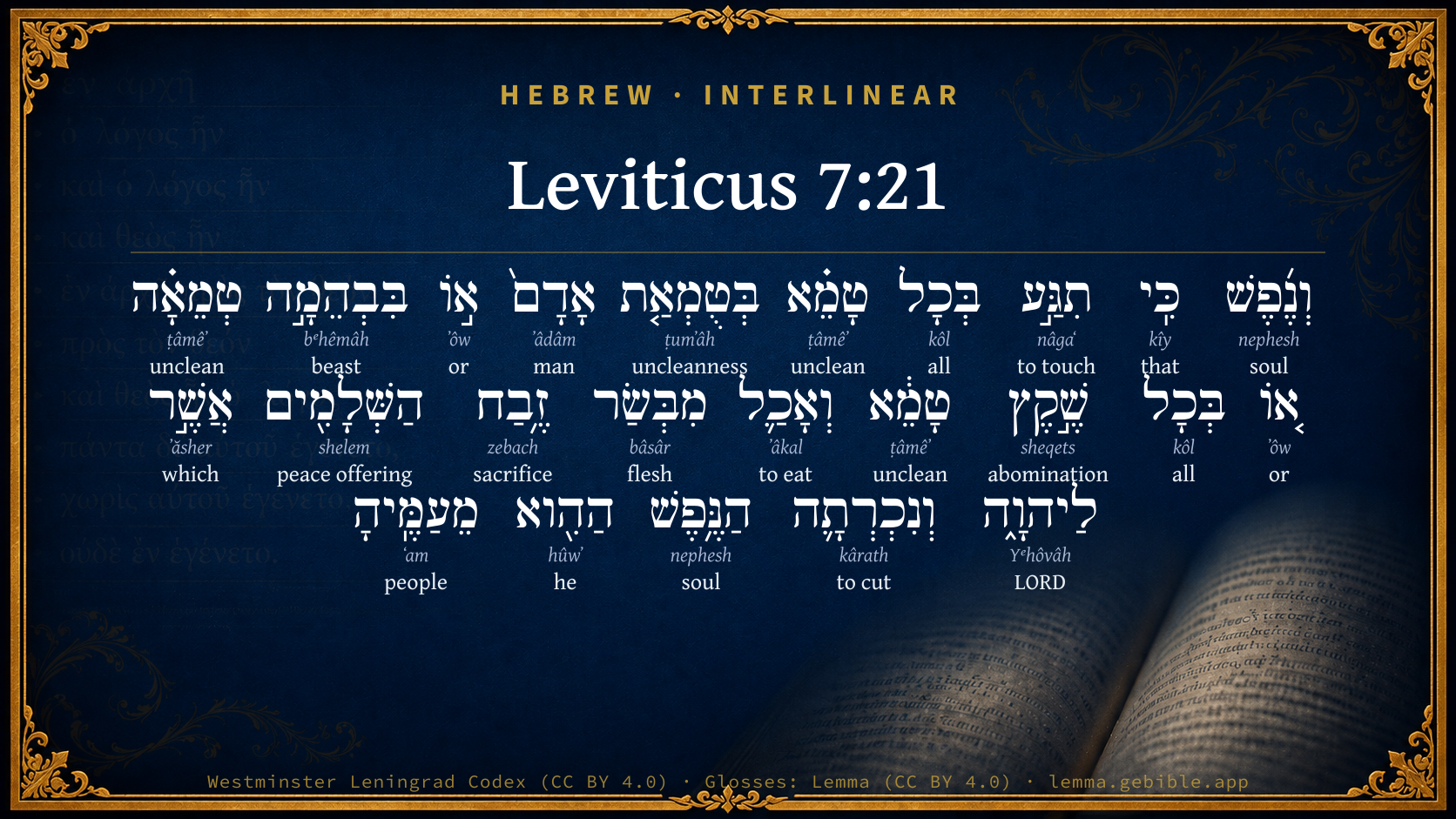
Hebrew (Westminster Leningrad Codex) Leviticus 7:21 appears in the Hebrew Old Testament. The text above is from the Westminster Leningrad Codex. Each word links to its Strong’s number, a concise gloss, and parsing drawn from the Open Scriptures Hebrew Bible morphology. Click any word for its full Brown-Driver-Briggs (BDB) entry.
Download image
Cite this verse

Leviticus 7:21 (World English Bible). Public Domain. Lemma interlinear Bible study tool, https://lemma.gebible.app/v/leviticus/7/21.

Show BibTeX & RIS
BibTeX
RIS
English Translation
When anyone touches any unclean thing, the uncleanness of man, or an unclean animal, or any unclean abomination, and eats some of the flesh of the sacrifice of peace offerings, which belong to Yahweh, that soul shall be cut off from his people.'"
World English Bible · Public Domain
Highlights Full analysis ↓
Download a study sheet

One document with this verse’s original text, its word-by-word gloss line, the meaning frame, cross-references with their text, attributed commentary, and full source and license credits — printable, and it pastes into notes with its structure intact.

This verse Autodidact and up

Study sheet (.html) Plain text (.txt)

A passage Seminary Student

Up to 50 verses in one chapter. A passage sheet keeps up to 6 commentary sources and 12 cross-references per verse, in the order this page ranks them, and says so on the sheet whenever that leaves anything out. Ask for a single verse and you get the Autodidact verse sheet above.

Everything on this page stays free to read, with no account — the sheet is a download of what is already on screen, not access to it.

Want to remove ads? Support Godless Engineer
Compare translations 3

The same verse in 3 English versions, stacked beneath the original-language interlinear above. Click any original word for its lexicon entry.

Each is an independent rendering of the whole verse — the interlinear is not word-aligned to these translations.

Highlighted words mark where these versions differ — a whole-verse word diff, not a word-by-word alignment.

  • World English Bible Public Domain
    When anyone touches any unclean thing, the uncleanness of man, or an unclean animal, or any unclean abomination, and eats some of the flesh of the sacrifice of peace offerings, which belong to Yahweh, that soul shall be cut off from his people.'"
  • King James Version Public Domain
    Moreover the soul that shall touch any unclean thing, as the uncleanness of man, or any unclean beast, or any abominable unclean thing, and eat of the flesh of the sacrifice of peace offerings, which pertain unto the LORD, even that soul shall be cut off from his people.
  • unfoldingWord Literal Text CC BY-SA 4.0
    And a person, when he touches any unclean, the uncleanness of a man or an unclean livestock or any unclean detestable thing, and he eats some of the meat of a sacrifice of the peace offerings that for Yahweh, that person shall be cut off from his people.’”

unfoldingWord Literal Text — © unfoldingWord, licensed CC BY-SA 4.0. Word-aligned USFM3 via Door43 (git.door43.org/unfoldingWord/en_ult).

Versions to compare (up to 4)

3 of 4 selected

Show all 18 translations

Every available English version of this verse, each an independent rendering of the whole verse.

  • World English Bible Public Domain
    When anyone touches any unclean thing, the uncleanness of man, or an unclean animal, or any unclean abomination, and eats some of the flesh of the sacrifice of peace offerings, which belong to Yahweh, that soul shall be cut off from his people.'"
  • Berean Standard Bible Public Domain
    If one touches anything unclean, whether human uncleanness, an unclean animal, or any unclean, detestable thing, and then eats any of the meat of the peace offering that belongs to the LORD, that person must be cut off from his people.”
  • Majority Standard Bible Public Domain
    If one touches anything unclean, whether human uncleanness, an unclean animal, or any unclean, detestable thing, and then eats any of the meat of the peace offering that belongs to the LORD, that person must be cut off from his people.”
  • King James Version Public Domain
    Moreover the soul that shall touch any unclean thing, as the uncleanness of man, or any unclean beast, or any abominable unclean thing, and eat of the flesh of the sacrifice of peace offerings, which pertain unto the LORD, even that soul shall be cut off from his people.
  • American Standard Version (1901) Public Domain
    And when any one shall touch any unclean thing, the uncleanness of man, or an unclean beast, or any unclean abomination, and eat of the flesh of the sacrifice of peace-offerings, which pertain unto Jehovah, that soul shall be cut off from his people.
  • Revised Version (1885) Public Domain
    And when any one shall touch any unclean thing, the uncleanness of man, or an unclean beast, or any unclean abomination, and eat of the flesh of the sacrifice of peace offerings, which pertain unto the LORD, that soul shall be cut off from his people.
  • Geneva Bible (1599) Public Domain
    Moreouer, whe any toucheth any vncleane thing, as the vncleannesse of man, or of an vncleane beast, or of any filthie abomination, and eate of the flesh of the peace offrings, which pertaineth vnto the Lord, euen that person shalbe cut off from his people.
  • Douay-Rheims (1899) Public Domain
    And he that hath touched the uncleanness of man, or of beast, or of any thing that can defile, and shall eat of such kind of flesh, shall be cut off from his people.
  • Young's Literal Translation Public Domain
    `And when a person cometh against any thing unclean, of the uncleanness of man, or of the uncleanness of beasts, or of any unclean teeming creature, and hath eaten of the flesh of the sacrifice of the peace-offerings which `are' Jehovah's, even that person hath been cut off from his people.'
  • Literal Standard Version CC BY-SA 4.0
    And when a person comes against anything unclean, of the uncleanness of man, or of the uncleanness of beasts, or of any unclean teeming creature, and has eaten of the flesh of the sacrifice of the peace-offerings which [are] YHWH’s, indeed, that person has been cut off from his people.”
  • Unlocked Literal Bible CC BY-SA 4.0
    If anyone touches any unclean thing—whether uncleanness of man, or of unclean beast, or of some unclean and disgusting thing, and if he then eats some of the meat of a sacrifice of peace offering that belongs to Yahweh, that person must be cut off from his people.'”
  • unfoldingWord Literal Text CC BY-SA 4.0
    And a person, when he touches any unclean, the uncleanness of a man or an unclean livestock or any unclean detestable thing, and he eats some of the meat of a sacrifice of the peace offerings that for Yahweh, that person shall be cut off from his people.’”
  • Darby Bible Public Domain
    And if any one touch anything unclean, the uncleanness of man, or unclean beast, or any unclean abomination, and eat of the flesh of the sacrifice of peace-offering, which is for Jehovah, that soul shall be cut off from his peoples.
  • World Messianic Bible Public Domain
    When anyone touches any unclean thing, the uncleanness of man, or an unclean animal, or any unclean abomination, and eats some of the meat of the sacrifice of peace offerings which belong to the LORD, that soul shall be cut off from his people.’”
  • Webster's Bible Public Domain
    Moreover, the soul that shall touch any unclean thing, as the uncleanness of man, or any unclean beast, or any abominable unclean thing, and eat of the flesh of the sacrifice of peace-offerings which pertain to the LORD, even that soul shall be cut off from his people.
  • Free Bible Version CC BY-SA 4.0
    Anyone who touches anything unclean, whether it's from a person, an unclean animal, or an unclean revolting thing, and then eats meat from the peace offering given to the Lord, they must be expelled from their people.”
  • Bible in Basic English Public Domain
    And anyone who, after touching any unclean thing of man or an unclean beast or any unclean and disgusting thing, takes as food the flesh of the peace-offerings, which are the Lord's, will be cut off from his people.
  • JPS Tanakh (1917) Public Domain
    And when any one shall touch any unclean thing, whether it be the uncleanness of man, or an unclean beast, or any unclean detestable thing, and eat of the flesh of the sacrifice of peace-offerings, which pertain unto the LORD, that soul shall be cut off from his people.

Literal Standard Version (2020), Covenant Press — licensed CC BY-SA 4.0. Text via the HelloAO Bible API (eBible.org). Unlocked Literal Bible (unfoldingWord) — licensed CC BY-SA 4.0. Text via the HelloAO Bible API (eBible.org). unfoldingWord Literal Text — © unfoldingWord, licensed CC BY-SA 4.0. Word-aligned USFM3 via Door43 (git.door43.org/unfoldingWord/en_ult). Free Bible Version, Dr. Jonathan Gallagher — licensed CC BY-SA 4.0. Text via the HelloAO Bible API (eBible.org).

Word by word

More ways to search: Search by grammar → Find every occurrence → Compare this word →

Practice this passage: Drill this verse → Learn its vocabulary →

שֶׁ֣קֶץ
sheqets
H8263
“abomination”
Noun, Common, Masculine, Singular, Absolute
Part of Speech
Noun
Type
Common
Gender
Masculine
Number
Singular
State
Absolute
Full BDB Definition

Origin: from H8262

TWOT: 2459a , 2459b

detestable thing or idol, an unclean thing, an abomination, detestation
  1. וְנֶ֜פֶשׁ nephesh H5315 “and · soul” Conjunction + Noun, Common, Both, Singular, Absolute
  2. כִּֽי kîy H3588 “that” Conjunction
  3. תִגַּ֣ע nâgaʻ H5060 “to touch” Verb, Qal, Imperfect, 3rd Person, Feminine, Singular
  4. בְּכָל kôl H3605 “in/at · all of” Preposition + Noun, Common, Masculine, Singular, Construct
  5. טָמֵ֗א ṭâmêʼ H2931 “unclean” Adjective, Adjective, Masculine, Singular, Absolute
  6. בְּטֻמְאַ֤ת ṭumʼâh H2932 “in/at · uncleanness of” Preposition + Noun, Common, Feminine, Singular, Construct
  7. אָדָם֙ ʼâdâm H120 “man” Noun, Common, Masculine, Singular, Absolute
  8. א֣וֹ ʼôw H176 “or” Conjunction
  9. בִּבְהֵמָ֣ה bᵉhêmâh H929 “in/at · beast” Preposition + Noun, Common, Feminine, Singular, Absolute
  10. טְמֵאָ֗ה ṭâmêʼ H2931 “unclean” Adjective, Adjective, Feminine, Singular, Absolute
  11. א֚וֹ ʼôw H176 “or” Conjunction
  12. בְּכָל kôl H3605 “in/at · all of” Preposition + Noun, Common, Masculine, Singular, Construct
  13. טָמֵ֔א ṭâmêʼ H2931 “unclean” Adjective, Adjective, Masculine, Singular, Absolute
  14. וְאָכַ֛ל ʼâkal H398 “and · to eat” Conjunction + Verb, Qal, Sequential Perfect, 3rd Person, Masculine, Singular
  15. מִבְּשַׂר bâsâr H1320 “from · flesh of” Preposition + Noun, Common, Masculine, Singular, Construct
  16. זֶ֥בַח zebach H2077 “sacrifice of” Noun, Common, Masculine, Singular, Construct
  17. הַשְּׁלָמִ֖ים shelem H8002 “the · peace offerings” Particle, Definite Article + Noun, Common, Masculine, Plural, Absolute
  18. אֲשֶׁ֣ר ʼăsher H834 “which” Particle, Relative
  19. לַיהוָ֑ה Yᵉhôvâh H3068 “to/for · LORD” Preposition + Noun, Proper
  20. וְנִכְרְתָ֛ה kârath H3772 “and · to cut” Conjunction + Verb, Niphal, Sequential Perfect, 3rd Person, Feminine, Singular
  21. הַנֶּ֥פֶשׁ nephesh H5315 “the · soul” Particle, Definite Article + Noun, Common, Both, Singular, Absolute
  22. הַהִ֖וא hûwʼ H1931 “the · he” Particle, Definite Article + Pronoun, Personal, 3rd Person, Feminine, Singular
  23. מֵעַמֶּֽיהָ ʻam H5971 “from · peoples · her” Preposition + Noun, Common, Masculine, Plural, Construct + Suffix, Personal, 3rd Person, Feminine, Singular

About this verse

These counts appear in no published source. They are computed here, from the morphology-tagged text and Lemma’s own curated glosses. What Lemma adds →

24
words
19
distinct lemmas
Pentateuch
section

Notable vocabulary

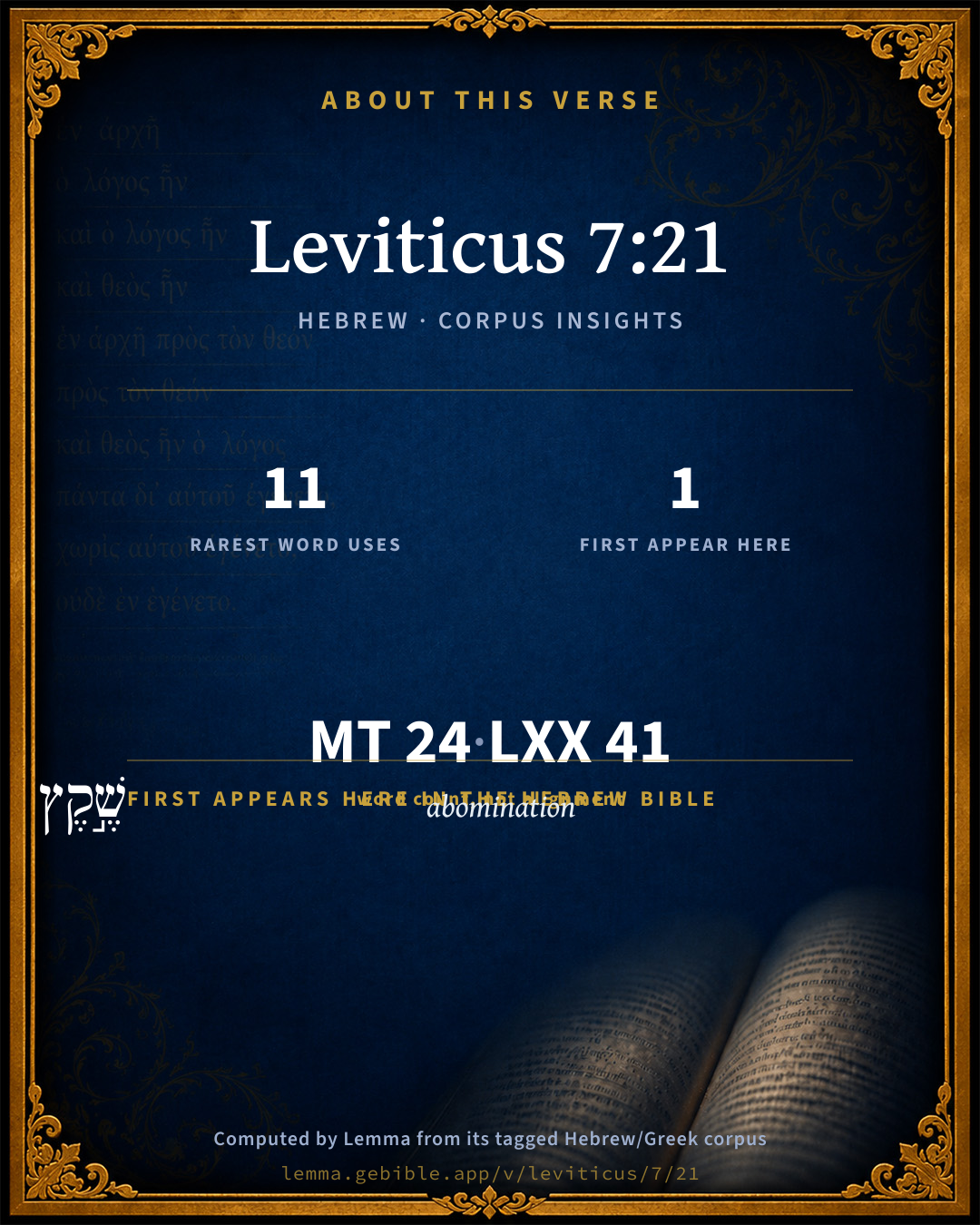
The rarest word here is שֶׁ֣קֶץ abomination H8263 — appearing just 11 times in the whole Hebrew Bible.

First appearance in Scripture

This word makes its first canonical appearance in the Hebrew Bible here:

  • שֶׁ֣קֶץ abomination H8263

Shared distinctive vocabulary

שֶׁ֣קֶץ abomination H8263 occurs in 11 verses of the Hebrew Bible. Also found in:

Grammatical profile

  • 3 verbs
  • 13 nouns
  • 3 adjectives
  • 1 pronoun
  • 3 conjunctions
  • 1 particle

Verb forms

  • תִגַּ֣ע Qal · Imperfect
  • וְאָכַ֛ל Qal · Sequential Perfect
  • וְנִכְרְתָ֛ה Niphal · Sequential Perfect

Repetition

Words recur within this verse — often emphatic in Hebrew:

  • טָמֵ֗א unclean H2931 ×3
  • וְנֶ֜פֶשׁ soul H5315 ×2
  • בְּכָל all H3605 ×2
  • א֣וֹ or H176 ×2

Hebrew & Septuagint length

In English translation the verse runs 43 words from the Hebrew and 19 from the Septuagint (LXX English) — the Septuagint runs noticeably shorter here. See the side-by-side →

A rough comparison of the two English renderings, which tokenize alike — not a word-level alignment.

Word counts can differ between the Hebrew and the Greek without any difference in meaning — e.g. the Hebrew direct-object marker אֵת has no separate Greek word, and Greek often adds the article ὁ.

In the original languages it is 24 Hebrew tokens and 41 Greek tokens — but the two are counted differently (Hebrew bundles its prefixes and suffixes into one token; the Greek is in lemma form), so that isn’t a like-for-like length.

Cross-references

23

Topical passages linked to Leviticus 7:21 in the Treasury of Scripture Knowledge — connected by theme and wording, ordered by reader-vote popularity; previews shown in the World English Bible.

  • Leviticus 5:2–3 "'Or if anyone touches any unclean thing, whether it is the carcass of an unclean animal, or the carcass of unclean cattle, or the carcass of unclean creeping things, and it is hidden from him, and he is unclean, then he shall be guilty.
  • Leviticus 11:10–13 All that don't have fins and scales in the seas, and in the rivers, of all that move in the waters, and of all the living creatures that are in the waters, they are an abomination to you,
  • Leviticus 11:20 "'All flying insects that walk on all fours are an abomination to you.
  • Leviticus 12:1–13:59 Yahweh spoke to Moses, saying,
  • Leviticus 15:1–33 Yahweh spoke to Moses and to Aaron, saying,
  • Ezekiel 4:14 Then said I, Ah Lord Yahweh! behold, my soul has not been polluted; for from my youth up even until now have I not eaten of that which dies of itself, or is torn of animals; neither came there abominable flesh into my mouth.
  • Genesis 17:14 The uncircumcised male who is not circumcised in the flesh of his foreskin, that soul shall be cut off from his people. He has broken my covenant."
  • Exodus 12:15 Seven days shall you eat unleavened bread; even the first day you shall put away yeast out of your houses, for whoever eats leavened bread from the first day until the seventh day, that soul shall be cut off from Israel.
  • Exodus 12:19 Seven days shall there be no yeast found in your houses, for whoever eats that which is leavened, that soul shall be cut off from the congregation of Israel, whether he be a foreigner, or one who is born in the land.
  • Exodus 30:33–38 Whoever compounds any like it, or whoever puts any of it on a stranger, he shall be cut off from his people.'"
  • Leviticus 7:20 but the soul who eats of the flesh of the sacrifice of peace offerings, that belongs to Yahweh, having his uncleanness on him, that soul shall be cut off from his people.
  • Leviticus 7:25 For whoever eats the fat of the animal, of which men offer an offering made by fire to Yahweh, even the soul who eats it shall be cut off from his people.
  • Leviticus 7:27 Whoever it is who eats any blood, that soul shall be cut off from his people.'"
  • Leviticus 11:24–42 "'By these you will become unclean: whoever touches the carcass of them shall be unclean until the evening.
  • Leviticus 17:10 "'Any man of the house of Israel, or of the strangers who live as foreigners among them, who eats any kind of blood, I will set my face against that soul who eats blood, and will cut him off from among his people.
  • Leviticus 17:14 For as to the life of all flesh, its blood is with its life: therefore I said to the children of Israel, "You shall not eat the blood of any kind of flesh; for the life of all flesh is its blood. Whoever eats it shall be cut off."
  • Leviticus 18:29 "'For whoever shall do any of these abominations, even the souls that do them shall be cut off from among their people.
  • Leviticus 22:4 "'Whoever of the seed of Aaron is a leper or has an issue; he shall not eat of the holy things, until he is clean. Whoever touches anything that is unclean by the dead, or a man whose seed goes from him;
  • Numbers 19:11–16 He who touches the dead body of any man shall be unclean seven days:
  • Deuteronomy 14:3 You shall not eat any abominable thing.
  • Deuteronomy 14:7–8 Nevertheless these you shall not eat of them that chew the cud, or of those who have the hoof cloven: the camel, and the hare, and the rabbit; because they chew the cud but don't part the hoof, they are unclean to you.
  • Deuteronomy 14:10 and whatever doesn't have fins and scales you shall not eat; it is unclean to you.
  • Deuteronomy 14:12–20 But these are they of which you shall not eat: the eagle, and the gier-eagle, and the ospray,

Cross-references courtesy of OpenBible.info (CC BY 4.0).

Hebrew and Greek witnesses Masoretic Hebrew ↔ Greek Septuagint

The same verse in the two great witnesses to the Old Testament, shown verse-for-verse.

Here the Septuagint runs noticeably shorter than the Hebrew — LXX2012 (modern English Septuagint) 19 words vs World English Bible 43. A rough length comparison of the two English translations, not a word-level alignment — read both below.

These are two independent witnesses, not word-aligned to each other, and the Septuagint is shown in lemma (dictionary) form.

Hebrew Leviticus 7:21 Masoretic · Westminster Leningrad Codex

וְנֶ֜פֶשׁ כִּֽי תִגַּ֣ע בְּכָל טָמֵ֗א בְּטֻמְאַ֤ת אָדָם֙ א֣וֹ בִּבְהֵמָ֣ה טְמֵאָ֗ה א֚וֹ בְּכָל שֶׁ֣קֶץ טָמֵ֔א וְאָכַ֛ל מִבְּשַׂר זֶ֥בַח הַשְּׁלָמִ֖ים אֲשֶׁ֣ר לַיהוָ֑ה וְנִכְרְתָ֛ה הַנֶּ֥פֶשׁ הַהִ֖וא מֵעַמֶּֽיהָ

When anyone touches any unclean thing, the uncleanness of man, or an unclean animal, or any unclean abomination, and eats some of the flesh of the sacrifice of peace offerings, which belong to Yahweh, that soul shall be cut off from his people.'"

World English Bible · Public Domain

Greek LXX Leviticus 7:21 Septuagint · lemma form

καί ψυχή ὅς ἄν ἅπτομαι πᾶς πρᾶγμα ἀκάθαρτος ἤ ἀπό ἀκαθαρσία ἄνθρωπος ἤ ὁ τετράποδος ὁ ἀκάθαρτος ἤ πᾶς βδέλυγμα ἀκάθαρτος καί ἐσθίω ἀπό ὁ κρέας ὁ θυσία ὁ σωτήριον ὅς εἰμί κύριος ἀποὀλλύω ὁ ψυχή ἐκεῖνος ἐκ ὁ λαός αὐτός

And the priest shall offer the fat upon the altar, and the breast shall be Aaron's and his sons,

LXX2012 (modern English Septuagint) · Public Domain

Hebrew: Westminster Leningrad Codex (CC BY 4.0). Greek: Septuagint (public domain); English from LXX2012 (modern English Septuagint) (Public Domain). How the Septuagint differs from the Hebrew →

Targum (Aramaic paraphrase)

2

The Targum is the ancient Jewish Aramaic paraphrase of the Hebrew Scriptures — an interpretive translation, not the Hebrew text itself. Onkelos (literal) and Pseudo-Jonathan (expansive) render the Torah, and Jonathan the Prophets. Coverage is partial: where no permissively-licensed English translation exists for a verse, only the Aramaic is shown. This is verse-level text, not a word-by-word alignment to the Hebrew.

  1. Targum Onkelos Torah (Genesis–Deuteronomy)
    וֶאֱנַשׁ אֲרֵי תִקְרַב בְּכָל מְסָאָב בְסוֹאֲבַת אֱנָשָׁא אוֹ בִּבְעִירָא מְסָאֲבָא אוֹ בְּכָל שִׁקְצָא מְסָאָב וְיֵיכוּל מִבְּסַר נִכְסַת קוּדְשַׁיָא דִי קֳדָם יְיָ וְיִשְׁתֵּיצֵי אֱנָשָׁא הַהוּא מֵעַמֵּיהּ

    (no public-domain English translation for this verse)

    Targum Onkelos — Aramaic: “Onkelos Genesis” (public domain); “Onkelos Exodus” (public domain); “Onkelos Leviticus” (public domain); “Onkelos Numbers” (public domain); “Onkelos Deuteronomy” (public domain). English: “Sefaria Community Translation” (CC0 1.0 (public-domain dedication)); “J.W. Etheridge. The Targums of Onkelos and Jonathan Ben Uzziel on the Pentateuch. London: Longmans, Green, 1862” (public domain). Text via Sefaria.

  2. Targum Pseudo-Jonathan Torah (Genesis–Deuteronomy)
    וּבַר נַשׁ אֲרוּם יַקְרִיב בְּכָל מְסָאָב בְּסוֹאֲבוֹת אֵינָשָׁא אוֹ בִּבְעִירָא מְסָאֲבָא אוֹ בְּכָל שִׁיקוּץ מְסָאָב וְיֵיכוּל מִבְּשַר נִכְסַת קוּדְשַׁיָא דְמִתְקַרְבִין קֳדָם יְיָ וְיִשְׁתְּצֵי בַּר נְשָׁא הַהוּא מֵעַמֵיהּ

    The man also who toucheth any unclean thing, whether the uncleanness of man, or of unclean beasts, or any unclean reptile, and eateth of the flesh of the hallowed sacrifices offered before the Lord, that man shall be cut off from his people.

    Targum Pseudo-Jonathan — Aramaic: “Targum Jonathan on Genesis” (public domain); “Targum Jonathan on Exodus” (public domain); “Targum Jonathan on Leviticus” (public domain); “Targum Jonathan on Numbers” (public domain); “Targum Jonathan on Deuteronomy” (public domain). English: “The Targum of Jonathan ben Uzziel, trans. J. W. Etheridge, London, 1862” (public domain). Text via Sefaria.

Commentary

Notes on Leviticus 7:21 from classic Christian and Jewish commentators (each source and its license shown beneath its notes). The classic Christian expositions comment on the surrounding passage and are grouped to its opening verse, so a note may address several verses; the Jewish commentaries on the Tanakh (Rashi and others) are per-verse, so they appear only where the commentator wrote on this verse.

Lemma curates 59 commentaries, every one of them public domain or Creative Commons licensed, each selected and text-cleaned for this edition rather than reprinted as found. About our sources →

Trapp's Complete Commentary

John Trapp

Lev 7:21 Moreover the soul that shall touch any unclean [thing, as] the uncleanness of man, or [any] unclean beast, or any abominable unclean [thing], and eat of the flesh of the sacrifice of peace offerings, which [pertain] unto the LORD, even that soul shall be cut off from his people.

Ver. 21. Cut off from his people.] Compare 1Co 11:27-29.

John Trapp, A Commentary or Exposition upon All the Books of the Old and New Testament (1647–1656) — public domain. Text from a community e-Sword module.

Jamieson, Fausset & Brown

Robert Jamieson, A. R. Fausset & David Brown

abominable unclean thing--Some copies of the Bible read, "any reptile."

Jamieson, Fausset & Brown — Commentary Critical and Explanatory on the Whole Bible (1871) — public domain (CC PDM 1.0). Text via the HelloAO Bible API.

Adam Clarke's Commentary

Verse 21. The uncleanness of man] Any ulcer, sore, or leprosy; or any sort of cutaneous disorder, either loathsome or infectious.

Adam Clarke's Commentary on the Bible (1810–1826) — public domain. Text from a community e-Sword/MySword module.

The Cambridge Bible for Schools and Colleges

gen. ed. J. J. S. Perowne

21. abomination] detestation, Heb. shéḳeẓ: the word is used in ch. Lev_11:10-12 of things without fins and scales that move in the waters, and in Lev_11:13; Lev_11:20; Lev_11:23; Lev_11:41-42 of birds of prey and creeping (swarming) things. See notes there. Some prefer to read shereẓ (swarming thing) following Sam. Targ. Pesh.

shall be cut off] It has been debated whether this expression means death or outlawry. Probably the latter penalty is intended. Cp. Code of Ḥammurabi (Johns) §§ 154, 158.

The Cambridge Bible for Schools and Colleges (gen. ed. J. J. S. Perowne; Cambridge University Press, 1878–1918) — public domain. Text from a community e-Sword module.

John Gill's Exposition

And the Lord spake unto Moses,.... Continued speaking to him:

saying; as follows.

John Gill's Exposition of the Whole Bible (1746–1763) — public domain (CC PDM 1.0). Text via the HelloAO Bible API.

Albert Barnes' Notes on the Bible

Unclean beast - that is, carrion of any kind. See Lev. 11.

Shall be cut off - See the Exo 31:14 note.

Albert Barnes' Notes on the Bible (1834–1885) — public domain. Text from a community e-Sword/MySword module.

Haydock's Catholic Bible Commentary

Uncleanness of man, means a person defiled, or his excrements. (Cornelius a Lapide)

George Leo Haydock (1774–1849), Haydock's Catholic Family Bible and Commentary, 1859 edition — public domain. Excludes Psalms (Douay-Rheims chapter numbering differs from Protestant) and Deuterocanonical books (Catholic canon only).

Matthew Poole's English Annotations

The uncleanness of man, or,

of women, for the word signifies both; and that there were such things coming from men or women, the touch whereof did pollute men and things, may be seen Le 15, and elsewhere. Others make it an hypallage uncleanness of man, for a man of uncleanness, or, an unclean man. But that seems not necessary here.

Matthew Poole's English Annotations on the Holy Bible (1683–1685) — public domain. Text from a community e-Sword/MySword module.

John Wesley's Explanatory Notes

Of man - Or, of women, for the word signifies both.

John Wesley, Explanatory Notes Upon the Whole Bible (1754–1765) — public domain. Text via the GEBible commentary corpus.

unfoldingWord translationNotes

Door43 World Missions Community

any unclean thing

Something that Yahweh has stated is unfit to touch or eat is spoken of as if it were physically unclean. (See: Metaphor)

whether uncleanness of man, or of unclean beast

Here "man" means humans in general. AT: "whether of a person or a beast"

or of some unclean and disgusting thing

"or of some unclean thing that disgusts Yahweh"

that person must be cut off from his people

A person being excluded from his community is spoken of as if he had been cut off from his people, as one would cut a piece of cloth or cut a branch from a tree. This can be translated in active form. See how you translated this in Leviticus 7:20. (See: Metaphor and Active or Passive)

translationWords

clean

beast

peace offering

Yahweh

cut off

unfoldingWord translationNotes — © Distant Shores Media and the Door43 World Missions Community, licensed CC BY-SA 4.0. Source: git.door43.org/Door43/en_tn.

Ramban (Nachmanides)

Rabbi Moshe ben Nachman (Ramban / Nachmanides)

OR AN UNCLEAN BEAST. Scripture speaks here briefly, mentioning only some of the unclean objects. But the same law applies to all [sources of uncleanness], for even if he touched the carcass of a clean animal and then ate holy food, he is liable to this [punishment of] excision. The nature of this excision I will explain in the section of forbidden marriages, with the help of G-d.

Ramban (Nachmanides) on the Tanakh — English translation: “Commentary on the Torah by Ramban (Nachmanides). Translated and annotated by Charles B. Chavel. New York, Shilo Pub. House, 1971-1976” (CC BY 4.0). Text via Sefaria.

Lesson kit

Teaching starters — assembled from the data on this page, not authored interpretation. Every prompt links to the verse data it draws on. Edit before teaching.

Leviticus, in the Pentateuch, opens this verse with 24 words (19 distinct Hebrew lemmas). Its most distinctive word is sheqets (“abomination”). The Greek Septuagint runs shorter here. A historical commentator’s framing appears above. Read the whole chapter for the surrounding context.

Discussion questions

  1. How does “abomination” (sheqets) shape what this verse is saying?
  2. The word “abomination” first appears here in Scripture. What is being introduced at this debut?
  3. Leviticus 11:10 shares the word «abomination» with this verse. How do the two illuminate each other?
  4. “unclean” occurs 3× in this one verse. What is the effect of the repetition?
  5. Compared with the Hebrew, the Septuagint runs shorter here. What questions does that raise?
  6. These translations render this verse differently; the difference is in the English rendering, not the original. What questions does that raise?
  7. The verb «תִגַּ֣ע» is Qal Imperfect. How does its form color the action?
  8. Reading how Trapp's Complete Commentary and Jamieson, Fausset & Brown read this verse, where do the two commentators agree and where do they part?

Things to notice

Reading settings

Reading text

Shown beneath each verse's original-language words.

Old Testament
Old Testament edition

Read the OT as the Masoretic Hebrew (MT) or the Greek Septuagint (LXX).

English shown for the Greek Septuagint (in the Hebrew ↔ Greek comparison).

Comparing translations? Open the Compare panel on any verse page to stack up to four side by side.