Exodus 34:13

Hebrew (Westminster Leningrad Codex) Exodus 34:13 appears in the Hebrew Old Testament. The text above is from the Westminster Leningrad Codex. Each word links to its Strong’s number, a concise gloss, and parsing drawn from the Open Scriptures Hebrew Bible morphology. Click any word for its full Brown-Driver-Briggs (BDB) entry.
Download image
Cite this verse

Exodus 34:13 (World English Bible). Public Domain. Lemma interlinear Bible study tool, https://lemma.gebible.app/v/exodus/34/13.

Show BibTeX & RIS
BibTeX
RIS
English Translation
but you shall break down their altars, and dash in pieces their pillars, and you shall cut down their Asherim;
World English Bible · Public Domain
Highlights Full analysis ↓
Download a study sheet

One document with this verse’s original text, its word-by-word gloss line, the meaning frame, cross-references with their text, attributed commentary, and full source and license credits — printable, and it pastes into notes with its structure intact.

This verse Autodidact and up

Study sheet (.html) Plain text (.txt)

A passage Seminary Student

Up to 50 verses in one chapter. A passage sheet keeps up to 6 commentary sources and 12 cross-references per verse, in the order this page ranks them, and says so on the sheet whenever that leaves anything out. Ask for a single verse and you get the Autodidact verse sheet above.

Everything on this page stays free to read, with no account — the sheet is a download of what is already on screen, not access to it.

Want to remove ads? Support Godless Engineer
Compare translations 3

The same verse in 3 English versions, stacked beneath the original-language interlinear above. Click any original word for its lexicon entry.

Each is an independent rendering of the whole verse — the interlinear is not word-aligned to these translations.

Highlighted words mark where these versions differ — a whole-verse word diff, not a word-by-word alignment.

  • World English Bible Public Domain
    but you shall break down their altars, and dash in pieces their pillars, and you shall cut down their Asherim;
  • King James Version Public Domain
    But ye shall destroy their altars, break their images, and cut down their groves:
  • unfoldingWord Literal Text CC BY-SA 4.0
    Instead, their altars you shall break down, and their pillars you shall smash, and his Asherah poles you shall cut down.

unfoldingWord Literal Text — © unfoldingWord, licensed CC BY-SA 4.0. Word-aligned USFM3 via Door43 (git.door43.org/unfoldingWord/en_ult).

Versions to compare (up to 4)

3 of 4 selected

Show all 18 translations

Every available English version of this verse, each an independent rendering of the whole verse.

  • World English Bible Public Domain
    but you shall break down their altars, and dash in pieces their pillars, and you shall cut down their Asherim;
  • Berean Standard Bible Public Domain
    Rather, you must tear down their altars, smash their sacred stones, and chop down their Asherah poles.
  • Majority Standard Bible Public Domain
    Rather, you must tear down their altars, smash their sacred stones, and chop down their Asherah poles.
  • King James Version Public Domain
    But ye shall destroy their altars, break their images, and cut down their groves:
  • American Standard Version (1901) Public Domain
    but ye shall break down their altars, and dash in pieces their pillars, and ye shall cut down their Asherim;
  • Revised Version (1885) Public Domain
    but ye shall break down their altars, and dash in pieces their pillars, and ye shall cut down their Asherim:
  • Geneva Bible (1599) Public Domain
    But yee shall ouerthrowe their altars, and breake their images in pieces, and cut downe their groues,
  • Douay-Rheims (1899) Public Domain
    But destroy their altars, break their statues, and cut down their groves:
  • Young's Literal Translation Public Domain
    for their altars ye break down, and their standing pillars ye shiver, and its shrines ye cut down;
  • Literal Standard Version CC BY-SA 4.0
    for you break down their altars, and you shatter their standing pillars, and you cut down its Asherim;
  • Unlocked Literal Bible CC BY-SA 4.0
    Instead, you must break down their altars, smash their stone pillars, and cut down their Asherah poles.
  • unfoldingWord Literal Text CC BY-SA 4.0
    Instead, their altars you shall break down, and their pillars you shall smash, and his Asherah poles you shall cut down.
  • Darby Bible Public Domain
    but ye shall demolish their altars, shatter their statues, and hew down their Asherahs.
  • World Messianic Bible Public Domain
    but you shall break down their altars, and dash in pieces their pillars, and you shall cut down their Asherah poles;
  • Webster's Bible Public Domain
    But ye shall destroy their altars, break their images, and cut down their groves.
  • Free Bible Version CC BY-SA 4.0
    For you must tear down their altars, knock down their idolatrous pillars, and cut down their Asherah poles,
  • Bible in Basic English Public Domain
    But their altars are to be overturned and their pillars broken and their images cut down:
  • JPS Tanakh (1917) Public Domain
    But ye shall break down their altars, and dash in pieces their pillars, and ye shall cut down their Asherim.

Literal Standard Version (2020), Covenant Press — licensed CC BY-SA 4.0. Text via the HelloAO Bible API (eBible.org). Unlocked Literal Bible (unfoldingWord) — licensed CC BY-SA 4.0. Text via the HelloAO Bible API (eBible.org). unfoldingWord Literal Text — © unfoldingWord, licensed CC BY-SA 4.0. Word-aligned USFM3 via Door43 (git.door43.org/unfoldingWord/en_ult). Free Bible Version, Dr. Jonathan Gallagher — licensed CC BY-SA 4.0. Text via the HelloAO Bible API (eBible.org).

Word by word

More ways to search: Search by grammar → Find every occurrence → Compare this word →

Practice this passage: Drill this verse → Learn its vocabulary →

מַצֵּבֹתָ֖ם
matstsêbâh
H4676
“pillars · their”
Noun, Common, Feminine, Plural, Construct + Suffix, Personal, 3rd Person, Masculine, Plural
Part of Speech
Noun
Type
Common
Gender
Feminine
Number
Plural
State
Construct
Full BDB Definition

Origin: (causatively) participle of H5324

TWOT: 1398g

pillar, mastaba, stump - pillar - as monument, personal memorial - with an altar - (Hophal) stock, stump (of tree)
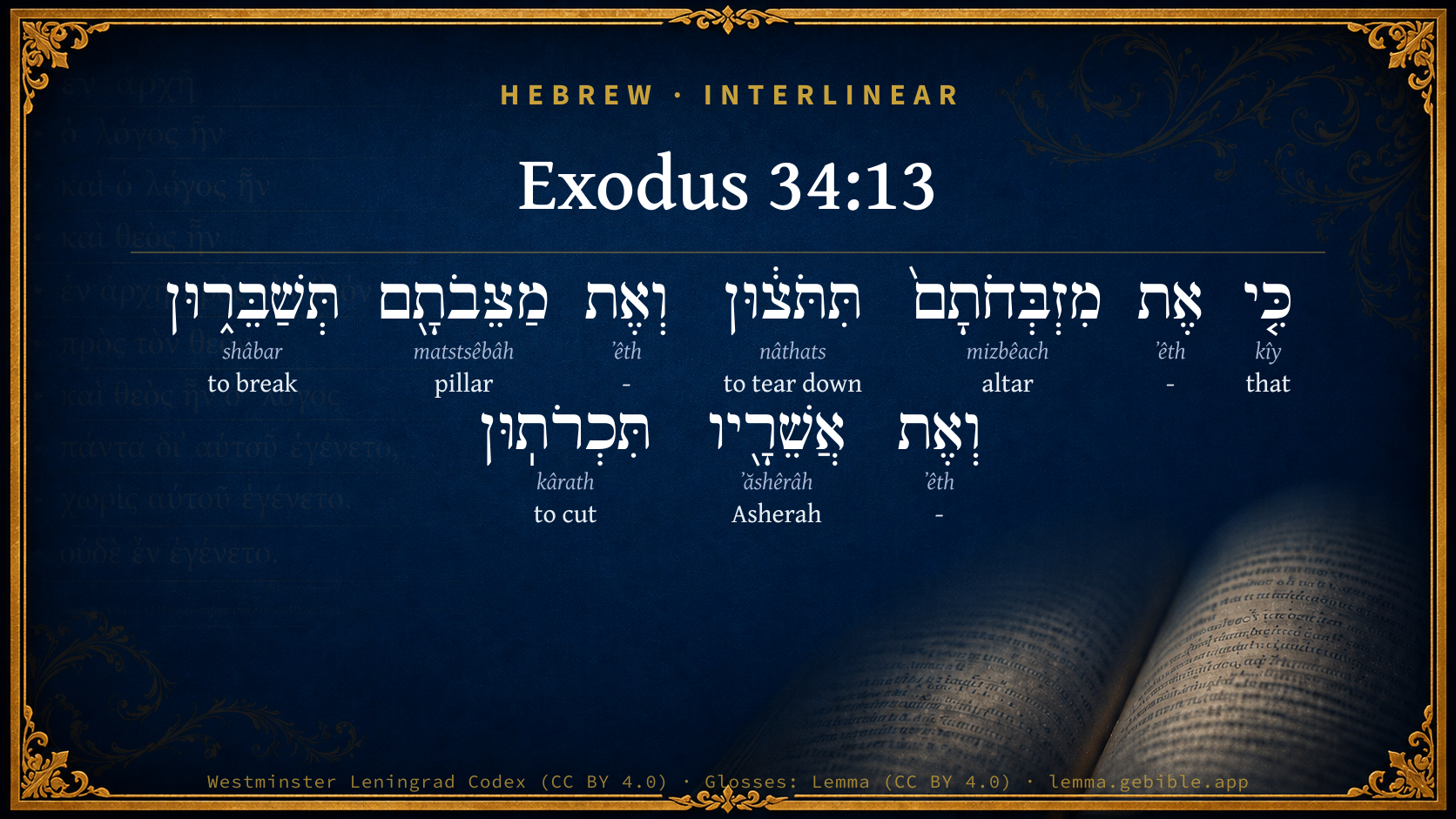
  1. כִּ֤י kîy H3588 “that” Conjunction
  2. אֶת ʼêth H853 “-” Particle, Direct Object
  3. מִזְבְּחֹתָם֙ mizbêach H4196 “altars · their” Noun, Common, Masculine, Plural, Construct + Suffix, Personal, 3rd Person, Masculine, Plural
  4. תִּתֹּצ֔וּן nâthats H5422 “to tear down” Verb, Qal, Imperfect, 2nd Person, Masculine, Plural + Suffix, n
  5. וְאֶת ʼêth H853 “and · -” Conjunction + Particle, Direct Object
  6. תְּשַׁבֵּר֑וּן shâbar H7665 “to break” Verb, Piel, Imperfect, 2nd Person, Masculine, Plural + Suffix, n
  7. וְאֶת ʼêth H853 “and · -” Conjunction + Particle, Direct Object
  8. אֲשֵׁרָ֖יו ʼăshêrâh H842 “Asherah · his” Noun, Proper + Suffix, Personal, 3rd Person, Masculine, Singular
  9. תִּכְרֹתֽוּן kârath H3772 “to cut” Verb, Qal, Imperfect, 2nd Person, Masculine, Plural + Suffix, n

About this verse

These counts appear in no published source. They are computed here, from the morphology-tagged text and Lemma’s own curated glosses. What Lemma adds →

10
words
8
distinct lemmas
Pentateuch
section

First appearance in Scripture

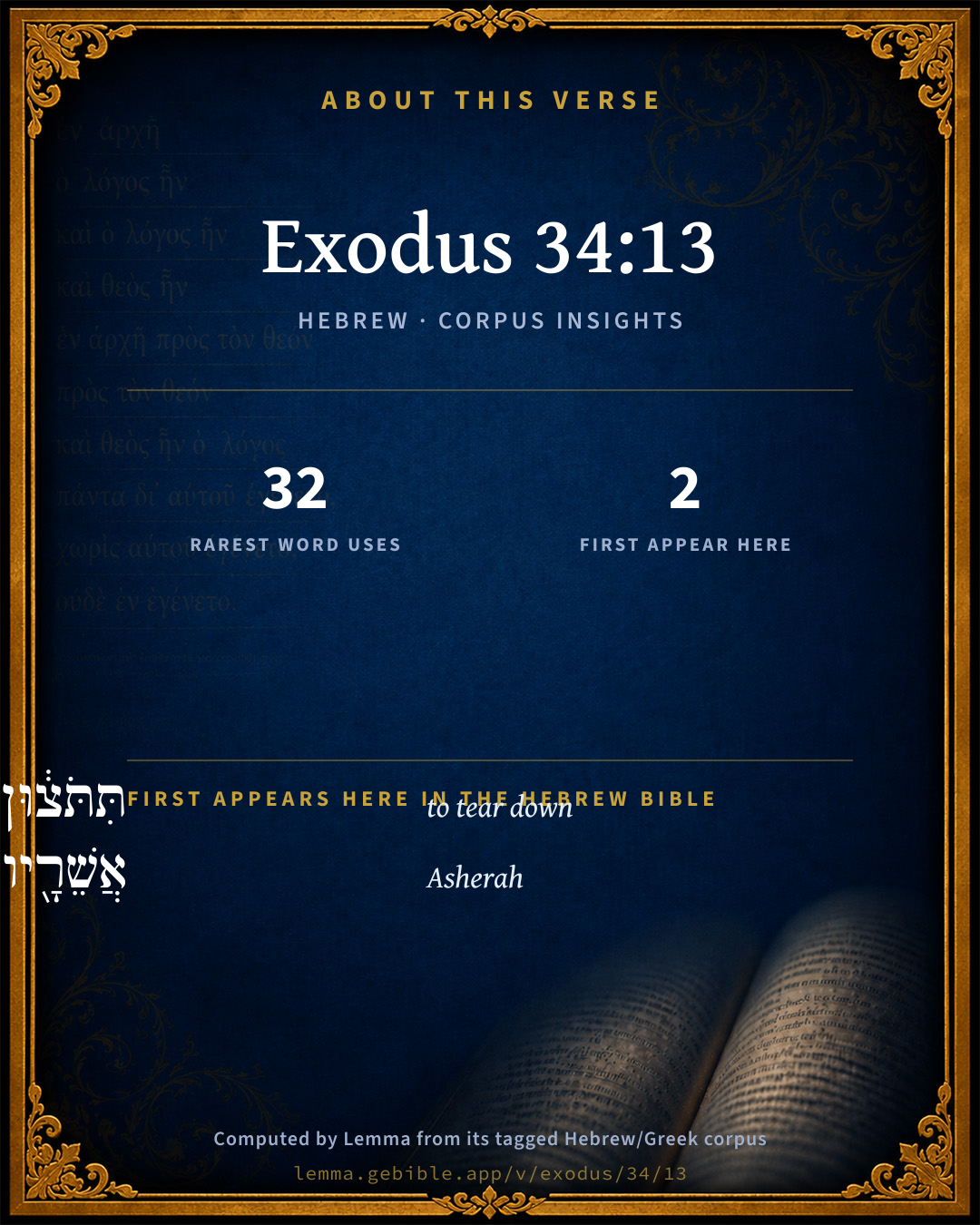
These words make their first canonical appearance in the Hebrew Bible here:

  • תִּתֹּצ֔וּן to tear down H5422
  • אֲשֵׁרָ֖יו Asherah H842

Shared distinctive vocabulary

מַצֵּבֹתָ֖ם pillar H4676 occurs in 31 verses of the Hebrew Bible. Also found in:

Grammatical profile

  • 3 verbs
  • 3 nouns
  • 1 conjunction
  • 3 particles

Verb forms

  • תִּתֹּצ֔וּן Qal · Imperfect
  • תְּשַׁבֵּר֑וּן Piel · Imperfect
  • תִּכְרֹתֽוּן Qal · Imperfect

Hebrew & Septuagint length

In English translation the verse runs 20 words from the Hebrew and 30 from the Septuagint (LXX English) — the Septuagint runs noticeably longer here. See the side-by-side →

A rough comparison of the two English renderings, which tokenize alike — not a word-level alignment.

Word counts can differ between the Hebrew and the Greek without any difference in meaning — e.g. the Hebrew direct-object marker אֵת has no separate Greek word, and Greek often adds the article ὁ.

Cross-references

11

Topical passages linked to Exodus 34:13 in the Treasury of Scripture Knowledge — connected by theme and wording, ordered by reader-vote popularity; previews shown in the World English Bible.

  • 2 Kings 18:4 He removed the high places, and broke the pillars, and cut down the Asherah: and he broke in pieces the brazen serpent that Moses had made; for to those days the children of Israel did burn incense to it; and he called it Nehushtan.
  • Exodus 23:24 You shall not bow down to their gods, nor serve them, nor follow their practices, but you shall utterly overthrow them and demolish their pillars.
  • Deuteronomy 7:5 But thus shall you deal with them: you shall break down their altars, and dash in pieces their pillars, and hew down their Asherim, and burn their engraved images with fire.
  • Deuteronomy 7:25–26 The engraved images of their gods shall you burn with fire: you shall not covet the silver or the gold that is on them, nor take it to you, lest you be snared therein; for it is an abomination to Yahweh your God.
  • Deuteronomy 12:2–3 You shall surely destroy all the places in which the nations that you shall dispossess served their gods, on the high mountains, and on the hills, and under every green tree:
  • Deuteronomy 16:21 You shall not plant you an Asherah of any kind of tree beside the altar of Yahweh your God, which you shall make you.
  • Judges 2:2 and you shall make no covenant with the inhabitants of this land; you shall break down their altars. But you have not listened to my voice: why have you done this?
  • Judges 6:25 It happened the same night, that Yahweh said to him, Take your father's bull, even the second bull seven years old, and throw down the altar of Baal that your father has, and cut down the Asherah that is by it;
  • 2 Kings 23:14 He broke in pieces the pillars, and cut down the Asherim, and filled their places with the bones of men.
  • 2 Chronicles 31:1 Now when all this was finished, all Israel who were present went out to the cities of Judah, and broke in pieces the pillars, and hewed down the Asherim, and broke down the high places and the altars out of all Judah and Benjamin, in Ephraim also and Manasseh, until they had destroyed them all. Then all the children of Israel returned, every man to his possession, into their own cities.
  • 2 Chronicles 34:3–4 For in the eighth year of his reign, while he was yet young, he began to seek after the God of David his father; and in the twelfth year he began to purge Judah and Jerusalem from the high places, and the Asherim, and the engraved images, and the molten images.

Cross-references courtesy of OpenBible.info (CC BY 4.0).

Hebrew and Greek witnesses Masoretic Hebrew ↔ Greek Septuagint

The same verse in the two great witnesses to the Old Testament, shown verse-for-verse.

Here the Septuagint runs noticeably longer than the Hebrew — LXX2012 (modern English Septuagint) 30 words vs World English Bible 20. A rough length comparison of the two English translations, not a word-level alignment — read both below.

These are two independent witnesses, not word-aligned to each other, and the Septuagint is shown in lemma (dictionary) form.

Hebrew Exodus 34:13 Masoretic · Westminster Leningrad Codex

כִּ֤י אֶת מִזְבְּחֹתָם֙ תִּתֹּצ֔וּן וְאֶת מַצֵּבֹתָ֖ם תְּשַׁבֵּר֑וּן וְאֶת אֲשֵׁרָ֖יו תִּכְרֹתֽוּן

but you shall break down their altars, and dash in pieces their pillars, and you shall cut down their Asherim;

World English Bible · Public Domain

Greek LXX Exodus 34:13 Septuagint · lemma form

ὁ βωμός αὐτός κατααἱρέω καί ὁ στήλη αὐτός συντρίβω καί ὁ ἄλσος αὐτός ἐκκόπτω καί ὁ γλυπτός ὁ θεός αὐτός κατακαίω ἐν πῦρ

You⌃ shall destroy their altars, and break in pieces their pillars, and you⌃ shall cut down their groves, and the graven images of their gods you⌃ shall burn with fire.

LXX2012 (modern English Septuagint) · Public Domain

On this verse, Haydock's Catholic Bible Commentary discusses the Septuagint’s reading. Read the note in Commentary ↓

Hebrew: Westminster Leningrad Codex (CC BY 4.0). Greek: Septuagint (public domain); English from LXX2012 (modern English Septuagint) (Public Domain). How the Septuagint differs from the Hebrew →

Targum (Aramaic paraphrase)

2

The Targum is the ancient Jewish Aramaic paraphrase of the Hebrew Scriptures — an interpretive translation, not the Hebrew text itself. Onkelos (literal) and Pseudo-Jonathan (expansive) render the Torah, and Jonathan the Prophets. Coverage is partial: where no permissively-licensed English translation exists for a verse, only the Aramaic is shown. This is verse-level text, not a word-by-word alignment to the Hebrew.

  1. Targum Onkelos Torah (Genesis–Deuteronomy)
    אֲרֵי יָת אֲגוֹרֵיהוֹן תְּתַרְעוּן וְיָת קָמַתְהוֹן תְּתַבְּרוּן וְיָת אַשְׁרֵיהוֹן תְּקַצְצוּן:

    (no public-domain English translation for this verse)

    Targum Onkelos — Aramaic: “Onkelos Genesis” (public domain); “Onkelos Exodus” (public domain); “Onkelos Leviticus” (public domain); “Onkelos Numbers” (public domain); “Onkelos Deuteronomy” (public domain). English: “Sefaria Community Translation” (CC0 1.0 (public-domain dedication)); “J.W. Etheridge. The Targums of Onkelos and Jonathan Ben Uzziel on the Pentateuch. London: Longmans, Green, 1862” (public domain). Text via Sefaria.

  2. Targum Pseudo-Jonathan Torah (Genesis–Deuteronomy)
    אֲרוּם יַת אֵיגוֹרֵיהוֹן תְּתַרְעוּן וְיַת קָמַתְהוֹן תְּתַבְּרוּן וְיַת אֲשֵׁרֵיהוֹן תְּקַצְּצוּן

    But thou shalt rather destroy their high places, and break their statues, and cut down their groves;

    Targum Pseudo-Jonathan — Aramaic: “Targum Jonathan on Genesis” (public domain); “Targum Jonathan on Exodus” (public domain); “Targum Jonathan on Leviticus” (public domain); “Targum Jonathan on Numbers” (public domain); “Targum Jonathan on Deuteronomy” (public domain). English: “The Targum of Jonathan ben Uzziel, trans. J. W. Etheridge, London, 1862” (public domain). Text via Sefaria.

Commentary

Notes on Exodus 34:13 from classic Christian and Jewish commentators (each source and its license shown beneath its notes). The classic Christian expositions comment on the surrounding passage and are grouped to its opening verse, so a note may address several verses; the Jewish commentaries on the Tanakh (Rashi and others) are per-verse, so they appear only where the commentator wrote on this verse.

Lemma curates 59 commentaries, every one of them public domain or Creative Commons licensed, each selected and text-cleaned for this edition rather than reprinted as found. About our sources →

Trapp's Complete Commentary

John Trapp

Exo 34:13 But ye shall destroy their altars, break their images, and cut down their groves:

Ver. 13. Break their images.] The Popish historians have blurred and blasted those zealous emperors, Zeno and others, that were Iconomachi and Iconoclastai, as sacrilegious. Berne was the first town that, after the Reformation, was purged of images; which Augustine saith cannot be placed in churches, Sine praesentissimo idololatrioe periculo, {a} without extreme danger of idolatry. Epiphanius saith, It is utterly unlawful and abominable to set up images in the churches of Christians. Irenaeus reproveth the Gnostics, for that they carried about the picture of Christ in Pilate’s time, after his own proportion: using also, for declaration of their affection toward it, to set garlands upon the head of it.

{a} Aug., in Psalm cxiv.

John Trapp, A Commentary or Exposition upon All the Books of the Old and New Testament (1647–1656) — public domain. Text from a community e-Sword module.

Tyndale Open Study Notes

Tyndale Open Resources

34:13 Asherah was a Canaanite fertility goddess who would continue to be a temptation throughout Israel’s history (see, e.g., Judg 6:25; 1 Kgs 14:15; 2 Kgs 23:15). • The poles seem to have been fertility symbols.

Tyndale Open Study Notes — © Tyndale Open Resources, licensed CC BY-SA 4.0. Text via the HelloAO Bible API.

Geneva Bible (1599)

Geneva Bible translators

Which pleasant places they chose for their idols.

Geneva Bible (1599) marginal notes — public domain. Text via Bolls.life.

Adam Clarke's Commentary

Verse 13. Ye shall destroy their images] See the subjects of this and all the following verses, to Ex 34:28, treated at large in the notes on "Ex 23:24".

Adam Clarke's Commentary on the Bible (1810–1826) — public domain. Text from a community e-Sword/MySword module.

Ellicott's Commentary for English Readers

(13) Ye shall destroy their altars, break their images, and cut down their groves.—In the “Book of the Covenant” the command had been simply to “quite break down their images” (Exo_23:24). Now, after the Israelites had displayed their idolatrous leanings, it is added that they are likewise to destroy the “altars” and the “groves.” Altars were common among all the idolatrous nations, sometimes attached to temples (1Ki_16:32; 2Ki_21:4-5), sometimes separate from them (Num_23:1; Num_23:29; 2Ki_16:10-11), and were used for much the same purposes as the Hebrew altars: i.e., for sacrifices, bloody and unbloody, and for burning incense. “Groves”—here mentioned for the first time—were peculiar to a limited number of nations, as the Assyrians, Babylonians, Phœnicians, Syrians, and a few others. They appear to have been artificial constructions, either of wood or stone, or both, imitative of vegetable forms, and probably emblematic of the productive powers of nature. The worship connected with the “groves” was of a peculiarly gross and licentious character. The very name, ashêrah, was a modification of Ashtoreth, or Astarte. It is remarkable that nothing is said of destroying Canaannite temples—an indication that as yet they did not exist, and a mark of the high antiquity of the book.

A Bible Commentary for English Readers, edited by Charles John Ellicott (1878–1897) — public domain. Text from a community e-Sword module.

The Cambridge Bible for Schools and Colleges

gen. ed. J. J. S. Perowne

13. The altars and religious emblems of the Canaanites to be utterly destroyed. Cf. Exo_23:24, with the references; and the almost verbal repetitions in Deu_7:5; Deu_12:3.

pillars] or standing-stones: see on Exo_23:24.

Ashçrim] The plur. of Ashçrâh, the sacred wooden (see Deu_16:21, Jdg_6:26) post or column, which stood by the altar in Canaanite places of worship (cf. Jdg_6:25-30, by an altar of Baal), and was often by the unspiritual Israelites set up (2Ki_17:10), or (Deu_16:21) ‘planted,’ beside the altar of Jehovah. It is often supposed to have been a conventional substitute for a sacred tree; but this is not certain. We have no particulars about the precise size or shape of an Ashçrâh: the two posts, of the form of tree-trunks, resting on a wide base, and surmounted by representations of the full and crescent moon, carved upon a stone from Carthage (Nowack, Arch. ii. 19; Benzinger, Arch. 1p. 381, 2p. 326), might indeed be Ashçrâhs; but we have no evidence that they were. The name Abd-ashirta (‘servant of Ashirta’) in the Tell el-Amarna letters, and the expression ‘finger (oracle) of Ashirta,’ on a cuneiform tablet of c. 1350 found at Taanach (see the writer’s Schweich Lectures, p. 82), seem to indicate that there was an old Semitic goddess Ashçrâh; and if this was the case, the ‘Ashçrâh’ of the OT. was probably her emblem: but the great difference in the Heb. (אשרה and עשתרת) makes it unlikely that she was the same as the Phoen. ‘Ashtôreth, or the Ass. Ishtar (Benz. Arch.2[220] 326 f.). On account of their heathen associations, the Ashçrîm, like the maẓẓçbâhs (see on Exo_23:24), were proscribed by the more spiritual Israelites. For other allusions to Ashçrâhs, see Deu_7:5; Deu_12:3 (repetitions of the present prohibition), 1Ki_14:15; 1Ki_14:23; 1Ki_15:13; 1Ki_16:33, 2Ki_13:6; 2Ki_18:4; 2Ki_21:3; 2Ki_21:7; 2Ki_23:4; 2Ki_23:6-7; 2Ki_23:14-15; and comp. Moore’s art. in EB. s.v.

[220] I. Benzinger, Hebr. Archäologie, 1894, ed. 2 (enlarged), 1907.

The Cambridge Bible for Schools and Colleges (gen. ed. J. J. S. Perowne; Cambridge University Press, 1878–1918) — public domain. Text from a community e-Sword module.

John Gill's Exposition

But ye shall destroy their altars,.... On which they had sacrificed to their idols; since, if they were allowed to continue, they might be temptations to offer sacrifice thereon, contrary to the command of God:

break their images: of gold or silver, wood or stone, which they made for themselves, and worshipped as deities; seeing if these continued, the sight of them might lead to the worship of them, and so bring under the divine displeasure, as a breach of the command of God given them:

and cut down their groves; which were clusters of trees, where they had their temples and their idols, and did service to them, and where, besides idolatry, many impurities were committed. Such places were originally used by good men for devotion, being shady and solitary, but when abused to superstitious and idolatrous uses, were forbidden. It is said (n), the word for "grove" is general, and includes every tree they serve, or plant, for an idol.

(n) R. Sol. Urbin. Ohel Moed, fol. 72. 1.

John Gill's Exposition of the Whole Bible (1746–1763) — public domain (CC PDM 1.0). Text via the HelloAO Bible API.

Haydock's Catholic Bible Commentary

Statues. Septuagint have, "pillars," and subjoin after groves, (unless it be another translation, as Grabe insinuates) "you shall burn with fire the graven things of their gods."

George Leo Haydock (1774–1849), Haydock's Catholic Family Bible and Commentary, 1859 edition — public domain. Excludes Psalms (Douay-Rheims chapter numbering differs from Protestant) and Deuterocanonical books (Catholic canon only).

Matthew Poole's English Annotations

Which at first were used by good men for their devotion, as Gen 21:33; but afterwards being horribly abused to superstition and idolatry, were by God, s command to be destroyed.

Matthew Poole's English Annotations on the Holy Bible (1683–1685) — public domain. Text from a community e-Sword/MySword module.

Whedon's Commentary on the Bible

Daniel D. Whedon

13. Groves — Rather, Asherah, pillars, wooden images of Asherah. See notes on Jdg_2:13; Jdg_3:7; and 1Ki_19:15.

Daniel D. Whedon (gen. ed.), Commentary on the Old and New Testaments (1874–1909) — public domain. Text from a community e-Sword module.

The Pulpit Commentary

Ye shall destroy their altars, etc. This command is more sweeping than the corresponding one in the "Book of the Covenant", (Exo_23:24) which expressly mentions only the "images." Here the destruction of idol-altars and idol-groves is further commanded. On idol-altars, see Num_23:1, Num_23:29; Jud_1:2:2; 1Ki_16:32 1Ki_18:26, etc. Groves are here for the first time mentioned. They appear to have been artificial constructions, either of wood or metal, or both, more or less imitative of trees, and regarded as emblems of the Oriental nature-deities, especially Baal and Astarte or Ashtoreth. The word translated "grove" (asherah) is a modification of the name Ashtoreth. The well-known "sacred tree" of the Assyrians is probably an asherah.

The Pulpit Commentary (1880–1919), ed. H.D.M. Spence-Jones & Joseph S. Exell — public domain. Text from a community e-Sword module.

Rashi

Rabbi Shlomo Yitzchaki (Rashi)

אשריו — An אשרה was a tree which they worshipped.

Rashi on the Tanakh — English translations: “The Judaica Press complete Tanach with Rashi, translated by A. J. Rosenberg” (CC BY 4.0); “Pentateuch with Rashi's commentary by M. Rosenbaum and A.M. Silbermann, 1929-1934” (public domain); “The Metsudah Tanach series, Lakewood, N.J” (CC BY 4.0); and “The Book of Joshua, Metsudah Publications, 1997” (CC BY 4.0). Text via Sefaria.

Lesson kit

Teaching starters — assembled from the data on this page, not authored interpretation. Every prompt links to the verse data it draws on. Edit before teaching.

Exodus, in the Pentateuch, opens this verse with 10 words (8 distinct Hebrew lemmas). Its most distinctive word is matstsêbâh (“pillar”). The Greek Septuagint runs longer here. A historical commentator’s framing appears above. Read the whole chapter for the surrounding context.

Discussion questions

  1. How does “pillar” (matstsêbâh) shape what this verse is saying?
  2. 2 words make their first appearance in Scripture here. What does this debut establish?
  3. How does Genesis 28:18, which shares the word «pillar», read alongside this verse?
  4. The Septuagint runs longer here than the Hebrew. What might account for the difference?
  5. These translations render this verse differently; the difference is in the English rendering, not the original. What questions does that raise?
  6. «תִּתֹּצ֔וּן» is a Qal Imperfect verb. How does that grammatical form shape the action described?
  7. Compare how Trapp's Complete Commentary and Tyndale Open Study Notes read this verse. Where do they agree or differ?

Things to notice

Reading settings

Reading text

Shown beneath each verse's original-language words.

Old Testament
Old Testament edition

Read the OT as the Masoretic Hebrew (MT) or the Greek Septuagint (LXX).

English shown for the Greek Septuagint (in the Hebrew ↔ Greek comparison).

Comparing translations? Open the Compare panel on any verse page to stack up to four side by side.