
1 Kings 18:5

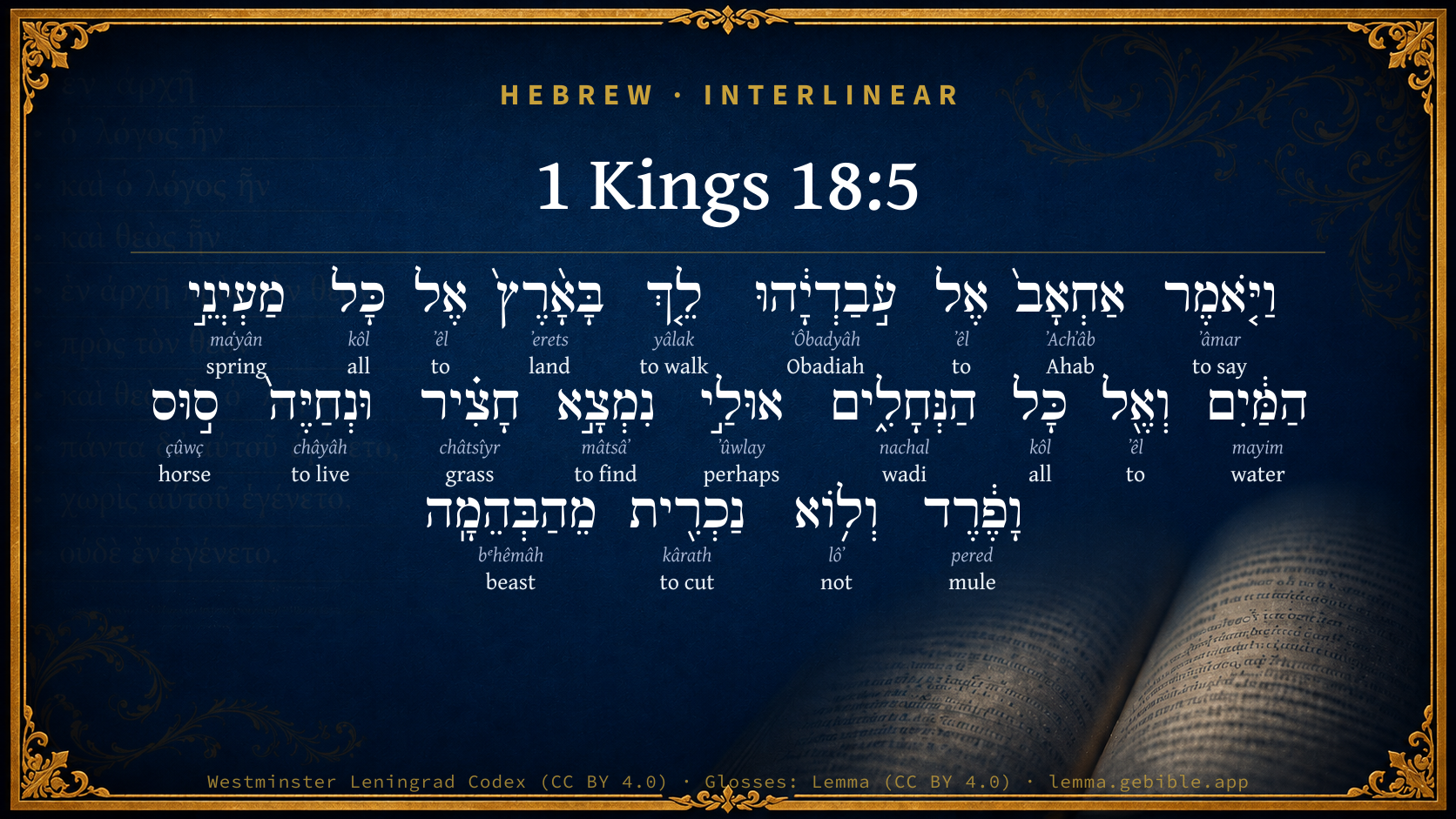
Hebrew (Westminster Leningrad Codex) 1 Kings 18:5 appears in the Hebrew Old Testament. The text above is from the Westminster Leningrad Codex. Each word links to its Strong’s number, a concise gloss, and parsing drawn from the Open Scriptures Hebrew Bible morphology. Click any word for its full Brown-Driver-Briggs (BDB) entry.
Download image
Cite this verse

1 Kings 18:5 (World English Bible). Public Domain. Lemma interlinear Bible study tool, https://lemma.gebible.app/v/1-kings/18/5.

Show BibTeX & RIS
BibTeX
RIS
English Translation
Ahab said to Obadiah, Go through the land, to all the springs of water, and to all the brooks: peradventure we may find grass and save the horses and mules alive, that we not lose all the animals.
World English Bible · Public Domain
Download a study sheet

One document with this verse’s original text, its word-by-word gloss line, the meaning frame, cross-references with their text, attributed commentary, and full source and license credits — printable, and it pastes into notes with its structure intact.

This verse Autodidact and up

Study sheet (.html) Plain text (.txt)

A passage Seminary Student

Up to 50 verses in one chapter. A passage sheet keeps up to 6 commentary sources and 12 cross-references per verse, in the order this page ranks them, and says so on the sheet whenever that leaves anything out. Ask for a single verse and you get the Autodidact verse sheet above.

Everything on this page stays free to read, with no account — the sheet is a download of what is already on screen, not access to it.

Want to remove ads? Support Godless Engineer
Compare translations 3

The same verse in 3 English versions, stacked beneath the original-language interlinear above. Click any original word for its lexicon entry.

Each is an independent rendering of the whole verse — the interlinear is not word-aligned to these translations.

Highlighted words mark where these versions differ — a whole-verse word diff, not a word-by-word alignment.

  • World English Bible Public Domain
    Ahab said to Obadiah, Go through the land, to all the springs of water, and to all the brooks: peradventure we may find grass and save the horses and mules alive, that we not lose all the animals.
  • King James Version Public Domain
    And Ahab said unto Obadiah, Go into the land, unto all fountains of water, and unto all brooks: peradventure we may find grass to save the horses and mules alive, that we lose not all the beasts.
  • unfoldingWord Literal Text CC BY-SA 4.0
    And Ahab said to Obadiah, “Go into the land, to all of the springs of water and to all of the wadis. Perhaps we will find grass, and we will keep alive a horse or a mule, and we will not cut off from the cattle.”

unfoldingWord Literal Text — © unfoldingWord, licensed CC BY-SA 4.0. Word-aligned USFM3 via Door43 (git.door43.org/unfoldingWord/en_ult).

Versions to compare (up to 4)

3 of 4 selected

Show all 18 translations

Every available English version of this verse, each an independent rendering of the whole verse.

  • World English Bible Public Domain
    Ahab said to Obadiah, Go through the land, to all the springs of water, and to all the brooks: peradventure we may find grass and save the horses and mules alive, that we not lose all the animals.
  • Berean Standard Bible Public Domain
    Then Ahab said to Obadiah, “Go throughout the land to every spring and every valley. Perhaps we will find grass to keep the horses and mules alive so that we will not have to destroy any livestock.”
  • Majority Standard Bible Public Domain
    Then Ahab said to Obadiah, “Go throughout the land to every spring and every valley. Perhaps we will find grass to keep the horses and mules alive so that we will not have to destroy any livestock.”
  • King James Version Public Domain
    And Ahab said unto Obadiah, Go into the land, unto all fountains of water, and unto all brooks: peradventure we may find grass to save the horses and mules alive, that we lose not all the beasts.
  • American Standard Version (1901) Public Domain
    And Ahab said unto Obadiah, Go through the land, unto all the fountains of water, and unto all the brooks: peradventure we may find grass and save the horses and mules alive, that we lose not all the beasts.
  • Revised Version (1885) Public Domain
    And Ahab said unto Obadiah, Go through the land, unto all the fountains of water, and unto all the brooks: peradventure we may find grass and save the horses and mules alive, that we lose not all the beasts.
  • Geneva Bible (1599) Public Domain
    And Ahab saide vnto Obadiah, Goe into the land, vnto all the fountaines of water, and vnto all the riuers, if so be that we may finde grasse to saue the horses and the mules aliue, lest we depriue the lande of the beastes.
  • Douay-Rheims (1899) Public Domain
    And Achab said to Abdias: Go into the land unto all fountains of waters, and into all valleys, to see if we can find grass, and save the horses and mules, that the beasts may not utterly perish.
  • Young's Literal Translation Public Domain
    and Ahab saith unto Obadiah, `Go through the land, unto all fountains of waters, and unto all the brooks, if so be we find hay, and keep alive horse and mule, and do not cut off any of the cattle.'
  • Literal Standard Version CC BY-SA 4.0
    and Ahab says to Obadiah, “Go through the land, to all fountains of waters, and to all the brooks, perhaps we find hay, and keep alive horse and mule, and do not cut off any of the livestock.”
  • Unlocked Literal Bible CC BY-SA 4.0
    Ahab said to Obadiah, “Go through the land to all the water springs and brooks. Perhaps we will find grass and save the horses and mules alive, so that we will not lose all the animals.”
  • unfoldingWord Literal Text CC BY-SA 4.0
    And Ahab said to Obadiah, “Go into the land, to all of the springs of water and to all of the wadis. Perhaps we will find grass, and we will keep alive a horse or a mule, and we will not cut off from the cattle.”
  • Darby Bible Public Domain
    and Ahab said to Obadiah, Go through the land, to all the fountains of water and to all the torrents, perhaps we may find grass to save the horses and the mules alive, so that we may not have to destroy some of [our] beasts.
  • World Messianic Bible Public Domain
    Ahab said to Obadiah, “Go through the land, to all the springs of water, and to all the brooks. Perhaps we may find grass and save the horses and mules alive, that we not lose all the animals.”
  • Webster's Bible Public Domain
    And Ahab said to Obadiah, Go into the land, to all fountains of water, and to all brooks: it may be we may find grass to save the horses and mules alive, that we lose not all the beasts.
  • Free Bible Version CC BY-SA 4.0
    Ahab told Obadiah, “Go throughout the country and check all the springs and valleys. Perhaps we can find some grass to keep the horses and mules alive so we will not lose any of the animals.”
  • Bible in Basic English Public Domain
    And Ahab said to Obadiah, Come, let us go through all the country, to all the fountains of water and all the rivers, and see if there is any grass to be had for the horses and the transport beasts, so that we may be able to keep some of the beasts from destruction.
  • JPS Tanakh (1917) Public Domain
    And Ahab said unto Obadiah: 'Go through the land, unto all the springs of water, and unto all the brooks; peradventure we may find grass and save the horses and mules alive, that we lose not all the beasts.'

Literal Standard Version (2020), Covenant Press — licensed CC BY-SA 4.0. Text via the HelloAO Bible API (eBible.org). Unlocked Literal Bible (unfoldingWord) — licensed CC BY-SA 4.0. Text via the HelloAO Bible API (eBible.org). unfoldingWord Literal Text — © unfoldingWord, licensed CC BY-SA 4.0. Word-aligned USFM3 via Door43 (git.door43.org/unfoldingWord/en_ult). Free Bible Version, Dr. Jonathan Gallagher — licensed CC BY-SA 4.0. Text via the HelloAO Bible API (eBible.org).

Word by word

More ways to search: Search by grammar → Find every occurrence → Compare this word →

Practice this passage: Drill this verse → Learn its vocabulary →

וָפֶ֔רֶד
pered
H6505
“and · mule”
Conjunction + Noun, Common, Masculine, Singular, Absolute
Part of Speech
Conjunction + Noun
Type
Common
Gender
Masculine
Number
Singular
State
Absolute
Full BDB Definition

Origin: from H6504

TWOT: 1807a

mule
  1. וַיֹּ֤אמֶר ʼâmar H559 “and · to say” Conjunction + Verb, Qal, Sequential Imperfect, 3rd Person, Masculine, Singular
  2. אַחְאָב֙ ʼAchʼâb H256 “Ahab” Noun, Proper
  3. אֶל ʼêl H413 “to” Preposition
  4. עֹ֣בַדְיָ֔הוּ ʻÔbadyâh H5662 “Obadiah” Noun, Proper
  5. לֵ֤ךְ yâlak H3212 “walk” Verb, Qal, Imperative, 2nd Person, Masculine, Singular
  6. בָּאָ֨רֶץ֙ ʼerets H776 “in/at the · land” Preposition, Determined + Noun, Common, Both, Singular, Absolute
  7. אֶל ʼêl H413 “to” Preposition
  8. כָּל kôl H3605 “all of” Noun, Common, Masculine, Singular, Construct
  9. מַעְיְנֵ֣י maʻyân H4599 “springs of” Noun, Common, Masculine, Plural, Construct
  10. הַמַּ֔יִם mayim H4325 “the · water(s)” Particle, Definite Article + Noun, Common, Masculine, Plural, Absolute
  11. וְאֶ֖ל ʼêl H413 “and · to” Conjunction + Preposition
  12. כָּל kôl H3605 “all of” Noun, Common, Masculine, Singular, Construct
  13. הַנְּחָלִ֑ים nachal H5158 “the · wadis” Particle, Definite Article + Noun, Common, Masculine, Plural, Absolute
  14. אוּלַ֣י ʼûwlay H194 “perhaps” Adverb
  15. נִמְצָ֣א mâtsâʼ H4672 “to find” Verb, Qal, Imperfect, 1st Person, Common, Plural
  16. חָצִ֗יר châtsîyr H2682 “grass” Noun, Common, Masculine, Singular, Absolute
  17. וּנְחַיֶּה֙ châyâh H2421 “and · to live” Conjunction + Verb, Piel, Imperfect, 1st Person, Common, Plural
  18. ס֣וּס çûwç H5483 “horse” Noun, Common, Masculine, Singular, Absolute
  19. וְל֥וֹא lôʼ H3808 “and · not” Conjunction + Particle, Negative
  20. נַכְרִ֖ית kârath H3772 “to cut” Verb, Hiphil, Imperfect, 1st Person, Common, Plural
  21. מֵהַבְּהֵמָֽה bᵉhêmâh H929 “from · the · beast” Preposition + Particle, Definite Article + Noun, Common, Feminine, Singular, Absolute

About this verse

These counts appear in no published source. They are computed here, from the morphology-tagged text and Lemma’s own curated glosses. What Lemma adds →

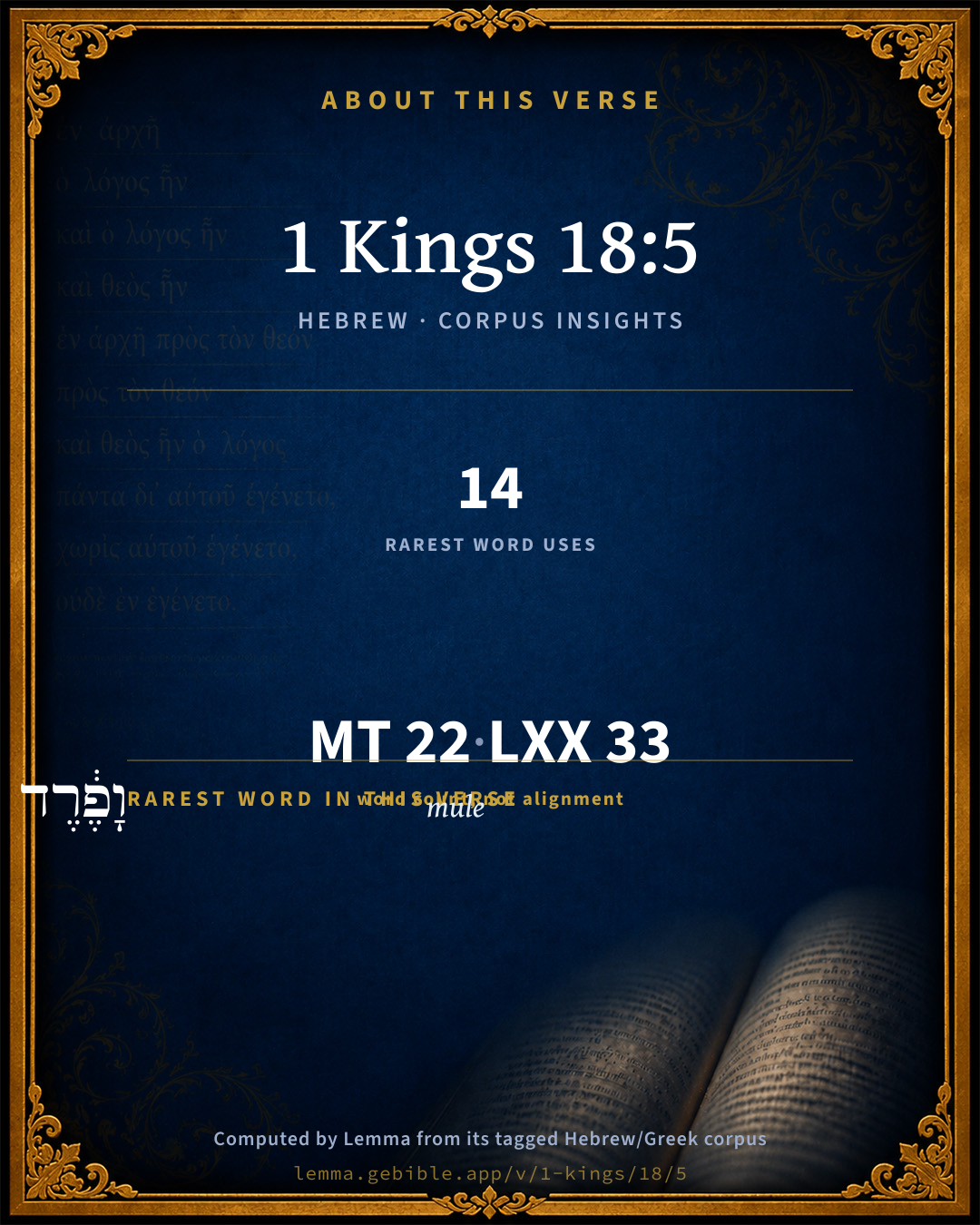
22
words
19
distinct lemmas
Historical
section

Notable vocabulary

The rarest word here is וָפֶ֔רֶד mule H6505 — appearing just 14 times in the whole Hebrew Bible.

Shared distinctive vocabulary

וָפֶ֔רֶד mule H6505 occurs in 12 verses of the Hebrew Bible. Also found in:

Grammatical profile

  • 5 verbs
  • 12 nouns
  • 3 prepositions
  • 1 adverb
  • 1 particle

Verb forms

  • וַיֹּ֤אמֶר Qal · Sequential Imperfect
  • לֵ֤ךְ Qal · Imperative
  • נִמְצָ֣א Qal · Imperfect
  • וּנְחַיֶּה֙ Piel · Imperfect
  • נַכְרִ֖ית Hiphil · Imperfect

Repetition

Words recur within this verse — often emphatic in Hebrew:

Hebrew & Septuagint length

In English translation the verse runs 38 words from the Hebrew and 47 from the Septuagint (LXX English) — closely comparable.

A rough comparison of the two English renderings, which tokenize alike — not a word-level alignment.

Word counts can differ between the Hebrew and the Greek without any difference in meaning — e.g. the Hebrew direct-object marker אֵת has no separate Greek word, and Greek often adds the article ὁ.

In the original languages it is 22 Hebrew tokens and 33 Greek tokens — but the two are counted differently (Hebrew bundles its prefixes and suffixes into one token; the Greek is in lemma form), so that isn’t a like-for-like length.

Cross-references

6

Topical passages linked to 1 Kings 18:5 in the Treasury of Scripture Knowledge — connected by theme and wording, ordered by reader-vote popularity; previews shown in the World English Bible.

  • Jeremiah 14:5–6 Yes, the hind also in the field calves, and forsakes [her young], because there is no grass.
  • Joel 1:18 How the animals groan! The herds of cattle are perplexed, because they have no pasture. Yes, the flocks of sheep are made desolate.
  • Psalms 104:14 He causes the grass to grow for the cattle, And plants for man to cultivate, That he may bring forth food out of the earth:
  • Joel 2:22 Don't be afraid, you animals of the field; For the pastures of the wilderness spring up, For the tree bears its fruit. The fig tree and the vine yield their strength.
  • Habakkuk 3:17 For though the fig tree doesn't flourish, Nor fruit be in the vines; The labor of the olive fails, The fields yield no food; The flocks are cut off from the fold, And there is no herd in the stalls:
  • Romans 8:20–22 For the creation was subjected to vanity, not of its own will, but because of him who subjected it, in hope

Cross-references courtesy of OpenBible.info (CC BY 4.0).

Hebrew and Greek witnesses Masoretic Hebrew ↔ Greek Septuagint

The same verse in the two great witnesses to the Old Testament, shown verse-for-verse.

These are two independent witnesses, not word-aligned to each other, and the Septuagint is shown in lemma (dictionary) form.

Hebrew 1 Kings 18:5 Masoretic · Westminster Leningrad Codex

וַיֹּ֤אמֶר אַחְאָב֙ אֶל עֹ֣בַדְיָ֔הוּ לֵ֤ךְ בָּאָ֨רֶץ֙ אֶל כָּל מַעְיְנֵ֣י הַמַּ֔יִם וְאֶ֖ל כָּל הַנְּחָלִ֑ים אוּלַ֣י נִמְצָ֣א חָצִ֗יר וּנְחַיֶּה֙ ס֣וּס וָפֶ֔רֶד וְל֥וֹא נַכְרִ֖ית מֵהַבְּהֵמָֽה

Ahab said to Obadiah, Go through the land, to all the springs of water, and to all the brooks: peradventure we may find grass and save the horses and mules alive, that we not lose all the animals.

World English Bible · Public Domain

Greek LXX 1 Kings 18:5 Septuagint · lemma form

καί εἶπον αχααβ πρός αβδιου δεῦρο καί διαἔρχομαι ἐπί ὁ γῆ ἐπί πηγή ὁ ὕδωρ καί ἐπί χειμάρρους ἐάν πῶς εὑρίσκω βοτάνη καί περιποιέω ἵππος καί ἡμίονος καί οὐ ἐκὀλοθρεύω ἀπό ὁ κτῆνος

And Achaab said to Abdiu, Come, and let us go through the land, and to the fountains of water, and to the brooks, if by any means we may find grass, and may save the horses and mules, and so they will not perish from the tents.

LXX2012 (modern English Septuagint) · Public Domain

On this verse, The Cambridge Bible for Schools and Colleges discusses the Septuagint’s reading. Read the note in Commentary ↓

Hebrew: Westminster Leningrad Codex (CC BY 4.0). Greek: Septuagint (public domain); English from LXX2012 (modern English Septuagint) (Public Domain). How the Septuagint differs from the Hebrew →

Targum (Aramaic paraphrase)

1

The Targum is the ancient Jewish Aramaic paraphrase of the Hebrew Scriptures — an interpretive translation, not the Hebrew text itself. Onkelos (literal) and Pseudo-Jonathan (expansive) render the Torah, and Jonathan the Prophets. Coverage is partial: where no permissively-licensed English translation exists for a verse, only the Aramaic is shown. This is verse-level text, not a word-by-word alignment to the Hebrew.

  1. Targum Jonathan Prophets (Joshua–Malachi)
    וַאֲמַר אַחְאָב לְעוֹבַדְיָהוּ הֲלִיךְ בְּאַרְעָא עַל כָּל מַבּוּעֵי מַיָא וְעַל כָּל נַחְלַיָא מָאִים נִשְׁכַּח עִסְבָּא וּנְקַיֵם סוּסְוָּן וְכוּדַנְוָן וְלָא נִפְסוֹק מִבְּעִירָא:

    (no public-domain English translation for this verse)

    Targum Jonathan — Aramaic: “Mikraot Gedolot” (public domain). English: “Sefaria Community Translation” (CC0 1.0 (public-domain dedication)); “London "Chaldee Paraphrase," 1871” (public domain). Text via Sefaria.

Commentary

Notes on 1 Kings 18:5 from classic Christian and Jewish commentators (each source and its license shown beneath its notes). The classic Christian expositions comment on the surrounding passage and are grouped to its opening verse, so a note may address several verses; the Jewish commentaries on the Tanakh (Rashi and others) are per-verse, so they appear only where the commentator wrote on this verse.

Lemma curates 59 commentaries, every one of them public domain or Creative Commons licensed, each selected and text-cleaned for this edition rather than reprinted as found. About our sources →

Trapp's Complete Commentary

John Trapp

1Ki 18:5 And Ahab said unto Obadiah, Go into the land, unto all fountains of water, and unto all brooks: peradventure we may find grass to save the horses and mules alive, that we lose not all the beasts.

Ver. 5. And Ahab said unto Obadiah.] Goodness carrieth away trust, where it cannot have imitation.

Peradventure we may find grass.] Which groweth best in locis irriguis, in low and moist places that lie by water sides.

To save the horses and mules alive.] These were his delight and confidence; and for this more care is taken than for those "precious sons of Zion," the prophets, whom he suffered to be cut off by his wicked wife Jezebel.

That we lose not all the beasts.] The loss of their souls, meanwhile, is never thought on; though our Saviour - who only went to the price of souls - showeth that the loss of a soul is, (1.) incomparable, (2.) irreparable. {Mat 16:26}

John Trapp, A Commentary or Exposition upon All the Books of the Old and New Testament (1647–1656) — public domain. Text from a community e-Sword module.

Joseph Benson's Commentary

1Ki 18:5-6. Go unto all fountains of water, and unto all brooks — About which grass was most probably to be found in that great drought; that we lose not all the beasts — Many, it appears, were already dead for want of grass, which he hoped they might find in such moist places, sufficient to preserve, at least, a part of the rest. Ahab went one way by himself — Not daring to trust any other, Obadiah excepted; lest, being bribed by such as had grass for their own use, they should not give him a true account.

Joseph Benson's Commentary on the Old and New Testaments (1811–1818) — public domain. Text from a community e-Sword module.

Adam Clarke's Commentary

Verse 5. Unto all fountains of water] All marshy or well-watered districts, where grass was most likely to be preserved.

Adam Clarke's Commentary on the Bible (1810–1826) — public domain. Text from a community e-Sword/MySword module.

The Cambridge Bible for Schools and Colleges

gen. ed. J. J. S. Perowne

5. Go into [R.V. through] the land] The change gives a clearer idea of what is meant, and the preposition is the same which in 1Ki_18:6 is rendered ‘throughout.’ In the next clause, as both nouns are definite in the original, the R.V. has ‘the fountains’ and ‘the brooks.’ In their neighbourhood grass would remain longest.

grass to save] R.V. ‘grass and save,’ which is literal and equally good English with A.V.

that we leese not all the beasts] They might have to kill some, but the discovery of grass might save a part. The LXX. gives καὶ οὐκ ἐξολοθρευθήσονται ἀπὸ τῶν σκηνῶν. ‘Leese’ is the old English form of ‘lose.’ Cf. Shakspeare, Sonn. 1Ki_18:14, ‘Flowers distilled leese but their show.’

The Cambridge Bible for Schools and Colleges (gen. ed. J. J. S. Perowne; Cambridge University Press, 1878–1918) — public domain. Text from a community e-Sword module.

John Gill's Exposition

And Ahab said unto Obadiah, go into the land, unto all fountains of water, and unto all brooks,.... To observe in what condition they were, and the places adjoining to them, the meadows and valleys:

peradventure we may find grass to save the horses and mules alive; particularly those which belonged to the king's stables, to find provisions for which it was found difficult:

that we lose not all the beasts; many of them, doubtless, were lost through the drought already, and there was great danger of the rest, and so, in time, of there being none to procreate and preserve their species, and to prevent which Ahab proposed to take this method.

John Gill's Exposition of the Whole Bible (1746–1763) — public domain (CC PDM 1.0). Text via the HelloAO Bible API.

Albert Barnes' Notes on the Bible

Unto all fountains of water and unto all brooks - Rather, “to all springs of water and to all torrent-courses.” The former are the perennial streams; the latter are the torrent-courses which become dry in an ordinary summer.

All the beasts - Rather, some, or, “a portion of our beasts.”

Albert Barnes' Notes on the Bible (1834–1885) — public domain. Text from a community e-Sword/MySword module.

Matthew Poole's English Annotations

Unto all fountains of water, and unto all brooks; about which grass was most probably to be found in that great drought.

Matthew Poole's English Annotations on the Holy Bible (1683–1685) — public domain. Text from a community e-Sword/MySword module.

The Pulpit Commentary

And Ahab said had said unto Obadiah, Go into Heb. in the land, unto all fountains Heb. places of fountains. Cf. with ym from yi rwOam; from rwOa etc. of water, and unto all brooks wadies; (see on 1Ki_17:3) peradventure we may find grass to save the horses and mules alive It has been inferred from Ahab"s concern for his stud that he viewed the sufferings of his subjects with comparative indifference, or at least regarded them as of altogether secondary importance. But this is a too hasty conclusion. His subjects were, for the most part, as well able to find water for themselves as he was for them, and he might safely trust to their instinct of self preservation to do their best to meet the emergency. But the dumb cattle, con. fined to the stall, could not act for themselves. Hence this expedition in search of fodder, that we lose not all the beasts. Marg. that we cut not ourselves off from, etc. But this rendering, and still more that of the text, misinterprets the force of the Hiphil tyriqn." The literal translation is, That we may not have to cut off from (i.e. , a portion of, mi partitive, as in ver. 13 below, yaeybiGm). What Ahab means is that, unless they soon find fodder, they will have to slaughter a portion of their animals. So Bahr, Und nicht von dem Vieh (einen Theil) umbringen mussen . Similarly Keil.

The Pulpit Commentary (1880–1919), ed. H.D.M. Spence-Jones & Joseph S. Exell — public domain. Text from a community e-Sword module.

unfoldingWord translationNotes

Door43 World Missions Community

save the horses and mules alive ... not lose all the animals

These two phrases mean basically the same thing and are combined for emphasis. AT: "prevent the horses and mules from dying" (See: Parallelism)

Ahab went one way by himself and Obadiah went another way

The phrase "by himself" emphasizes that Ahab and Obadiah went in separate directions, not necessarily that no one was with Ahab. AT: "Ahab lead a team in one direction and Obadiah lead a team in the other direction" (See: Synecdoche)

translationWords

water

save

horse

donkey

life

unfoldingWord translationNotes — © Distant Shores Media and the Door43 World Missions Community, licensed CC BY-SA 4.0. Source: git.door43.org/Door43/en_tn.

Rashi

Rabbi Shlomo Yitzchaki (Rashi)

And we will not be bereft of [our] animals. All our animals will not be cut off from us.

Rashi on the Tanakh — English translations: “The Judaica Press complete Tanach with Rashi, translated by A. J. Rosenberg” (CC BY 4.0); “Pentateuch with Rashi's commentary by M. Rosenbaum and A.M. Silbermann, 1929-1934” (public domain); “The Metsudah Tanach series, Lakewood, N.J” (CC BY 4.0); and “The Book of Joshua, Metsudah Publications, 1997” (CC BY 4.0). Text via Sefaria.

Lesson kit

Teaching starters — assembled from the data on this page, not authored interpretation. Every prompt links to the verse data it draws on. Edit before teaching.

1 Kings, in the Historical, opens this verse with 22 words (19 distinct Hebrew lemmas). Its most distinctive word is pered (“mule”). A historical commentator’s framing appears above. Read the whole chapter for the surrounding context.

Discussion questions

  1. The word pered carries the sense “mule.” How does it shape the verse?
  2. How does 2 Samuel 13:29, which shares the word «mule», read alongside this verse?
  3. What does the repetition of “all” (2× in this one verse) do in this verse?
  4. These translations render this verse differently; the difference is in the English rendering, not the original. What questions does that raise?
  5. «וַיֹּ֤אמֶר» is a Qal Sequential Imperfect verb. How does that grammatical form shape the action described?
  6. Compare how Trapp's Complete Commentary and Joseph Benson's Commentary read this verse. Where do they agree or differ?

Things to notice

Reading settings

Reading text

Shown beneath each verse's original-language words.

Old Testament
Old Testament edition

Read the OT as the Masoretic Hebrew (MT) or the Greek Septuagint (LXX).

English shown for the Greek Septuagint (in the Hebrew ↔ Greek comparison).

Comparing translations? Open the Compare panel on any verse page to stack up to four side by side.