
Judges 6:26

Hebrew (Westminster Leningrad Codex) Judges 6:26 appears in the Hebrew Old Testament. The text above is from the Westminster Leningrad Codex. Each word links to its Strong’s number, a concise gloss, and parsing drawn from the Open Scriptures Hebrew Bible morphology. Click any word for its full Brown-Driver-Briggs (BDB) entry.
Download image
Cite this verse

Judges 6:26 (World English Bible). Public Domain. Lemma interlinear Bible study tool, https://lemma.gebible.app/v/judges/6/26.

Show BibTeX & RIS
BibTeX
RIS
English Translation
and build an altar to Yahweh your God on the top of this stronghold, in the orderly manner, and take the second bull, and offer a burnt offering with the wood of the Asherah which you shall cut down.
World English Bible · Public Domain
Highlights
  • 1 first appearance in the Hebrew Bible
Full analysis ↓
Download a study sheet

One document with this verse’s original text, its word-by-word gloss line, the meaning frame, cross-references with their text, attributed commentary, and full source and license credits — printable, and it pastes into notes with its structure intact.

This verse Autodidact and up

Study sheet (.html) Plain text (.txt)

A passage Seminary Student

Up to 50 verses in one chapter. A passage sheet keeps up to 6 commentary sources and 12 cross-references per verse, in the order this page ranks them, and says so on the sheet whenever that leaves anything out. Ask for a single verse and you get the Autodidact verse sheet above.

Everything on this page stays free to read, with no account — the sheet is a download of what is already on screen, not access to it.

Want to remove ads? Support Godless Engineer
Compare translations 3

The same verse in 3 English versions, stacked beneath the original-language interlinear above. Click any original word for its lexicon entry.

Each is an independent rendering of the whole verse — the interlinear is not word-aligned to these translations.

Highlighted words mark where these versions differ — a whole-verse word diff, not a word-by-word alignment.

  • World English Bible Public Domain
    and build an altar to Yahweh your God on the top of this stronghold, in the orderly manner, and take the second bull, and offer a burnt offering with the wood of the Asherah which you shall cut down.
  • King James Version Public Domain
    And build an altar unto the LORD thy God upon the top of this rock, in the ordered place, and take the second bullock, and offer a burnt sacrifice with the wood of the grove which thou shalt cut down.
  • unfoldingWord Literal Text CC BY-SA 4.0
    And you shall build an altar to Yahweh your God on the head of this stronghold, in the arrangement. Then you shall take the second bull and you shall offer an offering on the wood of the Asherah that you shall cut down.”

unfoldingWord Literal Text — © unfoldingWord, licensed CC BY-SA 4.0. Word-aligned USFM3 via Door43 (git.door43.org/unfoldingWord/en_ult).

Versions to compare (up to 4)

3 of 4 selected

Show all 18 translations

Every available English version of this verse, each an independent rendering of the whole verse.

  • World English Bible Public Domain
    and build an altar to Yahweh your God on the top of this stronghold, in the orderly manner, and take the second bull, and offer a burnt offering with the wood of the Asherah which you shall cut down.
  • Berean Standard Bible Public Domain
    Then build a proper altar to the LORD your God on the top of this stronghold. And with the wood of the Asherah pole you cut down, take the second bull and offer it as a burnt offering.”
  • Majority Standard Bible Public Domain
    Then build a proper altar to the LORD your God on the top of this stronghold. And with the wood of the Asherah pole you cut down, take the second bull and offer it as a burnt offering.”
  • King James Version Public Domain
    And build an altar unto the LORD thy God upon the top of this rock, in the ordered place, and take the second bullock, and offer a burnt sacrifice with the wood of the grove which thou shalt cut down.
  • American Standard Version (1901) Public Domain
    and build an altar unto Jehovah thy God upon the top of this stronghold, in the orderly manner, and take the second bullock, and offer a burnt-offering with the wood of the Asherah which thou shalt cut down.
  • Revised Version (1885) Public Domain
    and build an altar unto the LORD thy God upon the top of this strong hold, in the orderly manner, and take the second bullock, and offer a burnt offering with the wood of the Asherah which thou shalt cut down.
  • Geneva Bible (1599) Public Domain
    And build an altar vnto the Lord thy God vpon the top of this rocke, in a plaine place: and take the seconde bullocke, and offer a burnt offringe with the woode of the groue, which thou shalt cut downe.
  • Douay-Rheims (1899) Public Domain
    That night the Lord said to him: Take a bullock of thy father's, and another bullock of seven years, and thou shalt destroy the altar of Baal, which is thy father's: and cut down the grove that is about the altar:
  • Young's Literal Translation Public Domain
    and thou hast built an altar to Jehovah thy God on the top of this stronghold, by the arrangement, and hast taken the second bullock, and caused to ascend a burnt-offering with the wood of the shrine which thou cuttest down.'
  • Literal Standard Version CC BY-SA 4.0
    and you have built an altar to your God YHWH on the top of this stronghold, by the arrangement, and have taken the second bullock, and caused a burnt-offering to ascend with the wood of the Asherah which you cut down.”
  • Unlocked Literal Bible CC BY-SA 4.0
    Build an altar to Yahweh your God on the top of this place of refuge, and construct it the correct way. Offer the second bull as a burnt offering, using the wood from the Asherah that you cut down.”
  • unfoldingWord Literal Text CC BY-SA 4.0
    And you shall build an altar to Yahweh your God on the head of this stronghold, in the arrangement. Then you shall take the second bull and you shall offer an offering on the wood of the Asherah that you shall cut down.”
  • Darby Bible Public Domain
    and build an altar to the LORD your God on the top of the stronghold here, with stones laid in due order; then take the second bull, and offer it as a burnt offering with the wood of the Ashe'rah which you shall cut down."
  • World Messianic Bible Public Domain
    Then build an altar to the LORD your God on the top of this stronghold, in an orderly way, and take the second bull, and offer a burnt offering with the wood of the Asherah which you shall cut down.”
  • Webster's Bible Public Domain
    And build an altar to the LORD thy God upon the top of this rock, in the ordered place, and take the second bullock, and offer a burnt-sacrifice with the wood of the grove which thou shalt cut down.
  • Free Bible Version CC BY-SA 4.0
    Then build an altar to the Lord your God in the proper way on this hilltop. Using the wood of the Asherah pole you cut down as firewood, take the second bull and present it as a burnt offering.”
  • Bible in Basic English Public Domain
    Make an altar to the Lord your God on the top of this rock, in the ordered way and take the ox and make a burned offering with the wood of the holy tree which has been cut down.
  • JPS Tanakh (1917) Public Domain
    and build an altar unto the LORD thy God upon the top of this stronghold, in the ordered place, and take the second bullock, and offer a burnt-offering with the wood of the Asherah which thou shalt cut down.'

Literal Standard Version (2020), Covenant Press — licensed CC BY-SA 4.0. Text via the HelloAO Bible API (eBible.org). Unlocked Literal Bible (unfoldingWord) — licensed CC BY-SA 4.0. Text via the HelloAO Bible API (eBible.org). unfoldingWord Literal Text — © unfoldingWord, licensed CC BY-SA 4.0. Word-aligned USFM3 via Door43 (git.door43.org/unfoldingWord/en_ult). Free Bible Version, Dr. Jonathan Gallagher — licensed CC BY-SA 4.0. Text via the HelloAO Bible API (eBible.org).

Word by word

More ways to search: Search by grammar → Find every occurrence → Compare this word →

Practice this passage: Drill this verse → Learn its vocabulary →

בַּמַּֽעֲרָכָ֑ה
maʻărâkâh
H4634
“in/at the · rank”
Preposition, Determined + Noun, Common, Feminine, Singular, Absolute
Part of Speech
Preposition + Noun
Type
Common
Gender
Feminine
Number
Singular
State
Absolute
Full BDB Definition

Origin: from H4633

TWOT: 1694d

row, rank, battle-line - battle-line - rank - row
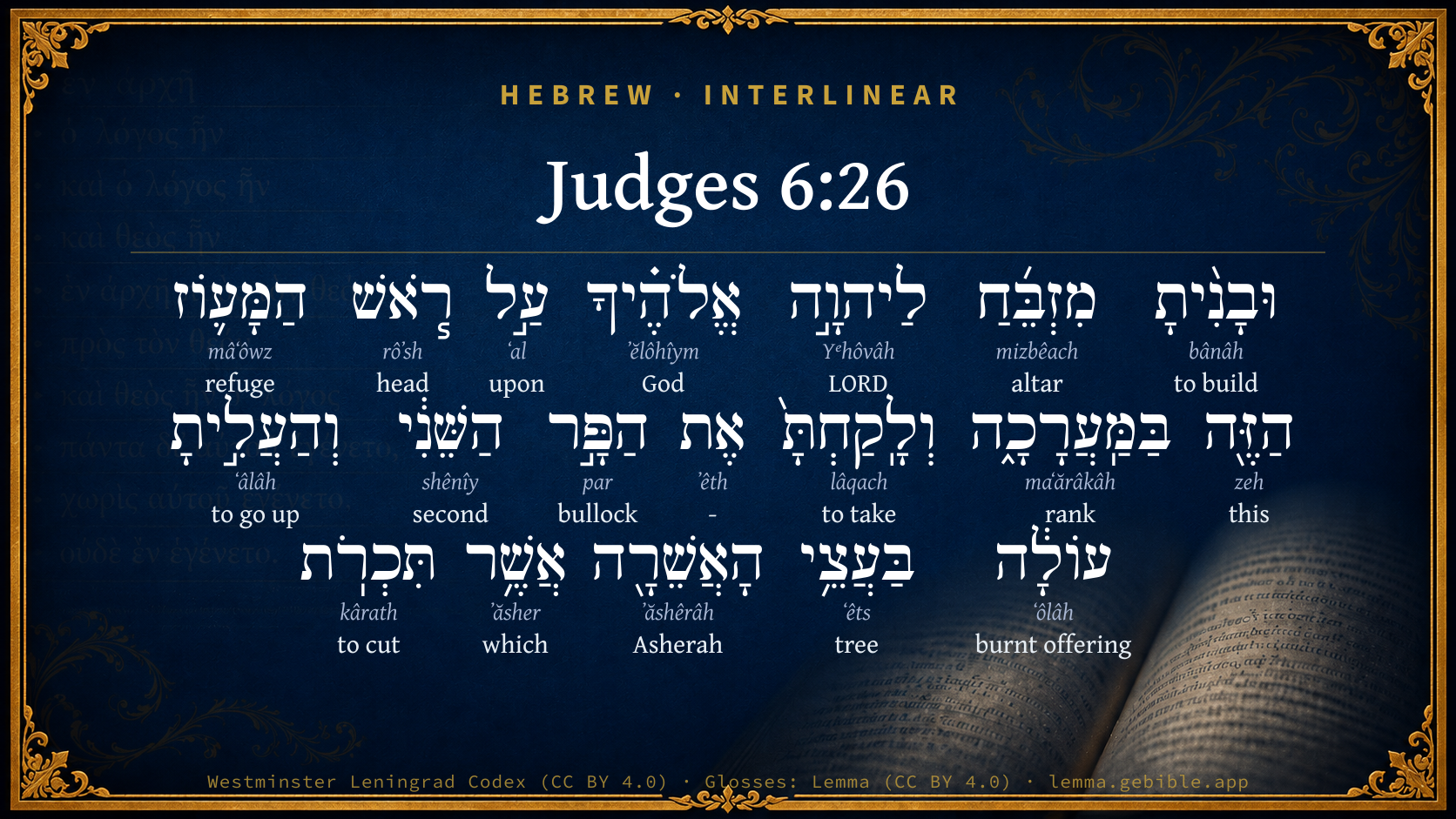
  1. וּבָנִ֨יתָ bânâh H1129 “and · to build” Conjunction + Verb, Qal, Sequential Perfect, 2nd Person, Masculine, Singular
  2. מִזְבֵּ֜חַ mizbêach H4196 “altar” Noun, Common, Masculine, Singular, Absolute
  3. לַיהוָ֣ה Yᵉhôvâh H3068 “to/for · LORD” Preposition + Noun, Proper
  4. אֱלֹהֶ֗יךָ ʼĕlôhîym H430 “God(s) · your” Noun, Common, Masculine, Plural, Construct + Suffix, Personal, 2nd Person, Masculine, Singular
  5. עַ֣ל ʻal H5921 “upon” Preposition
  6. רֹ֧אשׁ rôʼsh H7218 “head of” Noun, Common, Masculine, Singular, Construct
  7. הַמָּע֛וֹז mâʻôwz H4581 “the · refuge” Particle, Definite Article + Noun, Common, Masculine, Singular, Absolute
  8. הַזֶּ֖ה zeh H2088 “the · this” Particle, Definite Article + Pronoun, Demonstrative, Masculine, Singular
  9. וְלָֽקַחְתָּ֙ lâqach H3947 “and · to take” Conjunction + Verb, Qal, Sequential Perfect, 2nd Person, Masculine, Singular
  10. אֶת ʼêth H853 “-” Particle, Direct Object
  11. הַפָּ֣ר par H6499 “the · bullock” Particle, Definite Article + Noun, Common, Masculine, Singular, Absolute
  12. הַשֵּׁנִ֔י shênîy H8145 “the · second” Particle, Definite Article + Adjective, Ordinal number, Masculine, Singular, Absolute
  13. וְהַעֲלִ֣יתָ ʻâlâh H5927 “and · to go up” Conjunction + Verb, Hiphil, Sequential Perfect, 2nd Person, Masculine, Singular
  14. עוֹלָ֔ה ʻôlâh H5930 “burnt offering” Noun, Common, Feminine, Singular, Absolute
  15. בַּעֲצֵ֥י ʻêts H6086 “in/at · trees of” Preposition + Noun, Common, Masculine, Plural, Construct
  16. הָאֲשֵׁרָ֖ה ʼăshêrâh H842 “the · Asherah” Particle, Definite Article + Noun, Proper
  17. אֲשֶׁ֥ר ʼăsher H834 “which” Particle, Relative
  18. תִּכְרֹֽת kârath H3772 “to cut” Verb, Qal, Imperfect, 2nd Person, Masculine, Singular

About this verse

These counts appear in no published source. They are computed here, from the morphology-tagged text and Lemma’s own curated glosses. What Lemma adds →

19
words
19
distinct lemmas
Historical
section

Notable vocabulary

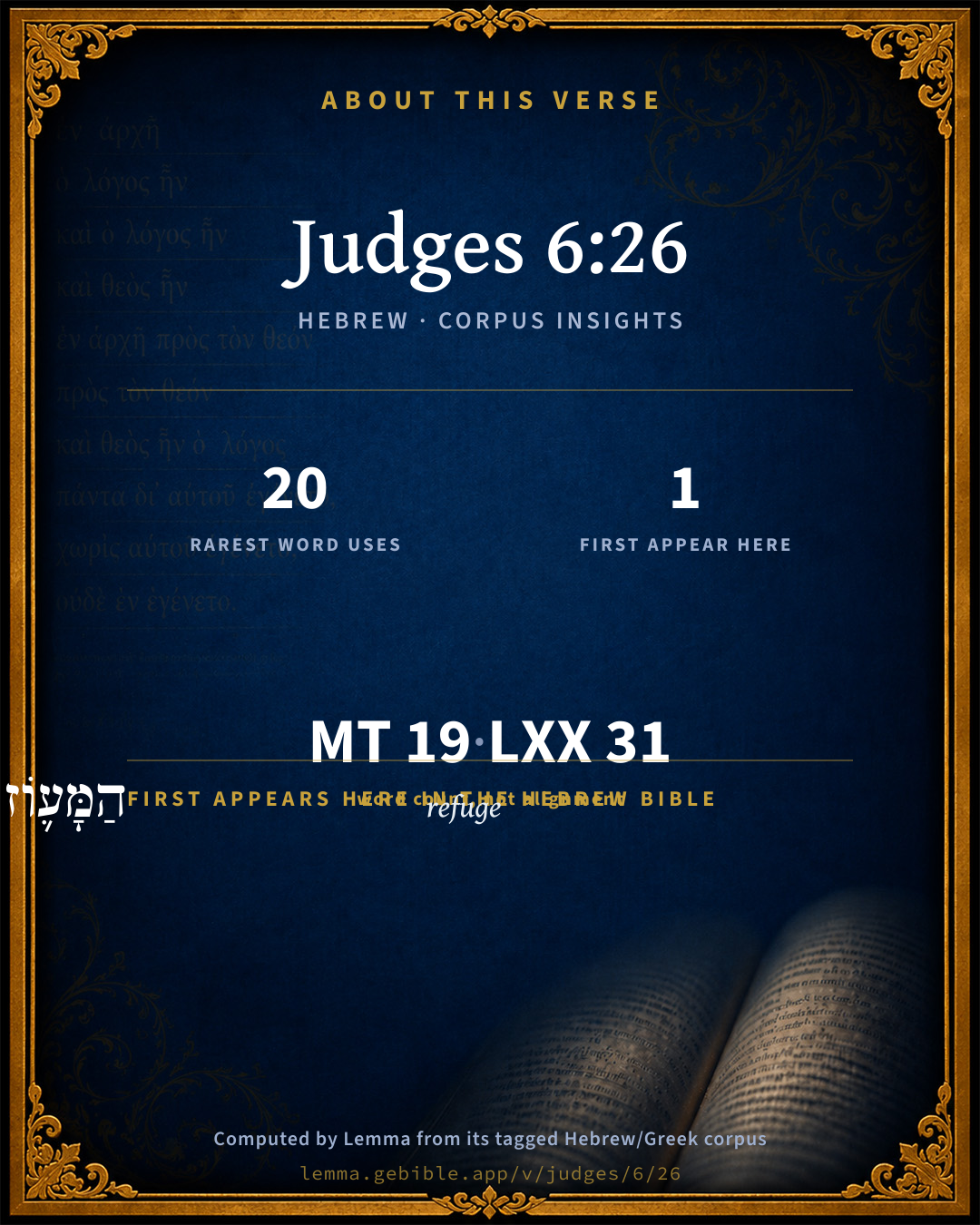
The rarest word here is בַּמַּֽעֲרָכָ֑ה rank H4634 — appearing just 20 times in the whole Hebrew Bible.

First appearance in Scripture

This word makes its first canonical appearance in the Hebrew Bible here:

  • הַמָּע֛וֹז refuge H4581

Shared distinctive vocabulary

בַּמַּֽעֲרָכָ֑ה rank H4634 occurs in 18 verses of the Hebrew Bible. Also found in:

Grammatical profile

  • 4 verbs
  • 10 nouns
  • 1 adjective
  • 1 pronoun
  • 1 preposition
  • 2 particles

Verb forms

  • וּבָנִ֨יתָ Qal · Sequential Perfect
  • וְלָֽקַחְתָּ֙ Qal · Sequential Perfect
  • וְהַעֲלִ֣יתָ Hiphil · Sequential Perfect
  • תִּכְרֹֽת Qal · Imperfect

Hebrew & Septuagint length

In English translation the verse runs 39 words from the Hebrew and 44 from the Septuagint (LXX English) — closely comparable.

A rough comparison of the two English renderings, which tokenize alike — not a word-level alignment.

Word counts can differ between the Hebrew and the Greek without any difference in meaning — e.g. the Hebrew direct-object marker אֵת has no separate Greek word, and Greek often adds the article ὁ.

In the original languages it is 19 Hebrew tokens and 31 Greek tokens — but the two are counted differently (Hebrew bundles its prefixes and suffixes into one token; the Greek is in lemma form), so that isn’t a like-for-like length.

Cross-references

3

Topical passages linked to Judges 6:26 in the Treasury of Scripture Knowledge — connected by theme and wording, ordered by reader-vote popularity; previews shown in the World English Bible.

  • 1 Corinthians 14:33 for God is not a God of confusion, but of peace. As in all the assemblies of the saints,
  • 1 Corinthians 14:40 Let all things be done decently and in order.
  • 2 Samuel 24:18 Gad came that day to David, and said to him, Go up, rear an altar to Yahweh in the threshing floor of Araunah the Jebusite.

Cross-references courtesy of OpenBible.info (CC BY 4.0).

Hebrew and Greek witnesses Masoretic Hebrew ↔ Greek Septuagint

The same verse in the two great witnesses to the Old Testament, shown verse-for-verse.

These are two independent witnesses, not word-aligned to each other, and the Septuagint is shown in lemma (dictionary) form.

Hebrew Judges 6:26 Masoretic · Westminster Leningrad Codex

וּבָנִ֨יתָ מִזְבֵּ֜חַ לַיהוָ֣ה אֱלֹהֶ֗יךָ עַ֣ל רֹ֧אשׁ הַמָּע֛וֹז הַזֶּ֖ה בַּמַּֽעֲרָכָ֑ה וְלָֽקַחְתָּ֙ אֶת הַפָּ֣ר הַשֵּׁנִ֔י וְהַעֲלִ֣יתָ עוֹלָ֔ה בַּעֲצֵ֥י הָאֲשֵׁרָ֖ה אֲשֶׁ֥ר תִּכְרֹֽת

and build an altar to Yahweh your God on the top of this stronghold, in the orderly manner, and take the second bull, and offer a burnt offering with the wood of the Asherah which you shall cut down.

World English Bible · Public Domain

Greek LXX Judges 6:26 Septuagint · lemma form

καί οἰκοδομέω θυσιαστήριον κύριος ὁ θεός σύ ἐπί κορυφή ὁ μαουεκ οὗτος ἐν ὁ παράταξις καί λαμβάνω ὁ μόσχος ὁ δεύτερος καί ἀναφέρω ὁλοκαύτωμα ἐν ὁ ξύλον ὁ ἄλσος ὅς ἐκὀλεθρεύω

And you shall build an altar to the Lord your God on the top of this Maozi in the orderingit, and you shall take the second bullock, and shall offer up whole burnt offerings with the wood of the grove, which you shall destroy.

LXX2012 (modern English Septuagint) · Public Domain

On this verse, Ellicott's Commentary for English Readers discusses the Septuagint’s reading. Read the note in Commentary ↓

Hebrew: Westminster Leningrad Codex (CC BY 4.0). Greek: Septuagint (public domain); English from LXX2012 (modern English Septuagint) (Public Domain). How the Septuagint differs from the Hebrew →

Targum (Aramaic paraphrase)

1

The Targum is the ancient Jewish Aramaic paraphrase of the Hebrew Scriptures — an interpretive translation, not the Hebrew text itself. Onkelos (literal) and Pseudo-Jonathan (expansive) render the Torah, and Jonathan the Prophets. Coverage is partial: where no permissively-licensed English translation exists for a verse, only the Aramaic is shown. This is verse-level text, not a word-by-word alignment to the Hebrew.

  1. Targum Jonathan Prophets (Joshua–Malachi)
    וְתִבְנֵי מַדְבְּחָא קֳדָם יְיָ אֱלָהָךְ עַל רֵישׁ תּוּקְפָא הָדֵין בְּסִדְרָא וְתִסַב יַת תּוֹרָא תִּנְיָנָא וְתַסֵיק עֲלָתָא בְּאָעֵי אֲשֶׁרְתָּא דִי תְקוֹץ:

    (no public-domain English translation for this verse)

    Targum Jonathan — Aramaic: “Mikraot Gedolot” (public domain). English: “Sefaria Community Translation” (CC0 1.0 (public-domain dedication)); “London "Chaldee Paraphrase," 1871” (public domain). Text via Sefaria.

Commentary

Notes on Judges 6:26 from classic Christian and Jewish commentators (each source and its license shown beneath its notes). The classic Christian expositions comment on the surrounding passage and are grouped to its opening verse, so a note may address several verses; the Jewish commentaries on the Tanakh (Rashi and others) are per-verse, so they appear only where the commentator wrote on this verse.

Lemma curates 59 commentaries, every one of them public domain or Creative Commons licensed, each selected and text-cleaned for this edition rather than reprinted as found. About our sources →

Trapp's Complete Commentary

John Trapp

Jdg 6:26 And build an altar unto the LORD thy God upon the top of this rock, in the ordered place, and take the second bullock, and offer a burnt sacrifice with the wood of the grove which thou shalt cut down.

Ver. 26. And take the second bullock.] Appointed likely for Baal. This bullock was to be offered up, and with the wood of the grove, in sacrifice to the Lord. We see then that things which have been abused to idolatry, may afterwards be lawfully used in God’s service, as churches, monasteries, chalices, &c. So the men of Bethshemesh took and used the Philistines’ cart and cattle. {1Sa 6:15}

John Trapp, A Commentary or Exposition upon All the Books of the Old and New Testament (1647–1656) — public domain. Text from a community e-Sword module.

Joseph Benson's Commentary

Jdg 6:26. Upon the top of this rock — Hebrew, of this strong hold. For in that calamitous time the Israelites retreated to such rocks, and hid and fortified themselves in them. In the ordered place — That is, in a plain and smooth part of the rock, where an altar may be conveniently built; and offer a burnt-sacrifice — Gideon was no priest, nor was this the appointed place of sacrifice; but God can dispense with his own institutions, though we may not; and his call gave Gideon sufficient authority.

Joseph Benson's Commentary on the Old and New Testaments (1811–1818) — public domain. Text from a community e-Sword module.

Geneva Bible (1599)

Geneva Bible translators

Which grew about Baal’s altar.

Geneva Bible (1599) marginal notes — public domain. Text via Bolls.life.

Adam Clarke's Commentary

Verse 26. With the wood of the grove] It is probable that אשרה Asherah here signifies Astarte; and that there was a wooden image of this goddess on the altar of Baal. Baal-peor was the same as Priapus, Astarte as Venus; these two impure idols were proper enough for the same altar. In early times, and among rude people, the images of the gods were made of wood. This is the case still with the inhabitants of the South Sea Islands, with the Indians of America, and with the inhabitants of Ceylon: many of the images of Budhoo are of wood. The Scandinavians also had wooden gods.

Adam Clarke's Commentary on the Bible (1810–1826) — public domain. Text from a community e-Sword/MySword module.

Ellicott's Commentary for English Readers

(26) Of this rock.—The word is not selah, as in Jdg_6:20, or tsor, as in Jdg_6:21, but malioz, “stronghold,” probably the citadel of Ophrah. The LXX. render it as a proper name (maoz), or in some MSS., “on the top of this mountain.” The word only occurs elsewhere in Hebrew poetry.

In the ordered place.—The margin reads, “in an orderly manner;” but probably neither version is quite correct. The Hebrew word is bammaarachah (comp. Lev_24:6; 2Ch_2:4); and as the particle be is used of the materials with which a thing is built in 1Ki_15:22; some here render it, “with the materials.” That the Jews themselves were not quite certain of the meaning appears from the various versions. The LXX. render it, “in the arrangement,” and the Vulg., “on which you have before placed the sacrifice.” It means “with the Asherah pillar hewed down, and split up into firewood.” The Jews point out the peculiar features of this burnt offering: (1) It was not at Shiloh; (2) it was not offered by a priest; (3) it was offered at night; and (4) the fire was kindled with the unhallowed materials of an idol. The Divine command was, of course, more than sufficient to justify these merely ritual irregularities; and, indeed, it is clear that in these rude times, when the country was in the hands of the heathen, the Levitic order of worship became, for the time, impossible in many particulars. Prophets and those directly commissioned by heaven were tacitly regarded as exempt from the strict rules of outward ritual which were necessary for the mass of the nation.

A Bible Commentary for English Readers, edited by Charles John Ellicott (1878–1897) — public domain. Text from a community e-Sword module.

The Cambridge Bible for Schools and Colleges

gen. ed. J. J. S. Perowne

26. build an altar unto the Lord] The present narrative tells another story about Gideon independently of what has gone before, Jdg_6:24.

this strong hold] Strictly ‘place of refuge’; but sometimes, as here and in Isa_17:9-10, the idea of strength is added. For Jehovah’s altar a new site is to be chosen.

in the orderly manner] The cognate verb is used in Num_23:4 of arranging altars, and elsewhere of arranging in order offerings or wood for sacrifice. The noun generally means a row or rank, esp. the ranks of an army, e.g. 1Sa_4:2; 1Sa_4:12 (‘army,’ marg. ‘array’); hence it may denote here the row or course of stones built into the altar. But the exact sense of the word is uncertain. The marg. may be ignored.

the second bullock] Probably the second has been introduced here and in Jdg_6:28 for the sake of verbal harmony with Jdg_6:25, where, however, the text is corrupt.

The Cambridge Bible for Schools and Colleges (gen. ed. J. J. S. Perowne; Cambridge University Press, 1878–1918) — public domain. Text from a community e-Sword module.

John Gill's Exposition

Then Gideon took ten men of his servants,.... Not only whom he could command, but could confide in, and whom he knew would cheerfully engage in this work, being like himself, who had not bowed the knee to Baal; and as there was much work to do, and it required dispatch, such a number was necessary; since he had not only the altar of Baal to throw down, and his grove or idol to cut down, but an altar to build, and a sacrifice to be taken and offered:

and did as the Lord had said unto him; all the above things, he set about them at once, and dispatched them all in one night; so ready and cheerful was he in obedience to the divine command:

and so it was, because he feared his father's household, and the men of the city, that he could not do it by day, that he did it by night; for both his father's family, and the inhabitants of the city of Ophrah, were all idolaters, worshippers of Baal; and this fear of them was not a fear of being reproached or punished for what he did, or of any harm coming to him for the fact, which as he might expect would be known, so the risk was the same, be it done when it would; but it was a fear of being restrained and hindered from doing it, and therefore in point of prudence, and consulting the honour of God and religion, and not his own safety, he took the time of the night to do it in.

John Gill's Exposition of the Whole Bible (1746–1763) — public domain (CC PDM 1.0). Text via the HelloAO Bible API.

Albert Barnes' Notes on the Bible

In the ordered place - See the margin. “Build an altar, etc., with the materials,” “the wood laid in order” (compare Gen 22:9), that, namely, which he would find ready to hand in the altar of Baal which he was to throw down.

The wood of the grove - “The (blocks of) wood of the idol,” i. e. the image of Astarte. The command from God Himself to build an altar, and sacrifice upon it, is analogous to Elijah’s sacrifice 1 Kings 18, and was doubtless caused by the extraordinary circumstance of the defection of the Israelites from the worship of the true God. Possibly, too, the Midianite invasion had made the worship at Shiloh impossible at this time.

Albert Barnes' Notes on the Bible (1834–1885) — public domain. Text from a community e-Sword/MySword module.

Haydock's Catholic Bible Commentary

Top. Hebrew, "on the to of this fortress, (Mawz. Daniel xi. 38.; Septuagint) on the platform, (Calmet) or place appointed." (Haydock) --- Offer. Though Gedeon was not a priest, he was authorized to offer sacrifice. (Menochius) --- God can dispense with his own laws. (Haydock)

George Leo Haydock (1774–1849), Haydock's Catholic Family Bible and Commentary, 1859 edition — public domain. Excludes Psalms (Douay-Rheims chapter numbering differs from Protestant) and Deuterocanonical books (Catholic canon only).

Matthew Poole's English Annotations

Upon the top of this rock; of which Jdg 6:20,21. Heb. of this strong hold; for in that calamitous time the Israelites retreated to such rocks, and hid and fortified themselves in them.

In the ordered place, i.e. in a plain and smooth part of the rock, where an altar may be conveniently built. Or,

in order, i.e. in such manner as I have appointed; for God had given rules about the building of altars.

Offer a burnt-sacrifice: Gideon was no priest, nor was this the appointed place of sacrifice; but God can dispense with his own institutions, though we may not; and his call gave Gideon sufficient authority.

Matthew Poole's English Annotations on the Holy Bible (1683–1685) — public domain. Text from a community e-Sword/MySword module.

Whedon's Commentary on the Bible

Daniel D. Whedon

26. Upon the top of this rock — Rather, the top of this stronghold. The reference is to the fortified summit of the mountain or hill on which Ophrah stood, not the rock on which Gideon had already built his Jehovah-shalom altar.

In the ordered place — Rather, as in the margin, in an orderly manner; literally, with the arrangement; that is, with that order, arrangement, and disposition which becomes a thing so sacred as an altar to Jehovah. Some, without sufficient reason, understand the Hebrew word to refer to the materials of the overthrown altar of Baal, out of which the new altar was to be built; others to the pieces of wood at the Baal altar which were lying there in readiness for use in the idol sacrifices.

The wood of the grove — Rather, the wood of the Asherah; that is, of the wooden statue mentioned in the preceding verse.

Daniel D. Whedon (gen. ed.), Commentary on the Old and New Testaments (1874–1909) — public domain. Text from a community e-Sword module.

The Pulpit Commentary

This rock. Rather, the keep or stronghold of Ophrah, where also the high place was; just as the temple was in the stronghold of Zion, and the hold of the house of Baal-Berith at Shechem was in the citadel of the place. (Jud_1:9:46) In the ordered place. The meaning of this phrase is uncertain. It may either be rendered as in the A.V, meaning on the levelled ground ordered and prepared for the building of the altar; or it may more probably be rendered with the arranged material, i.e. the stones which were laid in order at the bottom, and the wood which was laid in order upon the top of the altar. (cf. Gen_22:9) The material may either refer to that taken from the altar of Baal, which had been thrown down, and which was then ordered to be used in building the altar of the Lord, or to its own arranged material or superstructure, the wood of the asherah .

The Pulpit Commentary (1880–1919), ed. H.D.M. Spence-Jones & Joseph S. Exell — public domain. Text from a community e-Sword module.

John Wesley's Explanatory Notes

Of this rock - Hebrew. of this strong hold: for in that calamitous time the Israelites retreated to such rocks, and hid and fortified themselves in them. Ordered place - That is, in a plain and smooth part of the rock, where an altar may be conveniently built. And offer - Gideon was no priest, nor was this the appointed place of sacrifice; but God can dispense with his own institutions, though we may not; and his call gave Gideon sufficient authority.

John Wesley, Explanatory Notes Upon the Whole Bible (1754–1765) — public domain. Text via the GEBible commentary corpus.

Rashi

Rabbi Shlomo Yitzchaki (Rashi)

Top of the bulwark. Top of the rock.

Rashi on the Tanakh — English translations: “The Judaica Press complete Tanach with Rashi, translated by A. J. Rosenberg” (CC BY 4.0); “Pentateuch with Rashi's commentary by M. Rosenbaum and A.M. Silbermann, 1929-1934” (public domain); “The Metsudah Tanach series, Lakewood, N.J” (CC BY 4.0); and “The Book of Joshua, Metsudah Publications, 1997” (CC BY 4.0). Text via Sefaria.

Lesson kit

Teaching starters — assembled from the data on this page, not authored interpretation. Every prompt links to the verse data it draws on. Edit before teaching.

Judges, in the Historical, opens this verse with 19 words (19 distinct Hebrew lemmas). Its most distinctive word is maʻărâkâh (“rank”). A historical commentator’s framing appears above. Read the whole chapter for the surrounding context.

Discussion questions

  1. How does “rank” (maʻărâkâh) shape what this verse is saying?
  2. The word “refuge” first appears here in Scripture. What is being introduced at this debut?
  3. Exodus 39:37 shares the word «rank» with this verse. How do the two illuminate each other?
  4. These translations render this verse differently. What is at stake in choosing one wording over another?
  5. The verb «וּבָנִ֨יתָ» is Qal Sequential Perfect. How does its form color the action?
  6. Reading how Trapp's Complete Commentary and Joseph Benson's Commentary read this verse, where do the two commentators agree and where do they part?

Things to notice

Reading settings

Reading text

Shown beneath each verse's original-language words.

Old Testament
Old Testament edition

Read the OT as the Masoretic Hebrew (MT) or the Greek Septuagint (LXX).

English shown for the Greek Septuagint (in the Hebrew ↔ Greek comparison).

Comparing translations? Open the Compare panel on any verse page to stack up to four side by side.