
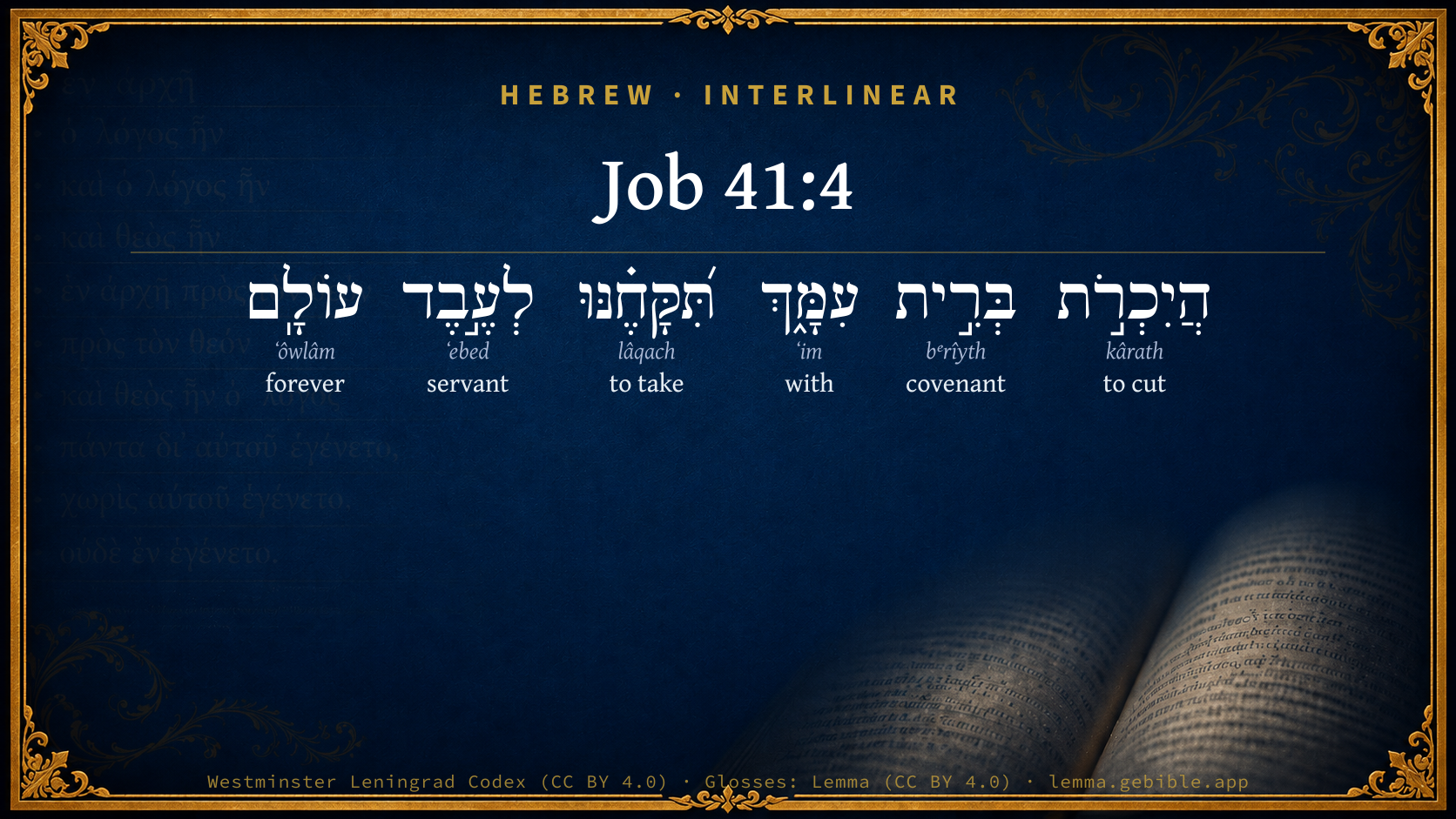
Job 41:4

Hebrew (Westminster Leningrad Codex) Job 41:4 appears in the Hebrew Old Testament. The text above is from the Westminster Leningrad Codex. Each word links to its Strong’s number, a concise gloss, and parsing drawn from the Open Scriptures Hebrew Bible morphology. Click any word for its full Brown-Driver-Briggs (BDB) entry.
Download image
Cite this verse

Job 41:4 (World English Bible). Public Domain. Lemma interlinear Bible study tool, https://lemma.gebible.app/v/job/41/4.

Show BibTeX & RIS
BibTeX
RIS
English Translation
Will he make a covenant with you, That you should take him for a servant forever?
World English Bible · Public Domain
Download a study sheet

One document with this verse’s original text, its word-by-word gloss line, the meaning frame, cross-references with their text, attributed commentary, and full source and license credits — printable, and it pastes into notes with its structure intact.

This verse Autodidact and up

Study sheet (.html) Plain text (.txt)

A passage Seminary Student

Up to 50 verses in one chapter. A passage sheet keeps up to 6 commentary sources and 12 cross-references per verse, in the order this page ranks them, and says so on the sheet whenever that leaves anything out. Ask for a single verse and you get the Autodidact verse sheet above.

Everything on this page stays free to read, with no account — the sheet is a download of what is already on screen, not access to it.

Want to remove ads? Support Godless Engineer
Compare translations 3

The same verse in 3 English versions, stacked beneath the original-language interlinear above. Click any original word for its lexicon entry.

Each is an independent rendering of the whole verse — the interlinear is not word-aligned to these translations.

Highlighted words mark where these versions differ — a whole-verse word diff, not a word-by-word alignment.

  • World English Bible Public Domain
    Will he make a covenant with you, That you should take him for a servant forever?
  • King James Version Public Domain
    Will he make a covenant with thee? wilt thou take him for a servant for ever?
  • unfoldingWord Literal Text CC BY-SA 4.0
    Will it cut a covenant with you? Will you take it for a servant forever?

unfoldingWord Literal Text — © unfoldingWord, licensed CC BY-SA 4.0. Word-aligned USFM3 via Door43 (git.door43.org/unfoldingWord/en_ult).

Versions to compare (up to 4)

3 of 4 selected

Show all 18 translations

Every available English version of this verse, each an independent rendering of the whole verse.

  • World English Bible Public Domain
    Will he make a covenant with you, That you should take him for a servant forever?
  • Berean Standard Bible Public Domain
    Will he make a covenant with you to take him as a slave for life?
  • Majority Standard Bible Public Domain
    Will he make a covenant with you to take him as a slave for life?
  • King James Version Public Domain
    Will he make a covenant with thee? wilt thou take him for a servant for ever?
  • American Standard Version (1901) Public Domain
    Will he make a covenant with thee, That thou shouldest take him for a servant for ever?
  • Revised Version (1885) Public Domain
    Will he make a covenant with thee, that thou shouldest take him for a servant for ever?
  • Geneva Bible (1599) Public Domain
    Who can discouer the face of his garmet? or who shall come to him with a double bridle?
  • Douay-Rheims (1899) Public Domain
    Who can discover the face of his garment? or who can go into the midst of his mouth?
  • Young's Literal Translation Public Domain
    Doth he make a covenant with thee? Dost thou take him for a servant age-during?
  • Literal Standard Version CC BY-SA 4.0
    Does he make a covenant with you? Do you take him for a perpetual servant?
  • Unlocked Literal Bible CC BY-SA 4.0
    Will he make a covenant with you, that you should take him for a servant forever?
  • unfoldingWord Literal Text CC BY-SA 4.0
    Will it cut a covenant with you? Will you take it for a servant forever?
  • Darby Bible Public Domain
    Will he make a covenant with thee? wilt thou take him as a bondman for ever?
  • World Messianic Bible Public Domain
    Will he make a covenant with you, that you should take him for a servant forever?
  • Webster's Bible Public Domain
    \\41:13\\Who can discover the face of his garment? or who can come to him with his double bridle?
  • Free Bible Version CC BY-SA 4.0
    Will it make a contract with you? Will it agree to be your slave forever?
  • Bible in Basic English Public Domain
    Who has ever taken off his outer skin? who may come inside his inner coat of iron?
  • JPS Tanakh (1917) Public Domain
    (40-28) Will he make a covenant with thee, that thou shouldest take him for a servant for ever?

Literal Standard Version (2020), Covenant Press — licensed CC BY-SA 4.0. Text via the HelloAO Bible API (eBible.org). Unlocked Literal Bible (unfoldingWord) — licensed CC BY-SA 4.0. Text via the HelloAO Bible API (eBible.org). unfoldingWord Literal Text — © unfoldingWord, licensed CC BY-SA 4.0. Word-aligned USFM3 via Door43 (git.door43.org/unfoldingWord/en_ult). Free Bible Version, Dr. Jonathan Gallagher — licensed CC BY-SA 4.0. Text via the HelloAO Bible API (eBible.org).

Word by word

More ways to search: Search by grammar → Find every occurrence → Compare this word →

Practice this passage: Drill this verse → Learn its vocabulary →

בְּרִ֣ית
bᵉrîyth
H1285
“covenant”
Noun, Common, Feminine, Singular, Absolute
Part of Speech
Noun
Type
Common
Gender
Feminine
Number
Singular
State
Absolute
Full BDB Definition

Origin: from H1262 (in the sense of cutting [like H1254 ])

TWOT: 282a

covenant, alliance, pledge - between men - treaty, alliance, league (man to man) - constitution, ordinance (monarch to subjects) - agreement, pledge (man to man) - alliance (of friendship) - alliance (of marriage) - between God and man - alliance (of friendship) - covenant (divine ordinance with signs or pledges) - (phrases) - covenant making - covenant keeping - covenant violation
  1. הֲיִכְרֹ֣ת kârath H3772 “to cut” Particle, Interrogative + Verb, Qal, Imperfect, 3rd Person, Masculine, Singular
  2. עִמָּ֑ךְ ʻim H5973 “with · you” Preposition + Suffix, Personal, 2nd Person, Feminine, Singular
  3. תִּ֝קָּחֶ֗נּוּ lâqach H3947 “to take · him” Verb, Qal, Imperfect, 2nd Person, Masculine, Singular + Suffix, Personal, 3rd Person, Masculine, Singular
  4. לְעֶ֣בֶד ʻebed H5650 “to/for · servant of” Preposition + Noun, Common, Masculine, Singular, Construct
  5. עוֹלָֽם ʻôwlâm H5769 “forever” Noun, Common, Masculine, Singular, Absolute

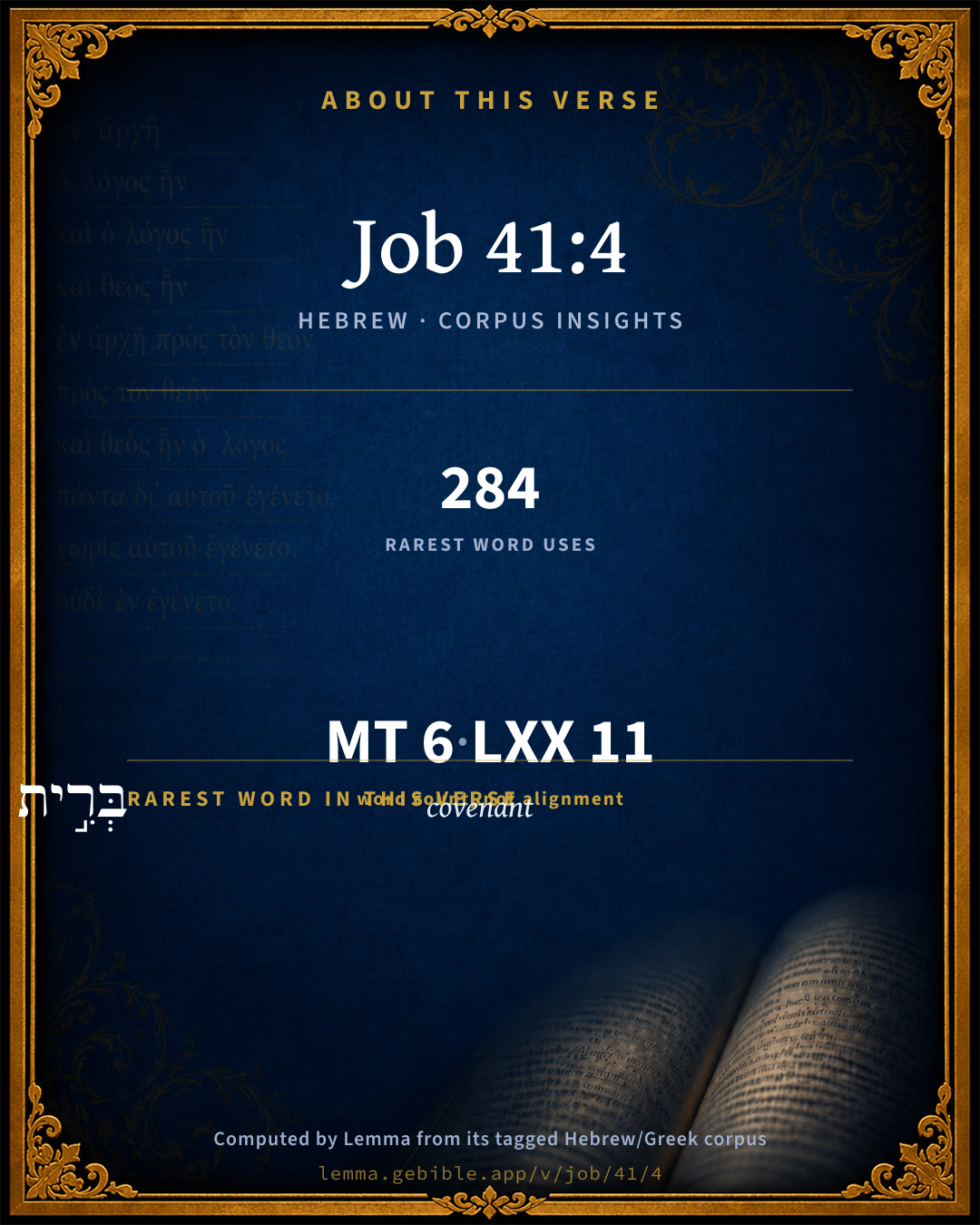
About this verse

These counts appear in no published source. They are computed here, from the morphology-tagged text and Lemma’s own curated glosses. What Lemma adds →

6
words
6
distinct lemmas
Wisdom
section

Grammatical profile

  • 2 verbs
  • 3 nouns
  • 1 preposition

Verb forms

  • הֲיִכְרֹ֣ת Qal · Imperfect
  • תִּ֝קָּחֶ֗נּוּ Qal · Imperfect

Hebrew & Septuagint length

In English translation the verse runs 16 words from the Hebrew and 18 from the Septuagint (LXX English) — closely comparable.

A rough comparison of the two English renderings, which tokenize alike — not a word-level alignment.

Word counts can differ between the Hebrew and the Greek without any difference in meaning — e.g. the Hebrew direct-object marker אֵת has no separate Greek word, and Greek often adds the article ὁ.

In the original languages it is 6 Hebrew tokens and 11 Greek tokens — but the two are counted differently (Hebrew bundles its prefixes and suffixes into one token; the Greek is in lemma form), so that isn’t a like-for-like length.

Cross-references

5

Topical passages linked to Job 41:4 in the Treasury of Scripture Knowledge — connected by theme and wording, ordered by reader-vote popularity; previews shown in the World English Bible.

  • Exodus 21:6 then his master shall bring him to God, and shall bring him to the door or to the door-post, and his master shall bore his ear through with an awl, and he shall serve him for ever.
  • Deuteronomy 15:17 then you shall take an awl, and thrust it through his ear to the door, and he shall be your servant forever. Also to your maid-servant you shall do likewise.
  • Genesis 1:28 God blessed them. God said to them, "Be fruitful, multiply, fill the earth, and subdue it. Have dominion over the fish of the sea, over the birds of the sky, and over every living thing that moves on the earth."
  • 1 Kings 20:31–34 His servants said to him, See now, we have heard that the kings of the house of Israel are merciful kings: let us, we pray you, put sackcloth on our loins, and ropes on our heads, and go out to the king of Israel: peradventure he will save your life.
  • Psalms 8:5–6 For you have made him a little lower than God, And crowned him with glory and honor.

Cross-references courtesy of OpenBible.info (CC BY 4.0).

Hebrew and Greek witnesses Masoretic Hebrew ↔ Greek Septuagint

The same verse in the two great witnesses to the Old Testament, shown verse-for-verse.

These are two independent witnesses, not word-aligned to each other, and the Septuagint is shown in lemma (dictionary) form.

Hebrew Job 41:4 Masoretic · Westminster Leningrad Codex

הֲיִכְרֹ֣ת בְּרִ֣ית עִמָּ֑ךְ תִּ֝קָּחֶ֗נּוּ לְעֶ֣בֶד עוֹלָֽם

Will he make a covenant with you, That you should take him for a servant forever?

World English Bible · Public Domain

Greek LXX Job 41:4 Septuagint · lemma form

οὐ σιωπάω διά αὐτός καί λόγος δύναμις ἐλεέω ὁ ἴσος αὐτός

Who will open the face of his garment? and who can enter within the fold of his breastplate?

LXX2012 (modern English Septuagint) · Public Domain

On this verse, Haydock's Catholic Bible Commentary discusses the Septuagint’s reading. Read the note in Commentary ↓

Hebrew: Westminster Leningrad Codex (CC BY 4.0). Greek: Septuagint (public domain); English from LXX2012 (modern English Septuagint) (Public Domain). How the Septuagint differs from the Hebrew →

Commentary

Notes on Job 41:4 from classic Christian and Jewish commentators (each source and its license shown beneath its notes). The classic Christian expositions comment on the surrounding passage and are grouped to its opening verse, so a note may address several verses; the Jewish commentaries on the Tanakh (Rashi and others) are per-verse, so they appear only where the commentator wrote on this verse.

Lemma curates 59 commentaries, every one of them public domain or Creative Commons licensed, each selected and text-cleaned for this edition rather than reprinted as found. About our sources →

Trapp's Complete Commentary

John Trapp

Job 41:4 Will he make a covenant with thee? wilt thou take him for a servant for ever?

Ver. 4. Will he make a covenant with thee?] And compound, where he cannot conquer.

Wilt thou take him for a servant for ever?] To be at thy disposal, and to do thy drudgery? q.d. He scorns the motion. Before the fall this and all other creatures were at man’s service, Gen 1:28; Gen 2:19-20; but now, alas! it is otherwise. Howbeit to those that are in Christ this part of God’s lost image is in part restored, Heb 2:6, with Psa 8:4-5, and shall be perfectly, Rev 2:26. What singular service the whale did Jonas in shipping him to land who knows not?

John Trapp, A Commentary or Exposition upon All the Books of the Old and New Testament (1647–1656) — public domain. Text from a community e-Sword module.

Geneva Bible (1599)

Geneva Bible translators

That is, who dare pull off his skin?

Who dare put a bridle in his mouth?

Geneva Bible (1599) marginal notes — public domain. Text via Bolls.life.

Jamieson, Fausset & Brown

Robert Jamieson, A. R. Fausset & David Brown

Can he be tamed for domestic use (so Job 39:10-12)?

Jamieson, Fausset & Brown — Commentary Critical and Explanatory on the Whole Bible (1871) — public domain (CC PDM 1.0). Text via the HelloAO Bible API.

Adam Clarke's Commentary

Verse 4. Will he make a covenant] Canst thou hire him as thou wouldst a servant, who is to be so attached to thy family as to have his ear bored, that he may abide in thy house for ever? Is not this an allusion to the law, Ex 21:1-6?

Adam Clarke's Commentary on the Bible (1810–1826) — public domain. Text from a community e-Sword/MySword module.

Ellicott's Commentary for English Readers

(4) A servant for ever.—The crocodile being probably quite untameable.

A Bible Commentary for English Readers, edited by Charles John Ellicott (1878–1897) — public domain. Text from a community e-Sword module.

The Cambridge Bible for Schools and Colleges

gen. ed. J. J. S. Perowne

4. Will he consent to be one of thy domesticated animals, and serve thee?

The Cambridge Bible for Schools and Colleges (gen. ed. J. J. S. Perowne; Cambridge University Press, 1878–1918) — public domain. Text from a community e-Sword module.

John Gill's Exposition

Will he make a covenant with thee?.... To live in friendship or servitude, as follows;

wilt thou take him for a servant for ever? oblige him to serve thee for life, or reduce him to perpetual bondage; signifying, that he is not to be tamed or brought into subjection; which is true of the whale, but not of the crocodile; for several authors (i) speak of them as making a sort of a truce with the priests of Egypt for a certain time, and of their being tamed so as to be handled, and fed, and brought up in the house.

(i) Herodot, ut supra, (Euterpe, sive, l. 2.) c. 69. Aelian. l. 8. c. 2. & l. 10. c. 21. Solin. c. 45. Plin. l. 8. c. 46.

John Gill's Exposition of the Whole Bible (1746–1763) — public domain (CC PDM 1.0). Text via the HelloAO Bible API.

Albert Barnes' Notes on the Bible

Will he make a covenant with thee? - That is, will he submit himself to thee, and enter into a compact to serve thee? Such a compact was made by those who agreed to serve another; and the idea here is, that the animal here referred to could not be reduced to such service - that is, could not be tamed.

Wilt thou take him for a servant for ever? - Canst thou so subdue him that he will be a perpetual slave? The meaning of all this is, that he was an untamable animal, and could not be reduced, as many others could, to domestic use.

Albert Barnes' Notes on the Bible (1834–1885) — public domain. Text from a community e-Sword/MySword module.

Haydock's Catholic Bible Commentary

Garment, or the skin. (Menochius) --- Who shall look steadfastly, or dare to take off its skin? --- Mouth. Protestants, "Who can come to him with his double bridle?" (Haydock) though it be of the greatest strength; or, who will enter its jaws, or put bits in them? It is reported that the Tentyrites jump on the crocodile’s back, and having thrown a piece of wood into its open mouth, like bits, which they hold with both hands, they conduct it to the river side, and kill it. (Pliny viii. 25.) --- Septuagint, "Who would enter the wrinkles of his breast, (Calmet) or the folds of its coat of arms?" which may allude to the almost impenetrable scales of the leviathan. (Haydock) --- Symmachus, "Who will enter the folds of its scales?" The crocodile can open its mouth so wide as to swallow a heifer, or to let a man stand upright. (Calmet) --- Each jaw is furnished with thirty-six teeth. (Vansleb.)

George Leo Haydock (1774–1849), Haydock's Catholic Family Bible and Commentary, 1859 edition — public domain. Excludes Psalms (Douay-Rheims chapter numbering differs from Protestant) and Deuterocanonical books (Catholic canon only).

Matthew Poole's English Annotations

A covenant, to wit, to do thee faithful service, as the next words explain it. Canst thou bring him into bondage, and force him to serve thee?

Matthew Poole's English Annotations on the Holy Bible (1683–1685) — public domain. Text from a community e-Sword/MySword module.

Whedon's Commentary on the Bible

Daniel D. Whedon

4. Will he make a covenant? — The same phrase, כרת ברית, is used in the description in Gen_15:18, of the covenant between the Lord and Abraham. The phrase means literally, “cut a covenant,” and reappears in the Greek and the Latin, and apparently springs from a like primeval custom common to them all.

A servant for ever — Will he, as a consideration for sparing his life, enter into a covenant of perpetual service? On the hypothesis that this book was written subsequently to the Mosaic economy, there may be in the phrase “servant for ever,” an allusion to the mode by which Israelitish servants covenanted to serve for ever. Exo_21:6.

Daniel D. Whedon (gen. ed.), Commentary on the Old and New Testaments (1874–1909) — public domain. Text from a community e-Sword module.

The Pulpit Commentary

Will he make a covenant with thee? As captive monarchs do. Wilt thou take him as a servant for ever? (comp. Exo_21:6 Deu_15:17)

The Pulpit Commentary (1880–1919), ed. H.D.M. Spence-Jones & Joseph S. Exell — public domain. Text from a community e-Sword module.

unfoldingWord translationNotes

Door43 World Missions Community

Connecting Statement:

Yahweh continues to rebuke Job. He uses rhetorical questions to remind Job that Job is not powerful like Leviathan.

Will he make a covenant with you, that you should take him for a servant forever?

This question can be translated as a statement. AT: "You know that he will not make a covenant with you, that you should take him for a servant forever." (See: Rhetorical Question)

he ... him

The words "he" and "him" refer to Leviathan.

Will you play with him as you would with a bird?

This question can be translated as a statement. AT: "You know that you cannot play with him as you would play with a bird." (See: Rhetorical Question)

Will you tie him up for your servant girls?

This question can be translated as a statement. AT: "You know that you cannot tie him up for your servant girls." (See: Rhetorical Question)

Will the groups of fishermen bargain for him?

This question can be translated as a statement. AT: "You know that the groups of fishermen will not bargain for him." (See: Rhetorical Question)

Will they divide him up to trade among the merchants?

This question can be translated as a statement. AT: "You know that they will not divide him up to trade among the merchants." (See: Rhetorical Question)

Will they divide

"Will the groups of fishermen divide"

translationWords

servant

eternity

unfoldingWord translationNotes — © Distant Shores Media and the Door43 World Missions Community, licensed CC BY-SA 4.0. Source: git.door43.org/Door43/en_tn.

Rashi

Rabbi Shlomo Yitzchaki (Rashi)

I will not be silent concerning his sons I will not be silent concerning the sons of a righteous man who went before Me sincerely, and his sons will be paid the good reward of their father, and they will find good in his merit.

either for his acts of heroism and the arrangement of his supplication Either for his heroic deeds, that he strengthened himself to do what is good and upright, and the arrangement of the righteous man’s supplication [is that] I will pay his reward also to his sons after him.

his sons Heb. בדיו, his branches, and they are his sons, like (Ezek. 17:6), “and brought forth branches (בדים) and sent out sprigs.”

Rashi on the Tanakh — English translations: “The Judaica Press complete Tanach with Rashi, translated by A. J. Rosenberg” (CC BY 4.0); “Pentateuch with Rashi's commentary by M. Rosenbaum and A.M. Silbermann, 1929-1934” (public domain); “The Metsudah Tanach series, Lakewood, N.J” (CC BY 4.0); and “The Book of Joshua, Metsudah Publications, 1997” (CC BY 4.0). Text via Sefaria.

Lesson kit

Teaching starters — assembled from the data on this page, not authored interpretation. Every prompt links to the verse data it draws on. Edit before teaching.

Job, in the Wisdom, opens this verse with 6 words (6 distinct Hebrew lemmas). Its most distinctive word is bᵉrîyth (“covenant”). A historical commentator’s framing appears above. Read the whole chapter for the surrounding context.

Discussion questions

  1. The word bᵉrîyth carries the sense “covenant.” How does it shape the verse?
  2. Exodus 21:6 shares this passage’s theme. How do the two illuminate each other?
  3. These translations render this verse differently. What is at stake in choosing one wording over another?
  4. The verb «הֲיִכְרֹ֣ת» is Qal Imperfect. How does its form color the action?
  5. Reading how Trapp's Complete Commentary and Geneva Bible (1599) read this verse, where do the two commentators agree and where do they part?

Things to notice

Reading settings

Reading text

Shown beneath each verse's original-language words.

Old Testament
Old Testament edition

Read the OT as the Masoretic Hebrew (MT) or the Greek Septuagint (LXX).

English shown for the Greek Septuagint (in the Hebrew ↔ Greek comparison).

Comparing translations? Open the Compare panel on any verse page to stack up to four side by side.