
Isaiah 57:8

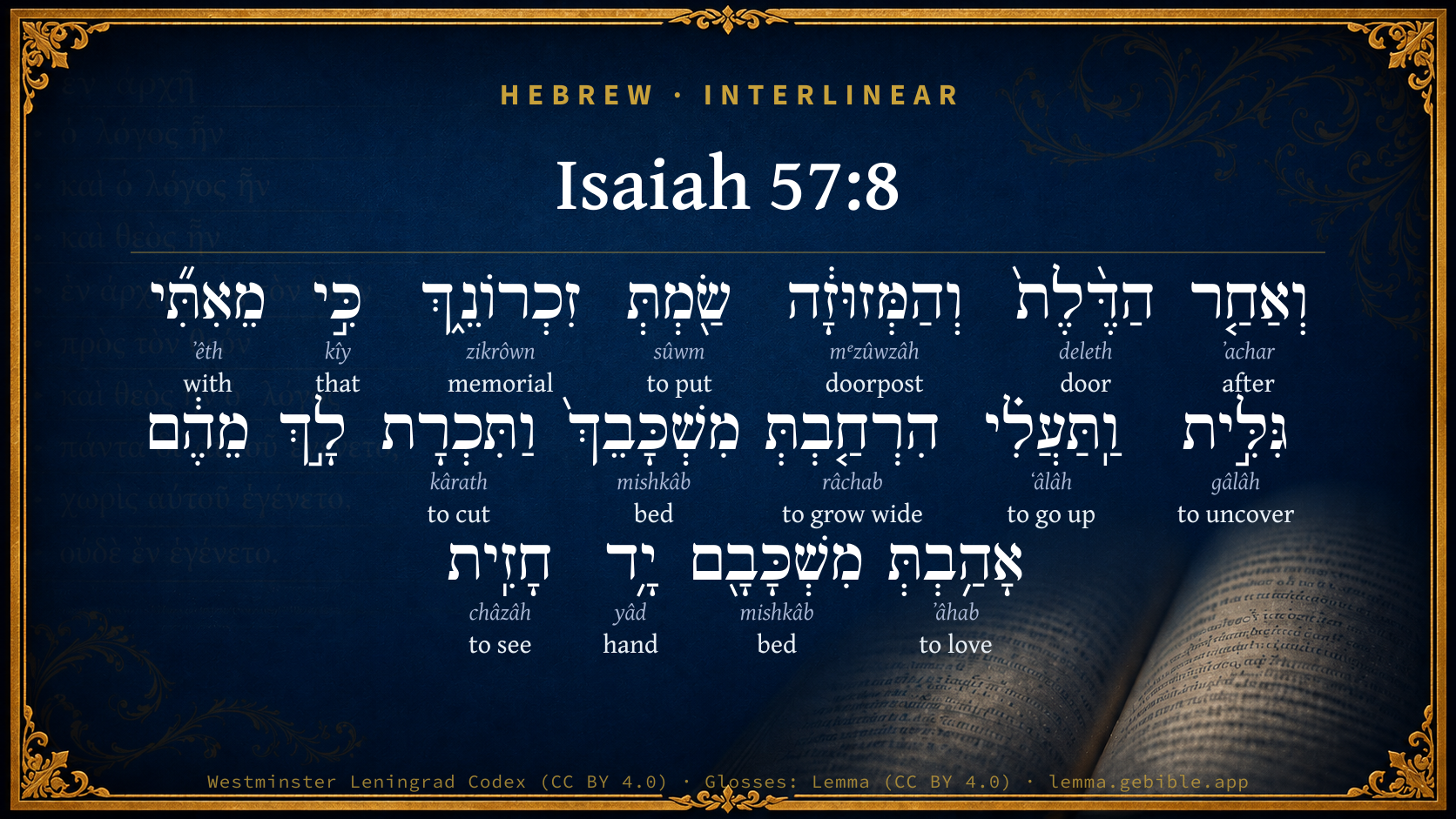
Hebrew (Westminster Leningrad Codex) Isaiah 57:8 appears in the Hebrew Old Testament. The text above is from the Westminster Leningrad Codex. Each word links to its Strong’s number, a concise gloss, and parsing drawn from the Open Scriptures Hebrew Bible morphology. Click any word for its full Brown-Driver-Briggs (BDB) entry.
Download image
Cite this verse

Isaiah 57:8 (World English Bible). Public Domain. Lemma interlinear Bible study tool, https://lemma.gebible.app/v/isaiah/57/8.

Show BibTeX & RIS
BibTeX
RIS
English Translation
Behind the doors and the posts have you set up your memorial: for you have uncovered [yourself] to another than me, and are gone up; you have enlarged your bed, and made you a covenant with them: you loved their bed where you saw it.
World English Bible · Public Domain
Download a study sheet

One document with this verse’s original text, its word-by-word gloss line, the meaning frame, cross-references with their text, attributed commentary, and full source and license credits — printable, and it pastes into notes with its structure intact.

This verse Autodidact and up

Study sheet (.html) Plain text (.txt)

A passage Seminary Student

Up to 50 verses in one chapter. A passage sheet keeps up to 6 commentary sources and 12 cross-references per verse, in the order this page ranks them, and says so on the sheet whenever that leaves anything out. Ask for a single verse and you get the Autodidact verse sheet above.

Everything on this page stays free to read, with no account — the sheet is a download of what is already on screen, not access to it.

Want to remove ads? Support Godless Engineer
Compare translations 3

The same verse in 3 English versions, stacked beneath the original-language interlinear above. Click any original word for its lexicon entry.

Each is an independent rendering of the whole verse — the interlinear is not word-aligned to these translations.

Highlighted words mark where these versions differ — a whole-verse word diff, not a word-by-word alignment.

  • World English Bible Public Domain
    Behind the doors and the posts have you set up your memorial: for you have uncovered [yourself] to another than me, and are gone up; you have enlarged your bed, and made you a covenant with them: you loved their bed where you saw it.
  • King James Version Public Domain
    Behind the doors also and the posts hast thou set up thy remembrance: for thou hast discovered thyself to another than me, and art gone up; thou hast enlarged thy bed, and made thee a covenant with them; thou lovedst their bed where thou sawest it.
  • unfoldingWord Literal Text CC BY-SA 4.0
    And you set your memorial behind the door and the doorpost. For away from me you uncover and go up; you make wide your bed, and you cut for yourself with them. You love their bed; you see a hand.

unfoldingWord Literal Text — © unfoldingWord, licensed CC BY-SA 4.0. Word-aligned USFM3 via Door43 (git.door43.org/unfoldingWord/en_ult).

Versions to compare (up to 4)

3 of 4 selected

Show all 18 translations

Every available English version of this verse, each an independent rendering of the whole verse.

  • World English Bible Public Domain
    Behind the doors and the posts have you set up your memorial: for you have uncovered [yourself] to another than me, and are gone up; you have enlarged your bed, and made you a covenant with them: you loved their bed where you saw it.
  • Berean Standard Bible Public Domain
    Behind the door and doorpost you have set up your memorial. Forsaking Me, you uncovered your bed; you climbed up and opened it wide. And you have made a pact with those whose bed you have loved; you have gazed upon their nakedness.
  • Majority Standard Bible Public Domain
    Behind the door and doorpost you have set up your memorial. Forsaking Me, you uncovered your bed; you climbed up and opened it wide. And you have made a pact with those whose bed you have loved; you have gazed upon their nakedness.
  • King James Version Public Domain
    Behind the doors also and the posts hast thou set up thy remembrance: for thou hast discovered thyself to another than me, and art gone up; thou hast enlarged thy bed, and made thee a covenant with them; thou lovedst their bed where thou sawest it.
  • American Standard Version (1901) Public Domain
    And behind the doors and the posts hast thou set up thy memorial: for thou hast uncovered `thyself' to another than me, and art gone up; thou hast enlarged thy bed, and made thee a covenant with them: thou lovedst their bed where thou sawest it.
  • Revised Version (1885) Public Domain
    And behind the doors and the posts hast thou set up thy memorial: for thou hast discovered thyself to another than me, and art gone up; thou hast enlarged thy bed, and made thee a covenant with them; thou lovedst their bed where thou sawest it.
  • Geneva Bible (1599) Public Domain
    Behinde the doores also and postes hast thou set vp thy remembrance: for thou hast discouered thy selfe to another then me, and wentest vp, and diddest enlarge thy bed, and make a couenant betweene thee and them, and louedst their bed in euery place where thou sawest it.
  • Douay-Rheims (1899) Public Domain
    And behind the door, and behind the post thou best set up thy remembrance: for thou hast discovered thyself near me, and hast received an adulterer: thou hast enlarged thy bed, and made a covenant with them: thou hast loved their bed with open hand.
  • Young's Literal Translation Public Domain
    And behind the door, and the post, Thou hast set up thy memorial, For from Me thou hast removed, and goest up, Thou hast enlarged thy couch, And dost covenant for thyself among them, Thou hast loved their couch, the station thou sawest,
  • Literal Standard Version CC BY-SA 4.0
    And behind the door, and the post, || You have set up your memorial, || For you have removed from Me, and go up, || You have enlarged your bed, || And cut [a covenant] with them, || You have loved their bed, the station you saw,
  • Unlocked Literal Bible CC BY-SA 4.0
    Behind the door and the doorposts you set up your symbols; you deserted me, made yourselves naked, and went up; you made your bed wide. You made a covenant with them; you loved their beds; you saw their private parts.
  • unfoldingWord Literal Text CC BY-SA 4.0
    And you set your memorial behind the door and the doorpost. For away from me you uncover and go up; you make wide your bed, and you cut for yourself with them. You love their bed; you see a hand.
  • Darby Bible Public Domain
    Behind the doors also and the posts hast thou set up thy remembrance: for apart from me, thou hast uncovered thyself, and art gone up; thou hast enlarged thy bed, and hast made agreement with them; thou lovedst their bed, thou sawest their nakedness.
  • World Messianic Bible Public Domain
    You have set up your memorial behind the doors and the posts, for you have exposed yourself to someone besides me, and have gone up. You have enlarged your bed and made you a covenant with them. You loved what you saw on their bed.
  • Webster's Bible Public Domain
    Behind the doors also and the posts hast thou set up thy remembrance: for thou hast uncovered thyself to another than me, and hast gone up; thou hast enlarged thy bed, and made thee a covenant with them; thou lovedst their bed where thou sawest it.
  • Free Bible Version CC BY-SA 4.0
    You've placed your pagan signs behind your doors and on your doorposts. Deserting me, you took off your clothes and climbed into bed, committing yourselves to those you love, going to bed with them. You've seen them naked.
  • Bible in Basic English Public Domain
    And on the back of the doors and on the pillars you have put your sign: for you have been false to me with another; you have made your bed wide, and made an agreement with them; you had a desire for their bed where you saw it
  • JPS Tanakh (1917) Public Domain
    And behind the doors and the posts hast thou set up thy symbol; for thou hast uncovered, and art gone up from Me, thou hast enlarged thy bed, and chosen thee of them whose bed thou lovedst, whose hand thou sawest.

Literal Standard Version (2020), Covenant Press — licensed CC BY-SA 4.0. Text via the HelloAO Bible API (eBible.org). Unlocked Literal Bible (unfoldingWord) — licensed CC BY-SA 4.0. Text via the HelloAO Bible API (eBible.org). unfoldingWord Literal Text — © unfoldingWord, licensed CC BY-SA 4.0. Word-aligned USFM3 via Door43 (git.door43.org/unfoldingWord/en_ult). Free Bible Version, Dr. Jonathan Gallagher — licensed CC BY-SA 4.0. Text via the HelloAO Bible API (eBible.org).

Word by word

More ways to search: Search by grammar → Find every occurrence → Compare this word →

Practice this passage: Drill this verse → Learn its vocabulary →

וְהַמְּזוּזָ֔ה
mᵉzûwzâh
H4201
“and · the · doorpost”
Conjunction + Particle, Definite Article + Noun, Common, Feminine, Singular, Absolute
Part of Speech
Conjunction + Particle + Noun
Type
Common
Gender
Feminine
Number
Singular
State
Absolute
Full BDB Definition

Origin: from the same as H2123

TWOT: 535b

doorpost, gatepost
  1. וְאַחַ֤ר ʼachar H310 “and · after” Conjunction + Preposition
  2. הַדֶּ֨לֶת֙ deleth H1817 “the · door” Particle, Definite Article + Noun, Common, Feminine, Singular, Absolute
  3. שַׂ֖מְתְּ sûwm H7760 “to put” Verb, Qal, Perfect, 2nd Person, Feminine, Singular
  4. זִכְרוֹנֵ֑ךְ zikrôwn H2146 “memorial · your” Noun, Common, Masculine, Singular, Construct + Suffix, Personal, 2nd Person, Feminine, Singular
  5. כִּ֣י kîy H3588 “that” Conjunction
  6. מֵאִתִּ֞י ʼêth H854 “from · with · me” Preposition + Preposition + Suffix, Personal, 1st Person, Common, Singular
  7. גִּלִּ֣ית gâlâh H1540 “to uncover” Verb, Piel, Perfect, 2nd Person, Feminine, Singular
  8. וַֽתַּעֲלִ֗י ʻâlâh H5927 “and · to go up” Conjunction + Verb, Qal, Sequential Imperfect, 2nd Person, Feminine, Singular
  9. הִרְחַ֤בְתְּ râchab H7337 “to grow wide” Verb, Hiphil, Perfect, 2nd Person, Feminine, Singular
  10. מִשְׁכָּבֵךְ֙ mishkâb H4904 “bed · your” Noun, Common, Masculine, Singular, Construct + Suffix, Personal, 2nd Person, Feminine, Singular
  11. וַתִּכְרָת kârath H3772 “and · to cut” Conjunction + Verb, Qal, Sequential Imperfect, 2nd Person, Feminine, Singular
  12. אָהַ֥בְתְּ ʼâhab H157 “to love” Verb, Qal, Perfect, 2nd Person, Feminine, Singular
  13. מִשְׁכָּבָ֖ם mishkâb H4904 “bed · their” Noun, Common, Masculine, Singular, Construct + Suffix, Personal, 3rd Person, Masculine, Plural
  14. יָ֥ד yâd H3027 “hand” Noun, Common, Both, Singular, Absolute
  15. חָזִֽית châzâh H2372 “to see” Verb, Qal, Perfect, 2nd Person, Feminine, Singular

About this verse

These counts appear in no published source. They are computed here, from the morphology-tagged text and Lemma’s own curated glosses. What Lemma adds →

18
words
15
distinct lemmas
Prophets
section

Notable vocabulary

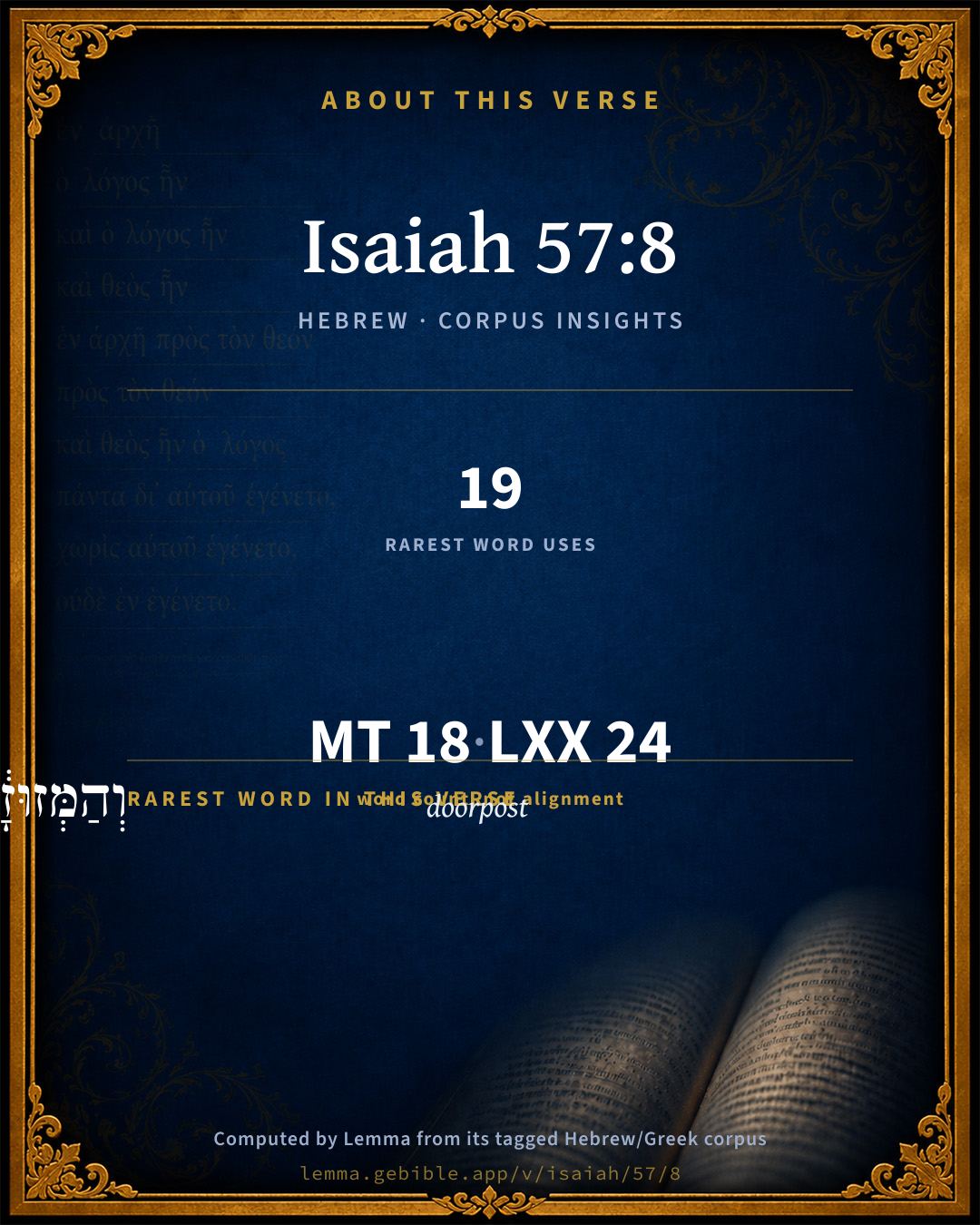
The rarest word here is וְהַמְּזוּזָ֔ה doorpost H4201 — appearing just 19 times in the whole Hebrew Bible.

Shared distinctive vocabulary

וְהַמְּזוּזָ֔ה doorpost H4201 occurs in 17 verses of the Hebrew Bible. Also found in:

Grammatical profile

  • 7 verbs
  • 6 nouns
  • 4 prepositions
  • 1 conjunction

Verb forms

  • שַׂ֖מְתְּ Qal · Perfect
  • גִּלִּ֣ית Piel · Perfect
  • וַֽתַּעֲלִ֗י Qal · Sequential Imperfect
  • הִרְחַ֤בְתְּ Hiphil · Perfect
  • וַתִּכְרָת Qal · Sequential Imperfect
  • אָהַ֥בְתְּ Qal · Perfect
  • חָזִֽית Qal · Perfect

Repetition

A word recurs within this verse — often emphatic in Hebrew:

  • מִשְׁכָּבֵךְ֙ bed H4904 ×2

Hebrew & Septuagint length

In English translation the verse runs 45 words from the Hebrew and 33 from the Septuagint (LXX English) — closely comparable.

A rough comparison of the two English renderings, which tokenize alike — not a word-level alignment.

Word counts can differ between the Hebrew and the Greek without any difference in meaning — e.g. the Hebrew direct-object marker אֵת has no separate Greek word, and Greek often adds the article ὁ.

In the original languages it is 18 Hebrew tokens and 24 Greek tokens — but the two are counted differently (Hebrew bundles its prefixes and suffixes into one token; the Greek is in lemma form), so that isn’t a like-for-like length.

Cross-references

5

Topical passages linked to Isaiah 57:8 in the Treasury of Scripture Knowledge — connected by theme and wording, ordered by reader-vote popularity; previews shown in the World English Bible.

  • Ezekiel 8:8–12 Then said he to me, Son of man, dig now in the wall: and when I had dug in the wall, behold, a door.
  • Ezekiel 16:25–28 You have built your lofty place at the head of every way, and have made your beauty an abomination, and have opened your feet to everyone who passed by, and multiplied your prostitution.
  • Ezekiel 16:32 A wife who commits adultery! who takes strangers instead of her husband!
  • Ezekiel 23:2–20 Son of man, there were two women, the daughters of one mother:
  • Ezekiel 23:41 and sit on a stately bed, with a table prepared before it, whereupon you did set my incense and my oil.

Cross-references courtesy of OpenBible.info (CC BY 4.0).

Hebrew and Greek witnesses Masoretic Hebrew ↔ Greek Septuagint

The same verse in the two great witnesses to the Old Testament, shown verse-for-verse.

These are two independent witnesses, not word-aligned to each other, and the Septuagint is shown in lemma (dictionary) form.

Hebrew Isaiah 57:8 Masoretic · Westminster Leningrad Codex

וְאַחַ֤ר הַדֶּ֨לֶת֙ וְהַמְּזוּזָ֔ה שַׂ֖מְתְּ זִכְרוֹנֵ֑ךְ כִּ֣י מֵאִתִּ֞י גִּלִּ֣ית וַֽתַּעֲלִ֗י הִרְחַ֤בְתְּ מִשְׁכָּבֵךְ֙ וַתִּכְרָת לָ֣ךְ מֵהֶ֔ם אָהַ֥בְתְּ מִשְׁכָּבָ֖ם יָ֥ד חָזִֽית

Behind the doors and the posts have you set up your memorial: for you have uncovered [yourself] to another than me, and are gone up; you have enlarged your bed, and made you a covenant with them: you loved their bed where you saw it.

World English Bible · Public Domain

Greek LXX Isaiah 57:8 Septuagint · lemma form

καί ὀπίσω ὁ σταθμός ὁ θύρα σύ τίθημι μνημόσυνον σύ οἴομαι ὅτι ἐάν ἀπό ἐγώ ἀποἵστημι πολύς τις ἔχω ἀγαπάω ὁ κοιμάω μετά σύ

and behind the posts of your door you did place your memorials. Did you think that if you should depart from me, you would gain? you have loved those that lay with you;

LXX2012 (modern English Septuagint) · Public Domain

Hebrew: Westminster Leningrad Codex (CC BY 4.0). Greek: Septuagint (public domain); English from LXX2012 (modern English Septuagint) (Public Domain). How the Septuagint differs from the Hebrew →

Targum (Aramaic paraphrase)

1

The Targum is the ancient Jewish Aramaic paraphrase of the Hebrew Scriptures — an interpretive translation, not the Hebrew text itself. Onkelos (literal) and Pseudo-Jonathan (expansive) render the Torah, and Jonathan the Prophets. Coverage is partial: where no permissively-licensed English translation exists for a verse, only the Aramaic is shown. This is verse-level text, not a word-by-word alignment to the Hebrew.

  1. Targum Jonathan Prophets (Joshua–Malachi)
    וַאֲחוֹרֵי דֶשֶׁא וּמְזוּזָתָא שַׁוֵית דוּכְרָן טַעֲוָתִיךְ הֲוֵית דַמְיָא לְאִתְּתָא דִרְחִימָא עַל בַּעֲלָהּ וּטְעַת בָּתַר נוּכְרָאִין אַפְתֵּית אֲתַר בֵּית מֵישְׁרָךְ וְגָזַרְתְּ לִיךְ מִנְהוֹן קְיַם רְחֵימְתְּ אֲתַר בֵּית מַשְׁכַּבְהוֹן אֲתַר בְּחַרְתְּ:

    Behind the doors and the posts hast thou set up the remembrance of thy idols; thou hast been like a woman who is beloved by her husband, but goeth astray after strangers; thou hast enlarged thy bed: thou hast made a covenant with some of them, thou lovedst the place, the place of their beds, the place thou hast chosen.

    Targum Jonathan — Aramaic: “Mikraot Gedolot” (public domain). English: “Sefaria Community Translation” (CC0 1.0 (public-domain dedication)); “London "Chaldee Paraphrase," 1871” (public domain). Text via Sefaria.

Commentary

Notes on Isaiah 57:8 from classic Christian and Jewish commentators (each source and its license shown beneath its notes). The classic Christian expositions comment on the surrounding passage and are grouped to its opening verse, so a note may address several verses; the Jewish commentaries on the Tanakh (Rashi and others) are per-verse, so they appear only where the commentator wrote on this verse.

Lemma curates 59 commentaries, every one of them public domain or Creative Commons licensed, each selected and text-cleaned for this edition rather than reprinted as found. About our sources →

Trapp's Complete Commentary

John Trapp

Isa 57:8 Behind the doors also and the posts hast thou set up thy remembrance: for thou hast discovered [thyself to another] than me, and art gone up; thou hast enlarged thy bed, and made thee [a covenant] with them; thou lovedst their bed where thou sawest [it].

Ver. 8. Behind the doors also, and the posts.] Where my law should have been written. {Deu 6:9; Deu 11:20}

Hast thou set up thy remembrance?] Thy idols and monuments of idolatry, such as Papists now call memories and laymen’s books.

Thou hast discovered thyself] Thy nakedness, like a meretrix meretricissima, divaricasti tibias {as Eze 23:29} Omnibus modis te comparans ut impudentissimum scortum, prostituting thyself as a most impudent harlot, prodigiously lascivious.

John Trapp, A Commentary or Exposition upon All the Books of the Old and New Testament (1647–1656) — public domain. Text from a community e-Sword module.

Tyndale Open Study Notes

Tyndale Open Resources

57:8 climbed into bed: The people of Israel had a sickening commitment to the fertility religions, which included sex as part of their rituals.

Tyndale Open Study Notes — © Tyndale Open Resources, licensed CC BY-SA 4.0. Text via the HelloAO Bible API.

Geneva Bible (1599)

Geneva Bible translators

That is, didst increase thine idolatry more and more.

Instead of setting up the word of God in the open places on the posts and doors to have it in remembrance, Deut. 6:9 and 27:1, thou hast set up signs and marks of thine idolatry in every place.

Geneva Bible (1599) marginal notes — public domain. Text via Bolls.life.

Jamieson, Fausset & Brown

Robert Jamieson, A. R. Fausset & David Brown

"Remembrance," that is, memorials of thy idolatry: the objects which thou holdest in remembrance. They hung up household tutelary gods "behind the doors"; the very place where God has directed them to write His laws "on the posts and gates" (Deu 6:9; Deu 11:20); a curse, too, was pronounced on putting up an image "in a secret place" (Deu 27:15).

discovered thyself--image from an adulteress.

enlarged . . . bed--so as to receive the more paramours.

made . . . covenant--with idols: in open violation of thy "covenant" with God (Exo 19:5; Exo 23:32). Or, "hast made assignations with them for thyself" [HORSLEY].

thy bed . . . their bed--The Jews' sin was twofold; they resorted to places of idolatry ("their bed"), and they received idols into the temple of God ("thy bed").

where--rather, "ever since that" [HORSLEY]. The Hebrew for "where" means "room" (Margin), a place; therefore, translate, "thou hast provided a place for it" (for "their bed"), namely, by admitting idolatrous altars in thy land [BARNES]; or "thou choosest a (convenient) place for thyself" in their bed [MAURER] (Isa 56:5).

Jamieson, Fausset & Brown — Commentary Critical and Explanatory on the Whole Bible (1871) — public domain (CC PDM 1.0). Text via the HelloAO Bible API.

Adam Clarke's Commentary

Verse 8. Behind the doors also and the posts hast thou set up thy remembrance - "Behind the door, and the door-posts, hast thou set up thy memorial"] That is, the image of their tutelary gods, or something dedicated to them; in direct opposition to the law of God, which commanded them to write upon the door-posts of their house, and upon their gates, the words of God's law; De 6:9; De 11:20. If they chose for them such a situation as more private, it was in defiance of a particular curse denounced in the law against the man who should make a graven or a molten image, and put it in a secret place; De 27:15. An ancient MS., with another, has אחר achar, without the conjunction ו vau, and.

Adam Clarke's Commentary on the Bible (1810–1826) — public domain. Text from a community e-Sword/MySword module.

Ellicott's Commentary for English Readers

(8) Hast thou set up thy remembrance . . .—The noun has been commonly referred to the Mesusah, or memorial text, “Jehovah is our God; Jehovah is one,” which was to be written on the door-posts of each house (Deu_6:9; Deu_11:20); and the prophet is supposed to point to the fact that this had been written behind the door, as showing that Israel had been ashamed to confess her creed. The explanation seems tenable, but it is possible that “remembrance” may stand for some idolatrous symbol or inscription which had been substituted for the true confession.

Thou hast discovered thyself.—The figure of the unfaithful wife is carried into its details almost with Ezekiel’s boldness.

Made thee a covenant with them . . .—The noun, as the italics show, is implied in the verb. The faithless wife forsook the covenant of her youth with her husband, and made a fresh compact with the adulterers.

Where thou sawest it.—And thou sawest the place, the words being used euphemistically for the obscene image of a Chemosh-liko idol.

A Bible Commentary for English Readers, edited by Charles John Ellicott (1878–1897) — public domain. Text from a community e-Sword module.

The Cambridge Bible for Schools and Colleges

gen. ed. J. J. S. Perowne

8. The first part of the verse seems to allude to some form of household idolatry. Many commentators explain the expression as a violation of the command in Deu_6:9; Deu_11:20. In these passages the Israelites are directed to write certain sentences of Scripture on the doorposts of their houses, and it is supposed that the practice here denounced is placing the texts at the back of the door so as to be out of sight! This is an utterly improbable interpretation. The thing called “remembrance” (zikkarôn, better memorial, as R.V.) must be some heathen emblem, whose exact nature cannot be determined; and from the fact that it stood at the entrance of the house, it may be presumed to have represented the patron deity of the family.

for thou hast discovered … bed] The last word appears to be the object to each of the three verbs: for away from me thou hast uncovered and ascended and enlarged thy bed. The connexion (“for”) may lie in the thought that they sought every possible opportunity of being unfaithful to Jehovah, their household cults being an expression of their irresistible inclination to idolatry.

and made thee a covenant with them &c.] The sense is uncertain: either, “and thou hast made a contract with them” &c. (?); or, substituting a verb meaning “purchase” (in Deu_2:6; Hos_3:2), “and thou didst procure for thee (some) of those whose bed thou lovest.” For the idea, cf. Eze_16:16 ff., Eze_16:32 ff.

where thou sawest it] Lit. “thou hast seen a hand.” The rendering of E.V. cannot be maintained, but the real meaning of the expression is altogether obscure.

The Cambridge Bible for Schools and Colleges (gen. ed. J. J. S. Perowne; Cambridge University Press, 1878–1918) — public domain. Text from a community e-Sword module.

John Gill's Exposition

Behind the doors also and the posts hast thou set up thy remembrance,.... The memorial of thine idols, as the Targum. As the Heathens had their "lares" and "penates", their household gods, so the Papists have their tutelar images, which they place in their houses, and in their bedchambers; their images of saints, their crucifixes and superstitious pictures, which they call "memories", and "laymen's books":

for thou hast discovered thyself to another than me; or, "from me" (n); departing from me, and leaving my bed; rejecting Christ as King of saints, deserting his worship and ordinances; thou hast uncovered thyself to another, prostituted thyself to another, been guilty of spiritual adultery or idolatry; receiving and acknowledging another for head of the church, according to whose will all things in worship are directed:

and art gone up; to the bed set up in the high place; to idolatrous temples and altars, there to offer sacrifice:

thou hast enlarged thy bed; to take in many adulterers, and idolatrous worshippers; and so, as Musculus observes, many small chapels, at first erected for this and the other saint, through the vast concourse of people to them, and the gifts they have brought, have, in process of time, become large and magnificent temples:

and made a covenant with them; with idols, and idol worshippers; agreeing to receive the mark and name of the beast, and to worship his image, Rev 13:15, or, "thou hast cut for thyself more than they" (o); more trees to make idols of, or to make more room for the placing of idols in groves than the Heathens: or, "thou hast hewed it for thyself",

a bed larger (p) than theirs; that is, thy bed thou hast made larger than theirs: or, "thou hast cut for thyself from them" (q); taken away from emperors and kings part of, their dominions, and joined them to thy patrimony, and appropriated them to thine own use:

thou lovedst their bed where thou sawest it; took delight and pleasure in places of idolatrous worship, and in their idolatry, wherever they were: or, "thou lovedst their bed, a hand thou hast seen" (r); stretched out to help thee, or give thee power, or to invite, encourage, and receive thee into the idolatrous bed; or rather any pillar, monument (s), or statue, erected for idolatry, which seen, they fell down to and worshipped.

(n) "a me", Pagninus, Montanus, Junius & Tremellius, Piscator, Vitringa. (o) "et caedis tibi arbores plusquam illi", Piscator. (p) "Caedens tibi amplius Cubile quam illorum sit", Junius & Tremellius. (q) "Et excidisti tibi ex eis", Montanus. (r) "manum vidisti", Montanus, Cocceius. (s) "Ubi monumentum vidisti", Vitringa.

John Gill's Exposition of the Whole Bible (1746–1763) — public domain (CC PDM 1.0). Text via the HelloAO Bible API.

Albert Barnes' Notes on the Bible

Behind the doors - In every part of their habitations - behind the doors and posts and beams of their houses, they had erected the memorials of idolatrous worship.

Hast thou set up thy remembrance - That is, they had filled their houses with the images of tutelary gods, or with something dedicated to them. The Greeks and Romans had their Lares and Penates - their household or domestic gods - the images of which were in every family. The same was true of the apostate Hebrews. They had filled their houses with the memorials of idol-worship, and there was no part of their dwellings in which such memorials were not to be found. When a people forget God, the memorials of their apostasy will be found in every part of their habitations. The shrines of idol-gods may not be there; the beautiful images of the Greek and Roman mythology, or the clumsy devices of less refined pagans, may not be there; but the furniture, the style of living, will reveal from ‘behind every door and the posts’ of the house that God is forgotten, and that they are influenced by other principles than a regard to his name. The sofa, the carpet, the chandelier, the center-table, the instruments of music, the splendid mirror, may be of such workmanship as to show, as clearly as the image of a pagan god, that Yahweh is not honored in the dwelling, and that his law does not control the domestic arrangements. It may be added here that this custom of the Hebrews of placing the images of idols in their dwellings, was in direct violation of the law of Moses. They were expressly directed to write the laws of God on the posts of the house and on the gates Deu 6:9; Deu 11:20; and a curse was denounced against the man who made a graven or molten image and put it in a secret place Deu 27:15.

For thou hast discovered thyself - This language is taken from adulterous intercourse, and is designed to show the love which they had for idolatrous worship, and the extent of their unfaithfulness to God.

And made thee a covenant with them - Margin, ‘Hewed it for thyself larger than theirs. The true sense is, that they had made an agreement with idolaters, or had entered into a covenant with them.

Thou lovedst their bed - Margin, ‘Thou providest room.’ Literally, ‘Thou lovest their bed; thou hast provided a place for it.’ The word יד yâd, rendered here ‘where,’ means literally a hand; then a side, a place (see the notes at Isa 56:5). The passage means, that they had delighted in the temples, altars, groves, and sacrifices of idolatry, and had provided a place for them in their own land.

Albert Barnes' Notes on the Bible (1834–1885) — public domain. Text from a community e-Sword/MySword module.

Haydock's Catholic Bible Commentary

Remembrance. Domestic gods. (St. Jerome) The Lares or Penates were usually placed in the court or porch. The Jews probably used Hecate or Trivia, for the same purpose, chap. lxv. 11., and lxvi. 17. To prevent this impiety, God had ordered some of the law to be written on the doors, Deuteronomy vi. 9. But this it seems was disregarded, 4 Kings xxiii. 8., and 1 Machabees i. 58., and Ezechiel viii. 5. --- Near me. Idols were placed in the very temple, Jeremias xxxv. 15., and 4 Kings xxi. 4., and Ezechiel viii. 3., and xvi. 17. (Calmet) --- Hand. Protestants, "where thou sawest it." Thou didst even invite thy lovers by presents, Ezechiel xvi. 32. (Haydock)

George Leo Haydock (1774–1849), Haydock's Catholic Family Bible and Commentary, 1859 edition — public domain. Excludes Psalms (Douay-Rheims chapter numbering differs from Protestant) and Deuterocanonical books (Catholic canon only).

Matthew Poole's English Annotations

Behind the doors also and the posts; which by a figure called hendiaduo may be put for the door-posts, as it is expressed, Deu 11:20. Behind the posts of the doors of thine house; where the heathens are said to have placed their tutelar gods, to whose protection they committed themselves and their houses, that so they might have their eyes and minds upon them, whensoever they went out or came in. Here also the Israelites might put them in some close corner, that they might keep them secret, it being opprobrious, and ofttimes dangerous, for them to worship idols.

Thy remembrance; those images or monuments and tokens which thou didst make and set up there as remembrances of those idol-gods whom they represented, or to whom they belonged. He saith,

thy remembrance, in opposition to God’s remembrances, or to that writing of God’s law upon their door-posts, which God prescribed to keep him and his law in their remembrance, Deu 6:9; 11:20.

Thou hast discovered thyself to another than me; thou hast uncovered thy nakedness, i.e. prostituted thy body, (as the phrase commonly signifies,) to others besides me, thine Husband. Heb. from with me (departing from me, or as it were rising out of my bed) thou hast uncovered or prostituted thyself to others, like an impudent and insatiable strumpet. Art gone up into the adulterous bed, as this very word is used, Gen 49:4.

Thou hast enlarged thy bed, that it might receive many adulterers together. Thou hast multiplied thine idols and altars. Made a covenant with them; thou hast covenanted to serve them, and to expect help from them. But because the verb here used being thus put by itself never signifies to make a covenant, it seems to be better rendered in the margin of our Bible, and by others, hast hewed it (to wit, thy bed, which is expressed both in the next foregoing and in the next following words) for thyself (for thine idolatrous uses) larger than theirs; than their bed, as it follows: or thus, didst hew down (to wit, trees, which is easily understood, both from the verb, and from the nature of the thing) to or for thyself (to make images or other things relating to thy false gods) more than they; more than the heathens, of whom thou hast learned these practices, as God complains, 2Ki 21:9; Eze 16:46,47,52. Thou lovedst their bed where thou sawest it; no sooner didst thou see their idols but thou wast enamoured with them, and didst fall down and worship them, like an unchaste and lewd woman, who upon all occasions, and at the very first view of any man, is inflamed with lust towards them. Heb. thou lovedst their bed (i.e. their filthy conversation) in the place (for so this Hebrew word frequently signifies, as Deu 23:12; Isa 22:18, and elsewhere) where thou sawest it. Or thus, thou lovedst their bed, thou didst provide (as this word signifies, Exo 18:21, and so doth a word of the very same signification, Gen 22:8) a place for it, to receive their bed, to set up their idols in thine own house.

Matthew Poole's English Annotations on the Holy Bible (1683–1685) — public domain. Text from a community e-Sword/MySword module.

The Pulpit Commentary

Behind the doors also and the posts hast thou set up thy remembrance. It has been usual to explain this of a removal from its proper place into an obscure position of the formulae which the Israelites were commanded in the Law to write on their doorposts and on their gates. (Deu_6:9 Deu_11:20) But, in the first place, there is no evidence that anciently these passages were understood literally, or that such inscriptions were ever set up; and secondly, as Mr. Cheyne remarks, they would have been more, rather than less, conspicuous in a new place. Probably, therefore, the "memorial" (zikkaron) of this place is some idolatrous symbol or emblem newly adopted by the Jews, and made use of as a sort of talisman. Many commentators think that it was of a phallic character. (see Eze_16:17) Discovered thyself; rather, uncovered thyself. Thou hast enlarged thy bed; i.e. multiplied thy idolatries. (comp. 2Ki_16:3, 2Ki_16:4, 10 21:3-7) It is a feature of the idolatry of the time, that it was a mixture adopted from many quarters. It included Baal and Ashtoreth-worship from Phoenicia, Moloch-worship from Moab and Ammos, worship of the Queen of Heaven from Syria, high-place worship from the Canaanites, and stone-worship from their own remote Mesopotamian ancestors. And made thee a covenant with them; i.e. "a bargain for wages," that aid and protection should be rendered in return for worship and sacrifice. Where thou sawest it. The original is very obscure, but can scarcely have this meaning. It is certainly a distinct clause, and may perhaps be best translated, "thou sawest indecency."

The Pulpit Commentary (1880–1919), ed. H.D.M. Spence-Jones & Joseph S. Exell — public domain. Text from a community e-Sword module.

John Wesley's Explanatory Notes

The posts - Behind the posts of the doors of thine house: where the Heathens placed their tutelar gods to whose protection they committed their houses, that so they might have their eyes and minds upon them, whensoever they went out or came in. Set up - Those monuments which thou didst set up there as remembrances of those idol-gods whom they represented. Discovered - Thou hast uncovered thy nakedness; to others beside me thine husband. Gone up - Into the adulterous bed. Enlarged - That it might receive many adulterers together. Thou hast multiplied thine idols and altars. A covenant - Thou hast covenanted to serve them.

John Wesley, Explanatory Notes Upon the Whole Bible (1754–1765) — public domain. Text via the GEBible commentary corpus.

J. A. Alexander on Isaiah

Joseph Addison Alexander

“And behind the door and the door-post thou hast placed thy memorial, for away from me thou hast uncovered (thyself or thy bed), and hast gone up, thou hast enlarged thy bed and hast covenanted with them, (or with some of them), thou hast loved their bed, thou hast provided room.” Interpreters are much divided as to the particular expressions of this very obscure verse, although agreed in understanding it as a description of the grossest idolatry. The image of a false god may be reckoned its memorial; or that which brings to mind the absent object. Perhaps they are here described as thrusting the memorial of Jehovah into a corner to make room for that of the beloved idol. Some suppose a special reference to the worship of Penates, Lares, or household gods. The rest of the verse describes idolatry as adulterous intercourse with them. ‘Room’, literally hand, as in Isa 56:5.

Joseph Addison Alexander, The Prophecies of Isaiah (1846–1847; New York: Scribner, 1870–1878) — public domain. Text from a community e-Sword module.

Rashi

Rabbi Shlomo Yitzchaki (Rashi)

And behind the door and the doorpost you have directed your thoughts Since he compares her to an adulterous woman, for whom her paramours look and wait before the door of her house, while she, lying beside her husband, directs her heart and her thoughts to the door and the doorpost, how she will open the door and come out to them.

for while with Me, you uncovered [us] and went up You were lying beside Me, and you removed the cover with which we were covered together, and you went up from beside Me.

you widened your couch to accommodate many adulterers.

and made for yourself a covenant with them.

you loved their couch when you chose for yourself יָד, a place, to demonstrate to them your love.

a place Heb. יָד, aise or ajjse in O.F., a side. Comp. (II Sam. 14: 30) “See Joab’s field is near mine (עַל יָדִי).”

Rashi on the Tanakh — English translations: “The Judaica Press complete Tanach with Rashi, translated by A. J. Rosenberg” (CC BY 4.0); “Pentateuch with Rashi's commentary by M. Rosenbaum and A.M. Silbermann, 1929-1934” (public domain); “The Metsudah Tanach series, Lakewood, N.J” (CC BY 4.0); and “The Book of Joshua, Metsudah Publications, 1997” (CC BY 4.0). Text via Sefaria.

Ibn Ezra

Rabbi Abraham ibn Ezra

Behind the doors also, etc., that is, also privately.

זכרונך Thy scent. Comp. וזכרו the scent thereof (Hos. 14:8); אזכרתה a sweet savour (Lev. 2:2).

Thou hast discovered thyself, etc., that is, thou hast behaved like a harlot. גלית מאתי Thou hast discovered thyself of me, who covered thee.

Thou art gone up, to commit whoredom publicly.

Thou hast enlarged thy bed, to fit it for more than one.

ותכרת is here used instead of ותכרתי as ותוכל instead of ותוכלי thou couldest (Jer. 3:5). ותכרת לך מהם And made thee a covenant with them. Thou hast chosen for thy friends those,

אהבת משכבם whose bed thou lovedst, whom thou desiredst to lie with thee.

יד חזית In every place which thou sawest. It has the same meaning as בכל מקום אשר תראה in every place, which thou seest (Deut. 12:13)

Ibn Ezra on the Tanakh — English translations: “Sefaria Community Translation” (CC0 1.0 (public-domain dedication)); “Yalkut, Sifsei Chachomim Chumash, Metsudah Publications, 2009” (CC BY 4.0); and “Commentary of Ibn Ezra on Isaiah - trans. by M. Friedlander, 1873” (public domain). Text via Sefaria.

Lesson kit

Teaching starters — assembled from the data on this page, not authored interpretation. Every prompt links to the verse data it draws on. Edit before teaching.

Isaiah, in the Prophets, opens this verse with 18 words (15 distinct Hebrew lemmas). Its most distinctive word is mᵉzûwzâh (“doorpost”). A historical commentator’s framing appears above. Read the whole chapter for the surrounding context.

Discussion questions

  1. The word mᵉzûwzâh carries the sense “doorpost.” How does it shape the verse?
  2. How does Exodus 12:7, which shares the word «doorpost», read alongside this verse?
  3. What does the repetition of “bed” (2× in this one verse) do in this verse?
  4. These translations render this verse differently; the difference is in the English rendering, not the original. What questions does that raise?
  5. «שַׂ֖מְתְּ» is a Qal Perfect verb. How does that grammatical form shape the action described?
  6. Compare how Trapp's Complete Commentary and Tyndale Open Study Notes read this verse. Where do they agree or differ?

Things to notice

Reading settings

Reading text

Shown beneath each verse's original-language words.

Old Testament
Old Testament edition

Read the OT as the Masoretic Hebrew (MT) or the Greek Septuagint (LXX).

English shown for the Greek Septuagint (in the Hebrew ↔ Greek comparison).

Comparing translations? Open the Compare panel on any verse page to stack up to four side by side.