2 Kings 17:38

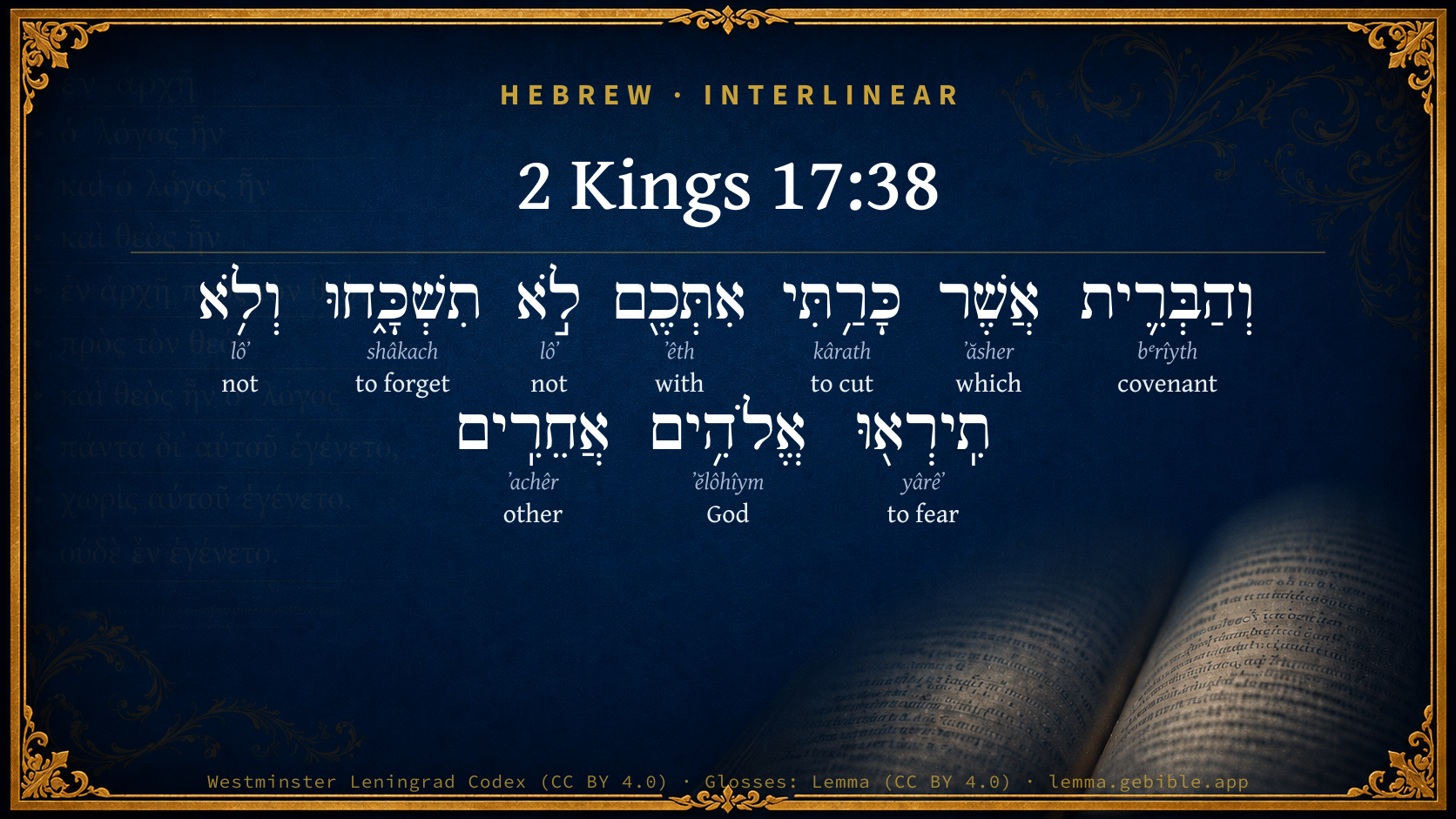
Hebrew (Westminster Leningrad Codex) 2 Kings 17:38 appears in the Hebrew Old Testament. The text above is from the Westminster Leningrad Codex. Each word links to its Strong’s number, a concise gloss, and parsing drawn from the Open Scriptures Hebrew Bible morphology. Click any word for its full Brown-Driver-Briggs (BDB) entry.
Download image
Cite this verse

2 Kings 17:38 (World English Bible). Public Domain. Lemma interlinear Bible study tool, https://lemma.gebible.app/v/2-kings/17/38.

Show BibTeX & RIS
BibTeX
RIS
English Translation
and the covenant that I have made with you you shall not forget; neither shall you fear other gods:
World English Bible · Public Domain
Download a study sheet

One document with this verse’s original text, its word-by-word gloss line, the meaning frame, cross-references with their text, attributed commentary, and full source and license credits — printable, and it pastes into notes with its structure intact.

This verse Autodidact and up

Study sheet (.html) Plain text (.txt)

A passage Seminary Student

Up to 50 verses in one chapter. A passage sheet keeps up to 6 commentary sources and 12 cross-references per verse, in the order this page ranks them, and says so on the sheet whenever that leaves anything out. Ask for a single verse and you get the Autodidact verse sheet above.

Everything on this page stays free to read, with no account — the sheet is a download of what is already on screen, not access to it.

Want to remove ads? Support Godless Engineer
Compare translations 3

The same verse in 3 English versions, stacked beneath the original-language interlinear above. Click any original word for its lexicon entry.

Each is an independent rendering of the whole verse — the interlinear is not word-aligned to these translations.

Highlighted words mark where these versions differ — a whole-verse word diff, not a word-by-word alignment.

  • World English Bible Public Domain
    and the covenant that I have made with you you shall not forget; neither shall you fear other gods:
  • King James Version Public Domain
    And the covenant that I have made with you ye shall not forget; neither shall ye fear other gods.
  • unfoldingWord Literal Text CC BY-SA 4.0
    And you shall not forget the covenant that I cut with you, and you shall not fear other gods,

unfoldingWord Literal Text — © unfoldingWord, licensed CC BY-SA 4.0. Word-aligned USFM3 via Door43 (git.door43.org/unfoldingWord/en_ult).

Versions to compare (up to 4)

3 of 4 selected

Show all 18 translations

Every available English version of this verse, each an independent rendering of the whole verse.

  • World English Bible Public Domain
    and the covenant that I have made with you you shall not forget; neither shall you fear other gods:
  • Berean Standard Bible Public Domain
    Do not forget the covenant I have made with you. Do not worship other gods,
  • Majority Standard Bible Public Domain
    Do not forget the covenant I have made with you. Do not worship other gods,
  • King James Version Public Domain
    And the covenant that I have made with you ye shall not forget; neither shall ye fear other gods.
  • American Standard Version (1901) Public Domain
    and the covenant that I have made with you ye shall not forget; neither shall ye fear other gods:
  • Revised Version (1885) Public Domain
    and the covenant that I have made with you ye shall not forget; neither shall ye fear other gods:
  • Geneva Bible (1599) Public Domain
    And forget not the couenant that I haue made with you, neither feare ye other gods,
  • Douay-Rheims (1899) Public Domain
    And the covenant that he made with you, you shall not forget: neither shall ye worship strange gods,
  • Young's Literal Translation Public Domain
    and the covenant that I have made with you ye do not forget, and ye do not fear other gods;
  • Literal Standard Version CC BY-SA 4.0
    and you do not forget the covenant that I have made with you, and you do not fear other gods;
  • Unlocked Literal Bible CC BY-SA 4.0
    and the covenant that I have made with you, you will not forget; neither will you honor other gods.
  • unfoldingWord Literal Text CC BY-SA 4.0
    And you shall not forget the covenant that I cut with you, and you shall not fear other gods,
  • Darby Bible Public Domain
    And ye shall not forget the covenant that I have made with you, neither shall ye fear other gods;
  • World Messianic Bible Public Domain
    You shall not forget the covenant that I have made with you. You shall not fear other gods.
  • Webster's Bible Public Domain
    And the covenant that I have made with you ye shall not forget; neither shall ye fear other gods.
  • Free Bible Version CC BY-SA 4.0
    Don't forget the agreement I have made with you, and don't worship other gods.
  • Bible in Basic English Public Domain
    And you are to keep in memory the agreement which I have made with you; and you are to have no other gods.
  • JPS Tanakh (1917) Public Domain
    and the covenant that I have made with you ye shall not forget; neither shall ye fear other gods;

Literal Standard Version (2020), Covenant Press — licensed CC BY-SA 4.0. Text via the HelloAO Bible API (eBible.org). Unlocked Literal Bible (unfoldingWord) — licensed CC BY-SA 4.0. Text via the HelloAO Bible API (eBible.org). unfoldingWord Literal Text — © unfoldingWord, licensed CC BY-SA 4.0. Word-aligned USFM3 via Door43 (git.door43.org/unfoldingWord/en_ult). Free Bible Version, Dr. Jonathan Gallagher — licensed CC BY-SA 4.0. Text via the HelloAO Bible API (eBible.org).

Word by word

More ways to search: Search by grammar → Find every occurrence → Compare this word →

Practice this passage: Drill this verse → Learn its vocabulary →

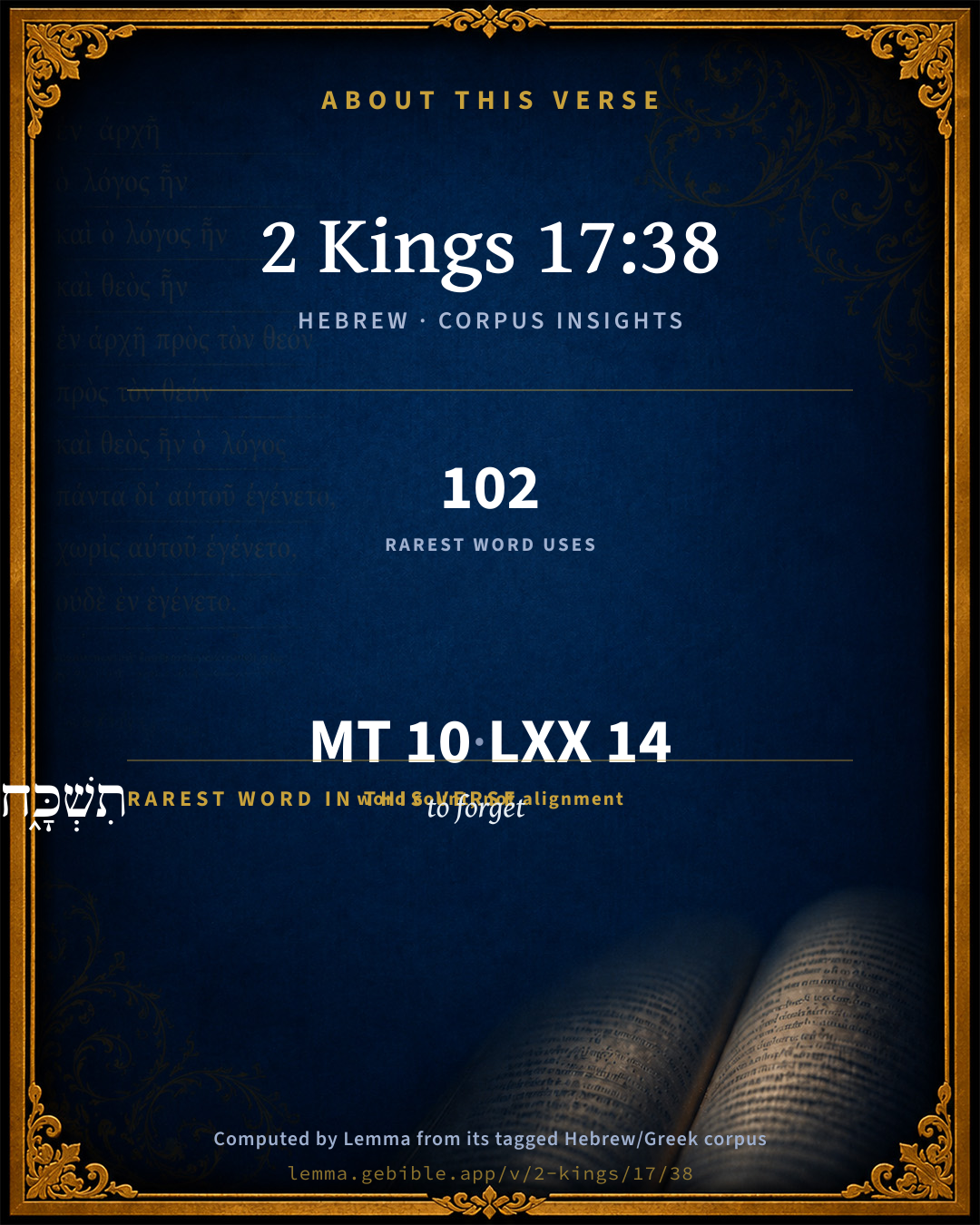
תִשְׁכָּ֑חוּ
shâkach
H7911
“to forget”
Verb, Qal, Imperfect, 2nd Person, Masculine, Plural
Part of Speech
Verb
Stem
Qal
Form
Imperfect
Person
2nd Person
Gender
Masculine
Number
Plural
Full BDB Definition

Origin: a primitive root

TWOT: 2383

to forget, ignore, wither - (Qal) - to forget - to cease to care - (Niphal) to be forgotten - (Piel) to cause to forget - (Hiphil) to make or cause to forget - (Hithpael) to be forgotten
  1. וְהַבְּרִ֛ית bᵉrîyth H1285 “and · the · covenant” Conjunction + Particle, Definite Article + Noun, Common, Feminine, Singular, Absolute
  2. אֲשֶׁר ʼăsher H834 “which” Particle, Relative
  3. כָּרַ֥תִּי kârath H3772 “to cut” Verb, Qal, Perfect, 1st Person, Common, Singular
  4. אִתְּכֶ֖ם ʼêth H854 “with · you” Preposition + Suffix, Personal, 2nd Person, Masculine, Plural
  5. לֹ֣א lôʼ H3808 “not” Particle, Negative
  6. וְלֹ֥א lôʼ H3808 “and · not” Conjunction + Particle, Negative
  7. תִֽירְא֖וּ yârêʼ H3372 “to fear” Verb, Qal, Imperfect, 2nd Person, Masculine, Plural
  8. אֱלֹהִ֥ים ʼĕlôhîym H430 “God(s)” Noun, Common, Masculine, Plural, Absolute
  9. אֲחֵרִֽים ʼachêr H312 “other” Adjective, Adjective, Masculine, Plural, Absolute

About this verse

These counts appear in no published source. They are computed here, from the morphology-tagged text and Lemma’s own curated glosses. What Lemma adds →

10
words
9
distinct lemmas
Historical
section

Grammatical profile

  • 3 verbs
  • 2 nouns
  • 1 adjective
  • 1 preposition
  • 3 particles

Verb forms

  • כָּרַ֥תִּי Qal · Perfect
  • תִשְׁכָּ֑חוּ Qal · Imperfect
  • תִֽירְא֖וּ Qal · Imperfect

Repetition

A word recurs within this verse — often emphatic in Hebrew:

Hebrew & Septuagint length

In English translation the verse runs 19 words from the Hebrew and 18 from the Septuagint (LXX English) — closely comparable.

A rough comparison of the two English renderings, which tokenize alike — not a word-level alignment.

Word counts can differ between the Hebrew and the Greek without any difference in meaning — e.g. the Hebrew direct-object marker אֵת has no separate Greek word, and Greek often adds the article ὁ.

In the original languages it is 10 Hebrew tokens and 14 Greek tokens — but the two are counted differently (Hebrew bundles its prefixes and suffixes into one token; the Greek is in lemma form), so that isn’t a like-for-like length.

Cross-references

3

Topical passages linked to 2 Kings 17:38 in the Treasury of Scripture Knowledge — connected by theme and wording, ordered by reader-vote popularity; previews shown in the World English Bible.

  • Deuteronomy 4:23 Take heed to yourselves, lest you forget the covenant of Yahweh your God, which he made with you, and make you an engraved image in the form of anything which Yahweh your God has forbidden you.
  • Deuteronomy 6:12 then beware lest you forget Yahweh, who brought you forth out of the land of Egypt, out of the house of bondage.
  • Deuteronomy 8:14–18 then your heart be lifted up, and you forget Yahweh your God, who brought you forth out of the land of Egypt, out of the house of bondage;

Cross-references courtesy of OpenBible.info (CC BY 4.0).

Hebrew and Greek witnesses Masoretic Hebrew ↔ Greek Septuagint

The same verse in the two great witnesses to the Old Testament, shown verse-for-verse.

These are two independent witnesses, not word-aligned to each other, and the Septuagint is shown in lemma (dictionary) form.

Hebrew 2 Kings 17:38 Masoretic · Westminster Leningrad Codex

וְהַבְּרִ֛ית אֲשֶׁר כָּרַ֥תִּי אִתְּכֶ֖ם לֹ֣א תִשְׁכָּ֑חוּ וְלֹ֥א תִֽירְא֖וּ אֱלֹהִ֥ים אֲחֵרִֽים

and the covenant that I have made with you you shall not forget; neither shall you fear other gods:

World English Bible · Public Domain

Greek LXX 2 Kings 17:38 Septuagint · lemma form

καί ὁ διαθήκη ὅς διατίθημι μετά σύ οὐ ἐπιλανθάνω καί οὐ φοβέω θεός ἕτερος

Neither shall you⌃ forget the covenant which he made with you: and you⌃ shall not fear other gods.

LXX2012 (modern English Septuagint) · Public Domain

Hebrew: Westminster Leningrad Codex (CC BY 4.0). Greek: Septuagint (public domain); English from LXX2012 (modern English Septuagint) (Public Domain). How the Septuagint differs from the Hebrew →

Targum (Aramaic paraphrase)

1

The Targum is the ancient Jewish Aramaic paraphrase of the Hebrew Scriptures — an interpretive translation, not the Hebrew text itself. Onkelos (literal) and Pseudo-Jonathan (expansive) render the Torah, and Jonathan the Prophets. Coverage is partial: where no permissively-licensed English translation exists for a verse, only the Aramaic is shown. This is verse-level text, not a word-by-word alignment to the Hebrew.

  1. Targum Jonathan Prophets (Joshua–Malachi)
    וּקְיָמָא דִגְזָרִית עִמְכוֹן לָא תִתְנְשׁוּן וְלָא תִדְחֲלוּן לְטַעֲוַת עַמְמַיָא:

    (no public-domain English translation for this verse)

    Targum Jonathan — Aramaic: “Mikraot Gedolot” (public domain). English: “Sefaria Community Translation” (CC0 1.0 (public-domain dedication)); “London "Chaldee Paraphrase," 1871” (public domain). Text via Sefaria.

Commentary

Notes on 2 Kings 17:38 from classic Christian and Jewish commentators (each source and its license shown beneath its notes). The classic Christian expositions comment on the surrounding passage and are grouped to its opening verse, so a note may address several verses; the Jewish commentaries on the Tanakh (Rashi and others) are per-verse, so they appear only where the commentator wrote on this verse.

Lemma curates 59 commentaries, every one of them public domain or Creative Commons licensed, each selected and text-cleaned for this edition rather than reprinted as found. About our sources →

Ellicott's Commentary for English Readers

(38) Neither shall ye fear other gods.—This formula is repeated thrice (2Ki_17:35; 2Ki_17:37-38), as the main point of the covenant between Jehovah and Israel.

A Bible Commentary for English Readers, edited by Charles John Ellicott (1878–1897) — public domain. Text from a community e-Sword module.

John Gill's Exposition

But the Lord your God ye shall fear,.... Or worship him, both internally and externally, according to his revealed will; for the fear of God includes both internal and external worship:

and he shall deliver you out of the hand of all your enemies; that is, provided they feared and served him as he required, and it became them to do.

John Gill's Exposition of the Whole Bible (1746–1763) — public domain (CC PDM 1.0). Text via the HelloAO Bible API.

The Pulpit Commentary

And the covenant that I have made with you ye shall not forget. The "covenant" intended is not the covenant of circumcision, which God made with Abraham, (Gen_17:9-14) but the covenant of protection and obedience made at Sinai between God and the entire people, (Exo_19:5-8) and most solemnly ratified by sprinkling with blood and by a covenant feast, as related in Exo_24:3-11. This was the covenant which Israel had been warned so frequently not to "forget" (Deu_4:23 Deu_8:11 Deu_26:13; Pro_2:17) yet which they had "forgotten," or, at any rate, "forsaken," as already declared in ver. 15. Neither shall ye fear other gods. The writer has probably a practical object in his reiteration. He expects his words to reach the ears of the mixed race inhabiting Samaria in his day, and would fain warn them against their idolatrous practices, and point them to the pure worship of Jehovah. It is pleasing to remember that ultimately the mixed race was won to the true faith, and that the Samaritans of our Lord"s time were as true worshippers of Jehovah, and as zealous followers of the Law, as the Jews themselves. The interesting community at Nablous still maintains Samaritan forms, and reads the Samaritan Pentateuch.

The Pulpit Commentary (1880–1919), ed. H.D.M. Spence-Jones & Joseph S. Exell — public domain. Text from a community e-Sword module.

Lesson kit

Teaching starters — assembled from the data on this page, not authored interpretation. Every prompt links to the verse data it draws on. Edit before teaching.

2 Kings, in the Historical, opens this verse with 10 words (9 distinct Hebrew lemmas). Its most distinctive word is shâkach (“to forget”). A historical commentator’s framing appears above. Read the whole chapter for the surrounding context.

Discussion questions

  1. How does “to forget” (shâkach) shape what this verse is saying?
  2. How does Deuteronomy 4:23, which shares this passage’s theme, read alongside this verse?
  3. What does the repetition of “not” (2× in this one verse) do in this verse?
  4. These translations render this verse differently; the difference is in the English rendering, not the original. What questions does that raise?
  5. «כָּרַ֥תִּי» is a Qal Perfect verb. How does that grammatical form shape the action described?
  6. Compare how Ellicott's Commentary for English Readers and John Gill's Exposition read this verse. Where do they agree or differ?

Things to notice

Reading settings

Reading text

Shown beneath each verse's original-language words.

Old Testament
Old Testament edition

Read the OT as the Masoretic Hebrew (MT) or the Greek Septuagint (LXX).

English shown for the Greek Septuagint (in the Hebrew ↔ Greek comparison).

Comparing translations? Open the Compare panel on any verse page to stack up to four side by side.