

Psalms 12:3

Hebrew (Westminster Leningrad Codex) Psalms 12:3 appears in the Hebrew Old Testament. The text above is from the Westminster Leningrad Codex. Each word links to its Strong’s number, a concise gloss, and parsing drawn from the Open Scriptures Hebrew Bible morphology. Click any word for its full Brown-Driver-Briggs (BDB) entry.
Download image
Cite this verse

Psalms 12:3 (World English Bible). Public Domain. Lemma interlinear Bible study tool, https://lemma.gebible.app/v/psalms/12/3.

Show BibTeX & RIS
BibTeX
RIS
English Translation
May Yahweh cut off all flattering lips, And the tongue that boasts,
World English Bible · Public Domain
Download a study sheet

One document with this verse’s original text, its word-by-word gloss line, the meaning frame, cross-references with their text, attributed commentary, and full source and license credits — printable, and it pastes into notes with its structure intact.

This verse Autodidact and up

Study sheet (.html) Plain text (.txt)

A passage Seminary Student

Up to 50 verses in one chapter. A passage sheet keeps up to 6 commentary sources and 12 cross-references per verse, in the order this page ranks them, and says so on the sheet whenever that leaves anything out. Ask for a single verse and you get the Autodidact verse sheet above.

Everything on this page stays free to read, with no account — the sheet is a download of what is already on screen, not access to it.

Want to remove ads? Support Godless Engineer
Compare translations 3

The same verse in 3 English versions, stacked beneath the original-language interlinear above. Click any original word for its lexicon entry.

Each is an independent rendering of the whole verse — the interlinear is not word-aligned to these translations.

Highlighted words mark where these versions differ — a whole-verse word diff, not a word-by-word alignment.

  • World English Bible Public Domain
    May Yahweh cut off all flattering lips, And the tongue that boasts,
  • King James Version Public Domain
    The LORD shall cut off all flattering lips, and the tongue that speaketh proud things:
  • unfoldingWord Literal Text CC BY-SA 4.0
    May Yahweh cut off all lips of smoothness, the tongue speaking great things,

unfoldingWord Literal Text — © unfoldingWord, licensed CC BY-SA 4.0. Word-aligned USFM3 via Door43 (git.door43.org/unfoldingWord/en_ult).

Versions to compare (up to 4)

3 of 4 selected

Show all 18 translations

Every available English version of this verse, each an independent rendering of the whole verse.

  • World English Bible Public Domain
    May Yahweh cut off all flattering lips, And the tongue that boasts,
  • Berean Standard Bible Public Domain
    May the LORD cut off all flattering lips and every boastful tongue.
  • Majority Standard Bible Public Domain
    May the LORD cut off all flattering lips and every boastful tongue.
  • King James Version Public Domain
    The LORD shall cut off all flattering lips, and the tongue that speaketh proud things:
  • American Standard Version (1901) Public Domain
    Jehovah will cut off all flattering lips, The tongue that speaketh great things;
  • Revised Version (1885) Public Domain
    The LORD shall cut off all flattering lips, the tongue that speaketh great things:
  • Geneva Bible (1599) Public Domain
    The Lord cut off all flattering lippes, and the tongue that speaketh proude things:
  • Douay-Rheims (1899) Public Domain
    They have spoken vain things every one to his neighbour: with deceitful lips, and with a double heart have they spoken.
  • Young's Literal Translation Public Domain
    Jehovah doth cut off all lips of flattery, A tongue speaking great things,
  • Literal Standard Version CC BY-SA 4.0
    YHWH cuts off all lips of flattery, || A tongue speaking great things,
  • Unlocked Literal Bible CC BY-SA 4.0
    Yahweh, cut off all flattering lips, every tongue declaring great things.
  • unfoldingWord Literal Text CC BY-SA 4.0
    May Yahweh cut off all lips of smoothness, the tongue speaking great things,
  • Darby Bible Public Domain
    Jehovah will cut off all flattering lips, the tongue that speaketh proud things,
  • World Messianic Bible Public Domain
    May the LORD cut off all flattering lips, and the tongue that boasts,
  • Webster's Bible Public Domain
    \\12:2\\They speak vanity every one with his neighbor: with flattering lips and with a double heart do they speak.
  • Free Bible Version CC BY-SA 4.0
    Stop their flattery, Lord, and silence their boasts—
  • Bible in Basic English Public Domain
    The smooth lips and the tongue of pride will be cut off by the Lord.
  • JPS Tanakh (1917) Public Domain
    (12-4) May the LORD cut off all flattering lips, the tongue that speaketh proud things!

Literal Standard Version (2020), Covenant Press — licensed CC BY-SA 4.0. Text via the HelloAO Bible API (eBible.org). Unlocked Literal Bible (unfoldingWord) — licensed CC BY-SA 4.0. Text via the HelloAO Bible API (eBible.org). unfoldingWord Literal Text — © unfoldingWord, licensed CC BY-SA 4.0. Word-aligned USFM3 via Door43 (git.door43.org/unfoldingWord/en_ult). Free Bible Version, Dr. Jonathan Gallagher — licensed CC BY-SA 4.0. Text via the HelloAO Bible API (eBible.org).

Word by word

More ways to search: Search by grammar → Find every occurrence → Compare this word →

Practice this passage: Drill this verse → Learn its vocabulary →

About this verse

These counts appear in no published source. They are computed here, from the morphology-tagged text and Lemma’s own curated glosses. What Lemma adds →

8
words
8
distinct lemmas
Wisdom
section

Shared distinctive vocabulary

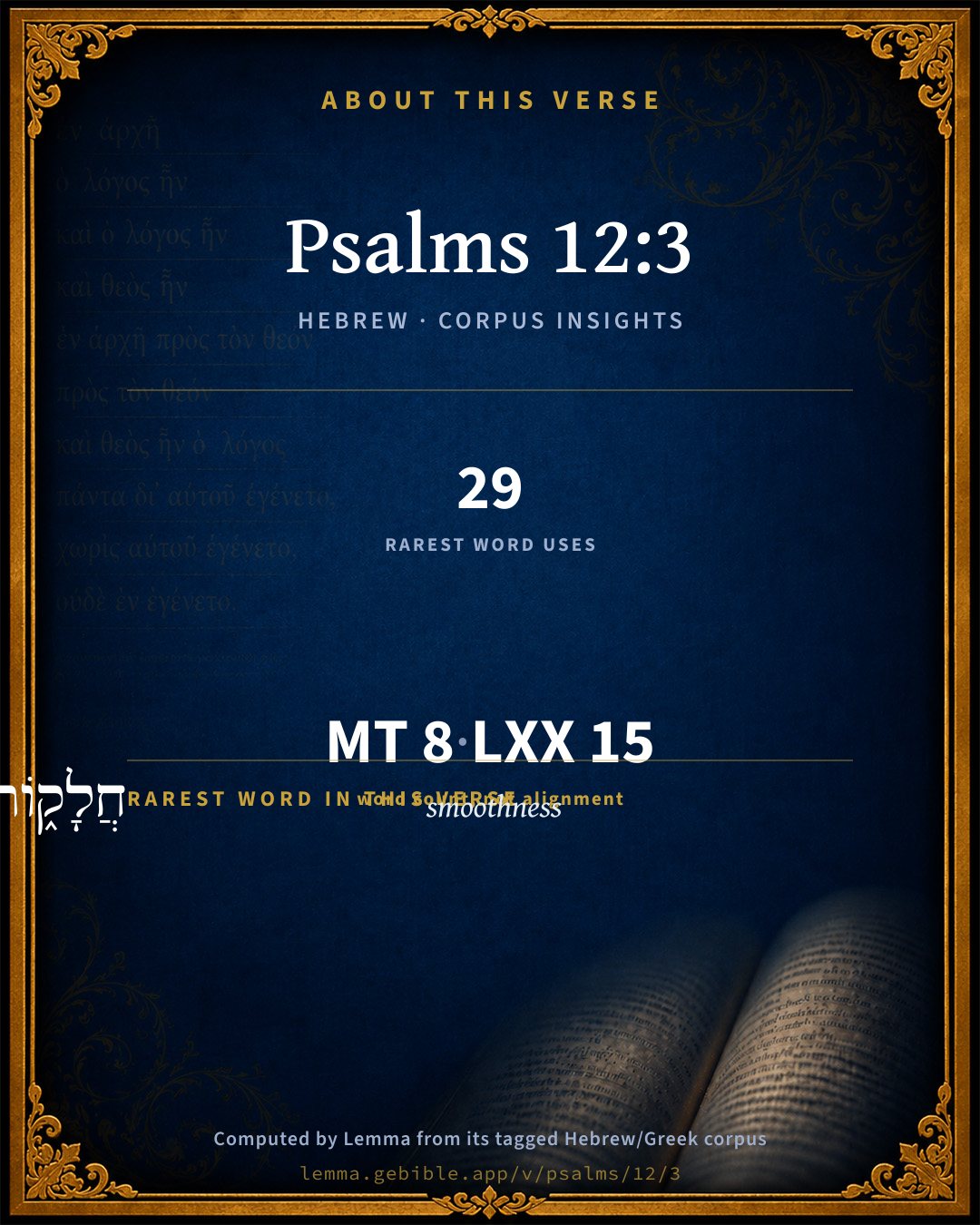
חֲלָק֑וֹת smoothness H2513 occurs in 25 verses of the Hebrew Bible. Also found in:

Grammatical profile

  • 2 verbs
  • 4 nouns
  • 2 adjectives

Verb forms

  • יַכְרֵ֣ת Hiphil · Jussive
  • מְדַבֶּ֥רֶת Piel · Participle Active

Hebrew & Septuagint length

In English translation the verse runs 12 words from the Hebrew and 15 from the Septuagint (LXX English) — closely comparable.

A rough comparison of the two English renderings, which tokenize alike — not a word-level alignment.

Word counts can differ between the Hebrew and the Greek without any difference in meaning — e.g. the Hebrew direct-object marker אֵת has no separate Greek word, and Greek often adds the article ὁ.

In the original languages it is 8 Hebrew tokens and 15 Greek tokens — but the two are counted differently (Hebrew bundles its prefixes and suffixes into one token; the Greek is in lemma form), so that isn’t a like-for-like length.

Cross-references

19

Topical passages linked to Psalms 12:3 in the Treasury of Scripture Knowledge — connected by theme and wording, ordered by reader-vote popularity; previews shown in the World English Bible.

  • Proverbs 18:21 Death and life are in the power of the tongue; Those who love it will eat its fruit.
  • Daniel 7:8 I considered the horns, and, behold, there came up among them another horn, a little one, before which three of the first horns were plucked up by the roots: and, behold, in this horn were eyes like the eyes of a man, and a mouth speaking great things.
  • Revelation 13:5 A mouth speaking great things and blasphemy was given to him. Authority to make war for forty-two months was given to him.
  • Psalms 17:10 They close up their callous hearts. With their mouth they speak proudly.
  • Exodus 15:9 The enemy said, 'I will pursue, I will overtake, I will divide the spoil. My desire shall be satisfied on them. I will draw my sword, my hand shall destroy them.'
  • 1 Samuel 2:3 Talk no more so exceeding proudly; Don't let arrogance come out of your mouth; For Yahweh is a God of knowledge, By him actions are weighed.
  • 1 Samuel 17:43–44 The Philistine said to David, Am I a dog, that you come to me with sticks? The Philistine cursed David by his gods.
  • 2 Kings 19:23–24 By your messengers you have defied the Lord, and have said, With the multitude of my chariots am I come up to the height of the mountains, to the innermost parts of Lebanon; and I will cut down the tall cedars of it, and the choice fir trees of it; and I will enter into his farthest lodging-place, the forest of his fruitful field.
  • Psalms 73:8–9 They scoff and speak with malice. In arrogance, they threaten oppression.
  • Ezekiel 28:2 Son of man, tell the prince of Tyre, Thus says the Lord Yahweh: Because your heart is lifted up, and you have said, I am a god, I sit in the seat of God, in the midst of the seas; yet you are man, and not God, though you did set your heart as the heart of God;-
  • Ezekiel 28:9 Will you yet say before him who kills you, I am God? but you are man, and not God, in the hand of him who wounds you.
  • Ezekiel 29:3 speak, and say, Thus says the Lord Yahweh: Behold, I am against you, Pharaoh king of Egypt, the great monster that lies in the midst of his rivers, that has said, My river is my own, and I have made it for myself.
  • Daniel 4:30–31 The king spoke and said, Is not this great Babylon, which I have built for the royal dwelling-place, by the might of my power and for the glory of my majesty?
  • Daniel 7:25 He shall speak words against the Most High, and shall wear out the saints of the Most High; and he shall think to change the times and the law; and they shall be given into his hand until a time and times and half a time.
  • Malachi 3:13 "Your words have been stout against me," says Yahweh. "Yet you say, 'What have we spoken against you?'
  • 2 Peter 2:18 For, uttering great swelling words of emptiness, they entice in the lusts of the flesh, by licentiousness, those who are indeed escaping from those who live in error;
  • Jude 1:16 These are murmurers and complainers, walking after their lusts (and their mouth speaks proud things), showing respect of persons to gain advantage.
  • Job 32:22 For I don't know how to give flattering titles; Or else my Maker would soon take me away.
  • Isaiah 10:10 As my hand has found the kingdoms of the idols, whose engraved images did excel them of Jerusalem and of Samaria;

Cross-references courtesy of OpenBible.info (CC BY 4.0).

Hebrew and Greek witnesses Masoretic Hebrew ↔ Greek Septuagint

The same verse in the two great witnesses to the Old Testament, shown verse-for-verse.

You’re reading Greek Psalm 11 (Hebrew Psalm 12). The Septuagint counts the superscription, so verse numbers can differ from the Hebrew — chapter-level alignment, not verse-by-verse. Numbering follows Rahlfs.

These are two independent witnesses, not word-aligned to each other, and the Septuagint is shown in lemma (dictionary) form.

Hebrew Psalms 12:3 Masoretic · Westminster Leningrad Codex

יַכְרֵ֣ת יְ֭הוָה כָּל שִׂפְתֵ֣י חֲלָק֑וֹת לָ֝שׁ֗וֹן מְדַבֶּ֥רֶת גְּדֹלֽוֹת

May Yahweh cut off all flattering lips, And the tongue that boasts,

World English Bible · Public Domain

Greek LXX Greek Psalm 11:3 Septuagint · lemma form

μάταιος λαλέω ἕκαστος πρός ὁ πλησίον αὐτός χεῖλος δόλιος ἐν καρδία καί ἐν καρδία λαλέω

Let the Lord destroy all the deceitful lips, and the tongue that speaks great words:

LXX2012 (modern English Septuagint) · Public Domain

Hebrew: Westminster Leningrad Codex (CC BY 4.0). Greek: Septuagint (public domain); English from LXX2012 (modern English Septuagint) (Public Domain). How the Septuagint differs from the Hebrew →

Commentary

Notes on Psalms 12:3 from classic Christian and Jewish commentators (each source and its license shown beneath its notes). The classic Christian expositions comment on the surrounding passage and are grouped to its opening verse, so a note may address several verses; the Jewish commentaries on the Tanakh (Rashi and others) are per-verse, so they appear only where the commentator wrote on this verse.

Lemma curates 59 commentaries, every one of them public domain or Creative Commons licensed, each selected and text-cleaned for this edition rather than reprinted as found. About our sources →

Trapp's Complete Commentary

John Trapp

Psa 12:3 The LORD shall cut off all flattering lips, [and] the tongue that speaketh proud things:

Ver. 3. The Lord shall cut off all flattering lips] As a rotten member is cut off from the body - Ne pars sincera trahatur, or as a barren tree is stocked up, that it cumber not the ground. There is a wonderful sympathy between princes and parasites, whose song is Mihi placet, quicquid regi placet, and whose practice is to speak suavia potius quam sans, sweet rather than sound things. But God will cut off such lips (taking notice of the offending member), as he dealt by Doeg, Ahithophel, Shebna, Shemaiah the Nehelamite, Jer 29:32, and as it were to be wished that Christian princes would do; serving them all as the Thessalians did that city in Greece called Kολακεια, or flattery, which they destroyed and pulled down to the ground (Hen. Steph. Apol. pro Herod.).

And the tougue that speaketh proud things] Magnifica, bubbles of words, blustering speeches, breathing out nothing but arrogance and contempt of God and his people. These grandiloqui must one day answer for their hard speeches with flames about their ears, whatever they meet with in the meanwhile, as did Nestorius, Thomas Arundel, Stephen Gardiner, and others, plagued here in their tongues, those little members that had boasted so great things, Jas 3:5.

John Trapp, A Commentary or Exposition upon All the Books of the Old and New Testament (1647–1656) — public domain. Text from a community e-Sword module.

The Biblical Illustrator

Joseph S. Exell

Psa_12:3-4

The Lord shall cut off all flattering lips.

The lawlessness of the tongue

The language of agitators is indicated in this text, of men who think to carry everything by free speech, a free press, and a free pulpit. God forbid that we should ever see the day when either of these three great agencies for enlightening, exciting, and directing human thought shall not be free. However much they may be abused, they are still the chief glory of a country. It is not to be denied, however, that they are abused. Instead of being used only for the defence of truth and right, they are often prostituted to stirring up the most fearful passions that can agitate the human breast; to array brother against brother, citizen against citizen, section against section, and Church against Church. You may remonstrate with the men so engaged, but the only answer you can obtain from them is likely to be, With our tongue will we prevail; our lips are our own; who is lord over us? They act as if freedom of speech implied the right to say whatever fancy may dictate, where it may dictate, when it may dictate, and as it may dictate. Hence the recklessness with which not only opinions, but characters and motives, are assailed. The right of free discussion is often indulged by its advocates, till they seem to have forgotten that men have any other rights. Nor is this lawlessness of tongue confined to partisan leaders, and to those in authority; it pervades and embitters private life. We meet, in every walk of society, persons who pride themselves on their fearlessness of speech, and who, in sheer wantonness, inflict wounds upon the characters and feelings of others that time can never heal. (David Caldwell, A. M.)

Flattery dangerous

The philosopher Bion, being asked what animal he thought the most hurtful, replied, That of wild creatures a tyrant, and of tame ones a flatterer. The flatterer is the most dangerous enemy we can have. Raleigh, himself a courtier, and therefore initiated into the whole art of flattery, who discovered in his own career and fate its dangerous and deceptive power, its deep artifice and deeper falsehood, says, A flatterer is said to be a beast that biteth smiling. But it is hard to know them from friends--they are so obsequious and full of protestations; for as a wolf resembles a dog, so doth a flatterer a friend. (The Book of Symbols.)

Our lips are our own.

Conversation

Thoughts, words, actions: these are the three activities in which our life is spent. The first and the last, as representing the inner and the outer life, are constant topics of religious teaching; but perhaps words, on account of their ambiguous character, as midway between thought and actions, have not received equal attention. To the thoughtless a word appears the most trivial of all things; what is it but a breath carried away on the air to be immediately extinguished? Yet, in truth, this activity is one of the great sides of life, in which we may either honour or dishonour God, in which we must display our own worth or unworth, and for which we shall at the last be either approved or rejected. Our conversation, indeed, is even more than this: it is a kind of index or epitome of our whole life; what we are in it, the same shall we be found to be in every other respect. It is to this effect that St. James says, If any man offend not in word, the same is a perfect man, and able also to bridle the whole body: and our Lord still more solemnly, By thy words shalt thou be justified, and by thy words thou shalt be condemned, as if nothing else required to be considered even at the final tribunal. Conversation is a daily, an hourly thing; it is continued from weeks end to weeks end, and from years end to years end; it goes on throughout life, from the time when the tongue of the child learns to babble the first words till the time when the old man eloquent is celebrating the days when he was young. It takes place in the house and by the way, where two or three are met together, and where crowds exchange their fleeting salutations. It passes between friend and friend, and between friend and foe, between neighbours and between strangers. There is no limit to the subjects which it may embrace. It takes in both the objects which present themselves to our observation in the places where we live, and those which are brought us by report from a distance. It ranges over the world invisible of thoughts and feelings, as well as the visible world of things and men. It moves easily from topic to topic, and may in an hour traverse a hundred subjects, passing from land to land in space, and from age to age in time. If the amount of our conversation could be represented to us visually it would astonish us. If it were printed, for instance, how many pages would an average talker fill in a single day? In a year it would amount to as many volumes as the collected works of a great author. In a lifetime it would fill a library. The mere bulk of this activity shows how momentous it is. But there are weightier considerations than this. Conversation is a forth-putting of the strength of the soul to produce an effect. It may be an effort of stupendous strength, or it may have no more force than the fall of a feather; for conversation, as an instrument of the mind, may be compared to those steam-hammers which can be worked either with such force as to grind an iron bar to powder, or with such gentleness as only to chip the shell of an egg. But whether the effort be great or small, that which it always aims at is an impression on another mind. Conversation is not the affair of one person, but always of, at least, two. It is perhaps the most direct and powerful means we have of influencing our fellow men. I put forth my hand and lay it on my neighbours person; but in so doing I am not touching him so closely as if I speak a sentence in his hearing. In the one case only our bodies touch; but in the other our souls touch. Conversation is the touching of souls. Souls never touch each other except for weal or woe. Every touch leaves a mark, which may be either a black mark or a point of splendour. No doubt the impressions made by conversation are generally minute. But all the impressions which we make in this way on different persons, when added together, amount to a great influence; and to those who for years are constantly hearing us speak we cannot but be doing much good or harm. One snow-flake is nothing; it melts away on the outstretched hand in a moment; but, flake by flake, the snow accumulates till it is the only thing visible in the landscape, and even boughs of the oak crack beneath its weight. And such is the cumulative influence of the conversation of a lifetime. (James Stalker, D. D.)

Who is Lord over us?--

The ideal Christianity

When we mistake our proprietorship we cease to be religious, and we give up the possibility of being religious. What is the first lesson in true Christian religion? The first lesson is that we are not our own, have no right, title, or claim to ourselves; we are branded; we have the burnt in mark upon us that we belong to Christ Jesus, that we are blood bought, that we are not our own; we have not a moment of time, not a single thought, energy, wish, will, desire, that is our own. That is the ideal Christianity, the very purpose and consummation of Christs priesthood, the tree meaning--that is, the large and complete meaning--of self-denial, saying No when anything within us claims to have an existence or right of its own. So long as we think that our lips are our own we shall speak what we please; when we begin to learn that our lips are not our own, nor our hands, nor feet, nor head, nor heart, we shall have but one question: Lord, what wilt Thou have me to do? Tell me, and give me strength to do it. That will be the day of jubilee, the morning of coronation. (Joseph Parker, D. D.)

The Biblical Illustrator, edited by Joseph S. Exell (c. 1880s–1900s) — public domain. Text from a community e-Sword module.

The Treasury of David

Charles H. Spurgeon

Ver. 3-4. Total destruction shall overwhelm the lovers of flattery and pride, but meanwhile how they hector and fume! Well did the apostle call them "raging waves of the sea, foaming out their own shame." Free thinkers are generally very free talkers, and they are never more at ease than when railing at God's dominion, and arrogating to themselves unbounded license. Strange is it that the easy yoke of the Lord should so gall the shoulders of the proud, while the iron bands of Satan they bind about themselves as chains of honour: they boastfully cry unto God,

Who is lord over us? and hear not the hollow voice of the evil one, who cries from the infernal lake, "I am your lord, and right faithfully do ye serve me." Alas, poor fools, their pride and glory shall be cut off like a fading flower! May God grant that our soul may not be gathered with them. It is worthy of observation that flattering lips, and tongues speaking proud things, are classed together: the fitness of this is clear, for they are guilty of the same vice, the first flatters another, and the second flatters himself, in both cases a lie is in their right hands. One generally imagines that flatterers are such mean parasites, so cringing and fawning, that they cannot be proud; but the wise man will tell you that while all pride is truly meanness, there is in the very lowest meanness no small degree of pride. Caesar's horse is even more proud of carrying Caesar, that Caesar is of riding him. The mat on which the emperor wiped his shoes, boasts vain gloriously, crying out, "I cleaned the imperial boots." None are so detestably domineering as the little creatures who creep into office by cringing to the great; those are bad times, indeed, in which these obnoxious beings are numerous and powerful. No wonder that the justice of God in cutting off such injurious persons is matter for a psalm, for both earth and heaven are weary of such provoking offenders, whose presence is a very plague to the people afflicted thereby. Men cannot tame the tongues of such boastful flatterers; but the Lord's remedy if sharp is sure, and is an unanswerable answer to their swelling words of vanity.

Ver. 3. The Lord shall cut off all flattering lips, etc. They who take pleasure in deceiving others, will at the last find themselves most of all deceived, when the Sun of truth, by the brightness of his rising, shall at once detect and consume hypocrisy. George Horne.

Ver. 3. Cut off lips and tongues. May there not be here an allusion to those terrible but suggestive punishments which Oriental monarchs were wont to execute on criminals? Lips were cut off and tongues torn out when offenders were convicted of lying or treason. So terrible and infinitely more so are the punishments of sin. C.H.S.

Ver. 3-4. It need not now seem strange to tell you that the Lord is the owner of our bodies, that he has so much propriety therein that they are more his than ours. The apostle tells us as much. 1Co 6:20. "Glorify God in your bodies which are his." Our bodies, and every member thereof, are his: for if the whole be so, no part is exempted. And therefore they spake proud things, and presumptuously usurped the propriety of God, who said, Our lips are our own; as though their lips had not been his who is Lord and Owner of all, but they had been lords thereof, and might have used them as they list. This provoked God to show what right he had to dispose of such lips and tongues, by cutting them off. David Clarkson.

Ver. 3. God's hatred of those twin sins of the lipsFlattery and Pride (which is self flattery). Why he hates them. How he shows his hatred. In whom he hates them most. How to be cleansed from them.

Ver. 3-4.

1. The revolt of the tongue. Its claim of power, self possession, and liberty. Contrast this and the believer's confession, "we are not our own."

2. The method of its rebellion "flattery, and speaking proud things."

3. The end of its treason "cut off."

Psalms 12:4*

Ver. 3-4. See Psalms on "Ps 12:3" for further information.

Ver. 3-4. See Psalms on "Ps 12:3" for further information.

Ver. 3-4.

1. The revolt of the tongue. Its claim of power, self possession, and liberty. Contrast this and the believer's confession, "we are not our own."

2. The method of its rebellion "flattery, and speaking proud things."

3. The end of its treason "cut off."

Psalms 12:5*

Charles H. Spurgeon's The Treasury of David (1869–1885) — public domain. Psalms only. Text from a community e-Sword/MySword module.

Joseph Benson's Commentary

Psa 12:3. The Lord shall cut off all flattering lips — All such as speak kind things to any one, at the same time that they mean quite the contrary in their hearts; and the tongue that speaketh proud things — Hebrew, גדלות, gedoleth, great things, or, great words, boasting what they have done, or declaring, or threatening what they will do, and what great things they will effect, namely, with their tongues, as they themselves explain it in the next words.

Joseph Benson's Commentary on the Old and New Testaments (1811–1818) — public domain. Text from a community e-Sword module.

J. A. Alexander on Psalms

Joseph Addison Alexander

4. (Psa 12:3.) May Jehovah destroy all lips of smoothness, flattering lips, (and every) tongue speaking great things, i.e. speaking proudly, boasting. The form of the Hebrew verb is one commonly employed to express an optative meaning; but as this form is often poetically used for the future proper, it might be rendered here, Jehovah will destroy. There is no inconsistency between the flattering lips and the boastful tongue, because the subject of the boasting, as appears from what follows, is the flattery or deceit itself. As if he had said, Jehovah will destroy all flattering lips, and every tongue that boasts of their possession or use. For an example of such boasting, see Isa 28:15.

Joseph Addison Alexander, The Psalms Translated and Explained (1850) — public domain. Text from a community e-Sword module.

Jamieson, Fausset & Brown

Robert Jamieson, A. R. Fausset & David Brown

Boasting (Dan 7:25) is, like flattery, a species of lying.

lips, and . . . tongue--for persons.

Jamieson, Fausset & Brown — Commentary Critical and Explanatory on the Whole Bible (1871) — public domain (CC PDM 1.0). Text via the HelloAO Bible API.

Adam Clarke's Commentary

Verse 3. Proud things] גדלות gedoloth, great things; great swelling words, both in their promises and in their commendations.

Adam Clarke's Commentary on the Bible (1810–1826) — public domain. Text from a community e-Sword/MySword module.

John Calvin's Commentaries

To his complaint in the preceding verse he now subjoins an imprecation, that God would cut off deceitful tongues. It is uncertain whether he wishes that deceitful men may be utterly destroyed, or only that the means of doing mischief may be taken from them; but the scope of the passage leads us rather to adopt the first sense, and to view David as desiring that God, by some means or other, would remove that plague out of the way. As he makes no mention of malice, while he inveighs so vehemently against their envenomed tongues, we hence conclude, that he had suffered much more injury from the latter than from the former; and certainly falsehood and calumnies are more deadly than swords and all other kind of weapons. From the second clause of the third verse it appears more clearly what kind of flatterers they were of whom mention was made in the preceding verse: The tongue that speaketh great or proud things. Some flatter in a slavish and fulsome manner, declaring that they are ready to do and suffer any thing which they possibly can for our benefit. But David here speaks of another kind of flatterers, namely, those who in flattering proudly boast of what they will accomplish, and mingle base effrontery and threatening with their deceitful arts. He does not, therefore, speak of the herd of mean conceited persons among the common people who make a trade of flattering, that they may live at other people’s expense; “Il ne parle donc pas d’un tas de faquins du commun peuple, qui sont estat de flatter pour avoir la lippee franche.” — Fr.

“The occasion on which this psalm was composed is not expressed, but it is a sad complaint of the corrupt manners of that age, (especially of the court of Saul, 5:3,) in which it was hard to find an honest plain dealing man, in whom one might confide. Some think it aims partly at Doeg, and such like courtiers; partly at the Ziphires, and such perfidious people in the country, who, promising him their friendship, (as Theodoret understands it,) would have most basely betrayed him unto Saul, his declared enemy.” — Bishop Patrick’s Paraphrase on the Book of Psalms.

“Mais qui mentent plaisir en se vantans et tenans propos braves et hautains, desquels ils accablent les poures et simples.” — Fr.

John Calvin's Commentaries (1540-1563) — public domain. Text from the Calvin Translation Society English edition (1840s-50s) via the Christian Classics Ethereal Library (ccel.org). Calvin's coverage is partial (roughly two-thirds of the Bible); uncommented books and verses are honest gaps, never fabricated. The 19th-century editor's footnotes and remarks are omitted so the notes are faithfully Calvin's own voice.

Ellicott's Commentary for English Readers

(3) The Lord shall.—Translate, May Jehovah cut off.

Proud things.—Literally, great things. Vulg., linguam magniloquam.

A Bible Commentary for English Readers, edited by Charles John Ellicott (1878–1897) — public domain. Text from a community e-Sword module.

The Cambridge Bible for Schools and Colleges

gen. ed. J. J. S. Perowne

3. Render: May Jehovah cut off &c. Cp. Psa_31:17-18.

proud things] Lit. as R.V., great things; further defined in Psa_12:4.

3, 4. The prayer for help passes into a prayer for the excision of these false-hearted braggarts. Cp. Psa_5:10.

The Cambridge Bible for Schools and Colleges (gen. ed. J. J. S. Perowne; Cambridge University Press, 1878–1918) — public domain. Text from a community e-Sword module.

John Gill's Exposition

The Lord shall cut off all flattering lips,.... This is either a prophecy or a prayer, as Aben Ezra and Kimchi observe; that God either would or should cut off such who used flattery with their lips, by inflicting some judgment in this life, or everlasting punishment hereafter; by taking them away by death "out of the world", as the Targum paraphrases it; or by casting them into hell, where all liars and deceitful persons will have their portion; see Job 32:21;

and the tongue that speaketh proud things, or "great things" (f), as the little horn, Dan 7:20; and the beast, or Romish antichrist, who is designed by both, Rev 13:5; and which will be accomplished when Christ shall destroy him with the breath of his mouth, and the brightness of his coming; and indeed every tongue that riseth up against God, Christ, and his people, will be condemned; when ungodly sinners will be convinced of all their hard speeches, Isa 54:17, Jde 1:15. Perhaps some regard may be had to the tongue of Doeg the Edomite; see Psa 52:3.

(f) "magna", Pagninus, Montanus, Vatablus, Piscator, Gejerus, Michaelis; "grandia", Cocceius.

John Gill's Exposition of the Whole Bible (1746–1763) — public domain (CC PDM 1.0). Text via the HelloAO Bible API.

Albert Barnes' Notes on the Bible

The Lord shall cut off - This might be rendered, “May the Lord cut off,” implying a wish on the part of the psalmist that it might occur. But probably the common rendering is the correct one. It is the statement of a solemn truth, designed for warning, that all such persons would be punished.

All flattering lips - The meaning is, that he will cut off all “persons” who use flattery; that is, he will cut them off from the favors which he will show to his own people, or will punish them. The word used here is the common one to denote disowning or excommunicating, and derives its meaning from the act of separating offenders from a community. See Gen 17:14; Lev 17:10; Lev 18:29; Lev 20:3, Lev 20:6; et soepe.

And the tongue that speaketh proud things - That boasts, or is self-confident. For an example of this, see Isa 28:15; and compare the notes at that passage. It was this disposition to falsehood, flattery, and boasting, which constituted the fact stated in Psa 12:1, that “godly” and “faithful” men - men on whom reliance might be placed, whose word might be trusted, and whose promised aid in the cause of truth might be depended on - had seemed to “fail” among men. That is, no such men could be found.

Albert Barnes' Notes on the Bible (1834–1885) — public domain. Text from a community e-Sword/MySword module.

Matthew Poole's English Annotations

Or great things, or great words, either bragging or threatening what they will do, and what great things they will effect, to wit, by their tongues, as they themselves explain it in the next verse, which they will use so cunningly and powerfully, that they shall not need to use their hands, or strike a stroke.

Matthew Poole's English Annotations on the Holy Bible (1683–1685) — public domain. Text from a community e-Sword/MySword module.

Whedon's Commentary on the Bible

Daniel D. Whedon

3. Flattering lips… tongue that speaketh proud things—Two opposite characters, the dissembler and the self-confident boaster, alike abominable to God.

Daniel D. Whedon (gen. ed.), Commentary on the Old and New Testaments (1874–1909) — public domain. Text from a community e-Sword module.

The Pulpit Commentary

The Lord shall cut off all flattering lips. The complaint having been made, a threat follows. (comp. Psa_10:15 Psa_11:6 Psa_17:13, etc.) The men who flatter with their lips, beguiling and cozening their victims to get them completely into their power, shall be "cut off" from the congregation. (see Gen_17:14 Exo_12:15, 19 Lev_7:20, 27 17:10, etc.) And the tongue that speaketh proud things; literally, greet rhinos; but proud and lofty boastings are intended. (comp. Dan_7:8, Dan_7:20) The same man sometimes cozens with smooth words, sometimes blusters and talks big.

The Pulpit Commentary (1880–1919), ed. H.D.M. Spence-Jones & Joseph S. Exell — public domain. Text from a community e-Sword module.

Keil & Delitzsch

C. F. Keil & F. Delitzsch

(Heb.: 12:4-5) In this instance the voluntative has its own proper signification: may He root out (cf. Psa 109:15, and the oppositive Psa 11:6). Flattering lips and a vaunting tongue are one, insofar as the braggart becomes a flatterer when it serves his own selfish interest. אשׁר refers to lips and tongue, which are put for their possessors. The Hiph. הגבּיר may mean either to impart strength, or to give proof of strength. The combination with ל, not בּ, favours the former: we will give emphasis to our tongue (this is their self-confident declaration). Hupfeld renders it, contrary to the meaning of the Hiph.: over our tongue we have power, and Ewald and Olshausen, on the ground of an erroneous interpretation of Dan 9:27, render: we make or have a firm covenant with our tongue. They describe their lips as being their confederates (את as in Kg2 9:32), and by the expression "who is lord over us" they declare themselves to be absolutely free, and exalted above all authority. If any authority were to assert itself over them, their mouth would put it down and their tongue would thrash it into submission. But Jahve, whom this making of themselves into gods challenges, will not always suffer His own people to be thus enslaved.

Keil & Delitzsch — Biblical Commentary on the Old Testament (1861–1891) — public domain (CC PDM 1.0). Text via the HelloAO Bible API. (Old Testament only.)

Rashi

Rabbi Shlomo Yitzchaki (Rashi)

with a double heart Lit. with a heart and a heart; with two hearts. They feign friendliness, but there is hatred hidden in their heart.

Rashi on the Tanakh — English translations: “The Judaica Press complete Tanach with Rashi, translated by A. J. Rosenberg” (CC BY 4.0); “Pentateuch with Rashi's commentary by M. Rosenbaum and A.M. Silbermann, 1929-1934” (public domain); “The Metsudah Tanach series, Lakewood, N.J” (CC BY 4.0); and “The Book of Joshua, Metsudah Publications, 1997” (CC BY 4.0). Text via Sefaria.

Lesson kit

Teaching starters — assembled from the data on this page, not authored interpretation. Every prompt links to the verse data it draws on. Edit before teaching.

Psalms, in the Wisdom, opens this verse with 8 words (8 distinct Hebrew lemmas). Its most distinctive word is chelqâh (“smoothness”). A historical commentator’s framing appears above. Read the whole chapter for the surrounding context.

Discussion questions

  1. What does “smoothness” (chelqâh) contribute to the verse as a whole?
  2. Genesis 27:16 shares the word «smoothness» with this verse. How do the two illuminate each other?
  3. The translations on this page render this verse differently — a whole-verse word diff, not a word-by-word alignment. What might account for the different wordings?
  4. The verb «יַכְרֵ֣ת» is Hiphil Jussive. How does its form color the action?
  5. Reading how Trapp's Complete Commentary and The Biblical Illustrator read this verse, where do the two commentators agree and where do they part?

Things to notice

Reading settings

Reading text

Shown beneath each verse's original-language words.

Old Testament
Old Testament edition

Read the OT as the Masoretic Hebrew (MT) or the Greek Septuagint (LXX).

English shown for the Greek Septuagint (in the Hebrew ↔ Greek comparison).

Comparing translations? Open the Compare panel on any verse page to stack up to four side by side.