
1 Kings 14:10

Hebrew (Westminster Leningrad Codex) 1 Kings 14:10 appears in the Hebrew Old Testament. The text above is from the Westminster Leningrad Codex. Each word links to its Strong’s number, a concise gloss, and parsing drawn from the Open Scriptures Hebrew Bible morphology. Click any word for its full Brown-Driver-Briggs (BDB) entry.
Download image
Cite this verse

1 Kings 14:10 (World English Bible). Public Domain. Lemma interlinear Bible study tool, https://lemma.gebible.app/v/1-kings/14/10.

Show BibTeX & RIS
BibTeX
RIS
English Translation
therefore, behold, I will bring evil on the house of Jeroboam, and will cut off from Jeroboam every man-child, him who is shut up and him who is left at large in Israel, and will utterly sweep away the house of Jeroboam, as a man sweeps away dung, until it be all gone.
World English Bible · Public Domain
Highlights
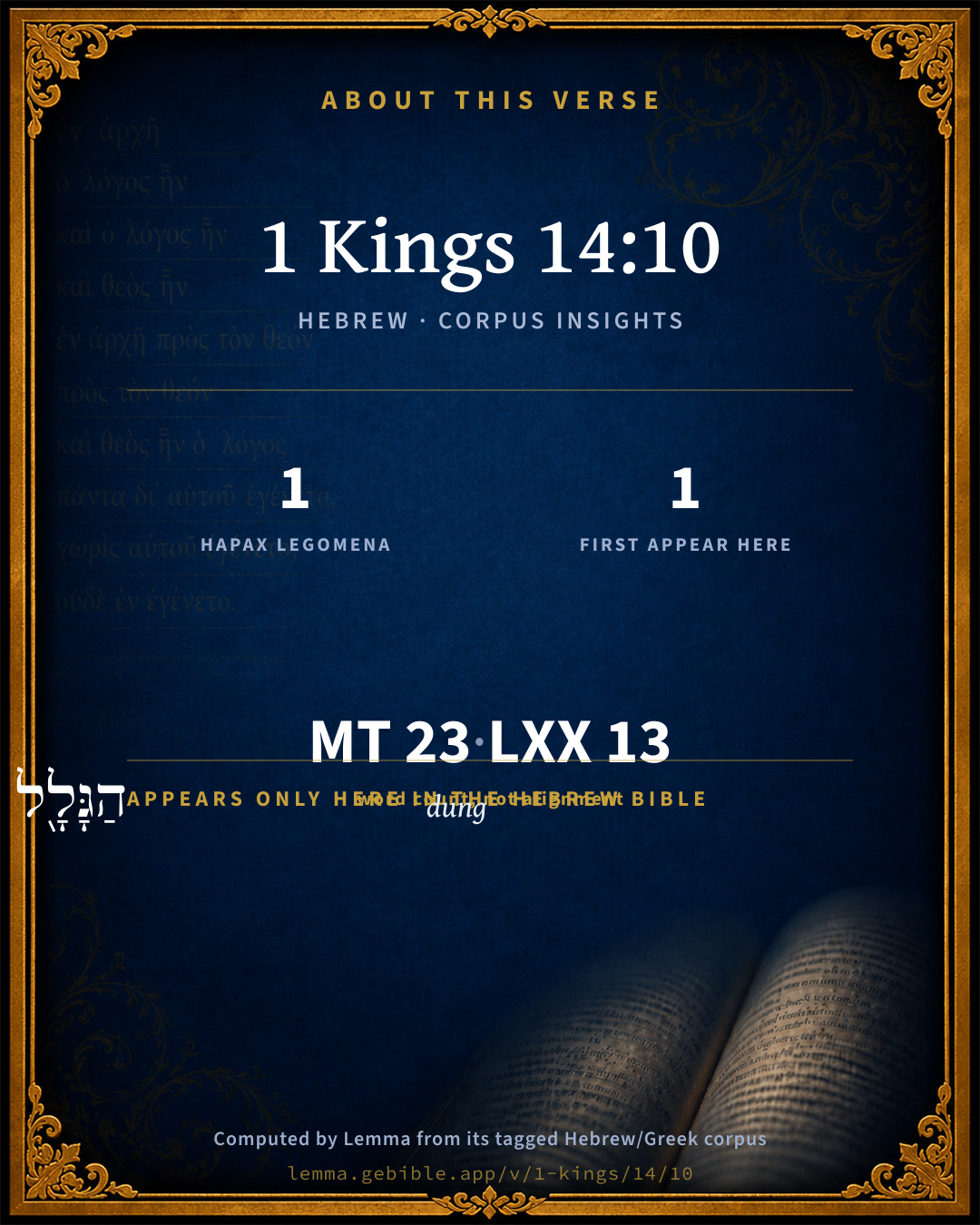
  • 1 hapax legomenon — only here in the Hebrew Bible
  • 1 first appearance in the Hebrew Bible
Full analysis ↓
Download a study sheet

One document with this verse’s original text, its word-by-word gloss line, the meaning frame, cross-references with their text, attributed commentary, and full source and license credits — printable, and it pastes into notes with its structure intact.

This verse Autodidact and up

Study sheet (.html) Plain text (.txt)

A passage Seminary Student

Up to 50 verses in one chapter. A passage sheet keeps up to 6 commentary sources and 12 cross-references per verse, in the order this page ranks them, and says so on the sheet whenever that leaves anything out. Ask for a single verse and you get the Autodidact verse sheet above.

Everything on this page stays free to read, with no account — the sheet is a download of what is already on screen, not access to it.

Want to remove ads? Support Godless Engineer
Compare translations 3

The same verse in 3 English versions, stacked beneath the original-language interlinear above. Click any original word for its lexicon entry.

Each is an independent rendering of the whole verse — the interlinear is not word-aligned to these translations.

Highlighted words mark where these versions differ — a whole-verse word diff, not a word-by-word alignment.

  • World English Bible Public Domain
    therefore, behold, I will bring evil on the house of Jeroboam, and will cut off from Jeroboam every man-child, him who is shut up and him who is left at large in Israel, and will utterly sweep away the house of Jeroboam, as a man sweeps away dung, until it be all gone.
  • King James Version Public Domain
    Therefore, behold, I will bring evil upon the house of Jeroboam, and will cut off from Jeroboam him that pisseth against the wall, and him that is shut up and left in Israel, and will take away the remnant of the house of Jeroboam, as a man taketh away dung, till it be all gone.
  • unfoldingWord Literal Text CC BY-SA 4.0
    therefore, behold me, bringing harm to the house of Jeroboam, and I will cut off from Jeroboam one pissing against a wall, one restrained and one set free in Israel. And I will burn after the house of Jeroboam, just as dung burns until the finishing of it.

unfoldingWord Literal Text — © unfoldingWord, licensed CC BY-SA 4.0. Word-aligned USFM3 via Door43 (git.door43.org/unfoldingWord/en_ult).

Versions to compare (up to 4)

3 of 4 selected

Show all 18 translations

Every available English version of this verse, each an independent rendering of the whole verse.

  • World English Bible Public Domain
    therefore, behold, I will bring evil on the house of Jeroboam, and will cut off from Jeroboam every man-child, him who is shut up and him who is left at large in Israel, and will utterly sweep away the house of Jeroboam, as a man sweeps away dung, until it be all gone.
  • Berean Standard Bible Public Domain
    Because of all this, behold, I am bringing disaster on the house of Jeroboam: I will cut off from Jeroboam every male, both slave and free, in Israel; I will burn up the house of Jeroboam as one burns up dung until it is gone!
  • Majority Standard Bible Public Domain
    Because of all this, behold, I am bringing disaster on the house of Jeroboam: I will cut off from Jeroboam every male, both slave and free, in Israel; I will burn up the house of Jeroboam as one burns up dung until it is gone!
  • King James Version Public Domain
    Therefore, behold, I will bring evil upon the house of Jeroboam, and will cut off from Jeroboam him that pisseth against the wall, and him that is shut up and left in Israel, and will take away the remnant of the house of Jeroboam, as a man taketh away dung, till it be all gone.
  • American Standard Version (1901) Public Domain
    therefore, behold, I will bring evil upon the house of Jeroboam, and will cut off from Jeroboam every man-child, him that is shut up and him that is left at large in Israel, and will utterly sweep away the house of Jeroboam, as a man sweepeth away dung, till it be all gone.
  • Revised Version (1885) Public Domain
    therefore, behold, I will bring evil upon the house of Jeroboam, and will cut off from Jeroboam every man child, him that is shut up and him that is left at large in Israel, and will utterly sweep away the house of Jeroboam, as a man sweepeth away dung, till it be all gone.
  • Geneva Bible (1599) Public Domain
    Therefore beholde, I will bring euill vpon the house of Ieroboam, and will cut off from Ieroboam him that pisseth against the wall, aswell him that is shut vp, as him that is left in Israel, and will sweepe away the remnant of the house of Ieroboam, as a man sweepeth away doung, till it be all gone.
  • Douay-Rheims (1899) Public Domain
    Therefore behold I will bring evils upon the house of Jeroboam, and will cut of from Jeroboam him that pisseth against the wall, and him that is shut up, and the last in Israel: and I will sweep away the remnant of the house of Jeroboam, as dung is swept away till all be clean.
  • Young's Literal Translation Public Domain
    `Therefore, lo, I am bringing in evil unto the house of Jeroboam, and have cut off to Jeroboam those sitting on the wall -- shut up and left -- in Israel, and have put away the posterity of the house of Jeroboam, as one putteth away the dung till its consumption;
  • Literal Standard Version CC BY-SA 4.0
    therefore, behold, I am bringing calamity to the house of Jeroboam, and have cut off to Jeroboam those sitting on the wall—shut up and left—in Israel, and have put away the posterity of the house of Jeroboam, as one puts away the dung until its consumption;
  • Unlocked Literal Bible CC BY-SA 4.0
    Therefore, look, I will bring disaster on your family; I will cut off from you every male child in Israel, whether slave or free, and will completely remove your family, like someone who burns up dung until it is gone.
  • unfoldingWord Literal Text CC BY-SA 4.0
    therefore, behold me, bringing harm to the house of Jeroboam, and I will cut off from Jeroboam one pissing against a wall, one restrained and one set free in Israel. And I will burn after the house of Jeroboam, just as dung burns until the finishing of it.
  • Darby Bible Public Domain
    therefore behold, I will bring evil upon the house of Jeroboam, and will cut off from Jeroboam every male, him that is shut up and left in Israel, and will take away the house of Jeroboam, as a man taketh away dung, till it be all gone.
  • World Messianic Bible Public Domain
    therefore, behold, I will bring evil on the house of Jeroboam, and will cut off from Jeroboam everyone who urinates on a wall, he who is shut up and he who is left at large in Israel, and will utterly sweep away the house of Jeroboam, as a man sweeps away dung until it is all gone.
  • Webster's Bible Public Domain
    Therefore behold, I will bring evil upon the house of Jeroboam, and will cut off from Jeroboam the males, and him that is shut up and left in Israel, and will take away the remnant of the house of Jeroboam, as a man taketh away dung, till it is all gone.
  • Free Bible Version CC BY-SA 4.0
    Now pay attention, because as a result of this I am going to bring disaster on the house of Jeroboam. I will totally exterminate every one of your descendants in Israel, whether slave or free. I will burn the house of Jeroboam like a man burning refuse until it's all gone.
  • Bible in Basic English Public Domain
    So I will send evil on the line of Jeroboam, cutting off from his family every male child, those who are shut up and those who go free in Israel; the family of Jeroboam will be brushed away like a man brushing away waste till it is all gone.
  • JPS Tanakh (1917) Public Domain
    therefore, behold, I will bring evil upon the house of Jeroboam, and will cut off from Jeroboam every man-child, and him that is shut up and him that is left at large in Israel, and will utterly sweep away the house of Jeroboam, as a man sweepeth away dung, till it be all gone.

Literal Standard Version (2020), Covenant Press — licensed CC BY-SA 4.0. Text via the HelloAO Bible API (eBible.org). Unlocked Literal Bible (unfoldingWord) — licensed CC BY-SA 4.0. Text via the HelloAO Bible API (eBible.org). unfoldingWord Literal Text — © unfoldingWord, licensed CC BY-SA 4.0. Word-aligned USFM3 via Door43 (git.door43.org/unfoldingWord/en_ult). Free Bible Version, Dr. Jonathan Gallagher — licensed CC BY-SA 4.0. Text via the HelloAO Bible API (eBible.org).

Word by word

More ways to search: Search by grammar → Find every occurrence → Compare this word →

Practice this passage: Drill this verse → Learn its vocabulary →

הַגָּלָ֖ל
gâlâl
H1557
“the · dung”
Particle, Definite Article + Noun, Common, Masculine, Singular, Absolute
Part of Speech
Particle + Noun
Type
Common
Gender
Masculine
Number
Singular
State
Absolute
Full BDB Definition

Origin: from H1556

TWOT: 353d

dung
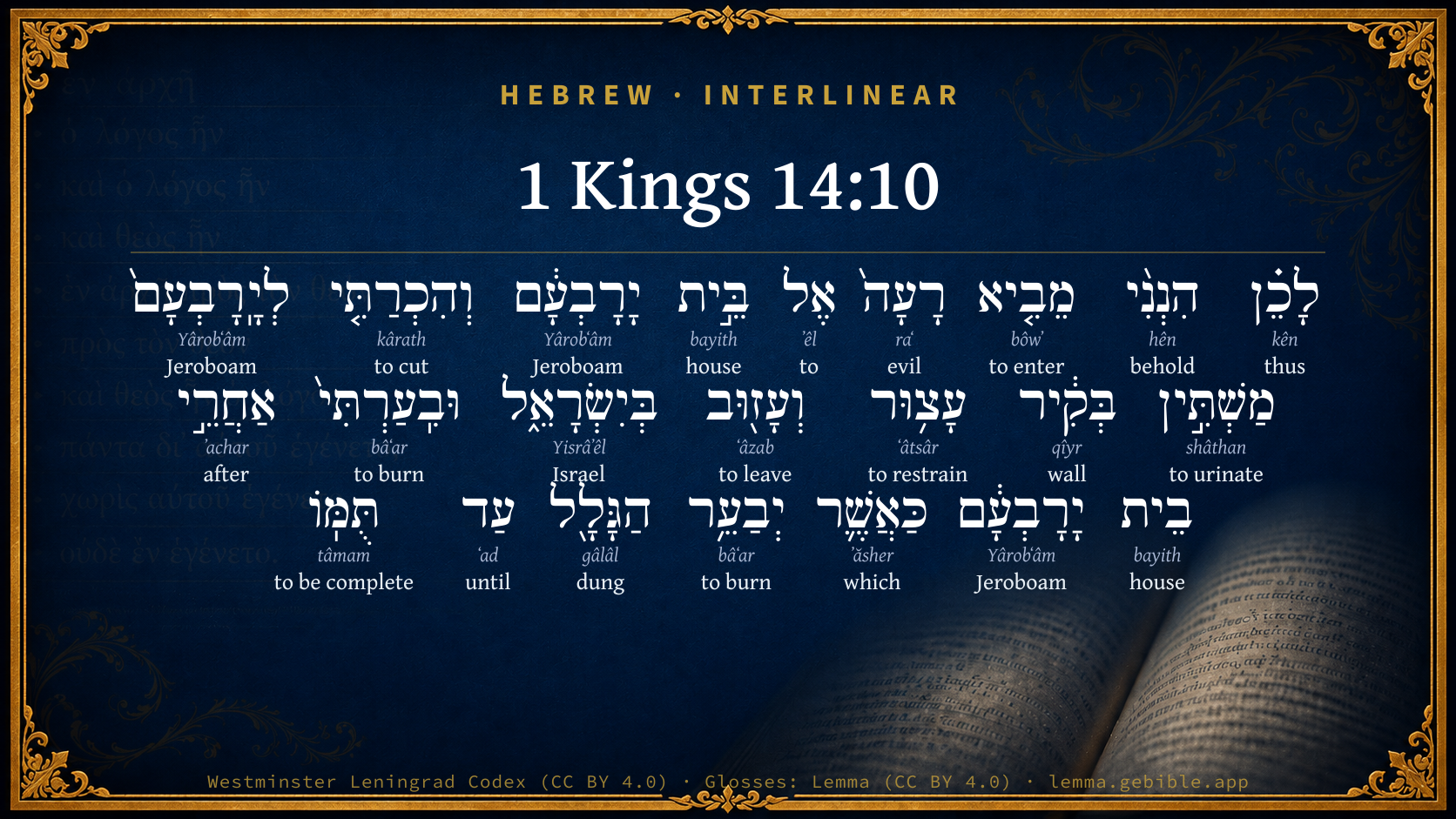
  1. לָכֵ֗ן kên H3651 “to/for · thus” Preposition + Adverb
  2. הִנְנִ֨י hên H2005 “behold · me” Particle, Demonstrative + Suffix, Personal, 1st Person, Common, Singular
  3. מֵבִ֤יא bôwʼ H935 “entering” Verb, Hiphil, Participle Active, Masculine, Singular, Absolute
  4. רָעָה֙ raʻ H7451 “evil” Noun, Common, Feminine, Singular, Absolute
  5. אֶל ʼêl H413 “to” Preposition
  6. בֵּ֣ית bayith H1004 “house of” Noun, Common, Masculine, Singular, Construct
  7. יָרָבְעָ֔ם Yârobʻâm H3379 “Jeroboam” Noun, Proper
  8. וְהִכְרַתִּ֤י kârath H3772 “and · to cut” Conjunction + Verb, Hiphil, Sequential Perfect, 1st Person, Common, Singular
  9. לְיָֽרָבְעָם֙ Yârobʻâm H3379 “to/for · Jeroboam” Preposition + Noun, Proper
  10. מַשְׁתִּ֣ין shâthan H8366 “urinating” Verb, Hiphil, Participle Active, Masculine, Singular, Absolute
  11. בְּקִ֔יר qîyr H7023 “in/at · wall” Preposition + Noun, Common, Masculine, Singular, Absolute
  12. עָצ֥וּר ʻâtsâr H6113 “restrained” Verb, Qal, Participle Passive, Masculine, Singular, Absolute
  13. וְעָז֖וּב ʻâzab H5800 “and · left” Conjunction + Verb, Qal, Participle Passive, Masculine, Singular, Absolute
  14. בְּיִשְׂרָאֵ֑ל Yisrâʼêl H3478 “in/at · Israel” Preposition + Noun, Proper
  15. וּבִֽעַרְתִּי֙ bâʻar H1197 “and · to burn” Conjunction + Verb, Piel, Sequential Perfect, 1st Person, Common, Singular
  16. אַחֲרֵ֣י ʼachar H310 “after” Preposition
  17. בֵית bayith H1004 “house of” Noun, Common, Masculine, Singular, Construct
  18. יָרָבְעָ֔ם Yârobʻâm H3379 “Jeroboam” Noun, Proper
  19. כַּאֲשֶׁ֛ר ʼăsher H834 “like/as · which” Preposition + Particle, Relative
  20. יְבַעֵ֥ר bâʻar H1197 “to burn” Verb, Piel, Imperfect, 3rd Person, Masculine, Singular
  21. עַד ʻad H5704 “until” Preposition
  22. תֻּמּֽוֹ tâmam H8552 “to be complete · him” Verb, Qal, Infinitive Construct + Suffix, Personal, 3rd Person, Masculine, Singular

About this verse

These counts appear in no published source. They are computed here, from the morphology-tagged text and Lemma’s own curated glosses. What Lemma adds →

23
words
19
distinct lemmas
Historical
section

Notable vocabulary

1 hapax legomenon — a word that appears only here in the entire Hebrew Bible:

  • הַגָּלָ֖ל dung H1557

First appearance in Scripture

This word makes its first canonical appearance in the Hebrew Bible here:

  • הַגָּלָ֖ל dung H1557

Shared distinctive vocabulary

מַשְׁתִּ֣ין to urinate H8366 occurs in 6 verses of the Hebrew Bible. Also found in:

Grammatical profile

  • 8 verbs
  • 9 nouns
  • 3 prepositions
  • 1 adverb
  • 2 particles

Verb forms

  • מֵבִ֤יא Hiphil · Participle Active
  • וְהִכְרַתִּ֤י Hiphil · Sequential Perfect
  • מַשְׁתִּ֣ין Hiphil · Participle Active
  • עָצ֥וּר Qal · Participle Passive
  • וְעָז֖וּב Qal · Participle Passive
  • וּבִֽעַרְתִּי֙ Piel · Sequential Perfect
  • יְבַעֵ֥ר Piel · Imperfect
  • תֻּמּֽוֹ Qal · Infinitive Construct

Repetition

Words recur within this verse — often emphatic in Hebrew:

  • יָרָבְעָ֔ם Jeroboam H3379 ×3
  • בֵּ֣ית house H1004 ×2
  • וּבִֽעַרְתִּי֙ to burn H1197 ×2

Hebrew & Septuagint length

In the original languages it is 23 Hebrew tokens and 13 Greek tokens — but the two are counted differently (Hebrew bundles its prefixes and suffixes into one token; the Greek is in lemma form), so that isn’t a like-for-like length.

Cross-references

22

Topical passages linked to 1 Kings 14:10 in the Treasury of Scripture Knowledge — connected by theme and wording, ordered by reader-vote popularity; previews shown in the World English Bible.

  • Deuteronomy 32:36 For Yahweh will judge his people, Repent himself for his servants; When he sees that [their] power is gone, There is none [remaining], shut up or left at large.
  • 1 Kings 21:21 Behold, I will bring evil on you, and will utterly sweep you away and will cut off from Ahab every man-child, and him who is shut up and him who is left at large in Israel:
  • 2 Kings 14:26 For Yahweh saw the affliction of Israel, that it was very bitter; for there was none shut up nor left at large, neither was there any helper for Israel.
  • 2 Kings 9:8–9 For the whole house of Ahab shall perish; and I will cut off from Ahab every man-child, and him who is shut up and him who is left at large in Israel.
  • 1 Samuel 2:30 Therefore Yahweh, the God of Israel, says, I said indeed that your house, and the house of your father, should walk before me forever: but now Yahweh says, Be it far from me; for those who honor me I will honor, and those who despise me shall be lightly esteemed.
  • 1 Samuel 25:22 God do so to the enemies of David, and more also, if I leave of all that belongs to him by the morning light so much as one man-child.
  • 1 Samuel 25:34 For in very deed, as Yahweh, the God of Israel, lives, who has withheld me from hurting you, except you had hurried and come to meet me, surely there wouldn't have been left to Nabal by the morning light so much as one man-child.
  • 1 Kings 15:25–30 Nadab the son of Jeroboam began to reign over Israel in the second year of Asa king of Judah; and he reigned over Israel two years.
  • 1 Kings 16:11 It happened, when he began to reign, as soon as he sat on his throne, that he struck all the house of Baasha: he didn't leave him a single man-child, neither of his relatives, nor of his friends.
  • 2 Kings 9:37 and the body of Jezebel shall be as dung on the face of the field in the portion of Jezreel, so that they shall not say, This is Jezebel.
  • 2 Kings 21:13 I will stretch over Jerusalem the line of Samaria, and the plummet of the house of Ahab; and I will wipe Jerusalem as a man wipes a dish, wiping it and turning it upside down.
  • Job 20:7 Yet he shall perish forever like his own dung, Those who have seen him shall say, 'Where is he?'
  • Psalms 83:10 Who perished at Endor, Who became as dung for the earth.
  • Isaiah 5:25 Therefore Yahweh's anger burns against his people, And he has stretched out his hand against them, and has struck them. The mountains tremble, And their dead bodies are as refuse in the midst of the streets. For all this, his anger is not turned away, But his hand is still stretched out.
  • Isaiah 14:19 But you are cast forth away from your tomb like an abominable branch, clothed with the slain, who are thrust through with the sword, who go down to the stones of the pit; as a dead body trodden under foot.
  • Isaiah 14:23 I will also make it a possession for the porcupine, and pools of water: and I will sweep it with the broom of destruction, says Yahweh of Hosts.
  • Jeremiah 8:2 and they shall spread them before the sun, and the moon, and all the host of the sky, which they have loved, and which they have served, and after which they have walked, and which they have sought, and which they have worshiped: they shall not be gathered, nor be buried, they shall be for dung on the surface of the earth.
  • Ezekiel 26:4 They shall destroy the walls of Tyre, and break down her towers: I will also scrape her dust from her, and make her a bare rock.
  • Amos 3:6 Does the trumpet alarm sound in a city, Without the people being afraid? Does evil happen to a city, And Yahweh hasn't done it?
  • Zephaniah 1:17 I will bring distress on men, that they will walk like blind men, because they have sinned against Yahweh, and their blood will be poured out like dust, and their flesh like dung.
  • Malachi 2:3 Behold, I will rebuke your seed, and will spread dung on your faces, even the dung of your feasts; and you will be taken away with it.
  • Luke 14:34–35 Salt is good, but if the salt becomes flat and tasteless, with what do you season it?

Cross-references courtesy of OpenBible.info (CC BY 4.0).

Hebrew and Greek witnesses Masoretic Hebrew ↔ Greek Septuagint

The same verse in the two great witnesses to the Old Testament, shown verse-for-verse.

These are two independent witnesses, not word-aligned to each other, and the Septuagint is shown in lemma (dictionary) form.

Hebrew 1 Kings 14:10 Masoretic · Westminster Leningrad Codex

לָכֵ֗ן הִנְנִ֨י מֵבִ֤יא רָעָה֙ אֶל בֵּ֣ית יָרָבְעָ֔ם וְהִכְרַתִּ֤י לְיָֽרָבְעָם֙ מַשְׁתִּ֣ין בְּקִ֔יר עָצ֥וּר וְעָז֖וּב בְּיִשְׂרָאֵ֑ל וּבִֽעַרְתִּי֙ אַחֲרֵ֣י בֵית יָרָבְעָ֔ם כַּאֲשֶׁ֛ר יְבַעֵ֥ר הַגָּלָ֖ל עַד תֻּמּֽוֹ

therefore, behold, I will bring evil on the house of Jeroboam, and will cut off from Jeroboam every man-child, him who is shut up and him who is left at large in Israel, and will utterly sweep away the house of Jeroboam, as a man sweeps away dung, until it be all gone.

World English Bible · Public Domain

Greek LXX 1 Kings 14:10 Septuagint · lemma form

καί πόλεμος εἰμί ἀνά μέσος ροβοαμ καί ἀνά μέσος ιεροβοαμ πᾶς ὁ ἡμέρα

No English rendering of this Greek verse — the small residue in the structurally divergent books.

Hebrew: Westminster Leningrad Codex (CC BY 4.0). Greek: Septuagint (public domain); English from a public-domain English Septuagint. How the Septuagint differs from the Hebrew →

Targum (Aramaic paraphrase)

1

The Targum is the ancient Jewish Aramaic paraphrase of the Hebrew Scriptures — an interpretive translation, not the Hebrew text itself. Onkelos (literal) and Pseudo-Jonathan (expansive) render the Torah, and Jonathan the Prophets. Coverage is partial: where no permissively-licensed English translation exists for a verse, only the Aramaic is shown. This is verse-level text, not a word-by-word alignment to the Hebrew.

  1. Targum Jonathan Prophets (Joshua–Malachi)
    בְּכֵן הָא אֲנָא מַיְתֵי בִישְׁתָּא לְבֵית יָרָבְעָם וֶאֱשֵׁיצֵי לְיָרְבְעָם יָדַע מַדַע וַאֲחִיד וּשְׁבִיק בְּיִשְׂרָאֵל וַאֲפַלֵי בָּתַר בֵּית יָרָבְעָם כְּמָא דִמְגַנְדְרִין בְּגוּלִילִין עַד דִמְסַיְפִין:

    (no public-domain English translation for this verse)

    Targum Jonathan — Aramaic: “Mikraot Gedolot” (public domain). English: “Sefaria Community Translation” (CC0 1.0 (public-domain dedication)); “London "Chaldee Paraphrase," 1871” (public domain). Text via Sefaria.

Commentary

Notes on 1 Kings 14:10 from classic Christian and Jewish commentators (each source and its license shown beneath its notes). The classic Christian expositions comment on the surrounding passage and are grouped to its opening verse, so a note may address several verses; the Jewish commentaries on the Tanakh (Rashi and others) are per-verse, so they appear only where the commentator wrote on this verse.

Lemma curates 59 commentaries, every one of them public domain or Creative Commons licensed, each selected and text-cleaned for this edition rather than reprinted as found. About our sources →

Trapp's Complete Commentary

John Trapp

1Ki 14:10 Therefore, behold, I will bring evil upon the house of Jeroboam, and will cut off from Jeroboam him that pisseth against the wall, [and] him that is shut up and left in Israel, and will take away the remnant of the house of Jeroboam, as a man taketh away dung, till it be all gone.

Ver. 10. Him that pisseth against the, wall] Ne canibus quidem parcam; not so much as a dog of his shall escape.

And him that is shut up - in some garrison - and left,] viz., To shift as they may, there being not room in the hold to receive them; as there is not for all the bees in a hive, but some are fain to hang on it at the hive’s mouth on heaps

As a man taketh away dung.] That the pavement may be pure. Delebo omnes reliquias et quisquilias tuae familiae, I will sweep thee with the besem of destruction; and make an utter riddance of thee. {a}

{a} Scopis everram, evertam.

John Trapp, A Commentary or Exposition upon All the Books of the Old and New Testament (1647–1656) — public domain. Text from a community e-Sword module.

Joseph Benson's Commentary

1Ki 14:10-11. Will cut off him that is shut up — Those who had escaped the fury of their enemies invading them, either because they were shut up in caves, or castles, or strong towns: or, because they were left, overlooked, or neglected by them, or spared as poor, impotent, helpless creatures. But now, saith he, they shall be all searched out, and brought to destruction. As a man taketh away dung — Which they remove as a loathsome thing, out of their houses, and that thoroughly and universally. Shall the fowls of the air eat — So both sorts shall die and lie on the ground unburied.

Joseph Benson's Commentary on the Old and New Testaments (1811–1818) — public domain. Text from a community e-Sword module.

Geneva Bible (1599)

Geneva Bible translators

Every male even to the dogs, 1 Sam. 25:22.

As well him that is in the stronghold, as him that is abroad.

Geneva Bible (1599) marginal notes — public domain. Text via Bolls.life.

Jamieson, Fausset & Brown

Robert Jamieson, A. R. Fausset & David Brown

I will bring evil upon the house of Jeroboam--Strong expressions are here used to indicate the utter extirpation of his house;

him that is shut up and left in Israel--means those who were concealed with the greatest privacy, as the heirs of royalty often are where polygamy prevails; the other phrase, from the loose garments of the East having led to a different practice from what prevails in the West, cannot refer to men; it must signify either a very young boy, or rather, perhaps, a dog, so entire would be the destruction of Jeroboam's house that none, not even a dog, belonging to it should escape. This peculiar phrase occurs only in regard to the threatened extermination of a family (Sa1 25:22-34). See the manner of extermination (Kg1 16:4; Kg1 21:24).

Jamieson, Fausset & Brown — Commentary Critical and Explanatory on the Whole Bible (1871) — public domain (CC PDM 1.0). Text via the HelloAO Bible API.

Adam Clarke's Commentary

Verse 10. Him that pisseth against the wall] Every male. The phrase should be thus rendered wherever it occurs.

Adam Clarke's Commentary on the Bible (1810–1826) — public domain. Text from a community e-Sword/MySword module.

Ellicott's Commentary for English Readers

(10) Him . . . and him.—The first phrase is used also in 1Ki_21:21, 2Ki_9:8, to signify, “every male,” implying (possibly with a touch of contempt) that even the lowest should be destroyed. The words following have in the original no conjunction and between them. They are in antithesis to each other, signifying in some form two opposite divisions of males. The literal sense seems to be “him who is shut up, or bound, and him who is left loose;” and this phrase has been variously interpreted as “the bond and the free,” “the married and the unmarried,” “the child” who keeps at home, “and the man” who goes abroad. Perhaps the last of these best suits the context; it is like “the old and young” of Jos_6:21, Est_3:13, Eze_9:6, &c.

As a man taketh away dung.—The same contemptuous tone runs on to the end of the verse. The house of Jeroboam is the filth which pollutes the sacred band of Israel; to its last relics it is to be swept away by the besom of destruction. (Comp. 2Ki_9:37; Psa_83:10.)

A Bible Commentary for English Readers, edited by Charles John Ellicott (1878–1897) — public domain. Text from a community e-Sword module.

The Cambridge Bible for Schools and Colleges

gen. ed. J. J. S. Perowne

10. and will cut off] The entire family is to be exterminated. R.V. ‘will cut off from Jeroboam every man child’.

and him that is shut up and left in Israel] There is no conjunction at the beginning of this phrase, which is used to explain the comprehensiveness of what has gone before. The words are alliterative, and apparently proverbial, in the original. The R.V. has given the sense somewhat more fully: ‘him that is shut up and him that is left at large’. That is whether a man be young and so under wardship, or older, and free to go about as he pleases. Hence the expression amounts to ‘young and old’.

and will take away the remnant] The verb is one that is frequently used of exterminating wickedness and the wicked, but the word translated ‘remnant’ is only a preposition meaning ‘after’. The sense is ‘I will clear away after the house of Jeroboam’, i.e., not only that they shall be taken away, but all traces of their existence shall be removed. As the verb in the latter clause would be most naturally rendered by ‘sweep’, the R.V. has translated the whole passage ‘and will utterly sweep away the house of Jeroboam, as a man sweepeth away dung’, where ‘utterly’ gives the force of the literal rendering very well.

The Cambridge Bible for Schools and Colleges (gen. ed. J. J. S. Perowne; Cambridge University Press, 1878–1918) — public domain. Text from a community e-Sword module.

John Gill's Exposition

Him that dieth of Jeroboam in the city shall the dogs eat, and him that dieth in the fields shall the fowls of the air eat,.... The meaning is, that they should have no burial:

for the Lord hath spoken it; and therefore shall be fulfilled, for what he hath said he will do, Num 23:19.

John Gill's Exposition of the Whole Bible (1746–1763) — public domain (CC PDM 1.0). Text via the HelloAO Bible API.

Albert Barnes' Notes on the Bible

All the males of the family of Jeroboam were put to death by Baasha 1Ki 15:28-29. The phrase “will cut off,” etc., appears to have been a common expression among the Jews from the time of David 1Sa 25:22 to that of Jehu 2Ki 9:8, but scarcely either before or after. We may suspect that, where the author of Kings uses it, he found it in the documents which he consulted.

Him that is shut up and left in Israel - See the marginal reference note.

And will take away the remnant ... - The idea is, that the whole family is to be cleared away at once, as men clear away ordure or any vile refuse.

Albert Barnes' Notes on the Bible (1834–1885) — public domain. Text from a community e-Sword/MySword module.

Haydock's Catholic Bible Commentary

Wall. Every male child, or every dog. See 1 Kings xxv. 22. (Haydock) --- The Hebrew word mashtin, in Spanish and French, signifies a "shepherd’s dog." --- Israel. This proverbial expression signifies, that even those who keep at home, and meddle not with the affairs of war, will not escape; (Calmet) nor shall those who have run away from the field of battle, (Haydock) nor the most precious or contemptible things be spared, Deuteronomy xxxii. 36., and 4 Kings xiv. 26. (Menochius) --- Clean. This family is compared to something most disgusting, (Haydock) because it had introduced idolatry, and the prediction against it was literally fulfilled by Baasa, (chap. xv. 29.; Tirinus) "as the vintner seeks in the vineyard even for the last grape." (Syriac and Arabic)

George Leo Haydock (1774–1849), Haydock's Catholic Family Bible and Commentary, 1859 edition — public domain. Excludes Psalms (Douay-Rheims chapter numbering differs from Protestant) and Deuterocanonical books (Catholic canon only).

Matthew Poole's English Annotations

See Poole "1Sa 25:22".

Him that is shut up and left; those who had escaped the fury of their enemies invading them, either because they were shut up in caves, or castles, or strong towns; or because they were left, overlooked or neglected by them, or spared as poor, impotent, helpless creatures. But now, saith he, they shall be all searched out, and brought to destruction. See Poole "Deu 32:26".

As a man taketh away dung; which they remove as a loathsome thing out of their houses, and that thoroughly and universally.

Matthew Poole's English Annotations on the Holy Bible (1683–1685) — public domain. Text from a community e-Sword/MySword module.

Whedon's Commentary on the Bible

Daniel D. Whedon

10. Him that pisseth against the wall — The vilest and most insignificant domestic in his household. See note on 1Sa_25:22.

Him that is shut up and left in Israel — According to some these words designate the bond and the free in Israel; according to others, the marred and the single. The words עצור ועזוב, mean literally, shut up and loosed, and may refer to such cases of confinement and freedom as are indicated by the translations above given. The slave is shut up to service, the husband to the cares of a household; and loosed may be the opposite of either of these thoughts. But it is better, both here and elsewhere, where the phrase occurs, (Deu_32:36; 1Ki_21:21; 2Ki_14:26,) to take shut up and left in the wider sense of the prisoner and the one not yet taken, the fettered and the free. The idea is that of a people besieged by a conquering force; some are captured and shut up in prison, others are not yet taken, but one destiny awaits both — to be cut off. The expression is hyperbolical, but in keeping with Oriental forms of speech.

The remnant — If after the fierce destructions just named there should yet be a remnant of this wicked house that had escaped thus far, even that remnant shall be most vilely taken off. Observe how the prophet associates no dignity with any portion of Jeroboam’s doomed house. He sees in it only the vile slave or the slaughtered victim of Divine judgment, whether already a prisoner or still fighting to keep free from the hands of the foe, or, lastly, the lone few that may have escaped death during the siege.

Daniel D. Whedon (gen. ed.), Commentary on the Old and New Testaments (1874–1909) — public domain. Text from a community e-Sword module.

The Pulpit Commentary

Therefore, behold, I will bring evil upon the house The punishment fell on the house, (1Ki_15:29) not, however, to the exclusion of the prime offender (2Ch_13:20; cf. 1Ki_21:29) The reader will observe that the judgments denounced against Jeroboam"s sin, like all those of the Old Testament, are temporal. The recompense to come is completely ignored. These severe retributions are calculated and proportioned precisely as if there were no hereafter of Jeroboam, and win cut off from Jeroboam him that pisseth against the wall This phrase, which Rawlinson observes is confined to the period from David to Jehu, is by him, and generally, understood to mean "every male." (It is found in 1Sa_25:22; 1Ki_16:11 1Ki_21:21; and 2Ki_9:8) But it is noteworthy, as Gesenius has remarked, that this is not a habit of Eastern men. Every traveller in Egypt will confirm the remark of Herodotus (ch. 2:35) on this subject, and the same applies to Palestine; i.e., the men sit down for this purpose, covered with their garments (Jud_1:3:24; 1Sa_24:3) Some, consequently, have been led to suppose that the reference is to the dog, but animals would hardly share in the destruction of the royal house. Gesenius is probably right when he interprets it of boys. Thus understood, it lends additional meaning to the passages where it occurs. It expresses extermination, root and branch, man and boy, and him that is shut up and left in Israel A proverbial expression (Deu_32:36; 1Ki_21:21; 2Ki_9:8) and involving some play upon words. It evidently means "men of all kinds," but as to the precise signification of the terms "shut up" and "left," there has been much difference of opinion, some

(1) interpreting them to mean respectively married and single also Keil, al.); others

(2) bond and free Gesen, al.); others

(3) precious and vile; and others again

(4) minors and those of age. (so Bahr, "All the male descendants, even the minors, were threatened with destruction.") On the whole perhaps (2) is preferable, and will take away the remnant Heb. exterminate after" (Gesen.) or sweep after" (Keil). The first rendering is the more literal. The "after" is explained, not as Bahr ("as often as a new scion arises I will take it away"), but by the fact that one who expels another follows after him (Gesen.) of the house of Jeroboam, as a man taketh away dung cf. 2Ki_9:7; Job_20:7; Jer_8:2 Jer_9:22 Jer_16:4. This word expresses the loathing and contempt with which they would be treated till it be gone.

The Pulpit Commentary (1880–1919), ed. H.D.M. Spence-Jones & Joseph S. Exell — public domain. Text from a community e-Sword module.

John Wesley's Explanatory Notes

Shut up - Those who had escaped the fury of their enemies invading them, either because they were shut up in caves, or castles, or strong towns, or, because they were left, over-looked or neglected by them, or spared as poor, impotent, helpless creatures. But now, saith he, they shall be all searched out, and brought to destruction. Dung - Which they remove, as a loathsome thing, out of their houses, and that throughly and universally.

John Wesley, Explanatory Notes Upon the Whole Bible (1754–1765) — public domain. Text via the GEBible commentary corpus.

Rashi

Rabbi Shlomo Yitzchaki (Rashi)

Male child. [Targum] Yonoson rendered, “one who knows knowledge,” [i.e.,] he who places it into the walls of his heart.

Any that are restrained and that are abandoned. עצור is one who has someone restraining him, as in, “This one will rule over My people.” And עזוב is one who has no one restraining him.

As one removes. As the one who digests food which [eventually] becomes dung, so will I expunge after him until he is totally consumed.

Rashi on the Tanakh — English translations: “The Judaica Press complete Tanach with Rashi, translated by A. J. Rosenberg” (CC BY 4.0); “Pentateuch with Rashi's commentary by M. Rosenbaum and A.M. Silbermann, 1929-1934” (public domain); “The Metsudah Tanach series, Lakewood, N.J” (CC BY 4.0); and “The Book of Joshua, Metsudah Publications, 1997” (CC BY 4.0). Text via Sefaria.

Lesson kit

Teaching starters — assembled from the data on this page, not authored interpretation. Every prompt links to the verse data it draws on. Edit before teaching.

1 Kings, in the Historical, opens this verse with 23 words (19 distinct Hebrew lemmas). Its most distinctive word is gâlâl (“dung”). A historical commentator’s framing appears above. Read the whole chapter for the surrounding context.

Discussion questions

  1. The word gâlâl carries the sense “dung.” How does it shape the verse?
  2. 1 word here appears nowhere else in the Hebrew Bible. Why might the author reach for such rare wording?
  3. This is the first place “dung” appears in Scripture (first appears here). What does its debut here establish?
  4. How does 1 Samuel 25:22, which shares the word «to urinate», read alongside this verse?
  5. What does the repetition of “Jeroboam” (3× in this one verse) do in this verse?
  6. The translations on this page render this verse differently — a whole-verse word diff, not a word-by-word alignment. What might account for the different wordings?
  7. «מֵבִ֤יא» is a Hiphil Participle Active verb. How does that grammatical form shape the action described?
  8. Compare how Trapp's Complete Commentary and Joseph Benson's Commentary read this verse. Where do they agree or differ?

Things to notice

  • 1 word in this verse appears nowhere else in the Hebrew Bible.
  • 1 word makes its first canonical appearance in Scripture here.
  • This verse counts 23 Hebrew ↔ 13 Greek words.
  • These translations choose different wording for 39 words in this verse.
  • “Jeroboam” occurs 3× in this single verse.

Reading settings

Reading text

Shown beneath each verse's original-language words.

Old Testament
Old Testament edition

Read the OT as the Masoretic Hebrew (MT) or the Greek Septuagint (LXX).

English shown for the Greek Septuagint (in the Hebrew ↔ Greek comparison).

Comparing translations? Open the Compare panel on any verse page to stack up to four side by side.