
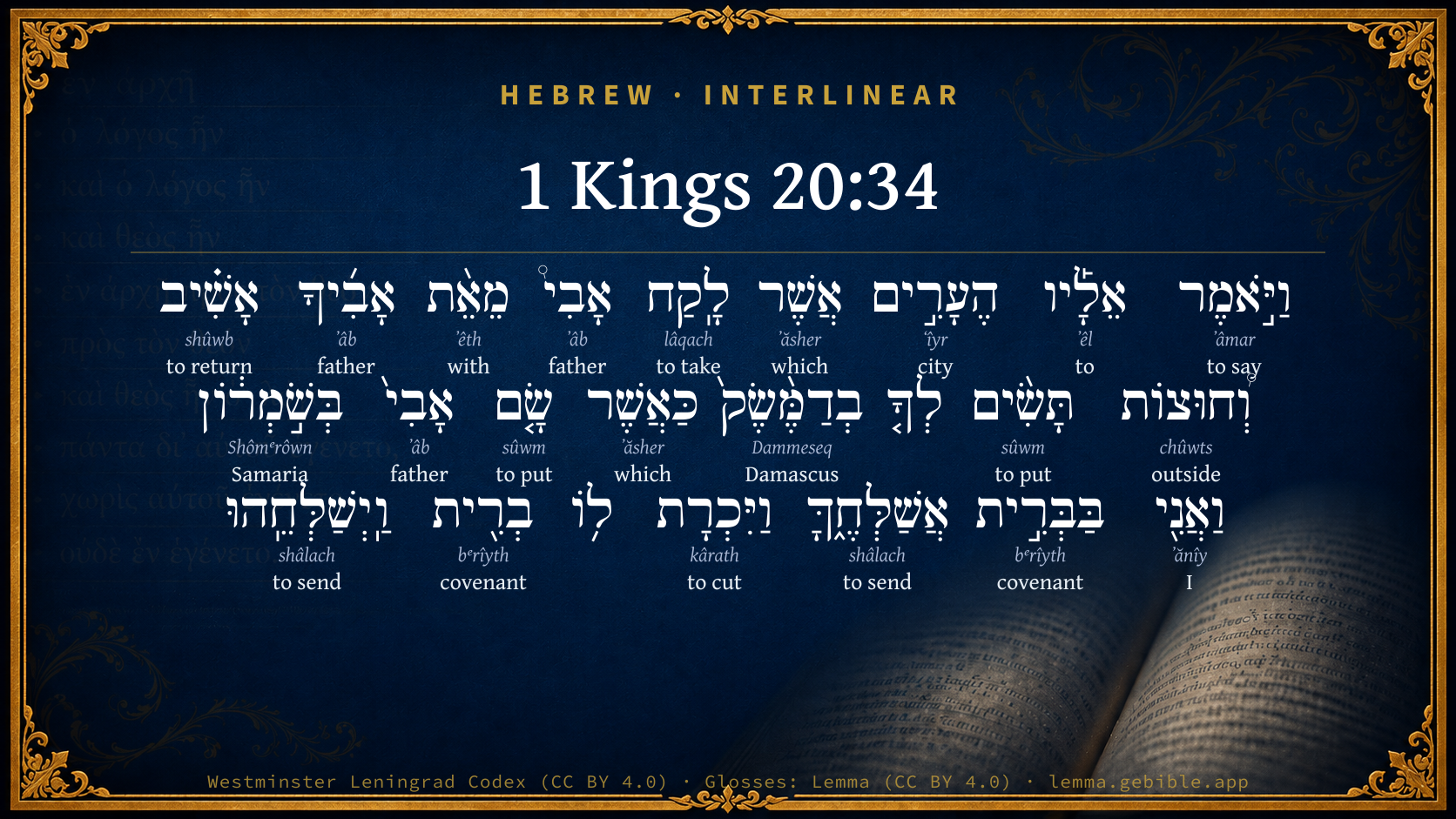
1 Kings 20:34

Hebrew (Westminster Leningrad Codex) 1 Kings 20:34 appears in the Hebrew Old Testament. The text above is from the Westminster Leningrad Codex. Each word links to its Strong’s number, a concise gloss, and parsing drawn from the Open Scriptures Hebrew Bible morphology. Click any word for its full Brown-Driver-Briggs (BDB) entry.
Download image
Cite this verse

1 Kings 20:34 (World English Bible). Public Domain. Lemma interlinear Bible study tool, https://lemma.gebible.app/v/1-kings/20/34.

Show BibTeX & RIS
BibTeX
RIS
English Translation
[Ben Hadad] said to him, The cities which my father took from your father I will restore; and you shall make streets for you in Damascus, as my father made in Samaria. I, [said Ahab], will let you go with this covenant. So he made a covenant with him, and let him go.
World English Bible · Public Domain
Download a study sheet

One document with this verse’s original text, its word-by-word gloss line, the meaning frame, cross-references with their text, attributed commentary, and full source and license credits — printable, and it pastes into notes with its structure intact.

This verse Autodidact and up

Study sheet (.html) Plain text (.txt)

A passage Seminary Student

Up to 50 verses in one chapter. A passage sheet keeps up to 6 commentary sources and 12 cross-references per verse, in the order this page ranks them, and says so on the sheet whenever that leaves anything out. Ask for a single verse and you get the Autodidact verse sheet above.

Everything on this page stays free to read, with no account — the sheet is a download of what is already on screen, not access to it.

Want to remove ads? Support Godless Engineer
Compare translations 3

The same verse in 3 English versions, stacked beneath the original-language interlinear above. Click any original word for its lexicon entry.

Each is an independent rendering of the whole verse — the interlinear is not word-aligned to these translations.

Highlighted words mark where these versions differ — a whole-verse word diff, not a word-by-word alignment.

  • World English Bible Public Domain
    [Ben Hadad] said to him, The cities which my father took from your father I will restore; and you shall make streets for you in Damascus, as my father made in Samaria. I, [said Ahab], will let you go with this covenant. So he made a covenant with him, and let him go.
  • King James Version Public Domain
    And Ben-hadad said unto him, The cities, which my father took from thy father, I will restore; and thou shalt make streets for thee in Damascus, as my father made in Samaria. Then said Ahab, I will send thee away with this covenant. So he made a covenant with him, and sent him away.
  • unfoldingWord Literal Text CC BY-SA 4.0
    And he said to him, “I will return the cities that my father took from your father, and you may establish marketplaces for yourself in Damascus, just as my father established in Samaria.” “And I, I will send you away with a covenant.” And he cut a covenant with him, and he sent him away.

unfoldingWord Literal Text — © unfoldingWord, licensed CC BY-SA 4.0. Word-aligned USFM3 via Door43 (git.door43.org/unfoldingWord/en_ult).

Versions to compare (up to 4)

3 of 4 selected

Show all 18 translations

Every available English version of this verse, each an independent rendering of the whole verse.

  • World English Bible Public Domain
    [Ben Hadad] said to him, The cities which my father took from your father I will restore; and you shall make streets for you in Damascus, as my father made in Samaria. I, [said Ahab], will let you go with this covenant. So he made a covenant with him, and let him go.
  • Berean Standard Bible Public Domain
    Ben-hadad said to him, “I will restore the cities my father took from your father; you may set up your own marketplaces in Damascus, as my father did in Samaria.” “By this treaty I release you,” Ahab replied. So he made a treaty with him and sent him away.
  • Majority Standard Bible Public Domain
    Ben-hadad said to him, “I will restore the cities my father took from your father; you may set up your own marketplaces in Damascus, as my father did in Samaria.” “By this treaty I release you,” Ahab replied. So he made a treaty with him and sent him away.
  • King James Version Public Domain
    And Ben-hadad said unto him, The cities, which my father took from thy father, I will restore; and thou shalt make streets for thee in Damascus, as my father made in Samaria. Then said Ahab, I will send thee away with this covenant. So he made a covenant with him, and sent him away.
  • American Standard Version (1901) Public Domain
    And `Ben-hadad' said unto him, The cities which my father took from thy father I will restore; and thou shalt make streets for thee in Damascus, as my father made in Samaria. And I, `said Ahab', will let thee go with this covenant. So he made a covenant with him, and let him go.
  • Revised Version (1885) Public Domain
    And Ben-hadad said unto him, The cities which my father took from thy father I will restore; and thou shalt make streets for thee in Damascus, as my father made in Samaria. And I, said Ahab, will let thee go with this covenant. So he made a covenant with him, and let him go.
  • Geneva Bible (1599) Public Domain
    And Ben-hadad sayd vnto him, The cities, which my father tooke from thy father, I wil restore, and thou shalt make streetes for thee in Damascus, as my father did in Samaria. Then said Ahab, I will let thee goe with this couenant. So he made a couenant with him, and let him goe.
  • Douay-Rheims (1899) Public Domain
    And he said to him: The cities which my father took from thy father, I will restore: and do thou make thee streets in Damascus, as my father made in Samaria, and having made a league I will depart from thee. So he made a league with him, and let him go.
  • Young's Literal Translation Public Domain
    And he saith unto him, `The cities that my father took from thy father, I give back, and streets thou dost make for thee in Damascus, as my father did in Samaria;' -- `and I, with a covenant, send thee away;' and he maketh with him a covenant, and sendeth him away.
  • Literal Standard Version CC BY-SA 4.0
    And he says to him, “The cities that my father took from your father, I give back, and you make streets for yourself in Damascus, as my father did in Samaria; and I, with a covenant, send you away”; and he makes a covenant with him, and sends him away.
  • Unlocked Literal Bible CC BY-SA 4.0
    Ben Hadad said to Ahab, “I will restore to you the cities that my father took from your father, and you may make markets for yourself in Damascus, as my father did in Samaria.” Ahab replied, “I will let you go with this covenant.” So Ahab made a covenant with him and then let him go.
  • unfoldingWord Literal Text CC BY-SA 4.0
    And he said to him, “I will return the cities that my father took from your father, and you may establish marketplaces for yourself in Damascus, just as my father established in Samaria.” “And I, I will send you away with a covenant.” And he cut a covenant with him, and he sent him away.
  • Darby Bible Public Domain
    And [Ben-Hadad] said to him, The cities that my father took from thy father I will restore; and thou shalt make streets for thyself in Damascus, as my father made in Samaria. And I [said Ahab] will send thee away with this covenant. So he made a covenant with him, and sent him away.
  • World Messianic Bible Public Domain
    Ben Hadad said to him, “The cities which my father took from your father I will restore. You shall make streets for yourself in Damascus, as my father made in Samaria.” “I”, said Ahab, “will let you go with this covenant.” So he made a covenant with him and let him go.
  • Webster's Bible Public Domain
    And Ben-hadad said to him, The cities, which my father took from thy father, I will restore; and thou shalt make streets for thee in Damascus, as my father made in Samaria. Then said Ahab, I will send thee away with this covenant. So he made a covenant with him, and sent him away.
  • Free Bible Version CC BY-SA 4.0
    Ben-hadad said to him, “I will return the towns my father took from your father, and you can organize your own places for trade in Damascus, like my father did in Samaria.” “By making this agreement I set you free,” Ahab replied. He made a treaty with Ben-hadad and let him go.
  • Bible in Basic English Public Domain
    And Ben-hadad said to him, The towns my father took from your father I will give back; and you may make streets for yourself in Damascus as my father did in Samaria. And as for me, at the price of this agreement you will let me go. So he made an agreement with him and let him go.
  • JPS Tanakh (1917) Public Domain
    And Ben-hadad said unto him: 'The cities which my father took from thy father I will restore; and thou shalt make streets for thee in Damascus, as my father made in Samaria.' 'And I, said Ahab, will let thee go with this covenant.' So he made a covenant with him, and let him go.

Literal Standard Version (2020), Covenant Press — licensed CC BY-SA 4.0. Text via the HelloAO Bible API (eBible.org). Unlocked Literal Bible (unfoldingWord) — licensed CC BY-SA 4.0. Text via the HelloAO Bible API (eBible.org). unfoldingWord Literal Text — © unfoldingWord, licensed CC BY-SA 4.0. Word-aligned USFM3 via Door43 (git.door43.org/unfoldingWord/en_ult). Free Bible Version, Dr. Jonathan Gallagher — licensed CC BY-SA 4.0. Text via the HelloAO Bible API (eBible.org).

Word by word

More ways to search: Search by grammar → Find every occurrence → Compare this word →

Practice this passage: Drill this verse → Learn its vocabulary →

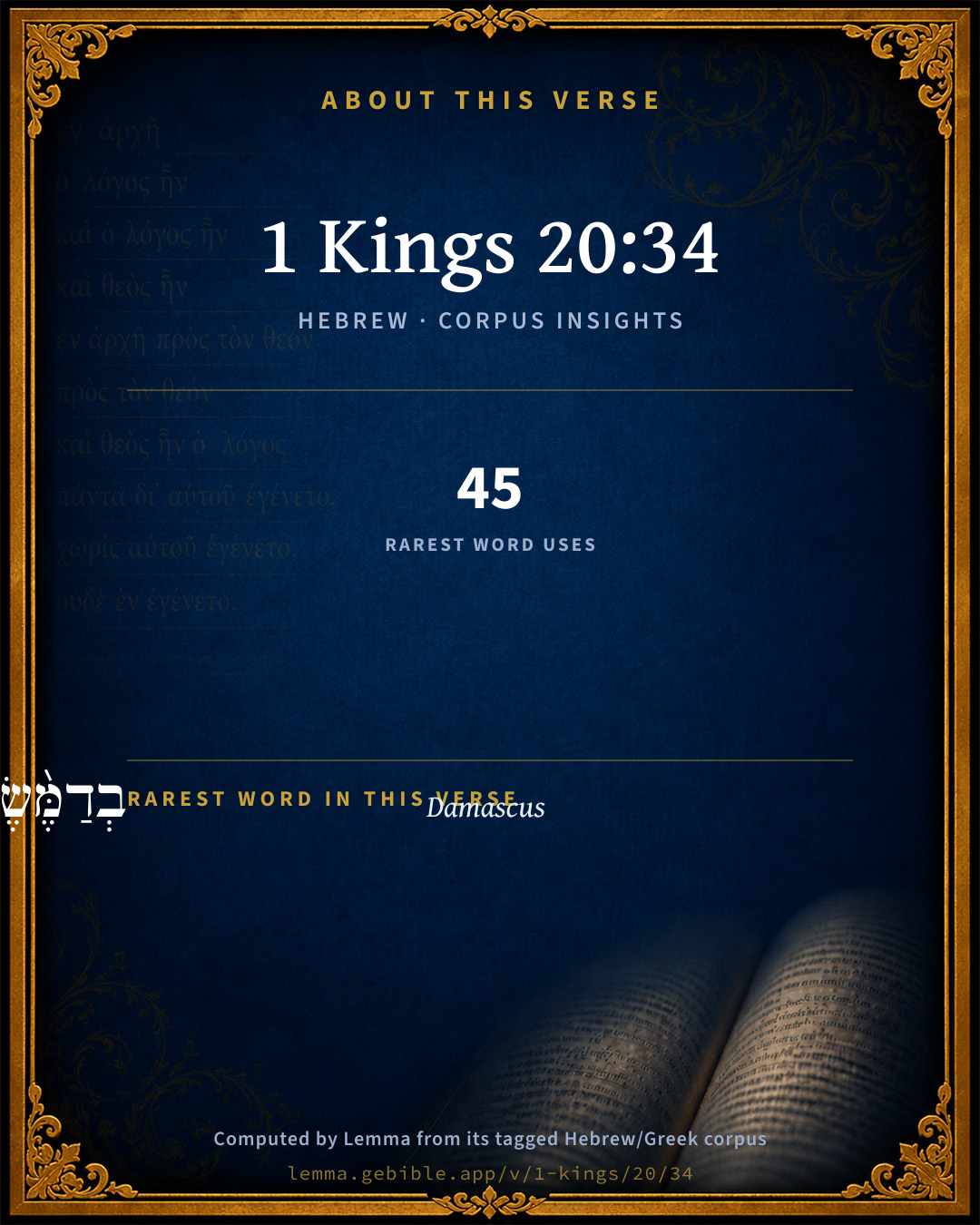
בְדַמֶּ֨שֶׂק֙
Dammeseq
H1834
“in/at · Damascus”
Preposition + Noun, Proper
Part of Speech
Preposition + Noun
Type
Proper
Full BDB Definition

Origin: of foreign origin

TWOT: None

Damascus = "silent is the sackcloth weaver" - an ancient trading city, capital of Syria, located in the plain east of Hermon, 130 (205 kilometers) miles northeast of Jerusalem
  1. וַיֹּ֣אמֶר ʼâmar H559 “and · to say” Conjunction + Verb, Qal, Sequential Imperfect, 3rd Person, Masculine, Singular
  2. אֵלָ֡יו ʼêl H413 “to · him” Preposition + Suffix, Personal, 3rd Person, Masculine, Singular
  3. הֶעָרִ֣ים ʻîyr H5892 “the · cities” Particle, Definite Article + Noun, Common, Feminine, Plural, Absolute
  4. אֲשֶׁר ʼăsher H834 “which” Particle, Relative
  5. לָֽקַח lâqach H3947 “to take” Verb, Qal, Perfect, 3rd Person, Masculine, Singular
  6. אָבִי֩ ʼâb H1 “father · my” Noun, Common, Masculine, Singular, Construct + Suffix, Personal, 1st Person, Common, Singular
  7. מֵאֵ֨ת ʼêth H854 “from · with” Preposition + Preposition
  8. אָבִ֜יךָ ʼâb H1 “father · your” Noun, Common, Masculine, Singular, Construct + Suffix, Personal, 2nd Person, Masculine, Singular
  9. אָשִׁ֗יב shûwb H7725 “to return” Verb, Hiphil, Imperfect, 1st Person, Common, Singular
  10. וְ֠חוּצוֹת chûwts H2351 “and · streets” Conjunction + Noun, Common, Masculine, Plural, Absolute
  11. תָּשִׂ֨ים sûwm H7760 “to put” Verb, Qal, Imperfect, 2nd Person, Masculine, Singular
  12. כַּאֲשֶׁר ʼăsher H834 “like/as · which” Preposition + Particle, Relative
  13. שָׂ֤ם sûwm H7760 “to put” Verb, Qal, Perfect, 3rd Person, Masculine, Singular
  14. אָבִי֙ ʼâb H1 “father · my” Noun, Common, Masculine, Singular, Construct + Suffix, Personal, 1st Person, Common, Singular
  15. בְּשֹׁ֣מְר֔וֹן Shômᵉrôwn H8111 “in/at · Samaria” Preposition + Noun, Proper
  16. וַאֲנִ֖י ʼănîy H589 “and · I” Conjunction + Pronoun, Personal, 1st Person, Common, Singular
  17. בַּבְּרִ֣ית bᵉrîyth H1285 “in/at the · covenant” Preposition, Determined + Noun, Common, Feminine, Singular, Absolute
  18. אֲשַׁלְּחֶ֑ךָּ shâlach H7971 “to send · you” Verb, Piel, Imperfect, 1st Person, Common, Singular + Suffix, Personal, 2nd Person, Masculine, Singular
  19. וַיִּכְרָת kârath H3772 “and · to cut” Conjunction + Verb, Qal, Sequential Imperfect, 3rd Person, Masculine, Singular
  20. בְרִ֖ית bᵉrîyth H1285 “covenant” Noun, Common, Feminine, Singular, Absolute
  21. וַֽיְשַׁלְּחֵֽהוּ shâlach H7971 “and · to send · him” Conjunction + Verb, Piel, Sequential Imperfect, 3rd Person, Masculine, Singular + Suffix, Personal, 3rd Person, Masculine, Singular

About this verse

These counts appear in no published source. They are computed here, from the morphology-tagged text and Lemma’s own curated glosses. What Lemma adds →

24
words
16
distinct lemmas
Historical
section

Shared distinctive vocabulary

בְדַמֶּ֨שֶׂק֙ Damascus H1834 occurs in 40 verses of the Hebrew Bible. Also found in:

Grammatical profile

  • 8 verbs
  • 9 nouns
  • 1 pronoun
  • 4 prepositions
  • 2 particles

Verb forms

  • וַיֹּ֣אמֶר Qal · Sequential Imperfect
  • לָֽקַח Qal · Perfect
  • אָשִׁ֗יב Hiphil · Imperfect
  • תָּשִׂ֨ים Qal · Imperfect
  • שָׂ֤ם Qal · Perfect
  • אֲשַׁלְּחֶ֑ךָּ Piel · Imperfect
  • וַיִּכְרָת Qal · Sequential Imperfect
  • וַֽיְשַׁלְּחֵֽהוּ Piel · Sequential Imperfect

Repetition

Words recur within this verse — often emphatic in Hebrew:

  • אָבִי֩ father H1 ×3
  • תָּשִׂ֨ים to put H7760 ×2
  • בַּבְּרִ֣ית covenant H1285 ×2
  • אֲשַׁלְּחֶ֑ךָּ to send H7971 ×2
  • אֲשֶׁר which H834 ×2

Cross-references

7

Topical passages linked to 1 Kings 20:34 in the Treasury of Scripture Knowledge — connected by theme and wording, ordered by reader-vote popularity; previews shown in the World English Bible.

  • 1 Kings 15:20 Ben Hadad listened to king Asa, and sent the captains of his armies against the cities of Israel, and struck Ijon, and Dan, and Abel Beth Maacah, and all Chinneroth, with all the land of Naphtali.
  • 1 Kings 20:42 He said to him, Thus says Yahweh, Because you have let go out of your hand the man whom I had devoted to destruction, therefore your life shall go for his life, and your people for his people.
  • Isaiah 26:10 Let favor be shown to the wicked, yet will he not learn righteousness; in the land of uprightness will he deal wrongfully, and will not see the majesty of Yahweh.
  • 1 Kings 22:31 Now the king of Syria had commanded the thirty-two captains of his chariots, saying, Fight neither with small nor great, save only with the king of Israel.
  • 2 Chronicles 16:4 Ben Hadad listened to king Asa, and sent the captains of his armies against the cities of Israel; and they struck Ijon, and Dan, and Abel Maim, and all the store-cities of Naphtali.
  • 2 Chronicles 18:30 Now the king of Syria had commanded the captains of his chariots, saying, Fight neither with small nor great, save only with the king of Israel.
  • Isaiah 8:12 Don't you say, "A conspiracy!" concerning all about which this people shall say, "A conspiracy!" neither fear their fear, nor be in dread [of it].

Cross-references courtesy of OpenBible.info (CC BY 4.0).

Hebrew and Greek witnesses Masoretic Hebrew ↔ Greek Septuagint

The same verse in the two great witnesses to the Old Testament, shown verse-for-verse.

These are two independent witnesses, not word-aligned to each other, and the Septuagint is shown in lemma (dictionary) form.

Hebrew 1 Kings 20:34 Masoretic · Westminster Leningrad Codex

וַיֹּ֣אמֶר אֵלָ֡יו הֶעָרִ֣ים אֲשֶׁר לָֽקַח אָבִי֩ מֵאֵ֨ת אָבִ֜יךָ אָשִׁ֗יב וְ֠חוּצוֹת תָּשִׂ֨ים לְךָ֤ בְדַמֶּ֨שֶׂק֙ כַּאֲשֶׁר שָׂ֤ם אָבִי֙ בְּשֹׁ֣מְר֔וֹן וַאֲנִ֖י בַּבְּרִ֣ית אֲשַׁלְּחֶ֑ךָּ וַיִּכְרָת ל֥וֹ בְרִ֖ית וַֽיְשַׁלְּחֵֽהוּ

[Ben Hadad] said to him, The cities which my father took from your father I will restore; and you shall make streets for you in Damascus, as my father made in Samaria. I, [said Ahab], will let you go with this covenant. So he made a covenant with him, and let him go.

World English Bible · Public Domain

On this verse, The Cambridge Bible for Schools and Colleges discusses the Septuagint’s reading. Read the note in Commentary ↓

Hebrew: Westminster Leningrad Codex (CC BY 4.0). Greek: Septuagint (public domain); English from a public-domain English Septuagint. How the Septuagint differs from the Hebrew →

Targum (Aramaic paraphrase)

1

The Targum is the ancient Jewish Aramaic paraphrase of the Hebrew Scriptures — an interpretive translation, not the Hebrew text itself. Onkelos (literal) and Pseudo-Jonathan (expansive) render the Torah, and Jonathan the Prophets. Coverage is partial: where no permissively-licensed English translation exists for a verse, only the Aramaic is shown. This is verse-level text, not a word-by-word alignment to the Hebrew.

  1. Targum Jonathan Prophets (Joshua–Malachi)
    וַאֲמַר לֵיהּ קִרְוִין דִנְסִיב אַבָּא מִן אָבוּךְ אָתֵיב וְשׁוּקִין תְּמַנֵי לָךְ בְּדַמֶשֶׂק כְּמָא דְמָנֵי אַבָּא בְּשֹׁמְרוֹן וַאֲנָא בִּקְיַם אֲשַׁלְחִינָךְ וּגְזַר לֵיהּ קְיָם וְשִׁלְחֵיהּ:

    (no public-domain English translation for this verse)

    Targum Jonathan — Aramaic: “Mikraot Gedolot” (public domain). English: “Sefaria Community Translation” (CC0 1.0 (public-domain dedication)); “London "Chaldee Paraphrase," 1871” (public domain). Text via Sefaria.

Commentary

Notes on 1 Kings 20:34 from classic Christian and Jewish commentators (each source and its license shown beneath its notes). The classic Christian expositions comment on the surrounding passage and are grouped to its opening verse, so a note may address several verses; the Jewish commentaries on the Tanakh (Rashi and others) are per-verse, so they appear only where the commentator wrote on this verse.

Lemma curates 59 commentaries, every one of them public domain or Creative Commons licensed, each selected and text-cleaned for this edition rather than reprinted as found. About our sources →

Trapp's Complete Commentary

John Trapp

1Ki 20:34 And [Benhadad] said unto him, The cities, which my father took from thy father, I will restore; and thou shalt make streets for thee in Damascus, as my father made in Samaria. Then [said Ahab], I will send thee away with this covenant. So he made a covenant with him, and sent him away.

Ver. 34. The cities which my father took from thy father.] That is, From thy predecessor Baasha. {1Ki 15:20}

I will restore.] Which yet he did not; witness Ramothgilead. {1Ki 22:4}

And thou shalt make streets for thee.] Fora rerum venalium constitues tibi, ex quibus vectigalia accipies quasi nundinas; markets out of which thou shalt have the toll and other dues.

I will send thee away.] This was too great facility; such as afterwards cost him his life.

And sent him away.] This preservation of Benhadad was but a reservation; for he was afterward murdered by cruel Hazael. {2Ki 8:15}

John Trapp, A Commentary or Exposition upon All the Books of the Old and New Testament (1647–1656) — public domain. Text from a community e-Sword module.

Joseph Benson's Commentary

1Ki 20:34. The cities which my father took from thy father — Either from Baasha, (1Ki 15:20,) whom he calls Ahab’s father, because he was his predecessor in the government; or rather, from Omri, in whose time he probably made a successful invasion into the land of Israel, and took some more of the cities, and Aphek among the rest, though it be not elsewhere recorded in Scripture. And thou shall make streets in Damascus — Bishop Patrick tells us, that some suppose the word to signify market-places, where things were sold, the toll of which should belong to Ahab: others think he meant courts of judicature, where he should exercise a jurisdiction over the Syrians; others, what we now call a piazza, or rather, what by Rauwolff is called a caravansera, and by others a kane, that is, a great house, built like a cloister, round a great court-yard, and full of warehouses and apartments, in which foreign merchants are wont to live, or travellers to repair to, as to an inn, and of which Ahab was to receive the rents. It is probable, it was a quarter for his subjects to live in, and which he should possess, and over which he should enjoy the same jurisdiction, as he did with respect to the rest of his kingdom. Such a power granted in Samaria, and such a making over a part of it, to the father of Ben-hadad, and annexing it to the kingdom of Syria, with a right of building such idol temples as he thought fit, was a sufficient disgrace to the father of Ahab; as the proposing to give Ahab now a like honour in Damascus, was an expression of a very abject adulation in Ben-hadad.

Joseph Benson's Commentary on the Old and New Testaments (1811–1818) — public domain. Text from a community e-Sword module.

Tyndale Open Study Notes

Tyndale Open Resources

20:34 The treaty that Ahab and Ben-hadad established provided parity between the parties, although it was especially favorable to Ahab as the victor. • The towns that Israel had lost to Aram (15:20) were restored and Ben-hadad made important trade concessions to Ahab, who may have reasoned that such an arrangement would be profitable and provide him with an ally against the rising power of Shalmaneser III of Assyria.

Tyndale Open Study Notes — © Tyndale Open Resources, licensed CC BY-SA 4.0. Text via the HelloAO Bible API.

Geneva Bible (1599)

Geneva Bible translators

Thou shalt appoint in my chief city what thou wilt, and I will obey thee.

Geneva Bible (1599) marginal notes — public domain. Text via Bolls.life.

Jamieson, Fausset & Brown

Robert Jamieson, A. R. Fausset & David Brown

streets for thee in Damascus--implying that a quarter of that city was to be assigned to Jews, with the free exercise of their religion and laws, under a judge of their own. This misplaced kindness to a proud and impious idolater, so unbecoming a theocratic monarch, exposed Ahab to the same censure and fate as Saul (Sa1 15:9, &c.). It was in opposition to God's purpose in giving him the victory.

Jamieson, Fausset & Brown — Commentary Critical and Explanatory on the Whole Bible (1871) — public domain (CC PDM 1.0). Text via the HelloAO Bible API.

Adam Clarke's Commentary

Verse 34. Thou shalt make streets for thee in Damascus] It appears that it was customary for foreigners to have a place assigned to them, particularly in maritime towns, where they might deposit and vend their merchandise. This was the very origin of European settlements in Asiatic countries: "The people gave an inch to those strangers; and in consequence they took an ell." Under the pretense of strengthening the place where they kept their wares, to prevent depredations, they built forts, and soon gave laws to their entertainers. In vain did the natives wish them away; they had got power, and would retain it; and at last subjected these countries to their own dominion.

It was customary also, in the time of the crusades, to give those nations which were engaged in them streets, churches, and post dues, in those places which they assisted to conquer. The Genoese and Venetians had each a street in Accon, or St. Jean d'Acre, in which they had their own jurisdiction; with oven, mill, bagnio, weights, and measures. - See William of Tyre, and Harmer's Observations.

He made a covenant with him] According to the words recited above, putting him under no kind of disabilities whatsoever.

Adam Clarke's Commentary on the Bible (1810–1826) — public domain. Text from a community e-Sword/MySword module.

Ellicott's Commentary for English Readers

(34) Make streets—properly, squares, or quarters of a city. This concession implies a virtual acknowledgment of supremacy; for the right to have certain quarters for residence, for trade, perhaps even for garrison, in the capital of a king, belongs only to one who has sovereignty over him. Hence it goes beyond the significance of the restoration of the cities—conquered, it would seem, from Omri, unless, indeed, taking “father” in the sense of predecessor, the reference is to the Syrian victories in the days of Baasha. (See 1Ki_15:20.) The narrative seems to convey an idea that the covenant was made hastily, on insufficient security. The great point, however, was that a war, victoriously conducted under prophetic guidance, should not have been concluded without prophetic sanction.

A Bible Commentary for English Readers, edited by Charles John Ellicott (1878–1897) — public domain. Text from a community e-Sword module.

The Cambridge Bible for Schools and Colleges

gen. ed. J. J. S. Perowne

34. This verse is very singular from the omission of the names of both the speakers. It is clear enough from the sense, to whom each clause must be assigned, but the omissions are so unusual that one can hardly help suspecting some error in the text. The LXX. joins the two clauses as though they were spoken by the same person.

make streets for thee in Damascus] This must signify that a portion of Damascus should be set apart as belonging to Israel, and that dwellings might be erected there for the use of such Israelites as should have need to go thither. That such a privileged quarter in a foreign city might be of great use for purposes of commerce we can readily imagine, and more so in those days and lands of caravans than in the western world. Probably ‘Lombard Street’ in London was originally a privileged part of the city, where the wealthy Lombard merchants established themselves.

Then, said Ahab, I will send thee away] R.V., And I, said Ahab, will let thee go. The verb is rendered ‘to let go’ in the application made by the son of the prophets in 1Ki_20:42. It is better therefore to translate it in the same way here, and in the following clause of this verse ‘and let him go’.

with this covenant] The agreement, namely, for the restoration of the taken cities, and for the privilege of occupying part of Damascus with houses for Israelites. The language sets before us the easy way in which Ahab allowed the advantages of the victory to slip from his grasp. It seems too that Ben-hadad did not fulfil all his part of the covenant (see 1Ki_22:3), and this may have been in consequence of the behaviour of Ahab, which would make the compact appear of little moment.

The Cambridge Bible for Schools and Colleges (gen. ed. J. J. S. Perowne; Cambridge University Press, 1878–1918) — public domain. Text from a community e-Sword module.

John Gill's Exposition

And Benhadad said unto him,.... The word Benhadad is not in the original text, and some, as Osiander and others, have thought they are the words of Ahab last spoken of; which seems most likely, who not only took Benhadad into his chariot, but in his great and superabundant kindness, though the conqueror, said to him what follows:

the cities which my father took from thy father I will restore; that is, those cities which Omri, the father of Ahab, had taken from the father of Benhadad; for as Omri was a prince of might and valour, Kg1 16:16, it is more probable that he took cities from the king of Syria, than that the king of Syria should take any from him, and which Ahab in his circumstances weakly promises to restore:

and thou shall make streets for thee in Damascus, as my father made in Samaria; which confirms it that it is Ahab, and not Benhadad, that is speaking; for Benhadad's father never had any power nor residence in Samaria, whereas Omri, the father of Ahab, had, he built it, and made it his royal seat; and, in like manner, Ahab promises Benhadad that he should have his palace at Damascus, the metropolis of Syria, and exercise power there, and over all Syria; whereby Ahab renounced all right he had to the kingdom, and any of the cities of it: for by "streets" are not meant those literally so called, for the making of which there was no reason; nor markets to take a toll from, as some, supposing them to be the words of Benhadad; nor courts of judicature, to oblige them to pay it who refused it, as others; nor fortresses to keep them in awe; but a royal palace, as a learned critic (t) has observed, for Benhadad to reside in; this Ahab gave him power to erect, and added:

and I will send thee away with this covenant; or promise now made:

so he made a covenant with him; confirmed the above promises:

and sent him away; free, to enjoy his crown and kingdom, for which folly and weakness Ahab is reproved by a prophet, Kg1 20:42.

(t) Vallandi Dissert. ad 1. Reg. xx. 33, 34. Subsect. 2. sect. 4.

John Gill's Exposition of the Whole Bible (1746–1763) — public domain (CC PDM 1.0). Text via the HelloAO Bible API.

Albert Barnes' Notes on the Bible

Ben-hadad, secure of his life, suggests terms of peace as the price of his freedom. He will restore to Ahab the Israelite cities taken from Omri by his father, among which Ramoth Gilead was probably the most important 1Ki 22:3; and he will allow Ahab the privilege of making for himself “streets,” or rather squares, in Damascus, a privilege which his own father had possessed with respect to Samaria. Commercial advantages, rather than any other, were probably sought by this arrangement.

So he made a covenant with him ... - Ahab, without “inquiring of the Lord,” at once agreed to the terms offered; and, without even taking any security for their due observance, allowed the Syrian monarch to depart. Considered politically, the act was one of culpable carelessness and imprudence. Ben-hadad did not regard himself as bound by the terms of a covenant made when he was a prisoner - as his after conduct shows 1Ki 22:3. Ahab’s conduct was even more unjustifiable in one who held his crown under a theocracy. “Inquiry at the word of the Lord” was still possible in Israel 1Ki 22:5, 1Ki 22:8, and would seem to have been the course that ordinary gratitude might have suggested.

Albert Barnes' Notes on the Bible (1834–1885) — public domain. Text from a community e-Sword/MySword module.

Haydock's Catholic Bible Commentary

Thy father. Benadad did not know the changes which had taken place in the royal family of Israel. He speaks of the cities which his predecessor had wrested from Baasa, chap. xv. 20. --- Streets, for merchants, of whom he would receive tribute: or military stations, as David had done, (2 Kings viii. 6.) to prevent any inroads. Benadad does not appear to have complied with these conditions, as the king of Israel had to take Ramath by force, chap. xxii. 2. --- And having. These words seem to be the conclusion of Benadad’s proposition: but, according to the Hebrew, they contain Achab’s reply. (Calmet) --- Protestants, "The said Achab: I will send thee away with this covenant." (Haydock) --- How generous does the conduct of Achab appear to the world! Yet it displeased God. (Salien) --- He severely punished this foolish pity towards a dangerous foe. (Worthington)

George Leo Haydock (1774–1849), Haydock's Catholic Family Bible and Commentary, 1859 edition — public domain. Excludes Psalms (Douay-Rheims chapter numbering differs from Protestant) and Deuterocanonical books (Catholic canon only).

Matthew Poole's English Annotations

The cities which my father took from thy father; either,

1. From Baasha, 1Ki 15:20, whom he calls Ahab’s father, because he was his legal father, i.e. his predecessor. Or,

2. From Omri; in whose time, it seems, he made a successful invasion into the land of Israel, and took some more of the cities, and Aphek amongst the rest, though it be not elsewhere recorded in Scripture.

Thou shalt make streets, or markets, &c., places where thou mayest either receive the tribute which I promise to pay thee, or exercise judicature upon my subjects in case of their refusal; or outlets (as the LXX. render it) in or into Damascus, i.e. some strong fort near Damascus, which might curb the kings of Damascus, and keep them from attempting any other invasion into the land of Israel. With this covenant: he takes no notice of his blasphemy against God, nor of the vast injuries which his people had suffered from him; but only minds his own grandeur, and the advancement of his power.

Matthew Poole's English Annotations on the Holy Bible (1683–1685) — public domain. Text from a community e-Sword/MySword module.

Whedon's Commentary on the Bible

Daniel D. Whedon

34. The cities — See at 1Ki_15:20. Streets for thee in

Damascus — Whole streets and houses to be known and honoured as the Israelitish quarter, and something like the bazaars of modern Oriental cities. Compare “the bakers’ street.” Jer_37:21. Ben-hadad’s father had such a Syrian quarter in Samaria.

Daniel D. Whedon (gen. ed.), Commentary on the Old and New Testaments (1874–1909) — public domain. Text from a community e-Sword module.

The Pulpit Commentary

And Ben-hadad said unto him The cities, which my father took from thy father, I will restore We can hardly see in these words "the terms of peace which he is willing to offer as the price of his freedom" (Rawlinson), because he was absolutely at Ahab"s mercy, and was not in a position to make any stipulations; but they express Ben-hadad"s idea of the results which must follow the conquest. His utter defeat would necessitate this reconstruction of their respective territories, etc. We cannot be quite certain that the cities here referred to are those enumerated in 1Ki_15:20, as taken by Ben-hadad"s armies from Baasha. For Baasha was not the father, nor even was he the "ancestor" (as Keil, later edition) of Ahab, but belonged to a different dynasty. At the same time it is quite conceivable that a prince in Ben-hadad"s position, in his ignorance or forgetfulness of the history of Israel, might use the word "father" improperly, or even in the sense of "predecessor." We know that ba; had a very extended signification. Keil and Bahr, however, think that we have a reference to some war in the reign of Omri. (cf. 1Ki_16:27) which is not recorded in Scripture. And the words which follow make this extremely probable, inasmuch as in Baasha"s days Samaria had no existence and thou shalt make streets twOxj lit., whatever is without; hence streets, spaces, quarters for thee in Damascus, as my father made in Samaria. The commentators are agreed that a permission to establish bazaars or quarters, in which the Hebrews might live and trade, is here conceded. Then said Ahab These words are rightly supplied by our translators. The meaning would have been quite clear had the Hebrews been familiar with the use of quotation marks. For lack of these, all the versions ascribe the words to Ben-hadad, I will send thee away with this covenant. So he made a covenant with him and sent him away.

I will send thee away," etc. On another occasion such conduct as this was commanded. (2Ki_6:22, 2Ki_6:23) Why, then, was it sinful now? Precisely because it was not commanded; because God intended the opposite (ver. 42). It was not clemency, it was culpable weakness to send this overbearing despot, who had already cost Israel so dear, to send him to his home, there to renew his plots against the people of God. As well might the magistrate compassionate the burglar, or the garotter, and instead of shutting him up in prison, send him into the streets, to be the plague of society. The king, like the magistrate, is trustee for the commonwealth. He has no right to gratify his benevolent instincts at the expense of the community. Still less right had the theocratic king, the representative of Heaven, to liberate, ex mero arbitrio, a tyrant whom God had manifestly given into his hands. "Charity cannot excuse disobedience." He had proved Ben-hadad twice, yet he asks for no material guarantees. He neither consults nor remembers his deliverer.

The Pulpit Commentary (1880–1919), ed. H.D.M. Spence-Jones & Joseph S. Exell — public domain. Text from a community e-Sword module.

John Wesley's Explanatory Notes

Streets - Or, Markets, &c. places where thou mayest either receive the tribute which I promise to pay thee, or exercise judicature upon my subjects in case of their refusal. So he made, &c. - He takes no notice of his blasphemy against God; nor of the injuries which his people had suffered from him.

John Wesley, Explanatory Notes Upon the Whole Bible (1754–1765) — public domain. Text via the GEBible commentary corpus.

Keil & Delitzsch

C. F. Keil & F. Delitzsch

Benhadad, in order to keep Ahab in this favourable mood, promised to give him back at once the cities which his father had taken away from Ahab's father, and said, "Thou mayest make thyself roads in Damascus, as my father made in Samaria." There is no account of any war between Omri and Benhadad I; it is simply stated in Kg1 15:20 that Benhadad I had taken away several cities in Galilee from the Israelites during the reign of Baasha. This cannot be the war intended here, however, not indeed because of the expression אביך מאת, since אב might certainly be taken in a broader sense as referring to Baasha as an ancestor of Ahab, but chiefly on account of the statement that Benhadad had made himself roads in Samaria. This points to a war between Omri and Benhadad, after the building of Samaria into the capital of the kingdom, of which no account has been preserved. לו חצות שׂים, "to make himself roads," cannot be understood as referring either to fortifications and military posts, or to roads for cattle and free pasturage in the Syrian kingdom, since Samaria and Damascus were cities; not can it signify the establishment of custom-houses, but only the clearing of portions of the city for the purpose of trade and free intercourse (Cler., Ges. etc.), or for the establishment of bazaars, which would occupy a whole street (Bttcher, Thenius; see also Movers, Phnizier, ii. 3, p. 135). - "And I," said Ahab, "will let thee go upon a covenant" (a treaty on oath), and then made a covenant with him, giving him both life and liberty. Before ואני we must supply in thought אחאב ויּאמר. This thoroughly impolitic proceeding on the part of Ahab arose not merely from a natural and inconsiderate generosity and credulity of mind (G. L. Bauer, Thenius), but from an unprincipled weakness, vanity, and blindness. To let a cruel and faithless foe go unpunished, was not only the greatest harshness to his own subjects, but open opposition to God, who had announced to him the victory, and delivered the enemy of His people into his hand.

(Note: Clericus is correct in the explanation which he has given: "Although, therefore, this act of Ahab had all the appearance of clemency, it was not an act of true clemency, which ought not to be shown towards violent aggressors, who if released will do much more injury than before, as Benhadad really did. God had given the victory to Ahab, and delivered the guilty king into his hands, that he might inflict punishment upon him, not that he might treat him kindly. And Ahab, who had allowed so many prophets to be slain by his wife Jezebel, had no great clemency at other times.")

Even if Ahab had no express command from God to put Benhadad to death, as Saul had in Sa1 15:3, it was his duty to punish this bitter foe of Israel with death, if only to secure quiet for his own subjects; as it was certainly to be foreseen that Benhadad would not keep the treaty which had been wrung from him by force, as was indeed very speedily proved (see Kg1 22:1).

Keil & Delitzsch — Biblical Commentary on the Old Testament (1861–1891) — public domain (CC PDM 1.0). Text via the HelloAO Bible API. (Old Testament only.)

Rashi

Rabbi Shlomo Yitzchaki (Rashi)

He [Ben-Hadad] said. Ben-Hadad [said], “The cities that my father took from your father Omri, I will return to you.”

And you may establish markets in Damascus. And you rule in it, although it is the capital of my kingdom.

As my father established in Shomron. Your city, against your will. He was saying all this out of fear. Achov said to him, “And with this treaty I will release you.”

Rashi on the Tanakh — English translations: “The Judaica Press complete Tanach with Rashi, translated by A. J. Rosenberg” (CC BY 4.0); “Pentateuch with Rashi's commentary by M. Rosenbaum and A.M. Silbermann, 1929-1934” (public domain); “The Metsudah Tanach series, Lakewood, N.J” (CC BY 4.0); and “The Book of Joshua, Metsudah Publications, 1997” (CC BY 4.0). Text via Sefaria.

Lesson kit

Teaching starters — assembled from the data on this page, not authored interpretation. Every prompt links to the verse data it draws on. Edit before teaching.

1 Kings, in the Historical, opens this verse with 24 words (16 distinct Hebrew lemmas). Its most distinctive word is Dammeseq (“Damascus”). A historical commentator’s framing appears above. Read the whole chapter for the surrounding context.

Discussion questions

  1. How does “Damascus” (Dammeseq) shape what this verse is saying?
  2. Genesis 14:15 shares the word «Damascus» with this verse. How do the two illuminate each other?
  3. “father” occurs 3× in this one verse. What is the effect of the repetition?
  4. These translations render this verse differently. What is at stake in choosing one wording over another?
  5. The verb «וַיֹּ֣אמֶר» is Qal Sequential Imperfect. How does its form color the action?
  6. Reading how Trapp's Complete Commentary and Joseph Benson's Commentary read this verse, where do the two commentators agree and where do they part?

Things to notice

Reading settings

Reading text

Shown beneath each verse's original-language words.

Old Testament
Old Testament edition

Read the OT as the Masoretic Hebrew (MT) or the Greek Septuagint (LXX).

English shown for the Greek Septuagint (in the Hebrew ↔ Greek comparison).

Comparing translations? Open the Compare panel on any verse page to stack up to four side by side.