
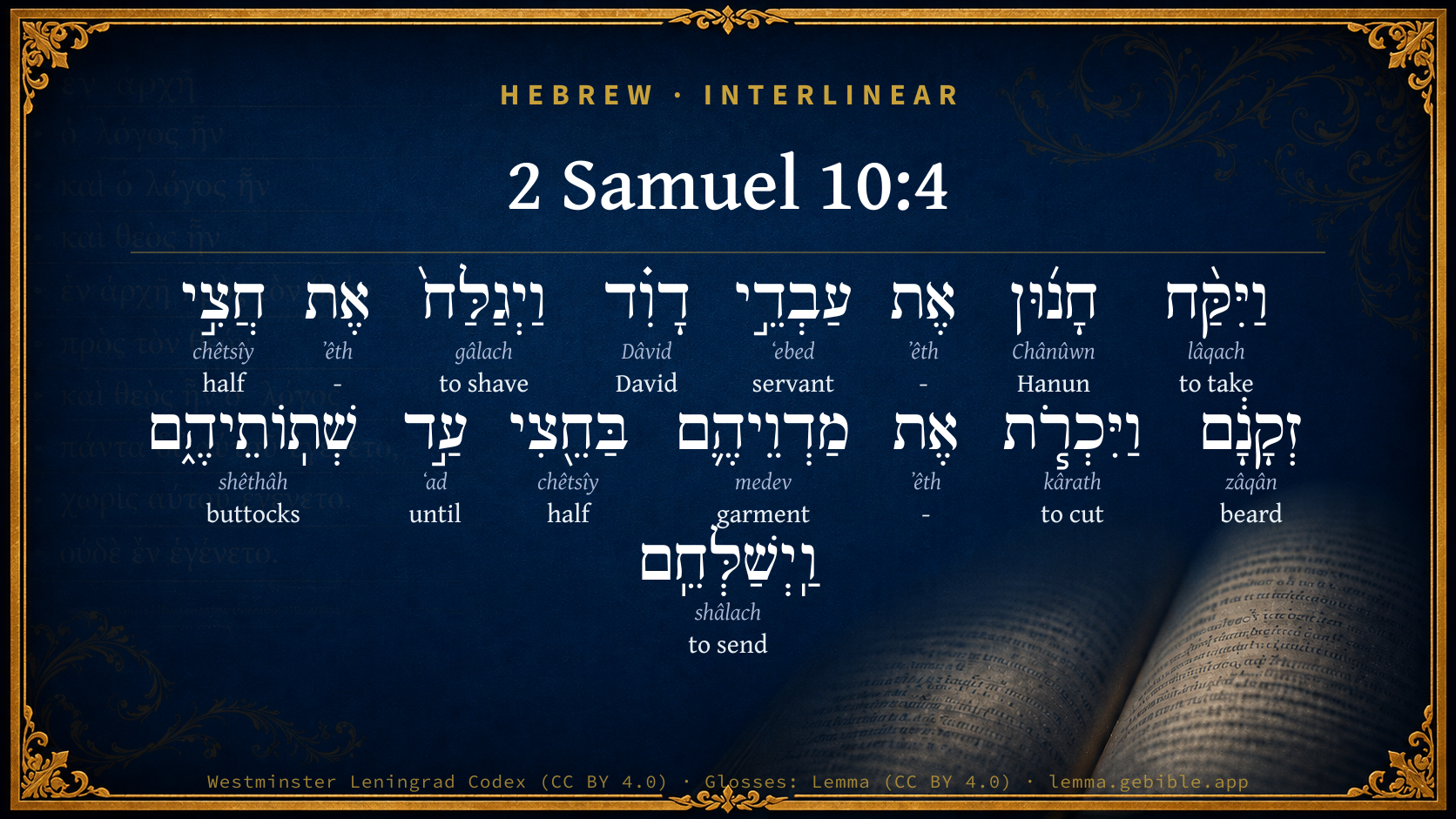
2 Samuel 10:4

Hebrew (Westminster Leningrad Codex) 2 Samuel 10:4 appears in the Hebrew Old Testament. The text above is from the Westminster Leningrad Codex. Each word links to its Strong’s number, a concise gloss, and parsing drawn from the Open Scriptures Hebrew Bible morphology. Click any word for its full Brown-Driver-Briggs (BDB) entry.
Download image
Cite this verse

2 Samuel 10:4 (World English Bible). Public Domain. Lemma interlinear Bible study tool, https://lemma.gebible.app/v/2-samuel/10/4.

Show BibTeX & RIS
BibTeX
RIS
English Translation
So Hanun took David's servants, and shaved off the one half of their beards, and cut off their garments in the middle, even to their buttocks, and sent them away.
World English Bible · Public Domain
Highlights
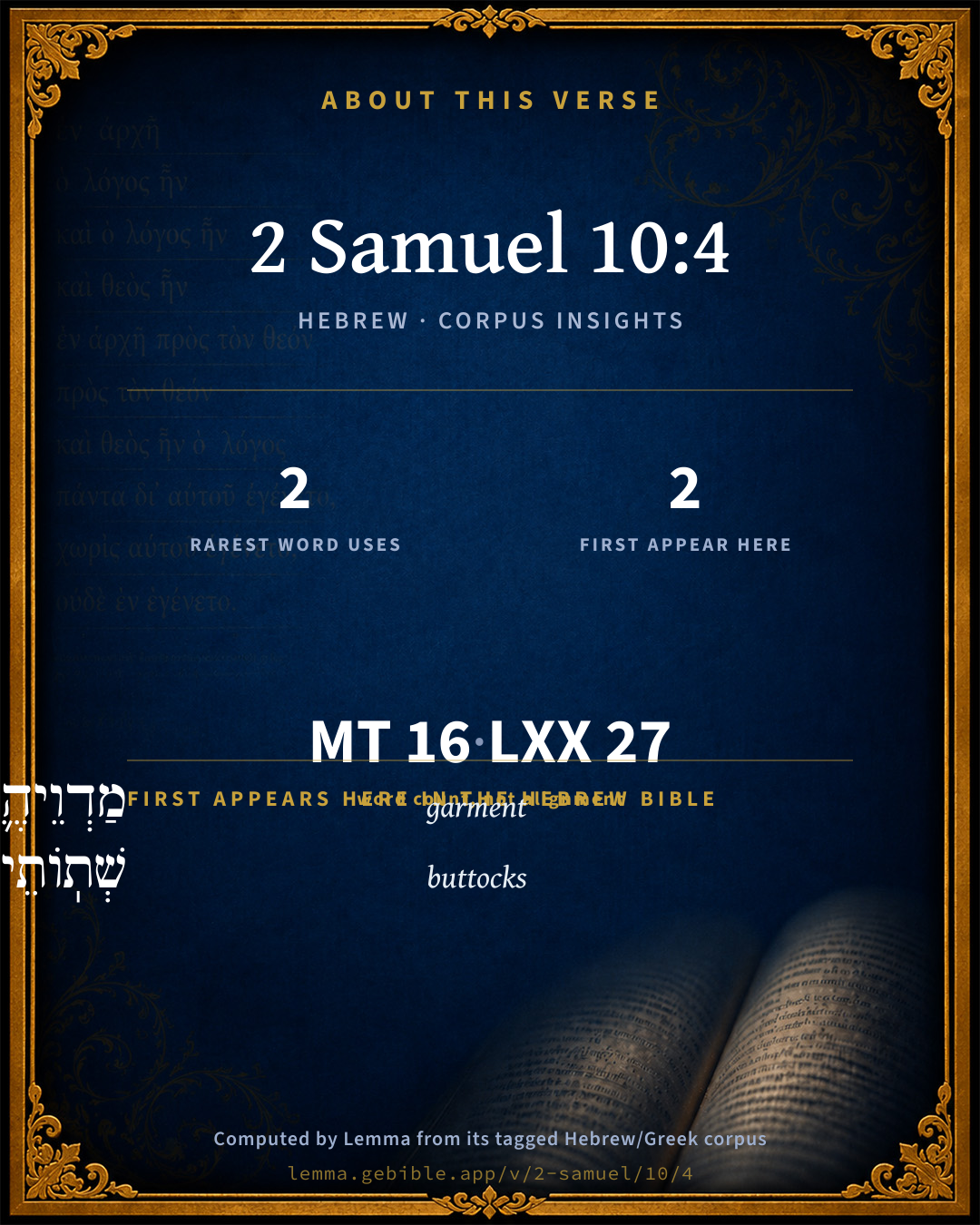
  • 2 first appearances in the Hebrew Bible
Full analysis ↓
Download a study sheet

One document with this verse’s original text, its word-by-word gloss line, the meaning frame, cross-references with their text, attributed commentary, and full source and license credits — printable, and it pastes into notes with its structure intact.

This verse Autodidact and up

Study sheet (.html) Plain text (.txt)

A passage Seminary Student

Up to 50 verses in one chapter. A passage sheet keeps up to 6 commentary sources and 12 cross-references per verse, in the order this page ranks them, and says so on the sheet whenever that leaves anything out. Ask for a single verse and you get the Autodidact verse sheet above.

Everything on this page stays free to read, with no account — the sheet is a download of what is already on screen, not access to it.

Want to remove ads? Support Godless Engineer
Compare translations 3

The same verse in 3 English versions, stacked beneath the original-language interlinear above. Click any original word for its lexicon entry.

Each is an independent rendering of the whole verse — the interlinear is not word-aligned to these translations.

Highlighted words mark where these versions differ — a whole-verse word diff, not a word-by-word alignment.

  • World English Bible Public Domain
    So Hanun took David's servants, and shaved off the one half of their beards, and cut off their garments in the middle, even to their buttocks, and sent them away.
  • King James Version Public Domain
    Wherefore Hanun took David's servants, and shaved off the one half of their beards, and cut off their garments in the middle, even to their buttocks, and sent them away.
  • unfoldingWord Literal Text CC BY-SA 4.0
    So Hanun took the servants of David, and he shaved half of their beard, and he cut their garments in the middle, to their buttocks, and he sent them away.

unfoldingWord Literal Text — © unfoldingWord, licensed CC BY-SA 4.0. Word-aligned USFM3 via Door43 (git.door43.org/unfoldingWord/en_ult).

Versions to compare (up to 4)

3 of 4 selected

Show all 18 translations

Every available English version of this verse, each an independent rendering of the whole verse.

  • World English Bible Public Domain
    So Hanun took David's servants, and shaved off the one half of their beards, and cut off their garments in the middle, even to their buttocks, and sent them away.
  • Berean Standard Bible Public Domain
    So Hanun took David’s servants, shaved off half of each man’s beard, cut off their garments at the hips, and sent them away.
  • Majority Standard Bible Public Domain
    So Hanun took David’s servants, shaved off half of each man’s beard, cut off their garments at the hips, and sent them away.
  • King James Version Public Domain
    Wherefore Hanun took David's servants, and shaved off the one half of their beards, and cut off their garments in the middle, even to their buttocks, and sent them away.
  • American Standard Version (1901) Public Domain
    So Hanun took David's servants, and shaved off the one half of their beards, and cut off their garments in the middle, even to their buttocks, and sent them away.
  • Revised Version (1885) Public Domain
    So Hanun took David’s servants, and shaved off the one half of their beards, and cut off their garments in the middle, even to their buttocks, and sent them away.
  • Geneva Bible (1599) Public Domain
    Wherefore Hanun tooke Dauids seruants, and shaued off the halfe of their beard, and cut off their garments in the middle, euen to their buttockes, and sent them away.
  • Douay-Rheims (1899) Public Domain
    Wherefore Hanon took the servants of David, and shaved off the one half of their beards, and cut away half of their garments even to the buttocks, and sent them away.
  • Young's Literal Translation Public Domain
    And Hanun taketh the servants of David, and shaveth off the half of their beard, and cutteth off their long robes in the midst -- unto their buttocks, and sendeth them away;
  • Literal Standard Version CC BY-SA 4.0
    And Hanun takes the servants of David, and shaves off the half of their beard, and cuts off their long robes in the midst—to their buttocks, and sends them away;
  • Unlocked Literal Bible CC BY-SA 4.0
    So Hanun took David's servants, shaved off half their beards, cut off their garments up to their buttocks, and sent them away.
  • unfoldingWord Literal Text CC BY-SA 4.0
    So Hanun took the servants of David, and he shaved half of their beard, and he cut their garments in the middle, to their buttocks, and he sent them away.
  • Darby Bible Public Domain
    And Hanun took David's servants, and had the one half of their beards shaved off, and their raiment cut off in the midst, as far as their buttocks, and sent them away.
  • World Messianic Bible Public Domain
    So Hanun took David’s servants, shaved off one half of their beards, and cut off their garments in the middle, even to their buttocks, and sent them away.
  • Webster's Bible Public Domain
    Wherefore Hanun took David's servants, and shaved off the one half of their beards, and cut off their garments in the middle, even to their buttocks, and sent them away.
  • Free Bible Version CC BY-SA 4.0
    So Hanun had David's representatives detained, shaved off half of each man's beard, cut off their clothes at the buttocks, and then sent them back home.
  • Bible in Basic English Public Domain
    So Hanun took David's servants, and after cutting off half the hair on their chins, and cutting off the skirts of their robes up to the middle, he sent them away.
  • JPS Tanakh (1917) Public Domain
    So Hanun took David's servants, and shaved off the one half of their beards, and cut off their garments in the middle, even to their buttocks, and sent them away.

Literal Standard Version (2020), Covenant Press — licensed CC BY-SA 4.0. Text via the HelloAO Bible API (eBible.org). Unlocked Literal Bible (unfoldingWord) — licensed CC BY-SA 4.0. Text via the HelloAO Bible API (eBible.org). unfoldingWord Literal Text — © unfoldingWord, licensed CC BY-SA 4.0. Word-aligned USFM3 via Door43 (git.door43.org/unfoldingWord/en_ult). Free Bible Version, Dr. Jonathan Gallagher — licensed CC BY-SA 4.0. Text via the HelloAO Bible API (eBible.org).

Word by word

More ways to search: Search by grammar → Find every occurrence → Compare this word →

Practice this passage: Drill this verse → Learn its vocabulary →

מַדְוֵיהֶ֛ם
medev
H4063
“garments · their”
Noun, Common, Masculine, Plural, Construct + Suffix, Personal, 3rd Person, Masculine, Plural
Part of Speech
Noun
Type
Common
Gender
Masculine
Number
Plural
State
Construct
Full BDB Definition

Origin: from an unused root meaning to stretch

TWOT: 1148a

garment
  1. וַיִּקַּ֨ח lâqach H3947 “and · to take” Conjunction + Verb, Qal, Sequential Imperfect, 3rd Person, Masculine, Singular
  2. חָנ֜וּן Chânûwn H2586 “Hanun” Noun, Proper
  3. אֶת ʼêth H853 “-” Particle, Direct Object
  4. עַבְדֵ֣י ʻebed H5650 “servants of” Noun, Common, Masculine, Plural, Construct
  5. דָוִ֗ד Dâvid H1732 “David” Noun, Proper
  6. וַיְגַלַּח֙ gâlach H1548 “and · to shave” Conjunction + Verb, Piel, Sequential Imperfect, 3rd Person, Masculine, Singular
  7. אֶת ʼêth H853 “-” Particle, Direct Object
  8. חֲצִ֣י chêtsîy H2677 “half of” Noun, Common, Masculine, Singular, Construct
  9. זְקָנָ֔ם zâqân H2206 “beard · their” Noun, Common, Both, Singular, Construct + Suffix, Personal, 3rd Person, Masculine, Plural
  10. וַיִּכְרֹ֧ת kârath H3772 “and · to cut” Conjunction + Verb, Qal, Sequential Imperfect, 3rd Person, Masculine, Singular
  11. אֶת ʼêth H853 “-” Particle, Direct Object
  12. בַּחֵ֖צִי chêtsîy H2677 “in/at the · half” Preposition, Determined + Noun, Common, Masculine, Singular, Absolute
  13. עַ֣ד ʻad H5704 “until” Preposition
  14. שְׁתֽוֹתֵיהֶ֑ם shêthâh H8357 “buttocks · their” Noun, Common, Masculine, Plural, Construct + Suffix, Personal, 3rd Person, Masculine, Plural
  15. וַֽיְשַׁלְּחֵֽם shâlach H7971 “and · to send · them” Conjunction + Verb, Piel, Sequential Imperfect, 3rd Person, Masculine, Singular + Suffix, Personal, 3rd Person, Masculine, Plural

About this verse

These counts appear in no published source. They are computed here, from the morphology-tagged text and Lemma’s own curated glosses. What Lemma adds →

16
words
13
distinct lemmas
Historical
section

Notable vocabulary

The rarest word here is מַדְוֵיהֶ֛ם garment H4063 — appearing just 2 times in the whole Hebrew Bible.

First appearance in Scripture

These words make their first canonical appearance in the Hebrew Bible here:

  • מַדְוֵיהֶ֛ם garment H4063
  • שְׁתֽוֹתֵיהֶ֑ם buttocks H8357

Shared distinctive vocabulary

מַדְוֵיהֶ֛ם garment H4063 occurs in 2 verses of the Hebrew Bible. Also found in:

Grammatical profile

  • 4 verbs
  • 8 nouns
  • 1 preposition
  • 3 particles

Verb forms

  • וַיִּקַּ֨ח Qal · Sequential Imperfect
  • וַיְגַלַּח֙ Piel · Sequential Imperfect
  • וַיִּכְרֹ֧ת Qal · Sequential Imperfect
  • וַֽיְשַׁלְּחֵֽם Piel · Sequential Imperfect

Repetition

A word recurs within this verse — often emphatic in Hebrew:

  • חֲצִ֣י half H2677 ×2

Hebrew & Septuagint length

In English translation the verse runs 30 words from the Hebrew and 28 from the Septuagint (LXX English) — closely comparable.

A rough comparison of the two English renderings, which tokenize alike — not a word-level alignment.

Word counts can differ between the Hebrew and the Greek without any difference in meaning — e.g. the Hebrew direct-object marker אֵת has no separate Greek word, and Greek often adds the article ὁ.

In the original languages it is 16 Hebrew tokens and 27 Greek tokens — but the two are counted differently (Hebrew bundles its prefixes and suffixes into one token; the Greek is in lemma form), so that isn’t a like-for-like length.

Cross-references

6

Topical passages linked to 2 Samuel 10:4 in the Treasury of Scripture Knowledge — connected by theme and wording, ordered by reader-vote popularity; previews shown in the World English Bible.

  • Isaiah 20:4 so shall the king of Assyria lead away the captives of Egypt, and the exiles of Ethiopia, young and old, naked and barefoot, and with buttocks uncovered, to the shame of Egypt.
  • Jeremiah 41:5 that there came men from Shechem, from Shiloh, and from Samaria, even eighty men, having their beards shaved and their clothes torn, and having cut themselves, with meal-offerings and frankincense in their hand, to bring them to the house of Yahweh.
  • 1 Chronicles 19:3–4 But the princes of the children of Ammon said to Hanun, Think you that David does honor your father, in that he has sent comforters to you? Aren't his servants come to you to search, and to overthrow, and to spy out the land?
  • Isaiah 15:2 They are gone up to Bayith, and to Dibon, to the high places, to weep: Moab wails over Nebo, and over Medeba; on all their heads is baldness, every beard is cut off.
  • Leviticus 19:27 You shall not cut the hair on the sides of your heads, neither shall you clip off the edge of your beard.
  • Psalms 109:4–5 In return for my love, they are my adversaries; But I am in prayer.

Cross-references courtesy of OpenBible.info (CC BY 4.0).

Hebrew and Greek witnesses Masoretic Hebrew ↔ Greek Septuagint

The same verse in the two great witnesses to the Old Testament, shown verse-for-verse.

These are two independent witnesses, not word-aligned to each other, and the Septuagint is shown in lemma (dictionary) form.

Hebrew 2 Samuel 10:4 Masoretic · Westminster Leningrad Codex

וַיִּקַּ֨ח חָנ֜וּן אֶת עַבְדֵ֣י דָוִ֗ד וַיְגַלַּח֙ אֶת חֲצִ֣י זְקָנָ֔ם וַיִּכְרֹ֧ת אֶת מַדְוֵיהֶ֛ם בַּחֵ֖צִי עַ֣ד שְׁתֽוֹתֵיהֶ֑ם וַֽיְשַׁלְּחֵֽם

So Hanun took David's servants, and shaved off the one half of their beards, and cut off their garments in the middle, even to their buttocks, and sent them away.

World English Bible · Public Domain

Greek LXX 2 Samuel 10:4 Septuagint · lemma form

καί λαμβάνω αννων ὁ παῖς δαυίδ καί ξυράω ὁ πώγων αὐτός καί ἀποκόπτω ὁ μανδύας αὐτός ἐν ὁ ἥμισυς ἕως ὁ ἰσχίον αὐτός καί ἐκ ἀποστέλλω αὐτός

And Annon took the servants of David, and shaved their beards, and cut off their garments in the midst as far as their haunches, and sent them away.

LXX2012 (modern English Septuagint) · Public Domain

On this verse, Haydock's Catholic Bible Commentary discusses the Septuagint’s reading. Read the note in Commentary ↓

Hebrew: Westminster Leningrad Codex (CC BY 4.0). Greek: Septuagint (public domain); English from LXX2012 (modern English Septuagint) (Public Domain). How the Septuagint differs from the Hebrew →

Targum (Aramaic paraphrase)

1

The Targum is the ancient Jewish Aramaic paraphrase of the Hebrew Scriptures — an interpretive translation, not the Hebrew text itself. Onkelos (literal) and Pseudo-Jonathan (expansive) render the Torah, and Jonathan the Prophets. Coverage is partial: where no permissively-licensed English translation exists for a verse, only the Aramaic is shown. This is verse-level text, not a word-by-word alignment to the Hebrew.

  1. Targum Jonathan Prophets (Joshua–Malachi)
    וּנְסִיב חָנוּן יַת עַבְדֵי דָוִד וּגְדַע יַת פַלְגוּת דִקְנֵיהוֹן וּפְסִיק יַת לְבוּשֵׁיהוֹן עַד פַּלְגֵיהוֹן עַד אֲתַר בֵּית בְּהָתַתְהוֹן וְשַׁלְחִינוּן:

    (no public-domain English translation for this verse)

    Targum Jonathan — Aramaic: “Mikraot Gedolot” (public domain). English: “Sefaria Community Translation” (CC0 1.0 (public-domain dedication)); “London "Chaldee Paraphrase," 1871” (public domain). Text via Sefaria.

Commentary

Notes on 2 Samuel 10:4 from classic Christian and Jewish commentators (each source and its license shown beneath its notes). The classic Christian expositions comment on the surrounding passage and are grouped to its opening verse, so a note may address several verses; the Jewish commentaries on the Tanakh (Rashi and others) are per-verse, so they appear only where the commentator wrote on this verse.

Lemma curates 59 commentaries, every one of them public domain or Creative Commons licensed, each selected and text-cleaned for this edition rather than reprinted as found. About our sources →

Trapp's Complete Commentary

John Trapp

2Sa 10:4 Wherefore Hanun took David’s servants, and shaved off the one half of their beards, and cut off their garments in the middle, [even] to their buttocks, and sent them away.

Ver. 4. Wherefore Hanun took David’s servants.] His ambassadors, whom to misuse was against the law of nations, and severely punished by the Romans upon the Corinthians, whose city they razed and destroyed for some contumelious speeches given to their ambassadors. But Hanun did not only reproach and revile these men, sed turpiter deformavit Legatorum vultum et vestitum, but basely deformed and abused them, {1Ch 19:4} which the Vulgate rendereth, Decalvavit, rasit, praecidit tunicas eorum, making it a threefold indignity and ignominy that he put upon them.

And shaved off the one half of their beards.] Which, amongst the Greeks and the Egyptians, was wont to be done in derision and for a scorn. Imo apud omnes nationes probrosum est barbam vellere. {a} But there was more in it than all this; for these Ammonites knew that the Israelites were forbidden either a shaven beard or a short garment. In despite therefore, likely, to their law, David’s ambassadors are sent away with both. Julian the apostate served the Christians, whom he contumeliously called Galileans, in like sort, writing books against their gospel, and robbing them of their riches, that, as he said, they might go more readily to heaven.

And cut off their garments.] Which the Hebrews wore long and side, both for ease and honesty. See Isa 20:4; Isa 47:2-3. As for those Christiansthat separate knowledge and good conscience, they deal by their holy calling, saith one, as Hanun did by David’s servants, when he disguised them, and cut heir garments in the midst.

Even to their buttocks.] That the shame of their nakedness might appear, and especially that of their circumcision, so derided by the heathen.

“ Credat Iudaeus Apella ”

{a} Plut., in Ages. Herod. Euterp.

John Trapp, A Commentary or Exposition upon All the Books of the Old and New Testament (1647–1656) — public domain. Text from a community e-Sword module.

Tyndale Open Study Notes

Tyndale Open Resources

10:4 Shaving half of each man’s beard was intended to maximize the humiliation and ridicule. • cut off their robes: The humiliating display of genitalia or the buttocks was associated with military defeat and exile (Isa 20).

Tyndale Open Study Notes — © Tyndale Open Resources, licensed CC BY-SA 4.0. Text via the HelloAO Bible API.

Jamieson, Fausset & Brown

Robert Jamieson, A. R. Fausset & David Brown

Hanun took David's servants, and shaved off the one half of their beards--From the long flowing dress of the Hebrews and other Orientals, the curtailment of their garments must have given them an aspect of gross indelicacy and ludicrousness. Besides, a knowledge of the extraordinary respect and value which has always been attached, and the gross insult that is implied in any indignity offered, to the beard in the East, will account for the shame which the deputies felt, and the determined spirit of revenge which burst out in all Israel on learning the outrage. Two instances are related in the modern history of Persia, of similar insults by kings of haughty and imperious temper, involving the nation in war; and we need not, therefore, be surprised that David vowed revenge for this wanton and public outrage.

Jamieson, Fausset & Brown — Commentary Critical and Explanatory on the Whole Bible (1871) — public domain (CC PDM 1.0). Text via the HelloAO Bible API.

Adam Clarke's Commentary

Verse 4. Shaved off the one half of their beards] The beard is held in high respect in the East: the possessor considers it his greatest ornament; often swears by it; and, in matters of great importance, pledges it. Nothing can be more secure than a pledge of this kind; its owner will redeem it at the hazard of his life. The beard was never cut off but in mourning, or as a sign of slavery. Cutting off half of the beard and the clothes rendered the men ridiculous, and made them look like slaves: what was done to these men was an accumulation of insult.

Adam Clarke's Commentary on the Bible (1810–1826) — public domain. Text from a community e-Sword/MySword module.

Ellicott's Commentary for English Readers

(4) Shaved off the one half of their beards.—According to Oriental ideas, the extremest insult which could have been inflicted. “Cutting off a person’s beard is regarded by the Arabs as an indignity quite equal to flogging and branding among ourselves. Many would rather die than have their beard shaved off (Arvieux, quoted by Keil). It is remarkable that in none of David’s wars does he appear as the aggressor.

A Bible Commentary for English Readers, edited by Charles John Ellicott (1878–1897) — public domain. Text from a community e-Sword module.

The Cambridge Bible for Schools and Colleges

gen. ed. J. J. S. Perowne

4. shaved off the one half of their beards] Compare the story in Herodotus of the thief who made some guards drunk, and for an insult shaved their right cheeks (II. 121). No grosser insult could have been devised. The beard was and still is to an Oriental the badge of the dignity of manhood. It was only shaved as a sign of the deepest mourning. See Isa_15:2; Jer_41:5. “Cutting off a person’s beard is regarded by the Arabs as an indignity equal to flogging and branding among ourselves. Many would rather die than have their beard shaved off.” D’Arvieux’ Customs of the Bedouin Arabs. A similar occurrence is said to have taken place in modern times. “In 1764 Kerim Khan, a pretender to the Persian throne, sent ambassadors to Mir Mahenna, the prince of Bendervigk, on the Persian Gulf, to demand tribute from him; but he in return cut off the ambassadors’ beards. Kerim Khan was so enraged at this that he went the next year with a large army to make war upon this prince, and took the city, and almost the whole of his territory, to avenge the insult.” Niebuhr’s Description of Arabia.

cut off their garments] The ambassadors, who wore long dignified garments, were sent away in the shameful plight of captives. See Isa_20:4.

The Cambridge Bible for Schools and Colleges (gen. ed. J. J. S. Perowne; Cambridge University Press, 1878–1918) — public domain. Text from a community e-Sword module.

John Gill's Exposition

Wherefore Hanun took David's servants,.... His ambassadors:

and shaved off one half of their beards; that is, he ordered them to be shaved off; than which a greater indignity could not have been well done to them and to David, whom they represented, since the Israelites shaved not their beards, and were very careful of preserving them; for had it been the custom to shave, they might have shaved off the other half, and then they would not have appeared so ridiculous; and with other people it has been reckoned a very great punishment as well could be inflicted, and as great an affront as could well be offered, to mar a man's beard, or shave it off in whole or in part (p). The Lacedemonians, as Plutarch (q) relates, when any fled from battle, used, by way of reproach, to shave off part of their beards, and let the other part grow long; and with the Indians, as Bishop Patrick observes from an ancient writer, the king used to order the greatest offenders to be shaven, as the heaviest punishment he could inflict upon them; but what comes nearest to the case here is what the same learned commentator quotes from Tavernier, who in his Indian Travels tells us, that the sophi of Persia caused an ambassador of Aurengzeb to have his beard shaved off, telling him he was not worthy to wear a beard, and thereupon commanded it should be shaved off; which affront offered him in the person of his ambassador was most highly resented by Aurengzeb, as this was by David:

and cut off their garments in the middle, even to their buttocks; and as they wore long garments in those countries, without any breeches or drawers under them, those parts by these means were exposed to view which modesty requires should be concealed (r); so that they must be put to the utmost shame and confusion:

and sent them away; in this ridiculous manner, scoffing and leering at them no doubt; that since they came with compliments of condolence, it was proper they should appear in the habit of mourners, with their beards shaved, and their garments rent; cutting of garments, and standing in them from morning tonight, was a punishment of soldiers with the Romans, when they offended (s).

(p) Apollon. Vit. Philostrat. l. 7. c. 14. (q) In Agesitao. (r) "Dimidiasque nates Gallica palla tegit". Martial. (s) Valer. Maxim. l. 2. c. 2.

John Gill's Exposition of the Whole Bible (1746–1763) — public domain (CC PDM 1.0). Text via the HelloAO Bible API.

Albert Barnes' Notes on the Bible

In 1Ch 19:4, more concisely “shaved.” Cutting off a person’s beard is regarded by the Arabs as an indignity equal to flogging and branding among ourselves. The loss of their long garments, so essential to Oriental dignity, was no less insulting than that of their beards.

Albert Barnes' Notes on the Bible (1834–1885) — public domain. Text from a community e-Sword/MySword module.

Haydock's Catholic Bible Commentary

Away, having forced them as it were to go into mourning for the deceased king. These nations adopted the same customs as the Hebrews: they cut their hair, and rent their garments, to express their deep affliction, Isaias xv. 2. The Arabs would deem it a great insult, and a piece of irreligion, to shave their beard. (Darvieux vii. p. 175.) Plutarch (Agesil) observes, that the Lacedemonians obliged those who acted in a cowardly manner in war, to wear only one wisker: and Herodotus (ii. 121,) takes notice of a person who, in contempt, cut off the beard on the right cheeks of some soldiers, who were placed to guard the body of his brother, who had been gibbeted, having first made them drunk, that he might take away the body. The garments (Aquila says, "the tunic," Septuagint, "the cloak, or mandua," which is a military garment used in Persia) were cut (Calmet) for the same purpose, like our spencers, (Haydock) that the ambassadors might be exposed to derision, as breeches were not usually worn, (Calmet) except by priests officiating. (Du Hamel) --- This was in contempt of circumcision. (Menochius) --- Yet we cannot suppose, but that the ambassadors would procure something to cover themselves before they arrived at Jericho, where they remained till their beard and the hair of their head (1 Paralipomenon xix.) were grown. The city was not rebuilt, but there were some houses in the territory of that devoted place, Josue vi. 26. (Haydock)

George Leo Haydock (1774–1849), Haydock's Catholic Family Bible and Commentary, 1859 edition — public domain. Excludes Psalms (Douay-Rheims chapter numbering differs from Protestant) and Deuterocanonical books (Catholic canon only).

Matthew Poole's English Annotations

Shaved off the one half of their beards; partly that he might compel them to bear a part in their mourning, and that in such a way as was usual with them, but forbidden to the Israelites, Lev 19:27; Deu 14:1; which probably was not unknown to them; and partly to fasten this as a reproach upon them, and to make them ridiculous and contemptible. Compare Isa 20:4; 47:2; 50:6.

Even to their buttocks: this was worse than the former, because the Israelites wore no breeches, and so their nakedness was hereby uncovered. Compare Isa 20:4.

Matthew Poole's English Annotations on the Holy Bible (1683–1685) — public domain. Text from a community e-Sword/MySword module.

Whedon's Commentary on the Bible

Daniel D. Whedon

4. Shaved off the one half of their beards — “More ignominious than to remove it altogether, although that, among the ancient and modern eastern nations that cultivate the beard, was all offence not to be named without horror. It is very difficult to us to realize the intense appreciation of, and respect for, the beard, which is entertained among the Persians, Arabians, and other bearded nations. This is truly to them the seat of honour. They treat their own beards with respect, suffering no defilement to come near them, and handling them with deliberate care. They bury with solicitude any stray hairs that come from it; to lose it by accident were worse than the loss of the head itself, which would, in their esteem, become ridiculous and useless without this essential appendage. For any one else to touch a man’s beard irreverently, to speak of it lightly, to cast a reproach upon it, were an offence never to be forgotten or forgiven; but to cut or remove it by violence or stealth, were an affront, a disgrace, a horror, which scarcely the heart’s blood of the offender can expiate.” — Kitto.

Daniel D. Whedon (gen. ed.), Commentary on the Old and New Testaments (1874–1909) — public domain. Text from a community e-Sword module.

The Pulpit Commentary

Hanun shaved off the one half of their beards. To an Oriental the beard was the mark of his being a free man, and to cut it off on one side was not merely an insult to David"s ambassadors, but the treating them like slaves. Moreover, as only the priests wore underclothing, and as the ordinary dress of men consisted of a tunic and a loose flowing robe thrown over it, the cutting of this robe short up to the hip was a vile and abominable affront. Of course, Hanun intended this as a challenge to war, whereas David had meant peace and friendship.

Vers. 4, 5. (JERICHO.) (1Ch_19:4, 1Ch_19:5)

Ridicule.

at Jericho until your beards be grown, and then return" (ver. 5). It has been the endeavour of men in all ages to make the objects of their aversion appear contemptible and ridiculous. Few things are more painful and humiliating than exposure to popular derision. The fear of it, no doubt, sometimes exerts a salutary influence in restraining from what is unseemly and wrong; but it also frequently exercises an opposite influence in deterring from what is becoming and right. Of ridicule, together with the sense of dishonour (ver. 5, former part) which it naturally produces, observe that it is often

I INCURRED BY FIDELITY. Like the servants of David, the servants of Christ are made the object of scornful raillery (a common and effective instrument of persecution):

1. In the faithful performance of duty, in obedience to the will of their Lord; conveying his message of kindness, acting as his representatives. "For righteousness" sake;" "For my sake". (Mat_5:10, 11 10:22) It is not the suffering, but the cause, that makes the martyr. (1Pe_2:20 1Pe_4:15)

2. By those who hate and misrepresent them and him whom they serve, and whose hostility is due to their diverse character and principles. "If ye were of the world," etc.. (Joh_15:19)

3. After the example of the faithful in past time. "Others had trial of mockings". (Heb_11:36) "Herod with his soldiers set him at nought, and mocked him," etc.. (Luk_23:11, Luk_23:35, Luk_23:36)

II MODERATED BY SYMPATHY. "And they told it unto David, and he sent to meet them," etc. Those who, in the way of duty, suffer the reproach of the bad, enjoy the sympathy of the good; and especially of the Master himself:

1. Whose sympathy is inexpressibly precious.

2. Who has suffered the same, and is therefore able to feel with them and for them. (2Sa_6:20)

3. Who also expresses it in the most appropriate and effectual manner. He regards what is done to them as done to himself, affords them wise and friendly counsel, takes them under his protection, and stands ready to defend and avenge them. "They departed, rejoicing that they were counted worthy to suffer dishonour for the Name" (Act_5:41 Act_16:25; 1Th_2:2)

III REMEDIED BY PATIENCE. "Tarry," etc. They were probably disposed to go up at once to Jerusalem, and proclaim their wrongs; but David, out of consideration for their position in public estimation, bade them remain in obscurity, and "bide their time a piece of advice sometimes given (though not always in a like spirit) to persons who are about to attempt something for which they are unfit, on account of their immaturity or want of due preparation; or in which they have already failed.

1. Those who would attain success and honour in any position orenterprise should consider well their ability to accomplish what is necessary for their purpose. (Luk_14:28)

2. Inconsiderate and rash endeavours are likely to issue in a result which those who make them neither expect nor desire.

3. The lapse of time soothes many a smart; and the wise and patient employment of it qualifies for and ensures honourable achievements. "Ye have need of patience". (Heb_10:36) "Let us learn not to lay too much to heart unjust reproaches; after a while they will wear off of themselves, and turn only to the shame of their authors; while the injured reputation in a little time grows again, as these beards did" (Matthew Henry).

IV SUCCEEDED BY HONOUR. "And then return" to the holy city, where they would be honoured (instead of being despised) with:

1. The public commendation of the king.

2. The general admiration of the people.

3. All the more because of the indignity and ridicule which they hadpreviously endured.

ye are reproached for the Name of Christ, blessed are ye," etc.; (1Pe_4:14) "great is your reward in heaven". D. (Mat_5:12)

The Pulpit Commentary (1880–1919), ed. H.D.M. Spence-Jones & Joseph S. Exell — public domain. Text from a community e-Sword module.

John Wesley's Explanatory Notes

Shaved - To fasten this is a reproach upon them, and to make them ridiculous and contemptible. Cut off, &c. - This was worse than the former, because the Israelites wore no breeches, and so their nakedness was hereby uncovered.

John Wesley, Explanatory Notes Upon the Whole Bible (1754–1765) — public domain. Text via the GEBible commentary corpus.

unfoldingWord translationNotes

Door43 World Missions Community

shaved off half their beards

This act was meant as an insult to humiliate the men. (See: Assumed Knowledge and Implicit Information)

were deeply ashamed

Here "deeply" is an idiom that means "very." (See: Idiom)

then return

It is understood that they should return to Jerusalem. (See: Ellipsis)

translationWords

shame

unfoldingWord translationNotes — © Distant Shores Media and the Door43 World Missions Community, licensed CC BY-SA 4.0. Source: git.door43.org/Door43/en_tn.

Rashi

Rabbi Shlomo Yitzchaki (Rashi)

Their clothes. Their robes.

Their buttocks. The buttocks.

Rashi on the Tanakh — English translations: “The Judaica Press complete Tanach with Rashi, translated by A. J. Rosenberg” (CC BY 4.0); “Pentateuch with Rashi's commentary by M. Rosenbaum and A.M. Silbermann, 1929-1934” (public domain); “The Metsudah Tanach series, Lakewood, N.J” (CC BY 4.0); and “The Book of Joshua, Metsudah Publications, 1997” (CC BY 4.0). Text via Sefaria.

Lesson kit

Teaching starters — assembled from the data on this page, not authored interpretation. Every prompt links to the verse data it draws on. Edit before teaching.

2 Samuel, in the Historical, opens this verse with 16 words (13 distinct Hebrew lemmas). Its most distinctive word is medev (“garment”). A historical commentator’s framing appears above. Read the whole chapter for the surrounding context.

Discussion questions

  1. How does “garment” (medev) shape what this verse is saying?
  2. 2 words here appear for the first time in Scripture. What is being introduced at this debut?
  3. 1 Chronicles 19:4 shares the word «garment» with this verse. How do the two illuminate each other?
  4. “half” occurs 2× in this one verse. What is the effect of the repetition?
  5. These translations render this verse differently. What is at stake in choosing one wording over another?
  6. The verb «וַיִּקַּ֨ח» is Qal Sequential Imperfect. How does its form color the action?
  7. Reading how Trapp's Complete Commentary and Tyndale Open Study Notes read this verse, where do the two commentators agree and where do they part?

Things to notice

Reading settings

Reading text

Shown beneath each verse's original-language words.

Old Testament
Old Testament edition

Read the OT as the Masoretic Hebrew (MT) or the Greek Septuagint (LXX).

English shown for the Greek Septuagint (in the Hebrew ↔ Greek comparison).

Comparing translations? Open the Compare panel on any verse page to stack up to four side by side.