Exodus 34:27

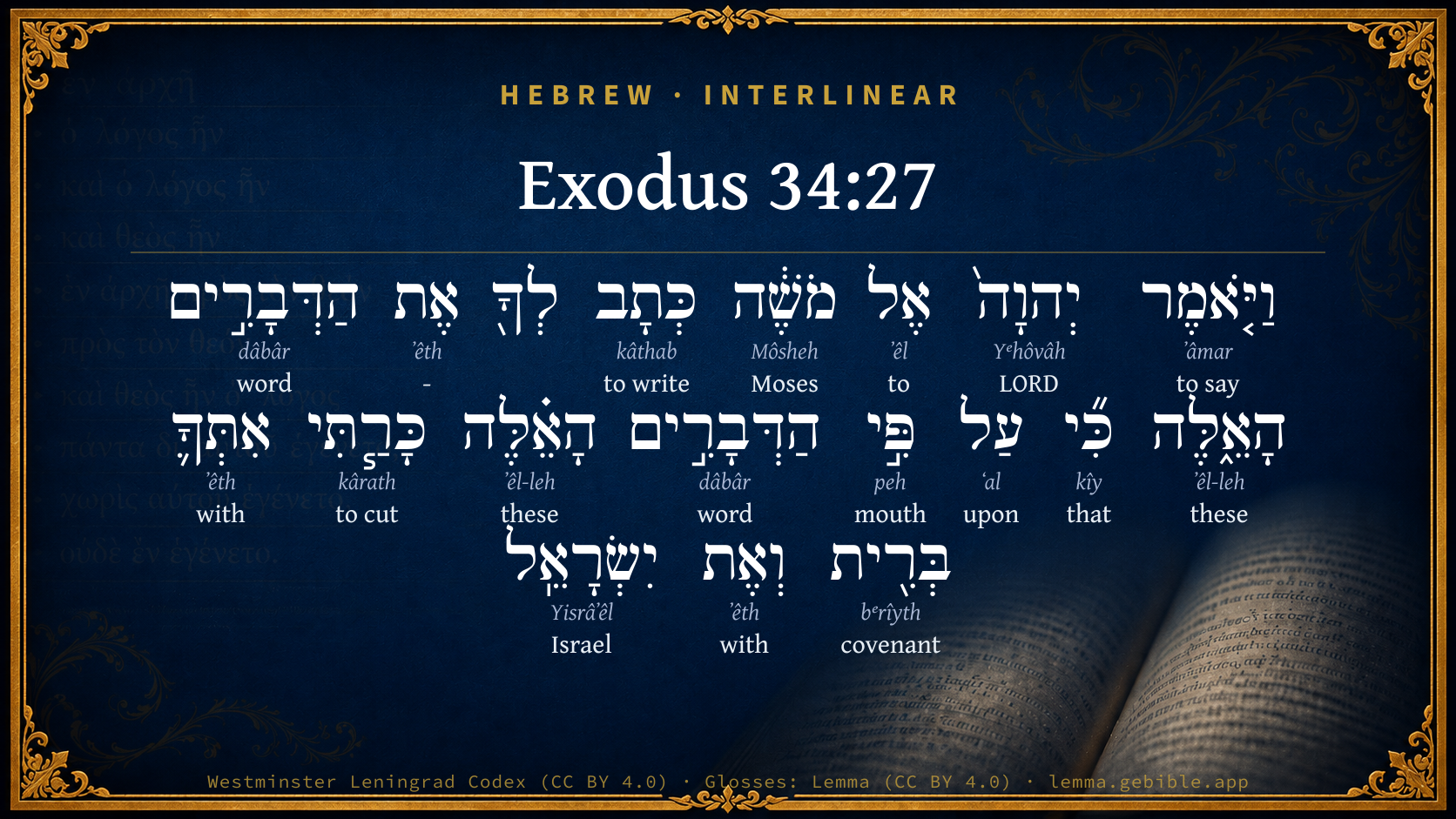
Hebrew (Westminster Leningrad Codex) Exodus 34:27 appears in the Hebrew Old Testament. The text above is from the Westminster Leningrad Codex. Each word links to its Strong’s number, a concise gloss, and parsing drawn from the Open Scriptures Hebrew Bible morphology. Click any word for its full Brown-Driver-Briggs (BDB) entry.
Download image
Cite this verse

Exodus 34:27 (World English Bible). Public Domain. Lemma interlinear Bible study tool, https://lemma.gebible.app/v/exodus/34/27.

Show BibTeX & RIS
BibTeX
RIS
English Translation
Yahweh said to Moses, "Write you these words: for in accordance with these words I have made a covenant with you and with Israel."
World English Bible · Public Domain
Download a study sheet

One document with this verse’s original text, its word-by-word gloss line, the meaning frame, cross-references with their text, attributed commentary, and full source and license credits — printable, and it pastes into notes with its structure intact.

This verse Autodidact and up

Study sheet (.html) Plain text (.txt)

A passage Seminary Student

Up to 50 verses in one chapter. A passage sheet keeps up to 6 commentary sources and 12 cross-references per verse, in the order this page ranks them, and says so on the sheet whenever that leaves anything out. Ask for a single verse and you get the Autodidact verse sheet above.

Everything on this page stays free to read, with no account — the sheet is a download of what is already on screen, not access to it.

Want to remove ads? Support Godless Engineer
Compare translations 3

The same verse in 3 English versions, stacked beneath the original-language interlinear above. Click any original word for its lexicon entry.

Each is an independent rendering of the whole verse — the interlinear is not word-aligned to these translations.

Highlighted words mark where these versions differ — a whole-verse word diff, not a word-by-word alignment.

  • World English Bible Public Domain
    Yahweh said to Moses, "Write you these words: for in accordance with these words I have made a covenant with you and with Israel."
  • King James Version Public Domain
    And the LORD said unto Moses, Write thou these words: for after the tenor of these words I have made a covenant with thee and with Israel.
  • unfoldingWord Literal Text CC BY-SA 4.0
    And Yahweh said to Moses, “Write these words for yourself, for over the mouth of these words I have cut a covenant with you and with Israel.”

unfoldingWord Literal Text — © unfoldingWord, licensed CC BY-SA 4.0. Word-aligned USFM3 via Door43 (git.door43.org/unfoldingWord/en_ult).

Versions to compare (up to 4)

3 of 4 selected

Show all 18 translations

Every available English version of this verse, each an independent rendering of the whole verse.

  • World English Bible Public Domain
    Yahweh said to Moses, "Write you these words: for in accordance with these words I have made a covenant with you and with Israel."
  • Berean Standard Bible Public Domain
    The LORD also said to Moses, “Write down these words, for in accordance with these words I have made a covenant with you and with Israel.”
  • Majority Standard Bible Public Domain
    The LORD also said to Moses, “Write down these words, for in accordance with these words I have made a covenant with you and with Israel.”
  • King James Version Public Domain
    And the LORD said unto Moses, Write thou these words: for after the tenor of these words I have made a covenant with thee and with Israel.
  • American Standard Version (1901) Public Domain
    And Jehovah said unto Moses, Write thou these words: for after the tenor of these words I have made a covenant with thee and with Israel.
  • Revised Version (1885) Public Domain
    And the LORD said unto Moses, Write thou these words: for after the tenor of these words I have made a covenant with thee and with Israel.
  • Geneva Bible (1599) Public Domain
    And the Lord said vnto Moses, Write thou these words: for after the tenour of these words I haue made a couenant with thee and with Israel.
  • Douay-Rheims (1899) Public Domain
    And the Lord said to Moses: Write these words by which I have made a covenant both with thee and with Israel.
  • Young's Literal Translation Public Domain
    And Jehovah saith unto Moses, `Write for thyself these words, for, according to the tenor of these words I have made with thee a covenant, and with Israel.'
  • Literal Standard Version CC BY-SA 4.0
    And YHWH says to Moses, “Write these words for yourself, for I have made a covenant with you and with Israel according to the tenor of these words.”
  • Unlocked Literal Bible CC BY-SA 4.0
    Yahweh said to Moses, “Write down these words, for in accordance with these words I have made a covenant with you and with Israel.”
  • unfoldingWord Literal Text CC BY-SA 4.0
    And Yahweh said to Moses, “Write these words for yourself, for over the mouth of these words I have cut a covenant with you and with Israel.”
  • Darby Bible Public Domain
    And Jehovah said to Moses, Write thee these words; for after the tenor of these words have I made a covenant with thee and with Israel.
  • World Messianic Bible Public Domain
    The LORD said to Moses, “Write these words; for in accordance with these words I have made a covenant with you and with Israel.”
  • Webster's Bible Public Domain
    And the LORD said to Moses, Write thou these words: for after the tenor of these words I have made a covenant with thee, and with Israel.
  • Free Bible Version CC BY-SA 4.0
    Then the Lord told Moses, “Write down these words, because these are the basis for the agreement I have made with you and with Israel.”
  • Bible in Basic English Public Domain
    And the Lord said to Moses, Put all these words in writing; for on them is based the agreement which I will make with you.
  • JPS Tanakh (1917) Public Domain
    And the LORD said unto Moses: 'Write thou these words, for after the tenor of these words I have made a covenant with thee and with Israel.'

Literal Standard Version (2020), Covenant Press — licensed CC BY-SA 4.0. Text via the HelloAO Bible API (eBible.org). Unlocked Literal Bible (unfoldingWord) — licensed CC BY-SA 4.0. Text via the HelloAO Bible API (eBible.org). unfoldingWord Literal Text — © unfoldingWord, licensed CC BY-SA 4.0. Word-aligned USFM3 via Door43 (git.door43.org/unfoldingWord/en_ult). Free Bible Version, Dr. Jonathan Gallagher — licensed CC BY-SA 4.0. Text via the HelloAO Bible API (eBible.org).

Word by word

More ways to search: Search by grammar → Find every occurrence → Compare this word →

Practice this passage: Drill this verse → Learn its vocabulary →

כְּתָב
kâthab
H3789
“write”
Verb, Qal, Imperative, 2nd Person, Masculine, Singular
Part of Speech
Verb
Stem
Qal
Form
Imperative
Person
2nd Person
Gender
Masculine
Number
Singular
Full BDB Definition

Origin: a primitive root

TWOT: 1053

to write, record, enroll - (Qal) - to write, inscribe, engrave, write in, write on - to write down, describe in writing - to register, enroll, record - to decree - (Niphal) - to be written - to be written down, be recorded, be enrolled - (Piel) to continue writing
  1. וַיֹּ֤אמֶר ʼâmar H559 “and · to say” Conjunction + Verb, Qal, Sequential Imperfect, 3rd Person, Masculine, Singular
  2. יְהוָה֙ Yᵉhôvâh H3068 “LORD” Noun, Proper
  3. אֶל ʼêl H413 “to” Preposition
  4. מֹשֶׁ֔ה Môsheh H4872 “Moses” Noun, Proper
  5. אֶת ʼêth H853 “-” Particle, Direct Object
  6. הַדְּבָרִ֣ים dâbâr H1697 “the · words” Particle, Definite Article + Noun, Common, Masculine, Plural, Absolute
  7. הָאֵ֑לֶּה ʼêl-leh H428 “the · these” Particle, Definite Article + Pronoun, Demonstrative, Common, Plural
  8. כִּ֞י kîy H3588 “that” Conjunction
  9. עַל ʻal H5921 “upon” Preposition
  10. פִּ֣י peh H6310 “mouth of” Noun, Common, Masculine, Singular, Construct
  11. הַדְּבָרִ֣ים dâbâr H1697 “the · words” Particle, Definite Article + Noun, Common, Masculine, Plural, Absolute
  12. הָאֵ֗לֶּה ʼêl-leh H428 “the · these” Particle, Definite Article + Pronoun, Demonstrative, Common, Plural
  13. כָּרַ֧תִּי kârath H3772 “to cut” Verb, Qal, Perfect, 1st Person, Common, Singular
  14. אִתְּךָ֛ ʼêth H854 “with · you” Preposition + Suffix, Personal, 2nd Person, Masculine, Singular
  15. בְּרִ֖ית bᵉrîyth H1285 “covenant” Noun, Common, Feminine, Singular, Absolute
  16. וְאֶת ʼêth H854 “and · with” Conjunction + Preposition
  17. יִשְׂרָאֵֽל Yisrâʼêl H3478 “Israel” Noun, Proper

About this verse

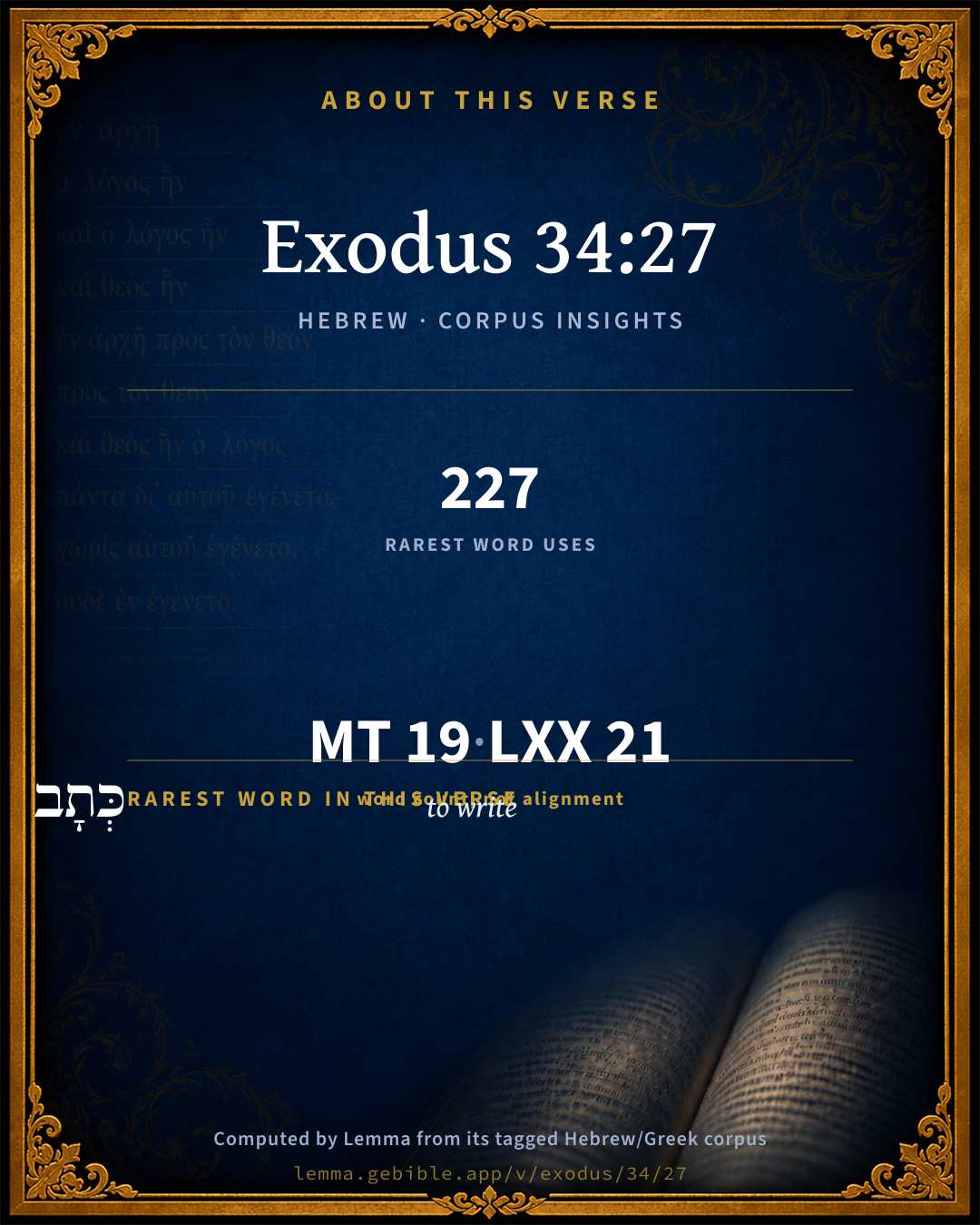
These counts appear in no published source. They are computed here, from the morphology-tagged text and Lemma’s own curated glosses. What Lemma adds →

19
words
15
distinct lemmas
Pentateuch
section

Grammatical profile

  • 3 verbs
  • 7 nouns
  • 2 pronouns
  • 5 prepositions
  • 1 conjunction
  • 1 particle

Verb forms

  • וַיֹּ֤אמֶר Qal · Sequential Imperfect
  • כְּתָב Qal · Imperative
  • כָּרַ֧תִּי Qal · Perfect

Repetition

Words recur within this verse — often emphatic in Hebrew:

  • הַדְּבָרִ֣ים word H1697 ×2
  • הָאֵ֑לֶּה these H428 ×2
  • אִתְּךָ֛ with H854 ×2

Hebrew & Septuagint length

In English translation the verse runs 24 words from the Hebrew and 25 from the Septuagint (LXX English) — closely comparable.

A rough comparison of the two English renderings, which tokenize alike — not a word-level alignment.

Word counts can differ between the Hebrew and the Greek without any difference in meaning — e.g. the Hebrew direct-object marker אֵת has no separate Greek word, and Greek often adds the article ὁ.

In the original languages it is 19 Hebrew tokens and 21 Greek tokens — but the two are counted differently (Hebrew bundles its prefixes and suffixes into one token; the Greek is in lemma form), so that isn’t a like-for-like length.

Cross-references

6

Topical passages linked to Exodus 34:27 in the Treasury of Scripture Knowledge — connected by theme and wording, ordered by reader-vote popularity; previews shown in the World English Bible.

  • Exodus 24:4 Moses wrote all the words of Yahweh, and rose up early in the morning, and built an altar under the mountain, and twelve pillars for the twelve tribes of Israel.
  • Deuteronomy 31:9 Moses wrote this law, and delivered it to the priests the sons of Levi, who bore the ark of the covenant of Yahweh, and to all the elders of Israel.
  • Exodus 17:14 Yahweh said to Moses, "Write this for a memorial in a book, and rehearse it in the ears of Joshua: that I will utterly blot out the memory of Amalek from under the sky."
  • Deuteronomy 4:13 He declared to you his covenant, which he commanded you to perform, even the ten commandments; and he wrote them on two tables of stone.
  • Exodus 24:7 He took the book of the covenant and read it in the hearing of the people, and they said, "All that Yahweh has spoken will we do, and be obedient."
  • Exodus 34:10 He said, "Behold, I make a covenant: before all your people I will do marvels, such as have not been worked in all the earth, nor in any nation; and all the people among which you are shall see the work of Yahweh; for it is an awesome thing that I do with you.

Cross-references courtesy of OpenBible.info (CC BY 4.0).

Hebrew and Greek witnesses Masoretic Hebrew ↔ Greek Septuagint

The same verse in the two great witnesses to the Old Testament, shown verse-for-verse.

These are two independent witnesses, not word-aligned to each other, and the Septuagint is shown in lemma (dictionary) form.

Hebrew Exodus 34:27 Masoretic · Westminster Leningrad Codex

וַיֹּ֤אמֶר יְהוָה֙ אֶל מֹשֶׁ֔ה כְּתָב לְךָ֖ אֶת הַדְּבָרִ֣ים הָאֵ֑לֶּה כִּ֞י עַל פִּ֣י הַדְּבָרִ֣ים הָאֵ֗לֶּה כָּרַ֧תִּי אִתְּךָ֛ בְּרִ֖ית וְאֶת יִשְׂרָאֵֽל

Yahweh said to Moses, "Write you these words: for in accordance with these words I have made a covenant with you and with Israel."

World English Bible · Public Domain

Greek LXX Exodus 34:27 Septuagint · lemma form

καί εἶπον κύριος πρός μωυσῆς γράφω σεαυτοῦ ὁ ῥῆμα οὗτος ἐπί γάρ ὁ λόγος οὗτος τίθημι σύ διαθήκη καί ὁ ἰσραήλ

And the Lord said to Moses, Write these words for yourself, for on these words I have established a covenant with you and with Israel.

LXX2012 (modern English Septuagint) · Public Domain

Hebrew: Westminster Leningrad Codex (CC BY 4.0). Greek: Septuagint (public domain); English from LXX2012 (modern English Septuagint) (Public Domain). How the Septuagint differs from the Hebrew →

Targum (Aramaic paraphrase)

2

The Targum is the ancient Jewish Aramaic paraphrase of the Hebrew Scriptures — an interpretive translation, not the Hebrew text itself. Onkelos (literal) and Pseudo-Jonathan (expansive) render the Torah, and Jonathan the Prophets. Coverage is partial: where no permissively-licensed English translation exists for a verse, only the Aramaic is shown. This is verse-level text, not a word-by-word alignment to the Hebrew.

  1. Targum Onkelos Torah (Genesis–Deuteronomy)
    וַאֲמַר יְיָ לְמשֶׁה כְּתַב לָךְ יָת פִּתְגָמַיָא הָאִלֵין אֲרֵי עַל מֵימַר פִּתְגָמַיָא הָאִלֵין גְזָרִית עִמָךְ קְיַם וְעִם יִשְׂרָאֵל:

    (no public-domain English translation for this verse)

    Targum Onkelos — Aramaic: “Onkelos Genesis” (public domain); “Onkelos Exodus” (public domain); “Onkelos Leviticus” (public domain); “Onkelos Numbers” (public domain); “Onkelos Deuteronomy” (public domain). English: “Sefaria Community Translation” (CC0 1.0 (public-domain dedication)); “J.W. Etheridge. The Targums of Onkelos and Jonathan Ben Uzziel on the Pentateuch. London: Longmans, Green, 1862” (public domain). Text via Sefaria.

  2. Targum Pseudo-Jonathan Torah (Genesis–Deuteronomy)
    וַאֲמַר יְיָ לְמשֶׁה כְּתוֹב לָךְ יַת פִּתְגָמַיָא הָאִילֵין אֲרוּם עַל מֵימַר פִּתְגָמַיָא הָאִילֵין גְּזָרִית עִמָּךְ קְיַים וְעִם יִשְרָאֵל

    And the Lord said to Mosheh, Write thou these words; for upon the expression of these words have I stricken My covenant with thee and with the people of Israel.

    Targum Pseudo-Jonathan — Aramaic: “Targum Jonathan on Genesis” (public domain); “Targum Jonathan on Exodus” (public domain); “Targum Jonathan on Leviticus” (public domain); “Targum Jonathan on Numbers” (public domain); “Targum Jonathan on Deuteronomy” (public domain). English: “The Targum of Jonathan ben Uzziel, trans. J. W. Etheridge, London, 1862” (public domain). Text via Sefaria.

Commentary

Notes on Exodus 34:27 from classic Christian and Jewish commentators (each source and its license shown beneath its notes). The classic Christian expositions comment on the surrounding passage and are grouped to its opening verse, so a note may address several verses; the Jewish commentaries on the Tanakh (Rashi and others) are per-verse, so they appear only where the commentator wrote on this verse.

Lemma curates 59 commentaries, every one of them public domain or Creative Commons licensed, each selected and text-cleaned for this edition rather than reprinted as found. About our sources →

Trapp's Complete Commentary

John Trapp

Exo 34:27 And the LORD said unto Moses, Write thou these words: for after the tenor of these words I have made a covenant with thee and with Israel.

Ver. 27. I have made a covenant.] We also have the covenant, the seals, ministers, &c. But, alas! are not these blessings amongst us as the ark was amongst the Philistines, rather as prisoners than as privileges? Rather in testimonium et ruinam quam in salutem? Rather for our ruin than reformation?

John Trapp, A Commentary or Exposition upon All the Books of the Old and New Testament (1647–1656) — public domain. Text from a community e-Sword module.

The Biblical Illustrator

Joseph S. Exell

Exo_34:27-28

He wrote upon the tables.

The second tables

The Ten Commandments were twice written by the finger of God Himself (see Deu_10:1-3), and upon enduring tables of stone, to show how deeply and permanently they were to be engraved upon the heart of man. Twice written, once upon a broken and once upon an unbroken tablet, symbolically setting forth the truth that they were once written upon the nature before the Fall, and are to be inscribed a second time upon that nature, which inscription is made at his regeneration. Also, as they were once written upon stone, they were to be engraved a second time upon the heart, as the prophet Jeremiah predicted would be, and as the apostle asserted had been done (Heb_8:10). Then by special command they were afterwards deposited for safe keeping in the ark of the covenant, upon which rested the Shekinah of the Lord, the most inviolably sacred place outside the courts of heaven, and by special designation were ever afterward known as the Tables of the Testimony. (James Stacy, D. D.)

The Biblical Illustrator, edited by Joseph S. Exell (c. 1880s–1900s) — public domain. Text from a community e-Sword module.

The Preacher's Complete Homiletical Commentary

Joseph S. Exell (gen. ed.)

MAIN HOMILETICS OF THE PARAGRAPH.—Exo_34:27-32

DIVINE REVELATION

Divine revelation is the communication by God to man of certain facts, doctrines, duties, for instruction, comfort, or practice, which would not otherwise have been discovered. Our text may be used as covering the whole revelation of God’s character and will as contained in the Bible. We remark—

I. That Divine revelation is the result of Divine inspiration. “And He was there with the Lord.” It is no human conjecture, however true. It is no inference, however correct, from existing facts; but information directly derived from the presence of Divine wisdom and Divine power.

II. That Divine revelation is made through a human medium. In some cases God has sent angels to communicate His truth; but even those communications have only reached the people through the appointed medium. We earn therefore—

1. That the inspired man is only the medium, and must not be treated as the revealer.

2. The way to account for variations of style and apparent discrepancies. The thought is God’s, the words are man’s.

III. That Divine revelation is infallible on the one hand, intelligible on the other.

1. Infallible.

(1) As regards authority. “All that the Lord had spoken to him.” A most conspicuous fact in God’s Word is, that inspired men disclaim all originality and speak “in the name of the Lord.”

(2) As regards completeness. “All that the Lord had spoken.” Inspired men claim to “declare all the counsel of God.” The Book claims to be a revelation of “all things pertaining to life and godliness.”

2. Intelligible. Being through man, God’s thoughts are presented in a form adapted to the conditions of the human intellect, in words man can understand.

IV. That Divine revelation is binding upon man. “He gave them commandment.”

1. God does not speak for nothing. It cannot be supposed that having spoken He would leave it to man, whether he obeyed or disobeyed. Nor can it be supposed that man is at liberty to pick and choose as to what he shall accept and what reject. The whole counsel of God, because it is His counsel, is binding upon man.

2. It is binding because only by obeying God’s laws, and following the lines indicated by God’s wisdom and goodness, that man’s well-being can be secured mentally, morally, and spiritually. Learn then—

i. To value this revelation. ii. To treat it reverently, not to cavil at its apparent discrepancies, &c. iii. To make it the one rule of our faith and practice.—J. W. Burn.

ILLUSTRATIONS

BY

REV. WILLIAM ADAMSON

Law-Lights! Exo_34:1-35. Pressense says, that whatever opinions men may hold as to the integrity of that primitive witness, all must own that it contains pages in which one beholds, as it were, the reflection of the lustre which caused Moses’s face to shine when he held converse with God. It has ever been the pious mind which has through the eyes beheld the chain of revelation and the long series of Divine manifestations gradually unwind themselves. Just as they that watch for the morning gaze out from the height of the tower, longing with inexpressible desire for the approach of dawn; so does religious consciousness cast glances of fire upon the horizon as she looks out for the Divine Sunrise. The whole of the Old Testament pants and throbs with this Divine yearning, and it also shows us the finger of God writing in the heart of man the great preparation for the Gospel. The angels ever

“Draw strength from gazing on its glance,

Though none its meaning fathom may;

The Word’s unwithered countenance

Is bright as at Mount Sinai’s day.”

—Goëthe.

Spiritual-Sustenance! Exo_34:28.

(1.) In the beautiful transparent amber of the Eocene epoch are often found threads of mould, fragments of moss and lichens, blossoms and leaves of flower-bearing plants, as well as wings of bees and butterflies. Nature has preserved these things of the past—things, too, which, apparently small and insignificant, open up to the mind’s eye a wide vista into the mysterious past. So in the precious amber of the Bible are preserved incidents and statements, remnants of thought and blossomings of truth. To the careless readers these may appear trivial; but they are infinitely suggestive to those who examine them.

(2.) One of the most interesting and suggestive is that of Moses existing for forty days without nature’s bountiful stores. He was fed by the melodies of heaven, the music of the spheres, as the beautiful Jewish legend says, until God’s purposes were accomplished, and then he returned to the common mode of sustaining life. It teaches that bread has no essential or necessary relations to the bodily organisation of man, that human life can be sustained independently of material means, and that, as God Himself is the nourisher, He can, when He pleases, dispense with the mere outward instrumentality, and feed by His own direct and unveiled sustaining power—

“O Lord, Thou hast with angel food my fainting spirit fed;

If ’tis Thy will I linger here, bless Thou the path I tread;

And though my soul doth pant to pass within the pearly gate,

Yet teach me for Thy summons, Lord, in patience still to wait.”

—Shipton.

Written Word! Exo_34:28.

(1.) In proportion as a nation becomes civilised, the desire for a code of written law increases along with the knowledge of its desirableness. Our forefathers wandered as savages amid the wilds, relying upon oral traditions, which became more and more degenerate. And so in these Gentile religions, all alive with hideous and abominable idolatries, who could believe that this is what man has made of that oral revelation vouchsafed to Noah, so clear and pellucid in its Ararat outflow?

(2.) When civilisation disclosed their degenerate conditions to our ancestors, they felt the need of a written code of laws and enactments; and these are embodied in our statutes called the Law of the Land. The condition of the world at large, and of Israel in Egypt, evidenced the moral necessity for a written law. Even amidst the awful glories of Sinai, Israel learned from its own tendency to degenerate how urgently essential it was to have the written Word.

“Thy Word, O God, is living yet

Amid earth’s restless strife,

New harmony creating still,

And ever higher life.

And as that Word moves surely on,

The light, ray after ray,

Streams farther out athwart the dark,

And night grows into day.”

—Longfellow.

Fellowship-Fruits! Exo_34:29-35.

(1.) For forty days successively, the great Jewish legislator was concealed on the summit of Mount Sinai, within the thick darkness by which the glory of Jehovah was veiled from the less-favoured eyes of the multitude. In this prophetic seclusion, separated from the world, his mind took deeply and strongly the impress of heaven. By communion with God his soul was saturated with the light of His holiness. His countenance by a spiritual affinity caught the celestial radiance and reflected it with dazzling brightness. On his descent from the mount, this splendour from the Divine Presence continued to shine on his face, that Aaron beheld it while he talked with him, and all the children of Israel were afraid to come nigh.

(2.) Brown says his face was radiant, and dispersing beams like many horns or cones about his head; which is also consonant unto the original signification. Our Saviour and the Virgin Mary are commonly painted with scintillations or radiant halos about their head, which by the French are designated the glory. In some of the ancient Bibles, Moses is described with horns. The same description we find on a silver medal, i.e., upon one side Moses horned, and on the reverse side the commandment against sculptured images. The believer’s walk and conversation should be thus encircled with “horns of glory,” rays of the beauties of holiness.

“Ne’er let the glory from my soul remove,

Till perfect with Thy ransomed flock above,

I cease to sin, but never cease to love.”

The Preacher's Complete Homiletical Commentary (gen. ed. Joseph S. Exell; Funk & Wagnalls, c. 1892) — public domain (pre-1929). A full-Bible homiletical/sermon-outline anthology covering 65 of 66 books (2 John is absent from the source module). Text from a community e-Sword module.

Tyndale Open Study Notes

Tyndale Open Resources

34:27-28 Moses wrote down this reiteration of the general terms of the covenant (34:27). The Ten Commandments, the summary of the terms, were written on the new tablets (34:28).

Tyndale Open Study Notes — © Tyndale Open Resources, licensed CC BY-SA 4.0. Text via the HelloAO Bible API.

Jamieson, Fausset & Brown

Robert Jamieson, A. R. Fausset & David Brown

And the Lord said unto Moses, Write thou these words--that is, the ceremonial and judicial injunctions comprehended above (Exo. 34:11-26); while the rewriting of the ten commandments on the newly prepared slabs was done by God Himself (compare Deu 10:1-4).

Jamieson, Fausset & Brown — Commentary Critical and Explanatory on the Whole Bible (1871) — public domain (CC PDM 1.0). Text via the HelloAO Bible API.

Adam Clarke's Commentary

Verse 27. Write thou these words] Either a transcript of the whole law now delivered, or the words included from Ex 34:11 to Ex 34:26. God certainly wrote the ten words on both sets of tables. Moses either wrote a transcript of these and the accompanying precepts for the use of the people, or he wrote the precepts themselves in addition to the ten commandments which were written by the finger of God. See Clarke on Ex 34:1. Allowing this mode of interpretation, the accompanying precepts were, probably, what was written on the back side of the tables by Moses; the ten commandments, what were written on the front by the finger of Jehovah: for we must pay but little attention to the supposition of the rabbins, that the letters on each table were cut through the stone, so as to be legible on each side. See Clarke on Ex 32:15.

Adam Clarke's Commentary on the Bible (1810–1826) — public domain. Text from a community e-Sword/MySword module.

Ellicott's Commentary for English Readers

(27) Write thou these words.—Heb., Write for thee these words, i.e., put them in writing for thine own use and the use of thy people. This express command accounts for the assignment of so much space to what is mainly repetition. The requirement of the repetition can only be explained by the importance of the laws laid down under the circumstances of the Hebrew nation, and the power of repetition to enforce upon the conscience what is pressed upon it by reiteration.

After the tenor of these words.—The summary of positive laws contained in this chapter (Exo_34:12-26) was not intended to supersede the “Book of the Covenant,” but rather to confirm and reinforce it. The covenant was renewed not upon these words only, but “after the tenor,” i.e., after their general aspect or bearing.

A Bible Commentary for English Readers, edited by Charles John Ellicott (1878–1897) — public domain. Text from a community e-Sword module.

The Cambridge Bible for Schools and Colleges

gen. ed. J. J. S. Perowne

27. These words,—i.e. the commands of vv. 11–26,—are to be written down by Moses; for they constitute the conditions upon which Jehovah establishes His covenant (vv. 10, 27) with Israel. ‘The verse is J’s parallel to Exo_24:3-8 in E’ (Di.).

after the tenor of] The expression used in Gen_43:7.

28a. And he was there, &c.] viz. after the ascent of the mount described in v. 4, i.e. in the present form of vv. 1–4, Moses second ascent of it, but in their original form, if the view stated on p. 364 be correct, the ascent mentioned in Exo_24:1-2; Exo_24:9-11, so that in this case the forty days of J here will be the same as the forty days of E in Exo_24:18 b.

28b. And he wrote] i.e., in the present context of the words, Moses (see p. 364). Of course it must be admitted that v. 28b may have once stood in a context in which the pronoun would refer naturally to Jehovah: this would be the case, for instance, if it once stood immediately after v. 4, as Deu_10:4 would suggest (cf. p. 364).

the words of the covenant] The ‘words’ of v. 27, i.e. the commands of vv. Exodus 11-26. It is difficult to think that this expression, at least as an original part of J, can have denoted the Decalogue of Exodus 20 : for the Decalogue of Exodus 20 is not in any part of Ex. made the basis of a covenant: this is a representation characteristic of Dt. (Deu_4:13, Deu_5:2-3 al.: see pp. 175, 193).

the ten commandments] Heb. words: i.e., if the words are part of J, and in their original context, the ‘words,’ or commandments, of vv. 11–26, which, though they are now more, may once have consisted only of ten (the ‘ritual Decalogue,’ p. 365). But it is probable that the words are a later addition, made, on the basis of Deu_4:13; Deu_10:4, after the original wording of the chapter had been modified in vv. 1, 4, so as to make it describe the re-writing of the ‘moral’ Decalogue of Exodus 20 (p. 365); and in this case they will, as in Deu_4:13; Deu_10:4 †, refer to that Decalogue. So Kittel, Bä., McNeile (p. xxxi), al.

The Cambridge Bible for Schools and Colleges (gen. ed. J. J. S. Perowne; Cambridge University Press, 1878–1918) — public domain. Text from a community e-Sword module.

John Gill's Exposition

And when Aaron and all the children of Israel saw Moses,.... Who very probably met him at the bottom of the mount; these Israelites with Aaron were the princes, as Aben Ezra seems rightly to interpret it, and as appears from the following verse; for Moses could not well be seen by the whole body of the people at once, upon his descent from the mount:

behold, the skin of his face shone; darted out rays of light and glory all around it, much perhaps in the same manner as the glory about our Lord, and others, is painted by the Romanists:

and they were afraid to come nigh him; there was something so majestic and striking in it; and perhaps they could not tell whether it foreboded good or evil to them; and this may signify, that as by the light of the law sin is discovered, it fills with a sense of wrath and fear of damnation; and being the ministration of condemnation and death, it is terrifying and killing, though it has a glory in it.

John Gill's Exposition of the Whole Bible (1746–1763) — public domain (CC PDM 1.0). Text via the HelloAO Bible API.

Matthew Poole's English Annotations

Object.

God saith, I will write, Exo 34:1.

Answ. 1. Moses was to write the ritual precepts mentioned here above, God wrote the moral law.

2. Moses wrote what he wrote in a book; see Exo 24:7; but what was written upon the tables of stone was written by God himself, not by Moses, who had no graving instruments with him in the mount, and could not without them write upon the stone.

Matthew Poole's English Annotations on the Holy Bible (1683–1685) — public domain. Text from a community e-Sword/MySword module.

Whedon's Commentary on the Bible

Daniel D. Whedon

27. Write thou these words — This narrative very clearly teaches that Moses recorded repeated acts of legislation. The covenant was broken and renewed. A record was made of all the important facts, and such a record, if faithful, must needs have contained various repetitions. Some critics discover different “strata of laws,” but fail to pay proper respect to the fact, that, according to the plain import of the Mosaic narrative, laws were repeatedly given, revised, renewed, and in some instances changed, as the conduct and interests of the people required. The different codes and stages of legislation are not inconsistent with each other, nor of such a nature as to be inconsistent with a Mosaic origin. See our Introduction to the Pentateuch, page 31.

Daniel D. Whedon (gen. ed.), Commentary on the Old and New Testaments (1874–1909) — public domain. Text from a community e-Sword module.

The Pulpit Commentary

Vers. 27-35. FINAL DESCENT OF MOSES FROM SINAI. The covenant having been renewed, Moses prepared to descend, having first however received a command to commit to writing the words of this second covenant (ver. 27). He received back the tables from God, inscribed with the Ten Commandments, and after a stay in Sinai of equal duration with the former one (ver. 28), descended, having the tables in his hands. He was not aware that the skin of his face had become radiant (ver. 29), and first learnt the fact by the rulers being afraid to come near him (ver. 30). After conversing with them and with the people he resolved to "put a vail on his face" ordinarily, only taking it of when he "went in before the Lord" into the, tent of meeting," and when, having received a message from the Lord to the people, he came out to deliver it.

Write thou these words. Literally, "write thee these wordsi.e. , "write them for thyself and for thy people." According to the tenor of these words have I made a covenant. That is, "the covenant on my part is conditional on the observance of these words on the part of Israel." The "words" intended are those of vers. 10-26.

The Pulpit Commentary (1880–1919), ed. H.D.M. Spence-Jones & Joseph S. Exell — public domain. Text from a community e-Sword module.

Keil & Delitzsch

C. F. Keil & F. Delitzsch

Moses was to write down these words, like the covenant rights and laws that had been given before (Exo 24:4, Exo 24:7), because Jehovah had concluded the covenant with Moses and Israel according to the tenor of them. By the renewed adoption of the nation, the covenant in ch. 24 was eo ipso restored; so that no fresh conclusion of this covenant was necessary, and the writing down of the fundamental conditions of the covenant was merely intended as a proof of its restoration. It does not appear in the least degree "irreconcilable," therefore, with the writing down of the covenant rights before Knobel).

Exo 34:28

Moses remained upon the mountain forty days, just as on the former occasion (cf. Exo 24:18). "And He (Jehovah) wrote upon the tables the ten covenant words" (see at Exo 34:1).

Exo 34:29-35

The sight of the glory of Jehovah, though only of the back or reflection of it, produced such an effect upon Moses' face, that the skin of it shone, though without Moses observing it. When he came down from the mountain with the tables of the law in his hand, and the skin of his face shone אתּו בּדבּרו, i.e., on account of his talking with God, Aaron and the people were afraid to go near him when they saw the brightness of his face. But Moses called them to him, - Viz. first of all Aaron and the princes of the congregation to speak to them, and then all the people to give them the commandments of Jehovah; but on doing this (Exo 34:33), he put a veil upon (before) his face, and only took it away when he went in before Jehovah to speak with Him, and then, when he came out (from the Lord out of the tabernacle, of course after the erection of the tabernacle), he made known His commands to the people. But while doing this, he put the veil upon his face again, and always wore it in his ordinary intercourse with the people (Exo 34:34, Exo 34:35). This reflection of the splendour thrown back by the glory of God was henceforth to serve as the most striking proof of the confidential relation in which Moses stood to Jehovah, and to set forth the glory of the office which Moses filled. The Apostle Paul embraces this view in Co2 3:7., and lays stress upon the fact that the glory was to be done away, which he was quite justified in doing, although nothing is said in the Old Testament about the glory being transient, from the simple fact that Moses died. The apostle refers to it for the purpose of contrasting the perishable glory of the law with the far higher and imperishable glory of the Gospel. At the same time he regards the veil which covered Moses' face as a symbol of the obscuring of the truth revealed in the Old Testament. But this does not exhaust the significance of this splendour. The office could only confer such glory upon the possessor by virtue of the glory of the blessings which it contained, and conveyed to those for whom it was established. Consequently, the brilliant light on Moses' face also set forth the glory of the Old Covenant, and was intended both for Moses and the people as a foresight and pledge of the glory to which Jehovah had called, and would eventually exalt, the people of His possession.

Keil & Delitzsch — Biblical Commentary on the Old Testament (1861–1891) — public domain (CC PDM 1.0). Text via the HelloAO Bible API. (Old Testament only.)

unfoldingWord translationNotes

Door43 World Missions Community

Moses was there

"Moses was on the mountain"

forty days

"40 days" (See: Numbers)

for forty days and nights

"for forty days, both day and night"

He wrote

"Moses wrote"

translationWords

Yahweh

Moses

word

pledge

covenant

Israel

Ten Commandments

unfoldingWord translationNotes — © Distant Shores Media and the Door43 World Missions Community, licensed CC BY-SA 4.0. Source: git.door43.org/Door43/en_tn.

Rashi

Rabbi Shlomo Yitzchaki (Rashi)

את הדברים האלה [WRITE THOU] THESE WORDS — These words, but you are not permitted to write down the “Oral Law” (Gittin 60b).

Rashi on the Tanakh — English translations: “The Judaica Press complete Tanach with Rashi, translated by A. J. Rosenberg” (CC BY 4.0); “Pentateuch with Rashi's commentary by M. Rosenbaum and A.M. Silbermann, 1929-1934” (public domain); “The Metsudah Tanach series, Lakewood, N.J” (CC BY 4.0); and “The Book of Joshua, Metsudah Publications, 1997” (CC BY 4.0). Text via Sefaria.

Ramban (Nachmanides)

Rabbi Moshe ben Nachman (Ramban / Nachmanides)

WRITE THOU THESE WORDS. G-d commanded Moses that he write a book of covenant and read it in the hearing of the people, and they should accept it upon themselves by saying, we will do and we will obey, as they had done at first; for He wanted that the whole procedure with the first Tablets should now be repeated with the second Tablets. There is no doubt that Moses actually did repeat it; however, Scripture did not want to prolong the account by saying, “and Moses did so,” as I have shown you in many places., 10:2, etc.The correct interpretation appears to me to be, that since Israel had sinned and violated the [first] covenant, the Holy One, blessed be He, had to renew the covenant with them, so that He should not nullify His covenant with them, and so He told Moses to write the conditions [of the renewed covenant]. This is the sense of the verse, for after the tenor of these words I have made a covenant with thee and with Israel. The meaning of with thee is that for your sake I have done it with them, and it will not be necessary for them to bring themselves into the bond of this covenant. However, G-d, blessed be He, had to make with them a covenant on the forgiveness that He extended to them [for their sin with the calf], and so [Moses] wrote the forgiveness, and the conditions [of the new covenant].

Ramban (Nachmanides) on the Tanakh — English translation: “Commentary on the Torah by Ramban (Nachmanides). Translated and annotated by Charles B. Chavel. New York, Shilo Pub. House, 1971-1976” (CC BY 4.0). Text via Sefaria.

Lesson kit

Teaching starters — assembled from the data on this page, not authored interpretation. Every prompt links to the verse data it draws on. Edit before teaching.

Exodus, in the Pentateuch, opens this verse with 19 words (15 distinct Hebrew lemmas). Its most distinctive word is kâthab (“to write”). A historical commentator’s framing appears above. Read the whole chapter for the surrounding context.

Discussion questions

  1. How does “to write” (kâthab) shape what this verse is saying?
  2. Exodus 24:4 shares this passage’s theme. How do the two illuminate each other?
  3. “word” occurs 2× in this one verse. What is the effect of the repetition?
  4. These translations render this verse differently. What is at stake in choosing one wording over another?
  5. The verb «וַיֹּ֤אמֶר» is Qal Sequential Imperfect. How does its form color the action?
  6. Reading how Trapp's Complete Commentary and The Biblical Illustrator read this verse, where do the two commentators agree and where do they part?

Things to notice

Reading settings

Reading text

Shown beneath each verse's original-language words.

Old Testament
Old Testament edition

Read the OT as the Masoretic Hebrew (MT) or the Greek Septuagint (LXX).

English shown for the Greek Septuagint (in the Hebrew ↔ Greek comparison).

Comparing translations? Open the Compare panel on any verse page to stack up to four side by side.