
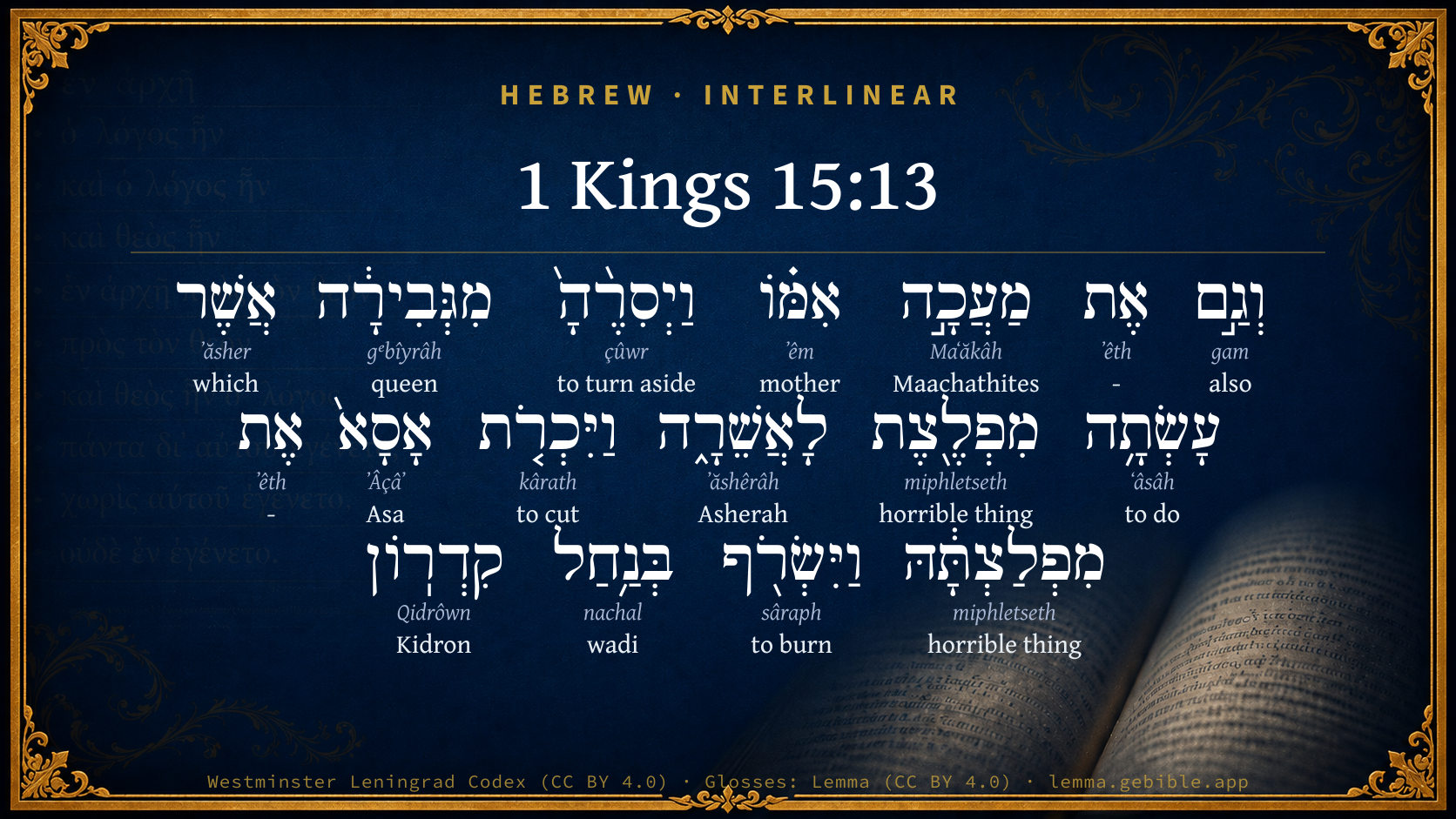
1 Kings 15:13

Hebrew (Westminster Leningrad Codex) 1 Kings 15:13 appears in the Hebrew Old Testament. The text above is from the Westminster Leningrad Codex. Each word links to its Strong’s number, a concise gloss, and parsing drawn from the Open Scriptures Hebrew Bible morphology. Click any word for its full Brown-Driver-Briggs (BDB) entry.
Download image
Cite this verse

1 Kings 15:13 (World English Bible). Public Domain. Lemma interlinear Bible study tool, https://lemma.gebible.app/v/1-kings/15/13.

Show BibTeX & RIS
BibTeX
RIS
English Translation
Also Maacah his mother he removed from being queen, because she had made an abominable image for an Asherah; and Asa cut down her image, and burnt it at the brook Kidron.
World English Bible · Public Domain
Highlights
  • 1 first appearance in the Hebrew Bible
Full analysis ↓
Download a study sheet

One document with this verse’s original text, its word-by-word gloss line, the meaning frame, cross-references with their text, attributed commentary, and full source and license credits — printable, and it pastes into notes with its structure intact.

This verse Autodidact and up

Study sheet (.html) Plain text (.txt)

A passage Seminary Student

Up to 50 verses in one chapter. A passage sheet keeps up to 6 commentary sources and 12 cross-references per verse, in the order this page ranks them, and says so on the sheet whenever that leaves anything out. Ask for a single verse and you get the Autodidact verse sheet above.

Everything on this page stays free to read, with no account — the sheet is a download of what is already on screen, not access to it.

Want to remove ads? Support Godless Engineer
Compare translations 3

The same verse in 3 English versions, stacked beneath the original-language interlinear above. Click any original word for its lexicon entry.

Each is an independent rendering of the whole verse — the interlinear is not word-aligned to these translations.

Highlighted words mark where these versions differ — a whole-verse word diff, not a word-by-word alignment.

  • World English Bible Public Domain
    Also Maacah his mother he removed from being queen, because she had made an abominable image for an Asherah; and Asa cut down her image, and burnt it at the brook Kidron.
  • King James Version Public Domain
    And also Maachah his mother, even her he removed from being queen, because she had made an idol in a grove; and Asa destroyed her idol, and burnt it by the brook Kidron.
  • unfoldingWord Literal Text CC BY-SA 4.0
    And also Maacah his mother, he removed her from queen mother because she had made a horror for Asherah. And Asa cut down her horror, and he burned in the wadi of Kidron.

unfoldingWord Literal Text — © unfoldingWord, licensed CC BY-SA 4.0. Word-aligned USFM3 via Door43 (git.door43.org/unfoldingWord/en_ult).

Versions to compare (up to 4)

3 of 4 selected

Show all 18 translations

Every available English version of this verse, each an independent rendering of the whole verse.

  • World English Bible Public Domain
    Also Maacah his mother he removed from being queen, because she had made an abominable image for an Asherah; and Asa cut down her image, and burnt it at the brook Kidron.
  • Berean Standard Bible Public Domain
    He also removed his grandmother Maacah from her position as queen mother because she had made a detestable Asherah pole. Asa chopped down the pole and burned it in the Kidron Valley.
  • Majority Standard Bible Public Domain
    He also removed his grandmother Maacah from her position as queen mother because she had made a detestable Asherah pole. Asa chopped down the pole and burned it in the Kidron Valley.
  • King James Version Public Domain
    And also Maachah his mother, even her he removed from being queen, because she had made an idol in a grove; and Asa destroyed her idol, and burnt it by the brook Kidron.
  • American Standard Version (1901) Public Domain
    And also Maacah his mother he removed from being queen, because she had made an abominable image for an Asherah; and Asa cut down her image, and burnt it at the brook Kidron.
  • Revised Version (1885) Public Domain
    And also Maacah his mother he removed from being queen, because she had made an abominable image for an Asherah; and Asa cut down her image, and burnt it at the brook Kidron.
  • Geneva Bible (1599) Public Domain
    And he put downe Maachah his mother also from her estate, because shee had made an idole in a groue: and Asa destroyed her idoles, and burnt them by the brooke Kidron.
  • Douay-Rheims (1899) Public Domain
    Moreover he also removed his mother Maacha, from being the princess in the sacrifices of Priapus, and in the grove which she had consecrated to him: and he destroyed her den, and broke in pieces the filthy idol, and burnt it by the torrent Cedron:
  • Young's Literal Translation Public Domain
    and also Maachah his mother -- he turneth her aside from being mistress, in that she made a horrible thing for a shrine, and Asa cutteth down her horrible thing, and burneth `it' by the brook Kidron;
  • Literal Standard Version CC BY-SA 4.0
    and also his mother Maachah—he turns her aside from being mistress, in that she made a horrible thing for an Asherah, and Asa cuts down her horrible thing, and burns [it] by the Brook of Kidron;
  • Unlocked Literal Bible CC BY-SA 4.0
    He also removed Maacah, his grandmother, from being queen, because she had made a disgusting figure out of an Asherah pole. Asa cut down the disgusting figure and burned it at the Kidron Valley.
  • unfoldingWord Literal Text CC BY-SA 4.0
    And also Maacah his mother, he removed her from queen mother because she had made a horror for Asherah. And Asa cut down her horror, and he burned in the wadi of Kidron.
  • Darby Bible Public Domain
    And also Maachah his mother he removed from being queen, because she had made an idol for the Asherah; and Asa cut down her idol, and burned it in the valley of Kidron.
  • World Messianic Bible Public Domain
    He also removed Maacah his mother from being queen, because she had made an abominable image for an Asherah. Asa cut down her image and burned it at the brook Kidron.
  • Webster's Bible Public Domain
    And also Maachah his mother, even her he removed from being queen, because she had made an idol in a grove; and Asa destroyed her idol, and burnt it by the brook Kidron.
  • Free Bible Version CC BY-SA 4.0
    He even dismissed his grandmother Maacah as queen mother, because she had made a disgusting idol. Asa had the idol chopped down and burned in the Kidron Valley.
  • Bible in Basic English Public Domain
    And he would not let Maacah his mother be queen, because she had made a disgusting image for Asherah; and Asa had the image cut down and burned by the stream Kidron.
  • JPS Tanakh (1917) Public Domain
    And also Maacah his mother he removed from being queen, because she had made an abominable image for an Asherah; and Asa cut down her image, and burnt it at the brook Kidron.

Literal Standard Version (2020), Covenant Press — licensed CC BY-SA 4.0. Text via the HelloAO Bible API (eBible.org). Unlocked Literal Bible (unfoldingWord) — licensed CC BY-SA 4.0. Text via the HelloAO Bible API (eBible.org). unfoldingWord Literal Text — © unfoldingWord, licensed CC BY-SA 4.0. Word-aligned USFM3 via Door43 (git.door43.org/unfoldingWord/en_ult). Free Bible Version, Dr. Jonathan Gallagher — licensed CC BY-SA 4.0. Text via the HelloAO Bible API (eBible.org).

Word by word

More ways to search: Search by grammar → Find every occurrence → Compare this word →

Practice this passage: Drill this verse → Learn its vocabulary →

מִפְלֶ֖צֶת
miphletseth
H4656
“horrible thing”
Noun, Common, Feminine, Singular, Absolute
Part of Speech
Noun
Type
Common
Gender
Feminine
Number
Singular
State
Absolute
Full BDB Definition

Origin: from H6426

TWOT: 1778b

horrid thing, horrible thing
  1. וְגַ֣ם gam H1571 “and · also” Conjunction + Particle, Accusative
  2. אֶת ʼêth H853 “-” Particle, Direct Object
  3. מַעֲכָ֣ה Maʻăkâh H4601 “Maachathites” Noun, Proper
  4. אִמּ֗וֹ ʼêm H517 “mother · his” Noun, Common, Feminine, Singular, Construct + Suffix, Personal, 3rd Person, Masculine, Singular
  5. וַיְסִרֶ֨הָ֙ çûwr H5493 “and · to turn aside · her” Conjunction + Verb, Hiphil, Sequential Imperfect, 3rd Person, Masculine, Singular + Suffix, Personal, 3rd Person, Feminine, Singular
  6. מִגְּבִירָ֔ה gᵉbîyrâh H1377 “from · queen” Preposition + Noun, Common, Feminine, Singular, Absolute
  7. אֲשֶׁר ʼăsher H834 “which” Particle, Relative
  8. עָשְׂתָ֥ה ʻâsâh H6213 “to do” Verb, Qal, Perfect, 3rd Person, Feminine, Singular
  9. לָאֲשֵׁרָ֑ה ʼăshêrâh H842 “to/for the · Asherah” Preposition, Determined + Noun, Proper
  10. וַיִּכְרֹ֤ת kârath H3772 “and · to cut” Conjunction + Verb, Qal, Sequential Imperfect, 3rd Person, Masculine, Singular
  11. אָסָא֙ ʼÂçâʼ H609 “Asa” Noun, Proper
  12. אֶת ʼêth H853 “-” Particle, Direct Object
  13. מִפְלַצְתָּ֔הּ miphletseth H4656 “horrible thing · her” Noun, Common, Feminine, Singular, Construct + Suffix, Personal, 3rd Person, Feminine, Singular
  14. וַיִּשְׂרֹ֖ף sâraph H8313 “and · to burn” Conjunction + Verb, Qal, Sequential Imperfect, 3rd Person, Masculine, Singular
  15. בְּנַ֥חַל nachal H5158 “in/at · wadi of” Preposition + Noun, Common, Masculine, Singular, Construct
  16. קִדְרֽוֹן Qidrôwn H6939 “Kidron” Noun, Proper

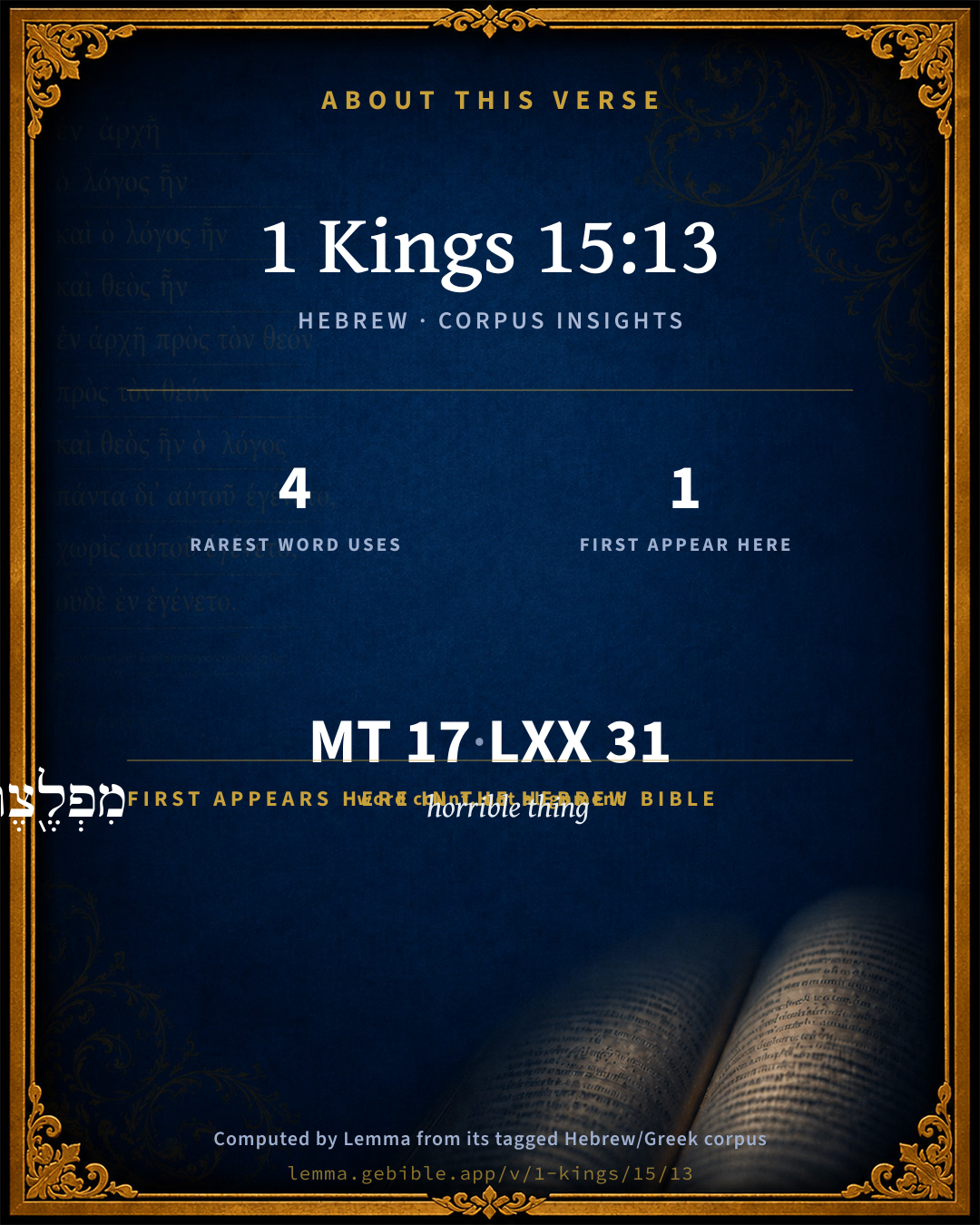
About this verse

These counts appear in no published source. They are computed here, from the morphology-tagged text and Lemma’s own curated glosses. What Lemma adds →

17
words
15
distinct lemmas
Historical
section

Notable vocabulary

The rarest word here is מִפְלֶ֖צֶת horrible thing H4656 — appearing just 4 times in the whole Hebrew Bible.

First appearance in Scripture

This word makes its first canonical appearance in the Hebrew Bible here:

  • מִפְלֶ֖צֶת horrible thing H4656

Shared distinctive vocabulary

מִפְלֶ֖צֶת horrible thing H4656 occurs in 2 verses of the Hebrew Bible. Also found in:

Grammatical profile

  • 4 verbs
  • 9 nouns
  • 4 particles

Verb forms

  • וַיְסִרֶ֨הָ֙ Hiphil · Sequential Imperfect
  • עָשְׂתָ֥ה Qal · Perfect
  • וַיִּכְרֹ֤ת Qal · Sequential Imperfect
  • וַיִּשְׂרֹ֖ף Qal · Sequential Imperfect

Repetition

A word recurs within this verse — often emphatic in Hebrew:

  • מִפְלֶ֖צֶת horrible thing H4656 ×2

Hebrew & Septuagint length

In English translation the verse runs 32 words from the Hebrew and 34 from the Septuagint (LXX English) — closely comparable.

A rough comparison of the two English renderings, which tokenize alike — not a word-level alignment.

Word counts can differ between the Hebrew and the Greek without any difference in meaning — e.g. the Hebrew direct-object marker אֵת has no separate Greek word, and Greek often adds the article ὁ.

In the original languages it is 17 Hebrew tokens and 31 Greek tokens — but the two are counted differently (Hebrew bundles its prefixes and suffixes into one token; the Greek is in lemma form), so that isn’t a like-for-like length.

Cross-references

22

Topical passages linked to 1 Kings 15:13 in the Treasury of Scripture Knowledge — connected by theme and wording, ordered by reader-vote popularity; previews shown in the World English Bible.

  • Exodus 32:20 He took the calf which they had made, and burnt it with fire, ground it to powder, and scattered it on the water, and made the children of Israel drink of it.
  • Leviticus 26:30 I will destroy your high places, and cut down your incense altars, and cast your dead bodies upon the bodies of your idols; and my soul will abhor you.
  • Deuteronomy 7:5 But thus shall you deal with them: you shall break down their altars, and dash in pieces their pillars, and hew down their Asherim, and burn their engraved images with fire.
  • Deuteronomy 9:21 I took your sin, the calf which you had made, and burnt it with fire, and stamped it, grinding it very small, until it was as fine as dust: and I cast the dust of it into the brook that descended out of the mountain.
  • Deuteronomy 13:6–11 If your brother, the son of your mother, or your son, or your daughter, or the wife of your bosom, or your friend, who is as your own soul, entice you secretly, saying, Let us go and serve other gods, which you have not known, you, nor your fathers;
  • Deuteronomy 33:9 Who said of his father, and of his mother, I have not seen him; Neither did he acknowledge his brothers, Nor knew he his own children: For they have observed your word, Keep your covenant.
  • Joshua 6:24 They burnt the city with fire, and all that was therein; only the silver, and the gold, and the vessels of brass and of iron, they put into the treasury of the house of Yahweh.
  • 2 Samuel 15:23 All the country wept with a loud voice, and all the people passed over: the king also himself passed over the brook Kidron, and all the people passed over, toward the way of the wilderness.
  • 1 Kings 15:2 Three years reigned he in Jerusalem: and his mother's name was Maacah the daughter of Abishalom.
  • 1 Kings 15:10 Forty-one years reigned he in Jerusalem: and his mother's name was Maacah the daughter of Abishalom.
  • 2 Kings 18:4 He removed the high places, and broke the pillars, and cut down the Asherah: and he broke in pieces the brazen serpent that Moses had made; for to those days the children of Israel did burn incense to it; and he called it Nehushtan.
  • 2 Kings 23:6 He brought out the Asherah from the house of Yahweh, outside of Jerusalem, to the brook Kidron, and burned it at the brook Kidron, and beat it to dust, and cast the dust of it on the graves of the common people.
  • 2 Kings 23:12–15 The altars that were on the roof of the upper chamber of Ahaz, which the kings of Judah had made, and the altars which Manasseh had made in the two courts of the house of Yahweh, did the king break down, and beat [them] down from there, and cast the dust of them into the brook Kidron.
  • 2 Chronicles 15:15–19 All Judah rejoiced at the oath; for they had sworn with all their heart, and sought him with their whole desire; and he was found of them: and Yahweh gave them rest round about.
  • 2 Chronicles 34:4 They broke down the altars of the Baals in his presence; and the sun-images that were on high above them he hewed down; and the Asherim, and the engraved images, and the molten images, he broke in pieces, and made dust of them, and strewed it on the graves [of those] who had sacrificed to them.
  • Zechariah 13:3 It will happen that, when anyone still prophesies, then his father and his mother who bore him will tell him, 'You must die, because you speak lies in the name of Yahweh;' and his father and his mother who bore him will stab him when he prophesies.
  • Matthew 10:37 He who loves father or mother more than me is not worthy of me; and he who loves son or daughter more than me isn't worthy of me.
  • Matthew 12:46–50 While he was yet speaking to the multitudes, behold, his mother and his brothers stood outside, seeking to speak to him.
  • John 18:1 When Jesus had spoken these words, he went out with his disciples over the brook Kidron, where was a garden, into which he and his disciples entered.
  • 2 Corinthians 5:16 Therefore we know no one after the flesh from now on. Even though we have known Christ after the flesh, yet now we know him so no more.
  • Galatians 2:5–6 to whom we gave no place in the way of subjection, not for an hour, that the truth of the Gospel might continue with you.
  • Galatians 2:14 But when I saw that they didn't walk uprightly according to the truth of the Gospel, I said to Peter before them all, "If you, being a Jew, live as the Gentiles do, and not as the Jews do, why do you compel the Gentiles to live as the Jews do?

Cross-references courtesy of OpenBible.info (CC BY 4.0).

Hebrew and Greek witnesses Masoretic Hebrew ↔ Greek Septuagint

The same verse in the two great witnesses to the Old Testament, shown verse-for-verse.

These are two independent witnesses, not word-aligned to each other, and the Septuagint is shown in lemma (dictionary) form.

Hebrew 1 Kings 15:13 Masoretic · Westminster Leningrad Codex

וְגַ֣ם אֶת מַעֲכָ֣ה אִמּ֗וֹ וַיְסִרֶ֨הָ֙ מִגְּבִירָ֔ה אֲשֶׁר עָשְׂתָ֥ה מִפְלֶ֖צֶת לָאֲשֵׁרָ֑ה וַיִּכְרֹ֤ת אָסָא֙ אֶת מִפְלַצְתָּ֔הּ וַיִּשְׂרֹ֖ף בְּנַ֥חַל קִדְרֽוֹן

Also Maacah his mother he removed from being queen, because she had made an abominable image for an Asherah; and Asa cut down her image, and burnt it at the brook Kidron.

World English Bible · Public Domain

Greek LXX 1 Kings 15:13 Septuagint · lemma form

καί ὁ ανα ὁ μήτηρ αὐτός μεταἵστημι ὁ μή εἰμί ἡγέομαι καθώς ποιέω σύνοδος ἐν ὁ ἄλσος αὐτός καί ἐκκόπτω ασα ὁ καταδύσις αὐτός καί ἐνπίμπρημι πῦρ ἐν ὁ χειμάρρους κεδρων

And he removed Ana his mother from being queen, forasmuch as she gathered a meeting in her grove: and Asa cut down her retreats, and burnt them with fire in the brook of Kedron.

LXX2012 (modern English Septuagint) · Public Domain

On this verse, Adam Clarke's Commentary discusses the Septuagint’s reading. Read the note in Commentary ↓

Hebrew: Westminster Leningrad Codex (CC BY 4.0). Greek: Septuagint (public domain); English from LXX2012 (modern English Septuagint) (Public Domain). How the Septuagint differs from the Hebrew →

Targum (Aramaic paraphrase)

1

The Targum is the ancient Jewish Aramaic paraphrase of the Hebrew Scriptures — an interpretive translation, not the Hebrew text itself. Onkelos (literal) and Pseudo-Jonathan (expansive) render the Torah, and Jonathan the Prophets. Coverage is partial: where no permissively-licensed English translation exists for a verse, only the Aramaic is shown. This is verse-level text, not a word-by-word alignment to the Hebrew.

  1. Targum Jonathan Prophets (Joshua–Malachi)
    וְאַף יַת מַעֲכָה אִמֵיהּ אַעְדָהּ מִמַלְכוּתָהּ דַעֲבַדַת טַעֲוָתָא לַאֲשֵׁרָתָא וְקָץ אָסָא יַת טַעֲוָתָא וְאוֹקֵיד בְּנַחְלָא דְקִדְרוֹן:

    (no public-domain English translation for this verse)

    Targum Jonathan — Aramaic: “Mikraot Gedolot” (public domain). English: “Sefaria Community Translation” (CC0 1.0 (public-domain dedication)); “London "Chaldee Paraphrase," 1871” (public domain). Text via Sefaria.

Commentary

Notes on 1 Kings 15:13 from classic Christian and Jewish commentators (each source and its license shown beneath its notes). The classic Christian expositions comment on the surrounding passage and are grouped to its opening verse, so a note may address several verses; the Jewish commentaries on the Tanakh (Rashi and others) are per-verse, so they appear only where the commentator wrote on this verse.

Lemma curates 59 commentaries, every one of them public domain or Creative Commons licensed, each selected and text-cleaned for this edition rather than reprinted as found. About our sources →

Trapp's Complete Commentary

John Trapp

1Ki 15:13 And also Maachah his mother, even her he removed from [being] queen, because she had made an idol in a grove; and Asa destroyed her idol, and burnt [it] by the brook Kidron.

Ver. 13. From being queen.] Queen regent, or queen mother at least. Ne Domina esset, so the Tigurine; ne princeps esset in sacris Priapi, so the Vulgate; ne esset Augusta, so Junius; ne esset sacerdotissa prima, so others.

Because she had made an idol.] Heb., A horrible ugly thing, which some say was the picture of Priapus, others of Pan; others hold it to have been Idolum turpissimum a matre ad cultum Veneris institutum, a most filthy idol, set up in honour of Venus.

And Asa destroyed her idol.] Heb., Cut off, deheaded it, as the expression is in Hos 10:2.

John Trapp, A Commentary or Exposition upon All the Books of the Old and New Testament (1647–1656) — public domain. Text from a community e-Sword module.

Joseph Benson's Commentary

1Ki 15:13. Her he removed from being queen — He took from her either the name and authority of queen regent, which she, having been Rehoboam’s wife, and Abijam’s mother, took to herself during Asa’s minority, or the dignity of the queen-mother, and those guards, or instruments of power, which she had enjoyed and misemployed. She had made an idol — Hebrew, a terror, or horror, that is, a horrible idol; which, it may be, is so called, because it was of a more terrible shape than ordinary, and not to be seen without horror. Kidron — That when it was burned to powder, it might be thrown into the water, and be unfit for any use.

Joseph Benson's Commentary on the Old and New Testaments (1811–1818) — public domain. Text from a community e-Sword module.

Geneva Bible (1599)

Geneva Bible translators

Neither kindred nor authority ought to be regarded, when they blaspheme God, and become idolaters, but must be punished.

Geneva Bible (1599) marginal notes — public domain. Text via Bolls.life.

Jamieson, Fausset & Brown

Robert Jamieson, A. R. Fausset & David Brown

also Maachah his mother, even her he removed from being queen--The sultana, or queen dowager, was not necessarily the king's natural mother (see Kg1 2:19), nor was Maachah. Her title, and the privileges connected with that honor and dignity which gave her precedency among the ladies of the royal family, and great influence in the kingdom, were taken away. She was degraded for her idolatry.

because she had made an idol in a grove--A very obscene figure, and the grove was devoted to the grossest licentiousness. His plans of religious reformation, however, were not completely carried through, "the high places were not removed" (see Kg1 3:2). The suppression of this private worship on natural or artificial hills, though a forbidden service after the temple had been declared the exclusive place of worship, the most pious king's laws were not able to accomplish.

Jamieson, Fausset & Brown — Commentary Critical and Explanatory on the Whole Bible (1871) — public domain (CC PDM 1.0). Text via the HelloAO Bible API.

Adam Clarke's Commentary

Verse 13. She had made an idol in a grove] The original word, מפלצת miphletseth, is variously understood. I shall give its different views in the versions:-

"Besides, he removed his mother Maacha from being chief in the sacred rites of Priapus, and in his grove which she had consecrated." - VULGATE.

"And Ana, [other copies Maacha,] he removed from being governess, because she had made an assembly in her grove." - SEPTUAGINT.

"Moreover, he deprived Maacha, his mother, of her own magnificence, because she had celebrated a solemnity to her own worship." - SYRIAC.

"And even Maacha, his mother, he removed from the kingdom, because she had made an idol in a grove." - CHALDEE.

"Besides, he removed Maacha, his mother, from her kingdom, because she had made a high tree into an idol." - ARABIC.

"Also he removed Maacha, his mother, from the kingdom, because she had made a horrible statue; and our rabbins say that it was called מפלצת miphletseth, because מפליא ליצנותא maphli leytsanutha, it produced wonderful ridicule; for she made it ad instar membri virilis, and she used it daily." - RABBI SOLOMON JARCHI.

From the whole, it is pretty evident that the image was a mere Priapus, or something of the same nature, and that Maachah had an assembly in the grove where this image was set up, and doubtless worshipped it with the most impure rites. What the Roman Priapus was I need not tell the learned reader; and as to the unlearned, it would not profit him to know. Maachah was most likely another Messalina; and Asa probably did for his mother what Claudius did for his wife.

Adam Clarke's Commentary on the Bible (1810–1826) — public domain. Text from a community e-Sword/MySword module.

Ellicott's Commentary for English Readers

(13) An idol in a grove.—The original word for “idol”—peculiar to this passage and its parallel (2Ch_15:16)—appears to signify a “horrible abomination” of some monstrous kind; and instead of “in a grove,” we should read “for an asherah,” the wooden emblem of the Canaanitish deity (on which see 1Ki_14:22). There seems little doubt that some obscene emblem is meant, of the kind so often connected with worship of the productive powers of nature in ancient religions, substituted as a still greater abomination for the ordinary asherah. Clearly the act of Maachah was one of so flagrant a kind, that Asa took the unusual step, on which the historian here lays great stress, of degrading her in her old age from her high dignity, besides hewing down her idol, and burning it publicly under the walls of Jerusalem.

A Bible Commentary for English Readers, edited by Charles John Ellicott (1878–1897) — public domain. Text from a community e-Sword module.

The Cambridge Bible for Schools and Colleges

gen. ed. J. J. S. Perowne

13. And also Maachah] Here, as above, the LXX. has Ana.

his mother, even her he removed] The R.V. omits ‘even her’. The Hebrew has this construction, but it is Hebrew, not English, though like several other Hebrew idioms, it has become accepted, through the influence of the A. V.

from being queen] i.e. From the influential position of queen mother. The title is not the usual word for ‘queen’ but one which implies special authority and influence.

she had made an idol in a grove] R.V. ‘had made an abominable image for an Ashêrah.’ The word which the A.V. renders ‘idol’ is one of the numerous terms which the Hebrew language applied to the objects of idolatrous worship. It is cognate with words which signify ‘horror,’ ‘trembling,’ ‘fearfulness,’ and indicates an erection which was likely to excite such feelings. On ‘Ashêrah,’ which is used sometimes for the goddess, sometimes for the idol set up to represent her, see above on 1Ki_14:15.

and Asa destroyed her idol] R.V. cut down her image. The verb indicates the manner of the destruction, and shews that the image was such that it could be cut down as you would cut down a tree. Hence most likely it was of wood, for in the next clause we find that it was burnt.

by the brook Kidron] This was rather a valley or torrent bed, which became a stream in the time of rain. It was close to Jerusalem, lying between the city and the mount of Olives. The name is connected with several events which mark it as a spot of evil fame. Beside the burning there of these idols, it was at this place that Athaliah was put to death (2Ki_11:16), and hither in after times many impure objects of worship and abominations were brought to be destroyed (2Ki_23:4; 2Ki_23:6; 2Ki_23:12; 2Ch_29:16; 2Ch_30:14).

The Cambridge Bible for Schools and Colleges (gen. ed. J. J. S. Perowne; Cambridge University Press, 1878–1918) — public domain. Text from a community e-Sword module.

John Gill's Exposition

Then Asa took all the silver and the gold that were left in the treasures of the house of the Lord, and the treasures of the king's house,.... What was left untaken away by Shishak king of Egypt, Kg1 14:26, or what he had put there dedicated by his father and himself, Kg1 15:15 and be they either, they were not to be taken, especially the treasures of the house of the Lord, and put to profane use, and particularly to such bad purposes as these were:

and delivered them into the hands of his servants: to be disposed of as next directed:

and King Asa sent them to Benhadad the son of Tabrimon, the son of Hezion king of Syria, that dwelt at Damascus; according to some chronologers (w), Hezion, the grandfather of this Benhadad, is the same with Rezon the first king of Damascus, Kg1 11:23, who was succeeded by Tabrimon, and he by Benhadad:

saying: as follows.

(w) Usher. Annal. A. M. 3064. Marsham. Canon. Chron. Seculum 13. p. 346.

John Gill's Exposition of the Whole Bible (1746–1763) — public domain (CC PDM 1.0). Text via the HelloAO Bible API.

Albert Barnes' Notes on the Bible

Asa degraded Maachah from the rank and state of queen-mother.

The word translated “idol” both here and in the parallel passage (marginal reference), does not occur elsewhere in Scripture. It is derived from a root signifying “fear” or “trembling,” and may perhaps best be understood as “a fright, a horror.” Such a name would seem best to apply to a grotesque and hideous image like the Phthah of the Egyptians. She made it to serve in lieu of the ordinary “grove” - asherah, or idolatrous emblem of Astarte (Exo 34:13 note). Asa cut it down, for like the usual “asherah,” Maachah’s “horror” was fixed in the ground.

And burnt it at the brook Kidron - Similarly Josiah, when he removed Manasseh’s “grove” - asherah - from the house of the Lord, brought it out to the brook Kidron, and burned it there. The object probably was to prevent the pollution of the holy city by even the ashes from the burning.

Albert Barnes' Notes on the Bible (1834–1885) — public domain. Text from a community e-Sword/MySword module.

Haydock's Catholic Bible Commentary

Priapus. He would not spare such abominations in his own family. (Menochius) He took from his mother the direction of the palace, (Vatable) and her guards. (Grotius) --- Hebrew, "even her he removed from being queen, because she had made a Miphlatstah." (Haydock) --- Septuagint render this term a synod, "meeting," or something shameful; also a cavern, or den; and in Paralipomenon, the "idol" Astarte. St. Jerome also gives different meanings; so that the precise import is not well known. Most people translate, "a scarecrow;" (Calmet) terriculum. In the gardens of Greece and or Rome, the figure of Priapus was set up (Du Hamel) to frighten thieves and birds away. Inde ego furum aviumque

Maxima formido. (Horace, Sat. l. 8.)

Others understand that Pan, another frightening idol, is here meant; (Castalion) or the abominations of Phallus and Ithyphallus, derived from the same Hebrew word. (Seldon) --- As the goddess Astarte, or Asera, "the grove," here the object of adoration, was the wife of Adonis, it is probable, that the same obscenities were carried in triumph, as Herodotus (ii. 28., and 49.) specifies in the description of the festival of Bacchus, celebrated by the Egyptians. --- To him. Protestants, "She had made an idol in the grove." Hebrew also, "to Asera; and Asa destroyed her idol, (miphlatstah) and burnt it." (Haydock)

George Leo Haydock (1774–1849), Haydock's Catholic Family Bible and Commentary, 1859 edition — public domain. Excludes Psalms (Douay-Rheims chapter numbering differs from Protestant) and Deuterocanonical books (Catholic canon only).

Matthew Poole's English Annotations

Her he removed from being queen, i.e. he took from her either the name and authority of queen-regent, which she, having been Rehoboam’s wife, and Abijam’s mother, took to herself during Asa’s minority, and abused to the patronage of idolatry; or the dignity of the queen-mother, and those guards, or other ensigns of honour, or instruments of power, which, as such, she had enjoyed and misemployed. Otherwise,

he removed her from the queen, i.e. from his wife, that she might not be infected by her, and afterwards infect his children; which was a prudent and necessary care, for the prevention of so great and public a mischief.

An idol, Heb. a terror, or horror, i.e. a horrible idol; which it may be so called, either because all idols, though for a season they please, yet in the end will bring dreadful effects upon their worshippers; or because this was an idol of a more horrible or terrible shape, more abominable than ordinary, and not to be seen without horror; whether it was that filthy idol, called Priapus, which was commonly placed in groves or gardens; or Pan, or some other heathen god, to whose service she in a special manner devoted herself.

Burnt it by the brook Kidron; that when it was burnt to powder, it might be thrown into the water, and be unfit for any use. See Exo 32:20; Deu 12:3.

Matthew Poole's English Annotations on the Holy Bible (1683–1685) — public domain. Text from a community e-Sword/MySword module.

Whedon's Commentary on the Bible

Daniel D. Whedon

13. Queen — “There can be no queen-consort where there is more than one wife; and, in the East, where there is no more than one, she is not a queen, she is simply the zan-i-shah, ‘the king’s wife’ — that is all. There is, however, in most cases, some one in the harem who, on one account or another, is recognised as the chief lady. There was one whose claim to be chief lady, or queen, was superior to all others, and that was the MOTHER of the king. The prevalent usage of the East assigns the first rank in every household not to the wife of the master, but to his mother, to whom the wife merely becomes another daughter. And so the rank of ‘the king’s mother’ was the nearest approach to the rank and dignity of a non-regnant queen.” — Kitto. A close analogy is supposed to be in the Sultana Walide, in the Ottoman empire.

She had made an idol in a grove — Rather, she made a horrible statue to Asherah. On Asherah, see note at 1Ki_14:15. The word מפלצת, here rendered idol, means something horrible or terrible. Furst, after some of the Rabbins, regards it as the name of a Phallus-statue, erected to the goddess Asherah, and a symbol of the procreative power of nature. Whatever its form and its symbolism, it was an idol set up in honour of a licentious goddess and a foul system of worship, and, therefore, a horrible thing for a mother in Israel to make.

Burnt it — As Moses did the golden calf. Exo_32:20. So this idol of Maachah, like the calf at Sinai, was probably made of wood, and covered over with gold.

Kidron — which runs through the deep valley beneath the walls of Jerusalem on the east. See note on 2Sa_15:23.

Daniel D. Whedon (gen. ed.), Commentary on the Old and New Testaments (1874–1909) — public domain. Text from a community e-Sword module.

The Pulpit Commentary

And also Maachah his mother, oven her he removed from being queen Rather, queen-mother. Gebiruh, as already pointed out on ch. 2:19, answers to the Sultana Valide. The Vulgate reads, Ne esset princeps in sacris Priapi. Wordsworth reminds us of the position which the queen-mother Atossa holds in the Persae (vers. 159-850). A queen consort is hardly possible in a polygamous household; see Kitto, 4:177 because Heb. which, as in ver. 5 she had made all idol txlpmi from l terruit, signifies an object of fear, formido not pudendum, a thing of shame, as the Rabbis and others have held, i.e., a phallic image (simulacrum obscoenum, Jerome), but horrendum. The devout Jew could not but regard such objects with horror in a grove Heb. for (i.e., to serve as) an Asherah. See note on, 1Ki_14:15, 1Ki_14:23. Asherah is not the name of the goddess= (Astarte) as Wordsworth thinks, but of the image, and Asa destroyed Marg. cut off, Heb. simply cut, which here must mean cut down. The image was, no doubt, planted erect in the ground her idol horror, as above, and burnt it this shows that it was made of wood by the brook Kidron. Cf. Exo_32:20. Here, as in, 1Ki_17:3 (where see note) our translators have been unable to adhere strictly to the original in the brook," etc., from not knowing that lj"n," which primarily means "brook," also means" watercourse," wady. It is probable that the brook was at this time flowing, and that the ashes of the wooden Asherah were cast into it; but the burning also took place in the Wady, or valley. We read of another similar burning in 2Ki_23:4, 2Ki_23:6; but in this ease the ashes were either carried to Bethel or cast upon the graves, to defile them. It is a fair inference that on this latter occasion the Kedron was dry. The valley, "the fields of the Kedron" (ver. 4 l.c. ), is conveniently placed for such a purpose.

The Pulpit Commentary (1880–1919), ed. H.D.M. Spence-Jones & Joseph S. Exell — public domain. Text from a community e-Sword module.

John Wesley's Explanatory Notes

He removed - He took from her either the name and authority of queen regent, which she, having been Rehoboam's wife, and Abijam's mother, took to herself during Asa's minority; or, the dignity of the queen mother, and those guards, or instruments of power, which she had enjoyed and misemployed. An Idol - Hebrew. a terror, or horror, that is, an horrible idol; which it may be so called, because it was of a more terrible shape than ordinary, and not to be seen without horror. Kidron - That when it was burnt to powder, it might be thrown into the water, and be unfit for any use.

John Wesley, Explanatory Notes Upon the Whole Bible (1754–1765) — public domain. Text via the GEBible commentary corpus.

Rashi

Rabbi Shlomo Yitzchaki (Rashi)

He removed from her position of authority. From being queen.

For she had made a fearful image. Our Rabbis stated [that מפלצת is a combination of] מפליא ליצונתא [=extreme lasciviousness]. She made for it a phallic symbol, and she would copulate with it every day.

Rashi on the Tanakh — English translations: “The Judaica Press complete Tanach with Rashi, translated by A. J. Rosenberg” (CC BY 4.0); “Pentateuch with Rashi's commentary by M. Rosenbaum and A.M. Silbermann, 1929-1934” (public domain); “The Metsudah Tanach series, Lakewood, N.J” (CC BY 4.0); and “The Book of Joshua, Metsudah Publications, 1997” (CC BY 4.0). Text via Sefaria.

Lesson kit

Teaching starters — assembled from the data on this page, not authored interpretation. Every prompt links to the verse data it draws on. Edit before teaching.

1 Kings, in the Historical, opens this verse with 17 words (15 distinct Hebrew lemmas). Its most distinctive word is miphletseth (“horrible thing”). A historical commentator’s framing appears above. Read the whole chapter for the surrounding context.

Discussion questions

  1. The word miphletseth carries the sense “horrible thing.” How does it shape the verse?
  2. This is the first place “horrible thing” appears in Scripture (first appears here). What does its debut here establish?
  3. How does 2 Chronicles 15:16, which shares the word «horrible thing», read alongside this verse?
  4. What does the repetition of “horrible thing” (2× in this one verse) do in this verse?
  5. The translations on this page render this verse differently — a whole-verse word diff, not a word-by-word alignment. What might account for the different wordings?
  6. «וַיְסִרֶ֨הָ֙» is a Hiphil Sequential Imperfect verb. How does that grammatical form shape the action described?
  7. Compare how Trapp's Complete Commentary and Joseph Benson's Commentary read this verse. Where do they agree or differ?

Things to notice

Reading settings

Reading text

Shown beneath each verse's original-language words.

Old Testament
Old Testament edition

Read the OT as the Masoretic Hebrew (MT) or the Greek Septuagint (LXX).

English shown for the Greek Septuagint (in the Hebrew ↔ Greek comparison).

Comparing translations? Open the Compare panel on any verse page to stack up to four side by side.